Ezekiel 1:11

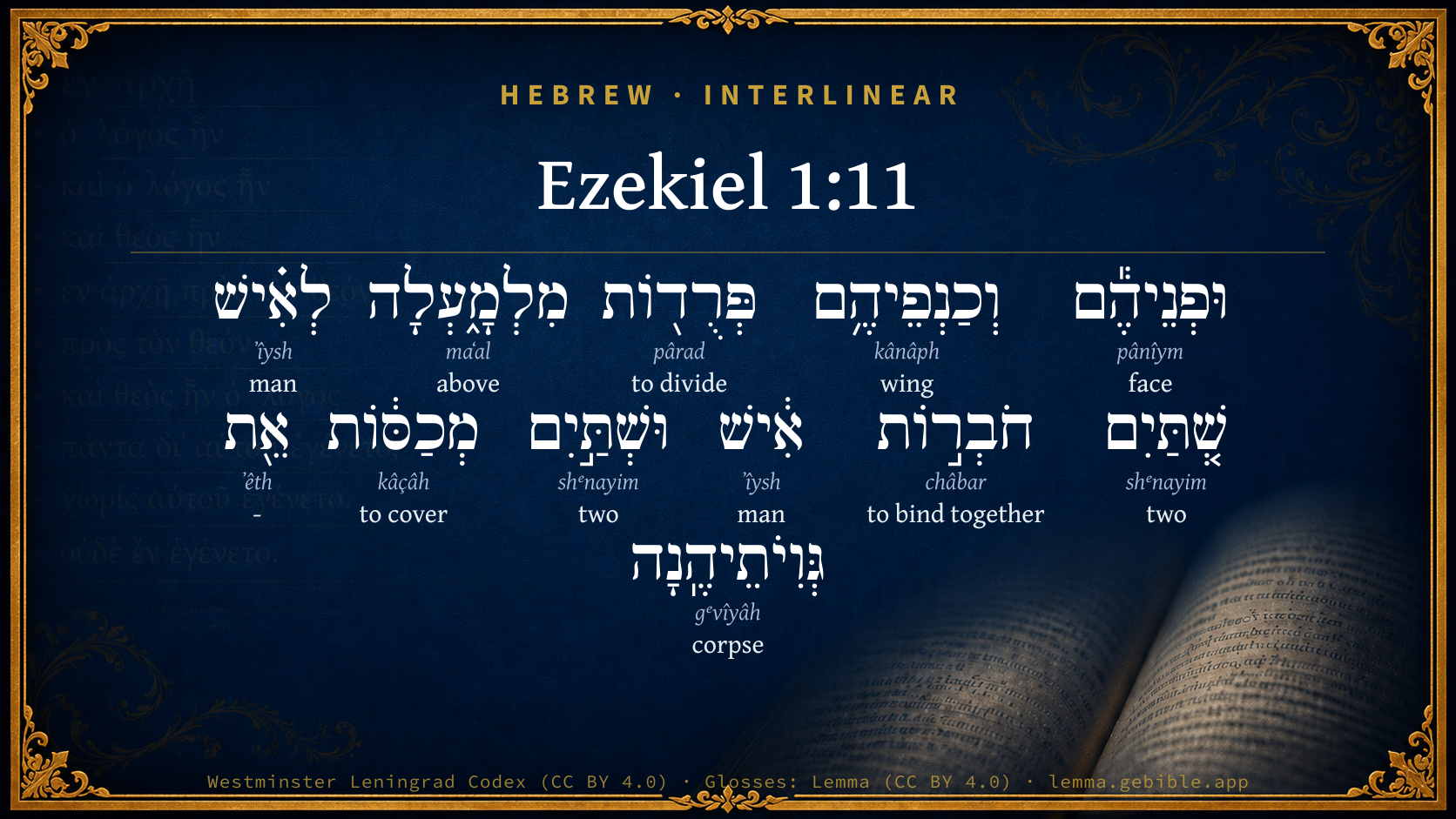
Hebrew (Westminster Leningrad Codex) Ezekiel 1:11 appears in the Hebrew Old Testament. The text above is from the Westminster Leningrad Codex. Each word links to its Strong’s number, a concise gloss, and parsing drawn from the Open Scriptures Hebrew Bible morphology. Click any word for its full Brown-Driver-Briggs (BDB) entry.
Download image
Cite this verse

Ezekiel 1:11 (World English Bible). Public Domain. Lemma interlinear Bible study tool, https://lemma.gebible.app/v/ezekiel/1/11.

Show BibTeX & RIS
BibTeX
RIS
English Translation
Their faces and their wings were separate above; two [wings] of everyone were joined one to another, and two covered their bodies.
World English Bible · Public Domain
Download a study sheet

One document with this verse’s original text, its word-by-word gloss line, the meaning frame, cross-references with their text, attributed commentary, and full source and license credits — printable, and it pastes into notes with its structure intact.

This verse Autodidact and up

Study sheet (.html) Plain text (.txt)

A passage Seminary Student

Up to 50 verses in one chapter. A passage sheet keeps up to 6 commentary sources and 12 cross-references per verse, in the order this page ranks them, and says so on the sheet whenever that leaves anything out. Ask for a single verse and you get the Autodidact verse sheet above.

Everything on this page stays free to read, with no account — the sheet is a download of what is already on screen, not access to it.

Want to remove ads? Support Godless Engineer
Compare translations 3

The same verse in 3 English versions, stacked beneath the original-language interlinear above. Click any original word for its lexicon entry.

Each is an independent rendering of the whole verse — the interlinear is not word-aligned to these translations.

Highlighted words mark where these versions differ — a whole-verse word diff, not a word-by-word alignment.

  • World English Bible Public Domain
    Their faces and their wings were separate above; two [wings] of everyone were joined one to another, and two covered their bodies.
  • King James Version Public Domain
    Thus were their faces: and their wings were stretched upward; two wings of every one were joined one to another, and two covered their bodies.
  • unfoldingWord Literal Text CC BY-SA 4.0
    Their faces were like that, and their wings were spread out above, so that each creature had a pair of wings that touched another creature’s wing, and also a pair of wings that covered their bodies.

unfoldingWord Literal Text — © unfoldingWord, licensed CC BY-SA 4.0. Word-aligned USFM3 via Door43 (git.door43.org/unfoldingWord/en_ult).

Versions to compare (up to 4)

3 of 4 selected

Show all 18 translations

Every available English version of this verse, each an independent rendering of the whole verse.

  • World English Bible Public Domain
    Their faces and their wings were separate above; two [wings] of everyone were joined one to another, and two covered their bodies.
  • Berean Standard Bible Public Domain
    Such were their faces. Their wings were spread upward; each had two wings touching the wings of the creature on either side, and two wings covering its body.
  • Majority Standard Bible Public Domain
    Such were their faces. Their wings were spread upward; each had two wings touching the wings of the creature on either side, and two wings covering its body.
  • King James Version Public Domain
    Thus were their faces: and their wings were stretched upward; two wings of every one were joined one to another, and two covered their bodies.
  • American Standard Version (1901) Public Domain
    And their faces and their wings were separate above; two `wings' of every one were joined one to another, and two covered their bodies.
  • Revised Version (1885) Public Domain
    And their faces and their wings were separate above; two wings of every one were joined one to another, and two covered their bodies.
  • Geneva Bible (1599) Public Domain
    Thus were their faces: but their wings were spred out aboue: two wings of euery one were ioined one to another, and two couered their bodies.
  • Douay-Rheims (1899) Public Domain
    And their faces, and their wings were stretched upward: two wings of every one were joined, and two covered their bodies:
  • Young's Literal Translation Public Domain
    And their faces and their wings are separate from above, to each `are' two joining together, and two are covering their bodies.
  • Literal Standard Version CC BY-SA 4.0
    And their faces and their wings dividing from above, of each [are] two joining together, and two are covering their bodies.
  • Unlocked Literal Bible CC BY-SA 4.0
    Their faces were like that, and their wings were spread out above, so that each creature had a pair of wings that touched another creature's wing, and also a pair of wings that covered their bodies.
  • unfoldingWord Literal Text CC BY-SA 4.0
    Their faces were like that, and their wings were spread out above, so that each creature had a pair of wings that touched another creature’s wing, and also a pair of wings that covered their bodies.
  • Darby Bible Public Domain
    And their faces and their wings were parted above; two [wings] of every one were joined one to another, and two covered their bodies.
  • World Messianic Bible Public Domain
    Such were their faces. Their wings were spread out above. Two wings of each one touched another, and two covered their bodies.
  • Webster's Bible Public Domain
    Thus were their faces: and their wings were stretched upward; two wings of every one were joined one to another, and two covered their bodies.
  • Free Bible Version CC BY-SA 4.0
    These were their faces. Their wings were spread out above them. They all had two wings that touched the wings of the one beside it, as well as two wings that covered its body.
  • Bible in Basic English Public Domain
    And their wings were separate at the top; two of the wings of every one were joined one to another, and two were covering their bodies.
  • JPS Tanakh (1917) Public Domain
    Thus were their faces; and their wings were stretched upward; two wings of every one were joined one to another, and two covered their bodies.

Literal Standard Version (2020), Covenant Press — licensed CC BY-SA 4.0. Text via the HelloAO Bible API (eBible.org). Unlocked Literal Bible (unfoldingWord) — licensed CC BY-SA 4.0. Text via the HelloAO Bible API (eBible.org). unfoldingWord Literal Text — © unfoldingWord, licensed CC BY-SA 4.0. Word-aligned USFM3 via Door43 (git.door43.org/unfoldingWord/en_ult). Free Bible Version, Dr. Jonathan Gallagher — licensed CC BY-SA 4.0. Text via the HelloAO Bible API (eBible.org).

Word by word

More ways to search: Search by grammar → Find every occurrence → Compare this word →

Practice this passage: Drill this verse → Learn its vocabulary →

גְּוִיֹתֵיהֶֽנָה
gᵉvîyâh
H1472
“corpses · their”
Noun, Common, Feminine, Plural, Construct + Suffix, Personal, 3rd Person, Feminine, Plural
Part of Speech
Noun
Type
Common
Gender
Feminine
Number
Plural
State
Construct
Full BDB Definition

Origin: prolonged for H1465

TWOT: 326d

a body (of living creatures) - a corpse, carcass, dead body
  1. וּפְנֵיהֶ֕ם pânîym H6440 “and · face(s) · their” Conjunction + Noun, Common, Both, Plural, Construct + Suffix, Personal, 3rd Person, Masculine, Plural
  2. וְכַנְפֵיהֶ֥ם kânâph H3671 “and · wings · their” Conjunction + Noun, Common, Feminine, Dual, Construct + Suffix, Personal, 3rd Person, Masculine, Plural
  3. פְּרֻד֖וֹת pârad H6504 “divided” Verb, Qal, Participle Passive, Feminine, Plural, Absolute
  4. מִלְמָ֑עְלָה maʻal H4605 “from · to/for · above · toward” Preposition + Preposition + Adverb + Suffix, Demonstrative
  5. לְאִ֗ישׁ ʼîysh H376 “to/for · man” Preposition + Noun, Common, Masculine, Singular, Absolute
  6. שְׁ֚תַּיִם shᵉnayim H8147 “two” Adjective, Cardinal number, Feminine, Dual, Absolute
  7. חֹבְר֣וֹת châbar H2266 “binding together” Verb, Qal, Participle Active, Feminine, Plural, Absolute
  8. אִ֔ישׁ ʼîysh H376 “man” Noun, Common, Masculine, Singular, Absolute
  9. וּשְׁתַּ֣יִם shᵉnayim H8147 “and · two” Conjunction + Adjective, Cardinal number, Feminine, Dual, Absolute
  10. מְכַסּ֔וֹת kâçâh H3680 “covering” Verb, Piel, Participle Active, Feminine, Plural, Absolute
  11. אֵ֖ת ʼêth H853 “-” Particle, Direct Object

About this verse

These counts appear in no published source. They are computed here, from the morphology-tagged text and Lemma’s own curated glosses. What Lemma adds →

12
words
10
distinct lemmas
Prophets
section

Notable vocabulary

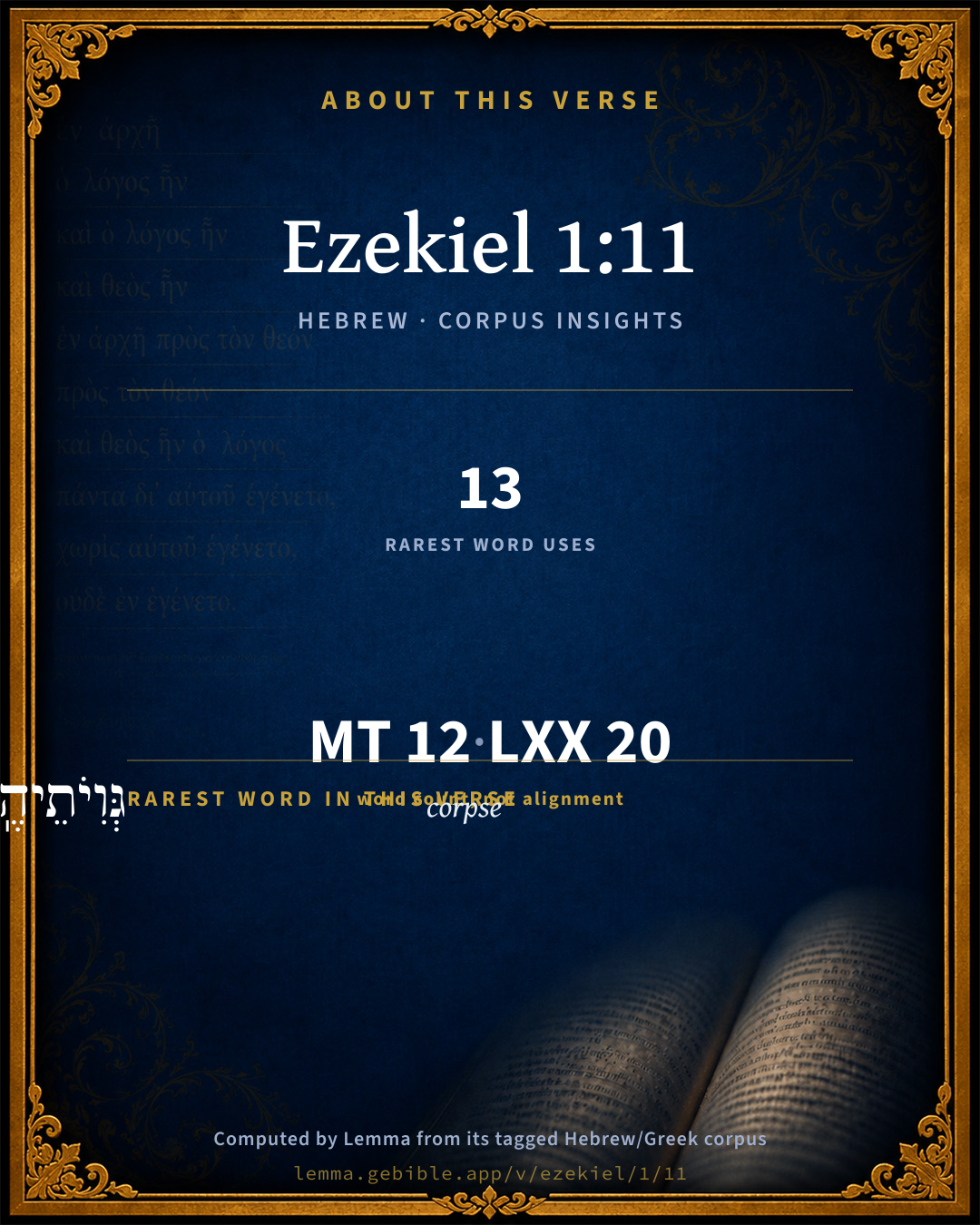
The rarest word here is גְּוִיֹתֵיהֶֽנָה corpse H1472 — appearing just 13 times in the whole Hebrew Bible.

Shared distinctive vocabulary

גְּוִיֹתֵיהֶֽנָה corpse H1472 occurs in 11 verses of the Hebrew Bible. Also found in:

Grammatical profile

  • 3 verbs
  • 5 nouns
  • 2 adjectives
  • 1 adverb
  • 1 particle

Verb forms

  • פְּרֻד֖וֹת Qal · Participle Passive
  • חֹבְר֣וֹת Qal · Participle Active
  • מְכַסּ֔וֹת Piel · Participle Active

Repetition

Words recur within this verse — often emphatic in Hebrew:

  • לְאִ֗ישׁ man H376 ×2
  • שְׁ֚תַּיִם two H8147 ×2

Hebrew & Septuagint length

In English translation the verse runs 22 words from the Hebrew and 22 from the Septuagint (LXX English) — the same length.

A rough comparison of the two English renderings, which tokenize alike — not a word-level alignment.

Word counts can differ between the Hebrew and the Greek without any difference in meaning — e.g. the Hebrew direct-object marker אֵת has no separate Greek word, and Greek often adds the article ὁ.

In the original languages it is 12 Hebrew tokens and 20 Greek tokens — but the two are counted differently (Hebrew bundles its prefixes and suffixes into one token; the Greek is in lemma form), so that isn’t a like-for-like length.

Cross-references

4

Topical passages linked to Ezekiel 1:11 in the Treasury of Scripture Knowledge — connected by theme and wording, ordered by reader-vote popularity; previews shown in the World English Bible.

  • Isaiah 6:2 Above him stood the seraphim. Each one had six wings. With two he covered his face. With two he covered his feet. With two he flew.
  • Ezekiel 1:23 Under the expanse were their wings straight, the one toward the other: everyone had two which covered on this side, and every one had two which covered on that side, their bodies.
  • Ezekiel 10:16 When the cherubim went, the wheels went beside them; and when the cherubim lifted up their wings to mount up from the earth, the wheels also didn't turn from beside them.
  • Ezekiel 10:19 The cherubim lifted up their wings, and mounted up from the earth in my sight when they went forth, and the wheels beside them: and they stood at the door of the east gate of Yahweh's house; and the glory of the God of Israel was over them above.

Cross-references courtesy of OpenBible.info (CC BY 4.0).

Hebrew and Greek witnesses Masoretic Hebrew ↔ Greek Septuagint

The same verse in the two great witnesses to the Old Testament, shown verse-for-verse.

These are two independent witnesses, not word-aligned to each other, and the Septuagint is shown in lemma (dictionary) form.

Hebrew Ezekiel 1:11 Masoretic · Westminster Leningrad Codex

וּפְנֵיהֶ֕ם וְכַנְפֵיהֶ֥ם פְּרֻד֖וֹת מִלְמָ֑עְלָה לְאִ֗ישׁ שְׁ֚תַּיִם חֹבְר֣וֹת אִ֔ישׁ וּשְׁתַּ֣יִם מְכַסּ֔וֹת אֵ֖ת גְּוִיֹתֵיהֶֽנָה

Their faces and their wings were separate above; two [wings] of everyone were joined one to another, and two covered their bodies.

World English Bible · Public Domain

Greek LXX Ezekiel 1:11 Septuagint · lemma form

καί ὁ πτέρυξ αὐτός ἐκτείνω ἄνωθεν ὁ τέσσαρες ἑκάτερος δύο συνζεύγνυμι πρός ἀλλήλω καί δύο ἐπικαλύπτω ἐπάνω ὁ σῶμα αὐτός

And the four had their wings spread out above; each one had two joined to one another, and two covered their bodies.

LXX2012 (modern English Septuagint) · Public Domain

On this verse, The Cambridge Bible for Schools and Colleges discusses the Septuagint’s reading. Read the note in Commentary ↓

Hebrew: Westminster Leningrad Codex (CC BY 4.0). Greek: Septuagint (public domain); English from LXX2012 (modern English Septuagint) (Public Domain). How the Septuagint differs from the Hebrew →

Targum (Aramaic paraphrase)

1

The Targum is the ancient Jewish Aramaic paraphrase of the Hebrew Scriptures — an interpretive translation, not the Hebrew text itself. Onkelos (literal) and Pseudo-Jonathan (expansive) render the Torah, and Jonathan the Prophets. Coverage is partial: where no permissively-licensed English translation exists for a verse, only the Aramaic is shown. This is verse-level text, not a word-by-word alignment to the Hebrew.

  1. Targum Jonathan Prophets (Joshua–Malachi)
    וְאַפֵּיהֵן וְגַפֵּיהֵן פְּרִישִׁין מִלְעָלָא לַחֲדָא תַּרְתִּין מְכַוְנָן חֲדָא וְתַרְתֵּין מְכַסָן יַת גְוִיָתְהֵין:

    (no public-domain English translation for this verse)

    Targum Jonathan — Aramaic: “Mikraot Gedolot” (public domain). English: “Sefaria Community Translation” (CC0 1.0 (public-domain dedication)); “London "Chaldee Paraphrase," 1871” (public domain). Text via Sefaria.

Commentary

Notes on Ezekiel 1:11 from classic Christian and Jewish commentators (each source and its license shown beneath its notes). The classic Christian expositions comment on the surrounding passage and are grouped to its opening verse, so a note may address several verses; the Jewish commentaries on the Tanakh (Rashi and others) are per-verse, so they appear only where the commentator wrote on this verse.

Lemma curates 59 commentaries, every one of them public domain or Creative Commons licensed, each selected and text-cleaned for this edition rather than reprinted as found. About our sources →

Trapp's Complete Commentary

John Trapp

Eze 1:11 Thus [were] their faces: and their wings [were] stretched upward; two [wings] of every one [were] joined one to another, and two covered their bodies.

Ver. 11. And their wings were stretched upward.] Faces and wings are both turned toward God, at whose beck and obedience the holy angels wholly are; {Psa 103:20} or hereby may be imported the swiftness, sublimeness, and equality of their service.

Two wings of every one.] See on Eze 1:9.

And two covered their bodies.] See on Isa 6:2.

John Trapp, A Commentary or Exposition upon All the Books of the Old and New Testament (1647–1656) — public domain. Text from a community e-Sword module.

Joseph Benson's Commentary

Eze 1:11-12. Their wings were stretched upward — That is, two wings of each, namely, in a posture of flying, to show that they were always actively employed in executing God’s commands. Some unite this clause with the preceding, and render the whole, Their faces and their wings were stretched upward, namely, denoting a posture of attention, as if they were hearkening to the voice of God’s words, as angels are represented Psa 103:20. Two wings of every one were joined one to another, &c. — Of the two living creatures in front, and of the two behind, the right wing of one reached to the left wing of the other, the extremities of the expanded inner wings forming an arch. In Isa 6:2, and Rev 4:6, each of the seraphim has six wings assigned him, whereas the living creatures here have each but four; the reason of which is, that in those places these appearances are described as making use of two of their wings to cover their faces, out of reverence to the divine presence, before which they stand and worship; whereas, here they are supposed to be actively employed as ministers of the Divine Providence, in executing his counsels in all parts of the world. And two covered their bodies — To signify, perhaps, that we men are not able to understand the nature of angels. Whither the spirit was to go, they went — Without any dispute or delay: the Spirit of God directed all their motions: and all their ministrations were as truly unconstrained and free, as they were subservient to God’s designs in his providential government of the church and the world. They turned not when they went — They looked not back; they turned not out of the way; they ceased not till they had completed their course.

Joseph Benson's Commentary on the Old and New Testaments (1811–1818) — public domain. Text from a community e-Sword module.

Tyndale Open Study Notes

Tyndale Open Resources

1:11-14 These fiery creatures had both wings and legs, enabling them to move like . . . lightning in any direction. No one could run away from such fearsome beasts. In the similar vision in ch 10, they are identified as cherubim, agents of divine judgment.

Tyndale Open Study Notes — © Tyndale Open Resources, licensed CC BY-SA 4.0. Text via the HelloAO Bible API.

Jamieson, Fausset & Brown

Robert Jamieson, A. R. Fausset & David Brown

The tips of the two outstretched wings reached to one another, while the other two, in token of humble awe, formed a veil for the lower parts of the body.

stretched upward--rather, "were parted from above" (compare Margin; see on Isa 6:2). The joining together of their wings above implies that, though the movements of Providence on earth may seem conflicting and confused, yet if one lift up his eyes to heaven, he will see that they admirably conspire towards the one end at last.

Jamieson, Fausset & Brown — Commentary Critical and Explanatory on the Whole Bible (1871) — public domain (CC PDM 1.0). Text via the HelloAO Bible API.

John Calvin's Commentaries

He says, that the faces as well as the wings were extended, because the four faces proceeded from one body. Here then the Prophet says, that they are not united together, so that a fourfold form could be seen on one head: there was the form of a man, and then that of a lion, as in one glass various forms sometimes appear, but each answers to its own original. So also the reader might mistake here, as if different faces belonged to the same head: hence the Prophet says, they were stretched forth or divided from above. Here he points out a diversity of heads, and as to the wings, he says they were extended, and, at the same time, shows the manner, viz., two joined or bound together, so that each animal was bound to its neighbor. The four living creatures were united by their wings: this the Prophet means; and as to the other wings, he says that they covered their bodies, and so we see some likeness between this vision and that vouchsafed to Isaiah, which he relates in his chap. 6. The reason why the rings were joined together upwards is sufficiently clear; because God has such different motions, and so agitates the earth, that the things which seem to be conflicting are most in unison. The joining, then, was upwards, that is, with respect to God himself, because on earth there often appears dreadful confusion, and the works of God, as far as we can understand them, appear mutually discordant: but whoever raises his eyes to heaven will see the greatest harmony between those things which have the appearance of opposition below — that is, as long as we remain upon earth, and in the present state of the world.

John Calvin's Commentaries (1540-1563) — public domain. Text from the Calvin Translation Society English edition (1840s-50s) via the Christian Classics Ethereal Library (ccel.org). Calvin's coverage is partial (roughly two-thirds of the Bible); uncommented books and verses are honest gaps, never fabricated. The 19th-century editor's footnotes and remarks are omitted so the notes are faithfully Calvin's own voice.

Ellicott's Commentary for English Readers

(11) Thus were their faces: and their wings were stretched upward.—Rather, and their wings and their faces were separated above. The word never has the sense of stretched, but always that of separated or divided, as given in the margin. Each cherub was essentially one creature, and yet (not Janus-like, with four faces upon one head) their heads and their wings were separated above, and when they were in flight the two lifted wings touched on either side the wing of the next cherub, while two were used to veil their bodies. There is much of emphatic repetition throughout the description.

A Bible Commentary for English Readers, edited by Charles John Ellicott (1878–1897) — public domain. Text from a community e-Sword module.

The Cambridge Bible for Schools and Colleges

gen. ed. J. J. S. Perowne

11. Thus were their faces] This rendering is perhaps just possible, particularly if present text in Eze_47:17-19 be accepted (which most scholars, however, alter according to Eze_1:20). The words are rather to be omitted (with LXX.); or “inwards” (penîmah) is to be read for “their faces” (pençhem) with Wellh. and attached to Eze_1:10—the face of an eagle inwards, i. e. towards the centre of the chariot. The same change is required ch. Eze_40:22; Eze_40:26.

wings were stretched upward] Or, and their wings were outstretched above. This was their appearance when in flight; each creature stretched out one pair of wings above, while the other pair covered its body. The wings being expanded horizontally would be nearly on a level with the head of the living creature, hence the “firmament” is said to be over the heads of the living creatures or over their expanded wings (Eze_1:22-23). The next clause reads literally: everyone (of the living creatures) had two wings joining everyone (of the living creatures to the others). If the text be correct it states somewhat elliptically what is said with more precision in Eze_1:23 (cf. Eze_1:9), viz. that the tips of the expanded wings of one creature touched the tips of the wings of two other creatures, on his right and on his left.

The Cambridge Bible for Schools and Colleges (gen. ed. J. J. S. Perowne; Cambridge University Press, 1878–1918) — public domain. Text from a community e-Sword module.

John Gill's Exposition

Thus were their faces: and their wings were stretched upward,.... The former clause, "thus were their faces", either belongs to Eze 1:10; and the meaning is, this, as now represented, was the likeness of their faces, and this the position of them: or it may be read in connection with the following clause, and be rendered, "and their faces and their wings were stretched upwards"; as they are in the Chaldee paraphrase, the Vulgate Latin, Syriac, and Arabic versions: "their faces were stretched upwards", showing that the ministers of the Gospel look up to Christ for fresh supplies of gifts and grace, of light, knowledge, wisdom, and strength, to enable them to perform their work: "and their wings were stretched upwards", that is, two of them; not four, as the Arabic version has it; for two covered their bodies, as is after said. Those that were stretched upwards answer to the two with which Isaiah's seraphim flew; for these were, as in the original text, "parted upwards" (p); though they were joined together at the bottom of them, as in Eze 1:9; yet being spread in flying, they opened wider and wider, and were at a greater distance from each other in their extreme points. This may design the agility, swiftness, and readiness of ministers in the performance of their work;

two wings of everyone were joined one to another: with which they, covered their heads and faces, as did Isaiah's seraphim, as conscious of their unworthiness and infirmities; looking upon themselves to be less than the least of all saints, unfit to be ministers of the Gospel; acknowledging they have nothing but what they have received and therefore would not glory as though they had not received, and as ashamed of their poor performances and ministrations;

and two covered their bodies; their lower and secret parts called their feet in Isaiah; which however to others beautiful upon the mountains, running and bringing the good news of peace, righteousness, and salvation by Christ; yet sensible of their deficiencies, they cover them, and confess, when they have done all they can, they are but unprofitable servants; from hence it appears that these living creatures had six wings, as the seraphim in Isaiah, and the four beasts in John's vision.

(p) "disjunctae", Montanus; "divisae", Calvin, Starckius. So Ben Melech.

John Gill's Exposition of the Whole Bible (1746–1763) — public domain (CC PDM 1.0). Text via the HelloAO Bible API.

Albert Barnes' Notes on the Bible

Thus ... - Rather, And their faces and their wings were separated above. All four formed a whole, yet the upper parts of each, the heads and the wings (though touching), rose distinct from one another. Two wings of each, as in the case of Isaiah’s Seraphim, were folded down over the body: and two were in their flight Eze 1:9 “stretched upward” parted) so as to meet, each a wing of the neighboring living creature, just as the wings of the cherubim touched one another over the mercy-seat of the ark.

Albert Barnes' Notes on the Bible (1834–1885) — public domain. Text from a community e-Sword/MySword module.

Haydock's Catholic Bible Commentary

Faces. Septuagint, "wings:" and indeed it does not appear how their faces were stretched upwards, (Calmet) unless they looked earnestly that way; though, out of respect, they covered their faces with two wings.

George Leo Haydock (1774–1849), Haydock's Catholic Family Bible and Commentary, 1859 edition — public domain. Excludes Psalms (Douay-Rheims chapter numbering differs from Protestant) and Deuterocanonical books (Catholic canon only).

Matthew Poole's English Annotations

Thus were their faces: if you make a full point at faces, it should seem better joined with the former verse, and this text will be more easy, for it is somewhat harsh to speak of faces stretched as wings are; but if their faces as well as wings must be stretched upward, we must understand their faces looking upward to the great and glorious Governor of the world, who sat upon the throne above the firmament, which was over their heads, Eze 1:22,23,25,26, admiring, and adoring, and waiting his pleasure to do it.

Their wings were stretched upward; were divided above, so each face appeared distinct above the shoulders, and there the wings, divided from each other, were united to the body of the living creature.

Two wings of every one were joined one to another; which stretching two upward joined them to the wings of that living creature which stood by its side, to testify their readiness, concord, and cheerfulness in their office.

And two covered their bodies; see Isa 6:2; with twain they covered their feet, either in deep humility, and for decency, or because of infirmity of human nature, for whose relief they appear in what they do, but must not appear what they are, because they would be too glorious for our sight.

Matthew Poole's English Annotations on the Holy Bible (1683–1685) — public domain. Text from a community e-Sword/MySword module.

Whedon's Commentary on the Bible

Daniel D. Whedon

11. Their wings were in as perfect repose as their faces. Their two uplifted wings, although being used for flight (Eze_1:24), were quiet as those of a bird sailing without effort through the air. Each pair of wings was uplifted to the same plane, so that the wings, though “spread apart,” or “separated,” as the Hebrew states, yet seemed to be joined to each other and thus to form a sort of platform for the crystal firmament on which rested Jehovah’s throne (Eze_1:22-23). A private note from a well-known English Assyriologist says: “The figures of the Igigi, or ‘spirits of heaven,’ found at Nineveh are always represented with two pairs of wings, one pair up and one pair down, signifying that the spirit was at rest, yet watchful.”

Daniel D. Whedon (gen. ed.), Commentary on the Old and New Testaments (1874–1909) — public domain. Text from a community e-Sword module.

The Pulpit Commentary

Thus were their faces: and, etc.; better, with Revised Version, and their faces and their wings were separate above; i.e. were stretched upward, touching the neighbouring wings at the tip, and so "joined," while the other two covered the bodies and were never stretched. (Isa_6:2)

The Pulpit Commentary (1880–1919), ed. H.D.M. Spence-Jones & Joseph S. Exell — public domain. Text from a community e-Sword module.

John Wesley's Explanatory Notes

Divided - So each face appeared distinct above the shoulders, and there the wings divided from each other were united to the body of the living creature.

John Wesley, Explanatory Notes Upon the Whole Bible (1754–1765) — public domain. Text via the GEBible commentary corpus.

Rashi

Rabbi Shlomo Yitzchaki (Rashi)

And so were their faces, and their wings were extended upward Had I not seen the cantillation sign of a “zakef gadol” [indicating a pause] punctuating “And so were their faces,” I would not know how to explain it, but the punctuation taught me to separate them [the words of the verse] one from the other and to place the word וּפְנֵיהֶם by itself. And so, [this] is its explanation: And they had faces and their wings were extended above their faces and covered them. How so? “Each had two wings joined to each other”to each face, their two wings were joined. On each one, the wing of this living being was stretched out towards the side of that living being, and this one’s towards the side of this one, and the face that was in between was covered by them. [A verse whose wording] is similar to the language of this verse appears again in this chapter (verse 18): “And they had backs, and they were very high and they were dreadful.” The word וְגֲבֵּיהֶן, “and they had backs,” stands by itself.

and two covering their bodies And the two remaining wings would cover their bodies.

Rashi on the Tanakh — English translations: “The Judaica Press complete Tanach with Rashi, translated by A. J. Rosenberg” (CC BY 4.0); “Pentateuch with Rashi's commentary by M. Rosenbaum and A.M. Silbermann, 1929-1934” (public domain); “The Metsudah Tanach series, Lakewood, N.J” (CC BY 4.0); and “The Book of Joshua, Metsudah Publications, 1997” (CC BY 4.0). Text via Sefaria.

Lesson kit

Teaching starters — assembled from the data on this page, not authored interpretation. Every prompt links to the verse data it draws on. Edit before teaching.

Ezekiel, in the Prophets, opens this verse with 12 words (10 distinct Hebrew lemmas). Its most distinctive word is gᵉvîyâh (“corpse”). A historical commentator’s framing appears above. Read the whole chapter for the surrounding context.

Discussion questions

  1. What does “corpse” (gᵉvîyâh) contribute to the verse as a whole?
  2. Genesis 47:18 shares the word «corpse» with this verse. How do the two illuminate each other?
  3. “man” occurs 2× in this one verse. What is the effect of the repetition?
  4. These translations render this verse differently. What is at stake in choosing one wording over another?
  5. The verb «פְּרֻד֖וֹת» is Qal Participle Passive. How does its form color the action?
  6. Reading how Trapp's Complete Commentary and Joseph Benson's Commentary read this verse, where do the two commentators agree and where do they part?

Things to notice

Reading settings

Reading text

Shown beneath each verse's original-language words.

Old Testament
Old Testament edition

Read the OT as the Masoretic Hebrew (MT) or the Greek Septuagint (LXX).

English shown for the Greek Septuagint (in the Hebrew ↔ Greek comparison).

Comparing translations? Open the Compare panel on any verse page to stack up to four side by side.