
Leviticus 24:6

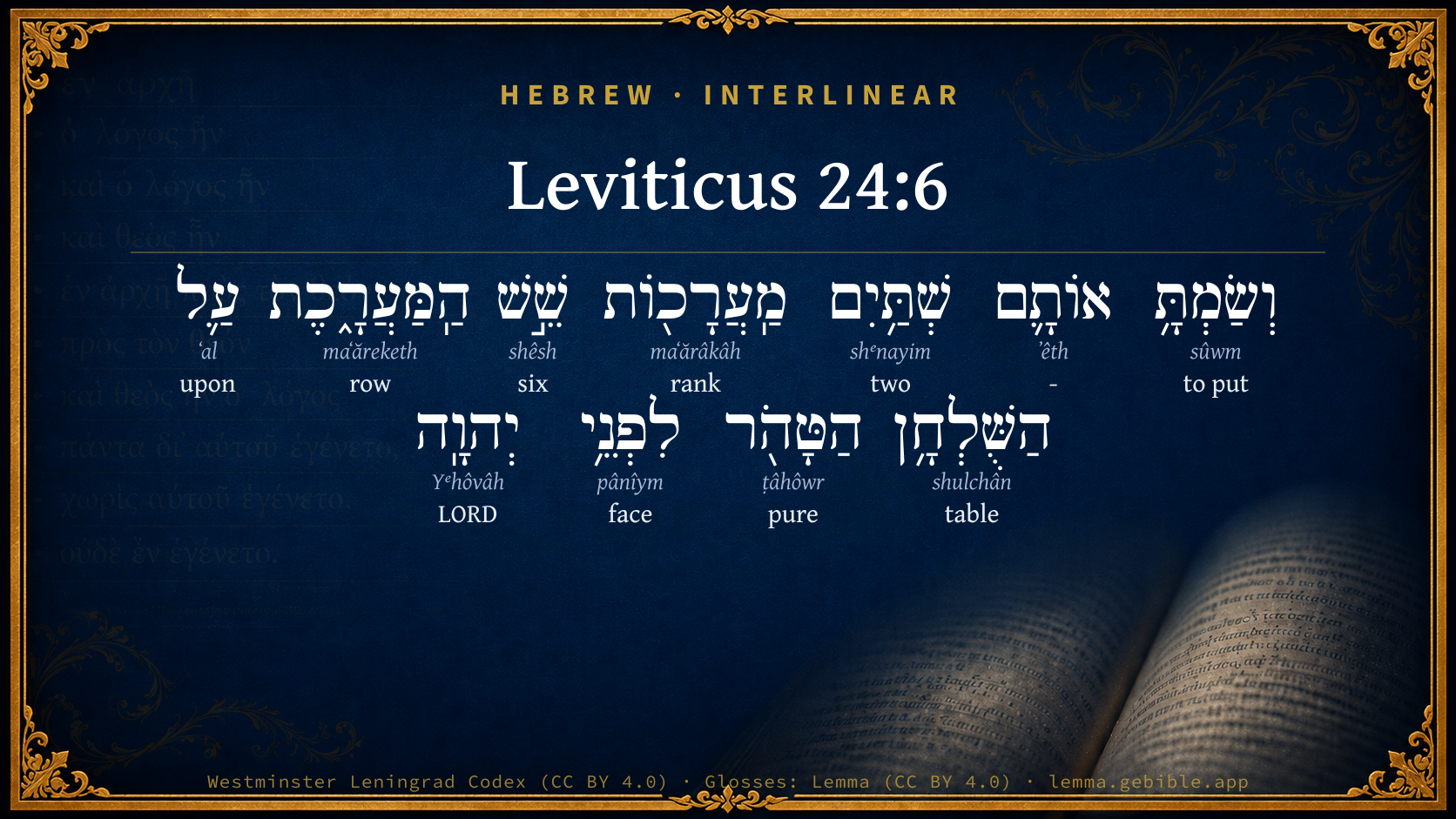
Hebrew (Westminster Leningrad Codex) Leviticus 24:6 appears in the Hebrew Old Testament. The text above is from the Westminster Leningrad Codex. Each word links to its Strong’s number, a concise gloss, and parsing drawn from the Open Scriptures Hebrew Bible morphology. Click any word for its full Brown-Driver-Briggs (BDB) entry.
Download image
Cite this verse

Leviticus 24:6 (World English Bible). Public Domain. Lemma interlinear Bible study tool, https://lemma.gebible.app/v/leviticus/24/6.

Show BibTeX & RIS
BibTeX
RIS
English Translation
You shall set them in two rows, six on a row, on the pure gold table before Yahweh.
World English Bible · Public Domain
Highlights
  • 1 first appearance in the Hebrew Bible
Full analysis ↓
Download a study sheet

One document with this verse’s original text, its word-by-word gloss line, the meaning frame, cross-references with their text, attributed commentary, and full source and license credits — printable, and it pastes into notes with its structure intact.

This verse Autodidact and up

Study sheet (.html) Plain text (.txt)

A passage Seminary Student

Up to 50 verses in one chapter. A passage sheet keeps up to 6 commentary sources and 12 cross-references per verse, in the order this page ranks them, and says so on the sheet whenever that leaves anything out. Ask for a single verse and you get the Autodidact verse sheet above.

Everything on this page stays free to read, with no account — the sheet is a download of what is already on screen, not access to it.

Want to remove ads? Support Godless Engineer
Compare translations 3

The same verse in 3 English versions, stacked beneath the original-language interlinear above. Click any original word for its lexicon entry.

Each is an independent rendering of the whole verse — the interlinear is not word-aligned to these translations.

Highlighted words mark where these versions differ — a whole-verse word diff, not a word-by-word alignment.

  • World English Bible Public Domain
    You shall set them in two rows, six on a row, on the pure gold table before Yahweh.
  • King James Version Public Domain
    And thou shalt set them in two rows, six on a row, upon the pure table before the LORD.
  • unfoldingWord Literal Text CC BY-SA 4.0
    And you shall place them two rows, six the row, on the pure table to the face of Yahweh.

unfoldingWord Literal Text — © unfoldingWord, licensed CC BY-SA 4.0. Word-aligned USFM3 via Door43 (git.door43.org/unfoldingWord/en_ult).

Versions to compare (up to 4)

3 of 4 selected

Show all 18 translations

Every available English version of this verse, each an independent rendering of the whole verse.

  • World English Bible Public Domain
    You shall set them in two rows, six on a row, on the pure gold table before Yahweh.
  • Berean Standard Bible Public Domain
    and set them in two rows—six per row—on the table of pure gold before the LORD.
  • Majority Standard Bible Public Domain
    and set them in two rows—six per row—on the table of pure gold before the LORD.
  • King James Version Public Domain
    And thou shalt set them in two rows, six on a row, upon the pure table before the LORD.
  • American Standard Version (1901) Public Domain
    And thou shalt set them in two rows, six on a row, upon the pure table before Jehovah.
  • Revised Version (1885) Public Domain
    And thou shalt set them in two rows, six on a row, upon the pure table before the LORD.
  • Geneva Bible (1599) Public Domain
    And thou shalt set them in two rowes, six in a rowe vpon the pure table before the Lord.
  • Douay-Rheims (1899) Public Domain
    And thou shalt set them six and six one against another upon the most clean table before the Lord:
  • Young's Literal Translation Public Domain
    and thou hast set them two ranks (six in the rank) on the pure table before Jehovah,
  • Literal Standard Version CC BY-SA 4.0
    and you have set them [in] two rows (six in the row) on the pure table before YHWH,
  • Unlocked Literal Bible CC BY-SA 4.0
    Then you must set them in two rows, six in a row, on the table of pure gold before Yahweh.
  • unfoldingWord Literal Text CC BY-SA 4.0
    And you shall place them two rows, six the row, on the pure table to the face of Yahweh.
  • Darby Bible Public Domain
    And thou shalt set them in two rows, six in a row, upon the pure table before Jehovah.
  • World Messianic Bible Public Domain
    You shall set them in two rows, six on a row, on the pure gold table before the LORD.
  • Webster's Bible Public Domain
    And thou shalt set them in two rows, six in a row, upon the pure table before the LORD.
  • Free Bible Version CC BY-SA 4.0
    Place them in two piles, six in each pile, on the table made of pure gold that stands before the Lord.
  • Bible in Basic English Public Domain
    And put them in two lines, six in a line, on the holy table before the Lord.
  • JPS Tanakh (1917) Public Domain
    And thou shalt set them in two rows, six in a row, upon the pure table before the LORD.

Literal Standard Version (2020), Covenant Press — licensed CC BY-SA 4.0. Text via the HelloAO Bible API (eBible.org). Unlocked Literal Bible (unfoldingWord) — licensed CC BY-SA 4.0. Text via the HelloAO Bible API (eBible.org). unfoldingWord Literal Text — © unfoldingWord, licensed CC BY-SA 4.0. Word-aligned USFM3 via Door43 (git.door43.org/unfoldingWord/en_ult). Free Bible Version, Dr. Jonathan Gallagher — licensed CC BY-SA 4.0. Text via the HelloAO Bible API (eBible.org).

Word by word

More ways to search: Search by grammar → Find every occurrence → Compare this word →

Practice this passage: Drill this verse → Learn its vocabulary →

הַֽמַּעֲרָ֑כֶת
maʻăreketh
H4635
“the · row”
Particle, Definite Article + Noun, Common, Feminine, Singular, Absolute
Part of Speech
Particle + Noun
Type
Common
Gender
Feminine
Number
Singular
State
Absolute
Full BDB Definition

Origin: from H6186

TWOT: 1694e

row, line
  1. וְשַׂמְתָּ֥ sûwm H7760 “and · to put” Conjunction + Verb, Qal, Sequential Perfect, 2nd Person, Masculine, Singular
  2. אוֹתָ֛ם ʼêth H853 “- · them” Particle, Direct Object + Suffix, Personal, 3rd Person, Masculine, Plural
  3. שְׁתַּ֥יִם shᵉnayim H8147 “two” Adjective, Cardinal number, Feminine, Dual, Absolute
  4. מַֽעֲרָכ֖וֹת maʻărâkâh H4634 “ranks” Noun, Common, Feminine, Plural, Absolute
  5. שֵׁ֣שׁ shêsh H8337 “six” Adjective, Cardinal number, Feminine, Singular, Absolute
  6. עַ֛ל ʻal H5921 “upon” Preposition
  7. הַשֻּׁלְחָ֥ן shulchân H7979 “the · table” Particle, Definite Article + Noun, Common, Masculine, Singular, Absolute
  8. הַטָּהֹ֖ר ṭâhôwr H2889 “the · pure” Particle, Definite Article + Adjective, Adjective, Masculine, Singular, Absolute
  9. לִפְנֵ֥י pânîym H6440 “to/for · face(s) of” Preposition + Noun, Common, Both, Plural, Construct
  10. יְהוָֽה Yᵉhôvâh H3068 “LORD” Noun, Proper

About this verse

These counts appear in no published source. They are computed here, from the morphology-tagged text and Lemma’s own curated glosses. What Lemma adds →

11
words
11
distinct lemmas
Pentateuch
section

Notable vocabulary

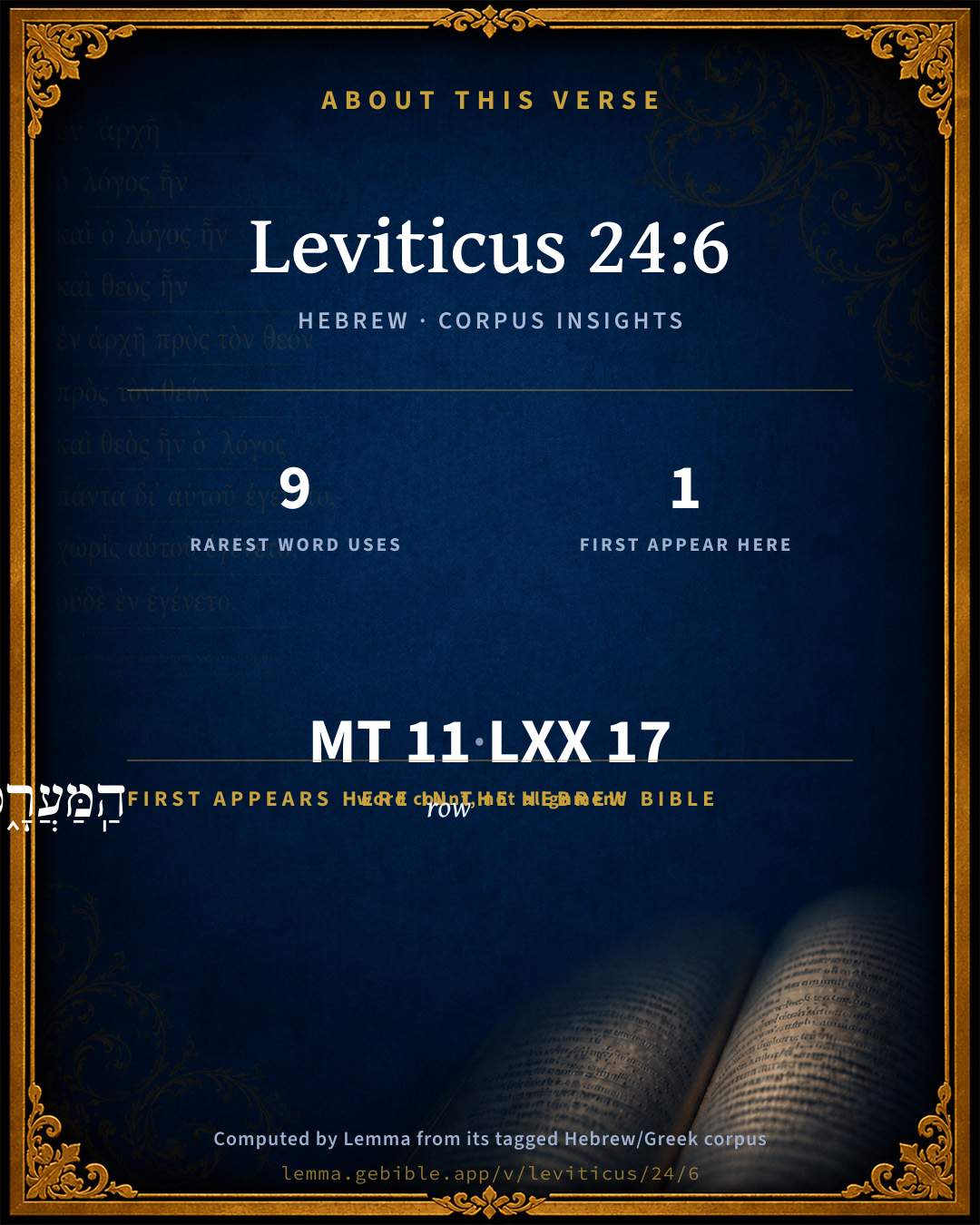
The rarest word here is הַֽמַּעֲרָ֑כֶת row H4635 — appearing just 9 times in the whole Hebrew Bible.

First appearance in Scripture

This word makes its first canonical appearance in the Hebrew Bible here:

  • הַֽמַּעֲרָ֑כֶת row H4635

Shared distinctive vocabulary

הַֽמַּעֲרָ֑כֶת row H4635 occurs in 9 verses of the Hebrew Bible. Also found in:

Grammatical profile

  • 1 verb
  • 5 nouns
  • 3 adjectives
  • 1 preposition
  • 1 particle

Verb forms

  • וְשַׂמְתָּ֥ Qal · Sequential Perfect

Hebrew & Septuagint length

In English translation the verse runs 18 words from the Hebrew and 20 from the Septuagint (LXX English) — closely comparable.

A rough comparison of the two English renderings, which tokenize alike — not a word-level alignment.

Word counts can differ between the Hebrew and the Greek without any difference in meaning — e.g. the Hebrew direct-object marker אֵת has no separate Greek word, and Greek often adds the article ὁ.

In the original languages it is 11 Hebrew tokens and 17 Greek tokens — but the two are counted differently (Hebrew bundles its prefixes and suffixes into one token; the Greek is in lemma form), so that isn’t a like-for-like length.

Cross-references

9

Topical passages linked to Leviticus 24:6 in the Treasury of Scripture Knowledge — connected by theme and wording, ordered by reader-vote popularity; previews shown in the World English Bible.

  • 1 Kings 7:48 Solomon made all the vessels that were in the house of Yahweh: the golden altar, and the table whereupon the show bread was, of gold;
  • Exodus 25:23–24 "You shall make a table of acacia wood. Two cubits shall be its length, and a cubit its breadth, and one and a half cubits its height.
  • Exodus 37:10–16 He made the table of acacia wood. Its length was two cubits, and its breadth was a cubit, and its height was a cubit and a half.
  • 2 Chronicles 4:19 Solomon made all the vessels that were in the house of God, the golden altar also, and the tables whereon was the show bread;
  • 2 Chronicles 13:11 and they burn to Yahweh every morning and every evening burnt offerings and sweet incense: the show bread also [set they] in order on the pure table; and the lampstand of gold with the lamps of it, to burn every evening: for we keep the charge of Yahweh our God; but you have forsaken him.
  • Hebrews 9:2 For there was a tabernacle prepared. In the first part were the lampstand, the table, and the show bread; which is called the Holy Place.
  • Exodus 39:36 the table, all its vessels, the show bread,
  • Exodus 40:22–23 He put the table in the tent of meeting, on the side of the tent northward, outside of the veil.

Cross-references courtesy of OpenBible.info (CC BY 4.0).

Hebrew and Greek witnesses Masoretic Hebrew ↔ Greek Septuagint

The same verse in the two great witnesses to the Old Testament, shown verse-for-verse.

These are two independent witnesses, not word-aligned to each other, and the Septuagint is shown in lemma (dictionary) form.

Hebrew Leviticus 24:6 Masoretic · Westminster Leningrad Codex

וְשַׂמְתָּ֥ אוֹתָ֛ם שְׁתַּ֥יִם מַֽעֲרָכ֖וֹת שֵׁ֣שׁ הַֽמַּעֲרָ֑כֶת עַ֛ל הַשֻּׁלְחָ֥ן הַטָּהֹ֖ר לִפְנֵ֥י יְהוָֽה

You shall set them in two rows, six on a row, on the pure gold table before Yahweh.

World English Bible · Public Domain

Greek LXX Leviticus 24:6 Septuagint · lemma form

καί ἐπιτίθημι αὐτός δύο θέμα ἕξ ἄρτος ὁ εἷς θέμα ἐπί ὁ τράπεζα ὁ καθαρός ἔναντι κύριος

And you⌃ shall put them in two rows, each row containing six loaves, on the pure table before the Lord.

LXX2012 (modern English Septuagint) · Public Domain

Hebrew: Westminster Leningrad Codex (CC BY 4.0). Greek: Septuagint (public domain); English from LXX2012 (modern English Septuagint) (Public Domain). How the Septuagint differs from the Hebrew →

Targum (Aramaic paraphrase)

2

The Targum is the ancient Jewish Aramaic paraphrase of the Hebrew Scriptures — an interpretive translation, not the Hebrew text itself. Onkelos (literal) and Pseudo-Jonathan (expansive) render the Torah, and Jonathan the Prophets. Coverage is partial: where no permissively-licensed English translation exists for a verse, only the Aramaic is shown. This is verse-level text, not a word-by-word alignment to the Hebrew.

  1. Targum Onkelos Torah (Genesis–Deuteronomy)
    וּתְשַׁוִי יָתְהוֹן תַּרְתֵּי סִדְרִין שִׁית סִדְרָא עַל פָּתוֹרָא דַכְיָא קֳדָם יְיָ

    (no public-domain English translation for this verse)

    Targum Onkelos — Aramaic: “Onkelos Genesis” (public domain); “Onkelos Exodus” (public domain); “Onkelos Leviticus” (public domain); “Onkelos Numbers” (public domain); “Onkelos Deuteronomy” (public domain). English: “Sefaria Community Translation” (CC0 1.0 (public-domain dedication)); “J.W. Etheridge. The Targums of Onkelos and Jonathan Ben Uzziel on the Pentateuch. London: Longmans, Green, 1862” (public domain). Text via Sefaria.

  2. Targum Pseudo-Jonathan Torah (Genesis–Deuteronomy)
    וּתְסַדֵר יַתְהוֹן תַּרְתֵּין סִדוּרִין שִׁית בְּסִדְרָא חֲדָא וְשִׁית בְּסִדְרָא חֲדָא עַל פְּתוֹרָא בִּטְהֲרֵיהּ דִמְסַדֵר קֳדָם יְיָ

    And thou shalt set them in two orders (rows), six in one order, and six in the other upon the table in its purity, as it is ordained before the Lord.

    Targum Pseudo-Jonathan — Aramaic: “Targum Jonathan on Genesis” (public domain); “Targum Jonathan on Exodus” (public domain); “Targum Jonathan on Leviticus” (public domain); “Targum Jonathan on Numbers” (public domain); “Targum Jonathan on Deuteronomy” (public domain). English: “The Targum of Jonathan ben Uzziel, trans. J. W. Etheridge, London, 1862” (public domain). Text via Sefaria.

Commentary

Notes on Leviticus 24:6 from classic Christian and Jewish commentators (each source and its license shown beneath its notes). The classic Christian expositions comment on the surrounding passage and are grouped to its opening verse, so a note may address several verses; the Jewish commentaries on the Tanakh (Rashi and others) are per-verse, so they appear only where the commentator wrote on this verse.

Lemma curates 59 commentaries, every one of them public domain or Creative Commons licensed, each selected and text-cleaned for this edition rather than reprinted as found. About our sources →

Trapp's Complete Commentary

John Trapp

Lev 24:6 And thou shalt set them in two rows, six on a row, upon the pure table before the LORD.

Ver. 6. Six on a row.] One by another, not one upon another, as they are commonly painted.

John Trapp, A Commentary or Exposition upon All the Books of the Old and New Testament (1647–1656) — public domain. Text from a community e-Sword module.

Joseph Benson's Commentary

Lev 24:6-7. In two rows — One piled above another; and on the top of each row was set a golden dish, with a handful of the best frankincense therein. On the bread for a memorial — That is, in order to be burned upon the altar at the week’s end, instead of the bread, in honour of God, or to commemorate his name.

Joseph Benson's Commentary on the Old and New Testaments (1811–1818) — public domain. Text from a community e-Sword module.

Ellicott's Commentary for English Readers

(6) In two rows, six on a row.—Better, in two piles, six on a pile. The table on which the cakes are here ordered to be put stood along the northern or most sacred side of the holy place. Like all the sacred furniture, except the Ark of the Covenant, it was ranged lengthways of the sanctuary. It was one cubit and a half, or nine handbreadths high; the surface board or plate was two cubits, or twelve handbreadths long, and one cubit or six handbreadths broad. These twelve cakes were placed one upon another in two piles lengthwise on the breadth of the table. As the cakes were ten handbreadths long, and the table was only six handbreadths wide, the cakes projected two hand breadths at each side of the table.

Upon the pure table.—According to the interpretation which obtained during the second Temple, this denotes that the cakes are to be put upon the table itself, and not upon the hollow golden rods which were on the table to allow the air to pass through to prevent the shewbread becoming mouldy during the week. These hollow tubes are to be placed between the cakes, whilst the cakes themselves are to be put on the table itself and not on the tubes, so as to be raised above the table.

Before the Lord.—That is, the table which stood before the Lord, for it was placed in the sanctuary. The cakes, therefore, which were thus ranged upon it were constantly before God. Hence, not only is the table called “the table of His Presence” (Num_4:7), but the cakes are called “the bread of His Presence” (Exo_25:30; Exo_35:13; Exo_39:36). The rendering of the Authorised Version, “table of shewbread,” and “shewbread,” is taken from Luther, and does not express the import of the names. The names, “the bread set in order,” “the sets of bread,” and the “table set in order,” which were given to the cakes (1Ch_9:32; 1Ch_23:29; 2Ch_13:11; Neh_10:33) and to the table (2Ch_29:18) in later times, and which are unjustifiably obliterated in the Authorised Version, are derived from this verse where the cakes are ordered to be ranged in two “sets.”

A Bible Commentary for English Readers, edited by Charles John Ellicott (1878–1897) — public domain. Text from a community e-Sword module.

The Cambridge Bible for Schools and Colleges

gen. ed. J. J. S. Perowne

6. rows … row] rather, as R.V. mg., piles. So the word ‘shewbread’ should be rendered pile-bread in 1Ch_9:32; 1Ch_23:29; Neh_10:33.

the pure table] i.e. overlaid with pure gold (Exo_25:24). For a reproduction of the familiar likeness of it as depicted on the Arch of Titus in the Roman Forum, see Driver (C.B.) on Exod. at p. 272, or HDB. Art. Music, iii. 462.

The Cambridge Bible for Schools and Colleges (gen. ed. J. J. S. Perowne; Cambridge University Press, 1878–1918) — public domain. Text from a community e-Sword module.

John Gill's Exposition

And thou shalt set them in two rows,.... The twelve cakes:

six on a row; not by the side of each other, but six upon one another:

upon the pure table; the shewbread table, so called because overlaid with pure gold, and kept clean and bright, Exo 25:24,

before the Lord; for this stood in the holy place, in the same place as the candlestick did, which has the same position, Lev 24:4; of the mystical and typical sense of these cakes; see Gill on Exo 25:30.

John Gill's Exposition of the Whole Bible (1746–1763) — public domain (CC PDM 1.0). Text via the HelloAO Bible API.

Matthew Poole's English Annotations

Not one above another, but one beside another, as the frankincense put upon each, Lev 24:7, shows. The pure table was so called because it was covered with pure gold, Exo 25:24, and because it was always to be kept very pure and clean by the care of the priests.

Matthew Poole's English Annotations on the Holy Bible (1683–1685) — public domain. Text from a community e-Sword/MySword module.

Whedon's Commentary on the Bible

Daniel D. Whedon

6. Pure table — It was overlaid with pure gold; the term “pure” may mean more than this, and bear something of the force which it has in Mal_1:11. For its structure, see Exo_37:10-16.

Before the Lord — Not in the holy of holies, but in the first tabernacle. Exo_40:24; Heb_9:2. This throws much light upon the significance of the showbread, or “bread of the face or faces.” The term “faces” denotes the presence not of the people, who were not admitted into the first tabernacle or court of the priests, but the presence of God. This view Bahr has elaborated with singular force and beauty. It is said in Exo_23:21, that God’s name is in the angel of his presence, (face or faces.) The presence and the name may therefore be taken as equivalent. Both, in reference to their context, indicate the manifestation of God to his creatures. As the name stands for God himself, so the face, wherein a man’s individual personality is seen, stands for the person of God. To see the face is to see the person. The bread of the face is therefore that bread through which God is seen, that is, with the participation of which the seeing of God is bound up. Whence it follows that we have not to think of bread merely as such, as the means of nourishing bodily life, but as spiritual food, as a means of appropriating and retaining that life which consists in seeing the face of God. The bread of the face on the table in the tabernacle, the symbolic heaven, is an emblem of the heavenly bread. This points to none other than Jesus Christ. “For the bread of God is he which cometh down from heaven, and giveth life unto the world.” After this synopsis of Bahr’s Symbolik we cannot forbear to add one beautiful and instructive emblem in reference to the position of the showbread, which was opposite the candlestick, (Exo_40:24,) that its full light might fall upon it, prefiguring the precious truth that the Holy Spirit takes of the things of Christ and shows them to the believer.

Daniel D. Whedon (gen. ed.), Commentary on the Old and New Testaments (1874–1909) — public domain. Text from a community e-Sword module.

John Wesley's Explanatory Notes

Two rows - Not one above another, but one beside another, as the frankincense put upon each, ver. 7, shews.

John Wesley, Explanatory Notes Upon the Whole Bible (1754–1765) — public domain. Text via the GEBible commentary corpus.

Rashi

Rabbi Shlomo Yitzchaki (Rashi)

שש המערכת SIX ON A ROW — i. e. six cakes shall form one row.

השלחן הטהר THE PURE TABLE — i. e. the table of pure gold (cf. Rashi on v. 4). Another explanation is that על השלחן הטהר means: immediately upon the טהר of the table (i. e. its top and they must not rest upon something else that is placed on the table-top) — i. e. that the supporting pillars (cf. Rashi on Exodus 25:29) must not raise the bread (i. e. the lowest loaves) above the top of the table (Sifra, Emor, Chapter 18 4; Menachot 97a).

Rashi on the Tanakh — English translations: “The Judaica Press complete Tanach with Rashi, translated by A. J. Rosenberg” (CC BY 4.0); “Pentateuch with Rashi's commentary by M. Rosenbaum and A.M. Silbermann, 1929-1934” (public domain); “The Metsudah Tanach series, Lakewood, N.J” (CC BY 4.0); and “The Book of Joshua, Metsudah Publications, 1997” (CC BY 4.0). Text via Sefaria.

Ibn Ezra

Rabbi Abraham ibn Ezra

In two stacks. [This corresponds to] the number of the tribes, like the secret of the ephod and the choshen. Alternatively, two tenths like the number of the stacks.

On the Pure Table. As opposed to other tables that were there, this one alone was coated with gold and its crown was gold.

Ibn Ezra on the Tanakh — English translations: “Sefaria Community Translation” (CC0 1.0 (public-domain dedication)); “Yalkut, Sifsei Chachomim Chumash, Metsudah Publications, 2009” (CC BY 4.0); and “Commentary of Ibn Ezra on Isaiah - trans. by M. Friedlander, 1873” (public domain). Text via Sefaria.

Lesson kit

Teaching starters — assembled from the data on this page, not authored interpretation. Every prompt links to the verse data it draws on. Edit before teaching.

Leviticus, in the Pentateuch, opens this verse with 11 words (11 distinct Hebrew lemmas). Its most distinctive word is maʻăreketh (“row”). A historical commentator’s framing appears above. Read the whole chapter for the surrounding context.

Discussion questions

  1. What does “row” (maʻăreketh) contribute to the verse as a whole?
  2. The word “row” first appears here in Scripture. What is being introduced at this debut?
  3. Leviticus 24:7 shares the word «row» with this verse. How do the two illuminate each other?
  4. These translations render this verse differently; the difference is in the English rendering, not the original. What questions does that raise?
  5. The verb «וְשַׂמְתָּ֥» is Qal Sequential Perfect. How does its form color the action?
  6. Reading how Trapp's Complete Commentary and Joseph Benson's Commentary read this verse, where do the two commentators agree and where do they part?

Things to notice

Reading settings

Reading text

Shown beneath each verse's original-language words.

Old Testament
Old Testament edition

Read the OT as the Masoretic Hebrew (MT) or the Greek Septuagint (LXX).

English shown for the Greek Septuagint (in the Hebrew ↔ Greek comparison).

Comparing translations? Open the Compare panel on any verse page to stack up to four side by side.