
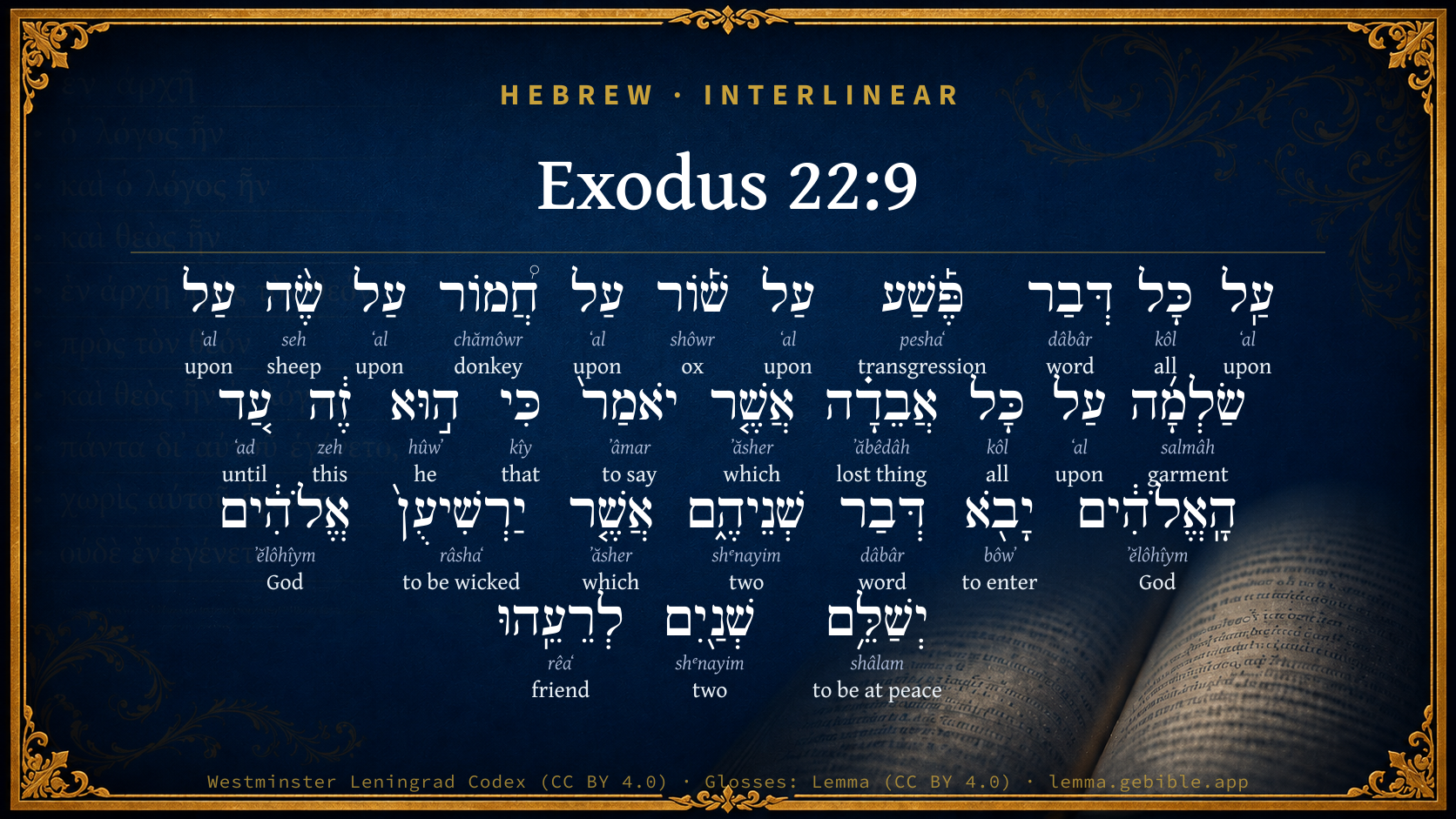
Exodus 22:9

Hebrew (Westminster Leningrad Codex) Exodus 22:9 appears in the Hebrew Old Testament. The text above is from the Westminster Leningrad Codex. Each word links to its Strong’s number, a concise gloss, and parsing drawn from the Open Scriptures Hebrew Bible morphology. Click any word for its full Brown-Driver-Briggs (BDB) entry.
Download image
Cite this verse

Exodus 22:9 (World English Bible). Public Domain. Lemma interlinear Bible study tool, https://lemma.gebible.app/v/exodus/22/9.

Show BibTeX & RIS
BibTeX
RIS
English Translation
For every matter of trespass, whether it be for ox, for donkey, for sheep, for clothing, or for any kind of lost thing, about which one says, 'This is mine,' the cause of both parties shall come before God. He whom God condemns shall pay double to his neighbor.
World English Bible · Public Domain
Highlights
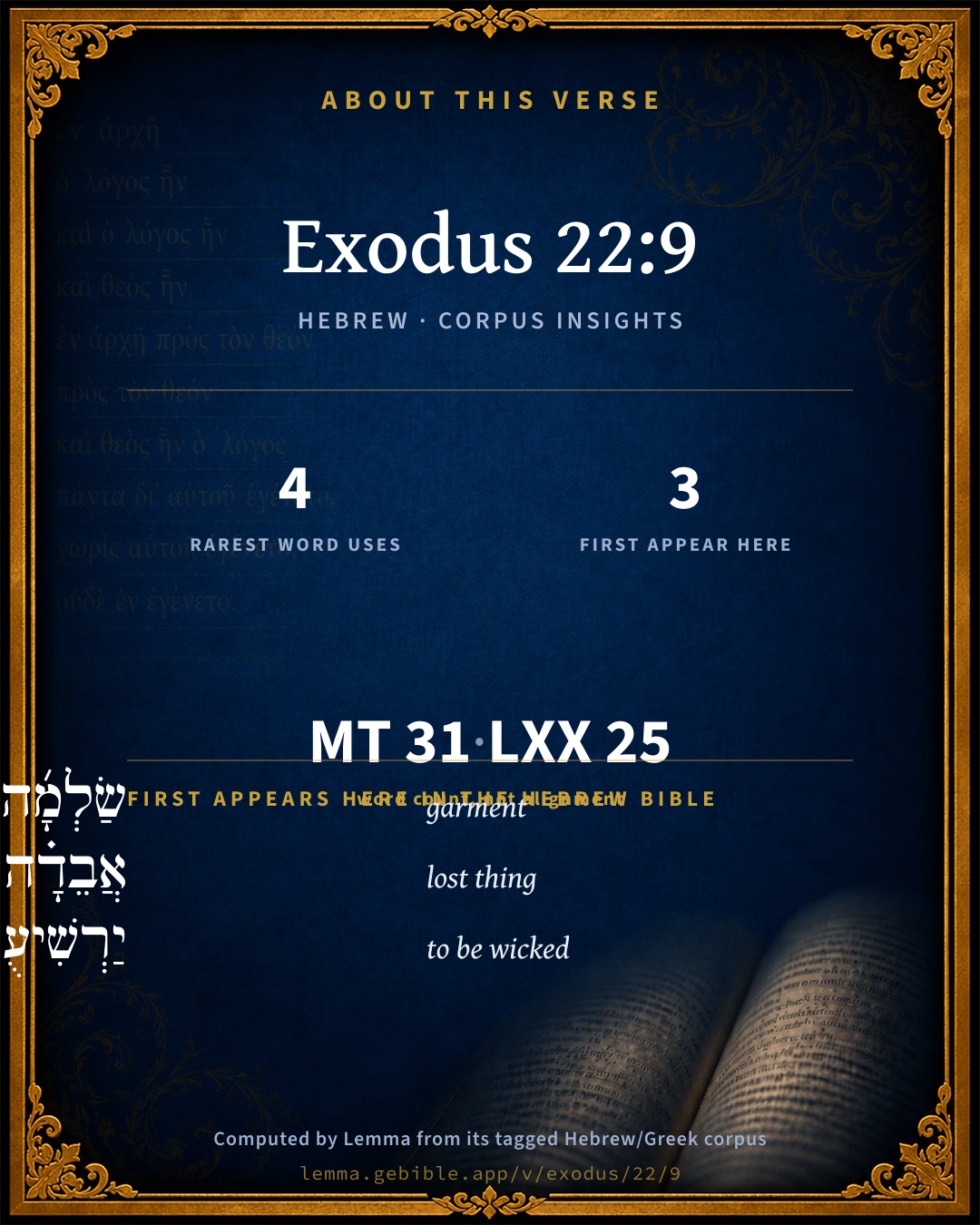
  • 3 first appearances in the Hebrew Bible
Full analysis ↓
Download a study sheet

One document with this verse’s original text, its word-by-word gloss line, the meaning frame, cross-references with their text, attributed commentary, and full source and license credits — printable, and it pastes into notes with its structure intact.

This verse Autodidact and up

Study sheet (.html) Plain text (.txt)

A passage Seminary Student

Up to 50 verses in one chapter. A passage sheet keeps up to 6 commentary sources and 12 cross-references per verse, in the order this page ranks them, and says so on the sheet whenever that leaves anything out. Ask for a single verse and you get the Autodidact verse sheet above.

Everything on this page stays free to read, with no account — the sheet is a download of what is already on screen, not access to it.

Want to remove ads? Support Godless Engineer
Compare translations 3

The same verse in 3 English versions, stacked beneath the original-language interlinear above. Click any original word for its lexicon entry.

Each is an independent rendering of the whole verse — the interlinear is not word-aligned to these translations.

Highlighted words mark where these versions differ — a whole-verse word diff, not a word-by-word alignment.

  • World English Bible Public Domain
    For every matter of trespass, whether it be for ox, for donkey, for sheep, for clothing, or for any kind of lost thing, about which one says, 'This is mine,' the cause of both parties shall come before God. He whom God condemns shall pay double to his neighbor.
  • King James Version Public Domain
    For all manner of trespass, whether it be for ox, for ass, for sheep, for raiment, or for any manner of lost thing which another challengeth to be his, the cause of both parties shall come before the judges; and whom the judges shall condemn, he shall pay double unto his neighbor.
  • unfoldingWord Literal Text CC BY-SA 4.0
    Concerning every matter of transgression, concerning an ox, concerning a donkey, concerning a sheep, concerning clothing, concerning every lost property about which someone says, “Surely this is it,” the matter of both parties shall come to God. Whomever God declares guilty shall compensate his neighbor double.

unfoldingWord Literal Text — © unfoldingWord, licensed CC BY-SA 4.0. Word-aligned USFM3 via Door43 (git.door43.org/unfoldingWord/en_ult).

Versions to compare (up to 4)

3 of 4 selected

Show all 18 translations

Every available English version of this verse, each an independent rendering of the whole verse.

  • World English Bible Public Domain
    For every matter of trespass, whether it be for ox, for donkey, for sheep, for clothing, or for any kind of lost thing, about which one says, 'This is mine,' the cause of both parties shall come before God. He whom God condemns shall pay double to his neighbor.
  • Berean Standard Bible Public Domain
    In all cases of illegal possession of an ox, a donkey, a sheep, a garment, or any lost item that someone claims, ‘This is mine,’ both parties shall bring their cases before the judges. The one whom the judges find guilty must pay back double to his neighbor.
  • Majority Standard Bible Public Domain
    In all cases of illegal possession of an ox, a donkey, a sheep, a garment, or any lost item that someone claims, ‘This is mine,’ both parties shall bring their cases before the judges. The one whom the judges find guilty must pay back double to his neighbor.
  • King James Version Public Domain
    For all manner of trespass, whether it be for ox, for ass, for sheep, for raiment, or for any manner of lost thing which another challengeth to be his, the cause of both parties shall come before the judges; and whom the judges shall condemn, he shall pay double unto his neighbor.
  • American Standard Version (1901) Public Domain
    For every matter of trespass, whether it be for ox, for ass, for sheep, for raiment, `or' for any manner of lost thing, whereof one saith, This is it, the cause of both parties shall come before God; he whom God shall condemn shall pay double unto his neighbor.
  • Revised Version (1885) Public Domain
    For every matter of trespass, whether it be for ox, for ass, for sheep, for raiment, or for any manner of lost thing, whereof one saith, This is it, the cause of both parties shall come before God; he whom God shall condemn shall pay double unto his neighbour.
  • Geneva Bible (1599) Public Domain
    In all maner of trespasse, whether it bee for oxen, for asse, for sheepe, for raiment, or for any maner of lost thing, which an other chalengeth to be his, the cause of both parties shall come before the iudges, and whom the Iudges condemne, he shall pay the double vnto his neighbour.
  • Douay-Rheims (1899) Public Domain
    To do any fraud, either in ox, or in ass, or sheep, or raiment, or any thing that may bring damage: the cause of both parties shall come to the gods: and if they give judgment, he shall restore double to his neighbour.
  • Young's Literal Translation Public Domain
    for every matter of transgression, for ox, for ass, for sheep, for raiment, for any lost thing of which it is said that it is his; unto God cometh the matter of them both; he whom God doth condemn, he repayeth double to his neighbour.
  • Literal Standard Version CC BY-SA 4.0
    For every matter of transgression, for ox, for donkey, for sheep, for raiment, for any lost thing of which it is said that it is his, the matter of them both comes to God; he whom God condemns repays double to his neighbor.
  • Unlocked Literal Bible CC BY-SA 4.0
    For every dispute about something, whether it is an ox, a donkey, a sheep, clothing, or any other missing thing about which one says, “This belongs to me,” the claim of both parties must come before the judges. The man whom the judges find guilty must pay double to his neighbor.
  • unfoldingWord Literal Text CC BY-SA 4.0
    Concerning every matter of transgression, concerning an ox, concerning a donkey, concerning a sheep, concerning clothing, concerning every lost property about which someone says, “Surely this is it,” the matter of both parties shall come to God. Whomever God declares guilty shall compensate his neighbor double.
  • Darby Bible Public Domain
    As to all manner of fraud, -- as to ox, as to ass, as to sheep, as to clothing, as to everything lost, of which [a man] saith, It is this -- the cause of both parties shall come before the judges: he whom the judges shall condemn shall restore double to his neighbour.
  • World Messianic Bible Public Domain
    For every matter of trespass, whether it is for ox, for donkey, for sheep, for clothing, or for any kind of lost thing, about which one says, ‘This is mine,’ the cause of both parties shall come before God. He whom God condemns shall pay double to his neighbor.
  • Webster's Bible Public Domain
    For all manner of trespass, whether it be for ox, for ass, for sheep, for raiment, or for any manner of lost thing which another challengeth to be his: the cause of both parties shall come before the judges; and he whom the judges shall condemn, shall pay double to his neighbor.
  • Free Bible Version CC BY-SA 4.0
    If there's an argument over the ownership of an ox, a donkey, a sheep, a garment, or anything that was lost that someone says, ‘This is mine,’ both parties are to bring their case before the judges. The one whom the judges find in the wrong must pay the other back double.
  • Bible in Basic English Public Domain
    In any question about an ox or an ass or a sheep or clothing, or about the loss of any property which anyone says is his, let the two sides put their cause before God; and he who is judged to be in the wrong is to make payment to his neighbour of twice the value.
  • JPS Tanakh (1917) Public Domain
    (22-8) For every matter of trespass, whether it be for ox, for ass, for sheep, for raiment, or for any manner of lost thing, whereof one saith: 'This is it,' the cause of both parties shall come before God; he whom God shall condemn shall pay double unto his neighbour.

Literal Standard Version (2020), Covenant Press — licensed CC BY-SA 4.0. Text via the HelloAO Bible API (eBible.org). Unlocked Literal Bible (unfoldingWord) — licensed CC BY-SA 4.0. Text via the HelloAO Bible API (eBible.org). unfoldingWord Literal Text — © unfoldingWord, licensed CC BY-SA 4.0. Word-aligned USFM3 via Door43 (git.door43.org/unfoldingWord/en_ult). Free Bible Version, Dr. Jonathan Gallagher — licensed CC BY-SA 4.0. Text via the HelloAO Bible API (eBible.org).

Word by word

More ways to search: Search by grammar → Find every occurrence → Compare this word →

Practice this passage: Drill this verse → Learn its vocabulary →

אֲבֵדָ֗ה
ʼăbêdâh
H9
“lost thing”
Noun, Common, Feminine, Singular, Absolute
Part of Speech
Noun
Type
Common
Gender
Feminine
Number
Singular
State
Absolute
Full BDB Definition

Origin: from H6

TWOT: 2b

a lost thing, something lost
  1. עַֽל ʻal H5921 “upon” Preposition
  2. כָּל kôl H3605 “all of” Noun, Common, Masculine, Singular, Construct
  3. דְּבַר dâbâr H1697 “word of” Noun, Common, Masculine, Singular, Construct
  4. פֶּ֡שַׁע peshaʻ H6588 “transgression” Noun, Common, Masculine, Singular, Absolute
  5. עַל ʻal H5921 “upon” Preposition
  6. שׁ֡וֹר shôwr H7794 “ox” Noun, Common, Masculine, Singular, Absolute
  7. עַל ʻal H5921 “upon” Preposition
  8. חֲ֠מוֹר chămôwr H2543 “donkey” Noun, Common, Both, Singular, Absolute
  9. עַל ʻal H5921 “upon” Preposition
  10. שֶׂ֨ה seh H7716 “sheep” Noun, Common, Both, Singular, Absolute
  11. עַל ʻal H5921 “upon” Preposition
  12. שַׂלְמָ֜ה salmâh H8008 “garment” Noun, Common, Feminine, Singular, Absolute
  13. עַל ʻal H5921 “upon” Preposition
  14. כָּל kôl H3605 “all of” Noun, Common, Masculine, Singular, Construct
  15. אֲשֶׁ֤ר ʼăsher H834 “which” Particle, Relative
  16. יֹאמַר֙ ʼâmar H559 “to say” Verb, Qal, Imperfect, 3rd Person, Masculine, Singular
  17. כִּי kîy H3588 “that” Conjunction
  18. ה֣וּא hûwʼ H1931 “he” Pronoun, Personal, 3rd Person, Masculine, Singular
  19. זֶ֔ה zeh H2088 “this” Pronoun, Demonstrative, Masculine, Singular
  20. עַ֚ד ʻad H5704 “until” Preposition
  21. הָֽאֱלֹהִ֔ים ʼĕlôhîym H430 “the · God(s)” Particle, Definite Article + Noun, Common, Masculine, Plural, Absolute
  22. יָבֹ֖א bôwʼ H935 “to enter” Verb, Qal, Imperfect, 3rd Person, Masculine, Singular
  23. דְּבַר dâbâr H1697 “word of” Noun, Common, Masculine, Singular, Construct
  24. שְׁנֵיהֶ֑ם shᵉnayim H8147 “two · their” Adjective, Cardinal number, Masculine, Dual, Construct + Suffix, Personal, 3rd Person, Masculine, Plural
  25. אֲשֶׁ֤ר ʼăsher H834 “which” Particle, Relative
  26. יַרְשִׁיעֻן֙ râshaʻ H7561 “to be wicked” Verb, Hiphil, Imperfect, 3rd Person, Masculine, Plural + Suffix, n
  27. אֱלֹהִ֔ים ʼĕlôhîym H430 “God(s)” Noun, Common, Masculine, Plural, Absolute
  28. יְשַׁלֵּ֥ם shâlam H7999 “to be at peace” Verb, Piel, Imperfect, 3rd Person, Masculine, Singular
  29. שְׁנַ֖יִם shᵉnayim H8147 “two” Adjective, Cardinal number, Masculine, Dual, Absolute
  30. לְרֵעֵֽהוּ rêaʻ H7453 “to/for · friend · his” Preposition + Noun, Common, Masculine, Singular, Construct + Suffix, Personal, 3rd Person, Masculine, Singular

About this verse

These counts appear in no published source. They are computed here, from the morphology-tagged text and Lemma’s own curated glosses. What Lemma adds →

31
words
21
distinct lemmas
Pentateuch
section

Notable vocabulary

The rarest word here is אֲבֵדָ֗ה lost thing H9 — appearing just 4 times in the whole Hebrew Bible.

First appearance in Scripture

These words make their first canonical appearance in the Hebrew Bible here:

  • שַׂלְמָ֜ה garment H8008
  • אֲבֵדָ֗ה lost thing H9
  • יַרְשִׁיעֻן֙ to be wicked H7561

Shared distinctive vocabulary

אֲבֵדָ֗ה lost thing H9 occurs in 4 verses of the Hebrew Bible. Also found in:

Grammatical profile

  • 4 verbs
  • 13 nouns
  • 2 adjectives
  • 2 pronouns
  • 7 prepositions
  • 1 conjunction
  • 2 particles

Verb forms

  • יֹאמַר֙ Qal · Imperfect
  • יָבֹ֖א Qal · Imperfect
  • יַרְשִׁיעֻן֙ Hiphil · Imperfect
  • יְשַׁלֵּ֥ם Piel · Imperfect

Repetition

Words recur within this verse — often emphatic in Hebrew:

  • עַֽל upon H5921 ×6
  • כָּל all H3605 ×2
  • דְּבַר word H1697 ×2
  • הָֽאֱלֹהִ֔ים God H430 ×2
  • שְׁנֵיהֶ֑ם two H8147 ×2
  • אֲשֶׁ֤ר which H834 ×2

Hebrew & Septuagint length

In English translation the verse runs 49 words from the Hebrew and 49 from the Septuagint (LXX English) — the same length.

A rough comparison of the two English renderings, which tokenize alike — not a word-level alignment.

Word counts can differ between the Hebrew and the Greek without any difference in meaning — e.g. the Hebrew direct-object marker אֵת has no separate Greek word, and Greek often adds the article ὁ.

In the original languages it is 31 Hebrew tokens and 25 Greek tokens — but the two are counted differently (Hebrew bundles its prefixes and suffixes into one token; the Greek is in lemma form), so that isn’t a like-for-like length.

Cross-references

14

Topical passages linked to Exodus 22:9 in the Treasury of Scripture Knowledge — connected by theme and wording, ordered by reader-vote popularity; previews shown in the World English Bible.

  • Deuteronomy 25:1 If there be a controversy between men, and they come to judgment, and [the judges] judge them; then they shall justify the righteous, and condemn the wicked;
  • Exodus 22:4 If the stolen property is found in his hand alive, whether it is ox, donkey, or sheep, he shall pay double.
  • Exodus 23:6–8 "You shall not deny justice to your poor people in their lawsuits.
  • Numbers 5:6–7 "Speak to the children of Israel: When a man or woman commits any sin that men commit, so as to trespass against Yahweh, and that soul is guilty;
  • 1 Kings 8:31 If a man sin against his neighbor, and an oath be laid on him to cause him to swear, and he come [and] swear before your altar in this house;
  • 2 Chronicles 19:10 Whenever any controversy shall come to you from your brothers who dwell in their cities, between blood and blood, between law and commandment, statutes and ordinances, you shall warn them, that they not be guilty towards Yahweh, and so wrath come on you and on your brothers: this do, and you shall not be guilty.
  • Matthew 18:35 So my heavenly Father will also do to you, if you don't each forgive your brother from your hearts for his misdeeds."
  • Luke 17:3–4 Be careful. If your brother sins against you, rebuke him. If he repents, forgive him.
  • Exodus 18:21–22 Moreover you shall provide out of all the people able men, such as fear God: men of truth, hating unjust gain; and place such over them, to be rulers of thousands, rulers of hundreds, rulers of fifties, and rulers of tens.
  • Exodus 22:7–8 "If a man delivers to his neighbor money or stuff to keep, and it is stolen out of the man's house; if the thief is found, he shall pay double.
  • Exodus 22:28 "You shall not blaspheme God, nor curse a ruler of your people.
  • Deuteronomy 16:18–19 Judges and officers shall you make you in all your gates, which Yahweh your God gives you, according to your tribes; and they shall judge the people with righteous judgment.
  • Matthew 6:14–15 "For if you forgive men their trespasses, your heavenly Father will also forgive you.
  • Matthew 18:15 "If your brother sins against you, go, show him his fault between you and him alone. If he listens to you, you have gained back your brother.

Cross-references courtesy of OpenBible.info (CC BY 4.0).

Hebrew and Greek witnesses Masoretic Hebrew ↔ Greek Septuagint

The same verse in the two great witnesses to the Old Testament, shown verse-for-verse.

These are two independent witnesses, not word-aligned to each other, and the Septuagint is shown in lemma (dictionary) form.

Hebrew Exodus 22:9 Masoretic · Westminster Leningrad Codex

עַֽל כָּל דְּבַר פֶּ֡שַׁע עַל שׁ֡וֹר עַל חֲ֠מוֹר עַל שֶׂ֨ה עַל שַׂלְמָ֜ה עַל כָּל אֲבֵדָ֗ה אֲשֶׁ֤ר יֹאמַר֙ כִּי ה֣וּא זֶ֔ה עַ֚ד הָֽאֱלֹהִ֔ים יָבֹ֖א דְּבַר שְׁנֵיהֶ֑ם אֲשֶׁ֤ר יַרְשִׁיעֻן֙ אֱלֹהִ֔ים יְשַׁלֵּ֥ם שְׁנַ֖יִם לְרֵעֵֽהוּ

For every matter of trespass, whether it be for ox, for donkey, for sheep, for clothing, or for any kind of lost thing, about which one says, 'This is mine,' the cause of both parties shall come before God. He whom God condemns shall pay double to his neighbor.

World English Bible · Public Domain

Greek LXX Exodus 22:9 Septuagint · lemma form

ἐάν δέ τις δίδωμι ὁ πλησίον ὑποζύγιον ἤ μόσχος ἤ πρόβατον ἤ πᾶς κτῆνος φυλάσσω καί συντρίβω ἤ τελευτάω ἤ αἰχμάλωτος γίγνομαι καί μηδείς γιγνώσκω

according to every injury alleged, both concerning a calf, and an ass, and a sheep, and a garment, and every alleged loss, whatever in fact it may be, —the judgment of both shall proceed before God, and he that is convicted by God shall repay to his neighbor double.

LXX2012 (modern English Septuagint) · Public Domain

Hebrew: Westminster Leningrad Codex (CC BY 4.0). Greek: Septuagint (public domain); English from LXX2012 (modern English Septuagint) (Public Domain). How the Septuagint differs from the Hebrew →

Targum (Aramaic paraphrase)

2

The Targum is the ancient Jewish Aramaic paraphrase of the Hebrew Scriptures — an interpretive translation, not the Hebrew text itself. Onkelos (literal) and Pseudo-Jonathan (expansive) render the Torah, and Jonathan the Prophets. Coverage is partial: where no permissively-licensed English translation exists for a verse, only the Aramaic is shown. This is verse-level text, not a word-by-word alignment to the Hebrew.

  1. Targum Onkelos Torah (Genesis–Deuteronomy)
    אֲרֵי יִתֵּן גְבַר לְחַבְרֵהּ חֲמַר אוֹ תוֹר אוֹ אִמָר וְכָל בְּעִירָא לְמִטָּר וּמִית אוֹ אִתְּבַר אוֹ אִשְׁתְּבִי לֵית דְחָזֵי:

    (no public-domain English translation for this verse)

    Targum Onkelos — Aramaic: “Onkelos Genesis” (public domain); “Onkelos Exodus” (public domain); “Onkelos Leviticus” (public domain); “Onkelos Numbers” (public domain); “Onkelos Deuteronomy” (public domain). English: “Sefaria Community Translation” (CC0 1.0 (public-domain dedication)); “J.W. Etheridge. The Targums of Onkelos and Jonathan Ben Uzziel on the Pentateuch. London: Longmans, Green, 1862” (public domain). Text via Sefaria.

  2. Targum Pseudo-Jonathan Torah (Genesis–Deuteronomy)
    אֲרוּם יִתֵּן גְּבַר לְחַבְרֵיהּ חֲמוֹר אוֹ תּוֹר אוֹ אִימַר וְכָל בְּעִירָא לְמִנְטוֹר בְּלָא אֲגַר נְטִיר וִימוּת אוֹ אִיתְבִיר מִן חֵיוָא אוֹ אִישְׁתְּבֵי וְלֵית סָהִיד חָמֵי וּמַסְהִיד

    If a man deliver to his neighbour all ox, or a sheep, or any animal to keep, (if) he is to keep it without recompense, and it die, or be torn by wild beast, or be carried off, and no witness seeing who can testify it;

    Targum Pseudo-Jonathan — Aramaic: “Targum Jonathan on Genesis” (public domain); “Targum Jonathan on Exodus” (public domain); “Targum Jonathan on Leviticus” (public domain); “Targum Jonathan on Numbers” (public domain); “Targum Jonathan on Deuteronomy” (public domain). English: “The Targum of Jonathan ben Uzziel, trans. J. W. Etheridge, London, 1862” (public domain). Text via Sefaria.

Commentary

Notes on Exodus 22:9 from classic Christian and Jewish commentators (each source and its license shown beneath its notes). The classic Christian expositions comment on the surrounding passage and are grouped to its opening verse, so a note may address several verses; the Jewish commentaries on the Tanakh (Rashi and others) are per-verse, so they appear only where the commentator wrote on this verse.

Lemma curates 59 commentaries, every one of them public domain or Creative Commons licensed, each selected and text-cleaned for this edition rather than reprinted as found. About our sources →

Trapp's Complete Commentary

John Trapp

Exo 22:9 For all manner of trespass, [whether it be] for ox, for ass, for sheep, for raiment, [or] for any manner of lost thing, which [another] challengeth to be his, the cause of both parties shall come before the judges; [and] whom the judges shall condemn, he shall pay double unto his neighbour.

Ver. 9. Before the judges.] Heb., The gods: so judges are called, if good especially. {Psa 82:6} And the seat of judicature is called the holy place. {Ecc 8:10}

John Trapp, A Commentary or Exposition upon All the Books of the Old and New Testament (1647–1656) — public domain. Text from a community e-Sword module.

Adam Clarke's Commentary

Verse 9. Challengeth to be his] It was necessary that such a matter should come before the judges, because the person in whose possession the goods were found might have had them by a fair and honest purchase; and, by sifting the business, the thief might be found out, and if found, be obliged to pay double to his neighbour.

Adam Clarke's Commentary on the Bible (1810–1826) — public domain. Text from a community e-Sword/MySword module.

Ellicott's Commentary for English Readers

(9) For all manner of trespass.—Rather, in every case of fraud. The context limits the expression to cases of fraud, or alleged fraud, in connection with a deposit.

For ox, for ass, for sheep.—The deposit of animals is unknown in classical antiquity, but might well be the custom of a people whose wealth consisted in flocks and herds. In the wilderness small proprietors might have been glad to intrust their few animals to the herdsmen who guarded the flocks and herds of their wealthier neighbours.

Which another challengeth to be his.—The case is supposed of the trustee saying a thing is lost which the depositor declares he can identify, and show to be still in his (the trustee’s) possession.

The cause of both parties shall come before the judges.—This seems to mean that the challenge was to be made at the challenger’s risk. If he proved his point to the satisfaction of the judges, he was to recover double; if he failed, he was to forfeit double of what he had claimed.

A Bible Commentary for English Readers, edited by Charles John Ellicott (1878–1897) — public domain. Text from a community e-Sword module.

The Cambridge Bible for Schools and Colleges

gen. ed. J. J. S. Perowne

9. Extension of the principle of v. 8 to all cases of suspected misappropriation of property, whether arising out of a ‘deposit,’ or not.

any manner of lost thing] which is found, it is implied, suspiciously in the possession of another.

This is it] viz. the thing that I have lost.

he whom, &c.] i.e. whoever, in such a case, is convicted of being in the unlawful possession of property. How the conviction was effected, is not stated: perhaps the oath was only one element in a judicial enquiry; perhaps it was accompanied by an ordeal, and if this was not passed successfully, it was regarded as God’s condemnation.

double] as in vv. 4, 7; not fourfold (v. 1), the disputed article being still, in the general case assumed in v. 9, in the possession of the party accused.

The Cambridge Bible for Schools and Colleges (gen. ed. J. J. S. Perowne; Cambridge University Press, 1878–1918) — public domain. Text from a community e-Sword module.

John Gill's Exposition

For all manner of trespass,.... With respect to what is committed to a man's trust, and it is lost to the owner of it, there must be somewhere or other a trespass committed, either by the person into whose hands it was put, or by a thief that has stolen it from him:

whether it be for ox, for ass, for sheep, for raiment, or for any manner of lost thing by which it appears that either of these, or any other cattle not named, as well as money and vessels, or household goods, or goods in trade, were sometimes, or might be lodged in the hands of another as a depositum for safety or convenience; and for which, or any other so deposited, and lost:

which another challengeth to be his, or affirms that he put into the hands of his neighbour, to be kept by him for him; "or who shall say this is he", or "he is" the person into whose hands I put it, or this is "it" (r); such and such were the thing or things I delivered to him:

the cause of both parties shall come before the judges; who were to hear what each party had to say, and to examine the witnesses each of them brought, and consider the nature of the evidence given, and to judge and determine:

and whom the judges shall condemn; or "pronounce wicked" (s), as having done a wicked thing; either the one as having brought a false accusation against his neighbour, charging him with a depositum he never had, or the other as having converted it to his own use:

he shall pay double unto his neighbour; either the depositor, who pretended to be so and was not, but brought a false charge against his neighbour, or a false witness, as Jarchi, such as one was to pay double to the person charged wrongfully; or, on the other hand, the person with whom the depositum was put, if it appeared that he had acted a fraudulent part, and abused his trust, then he was to pay double to the depositor.

(r) "qui dixerit quod illud hoc", Montanus; "quum dixerit illud ipsum esse", Junius & Tremellius; "de qua dixerit aliquis illum ipsum esse", Piscator; so Ainsworth. (s) Vid. Ainsworth.

John Gill's Exposition of the Whole Bible (1746–1763) — public domain (CC PDM 1.0). Text via the HelloAO Bible API.

Albert Barnes' Notes on the Bible

All manner of trespass - He who was accused, and he who had lost the stolen property, were both to appear before the judges Exo 18:25-26.

Albert Barnes' Notes on the Bible (1834–1885) — public domain. Text from a community e-Sword/MySword module.

Haydock's Catholic Bible Commentary

Damage. Hebrew, "thing lost, which another challengeth.…and whom the judges condemn, he," &c. If the person who had deposited a thing, pretended that the one produced was not the same, or not equally good, and failed in proving the charge, he was liable to pay double its value. (Calmet)

George Leo Haydock (1774–1849), Haydock's Catholic Family Bible and Commentary, 1859 edition — public domain. Excludes Psalms (Douay-Rheims chapter numbering differs from Protestant) and Deuterocanonical books (Catholic canon only).

Matthew Poole's English Annotations

All manner of trespass, to wit, about matters deposited upon trust, and lost, of which alone this place speaks.

Which another challengeth to be his; or, when, or concerning which he shall say, This is it, viz. the thing that I have lost; or rather, This is he, to whom I committed it, and whom I suspect and charge as guilty.

Whom the judges shall condemn; whether the person with whom the things were deposited, if they judged him guilty of theft, or the depositor, if he were convicted of a false accusation.

Matthew Poole's English Annotations on the Holy Bible (1683–1685) — public domain. Text from a community e-Sword/MySword module.

The Pulpit Commentary

For all manner of trespass. It has been supposed that this refers to "every case of theft;" but Kalisch is probably right in restricting it to cases where a person was accused of having embezzled property committed to his care. He was in that case to appear before the judges, (Exo_18:23) together with his accuser, and to clear himself if he could. When he failed to do so, and was "condemned," he was bound to restore double. Which another challenges to be his. Rather, "which a man challenges to be the very thing" (that he deposited). The ease is supposed of the depositor being able to point out that the person to whom he entrusted the deposit has it still in his keeping.

The Pulpit Commentary (1880–1919), ed. H.D.M. Spence-Jones & Joseph S. Exell — public domain. Text from a community e-Sword module.

Rashi

Rabbi Shlomo Yitzchaki (Rashi)

כי יתן איש אל רעהו חמור או שור IF A MAN GIVE UNTO HIS FELLOW-MAN AN ASS OR AN OX — The first section (v. 6—9) speaks of the gratuitous bailee and therefore (since the chattels are kept for the use of the bailor only) Scripture frees him of liability for theft, as it is written, (v. 6) “[If a man shall give … to keep] and it be stolen out of the man’s house, if the thief be not found, then the owner of the house shall approach the judges” to take an oath (cf. Rashi v. 7). You may learn from this that he (the bailee) frees himself from liability by this oath. This section (v. 9—12), however, speaks of a “bailee for payment” (שומר שכר) who is therefore not free from liability if the object has been stolen, as it is written, “but if it be certainly stolen from him, he shall pay [unto the owner thereof]” (Bava Metzia 94b). However, for any loss over which he has no control — if, for instance, the animal died a natural death or has been injured by a wild beast, or forcibly seized by robbers, and אין רואה NO ONE SEEING IT that could testify in this matter

Rashi on the Tanakh — English translations: “The Judaica Press complete Tanach with Rashi, translated by A. J. Rosenberg” (CC BY 4.0); “Pentateuch with Rashi's commentary by M. Rosenbaum and A.M. Silbermann, 1929-1934” (public domain); “The Metsudah Tanach series, Lakewood, N.J” (CC BY 4.0); and “The Book of Joshua, Metsudah Publications, 1997” (CC BY 4.0). Text via Sefaria.

Lesson kit

Teaching starters — assembled from the data on this page, not authored interpretation. Every prompt links to the verse data it draws on. Edit before teaching.

Exodus, in the Pentateuch, opens this verse with 31 words (21 distinct Hebrew lemmas). Its most distinctive word is ʼăbêdâh (“lost thing”). A historical commentator’s framing appears above. Read the whole chapter for the surrounding context.

Discussion questions

  1. How does “lost thing” (ʼăbêdâh) shape what this verse is saying?
  2. 3 words make their first appearance in Scripture here. What does this debut establish?
  3. How does Leviticus 6:3, which shares the word «lost thing», read alongside this verse?
  4. What does the repetition of “upon” (6× in this one verse) do in this verse?
  5. The translations on this page render this verse differently — a whole-verse word diff, not a word-by-word alignment. What might account for the different wordings?
  6. «יֹאמַר֙» is a Qal Imperfect verb. How does that grammatical form shape the action described?
  7. Compare how Trapp's Complete Commentary and Adam Clarke's Commentary read this verse. Where do they agree or differ?

Things to notice

Reading settings

Reading text

Shown beneath each verse's original-language words.

Old Testament
Old Testament edition

Read the OT as the Masoretic Hebrew (MT) or the Greek Septuagint (LXX).

English shown for the Greek Septuagint (in the Hebrew ↔ Greek comparison).

Comparing translations? Open the Compare panel on any verse page to stack up to four side by side.