
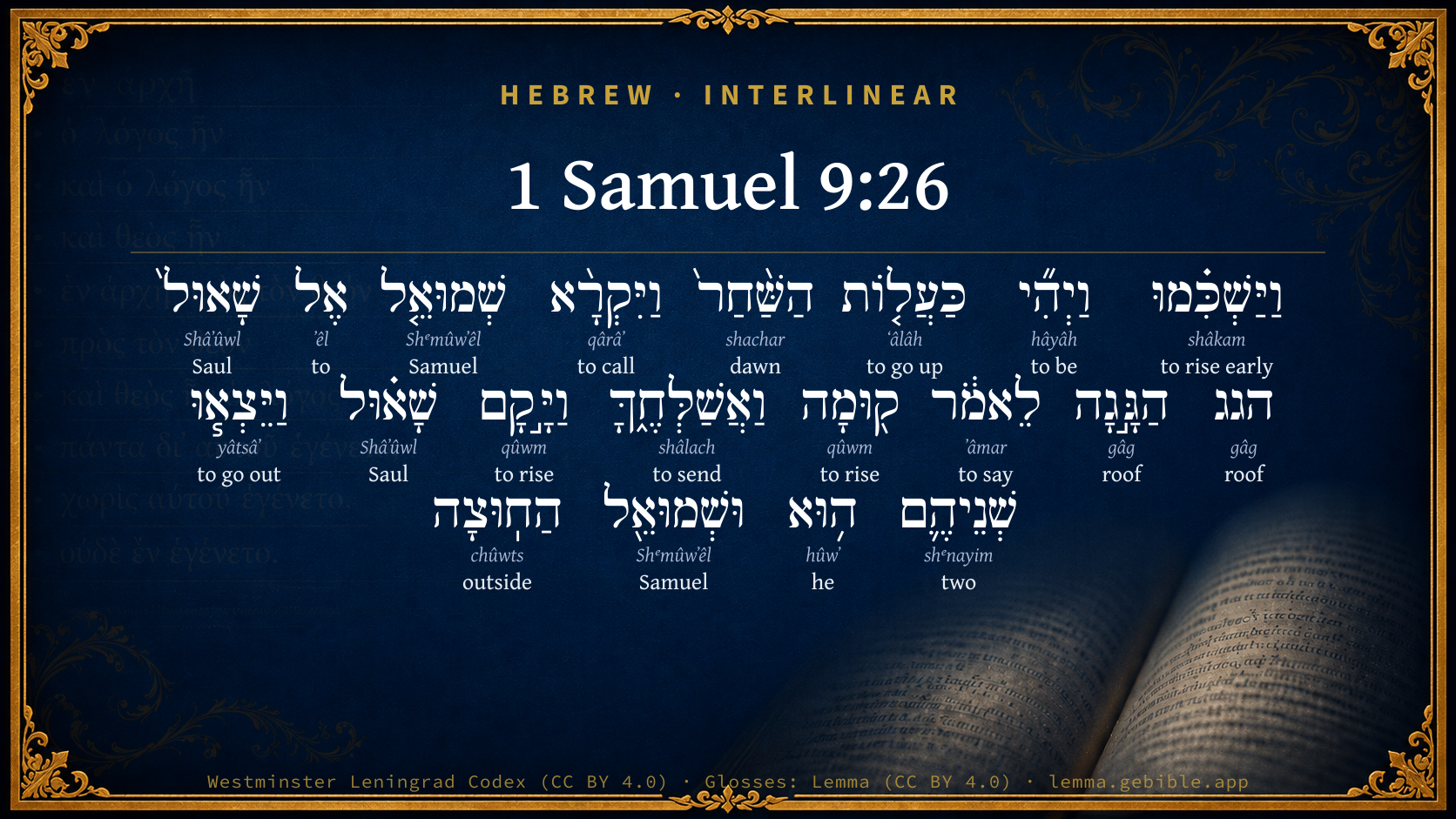
1 Samuel 9:26

Hebrew (Westminster Leningrad Codex) 1 Samuel 9:26 appears in the Hebrew Old Testament. The text above is from the Westminster Leningrad Codex. Each word links to its Strong’s number, a concise gloss, and parsing drawn from the Open Scriptures Hebrew Bible morphology. Click any word for its full Brown-Driver-Briggs (BDB) entry.
Download image
Cite this verse

1 Samuel 9:26 (World English Bible). Public Domain. Lemma interlinear Bible study tool, https://lemma.gebible.app/v/1-samuel/9/26.

Show BibTeX & RIS
BibTeX
RIS
English Translation
They arose early: and it happened about the spring of the day, that Samuel called to Saul on the housetop, saying, Up, that I may send you away. Saul arose, and they went out both of them, he and Samuel, abroad.
World English Bible · Public Domain
Download a study sheet

One document with this verse’s original text, its word-by-word gloss line, the meaning frame, cross-references with their text, attributed commentary, and full source and license credits — printable, and it pastes into notes with its structure intact.

This verse Autodidact and up

Study sheet (.html) Plain text (.txt)

A passage Seminary Student

Up to 50 verses in one chapter. A passage sheet keeps up to 6 commentary sources and 12 cross-references per verse, in the order this page ranks them, and says so on the sheet whenever that leaves anything out. Ask for a single verse and you get the Autodidact verse sheet above.

Everything on this page stays free to read, with no account — the sheet is a download of what is already on screen, not access to it.

Want to remove ads? Support Godless Engineer
Compare translations 3

The same verse in 3 English versions, stacked beneath the original-language interlinear above. Click any original word for its lexicon entry.

Each is an independent rendering of the whole verse — the interlinear is not word-aligned to these translations.

Highlighted words mark where these versions differ — a whole-verse word diff, not a word-by-word alignment.

  • World English Bible Public Domain
    They arose early: and it happened about the spring of the day, that Samuel called to Saul on the housetop, saying, Up, that I may send you away. Saul arose, and they went out both of them, he and Samuel, abroad.
  • King James Version Public Domain
    And they arose early: and it came to pass about the spring of the day, that Samuel called Saul to the top of the house, saying, Up, that I may send thee away. And Saul arose, and they went out both of them, he and Samuel, abroad.
  • unfoldingWord Literal Text CC BY-SA 4.0
    And they arose early. And it happened, as the dawn came up, that Samuel called to Saul on the roof, saying, “Arise, and I will send you away.” And Saul arose, and the two of them went out, he and Samuel, to the outside.

unfoldingWord Literal Text — © unfoldingWord, licensed CC BY-SA 4.0. Word-aligned USFM3 via Door43 (git.door43.org/unfoldingWord/en_ult).

Versions to compare (up to 4)

3 of 4 selected

Show all 18 translations

Every available English version of this verse, each an independent rendering of the whole verse.

  • World English Bible Public Domain
    They arose early: and it happened about the spring of the day, that Samuel called to Saul on the housetop, saying, Up, that I may send you away. Saul arose, and they went out both of them, he and Samuel, abroad.
  • Berean Standard Bible Public Domain
    They got up early in the morning, and just before dawn Samuel called to Saul on the roof, “Get ready, and I will send you on your way!” So Saul arose, and both he and Samuel went outside together.
  • Majority Standard Bible Public Domain
    They got up early in the morning, and just before dawn Samuel called to Saul on the roof, “Get ready, and I will send you on your way!” So Saul got ready, and both he and Samuel went outside together.
  • King James Version Public Domain
    And they arose early: and it came to pass about the spring of the day, that Samuel called Saul to the top of the house, saying, Up, that I may send thee away. And Saul arose, and they went out both of them, he and Samuel, abroad.
  • American Standard Version (1901) Public Domain
    And they arose early: and it came to pass about the spring of the day, that Samuel called to Saul on the housetop, saying, Up, that I may send thee away. And Saul arose, and they went out both of them, he and Samuel, abroad.
  • Revised Version (1885) Public Domain
    And they arose early: and it came to pass about the spring of the day, that Samuel called to Saul on the housetop, saying, Up, that I may send thee away. And Saul arose, and they went out both of them, he and Samuel, abroad.
  • Geneva Bible (1599) Public Domain
    And when they arose early about ye spring of the day, Samuel called Saul to the top of the house, saying, Vp, that I may send thee away. And Saul arose, and they went out, both he, and Samuel.
  • Douay-Rheims (1899) Public Domain
    And when they were risen in the morning, and it began now to be light, Samuel called Saul on the top of the house, saying: Arise, that I may let thee go. And Saul arose: and they went out both of them, to wit, he and Samuel.
  • Young's Literal Translation Public Domain
    And they rise early, and it cometh to pass, at the ascending of the dawn, that Samuel calleth unto Saul, on the roof, saying, `Rise, and I send thee away;' and Saul riseth, and they go out, both of them -- he and Samuel, without.
  • Literal Standard Version CC BY-SA 4.0
    And they rise early, and it comes to pass, at the ascending of the dawn, that Samuel calls to Saul, on the roof, saying, “Rise, and I send you away”; and Saul rises, and they go out, both of them—he and Samuel, outside.
  • Unlocked Literal Bible CC BY-SA 4.0
    Then at the break of dawn, Samuel called to Saul on the rooftop and said, “Get up, so I can send you on your way.” So Saul got up, and both he and Samuel went out into the street.
  • unfoldingWord Literal Text CC BY-SA 4.0
    And they arose early. And it happened, as the dawn came up, that Samuel called to Saul on the roof, saying, “Arise, and I will send you away.” And Saul arose, and the two of them went out, he and Samuel, to the outside.
  • Darby Bible Public Domain
    And they arose early; and when it was about the dawning of the day, Samuel called to Saul on the roof, saying, Arise, that I may send thee away. And Saul arose, and they went out both of them, he and Samuel, into the street.
  • World Messianic Bible Public Domain
    They arose early; and about daybreak, Samuel called to Saul on the housetop, saying, “Get up, that I may send you away.” Saul arose, and they both went outside, he and Samuel, together.
  • Webster's Bible Public Domain
    And they rose early: and it came to pass about the spring of the day, that Samuel called Saul to the top of the house, saying, Arise, that I may send thee away. And Saul arose, and they went out both of them, he and Samuel, abroad.
  • Free Bible Version CC BY-SA 4.0
    At dawn the next day Samuel called out to Saul on the roof, “Get up! I need to send you on your way!” So Saul got up, and he went outside with Samuel.
  • Bible in Basic English Public Domain
    And about dawn Samuel said to Saul on the roof, Get up so that I may send you away. So Saul got up, and he and Samuel went out together.
  • JPS Tanakh (1917) Public Domain
    And they arose early; and it came to pass about the break of day, that Samuel called to Saul on the housetop, saying: 'Up, that I may send thee away.' And Saul arose, and they went out both of them, he and Samuel, abroad.

Literal Standard Version (2020), Covenant Press — licensed CC BY-SA 4.0. Text via the HelloAO Bible API (eBible.org). Unlocked Literal Bible (unfoldingWord) — licensed CC BY-SA 4.0. Text via the HelloAO Bible API (eBible.org). unfoldingWord Literal Text — © unfoldingWord, licensed CC BY-SA 4.0. Word-aligned USFM3 via Door43 (git.door43.org/unfoldingWord/en_ult). Free Bible Version, Dr. Jonathan Gallagher — licensed CC BY-SA 4.0. Text via the HelloAO Bible API (eBible.org).

Word by word

More ways to search: Search by grammar → Find every occurrence → Compare this word →

Practice this passage: Drill this verse → Learn its vocabulary →

הַשַּׁ֨חַר֙
shachar
H7837
“the · dawn”
Particle, Definite Article + Noun, Common, Masculine, Singular, Absolute
Part of Speech
Particle + Noun
Type
Common
Gender
Masculine
Number
Singular
State
Absolute
Full BDB Definition

Origin: from H7836

TWOT: 2369a

dawn - dawn - at dawn (as adverb)
  1. וַיַּשְׁכִּ֗מוּ shâkam H7925 “and · to rise early” Conjunction + Verb, Hiphil, Sequential Imperfect, 3rd Person, Masculine, Plural
  2. וַיְהִ֞י hâyâh H1961 “and · to be” Conjunction + Verb, Qal, Sequential Imperfect, 3rd Person, Masculine, Singular
  3. כַּעֲל֤וֹת ʻâlâh H5927 “like/as · to go up” Preposition + Verb, Qal, Infinitive Construct
  4. וַיִּקְרָ֨א qârâʼ H7121 “and · to call” Conjunction + Verb, Qal, Sequential Imperfect, 3rd Person, Masculine, Singular
  5. שְׁמוּאֵ֤ל Shᵉmûwʼêl H8050 “Samuel” Noun, Proper
  6. אֶל ʼêl H413 “to” Preposition
  7. שָׁאוּל֙ Shâʼûwl H7586 “Saul” Noun, Proper
  8. הגג gâg H1406 “the · roof” Particle, Definite Article + Noun, Common, Masculine, Singular, Absolute
  9. הַגָּ֣גָה gâg H1406 “the · roof · toward” Particle, Definite Article + Noun, Common, Masculine, Singular, Absolute + Suffix, Demonstrative
  10. לֵאמֹ֔ר ʼâmar H559 “to say” Preposition + Verb, Qal, Infinitive Construct
  11. ק֖וּמָה qûwm H6965 “rise” Verb, Qal, Imperative, 2nd Person, Masculine, Singular + Suffix, h
  12. וַאֲשַׁלְּחֶ֑ךָּ shâlach H7971 “and · to send · you” Conjunction + Verb, Piel, Imperfect, 1st Person, Common, Singular + Suffix, Personal, 2nd Person, Masculine, Singular
  13. וַיָּ֣קָם qûwm H6965 “and · to rise” Conjunction + Verb, Qal, Sequential Imperfect, 3rd Person, Masculine, Singular
  14. שָׁא֗וּל Shâʼûwl H7586 “Saul” Noun, Proper
  15. וַיֵּצְא֧וּ yâtsâʼ H3318 “and · to go out” Conjunction + Verb, Qal, Sequential Imperfect, 3rd Person, Masculine, Plural
  16. שְׁנֵיהֶ֛ם shᵉnayim H8147 “two · their” Adjective, Cardinal number, Masculine, Dual, Construct + Suffix, Personal, 3rd Person, Masculine, Plural
  17. ה֥וּא hûwʼ H1931 “he” Pronoun, Personal, 3rd Person, Masculine, Singular
  18. וּשְׁמוּאֵ֖ל Shᵉmûwʼêl H8050 “and · Samuel” Conjunction + Noun, Proper
  19. הַחֽוּצָה chûwts H2351 “the · outside · toward” Particle, Definite Article + Noun, Common, Masculine, Singular, Absolute + Suffix, Demonstrative

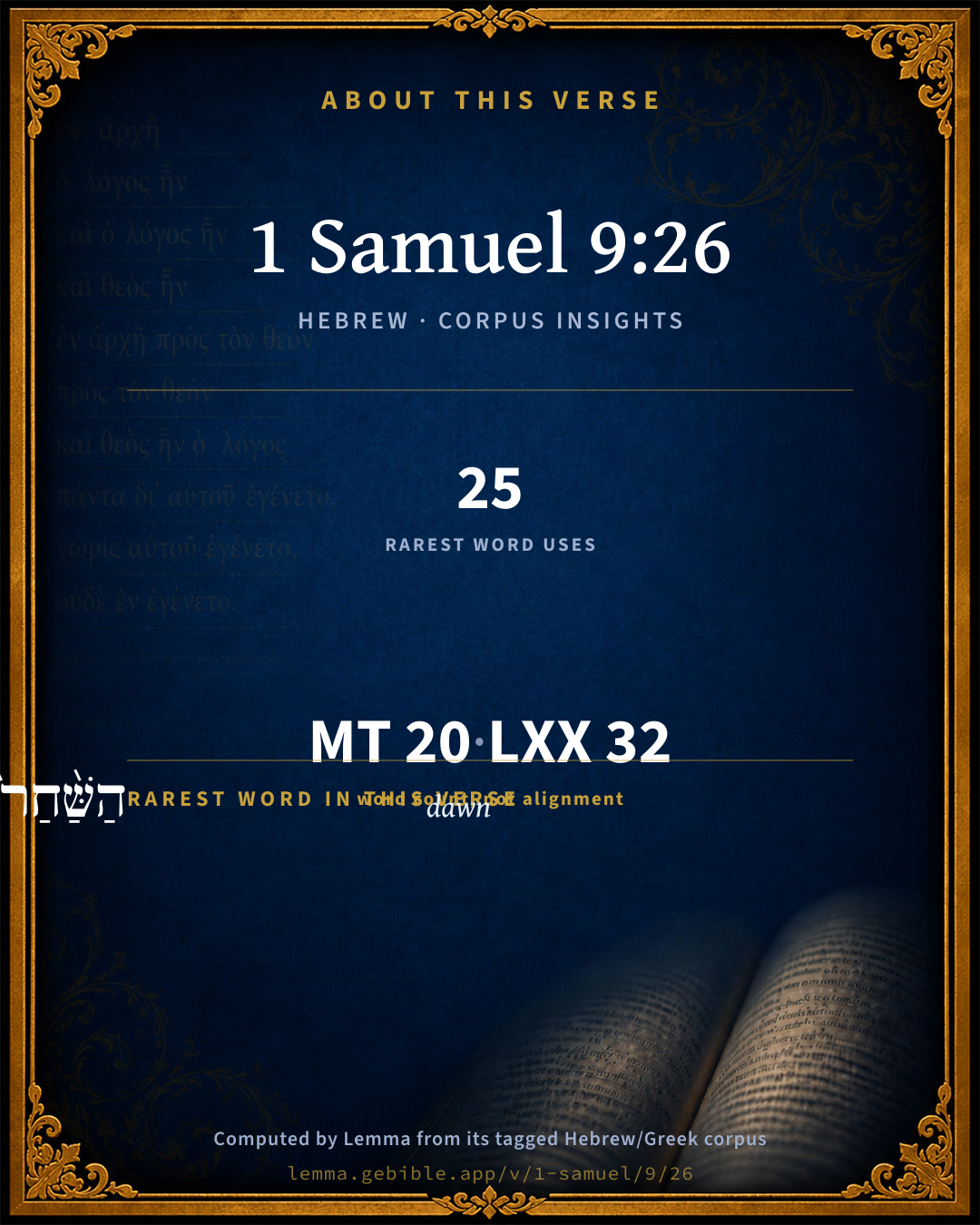
About this verse

These counts appear in no published source. They are computed here, from the morphology-tagged text and Lemma’s own curated glosses. What Lemma adds →

20
words
16
distinct lemmas
Historical
section

Notable vocabulary

The rarest word here is הַשַּׁ֨חַר֙ dawn H7837 — appearing just 25 times in the whole Hebrew Bible.

Shared distinctive vocabulary

הַשַּׁ֨חַר֙ dawn H7837 occurs in 24 verses of the Hebrew Bible. Also found in:

Grammatical profile

  • 9 verbs
  • 8 nouns
  • 1 adjective
  • 1 pronoun
  • 1 preposition

Verb forms

  • וַיַּשְׁכִּ֗מוּ Hiphil · Sequential Imperfect
  • וַיְהִ֞י Qal · Sequential Imperfect
  • כַּעֲל֤וֹת Qal · Infinitive Construct
  • וַיִּקְרָ֨א Qal · Sequential Imperfect
  • לֵאמֹ֔ר Qal · Infinitive Construct
  • ק֖וּמָה Qal · Imperative
  • וַאֲשַׁלְּחֶ֑ךָּ Piel · Imperfect
  • וַיָּ֣קָם Qal · Sequential Imperfect
  • וַיֵּצְא֧וּ Qal · Sequential Imperfect

Repetition

Words recur within this verse — often emphatic in Hebrew:

  • שְׁמוּאֵ֤ל Samuel H8050 ×2
  • שָׁאוּל֙ Saul H7586 ×2
  • הגג roof H1406 ×2
  • ק֖וּמָה to rise H6965 ×2

Hebrew & Septuagint length

In English translation the verse runs 41 words from the Hebrew and 33 from the Septuagint (LXX English) — closely comparable.

A rough comparison of the two English renderings, which tokenize alike — not a word-level alignment.

Word counts can differ between the Hebrew and the Greek without any difference in meaning — e.g. the Hebrew direct-object marker אֵת has no separate Greek word, and Greek often adds the article ὁ.

In the original languages it is 20 Hebrew tokens and 32 Greek tokens — but the two are counted differently (Hebrew bundles its prefixes and suffixes into one token; the Greek is in lemma form), so that isn’t a like-for-like length.

Cross-references

4

Topical passages linked to 1 Samuel 9:26 in the Treasury of Scripture Knowledge — connected by theme and wording, ordered by reader-vote popularity; previews shown in the World English Bible.

  • Genesis 19:14 Lot went out, and spoke to his sons-in-law, who were pledged to marry his daughters, and said, "Get up! Get out of this place, for Yahweh will destroy the city." But he seemed to his sons-in-law to be joking.
  • Genesis 44:4 When they had gone out of the city, and were not yet far off, Joseph said to his steward, "Up, follow after the men. When you overtake them, ask them, 'Why have you rewarded evil for good?
  • Joshua 7:13 Up, sanctify the people, and say, Sanctify yourselves against tomorrow: for thus says Yahweh, the God of Israel, There is a devoted thing in the midst of you, Israel; you can not stand before your enemies, until you take away the devoted thing from among you.
  • Judges 19:28 He said to her, Up, and let us be going; but none answered: then he took her up on the donkey; and the man rose up, and got him to his place.

Cross-references courtesy of OpenBible.info (CC BY 4.0).

Hebrew and Greek witnesses Masoretic Hebrew ↔ Greek Septuagint

The same verse in the two great witnesses to the Old Testament, shown verse-for-verse.

These are two independent witnesses, not word-aligned to each other, and the Septuagint is shown in lemma (dictionary) form.

Hebrew 1 Samuel 9:26 Masoretic · Westminster Leningrad Codex

וַיַּשְׁכִּ֗מוּ וַיְהִ֞י כַּעֲל֤וֹת הַשַּׁ֨חַר֙ וַיִּקְרָ֨א שְׁמוּאֵ֤ל אֶל שָׁאוּל֙ הגג הַגָּ֣גָה לֵאמֹ֔ר ק֖וּמָה וַאֲשַׁלְּחֶ֑ךָּ וַיָּ֣קָם שָׁא֗וּל וַיֵּצְא֧וּ שְׁנֵיהֶ֛ם ה֥וּא וּשְׁמוּאֵ֖ל הַחֽוּצָה

They arose early: and it happened about the spring of the day, that Samuel called to Saul on the housetop, saying, Up, that I may send you away. Saul arose, and they went out both of them, he and Samuel, abroad.

World English Bible · Public Domain

Greek LXX 1 Samuel 9:26 Septuagint · lemma form

καί κοιμάω καί γίγνομαι ὡς ἀναβαίνω ὁ ὄρθρος καί καλέω σαμουηλ ὁ σαούλ ἐπί ὁ δῶμα λέγω ἀναἵστημι καί ἐκ ἀποστέλλω σύ καί ἀναἵστημι σαούλ καί ἐκἔρχομαι αὐτός καί σαμουηλ ἕως ἔξω

And it came to pass when the morning dawned, that Samuel called Saul on the roof, saying, Rise up, and I will dismiss you. And Saul arose, and he and Samuel went out.

LXX2012 (modern English Septuagint) · Public Domain

On this verse, The Pulpit Commentary discusses the Septuagint’s reading. Read the note in Commentary ↓

Hebrew: Westminster Leningrad Codex (CC BY 4.0). Greek: Septuagint (public domain); English from LXX2012 (modern English Septuagint) (Public Domain). How the Septuagint differs from the Hebrew →

Targum (Aramaic paraphrase)

1

The Targum is the ancient Jewish Aramaic paraphrase of the Hebrew Scriptures — an interpretive translation, not the Hebrew text itself. Onkelos (literal) and Pseudo-Jonathan (expansive) render the Torah, and Jonathan the Prophets. Coverage is partial: where no permissively-licensed English translation exists for a verse, only the Aramaic is shown. This is verse-level text, not a word-by-word alignment to the Hebrew.

  1. Targum Jonathan Prophets (Joshua–Malachi)
    וְאַקְדִימוּ וַהֲוָה כְמֵסַק צַפְרָא וּקְרָא שְׁמוּאֵל לְשָׁאוּל לְאִגְרָא לְמֵימַר קוּם וְאֶשְׁלְחִינָךְ וְקָם שָׁאוּל וּנְפָקוּ תַרְוֵיהוֹן הוּא וּשְׁמוּאֵל לְבָרָא:

    (no public-domain English translation for this verse)

    Targum Jonathan — Aramaic: “Mikraot Gedolot” (public domain). English: “Sefaria Community Translation” (CC0 1.0 (public-domain dedication)); “London "Chaldee Paraphrase," 1871” (public domain). Text via Sefaria.

Commentary

Notes on 1 Samuel 9:26 from classic Christian and Jewish commentators (each source and its license shown beneath its notes). The classic Christian expositions comment on the surrounding passage and are grouped to its opening verse, so a note may address several verses; the Jewish commentaries on the Tanakh (Rashi and others) are per-verse, so they appear only where the commentator wrote on this verse.

Lemma curates 59 commentaries, every one of them public domain or Creative Commons licensed, each selected and text-cleaned for this edition rather than reprinted as found. About our sources →

Trapp's Complete Commentary

John Trapp

1Sa 9:26 And they arose early: and it came to pass about the spring of the day, that Samuel called Saul to the top of the house, saying, Up, that I may send thee away. And Saul arose, and they went out both of them, he and Samuel, abroad.

Ver. 26. To the top of the house.] Which was made flat in manner of a terrace: as now also they are in Italy, and some great men’s houses amongst us.

John Trapp, A Commentary or Exposition upon All the Books of the Old and New Testament (1647–1656) — public domain. Text from a community e-Sword module.

The Biblical Illustrator

Joseph S. Exell

1Sa_9:26

It came to pass about the spring of the day.

The spring of the day

The time was to the day what spring is to the year. The diurnal revolution of the earth round its own axis corresponds with the annual revolution of the earth round the sun, and the different periods of the day--morning, noon and night--therefore resemble the different seasons of the year--spring, summer, autumn, and winter. According to this beautiful analogy, the spring of the day embraces the early hours after sunrise. Nowhere is the spring of the day so delightful as in Palestine, for later on it becomes oppressively hot. The people do all their travelling and most of their work in the early morning. Saul commenced that, fateful journey homeward from the hill village of the prophet which led to the throne of Israel in the spring of the day. Ah! what difference that first setting out in life, from the hill of Juph in the spring of the day from the dark closing of his life on Mount Gilboa in the dreary winter of the day. (Hugh Macmillan, D. D.)

The Biblical Illustrator, edited by Joseph S. Exell (c. 1880s–1900s) — public domain. Text from a community e-Sword module.

Geneva Bible (1599)

Geneva Bible translators

To speak with him secretly: for the houses were flat above.

Geneva Bible (1599) marginal notes — public domain. Text via Bolls.life.

Adam Clarke's Commentary

Verse 26. Called Saul to the top of the house] Saul had no doubt slept there all night; and now, it being the break of day, "Samuel called to Saul on the top of the house, saying, Up, that I may send thee away." There was no calling him to the house-top a second time he was sleeping there, and Samuel called him up.

Adam Clarke's Commentary on the Bible (1810–1826) — public domain. Text from a community e-Sword/MySword module.

Ellicott's Commentary for English Readers

(26) And they arose early.—The English translation of this verse is misleading. It should run thus “And they arose early, namely, when the morning dawned. Samuel called for Saul upon the roof, Get up, that I may send thee, &c.” The English rendering seems to suppose that they rose first, and afterwards, about the spring of the day (the morning dawn), Samuel called Saul—the fact being that, as is frequent in Hebrew narration, the second clause simply related the same event as the first clause had already done, only with greater detail. The sense then is obvious. Saul, evidently weary after the exciting scene and revelations of the day before, slept soundly, probably heavily, on his couch spread on the roof of the prophet’s house. From this roof-top Samuel calls Saul in the early morning, wishing to conduct him himself out of the city, as he had a yet more important communication to make to his amazed and awe-struck visitor.

A Bible Commentary for English Readers, edited by Charles John Ellicott (1878–1897) — public domain. Text from a community e-Sword module.

The Cambridge Bible for Schools and Colleges

gen. ed. J. J. S. Perowne

26. about the spring of the day] “spring,” i.e. “rising” of the day = dawn. Cp. “dayspring,” Luk_1:78.

called Saul] Rather, “called to Saul.” Samuel had slept in the house, Saul on the roof.

abroad] In the language of the E. V. ‘abroad’ means simply ‘out of the house.’

27 a while] Now. The E. V. follows the Vulg. paulisper.

The Cambridge Bible for Schools and Colleges (gen. ed. J. J. S. Perowne; Cambridge University Press, 1878–1918) — public domain. Text from a community e-Sword module.

John Gill's Exposition

And they arose early,.... Neither of them being able to sleep, as Abarbinel supposes; not Samuel for thinking what he was to do the next morning, anoint Saul king over Israel; nor Saul for what Samuel had hinted to him about the desire of all Israel being upon him, and for the honour done him at the feast, and because of the conversation they had together afterwards:

and it came to pass about the spring of the day; or the "ascents of the morning" (x), when day was about to break, before the sun was up:

that Samuel called Saul to the top of the house; where they had conversed together the evening before:

saying, up, that I may send thee away; meaning not rise from his bed, for he was risen; but that he would prepare to set out on his journey, that Samuel might take his leave of him for the present, when he had accompanied him some part of his way, as he intended; and he was the more urgent upon him, because there was something to be done before people were stirring:

and Saul arose, and they went out both of them, he and Samuel, abroad; out of Samuel's house, without doors, into the street.

(x) "circa ascendere auroram", Montanus; "quum ascenderet aurora", Junius & Tremellius.

John Gill's Exposition of the Whole Bible (1746–1763) — public domain (CC PDM 1.0). Text via the HelloAO Bible API.

Albert Barnes' Notes on the Bible

To the top of the house - “On the top.” The bed on which Saul slept was on the top of the house. It is very common in the East to provide extra sleeping accommodation by placing a tent or awning on the house-top.

Albert Barnes' Notes on the Bible (1834–1885) — public domain. Text from a community e-Sword/MySword module.

Matthew Poole's English Annotations

Samuel called Saul to the top of the house a second time, to impart something more to him.

That I may send thee away; prepare thyself for thy departure and journey.

He and Samuel, abroad; Samuel accompanying Saul part of his way.

Matthew Poole's English Annotations on the Holy Bible (1683–1685) — public domain. Text from a community e-Sword/MySword module.

Whedon's Commentary on the Bible

Daniel D. Whedon

26. Called Saul to the top of the house — Rather, called unto Saul on the roof, for Saul had probably slept on the roof, and Samuel below.

Daniel D. Whedon (gen. ed.), Commentary on the Old and New Testaments (1874–1909) — public domain. Text from a community e-Sword module.

The Pulpit Commentary

Vers. 26, 27. It came to pass about the spring of the day. This is not a separate act from they arose early; for the A.V is wrong in translating the next clause, "Samuel called Saul to the top of the house." Saul had slept there, and, wearied out with his long wanderings and the excitement of the previous day, was fast asleep when Samuel came to him. The Hebrew is, "And they rose early; for at the spring of the day Samuel called to Saul upon the house top, saying," etc. And no sooner had Saul risen than they started upon his journey home, and as soon as they had left the city, at some fitting spot, Samuel bade the servant go forward, and as soon as he and Saul were alone he spake unto him the word of God. And by that Divine word he who had left his father"s house in search of lost asses was summoned to a post which, if one of the greatest dignity, was full also of danger, and burdened with solemn responsibility. And while on the human side Saul proved not unworthy of a royal crown, in his relation towards God he failed, because he let self-will and earthly policy prevail in his heart over obedience and trust in God.

Vers. Exo_30:33; Lev_8:10) as appointed and consecrated by God and to God, and intended to be the medium for receiving and transmitting blessing to the people" (Edersheim). "Anointing with oil was a symbol of endowment with the Spirit of God; as the oil itself, by virtue of the strength which it gives to the vital spirits, was a symbol of the Spirit of God as the principle of Divine and spiritual power" (Keil). "Two very good reasons they (the Jews) render why God did command the use of such anointing oil as in respect of the action. First, that it did signify the Divine election of that person and designation to that office; from whence it was necessary that it should be performed by a prophet who understood the will of God. Secondly, that by it the person anointed might be made fit to receive the Divine influx." "In respect to the matter they give two reasons why it was oil, and not any other liquor.

First, because, of all other, it signifies the greatest glory and excellency. Secondly, they tell us that oil continueth uncorrupted longer than any other liquor. And, indeed, it hath been observed to preserve not only itself but other things from corruption; hence they conclude it fit their kings and priests, whose succession was to continue forever, should be anointed with oil, the most proper emblem of eternity. Beside, they observe that simple oil without any mixture was sufficient for the candlestick; but that which was designed for unction must be compounded with principal spices, which signify a good name, always to be acquired by those in places of greatest dignity by the most laudable and honourable actions" ("Pearson on the Creed," Art. 2).

2. Accompanied with an act of homage. "And kissed him." The kiss was given on the mouth, the hand, the feet, or the garment, and was a token of friendship, affection, and, in the case of princes, of reverence and homage (1Ki_18:19; Psa_2:12; Hos_13:3)

3. And with a statement of its significance. "Is it not?" etc. Hath not the Lord anointed thee to be ruler over his people, over Israel? And thou shalt rule over the people of the Lord, and thou shalt save them out of the hand of their enemies" (LXX). His appointment was of God, and the purpose of it was the deliverance of his people. The manner in which he received it shows the change which had already taken place in his feelings. (1Sa_9:21) When God has work for a man to do, he has power to dispose and prepare him to do it.

II ASSURED OF CONFIRMATORY SIGNS (vers. 2-6). The events which Samuel predicted were proofs of the Divine interposition, means of Saul"s further preparation, and emblems of his future dignity and power.

1. First sign his royalty was an appointment made by God. By it he would be convinced that it was not made by Samuel merely, but by God, who fulfilled his words; (1Sa_9:20) at the same time he would be taught to leave lower cares, and aspire after the highest things. "Inwardly free, and consecrated to the Lord alone, he is to pursue his way upward.

2. Second sign his royalty was an honour shared with God, and held in subordination to him (vers. 3, 4). A part of the offerings that were about to be presented before Jehovah in Bethel would be presented to Saul, but only a part of them; the greater portion would be given to Jehovah as a sign of the supreme homage due to the invisible King of Israel, while he was to accept the lesser portion as a sign of his subordinate position under him.

"That this surprising prelude to all future royal gifts is taken from bread of offering points to the fact that in future some of the wealth of the land, which has hitherto gone undivided to the sanctuary, will go to the king" (Ewald). God commands us to "honour the king", (1Pe_2:17) but the honour which is due to himself may not be usurped by man (Mat_22:21; Act_12:23)

3. Third sign his royalty was an endowment dependent upon God, and effectually administered only through his grace. Coming to the hill (Gibeah) of God, near the city (Gibeah, his home), where there stood a garrison of the Philistines (or perhaps a pillar erected by them as a sign of their authority), which could hardly fail to impress upon him with great force the main purpose for which he had been appointed king, he would meet a band of prophets descending from the high place (of sacrifice), playing instruments of music and prophesying (speaking and singing in ecstatic utterances the praises of Jehovah, declaring his greatness, and his victory over his adversaries), and

(1) He would be imbued with a Divine power. "The Spirit of Jehovah will come upon thee.

(2) He would catch the spirit of the prophets, and join them in their ecstatic utterances. "Thou wilt prophesy with them.

(3) He would undergo a surprising transformation. "And will be turned into another man." When he had turned his back to go from Samuel, "God gave him another heart" (ver. 9), but the prediction of the prophet was more completely fulfilled afterwards (ver. 10). The fulfilment of these predictions shows that apparently accidental events are clearly foreseen by God, human affairs are under his direction and control, and "the king"s heart is in the hand of the Lord, as the rivers of water: he turneth it whithersoever he, (Pro_21:1) and that "the teachings of Providence unite with the teachings of revelation and of the Holy Spirit to show men their duty and their destiny.

III ADMONISHED OF FUTURE DUTY (vers. 7, 8). In relation to

1. Circumstances. "Do thou what thy hand findeth," i.e. what circumstances indicate to be thy duty. His own judgment would have to be exercised, but he would not be left to it alone.

2. God. "For God is with thee," to observe, direct, and aid thee. The firm belief in his presence is a mighty preservative from the neglect of duty, and a powerful incentive and encouragement to its performance.

3. The prophet, through whom he would receive "the word of God," in obedience to which he was bound always to act. "Gilgal, on the southwestern bank of the Jordan, was then, from all indications, one of the most holy places in Israel, and the true centre of the whole people; it had a like importance before, and much more then, because the Philistine control reached so far eastward that the middle point of the kingdom must have been pressed back to the bank of the Jordan. There the people must have assembled for all general political questions, and thence, after offering and consecration, have marched forth armed to war" (Ewald). Thither he was to gather the people; not, indeed: immediately, but when circumstances indicated that it was the proper time to prepare for war with the Philistines, which was the main object of his appointment. Samuel promised to meet him there, offer burnt offerings (dedicatory) and peace offerings (eucharistic), and tell him what to do; and directed him to wait seven days, and to do nothing without him. The direction was explicit, it set a limit to his authority, and its neglect was the first step in his disobedience (ch. 13:13). When God places men in positions of authority, he teaches them the obligations which they involve; and if they fail it is not from want of knowing them. D.

The Pulpit Commentary (1880–1919), ed. H.D.M. Spence-Jones & Joseph S. Exell — public domain. Text from a community e-Sword module.

Lesson kit

Teaching starters — assembled from the data on this page, not authored interpretation. Every prompt links to the verse data it draws on. Edit before teaching.

1 Samuel, in the Historical, opens this verse with 20 words (16 distinct Hebrew lemmas). Its most distinctive word is shachar (“dawn”). A historical commentator’s framing appears above. Read the whole chapter for the surrounding context.

Discussion questions

  1. How does “dawn” (shachar) shape what this verse is saying?
  2. How does Genesis 19:15, which shares the word «dawn», read alongside this verse?
  3. What does the repetition of “Samuel” (2× in this one verse) do in this verse?
  4. These translations render this verse differently. What is at stake in choosing one wording over another?
  5. «וַיַּשְׁכִּ֗מוּ» is a Hiphil Sequential Imperfect verb. How does that grammatical form shape the action described?
  6. Compare how Trapp's Complete Commentary and The Biblical Illustrator read this verse. Where do they agree or differ?

Things to notice

Reading settings

Reading text

Shown beneath each verse's original-language words.

Old Testament
Old Testament edition

Read the OT as the Masoretic Hebrew (MT) or the Greek Septuagint (LXX).

English shown for the Greek Septuagint (in the Hebrew ↔ Greek comparison).

Comparing translations? Open the Compare panel on any verse page to stack up to four side by side.