
Leviticus 8:2

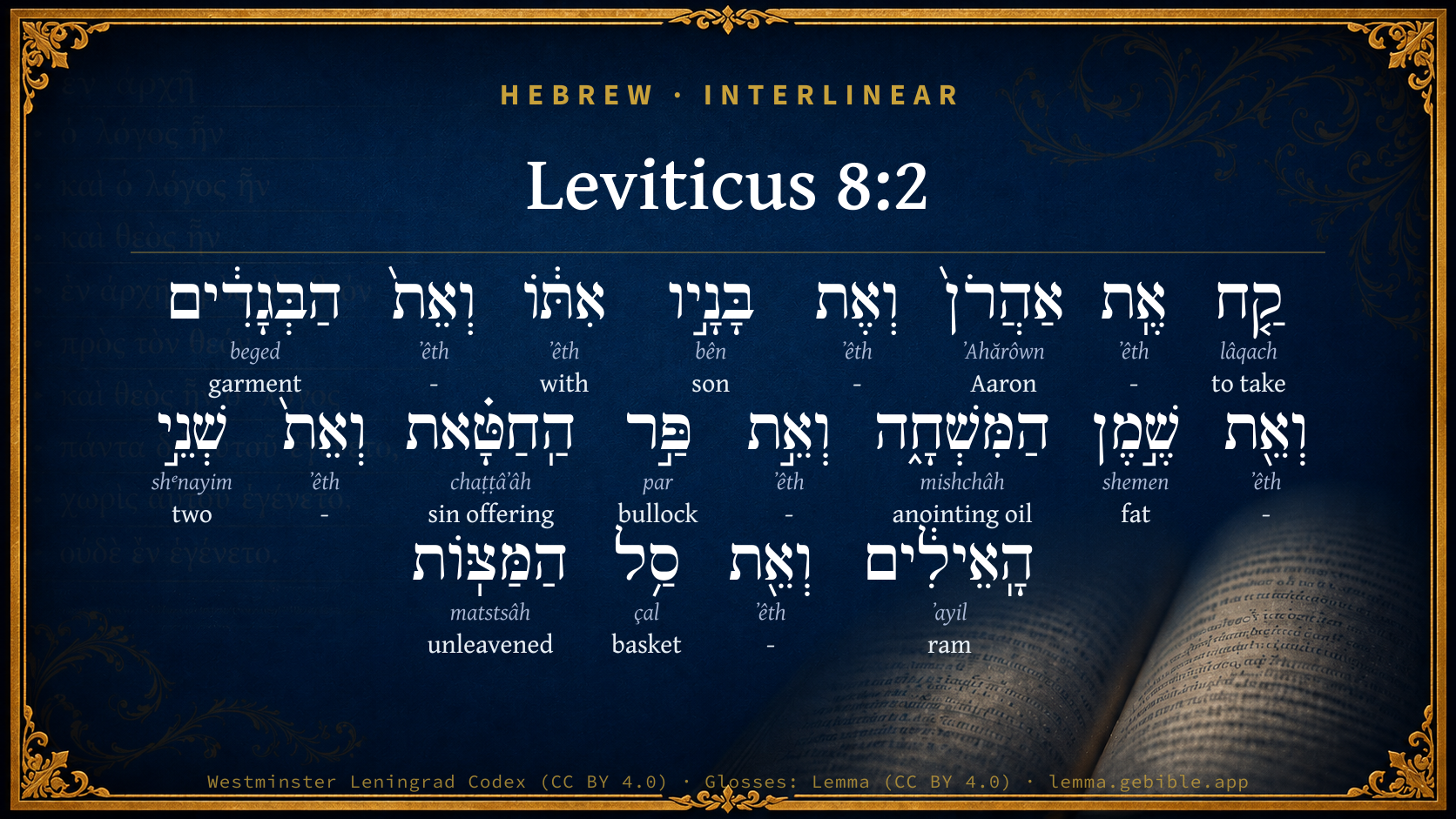
Hebrew (Westminster Leningrad Codex) Leviticus 8:2 appears in the Hebrew Old Testament. The text above is from the Westminster Leningrad Codex. Each word links to its Strong’s number, a concise gloss, and parsing drawn from the Open Scriptures Hebrew Bible morphology. Click any word for its full Brown-Driver-Briggs (BDB) entry.
Download image
Cite this verse

Leviticus 8:2 (World English Bible). Public Domain. Lemma interlinear Bible study tool, https://lemma.gebible.app/v/leviticus/8/2.

Show BibTeX & RIS
BibTeX
RIS
English Translation
"Take Aaron and his sons with him, and the garments, and the anointing oil, and the bull of the sin offering, and the two rams, and the basket of unleavened bread;
World English Bible · Public Domain
Download a study sheet

One document with this verse’s original text, its word-by-word gloss line, the meaning frame, cross-references with their text, attributed commentary, and full source and license credits — printable, and it pastes into notes with its structure intact.

This verse Autodidact and up

Study sheet (.html) Plain text (.txt)

A passage Seminary Student

Up to 50 verses in one chapter. A passage sheet keeps up to 6 commentary sources and 12 cross-references per verse, in the order this page ranks them, and says so on the sheet whenever that leaves anything out. Ask for a single verse and you get the Autodidact verse sheet above.

Everything on this page stays free to read, with no account — the sheet is a download of what is already on screen, not access to it.

Want to remove ads? Support Godless Engineer
Compare translations 3

The same verse in 3 English versions, stacked beneath the original-language interlinear above. Click any original word for its lexicon entry.

Each is an independent rendering of the whole verse — the interlinear is not word-aligned to these translations.

Highlighted words mark where these versions differ — a whole-verse word diff, not a word-by-word alignment.

  • World English Bible Public Domain
    "Take Aaron and his sons with him, and the garments, and the anointing oil, and the bull of the sin offering, and the two rams, and the basket of unleavened bread;
  • King James Version Public Domain
    Take Aaron and his sons with him, and the garments, and the anointing oil, and a bullock for the sin offering, and two rams, and a basket of unleavened bread;
  • unfoldingWord Literal Text CC BY-SA 4.0
    “Take Aaron and his sons with him and the clothes and the oil of anointing and the bull of the sin offering and two rams and a basket of unleavened bread.

unfoldingWord Literal Text — © unfoldingWord, licensed CC BY-SA 4.0. Word-aligned USFM3 via Door43 (git.door43.org/unfoldingWord/en_ult).

Versions to compare (up to 4)

3 of 4 selected

Show all 18 translations

Every available English version of this verse, each an independent rendering of the whole verse.

  • World English Bible Public Domain
    "Take Aaron and his sons with him, and the garments, and the anointing oil, and the bull of the sin offering, and the two rams, and the basket of unleavened bread;
  • Berean Standard Bible Public Domain
    “Take Aaron and his sons, their garments, the anointing oil, the bull of the sin offering, the two rams, and the basket of unleavened bread,
  • Majority Standard Bible Public Domain
    “Take Aaron and his sons, their garments, the anointing oil, the bull of the sin offering, the two rams, and the basket of unleavened bread,
  • King James Version Public Domain
    Take Aaron and his sons with him, and the garments, and the anointing oil, and a bullock for the sin offering, and two rams, and a basket of unleavened bread;
  • American Standard Version (1901) Public Domain
    Take Aaron and his sons with him, and the garments, and the anointing oil, and the bullock of the sin-offering, and the two rams, and the basket of unleavened bread;
  • Revised Version (1885) Public Domain
    Take Aaron and his sons with him, and the garments, and the anointing oil, and the bullock of the sin offering, and the two rams, and the basket of unleavened bread;
  • Geneva Bible (1599) Public Domain
    Take Aaron and his sonnes with him, and the garments and the anointing oyle, and a bullocke for the sinne offring, and two rammes, and a basket of vnleauened bread,
  • Douay-Rheims (1899) Public Domain
    Take Aaron with his sons, their vestments, and the oil of unction, a calf for sin, two rams, a basket with unleavened bread,
  • Young's Literal Translation Public Domain
    `Take Aaron and his sons with him, and the garments, and the anointing oil, and the bullock of the sin-offering, and the two rams, and the basket of unleavened things,
  • Literal Standard Version CC BY-SA 4.0
    “Take Aaron and his sons with him, and the garments, and the anointing oil, and the bullock of the sin-offering, and the two rams, and the basket of unleavened things,
  • Unlocked Literal Bible CC BY-SA 4.0
    “Take Aaron and his sons with him, the garments and the anointing oil, the bull for the sin offering, the two rams, and the basket of unleavened bread.
  • unfoldingWord Literal Text CC BY-SA 4.0
    “Take Aaron and his sons with him and the clothes and the oil of anointing and the bull of the sin offering and two rams and a basket of unleavened bread.
  • Darby Bible Public Domain
    Take Aaron and his sons with him, and the garments and the anointing oil, and the bullock of the sin-offering, and the two rams, and the basket of unleavened [bread];
  • World Messianic Bible Public Domain
    “Take Aaron and his sons with him, and the garments, and the anointing oil, and the bull of the sin offering, and the two rams, and the basket of unleavened bread;
  • Webster's Bible Public Domain
    Take Aaron and his sons with him, and the garments, and the anointing oil, and a bullock for the sin-offering, and two rams, and a basket of unleavened bread;
  • Free Bible Version CC BY-SA 4.0
    “Go with Aaron and his sons, and take their priestly clothes, anointing oil, the bull of the sin offering, two rams, and the basket of bread made without yeast,
  • Bible in Basic English Public Domain
    Take Aaron, and his sons with him, and the robes and the holy oil and the ox of the sin-offering and the two male sheep and the basket of unleavened bread;
  • JPS Tanakh (1917) Public Domain
    'Take Aaron and his sons with him, and the garments, and the anointing oil, and the bullock of the sin-offering, and the two rams, and the basket of unleavened bread;

Literal Standard Version (2020), Covenant Press — licensed CC BY-SA 4.0. Text via the HelloAO Bible API (eBible.org). Unlocked Literal Bible (unfoldingWord) — licensed CC BY-SA 4.0. Text via the HelloAO Bible API (eBible.org). unfoldingWord Literal Text — © unfoldingWord, licensed CC BY-SA 4.0. Word-aligned USFM3 via Door43 (git.door43.org/unfoldingWord/en_ult). Free Bible Version, Dr. Jonathan Gallagher — licensed CC BY-SA 4.0. Text via the HelloAO Bible API (eBible.org).

Word by word

More ways to search: Search by grammar → Find every occurrence → Compare this word →

Practice this passage: Drill this verse → Learn its vocabulary →

סַ֥ל
çal
H5536
“basket of”
Noun, Common, Masculine, Singular, Construct
Part of Speech
Noun
Type
Common
Gender
Masculine
Number
Singular
State
Construct
Full BDB Definition

Origin: from H5549

TWOT: 1507a

basket
  1. קַ֤ח lâqach H3947 “take” Verb, Qal, Imperative, 2nd Person, Masculine, Singular
  2. אֶֽת ʼêth H853 “-” Particle, Direct Object
  3. אַהֲרֹן֙ ʼAhărôwn H175 “Aaron” Noun, Proper
  4. וְאֶת ʼêth H853 “and · -” Conjunction + Particle, Direct Object
  5. בָּנָ֣יו bên H1121 “sons · his” Noun, Common, Masculine, Plural, Construct + Suffix, Personal, 3rd Person, Masculine, Singular
  6. אִתּ֔וֹ ʼêth H854 “with · him” Preposition + Suffix, Personal, 3rd Person, Masculine, Singular
  7. וְאֵת֙ ʼêth H853 “and · -” Conjunction + Particle, Direct Object
  8. הַבְּגָדִ֔ים beged H899 “the · garments” Particle, Definite Article + Noun, Common, Masculine, Plural, Absolute
  9. וְאֵ֖ת ʼêth H853 “and · -” Conjunction + Particle, Direct Object
  10. שֶׁ֣מֶן shemen H8081 “fat of” Noun, Common, Masculine, Singular, Construct
  11. הַמִּשְׁחָ֑ה mishchâh H4888 “the · anointing oil” Particle, Definite Article + Noun, Common, Feminine, Singular, Absolute
  12. וְאֵ֣ת ʼêth H853 “and · -” Conjunction + Particle, Direct Object
  13. פַּ֣ר par H6499 “bullock of” Noun, Common, Masculine, Singular, Construct
  14. הַֽחַטָּ֗את chaṭṭâʼâh H2403 “the · sin offering” Particle, Definite Article + Noun, Common, Feminine, Singular, Absolute
  15. וְאֵת֙ ʼêth H853 “and · -” Conjunction + Particle, Direct Object
  16. שְׁנֵ֣י shᵉnayim H8147 “two” Adjective, Cardinal number, Masculine, Dual, Construct
  17. הָֽאֵילִ֔ים ʼayil H352 “the · rams” Particle, Definite Article + Noun, Common, Masculine, Plural, Absolute
  18. וְאֵ֖ת ʼêth H853 “and · -” Conjunction + Particle, Direct Object
  19. הַמַּצּֽוֹת matstsâh H4682 “the · unleavened bread” Particle, Definite Article + Noun, Common, Feminine, Plural, Absolute

About this verse

These counts appear in no published source. They are computed here, from the morphology-tagged text and Lemma’s own curated glosses. What Lemma adds →

20
words
14
distinct lemmas
Pentateuch
section

Notable vocabulary

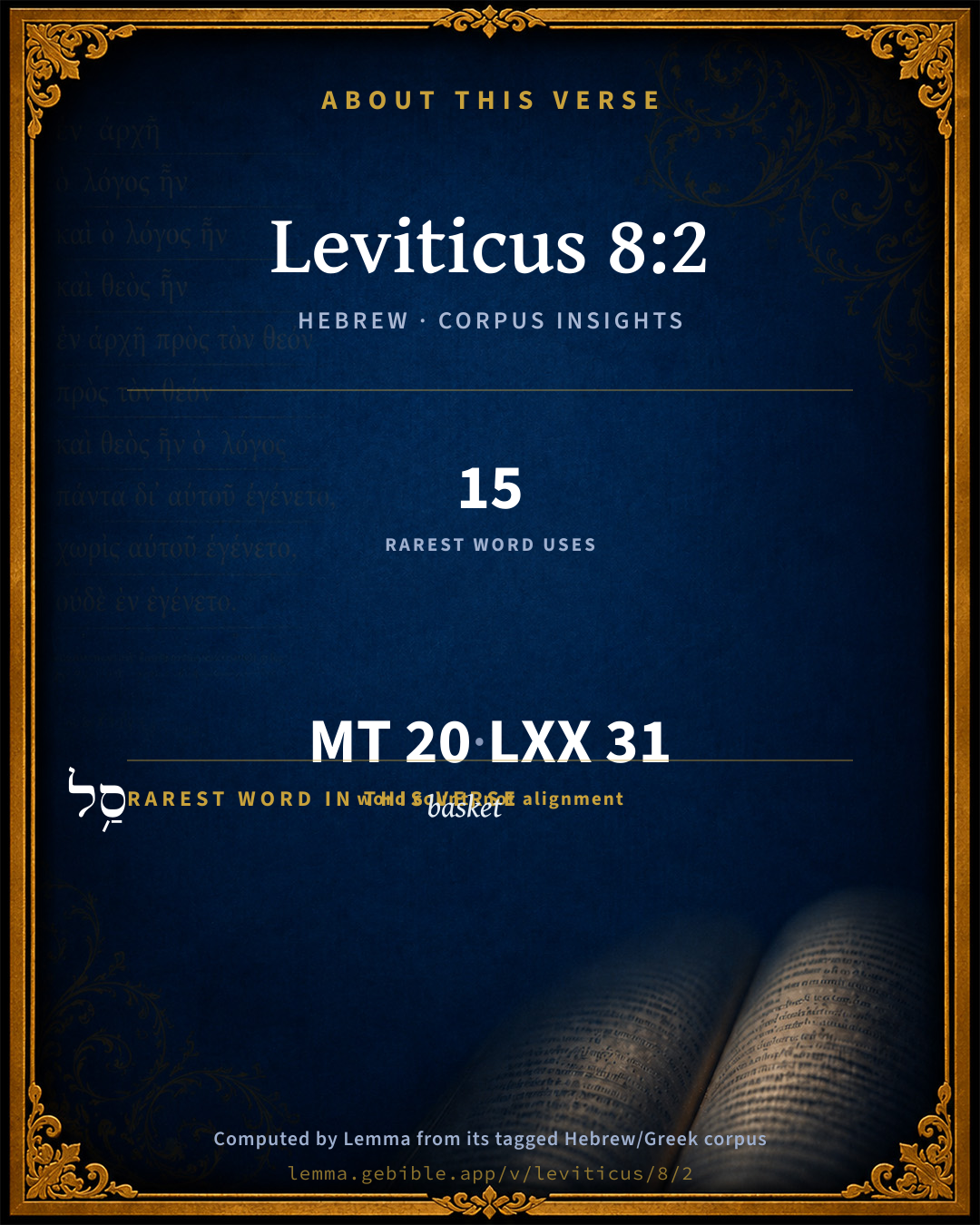
The rarest word here is סַ֥ל basket H5536 — appearing just 15 times in the whole Hebrew Bible.

Shared distinctive vocabulary

סַ֥ל basket H5536 occurs in 13 verses of the Hebrew Bible. Also found in:

Grammatical profile

  • 1 verb
  • 10 nouns
  • 1 adjective
  • 1 preposition
  • 7 particles

Verb forms

  • קַ֤ח Qal · Imperative

Hebrew & Septuagint length

In English translation the verse runs 31 words from the Hebrew and 28 from the Septuagint (LXX English) — closely comparable.

A rough comparison of the two English renderings, which tokenize alike — not a word-level alignment.

Word counts can differ between the Hebrew and the Greek without any difference in meaning — e.g. the Hebrew direct-object marker אֵת has no separate Greek word, and Greek often adds the article ὁ.

In the original languages it is 20 Hebrew tokens and 31 Greek tokens — but the two are counted differently (Hebrew bundles its prefixes and suffixes into one token; the Greek is in lemma form), so that isn’t a like-for-like length.

Cross-references

7

Topical passages linked to Leviticus 8:2 in the Treasury of Scripture Knowledge — connected by theme and wording, ordered by reader-vote popularity; previews shown in the World English Bible.

  • Exodus 28:2–4 You shall make holy garments for Aaron your brother, for glory and for beauty.
  • Exodus 28:40–29:4 "You shall make coats for Aaron's sons, and you shall make sashes for them and headbands shall you make for them, for glory and for beauty.
  • Exodus 39:1–31 Of the blue, purple, and scarlet, they made finely worked garments, for ministering in the holy place, and made the holy garments for Aaron; as Yahweh commanded Moses.
  • Exodus 39:41 the finely worked garments for ministering in the holy place, the holy garments for Aaron the priest, and the garments of his sons, to minister in the priest's office.
  • Exodus 40:12–15 You shall bring Aaron and his sons to the door of the tent of meeting, and shall wash them with water.
  • Hebrews 7:27 who doesn't need, like those high priests, to daily offer up sacrifices, first for his own sins, and then for the sins of the people. For this he did once for all, when he offered up himself.
  • Exodus 30:23–37 "Also take fine spices: of liquid myrrh, five hundred shekels; and of fragrant cinnamon half as much, even two hundred and fifty; and of fragrant cane, two hundred and fifty;

Cross-references courtesy of OpenBible.info (CC BY 4.0).

Hebrew and Greek witnesses Masoretic Hebrew ↔ Greek Septuagint

The same verse in the two great witnesses to the Old Testament, shown verse-for-verse.

These are two independent witnesses, not word-aligned to each other, and the Septuagint is shown in lemma (dictionary) form.

Hebrew Leviticus 8:2 Masoretic · Westminster Leningrad Codex

קַ֤ח אֶֽת אַהֲרֹן֙ וְאֶת בָּנָ֣יו אִתּ֔וֹ וְאֵת֙ הַבְּגָדִ֔ים וְאֵ֖ת שֶׁ֣מֶן הַמִּשְׁחָ֑ה וְאֵ֣ת פַּ֣ר הַֽחַטָּ֗את וְאֵת֙ שְׁנֵ֣י הָֽאֵילִ֔ים וְאֵ֖ת סַ֥ל הַמַּצּֽוֹת

"Take Aaron and his sons with him, and the garments, and the anointing oil, and the bull of the sin offering, and the two rams, and the basket of unleavened bread;

World English Bible · Public Domain

Greek LXX Leviticus 8:2 Septuagint · lemma form

λαμβάνω ἀαρών καί ὁ υἱός αὐτός καί ὁ στολή αὐτός καί ὁ ἔλαιον ὁ χρῖσις καί ὁ μόσχος ὁ περί ὁ ἁμαρτία καί ὁ δύο κριός καί ὁ κανοῦν ὁ ἄζυμος

Take Aaron and his sons, and his robes and the anointing oil, and the calf for the sin-offering, and the two rams, and the basket of unleavened bread,

LXX2012 (modern English Septuagint) · Public Domain

Hebrew: Westminster Leningrad Codex (CC BY 4.0). Greek: Septuagint (public domain); English from LXX2012 (modern English Septuagint) (Public Domain). How the Septuagint differs from the Hebrew →

Targum (Aramaic paraphrase)

2

The Targum is the ancient Jewish Aramaic paraphrase of the Hebrew Scriptures — an interpretive translation, not the Hebrew text itself. Onkelos (literal) and Pseudo-Jonathan (expansive) render the Torah, and Jonathan the Prophets. Coverage is partial: where no permissively-licensed English translation exists for a verse, only the Aramaic is shown. This is verse-level text, not a word-by-word alignment to the Hebrew.

  1. Targum Onkelos Torah (Genesis–Deuteronomy)
    קָרֵב יָת אַהֲרֹן וְיָת בְּנוֹהִי עִמֵהּ וְיָת לְבוּשַׁיָא וְיָת מִשְׁחָא דִרְבוּתָא וְיָת תּוֹרָא דְחַטָאתָא וְיָת תְּרֵין דִכְרִין וְיָת סַלָא דְפַטִירַיָא

    (no public-domain English translation for this verse)

    Targum Onkelos — Aramaic: “Onkelos Genesis” (public domain); “Onkelos Exodus” (public domain); “Onkelos Leviticus” (public domain); “Onkelos Numbers” (public domain); “Onkelos Deuteronomy” (public domain). English: “Sefaria Community Translation” (CC0 1.0 (public-domain dedication)); “J.W. Etheridge. The Targums of Onkelos and Jonathan Ben Uzziel on the Pentateuch. London: Longmans, Green, 1862” (public domain). Text via Sefaria.

  2. Targum Pseudo-Jonathan Torah (Genesis–Deuteronomy)
    קְרֵיב יַת אַהֲרן דְאִתְרַחֵק עַל עוֹבְדָא דְעֵיגְלָא וְטוֹל יַת לְבוּשַׁיָא דְפַקֵידְתָּךְ וְיַת מִשְׁחָא דִרְבוּתָא וְיַת תּוֹרָא דְחַטָאתָא וְיַת תְּרֵין דִכְרִין וְיַת סַלָא דְפַטִירַיָא

    Bring near Aharon who is afar off on account of the work of the calf; and take the vestments that I commanded thee, and the oil of consecration, and the bullock, and the two rams, with the basket of unleavened cakes.

    Targum Pseudo-Jonathan — Aramaic: “Targum Jonathan on Genesis” (public domain); “Targum Jonathan on Exodus” (public domain); “Targum Jonathan on Leviticus” (public domain); “Targum Jonathan on Numbers” (public domain); “Targum Jonathan on Deuteronomy” (public domain). English: “The Targum of Jonathan ben Uzziel, trans. J. W. Etheridge, London, 1862” (public domain). Text via Sefaria.

Commentary

Notes on Leviticus 8:2 from classic Christian and Jewish commentators (each source and its license shown beneath its notes). The classic Christian expositions comment on the surrounding passage and are grouped to its opening verse, so a note may address several verses; the Jewish commentaries on the Tanakh (Rashi and others) are per-verse, so they appear only where the commentator wrote on this verse.

Lemma curates 59 commentaries, every one of them public domain or Creative Commons licensed, each selected and text-cleaned for this edition rather than reprinted as found. About our sources →

The Biblical Illustrator

Joseph S. Exell

Lev_8:2-30

Sanctified Aaron . . . and his sons.

Aaron and his consecration

The chapter before us gives a description of the ceremonies by which the priests were consecrated and formally inducted into their high office. These ceremonies were, for the most part, the same for Aaron and his sons; but it is the case of the high priest more particularly that I propose to present now. The case of the common priests is reserved for another occasion.

I. Fixing attention, then, upon Aaron, as about to be set apart for the high priesthood, the first thing I notice is the publicity with which the consecration was performed. The whole congregation of Israel had to be gathered together to witness the solemn transaction. The creation of so high an officer for the whole people required to be done in open daylight and in the view of all concerned. And the scene presented an imposing spectacle. But, through this scene in the Hebrew camp, I ascend at once to the contemplation of a more glorious spectacle. There rises up before me, in awful grandeur, the mount of Almighty Holiness. Around it, in serried orders, lie the princedoms and principalities of heaven. Myriads of holy ones, who looked on when the world was made, stand in compact throngs to watch in solemn silence the development of that new thought which has been thrown into their Celestial contemptations. The four-and-twenty elders, with their crowns of gold glittering in the sublime effulgence of the great white throne, wait in impressive seriousness; when out upon the glassy sea, spanned by emerald bows, and radiant in jewelry of Gods head, steps the blessed Son, saying, Lo! I come to do Thy will, O God! I will redeem them from death: I will ransom them from the power of the grave! and the Father from His everlasting seat lifts up His hand in solemn oath and says, Thou art a priest for ever after the order of Melchisedek!

II. The first thing to be done after the appearance of Aaron before the congregation as the designated priest, was to wash him with water. It was meant to impress the idea of cleanness in him who was to act as an attorney between man and his Maker. And Aaron in his outward purification shows us our great High Priest in the sublime purity which He brought to His mediation work. Jesus was holy, harmless, undefiled, separate from sinners. It was partly in token of this pureness and separation that John, as another Moses, baptized Him in Jordan vale. He needed no cleansing. He always was pure. But, to indicate this purity, and to enter upon His priesthood in the regular way, He consented to be washed, as was Aaron. His baptism was part of His priestly installation.

III. The next thing done for Aarons consecration was the putting of the sacred vestments upon him. The priest was to be endowed with grace and glory as well as purity. He had to be clothed in righteousness, and girt for active obedience. He needed covering for those shoulders, which were to bear the peoples guilt, and for that brow, which was to be lifted up in confession. A rich, curious, graceful, and imposing suit was therefore provided for him--a suit which received its pattern from God, and was made according to specific Divine directions. A glorious High Priest is Jesus. Fold upon fold of glory and beauty encompass Him. With round upon round of heavenly excellency and celestial praise is He girded. Purity, and holiness, and power, and grace, and majesty, and ten thousand indescribable attractions, cluster upon Him, and surround Him with flames of perfection and light, which only the most costly jewelry can typify, which angels bend to contemplate, and which archangels cannot find words competent to express.

IV. The next thing in this impressive service was the holy chrism, or the anointing with oil This was not common oil, but the sacred, fragrant, and costly compound used only in solemn consecrations. It was precious ointment on the head, that ran down upon the beard, even Aarons beard, and went down to the skirts of his garments, enveloping him in aroma as grateful to the smell as his garments were to the eye. It was the symbol of Divine gifts and unction. It pointed to that solemn chrism or christing of Jesus, by the pouring out upon Him of the Holy Spirit and energy of God without measure.

V. But still, Christ was not yet made perfect. Moses had yet to mark and sprinkle Aaron with the blood of sacrifice; and, as the Captain of our salvation, Christ had to be made perfect through sufferings. He needed to have upon Him the marks of blood. And as He was both the sacrifice and the priest, He had to give Himself to death before He could enter the Holy Place as our availing intercessor. We read that Moses took of the blood, and put it upon the tip of Aarons right ear, and upon the thumb of his right hand, and upon the great toe of his right foot. And he took of the anointing oil, and of the blood upon the altar, and sprinkled it upon Aaron and upon his garments. It was the picture of the blood of Christ, who through the Eternal Spirit offered Himself without spot to God, marking our great High Priest with the final touches of His installation as the Saviour of the world. Thus being made perfect, He became the author of eternal salvation unto all them that obey Him. (J. A. Seiss, D. D.)

The spiritual signification of Aarons anointing

1. Some will have it to signify the power of consecration, which from the high priest was diffused upon others--as the oil ran down from the head to the inferior parts.

2. Some refer it to the graces of Gods Spirit upon ministers, whereby their ministration is made acceptable unto God.

3. Some that this abundance of oil poured upon the high priests head would have thereby expressed that he should excel others in the fragrant smell of good works.

4. But it is better referred to Christ, in whom there was a perfection of gifts, who is said to be anointed with the oil of gladness above His fellows; and the Evangelist saith, God giveth Him not the Spirit by measure. So also Rupertus understandeth it for the fulness of grace in Christ, whereof all have received, as again the Evangelist saith, Of His fulness have all we received, and grace for grace.

5. Hesychius taketh this unction also for the incarnation of Christ, who was anointed in His blessed flesh with the Spirit of grace. He anointeth, as He is God, in respect of His Divine nature, and is anointed in His humanity. God the Father anointed Him, as it is said in the Psalms, God, even Thy God, hath anointed Thee; and the Holy Spirit anointed Him, as the Prophet saith, The Spirit of the Lord God is upon Me; therefore He hath anointed Me. (A. Willet, D. D.)

The consecration of Aarons sons

I. These sons of Aaron, as well as Aaron himself, had been previously and divinely called to be priests. They had not been erected by men, but designated of God. Even so our calling and election to be priests of God and of Christ has come not from any workings of nature, but from the supernatural interposition of Divine grace. God, by His word and Spirit, has come forth, and nominated every one of us to the high service of ministering at His altar. He has sent forth His ministers and commissioned them to set apart all men whom they can reach, to be His priests.

II. Aaron and his sons obediently assented to their divine appointment. Would to God that I could say as much for all who are called to be priests under the new and better covenant! But it cannot be said. Though God calls, many refuse. They prefer to be priests of sin and self to being priests of God and of Christ. They choose rather to minister for iniquity and Satan than minister at the pure altar of Him who made them.

III. Aaron and his sons were consecrated according to specific divine directions. As Moses proceeded to attend to it, he said, This is the thing which the Lord commanded to be done. No wisdom or ingenuity of man can set apart priests for God. No rites that we can devise, no observances which this worlds sages may invent, can ever induct a man into Christian offices. Not even Moses had any right to proceed a single step, or to do one thing, except as God directed him. And everything which God commanded had to be done. Nor is it different now. We can only be set apart as priests of God and of Christ by the ceremonies which God Himself, by His Son, has prescribed. No rites of human make, no decrees of councils, or commands of earthly sovereigns, in Church or State; no liturgies; no manual impositions; no services, however solemn or dignified; nothing can avail one feathers weight toward making any one a priest of God. His own clear and specific appointments alone can do this. It must be done by means of Gods own unmutilated prescriptions, or it cannot be done at all.

IV. The consecration of Aaron and his sons was A public and open transaction. The command of God was, Gather thou all the congregation together; and the history says, the assembly was gathered together unto the door of the Tabernacle of the congregation, around the spot where the solemn deed was done. We cannot secretly be inducted into the holy priesthood to which the gospel calls us. If there is any such a thing as secret discipleship, it is a very imperfect discipleship. Christ requires of us to confess Him before men. He demands of us an open and unreserved following of Him. He exacts submission to all His holy ordinances, some of which are essentially public. And if we are not willing to be openly known as Gods consecrated priests, I doubt whether our secret religion is of a sort that will avail in the Great Day. We come now to consider the particulars of the consecration itself.

1. And Moses brought Aaron and his sons, and washed them with water. This was the first item in the service. And what does it typify, but that washing of regeneration, and renewing of the Holy Ghost, shed on us abundantly, through Jesus Christ our Saviour?

2. And Moses brought Aarons sons, and put coats upon them, and girded them with girdles, and put bonnets upon them. This was the second item in the service. After their cleansing they had to be clothed with ornaments for glory and for beauty. We must be pure, and we must be holy. Our native deformities must all be covered. We must put on the Lord Jesus Christ, and be arrayed in His loveliness. His own glorious attirements are to be reflected in ours.

3. A third item in this consecration service, was the leaning of hands upon the head of the sin-offering. Everywhere, even in our holiest moods and most sacred doings, there still flashes out the stern and humiliating accusation--O man, thou art a sinner! All thy goodness is but abomination apart from Christ! There must, therefore, be a habitual recurrence of our minds to this fact. Our hand must be ever kept on the brow of the atoning Lamb.

4. And Moses put of the blood upon the tip of their right ear, and upon the thumbs of their right hands, and upon the great toes of their right feet. The whole person is visibly dedicated to the Lord. Every faculty and power is consecrated with the blood of the Lamb.

5. And Moses took of the anointing oil, and of the blood which was upon the altar, and sprinkled it upon Aaron, and upon his garments, and upon his sons, and upon his sons garments with him. Even after their setting apart to be priests, they needed to be yet further sanctified as priests. Not only themselves, but their very garments also, were marked as holy. The sacred oil was emblematic of the gifts and graces of the Holy Spirit. And so the Holy Ghost, in conjunction with the blood of the Lamb, sanctifies and endows us for holy services. Sprinkled with these sacred elements--touched with moral unction and constrained by the dying love of Jesus, we become equipped for duty, and qualified to show forth the praises of Him who hath called us out of darkness into His marvellous light.

6. Still another item in the consecration of Gods ancient priests was that they had to eat the boiled flesh of the offered lamb with unleavened bread, at the door of the Tabernacle. This boiled lamb of course typifies the Saviour as offered for our sins. It calls to mind the great sufferings which He endured as our Substitute and Sacrifice of consecration. And now that He is thus made an offering for our sanctification, it appertains to us to put forth our hands, and eat of that offering, as the life and feast of our souls. He is the bread of life, and upon that bread we must feed to be Gods priests.

7. Aaron and his sons, having attended to these several particulars, were further required to abide at the door of the Tabernacle day and night seven days, before they could enter fully upon the high offices to which they had been consecrated. The number seven is very often used in the Scriptures as the type of perfection and completeness. The consecration period was a complete period--a full measure of time. It was not only the fact of completeness, but a duration through which this fact was brought out. We are not only to be completely consecrated to a complete spiritual priesthood, but it is to take a complete period of time in which this completeness is to be effected. We must yet wait the revolution of a complete period before we can come into the Holy of Holies. That complete period can be nothing short of our entire earthly life. It is necessary to complete our glorious installation as priests of God and of Christ. And it will soon be over. It is only seven days--the shortest o! all the complete periods of human reckoning. Before we think of it, it will have passed. For some of us, much of it has already gone. (A. Willet, D. D.)

The calling of the priests

I. The priestly calling.

1. Intimate access with God.

2. Fullest knowledge of God.

3. Holy service fur God.

II. A calling of highest happiness and privilege.

III. A calling harmonious with a Christians sacred instincts and energies,

IV. A calling into a wondrous life. (W. H. Jellie.)

Priests versus priestism

I. Priests ministered in Israel with the high sanction of God. He--

1. Created the office, and defined its solemn functions, which were of the loftiest character.

2. Invested the person of the priest with splendour, majesty, and beauty, to command admiration and awe.

3. Determined the mediatorial intervention of the priest between man and God; set one man in this august and solemn supremacy among his fellows.

4. Refused any other than the priest to come direct to His altar and stand in His most holy presence.

II. The priesthood was a provisional arrangement anticipatory of Christs glorious offices.

1. In the personal excellence and piety of individual priests, the faultless being always chosen, Christs perfect humanity was foreshadowed.

2. In the splendid attire with which the priests were adorned, Christs majestic attributes and Divine qualities were represented.

3. In the imposing ministries before and within the veil, Christs offices as atoning and mediating Priest were pourtrayed.

4. In the sacred and exclusive privileges the priests enjoyed, Christs entire acceptableness and Gods great delight in Him were impressively and constantly intimated.

III. Christian ministers inherit many of the most august and responsible spiritual functions of the priesthood.

1.° They have no priestly calling, yet are as distinctly commissioned and Divinely consecrated to their work.

2. Their solemn trust places them in highest ministries and responsibilities as mediators between God and human souls.

3. The Christian Church is commanded to maintain them in their ministry and esteem them very highly in the discharge of their sacred commission.

4. As bishops and shepherds of Christs flock they are put in trust with the souls of their people; they watch for souls.

IV. modern priestliness perverts and prostitutes the sacred office of the ministry in the Christian church,

1. Its offensive assumption of spiritual supremacy is in defiance of Christs law of equality and brotherhood among believers.

2. Its officious intrusion between God and men is an affront to the unfettered liberty and right of every one to seek God for himself, and is an infringement upon the mediatorship of Jesus which always avails for all.

3. Its daring pretensions of altar ministries is a perversion of New Covenant doctrines; neither altar nor sacrificial rites remaining now within the Church.

4. Its appalling misleading of seduced souls, who rest on such beguiling priestliness for spiritual safety, instead of wholly trusting Christ, is sufficient to fill Christian hearts with indignation and to cover the very name of priest with anathemas. There is now no priest but Jesus Christ. (W. H, Jellie.)

Qualifications and ministries of. Gods priests -

I. Consecration wholly the work of another.

II. Perfect cleanness the initial requirement.

III. Investiture in holy attire. To Moses it had before been said, Thou shalt make holy garments for Aaron thy brother, for glory and beauty. Those garments had been made.

1. All the adornments of grace have been prepared for us; wait in readiness for us.

2. A moment of intensest joy to Moses when he brought forth those prepared garments for adornment. Nor less to Christ when He clothes the soul with the garments of salvation.

3. Attire symbolic of sacred qualities. They were of blue, purple, scarlet, fine-twined linen, with connecting chains and ouches or settings of gold, indicating:

(1)

Heavenliness of character (typified by the blue).

(2) Purity (typified by the white linen).

(3) Official dignity (typified by the scarlet and purple).

(4) Divine power of sustaining others (typified by the chains and ouches of gold); gold being used in the Tabernacle as a symbol of Deity.

IV. Adorned with the crown of holiness. On his head was placed the holy crown, the golden plate.

(1) A crown is the symbol of kingship; it declares the royalty of consecrated souls, kings unto God.

(2) Holiness inscribed on the crown it declares that the highest dignity of man is moral rectitude, spiritual sanctity. That plate bore the inscription, Holiness to the Lord. It implied that--

1. The vindication of that holiness was the avowed object of his priestly service.

2. Bearing that inscription on his brow among the people, during his priestly ministries, asserted that Gods holiness had been and was being adequately maintained.

3. Entering into Gods presence with that inscription was evidence that God acknowledged the fact of His holiness being maintained.

V. The badge of mediatorship. Breastplate. Bearing others names is the crowning glory of the Lord Jesus.

VI. Spiritual anointing. That holy oil is the unction from the Holy One.

1. The plentitude of the Spirit; and--

2. The graces of the Spirit; and--

3. The efficient power of the Spirit, are essential to a priestly life of sanctity and service.

VII. Qualification based on sacrifice.

1. The scene suddenly changes, and the gloriously attired and anointed priest stands as a sinner by the sin-offering. For sin must be expiated even for the most privileged souls.

(1) Its blood sprinkled upon the altar indicated that appeasement was demanded or ever they could approach that altar in ministry.

(2) Its body being consumed without the camp declared what their doom would be did justice exact its due.

(3) But the blood on the altar and accepted, announced complete propitiation and acceptance.

(4) While the choice inward parts consumed on the altar fire, testified that Gods claim of inward perfectness was satisfied.

2. The burnt-sacrifice summoned them to absolute self-devotion; for God will receive no less in any who avowedly become His. His zeal must consume us.

3. But in the consecration-offering they yielded themselves up to God with gratitude and gladness: as those who reach towards the self-devotion of Jesus--I delight to do Thy will; yea, Thy law is within my heart.

VIII. Applied sacrificial grace. Moses took the blood of it, and put it upon the tip of Aarons ear, &c.

1. The value of sacrifice, which had before been accepted for them, was now applied to them.

2. The meaning of sacrifice, also, was now urged upon them: all life laid out for God, and in His service.

IX. Symbolic offerings presented to God.

1. Inward perfectness: perfectness in the reins, and in the heart; indicating the bringing, on their part, into Gods employ of their purest affections, and highest virtues, and noblest intelligence.

2. Outward developed perfectness of character; represented in the unleavened anointed bread that constituted the meat-offering. It is only in Christs perfectness--a perfectness to be appropriated by us--that we can present such offerings before God.

X. Sign of divine acceptance.

1. Being sprinkled by the blood which first bad been sprinkled and accepted upon the altar conveyed the fact that God received their consecration: that themselves, their office, and all its various functions were placed under the sanction and the acceptableness of the blood.

2. The sprinkling of the holy anointing oil symbolically connected the Holy Spirits grace with those offices into which God was, and is, pleased to call His people.

3. Their feeding upon the sacrifice signified the communication of strength, for we are nourished by food; and suggested the fellowship now established between them and God. (W. H. Jellie.)

Clothed and anointed for service

Moses having, in obedience to the Lords command, gathered all the congregation to the door of the Tabernacle (Lev_8:3-4)

, brought Aaron and his sons, and--

I. Washed them with water (Lev_8:6). We must bear in mind that in this ceremonial Aaron is made to be representatively what Christ is intrinsically, while Aarons sons represent the Church, as she is in Christ. This ceremonial was to hallow, sanctify, or set apart--Aaron and sons to minister unto the Lord in the priests office (Exo_29:1). Jesus, sanctified of Father (Joh_10:36; Heb_5:4-6), did also sanctify Himself for His peoples sake (Joh_17:17-19).

1. Aarons sons must be clean, to bear the vessels of the Lord (Isa_52:11). By nature all are as an unclean thing (Isa_64:6); nor can any wash himself (Jer_2:22); but God can cleanse the vilest (1Co_6:9-11), and does so in His grace and mercy. Jesus sanctifies the Church with the washing of water by the Word (Eph_5:26; Joh_15:3); and none can draw nigh to God without such washing (Heb_10:22; Tit_3:5).

2. Clothed (Lev_8:7-9). In the holy garments made for Aaron, for glory and for beauty (Exo_28:2; see Isa_4:2, marg.), Christ is shadowed forth as the God-man, Priest, Saviour, King; able to meet His peoples every need for time and for eternity. Moses put on--

II. AARON--

1. The coat. The Lord clothes (Isa_61:10; Zec_3:4-5). Body, prepared (Heb_10:5); the Word . . . made flesh (Joh_1:14).

2. Girdle, emblem of service (Joh_13:4; Luk_12:37). Jesus, Servant (Isa_42:1; Isa_49:6; Isa_53:11).

3. Robe; blue, heavenly, Jesus, the Lord from heaven. There, even when on earth, returned thither; will come from thence (1Co_15:47; Joh_3:13; Mar_16:19; Php_3:20). Heavenly in nature, character, all. Where Jesus is, there is heaven.

4. Ephod. Same materials as glorious inner covering of Tabernacle.

(1) Gold and blue, betokening the Divine and heavenly Man Christ Jesus. God manifest in the flesh (Joh_3:31; 1Ti_3:16; Luk_1:35).

(2) White and scarlet. Of spotless purity, and obedient unto death (Heb_7:26; Php_2:8).

(3) Purple. King of glory; King eternal (Psa_24:7-10; 1Ti_1:17; Zec_9:9; Luk_19:34-38).

5. Curious girdle, like ephod. Righteousness and faithfulness of our Great High Priest (Isa_11:5; Heb_4:14).

6. Breastplate. Jesus bears His people on His heart, proof of love. He loves to end (Joh_13:1). Gave Himself for Church, and now appears in the presence of God for His people (Eph_5:25; Heb_9:24).

7. Urim and Thummim in breastplate, by which the mind of God was made known. Literally, Lights and Perfections. Jehovah Jesus, in the midst of His chosen ones, is the Light and outshining of the Fathers glory (Joh_8:12; Heb_1:3); the Manifestation of His love (1Jn_4:9); the Declarer of His mind and will (Joh_1:18).

8. Mitre and crown (see Zec_3:5; Zec_6:11; Zec_6:13). Essential holiness and purity of our High Priest and King, who bare the iniquity of the holy things of His people (Exo_28:38; Isa_53:11). Next see--

III. AARONS SONS clothed (Lev_8:13) in coats, girdles, bonnets of fine linen (Exo_28:40; Exo_39:8-9; Exo_39:27; Exo_39:29).

1. Coats. Putting on the Lord . . . Christ (Rom_13:14).

2. Girdles. Serving Him (Col_3:24; Heb_12:28).

3. Fine linen. Death and resurrection with quickened seed (1Co_15:36; Joh_12:24).

4. Bonnets. Mind, intellect. A royal priesthood purified. Every thought brought into captivity (Eph_4:23-24; 2Co_10:5).

5. For glory and for beauty (Exo_28:40); which His people to share with their risen Lord (Joh_17:10; Joh_17:22; Rom_8:30; 2Co_3:13; 2Co_3:18; Psa_90:17; Eze_16:14); as they shine for Him and reflect His image; for as He is, so are, &c. (1Jn_4:17).

6. Woven. Righteousness wrought out (Rom_3:22; Rom_3:25-26; Eph_1:20; Psa_132:9; Rev_19:8); by the Head, Christ, who directs His members in the service of God.

IV. Anointed. Moses having anointed the Tabernacle, and all therein (Lev_8:10-12), where Aaron was to minister, as type of Jesus, minister of true Tabernacle (Heb_8:2); then poured anointing oil on Aarons head (Psa_23:5; Psa_133:2). Here Aaron stood alone, nor were his sons clothed till after his anointing. Jesus, holy from birth, yet anointed for service (Luk_3:21-22). God anointed Jesus, &c. (Act_10:38; Luk_4:18); above those He graciously deigns to call His fellows (Psa_45:7; Heb_1:9). He must have the pre-eminence (Col_1:18); being above all, and the Head (Eph_1:21-22). Oil poured. God giveth not the Spirit by measure, &c. (Joh_3:34), but in sevenfold power (Isa_11:2; Isa_61:1; Isa_16:2; Rev_3:1); for service, death, resurrection (Act_2:22; Act_4:27; Heb_9:14; 1Pe_3:18). But the Spirit could not be given to His people till His atoning work was accomplished and Himself glorified (Joh_7:39). Hence, till the sacrifices were offered, Aarons sons were not anointed (Lev_8:30). Then, together with Aaron, because Head and members one (Heb_2:11). First, blood was put on ear, hands, feet (Lev_8:24), then Moses sprinkled it upon the altar. After which, following the wave-offering (Lev_8:27)--typifying resurrection with Christ--Moses took of the anointing oil, and of the blood which was upon the altar, and sprinkled upon them and upon their garments. Oil and blood, blood and oil (Exo_29:21); significant of justification and sanctification, which are inseparably connected (1Co_6:11; 1Pe_1:2). Sealing and sanctifying (Eph_1:13) are the work of the blessed Trinity. God not only cleanses and clothes, but anoints (Eze_16:9-10; 2Co_1:21-22). Here see in type the sanctifying power of Jesus blood shed for us, and Holy Spirits work within, when the Father draws to Jesus those whom He has given Him (Joh_6:37; Joh_6:44-45). Thus, behold Aaron and sons, washed, clothed, anointed--

V. Consecrated, or set apart for service of God. The oneness of Christ and His people seen in Aaron and sons laying hands on head of each victim (leaning with weight, as word implies); Jesus--Antitype of offerings. His people partakers of the benefits resulting from His great work.

1. Sin-offering. Pardon and justification.

2. Burnt-offering. Acceptance and worship.

3. Ram of consecration. Consecration and devotedness, all in and through Christ.

VI. Filling the hand. See marginal reading of consecrate (Exo_28:41; Exo_29:9). The personal reception and appropriation of the Fathers Gift of love (Lev_8:25-28; 2Co_9:15), even Christ. His rich preciousness (fat and inwards), His life (cakes), His death (ram slain), His strength (shoulder). All things are yours; and ye are Christs; and Christ is Gods (1Co_3:21-23); and all given back to God as burnt-offering, a sweet-smelling savour (Eph_5:2; Rom_12:1).

VII. Feeding and communion (Lev_8:31-36) are needed to maintain the life given and consecrated to God. No fitness of service without. Seven days, complete cycle of time, as appointed by God. Some would rush into service directly the heart--through the operation of the Holy Spirit--has opened to receive Jesus; but ofttimes God sees fit to give long training. Only let God feed, strengthen, and fit for the service to which He calls, and then go forth in His strength. (Lady Beaujolois ,Dent.)

Lessons

1. Of the office of the law, which prepares for the gospel

2. A good life much available unto the understanding of Gods Word.

3. None should take upon them the office of the ministry, but thereunto called.

4. Without the knowledge of God, all other science is vain and unprofitable.

5. No laws or doctrine to be brought into the Church, but by warrant from God in His Word.

6. That every good gift is of God, and that we can do nothing of ourselves.

7. No sacrifice, sacrament, nor priesthood out of the Church. (A. Willet, D. D.)

The separation of Aaron and his sons

We are already familiar with the use that has been made of separation in the third age to inculcate the absolute necessity of holiness in order to intercourse with God. Abraham was separated from an idolatrous and wicked world, to be the head of a family and a nation that should be holy to the Lord; and accordingly, in comparison with the heathen world Israel as a whole was a priesthood, as is set forth in Exo_19:6 : Ye shall be unto Me a kingdom of priests and a holy nation. Observe now how the same principle is further carried out. From the entire nation one tribe, the tribe of Levi, is set apart to be, above all the others, holy unto the Lord. From the tribe of Levi, one family, that of Aaron, is set apart to be, above all the other families of the tribe, holy unto the Lord. And finally, from the family of Aaron a single individual, the high priest, is set apart to be, above all the other members of the family, holy unto the Lord. The washing with water (verse 6) led the mind still farther in the same direction. The effect of this on the minds of the people may perhaps be illustrated in this way: Suppose you wish to give the idea of perfectly pure water to some person who has never seen it, and you have no means of showing him the genuine article; by taking water in different degrees of impurity, and leading him to look at the different specimens, beginning with that which is most impure and going on to that which is least, you will at all events set his mind in the direction of the conception which you wish him to attain. And in the same way, though there was no way open of showing Israel at this time a genuine specimen of that holiness without which no man can see the Lord, yet by these successive separations of officially (or, if you choose, artificially) holy persons, the mind of Israel was set in the direction of that holiness up to which the Lord was educating them. It must be remembered that they had the moral law to help them to translate the symbolical holiness into the reality, of which it was the mere expression in language addressed to the eye. While Aaron and his sons represented Israel, they typified Christ and His Church. (J. M. Gibson, D. D.)

Divine institution of ministry

The reasons why the Lord thus precisely appointed these priests, and would not leave it to every man to perform this office, were these and such like.

1. It was to be known that not every man--no, not any man but the Man Christ Jesus could appease Gods wrath, satisfy His justice, and take away the sins of the world, reconciling us to God and putting us in assurance of eternal life. This could not be figured out better than by secluding all the whole host of Israel from this office and choosing but Aaron and his sons as types of Christ, this only able Priest, and therefore they only were chosen, and so by such ordinance the majesty, authority, and (if we may so speak)

the propriety of Christs office resembled and shadowed.

2. God was ever the God of order, decency, and comeliness, and therefore in His Church would have all things done accordingly, not enduring any to be an invader of another mans right, an intruder of himself into another mans office, and a busybody out of rule, out of order. Certain men, therefore, are appointed, and they only shall do it. Others, if they meddle, being strangers, because not called, shall die the death as you hear before. Thus hath He also in the New Testament established a ministry, and given some apostles, some evangelists, some pastors and doctors for the building up of His Church, &c. He also decreed that the contempt of these is the contempt of Him; and then judge you, first or last, what punishment will ensue. (Bp. Babington.)

The essential significance of the priesthood

The essential significance of the priesthood cannot be deduced from the etymology of the Hebrew word thus translated, since that is not clear; nor is the extra-Levitical usage of the word so restricted as to afford an unequivocal solution of the question. A direct declaration of the Mosaic conception is, however, given in connection with the Korahitic rebellion (Num_16:1-50.)

; in which passage the notes of the priesthood are given by Moses himself as follows:

1. A Divine choice or call (Whom He hath chosen).

2. A right of Divine service (Who are His).

3. Holiness (Who is holy).

4. A right of Divine access (Come near unto Him).

The priest was one who, having been Divinely selected, had accepted his call without reservation, and being possessor of an imputed righteousness, was privileged to draw near the Majesty from on high. A closer analysis might still further simplify this Mosaic conception of priesthood. Of the attributes just enumerated, it may be said that the second and the fourth are identical; then the first and the third rather belong to the prerequisites of priesthood than to its essence. The essential significance, therefore, of the priesthood may be stated to lie in its privilege of Divine approach. It will thus be seen that in a limited degree every Jew was, as the primary form of the covenant announced, a priest; nevertheless the right of Divine approach, restricted as it was to the court of the Tabernacle, was so meagre as to be unworthy of the name of priesthood. It was to the Aaronites, with their more tangible privileges of worship before the veil, that the name seemed more especially applicable; whilst to the officiating high priest alone was it permitted to occasionally enter within the veil, and participate in that highest access, in that most exalted priesthood, which was possible to Judaism. Guarded by so many restrictions, and rising through such gradations, how lofty the dignity, how sublime the privilege, of standing in the presence of the Holy One of Israel to worship and petition I The essential significance of the priesthood may be otherwise stated. For, if it be remembered that the privilege of Divine approach carried with it the privilege of representing others to whom such approach was denied, it may be said that the essence of the priesthood was mediation, that of the ordinary priests being indirect, and that of the high priest direct. Again, the essential attribute of the high priest, the privilege of access to the Holy of Holies, implying the purpose for which that access was made, the essence of the high priesthood, may be roughly described, as in some passages of the New Testament, and in popular theology, by its exceptional privilege of atonement. (A. Cave, D. D.)

The altar and the laver

As the sacrifices are ever leading us to the great altar of brass, and as the continual washings that are mentioned in this chapter will be ever turning us to the laver of brass, let us here, for a moment, fix our eye upon them. The one shows us pardon of sin by Christs death, the other shows us purification of heart by Christs Spirit. But why is there such a singular peculiarity in the construction of both altar and laver? The former was covered with the brass of the censers that had been held in the polluted hands of Korah, Dathan, and his company (Num_16:38)

; and the latter was formed of the brass that was obtained from the mirrors of the women (Exo_38:8) who worshipped at the Tabernacle door, and had been used but too frequently to gratify the unholy feelings called forth by the lust of the eye.

I. The brazen censers of korah and his company contrasted very evidently with the golden censer of a true priest. The gold of the latter marked its heavenly character and use, as we see also in the gold of the candlestick, of the table, and of the mercy-seat, or in the golden streets and golden harps of New Jerusalem. But nevertheless, out of these polluted materials, the Lord forms the altar where atonement for sin was to be made. Shittim-wood (very durable and incorruptible) is spread over with plates of this brass. Is not this fitted to remind us that Christ had the likeness of sinful flesh--the shittim-wood being veiled and hid by the brass? In the very nature that sinned so presumptuously the Lord Jesus appears; and, wearing that nature, presents in it His offering--only, in His person it was so pure that the Altar sanctified the Gift. When He arose and ascended, He threw off this obscurity, and was the Golden Altar.

II. The laver, made of the mirror brass, held pure water, the type of the holy spirit. In our very nature, which in our hands serves only the purposes of sin and vanity, the Redeemer exhibited purity--the very purity of the Holy Ghost, who dwelt in Him without measure! He took our true nature from the womb of the Virgin; and, assuming it to Himself, thereby made it holy. And so it became a holy vessel for the Spirit to fill.

The main ideas symbolised in the vestments of the high priest

The ephod with its girdle signified the beautiful character and the exalted service which are becoming to the Holy Place; and the shoulder-pieces and the breastplate, with the precious stones and the engraving on them, signified that the children of Israel as a whole, and each child individually, was borne on the strong shoulders and carried in the warm heart of their representative in the presence of the Lord, giving the conceptions of strength to sustain and love to cherish; the Urim and Thummim added the thought of heavenly guidance along a path that shineth more and more unto the perfect day; the pomegranates and bells on the blue robe of the ephod symbolised heavenly fruitfulness and joy; while the climax of all was reached in the golden graving of Holiness unto the Lord. You see how rich was the symbolism of the high priestly vestments. And how expressive as types of the glory and the grace of our great High Priest! The Lord Jesus needed no priestly vestments; for He had the great realities, of which these were only the symbols. He really possessed the lovely character which was only symbolised in the ephod; and no curious girdle was needed to make it evident that it was a high and holy work in which He was engaged. His strength to save and His love for lost sinners were so conspicuous all through His strong and loving life, that onyx stones upon His shoulders or precious stones ripen His breast would have been superfluous. No symbol of Urim and Thummim was needed for One who could say: I am the Light of the world; He that followeth Me shall not walk in darkness, but shall have the light of life. Nor were bells and pomegranates needful on that garment hem, the very touching of which, in the spirit of trembling faith, brought health to a cheek that for twelve years had been pale, and joy to a heart that after every remedy had been tried in vain, had bidden farewell to hope (Luk_8:43-44). And why should there be a plate of gold with Holiness to the Lord inscribed upon it, on the forehead of One who could fearlessly issue the challenge: Which of you convinceth Me of sin?--One who was really, as the Other was only symbolically, holy, harmless, undefiled, and separate from sinners? Verily, in a far higher sense is it true of Him than it was of Aaron, that Holiness unto the Lord is always on His forehead, that we may be accepted before the Lord. (J. M. Gibson, D. D.)

The Biblical Illustrator, edited by Joseph S. Exell (c. 1880s–1900s) — public domain. Text from a community e-Sword module.

Tyndale Open Study Notes

Tyndale Open Resources

8:2 These items are also mentioned in Exod 29:1-3, 7. • sacred garments: See Exod 28. • The anointing oil consisted of special ingredients to give it a unique scent. These included myrrh, cinnamon, cane, and cassia (dried flowers from the cinnamon tree) mixed into olive oil (see Exod 30:22-33). • bull for the sin offering: See Lev 4:3-12. • The first of the two rams was to be a whole burnt offering (8:18), while the second was a special ordination sacrifice (8:22). • basket of bread made without yeast: See 6:19-23.

Tyndale Open Study Notes — © Tyndale Open Resources, licensed CC BY-SA 4.0. Text via the HelloAO Bible API.

Adam Clarke's Commentary

Verse 2. Take Aaron and his sons] The whole subject of this chapter has been anticipated in the notes, See "Ex 28:1", c., and See "Ex 29:1", c., in which all the sacrifices, rites, and ceremonies have been explained in considerable detail and to those notes the reader is referred. It is only necessary to observe that Aaron and his sons were not anointed until now. Before, the thing was commanded now, first performed.

Adam Clarke's Commentary on the Bible (1810–1826) — public domain. Text from a community e-Sword/MySword module.

Ellicott's Commentary for English Readers

(2) Take Aaron and his sons.—That is, order them to come and to bring with them the sacred vestments and the sacrifices to the entrance of the tent of meeting. (See Lev_8:3.)

The garments.—Those which God had before commanded to be made. (See Exo_28:2, &c., Exo_29:1, &c.) For the anointing oil, see Exo_30:23, &c. Exo_29:7.

And a bullock for the sin offering, and two rams, and a basket.—Better, and the bullock, the two rams, and the basket. That is the offering about which directions are given in Exo_29:1-3, thus showing the intimate connection between this part of Leviticus and the latter part of Exodus.

A Bible Commentary for English Readers, edited by Charles John Ellicott (1878–1897) — public domain. Text from a community e-Sword module.

The Cambridge Bible for Schools and Colleges

gen. ed. J. J. S. Perowne

2. the bullock of the sin offering, and the two rams, and the basket …] As all the objects to be brought have already been prescribed in Exodus 29, they occur in this chapter with the definite article. The garments are described Exodus 28, 39. The anointing oil was made by Bezalel (Exo_37:29) according to the prescription in Exo_30:23-33.

of unleavened bread] unleavened cakes. The Heb. word is plural, and denotes thin biscuits. See Driver (C. B.) on Exo_12:8. This introductory verse does not describe the contents of the basket in full, as does Exo_29:2, but defers the mention of them till Lev_8:26, when the contents are used. On the other hand, it mentions the anointing oil, which in Exodus 29 first occurs in Lev_8:7, where the directions for its use are given.

The Cambridge Bible for Schools and Colleges (gen. ed. J. J. S. Perowne; Cambridge University Press, 1878–1918) — public domain. Text from a community e-Sword module.

John Gill's Exposition

Take Aaron, and his sons with him,.... That is, order them to come, or send a message to them, that they appear at such a time at the door of the tabernacle of the congregation, where the ceremony of consecration was to be performed, and was performed, Lev 8:3 which is observed and recorded by Moses, to show that he had a divine warrant for what he did, and that it was not from favour and affection to his brother, and because of the relation he and his family stood in to him, that he invested him and them with the priestly office, but it was by a command from the Lord; nor did Aaron take this honour to himself, but was called of God to it, Heb 5:4,

and the garments; the garments for the priesthood, ordered and described, and now made, see Exo 28:1.

and the anointing oil; which also was ordered to be made, and now was made, Exo 30:23.

and a bullock for the sin offering, and two rams, and a basket of unleavened bread; which were all to be used at the consecration with the anointing oil Aaron was to be anointed, and also the tabernacle and the altar; and the bullock was to be a sin offering, and one of the rams a burnt offering for Aaron, and his sons, and the other ram was the ram of consecration of them; and out of the basket of unleavened bread one cake of each sort was to be taken, and waved with other things, and burnt, which finished the consecration; but with it was no oath, as in the consecration of the antitypical high priest Christ Jesus, which difference is observed by the apostle, Heb 7:21 see Exo 29:1.

John Gill's Exposition of the Whole Bible (1746–1763) — public domain (CC PDM 1.0). Text via the HelloAO Bible API.

Albert Barnes' Notes on the Bible

A bullock ... two rams ... a basket - compare Exo 29:1-3. This shows the coherence of this part of Leviticus with the latter part of Exodus. The basket of unleavened bread used on this occasion appears to have contained:

(1) cakes or loaves of the ordinary unleavened bread;

(2) cakes of oiled bread, rather, oil bread (see Lev 2:1, Lev 2:4); and

(3) oiled wafers (see Lev 2:4, Lev 2:6).

Rabbinical tradition says that there were six cakes of each sort.

Albert Barnes' Notes on the Bible (1834–1885) — public domain. Text from a community e-Sword/MySword module.

Haydock's Catholic Bible Commentary

Bread. This basket stood near the altar of holocausts, in the court. Most part of this chapter has been already explained, Exodus xxix.

George Leo Haydock (1774–1849), Haydock's Catholic Family Bible and Commentary, 1859 edition — public domain. Excludes Psalms (Douay-Rheims chapter numbering differs from Protestant) and Deuterocanonical books (Catholic canon only).

Whedon's Commentary on the Bible

Daniel D. Whedon

THE INVESTMENT AND UNCTION, Lev_8:1-36.

2. Aaron and his sons — They had been previously designated to this office, and their official garments had been appointed, (Exodus 28,) and the anointing oil had been compounded, (Exo_30:23,) and the consecratory service had been minutely described. Exodus 29.

Sin offering — So encompassed are the best men with infirmities, and so liable to sins of ignorance (Heb_9:7, note) and inadvertence, that they need the efficacy of a perpetual expiatory sacrifice to keep them in a state of acceptance before a holy God. 1Jn_1:7, note. Hence Aaron and his sons are treated as presumptive sinners for whom atonement must be made before their induction into the priestly office. Christ commissions only pardoned and regenerate men to preach his glorious Gospel, though they may be called, as were Aaron and his sons, before they are sprinkled with the blood of atonement.

Two rams — One was for a burnt offering and the other was the ram of consecration, the flesh of which was treated as a peace offering. Lev_8:29-32.

Unleavened bread — This was for a meat or bread offering. Thus, with the exception of the trespass offering, all the great sacrifices were combined in a prescribed order in this consecratory service. The order of the offerings is important as a key to their significance. See Introduction, (5.)

Daniel D. Whedon (gen. ed.), Commentary on the Old and New Testaments (1874–1909) — public domain. Text from a community e-Sword module.

The Pulpit Commentary

Spiritual apparel.

"Take Aaron and his sons with him and the garments." Aaron and his sons were about to be invested. Their formal investiture of the priestly office was to be signified and symbolized by their putting on the sacerdotal garments. The robes of office are fully described (verses 7-9). These "holy garments" (Exo_28:2) not only gave an imposing and inspiring appearance to the officiating priests, but they severally and separately suggested certain spiritual qualities. The white linen spoke of righteousness, the girdle of activity or strength, etc. (see above).

We who are servants of Jesus Christ are also priests. (1Pe_2:5 Rev_1:6) There are certain things in which we are to be robed. We are, speaking generally, to "put on the Lord Jesus Christ; (Rom_13:14) to put on the new man," etc. (Eph_4:24)

But there are certain graces which we are more particularly to wear.

I THE ROBE OF HUMILITY. This is the beginning and the end, the first and the last grace, the foundation and the topstone of Christian character: we may call it an undergarment and an overcoat of the Christian wardrobe. "Be clothed with humility". (1Pe_5:5)

II THE GARMENT OF FAITH. This is that clothing without which we cannot be justified before God now, nor permitted to sit down to the heavenly banquet hereafter. (Mat_22:11, Mat_22:12)

III THE GIRDLE OF TRUTH. (Eph_6:14) It is truth, heavenly wisdom, which knits all other things together, and gives play and power to the spiritual faculties.

IV. THE SANDALS OF PEACE. (Rom_10:15 Eph_6:15)

V THE CROWN OF RIGHTEOUSNESS. (2Ti_4:8) Righteousness is the regal thing; when that is gone the crown is fallen from our head. (Lam_5:16)

To those who "overcome", (Rev_3:5) who are "faithful unto death", (Rev_2:10) who "keep the faith", (2Ti_4:7) it shall be given to:

1. Be clothed in white raiment" (spotless purity).

2. To receive "the crown of life" (life in all its celestial fullness and blessedness).

3. To wear "the crown of righteousness crown of glory that fadeth not away". C. (1Pe_5:4)

The Pulpit Commentary (1880–1919), ed. H.D.M. Spence-Jones & Joseph S. Exell — public domain. Text from a community e-Sword module.

Scofield Reference Notes

C. I. Scofield

Aaron

The priests did not consecrate themselves, all was done by another, in this instance Moses, acting for Jehovah. The priests simply presented their bodies in the sense of Rom 12:1.

The Scofield Reference Bible (1917 edition), notes by C. I. Scofield — public domain. Text from a community e-Sword module.

Rashi

Rabbi Shlomo Yitzchaki (Rashi)

קח את אהרן TAKE AARON — This section was spoken seven days before the final erection of the Tabernacle and so should have been placed before Exodus XL., but a transposition of this kind is quite customary in the Bible, because there is no “earlier” or “later” (no chronological order) in the Torah.

קח את אהרן means win him over with fine words and draw him on (cf. Rashi on Exodus 14:6) (Sifra, Tzav, Mechilta d'Miluim 1 2)).

ואת פר החטאת וגו'‏‎‎‎‎‎ AND THE BULLOCK FOR THE SIN OFFERING [AND THE TWO RAMS] etc. — These are the sacrifices mentioned in the section containing the command about the installation ceremony — in the Scriptural Reading beginning with the words, ואתה תצוה (see Exodus 29) and now, on the first day of the installation ceremony He again admonished him (Moses) regarding this when the time for performing the command arrived.

Rashi on the Tanakh — English translations: “The Judaica Press complete Tanach with Rashi, translated by A. J. Rosenberg” (CC BY 4.0); “Pentateuch with Rashi's commentary by M. Rosenbaum and A.M. Silbermann, 1929-1934” (public domain); “The Metsudah Tanach series, Lakewood, N.J” (CC BY 4.0); and “The Book of Joshua, Metsudah Publications, 1997” (CC BY 4.0). Text via Sefaria.

Ramban (Nachmanides)

Rabbi Moshe ben Nachman (Ramban / Nachmanides)

TAKE AARON. “This section [concerning the seven days of consecration of the priests] was said seven days before the [final] erection of the Tabernacle [which took place on the first day of Nisan], for there is no strict chronological order in the narrative of the Torah.” the final erection, we must perforce say that there is no strict chronological order in the narrative of the Torah. In other words, chronologically the proper place of this section here in the Book of Leviticus is before Exodus, Chapter 40! Ramban will strongly dissent to this interpretation of Rashi. Thus the language of Rashi. But why should we invert the words of the living G-d! Moreover, in the section of On the first day of the first month, He commanded concerning the erection of the whole Tabernacle, the clothing of Aaron and his sons and the anointing of all of them, and there He narrated Moses’ deeds in the matter of the erection of the Tabernacle, Verse 17-33. but did not mention anything concerning Aaron and his sons till here. And how could it be that He separated one subject into two sections, [as follows from Rashi], placing the later one [i.e., the final erection of the Tabernacle which took place on the first of Nisan, as recorded in the Book of Exodus], before the earlier one [i.e., the seven days of consecration that began on the twenty-third of Adar which He placed here in the Book of Leviticus]!Rather, the correct interpretation is that we say that Moses was commanded about the erection of the Tabernacle on the twenty-third day of Adar, and he erected it [on that day]. As soon as the Tabernacle stood in its position G-d, blessed be He, Who sitteth upon the cherubim called Moses and commanded him about the actions involved in the bringing of the offerings — all those sections from the beginning of the Book of Vayikra until here. [This was because] He wanted to teach him the actions and statutes of all the offerings before he offered up any of them, since among the initiation-offerings were the sin-offering, burnt-offering and peace-offering, and they could only know all their laws from these sections with which He preceded [to command him]. Afterwards He said to him, Take Aaron and his sons with him etc., to urge him on when the time came for performing what He had told him at first — And this is the thing that thou shalt do unto them to hallow them, to minister unto Me etc., adding here, And assemble thou all the congregation at the door of the Tent of Meeting, so that it should be done in the presence of all of them, that they should know that G-d, blessed be He, chose Aaron and his sons [to minister unto Him].By way of the proper interpretation of Scripture, Moses was commanded about the building of the Tabernacle prior to the incident of the golden calf [as is the order of these chapters in the Book of Exodus], (Chapters 25-27), and the story of the golden calf is in Seder Ki Thisa (Chapter 32). — This is unlike Rashi’s statement (ibid., 31:18) that the incident of the golden calf happened a considerable time before the command regarding the work of the Tabernacle. Hence Ramban preceded this discussion with the expression, “by way of the proper interpretation …” in order to indicate that his view is different than that stated elsewhere in Rashi’s commentary. and when the Holy One, blessed be He, became reconciled to him and promised him that He would cause His Divine Glory to dwell among them, Moses understood of his own accord that the command concerning the Tabernacle remained valid as before, and he then commanded Israel regarding it, as I have explained in the section of Vayakheil., 35:1. After they had completed the work, he was then told the section of On the first day of the first month shalt thou set up the Tabernacle of the Tent of Meeting, 40:2. and he was then told, And thou shalt bring Aaron and his sons unto the door of the Tent of Meeting etc., Verse 12. Thus Moses knew that Aaron and his sons also remained in their esteemed and beloved position before G-d. Here He urged them again on the first day of the consecration, at the time of performing the command [And thou shalt bring Aaron and his sons etc.], Verse 12. Thus all the sections of the Torah are in chronological order, except that He placed before its sequence the verse, And the cloud covered the Tent of Meeting, Verse 34. which in the opinion of our Rabbis. was on the eighth day of the initiation, in order to arrange in order the whole matter of the erection of the Tabernacle, it being the customary way of Scripture in all places to finish a subject that it has started to explain.

Ramban (Nachmanides) on the Tanakh — English translation: “Commentary on the Torah by Ramban (Nachmanides). Translated and annotated by Charles B. Chavel. New York, Shilo Pub. House, 1971-1976” (CC BY 4.0). Text via Sefaria.

Lesson kit

Teaching starters — assembled from the data on this page, not authored interpretation. Every prompt links to the verse data it draws on. Edit before teaching.

Leviticus, in the Pentateuch, opens this verse with 20 words (14 distinct Hebrew lemmas). Its most distinctive word is çal (“basket”). A historical commentator’s framing appears above. Read the whole chapter for the surrounding context.

Discussion questions

  1. What does “basket” (çal) contribute to the verse as a whole?
  2. Genesis 40:16 shares the word «basket» with this verse. How do the two illuminate each other?
  3. These translations render this verse differently. What is at stake in choosing one wording over another?
  4. The verb «קַ֤ח» is Qal Imperative. How does its form color the action?
  5. Reading how The Biblical Illustrator and Tyndale Open Study Notes read this verse, where do the two commentators agree and where do they part?

Things to notice

Reading settings

Reading text

Shown beneath each verse's original-language words.

Old Testament
Old Testament edition

Read the OT as the Masoretic Hebrew (MT) or the Greek Septuagint (LXX).

English shown for the Greek Septuagint (in the Hebrew ↔ Greek comparison).

Comparing translations? Open the Compare panel on any verse page to stack up to four side by side.