
Ezekiel 1:23

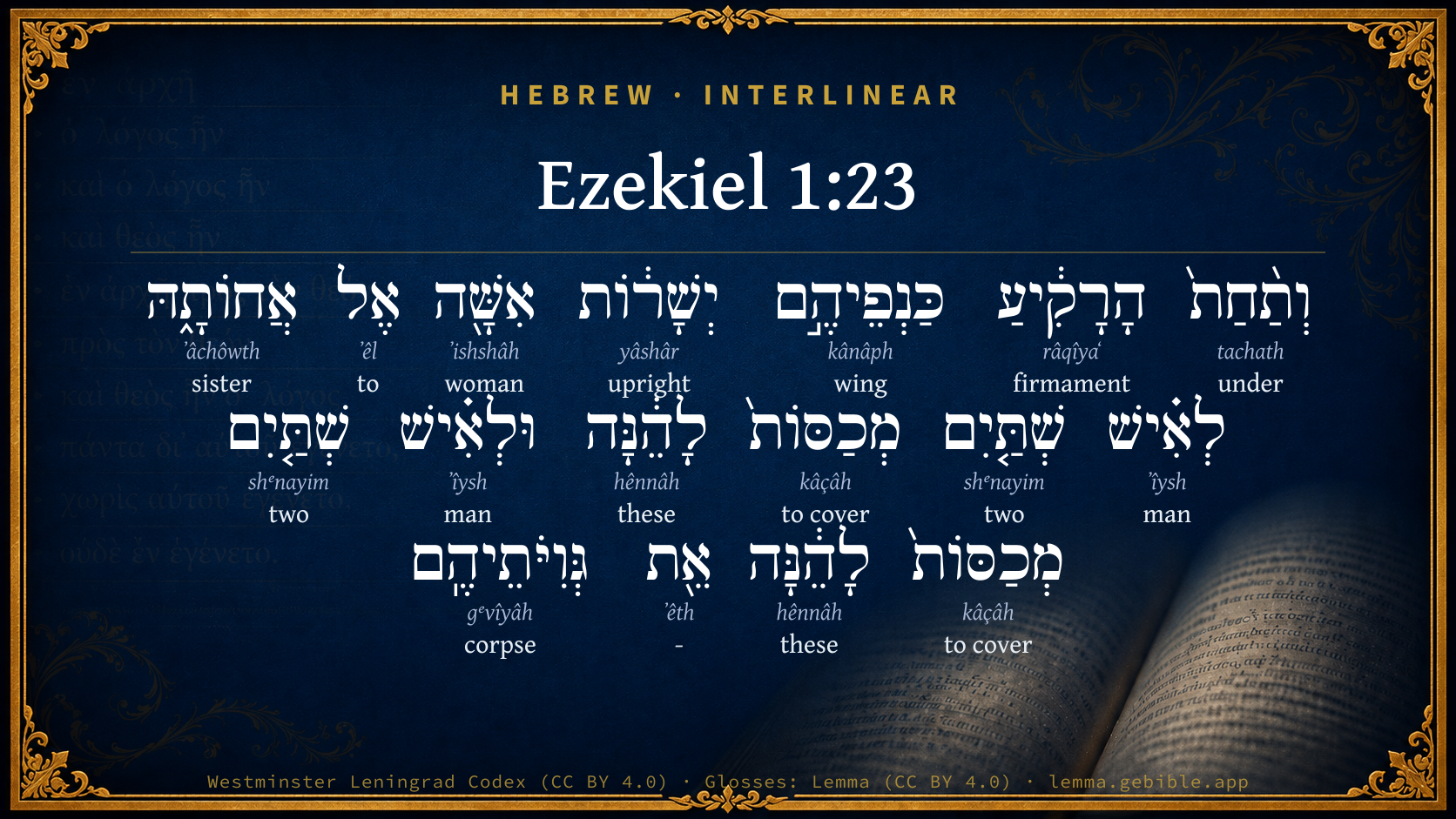
Hebrew (Westminster Leningrad Codex) Ezekiel 1:23 appears in the Hebrew Old Testament. The text above is from the Westminster Leningrad Codex. Each word links to its Strong’s number, a concise gloss, and parsing drawn from the Open Scriptures Hebrew Bible morphology. Click any word for its full Brown-Driver-Briggs (BDB) entry.
Download image
Cite this verse

Ezekiel 1:23 (World English Bible). Public Domain. Lemma interlinear Bible study tool, https://lemma.gebible.app/v/ezekiel/1/23.

Show BibTeX & RIS
BibTeX
RIS
English Translation
Under the expanse were their wings straight, the one toward the other: everyone had two which covered on this side, and every one had two which covered on that side, their bodies.
World English Bible · Public Domain
Download a study sheet

One document with this verse’s original text, its word-by-word gloss line, the meaning frame, cross-references with their text, attributed commentary, and full source and license credits — printable, and it pastes into notes with its structure intact.

This verse Autodidact and up

Study sheet (.html) Plain text (.txt)

A passage Seminary Student

Up to 50 verses in one chapter. A passage sheet keeps up to 6 commentary sources and 12 cross-references per verse, in the order this page ranks them, and says so on the sheet whenever that leaves anything out. Ask for a single verse and you get the Autodidact verse sheet above.

Everything on this page stays free to read, with no account — the sheet is a download of what is already on screen, not access to it.

Want to remove ads? Support Godless Engineer
Compare translations 3

The same verse in 3 English versions, stacked beneath the original-language interlinear above. Click any original word for its lexicon entry.

Each is an independent rendering of the whole verse — the interlinear is not word-aligned to these translations.

Highlighted words mark where these versions differ — a whole-verse word diff, not a word-by-word alignment.

  • World English Bible Public Domain
    Under the expanse were their wings straight, the one toward the other: everyone had two which covered on this side, and every one had two which covered on that side, their bodies.
  • King James Version Public Domain
    And under the firmament were their wings straight, the one toward the other: every one had two, which covered on this side, and every one had two, which covered on that side, their bodies.
  • unfoldingWord Literal Text CC BY-SA 4.0
    Beneath the dome, each one of the creature’s wings stretched out straight and touched another creature’s wings. Each of the living creatures also had a pair to cover themselves; each had a pair to cover his own body.

unfoldingWord Literal Text — © unfoldingWord, licensed CC BY-SA 4.0. Word-aligned USFM3 via Door43 (git.door43.org/unfoldingWord/en_ult).

Versions to compare (up to 4)

3 of 4 selected

Show all 18 translations

Every available English version of this verse, each an independent rendering of the whole verse.

  • World English Bible Public Domain
    Under the expanse were their wings straight, the one toward the other: everyone had two which covered on this side, and every one had two which covered on that side, their bodies.
  • Berean Standard Bible Public Domain
    And under the expanse, their wings stretched out toward one another. Each one also had two wings covering its body.
  • Majority Standard Bible Public Domain
    And under the expanse, their wings stretched out toward one another. Each one also had two wings covering its body.
  • King James Version Public Domain
    And under the firmament were their wings straight, the one toward the other: every one had two, which covered on this side, and every one had two, which covered on that side, their bodies.
  • American Standard Version (1901) Public Domain
    And under the firmament were their wings straight, the one toward the other: every one had two which covered on this side, and every one had two which covered on that side, their bodies.
  • Revised Version (1885) Public Domain
    And under the firmament were their wings straight, the one toward the other: every one had two which covered on this side, and every one had two which covered on that side, their bodies.
  • Geneva Bible (1599) Public Domain
    And vnder the firmament were their wings streight, the one toward the other: every one had two, which couered the, and euery one had two, which couered their bodies.
  • Douay-Rheims (1899) Public Domain
    And under the firmament were their wings straight, the one toward the other, every one with two wings covered his body, and the other was covered in like manner.
  • Young's Literal Translation Public Domain
    And under the expanse their wings `are' straight, one toward the other, to each are two covering on this side, and to each are two covering on that side -- their bodies.
  • Literal Standard Version CC BY-SA 4.0
    And under the expanse their wings [are] straight, one toward [its] sister; two [wings] of each are covering them, and two [wings] of each are covering their bodies.
  • Unlocked Literal Bible CC BY-SA 4.0
    Beneath the dome, each one of the creature's wings stretched out straight and touched another creature's wings. Each of the living creatures also had a pair to cover themselves; each had a pair to cover his own body.
  • unfoldingWord Literal Text CC BY-SA 4.0
    Beneath the dome, each one of the creature’s wings stretched out straight and touched another creature’s wings. Each of the living creatures also had a pair to cover themselves; each had a pair to cover his own body.
  • Darby Bible Public Domain
    And under the expanse were their wings straight, the one toward the other: every one had two which covered on this side, and every one had two which covered on that side their bodies.
  • World Messianic Bible Public Domain
    Under the expanse, their wings were straight, one toward the other. Each one had two which covered on this side, and each one had two which covered their bodies on that side.
  • Webster's Bible Public Domain
    And under the firmament were their wings straight, the one towards the other: every one had two, which covered on this side, and every one had two, which covered on that side, their bodies.
  • Free Bible Version CC BY-SA 4.0
    Under this expanse the wings of the beings spread out toward one another. Each of them also had two wings that covered its body.
  • Bible in Basic English Public Domain
    Under the arch their wings were straight, one stretched out to another: every one had two wings covering their bodies on this side and two covering their bodies on that side.
  • JPS Tanakh (1917) Public Domain
    And under the firmament were their wings conformable the one to the other; this one of them had two which covered, and that one of them had two which covered, their bodies.

Literal Standard Version (2020), Covenant Press — licensed CC BY-SA 4.0. Text via the HelloAO Bible API (eBible.org). Unlocked Literal Bible (unfoldingWord) — licensed CC BY-SA 4.0. Text via the HelloAO Bible API (eBible.org). unfoldingWord Literal Text — © unfoldingWord, licensed CC BY-SA 4.0. Word-aligned USFM3 via Door43 (git.door43.org/unfoldingWord/en_ult). Free Bible Version, Dr. Jonathan Gallagher — licensed CC BY-SA 4.0. Text via the HelloAO Bible API (eBible.org).

Word by word

More ways to search: Search by grammar → Find every occurrence → Compare this word →

Practice this passage: Drill this verse → Learn its vocabulary →

גְּוִיֹּתֵיהֶֽם
gᵉvîyâh
H1472
“corpses · their”
Noun, Common, Feminine, Plural, Construct + Suffix, Personal, 3rd Person, Masculine, Plural
Part of Speech
Noun
Type
Common
Gender
Feminine
Number
Plural
State
Construct
Full BDB Definition

Origin: prolonged for H1465

TWOT: 326d

a body (of living creatures) - a corpse, carcass, dead body
  1. וְתַ֨חַת֙ tachath H8478 “and · under” Conjunction + Preposition
  2. הָרָקִ֔יעַ râqîyaʻ H7549 “the · firmament” Particle, Definite Article + Noun, Common, Masculine, Singular, Absolute
  3. כַּנְפֵיהֶ֣ם kânâph H3671 “wings · their” Noun, Common, Feminine, Dual, Construct + Suffix, Personal, 3rd Person, Masculine, Plural
  4. יְשָׁר֔וֹת yâshâr H3477 “upright” Adjective, Adjective, Feminine, Plural, Absolute
  5. אִשָּׁ֖ה ʼishshâh H802 “woman” Noun, Common, Feminine, Singular, Absolute
  6. אֶל ʼêl H413 “to” Preposition
  7. אֲחוֹתָ֑הּ ʼâchôwth H269 “sister · her” Noun, Common, Feminine, Singular, Construct + Suffix, Personal, 3rd Person, Feminine, Singular
  8. לְאִ֗ישׁ ʼîysh H376 “to/for · man” Preposition + Noun, Common, Masculine, Singular, Absolute
  9. שְׁתַּ֤יִם shᵉnayim H8147 “two” Adjective, Cardinal number, Feminine, Dual, Absolute
  10. מְכַסּוֹת֙ kâçâh H3680 “covering” Verb, Piel, Participle Active, Feminine, Plural, Absolute
  11. לָהֵ֔נָּה hênnâh H2007 “to/for · these” Preposition + Pronoun, Personal, 3rd Person, Feminine, Plural
  12. וּלְאִ֗ישׁ ʼîysh H376 “and · to/for · man” Conjunction + Preposition + Noun, Common, Masculine, Singular, Absolute
  13. שְׁתַּ֤יִם shᵉnayim H8147 “two” Adjective, Cardinal number, Feminine, Dual, Absolute
  14. מְכַסּוֹת֙ kâçâh H3680 “covering” Verb, Piel, Participle Active, Feminine, Plural, Absolute
  15. לָהֵ֔נָּה hênnâh H2007 “to/for · these” Preposition + Pronoun, Personal, 3rd Person, Feminine, Plural
  16. אֵ֖ת ʼêth H853 “-” Particle, Direct Object

About this verse

These counts appear in no published source. They are computed here, from the morphology-tagged text and Lemma’s own curated glosses. What Lemma adds →

17
words
13
distinct lemmas
Prophets
section

Notable vocabulary

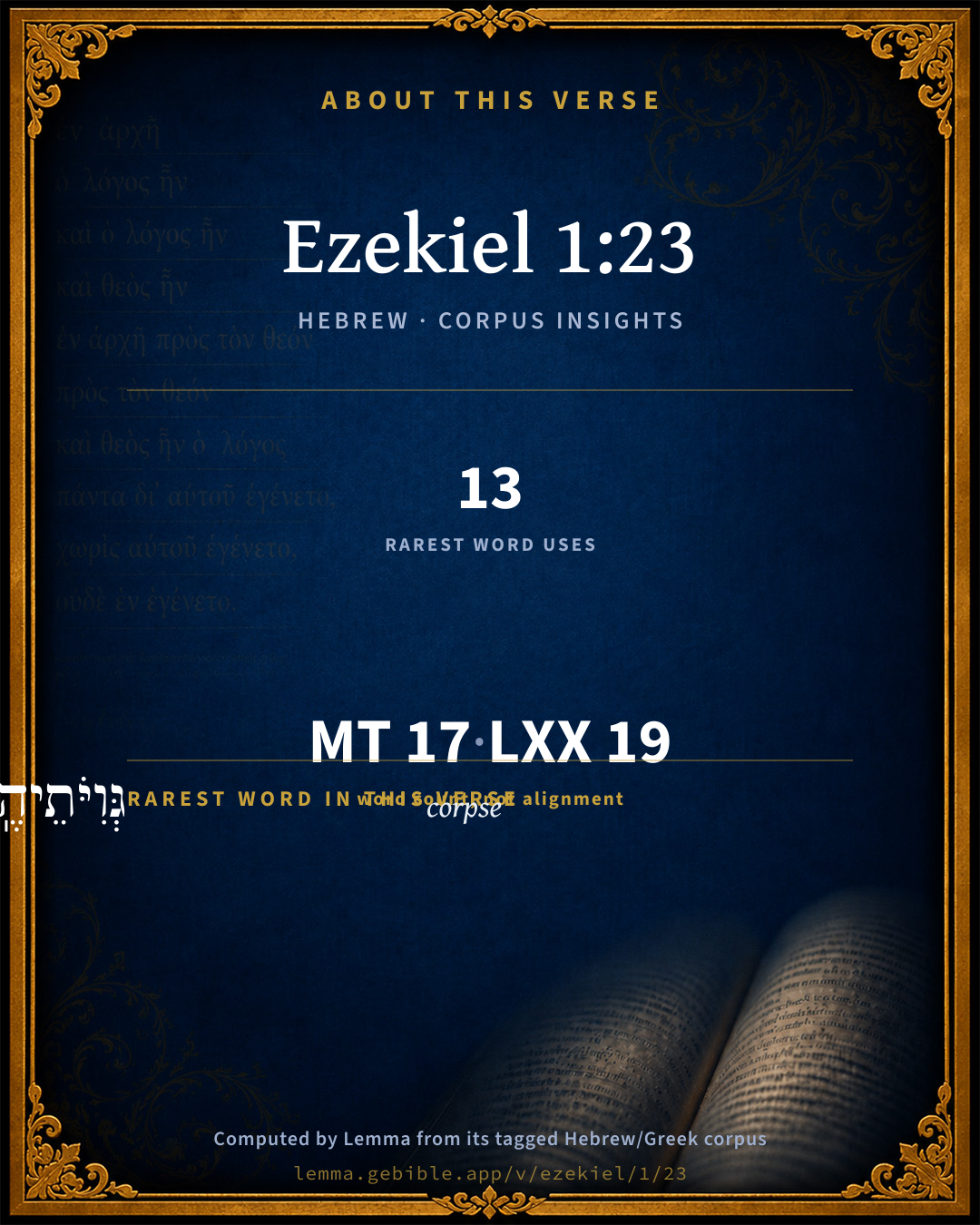
The rarest word here is גְּוִיֹּתֵיהֶֽם corpse H1472 — appearing just 13 times in the whole Hebrew Bible.

Shared distinctive vocabulary

גְּוִיֹּתֵיהֶֽם corpse H1472 occurs in 11 verses of the Hebrew Bible. Also found in:

Grammatical profile

  • 2 verbs
  • 7 nouns
  • 3 adjectives
  • 2 pronouns
  • 2 prepositions
  • 1 particle

Verb forms

  • מְכַסּוֹת֙ Piel · Participle Active
  • מְכַסּוֹת֙ Piel · Participle Active

Repetition

Words recur within this verse — often emphatic in Hebrew:

  • לְאִ֗ישׁ man H376 ×2
  • שְׁתַּ֤יִם two H8147 ×2
  • מְכַסּוֹת֙ to cover H3680 ×2
  • לָהֵ֔נָּה these H2007 ×2

Hebrew & Septuagint length

In English translation the verse runs 32 words from the Hebrew and 21 from the Septuagint (LXX English) — the Septuagint runs noticeably shorter here. See the side-by-side →

A rough comparison of the two English renderings, which tokenize alike — not a word-level alignment.

Word counts can differ between the Hebrew and the Greek without any difference in meaning — e.g. the Hebrew direct-object marker אֵת has no separate Greek word, and Greek often adds the article ὁ.

In the original languages it is 17 Hebrew tokens and 19 Greek tokens — but the two are counted differently (Hebrew bundles its prefixes and suffixes into one token; the Greek is in lemma form), so that isn’t a like-for-like length.

Cross-references

5

Topical passages linked to Ezekiel 1:23 in the Treasury of Scripture Knowledge — connected by theme and wording, ordered by reader-vote popularity; previews shown in the World English Bible.

  • Job 4:18 Behold, he puts no trust in his servants. He charges his angels with error.
  • Psalms 89:7 A very awesome God in the council of the holy ones, To be feared above all those who are around him?
  • Ezekiel 1:11–12 Their faces and their wings were separate above; two [wings] of everyone were joined one to another, and two covered their bodies.
  • Ezekiel 1:24 When they went, I heard the noise of their wings like the noise of great waters, like the voice of the Almighty, a noise of tumult like the noise of a host: when they stood, they let down their wings.
  • Luke 17:10 Even so you also, when you have done all the things that are commanded you, say, 'We are unworthy servants. We have done our duty.'"

Cross-references courtesy of OpenBible.info (CC BY 4.0).

Hebrew and Greek witnesses Masoretic Hebrew ↔ Greek Septuagint

The same verse in the two great witnesses to the Old Testament, shown verse-for-verse.

Here the Septuagint runs noticeably shorter than the Hebrew — LXX2012 (modern English Septuagint) 21 words vs World English Bible 32. A rough length comparison of the two English translations, not a word-level alignment — read both below.

These are two independent witnesses, not word-aligned to each other, and the Septuagint is shown in lemma (dictionary) form.

Hebrew Ezekiel 1:23 Masoretic · Westminster Leningrad Codex

וְתַ֨חַת֙ הָרָקִ֔יעַ כַּנְפֵיהֶ֣ם יְשָׁר֔וֹת אִשָּׁ֖ה אֶל אֲחוֹתָ֑הּ לְאִ֗ישׁ שְׁתַּ֤יִם מְכַסּוֹת֙ לָהֵ֔נָּה וּלְאִ֗ישׁ שְׁתַּ֤יִם מְכַסּוֹת֙ לָהֵ֔נָּה אֵ֖ת גְּוִיֹּתֵיהֶֽם

Under the expanse were their wings straight, the one toward the other: everyone had two which covered on this side, and every one had two which covered on that side, their bodies.

World English Bible · Public Domain

Greek LXX Ezekiel 1:23 Septuagint · lemma form

καί ὑποκάτω ὁ στερέωμα ὁ πτέρυξ αὐτός ἐκτείνω πτερύσσομαι ἕτερος ὁ ἕτερος ἕκαστος δύο συνζεύγνυμι ἐπικαλύπτω ὁ σῶμα αὐτός

And their wings were spread out under the firmament, reaching one to the other; two wings to each, covering their bodies.

LXX2012 (modern English Septuagint) · Public Domain

On this verse, The Cambridge Bible for Schools and Colleges discusses the Septuagint’s reading. Read the note in Commentary ↓

Hebrew: Westminster Leningrad Codex (CC BY 4.0). Greek: Septuagint (public domain); English from LXX2012 (modern English Septuagint) (Public Domain). How the Septuagint differs from the Hebrew →

Targum (Aramaic paraphrase)

1

The Targum is the ancient Jewish Aramaic paraphrase of the Hebrew Scriptures — an interpretive translation, not the Hebrew text itself. Onkelos (literal) and Pseudo-Jonathan (expansive) render the Torah, and Jonathan the Prophets. Coverage is partial: where no permissively-licensed English translation exists for a verse, only the Aramaic is shown. This is verse-level text, not a word-by-word alignment to the Hebrew.

  1. Targum Jonathan Prophets (Joshua–Malachi)
    וּתְחוֹת רְקִיעָא גַפֵּיהוֹן מְכַוְנָן חֲדָא לִקְבֵיל חֲדָא לַחֲדָא תַּרְתֵּין מְכַסִין לְהֵן וְלַחֲדָא תַּרְתֵּין מְכַסִין לְהֵן יַת גְוִיָתְהֵן:

    (no public-domain English translation for this verse)

    Targum Jonathan — Aramaic: “Mikraot Gedolot” (public domain). English: “Sefaria Community Translation” (CC0 1.0 (public-domain dedication)); “London "Chaldee Paraphrase," 1871” (public domain). Text via Sefaria.

Commentary

Notes on Ezekiel 1:23 from classic Christian and Jewish commentators (each source and its license shown beneath its notes). The classic Christian expositions comment on the surrounding passage and are grouped to its opening verse, so a note may address several verses; the Jewish commentaries on the Tanakh (Rashi and others) are per-verse, so they appear only where the commentator wrote on this verse.

Lemma curates 59 commentaries, every one of them public domain or Creative Commons licensed, each selected and text-cleaned for this edition rather than reprinted as found. About our sources →

Trapp's Complete Commentary

John Trapp

Eze 1:23 And under the firmament [were] their wings straight, the one toward the other: every one had two, which covered on this side, and every one had two, which covered on that side, their bodies.

Ver. 23. Were their wings straight,] sc., When they flew; for at other times they covered their bodies with them, {Eze 1:11} in reverence to Christ their Creator and Lord.

The one toward the other.] They serve the Lord Christ with one shoulder or consent; they do all mind the same thing.

John Trapp, A Commentary or Exposition upon All the Books of the Old and New Testament (1647–1656) — public domain. Text from a community e-Sword module.

Jamieson, Fausset & Brown

Robert Jamieson, A. R. Fausset & David Brown

straight--erect [FAIRBAIRN], expanded upright.

two . . . two . . . covered . . . bodies--not, as it might seem, contradicting Eze 1:11. The two wings expanded upwards, though chiefly used for flying, yet up to the summit of the figure where they were parted from each other, covered the upper part of the body, while the other two wings covered the lower parts.

Jamieson, Fausset & Brown — Commentary Critical and Explanatory on the Whole Bible (1871) — public domain (CC PDM 1.0). Text via the HelloAO Bible API.

Adam Clarke's Commentary

Verse 23. Every one had two, which covered on this side] While they employed two of their wings to form a foundation for the firmament to rest on, two other wings were let down to cover the lower part of their bodies: but this they did only when they stood, Eze 1:24.

Adam Clarke's Commentary on the Bible (1810–1826) — public domain. Text from a community e-Sword/MySword module.

John Calvin's Commentaries

There is some obscurity in the words, but it may be easily removed if we remark the two ways of covering; for those wings which tended upwards covered the living’ creatures themselves- that is, their faces, but the other wings, which were joined to their bodies, covered the body itself. Some think that there is a repetition here, and say that the two wings which cover the face and those which cover the body are the same. But this seems to me absurd. I have no doubt but that what we saw before is repeated, namely, that each living creature was covered with four wings, comprising the two which were raised upwards, and the two which were so joined that each living creature was connected with another. That was one form of covering: but another was by letting the wings fall which covered the whole body. On the whole, the Prophet adds nothing new, but impresses what he had said before. It follows —

John Calvin's Commentaries (1540-1563) — public domain. Text from the Calvin Translation Society English edition (1840s-50s) via the Christian Classics Ethereal Library (ccel.org). Calvin's coverage is partial (roughly two-thirds of the Bible); uncommented books and verses are honest gaps, never fabricated. The 19th-century editor's footnotes and remarks are omitted so the notes are faithfully Calvin's own voice.

Ellicott's Commentary for English Readers

(23) Two, which covered on this side.—The excessive literalness of this translation obscures the sense, for it seems to imply that each cherub used four wings to cover his body; whereas the true meaning is that “each had two wings covering his body on either side.” The other two wings of each cherub were “straight,” extended when they were in motion, but let down when at rest (Eze_1:25).

A Bible Commentary for English Readers, edited by Charles John Ellicott (1878–1897) — public domain. Text from a community e-Sword module.

The Cambridge Bible for Schools and Colleges

gen. ed. J. J. S. Perowne

23. were their wings straight] “straight” is even, level, and the reference appears to be to the upper side of the wings stretched out horizontally under the firmament. It is not meant that the firmament rested on the wings or heads of the living creatures, it was over them.

the one toward the other] A repetition of the statement that the outspread wings of one creature touched those of the other creatures; see Eze_1:9; Eze_1:11.

on this side … on that side] In these rather obscure words “this side,” “that side” do not refer to the “sides” of the individual creature, but to the positions of the different creatures, and might be rendered, “here … there,” or, “respectively … respectively.” It is doubtful, however, if the words can have this meaning. Probably the rendering should be: every one had two covering them, and every one had two covering them, even their bodies—the words “their bodies” giving a more exact definition of “covering them.” Cf. Isa_11:9. The statement is repeated in order to distribute it over each of the creatures, although the and before the repetition is less usual (ch. Eze_4:6, Eze_46:21). LXX. reads simply: every one had two, covering their bodies.

The Cambridge Bible for Schools and Colleges (gen. ed. J. J. S. Perowne; Cambridge University Press, 1878–1918) — public domain. Text from a community e-Sword module.

John Gill's Exposition

And under the firmament were their wings straight, the one toward the other,.... A further account is here given of the wings of the living creatures, which were under the firmament: two of their wings were stretched straight upwards towards the firmament, and joined each other; See Gill on Eze 1:9;

everyone had two, which covered on this side; besides the two that were carried straight upright towards heaven, they had other two, which covered their back and belly: and

everyone had two, which covered on that side, their bodies; that is, on each side of their bodies; so that there were in all six wings, as in Isaiah's vision, and in that of the Revelation of John: as their wings in general denote the swiftness and readiness of Gospel ministers to do the work of Christ, for which they exact help and assistance from above, signified by two being stretched straight upwards; see Eze 1:11; so covering the several parts of their bodies with the rest shows their modesty and humility, as being ashamed of themselves and their services, when performed in the best manor; it being altogether owing to the grace of God they are what they are, have and do; they themselves being the chief of sinners, and the least of saints, in their own account.

John Gill's Exposition of the Whole Bible (1746–1763) — public domain (CC PDM 1.0). Text via the HelloAO Bible API.

Albert Barnes' Notes on the Bible

Every one had two, which covered ... - Or, each one had two wings covering his body on either side.

Albert Barnes' Notes on the Bible (1834–1885) — public domain. Text from a community e-Sword/MySword module.

Matthew Poole's English Annotations

Under; below at a great, which is but due, distance of angels, and creatures and servants to their God, Creator, and Lord, stood these living creatures, i.e. two of each living creature, as appeareth by the phrase, one toward the other.

Straight; stretched forth, ready for motion if commanded, and with equal straightness and height, in close and affectionate union, joining in the work appointed them.

Every one had two, which covered on this side, and every one had two, which covered on that side, their bodies; each of the four living creatures had two other wings with which they covered their bodies; the two living creatures on the one side of the chariot, and two living creatures on the other side; so that in what position soever the prophet looked towards them, their lower wings covered them.

Bodies, here ascribed to them representatively, and, as all the rest, visionally.

Matthew Poole's English Annotations on the Holy Bible (1683–1685) — public domain. Text from a community e-Sword/MySword module.

Whedon's Commentary on the Bible

Daniel D. Whedon

23. Everyone had two, which covered their… bodies — Repeated from Eze_1:11. The reason for not describing these strange creatures more minutely is that their bodies were completely covered by their wings on every side.

Daniel D. Whedon (gen. ed.), Commentary on the Old and New Testaments (1874–1909) — public domain. Text from a community e-Sword module.

The Pulpit Commentary

Under the firmament, etc. The description must be read as completing that of ver. 11. The two upper wings of the "living creatures" were not only stretched out, but they pointed to the azure canopy above them, not as sustaining it, but in the attitude of adoration. Nature, in all her life phenomena, adores the majesty of the Eternal.

The Pulpit Commentary (1880–1919), ed. H.D.M. Spence-Jones & Joseph S. Exell — public domain. Text from a community e-Sword module.

John Wesley's Explanatory Notes

Under - Below at a great distance, stood these living creatures. Straight - Stretched forth, ready for motion. One - Each of the four had two other wings with which they covered their bodies.

John Wesley, Explanatory Notes Upon the Whole Bible (1754–1765) — public domain. Text via the GEBible commentary corpus.

Rashi

Rabbi Shlomo Yitzchaki (Rashi)

straight Parallel.

Rashi on the Tanakh — English translations: “The Judaica Press complete Tanach with Rashi, translated by A. J. Rosenberg” (CC BY 4.0); “Pentateuch with Rashi's commentary by M. Rosenbaum and A.M. Silbermann, 1929-1934” (public domain); “The Metsudah Tanach series, Lakewood, N.J” (CC BY 4.0); and “The Book of Joshua, Metsudah Publications, 1997” (CC BY 4.0). Text via Sefaria.

Lesson kit

Teaching starters — assembled from the data on this page, not authored interpretation. Every prompt links to the verse data it draws on. Edit before teaching.

Ezekiel, in the Prophets, opens this verse with 17 words (13 distinct Hebrew lemmas). Its most distinctive word is gᵉvîyâh (“corpse”). The Greek Septuagint runs shorter here. A historical commentator’s framing appears above. Read the whole chapter for the surrounding context.

Discussion questions

  1. How does “corpse” (gᵉvîyâh) shape what this verse is saying?
  2. How does Genesis 47:18, which shares the word «corpse», read alongside this verse?
  3. What does the repetition of “man” (2× in this one verse) do in this verse?
  4. The Septuagint runs shorter here than the Hebrew. What might account for the difference?
  5. These translations render this verse differently. What is at stake in choosing one wording over another?
  6. «מְכַסּוֹת֙» is a Piel Participle Active verb. How does that grammatical form shape the action described?
  7. Compare how Trapp's Complete Commentary and Jamieson, Fausset & Brown read this verse. Where do they agree or differ?

Things to notice

Reading settings

Reading text

Shown beneath each verse's original-language words.

Old Testament
Old Testament edition

Read the OT as the Masoretic Hebrew (MT) or the Greek Septuagint (LXX).

English shown for the Greek Septuagint (in the Hebrew ↔ Greek comparison).

Comparing translations? Open the Compare panel on any verse page to stack up to four side by side.