
Numbers 1:44

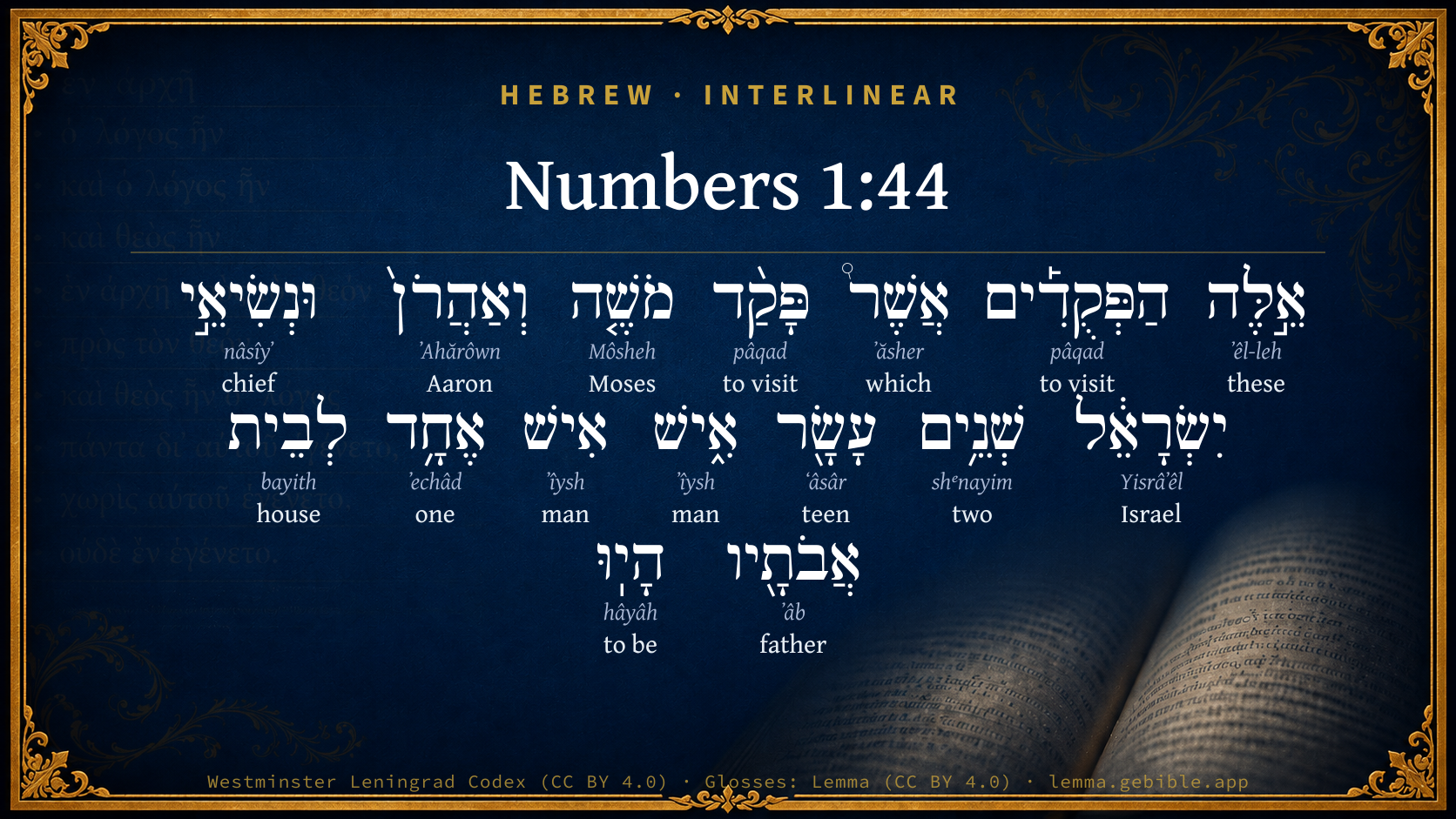
Hebrew (Westminster Leningrad Codex) Numbers 1:44 appears in the Hebrew Old Testament. The text above is from the Westminster Leningrad Codex. Each word links to its Strong’s number, a concise gloss, and parsing drawn from the Open Scriptures Hebrew Bible morphology. Click any word for its full Brown-Driver-Briggs (BDB) entry.
Download image
Cite this verse

Numbers 1:44 (World English Bible). Public Domain. Lemma interlinear Bible study tool, https://lemma.gebible.app/v/numbers/1/44.

Show BibTeX & RIS
BibTeX
RIS
English Translation
These are those who were numbered, whom Moses and Aaron numbered, and the princes of Israel, being twelve men: they were each one for his fathers' house.
World English Bible · Public Domain
Download a study sheet

One document with this verse’s original text, its word-by-word gloss line, the meaning frame, cross-references with their text, attributed commentary, and full source and license credits — printable, and it pastes into notes with its structure intact.

This verse Autodidact and up

Study sheet (.html) Plain text (.txt)

A passage Seminary Student

Up to 50 verses in one chapter. A passage sheet keeps up to 6 commentary sources and 12 cross-references per verse, in the order this page ranks them, and says so on the sheet whenever that leaves anything out. Ask for a single verse and you get the Autodidact verse sheet above.

Everything on this page stays free to read, with no account — the sheet is a download of what is already on screen, not access to it.

Want to remove ads? Support Godless Engineer
Compare translations 3

The same verse in 3 English versions, stacked beneath the original-language interlinear above. Click any original word for its lexicon entry.

Each is an independent rendering of the whole verse — the interlinear is not word-aligned to these translations.

Highlighted words mark where these versions differ — a whole-verse word diff, not a word-by-word alignment.

  • World English Bible Public Domain
    These are those who were numbered, whom Moses and Aaron numbered, and the princes of Israel, being twelve men: they were each one for his fathers' house.
  • King James Version Public Domain
    These are those that were numbered, which Moses and Aaron numbered, and the princes of Israel, being twelve men: each one was for the house of his fathers.
  • unfoldingWord Literal Text CC BY-SA 4.0
    These the counted ones, whom Moses and Aaron had counted, and the leaders of Israel, 12 men. They were one man for the house of his fathers.

unfoldingWord Literal Text — © unfoldingWord, licensed CC BY-SA 4.0. Word-aligned USFM3 via Door43 (git.door43.org/unfoldingWord/en_ult).

Versions to compare (up to 4)

3 of 4 selected

Show all 18 translations

Every available English version of this verse, each an independent rendering of the whole verse.

  • World English Bible Public Domain
    These are those who were numbered, whom Moses and Aaron numbered, and the princes of Israel, being twelve men: they were each one for his fathers' house.
  • Berean Standard Bible Public Domain
    These were the men numbered by Moses and Aaron, with the assistance of the twelve leaders of Israel, each one representing his family.
  • Majority Standard Bible Public Domain
    These were the men numbered by Moses and Aaron, with the assistance of the twelve leaders of Israel, each one representing his family.
  • King James Version Public Domain
    These are those that were numbered, which Moses and Aaron numbered, and the princes of Israel, being twelve men: each one was for the house of his fathers.
  • American Standard Version (1901) Public Domain
    These are they that were numbered, whom Moses and Aaron numbered, and the princes of Israel, being twelve men: they were each one for his fathers' house.
  • Revised Version (1885) Public Domain
    These are they that were numbered, which Moses and Aaron numbered, and the princes of Israel, being twelve men: they were each one for his fathers’ house.
  • Geneva Bible (1599) Public Domain
    These are the summes which Moses, and Aaron nombred, and the Princes of Israel, the twelue men, which were euery one for the house of their fathers.
  • Douay-Rheims (1899) Public Domain
    These era they who were numbered by Moses and Aaron, and the twelve princes of Israel, every one by the houses of their kindreds.
  • Young's Literal Translation Public Domain
    These `are' those numbered, whom Moses numbered -- Aaron also, and the princes of Israel, twelve men -- each for the house of his fathers, they have been.
  • Literal Standard Version CC BY-SA 4.0
    These [are] those numbered, whom Moses numbered—Aaron also—and the princes of Israel, twelve men, each one has been [the representative] for the house of his fathers.
  • Unlocked Literal Bible CC BY-SA 4.0
    Moses and Aaron counted all these men, together with the twelve men who were leading the twelve tribes of Israel.
  • unfoldingWord Literal Text CC BY-SA 4.0
    These the counted ones, whom Moses and Aaron had counted, and the leaders of Israel, 12 men. They were one man for the house of his fathers.
  • Darby Bible Public Domain
    These are those that were numbered, whom Moses and Aaron numbered, and the princes of Israel, the twelve men: each one was for the house of his fathers.
  • World Messianic Bible Public Domain
    These are those who were counted, whom Moses and Aaron counted, and the twelve men who were princes of Israel, each one for his fathers’ house.
  • Webster's Bible Public Domain
    These are those that were numbered, which Moses and Aaron numbered, and the princes of Israel, being twelve men: each one was for the house of his fathers.
  • Free Bible Version CC BY-SA 4.0
    These were the totals of the men counted and registered by Moses and Aaron, with the help of the twelve leaders of Israel, who each represented their family.
  • Bible in Basic English Public Domain
    These are they who were numbered by Moses and Aaron and by the twelve chiefs of Israel, one from every tribe.
  • JPS Tanakh (1917) Public Domain
    These are those that were numbered, which Moses and Aaron numbered, and the princes of Israel, being twelve men; they were each one for his fathers' house.

Literal Standard Version (2020), Covenant Press — licensed CC BY-SA 4.0. Text via the HelloAO Bible API (eBible.org). Unlocked Literal Bible (unfoldingWord) — licensed CC BY-SA 4.0. Text via the HelloAO Bible API (eBible.org). unfoldingWord Literal Text — © unfoldingWord, licensed CC BY-SA 4.0. Word-aligned USFM3 via Door43 (git.door43.org/unfoldingWord/en_ult). Free Bible Version, Dr. Jonathan Gallagher — licensed CC BY-SA 4.0. Text via the HelloAO Bible API (eBible.org).

Word by word

More ways to search: Search by grammar → Find every occurrence → Compare this word →

Practice this passage: Drill this verse → Learn its vocabulary →

וּנְשִׂיאֵ֣י
nâsîyʼ
H5387
“and · chiefs of”
Conjunction + Noun, Common, Masculine, Plural, Construct
Part of Speech
Conjunction + Noun
Type
Common
Gender
Masculine
Number
Plural
State
Construct
Full BDB Definition

Origin: from H5375

TWOT: 1421b , 1421c

one lifted up, chief, prince, captain, leader - rising mist, vapour
  1. אֵ֣לֶּה ʼêl-leh H428 “these” Pronoun, Demonstrative, Common, Plural
  2. הַפְּקֻדִ֡ים pâqad H6485 “the · visited” Particle, Definite Article + Verb, Qal, Participle Passive, Masculine, Plural, Absolute
  3. אֲשֶׁר֩ ʼăsher H834 “which” Particle, Relative
  4. פָּקַ֨ד pâqad H6485 “to visit” Verb, Qal, Perfect, 3rd Person, Masculine, Singular
  5. מֹשֶׁ֤ה Môsheh H4872 “Moses” Noun, Proper
  6. וְאַהֲרֹן֙ ʼAhărôwn H175 “and · Aaron” Conjunction + Noun, Proper
  7. יִשְׂרָאֵ֔ל Yisrâʼêl H3478 “Israel” Noun, Proper
  8. שְׁנֵ֥ים shᵉnayim H8147 “two” Adjective, Cardinal number, Masculine, Dual, Absolute
  9. עָשָׂ֖ר ʻâsâr H6240 “teen” Adjective, Cardinal number, Masculine, Singular, Absolute
  10. אִ֑ישׁ ʼîysh H376 “man” Noun, Common, Masculine, Singular, Absolute
  11. אִישׁ ʼîysh H376 “man” Noun, Common, Masculine, Singular, Absolute
  12. אֶחָ֥ד ʼechâd H259 “one” Adjective, Cardinal number, Masculine, Singular, Absolute
  13. לְבֵית bayith H1004 “to/for · house of” Preposition + Noun, Common, Masculine, Singular, Construct
  14. אֲבֹתָ֖יו ʼâb H1 “fathers · his” Noun, Common, Masculine, Plural, Construct + Suffix, Personal, 3rd Person, Masculine, Singular
  15. הָיֽוּ hâyâh H1961 “to be” Verb, Qal, Perfect, 3rd Person, Common, Plural

About this verse

These counts appear in no published source. They are computed here, from the morphology-tagged text and Lemma’s own curated glosses. What Lemma adds →

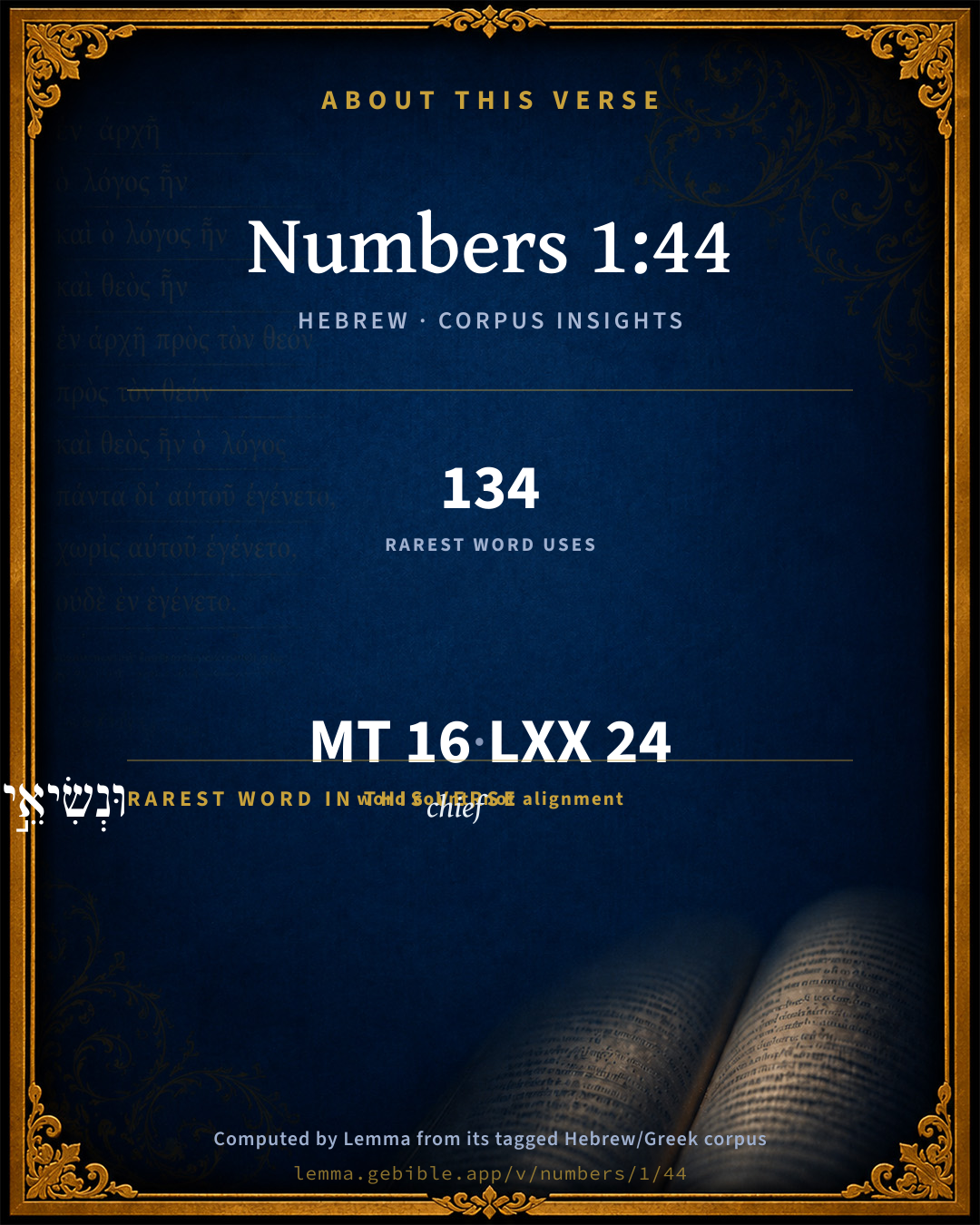
16
words
14
distinct lemmas
Pentateuch
section

Grammatical profile

  • 3 verbs
  • 8 nouns
  • 3 adjectives
  • 1 pronoun
  • 1 particle

Verb forms

  • הַפְּקֻדִ֡ים Qal · Participle Passive
  • פָּקַ֨ד Qal · Perfect
  • הָיֽוּ Qal · Perfect

Repetition

Words recur within this verse — often emphatic in Hebrew:

  • הַפְּקֻדִ֡ים to visit H6485 ×2
  • אִ֑ישׁ man H376 ×2

Hebrew & Septuagint length

In English translation the verse runs 27 words from the Hebrew and 36 from the Septuagint (LXX English) — closely comparable.

A rough comparison of the two English renderings, which tokenize alike — not a word-level alignment.

Word counts can differ between the Hebrew and the Greek without any difference in meaning — e.g. the Hebrew direct-object marker אֵת has no separate Greek word, and Greek often adds the article ὁ.

In the original languages it is 16 Hebrew tokens and 24 Greek tokens — but the two are counted differently (Hebrew bundles its prefixes and suffixes into one token; the Greek is in lemma form), so that isn’t a like-for-like length.

Cross-references

2

Topical passages linked to Numbers 1:44 in the Treasury of Scripture Knowledge — connected by theme and wording, ordered by reader-vote popularity; previews shown in the World English Bible.

  • Numbers 26:64 But among these there was not a man of them who were numbered by Moses and Aaron the priest, who numbered the children of Israel in the wilderness of Sinai.
  • Numbers 1:2–16 "Take a census of all the congregation of the children of Israel, by their families, by their fathers' houses, according to the number of the names, every male, one by one;

Cross-references courtesy of OpenBible.info (CC BY 4.0).

Hebrew and Greek witnesses Masoretic Hebrew ↔ Greek Septuagint

The same verse in the two great witnesses to the Old Testament, shown verse-for-verse.

These are two independent witnesses, not word-aligned to each other, and the Septuagint is shown in lemma (dictionary) form.

Hebrew Numbers 1:44 Masoretic · Westminster Leningrad Codex

אֵ֣לֶּה הַפְּקֻדִ֡ים אֲשֶׁר֩ פָּקַ֨ד מֹשֶׁ֤ה וְאַהֲרֹן֙ וּנְשִׂיאֵ֣י יִשְׂרָאֵ֔ל שְׁנֵ֥ים עָשָׂ֖ר אִ֑ישׁ אִישׁ אֶחָ֥ד לְבֵית אֲבֹתָ֖יו הָיֽוּ

These are those who were numbered, whom Moses and Aaron numbered, and the princes of Israel, being twelve men: they were each one for his fathers' house.

World English Bible · Public Domain

Greek LXX Numbers 1:44 Septuagint · lemma form

οὗτος ὁ ἐπίσκεψις ὅς ἐπισκέπτω μωυσῆς καί ἀαρών καί ὁ ἄρχων ἰσραήλ δώδεκα ἀνήρ ἀνήρ εἷς κατά φυλή εἷς κατά φυλή οἶκος πατριά εἰμί

This is the numbering which Moses and Aaron and the rulers of Israel, being twelve men, conducted: there was a man for each tribe, they were according to the tribe of the houses of their family.

LXX2012 (modern English Septuagint) · Public Domain

Hebrew: Westminster Leningrad Codex (CC BY 4.0). Greek: Septuagint (public domain); English from LXX2012 (modern English Septuagint) (Public Domain). How the Septuagint differs from the Hebrew →

Targum (Aramaic paraphrase)

2

The Targum is the ancient Jewish Aramaic paraphrase of the Hebrew Scriptures — an interpretive translation, not the Hebrew text itself. Onkelos (literal) and Pseudo-Jonathan (expansive) render the Torah, and Jonathan the Prophets. Coverage is partial: where no permissively-licensed English translation exists for a verse, only the Aramaic is shown. This is verse-level text, not a word-by-word alignment to the Hebrew.

  1. Targum Onkelos Torah (Genesis–Deuteronomy)
    אִלֵין מִנְיָנַיָא דִי מְנָא משֶׁה וְאַהֲרֹן וְרַבְרְבֵי יִשְׂרָאֵל תְּרֵי עֲשַׂר גֻבְרִין גַבְרָא חַד לְבֵית אֲבָהָתוֹהִי הֲווֹ

    (no public-domain English translation for this verse)

    Targum Onkelos — Aramaic: “Onkelos Genesis” (public domain); “Onkelos Exodus” (public domain); “Onkelos Leviticus” (public domain); “Onkelos Numbers” (public domain); “Onkelos Deuteronomy” (public domain). English: “Sefaria Community Translation” (CC0 1.0 (public-domain dedication)); “J.W. Etheridge. The Targums of Onkelos and Jonathan Ben Uzziel on the Pentateuch. London: Longmans, Green, 1862” (public domain). Text via Sefaria.

  2. Targum Pseudo-Jonathan Torah (Genesis–Deuteronomy)
    אִלֵין סְכוּמֵי מִנְיָינַיָא דִמְנָא משֶׁה וְאַהֲרן וְרַבְרְבֵי יִשְרָאֵל תְּרֵיסַר גוּבְרִין גַבְרָא חָד לְבֵית אַבְהָתוֹי הֲוָון

    These are the sums of the numbered ones which Mosheh and Aharon, and the princes of Israel, twelve men, a man for each house of their fathers, did number.

    Targum Pseudo-Jonathan — Aramaic: “Targum Jonathan on Genesis” (public domain); “Targum Jonathan on Exodus” (public domain); “Targum Jonathan on Leviticus” (public domain); “Targum Jonathan on Numbers” (public domain); “Targum Jonathan on Deuteronomy” (public domain). English: “The Targum of Jonathan ben Uzziel, trans. J. W. Etheridge, London, 1862” (public domain). Text via Sefaria.

Commentary

Notes on Numbers 1:44 from classic Christian and Jewish commentators (each source and its license shown beneath its notes). The classic Christian expositions comment on the surrounding passage and are grouped to its opening verse, so a note may address several verses; the Jewish commentaries on the Tanakh (Rashi and others) are per-verse, so they appear only where the commentator wrote on this verse.

Lemma curates 59 commentaries, every one of them public domain or Creative Commons licensed, each selected and text-cleaned for this edition rather than reprinted as found. About our sources →

Geneva Bible (1599)

Geneva Bible translators

Or, full count.

Geneva Bible (1599) marginal notes — public domain. Text via Bolls.life.

Matthew Henry's Commentary

We have here the sum total at the foot of the account; they were in all 600,000 fighting men, and 3550 over. Some think that when this was their number some months before (Exo 38:26) the Levites were reckoned with them, but now that tribe was separated for the service of God, yet so many more had by this time attained to the age of twenty years as that still they were the same number, to show that whatever we part with for the honour and service of God it shall certainly be made up to us one way of other. Now we see what a vast body of men they were. Let us consider, 1. How much went to maintain all these (besides twice as many more, no question, of women and children, sick and aged, and the mixed multitude) for forty years together in the wilderness; and they were all at God's finding every day, having their food from the dew of heaven, and not from the fatness of the earth. O what a great and good housekeeper is our God, that has such numbers depending on him and receiving from him every day! 2. What work sin makes with a people; within forty years most of them would indeed have died of course for the common sin of mankind; for, when sin entered into the world, death came with it, and how great are the desolations which it makes in the earth! But, for the particular sin of unbelief and murmuring, all those that were now numbered, except two, laid their bones under their iniquity, and perished in the wilderness. 3. What a great multitude God's spiritual Israel will amount to at last; though at one time, and in one place, they seem to be but a little flock, yet when they come all together they shall be a great multitude, innumerable, Rev 7:9. And, though the church's beginning be small, its latter end shall greatly increase. A little one shall become a thousand.

Matthew Henry's Commentary on the Whole Bible (1708–1710) — public domain (CC PDM 1.0). Text via the HelloAO Bible API.

John Gill's Exposition

These are those that were numbered,.... Or, as the Targum of Jonathan, these are the sums of the numbers; namely, those before given of the several respective tribes:

which Moses and Aaron numbered, and the princes of Israel, being twelve men; for though the tribe of Levi was not numbered, yet Joseph having a double portion, his two sons are reckoned as distinct tribes; so that one out of each tribe made up the number twelve:

each one for the house of his fathers; for the tribe he belonged to, with which it might reasonably be supposed he was best acquainted, and could more readily take the number of them.

John Gill's Exposition of the Whole Bible (1746–1763) — public domain (CC PDM 1.0). Text via the HelloAO Bible API.

The Pulpit Commentary

HOMILIES BY W. BINNIE Vers. 44-46. The two numberings in the wilderness.

The Bible abounds in statistics. The historical books, in particular, bristle with genealogies and census-tables. "Numbers" gets its name from the circumstance that it contains the tabulated results of two distinct numberings. The statistical chapters are commonly passed over in the consecutive reading of the Scripture, in the family, and in the Church. The wine of the kingdom does not flow from them freely; all the rather ought care to be taken to read and expound them occasionally. All Scripture is profitable; and the statistical chapters, hard and barren as they look, are no exception.

I For one thing, these chapters serve admirably to ANCHOR THE RELIGION OF THE BIBLE ON THE FIRM GROUND OF HISTORY. The Lord Jesus was not a mythical character, not a mere play of glorious colour on a bank of unsubstantial vapour. He was the son of a daughter of David"s house. His genealogy is extant; and a long chain of family registers, imbedded in the historical books of the Old Testament, afford the means of verifying it. The sacred writers are never afraid to descend from the region of moral and religious disquisition into the region of exact numbers, which can be sifted and weighed in the light of our modern statistical science. The importance of all this can hardly be exaggerated, especially for an age like the present, which so confidently calls in question the historical verity of the Scriptures. To come to these census chapters in Numbers. The critics laugh at the idea that a nation of two millions and more were led out of Egypt by Moses and sojourned in the wilderness for forty years. Objections formidable enough are brought forward; but the objectors have to face the fact that the history, besides giving the round numbers, explain how they were made up. What is more; the details are found, on examination by men expert in statistics, to have such an air of reality that the ablest commentator (Knobel) of the Critical School, can think of no more feasible explanation than to suggest that some Levite must have laid his hands on the report of some real census, taken in a later age, and inserted it here in the Pentateuch. How writings so dishonestly compiled should have reached the high moral elevation of the Pentateuch, the critic has omitted to explain. He is certainly right in taking the chapters in Numbers for veritable census-tables.

II NOR IS IT ONLY IN THIS GENERAL VIEW OF THEM THAT THESE STATISTICAL CHAPTERS ARE INSTRUCTIVE, The facts recorded (like all the authentic facts of God"s providential government of men) are very suggestive.

1. Observe how unequally the several tribes have multiplied. Compare Judah and his 74, 600 with Benjamin and his 35, 400. All family histories and national histories are full of similar inequalities. There are great nations (France, Spain) in which the population is stationary or receding; others, similarly situated, in which there is steady increase (Germany, Russia). In the course of two or three centuries, facts like these must powerfully affect the history of the world. What hopes with regard to the future are excited by observing that, as a rule, it is the Protestant nations that are multiplying, and replenishing the earth, and subduing it!

2. How the blessing delivered by Jacob bears fruit after he has gone; in Ge 49, two sons Judah and Joseph are honoured above the rest.

(a) To Judah is assigned the primacy of honour and power forfeited by Reuben, the firstborn (verses 8-12). How the fulfillment of this comes to light in the census at Sinai! His tribe outnumbers all the others save one; his tents occupy the place of honour in the camp, being pitched towards the rising of the sun; his standard (the lion of the tribe of Judah) leads the van in the march; in the captain of his best, Nahshon, the son of Amminadab, we recognize the ancestor of our Lord.

(b) Joseph, the best-beloved of the twelve, was to be a fruitful vine, a fruitful bough by a well, whose branches run over the wall. His two sons were to become each a several tribe, "as Reuben and Simeon they shall be mine". (Gen_48:5, 6 49:22-26) This also is exactly accomplished; not only are Ephraim and Manasseh reckoned as two tribes, but each takes rank with the other tribes in respect both to honour and numbers. Contemplating these facts in the light of Jacob"s blessing, we can perceive a moral purpose in them; Joseph and Judah were the two who excelled in godliness and magnanimity. The faithful God keepeth covenant to a thousand generations. (comp. Psa_103:17)

3. How a family, which at one time promised well; may catch a blight and fade away. Mark the story of Simeon; at Sinai he was one of the most populous of the tribes; thirty-eight years later he is much the smallest. From nearly 60, 000 he has shriveled into about 22, 000. (comp. 1Ch_4:27) This downward course went on after the conquest. Simeon"s allotted inheritance was next to that of the tribe of Judah; and ere many generations passed he seems to have been absorbed by his more energetic and prosperous brother. The statistics of the Bible, being the digested statement of facts in the Divine government of families and nations, are mines where those who choose to dig find much silver. "The works of the Lord are great, sought out of all them that have pleasure therein. B.

The Pulpit Commentary (1880–1919), ed. H.D.M. Spence-Jones & Joseph S. Exell — public domain. Text from a community e-Sword module.

unfoldingWord translationNotes

Door43 World Missions Community

So all the men of Israel ... were counted in each of their families

The phrase "were counted" can be stated in active form. This long phrase is repeated multiple times in the census. See how you translated it in Numbers 1:20. AT: "So they counted all the men of Israel ... in each of their families" (See: Active or Passive)

603,550 men

"six hundred and three thousand five hundred and fifty men" (See: Numbers)

translationWords

Moses

Aaron

twelve tribes of Israel

Israel

unfoldingWord translationNotes — © Distant Shores Media and the Door43 World Missions Community, licensed CC BY-SA 4.0. Source: git.door43.org/Door43/en_tn.

Lesson kit

Teaching starters — assembled from the data on this page, not authored interpretation. Every prompt links to the verse data it draws on. Edit before teaching.

Numbers, in the Pentateuch, opens this verse with 16 words (14 distinct Hebrew lemmas). Its most distinctive word is nâsîyʼ (“chief”). A historical commentator’s framing appears above. Read the whole chapter for the surrounding context.

Discussion questions

  1. How does “chief” (nâsîyʼ) shape what this verse is saying?
  2. How does Numbers 26:64, which shares this passage’s theme, read alongside this verse?
  3. What does the repetition of “to visit” (2× in this one verse) do in this verse?
  4. These translations render this verse differently. What is at stake in choosing one wording over another?
  5. «הַפְּקֻדִ֡ים» is a Qal Participle Passive verb. How does that grammatical form shape the action described?
  6. Compare how Geneva Bible (1599) and Matthew Henry's Commentary read this verse. Where do they agree or differ?

Things to notice

Reading settings

Reading text

Shown beneath each verse's original-language words.

Old Testament
Old Testament edition

Read the OT as the Masoretic Hebrew (MT) or the Greek Septuagint (LXX).

English shown for the Greek Septuagint (in the Hebrew ↔ Greek comparison).

Comparing translations? Open the Compare panel on any verse page to stack up to four side by side.