Ezekiel 41:24

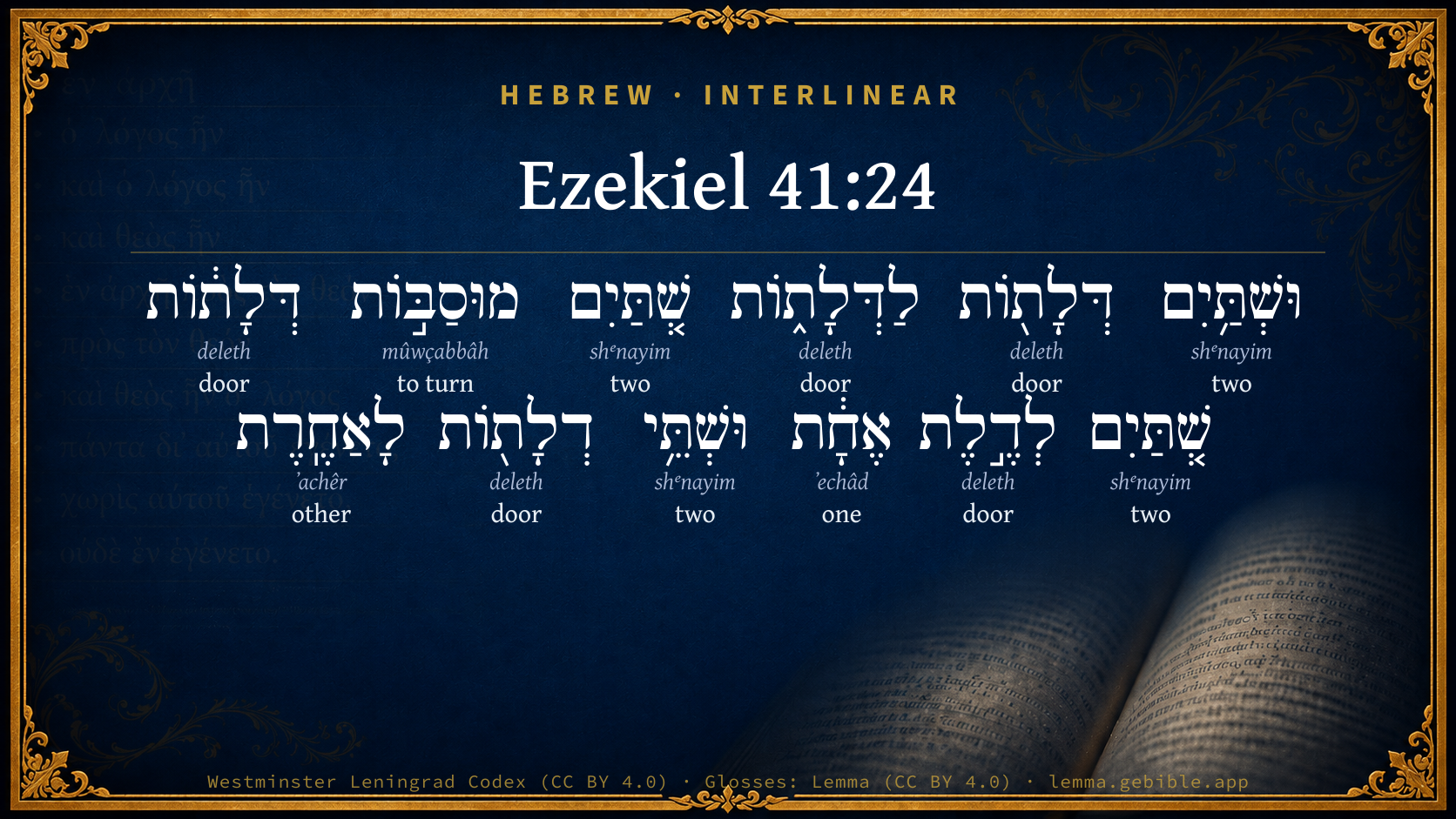
Hebrew (Westminster Leningrad Codex) Ezekiel 41:24 appears in the Hebrew Old Testament. The text above is from the Westminster Leningrad Codex. Each word links to its Strong’s number, a concise gloss, and parsing drawn from the Open Scriptures Hebrew Bible morphology. Click any word for its full Brown-Driver-Briggs (BDB) entry.
Download image
Cite this verse

Ezekiel 41:24 (World English Bible). Public Domain. Lemma interlinear Bible study tool, https://lemma.gebible.app/v/ezekiel/41/24.

Show BibTeX & RIS
BibTeX
RIS
English Translation
The doors had two leaves [apiece], two turning leaves: two [leaves] for the one door, and two leaves for the other.
World English Bible · Public Domain
Download a study sheet

One document with this verse’s original text, its word-by-word gloss line, the meaning frame, cross-references with their text, attributed commentary, and full source and license credits — printable, and it pastes into notes with its structure intact.

This verse Autodidact and up

Study sheet (.html) Plain text (.txt)

A passage Seminary Student

Up to 50 verses in one chapter. A passage sheet keeps up to 6 commentary sources and 12 cross-references per verse, in the order this page ranks them, and says so on the sheet whenever that leaves anything out. Ask for a single verse and you get the Autodidact verse sheet above.

Everything on this page stays free to read, with no account — the sheet is a download of what is already on screen, not access to it.

Want to remove ads? Support Godless Engineer
Compare translations 3

The same verse in 3 English versions, stacked beneath the original-language interlinear above. Click any original word for its lexicon entry.

Each is an independent rendering of the whole verse — the interlinear is not word-aligned to these translations.

Highlighted words mark where these versions differ — a whole-verse word diff, not a word-by-word alignment.

  • World English Bible Public Domain
    The doors had two leaves [apiece], two turning leaves: two [leaves] for the one door, and two leaves for the other.
  • King James Version Public Domain
    And the doors had two leaves apiece, two turning leaves; two leaves for the one door, and two leaves for the other door.
  • unfoldingWord Literal Text CC BY-SA 4.0
    These doors had two hinged door panels each, two panels for one door and two panels for the other.

unfoldingWord Literal Text — © unfoldingWord, licensed CC BY-SA 4.0. Word-aligned USFM3 via Door43 (git.door43.org/unfoldingWord/en_ult).

Versions to compare (up to 4)

3 of 4 selected

Show all 18 translations

Every available English version of this verse, each an independent rendering of the whole verse.

  • World English Bible Public Domain
    The doors had two leaves [apiece], two turning leaves: two [leaves] for the one door, and two leaves for the other.
  • Berean Standard Bible Public Domain
    and each door had two swinging panels. There were two panels for one door and two for the other.
  • Majority Standard Bible Public Domain
    and each door had two swinging panels. There were two panels for one door and two for the other.
  • King James Version Public Domain
    And the doors had two leaves apiece, two turning leaves; two leaves for the one door, and two leaves for the other door.
  • American Standard Version (1901) Public Domain
    And the doors had two leaves `apiece', two turning leaves: two `leaves' for the one door, and two leaves for the other.
  • Revised Version (1885) Public Domain
    And the doors had two leaves apiece, two turning leaves; two leaves for the one door, and two leaves for the other.
  • Geneva Bible (1599) Public Domain
    And the doores had two wickets, euen two turning wickets, two wickets for one doore, and two wickets for another doore.
  • Douay-Rheims (1899) Public Domain
    And in the two doors on both sides were two little doors, which were folded within each other: for there were two wickets on both sides of the doors.
  • Young's Literal Translation Public Domain
    and two leaves `are' to the doors, two turning leaves `are' to the doors, two to the one door, and two leaves to the other.
  • Literal Standard Version CC BY-SA 4.0
    and the doors had two panels, two turning panels: two on one door, and two panels on the other.
  • Unlocked Literal Bible CC BY-SA 4.0
    These doors had two hinged door panels each, two panels for one door and two panels for the other.
  • unfoldingWord Literal Text CC BY-SA 4.0
    These doors had two hinged door panels each, two panels for one door and two panels for the other.
  • Darby Bible Public Domain
    And the doors had two leaves, two turning-leaves: two for the one door, and two leaves for the other.
  • World Messianic Bible Public Domain
    The doors had two leaves each, two turning leaves: two for the one door, and two leaves for the other.
  • Webster's Bible Public Domain
    And the doors had two leaves each, two turning leaves; two leaves for the one door, and two leaves for the other door.
  • Free Bible Version CC BY-SA 4.0
    Each door had two panels that opened. There were two panels for one door, and two panels for the other door.
  • Bible in Basic English Public Domain
    And the holy place had two doors, and the doors had two turning leaves, two for one and two for the other.
  • JPS Tanakh (1917) Public Domain
    And the doors had two leaves apiece, two turning leaves; two leaves for the one door, and two leaves for the other.

Literal Standard Version (2020), Covenant Press — licensed CC BY-SA 4.0. Text via the HelloAO Bible API (eBible.org). Unlocked Literal Bible (unfoldingWord) — licensed CC BY-SA 4.0. Text via the HelloAO Bible API (eBible.org). unfoldingWord Literal Text — © unfoldingWord, licensed CC BY-SA 4.0. Word-aligned USFM3 via Door43 (git.door43.org/unfoldingWord/en_ult). Free Bible Version, Dr. Jonathan Gallagher — licensed CC BY-SA 4.0. Text via the HelloAO Bible API (eBible.org).

Word by word

More ways to search: Search by grammar → Find every occurrence → Compare this word →

Practice this passage: Drill this verse → Learn its vocabulary →

מוּסַבּ֣וֹת
mûwçabbâh
H4142
“turned”
Verb, Hophal, Participle Passive, Feminine, Plural, Absolute
Part of Speech
Verb
Stem
Hophal
Form
Participle Passive
Gender
Feminine
Number
Plural
State
Absolute
Full BDB Definition

Origin: from H4141

TWOT: 1456b

(Hophal) - to be turned - surrounded, set (participle)
  1. וּשְׁתַּ֥יִם shᵉnayim H8147 “and · two” Conjunction + Adjective, Cardinal number, Feminine, Dual, Absolute
  2. דְּלָת֖וֹת deleth H1817 “doors” Noun, Common, Feminine, Plural, Absolute
  3. לַדְּלָת֑וֹת deleth H1817 “to/for the · doors” Preposition, Determined + Noun, Common, Feminine, Plural, Absolute
  4. שְׁ֚תַּיִם shᵉnayim H8147 “two” Adjective, Cardinal number, Feminine, Dual, Absolute
  5. דְּלָת֔וֹת deleth H1817 “doors” Noun, Common, Feminine, Plural, Absolute
  6. שְׁ֚תַּיִם shᵉnayim H8147 “two” Adjective, Cardinal number, Feminine, Dual, Absolute
  7. לְדֶ֣לֶת deleth H1817 “to/for · door” Preposition + Noun, Common, Feminine, Singular, Absolute
  8. אֶחָ֔ת ʼechâd H259 “one” Adjective, Cardinal number, Feminine, Singular, Absolute
  9. וּשְׁתֵּ֥י shᵉnayim H8147 “and · two” Conjunction + Adjective, Cardinal number, Feminine, Dual, Construct
  10. דְלָת֖וֹת deleth H1817 “doors” Noun, Common, Feminine, Plural, Absolute
  11. לָאַחֶֽרֶת ʼachêr H312 “to/for the · other” Preposition, Determined + Adjective, Adjective, Feminine, Singular, Absolute

About this verse

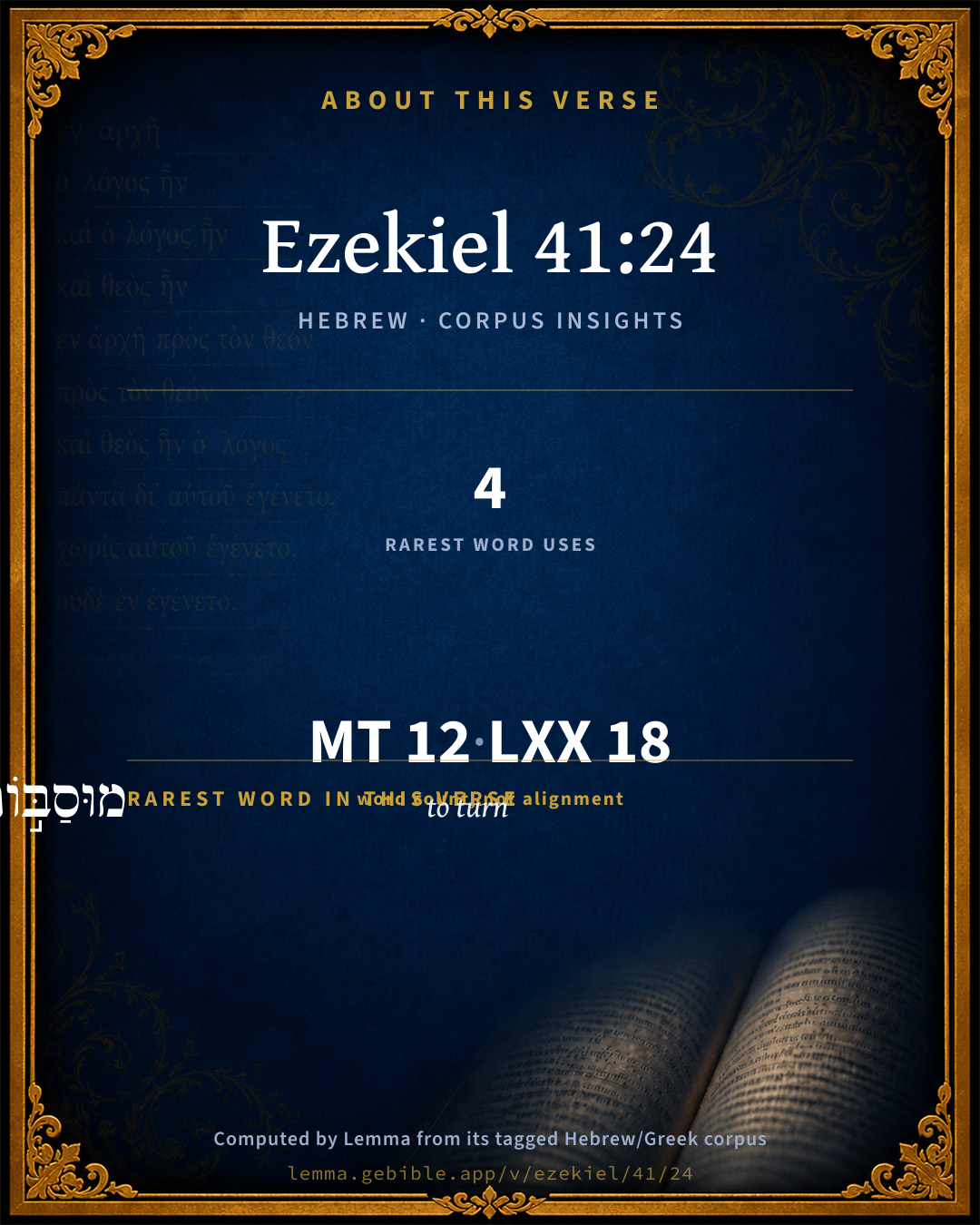
These counts appear in no published source. They are computed here, from the morphology-tagged text and Lemma’s own curated glosses. What Lemma adds →

12
words
5
distinct lemmas
Prophets
section

Notable vocabulary

The rarest word here is מוּסַבּ֣וֹת to turn H4142 — appearing just 4 times in the whole Hebrew Bible.

Shared distinctive vocabulary

מוּסַבּ֣וֹת to turn H4142 occurs in 4 verses of the Hebrew Bible. Also found in:

Grammatical profile

  • 1 verb
  • 5 nouns
  • 6 adjectives

Verb forms

  • מוּסַבּ֣וֹת Hophal · Participle Passive

Repetition

Words recur within this verse — often emphatic in Hebrew:

  • דְּלָת֖וֹת door H1817 ×5
  • וּשְׁתַּ֥יִם two H8147 ×4

Hebrew & Septuagint length

In English translation the verse runs 21 words from the Hebrew and 12 from the Septuagint (LXX English) — the Septuagint runs noticeably shorter here. See the side-by-side →

A rough comparison of the two English renderings, which tokenize alike — not a word-level alignment.

Word counts can differ between the Hebrew and the Greek without any difference in meaning — e.g. the Hebrew direct-object marker אֵת has no separate Greek word, and Greek often adds the article ὁ.

In the original languages it is 12 Hebrew tokens and 18 Greek tokens — but the two are counted differently (Hebrew bundles its prefixes and suffixes into one token; the Greek is in lemma form), so that isn’t a like-for-like length.

Cross-references

2

Topical passages linked to Ezekiel 41:24 in the Treasury of Scripture Knowledge — connected by theme and wording, ordered by reader-vote popularity; previews shown in the World English Bible.

  • 1 Kings 6:34 and two doors of fir-wood: the two leaves of the one door were folding, and the two leaves of the other door were folding.
  • Ezekiel 40:48 Then he brought me to the porch of the house, and measured each post of the porch, five cubits on this side, and five cubits on that side: and the breadth of the gate was three cubits on this side, and three cubits on that side.

Cross-references courtesy of OpenBible.info (CC BY 4.0).

Hebrew and Greek witnesses Masoretic Hebrew ↔ Greek Septuagint

The same verse in the two great witnesses to the Old Testament, shown verse-for-verse.

Here the Septuagint runs noticeably shorter than the Hebrew — LXX2012 (modern English Septuagint) 12 words vs World English Bible 21. A rough length comparison of the two English translations, not a word-level alignment — read both below.

These are two independent witnesses, not word-aligned to each other, and the Septuagint is shown in lemma (dictionary) form.

Hebrew Ezekiel 41:24 Masoretic · Westminster Leningrad Codex

וּשְׁתַּ֥יִם דְּלָת֖וֹת לַדְּלָת֑וֹת שְׁ֚תַּיִם מוּסַבּ֣וֹת דְּלָת֔וֹת שְׁ֚תַּיִם לְדֶ֣לֶת אֶחָ֔ת וּשְׁתֵּ֥י דְלָת֖וֹת לָאַחֶֽרֶת

The doors had two leaves [apiece], two turning leaves: two [leaves] for the one door, and two leaves for the other.

World English Bible · Public Domain

Greek LXX Ezekiel 41:24 Septuagint · lemma form

δύο θύρωμα ὁ δύο θύρωμα ὁ στροφωτός δύο θύρωμα ὁ εἷς καί δύο θύρωμα ὁ θύρα ὁ δεύτερος

two leaves to the one, and two leaves to the other door.

LXX2012 (modern English Septuagint) · Public Domain

Hebrew: Westminster Leningrad Codex (CC BY 4.0). Greek: Septuagint (public domain); English from LXX2012 (modern English Septuagint) (Public Domain). How the Septuagint differs from the Hebrew →

Targum (Aramaic paraphrase)

1

The Targum is the ancient Jewish Aramaic paraphrase of the Hebrew Scriptures — an interpretive translation, not the Hebrew text itself. Onkelos (literal) and Pseudo-Jonathan (expansive) render the Torah, and Jonathan the Prophets. Coverage is partial: where no permissively-licensed English translation exists for a verse, only the Aramaic is shown. This is verse-level text, not a word-by-word alignment to the Hebrew.

  1. Targum Jonathan Prophets (Joshua–Malachi)
    וְתַרְתֵּין דָשִׁין אִימְהָן לְדָשַׁיָא תַּרְתֵּין מַקְפָן דָשִׁין תַּרְתֵּין לְדָשָׁא חַד וְתַרְתֵּין דָשִׁין לְאוֹחֲרַנְתָּא:

    (no public-domain English translation for this verse)

    Targum Jonathan — Aramaic: “Mikraot Gedolot” (public domain). English: “Sefaria Community Translation” (CC0 1.0 (public-domain dedication)); “London "Chaldee Paraphrase," 1871” (public domain). Text via Sefaria.

Commentary

Notes on Ezekiel 41:24 from classic Christian and Jewish commentators (each source and its license shown beneath its notes). The classic Christian expositions comment on the surrounding passage and are grouped to its opening verse, so a note may address several verses; the Jewish commentaries on the Tanakh (Rashi and others) are per-verse, so they appear only where the commentator wrote on this verse.

Lemma curates 59 commentaries, every one of them public domain or Creative Commons licensed, each selected and text-cleaned for this edition rather than reprinted as found. About our sources →

Trapp's Complete Commentary

John Trapp

Eze 41:24 And the doors had two leaves [apiece], two turning leaves; two [leaves] for the one door, and two leaves for the other [door].

Ver. 24. Two leaves.] There are variety of ordinances.

John Trapp, A Commentary or Exposition upon All the Books of the Old and New Testament (1647–1656) — public domain. Text from a community e-Sword module.

Ellicott's Commentary for English Readers

(24) Two turning leaves.—The doors both of the Holy Place and of the Holy of Holies are more fully described in 1Ki_6:31-35. It is to be understood that each of them was made in two parts, and each part again in two leaves folding back, so that there were in all four leaves in each door.

A Bible Commentary for English Readers, edited by Charles John Ellicott (1878–1897) — public domain. Text from a community e-Sword module.

The Cambridge Bible for Schools and Colleges

gen. ed. J. J. S. Perowne

24. And the doors] i.e. the leaves of the door had again two leaves, so that the doors as a whole of the holy place and holiest were each composed of four small leaves, like a screen.

The Cambridge Bible for Schools and Colleges (gen. ed. J. J. S. Perowne; Cambridge University Press, 1878–1918) — public domain. Text from a community e-Sword module.

John Gill's Exposition

And there were made on them, on the doors of the temple,.... Both of the holy, and the most holy place:

cherubim and palm trees, like as were made on the walls; the doors of both places had the same decorations as the walls of each; See Gill on Eze 41:18; See Gill on Eze 41:19; See Gill on Eze 41:20; and so it was in Solomon's temple, Kg1 6:32, a cherub and a palm tree on each leaf, or on each folding of a leaf, according as it would admit of:

and there were thick planks upon the face of the porch without; on the outward front of the porch were some thick wainscot boards, which projected as a cover to the entrance into it; or, as it may be rendered, also on

the thick piece of wood in the front of the porch without (r); which, as Starckius thinks, was a large wooden bar, which shut and held in the folding leaves of the door; and on this, or these thick planks, were cherubim and palm trees.

(r) "etiam denso ligno in fronte vestibuli extrinsecus", Junius & Tremellius; "et trabs lignea ante vestibulum erat foris", Starckius.

John Gill's Exposition of the Whole Bible (1746–1763) — public domain (CC PDM 1.0). Text via the HelloAO Bible API.

Haydock's Catholic Bible Commentary

Other. It was not perhaps necessary to open the large door.

George Leo Haydock (1774–1849), Haydock's Catholic Family Bible and Commentary, 1859 edition — public domain. Excludes Psalms (Douay-Rheims chapter numbering differs from Protestant) and Deuterocanonical books (Catholic canon only).

Matthew Poole's English Annotations

Made; carved.

On them; the doors of both temple and oracle.

The temple; including the holy of holies also.

Cherubims: see Eze 41:18.

Thick planks; I suppose these were boards of more than ordinary thickness, which were fastened to the great beams, whose ends came out beyond the wall of the porch, and probably were laid so as to make a part of an arch over the entrance into the gate, as we see over some houses, and as sometimes under the balconies; and here also in these thicker planks, it is like, were some ornaments,

Upon or above the front

of the porch.

Without; on the court-side of the porch, that part that looked outward.

Matthew Poole's English Annotations on the Holy Bible (1683–1685) — public domain. Text from a community e-Sword/MySword module.

Rashi

Rabbi Shlomo Yitzchaki (Rashi)

And the doors had two doors each The entrance of the Heichal had two pairs of doors, as we learned in Middoth (4:1): “It had four doors, two on the inner side and two on the outer side... The outside doors opened [swinging] into the entrance space, overlaying the thickness of the wall.” For it [the wall’s depth] was six cubits, and the door was five cubits wide, measuring half the width of the entrance, and was recessed a cubit within the doorpost, with the result that the thickness of the wall had five cubits exposed, and when the outside door was opened toward the inside, it would cover it; and the inner doors would [swing] open toward the interior of the House, covering up [the area of the doorpost] behind the doors, for the entire House was overlaid with gold except [for the area of the doorpost] the doors. Rabbi Yehudah says: Also the inner doors stayed within the entrance, and were in the form of double doors. And they would fold back upon one another. These were two and a half cubits, and these were two and a half cubits, and a half cubit of the doorpost was here and a cubit and a half of the doorpost here, as it is said: ‘And the doors had two doors [each], two turning doors, etc.’ Now this is its explanation: Both the inner doors and the outer doors stood in the area demarcated by the thickness of the wall. These were recessed one half cubit further in along the doorpost. The inner doors would open toward the outer doors, and the outer doors toward the inner doors. How so? Two doors of five cubits each would open one opposite the other along five cubits width of the thickness of the wall. They were composed of leaves, and at their midpoint they would fold back when they were opened, like the wooden tablets upon which [scribes] write using an iron stylus, which fold up one behind the other. The result is that when they were folded, they [each] stood at two and a half cubits, and when they were opened one against the other, they [together] covered five cubits of the thickness of the wall.

Rashi on the Tanakh — English translations: “The Judaica Press complete Tanach with Rashi, translated by A. J. Rosenberg” (CC BY 4.0); “Pentateuch with Rashi's commentary by M. Rosenbaum and A.M. Silbermann, 1929-1934” (public domain); “The Metsudah Tanach series, Lakewood, N.J” (CC BY 4.0); and “The Book of Joshua, Metsudah Publications, 1997” (CC BY 4.0). Text via Sefaria.

Lesson kit

Teaching starters — assembled from the data on this page, not authored interpretation. Every prompt links to the verse data it draws on. Edit before teaching.

Ezekiel, in the Prophets, opens this verse with 12 words (5 distinct Hebrew lemmas). Its most distinctive word is mûwçabbâh (“to turn”). The Greek Septuagint runs shorter here. A historical commentator’s framing appears above. Read the whole chapter for the surrounding context.

Discussion questions

  1. How does “to turn” (mûwçabbâh) shape what this verse is saying?
  2. Exodus 28:11 shares the word «to turn» with this verse. How do the two illuminate each other?
  3. “door” occurs 5× in this one verse. What is the effect of the repetition?
  4. Compared with the Hebrew, the Septuagint runs shorter here. What questions does that raise?
  5. These translations render this verse differently. What is at stake in choosing one wording over another?
  6. The verb «מוּסַבּ֣וֹת» is Hophal Participle Passive. How does its form color the action?
  7. Reading how Trapp's Complete Commentary and Ellicott's Commentary for English Readers read this verse, where do the two commentators agree and where do they part?

Things to notice

Reading settings

Reading text

Shown beneath each verse's original-language words.

Old Testament
Old Testament edition

Read the OT as the Masoretic Hebrew (MT) or the Greek Septuagint (LXX).

English shown for the Greek Septuagint (in the Hebrew ↔ Greek comparison).

Comparing translations? Open the Compare panel on any verse page to stack up to four side by side.