
Numbers 10:2

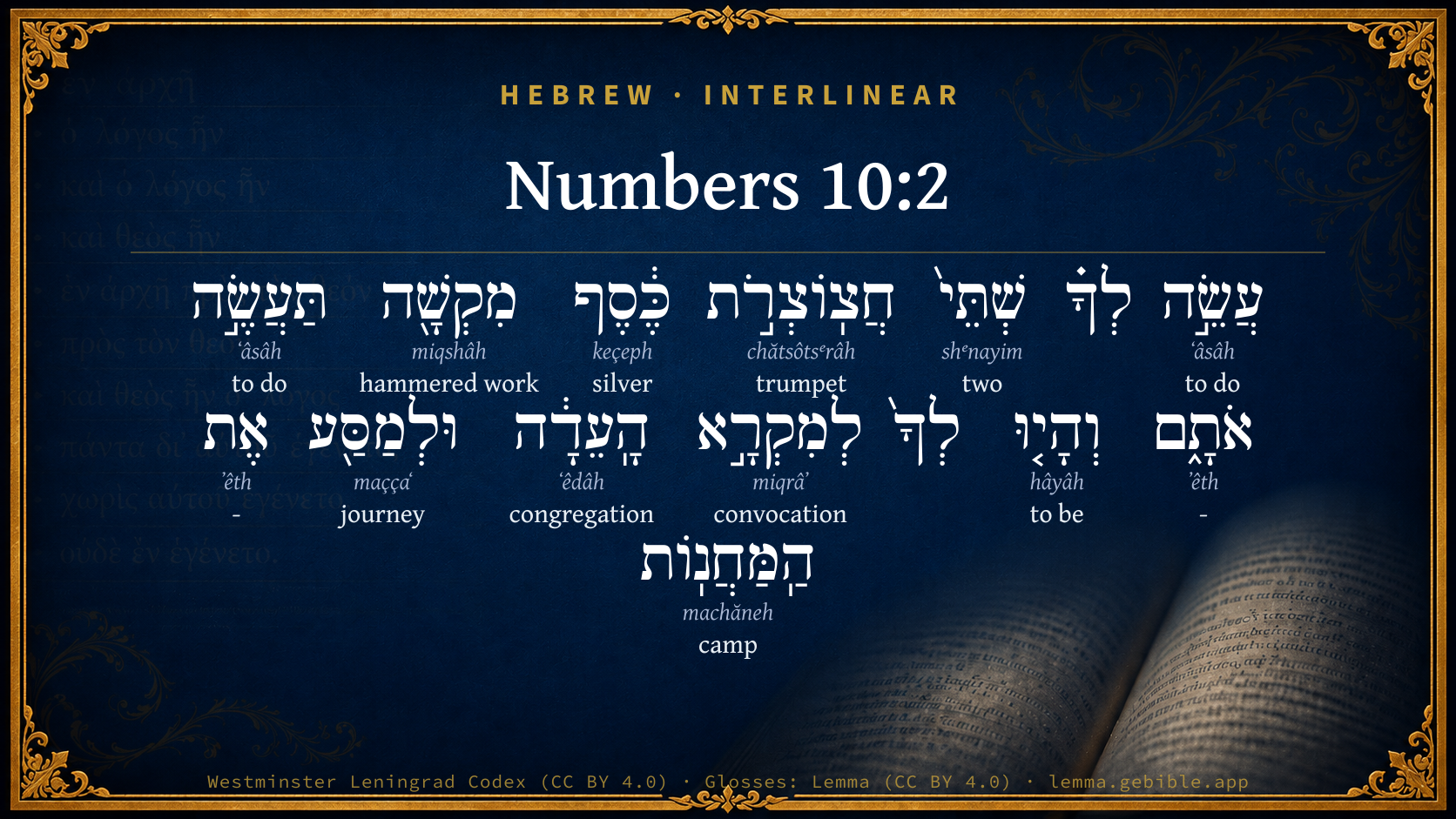
Hebrew (Westminster Leningrad Codex) Numbers 10:2 appears in the Hebrew Old Testament. The text above is from the Westminster Leningrad Codex. Each word links to its Strong’s number, a concise gloss, and parsing drawn from the Open Scriptures Hebrew Bible morphology. Click any word for its full Brown-Driver-Briggs (BDB) entry.
Download image
Cite this verse

Numbers 10:2 (World English Bible). Public Domain. Lemma interlinear Bible study tool, https://lemma.gebible.app/v/numbers/10/2.

Show BibTeX & RIS
BibTeX
RIS
English Translation
Make you two trumpets of silver; of beaten work shall you make them: and you shall use them for the calling of the congregation, and for the journeying of the camps.
World English Bible · Public Domain
Highlights
  • 1 first appearance in the Hebrew Bible
Full analysis ↓
Download a study sheet

One document with this verse’s original text, its word-by-word gloss line, the meaning frame, cross-references with their text, attributed commentary, and full source and license credits — printable, and it pastes into notes with its structure intact.

This verse Autodidact and up

Study sheet (.html) Plain text (.txt)

A passage Seminary Student

Up to 50 verses in one chapter. A passage sheet keeps up to 6 commentary sources and 12 cross-references per verse, in the order this page ranks them, and says so on the sheet whenever that leaves anything out. Ask for a single verse and you get the Autodidact verse sheet above.

Everything on this page stays free to read, with no account — the sheet is a download of what is already on screen, not access to it.

Want to remove ads? Support Godless Engineer
Compare translations 3

The same verse in 3 English versions, stacked beneath the original-language interlinear above. Click any original word for its lexicon entry.

Each is an independent rendering of the whole verse — the interlinear is not word-aligned to these translations.

Highlighted words mark where these versions differ — a whole-verse word diff, not a word-by-word alignment.

  • World English Bible Public Domain
    Make you two trumpets of silver; of beaten work shall you make them: and you shall use them for the calling of the congregation, and for the journeying of the camps.
  • King James Version Public Domain
    Make thee two trumpets of silver; of a whole piece shalt thou make them: that thou mayest use them for the calling of the assembly, and for the journeying of the camps.
  • unfoldingWord Literal Text CC BY-SA 4.0
    “Make for you two trumpets of silver. You shall make them hammered work, and they shall be for you for the assembly of the congregation and for the departure of the camps,

unfoldingWord Literal Text — © unfoldingWord, licensed CC BY-SA 4.0. Word-aligned USFM3 via Door43 (git.door43.org/unfoldingWord/en_ult).

Versions to compare (up to 4)

3 of 4 selected

Show all 18 translations

Every available English version of this verse, each an independent rendering of the whole verse.

  • World English Bible Public Domain
    Make you two trumpets of silver; of beaten work shall you make them: and you shall use them for the calling of the congregation, and for the journeying of the camps.
  • Berean Standard Bible Public Domain
    “Make two trumpets of hammered silver to be used for calling the congregation and for having the camps set out.
  • Majority Standard Bible Public Domain
    “Make two trumpets of hammered silver to be used for calling the congregation and for having the camps set out.
  • King James Version Public Domain
    Make thee two trumpets of silver; of a whole piece shalt thou make them: that thou mayest use them for the calling of the assembly, and for the journeying of the camps.
  • American Standard Version (1901) Public Domain
    Make thee two trumpets of silver; of beaten work shalt thou make them: and thou shalt use them for the calling of the congregation, and for the journeying of the camps.
  • Revised Version (1885) Public Domain
    Make thee two trumpets of silver; of beaten work shalt thou make them: and thou shalt use them for the calling of the congregation, and for the journeying of the camps.
  • Geneva Bible (1599) Public Domain
    Make thee two trumpets of siluer: of an whole piece shalt thou make the, that thou mayest vse them for the assembling of the Congregation, and for the departure of the campe.
  • Douay-Rheims (1899) Public Domain
    Make thee two trumpets of beaten silver, wherewith thou mayest call together the multitude when the camp is to be removed.
  • Young's Literal Translation Public Domain
    `Make to thee two trumpets of silver; beaten work thou dost make them, and they have been to thee for the convocation of the company, and for the journeying of the camps;
  • Literal Standard Version CC BY-SA 4.0
    “Make two trumpets of silver for yourself; you make them of beaten work, and they have been for you for the convocation of the congregation, and for the journeying of the camps;
  • Unlocked Literal Bible CC BY-SA 4.0
    “Make two silver trumpets. Hammer the silver to make them. You must use the trumpets to call the community together and to call the community to move their camps.
  • unfoldingWord Literal Text CC BY-SA 4.0
    “Make for you two trumpets of silver. You shall make them hammered work, and they shall be for you for the assembly of the congregation and for the departure of the camps,
  • Darby Bible Public Domain
    Make thee two trumpets of silver; of beaten work shalt thou make them; and they shall serve for the calling together of the assembly, and for the journeying of the camps.
  • World Messianic Bible Public Domain
    “Make two shofars of silver. You shall make them of beaten work. You shall use them for the calling of the congregation and for the journeying of the camps.
  • Webster's Bible Public Domain
    Make thee two trumpets of silver; of a whole piece shalt thou make them; that thou mayest use them for the calling of the assembly, and for the journeying of the camps.
  • Free Bible Version CC BY-SA 4.0
    “Make two trumpets out of hammered silver. They are to be used for summoning the Israelites and to have the camp move out.
  • Bible in Basic English Public Domain
    Make two silver horns of hammered work, to be used for getting the people together and to give the sign for the moving of the tents.
  • JPS Tanakh (1917) Public Domain
    'Make thee two trumpets of silver; of beaten work shalt thou make them; and they shall be unto thee for the calling of the congregation, and for causing the camps to set forward.

Literal Standard Version (2020), Covenant Press — licensed CC BY-SA 4.0. Text via the HelloAO Bible API (eBible.org). Unlocked Literal Bible (unfoldingWord) — licensed CC BY-SA 4.0. Text via the HelloAO Bible API (eBible.org). unfoldingWord Literal Text — © unfoldingWord, licensed CC BY-SA 4.0. Word-aligned USFM3 via Door43 (git.door43.org/unfoldingWord/en_ult). Free Bible Version, Dr. Jonathan Gallagher — licensed CC BY-SA 4.0. Text via the HelloAO Bible API (eBible.org).

Word by word

More ways to search: Search by grammar → Find every occurrence → Compare this word →

Practice this passage: Drill this verse → Learn its vocabulary →

מִקְשָׁ֖ה
miqshâh
H4749
“hammered work”
Noun, Common, Feminine, Singular, Absolute
Part of Speech
Noun
Type
Common
Gender
Feminine
Number
Singular
State
Absolute
Full BDB Definition

Origin: from H4748

TWOT: 2086b

hammered work, finely decorated cultic objects of gold or silver
  1. עֲשֵׂ֣ה ʻâsâh H6213 “do” Verb, Qal, Imperative, 2nd Person, Masculine, Singular
  2. שְׁתֵּי֙ shᵉnayim H8147 “two” Adjective, Cardinal number, Feminine, Dual, Construct
  3. חֲצֽוֹצְרֹ֣ת chătsôtsᵉrâh H2689 “trumpets of” Noun, Common, Feminine, Plural, Construct
  4. כֶּ֔סֶף keçeph H3701 “silver” Noun, Common, Masculine, Singular, Absolute
  5. תַּעֲשֶׂ֣ה ʻâsâh H6213 “to do” Verb, Qal, Imperfect, 2nd Person, Masculine, Singular
  6. אֹתָ֑ם ʼêth H853 “- · them” Particle, Direct Object + Suffix, Personal, 3rd Person, Masculine, Plural
  7. וְהָי֤וּ hâyâh H1961 “and · to be” Conjunction + Verb, Qal, Sequential Perfect, 3rd Person, Common, Plural
  8. לְמִקְרָ֣א miqrâʼ H4744 “to/for · convocation of” Preposition + Noun, Common, Masculine, Singular, Construct
  9. הָֽעֵדָ֔ה ʻêdâh H5712 “the · congregation” Particle, Definite Article + Noun, Common, Feminine, Singular, Absolute
  10. וּלְמַסַּ֖ע maççaʻ H4550 “and · to/for · journey” Conjunction + Preposition + Noun, Common, Masculine, Singular, Absolute
  11. אֶת ʼêth H853 “-” Particle, Direct Object
  12. הַֽמַּחֲנֽוֹת machăneh H4264 “the · camps” Particle, Definite Article + Noun, Common, Both, Plural, Absolute

About this verse

These counts appear in no published source. They are computed here, from the morphology-tagged text and Lemma’s own curated glosses. What Lemma adds →

15
words
11
distinct lemmas
Pentateuch
section

Notable vocabulary

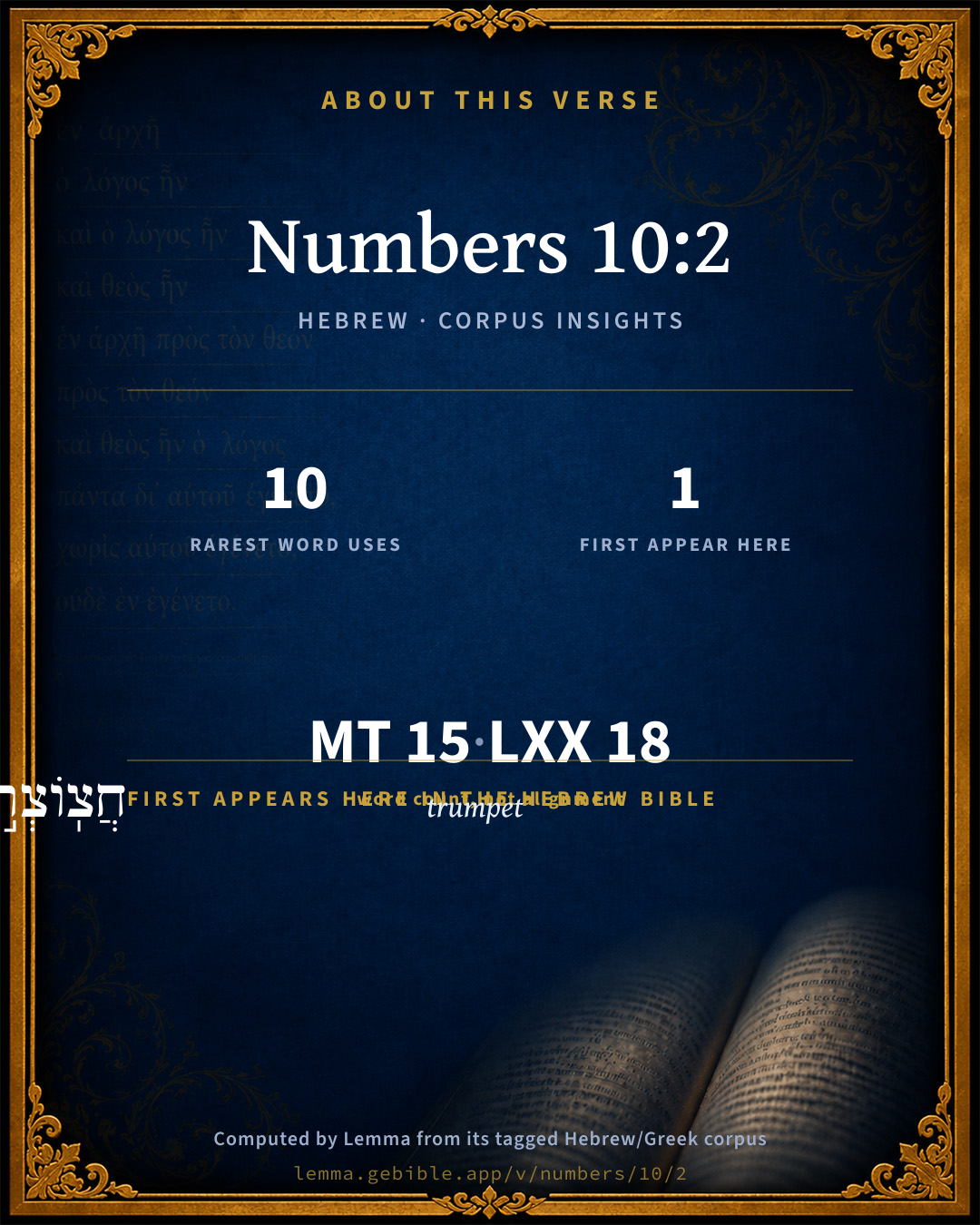
The rarest word here is מִקְשָׁ֖ה hammered work H4749 — appearing just 10 times in the whole Hebrew Bible.

First appearance in Scripture

This word makes its first canonical appearance in the Hebrew Bible here:

  • חֲצֽוֹצְרֹ֣ת trumpet H2689

Shared distinctive vocabulary

מִקְשָׁ֖ה hammered work H4749 occurs in 9 verses of the Hebrew Bible. Also found in:

Grammatical profile

  • 3 verbs
  • 7 nouns
  • 1 adjective
  • 2 prepositions
  • 2 particles

Verb forms

  • עֲשֵׂ֣ה Qal · Imperative
  • תַּעֲשֶׂ֣ה Qal · Imperfect
  • וְהָי֤וּ Qal · Sequential Perfect

Repetition

A word recurs within this verse — often emphatic in Hebrew:

  • עֲשֵׂ֣ה to do H6213 ×2

Hebrew & Septuagint length

In English translation the verse runs 31 words from the Hebrew and 31 from the Septuagint (LXX English) — the same length.

A rough comparison of the two English renderings, which tokenize alike — not a word-level alignment.

Word counts can differ between the Hebrew and the Greek without any difference in meaning — e.g. the Hebrew direct-object marker אֵת has no separate Greek word, and Greek often adds the article ὁ.

In the original languages it is 15 Hebrew tokens and 18 Greek tokens — but the two are counted differently (Hebrew bundles its prefixes and suffixes into one token; the Greek is in lemma form), so that isn’t a like-for-like length.

Cross-references

11

Topical passages linked to Numbers 10:2 in the Treasury of Scripture Knowledge — connected by theme and wording, ordered by reader-vote popularity; previews shown in the World English Bible.

  • Isaiah 1:13 Bring no more vain offerings. Incense is an abomination to me; New moons, Sabbaths, and convocations: I can't bear with evil assemblies.
  • Joel 1:14 Sanctify a fast. Call a solemn assembly. Gather the elders, And all the inhabitants of the land, to the house of Yahweh, your God, And cry to Yahweh.
  • Psalms 81:3 Blow the trumpet at the New Moon, At the full moon, on our feast day.
  • Exodus 25:18 You shall make two cherubim of hammered gold. You shall make them at the two ends of the mercy seat.
  • Exodus 25:31 "You shall make a lampstand of pure gold. Of hammered work shall the lampstand be made, even its base, its shaft, its cups, its buds, and its flowers, shall be of one piece with it.
  • Numbers 10:7 But when the assembly is to be gathered together, you shall blow, but you shall not sound an alarm.
  • 2 Kings 12:13 But there were not made for the house of Yahweh cups of silver, snuffers, basins, trumpets, any vessels of gold, or vessels of silver, of the money that was brought into the house of Yahweh;
  • 2 Chronicles 5:12 also the Levites who were the singers, all of them, even Asaph, Heman, Jeduthun, and their sons and their brothers, arrayed in fine linen, with cymbals and psalteries and harps, stood at the east end of the altar, and with them one hundred twenty priests sounding with trumpets;)
  • Psalms 89:15 Blessed are the people who learn to acclaim you. They walk in the light of your presence, Yahweh.
  • Hosea 8:1 "Put the trumpet to your lips! Something like an eagle is over Yahweh's house, Because they have broken my covenant, And rebelled against my law.
  • Ephesians 4:5 one Lord, one faith, one baptism,

Cross-references courtesy of OpenBible.info (CC BY 4.0).

Hebrew and Greek witnesses Masoretic Hebrew ↔ Greek Septuagint

The same verse in the two great witnesses to the Old Testament, shown verse-for-verse.

These are two independent witnesses, not word-aligned to each other, and the Septuagint is shown in lemma (dictionary) form.

Hebrew Numbers 10:2 Masoretic · Westminster Leningrad Codex

עֲשֵׂ֣ה לְךָ֗ שְׁתֵּי֙ חֲצֽוֹצְרֹ֣ת כֶּ֔סֶף מִקְשָׁ֖ה תַּעֲשֶׂ֣ה אֹתָ֑ם וְהָי֤וּ לְךָ֙ לְמִקְרָ֣א הָֽעֵדָ֔ה וּלְמַסַּ֖ע אֶת הַֽמַּחֲנֽוֹת

Make you two trumpets of silver; of beaten work shall you make them: and you shall use them for the calling of the congregation, and for the journeying of the camps.

World English Bible · Public Domain

Greek LXX Numbers 10:2 Septuagint · lemma form

ποιέω σεαυτοῦ δύο σάλπιγξ ἀργυροῦς ἐλάτη ποιέω αὐτός καί εἰμί σύ ἀνακαλέω ὁ συναγωγή καί ἐκαἴρω ὁ παρεμβολή

Make to yourself two silver trumpets: you shall make them of beaten work; and they shall be to you for the purpose of calling the assembly, and of removing the camps.

LXX2012 (modern English Septuagint) · Public Domain

On this verse, The Pulpit Commentary discusses the Septuagint’s reading. Read the note in Commentary ↓

Hebrew: Westminster Leningrad Codex (CC BY 4.0). Greek: Septuagint (public domain); English from LXX2012 (modern English Septuagint) (Public Domain). How the Septuagint differs from the Hebrew →

Targum (Aramaic paraphrase)

2

The Targum is the ancient Jewish Aramaic paraphrase of the Hebrew Scriptures — an interpretive translation, not the Hebrew text itself. Onkelos (literal) and Pseudo-Jonathan (expansive) render the Torah, and Jonathan the Prophets. Coverage is partial: where no permissively-licensed English translation exists for a verse, only the Aramaic is shown. This is verse-level text, not a word-by-word alignment to the Hebrew.

  1. Targum Onkelos Torah (Genesis–Deuteronomy)
    עֲבֵיד לָךְ תַּרְתֵּין חֲצוֹצְרָן דִכְסַף נְגִיד תַּעְבֵּד יַתְהוֹן וִיהֶוְיָן לָךְ לְעַרְעָא כְנִשְׁתָּא וּלְאַטָלָא יָת מַשִׁרְיָתָא

    (no public-domain English translation for this verse)

    Targum Onkelos — Aramaic: “Onkelos Genesis” (public domain); “Onkelos Exodus” (public domain); “Onkelos Leviticus” (public domain); “Onkelos Numbers” (public domain); “Onkelos Deuteronomy” (public domain). English: “Sefaria Community Translation” (CC0 1.0 (public-domain dedication)); “J.W. Etheridge. The Targums of Onkelos and Jonathan Ben Uzziel on the Pentateuch. London: Longmans, Green, 1862” (public domain). Text via Sefaria.

  2. Targum Pseudo-Jonathan Torah (Genesis–Deuteronomy)
    עִיבַד לָךְ מִדִילָךְ תַּרְתֵּין חֲצוֹצְרַן דִכְסַף מִמִינָא קַשְׁיָא עוֹבַד אוּמַן תַּעֲבֵד יַתְהוֹן וִיהוֹן לָךְ לְעַרְעָא כְנִשְׁתָּא וּלְאַטְלָא יַת מַשִׁרְיָתָא

    Make for thee, of thine, two trumpets of silver of solid material, the work of the artificer shalt thou make them; and let them be thine, with which to convoke the assembly, and for the removing of the camps.

    Targum Pseudo-Jonathan — Aramaic: “Targum Jonathan on Genesis” (public domain); “Targum Jonathan on Exodus” (public domain); “Targum Jonathan on Leviticus” (public domain); “Targum Jonathan on Numbers” (public domain); “Targum Jonathan on Deuteronomy” (public domain). English: “The Targum of Jonathan ben Uzziel, trans. J. W. Etheridge, London, 1862” (public domain). Text via Sefaria.

Commentary

Notes on Numbers 10:2 from classic Christian and Jewish commentators (each source and its license shown beneath its notes). The classic Christian expositions comment on the surrounding passage and are grouped to its opening verse, so a note may address several verses; the Jewish commentaries on the Tanakh (Rashi and others) are per-verse, so they appear only where the commentator wrote on this verse.

Lemma curates 59 commentaries, every one of them public domain or Creative Commons licensed, each selected and text-cleaned for this edition rather than reprinted as found. About our sources →

Trapp's Complete Commentary

John Trapp

Num 10:2 Make thee two trumpets of silver; of a whole piece shalt thou make them: that thou mayest use them for the calling of the assembly, and for the journeying of the camps.

Ver. 2. Two trumpets of silver.] Signifying the voice of the law and gospel in the mouths of God’s ministers, who must "lift up the voice like a trumpet," {Isa 58:1} with fervour, zeal, and courage; {a} (1.) To gather the people, and assemble the elders; {Joe 2:16} (2.) To put them upon their marchings and motions towards the heavenly Canaan; and here to blow an alarm -

“ Sic clames ut Stentora vincere possis - ”

as that famous Farellus did, when the friars, to drown his voice in the pulpit, rang their greatest bells, but he drowned them out; (3.) To get them upon their battlements, and there hence to blow an alarm likewise, upon the approach of spiritual enemies; taking the same liberty to cry down sin, that men take to commit it; {b} and to descry the devil’s stratagems that are so destructive to men’s souls. They must cast away the inverse trumpets of Furius Fulvius, which sounded a retreat when they should have sounded an alarm; they must faithfully show God’s "people their transgressions, and the house of Jacob their sins," {Isa 58:1} yea, "all their transgressions in all their sins." {Lev 16:21} Lastly, as the priests were to sound the silver trumpets at their solemn feasts, {Psa 81:3} for a monument of spiritual gladness before the Lord; so must ministers of the gospel publish the glad tidings of the gospel; "Speak to the heart of Jerusalem, and cry unto her, that her warfare is accomplished, her sin is pardoned"; {Isa 40:2} make the people hear the joyful sound, that they may walk in the sense of God’s presence, and in the light of his countenance; yea, "rejoice in his name all the day long." {Psa 89:15-16}

{a} Ad ravim usque vocem intendit, nec vinci se a strepitu ullo passus est. - Melch. Adam., 114.

{b} Suetonius ea libertate scripsit Imperatorum vitas qua ipsi vixerunt.

John Trapp, A Commentary or Exposition upon All the Books of the Old and New Testament (1647–1656) — public domain. Text from a community e-Sword module.

Joseph Benson's Commentary

Num 10:2. Two trumpets — For Aaron’s two sons; though afterward the number of the trumpets was much increased, as the number of the priests also was. These trumpets were ordained, both to signify the great duty of ministers, to preach the word, and for use, as here follows.

Joseph Benson's Commentary on the Old and New Testaments (1811–1818) — public domain. Text from a community e-Sword module.

Tyndale Open Study Notes

Tyndale Open Resources

10:2-4 The two trumpets were used to get people’s attention for important pronouncements (cp. Rev 8–11).

Tyndale Open Study Notes — © Tyndale Open Resources, licensed CC BY-SA 4.0. Text via the HelloAO Bible API.

Geneva Bible (1599)

Geneva Bible translators

Or, of work beaten out with the hammer.

Geneva Bible (1599) marginal notes — public domain. Text via Bolls.life.

Adam Clarke's Commentary

Verse 2. Make thee two trumpets of silver] The necessity of such instruments will at once appear, when the amazing extent of this numerous army is considered; and how even the sound of two trumpets could reach them all is difficult to conceive; but we may suppose that, when they were sounded, the motion of those that were within reach of that sound taught the others in succession what they should do.

As the trumpets were to be blown by the priests only, the sons of Aaron, there were only two, because there were only two such persons to use them at this time, Eleazar and Ithamar. In the time of Joshua there were seven trumpets used by the priests, but these were made, according to our text, of rams' horns, Jos 6:4. In the time of Solomon, when the priests had greatly increased, there were 120 priests sounding with trumpets, 2Ch 5:12.

Josephus intimates that one of these trumpets was always used to call the nobles together, the other to assemble the people; see Nu 9:4. It is possible that these trumpets were made of different lengths and wideness, and consequently they would emit different tones. Thus the sound itself would at once show which was the summons for the congregation, and which for the princes only. These trumpets were allowed to be emblematical of the sound of the Gospel, and in this reference they appear to be frequently used. Of the fate of the trumpets of the sanctuary, See Clarke on Ex 25:31.

Adam Clarke's Commentary on the Bible (1810–1826) — public domain. Text from a community e-Sword/MySword module.

Ellicott's Commentary for English Readers

X.

(2) Of a whole piece.—Better, of beaten (or, turned) work. (See Notes on Exo_25:18; Exo_25:31.) The trumpets here spoken of are supposed to have been straight, like that on the triumphal arch of Titus at Rome and on the old Egyptian monuments. In this respect the hazozerah is supposed to have differed from the cornet or horn, keren or shophar (which is interchanged with keren), which was crooked. (See Jos_6:5. compared with 6:4, 6, 8, 13.) We find reference to the jubilee trumpet in Lev_25:9, from which it has been inferred that the trumpets here mentioned were not first made at this time. It is true, indeed, that the first verse might be rendered: “Now the Lord had spoken unto Moses, saying”; but the word used in Lev_25:9 is shophar, not hazozerah, and the latter word occurs in this place for the first time.

A Bible Commentary for English Readers, edited by Charles John Ellicott (1878–1897) — public domain. Text from a community e-Sword module.

The Cambridge Bible for Schools and Colleges

gen. ed. J. J. S. Perowne

2. trumpets] or Clarions (ḥaẓôẓerôth). This rendering serves to distinguish the word from (a) the ‘ram’s horn’ (yôbhçl), used at Sinai (Exo_19:13), at Jericho (Jos_6:5), and to usher in the year of yôbhçl, i.e. the ‘Jubile’—(b) the ‘trumpet’ (shôphâr), which was the instrument ordinarily employed for secular purposes. The clarion is a secular instrument only in Hos_5:8 (R.V. ‘cornet’), 2Ki_11:14 = 2Ch_23:13 (R.V. ‘trumpet’). It is a sacred instrument in Psa_98:6 and frequently in P and Chr.-Ezr.-Neh. Its shape was that of a straight slender tube with an expanding mouth. See the illustrations in Driver’s Amos, p. 145.

2b–8. During the journeyings the clarions are to be used for summoning an assembly of the congregation (Num_10:3), or a council of the princes (Num_10:4), or for a signal to start on the march (Num_10:5-6).

The Cambridge Bible for Schools and Colleges (gen. ed. J. J. S. Perowne; Cambridge University Press, 1878–1918) — public domain. Text from a community e-Sword module.

John Gill's Exposition

Make thee two trumpets of silver,.... A metal very valuable and precious, durable, and fit for sound; only two are ordered, Aaron having but two sons, Eleazar and Ithamar, who were to blow with them, Num 10:8; for though Moses's order is, "make thee", or for thee, yet not for his own use, but for the priests to use when he should order them: the Targum of Jonathan adds, of what is thine own, as if they were to be made at his own expense; but others say, and which is more probable, that they were to be made at the public expense: Josephus (i) gives a description of them, and says, that they were little less than a cubit long, the pipe of them narrow, but broader about the mouth to receive the breath, and ended like a bell; they seem to be much of the shape of our trumpets: these trumpets were an emblem of the ministry of the Gospel, called the great trumpet, and in the ministration of which, the preachers of it are to lift up their voice like a trumpet, to show men their perishing condition through sin, and to encourage them, as such who are ready to perish, to come to Christ for salvation, Isa 27:13; the Gospel is comparable to silver, being fetched out of the mines of the sacred Scriptures, pure and free from the dross of errors and human inventions, will bear to be tried by the standard of the word, and is lasting and durable, yea, the everlasting Gospel; as well as valuable and precious, containing the unsearchable riches of Christ, &c. treasures of divine truths, comparable to gold, silver, and precious stones; yea, it is more valuable and precious than silver, not to be obtained by that, more profitable and useful, more satisfying and lasting: the number two may be applicable to the two dispensations, under which the Gospel has been ministered, directing to the same Saviour, and to the same way of salvation, by his grace, his blood, righteousness, and sacrifice; and to the two Testaments, which agree in the same truths respecting his person, offices, obedience, sufferings, and death; and to the prophets and apostles of both dispensations and testaments, who have united in laying Christ as the foundation; and also to the two witnesses that are still to prophecy in sackcloth, that is, preach the Gospel and blow the trumpet of it: Rev 11:3.

of an whole piece shall thou make them; of one solid mass of silver, beaten with an hammer, as Jarchi, such a piece as the candlestick was made of in Exo 25:31, where the same word is used as here, and rendered "beaten work": this may denote the pure and unmixed Gospel of Christ, having no dross, nor bad nor base metal of human corruptions in it; no jar, discord, or contradiction in it, but all in perfect harmony and agreement; and the whole of it, no part of it dropped or concealed; and the ministry of it, laboured by those employed in it, who study to show themselves workmen that need not be ashamed:

that thou mayest use them for the calling the assembly; the body of the people of Israel, either on civil or sacred accounts, see Joe 1:15; the ministry of the Gospel is for the calling and gathering of souls to Christ, and to his churches; even the remnant of Israel, all that are given to Christ and redeemed by his blood, whether Jews or Gentiles; these are gathered out of the world, which is an act of distinguishing grace; it is by means of the Gospel trumpet that they are awakened, and quickened, and directed to Christ:

and for the journeying of the camps: both of the four camps of the Israelites, and the camp of the Levites, to direct them when they should set forward on a journey: and of like use is the ministry of the Gospel; saints are pilgrims and travellers here; they are passing through a wilderness, their way is attended with many difficulties; Canaan is the place they are travelling to, and the Gospel is of singular use to them by the way, both to refresh them with its joyful sound, and to direct them in the path in which they should go.

(i) Antiqu. l. 3. c. 12. sect. 6.

John Gill's Exposition of the Whole Bible (1746–1763) — public domain (CC PDM 1.0). Text via the HelloAO Bible API.

Albert Barnes' Notes on the Bible

The trumpet was a straight instrument, differing in this respect from the curved horn or cornet; and is represented, among the other spoils of the temple, on the Arch of Titus. See Exo 25:23 cut. From Egyptian monuments it appears that the Jewish trumpet was copied from that used in the armies of the Pharaohs. The cornet was at first a simple ram’s horn Jos 6:4, and the metal instrument of later times preserved the original shape.

Albert Barnes' Notes on the Bible (1834–1885) — public domain. Text from a community e-Sword/MySword module.

Haydock's Catholic Bible Commentary

Two trumpets. These were probably deemed sufficient at first, though in the days of Josue there were seven, (Calmet) and in those of Solomon 20,000. (Josephus, [Antiquities?] viii. 2.) (Tirinus) --- They were used for all public assemblies. Josephus (iii. 11,) says, one was sounded to call the princes together, and the other to collect the people, which is not quite conformable to the Scriptures. (Calmet)

George Leo Haydock (1774–1849), Haydock's Catholic Family Bible and Commentary, 1859 edition — public domain. Excludes Psalms (Douay-Rheims chapter numbering differs from Protestant) and Deuterocanonical books (Catholic canon only).

Matthew Poole's English Annotations

Two trumpets, for Aaron’s two sons; though afterwards the number of trumpets was much increased, as the number of the priests also was. See 2Ch 5:12 These trumpets were ordained, both for signification of the great duty of ministers, to wit, to preach the word; and for use, as here follows.

Silver is a metal pure and precious, and giving a clear sound.

A whole piece. See Exo 25:31; Num 8:4.

Matthew Poole's English Annotations on the Holy Bible (1683–1685) — public domain. Text from a community e-Sword/MySword module.

The Pulpit Commentary

Make thee two trumpets. Hebrew, khatsotserah. From the testimony of Josephus, from the representation on the arch of Titus, and from a comparison of ancient Egyptian trumpets, it is clear that these trumpets were straight, long, and narrow, with an expanded mouth. The shophar, or trumpet of the Jubilee, on the other hand, was a buccina or cornet, either made of a ram"s horn, or shaped like one. Of a whole piece. Rather, "of beaten work." Hebrew, mikshah. (see on Exo_25:18) Septuagint, elataseiv autav . Probably they were made of a single plate of silver beaten out into the required shape, which was very simple.

The Pulpit Commentary (1880–1919), ed. H.D.M. Spence-Jones & Joseph S. Exell — public domain. Text from a community e-Sword module.

John Wesley's Explanatory Notes

Two trumpets - For Aaron's two sons: though afterwards the number of the trumpets was much increased, as the number of the priests also was. These trumpets were ordained, both for signification of the great duty of ministers, to preach the word; and for use, as here follows.

John Wesley, Explanatory Notes Upon the Whole Bible (1754–1765) — public domain. Text via the GEBible commentary corpus.

Rashi

Rabbi Shlomo Yitzchaki (Rashi)

עשה לך MAKE THEE etc. — make לך, “for thyself” (on thy own behalf) suggests that they shall blow them in your presence, as before a king, as it is said, (with reference to Moses) (Deuteronomy 33:5) ויהי בישרון מלך “and he was king in Jeshurun”.

עשה לך MAKE THEE — from that which is thine own and not from the common funds (Sifrei Bamidbar 72).

עשה לך MAKE FOR THYSELF” also suggests: you make them and use them, but no one else.

למקרא העדה [THAT THOU MAYEST USE THEM] FOR THE CALLING OF THE ASSEMBLY — i. e. when you wish to speak to the Sanhedrin and the rest of the people and you summon them to assemble unto you, you shall summon them by the trumpets.

ולמסע את המחנות AND FOR THE JOURNEYING OF THE CAMPS — at the time of departing on the journeys you shall blow them as a signal. Consequently you must say that they used to travel by a three-fold call: by the command of the Holy One, blessed be He, by the word of Moses (cf. Rashi on v. 18 at the end), and by the sound of the trumpets (Boraitha d’ Mlechet ha-Mishkan s. 13).

מקשה OF BEATEN WORK — from a block of silver you shall make them by hammer blows (Sifrei Bamidbar 72).

Rashi on the Tanakh — English translations: “The Judaica Press complete Tanach with Rashi, translated by A. J. Rosenberg” (CC BY 4.0); “Pentateuch with Rashi's commentary by M. Rosenbaum and A.M. Silbermann, 1929-1934” (public domain); “The Metsudah Tanach series, Lakewood, N.J” (CC BY 4.0); and “The Book of Joshua, Metsudah Publications, 1997” (CC BY 4.0). Text via Sefaria.

Lesson kit

Teaching starters — assembled from the data on this page, not authored interpretation. Every prompt links to the verse data it draws on. Edit before teaching.

Numbers, in the Pentateuch, opens this verse with 15 words (11 distinct Hebrew lemmas). Its most distinctive word is miqshâh (“hammered work”). A historical commentator’s framing appears above. Read the whole chapter for the surrounding context.

Discussion questions

  1. What does “hammered work” (miqshâh) contribute to the verse as a whole?
  2. This is the first place “trumpet” appears in Scripture (first appears here). What does its debut here establish?
  3. How does Exodus 25:18, which shares the word «hammered work», read alongside this verse?
  4. What does the repetition of “to do” (2× in this one verse) do in this verse?
  5. These translations render this verse differently. What is at stake in choosing one wording over another?
  6. «עֲשֵׂ֣ה» is a Qal Imperative verb. How does that grammatical form shape the action described?
  7. Compare how Trapp's Complete Commentary and Joseph Benson's Commentary read this verse. Where do they agree or differ?

Things to notice

Reading settings

Reading text

Shown beneath each verse's original-language words.

Old Testament
Old Testament edition

Read the OT as the Masoretic Hebrew (MT) or the Greek Septuagint (LXX).

English shown for the Greek Septuagint (in the Hebrew ↔ Greek comparison).

Comparing translations? Open the Compare panel on any verse page to stack up to four side by side.