
Genesis 4:19

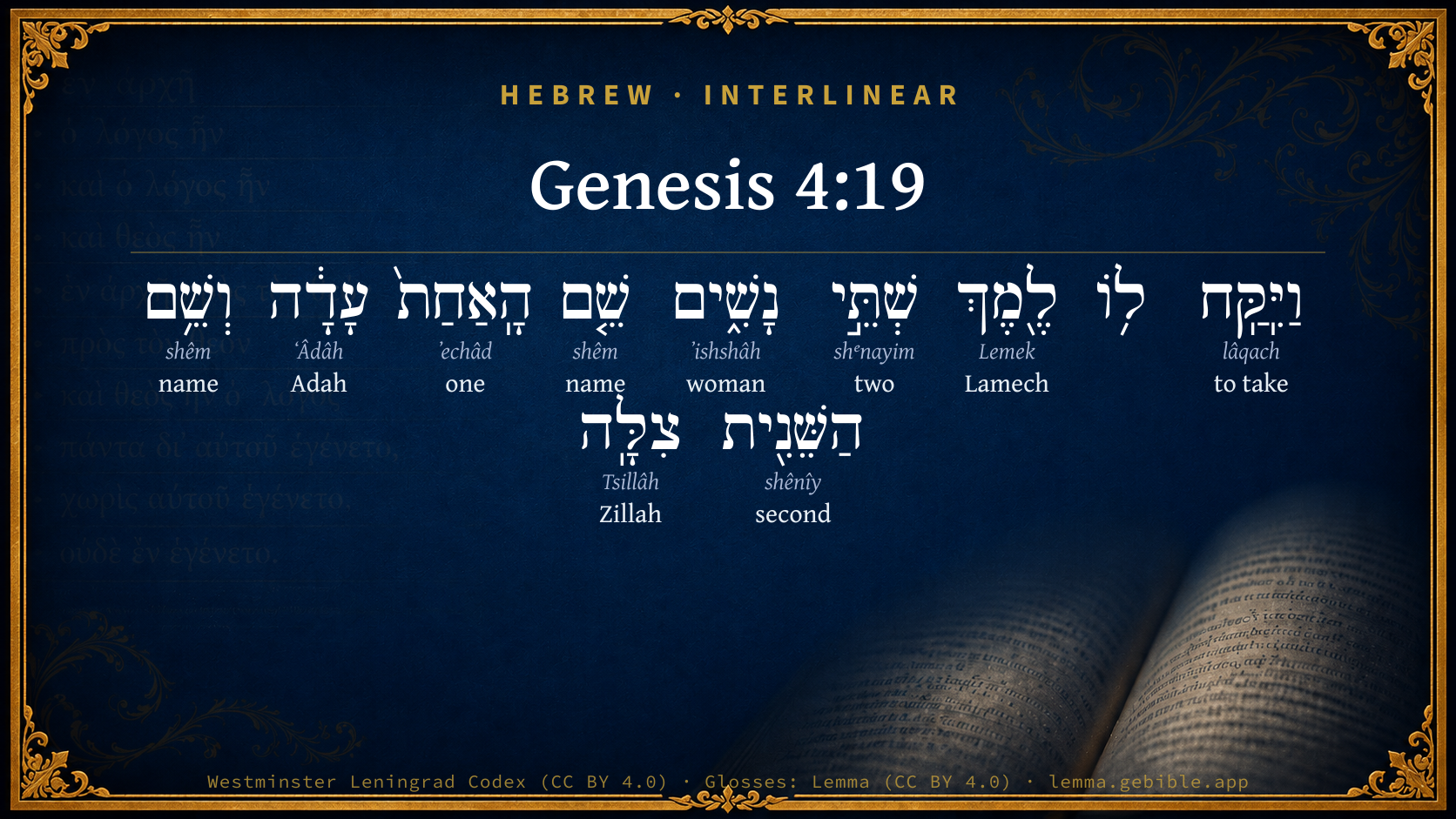
Hebrew (Westminster Leningrad Codex) Genesis 4:19 appears in the Hebrew Old Testament. The text above is from the Westminster Leningrad Codex. Each word links to its Strong’s number, a concise gloss, and parsing drawn from the Open Scriptures Hebrew Bible morphology. Click any word for its full Brown-Driver-Briggs (BDB) entry.
Download image
Cite this verse

Genesis 4:19 (World English Bible). Public Domain. Lemma interlinear Bible study tool, https://lemma.gebible.app/v/genesis/4/19.

Show BibTeX & RIS
BibTeX
RIS
English Translation
Lamech took two wives: the name of the one was Adah, and the name of the other Zillah.
World English Bible · Public Domain
Highlights
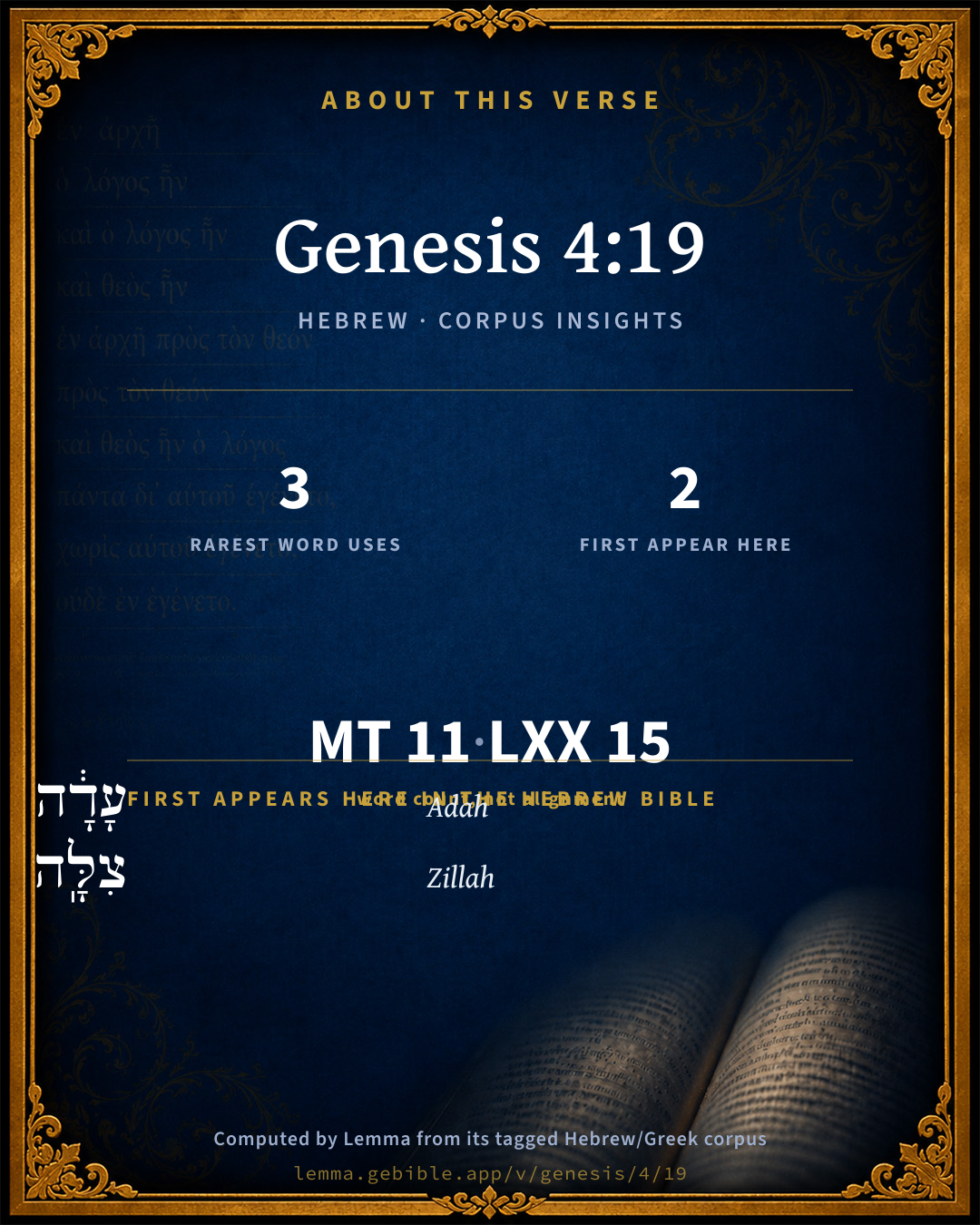
  • 2 first appearances in the Hebrew Bible
Full analysis ↓
Download a study sheet

One document with this verse’s original text, its word-by-word gloss line, the meaning frame, cross-references with their text, attributed commentary, and full source and license credits — printable, and it pastes into notes with its structure intact.

This verse Autodidact and up

Study sheet (.html) Plain text (.txt)

A passage Seminary Student

Up to 50 verses in one chapter. A passage sheet keeps up to 6 commentary sources and 12 cross-references per verse, in the order this page ranks them, and says so on the sheet whenever that leaves anything out. Ask for a single verse and you get the Autodidact verse sheet above.

Everything on this page stays free to read, with no account — the sheet is a download of what is already on screen, not access to it.

Want to remove ads? Support Godless Engineer
Compare translations 3

The same verse in 3 English versions, stacked beneath the original-language interlinear above. Click any original word for its lexicon entry.

Each is an independent rendering of the whole verse — the interlinear is not word-aligned to these translations.

Highlighted words mark where these versions differ — a whole-verse word diff, not a word-by-word alignment.

  • World English Bible Public Domain
    Lamech took two wives: the name of the one was Adah, and the name of the other Zillah.
  • King James Version Public Domain
    And Lamech took unto him two wives: the name of the one was Adah, and the name of the other Zillah.
  • unfoldingWord Literal Text CC BY-SA 4.0
    Then Lamech took for himself two wives. The name of the one Adah, and the name of the second Zillah.

unfoldingWord Literal Text — © unfoldingWord, licensed CC BY-SA 4.0. Word-aligned USFM3 via Door43 (git.door43.org/unfoldingWord/en_ult).

Versions to compare (up to 4)

3 of 4 selected

Show all 18 translations

Every available English version of this verse, each an independent rendering of the whole verse.

  • World English Bible Public Domain
    Lamech took two wives: the name of the one was Adah, and the name of the other Zillah.
  • Berean Standard Bible Public Domain
    And Lamech married two women, one named Adah and the other Zillah.
  • Majority Standard Bible Public Domain
    And Lamech married two women, one named Adah and the other Zillah.
  • King James Version Public Domain
    And Lamech took unto him two wives: the name of the one was Adah, and the name of the other Zillah.
  • American Standard Version (1901) Public Domain
    And Lamech took unto him two wives: the name of the one was Adah, and the name of the other Zillah.
  • Revised Version (1885) Public Domain
    And Lamech took unto him two wives: the name of the one was Adah, and the name of the other Zillah.
  • Geneva Bible (1599) Public Domain
    And Lamech tooke him two wiues: the name of the one was Adah, and the name of the other Zillah.
  • Douay-Rheims (1899) Public Domain
    Who took two wives: the name of the one was Ada, and the name of the other was Sella.
  • Young's Literal Translation Public Domain
    And Lamech taketh to himself two wives, the name of the one Adah, and the name of the second Zillah.
  • Literal Standard Version CC BY-SA 4.0
    And Lamech takes to himself two wives, the name of the first Adah, and the name of the second Zillah.
  • Unlocked Literal Bible CC BY-SA 4.0
    Lamech took for himself two wives. The name of the one was Adah, and the name of the other was Zillah.
  • unfoldingWord Literal Text CC BY-SA 4.0
    Then Lamech took for himself two wives. The name of the one Adah, and the name of the second Zillah.
  • Darby Bible Public Domain
    And Lemech took two wives: the name of the one was Adah, and the name of the second, Zillah.
  • World Messianic Bible Public Domain
    Lamech took two wives: the name of the first one was Adah, and the name of the second one was Zillah.
  • Webster's Bible Public Domain
    And Lamech took to him two wives: the name of the one was Adah, and the name of the other Zillah.
  • Free Bible Version CC BY-SA 4.0
    Lamech married two women. The first was named Adah, and the second was named Zillah.
  • Bible in Basic English Public Domain
    And Lamech had two wives; the name of the one was Adah, and the name of the other Zillah.
  • JPS Tanakh (1917) Public Domain
    And Lamech took unto him two wives; the name of one was Adah, and the name of the other Zillah.

Literal Standard Version (2020), Covenant Press — licensed CC BY-SA 4.0. Text via the HelloAO Bible API (eBible.org). Unlocked Literal Bible (unfoldingWord) — licensed CC BY-SA 4.0. Text via the HelloAO Bible API (eBible.org). unfoldingWord Literal Text — © unfoldingWord, licensed CC BY-SA 4.0. Word-aligned USFM3 via Door43 (git.door43.org/unfoldingWord/en_ult). Free Bible Version, Dr. Jonathan Gallagher — licensed CC BY-SA 4.0. Text via the HelloAO Bible API (eBible.org).

Word by word

More ways to search: Search by grammar → Find every occurrence → Compare this word →

Practice this passage: Drill this verse → Learn its vocabulary →

צִלָּֽה
Tsillâh
H6741
“Zillah”
Noun, Proper
Part of Speech
Noun
Type
Proper
Full BDB Definition

Origin: from H6738

TWOT: None

Zillah = "shade" - the 2nd wife of Lamech and mother of Tubal-cain, an instructor of every craftsman in bronze and iron
  1. וַיִּֽקַּֽח lâqach H3947 “and · to take” Conjunction + Verb, Qal, Sequential Imperfect, 3rd Person, Masculine, Singular
  2. לֶ֖מֶךְ Lemek H3929 “Lamech” Noun, Proper
  3. שְׁתֵּ֣י shᵉnayim H8147 “two” Adjective, Cardinal number, Feminine, Dual, Construct
  4. נָשִׁ֑ים ʼishshâh H802 “women” Noun, Common, Feminine, Plural, Absolute
  5. שֵׁ֤ם shêm H8034 “name of” Noun, Common, Masculine, Singular, Construct
  6. הָֽאַחַת֙ ʼechâd H259 “the · one” Particle, Definite Article + Adjective, Cardinal number, Feminine, Singular, Absolute
  7. עָדָ֔ה ʻÂdâh H5711 “Adah” Noun, Proper
  8. וְשֵׁ֥ם shêm H8034 “and · name of” Conjunction + Noun, Common, Masculine, Singular, Construct
  9. הַשֵּׁנִ֖ית shênîy H8145 “the · second” Particle, Definite Article + Adjective, Ordinal number, Feminine, Singular, Absolute

About this verse

These counts appear in no published source. They are computed here, from the morphology-tagged text and Lemma’s own curated glosses. What Lemma adds →

11
words
9
distinct lemmas
Pentateuch
section

Notable vocabulary

The rarest word here is צִלָּֽה Zillah H6741 — appearing just 3 times in the whole Hebrew Bible.

First appearance in Scripture

These words make their first canonical appearance in the Hebrew Bible here:

  • עָדָ֔ה Adah H5711
  • צִלָּֽה Zillah H6741

Shared distinctive vocabulary

צִלָּֽה Zillah H6741 occurs in 3 verses of the Hebrew Bible. Also found in:

Grammatical profile

  • 1 verb
  • 6 nouns
  • 3 adjectives
  • 1 preposition

Verb forms

  • וַיִּֽקַּֽח Qal · Sequential Imperfect

Repetition

A word recurs within this verse — often emphatic in Hebrew:

  • שֵׁ֤ם name H8034 ×2

Hebrew & Septuagint length

In English translation the verse runs 18 words from the Hebrew and 21 from the Septuagint (LXX English) — closely comparable.

A rough comparison of the two English renderings, which tokenize alike — not a word-level alignment.

Word counts can differ between the Hebrew and the Greek without any difference in meaning — e.g. the Hebrew direct-object marker אֵת has no separate Greek word, and Greek often adds the article ὁ.

In the original languages it is 11 Hebrew tokens and 15 Greek tokens — but the two are counted differently (Hebrew bundles its prefixes and suffixes into one token; the Greek is in lemma form), so that isn’t a like-for-like length.

Cross-references

4

Topical passages linked to Genesis 4:19 in the Treasury of Scripture Knowledge — connected by theme and wording, ordered by reader-vote popularity; previews shown in the World English Bible.

  • Genesis 2:24 Therefore a man will leave his father and his mother, and will join with his wife, and they will be one flesh.
  • Genesis 2:18 Yahweh God said, "It is not good that the man should be alone; I will make him a helper suitable for him."
  • Matthew 19:4–6 He answered, "Haven't you read that he who made them from the beginning made them male and female,
  • Matthew 19:8 He said to them, "Moses, because of the hardness of your hearts, allowed you to divorce your wives, but from the beginning it has not been so.

Cross-references courtesy of OpenBible.info (CC BY 4.0).

Hebrew and Greek witnesses Masoretic Hebrew ↔ Greek Septuagint

The same verse in the two great witnesses to the Old Testament, shown verse-for-verse.

These are two independent witnesses, not word-aligned to each other, and the Septuagint is shown in lemma (dictionary) form.

Hebrew Genesis 4:19 Masoretic · Westminster Leningrad Codex

וַיִּֽקַּֽח ל֥וֹ לֶ֖מֶךְ שְׁתֵּ֣י נָשִׁ֑ים שֵׁ֤ם הָֽאַחַת֙ עָדָ֔ה וְשֵׁ֥ם הַשֵּׁנִ֖ית צִלָּֽה

Lamech took two wives: the name of the one was Adah, and the name of the other Zillah.

World English Bible · Public Domain

Greek LXX Genesis 4:19 Septuagint · lemma form

καί λαμβάνω ἑαυτοῦ λαμεχ δύο γυνή ὄνομα ὁ εἷς αδα καί ὄνομα ὁ δεύτερος σελλα

And Lamech took to himself two wives; the name of the one was Ada, and the name of the second Sella.

LXX2012 (modern English Septuagint) · Public Domain

Hebrew: Westminster Leningrad Codex (CC BY 4.0). Greek: Septuagint (public domain); English from LXX2012 (modern English Septuagint) (Public Domain). How the Septuagint differs from the Hebrew →

Targum (Aramaic paraphrase)

2

The Targum is the ancient Jewish Aramaic paraphrase of the Hebrew Scriptures — an interpretive translation, not the Hebrew text itself. Onkelos (literal) and Pseudo-Jonathan (expansive) render the Torah, and Jonathan the Prophets. Coverage is partial: where no permissively-licensed English translation exists for a verse, only the Aramaic is shown. This is verse-level text, not a word-by-word alignment to the Hebrew.

  1. Targum Onkelos Torah (Genesis–Deuteronomy)
    וּנְסִיב לֵהּ לֶמֶךְ תַּרְתֵּין נְשִׁין שׁוּם חֲדָא עָדָה וְשׁוּם תִּנְיֵתָא צִלָּה

    (no public-domain English translation for this verse)

    Targum Onkelos — Aramaic: “Onkelos Genesis” (public domain); “Onkelos Exodus” (public domain); “Onkelos Leviticus” (public domain); “Onkelos Numbers” (public domain); “Onkelos Deuteronomy” (public domain). English: “Sefaria Community Translation” (CC0 1.0 (public-domain dedication)); “J.W. Etheridge. The Targums of Onkelos and Jonathan Ben Uzziel on the Pentateuch. London: Longmans, Green, 1862” (public domain). Text via Sefaria.

  2. Targum Pseudo-Jonathan Torah (Genesis–Deuteronomy)
    וּנְסֵיב לֵיהּ לֶמֶךְ תַּרְתֵּין נְשִׁין שׁוּם חֲדָא עָדָה וְשׁוּם תִּנְיֵתָא צִלָה

    And Lemek took to him two wives; the name of the first, Ada, and the name of the second, Zillah.

    Targum Pseudo-Jonathan — Aramaic: “Targum Jonathan on Genesis” (public domain); “Targum Jonathan on Exodus” (public domain); “Targum Jonathan on Leviticus” (public domain); “Targum Jonathan on Numbers” (public domain); “Targum Jonathan on Deuteronomy” (public domain). English: “The Targum of Jonathan ben Uzziel, trans. J. W. Etheridge, London, 1862” (public domain). Text via Sefaria.

Commentary

Notes on Genesis 4:19 from classic Christian and Jewish commentators (each source and its license shown beneath its notes). The classic Christian expositions comment on the surrounding passage and are grouped to its opening verse, so a note may address several verses; the Jewish commentaries on the Tanakh (Rashi and others) are per-verse, so they appear only where the commentator wrote on this verse.

Lemma curates 59 commentaries, every one of them public domain or Creative Commons licensed, each selected and text-cleaned for this edition rather than reprinted as found. About our sources →

Trapp's Complete Commentary

John Trapp

Gen 4:19 And Lamech took unto him two wives: the name of the one [was] Adah, and the name of the other Zillah.

Ver. 19. Lamech took unto himself.] As his own lust led him, not caring for consent of parents. And two wives, {a} as little caring for the command of God, that "two," and no more, "should be one flesh," {Gen 2:24} yea, though he "had the residue of the spirit," and so could have made many wives for Adam, yet "made he but one," saith the prophet {b} {Mal 2:15} And wherefore one? but that he might seek a godly seed. Solomon’s polygamy was punished with barrenness. We read not of any son he had but one, and he none of the wisest neither, Rehoboam. This great king had but one son by many housefuls of wives, when many a poor man hath a house full of children by one wife. Erasmus tells a story of a poor English cripple, lame on both legs, that married a blind woman, and gave this reason, We shall the better agree, when neither can hit other in the teeth with our several defects and deformities. Nec fefellit hominem iudicium , saith he; it proved a happy match. They lived lovingly and cheerfully together, and God Almighty blessed them with a dozen lusty boys, that had not the least deformity about them. {c} Sardus tells us, that the old Britons would ten or twelve of them take one woman to wife. {d} Likely women were scarce among them. But yet that was better than the old Scots, of whom St Hierome reports, that they took no wives; but satisfied their lusts up and down as they wished, and wheresoever they liked, after the manner of brute creatures. {e} I have somewhere read, that not many hundreds of years since, they had a custom kept up among them, that the landlord might demand the first night of his tenant’s wife, as a chief rent. And Mr Fox relates, {f} that the friars in Germany were grown to that height of impudence, as to require the tenth night of every man’s wife, as a tithe due to them. Which to prevent, the Helvetians, when they received any new priest into their churches, they bargained with him before, to take his concubine, lest he should attempt any misuse of their wives and daughters. How much better were it, for the "avoiding of fornication, if every man of them had his own wife," saith Paul. {1Co 7:2} Not so, not so, saith Cardinal Campeius; {g} for if comparison should be made, much greater offence it is, a priest to have a wife, than to have and keep at home many harlots; for they that keep harlots, saith he, as it is naught that they do, so do they acknowledge their sin; the other persuade themselves they do well, and so continue without repentance, or conscience of their fact. A fit reason for a carnal cardinal. Such another was his brother, Cardinalis Cremonensis, who after his stout replying in the Council of London, against the married estate of priests, exclaiming what a shameful thing it was to rise from the sides of a whore, to make Christ’s body, the night following was shamefully taken with a notable whore. {h} This was bad enough, but that was worse in Johannes from Casa, Dean of the Pope’s chamber, who so far forgot humanity and honesty, that he set forth a book in Italian metre, in commendation of Sodomitry, saying that he never used any other. {i} This might better have become a Turk, than a bishop. Sodomy in the Levant is not held a vice, so debauched they are grown. {j} The Turkish bashaws, besides their wives, whereof they have ten at least, each bashaw has as many, or likely more calamites, which are their serious loves. For their wives are used but to dress their meat, to laundress, and for reputation. {k} Only when the great Turk gives his daughter or sister to any bashaw to wife, it is somewhat otherwise. For he gives her at the same time a dagger, saying, I give you to this man to be your slave and bedfellow. If he is not loving, obedient, and dutiful to thee, I give you here this cunzhare or dagger to cut off his head. {l} Yet can she not forbid him to marry more wives "to vex her," {Lev 18:18} and fret her, as Peninnah did Hannah, {1Sa 1:6} yea, to make her to thunder, as the word here signifies: for Turks may take as many wives as they are able to maintain. Hence it is that in jealousy they exceed Italians, making their women go muffled all but their eyes; and not suffering them to go to church, or so much as look out of their own windows. {m}

{a} Lamech polygamus unam costam in duas divisit . - Hier.

{b} Heroum filii noxae .

{c} Procreatis ex isto coniugio duodecim fratribus, nulloque naevo deformatis . - Dei Instit. Matr.

{d} Deni duodenique unam uxorem ducebant .- De Morib. Gent., lib. i., cap. 1.

{e} Ut cuique libitum fuerit, pecudum more lasciviunt. - Twini, Comment. de reb. Britan. ex Hieron.

{f} Act. and Mon., fol. 791.

{g} Ibid. 790.

{h} Ibid. 1065.

{i} Act and Mon., 1417.

{j} Blunt’s Voyage, p. 79.

{k} Blunt, 14.

{l} Heyl., Geog., p. 583.

{m} Blunt, 106.

John Trapp, A Commentary or Exposition upon All the Books of the Old and New Testament (1647–1656) — public domain. Text from a community e-Sword module.

Joseph Benson's Commentary

Gen 4:19. Lamech took two wives — It was one of the degenerate race of Cain who first transgressed the original law of marriage, that two only should be one flesh, and introduced a custom which still subsists in many parts of the world. Christ fully laid open the iniquity of this practice, and restored marriage to its first form, Mat 19:8.

Joseph Benson's Commentary on the Old and New Testaments (1811–1818) — public domain. Text from a community e-Sword module.

The Preacher's Complete Homiletical Commentary

Joseph S. Exell (gen. ed.)

CRITICAL NOTES.—

Gen_4:23. Adah and Zillah.] Probably the oldest fragment of poetry extant. With a slight freedom of translation, we may perhaps thus approach the metrical cast of the original:—

“Adah and Zillah! hear ye my voice,

Ye wives of Lamech! give ear to my tale:

A MAN have I slain in dealing my wounds,

Yea, a YOUTH in striking my blows:

Since SEVENFOLD is to be the avenging of Cain,

Then, OF LAMECH, seventy and seven!”

MAIN HOMILETICS OF THE PARAGRAPH.—Gen_4:19-26

LAMECH

Gen_4:23-24. “And Lamech said unto his wives, Adah and Zillah, hear my voice; ye wives of Lamech, hearken unto my speech; for I have slain a man to my wounding, and a young man to my hurt; if Cain shall be avenged seven-fold, truly Lamech seventy and seven-fold.” The longevity of the antediluvian patriarchs serves to keep pure tradition, the only way in which religious truth was then transmitted. It also caused character to be very fully developed—the righteous and the wicked—this instance.

I. The case of Lamech shews the effect of an abandonment of the Church’s fellowship. 1st. The end and use of ordinances. 2nd. These are enjoyed only in the Church. 3rd. Cain and his posterity forsook the fellowship of the Church, and lost its privileges. 4th. Mark the effect of this in Lamech.

1. In his government of himself, unrestrained by Divine precepts, a polygamist.

2. In household government, a tyrant.

3. In his character as a member of society, a murderer. One sin leads to another.

II. The case of Lamech shews that outward prosperity is no sure mark of God’s favour. 1st. We have seen Lamech’s character. 2nd. He was remarkable for family prosperity (Gen_4:20-22). 3rd. God’s dealings with His people have all a reference to their spiritual and eternal good. 4th. Hence they have not uninterrupted prosperity. 5th. To the ungodly, temporal good is cursed, and becomes a curse—increased responsibility, increased guilt. 6th. Splendid masked misery—embroidered shroud—sculptured tomb. 7th. The graces of poetry given here—speech of Lamech.

III. The case of Lamech shews that the dealings of God are misunderstood and misinterpreted by the ungodly. 1st. God protected Cain by a special Providence, that his sentence might take effect. 2nd. Lamech argues from this, that he is under a similar special Providence. 3rd. Common—they who despise Divine things still know as much of them as is convenient for their reasonings. Doctrines—depravity, election, justification by faith Incidents—Noah, David; Peter, malefactor on the cross—“All things work” &c. “Because sentence against,” &c. Ecc_8:11. 4th. Satan thus uses something like the sword of the Spirit—infuses poison into the Word of Life. 5th. The Scriptures are thus by men made to injure them fatally. They wrest them to their own destruction—food in a weak stomach—a weed in a rich soil.

(1.) See the effects of a departure from God.

(2.) Avoid the first step.

SUGGESTIVE COMMENTS ON THE VERSES

Gen_4:19-22. Wives and offspring may be given to the most wicked in great number.

All arts and endowments, liberal and mechanical, may be vouchsafed to ungodly men.

Wicked men may be renowned for external inventions.

All such endowments leave men without grace and without God.

God’s curse works through such providential privileges to the wicked.

In the sixth generation from Cain, his descendants are noticed as introducing great improvements and refinements into the system of society. Not only farming and manufactures, but music and poetry flourished among them. In farming, Jabal gave a new form to the occupations of the shepherd and the herdsman; “he was the father of such as dwell in tents, and of such as have cattle” (Gen_4:20). In manufactures, Tubal Cain promoted the use of scientific tools, being the “instructor of every artificer in brass and iron” (Gen_4:22). Jubal, again, excelled in the science of melody, standing at the head of the profession of “all such as handle the harp and organ” (Gen_4:21). And Lamech himself, in his address to his two wives, gives the first specimen on record of primæval poetry, or the art of versification in measured couplets, or parallel lines redoubling and repeating the sense (Gen_4:23-24).

“Adah and Zillah, hear my voice!

Ye wives of Lamech, hearken unto my speech:

For I have slain a man to my wounding,

And a young man to my hurt.

If Cain shall be avenged sevenfold,

Truly Lamech, seventy-and-sevenfold.”

[Dr. Candelish.]

Thus in the apostate race, driven to the use of their utmost natural ingenuity, and full of secular ambition, the pomp of cities, and the manifold inventions of a flourishing community, arose and prospered. They increased in power, in wealth, and in luxury. In almost all earthly advantages, they attained to a superiority over the more simple and rural family of Seth. And they afford an instance of the high cultivation which a people may often possess who are altogether irreligious and ungodly, as well as of the progress which they may make in the arts and embellishments of life [Dr. Candelish].

Gen_4:23-24. Polygamy from the first has brought intestine vexations into families.

A lustful spirit will be tyrannical also.

God’s forbearance of some wicked ones makes others impudent to sin.

Lust will make men pervert the righteous word of God to their destruction.

Gen_4:25-26. The character of the ungodly family of Cainites was now fully developed in Lamech and his children. The history, therefore, turns from them to indicate the progress of the godly race. After Abel’s death a third son was born to Adam, to whom his mother gave the name of Seth, the appointed one, the compensation.

We have here an account of the commencement of that worship of God which consists in prayer, praise, and thanksgiving, or in the acknowledgment and celebration of the mercy and help of Jehovah. While the family of Cainites, by the erection of a city, and the invention and development of worldly arts and business, were laying the foundation for the kingdom of this world; the family of the Sethites began, by united invocation of the name of the God of grace, to found and to erect the Kingdom of God [Keil and Delitzsch].

There is a time to break off sad lament for departed saints.

Men’s names are sometimes as prophecies and doctrines to God’s church.

God has set His church to grow and none can hinder it.

God has stated times of renewing His worship where it has declined.

ILLUSTRATIONS

BY THE

REV. WM. ADAMSON

Difficulty! Gen_4:1. This was an hour of great difficulty—of intense anxiety—of appalling perplexity to Adam. Was he to be left alone—burdened with a weight of woe—abandoned to his own blind guidance—allowed to wander anywhere amid the Dædalian mazes of ignorance and folly? No; God would help him, if he would but take hold of His Divine Hand. “Papa! It is dark! Take my hand!” I reached out my hand, and took her tiny one in my own, clasping it firmly. A sigh of relief came up from her little heart. All her loneliness and fear were gone, and in a few moments she was sound sleep again. It was the voice of my little daughter sleeping in the crib beside my bed—at the very moment that I was awake amid the darkness of Providence. I lay awake thinking, until my brain grew wild with uncertainty. Again and again I took up and considered the difficulties of my situation—looking to the right and the left for ways of extrication; but all was dark. Presently my little girl’s timid voice broke faintly on my ears; and I, too—in an almost wild outburst of feeling—cried: “Father in Heaven, it is dark; take, oh! take my hand.” Then a great peace fell on me. The terror of darkness was gone. So with Adam; perplexed at first, he learned to take the proffered hand of God:—

“Child! take MY hand,

Cling close to Me: I’ll lead thee through the land;

Trust My all-seeing care; so shalt thou stand

’Midst glory bright above.”

Employment! Gen_4:2. Lord Tenterden was proud to point out to his son the shop in which his father had shaved persons for a penny. But men, as Beecher comments, seem ashamed of labour. They aim to lead a life of emasculated idleness and laziness. Like the polyps that float useless and nasty upon the sea—all jelly and flabby, no muscle or bone; it opens and shuts—shuts and opens—sucks in and squirts out—such are these poor fools. Their parents toiled and grew strong—built up their forms of iron and bone; but they themselves are boneless, without sinew of mind or muscle of heart.

“Better to sink beneath the shock,

Than moulder piecemeal on the rock.”—Byron.

ILLUSTRATIONS

BY THE

REV. WM. ADAMSON

Types! Gen_4:3. Reflected light has the marvellous power of painting the object from which it is thrown; hence our photographic likenesses. Thus the light of the Lord Jesus, radiating on our souls from the mirror of the Word, fixes His image there. The photographic discovery is a modern one, but God the Spirit has been painting the likeness of Christ upon souls from the beginning. They are one

“With Him, and in their souls His image bear,

Rejoicing in the likeness.”—Upham.

Fire! Gen_4:4. Fire was a symbol of the Divine Presence; and in the literature and customs of the East the same thing is asserted. In the ancient writings, where the marriages of the gods and demi-gods are described, it is always said the ceremony was performed in the presence of the God of Fire. In respectable marriages in India, fire is an important element in their celebration. It is made, says Roberts, of the wood of the mango-tree; and is kindled in the centre of the room, while round it walk the bride and bridegroom amid the Brahmin incantations. Is this a perversion of the primæval truth that God’s appearance by fire was His witness to the mystical union between Abel’s soul and His Son Jesus Christ?

“The smoke of sacrifice arose, and God

Smell’d a sweet savour of obedient faith.”

Atonement! Gen_4:4. The startling word “blood” would be the last a man would select for a symbol of peace and purity. While blood would render whatever it touches impure, it is the only thing that takes away the stain of sin. Nearly every heathen nation has had this “moral intuition” of the necessity of atoning blood. It remained for Christianity to have an excrescence such as that of the Unitarians, who declaim against “a religion of blood, and atonement of blood.” And yet is not the blood of atonement the leading idea in the Bible? It is like the scarlet thread which runs through all the naval cloth—cut it where you please, that vein of crimson is visible. The word “atonement” is constantly used to signify the reconciliation to God by bloody sacrifices. The priest made atonement by sacrifice—first for his own sins, and then for the sins of all the people.

“With blood—but not his own—the awful sign

At once of sin’s desert and guilt’s remission,

The Jew besought the clemency divine,

The hope of mercy blending with contrition.—Conder.

Disappointment! Gen_4:5. The offering of Cain was like a beautiful present, but there was no sorrow for sin in it—no asking for pardon—and so God would not receive it. “Mother won’t take my book,” once sobbed out a little boy—holding in his hand a very beautiful little volume prettily bound, with gilt edges to the leaves. It was a pretty present, purchased with the pocket-money which he had been for weeks saving for his mother’s birthday; and now she would not have it. But she did take the needle-book and purse which her little daughter presented to her. Why did she refuse the beautiful gift of her boy? He had been naughty—selfish, passionate, false—and had not at all repented; and so when he brought his offering, she put it gently on one side, saying, “No, Charlie.” He turned away sullenly, muttering that he did not care, and beginning to cherish feelings of a bad kind towards his sister. But after a while he came to himself—stole into the room, flung himself on her shoulder, confessed his fault with tears, and found favour with his mother. By-and-by, she tenderly whispered, “You may bring your present.” So God acted with Cain, but he would persist in obduracy of heart, of which one might say:—

“You may as well do anything most hard,

As seek to soften that (than which what’s harder?)”—Shakespeare.

Blood! Gen_4:7. In nearly every country, men have felt that bloodshedding was an essential element of religious belief. A Thug at Meerut, who had been guilty of many murders, was arrested and placed in prison. Whilst there, a missionary visited him—brought him to embrace the Gospel, and to consent to confess his crimes. On his trial, he accordingly avowed the sins of his dreadful life—and after recounting murder after murder, he declared that he had committed them in the full belief that, by the shedding of the blood of each victim, he would not only please the dreadful goddess Kali, but also procure her favour for the life to come. He then took out a Bible from his linen vest, and said: “Had I but received this book sooner, I should not have done it, for I find that the blood of Jesus Christ cleanseth from all sin.”

“Lord, I believe Thy precious blood,

Which at the mercy-seat of God

Forever doth for sinners plead,

For me—e’en for my soul—was shed.”—Wesley.

Murder! Gen_4:7. “Blood will out” is the blunt phrase of an old proverb or saw. Did Cain hide the body? Yet no matter, whether the lifeless corpse lay with its face open to the noonday sun, or buried in the leafy recesses of some thickset grove, or shrouded in the gloomy damps of some subterranean cavern: God could see it. He could hear the call of Justice. How strangely deeds of blood are disclosed! Two French merchants, relates Clarke, were travelling to a fair, and, while passing through a wood, one of them murdered the other, and robbed him of his money. After burying him to prevent discovery, he proceeded on his journey; but the murdered man’s dog remained behind. His howling attracted passers-by, who were led to search the spot. The fair being ended, they watched the return of the merchants; and the murderer no sooner made his appearance than the dog sprung furiously upon him. “Be sure your sin will find you out.” How terribly was this exemplified in the case of Eugene Aram, whose very conscience at last unfolded the tale:—

“He told how murderers walk the earth

Beneath the curse of Cain,

With crimson clouds before their eyes,

And flames about their brain.”—Hood.

Conscience! Gen_4:8. Away in the wilds of New Zealand, a noble champion of the Cross, once overheard a native voice from amid a tangled maze of brushwood praying that God would make sin as sensitive to his soul as a speck of dust is to the apple of the eye. Keep your conscience tender, tender as the eye that closes its lids against an atom of dust; or as that sensitive plant which shrinks when its leaves are touched, ay, even when the breath of the mouth falls on it. Had Cain but heeded this! Had he only taken notice of the first speck of dust that fell, of the first prick of the pin that reached, of the first breath of sin that rested on his conscience, all might have been well. There is a species of poplar, whose leaves are rustled by a breeze too faint to stir the foilage of other trees; and such should have been the conscience of Cain, easily moved by the “little sins” of envy and dislike. There would then have been no cry of brother’s blood, no need for him to wander forth—

“Like a deer in the fright of the chase,

With a fire in his heart, and a brand on his face.”

Retribution! Gen_4:8. The deed is done, and blood stains the hand of Cain, a brother’s blood. The ocean, with all its fierce and furious waves, cannot wash out the scarlet dye. Agonies of remorse cannot recall it. And yet these probably were not slight. Some have supposed that he showed no compunction for the cruel crime, and that his heart was ice. But if it was ice, it was that of the Arctic, beneath whose thick crust throb the waves, and move the reptiles of the deep. Far down within his breast, the waters of remorse were surging and muddy; and—

“From that day forth no place to him could be

So lonely, but that thence might come a pang

Brought from without to inward misery.”—Wordsworth.

ILLUSTRATIONS

BY THE

REV. WM. ADAMSON

Conviction! Gen_4:9. When Richard the Lion was on his return from the Holy Land, he was taken captive by his enemy the Archduke of Austria, and thrown into an unknown dungeon. His favorite minstrel went in search of him, having only the clue that his master was imprisoned in a castle in some mountain-forest. At last his music found out the prison, for one day when Blondel was playing his favorite air beneath the castle wall, Richard recognized the music and voice. When Adam was captive in Satan’s dungeon, God’s Divine voice called him forth to penitence in vain. Now the same voice of Divine music seeks to awaken echoes in the heart of Cain, to arouse him to contrition by the consciousness of conviction. But all in vain! No; the hardened heart breaks not. The sullen lips pour forth no cry for pardon. No contrition asks for mercy. Rather does his answer imply reproach, as when Adam said: The woman whom THOU gavest me—

“The unclean spirit

That from my childhood up, hath tortured me,

Hath been too cunning and too strong for me.

Am I to blame for this?”

Remorse! Gen_4:9. Tiberius felt the remorse of conscience so violent, that he protested to the senate that he suffered death daily; and Trapp tells us of Richard III that, after the murder of his two innocent nephews, he had fearful dreams and visions, would leap out of his bed, and, catching his sword, would go distractedly about the chamber, everywhere seeking to find out the cause of his own-occasioned disquiet. If, therefore, men more or less familiarized with crime and deeds of blood, had the fangs of the serpent ever probing their breasts, is it unreasonable to conclude that Cain knew seasons of sad regrets? If he had not, God’s enquiry soon stirred up the pangs! The cruel Montassar, having assassinated his father, was one day admiring a beautiful painting of a man on horseback, with a diadem encircling his head, and a Persian inscription. Enquiring the significance of the words, he was told that they were: “I am Shiunjeh, the son of Kosru, who murdered my father, and possessed the crown only six months.” Montassar turned pale, horrors of remorse at once seized on him, frightful dreams interrupted his slumbers until he died. And no sooner did God address the first fratricide, than conscience roused herself to inflict poignant pains:—

“O the wrath of the Lord is a terrible thing!

Like the tempest that withers the blossoms of spring,

Like the thunder that bursts on the summer’s domain,

It fell on the head of the homicide Cain.”

Guilt! (Gen_4:12.) Pilkington very excellently likens the pangs of conscious guilt to the groundswell after a storm, which mariners tell us appears long after the storm has ceased, and far off from its locality. They come up in awful vividness; as when a flash of lightning reveals but for a moment the dangers of a shipwrecked crew. They have long been covered up, but only covered like the carvings of some old minster, or like that invisible ink which needs but the fire to bring out legibly the handwriting on the wall of conscience. For a moment are the stings of some; but not so Cain’s—there they remained, acute and anguished; and of him we may say figuratively:—

“As he plodded on, with sullen clang

A sound of chains aloud the desert rang.”

Martyrs! (Gen_4:12.) “How early,” says Bishop Hall, “did martyrdom come into the world!” The first man that died—died for religion; and the greatest lesson, as Green remarks in this chapter, is that the first man saved went to heaven just as all of us must do—if we are to be saved at all. It must have been a strange, yet happy day for the angels of God when His spirit came among them from this far-off world. He had sinned—they had never fallen. He had laboured and sorrowed—they had never shed a tear for themselves. He had died—they knew not what death was. But now his soul is among them—singing, not their song, but a new one—one all his own. As he sings, how every seraphic harp is silent, and every seraphic heart is still to hear

“The song that ne’er was sung before

A sinner reached the heavenly shore;

And now does sound for evermore.”

Disclosure! (Gen_4:9.) How long it was before God met him, we are not told—some suppose that it was on his way back from the deed of blood. Others think that probably days and weeks elapsed—that the parents, like Jacob, had come to believe Abel dead at the hands of the wild beasts, and that possibly Cain was all the more fondly cherished. If so, was Cain’s conscience at ease? Or, did he have his hours of moodiness, when his wondering parents heard him start and mutter:—

“Too late! Too late! I shall not see him more

Among the living! That sweet, patient face

Will never more rebuke me?”

Very recently, a murderer buried his victim in the warehouse attached to his business premises. For months, the disconsolate parents sought their daughter far and near—besought her paramour to disclose the secret of her absence; but in vain. For twelve long weary months no trace of the missing one could be discovered; and then a trivial act of carelessness revealed the mystery of death. Yet, he had been heard to wish at times that he had never been born, or was dead:—

“It were a mercy

That I were dead, or never had been born.”—Longfellow.

Condemnation! Gen_4:13. Very little idea can be formed of the sufferings of Cain, when we read that God visited him with life-long remorse. John Randolph, in his last illness, said to his doctor: “Remorse! Remorse! Remorse! Let me see the word! show it to me in a dictionary.” There being none at hand, he asked the surgeon to write it out for him, then having looked at it carefully, he exclaimed: “Remorse! you do not know what it means.” Happy are those who never know. It gives, as Thomas says, a terrible form and a horrible voice to everything beautiful and musical without. It is recorded of Bessus—a native of Polonia in Greece—that the notes of birds were so insufferable to him, as they never ceased chirping the murder of his father—that he would tear down their nests and destroy both young and old. The music of the sweet songsters of the grove were as the shrieks of hell to a guilty conscience. And how terribly would the familiar things of life become to Cain a source of agony!

“The kiss of his children shall scorch him like flame,

When he thinks of the curse that hangs over his name,

And the wife of his bosom—the faithful and fair,

Can mix no sweet drop in his cup of despair:

For her tender caress, and her innocent breath,

But still in his soul the hot embers of death”—Knox.

ILLUSTRATIONS

BY THE

REV. WM. ADAMSON

Godless Prosperity! (Gen_4:20.) How pitifully foolish, exclaims Law, are the votaries of the world! They may have gifts, which glitter splendidly; but it is only for a speck of time. Their brightest sun soon sets in darkest night. Their joys are no true joys, while they remain; but their continuance is a fleeting dream. Their flowers have many a thorn, and in the plucking fade. Their fruitless blossoms soon decay. Their eyes stand out with fatness, they have often more than heart could wish; and yet all this has its end—like the pampered sacrificial victim described in Prescot’s History of Mexico. For twelve months, the intended sacrifice was allowed to revel in every luxury—to indulge in every pleasure; only to be laid on the altar and have his palpitating heart torn from his breast. “What shall I come to, father,” exclaimed a young man, “if I go on prospering in this way?”—to which enquiry the parent tersely and tritely responded: “The grave.” The tinsel glare, says Secker, is too apt to offend the weak eyes of a saint. Alas! why should we envy him a little light, who is to be shrouded in everlasting darkness? For

“When Fortune, thus has tossed her child in air,

Snatched from the covert of an humble state,

How often have I seen him dropped at once!

Our morning’s envy! and our evening’s sigh!”—Young.

First Step! Evil once introduced spreads as a flame amongst dry stubble. The weed—once rooted—can hardly be eradicated; and, like that great aquatic plant introduced from America, will spread on all sides. Mortify the first sin; for by yielding to it you may found a pyramid of misery. One fault indulged in soon swells into a deepening torrent, and widens into a boundless sea. One little leak may sink the boldest ship. It is said of Tiberius that, whilst Augustus ruled, he was no way tainted in his reputation; but that, when once he gave way to sin, there was no crime to which he was not accessory. When Lamech was yet a youth, he probably displayed no disposition to great crimes; but no sooner had he married two wives in violation of the Divine command than he gradually loosened all moral restrictions, and gave full vent to his passions—culminating in homicide. Avoid the first step!

“One mischief entered brings another in;

The second pulls a third—the third draws more,

And they for all the rest, set ope the door.”—Smith.

Church! (Gen_4:26.) The little seed which prophecy planted in Eden grows age by age more vast than that tree which the prophet beheld in vision, whose height reached unto heaven, and the sight thereof to the end of all the earth. “There are lofty heights in nature,” says Bate, which catch the morning sun before it has risen in the valleys, and which stand up glowing in the golden light when the shades of evening have wrapped these in deepening dusk. And so there are countries in which the Church has shed her light far and wide, while others remain in gloom of heathen ignorance. But as the sun before it has completed its circuit lights up every vale and hill, so the Church shall grow to her full dimensions in spite of all hindrances. It has entwined its roots through all the shadowy institutions of the elder dispensation, and standing tall and erect in the midst of the new, it defies—to use the sentiment of Wiseman—the whirlwind and the lightning, the draught and scorching sun. Like the prophet’s vine—it will spread its branches to the uttermost parts of the earth, to feed them with the sweetest fruits of holiness.

“Long as the world itself shall last,

The sacred Banyan still shall spread,

From clime to clime—from age to age,

Its sheltering shadow shall be shed.”

The Preacher's Complete Homiletical Commentary (gen. ed. Joseph S. Exell; Funk & Wagnalls, c. 1892) — public domain (pre-1929). A full-Bible homiletical/sermon-outline anthology covering 65 of 66 books (2 John is absent from the source module). Text from a community e-Sword module.

Tyndale Open Study Notes

Tyndale Open Resources

4:19 Marrying two women was contrary to God’s ideal pattern for marriage (2:24) and might be another manifestation of the arrogance and rebellion of Cain’s descendants.

Tyndale Open Study Notes — © Tyndale Open Resources, licensed CC BY-SA 4.0. Text via the HelloAO Bible API.

Geneva Bible (1599)

Geneva Bible translators

The lawful institution of marriage, which is, that two should be one flesh, was first corrupted in the house of Cain by Lamech.

Geneva Bible (1599) marginal notes — public domain. Text via Bolls.life.

Matthew Henry's Commentary

We have here some particulars concerning Lamech, the seventh from Adam in the line of Cain. Observe,

I. His marrying two wives. It was one of the degenerate race of Cain who first transgressed that original law of marriage that two only should be one flesh. Hitherto one man had but one wife at a time; but Lamech took two. From the beginning it was not so. Mal 2:15; Mat 19:5. See here, 1. Those who desert God's church and ordinances lay themselves open to all manner of temptation. 2. When a bad custom is begun by bad men sometimes men of better characters are, through unwariness, drawn in to follow them. Jacob, David, and many others, who were otherwise good men, were afterwards ensnared in this sin which Lamech begun.

II. His happiness in his children, notwithstanding this. Though he sinned, in marrying two wives, yet he was blessed with children by both, and those such as lived to be famous in their generation, not for their piety, no mention is made of this (for aught that appears they were the heathen of that age), but for their ingenuity. They were not only themselves men of business, but men that were serviceable to the world, and eminent for the invention, or at least the improvement, of some useful arts. 1. Jabal was a famous shepherd; he delighted much in keeping cattle himself, and was so happy in devising methods of doing it to the best advantage, and instructing others in them, that the shepherds of those times, nay, the shepherds of after-times, called him father; or perhaps, his children after him being brought up to the same employment, the family was a family of shepherds. 2. Jubal was a famous musician, and particularly an organist, and the first that gave rules for the noble art or science of music. When Jabal had set them in a way to be rich, Jubal put them in a way to be merry. Those that spend their days in wealth will not be without the timbrel and harp, Job 21:12, Job 21:13. From his name, Jubal, probably the jubilee-trumpet was so called; for the best music was that which proclaimed liberty and redemption. Jabal was their Pan and Jubal their Apollo. 3. Tubal Cain was a famous smith, who greatly improved the art of working in brass and iron, for the service both of war and husbandry. He was their Vulcan. See here, (1.) That worldly things are the only things that carnal wicked people set their hearts upon and are most ingenious and industrious about. So it was with this impious race of cursed Cain. Here were a father of shepherds and a father of musicians, but not a father of the faithful. Here was one to teach in brass and iron, but none to teach the good knowledge of the Lord. Here were devices how to be rich, and how to be mighty, and how to be merry, but nothing of God, nor of his fear and service, among them. Present things fill the heads of most people. (2.) That even those who are destitute of the knowledge and grace of God may be endued with many excellent and useful accomplishments, which may make them famous and serviceable in their generation. Common gifts are given to bad men, while God chooses to himself the foolish things of the world.

Matthew Henry's Commentary on the Whole Bible (1708–1710) — public domain (CC PDM 1.0). Text via the HelloAO Bible API.

Jamieson, Fausset & Brown

Robert Jamieson, A. R. Fausset & David Brown

Lamech took unto him two wives--This is the first transgression of the law of marriage on record, and the practice of polygamy, like all other breaches of God's institutions, has been a fruitful source of corruption and misery.

Jamieson, Fausset & Brown — Commentary Critical and Explanatory on the Whole Bible (1871) — public domain (CC PDM 1.0). Text via the HelloAO Bible API.

Adam Clarke's Commentary

Verse 19. Lamech took - two wives] He was the first who dared to reverse the order of God by introducing polygamy; and from him it has been retained, practised, and defended to the present day.

Adam Clarke's Commentary on the Bible (1810–1826) — public domain. Text from a community e-Sword/MySword module.

John Calvin's Commentaries

19. And Lamech took unto him two wives. We have here the origin of polygamy in a perverse and degenerate race; and the first author of it, a cruel man, destitute of all humanity. Whether he had been impelled by an immoderate desire of augmenting his own family, as proud and ambitious men are wont to be, or by mere lust, it is of little consequence to determine; because, in either way he violated the sacred law of marriage, which had been delivered by God. For God had determined, that “the two should be one flesh,” and that is the perpetual order of nature. Lamech, with brutal contempt of God, corrupts nature’s laws. The Lord, therefore, willed that the corruption of lawful marriage should proceed from the house of Cain, and from the person of Lamech, in order that polygamists might be ashamed of the example.

John Calvin's Commentaries (1540-1563) — public domain. Text from the Calvin Translation Society English edition (1840s-50s) via the Christian Classics Ethereal Library (ccel.org). Calvin's coverage is partial (roughly two-thirds of the Bible); uncommented books and verses are honest gaps, never fabricated. The 19th-century editor's footnotes and remarks are omitted so the notes are faithfully Calvin's own voice.

Ellicott's Commentary for English Readers

(19-22) Lamech took unto him two wives.—Whether polygamy began with Lamech is uncertain, but it is in keeping with the insolent character of the man. The names of his wives bear testimony to the existence, even at this early date, of considerable refinement; for I can scarcely believe that we need go to the Assyrian dialect for the meaning of two words for which Hebrew suffices. They are explained in Assyrian as being edhatu, “darkness,” and tzillatu, “the shades of night.” In Hebrew Adah means ornament, especially that which is for the decoration of the person; while Zillah means shadow, which agrees very closely with the Assyrian explanation. Both have distinguished children. Jabal, Adah’s eldest son, took to a nomadic life, whence his name, which means wanderer, and was looked up to by the nomad tribes as their founder. The difference between their mode of life and that of Abel was that they perpetually changed their habitation, while he remained in the neighbourhood of Adam’s dwelling. The younger, “Jubal,” that is, the music-player, “was the father of all such as handle the harp and organ.” Of these instruments, the kinnôr, always translated “harp” in our version, was certainly a stringed instrument, a guitar or lyre. The other, in Hebrew ‘ugab, is mentioned only in Job_21:12; Job_30:31; Psa_150:4. It was a small wind instrument, a reed or pipe.

The son of Zillah attained to higher distinction. He is the first “sharpener (or hammerer) of every instrument of copper and iron.” Copper is constantly found cropping up in a comparatively pure state upon the surface of the ground, and was the first metal made use of by man. It is comparatively soft, and is easily beaten to an edge; but it was long before men learned the art of mixing with it an alloy of tin, and so producing the far harder substance, bronze. The alloy to which we give the name of brass was absolutely unknown to the ancients. The discovery of iron marks a far greater advance in metallurgy, as the ore has to be smelted, and the implement produced is more precious. The Greeks in the time of Homer seem to have known it only as a rarity imported from the north; and Rawlinson (Anc. Monarchies, i. 167) mentions that in Mesopotamia, while silver was the metal current in traffic, iron was so rare as to be regarded as something very precious. The name of this hero is “Tubal-cain.” In Eze_27:13, Tubal brings copper to the mart of Tyre, and in Persian the word means copper. Cain is a distinct name from that of Adam’s firstborn, and means, in most Semitic languages, smith; thus Tubal-cain probably signifies coppersmith.

The sister of Tubal-cain was Naamah.—The same as Naomi (Rth_1:2), and meaning beauty, loveliness. As women are not mentioned in the genealogies, and as no history follows of this personage, her name must be given as an indication that a great advance had been made, not only in the arts, but also in the elegancies of life. Women could not have been mere drudges and household slaves, nor men coarse and boorish, when Naamah’s beauty was so highly appreciated. The Rabbins have turned her into a demon, and given free play to their imagination in the stories they have invented concerning her.

A Bible Commentary for English Readers, edited by Charles John Ellicott (1878–1897) — public domain. Text from a community e-Sword module.

The Cambridge Bible for Schools and Colleges

gen. ed. J. J. S. Perowne

19. Lamech] The seventh of the Cainite line has three sons, as Noah, the tenth of the Sethite line, has three sons.

two wives] Lamech is the first recorded instance of polygamy. The custom, prevalent in patriarchal times and in the days of the kings (e.g. David, Solomon), was recognized in the Law of the Pentateuch and placed under restrictions, Deu_21:13-23, Lev_18:6-20.

On the ideal of monogamy, from which Israel fell far short, see note on Gen_2:24. Lamech, the Cainite, is its first transgressor.

Adah] The name appears in Gen_36:2 as that of one of Esau’s wives. If of Hebrew origin, possibly connected with the word meaning “adornment,” but also possibly derived from a root = “brightness,” found in Arabic and Assyrian, and, if so, may mean “the dawn.”

Zillah] Probably from the Heb. ṣêl = “shade” or “shadows,” implying “comfort” and “coolness” in the glare of a day in the desert.

The Cambridge Bible for Schools and Colleges (gen. ed. J. J. S. Perowne; Cambridge University Press, 1878–1918) — public domain. Text from a community e-Sword module.

John Gill's Exposition

And Adah bare Jabal,.... According to Hillerus (m), this name, and Jubal and Tubal, after mentioned, all signify a river; why Lamech should call all his sons by names signifying the same thing, is not easy to say.

He was the father of such as dwelt in tents, and of such as have cattle: not in a proper sense the father of them, though his posterity might succeed him in the same business; but he was the first author and inventor of tents or movable habitations, which could be carried from place to place, for the convenience of pasturage for cattle: he was not the first that had cattle in his possession, or that first fed and kept them, for Abel, the son of Adam, was a keeper of sheep; but he was the first that found out the use of tents, and the pitching of them to abide in at proper places, so long as the pasturage lasted, and then to remove elsewhere; as we find in later times the patriarchs Abraham, Isaac, and Jacob did, and as the Scenitae and Nomades among the Arabs, and who retain the same method of keeping cattle to this day; and so the words may be rendered according to Bochart (n) and Noldius (o),"he was the father of such that dwell in tents "with" cattle.''Heidegger (p) thinks this Jabal to be the same with Pales, the god of shepherds (q), to whom the Palilia were sacred with the Heathens; and that from Jabal may be formed "Bal", leaving out the "jod", as is sometimes done, and by adding the termination, it will be "Bales", and by changing the letters of the same organ, "Pales".

(m) Onomastic. Sacr. p. 35, 45, 349. (n) Hierozoic. par. 1. l. 2. c. 44. col. 466. (o) Ebr. Part. Concord. p. 273. No. 1196. (p) Hist. Patriarch. Exercit. 6. sect. 11. (q) Vid. Servium & Probum in Virgil. Georgic. l. 3. ver. 1.

John Gill's Exposition of the Whole Bible (1746–1763) — public domain (CC PDM 1.0). Text via the HelloAO Bible API.

Haydock's Catholic Bible Commentary

Two wives. Lamech first transgressed the law of having only one wife at a time. (chap. ii. 24.) None before the deluge is mentioned as having followed his example, even among the abandoned sons of men. Abraham, the father of the faithful, and some others, after that event, when the age of man was shortened, and the number of the true servants of God very small, were dispensed with by God, who tolerated the custom of having many wives at the same time among the Jews, till our Saviour brought things back to the ancient standard. (Matthew xix. 4.) And why do we excuse the patriarchs, while we condemn Lamech? Because the one being associated with the wicked, gives us reason to judge unfavourably of him, while Abraham is constantly mentioned in Scripture with terms of approbation and praise, and therefore we have no right to pass sentence of condemnation upon him, as some Protestants have done, after the Manichees. Hence the fathers defend the one, and reject the other with abhorrence. (Haydock) --- Tertullian (Monog. c. 5.) and St. Jerome, contra Jovin. 1, says, "Lamech, first of all, a bloody murderer, divided one flesh between two wives." It was never lawful, says Pope Innocent III. contra Gaudemus, for any one to have many wives at once, unless leave was given by divine revelation;" and St. Augustine joins with him in defending the patriarchs, by this reason, "When it was the custom, it was not a sin."

George Leo Haydock (1774–1849), Haydock's Catholic Family Bible and Commentary, 1859 edition — public domain. Excludes Psalms (Douay-Rheims chapter numbering differs from Protestant) and Deuterocanonical books (Catholic canon only).

Matthew Poole's English Annotations

Lamech, the wicked branch of that cursed root of Cain,

took unto him two wives, against God’s first institution, Gen 2:24; Mal 2:15, and without God’s leave.

Matthew Poole's English Annotations on the Holy Bible (1683–1685) — public domain. Text from a community e-Sword/MySword module.

Whedon's Commentary on the Bible

Daniel D. Whedon

19. Lamech took… two wives — Here is the first recorded instance of bigamy, and it is here noted as originating in the race of Cain. “The names of the women,” says Keil, “are indicative of sensual attractions, Adah, the adorned; and Zillah, the shady, or the tinkling.”

Daniel D. Whedon (gen. ed.), Commentary on the Old and New Testaments (1874–1909) — public domain. Text from a community e-Sword module.

The Pulpit Commentary

And Lamech took unto him two wives. Being the first polygamist of whom mention is made, the first by whom "the ethical aspect of marriage, as ordained by God, was turned into the lust of the eye and lust of the flesh" (Keil). Though afterwards permitted because of the hardness of men"s hearts, it was not so from the beginning. This was "a new evil, without even the pretext that the first wife had no children, which held its ground until Christianity restored the original law Mat_19:4-6 (Inglis). The names of Lamech"s wives were suggestive of sensual attractions. The name of the one Adah, the Adorned (Gesenius), and the name of the other Zillah, the shady or the tinkling (Keil), the musical player (Lange), the shadow (Wordsworth). "Did Lamech choose a wife to gratify the eye with loveliness? and was he soon sated with that which is so short-lived as beauty, and then chose another wife in addition to Adah? But a second wife is hardly a wife; she is only the shadow of a wife" (ibid.).

The Pulpit Commentary (1880–1919), ed. H.D.M. Spence-Jones & Joseph S. Exell — public domain. Text from a community e-Sword module.

John Wesley's Explanatory Notes

And Lamech took two wives - It was one of the degenerate race of Cain who first transgressed that original law of marriage, that two only should be one flesh.

1. Jabal was a famous shepherd; he delighted much in keeping cattle, and was so happy in devising methods of doing it to the best advantage, and instructing others in them, that the shepherds of those times, nay, the shepherds of after-times, called him Father; or perhaps his children after him, being brought up to the same employment: the family was a family of shepherds.

2. Jubal was a famous musician, and particularly an organist, and the first that gave rules for that noble art or science of music. When Jabal had set them in a way to be rich, Jubal put them in a way to be merry. From Jubal probably the Jubilee trumpet was so called; for the best music was that which proclaimed liberty and redemption.

John Wesley, Explanatory Notes Upon the Whole Bible (1754–1765) — public domain. Text via the GEBible commentary corpus.

Rashi

Rabbi Shlomo Yitzchaki (Rashi)

ויקח לו למך AND LAMECH TOOK UNTO HIMSELF — It would not have been necessary to state all this in detail except to inform us by the conclusion of the narrative that the Holy One, blessed be He, kept the promise He made when He said, שבעתים יקם קין “vengeance shall be taken of Cain after seven generations״; for Lamech arose after he had begotten children and had raised the seventh generation and killed Cain. It is to this that the statement refers: כי איש הרגתי לפצעי וגו “for I have slain a man to my wounding etc.” (v. 23).

שתי נשים TWO WIVES — This was the custom of the generation that lived before the time of the Flood; they had two wives, one for child-bearing, the other for frivolous companionship and charm; the latter was given a cup of some drug to drink in order that she might become barren, and was dressed up like a bride and fed with the best food, whilst her fellow-wife was left without her husband’s companionship and ever mourned like a widow. Job expressly mentions this (Job 24:21). “He is a companion to (or, he feedeth) the barren that beareth not, and does not good to the widow”, as it is explained in the Agada of Pereq Chelek (see also Genesis Rabbah 23:2).

עדה ADAH — She was the wife intended for propagation, and she was so named because she was repulsive to him and was kept aloof from him [other versions read “from his table “] for עדה is the Aramaic word for סורה kept aloof.”

צלה ZILLAH — She was the one for companionship alone, and she was so named because she always abided in his shadow (צל means “shadow”). Thus is the statement of the Agada in Genesis Rabbah 23:2).

Rashi on the Tanakh — English translations: “The Judaica Press complete Tanach with Rashi, translated by A. J. Rosenberg” (CC BY 4.0); “Pentateuch with Rashi's commentary by M. Rosenbaum and A.M. Silbermann, 1929-1934” (public domain); “The Metsudah Tanach series, Lakewood, N.J” (CC BY 4.0); and “The Book of Joshua, Metsudah Publications, 1997” (CC BY 4.0). Text via Sefaria.

Radak

Rabbi David Kimhi (Radak)

ויקח לו למך, it appears that the generations prior to Lemech and even subsequent to him did not marry more than one wife. Lemech, who was the first one to marry two wives, was also the first one of whom disagreements between him and his wives have been recorded. The two wives were jealous one of the other so that Lemech had to scare them that he would kill them if they would disturb his domestic peace.

Radak on the Tanakh — English translations: “Sefaria Community Translation” (CC0 1.0 (public-domain dedication)); “Eliyahu Munk, HaChut Hameshulash” (CC BY 4.0); “Rabbi Mike Feuer, Jerusalem Anthology” (CC BY 4.0); and “R. David Kimhi on the first book of Psalms, Translated by R.G. Finch, London, 1919” (public domain). Text via Sefaria.

Lesson kit

Teaching starters — assembled from the data on this page, not authored interpretation. Every prompt links to the verse data it draws on. Edit before teaching.

Genesis, in the Pentateuch, opens this verse with 11 words (9 distinct Hebrew lemmas). Its most distinctive word is Tsillâh (“Zillah”). A historical commentator’s framing appears above. Read the whole chapter for the surrounding context.

Discussion questions

  1. How does “Zillah” (Tsillâh) shape what this verse is saying?
  2. 2 words here appear for the first time in Scripture. What is being introduced at this debut?
  3. Genesis 4:22 shares the word «Zillah» with this verse. How do the two illuminate each other?
  4. “name” occurs 2× in this one verse. What is the effect of the repetition?
  5. These translations render this verse differently; the difference is in the English rendering, not the original. What questions does that raise?
  6. The verb «וַיִּֽקַּֽח» is Qal Sequential Imperfect. How does its form color the action?
  7. Reading how Trapp's Complete Commentary and Joseph Benson's Commentary read this verse, where do the two commentators agree and where do they part?

Things to notice

Reading settings

Reading text

Shown beneath each verse's original-language words.

Old Testament
Old Testament edition

Read the OT as the Masoretic Hebrew (MT) or the Greek Septuagint (LXX).

English shown for the Greek Septuagint (in the Hebrew ↔ Greek comparison).

Comparing translations? Open the Compare panel on any verse page to stack up to four side by side.