Exodus 15:27

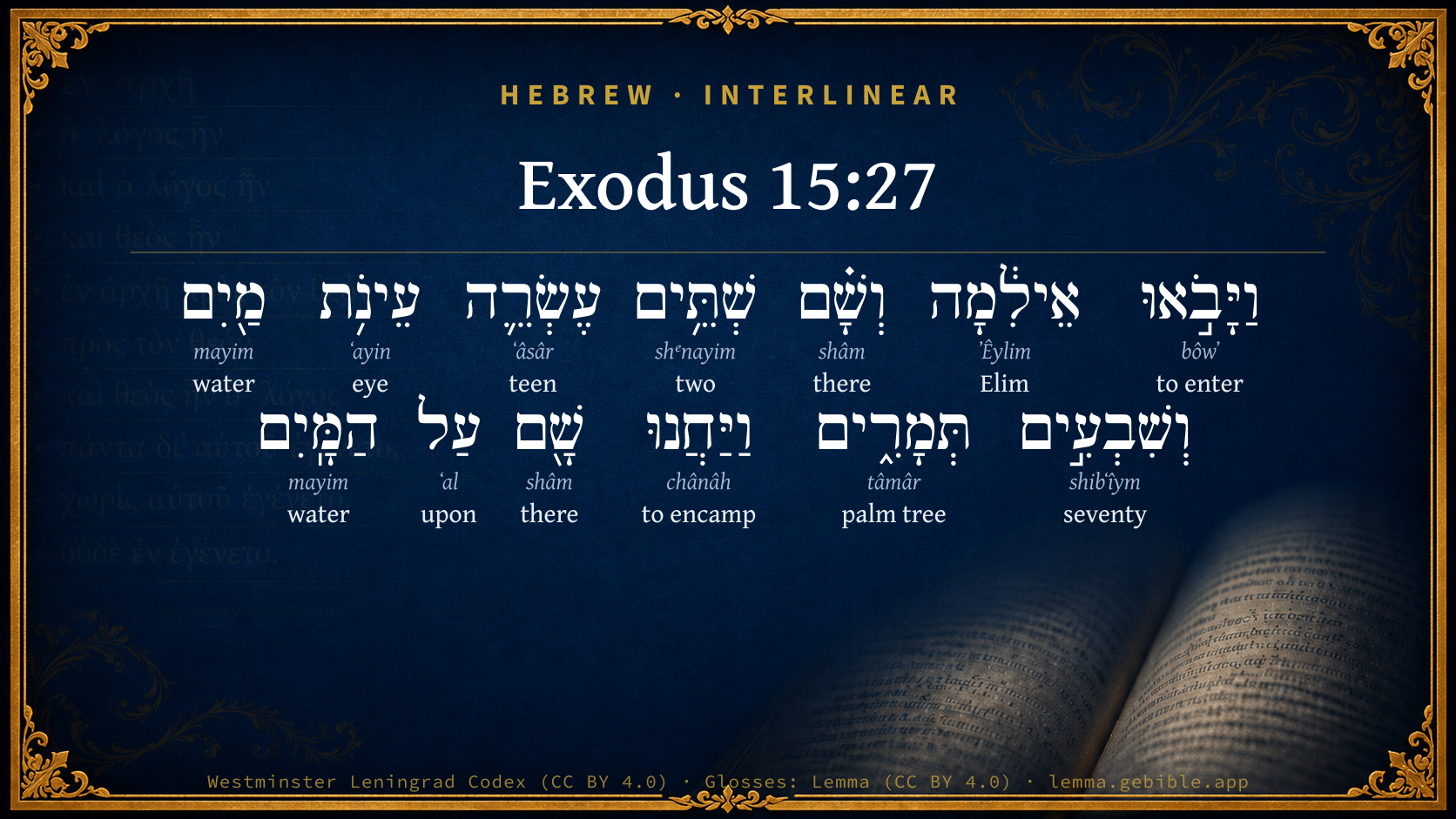
Hebrew (Westminster Leningrad Codex) Exodus 15:27 appears in the Hebrew Old Testament. The text above is from the Westminster Leningrad Codex. Each word links to its Strong’s number, a concise gloss, and parsing drawn from the Open Scriptures Hebrew Bible morphology. Click any word for its full Brown-Driver-Briggs (BDB) entry.
Download image
Cite this verse

Exodus 15:27 (World English Bible). Public Domain. Lemma interlinear Bible study tool, https://lemma.gebible.app/v/exodus/15/27.

Show BibTeX & RIS
BibTeX
RIS
English Translation
They came to Elim, where there were twelve springs of water, and seventy palm trees: and they encamped there by the waters.
World English Bible · Public Domain
Highlights
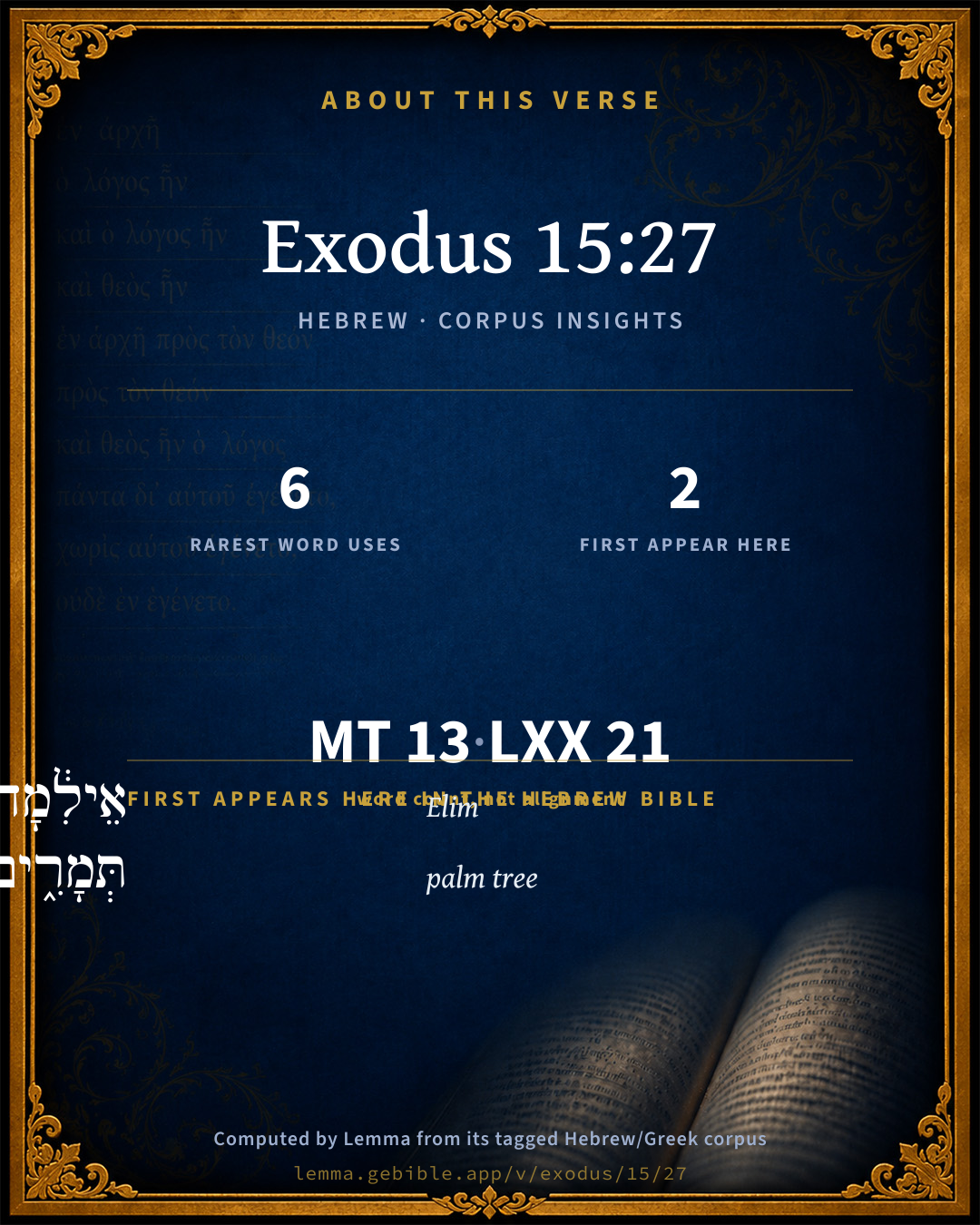
  • 2 first appearances in the Hebrew Bible
Full analysis ↓
Download a study sheet

One document with this verse’s original text, its word-by-word gloss line, the meaning frame, cross-references with their text, attributed commentary, and full source and license credits — printable, and it pastes into notes with its structure intact.

This verse Autodidact and up

Study sheet (.html) Plain text (.txt)

A passage Seminary Student

Up to 50 verses in one chapter. A passage sheet keeps up to 6 commentary sources and 12 cross-references per verse, in the order this page ranks them, and says so on the sheet whenever that leaves anything out. Ask for a single verse and you get the Autodidact verse sheet above.

Everything on this page stays free to read, with no account — the sheet is a download of what is already on screen, not access to it.

Want to remove ads? Support Godless Engineer
Compare translations 3

The same verse in 3 English versions, stacked beneath the original-language interlinear above. Click any original word for its lexicon entry.

Each is an independent rendering of the whole verse — the interlinear is not word-aligned to these translations.

Highlighted words mark where these versions differ — a whole-verse word diff, not a word-by-word alignment.

  • World English Bible Public Domain
    They came to Elim, where there were twelve springs of water, and seventy palm trees: and they encamped there by the waters.
  • King James Version Public Domain
    And they came to Elim, where were twelve wells of water, and threescore and ten palm trees: and they encamped there by the waters.
  • unfoldingWord Literal Text CC BY-SA 4.0
    And they came to Elim, and there were 12 springs of water and 70 palm trees there. And they camped there by the water.

unfoldingWord Literal Text — © unfoldingWord, licensed CC BY-SA 4.0. Word-aligned USFM3 via Door43 (git.door43.org/unfoldingWord/en_ult).

Versions to compare (up to 4)

3 of 4 selected

Show all 18 translations

Every available English version of this verse, each an independent rendering of the whole verse.

  • World English Bible Public Domain
    They came to Elim, where there were twelve springs of water, and seventy palm trees: and they encamped there by the waters.
  • Berean Standard Bible Public Domain
    Then they came to Elim, where there were twelve springs of water and seventy palm trees, and they camped there by the waters.
  • Majority Standard Bible Public Domain
    Then they came to Elim, where there were twelve springs of water and seventy palm trees, and they camped there by the waters.
  • King James Version Public Domain
    And they came to Elim, where were twelve wells of water, and threescore and ten palm trees: and they encamped there by the waters.
  • American Standard Version (1901) Public Domain
    And they came to Elim, where were twelve springs of water, and threescore and ten palm-trees: and they encamped there by the waters.
  • Revised Version (1885) Public Domain
    And they came to Elim, where were twelve springs of water, and threescore and ten palm trees: and they encamped there by the waters.
  • Geneva Bible (1599) Public Domain
    And they came to Elim, where were twelue fountaines of water, and seuentie palme trees, and they camped thereby the waters.
  • Douay-Rheims (1899) Public Domain
    And the children of Israel came into Elim, where there were twelve fountains of water, and seventy palm trees: and they encamped by the waters.
  • Young's Literal Translation Public Domain
    And they come to Elim, and there `are' twelve fountains of water, and seventy palm trees; and they encamp there by the waters.
  • Literal Standard Version CC BY-SA 4.0
    And they come to Elim, and there [are] twelve fountains of water, and seventy palm trees; and they encamp there by the waters.
  • Unlocked Literal Bible CC BY-SA 4.0
    Then the people came to Elim, where there were twelve springs of water and seventy palm trees. They camped there by the water.
  • unfoldingWord Literal Text CC BY-SA 4.0
    And they came to Elim, and there were 12 springs of water and 70 palm trees there. And they camped there by the water.
  • Darby Bible Public Domain
    And they came to Elim; and twelve springs of water were there, and seventy palm trees; and they encamped there by the waters.
  • World Messianic Bible Public Domain
    They came to Elim, where there were twelve springs of water and seventy palm trees. They encamped there by the waters.
  • Webster's Bible Public Domain
    And they came to Elim, where were twelve wells of water, and seventy palm-trees: and they encamped there by the waters.
  • Free Bible Version CC BY-SA 4.0
    Then they traveled on to Elim, which had twelve springs of water and seventy palm trees. They set up camp there beside the water.
  • Bible in Basic English Public Domain
    And they came to Elim where there were twelve water-springs and seventy palm-trees: and they put up their tents there by the waters.
  • JPS Tanakh (1917) Public Domain
    And they came to Elim, where were twelve springs of water, and three score and ten palm-trees; and they encamped there by the waters.

Literal Standard Version (2020), Covenant Press — licensed CC BY-SA 4.0. Text via the HelloAO Bible API (eBible.org). Unlocked Literal Bible (unfoldingWord) — licensed CC BY-SA 4.0. Text via the HelloAO Bible API (eBible.org). unfoldingWord Literal Text — © unfoldingWord, licensed CC BY-SA 4.0. Word-aligned USFM3 via Door43 (git.door43.org/unfoldingWord/en_ult). Free Bible Version, Dr. Jonathan Gallagher — licensed CC BY-SA 4.0. Text via the HelloAO Bible API (eBible.org).

Word by word

More ways to search: Search by grammar → Find every occurrence → Compare this word →

Practice this passage: Drill this verse → Learn its vocabulary →

אֵילִ֔מָה
ʼÊylim
H362
“Elim · toward”
Noun, Proper + Suffix, Demonstrative
Part of Speech
Noun
Type
Proper
Full BDB Definition

Origin: plural of H352

TWOT: None

Elim = "palms" - second encampment of the Israelites after the Exodus
  1. וַיָּבֹ֣אוּ bôwʼ H935 “and · to enter” Conjunction + Verb, Qal, Sequential Imperfect, 3rd Person, Masculine, Plural
  2. וְשָׁ֗ם shâm H8033 “and · there” Conjunction + Adverb
  3. שְׁתֵּ֥ים shᵉnayim H8147 “two” Adjective, Cardinal number, Feminine, Dual, Absolute
  4. עֶשְׂרֵ֛ה ʻâsâr H6240 “teen” Adjective, Cardinal number, Feminine, Singular, Absolute
  5. עֵינֹ֥ת ʻayin H5869 “eyes of” Noun, Common, Both, Plural, Construct
  6. מַ֖יִם mayim H4325 “water(s)” Noun, Common, Masculine, Plural, Absolute
  7. וְשִׁבְעִ֣ים shibʻîym H7657 “and · seventy” Conjunction + Adjective, Cardinal number, Both, Plural, Absolute
  8. תְּמָרִ֑ים tâmâr H8558 “palm trees” Noun, Common, Masculine, Plural, Absolute
  9. וַיַּחֲנוּ chânâh H2583 “and · to encamp” Conjunction + Verb, Qal, Sequential Imperfect, 3rd Person, Masculine, Plural
  10. שָׁ֖ם shâm H8033 “there” Adverb
  11. עַל ʻal H5921 “upon” Preposition
  12. הַמָּֽיִם mayim H4325 “the · water(s)” Particle, Definite Article + Noun, Common, Masculine, Plural, Absolute

About this verse

These counts appear in no published source. They are computed here, from the morphology-tagged text and Lemma’s own curated glosses. What Lemma adds →

13
words
11
distinct lemmas
Pentateuch
section

Notable vocabulary

The rarest word here is אֵילִ֔מָה Elim H362 — appearing just 6 times in the whole Hebrew Bible.

First appearance in Scripture

These words make their first canonical appearance in the Hebrew Bible here:

  • אֵילִ֔מָה Elim H362
  • תְּמָרִ֑ים palm tree H8558

Shared distinctive vocabulary

אֵילִ֔מָה Elim H362 occurs in 4 verses of the Hebrew Bible. Also found in:

Grammatical profile

  • 2 verbs
  • 5 nouns
  • 3 adjectives
  • 1 preposition
  • 2 adverbs

Verb forms

  • וַיָּבֹ֣אוּ Qal · Sequential Imperfect
  • וַיַּחֲנוּ Qal · Sequential Imperfect

Repetition

Words recur within this verse — often emphatic in Hebrew:

  • וְשָׁ֗ם there H8033 ×2
  • מַ֖יִם water H4325 ×2

Hebrew & Septuagint length

In English translation the verse runs 22 words from the Hebrew and 25 from the Septuagint (LXX English) — closely comparable.

A rough comparison of the two English renderings, which tokenize alike — not a word-level alignment.

Word counts can differ between the Hebrew and the Greek without any difference in meaning — e.g. the Hebrew direct-object marker אֵת has no separate Greek word, and Greek often adds the article ὁ.

In the original languages it is 13 Hebrew tokens and 21 Greek tokens — but the two are counted differently (Hebrew bundles its prefixes and suffixes into one token; the Greek is in lemma form), so that isn’t a like-for-like length.

Cross-references

5

Topical passages linked to Exodus 15:27 in the Treasury of Scripture Knowledge — connected by theme and wording, ordered by reader-vote popularity; previews shown in the World English Bible.

  • Revelation 22:2 in the middle of its street. On this side of the river and on that was the tree of life, bearing twelve kinds of fruits, yielding its fruit every month. The leaves of the tree were for the healing of the nations.
  • Revelation 7:17 for the Lamb who is in the midst of the throne shepherds them, and leads them to springs of waters of life. And God will wipe away every tear from their eyes."
  • Numbers 33:9 They traveled from Marah, and came to Elim: and in Elim were twelve springs of water, and seventy palm trees; and they encamped there.
  • Isaiah 12:3 Therefore with joy you shall draw water out of the wells of salvation.
  • Ezekiel 47:12 By the river on the bank of it, on this side and on that side, shall grow every tree for food, whose leaf shall not wither, neither shall the fruit of it fail: it shall bring forth new fruit every month, because the waters of it issue out of the sanctuary; and the fruit of it shall be for food, and the leaf of it for healing.

Cross-references courtesy of OpenBible.info (CC BY 4.0).

Hebrew and Greek witnesses Masoretic Hebrew ↔ Greek Septuagint

The same verse in the two great witnesses to the Old Testament, shown verse-for-verse.

These are two independent witnesses, not word-aligned to each other, and the Septuagint is shown in lemma (dictionary) form.

Hebrew Exodus 15:27 Masoretic · Westminster Leningrad Codex

וַיָּבֹ֣אוּ אֵילִ֔מָה וְשָׁ֗ם שְׁתֵּ֥ים עֶשְׂרֵ֛ה עֵינֹ֥ת מַ֖יִם וְשִׁבְעִ֣ים תְּמָרִ֑ים וַיַּחֲנוּ שָׁ֖ם עַל הַמָּֽיִם

They came to Elim, where there were twelve springs of water, and seventy palm trees: and they encamped there by the waters.

World English Bible · Public Domain

Greek LXX Exodus 15:27 Septuagint · lemma form

καί ἔρχομαι εἰς αιλιμ καί εἰμί ἐκεῖ δώδεκα πηγή ὕδωρ καί ἑβδομήκοντα στέλεχος φοῖνιξ παρα ἐνβάλλω δέ ἐκεῖ παρά ὁ ὕδωρ

And they came to Aelim, and there were there twelve fountains of water, and seventy stems of palm-trees; and they encamped there by the waters.

LXX2012 (modern English Septuagint) · Public Domain

Hebrew: Westminster Leningrad Codex (CC BY 4.0). Greek: Septuagint (public domain); English from LXX2012 (modern English Septuagint) (Public Domain). How the Septuagint differs from the Hebrew →

Targum (Aramaic paraphrase)

2

The Targum is the ancient Jewish Aramaic paraphrase of the Hebrew Scriptures — an interpretive translation, not the Hebrew text itself. Onkelos (literal) and Pseudo-Jonathan (expansive) render the Torah, and Jonathan the Prophets. Coverage is partial: where no permissively-licensed English translation exists for a verse, only the Aramaic is shown. This is verse-level text, not a word-by-word alignment to the Hebrew.

  1. Targum Onkelos Torah (Genesis–Deuteronomy)
    וַאֲתוֹ לְאֵילִם וְתַמָן תְּרֵי עֲסַר מַבּוּעִין דְמַיִן וְשִׁבְעִין דִקְלִין וּשְׁרוֹ תַמָן עַל מַיָא:

    (no public-domain English translation for this verse)

    Targum Onkelos — Aramaic: “Onkelos Genesis” (public domain); “Onkelos Exodus” (public domain); “Onkelos Leviticus” (public domain); “Onkelos Numbers” (public domain); “Onkelos Deuteronomy” (public domain). English: “Sefaria Community Translation” (CC0 1.0 (public-domain dedication)); “J.W. Etheridge. The Targums of Onkelos and Jonathan Ben Uzziel on the Pentateuch. London: Longmans, Green, 1862” (public domain). Text via Sefaria.

  2. Targum Pseudo-Jonathan Torah (Genesis–Deuteronomy)
    וְאָתוּ לְאֵלִים וּבְאֵלִים תַּרְתֵּי סְרֵי עֵינַוָון דְּמַיָין עַנְוָוא לְכָל שִׁבְטָא וְשׁוּבְעִין דִּקְלִין כָּל קְבֵיל שׁוּבְעִין סָבַיָא דְיִשְרָאֵל וּשְׁרוֹן תַּמָּן עַל מַיָא

    And they came to Elim; and in Elim were twelve fountains of water, a fountain for each tribe; and seventy palm-trees, corresponding with the seventy elders of Israel: and they encamped there by the waters.

    Targum Pseudo-Jonathan — Aramaic: “Targum Jonathan on Genesis” (public domain); “Targum Jonathan on Exodus” (public domain); “Targum Jonathan on Leviticus” (public domain); “Targum Jonathan on Numbers” (public domain); “Targum Jonathan on Deuteronomy” (public domain). English: “The Targum of Jonathan ben Uzziel, trans. J. W. Etheridge, London, 1862” (public domain). Text via Sefaria.

Commentary

Notes on Exodus 15:27 from classic Christian and Jewish commentators (each source and its license shown beneath its notes). The classic Christian expositions comment on the surrounding passage and are grouped to its opening verse, so a note may address several verses; the Jewish commentaries on the Tanakh (Rashi and others) are per-verse, so they appear only where the commentator wrote on this verse.

Lemma curates 59 commentaries, every one of them public domain or Creative Commons licensed, each selected and text-cleaned for this edition rather than reprinted as found. About our sources →

Trapp's Complete Commentary

John Trapp

Exo 15:27 And they came to Elim, where [were] twelve wells of water, and threescore and ten palm trees: and they encamped there by the waters.

Ver. 27. And they came to Elim.] The heathens slandered the Jews, that they found these fountains by the means of certain asses that guided them. Whence they are called Asinarii by Melon and Appion of Alexandria; who affirmed that for this cause the Jews worshipped the golden head of an ass, &c. {a}

{a} Corn. Tacit., Annul., lib. xii.

John Trapp, A Commentary or Exposition upon All the Books of the Old and New Testament (1647–1656) — public domain. Text from a community e-Sword module.

Joseph Benson's Commentary

Exo 15:27. Twelve wells of water — One for each tribe, and the seventy palm-trees affording a cooling shade.

Joseph Benson's Commentary on the Old and New Testaments (1811–1818) — public domain. Text from a community e-Sword module.

The Pulpit Commentary

They came to Elim. Elim was undoubtedly some spot in the comparatively fertile tract which lies south of the "wilderness of Shur," intervening between it and the "wilderness of Sin now E1 Murkha. This tract contains the three fertile wadys of Ghurundel, Useit, and Tayibeh, each of which is regarded by some writers as the true Elim. It has many springs of water, abundant tamarisks, and a certain number of palm-trees. On the whole, Ghurundel seems to be accepted by the majority of well-informed writers as having the best claim to be considered the Elhn of this passage Twelve wells. Rather "springs." The "twelve springs" have not been identified; but the Arabs are apt to conceal the sources of their water supplies (Niebuhr, Arabie, p. 347). A large stream flows down the Wady Ghurundel in the winter-time (ibid. ), which later becomes a small brook (Burckhardt, Syria, p. 778), and dries up altogether in the autumn. The pasture is good at most seasons, sometimes rich and luxuriant; there are abundant tamarisks, a considerable number of acacias, and. some palms. Three score and ten palm trees. The palm-trees of this part of Arabia are "not like those of Egypt or of pictures, but either dwarf that is, truntdess or else with savage hairy trunks, and branches all dishevelled" (Stanley, Sinai and Palestine, p. 68). There are a considerable number in the Wady Ghurundel, and others in the Wady Tayibeh ( ib, p. 69). They encamped there. It has been observed that the vast numbers of the host would more than fill the Wady Ghurundel, and that while the main body encamped there, others, with their cattle, probably occupied the adjacent wadys Useit, Ethal, and even Tayibeh or Shuweikah which all offer good pasturage

Elim.

they came to Elim, where were twelve wells of water," etc. (Exo_15:27) Describe locality, and point out the great change from Marah, and the miserable preceding three days in the desert. And then note the following suggestions as to the pilgrim path of a human soul.

I OUR PILGRIMAGE LIES THROUGH EVER-VARIED SCENERY. The changes here are so great that they cannot fail to suggest the corresponding truth, e.g. , fear on the west of the Red Sea, deliverance, triumph, three days" march, disappointment and healing at Marah, Elim.

II THE SCENERY WILL INCLUDE "ELIMS." In dark days we believe no bright will dawn, and vice versa. So the sorrowful must be reminded of Elims to come. Many oases for Israel; so to-day even in Sahara. Our Elims.

1. Lift the mind to their Giver.

2. Are earnests of the Better Land.

III "ELIMS" ARE THE CREATIONS OF TRUTH. Imagine all the beauty of Elim, and ask, what made it? It was the water that made the Paradise. Now, note the place of water in the economy of nature; as a constituent of the human body, in vegetation; as the chief element in all food, medicine, drink; as the universal solvent and purifier; as an agent in all dyes, gorgeous and homely; as "the eye" in every landscape, etc. It is no wonder then that water in Scripture is so often the emblem of truth, for which the soul thirsts, which is given as "water of life" from the throne of God and the Lamb. Doctrine "distils as the dew." God "pours clean water upon us that we may be clean." Note the analogy between truth and water implied in Mat_28:19. (See illustrations further in Bayley"s "Egypt to Canaan," pp. 110-112). And is it not new discovery of truth at crises in our lives, that make our "Elims"? Not at all anything external to the soul; but internal uncoverings of the goodness, grace and glory of our Heavenly Father, etc., etc. Develop and illustrate. Will it be considered fanciful to add, that:

IV OUR "ELIMS" HAVE AN INDIVIDUAL IMPRESS. Twelve wells," as many as tribes of Israel. Seventy palms," for the tent of each elder a palm. There is any way a speciality in our Father"s mercies, which marks them as for us, and reveals to us his personal love.

V THE "ELIMS" OF OUR PILGRIMAGE ARE NOT FAR FROM OUR "MARAHS." Only some eight or ten miles is that journey of Israel. Then:

1. At Marah let us hope for Elim.

2. From Marah push on for Elim. Never good to lie down and nurse sorrows and disappointments. Push "forward" along the pilgrim path of duty.

3. Marah prepares for the delight of Elim.

VI "ELIM" IS ONLY FOR ENCAMPMENT. "They encamped there by the waters;" did not dwell, or build a city there.

VII THE CHANGING SCENERY LEADS TO CANAAN. All the succeeding transformations of life are intended to prepare for the heavenly stability and rest. R.

The Pulpit Commentary (1880–1919), ed. H.D.M. Spence-Jones & Joseph S. Exell — public domain. Text from a community e-Sword module.

Geneva Bible (1599)

Geneva Bible translators

Or, date trees.

Geneva Bible (1599) marginal notes — public domain. Text via Bolls.life.

Jamieson, Fausset & Brown

Robert Jamieson, A. R. Fausset & David Brown

they came to Elim, where were twelve wells of water--supposed to be what is now called Wady-Ghurandel, the most extensive watercourse in the western desert--an oasis, adorned with a great variety of trees, among which the palm is still conspicuous, and fertilized by a copious stream. It is estimated to be a mile in breadth, but stretching out far to the northeast. After the weary travel through the desert, this must have appeared a most delightful encampment from its shade and verdure, as well as from its abundant supply of sweet water for the thirsty multitude. The palm is called "the tree of the desert," as its presence is always a sign of water. The palms in this spot are greatly increased in number, but the wells are diminished.

Next: Exodus Chapter 16

Jamieson, Fausset & Brown — Commentary Critical and Explanatory on the Whole Bible (1871) — public domain (CC PDM 1.0). Text via the HelloAO Bible API.

Adam Clarke's Commentary

Verse 27. They came to Elim] This was in the desert of Sin, and, according to Dr. Shaw, about two leagues from Tor, and thirty from Marah or Corondel.

Twelve wells of water] One for each of the tribes of Israel, say the Targums of Jonathan and Jerusalem.

And threescore and ten palm trees] One for each of the seventy elders.-Ibid.

Dr. Shaw found nine of the twelve wells, the other three having been choked up with sand; and the seventy palm trees multiplied into more than 2000, the dates of which bring a considerable revenue to the Greek monks at Tor. See his account at the end of this book, See Clarke on Ex 40:38. and see also the map. Thus sufficient evidence of the authenticity of this part of the sacred history remains, after the lapse of more than 3000 years.

IN the preceding notes the reader has been referred to Dr. Kennicott's translation and arrangement of the song of Moses. To this translation he prefixes the following observations: -

"This triumphant ode was sung by Moses and the sons of Israel: and the women, headed by Miriam, answered the men by repeating the two first lines of the song, altering only the first word, which two lines were probably sung more than once as a chorus.

"The conclusion of this ode seems very manifest; and yet, though the ancient Jews had sense enough to write this song differently from prose; and though their authority has prevailed even, to this day in this and three other poems in the Old Testament, (De 32:1-43; Jdg 5:1-31; 2Sa 22:1-51), still expressed by them as poetry; yet have these critics carried their ideas of the song here to the end of Ex 15:19. The reason why the same has been done by others probably is, they thought that the particle כי for, which begins Ex 15:19, necessarily connected it with the preceding poetry. But this difficulty is removed by translating כי when, especially if we take Ex 15:19-21 as being a prose explanation of the manner in which this song of triumph was performed. For these three verses say that the men singers were answered in the chorus by Miriam and the women, accompanying their words with musical instruments. 'When the horse of Pharaoh had gone into the sea, and the Lord had brought the sea upon them; and Israel had passed, on dry land, in the midst of the sea; then Miriam took a timbrel, and all the women went out after her with timbrels and dances; and Miriam (with the women) answered them (להם lahem, the men, by way of chorus) in the words, O sing ye, c.' That this chorus was sung more than once is thus stated by Bishop Lowth: Maria, cum mulieribus, virorum choro IDENTIDEM succinebat. - Praelect. 19.

"I shall now give what appears to me to be an exact translation of this whole song: -

MOSES. Part I

1. I will sing to JEHOVAH, for he hath triumphed

gloriously

The horse and his rider hath he thrown into

the sea.

2. My strength and my song is JEHOVAH;

And he is become to me for salvation:

This is my God, and I will celebrate him;

The God of my father, and I will exalt him.

3. Jehovah is mighty in Perhaps a

battle! - chorus sung

Jehovah is his name! by the men.

Chorus, by Miriam and the women.

Perhaps sung first in this place.

O sing ye to Jehovah, for he hath triumphed

gloriously:

The horse and his rider hath he thrown into the

sea.

MOSES. Part II

4. Pharaoh's chariots and his host hath he

cast into the sea;

And his chosen captains are drowned in the

Red Sea.

5. The depths have covered them, they went

down;

(They sank) to the bottom as a stone.

6. Thy right hand, Jehovah, is become glorious

in power;

Thy right hand, Jehovah, dasheth in pieces

the enemy.

7. And in the greatness of thine excellence

thou overthrowest them that rise against

thee.

Thou sendest forth thy wrath, which consumeth

them as stubble.

8. Even at the blast of thy displeasure the

waters are gathered together;

The floods stand upright as a heap,

Congealed are the depths in the very heart

of the sea.

O sing ye to JEHOVAH, c. Chorus by the

women.

MOSES. Part III

9. The enemy said: 'I will pursue, I shall

overtake

I shall divide the spoil, my soul shall be

satiated with them;

I will draw my sword, my hand shall destroy

them.'

10. Thou didst blow with thy wind, the sea

covered them;

They sank as lead in the mighty waters.

11. Who is like thee among the gods, O

JEHOVAH?

Who is like thee, glorious in holiness!

12. Fearful in praises; performing wonders!

Thou stretchest out thy right hand, the

earth swalloweth them!

13. Thou in thy mercy leadest the people whom

thou hast redeemed;

Thou in thy strength guidest to the

habitation of thy holiness!

O sing ye to JEHOVAH, c. Chorus by the

women.

MOSES. Part IV

14. The nations have heard, and are afraid

Sorrow hath seized the inhabitants of

Palestine.

15. Already are the dukes of Edom in

consternation,

And the mighty men of Moab, trembling

hath seized them;

All the inhabitants of Canaan do faint

16. Fear and dread shall fall upon them;

Through the greatness of thine arm they

shall be still as a stone.

17. Till thy people, JEHOVAH, pass over

[Jordan;]

Till the people pass over whom thou hast

redeemed.

18. Thou shalt bring them and plant them in

the mount of thine inheritance:

The place for thy rest which thou, JEHOVAH,

hast made;

The sanctuary, JEHOVAH, which thy hands

have established.

Grand chorus by ALL.

JEHOVAH FOR EVER AND EVER SHALL REIGN."

1. When poetry is consecrated to the service of God, and employed as above to commemorate his marvellous acts, it then becomes a very useful handmaid to piety, and God is honoured by his gifts. God inspired the song of Moses, and perhaps from this very circumstance it has passed for current among the most polished of the heathen nations, that a poet is a person Divinely inspired; and hence the epithet of προφητης, prophet, and vates, of the same import, was given them among the Greeks and Romans.

2. The song of Moses is a proof of the miraculous passage of the Israelites through the Red Sea. There has been no period since the Hebrew nation left Egypt in which this song was not found among them, as composed on that occasion, and to commemorate that event. It may be therefore considered as completely authentic as any living witness could be who had himself passed through the Red Sea, and whose life had been protracted through all the intervening ages to the present day.

3. We have already seen that it is a song of triumph for the deliverance of the people of God, and that it was intended to point out the final salvation and triumph of the whole Church of Christ; so that in the heaven of heavens the redeemed of the Lord, both among the Jews and the Gentiles, shall unite together to sing the song of Moses and the song of the Lamb. See Re 15:2-4. Reader, implore the mercy of God to enable thee to make thy calling and election sure, that thou mayest bear thy part in this glorious and eternal triumph.

Adam Clarke's Commentary on the Bible (1810–1826) — public domain. Text from a community e-Sword/MySword module.

Ellicott's Commentary for English Readers

(27) Elim—the next stage to Marah, where there were “twelve wells of water, and threescore and ten palm trees”—seems to be rightly identified with the Wady Ghurundel in which “abundant grass grows thick and high,” where acacias and tamarisks are plentiful, and in which, notwithstanding the ruthless denudation of the country by the Arabs, there are still a certain number of palm-trees. These are not now “seventy” in number, neither are they the ideal palm-trees of pictures, or even such as grow in the Valley of the Nile and in Upper Egypt generally. They are “either dwarf—that is, trunkless—or else with savage hairy trunks, and branches all dishevelled” (Stanley: Sinai and Palestine, p. 68)—specimens of the palm-tree growing under difficulties. The exact number of “twelve wells,” which is mentioned in the text, cannot now be traced with any distinctness; but there is a perennial brook which supports the vegetation through the whole of the year, and in the winter-time there is a large stream which flows down to the sea through the wady.—(Niebuhr: Description de l’Arabie, p. 347.)

They encamped there.—The head-quarters of the camp were at Elim (Wady Ghurundel); probably the mass of the people filled all the neighbouring wadys, as those of Useit, Ethal, and Tayibeh, or Shuweikah, which are all fertile, and have good pasturage.

A Bible Commentary for English Readers, edited by Charles John Ellicott (1878–1897) — public domain. Text from a community e-Sword module.

The Cambridge Bible for Schools and Colleges

gen. ed. J. J. S. Perowne

27. Elim] i.e. Terebinths, or perhaps Sacred trees in general (the word is quite possibly derived from ’çl, ‘god’), supposed by the common people to be inhabited by a deity, and venerated accordingly. When a tree or grove of trees is specially mentioned in the OT., a sacred tree, or grove, is often meant (cf. Isa_1:29): e.g. Gen_12:6 (see the writer’s note ad loc.), Exo_35:4; Exo_35:8, Jdg_9:6; Jdg_9:37 : see further Nature-Worship, §§ 2, 3, in EB. To the present day Palestine abounds in trees, esp. oaks, supposed to be ‘inhabited,’ or haunted by spirits (jinn); and the superstitious peasants hang rags upon them as tokens of homage (L. and B. ii. 104, 171 f., 222, 474).

Elim has been usually, since Burckhardt (p. 473 f.), identified with some spot in the Wady Gharandel1[155], a valley running down from the mountains about 7 miles SE. of Hawwárah, and forming a grateful contrast to the 54 miles of arid wilderness, which the traveller has passed through since leaving ‘Ayûn Mûsâ. Two miles below the point at which the route by Hawwárah enters the valley, there are springs which form the usual watering-place for caravans passing along this route: lower down, as the valley comes within 2 or 3 miles of the coast, ‘water rises in considerable volume to the surface, and nurtures a charming oasis,’ in which waterfowl and other birds are abundant, and there are ‘thickets of palms and tamarisks, beds of reeds and bulrushes, with a gurgling brook and pools’ (Ordn. Survey, p. 75): the thorny shrub called Gharkhad, with a juicy and refreshing berry, of which the Arabs are very fond, is also frequent in it (Burckh. l.c.; cf. Rob. i. 68 f.). The identification must not however be regarded as certain: there is no similarity of name to support it; and as Di. remarks, if the passage of the Israelites took place either through, or N. of, the Bitter Lakes, Elim would be more suitably located at ‘Ayûn Mûsâ.

[155] The identification seems really to have been made as early as the 6th cent.: for the Sarandula visited by Antoninus (Anton. Itinerarium, ed. Gildemeister, 1889, § 41), at about 570 a.d., can hardly be any other place.

The Cambridge Bible for Schools and Colleges (gen. ed. J. J. S. Perowne; Cambridge University Press, 1878–1918) — public domain. Text from a community e-Sword module.

Albert Barnes' Notes on the Bible

Elim - The valley of Gharandel, two hours’ journey south of Huwara.

Twelve wells - Read springs; the Hebrew denotes natural sources. These springs may have been perennial when a richer vegetation clothed the adjacent heights.

Albert Barnes' Notes on the Bible (1834–1885) — public domain. Text from a community e-Sword/MySword module.

Haydock's Catholic Bible Commentary

Elim, to the north-west of Sinai. Shaw says there are now only nine fountains. (Haydock) --- Strabo mentions a place of this description, five days’ journey from Jericho, which was consecrated to the gods. (B. xvi. p. 511.) (Calmet) --- We might here, (at the conclusion of the third age, according to those who call the deluge the first, and Abraham’s call, the second,) pause, with Dr. Worthington, to take a view of the progress of the Church, and of the true doctrine, which has at all times been believed. But the attentive reader of the sacred text, and of these notes, will find this to his hand almost every page. Meditate upon these things....Take heed to thyself and to doctrine, be earnest in them, 1 Timothy iv. 15. The holy Job probably lived about this time, so that his book may serve to corroborate those truths, which were the objects of faith to some good men living among the Gentiles, as well as to the more favoured nation of the Jews. (Haydock)

George Leo Haydock (1774–1849), Haydock's Catholic Family Bible and Commentary, 1859 edition — public domain. Excludes Psalms (Douay-Rheims chapter numbering differs from Protestant) and Deuterocanonical books (Catholic canon only).

Matthew Poole's English Annotations

Palm trees were both pleasant for their shade, and refreshing for their sweet fruit. Thus the Israelites are obliged and encouraged to the obedience commanded, by being put into better circumstances than they were under in their last station.

Matthew Poole's English Annotations on the Holy Bible (1683–1685) — public domain. Text from a community e-Sword/MySword module.

Whedon's Commentary on the Bible

Daniel D. Whedon

27. Elim — Trees. Here were palm trees and waters, or springs, around which they encamped, (rested and refreshed themselves,) probably for from two to three weeks, since it was just a month from the time of their leaving Rameses that they broke up from Elim. Exo_16:1. As the next encampment was “by the Red Sea,” according to the itinerary in Numbers xxxiii, which gives a fuller catalogue of the stations, it is plain that Elim took them back from the shore, within sight of which they had been moving. Just below Hawwarah, and surrounding three sides of Jebel (Mount) Hammam, there are several fertile wadies, through and across which their route now led them, which perfectly met their requirement. Jebel Hammam is a bare, picturesque cliff of flinty limestone, warm sulphur springs rising from its northern base, which comes down to the Sea in steep bluffs five miles long, thus cutting off the plain already described as the “Wilderness of Shur,” and compelling caravans from Suez to go round and over its northern shoulder in order to reach the plain which skirts the Sea below the Mount, and which we suppose to be the “Desert of Sin.” Exo_16:1. The Israelites were probably spread through all these wadies around Mount Hammam, while the headquarters of the host were encamped where there were wells corresponding in number to the tribes, and where there was a grove of palms corresponding to the tribal families — the Wady Gharandel. Gharandel is the principal halting place and the most fertile spot between Suez and Sinai; Wady Feiran alone comparing with it in richness and loveliness. It is in some places nearly a mile broad, its running brook fringed with trees, while water can be anywhere found by digging a little depth. “Here are the wild palms,” says Stanley, “successors of the threescore and ten. Not like those of Egypt or of pictures, but either dwarf, that is, trunkless, or else with savage, hairy trunks, and branches all dishevelled. Then there are the feathery tamarisks, here assuming gnarled boughs and hoary heads; the wild acacia; a tangled, spreading tree, which shoots out its gay foliage and blue blossoms over the desert.” — Sinai and Pal., p. 65. Here, too, the bright green grass is most refreshing to the eye wearied by the hot, white desert, but it is coarse and rough to the touch. Tischendorf says, “This is a glorious oasis… enclosed like a jewel between the chalky cliffs. We reposed for a long time in the grass, which was as tall as ourselves; tamarisks and dwarf palms stretched like a garland from east to west.” (Quoted by Kurtz.)

The wadies which succeed Gharandel resemble it somewhat in character, but are much inferior in fertility, although Useit once surpassed it in its palm-grove. Through these valleys we suppose the Israelitish camp to have spread, round the northern shoulder of Jebel Hammam, perhaps into Wady Taiyebeh, a beautiful valley, winding between steep cliffs of red sandstone, flinty chalk, and variegated conglomerates, down to the plain el Murkha, which skirts the Sea. When they left Elim they encamped at the mouth of the wady, and scattered along this plain, “by the Red Sea.”

Num_33:10. As they descended the mountain pass, between the high steep walls, then as now curtained here and there with the green, creeping caper, and painted, as they neared the Sea, with bright bands of red, and brown, and black — as they poured down into the plain and spread along the shelly beach — they caught one more view of the distant hills of Egypt across the blue waters that had swallowed up the chariots and horses of Pharaoh.

From Gharandel to the Sea at Ras (Cape) Zelinea is, by this route, about eight hours’ travel, an easy day’s journey for the men of Israel after their long rest at Elim, but quite long for the remainder of the host, who, it is likely, had generally to come only from Useit, or the upper part of Taiyebeh. Palmer, who has thoroughly surveyed all these wadies, decides that Taiyebeh is the only valley by which they could have descended to the Sea.

Daniel D. Whedon (gen. ed.), Commentary on the Old and New Testaments (1874–1909) — public domain. Text from a community e-Sword module.

unfoldingWord translationNotes

Door43 World Missions Community

Elim

This is an oasis in the desert, a place with water and shade trees. (See: How to Translate Names)

twelve

"12" (See: Numbers)

seventy

"70" (See: Numbers)

translationWords

water

palm

unfoldingWord translationNotes — © Distant Shores Media and the Door43 World Missions Community, licensed CC BY-SA 4.0. Source: git.door43.org/Door43/en_tn.

Rashi

Rabbi Shlomo Yitzchaki (Rashi)

שתים עשרה עינת מים TWELVE SPRINGS OF WATER — A number corresponding to the twelve tribes of Israel were ready for them (Mekhilta).

ושבעים תמרים AND SEVENTY PALM-TREES — corresponding to the seventy elders (Mekhilta).

Rashi on the Tanakh — English translations: “The Judaica Press complete Tanach with Rashi, translated by A. J. Rosenberg” (CC BY 4.0); “Pentateuch with Rashi's commentary by M. Rosenbaum and A.M. Silbermann, 1929-1934” (public domain); “The Metsudah Tanach series, Lakewood, N.J” (CC BY 4.0); and “The Book of Joshua, Metsudah Publications, 1997” (CC BY 4.0). Text via Sefaria.

Ramban (Nachmanides)

Rabbi Moshe ben Nachman (Ramban / Nachmanides)

AND THERE WERE TWELVE SPRINGS OF WATER, AND THREE SCORE AND TEN PALM TREES. It is not such a significant matter that seventy palm trees are found in a certain place. In the lowlands, a thousand and more palm trees can be found in one location, and springs of abundant water are springing forth in valleys and hills, and Scripture does not mention them at all! [Why then are these springs and palm trees singled out here?]Now Rabbi Abraham ibn Ezra explained that Scripture narrates that they came to a good place which was unlike Marah. In Elim, there were many springs, and the waters were sweet and good, since palm trees cannot thrive in soil where the waters are bitter. It is for this reason that Scripture says here and they encamped there, because on account of it, they stayed there for more days than in the other places they passed through. In the section of Eileh Mas’ei, however, Scripture does not relate anything about Marah, and yet it states, And they journeyed from Marah, and came unto Elim; and in Elim were twelve springs of water, and three score and ten palm trees, and they encamped there, Verse 9. Accordingly Ibn Ezra’s explanation that the springs and palm trees of Elim were mentioned here in order to contrast with Marah, where the waters were bitter, cannot be correct, because there in Eileh Mas’ei, Scripture states nothing about Marah and yet mentions the same about Elim as here. and a description of a place at such length is not found there about any of the places they traversed!Now Rashi wrote: “Twelve springs of water, a number corresponding to the twelve tribes of Israel, were ready for them. And seventy palm trees — these corresponded to the seventy elders.” But I do not know the nature of this preparation, i.e., whether it was done for them by a miracle just for that time. I have however, seen here in the Mechilta: “Rabbi Eleazar of Modaim said: ‘On the very day that the Holy One, blessed be He, created His world, He created twelve springs corresponding to the twelve tribes of Israel, and seventy palm trees corresponding to the seventy elders.’” Scripture thus tells that each tribe encamped beside his spring and the elders sat in their shade praising G-d for them, because He had prepared for them [such a restful place] in a land of drought. Our Rabbis have yet another explanation in the Midrash of Rabbi Nechunya ben Hakanah on this verse, which is wonderful in our eyes.

Ramban (Nachmanides) on the Tanakh — English translation: “Commentary on the Torah by Ramban (Nachmanides). Translated and annotated by Charles B. Chavel. New York, Shilo Pub. House, 1971-1976” (CC BY 4.0). Text via Sefaria.

Lesson kit

Teaching starters — assembled from the data on this page, not authored interpretation. Every prompt links to the verse data it draws on. Edit before teaching.

Exodus, in the Pentateuch, opens this verse with 13 words (11 distinct Hebrew lemmas). Its most distinctive word is ʼÊylim (“Elim”). A historical commentator’s framing appears above. Read the whole chapter for the surrounding context.

Discussion questions

  1. How does “Elim” (ʼÊylim) shape what this verse is saying?
  2. 2 words make their first appearance in Scripture here. What does this debut establish?
  3. How does Exodus 16:1, which shares the word «Elim», read alongside this verse?
  4. What does the repetition of “there” (2× in this one verse) do in this verse?
  5. The translations on this page render this verse differently — a whole-verse word diff, not a word-by-word alignment. What might account for the different wordings?
  6. «וַיָּבֹ֣אוּ» is a Qal Sequential Imperfect verb. How does that grammatical form shape the action described?
  7. Compare how Trapp's Complete Commentary and Joseph Benson's Commentary read this verse. Where do they agree or differ?

Things to notice

Reading settings

Reading text

Shown beneath each verse's original-language words.

Old Testament
Old Testament edition

Read the OT as the Masoretic Hebrew (MT) or the Greek Septuagint (LXX).

English shown for the Greek Septuagint (in the Hebrew ↔ Greek comparison).

Comparing translations? Open the Compare panel on any verse page to stack up to four side by side.