
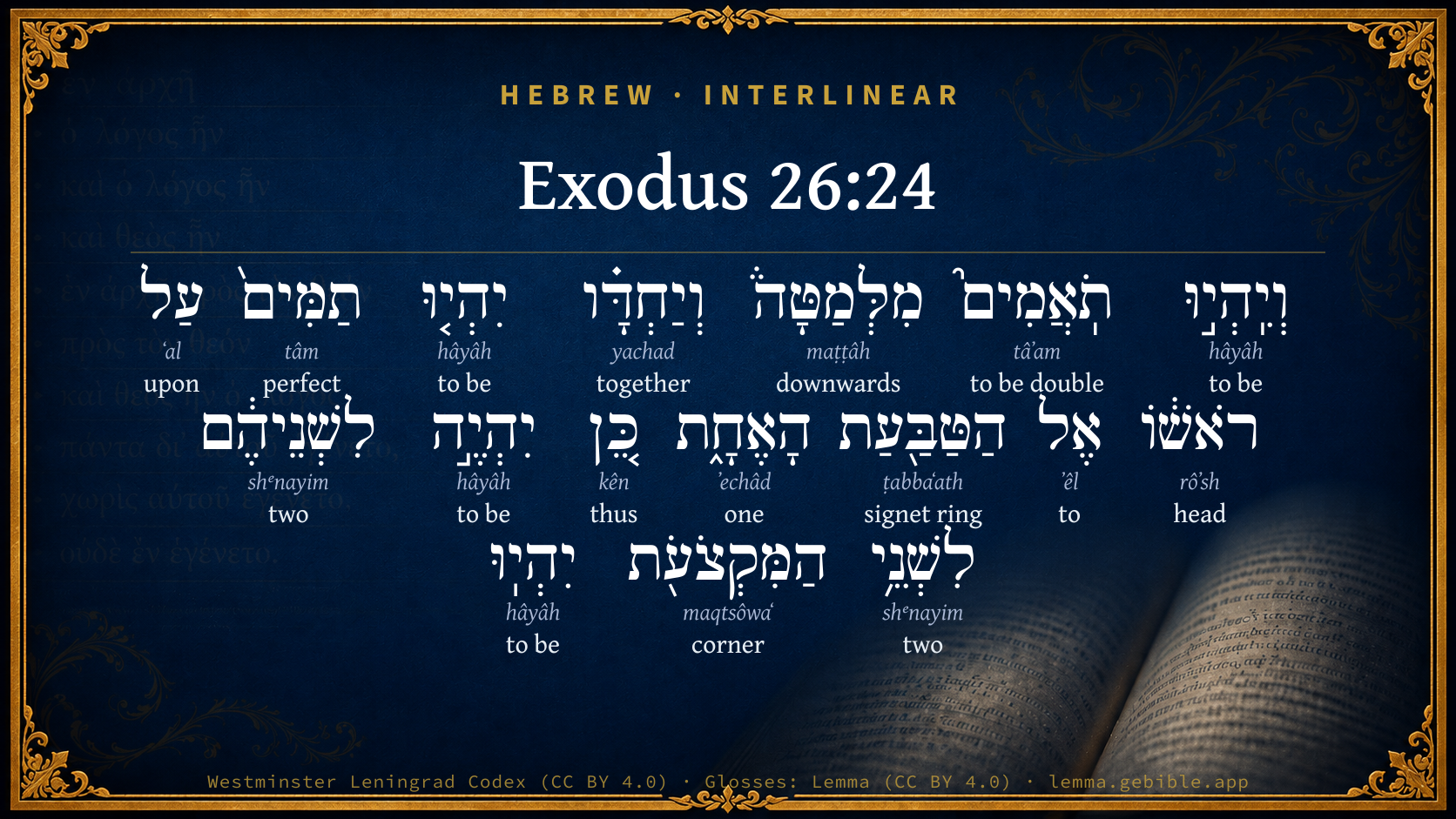
Exodus 26:24

Hebrew (Westminster Leningrad Codex) Exodus 26:24 appears in the Hebrew Old Testament. The text above is from the Westminster Leningrad Codex. Each word links to its Strong’s number, a concise gloss, and parsing drawn from the Open Scriptures Hebrew Bible morphology. Click any word for its full Brown-Driver-Briggs (BDB) entry.
Download image
Cite this verse

Exodus 26:24 (World English Bible). Public Domain. Lemma interlinear Bible study tool, https://lemma.gebible.app/v/exodus/26/24.

Show BibTeX & RIS
BibTeX
RIS
English Translation
They shall be double beneath, and in like manner they shall be entire to the top of it to one ring: thus shall it be for them both; they shall be for the two corners.
World English Bible · Public Domain
Highlights
  • 3 first appearances in the Hebrew Bible
Full analysis ↓
Download a study sheet

One document with this verse’s original text, its word-by-word gloss line, the meaning frame, cross-references with their text, attributed commentary, and full source and license credits — printable, and it pastes into notes with its structure intact.

This verse Autodidact and up

Study sheet (.html) Plain text (.txt)

A passage Seminary Student

Up to 50 verses in one chapter. A passage sheet keeps up to 6 commentary sources and 12 cross-references per verse, in the order this page ranks them, and says so on the sheet whenever that leaves anything out. Ask for a single verse and you get the Autodidact verse sheet above.

Everything on this page stays free to read, with no account — the sheet is a download of what is already on screen, not access to it.

Want to remove ads? Support Godless Engineer
Compare translations 3

The same verse in 3 English versions, stacked beneath the original-language interlinear above. Click any original word for its lexicon entry.

Each is an independent rendering of the whole verse — the interlinear is not word-aligned to these translations.

Highlighted words mark where these versions differ — a whole-verse word diff, not a word-by-word alignment.

  • World English Bible Public Domain
    They shall be double beneath, and in like manner they shall be entire to the top of it to one ring: thus shall it be for them both; they shall be for the two corners.
  • King James Version Public Domain
    And they shall be coupled together beneath, and they shall be coupled together above the head of it unto one ring: thus shall it be for them both; they shall be for the two corners.
  • unfoldingWord Literal Text CC BY-SA 4.0
    And they shall be a pair at the bottom, and they shall be completely together at the top to one ring. Thus it shall be for both; the two shall be the corners.

unfoldingWord Literal Text — © unfoldingWord, licensed CC BY-SA 4.0. Word-aligned USFM3 via Door43 (git.door43.org/unfoldingWord/en_ult).

Versions to compare (up to 4)

3 of 4 selected

Show all 18 translations

Every available English version of this verse, each an independent rendering of the whole verse.

  • World English Bible Public Domain
    They shall be double beneath, and in like manner they shall be entire to the top of it to one ring: thus shall it be for them both; they shall be for the two corners.
  • Berean Standard Bible Public Domain
    coupled together from bottom to top and fitted into a single ring. These will serve as the two corners.
  • Majority Standard Bible Public Domain
    coupled together from bottom to top and fitted into a single ring. These will serve as the two corners.
  • King James Version Public Domain
    And they shall be coupled together beneath, and they shall be coupled together above the head of it unto one ring: thus shall it be for them both; they shall be for the two corners.
  • American Standard Version (1901) Public Domain
    And they shall be double beneath, and in like manner they shall be entire unto the top thereof unto one ring: thus shall it be for them both; they shall be for the two corners.
  • Revised Version (1885) Public Domain
    And they shall be double beneath, and in like manner they shall be entire unto the top thereof unto one ring: thus shall it be for them both; they shall be for the two corners.
  • Geneva Bible (1599) Public Domain
    Also they shalbe ioyned beneath, and likewise they shalbe ioyned aboue to a ring: thus shall it be for them two: they shalbe for ye two corners.
  • Douay-Rheims (1899) Public Domain
    And they shall be joined together from beneath unto the top, and one joint shall hold them all. The like joining shall be observed for the two boards also that are to be put in the corners.
  • Young's Literal Translation Public Domain
    And they are pairs beneath, and together they are pairs above its head unto the one ring; so is it for them both, they are for the two corners.
  • Literal Standard Version CC BY-SA 4.0
    And they are pairs beneath, and together they are pairs above its head to one ring; so is it for them both, they are for the two corners.
  • Unlocked Literal Bible CC BY-SA 4.0
    These frames must be separate at the bottom, but joined at the top to the same ring. It must be this way for both of the back corners.
  • unfoldingWord Literal Text CC BY-SA 4.0
    And they shall be a pair at the bottom, and they shall be completely together at the top to one ring. Thus it shall be for both; the two shall be the corners.
  • Darby Bible Public Domain
    and they shall be joined beneath, and together shall be united at the top thereof to one ring: thus shall it be for them both; they shall be for the two corners.
  • World Messianic Bible Public Domain
    They shall be double beneath, and in the same way they shall be whole to its top to one ring: thus shall it be for them both; they shall be for the two corners.
  • Webster's Bible Public Domain
    And they shall be coupled together beneath, and they shall be coupled together above the head of it to one ring: thus shall it be for them both; they shall be for the two corners.
  • Free Bible Version CC BY-SA 4.0
    Join these corner frames at the bottom and at the top near to the first ring. This is how you are to make the two corner frames.
  • Bible in Basic English Public Domain
    The two are to be joined together at the base and at the top to one ring, forming the two angles.
  • JPS Tanakh (1917) Public Domain
    And they shall be double beneath, and in like manner they shall be complete unto the top thereof unto the first ring; thus shall it be for them both; they shall be for the two corners.

Literal Standard Version (2020), Covenant Press — licensed CC BY-SA 4.0. Text via the HelloAO Bible API (eBible.org). Unlocked Literal Bible (unfoldingWord) — licensed CC BY-SA 4.0. Text via the HelloAO Bible API (eBible.org). unfoldingWord Literal Text — © unfoldingWord, licensed CC BY-SA 4.0. Word-aligned USFM3 via Door43 (git.door43.org/unfoldingWord/en_ult). Free Bible Version, Dr. Jonathan Gallagher — licensed CC BY-SA 4.0. Text via the HelloAO Bible API (eBible.org).

Word by word

More ways to search: Search by grammar → Find every occurrence → Compare this word →

Practice this passage: Drill this verse → Learn its vocabulary →

תֹֽאֲמִים֮
tâʼam
H8382
“twins”
Noun, Common, Masculine, Plural, Absolute
Part of Speech
Noun
Type
Common
Gender
Masculine
Number
Plural
State
Absolute
Full BDB Definition

Origin: a primitive root

TWOT: 2489

to be double, be joined - (Qal) to be double - (Hiphil) to bear twins
  1. וְיִֽהְי֣וּ hâyâh H1961 “and · to be” Conjunction + Verb, Qal, Imperfect, 3rd Person, Masculine, Plural
  2. מִלְּמַטָּה֒ maṭṭâh H4295 “from · to/for · downwards” Preposition + Preposition + Adverb
  3. וְיַחְדָּ֗ו yachad H3162 “and · together” Conjunction + Adverb
  4. יִהְי֤וּ hâyâh H1961 “to be” Verb, Qal, Imperfect, 3rd Person, Masculine, Plural
  5. תַמִּים֙ tâm H8535 “perfect” Adjective, Adjective, Masculine, Plural, Absolute
  6. עַל ʻal H5921 “upon” Preposition
  7. רֹאשׁ֔וֹ rôʼsh H7218 “head · his” Noun, Common, Masculine, Singular, Construct + Suffix, Personal, 3rd Person, Masculine, Singular
  8. אֶל ʼêl H413 “to” Preposition
  9. הַטַּבַּ֖עַת ṭabbaʻath H2885 “the · signet ring” Particle, Definite Article + Noun, Common, Feminine, Singular, Absolute
  10. הָאֶחָ֑ת ʼechâd H259 “the · one” Particle, Definite Article + Adjective, Cardinal number, Feminine, Singular, Absolute
  11. כֵּ֚ן kên H3651 “thus” Particle, Demonstrative
  12. יִהְיֶ֣ה hâyâh H1961 “to be” Verb, Qal, Imperfect, 3rd Person, Masculine, Singular
  13. לִשְׁנֵיהֶ֔ם shᵉnayim H8147 “to/for · two · their” Preposition + Adjective, Cardinal number, Masculine, Dual, Construct + Suffix, Personal, 3rd Person, Masculine, Plural
  14. לִשְׁנֵ֥י shᵉnayim H8147 “to/for · two” Preposition + Adjective, Cardinal number, Masculine, Dual, Construct
  15. הַמִּקְצֹעֹ֖ת maqtsôwaʻ H4740 “the · corners” Particle, Definite Article + Noun, Common, Masculine, Plural, Absolute
  16. יִהְיֽוּ hâyâh H1961 “to be” Verb, Qal, Imperfect, 3rd Person, Masculine, Plural

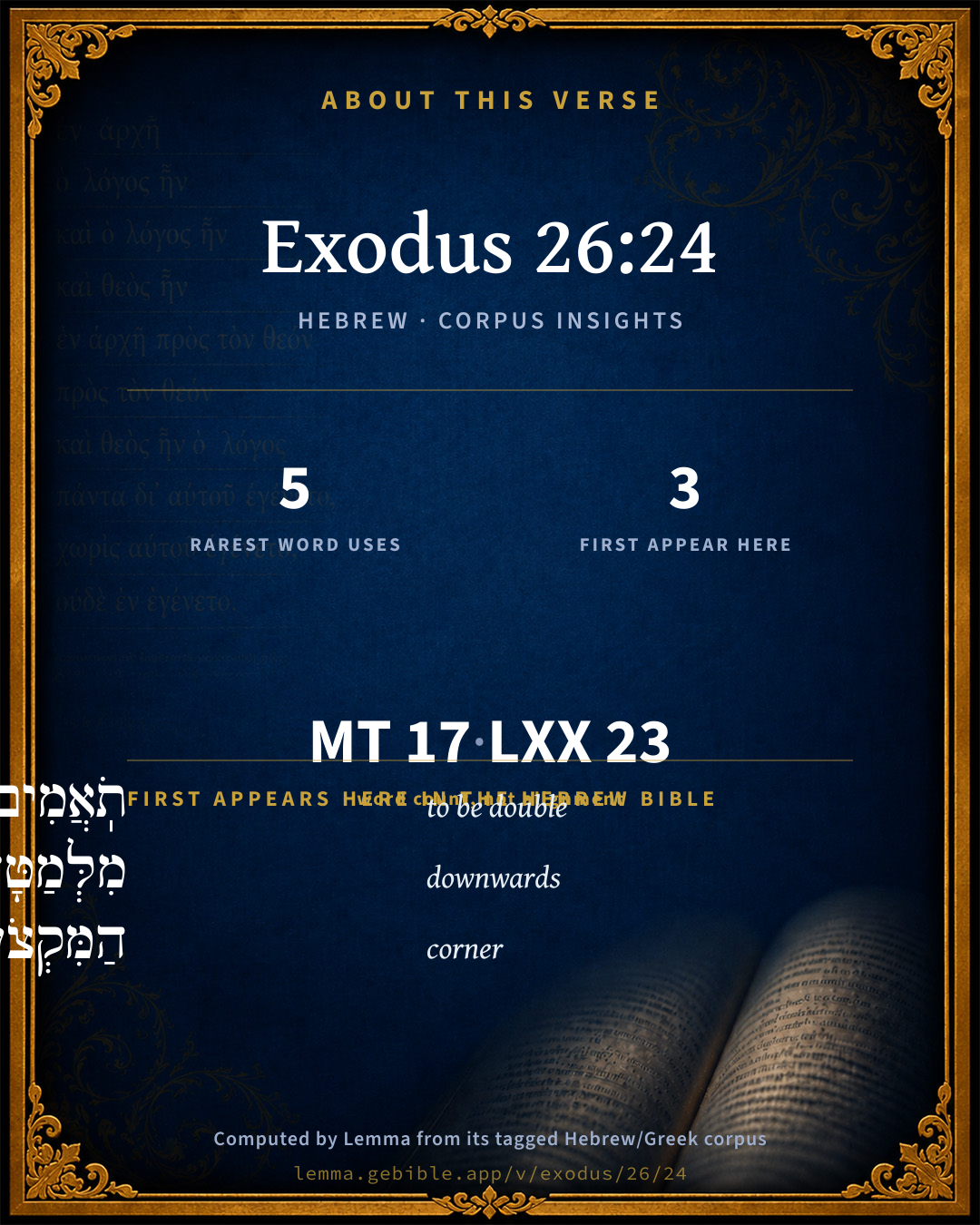
About this verse

These counts appear in no published source. They are computed here, from the morphology-tagged text and Lemma’s own curated glosses. What Lemma adds →

17
words
13
distinct lemmas
Pentateuch
section

Notable vocabulary

The rarest word here is תֹֽאֲמִים֮ to be double H8382 — appearing just 5 times in the whole Hebrew Bible.

First appearance in Scripture

These words make their first canonical appearance in the Hebrew Bible here:

  • תֹֽאֲמִים֮ to be double H8382
  • מִלְּמַטָּה֒ downwards H4295
  • הַמִּקְצֹעֹ֖ת corner H4740

Shared distinctive vocabulary

תֹֽאֲמִים֮ to be double H8382 occurs in 4 verses of the Hebrew Bible. Also found in:

Grammatical profile

  • 4 verbs
  • 4 nouns
  • 4 adjectives
  • 2 prepositions
  • 2 adverbs
  • 1 particle

Verb forms

  • וְיִֽהְי֣וּ Qal · Imperfect
  • יִהְי֤וּ Qal · Imperfect
  • יִהְיֶ֣ה Qal · Imperfect
  • יִהְיֽוּ Qal · Imperfect

Repetition

Words recur within this verse — often emphatic in Hebrew:

  • וְיִֽהְי֣וּ to be H1961 ×4
  • לִשְׁנֵיהֶ֔ם two H8147 ×2

Hebrew & Septuagint length

In English translation the verse runs 35 words from the Hebrew and 33 from the Septuagint (LXX English) — closely comparable.

A rough comparison of the two English renderings, which tokenize alike — not a word-level alignment.

Word counts can differ between the Hebrew and the Greek without any difference in meaning — e.g. the Hebrew direct-object marker אֵת has no separate Greek word, and Greek often adds the article ὁ.

In the original languages it is 17 Hebrew tokens and 23 Greek tokens — but the two are counted differently (Hebrew bundles its prefixes and suffixes into one token; the Greek is in lemma form), so that isn’t a like-for-like length.

Cross-references

5

Topical passages linked to Exodus 26:24 in the Treasury of Scripture Knowledge — connected by theme and wording, ordered by reader-vote popularity; previews shown in the World English Bible.

  • Exodus 36:29–30 They were double beneath, and in like manner they were all the way to the top of it to one ring. He did thus to both of them in the two corners.
  • Psalms 133:1–3 See how good and how pleasant it is For brothers to live together in unity!
  • 1 Corinthians 1:10 Now I beg you, brothers, through the name of our Lord, Jesus Christ, that you all speak the same thing and that there be no divisions among you, but that you be perfected together in the same mind and in the same judgment.
  • 1 Corinthians 3:16 Don't you know that you are a temple of God, and that God's Spirit lives in you?
  • 1 Peter 2:5 You also, as living stones, are built up as a spiritual house, to be a holy priesthood, to offer up spiritual sacrifices, acceptable to God through Jesus Christ.

Cross-references courtesy of OpenBible.info (CC BY 4.0).

Hebrew and Greek witnesses Masoretic Hebrew ↔ Greek Septuagint

The same verse in the two great witnesses to the Old Testament, shown verse-for-verse.

These are two independent witnesses, not word-aligned to each other, and the Septuagint is shown in lemma (dictionary) form.

Hebrew Exodus 26:24 Masoretic · Westminster Leningrad Codex

וְיִֽהְי֣וּ תֹֽאֲמִים֮ מִלְּמַטָּה֒ וְיַחְדָּ֗ו יִהְי֤וּ תַמִּים֙ עַל רֹאשׁ֔וֹ אֶל הַטַּבַּ֖עַת הָאֶחָ֑ת כֵּ֚ן יִהְיֶ֣ה לִשְׁנֵיהֶ֔ם לִשְׁנֵ֥י הַמִּקְצֹעֹ֖ת יִהְיֽוּ

They shall be double beneath, and in like manner they shall be entire to the top of it to one ring: thus shall it be for them both; they shall be for the two corners.

World English Bible · Public Domain

Greek LXX Exodus 26:24 Septuagint · lemma form

καί εἰμί ἐκ ἴσος κάτωθεν κατά ὁ αὐτός εἰμί ἴσος ἐκ ὁ κεφαλίς εἰς σύμβλησις εἷς οὕτως ποιέω ἀμφότεροι ὁ δύο γωνία εἰμί

And it shall be equal below, they shall be equal toward the same part from the heads to one joining; so shall you make to both the two corners, let them be equal.

LXX2012 (modern English Septuagint) · Public Domain

Hebrew: Westminster Leningrad Codex (CC BY 4.0). Greek: Septuagint (public domain); English from LXX2012 (modern English Septuagint) (Public Domain). How the Septuagint differs from the Hebrew →

Targum (Aramaic paraphrase)

2

The Targum is the ancient Jewish Aramaic paraphrase of the Hebrew Scriptures — an interpretive translation, not the Hebrew text itself. Onkelos (literal) and Pseudo-Jonathan (expansive) render the Torah, and Jonathan the Prophets. Coverage is partial: where no permissively-licensed English translation exists for a verse, only the Aramaic is shown. This is verse-level text, not a word-by-word alignment to the Hebrew.

  1. Targum Onkelos Torah (Genesis–Deuteronomy)
    וִיהוֹן מְכַוְנִין מִלְרַע וְכַחֲדָא יְהוֹן מְכַוְנִין עַל רֵישֵׁהּ לְעִזְקְתָא חֲדָא כֵּן יְהֵי לְתַרְוֵיהוֹן לִתְרֵין זָוְיָן יְהוֹן:

    (no public-domain English translation for this verse)

    Targum Onkelos — Aramaic: “Onkelos Genesis” (public domain); “Onkelos Exodus” (public domain); “Onkelos Leviticus” (public domain); “Onkelos Numbers” (public domain); “Onkelos Deuteronomy” (public domain). English: “Sefaria Community Translation” (CC0 1.0 (public-domain dedication)); “J.W. Etheridge. The Targums of Onkelos and Jonathan Ben Uzziel on the Pentateuch. London: Longmans, Green, 1862” (public domain). Text via Sefaria.

  2. Targum Pseudo-Jonathan Torah (Genesis–Deuteronomy)
    וִיהוֹן מִזַוְוגִין מִלְּרַע וְכַחֲדָא יְהוֹן מְזַוְוגִין עַל רֵישֵׁיהוֹן בְּעִזְקָתָא חֲדָא הֵיכְדֵין יְהֵי לְתַרְוֵיהוֹן לִתְּרֵין זִיוְויָן יְהוֹן

    And they shall be conjoined beneath, and in one manner shall be conjoined at their heads, with one ring; so shall it be with them both; for the two corners shall all they be.

    Targum Pseudo-Jonathan — Aramaic: “Targum Jonathan on Genesis” (public domain); “Targum Jonathan on Exodus” (public domain); “Targum Jonathan on Leviticus” (public domain); “Targum Jonathan on Numbers” (public domain); “Targum Jonathan on Deuteronomy” (public domain). English: “The Targum of Jonathan ben Uzziel, trans. J. W. Etheridge, London, 1862” (public domain). Text via Sefaria.

Commentary

Notes on Exodus 26:24 from classic Christian and Jewish commentators (each source and its license shown beneath its notes). The classic Christian expositions comment on the surrounding passage and are grouped to its opening verse, so a note may address several verses; the Jewish commentaries on the Tanakh (Rashi and others) are per-verse, so they appear only where the commentator wrote on this verse.

Lemma curates 59 commentaries, every one of them public domain or Creative Commons licensed, each selected and text-cleaned for this edition rather than reprinted as found. About our sources →

Geneva Bible (1599)

Geneva Bible translators

The Hebrew word signifieth twins: declaring that they should be so perfect and well joined as was possible.

Geneva Bible (1599) marginal notes — public domain. Text via Bolls.life.

Ellicott's Commentary for English Readers

(24) They shall be coupled together beneath.—The corner boards were to be coupled to the others in two places, below and above, in each place by means of one ring. Rings, through which passed the ends of the bars mentioned in Exo_26:26-29, are supposed to be meant.

A Bible Commentary for English Readers, edited by Charles John Ellicott (1878–1897) — public domain. Text from a community e-Sword module.

The Cambridge Bible for Schools and Colleges

gen. ed. J. J. S. Perowne

24. A most obscure verse, the crux of all interpreters. It must suffice here to state Kennedy’s view (p. 661); for a discussion of others, the reader is referred to McNeile, p. lxxv f. (see also W. R. Smith, Journ. of Phil. xvi. 76). After v. 22 these two extra frames do not really appear to be required: apparently, however, they are intended to strengthen the two corners, at the back of the Dwelling, the idea being that the last frame at each end of the hinder wall is to be doubled, the second frame forming a buttress, sloping upwards from the outside and terminating just under the uppermost of the bars described in v. 26 f. The verse may be rendered, And they shall be twinned (so AVm.: i.e. twin-pieces to the two extreme frames of the end wall, and braced to them to give additional strength) from beneath, and together (i.e. both alike, as Deu_12:22) they shall be twinned (reading תאמים, as just before, for תמים) unto the top thereof (viz. of the Dwelling) unto the first ring (i.e. the topmost ring (see v. 29) at the back of the Dwelling): thus shall it be, &c. The sense, it must be admitted, is contortedly expressed: but no explanation is free from objection, and nothing more satisfactory has been proposed.

The Cambridge Bible for Schools and Colleges (gen. ed. J. J. S. Perowne; Cambridge University Press, 1878–1918) — public domain. Text from a community e-Sword module.

John Gill's Exposition

And thou shalt make bars of shittim wood, Which being put into rings or staples of gold, kept the boards tight, close, and firm together:

five for the boards of the one side of the tabernacle: for instance, the south side; four of these were placed, two at the upper end of the boards, and two at the lower end, and the fifth in the middle, particularly taken notice of, Exo 26:28, how long these bars were it is not said, but it is reasonable to conclude that they reached the length of the tabernacle, which was thirty cubits; and as it was not easy to get bars of such a length, the notion of Josephus (u) perhaps, may be right, that each two consisted of divers parts which joined one another, the head of one entering into the hollow of the other and as he supposes they were five cubits long, a row of them must have six parts, which went along the sides, north and south, and the west end two, which was but ten cubits.

(u) Ut supra. (Antiqu. l. 3. c. 6. sect. 3.)

John Gill's Exposition of the Whole Bible (1746–1763) — public domain (CC PDM 1.0). Text via the HelloAO Bible API.

Matthew Poole's English Annotations

Coupled together, Heb. as twins, i.e. equal and equally joined together, and exactly answering one to the other.

Unto one ring, which ring was exactly in the corner, and with the help of the bars kept the corner boards, and with them the other boards of the tabernacle, close together. But you must note, that here were two rings in each corner, the one in the upper, the other in the lower parts.

Matthew Poole's English Annotations on the Holy Bible (1683–1685) — public domain. Text from a community e-Sword/MySword module.

The Pulpit Commentary

They shall be coupled together beneath unto one ring. This is very obscure, and might be explained in several ways. Perhaps it is best to suppose that the coupling was by the "bars," cf. vers. 26-29, the ends of which fitted into a sort of double ring, like the figure 8, attached to the corner posts. Above the head. Rather at" or near the head."

The Pulpit Commentary (1880–1919), ed. H.D.M. Spence-Jones & Joseph S. Exell — public domain. Text from a community e-Sword module.

Rashi

Rabbi Shlomo Yitzchaki (Rashi)

ויהיו AND THEY SHALL BE — all the boards shall be —תאמים COUPLED TOGETHER with each other, מלמטה BENEATH, so that the thickness of the edges of two adjacent sockets should not form a space between them, keeping them apart. That is what I meant when I explained (v. 17) that the pivot-like tenons of a board should be cut away on all sides, in order that the breadth of the board shall project at the sides beyond the tenons of the boards that it may cover the rim of the socket. In like manner was the adjacent board treated. The result was that they coupled together (stood one close against the other). Each end-board in the western row was cut away along its width into its thickness over against the portion cut away from the adjacent boards of the northern and southern wall, so that the sockets standing between should not part them (the end-board and that standing next to it on the north side or south side).

ויחדו יהיו תמים AND THEY SHALL BE COUPLED TOGETHER — תמים has the same meaning here as תאמים in the phrase immedialely preceding.

על ראשו ABOVE THE HEAD OF IT — i. e. of each board.

אל הטבעת האחת INTO ONE RING — Each board had on the top two semi-circular incisions, one on each end of its breadth, tallying with the thickness of the ring which was to be inserted into it. They passed it (the board) into the same ring into which the next board had been passed (see illustration); Thus it (one board) joined close to the board next to it. I do not know however whether these rings were fixed to the boards or whether they were loose (not screwed down). In the case of the end-board the ring was inserted into the incisions made in the thickness of the north and south board respectively, and the top of the board which was in the west row adjacent to it was passed into it also. Thus the two pairs of walls (the western with the southern and northern respectively) were held together.

כן יהיה לשניהם THUS SHALL IT BE FOR THEM BOTH — for the two end-boards; e. g., for the board at the end of the north side and for the adjacent board in the western wall; and thus shall it be at both corners.

Rashi on the Tanakh — English translations: “The Judaica Press complete Tanach with Rashi, translated by A. J. Rosenberg” (CC BY 4.0); “Pentateuch with Rashi's commentary by M. Rosenbaum and A.M. Silbermann, 1929-1934” (public domain); “The Metsudah Tanach series, Lakewood, N.J” (CC BY 4.0); and “The Book of Joshua, Metsudah Publications, 1997” (CC BY 4.0). Text via Sefaria.

Ramban (Nachmanides)

Rabbi Moshe ben Nachman (Ramban / Nachmanides)

AND THEY SHALL BE COUPLED TOGETHER ABOVE THE HEAD OF IT UNTO THE ONE RING. According to Rashi’s interpretation this verse goes back to explain that all the boards should be coupled together beneath, where the boards were cut away on their sides, and they all should be coupled together about the head of it, meaning “of each board.” Or it may be that rosho (the head of it) refers to the top of the Tabernacle. Similarly, [according to Rashi] the expression unto the one ring means of each of the boards. Likewise he explained, thus shall it be for them both, for the two end boards [for the board at the end of the north side and for the adjacent board in the western wall].But if this is so, I do not know why Scripture does not explicitly tell us about these rings, saying “and you shall make twenty gold rings” [instead of saying, unto the one ring, which means of each board], seeing that it mentions the cut which he is to make in all the boards. Moreover, how could Scripture say unto the one ring with the definite article [when it has not mentioned it previously]? Perhaps because it is the customary manner with all houses made of boards to attach them at the top with one ring, Scripture shortened the explanation and said the ring — meaning the one which is known to him and customary. Similarly it said of the bars, and thou shalt make their rings of gold for places for the bolts, which means the customary [rings] being known to them. A similar case is the expression, their hooks shall be of gold. I have found in the Beraitha on the work of the Tabernacle [the following text]: “He cut away the board at the top, a fingerbreadth on one side and a fingerbreadth on the other side, and he placed them [i.e., the two adjacent boards] inside one gold ring in order that they should not move apart from each other, for it is said, And they shall be coupled together beneath, and they shall be coupled together above the head of it unto the one ring. Now it need not have said, unto the one ring; and what does it teach us by saying it? It is to teach us that this is the place where the bolts were inserted.” Accordingly, the verse stating: and they shall be coupled together above the head of it, refers to the head of the board where it was cut away until the place of the upper ring of the bolts, for the incision in the board was to extend as far as the place of the ring. Now Scripture was not particular [concerning these upper parts of the boards] how they should be attached, whether with rings of silver or gold, fixed ones or moveable, or with connecting rods. But the Beraitha states that Moses made rings for that purpose. However, in line with the plain meaning of Scripture this verse refers only to the endboards.

Ramban (Nachmanides) on the Tanakh — English translation: “Commentary on the Torah by Ramban (Nachmanides). Translated and annotated by Charles B. Chavel. New York, Shilo Pub. House, 1971-1976” (CC BY 4.0). Text via Sefaria.

Lesson kit

Teaching starters — assembled from the data on this page, not authored interpretation. Every prompt links to the verse data it draws on. Edit before teaching.

Exodus, in the Pentateuch, opens this verse with 17 words (13 distinct Hebrew lemmas). Its most distinctive word is tâʼam (“to be double”). A historical commentator’s framing appears above. Read the whole chapter for the surrounding context.

Discussion questions

  1. The word tâʼam carries the sense “to be double.” How does it shape the verse?
  2. 3 words here appear for the first time in Scripture. What is being introduced at this debut?
  3. Exodus 36:29 shares the word «to be double» with this verse. How do the two illuminate each other?
  4. “to be” occurs 4× in this one verse. What is the effect of the repetition?
  5. These translations render this verse differently; the difference is in the English rendering, not the original. What questions does that raise?
  6. The verb «וְיִֽהְי֣וּ» is Qal Imperfect. How does its form color the action?
  7. Reading how Geneva Bible (1599) and Ellicott's Commentary for English Readers read this verse, where do the two commentators agree and where do they part?

Things to notice

Reading settings

Reading text

Shown beneath each verse's original-language words.

Old Testament
Old Testament edition

Read the OT as the Masoretic Hebrew (MT) or the Greek Septuagint (LXX).

English shown for the Greek Septuagint (in the Hebrew ↔ Greek comparison).

Comparing translations? Open the Compare panel on any verse page to stack up to four side by side.