Leviticus 16:8

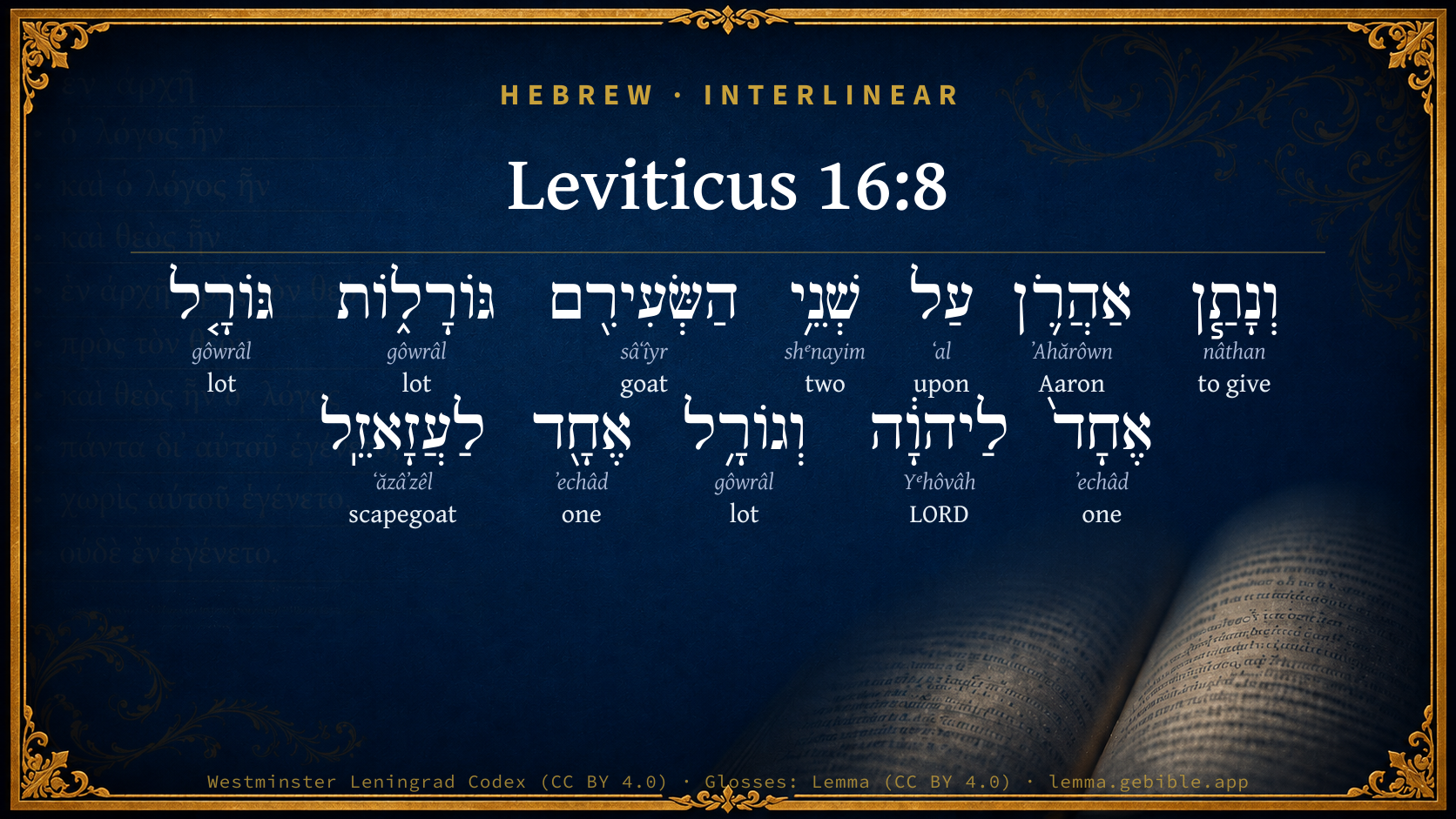
Hebrew (Westminster Leningrad Codex) Leviticus 16:8 appears in the Hebrew Old Testament. The text above is from the Westminster Leningrad Codex. Each word links to its Strong’s number, a concise gloss, and parsing drawn from the Open Scriptures Hebrew Bible morphology. Click any word for its full Brown-Driver-Briggs (BDB) entry.
Download image
Cite this verse

Leviticus 16:8 (World English Bible). Public Domain. Lemma interlinear Bible study tool, https://lemma.gebible.app/v/leviticus/16/8.

Show BibTeX & RIS
BibTeX
RIS
English Translation
Aaron shall cast lots for the two goats; one lot for Yahweh, and the other lot for the scapegoat.
World English Bible · Public Domain
Highlights
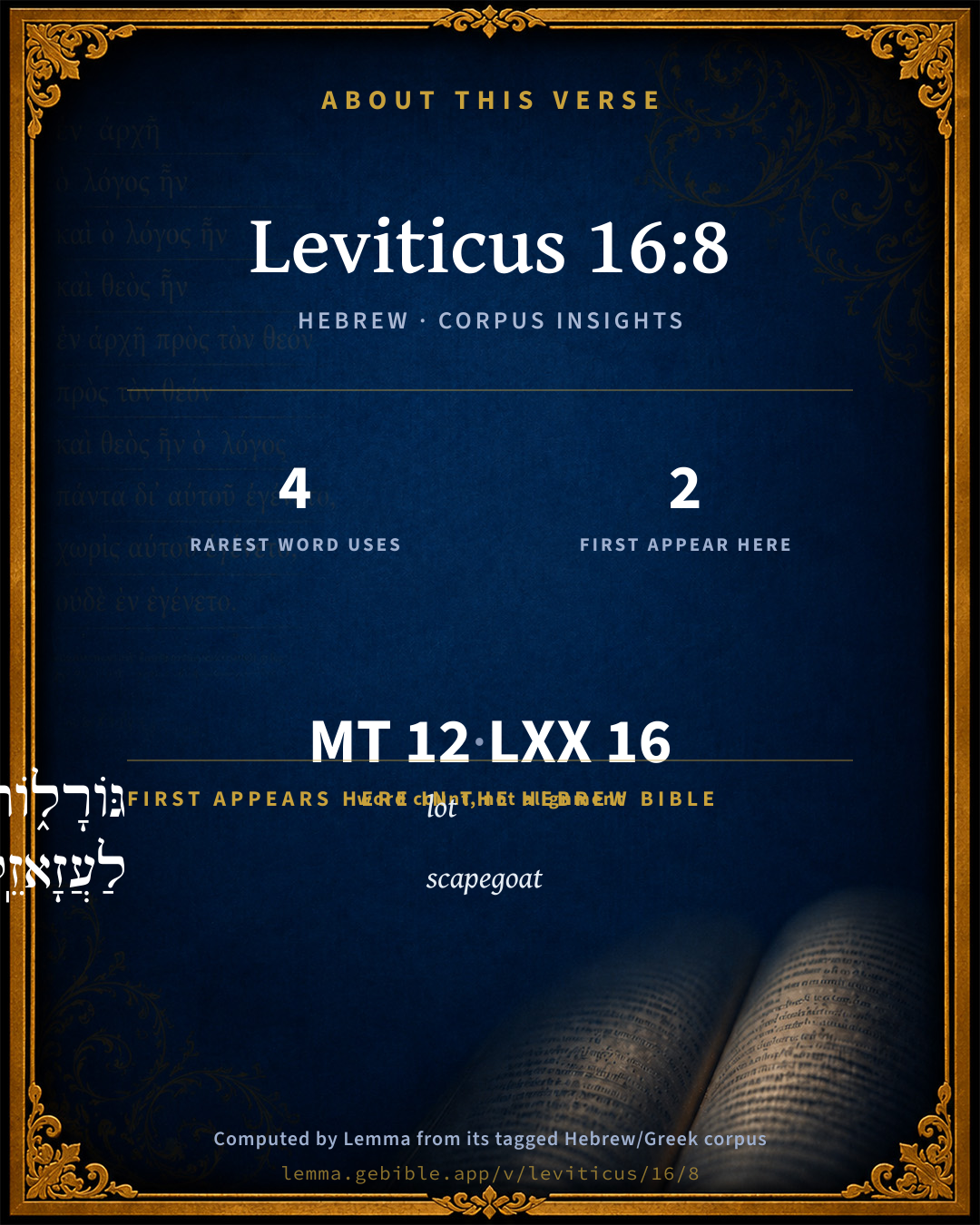
  • 2 first appearances in the Hebrew Bible
Full analysis ↓
Download a study sheet

One document with this verse’s original text, its word-by-word gloss line, the meaning frame, cross-references with their text, attributed commentary, and full source and license credits — printable, and it pastes into notes with its structure intact.

This verse Autodidact and up

Study sheet (.html) Plain text (.txt)

A passage Seminary Student

Up to 50 verses in one chapter. A passage sheet keeps up to 6 commentary sources and 12 cross-references per verse, in the order this page ranks them, and says so on the sheet whenever that leaves anything out. Ask for a single verse and you get the Autodidact verse sheet above.

Everything on this page stays free to read, with no account — the sheet is a download of what is already on screen, not access to it.

Want to remove ads? Support Godless Engineer
Compare translations 3

The same verse in 3 English versions, stacked beneath the original-language interlinear above. Click any original word for its lexicon entry.

Each is an independent rendering of the whole verse — the interlinear is not word-aligned to these translations.

Highlighted words mark where these versions differ — a whole-verse word diff, not a word-by-word alignment.

  • World English Bible Public Domain
    Aaron shall cast lots for the two goats; one lot for Yahweh, and the other lot for the scapegoat.
  • King James Version Public Domain
    And Aaron shall cast lots upon the two goats; one lot for the LORD, and the other lot for the scapegoat.
  • unfoldingWord Literal Text CC BY-SA 4.0
    And Aaron shall cast lots concerning the two goats—one lot for Yahweh, and one lot for the scapegoat.

unfoldingWord Literal Text — © unfoldingWord, licensed CC BY-SA 4.0. Word-aligned USFM3 via Door43 (git.door43.org/unfoldingWord/en_ult).

Versions to compare (up to 4)

3 of 4 selected

Show all 18 translations

Every available English version of this verse, each an independent rendering of the whole verse.

  • World English Bible Public Domain
    Aaron shall cast lots for the two goats; one lot for Yahweh, and the other lot for the scapegoat.
  • Berean Standard Bible Public Domain
    After Aaron casts lots for the two goats, one for the LORD and the other for the scapegoat,
  • Majority Standard Bible Public Domain
    After Aaron casts lots for the two goats, one for the LORD and the other for the scapegoat,
  • King James Version Public Domain
    And Aaron shall cast lots upon the two goats; one lot for the LORD, and the other lot for the scapegoat.
  • American Standard Version (1901) Public Domain
    And Aaron shall cast lots upon the two goats; one lot for Jehovah, and the other lot for Azazel.
  • Revised Version (1885) Public Domain
    And Aaron shall cast lots upon the two goats; one lot for the LORD, and the other lot for Azazel.
  • Geneva Bible (1599) Public Domain
    Then Aaron shall cast lots ouer the two hee goates: one lot for the Lord, and the other for the Scape goate.
  • Douay-Rheims (1899) Public Domain
    And casting lots upon them both, one to be offered to the Lord, and the other to be the emissary goat:
  • Young's Literal Translation Public Domain
    `And Aaron hath given lots over the two goats, one lot for Jehovah, and one lot for a goat of departure;
  • Literal Standard Version CC BY-SA 4.0
    And Aaron has given lots over the two goats, one lot for YHWH and one lot for a goat of departure;
  • Unlocked Literal Bible CC BY-SA 4.0
    Then Aaron must cast lots for the two goats, one lot for Yahweh, and the other lot for the scapegoat.
  • unfoldingWord Literal Text CC BY-SA 4.0
    And Aaron shall cast lots concerning the two goats—one lot for Yahweh, and one lot for the scapegoat.
  • Darby Bible Public Domain
    And Aaron shall cast lots upon the two goats: one lot for Jehovah, and the other lot for Azazel.
  • World Messianic Bible Public Domain
    Aaron shall cast lots for the two goats: one lot for the LORD, and the other lot for the scapegoat.
  • Webster's Bible Public Domain
    And Aaron shall cast lots upon the two goats; one lot for the LORD, and the other lot for the scape-goat.
  • Free Bible Version CC BY-SA 4.0
    Aaron will cast lots to choose between the goats, one for the Lord and the other for the scapegoat.
  • Bible in Basic English Public Domain
    And Aaron will make selection from the two goats by the decision of the Lord, one goat for the Lord and one for Azazel.
  • JPS Tanakh (1917) Public Domain
    And Aaron shall cast lots upon the two goats: one lot for the LORD, and the other lot for Azazel.

Literal Standard Version (2020), Covenant Press — licensed CC BY-SA 4.0. Text via the HelloAO Bible API (eBible.org). Unlocked Literal Bible (unfoldingWord) — licensed CC BY-SA 4.0. Text via the HelloAO Bible API (eBible.org). unfoldingWord Literal Text — © unfoldingWord, licensed CC BY-SA 4.0. Word-aligned USFM3 via Door43 (git.door43.org/unfoldingWord/en_ult). Free Bible Version, Dr. Jonathan Gallagher — licensed CC BY-SA 4.0. Text via the HelloAO Bible API (eBible.org).

Word by word

More ways to search: Search by grammar → Find every occurrence → Compare this word →

Practice this passage: Drill this verse → Learn its vocabulary →

לַעֲזָאזֵֽל
ʻăzâʼzêl
H5799
“to/for · scapegoat”
Preposition + Noun, Proper
Part of Speech
Preposition + Noun
Type
Proper
Full BDB Definition

Origin: from H5795 and H235

TWOT: 1593

entire removal, scapegoat - refers to the goat used for sacrifice for the sins of the people - meaning dubious
  1. וְנָתַ֧ן nâthan H5414 “and · to give” Conjunction + Verb, Qal, Sequential Perfect, 3rd Person, Masculine, Singular
  2. אַהֲרֹ֛ן ʼAhărôwn H175 “Aaron” Noun, Proper
  3. עַל ʻal H5921 “upon” Preposition
  4. שְׁנֵ֥י shᵉnayim H8147 “two” Adjective, Cardinal number, Masculine, Dual, Construct
  5. הַשְּׂעִירִ֖ם sâʻîyr H8163 “the · goats” Particle, Definite Article + Noun, Common, Masculine, Plural, Absolute
  6. גּוֹרָל֑וֹת gôwrâl H1486 “lots” Noun, Common, Masculine, Plural, Absolute
  7. גּוֹרָ֤ל gôwrâl H1486 “lot” Noun, Common, Masculine, Singular, Absolute
  8. אֶחָד֙ ʼechâd H259 “one” Adjective, Cardinal number, Masculine, Singular, Absolute
  9. לַיהוָ֔ה Yᵉhôvâh H3068 “to/for · LORD” Preposition + Noun, Proper
  10. וְגוֹרָ֥ל gôwrâl H1486 “and · lot” Conjunction + Noun, Common, Masculine, Singular, Absolute
  11. אֶחָ֖ד ʼechâd H259 “one” Adjective, Cardinal number, Masculine, Singular, Absolute

About this verse

These counts appear in no published source. They are computed here, from the morphology-tagged text and Lemma’s own curated glosses. What Lemma adds →

12
words
9
distinct lemmas
Pentateuch
section

Notable vocabulary

The rarest word here is לַעֲזָאזֵֽל scapegoat H5799 — appearing just 4 times in the whole Hebrew Bible.

First appearance in Scripture

These words make their first canonical appearance in the Hebrew Bible here:

  • גּוֹרָל֑וֹת lot H1486
  • לַעֲזָאזֵֽל scapegoat H5799

Shared distinctive vocabulary

לַעֲזָאזֵֽל scapegoat H5799 occurs in 3 verses of the Hebrew Bible. Also found in:

Grammatical profile

  • 1 verb
  • 7 nouns
  • 3 adjectives
  • 1 preposition

Verb forms

  • וְנָתַ֧ן Qal · Sequential Perfect

Repetition

Words recur within this verse — often emphatic in Hebrew:

  • גּוֹרָל֑וֹת lot H1486 ×3
  • אֶחָד֙ one H259 ×2

Hebrew & Septuagint length

In English translation the verse runs 19 words from the Hebrew and 20 from the Septuagint (LXX English) — closely comparable.

A rough comparison of the two English renderings, which tokenize alike — not a word-level alignment.

Word counts can differ between the Hebrew and the Greek without any difference in meaning — e.g. the Hebrew direct-object marker אֵת has no separate Greek word, and Greek often adds the article ὁ.

In the original languages it is 12 Hebrew tokens and 16 Greek tokens — but the two are counted differently (Hebrew bundles its prefixes and suffixes into one token; the Greek is in lemma form), so that isn’t a like-for-like length.

Cross-references

8

Topical passages linked to Leviticus 16:8 in the Treasury of Scripture Knowledge — connected by theme and wording, ordered by reader-vote popularity; previews shown in the World English Bible.

  • Acts 1:23–26 They put forward two, Joseph called Barsabbas, who was surnamed Justus, and Matthias.
  • Proverbs 16:33 The lot is cast into the lap, But its every decision is from Yahweh.
  • Jonah 1:7 They all said to each other, "Come, let us cast lots, that we may know for whose cause this evil is on us." So they cast lots, and the lot fell on Jonah.
  • Numbers 26:55 Notwithstanding, the land shall be divided by lot: according to the names of the tribes of their fathers they shall inherit.
  • Numbers 33:54 You shall inherit the land by lot according to your families; to the more you shall give the more inheritance, and to the fewer you shall give the less inheritance: wherever the lot falls to any man, that shall be his; according to the tribes of your fathers shall you inherit.
  • Joshua 18:10–11 Joshua cast lots for them in Shiloh before Yahweh: and there Joshua divided the land to the children of Israel according to their divisions.
  • 1 Samuel 14:41–42 Therefore Saul said to Yahweh, the God of Israel, Show the right. Jonathan and Saul were taken [by lot]; but the people escaped.
  • Ezekiel 48:29 This is the land which you shall divide by lot to the tribes of Israel for inheritance, and these are their several portions, says the Lord Yahweh.

Cross-references courtesy of OpenBible.info (CC BY 4.0).

Hebrew and Greek witnesses Masoretic Hebrew ↔ Greek Septuagint

The same verse in the two great witnesses to the Old Testament, shown verse-for-verse.

These are two independent witnesses, not word-aligned to each other, and the Septuagint is shown in lemma (dictionary) form.

Hebrew Leviticus 16:8 Masoretic · Westminster Leningrad Codex

וְנָתַ֧ן אַהֲרֹ֛ן עַל שְׁנֵ֥י הַשְּׂעִירִ֖ם גּוֹרָל֑וֹת גּוֹרָ֤ל אֶחָד֙ לַיהוָ֔ה וְגוֹרָ֥ל אֶחָ֖ד לַעֲזָאזֵֽל

Aaron shall cast lots for the two goats; one lot for Yahweh, and the other lot for the scapegoat.

World English Bible · Public Domain

Greek LXX Leviticus 16:8 Septuagint · lemma form

καί ἐπιτίθημι ἀαρών ἐπί ὁ δύο χίμαρος κλῆρος εἷς ὁ κύριος καί κλῆρος εἷς ὁ ἀποπομπαῖος

and Aaron shall cast lots upon the two goats, one lot for the Lord, and the other for the scape-goat.

LXX2012 (modern English Septuagint) · Public Domain

Hebrew: Westminster Leningrad Codex (CC BY 4.0). Greek: Septuagint (public domain); English from LXX2012 (modern English Septuagint) (Public Domain). How the Septuagint differs from the Hebrew →

Targum (Aramaic paraphrase)

2

The Targum is the ancient Jewish Aramaic paraphrase of the Hebrew Scriptures — an interpretive translation, not the Hebrew text itself. Onkelos (literal) and Pseudo-Jonathan (expansive) render the Torah, and Jonathan the Prophets. Coverage is partial: where no permissively-licensed English translation exists for a verse, only the Aramaic is shown. This is verse-level text, not a word-by-word alignment to the Hebrew.

  1. Targum Onkelos Torah (Genesis–Deuteronomy)
    וְיִתֵּן אַהֲרֹן עַל תְּרֵין צְפִירִין עַדְבִין עַדְבָא חַד לִשְׁמָא דַיְיָ וְעַדְבָא חַד לַעֲזָאזֵל

    (no public-domain English translation for this verse)

    Targum Onkelos — Aramaic: “Onkelos Genesis” (public domain); “Onkelos Exodus” (public domain); “Onkelos Leviticus” (public domain); “Onkelos Numbers” (public domain); “Onkelos Deuteronomy” (public domain). English: “Sefaria Community Translation” (CC0 1.0 (public-domain dedication)); “J.W. Etheridge. The Targums of Onkelos and Jonathan Ben Uzziel on the Pentateuch. London: Longmans, Green, 1862” (public domain). Text via Sefaria.

  2. Targum Pseudo-Jonathan Torah (Genesis–Deuteronomy)
    וְיִתֵּן אַהֲרן עַל תְּרֵין צְפִירִין עַדְבִין שָׁוִין עַדְבָא חַד לִשְׁמָא דַיְיָ וְעַדְבָא חַד לַעֲזָאזֵל וְיִטְרַף בִּקְלַפִי וְיוֹפְקִינוּן וְיִטְלְקִינוּן עַל צְפִירַיָא

    And Aharon shall put upon the goats equal lots; one lot for the Name of the Lord, and one lot for Azazel: and he shall throw them into the vase, and draw them out, and put them upon the goats.

    Targum Pseudo-Jonathan — Aramaic: “Targum Jonathan on Genesis” (public domain); “Targum Jonathan on Exodus” (public domain); “Targum Jonathan on Leviticus” (public domain); “Targum Jonathan on Numbers” (public domain); “Targum Jonathan on Deuteronomy” (public domain). English: “The Targum of Jonathan ben Uzziel, trans. J. W. Etheridge, London, 1862” (public domain). Text via Sefaria.

Commentary

Notes on Leviticus 16:8 from classic Christian and Jewish commentators (each source and its license shown beneath its notes). The classic Christian expositions comment on the surrounding passage and are grouped to its opening verse, so a note may address several verses; the Jewish commentaries on the Tanakh (Rashi and others) are per-verse, so they appear only where the commentator wrote on this verse.

Lemma curates 59 commentaries, every one of them public domain or Creative Commons licensed, each selected and text-cleaned for this edition rather than reprinted as found. About our sources →

Trapp's Complete Commentary

John Trapp

Lev 16:8 And Aaron shall cast lots upon the two goats; one lot for the LORD, and the other lot for the scapegoat.

Ver. 8. Shall cast lots.] To show that nothing was done for us by Christ but what God’s hand and his counsel determined. {Act 4:28 1Pe 1:20} {See Trapp on "Act 4:28"} {See Trapp on "1Pe 1:20"}

For the scape-goat.] Which being a piacular or purging oblation, carried the people’s curse with it: as did likewise those Obominales among the Grecians; who, from this custom of the Hebrews, borrowed their yearly expiation of their cities: the manner whereof, somewhat like unto this. {See Trapp on "1Co 4:13"}

John Trapp, A Commentary or Exposition upon All the Books of the Old and New Testament (1647–1656) — public domain. Text from a community e-Sword module.

Joseph Benson's Commentary

Lev 16:8. One lot for the Lord — To be sacrificed to him upon his altar. Both this and the other goat typified Christ; this in his death and passion for us, that in his resurrection for our deliverance. The other lot for the scape-goat — The Jewish doctors tell us that this goat, on which the sins of the nation were transferred, was loaded with all marks of reproach, and imprecations, and that the people prayed that all those evils which they thought due to themselves might fall upon it. Thus was Christ made a curse for us, while on him was laid the iniquities of us all.

Joseph Benson's Commentary on the Old and New Testaments (1811–1818) — public domain. Text from a community e-Sword module.

Tyndale Open Study Notes

Tyndale Open Resources

16:8 The Hebrew term ‘aza’zel (Azazel) is found only in 16:8, 10, 26. This word has generally been interpreted in four different ways: (1) as a word meaning “the goat of going away”; (2) as a demon that lived in the wilderness; (3) as a strengthened form of the Hebrew word for “go, leave,” meaning “utter loss”; and (4) as a rocky cliff over which the goat was pushed. Since this goat represented the removal of the sins of Israel from the camp (16:22), the first interpretation is probably the simplest solution.

Tyndale Open Study Notes — © Tyndale Open Resources, licensed CC BY-SA 4.0. Text via the HelloAO Bible API.

Geneva Bible (1599)

Geneva Bible translators

In Hebrew it is called Azazel, which some say, is a mountain near Sinai, whither this goat was sent, but rather it is called the Scapegoat, because it was not offered, but sent into the desert, as verse 11.

Geneva Bible (1599) marginal notes — public domain. Text via Bolls.life.

Adam Clarke's Commentary

Verse 8. Aaron shall cast lots upon the two goats] The Jews inform us that there were two lots made either of wood, stone, or any kind of metal. On one was written לשם LASHSHEM, for the NAME, i. e., יהוה JEHOVAH, which the Jews will neither write nor pronounce: on the other was written לעזאזל LAAZAZEL, for the SCAPE-GOAT: then they put the two lots into a vessel which was called קלפי kalpey, the goats standing with their faces towards the west. Then the priest came, and the goats stood before him, one on the right hand and the other on the left; the kalpey was then shaken, and the priest put in both his hands and brought out a lot in each: that which was in his right hand he laid on the goat that was on his right, and that in his left hand he laid on the goat that was on his left; and according to what was written on the lots, the scape-goat and the goat for sacrifice were ascertained. See the Mishna, in Tract. Yoma.

The determining this solemn business by lot, the disposal of which is with the Lord, Pr 16:33, shows that God alone was to select and point out the person by whom this great atonement was to be made; hence he says: Behold I lay in Zion a stone, elect (that is, chosen by himself) and precious - of infinite value.

Adam Clarke's Commentary on the Bible (1810–1826) — public domain. Text from a community e-Sword/MySword module.

Ellicott's Commentary for English Readers

(8) And Aaron shall cast lots.—The lots consisted of two small tablets which at an earlier time were of box or ebony wood, but which during the later part of the second Temple were made of gold, and were kept in a wooden chest. On the one was engraved the words “For Jehovah,” and on the other “For Azazel,” the expression in the original, which is translated scapegoat in the Authorised Version. The high priest, after shaking the chest, put both his hands into the urn and simultaneously took out the two tablets, one in each hand. Hereupon he put the tablet which he had in his right hand upon the goat that was standing on his right side, whilst the tablet in his left hand he put on the goat on his left side. If the tablet with the in scription “For Jehovah was in his right hand the chief priest who stood at the right of the pontiff exclaimed “Hold up thy right hand on high!” and if it happened to be in the left hand, the chief of the principal household, who stood on his left, called out to him “Hold up thy left hand.” Hereupon the high priest laid the two lots on the two goats, the one in the right hand on the goat at his right, and the one in the left hand on the animal at his left, exclaiming at the same time, “To the Lord a sin offering!”

And the other lot for the scapegoat.—Better, and the other lot for Azazel. The word, which only occurs in this chapter, probably denotes the utterly banished demon, the prince of the evil spirits, who with his legions occupies the desert regions and desolated places. (Comp. Isa_13:21; Isa_34:14; Mat_12:43; Luk_11:24; Rev_18:2.) As the removal or pardon of sin is often represented in the Bible by its being banished into the uttermost parts of the earth and seas (Mic_7:19; Psa_103:12), nothing could be more striking or convey to the people the idea of absolute forgiveness better than this symbolical act of sending the goat laden with the sins of the congregation to the wilderness, the abode of the prince of darkness, back to the author of all sin. The rendering, scapegoat, is contrary to the manifest antithesis of the verse. If the one member “For Jehovah” denotes a person, the second member “For Azazel,” which forms the contrast, must, primâ facie, also denote a person. Besides, the translation scapegoat cannot be admitted in the next verse but one, where, if adopted, it would literally be “to send the goat to the scapegoat in the wilderness” .(see Lev_16:10), or in Lev_16:26, where it is, “and he who taketh away the goat to the scapegoat.”

A Bible Commentary for English Readers, edited by Charles John Ellicott (1878–1897) — public domain. Text from a community e-Sword module.

The Cambridge Bible for Schools and Colleges

gen. ed. J. J. S. Perowne

8. for Azazel] for the scapegoat, A.V. For this peculiar feature of the Day of Atonement see Appendix V, pp. 185 ff.

The Cambridge Bible for Schools and Colleges (gen. ed. J. J. S. Perowne; Cambridge University Press, 1878–1918) — public domain. Text from a community e-Sword module.

John Gill's Exposition

And Aaron shall cast lots upon the two goats,.... Which should be slain, and which should be kept alive, and let go: the manner of casting lots, according to the Misnah (a), was this; the high priest went to the east of the court, to the north of the altar, the Sagan (or deputy priest) at his right hand, and Rosh Beth Ab (or the chief of the house of the fathers) on his left hand, and the two goats were there; and there was a vessel (box or urn, called Calphi), and in it were two lots of box tree: the high priest shook the Calphi (or urn) and took out the two lots; one, on which was written, "for the Lord", and the other, on which was written, "for Azazel"; if that came up on the right hand, the Sagan said to him, my lord high priest, lift up thy right hand on high; and if that on the left hand came up, Rosh Beth Ab said to him, my lord high priest, lift up thy left hand on high: he put them upon the two goats and said, a sin offering for the Lord; and they answered after him, blessed be the Lord, may the glory of his kingdom be for ever and ever: now these lots, as Ben Gersom observes, were alike, not one greater than another; and they were of the same matter, for if one had been of stone and the other of wood, they might, have been known by feeling, and so the lots would not have been legal: and the same is observed by Maimonides (b), that though they might be of any matter, of wood, or stone, or metal, yet one might not be great, and the other small, and the one of silver, and the other of gold, but both alike, for the reason before given:

one lot for the Lord, and the other lot for the scapegoat: one had written upon it, as in the above account, "for the Lord"; and the other had written upon it, "for Azazel"; directing that the goat on which the lot for the Lord fell was to be slain and offered up for a sin offering to him; and the other, on which the lot for Azazel fell, was to be kept alive and let go: now, however casual and contingent the casting of a lot may seem to men, it is certain to God, the disposal of it is of him, and according to his determination, Pro 16:33; and this, in the mystical sense, here denotes, that the sufferings and death of Christ were according to the determinate counsel and foreknowledge of God, and so were foretold in the Scriptures, and came to pass according to his appointment, will, and command, as was also his resurrection from the dead, Joh 10:18; see Act 1:23; and likewise his conflict with Satan, Joh 14:30.

(a) Misn. Yoma, c. 3. sect. 9. & c. 4. sect. 1. (b) Hilchot Yom Hacippurim, c. 3. sect. 1.

John Gill's Exposition of the Whole Bible (1746–1763) — public domain (CC PDM 1.0). Text via the HelloAO Bible API.

Albert Barnes' Notes on the Bible

The two goats formed a single sin-offering, Lev 16:5. To bring out the meaning of the sacrifice it was necessary that the act of a living being should be performed after death. See Lev 16:22 note. As this could not possibly be visibly set forth with a single victim, two were employed, as in the case of the birds in the rite for the healed leper Lev 14:4-6.

For the scapegoat - Rather, for Azazel. The word occurs nowhere else in the Old Testament but in this chapter, and is probably derived from a root in use in Arabic, but not in Hebrew, signifying to “remove”, or “to separate”.

Azazel is the pre-Mosaic name of an evil personal being placed in opposition to Yahweh. Each goat, having been presented to Yahweh before the lots were cast, stood in a sacrificial relation to Him. The casting of lots was an appeal to the decision of Yahweh (compare Jos 7:16-17; Jos 14:2; Pro 16:33; Act 1:26, etc.); it was therefore His act to choose one of the goats for His service in the way of ordinary sacrifice, the other for His service in carrying off the sins to Azazel (see the note at Lev 16:22). By this exppressive outward sign the sins were sent back to the author of sin himself, “the entirely separate one,” who was banished from the realm of grace.

The goat itself did not lose the sacred character with which it had been endued in being presented before Yahweh. It was, as much as the slain goat, a figure of Him who bore our griefs and carried our sorrows, on whom the Lord laid the iniquity of us all Isa 53:4, Isa 53:6, that we might become a sanctified Church to be presented unto Himself, not having spot or wrinkle or any such thing Eph 5:26-27.

Albert Barnes' Notes on the Bible (1834–1885) — public domain. Text from a community e-Sword/MySword module.

Haydock's Catholic Bible Commentary

The emissary-goat: caper emissarius; in Greek, apopompaios; in Hebrew, Hazazel. The goat to go off, or as some translate it, the scape-goat. This goat, on whose head the high priest was ordered to pour forth prayers, and to make a general confession of the sins of the people, laying them all, as it were, on his head; and after that to send him away into the wilderness, to be devoured by wild beasts, was a figure of our Saviour, charged with all our sins, in his passion.

George Leo Haydock (1774–1849), Haydock's Catholic Family Bible and Commentary, 1859 edition — public domain. Excludes Psalms (Douay-Rheims chapter numbering differs from Protestant) and Deuterocanonical books (Catholic canon only).

Matthew Poole's English Annotations

One lot for the Lord; for the Lord’s use and service by way of sacrifice. Both this and the other goat typified Christ; this in his death and passion for us; that in his resurrection for our deliverance.

Matthew Poole's English Annotations on the Holy Bible (1683–1685) — public domain. Text from a community e-Sword/MySword module.

Whedon's Commentary on the Bible

Daniel D. Whedon

8. Cast lots upon the two goats — The lots were first of boxwood, afterwards of gold, with an inscription on one “for the Name” — Jehovah was too sacred to write — and on the other, “for Azazel.” — Delitzsch on the Hebrews, Appendix. These were put into an urn and shaken, and drawn out with both hands of the high priest; that in the right hand was laid upon the goat standing at his right, and that in the left upon its corresponding goat. Divine Providence was supposed to direct the lots. Pro_16:33.

The scapegoat — The עזאזל, Azazel, occurs but four times in this chapter, and nowhere else in the Holy Scriptures. It is the puzzle of the Book of Leviticus, over which the most erudite scholars have uttered the despairing groan of “locus vexatissimus.” Bochart, the chief of Hebraists, notwithstanding his profound learning, frankly makes the following humiliating confession: “I have nothing certain to offer in regard to this word;” and Fairbairn admits that “its exact and determinate import is not to be pronounced on with certainty.” The chief theories are, 1.) That it is a place, a rough mountain in the vicinity of Mount Sinai: but no such mountain has ever been found. Besides this, the place is described indefinitely as any “land not inhabited — the wilderness.” 2.) That it is an appellation of God. This is sustained by the Syriac version of Azazel — “the mighty God.” The objection to this view is, that then the lot is a useless formality, since each goat would be allotted to the Deity, either as Jehovah or as the mighty God. 3.) That the word is a personal name for Satan or for one of his satellites. This is favoured by the Book of Enoch, in which Azazel is named as an evil spirit, and by the rabbinical writings, where it occurs as the appellation of one of four demons. The theory that the sins of Israel were confessed over the head of the devil, or over an animal devoted to him, thus making his Satanic majesty co-ordinate with the holy God in the sanctification of his people, so shocks our sense of propriety that we should dismiss it without further comment if the names of modern exegetes as celebrated as Bush, Oehler, Keil, and Ewald, had not given to it the weight of their authority. “The idea that it is a sacrifice to the devil is at utter variance with the whole Levitical system, not to speak of the incongruity of a sin offering to that wicked spirit; this is accordingly generally abandoned. The notion is spun from the interpreter’s own brain, without anything in the text to suggest it, that sin is hereby sent back to Satan as the source from which it has proceeded, or the one to whose realm it properly belongs; or that it is intended as an act of scorn and defiance. This malignant accuser may take these sins and do his worst with them, he can never bring Israel into condemnation for offences which have been expiated and forgiven. 4.) The word ‘Azazel’ is derived from a root meaning ‘to remove;’ and may with greater propriety, as it seems to me, be regarded as an abstract term, meaning, as the British revisers render it in their margin, ‘dismissal,’ or, as the American company prefer, as more descriptive of the function discharged by the goat, ‘removal.’” — Dr. W. Henry Green. “We must be very careful in the application of this term. It is one of the terms liable to abuse. The image has always been accepted as one symbolical of the work of Christ in bearing away the sins of the world. Considered strictly as a figure, it is full of beauty and helpful suggestiveness. It has, nevertheless, been open to the most mischievous perversion.” — Jos. Parker.

Daniel D. Whedon (gen. ed.), Commentary on the Old and New Testaments (1874–1909) — public domain. Text from a community e-Sword module.

John Wesley's Explanatory Notes

For the Lord - For the Lord's use by way of sacrifice. Both this and the other goat typified Christ; this in his death and passion for us; that in his resurrection for our deliverance.

John Wesley, Explanatory Notes Upon the Whole Bible (1754–1765) — public domain. Text via the GEBible commentary corpus.

unfoldingWord translationNotes

Door43 World Missions Community

the scapegoat

"the goat that is sent away." Aaron was to have someone set the goat free in the wilderness.

on which the lot fell

"which the lot designated"

But the goat ... must be brought alive before Yahweh

This can be stated in active form. AT: "But Aaron must bring the goat ... alive before Yahweh" (See: Active or Passive)

translationWords

lots

life

send

desert

unfoldingWord translationNotes — © Distant Shores Media and the Door43 World Missions Community, licensed CC BY-SA 4.0. Source: git.door43.org/Door43/en_tn.

Rashi

Rabbi Shlomo Yitzchaki (Rashi)

‎‎‎‎‏ השעירים גרלות‎שני ‎על ‎‎ אהרן ‎ונתן AND AARON SHALL CAST LOTS UPON THE TWO GOATS — He places one goat at his right and the other at his left. He then puts both his hands into an urn and takes one lot in his right hand and the other in his left. These he places upon them (the goats; i.e. one upon each of them). The goat upon which there fell that lot bearing the inscription 'לה, "For the Lord" was destined for the Lord, and that upon which there fell that lot bearing the inscription "For Azazel" was afterwards sent forth to the Azazel (Yoma 39a).

עזאזל AZAZEL — (The word is taken to be a compound of עזז "to be strong" and אל "mighty"). It was a precipitous and flinty rock — a towering peak, for it is said (v. 22) "[and the goat shall bear upon it their iniquities into] an גזר) "ארץ גזרה means to cut) — into a craggy land (Yoma 67b).

Rashi on the Tanakh — English translations: “The Judaica Press complete Tanach with Rashi, translated by A. J. Rosenberg” (CC BY 4.0); “Pentateuch with Rashi's commentary by M. Rosenbaum and A.M. Silbermann, 1929-1934” (public domain); “The Metsudah Tanach series, Lakewood, N.J” (CC BY 4.0); and “The Book of Joshua, Metsudah Publications, 1997” (CC BY 4.0). Text via Sefaria.

Ramban (Nachmanides)

Rabbi Moshe ben Nachman (Ramban / Nachmanides)

AND THE OTHER LOT FOR AZAZEL. “This was a high mountain — a flinty precipitous peak, as it is said, a land which is cut off.” This is the language of Rashi. And in the Torath Kohanim [the Rabbis have said]: 2:8. “For Azazel. This means the ‘hardest’ place in the mountains. I might think that it refers to an inhabited place; Scripture therefore says into the wilderness. Whence do we know that it be a precipitous peak? Scripture therefore says, unto a land which is cut off.” Accordingly the meaning of the word la’azazel is to “a hard” place, [the root of the word azazel being az — strong], with the letter za’yin doubled just like ‘izuz’ (strong) and mighty. Now Rabbi Abraham ibn Ezra wrote: “Said Rav Shmuel: ‘Although it is [only] with reference to the goat of the sin-offering that it is written [explicitly] that it was for the Eternal, and in the following verse it is stated that the goat upon which the lot fell for the Eternal be offered for a sin-offering. the goat which was sent away [to Azazel] was also for the Eternal.’ But there is no need for this [comment]. For the goat which was sent away was not an “offering’ since it was not slaughtered. Now if you can understand the secret of the word after ‘Azazel,’ (for Azazel into the wilderness). The secret is thus that this is the desert’s portion. you will know its secret [that of Azazel] and the secret of its name, (strong), which is indicative of the nature of the offering befitting him, and of the strength and might which are in his power” (Peirush Mototh on Ibn Ezra). since it has companions in Scripture., Verse 53). See Ramban ibid., Verse 53. And I will reveal to you part of the secret by hint: when you will be at thirty-three. Here then is the secret of why the goat that was sent away to Azazel was not slaughtered, so that it should not appear as a form of sacrifice to the satyrs (Ohel Yoseph). See my Hebrew commentary, p. 88. you will know it.” [Thus far are the words of Ibn Ezra]. Now of Rabbi Abraham ibn Ezra it may be said that he that is of a faithful spirit concealeth a matter, and I will not be the talebearer who revealeth his secret,. Ramban thus after paying tribute to Ibn Ezra for remaining faithful to the spirit of the second half of the verse, now says that nor will he himself be in violation of the first half of the verse, since the Sages have already revealed that secret in many places. since our Rabbis of blessed memory have already revealed it in many places. Thus they have said in Bereshith Rabbah: “And the ‘sa’ir’ was also used by Scripture with reference to Esau [as the text continues], in the sense of “hairy.” shall carry upon him, this is a reference to Esau, as it is said, Behold, Esau my brother is a man who is ‘sa’ir’ (hairy). All ‘avonotham’ (their iniquities), [read]: ‘avonoth tam’ (the sins of him who has been called tam, ‘a man of integrity’), as it is said, and Jacob was a man ‘tam’ (‘of integrity’).”, 25:27. It is explained more clearly in the Chapters of the great Rabbi Eliezer: “The reason why they would give Sammael [i.e., Satan] a conciliatory gift on the Day of Atonement, was so that he should not annul [the effect of] their offerings, as it is said, one lot for the Eternal, and the other lot for Azazel, the lot of the Holy One, blessed by He, to be a burnt-offering,.” It would seem, however, that Ramban calls it a “burnt-offering” because although it was technically a sin-offering, it was completely burnt as is a burnt-offering (further, Verse 27) and not eaten as is a sin-offering. and the lot of Azazel to be ‘the goat of sin,’ bearing upon it all the iniquities of Israel, as it is said, And the goat shall bear upon him all their iniquities. When Sammael saw that he could find no sin on the Day of Atonement amongst them [the children of Israel], he said to the Holy One, blessed by He: ‘Master of all worlds! You have one people on earth who are comparable to the ministering angels in the heavens. Just as the ministering angels are barefooted, so are the Israelites barefooted [i.e., do not wear leather shoes] on the Day of Atonement. Just as the ministering angels do not eat or drink, so is there no eating or drinking in Israel on the Day of Atonement. Just as the ministering angels have no joints [in their feet, and therefore cannot sit or lie down], so do the Israelites stand on their feet on the Day of Atonement. 619:5). Just as there is peace in the midst of the ministering angels, so do the Israelites bring peace among themselves on the Day of Atonement. Just as the ministering angels are free from all sin, so are the Israelites free from all sin on the Day of Atonement.’ And the Holy One, blessed be He, hears the testimony concerning Israel from their prosecutor, and He atones for the altar and for the Sanctuary, and for the priests and for all the people of the assembly, as it is said, And he shall make atonement for the most holy place etc.” Thus far is the language of this Agadah (tradition) in which the Rabbis have informed us of his name [i.e., Sammael] and the nature of his deeds.Now this is the secret of the matter. They used to worship “other gods,” namely, the angels, bringing offerings of a sweet savor to them, similarly to that which it says, and thou didst set Mine oil and My incense before them. My bread also which I gave thee, fine flour, and oil, and honey, wherewith I fed thee, thou didst even set it before them for a sweet savor, and thus it was; saith the Eternal G-d. You have to contemplate the Scriptural text as it is written and [also] as [it is read according to the] Masoretic tradition. (‘thou’ didst set Mine oil …), but the Hebrew word is actually written with a letter yod at the end, which suggests the reading nathati, meaning: “and ‘I’ did set Mine oil and Mine incense before them for your sake; that is to say, the offering which you brought before Me, it is I who gave it to them,” (Abusaula), as will be explained further on in the text. The same applies to the following verse where the Hebrew word is read unethatha (and ‘thou’ didst even set it), but it is actually written with a letter yod: unethati, meaning, “and I did set it …” (ibid.). Now the Torah has absolutely forbidden to accept them as deities, or to worship them in any manner. However, the Holy One, blessed be He, commanded us that on the Day of Atonement we should let loose a goat in the wilderness, to that “prince” [power] which rules over wastelands, and this [goat] is fitting for it because he is its master, and destruction and waste emanate from that power, which in turn is the cause of the stars of the sword, wars, quarrels, wounds, plagues, division and destruction. In short, it is the spirit of the sphere of Mars, and its portion among the nations is Esau [Rome], the people that inherited the sword and the wars, and among animals [its portion consists of] the se’irim (demons) and the goats. Also in its portion are the devils called “destroyers” in the language of our Rabbis, and in the language of Scripture: se’irim (satyrs, demons), for thus he [i.e., Esau] and his nation were called sa’ir. Now the intention in our sending away the goat to the desert was not that it should be an offering from us to it — Heaven forbid! Rather, our intention should be to fulfill the wish of our Creator, Who commanded us to do so. This may be compared to the case of someone who makes a feast for his master, and the master commands the person making the feast, “Give one portion to that servant of mine,” in which case the host gives nothing [of his own] to that servant, and it is not to show him honor that he acts in that way to him, but everything is given to the master and it is the master that gives a gift to his servant; the host only observes his command and does in honor of the master whatever he commanded him to do. The master, however, out of his own compassion for the host, wanted all his servants to derive some enjoyment from it [the feast], in order that they may all speak of his [the host’s] praise and not of his shortcomings.This then is the reason [for having someone] who casts the lots [on the two goats]. If the priest were to dedicate them merely, by word of mouth [without casting the lots], saying, “one for the Eternal” and “one for Azazel,” that would be like worshipping [Azazel] or taking a vow in its name. (Exodus 23:13, Rashi). Ramban’s thought is thus clear. If the priest were to dedicate the two goats by word of mouth, without the casting of lots, that would be as if he was worshipping Azazel, a deed which is punishable by death, and in addition it would be making a vow in the name of an idol, which is also prohibited under penalty of whipping. In either case, then, he would be doing something which the Torah has prohibited. Rather, the priest set the two goats before the Eternal at the door of the Tent of Meeting, for both of them were a gift to G-d, and he gave to His servant that portion which came to him from G-d. It is he [i.e., the priest] who cast the lots on them, but it is His hand that apportioned them, something like that which it says, The lot is cast into the lap; but the whole disposing of it is of the Eternal. Even after the casting of the lots, the priest placed the two goats before the Eternal, thus proclaiming that both are His and that by sending one away [to the desert] we intend merely to fulfill G-d’s wish, just as it said, And the goat, on which the lot fell for Azazel, shall be set alive ‘before the Eternal,’ to make atonement over him, to send him away etc. That is the reason why we do not ourselves do any act of slaughtering [of that goat, as this would imply that it is a proper offering which requires slaughtering]. And Onkelos rendered the expression (one lot for the Eternal, and one lot for Azazel) as: “one lot for ‘the Name of’ the Eternal and one lot for Azazel;” [thus he was careful not to translate “and one lot for the name of Azazel”], because the one was “for the Name of the Eternal” and not for him [Azazel], and the second was “for Azazel” but not “for the name of Azazel.”It is for this reason that our Rabbis have interpreted: 13:10. See also Yoma 67 b. “And My statutes shall ye keep. These are matters against which the evil inclination raises accusations, and the idolaters likewise bring charges, such as the [prohibition against] wearing clothes made of a mixture of wool and linen, [the law of] the Red Heifer, and of the goat that is sent away [to Azazel].” Now these idolaters have not accused us [according to our Rabbis] in connection with the offerings, for these are the fire-offerings unto the Eternal. But they accuse us in connection with the goat that is sent away [to Azazel], because they think that we act as they do. Similarly they accuse us in connection with the Red Heifer, because it is slaughtered without the camp, but [in truth] the purport thereof is analogous to that of the goat sent away [to Azazel], which is to remove the spirit of impurity, as it is said of the future, And also I will cause the [false] prophets and the unclean spirit to pass out of the Land. On this basis you will understand the reason why the person who sent forth the goat to Azazel must wash his garments [as they were rendered impure], and likewise he who burns the Red Heifer, and what our Rabbis have mentioned concerning the requirement of washing the garments [of those priests who are in charge] of the burning of the bulls and he-goats which were to be wholly burnt [outside the camp, i.e., outside the city of Jerusalem]. Thus Rabbi Abraham ibn Ezra intimated to you that you will know the secret of [sending away the goat to Azazel] when you reach the verse, And they shall no more sacrifice their sacrifices unto the satyrs. The word [Azazel] is a compound one [made of two words]. (the goat) and azal (going). It is the place to which “the goat goes.” So clearly explained by Rabbeinu Bachya (in my edition, II p. 499), and so found also in R’dak’s Sefer Hashorashim under root eiz. There are many such cases. Thus the matter is explained, unless you pursue a further investigation from this subject to that of the Separate Intelligences Vol. II, 292, Note 313. and how the spirits [are affected by] the offerings — [the influence upon the spirits] being known through the study of necromancy, while that of the [Separate] Intelligences is known by means of certain allusions of the Torah to those who understand their secrets. I cannot explain more, for I would have to close the mouths of those who claim to be wise in the study of nature, following after that Greek [philosopher Aristotle] who denied everything except that which could be perceived by him [through the physical senses], and he, and his wicked disciples, were so proud as to suspect that whatever he could not conceive of through his reasoning is not true!

Ramban (Nachmanides) on the Tanakh — English translation: “Commentary on the Torah by Ramban (Nachmanides). Translated and annotated by Charles B. Chavel. New York, Shilo Pub. House, 1971-1976” (CC BY 4.0). Text via Sefaria.

Lesson kit

Teaching starters — assembled from the data on this page, not authored interpretation. Every prompt links to the verse data it draws on. Edit before teaching.

Leviticus, in the Pentateuch, opens this verse with 12 words (9 distinct Hebrew lemmas). Its most distinctive word is ʻăzâʼzêl (“scapegoat”). A historical commentator’s framing appears above. Read the whole chapter for the surrounding context.

Discussion questions

  1. What does “scapegoat” (ʻăzâʼzêl) contribute to the verse as a whole?
  2. 2 words make their first appearance in Scripture here. What does this debut establish?
  3. How does Leviticus 16:10, which shares the word «scapegoat», read alongside this verse?
  4. What does the repetition of “lot” (3× in this one verse) do in this verse?
  5. These translations render this verse differently. What is at stake in choosing one wording over another?
  6. «וְנָתַ֧ן» is a Qal Sequential Perfect verb. How does that grammatical form shape the action described?
  7. Compare how Trapp's Complete Commentary and Joseph Benson's Commentary read this verse. Where do they agree or differ?

Things to notice

Reading settings

Reading text

Shown beneath each verse's original-language words.

Old Testament
Old Testament edition

Read the OT as the Masoretic Hebrew (MT) or the Greek Septuagint (LXX).

English shown for the Greek Septuagint (in the Hebrew ↔ Greek comparison).

Comparing translations? Open the Compare panel on any verse page to stack up to four side by side.