
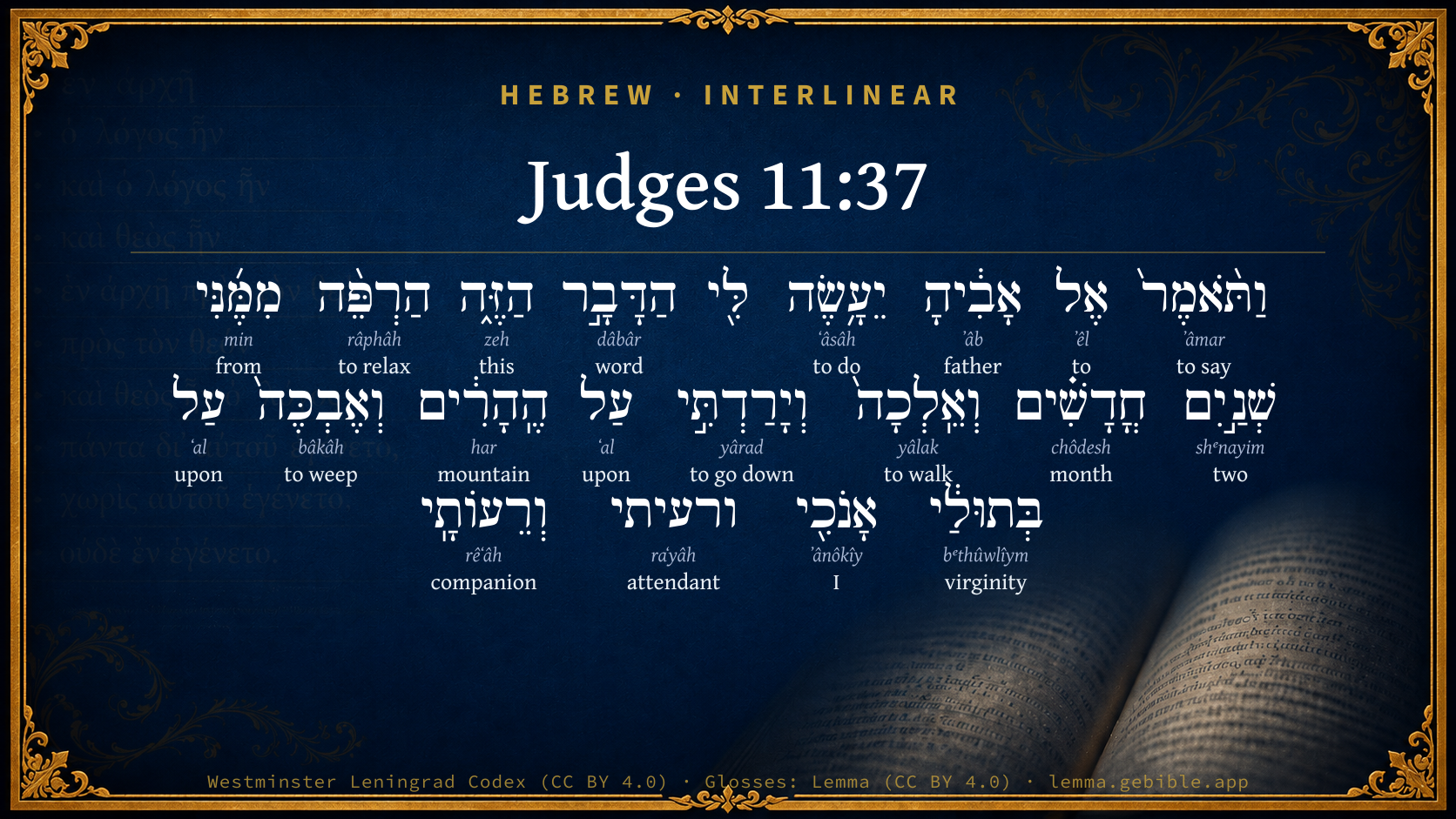
Judges 11:37

Hebrew (Westminster Leningrad Codex) Judges 11:37 appears in the Hebrew Old Testament. The text above is from the Westminster Leningrad Codex. Each word links to its Strong’s number, a concise gloss, and parsing drawn from the Open Scriptures Hebrew Bible morphology. Click any word for its full Brown-Driver-Briggs (BDB) entry.
Download image
Cite this verse

Judges 11:37 (World English Bible). Public Domain. Lemma interlinear Bible study tool, https://lemma.gebible.app/v/judges/11/37.

Show BibTeX & RIS
BibTeX
RIS
English Translation
She said to her father, Let this thing be done for me: let me alone two months, that I may depart and go down on the mountains, and bewail my virginity, I and my companions.
World English Bible · Public Domain
Highlights
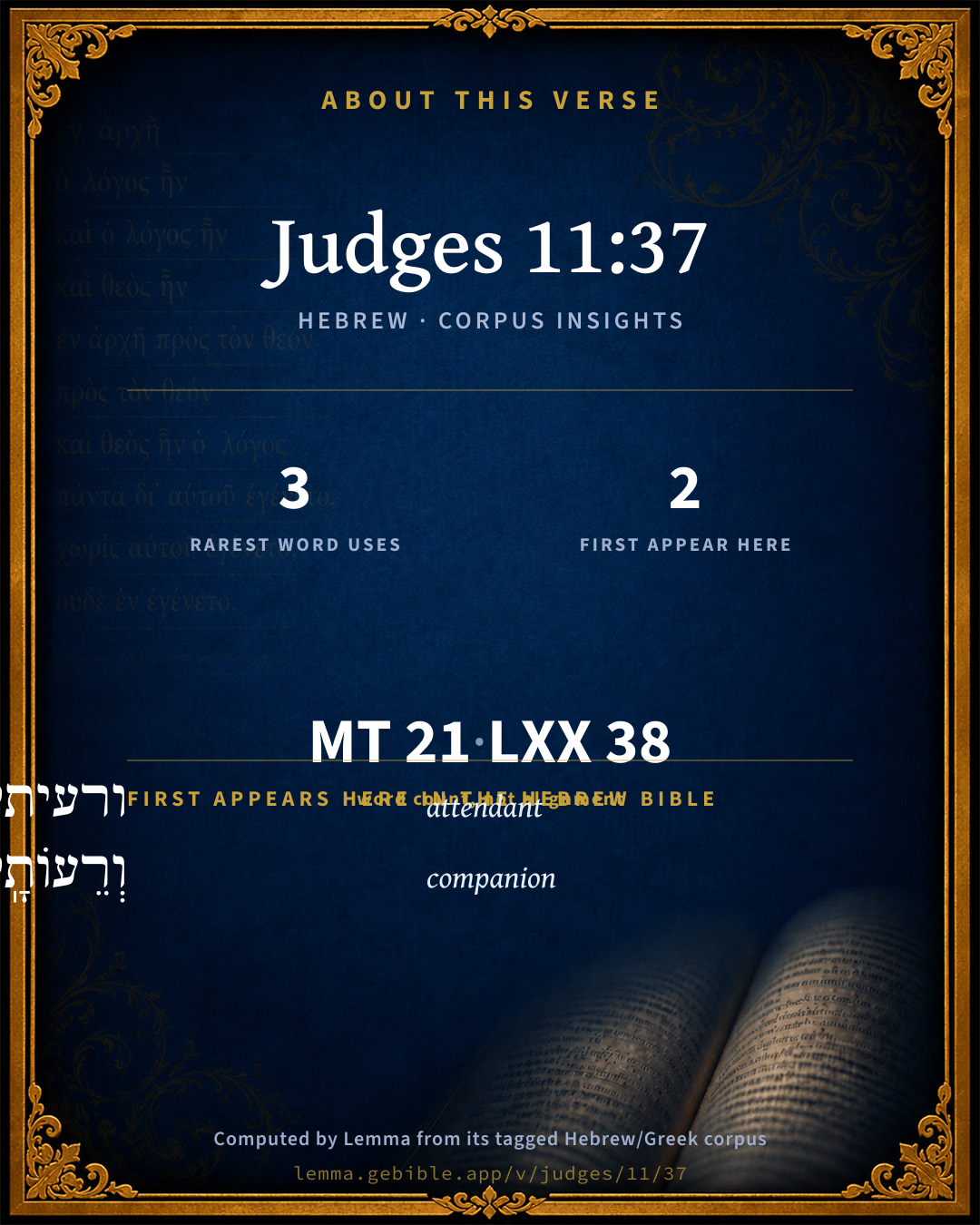
  • 2 first appearances in the Hebrew Bible
Full analysis ↓
Download a study sheet

One document with this verse’s original text, its word-by-word gloss line, the meaning frame, cross-references with their text, attributed commentary, and full source and license credits — printable, and it pastes into notes with its structure intact.

This verse Autodidact and up

Study sheet (.html) Plain text (.txt)

A passage Seminary Student

Up to 50 verses in one chapter. A passage sheet keeps up to 6 commentary sources and 12 cross-references per verse, in the order this page ranks them, and says so on the sheet whenever that leaves anything out. Ask for a single verse and you get the Autodidact verse sheet above.

Everything on this page stays free to read, with no account — the sheet is a download of what is already on screen, not access to it.

Want to remove ads? Support Godless Engineer
Compare translations 3

The same verse in 3 English versions, stacked beneath the original-language interlinear above. Click any original word for its lexicon entry.

Each is an independent rendering of the whole verse — the interlinear is not word-aligned to these translations.

Highlighted words mark where these versions differ — a whole-verse word diff, not a word-by-word alignment.

  • World English Bible Public Domain
    She said to her father, Let this thing be done for me: let me alone two months, that I may depart and go down on the mountains, and bewail my virginity, I and my companions.
  • King James Version Public Domain
    And she said unto her father, Let this thing be done for me: let me alone two months, that I may go up and down upon the mountains, and bewail my virginity, I and my fellows.
  • unfoldingWord Literal Text CC BY-SA 4.0
    Then she said to her father, “May this thing be done for me. Refrain from me two months so I may go, and I will go down upon the hills and weep upon my virginity, I and my companions.”

unfoldingWord Literal Text — © unfoldingWord, licensed CC BY-SA 4.0. Word-aligned USFM3 via Door43 (git.door43.org/unfoldingWord/en_ult).

Versions to compare (up to 4)

3 of 4 selected

Show all 18 translations

Every available English version of this verse, each an independent rendering of the whole verse.

  • World English Bible Public Domain
    She said to her father, Let this thing be done for me: let me alone two months, that I may depart and go down on the mountains, and bewail my virginity, I and my companions.
  • Berean Standard Bible Public Domain
    She also said to her father, “Let me do this one thing: Let me wander for two months through the mountains with my friends and mourn my virginity.”
  • Majority Standard Bible Public Domain
    She also said to her father, “Let me do this one thing: Let me wander for two months through the mountains with my friends and mourn my virginity.”
  • King James Version Public Domain
    And she said unto her father, Let this thing be done for me: let me alone two months, that I may go up and down upon the mountains, and bewail my virginity, I and my fellows.
  • American Standard Version (1901) Public Domain
    And she said unto her father, Let this thing be done for me: let me alone two months, that I may depart and go down upon the mountains, and bewail my virginity, I and my companions.
  • Revised Version (1885) Public Domain
    And she said unto her father, Let this thing be done for me: let me alone two months, that I may depart and go down upon the mountains, and bewail my virginity, I and my companions.
  • Geneva Bible (1599) Public Domain
    Also she saide vnto her father, Doe thus much for me: suffer me two moneths, that I may goe to the mountaines, and bewaile my virginitie, I and my fellowes.
  • Douay-Rheims (1899) Public Domain
    And she said to her father: Grant me only this which I desire: Let me go, that I may go about the mountains for two months, and may bewail my virginity with my companions.
  • Young's Literal Translation Public Domain
    And she saith unto her father, `Let this thing be done to me; desist from me two months, and I go on, and have gone down on the hills, and I weep for my virginity -- I and my friends.'
  • Literal Standard Version CC BY-SA 4.0
    And she says to her father, “Let this thing be done to me; desist from me [for] two months, and I go on, and have gone down on the hills, and I weep for my virginity—I and my friends.”
  • Unlocked Literal Bible CC BY-SA 4.0
    She said to her father, “Let this promise be kept for me. Leave me alone for two months, that I may leave and go down to the hills and grieve over my virginity, I and my companions.”
  • unfoldingWord Literal Text CC BY-SA 4.0
    Then she said to her father, “May this thing be done for me. Refrain from me two months so I may go, and I will go down upon the hills and weep upon my virginity, I and my companions.”
  • Darby Bible Public Domain
    And she said to her father, "Let this thing be done for me; let me alone two months, that I may go and wander on the mountains, and bewail my virginity, I and my companions."
  • World Messianic Bible Public Domain
    Then she said to her father, “Let this thing be done for me. Leave me alone two months, that I may depart and go down on the mountains, and bewail my virginity, I and my companions.”
  • Webster's Bible Public Domain
    And she said to her father, Let this thing be done for me: Let me alone two months, that I may go up and down upon the mountains, and bewail my virginity, I and my fellows.
  • Free Bible Version CC BY-SA 4.0
    Then she went on to say to him, “Just let me do this: let me walk through the hills for two months with my friends and grieve the fact that I'll never marry.”
  • Bible in Basic English Public Domain
    Then she said to her father, Only do this for me: let me have two months to go away into the mountains with my friends, weeping for my sad fate.
  • JPS Tanakh (1917) Public Domain
    And she said unto her father: 'Let this thing be done for me: let me alone two months, that I may depart and go down upon the mountains, and bewail my virginity, I and my companions.'

Literal Standard Version (2020), Covenant Press — licensed CC BY-SA 4.0. Text via the HelloAO Bible API (eBible.org). Unlocked Literal Bible (unfoldingWord) — licensed CC BY-SA 4.0. Text via the HelloAO Bible API (eBible.org). unfoldingWord Literal Text — © unfoldingWord, licensed CC BY-SA 4.0. Word-aligned USFM3 via Door43 (git.door43.org/unfoldingWord/en_ult). Free Bible Version, Dr. Jonathan Gallagher — licensed CC BY-SA 4.0. Text via the HelloAO Bible API (eBible.org).

Word by word

More ways to search: Search by grammar → Find every occurrence → Compare this word →

Practice this passage: Drill this verse → Learn its vocabulary →

וְרֵעוֹתָֽי
rêʻâh
H7464
“and · companions · my”
Conjunction + Noun, Common, Feminine, Plural, Construct + Suffix, Personal, 1st Person, Common, Singular
Part of Speech
Conjunction + Noun
Type
Common
Gender
Feminine
Number
Plural
State
Construct
Full BDB Definition

Origin: from H7453

TWOT: 2186c

female companion, companion, attendant (of maidens)
  1. וַתֹּ֨אמֶר֙ ʼâmar H559 “and · to say” Conjunction + Verb, Qal, Sequential Imperfect, 3rd Person, Feminine, Singular
  2. אֶל ʼêl H413 “to” Preposition
  3. אָבִ֔יהָ ʼâb H1 “father · her” Noun, Common, Masculine, Singular, Construct + Suffix, Personal, 3rd Person, Feminine, Singular
  4. יֵעָ֥שֶׂה ʻâsâh H6213 “to do” Verb, Niphal, Imperfect, 3rd Person, Masculine, Singular
  5. הַדָּבָ֣ר dâbâr H1697 “the · word” Particle, Definite Article + Noun, Common, Masculine, Singular, Absolute
  6. הַזֶּ֑ה zeh H2088 “the · this” Particle, Definite Article + Pronoun, Demonstrative, Masculine, Singular
  7. הַרְפֵּ֨ה râphâh H7503 “relax” Verb, Hiphil, Imperative, 2nd Person, Masculine, Singular
  8. מִמֶּ֜נִּי min H4480 “from · me” Preposition + Suffix, Personal, 1st Person, Common, Singular
  9. שְׁנַ֣יִם shᵉnayim H8147 “two” Adjective, Cardinal number, Masculine, Dual, Absolute
  10. חֳדָשִׁ֗ים chôdesh H2320 “months” Noun, Common, Masculine, Plural, Absolute
  11. וְאֵֽלְכָה֙ yâlak H3212 “and · to walk” Conjunction + Verb, Qal, Cohortative, 1st Person, Common, Singular
  12. וְיָרַדְתִּ֣י yârad H3381 “and · to go down” Conjunction + Verb, Qal, Sequential Perfect, 1st Person, Common, Singular
  13. עַל ʻal H5921 “upon” Preposition
  14. הֶֽהָרִ֔ים har H2022 “the · mountains” Particle, Definite Article + Noun, Common, Masculine, Plural, Absolute
  15. וְאֶבְכֶּה֙ bâkâh H1058 “and · to weep” Conjunction + Verb, Qal, Imperfect, 1st Person, Common, Singular
  16. עַל ʻal H5921 “upon” Preposition
  17. בְּתוּלַ֔י bᵉthûwlîym H1331 “virginity · my” Noun, Common, Both, Plural, Construct + Suffix, Personal, 1st Person, Common, Singular
  18. אָנֹכִ֖י ʼânôkîy H595 “I” Pronoun, Personal, 1st Person, Common, Singular
  19. ורעיתי raʻyâh H7474 “and · attendants · my” Conjunction + Noun, Common, Feminine, Plural, Construct + Suffix, Personal, 1st Person, Common, Singular

About this verse

These counts appear in no published source. They are computed here, from the morphology-tagged text and Lemma’s own curated glosses. What Lemma adds →

21
words
19
distinct lemmas
Historical
section

Notable vocabulary

The rarest word here is וְרֵעוֹתָֽי companion H7464 — appearing just 3 times in the whole Hebrew Bible.

First appearance in Scripture

These words make their first canonical appearance in the Hebrew Bible here:

  • ורעיתי attendant H7474
  • וְרֵעוֹתָֽי companion H7464

Shared distinctive vocabulary

וְרֵעוֹתָֽי companion H7464 occurs in 3 verses of the Hebrew Bible. Also found in:

Grammatical profile

  • 6 verbs
  • 7 nouns
  • 1 adjective
  • 2 pronouns
  • 5 prepositions

Verb forms

  • וַתֹּ֨אמֶר֙ Qal · Sequential Imperfect
  • יֵעָ֥שֶׂה Niphal · Imperfect
  • הַרְפֵּ֨ה Hiphil · Imperative
  • וְאֵֽלְכָה֙ Qal · Cohortative
  • וְיָרַדְתִּ֣י Qal · Sequential Perfect
  • וְאֶבְכֶּה֙ Qal · Imperfect

Repetition

A word recurs within this verse — often emphatic in Hebrew:

Hebrew & Septuagint length

In English translation the verse runs 35 words from the Hebrew and 39 from the Septuagint (LXX English) — closely comparable.

A rough comparison of the two English renderings, which tokenize alike — not a word-level alignment.

Word counts can differ between the Hebrew and the Greek without any difference in meaning — e.g. the Hebrew direct-object marker אֵת has no separate Greek word, and Greek often adds the article ὁ.

In the original languages it is 21 Hebrew tokens and 38 Greek tokens — but the two are counted differently (Hebrew bundles its prefixes and suffixes into one token; the Greek is in lemma form), so that isn’t a like-for-like length.

Cross-references

2

Topical passages linked to Judges 11:37 in the Treasury of Scripture Knowledge — connected by theme and wording, ordered by reader-vote popularity; previews shown in the World English Bible.

  • Luke 1:25 "Thus has the Lord done to me in the days in which he looked at me, to take away my reproach among men."
  • 1 Samuel 1:6 Her rival provoked her sore, to make her fret, because Yahweh had shut up her womb.

Cross-references courtesy of OpenBible.info (CC BY 4.0).

Hebrew and Greek witnesses Masoretic Hebrew ↔ Greek Septuagint

The same verse in the two great witnesses to the Old Testament, shown verse-for-verse.

These are two independent witnesses, not word-aligned to each other, and the Septuagint is shown in lemma (dictionary) form.

Hebrew Judges 11:37 Masoretic · Westminster Leningrad Codex

וַתֹּ֨אמֶר֙ אֶל אָבִ֔יהָ יֵעָ֥שֶׂה לִּ֖י הַדָּבָ֣ר הַזֶּ֑ה הַרְפֵּ֨ה מִמֶּ֜נִּי שְׁנַ֣יִם חֳדָשִׁ֗ים וְאֵֽלְכָה֙ וְיָרַדְתִּ֣י עַל הֶֽהָרִ֔ים וְאֶבְכֶּה֙ עַל בְּתוּלַ֔י אָנֹכִ֖י ורעיתי וְרֵעוֹתָֽי

She said to her father, Let this thing be done for me: let me alone two months, that I may depart and go down on the mountains, and bewail my virginity, I and my companions.

World English Bible · Public Domain

Greek LXX Judges 11:37 Septuagint · lemma form

καί ὅδε εἶπον πρός ὁ πατήρ αὐτός ποιέω δή ὁ πατήρ ἐγώ ὁ λόγος οὗτος ἐάω ἐγώ δύο μήν καί πορεύομαι καί καταβαίνω ἐπί ὁ ὄρος καί κλαίω ἐπί ὁ παρθένεια ἐγώ ἐγώ εἰμί καί ὁ συνεταιρίς ἐγώ

And she said to her father, Let my father now do this thing: let me alone for two months, and I will go up and down on the mountains, and I will bewail my virginity, I and my companions.

LXX2012 (modern English Septuagint) · Public Domain

Hebrew: Westminster Leningrad Codex (CC BY 4.0). Greek: Septuagint (public domain); English from LXX2012 (modern English Septuagint) (Public Domain). How the Septuagint differs from the Hebrew →

Targum (Aramaic paraphrase)

1

The Targum is the ancient Jewish Aramaic paraphrase of the Hebrew Scriptures — an interpretive translation, not the Hebrew text itself. Onkelos (literal) and Pseudo-Jonathan (expansive) render the Torah, and Jonathan the Prophets. Coverage is partial: where no permissively-licensed English translation exists for a verse, only the Aramaic is shown. This is verse-level text, not a word-by-word alignment to the Hebrew.

  1. Targum Jonathan Prophets (Joshua–Malachi)
    וַאֲמַרַת לַאֲבוּהָא יִתְעֲבֵיד לִי פִּתְגָמָא הָדֵין שְׁבוֹק מִנִי תְּרֵין יַרְחִין וְאֵהַךְ וְאִתְנְגִיד עַל טוּרַיָא וְאֶבְכֶּה עַל בְּתוּלַי אֲנָא וְחַבְרָתִי:

    (no public-domain English translation for this verse)

    Targum Jonathan — Aramaic: “Mikraot Gedolot” (public domain). English: “Sefaria Community Translation” (CC0 1.0 (public-domain dedication)); “London "Chaldee Paraphrase," 1871” (public domain). Text via Sefaria.

Commentary

Notes on Judges 11:37 from classic Christian and Jewish commentators (each source and its license shown beneath its notes). The classic Christian expositions comment on the surrounding passage and are grouped to its opening verse, so a note may address several verses; the Jewish commentaries on the Tanakh (Rashi and others) are per-verse, so they appear only where the commentator wrote on this verse.

Lemma curates 59 commentaries, every one of them public domain or Creative Commons licensed, each selected and text-cleaned for this edition rather than reprinted as found. About our sources →

Trapp's Complete Commentary

John Trapp

Jdg 11:37 And she said unto her father, Let this thing be done for me: let me alone two months, that I may go up and down upon the mountains, and bewail my virginity, I and my fellows.

Ver. 37. And bewail my virginity.] She saith, not the loss of my life, but the want of posterity; which in those days was counted a great curse.

John Trapp, A Commentary or Exposition upon All the Books of the Old and New Testament (1647–1656) — public domain. Text from a community e-Sword module.

Joseph Benson's Commentary

Jdg 11:37. That I may go up and down upon the mountains — Which she chose as a solitary place, and therefore fittest for lamentation. Bewail — That I shall die childless, which was esteemed both a curse and a disgrace for the Israelites, because such were excluded from that great privilege of increasing the holy seed, and contributing to the birth of the Messiah.

Joseph Benson's Commentary on the Old and New Testaments (1811–1818) — public domain. Text from a community e-Sword module.

Geneva Bible (1599)

Geneva Bible translators

For it was counted as a shame in Israel, to die without children, and therefore they rejoiced to be married.

Geneva Bible (1599) marginal notes — public domain. Text via Bolls.life.

Adam Clarke's Commentary

Verse 37. I and my fellows] Whether she meant the young women of her own acquaintance, or those who had been consecrated to God in the same way, though on different accounts, is not quite clear; but it is likely she means her own companions: and her going up and down upon the mountains may signify no more than her paying each of them a visit at their own houses, previously to her being shut up at the tabernacle; and this visiting of each at their own home might require the space of two months. This I am inclined to think is the meaning of this difficult clause.

Adam Clarke's Commentary on the Bible (1810–1826) — public domain. Text from a community e-Sword/MySword module.

Ellicott's Commentary for English Readers

(37) Let me alone two months.—There was nothing which forbade this postponement for a definite purpose and period of the fulfilment of the vow. For the phrase “let me alone,” see Deu_9:14; 1Sa_11:3.

And bewail my virginity.—The thought which was so grievous to the Hebrew maiden was not death, but to die unwedded and childless. This is the bitterest wail of Antigone also, in the great play of Sophocles (Ant. 890); but to a Hebrew maid the pang would be more bitter, because the absence of motherhood cut off from her, and, in this instance, from her house, the hopes which prophecy had cherished. Josephus makes the expression mean no more than “to bewail her youth,” neoteta (Jos. Antt. v. 7, § 10).

A Bible Commentary for English Readers, edited by Charles John Ellicott (1878–1897) — public domain. Text from a community e-Sword module.

The Cambridge Bible for Schools and Colleges

gen. ed. J. J. S. Perowne

37. and go down upon the mountains] A slight emendation (weradhti for weyaradhti) improves the sense: and roam or wander restlessly; cf. Jer_2:31 (‘we roam at large’).

bewail my virginity] To be neither wife nor mother was considered a punishment and a reproach: cf. Gen_16:1-5; Gen_30:23, 1Sa_1:10-11; 1Sa_1:15, Isa_4:1, Luk_1:25. The ancient Greeks felt similarly1[45].

[45] See Livingstone, The Greek Genius (1912), p. 83 f.

The Cambridge Bible for Schools and Colleges (gen. ed. J. J. S. Perowne; Cambridge University Press, 1878–1918) — public domain. Text from a community e-Sword module.

John Gill's Exposition

And it came to pass at the end of two months she returned to her father,.... For the request she made was not a pretence to make her escape out of his hands; but having done what she proposed to do, and the time fixed for it being come, she returned to her father's house, and delivered herself to him:

who did with her according to his vow which he had vowed: but what he did is a question, and which is not easily resolved; some think he really sacrificed her, through a mistaken sense of Lev 27:29 and which his action are accounted for through his living a military life, and in a distant part of the country, and at a time when idolatry had greatly prevailed in Israel, and to such a degree as it had not before, and no doubt that branch of it, sacrificing children to Molech; and Jephthah might think that though that was sinful, yet such a sacrifice might be acceptable to the Lord; and especially since his vow, as he thought, bound him to it; and how far the instance of Abraham offering up his son Isaac might encourage him to it, cannot be said: of this mind were Josephus (k), Jonathan Ben Uzziah the Targumist, and some other Jewish writers (l); and many of the ancient Christian fathers, and many modern authors of every name among Christians; and it has been thought that the story of Iphigenia, who Capellus (m) thinks is the same with Jepthigenia, that is, the daughter of Jephthah, and was slain by her father Agamemnon, having several circumstances in it similar to this, is taken from hence: and there is much such a case as this related (n) of Idomeneus, a king of the Cretians, who upon his return after the destruction of Troy, being in a tempest, vowed, should he be saved, that he would sacrifice the first he met with to the gods; and as it was his son he first met with, he sacrificed him; or, as others say, would have done it, but was prevented by the citizens, and who on this account drove him from his kingdom. But others are of opinion that what Jephthah did according to his vow was, that he shut up his daughter, and separated her from the company of men, and obliged her to live unmarried all her days, and therefore she is said to bewail her virginity. Kimchi and Ben Melech say, he built a house for her without the city, where she dwelt alone, and knew no man; and where her father supported her, and obliged her to live all her days; and Abarbinel thinks, that the Romanists from hence learnt to build their cloisters to put their nuns in; and so Ben Gersom interprets this vow of her being separated from men, and devoted to the service of God; and which is the sense of many Christian interpreters. Now though Jephthah had no such power over his daughter, as to oblige her to perpetual virginity, nor did his vow bind him to it; for persons devoted to the Lord were not obliged to abstain from marriage, nor have we any instances of a monastic life in those times, nor among the Jews at any time; yet as he did something not right, which he thought his vow obliged him to, one would be rather tempted to think, in charity to him, that of the two evils he did the least; for if she was put to death, it must be done either by the magistrates, or by the priests, or by Jephthah himself; neither of which is probable:

and she knew no man; never married, but lived and died a virgin: "and it was a custom in Israel"; the Targum adds,"that a man might not offer his son or his daughter for a burnt offering, as Jephthah the Gileadite did, and did not consult Phinehas the priest; for had he consulted Phinehas the priest, he would have redeemed her with a price;''so Jarchi, according to Lev 27:4 but each stood upon their honour, as the Jews say (o); Jephthah being a king would not go to Phinehas, and Phinehas being an high priest; and the son of an high priest, would not go to a plebeian; and so, between them both, the maiden was lost: but the custom refers to what follows.

(k) Antiqu l. 5. c. 7. sect. 10. (l) Bereshit Rabba, sect. 60, fol. 52. 3. Vajikra Rabba, sect. 37. fol. 176. 4. (m) De Voto Jephthae, sect. 12. (n) Alex. ab Alex. Genial. Dier. l. 3. c. 22. Servius in Virgil. Aeneid. l. 3. col. 693. in l. 11. col. 1634. (o) Bereshit Rabba & Vajikra, ut supra. (l)); Midrash Kohelet, fol. 81. 3.

John Gill's Exposition of the Whole Bible (1746–1763) — public domain (CC PDM 1.0). Text via the HelloAO Bible API.

Albert Barnes' Notes on the Bible

Bewail my virginity - To become a wife and a mother was the end of existence to an Israelite maiden. The premature death of Jephthah’s daughter was about to frustrate this end.

Albert Barnes' Notes on the Bible (1834–1885) — public domain. Text from a community e-Sword/MySword module.

Haydock's Catholic Bible Commentary

Bewail my virginity. The bearing of children was much coveted under the Old Testament, when women might hope that from some child of theirs the Saviour of the world might one day spring. But under the New Testament virginity is preferred, 1 Corinthians vii. 35.

George Leo Haydock (1774–1849), Haydock's Catholic Family Bible and Commentary, 1859 edition — public domain. Excludes Psalms (Douay-Rheims chapter numbering differs from Protestant) and Deuterocanonical books (Catholic canon only).

Matthew Poole's English Annotations

She chose

the mountains as a solitary place, and therefore fittest both for lamentations, and for her preparation for her approaching calamity.

Bewail my virginity; that I shall die childless, which was esteemed both a curse and a disgrace for the Israelites, Gen 30:23; 1Sa 1:6 7; Isa 4:1, because such were excluded from that great privilege of increasing the holy seed, and contributing to the birth of the Messiah, who was to be born of an Israelitish woman.

Matthew Poole's English Annotations on the Holy Bible (1683–1685) — public domain. Text from a community e-Sword/MySword module.

Whedon's Commentary on the Bible

Daniel D. Whedon

37. Bewail my virginity — Mark, not to bewail her death, for that, by itself considered, might be regarded as a glorious end. Die she must, sooner or later, and no more honourable death could ever be her lot. But she would bewail that which gave her death its only woful pang, and was to her far worse than death itself; a thing above all others deplorable in the estimation of that age and race — the fact that, in the flower of youthful womanhood, she must close life without a husband and without a child, leaving no heir to her father’s house. It is difficult for us, with our loose attachments to the coming ages, and familiar with the modern prevalent lack of interest in posterity, and the noticeable desire among multitudes of females to remain childless, to appreciate the depth of feeling on this subject among the Hebrew women. A husbandless and childless state was a reproach to any marriageable female. Keil makes a misleading assertion when he says, “To mourn one’s virginity does not mean to mourn because one has to die a virgin, but because one has to live and remain a virgin.” More truly should it be said, that the expression has as much respect to the past as to the future, but contemplates not specially life or death, but the fact of virginity. Could Jephthah’s daughter only have perpetuated her father’s house and name; could it only have been that sons and daughters survived her, to take away her reproach among women, there would have been no pang in her death.

But why, some ask, if she was doomed to death, did she not rather spend those two months at home, and enjoy all the comfort she could during the short respite of her life? To one thus appointed to death, we answer, home affords no soul comforts, and earth’s festal scenes and sociality no pleasure. It is not human, under such circumstances, to find entertainment in the common joys of home. Far more congenial to the feelings of the dying maiden would be the mountain solitudes than any thing her father’s house could furnish. Then, also, the two months were asked, not for one more round of pleasures, but for mourning her virginity; and for that purpose the solitudes of the mountains, not the peopled town, with the presence of men, were appropriate.

But if, on the other hand, she knew she was to live and remain a virgin, and be shut up in seclusion for the rest of life, what sense or object in taking those two months to mourn? And in what sense would she be more really consecrated to celibacy after than during the two months of sorrow? Much more natural, as we conceive, would it have been for her, in that case, to have said: Let me stay at home, and enjoy the scenes of common life yet a month or two, since I must give all after-life to tears and solitude.

Daniel D. Whedon (gen. ed.), Commentary on the Old and New Testaments (1874–1909) — public domain. Text from a community e-Sword module.

The Pulpit Commentary

And bewail my virginity. It is a striking evidence of the strong desire among Hebrew women to be mothers, as seen in Sarah, Rachel, Hannah, and others, that it was the prospect of dying unmarried which seemed to Jephthah"s daughter the saddest part of her fate. So in Psa_78:63, their maidens were not given to marriage is one of the items of the misery of Israel (see too ver. 39).

The Pulpit Commentary (1880–1919), ed. H.D.M. Spence-Jones & Joseph S. Exell — public domain. Text from a community e-Sword module.

John Wesley's Explanatory Notes

Mountains - Which she chose as a solitary place, and therefore fittest for lamentation. Bewail - That I shall die childless, which was esteemed both a curse and a disgrace for the Israelites, because such were excluded from that great privilege of increasing the holy seed, and contributing to the birth of the Messiah.

John Wesley, Explanatory Notes Upon the Whole Bible (1754–1765) — public domain. Text via the GEBible commentary corpus.

Rashi

Rabbi Shlomo Yitzchaki (Rashi)

To grieve on the hills. This word refers to bewailing. Similarly, "On its roofs and thoroughfares, total wailing, weeping grief." Weeping so intense that it causes a physical breakdown. Midrash Agada: R' Tanchuma expounded, On the hills; before the Sanhedrin—perhaps they may find a loophole in your vow.

Rashi on the Tanakh — English translations: “The Judaica Press complete Tanach with Rashi, translated by A. J. Rosenberg” (CC BY 4.0); “Pentateuch with Rashi's commentary by M. Rosenbaum and A.M. Silbermann, 1929-1934” (public domain); “The Metsudah Tanach series, Lakewood, N.J” (CC BY 4.0); and “The Book of Joshua, Metsudah Publications, 1997” (CC BY 4.0). Text via Sefaria.

Lesson kit

Teaching starters — assembled from the data on this page, not authored interpretation. Every prompt links to the verse data it draws on. Edit before teaching.

Judges, in the Historical, opens this verse with 21 words (19 distinct Hebrew lemmas). Its most distinctive word is rêʻâh (“companion”). A historical commentator’s framing appears above. Read the whole chapter for the surrounding context.

Discussion questions

  1. What does “companion” (rêʻâh) contribute to the verse as a whole?
  2. 2 words here appear for the first time in Scripture. What is being introduced at this debut?
  3. Judges 11:38 shares the word «companion» with this verse. How do the two illuminate each other?
  4. “upon” occurs 2× in this one verse. What is the effect of the repetition?
  5. These translations render this verse differently; the difference is in the English rendering, not the original. What questions does that raise?
  6. The verb «וַתֹּ֨אמֶר֙» is Qal Sequential Imperfect. How does its form color the action?
  7. Reading how Trapp's Complete Commentary and Joseph Benson's Commentary read this verse, where do the two commentators agree and where do they part?

Things to notice

Reading settings

Reading text

Shown beneath each verse's original-language words.

Old Testament
Old Testament edition

Read the OT as the Masoretic Hebrew (MT) or the Greek Septuagint (LXX).

English shown for the Greek Septuagint (in the Hebrew ↔ Greek comparison).

Comparing translations? Open the Compare panel on any verse page to stack up to four side by side.