Haggai 1:15

Hebrew (Westminster Leningrad Codex) Haggai 1:15 appears in the Hebrew Old Testament. The text above is from the Westminster Leningrad Codex. Each word links to its Strong’s number, a concise gloss, and parsing drawn from the Open Scriptures Hebrew Bible morphology. Click any word for its full Brown-Driver-Briggs (BDB) entry.
Download image
Cite this verse

Haggai 1:15 (World English Bible). Public Domain. Lemma interlinear Bible study tool, https://lemma.gebible.app/v/haggai/1/15.

Show BibTeX & RIS
BibTeX
RIS
English Translation
in the twenty-fourth day of the month, in the sixth month, in the second year of Darius the king.
World English Bible · Public Domain
Download a study sheet

One document with this verse’s original text, its word-by-word gloss line, the meaning frame, cross-references with their text, attributed commentary, and full source and license credits — printable, and it pastes into notes with its structure intact.

This verse Autodidact and up

Study sheet (.html) Plain text (.txt)

A passage Seminary Student

Up to 50 verses in one chapter. A passage sheet keeps up to 6 commentary sources and 12 cross-references per verse, in the order this page ranks them, and says so on the sheet whenever that leaves anything out. Ask for a single verse and you get the Autodidact verse sheet above.

Everything on this page stays free to read, with no account — the sheet is a download of what is already on screen, not access to it.

Want to remove ads? Support Godless Engineer
Compare translations 3

The same verse in 3 English versions, stacked beneath the original-language interlinear above. Click any original word for its lexicon entry.

Each is an independent rendering of the whole verse — the interlinear is not word-aligned to these translations.

Highlighted words mark where these versions differ — a whole-verse word diff, not a word-by-word alignment.

  • World English Bible Public Domain
    in the twenty-fourth day of the month, in the sixth month, in the second year of Darius the king.
  • King James Version Public Domain
    In the four and twentieth day of the sixth month, in the second year of Darius the king.
  • unfoldingWord Literal Text CC BY-SA 4.0
    on the twenty-fourth day of the sixth month in the second year of Darius the king,

unfoldingWord Literal Text — © unfoldingWord, licensed CC BY-SA 4.0. Word-aligned USFM3 via Door43 (git.door43.org/unfoldingWord/en_ult).

Versions to compare (up to 4)

3 of 4 selected

Show all 16 translations

Every available English version of this verse, each an independent rendering of the whole verse.

  • World English Bible Public Domain
    in the twenty-fourth day of the month, in the sixth month, in the second year of Darius the king.
  • Berean Standard Bible Public Domain
    on the twenty-fourth day of the sixth month, in the second year of King Darius.
  • Majority Standard Bible Public Domain
    on the twenty-fourth day of the sixth month, in the second year of King Darius.
  • King James Version Public Domain
    In the four and twentieth day of the sixth month, in the second year of Darius the king.
  • American Standard Version (1901) Public Domain
    in the four and twentieth day of the month, in the sixth `month', in the second year of Darius the king.
  • Revised Version (1885) Public Domain
    in the four and twentieth day of the month, in the sixth month, in the second year of Darius the king.
  • Young's Literal Translation Public Domain
    in the twenty and fourth day of the sixth month, in the second year of Darius the king.
  • Literal Standard Version CC BY-SA 4.0
    in the twenty-fourth day of the sixth month, in the second year of Darius the king.
  • Unlocked Literal Bible CC BY-SA 4.0
    in the twenty-fourth day of the sixth month, in the second year of Darius the king.
  • unfoldingWord Literal Text CC BY-SA 4.0
    on the twenty-fourth day of the sixth month in the second year of Darius the king,
  • Darby Bible Public Domain
    in the four and twentieth day of the sixth month, in the second year of Darius the king.
  • World Messianic Bible Public Domain
    in the twenty-fourth day of the month, in the sixth month, in the second year of Darius the king.
  • Webster's Bible Public Domain
    In the four and twentieth day of the same month, in the second year of Darius the king.
  • Free Bible Version CC BY-SA 4.0
    This happened on the twenty-fourth day of the sixth month in the second year of the reign of king Darius.
  • Bible in Basic English Public Domain
    On the twenty-fourth day of the month, in the sixth month, in the second year of Darius the king.
  • JPS Tanakh (1917) Public Domain
    in the four and twentieth day of the month, in the sixth month, in the second year of Darius the king.

Literal Standard Version (2020), Covenant Press — licensed CC BY-SA 4.0. Text via the HelloAO Bible API (eBible.org). Unlocked Literal Bible (unfoldingWord) — licensed CC BY-SA 4.0. Text via the HelloAO Bible API (eBible.org). unfoldingWord Literal Text — © unfoldingWord, licensed CC BY-SA 4.0. Word-aligned USFM3 via Door43 (git.door43.org/unfoldingWord/en_ult). Free Bible Version, Dr. Jonathan Gallagher — licensed CC BY-SA 4.0. Text via the HelloAO Bible API (eBible.org).

Word by word

More ways to search: Search by grammar → Find every occurrence → Compare this word →

Practice this passage: Drill this verse → Learn its vocabulary →

לְדָרְיָ֥וֶשׁ
Dârᵉyâvêsh
H1867
“to/for · Darius”
Preposition + Noun, Proper
Part of Speech
Preposition + Noun
Type
Proper
Full BDB Definition

Origin: of Persian origin

TWOT: None

Darius = "lord" - Darius the Mede, the son of Ahasuerus, king of the Chaldeans, who succeeded to the Babylonian kingdom on the death of Belshazzar; probably the same as " Astyages" the last king of the Medes (538 BC) - Darius, the son of Hystaspes, the founder of the Perso-Arian dynasty - Darius II or Darius III - Darius II, Nothus (Ochus) was king of Persia during the time of Nehemiah (424/3-405/4 BC). Darius II is the most probable because he is mentioned by Nehemiah and ruled during the time of Nehemiah - Darius III, Codomannus was king of Persia during its last years at the time of Alexander the Great and was his opponent
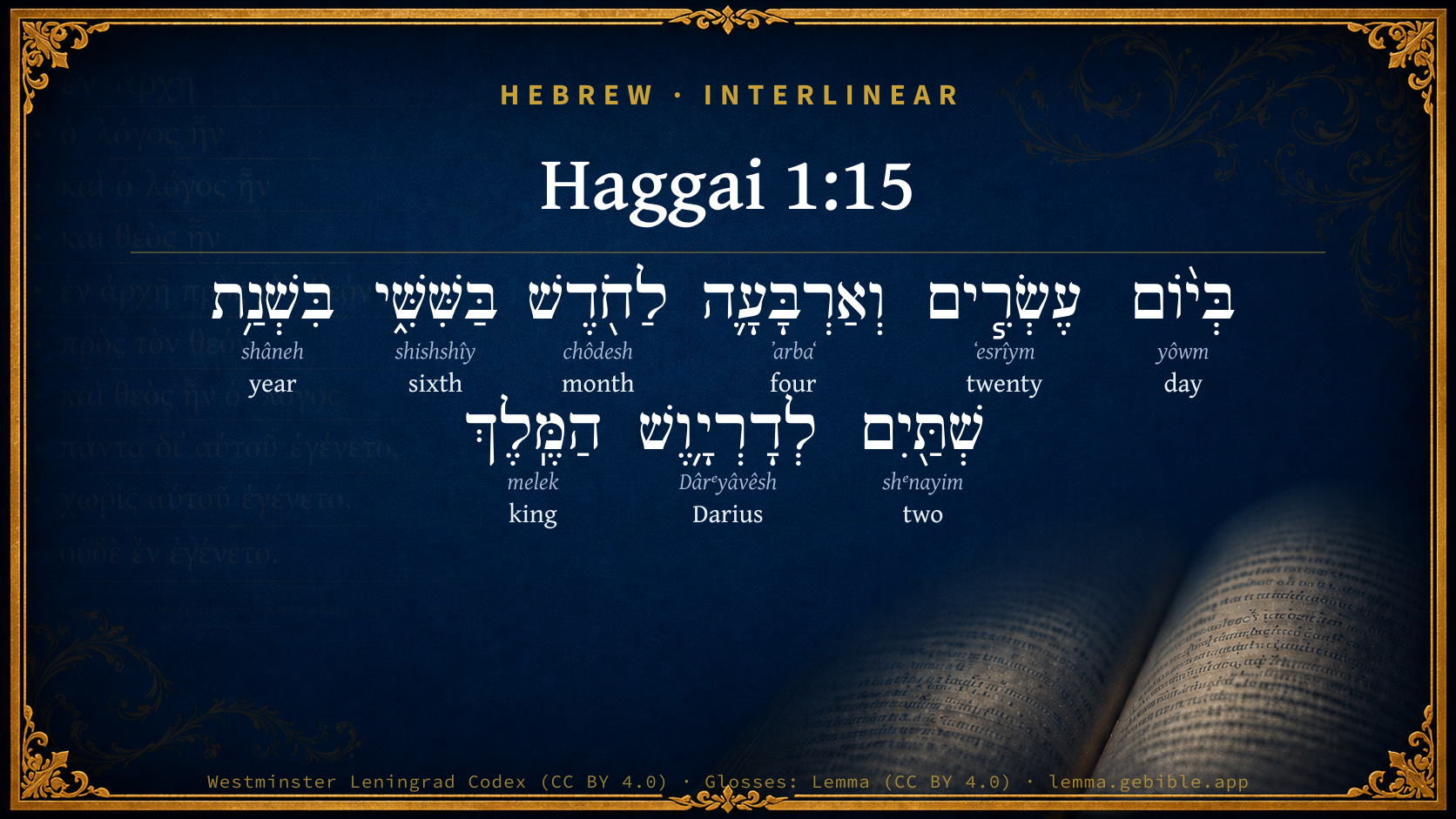
  1. בְּי֨וֹם yôwm H3117 “in/at · day of” Preposition + Noun, Common, Masculine, Singular, Construct
  2. עֶשְׂרִ֧ים ʻesrîym H6242 “twenty” Adjective, Cardinal number, Both, Plural, Absolute
  3. וְאַרְבָּעָ֛ה ʼarbaʻ H702 “and · four” Conjunction + Adjective, Cardinal number, Masculine, Singular, Absolute
  4. לַחֹ֖דֶשׁ chôdesh H2320 “to/for the · month” Preposition, Determined + Noun, Common, Masculine, Singular, Absolute
  5. בַּשִּׁשִּׁ֑י shishshîy H8345 “in/at the · sixth” Preposition, Determined + Adjective, Ordinal number, Masculine, Singular, Absolute
  6. בִּשְׁנַ֥ת shâneh H8141 “in/at · year of” Preposition + Noun, Common, Feminine, Singular, Construct
  7. שְׁתַּ֖יִם shᵉnayim H8147 “two” Adjective, Cardinal number, Feminine, Dual, Absolute
  8. הַמֶּֽלֶךְ melek H4428 “the · king” Particle, Definite Article + Noun, Common, Masculine, Singular, Absolute

About this verse

These counts appear in no published source. They are computed here, from the morphology-tagged text and Lemma’s own curated glosses. What Lemma adds →

9
words
9
distinct lemmas
Prophets
section

Notable vocabulary

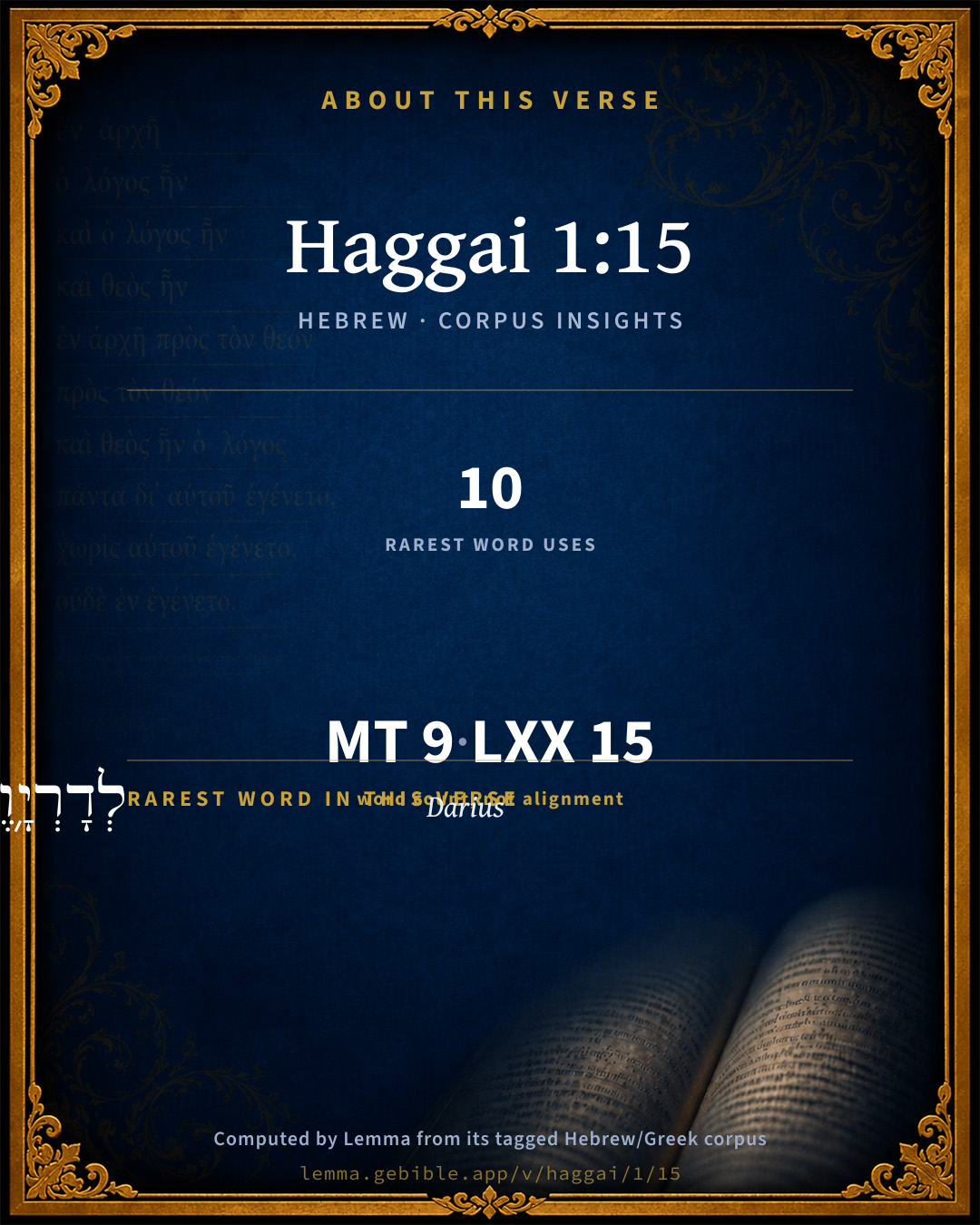
The rarest word here is לְדָרְיָ֥וֶשׁ Darius H1867 — appearing just 10 times in the whole Hebrew Bible.

Shared distinctive vocabulary

לְדָרְיָ֥וֶשׁ Darius H1867 occurs in 10 verses of the Hebrew Bible. Also found in:

Grammatical profile

  • 5 nouns
  • 4 adjectives

Hebrew & Septuagint length

In English translation the verse runs 19 words from the Hebrew and 18 from the Septuagint (LXX English) — closely comparable.

A rough comparison of the two English renderings, which tokenize alike — not a word-level alignment.

Word counts can differ between the Hebrew and the Greek without any difference in meaning — e.g. the Hebrew direct-object marker אֵת has no separate Greek word, and Greek often adds the article ὁ.

In the original languages it is 9 Hebrew tokens and 15 Greek tokens — but the two are counted differently (Hebrew bundles its prefixes and suffixes into one token; the Greek is in lemma form), so that isn’t a like-for-like length.

Cross-references

4

Topical passages linked to Haggai 1:15 in the Treasury of Scripture Knowledge — connected by theme and wording, ordered by reader-vote popularity; previews shown in the World English Bible.

  • Haggai 1:1 In the second year of Darius the king, in the sixth month, in the first day of the month, the Word of Yahweh came by Haggai, the prophet, to Zerubbabel, the son of Shealtiel, governor of Judah, and to Joshua, the son of Jehozadak, the high priest, saying,
  • Haggai 2:1 In the seventh month, in the twenty-first day of the month, the Word of Yahweh came by Haggai the prophet, saying,
  • Haggai 2:10 In the twenty-fourth day of the ninth month, in the second year of Darius, the Word of Yahweh came by Haggai the prophet, saying,
  • Haggai 2:20 The Word of Yahweh came the second time to Haggai in the twenty-fourth day of the month, saying,

Cross-references courtesy of OpenBible.info (CC BY 4.0).

Hebrew and Greek witnesses Masoretic Hebrew ↔ Greek Septuagint

The same verse in the two great witnesses to the Old Testament, shown verse-for-verse.

These are two independent witnesses, not word-aligned to each other, and the Septuagint is shown in lemma (dictionary) form.

Hebrew Haggai 1:15 Masoretic · Westminster Leningrad Codex

בְּי֨וֹם עֶשְׂרִ֧ים וְאַרְבָּעָ֛ה לַחֹ֖דֶשׁ בַּשִּׁשִּׁ֑י בִּשְׁנַ֥ת שְׁתַּ֖יִם לְדָרְיָ֥וֶשׁ הַמֶּֽלֶךְ

in the twenty-fourth day of the month, in the sixth month, in the second year of Darius the king.

World English Bible · Public Domain

Greek LXX Haggai 1:15 Septuagint · lemma form

ὁ τετράς καί εἰκάς ὁ μήν ὁ ἕκτος ὁ δεύτερος ἔτος ἐπί δαρείος ὁ βασιλεύς

on the four and twentieth day of the sixth month, in the second year of Darius the king.

LXX2012 (modern English Septuagint) · Public Domain

On this verse, The Cambridge Bible for Schools and Colleges discusses the Septuagint’s reading. Read the note in Commentary ↓

Hebrew: Westminster Leningrad Codex (CC BY 4.0). Greek: Septuagint (public domain); English from LXX2012 (modern English Septuagint) (Public Domain). How the Septuagint differs from the Hebrew →

Targum (Aramaic paraphrase)

1

The Targum is the ancient Jewish Aramaic paraphrase of the Hebrew Scriptures — an interpretive translation, not the Hebrew text itself. Onkelos (literal) and Pseudo-Jonathan (expansive) render the Torah, and Jonathan the Prophets. Coverage is partial: where no permissively-licensed English translation exists for a verse, only the Aramaic is shown. This is verse-level text, not a word-by-word alignment to the Hebrew.

  1. Targum Jonathan Prophets (Joshua–Malachi)
    בְּיוֹם עַסְרִין וְאַרְבְּעָה לְיַרְחָא בִּשְׁתִיתָאָה בִּשְׁנַת תַּרְתֵּין לְדָרְיָוֶשׁ מַלְכָּא:

    (no public-domain English translation for this verse)

    Targum Jonathan — Aramaic: “Mikraot Gedolot” (public domain). English: “Sefaria Community Translation” (CC0 1.0 (public-domain dedication)); “London "Chaldee Paraphrase," 1871” (public domain). Text via Sefaria.

Commentary

Notes on Haggai 1:15 from classic Christian and Jewish commentators (each source and its license shown beneath its notes). The classic Christian expositions comment on the surrounding passage and are grouped to its opening verse, so a note may address several verses; the Jewish commentaries on the Tanakh (Rashi and others) are per-verse, so they appear only where the commentator wrote on this verse.

Lemma curates 59 commentaries, every one of them public domain or Creative Commons licensed, each selected and text-cleaned for this edition rather than reprinted as found. About our sources →

Trapp's Complete Commentary

John Trapp

Hag 1:15 In the four and twentieth day of the sixth month, in the second year of Darius the king.

Ver. 15. In the four and twentieth day] {See Trapp on "Hag 1:13"} The time is diligently noted, to teach us to take good note of the moments of time, wherein matters of moment have been, by God’s help, begun, continued, and perfected in the Church. This will be of singular use, both for the increase of faith and of good affection in our hearts.

John Trapp, A Commentary or Exposition upon All the Books of the Old and New Testament (1647–1656) — public domain. Text from a community e-Sword module.

Matthew Poole's English Annotations

It appeareth then that Zerubbabel and Joshua, with the people, did resolve on the matter quickly; for in three weeks and three days they are at the work, as is evident; on the first day Haggai preached, Hag 1:1, on the twenty-fourth day of the month the people are at work, Hag 1:15.

Darius: see Hag 1:1. Now this Darius was not Darius Nothus, but Darius Hystaspes, as will appear by considering well the following scheme of years, from the captivity to the particular years of each of these two Dariuses. Suppose we therefore the computation of these years, according to either of these schemes, it will appear that there is no likelihood this Darius in the text should be Darius Nothus.

Helvicus. Usher.

Captivity 3350 3398.

Temple burnt 3360 3416.

Cyrus’s decree 3420 3468.

The decree of Darius, Nothus 3529 Hystaspes 3485.

This latter account begins the captivity at the fourth year of Jehoiakim. the former begins it at the first of Jeconiah’s reign, as Ezekiel also doth, Eze 1:2; 40:1. Hence that difference which is in the account of the years between the beginning of the captivity and the burning of the temple; the former account makes it eleven years, the latter makes it eighteen, for it begins seven years sooner. In what follows, we shall find both agreeing well enough to clear the unlikelihood of Darius Nothus being the king intended here.

Both accounts make the captivity to end in the seventieth year, according to the Scripture. But now the former account makes it one hundred and nine years between Cyrus’s decree and Darius’s decree; all which time the temple by this account lay desolate, without a prophet to stir them up to their duty of building the temple. Now is this probable? can it be reasonably supposed that the temple should so long lie waste after they were sent out of Babylon purposely to build it? or that they should be so long in that condition without a prophet? But now the latter account reckons seventeen years between Cyrus’s and Darius’s decree for building the temple, a space of time easily conceived likely to pass while the Jews did not build; nay, were forbidden by Cambyses, (in Scripture called Artaxerxes,) viceroy to his father Cyrus, (engaged in foreign wars,) all the time Cyrus lived after he gave out the decree, which some make more, some less, but those who make the likeliest guess, for aught I know, make it five years. Whether Cyrus, taken up with these wars, did know of this prohibition, or thought not good to take it off till he returned conqueror, I know not; but he died and left this bar on the work, which continued all Cambyses’s reign, and unto the second year of his successor Darius Hystaspes. Now if this were seventeen the most, some say but fifteen, others but twelve years, it is very probable, whereas one hundred and nine years is utterly improbable. Besides this, let us view what age those many or few were of, by these different accounts, who lived to see the temple re-edified. If in Darius Nothus’s time, they could be no less than one hundred and eighty-five, allowing them to be sixteen at the burning of the temple, thus; sixteen when the temple was burnt, thence sixty to Cyrus’s decree, and thence one hundred and nine to Darius Nothus’s decree. But by the latter account their age amounts but to ninety-five years, which appears thus; sixteen at the time the temple was burnt, thence sixty to Cyrus’s decree, thence seventeen to Darius Hystaspes’s decree; in all ninety-five, which though a great age, yet not improbable at that time, though the other (one hundred and eighty-five) be improbable. Besides, how few through one hundred and sixty-nine years can distinctly remember what they saw and took notice of at sixteen, or could make that judgment of the disproportion between the two temples! Hag 2:3. Or can it be supposed that Zecaraiah Zec 1:12) would have accounted but seventy years’ desolation, when he might have more than doubled the years, and have reckoned one hundred and sixty-nine years? would not the argument thus have been more moving?

Matthew Poole's English Annotations on the Holy Bible (1683–1685) — public domain. Text from a community e-Sword/MySword module.

Jamieson, Fausset & Brown

Robert Jamieson, A. R. Fausset & David Brown

four and twentieth day--twenty-three days after the first message of Haggai (Hag 1:1).

Next: Haggai Chapter 2

Jamieson, Fausset & Brown — Commentary Critical and Explanatory on the Whole Bible (1871) — public domain (CC PDM 1.0). Text via the HelloAO Bible API.

Adam Clarke's Commentary

Verse 15. In the four and twentieth day] Haggai received his commission on the first day of this month and by the twenty-fourth day he had so completely succeeded that he had the satisfaction to see the whole people engaged heartily in the Lord's work; they left their own houses to build that of the Lord. Here was a faithful reprover, and he found obedient ears; and the Lord's work was done, for the people had a mind to work.

Adam Clarke's Commentary on the Bible (1810–1826) — public domain. Text from a community e-Sword/MySword module.

John Calvin's Commentaries

The Prophet mentions even the time when they commenced the building of the temple. Three-and-twenty days interposed between the first message and the beginning of the work. It hence appears how ignorant he was who divided the chapters, having begun the second chapter at this verse, where the Prophet shows, as it were by his finger, how much was the distance between the day in which he began to exhort the people, and the success of which he speaks. He then simply tells us here when the Temple began to be built—that is, in the second year of Darius the king, and in the twenty-fourth day of the sixth month. He had previously said that a message was given to him in the second year of Darius the king, and in the sixth month, and on the first day. Then from that day to the twenty-fourth the people delayed; not that they disregarded the command of the Prophet, but because it was not so easy a thing to persuade them all, that they might unanimously undertake the work. Though then the promptitude of the people is commended, we must yet observe that there was some mixture of weakness; for the effect of the doctrine did not appear till the twenty-fourth day. It afterwards follows—

John Calvin's Commentaries (1540-1563) — public domain. Text from the Calvin Translation Society English edition (1840s-50s) via the Christian Classics Ethereal Library (ccel.org). Calvin's coverage is partial (roughly two-thirds of the Bible); uncommented books and verses are honest gaps, never fabricated. The 19th-century editor's footnotes and remarks are omitted so the notes are faithfully Calvin's own voice.

Ellicott's Commentary for English Readers

(15) It must be supposed that the intervening three weeks had been spent in collecting timber in the upland region, as was ordered in Hag_1:8, and resuming the “work of the house of God.”

A Bible Commentary for English Readers, edited by Charles John Ellicott (1878–1897) — public domain. Text from a community e-Sword module.

The Cambridge Bible for Schools and Colleges

gen. ed. J. J. S. Perowne

15. The note of time in this verse (which obviously belongs to this chapter, and not as in some editions both of Heb. and LXX. and in some MSS. to the next) seems designed to shew how prompt the response was to the prophet’s call. Only twenty-three days, little more that is than three weeks, had sufficed to make all necessary preparations, and summon workmen from all the neighbourhood to resume the work (ch. Hag_1:1).

The Cambridge Bible for Schools and Colleges (gen. ed. J. J. S. Perowne; Cambridge University Press, 1878–1918) — public domain. Text from a community e-Sword module.

John Gill's Exposition

In the four and twentieth day of the sixth month,.... Or, "in the four and twentieth of the month, in the sixth"; in that sixth month before mentioned, Hag 1:1. On this day they came and worked; not the sixth from Tisri, for the Jews had two ways of beginning their years, which would have answered to part of February; and, therefore, chose by some interpreters as being a proper time to begin building; but no regard is had to the fitness of the season, but to the order of the Lord; but the sixth month from Nisan, and answers to part of August; for so the months are reckoned in the prophecy of Zechariah, who began to prophecy the same year as Haggai did; see Zac 1:1 Zac 7:1 this was three and twenty days after the prophecy was delivered out; during which time they might be employed in cutting of stones, and sawing and hewing of wood, as Jarchi suggests, and preparing for work in the temple:

in the second year of Darius the king; See Gill on Hag 1:1. Here some begin a new chapter, but wrongly; since, if these words do not belong to the preceding, there would be a contradiction in joining them with the beginning of the next.

Next: Haggai Chapter 2

John Gill's Exposition of the Whole Bible (1746–1763) — public domain (CC PDM 1.0). Text via the HelloAO Bible API.

Albert Barnes' Notes on the Bible

In the four and twentieth day of the month - The interval of twenty-three days must have been spent in preparation, since the message came on the first of the month, and the obedience was immediate.

Albert Barnes' Notes on the Bible (1834–1885) — public domain. Text from a community e-Sword/MySword module.

The Pulpit Commentary

In the four and twentieth day of the sixth month. The first admonition had been made on the first day of this month; the three intervening weeks had doubtless been spent in planning and preparing materials, and obtaining workmen from the neighbouring villages. The note of time is introduced to show how prompt was their obedience, and the exact time when "they came and did work in the house of the Lord" (ver. 14). Some, on insufficient grounds, consider this clause to be an interpolation from Hag_2:10, Hag_2:18, with a change of "ninth" to "sixth month." In the Latin Vulgate, in Tischendorf"s Septuagint, and in many editions of the Hebrew Bible, the whole of this verse is wrongly annexed to the following chapter. St. Jerome arranges it as in the Authorized Version. It is possible that, as St. Cyril takes it, the words, in the second year of Darius the king, ought to begin ch. 2. The king"s reign has been already notified in ver. 1, and it seems natural to affix the date at the commencement of the second address.

The Pulpit Commentary (1880–1919), ed. H.D.M. Spence-Jones & Joseph S. Exell — public domain. Text from a community e-Sword module.

Lesson kit

Teaching starters — assembled from the data on this page, not authored interpretation. Every prompt links to the verse data it draws on. Edit before teaching.

Haggai, in the Prophets, opens this verse with 9 words (9 distinct Hebrew lemmas). Its most distinctive word is Dârᵉyâvêsh (“Darius”). A historical commentator’s framing appears above. Read the whole chapter for the surrounding context.

Discussion questions

  1. The word Dârᵉyâvêsh carries the sense “Darius.” How does it shape the verse?
  2. Ezra 4:5 shares the word «Darius» with this verse. How do the two illuminate each other?
  3. The translations on this page render this verse differently — a whole-verse word diff, not a word-by-word alignment. What might account for the different wordings?
  4. Reading how Trapp's Complete Commentary and Matthew Poole's English Annotations read this verse, where do the two commentators agree and where do they part?

Things to notice

Reading settings

Reading text

Shown beneath each verse's original-language words.

Old Testament
Old Testament edition

Read the OT as the Masoretic Hebrew (MT) or the Greek Septuagint (LXX).

English shown for the Greek Septuagint (in the Hebrew ↔ Greek comparison).

Comparing translations? Open the Compare panel on any verse page to stack up to four side by side.