
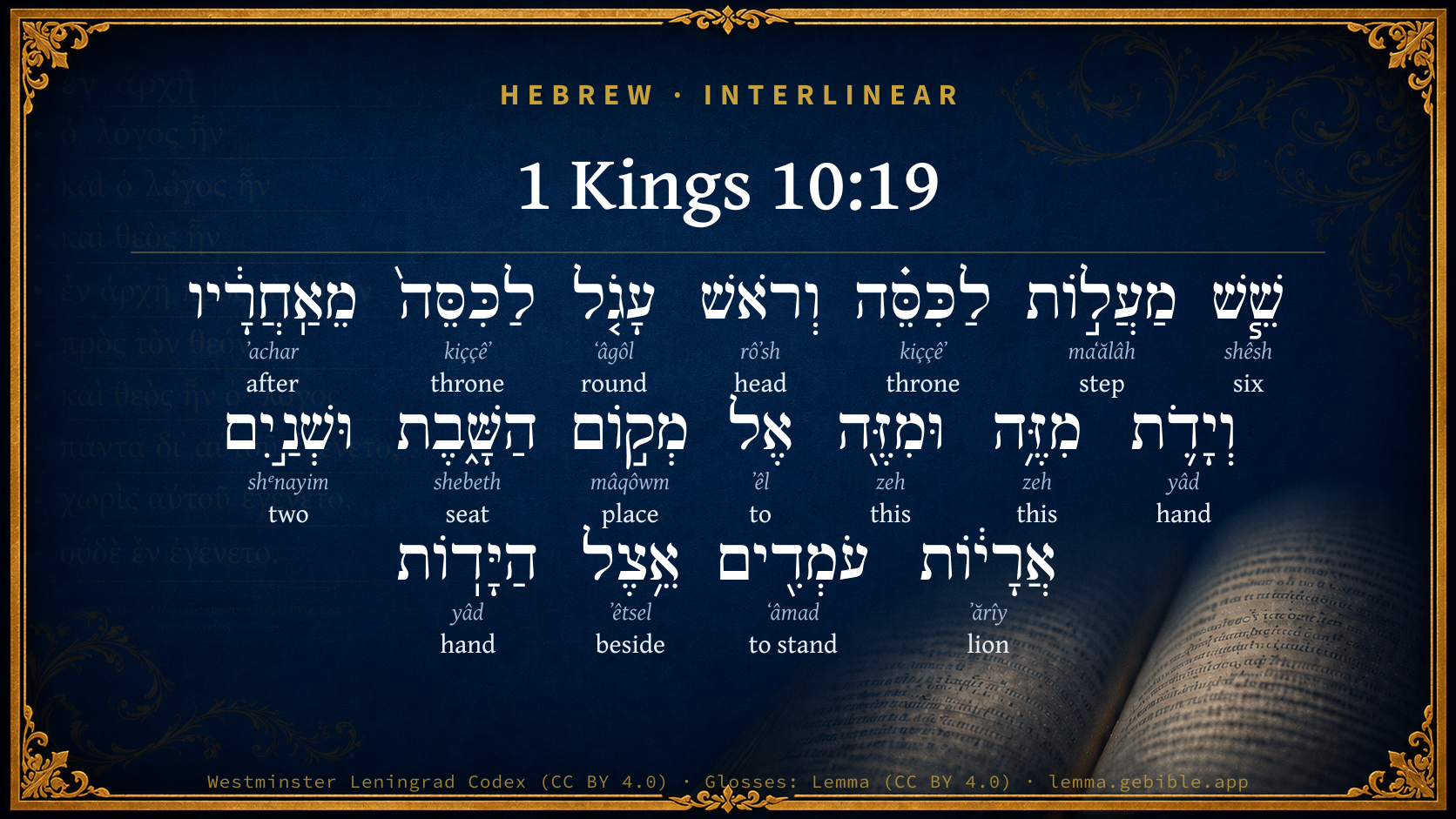
1 Kings 10:19

Hebrew (Westminster Leningrad Codex) 1 Kings 10:19 appears in the Hebrew Old Testament. The text above is from the Westminster Leningrad Codex. Each word links to its Strong’s number, a concise gloss, and parsing drawn from the Open Scriptures Hebrew Bible morphology. Click any word for its full Brown-Driver-Briggs (BDB) entry.
Download image
Cite this verse

1 Kings 10:19 (World English Bible). Public Domain. Lemma interlinear Bible study tool, https://lemma.gebible.app/v/1-kings/10/19.

Show BibTeX & RIS
BibTeX
RIS
English Translation
There were six steps to the throne, and the top of the throne was round behind; and there were stays on either side by the place of the seat, and two lions standing beside the stays.
World English Bible · Public Domain
Download a study sheet

One document with this verse’s original text, its word-by-word gloss line, the meaning frame, cross-references with their text, attributed commentary, and full source and license credits — printable, and it pastes into notes with its structure intact.

This verse Autodidact and up

Study sheet (.html) Plain text (.txt)

A passage Seminary Student

Up to 50 verses in one chapter. A passage sheet keeps up to 6 commentary sources and 12 cross-references per verse, in the order this page ranks them, and says so on the sheet whenever that leaves anything out. Ask for a single verse and you get the Autodidact verse sheet above.

Everything on this page stays free to read, with no account — the sheet is a download of what is already on screen, not access to it.

Want to remove ads? Support Godless Engineer
Compare translations 3

The same verse in 3 English versions, stacked beneath the original-language interlinear above. Click any original word for its lexicon entry.

Each is an independent rendering of the whole verse — the interlinear is not word-aligned to these translations.

Highlighted words mark where these versions differ — a whole-verse word diff, not a word-by-word alignment.

  • World English Bible Public Domain
    There were six steps to the throne, and the top of the throne was round behind; and there were stays on either side by the place of the seat, and two lions standing beside the stays.
  • King James Version Public Domain
    The throne had six steps, and the top of the throne was round behind: and there were stays on either side on the place of the seat, and two lions stood beside the stays.
  • unfoldingWord Literal Text CC BY-SA 4.0
    Six steps to the throne, and a round head to the throne from behind it. And hands from this side and from that side to the place of the seat. And two lions were standing beside the hands.

unfoldingWord Literal Text — © unfoldingWord, licensed CC BY-SA 4.0. Word-aligned USFM3 via Door43 (git.door43.org/unfoldingWord/en_ult).

Versions to compare (up to 4)

3 of 4 selected

Show all 18 translations

Every available English version of this verse, each an independent rendering of the whole verse.

  • World English Bible Public Domain
    There were six steps to the throne, and the top of the throne was round behind; and there were stays on either side by the place of the seat, and two lions standing beside the stays.
  • Berean Standard Bible Public Domain
    The throne had six steps, and its back had a rounded top. There were armrests on both sides of the seat, with a lion standing beside each armrest.
  • Majority Standard Bible Public Domain
    The throne had six steps, and its back had a rounded top. There were armrests on both sides of the seat, with a lion standing beside each armrest.
  • King James Version Public Domain
    The throne had six steps, and the top of the throne was round behind: and there were stays on either side on the place of the seat, and two lions stood beside the stays.
  • American Standard Version (1901) Public Domain
    There were six steps to the throne, and the top of the throne was round behind; and there were stays on either side by the place of the seat, and two lions standing beside the stays.
  • Revised Version (1885) Public Domain
    There were six steps to the throne, and the top of the throne was round behind: and there were stays on either side by the place of the seat, and two lions standing beside the stays.
  • Geneva Bible (1599) Public Domain
    And the throne had six steps, and the top of the throne was round behind, and there were stayes on either side on the place of the throne, and two lions standing by the stayes.
  • Douay-Rheims (1899) Public Domain
    It had six steps: and the top of the throne was round behind: and there were two hands on either side holding the seat: and two lions stood, one at each hand.
  • Young's Literal Translation Public Domain
    six steps hath the throne, and a round top `is' to the throne behind it, and hands `are' on this `side' and on that, unto the place of the sitting, and two lions are standing near the hands,
  • Literal Standard Version CC BY-SA 4.0
    the throne has six steps, and a round top [is] to the throne behind it, and hands [are] on this [side] and on that, to the place of the sitting, and two lions are standing near the hands,
  • Unlocked Literal Bible CC BY-SA 4.0
    There were six steps to the throne, and the back of it had a rounded top. There were armrests on each side of the seat, and two lions standing beside the armrests.
  • unfoldingWord Literal Text CC BY-SA 4.0
    Six steps to the throne, and a round head to the throne from behind it. And hands from this side and from that side to the place of the seat. And two lions were standing beside the hands.
  • Darby Bible Public Domain
    the throne had six steps, and the top of the throne was rounded behind; and there were arms on each side at the place of the seat, and two lions stood beside the arms;
  • World Messianic Bible Public Domain
    There were six steps to the throne, and the top of the throne was round behind; and there were armrests on either side by the place of the seat, and two lions standing beside the armrests.
  • Webster's Bible Public Domain
    The throne had six steps, and the top of the throne was round behind: and there were stays on either side on the place of the seat, and two lions stood beside the stays.
  • Free Bible Version CC BY-SA 4.0
    The throne had six steps, with a rounded top at the back. There were armrests on both sides of the seat, with lions standing beside the armrests.
  • Bible in Basic English Public Domain
    There were six steps going up to it, and the top of it was round at the back, there were arms on the two sides of the seat, and two lions by the side of the arms;
  • JPS Tanakh (1917) Public Domain
    There were six steps to the throne, and the top of the throne was round behind; and there were arms on either side by the place of the seat, and two lions standing beside the arms.

Literal Standard Version (2020), Covenant Press — licensed CC BY-SA 4.0. Text via the HelloAO Bible API (eBible.org). Unlocked Literal Bible (unfoldingWord) — licensed CC BY-SA 4.0. Text via the HelloAO Bible API (eBible.org). unfoldingWord Literal Text — © unfoldingWord, licensed CC BY-SA 4.0. Word-aligned USFM3 via Door43 (git.door43.org/unfoldingWord/en_ult). Free Bible Version, Dr. Jonathan Gallagher — licensed CC BY-SA 4.0. Text via the HelloAO Bible API (eBible.org).

Word by word

More ways to search: Search by grammar → Find every occurrence → Compare this word →

Practice this passage: Drill this verse → Learn its vocabulary →

הַשָּׁ֑בֶת
shebeth
H7675
“the · seat”
Particle, Definite Article + Noun, Common, Feminine, Singular, Absolute
Part of Speech
Particle + Noun
Type
Common
Gender
Feminine
Number
Singular
State
Absolute
Full BDB Definition

Origin: infinitive of H3427

TWOT: 922a

(Qal) seat, dwelling, place
  1. שֵׁ֧שׁ shêsh H8337 “six” Adjective, Cardinal number, Feminine, Singular, Absolute
  2. מַעֲל֣וֹת maʻălâh H4609 “steps” Noun, Common, Feminine, Plural, Absolute
  3. לַכִּסֵּ֗ה kiççêʼ H3678 “to/for the · throne” Preposition, Determined + Noun, Common, Masculine, Singular, Absolute
  4. וְרֹאשׁ rôʼsh H7218 “and · head” Conjunction + Noun, Common, Masculine, Singular, Absolute
  5. עָגֹ֤ל ʻâgôl H5696 “round” Adjective, Adjective, Masculine, Singular, Absolute
  6. לַכִּסֵּה֙ kiççêʼ H3678 “to/for the · throne” Preposition, Determined + Noun, Common, Masculine, Singular, Absolute
  7. מֵאַֽחֲרָ֔יו ʼachar H310 “from · after · him” Preposition + Preposition + Suffix, Personal, 3rd Person, Masculine, Singular
  8. וְיָדֹ֛ת yâd H3027 “and · hands” Conjunction + Noun, Common, Both, Plural, Absolute
  9. מִזֶּ֥ה zeh H2088 “from · this” Preposition + Pronoun, Demonstrative, Masculine, Singular
  10. וּמִזֶּ֖ה zeh H2088 “and · from · this” Conjunction + Preposition + Pronoun, Demonstrative, Masculine, Singular
  11. אֶל ʼêl H413 “to” Preposition
  12. מְק֣וֹם mâqôwm H4725 “place of” Noun, Common, Masculine, Singular, Construct
  13. וּשְׁנַ֣יִם shᵉnayim H8147 “and · two” Conjunction + Adjective, Cardinal number, Masculine, Dual, Absolute
  14. אֲרָי֔וֹת ʼărîy H738 “lions” Noun, Common, Masculine, Plural, Absolute
  15. עֹמְדִ֖ים ʻâmad H5975 “standing” Verb, Qal, Participle Active, Masculine, Plural, Absolute
  16. אֵ֥צֶל ʼêtsel H681 “beside” Preposition
  17. הַיָּדֽוֹת yâd H3027 “the · hands” Particle, Definite Article + Noun, Common, Both, Plural, Absolute

About this verse

These counts appear in no published source. They are computed here, from the morphology-tagged text and Lemma’s own curated glosses. What Lemma adds →

18
words
15
distinct lemmas
Historical
section

Notable vocabulary

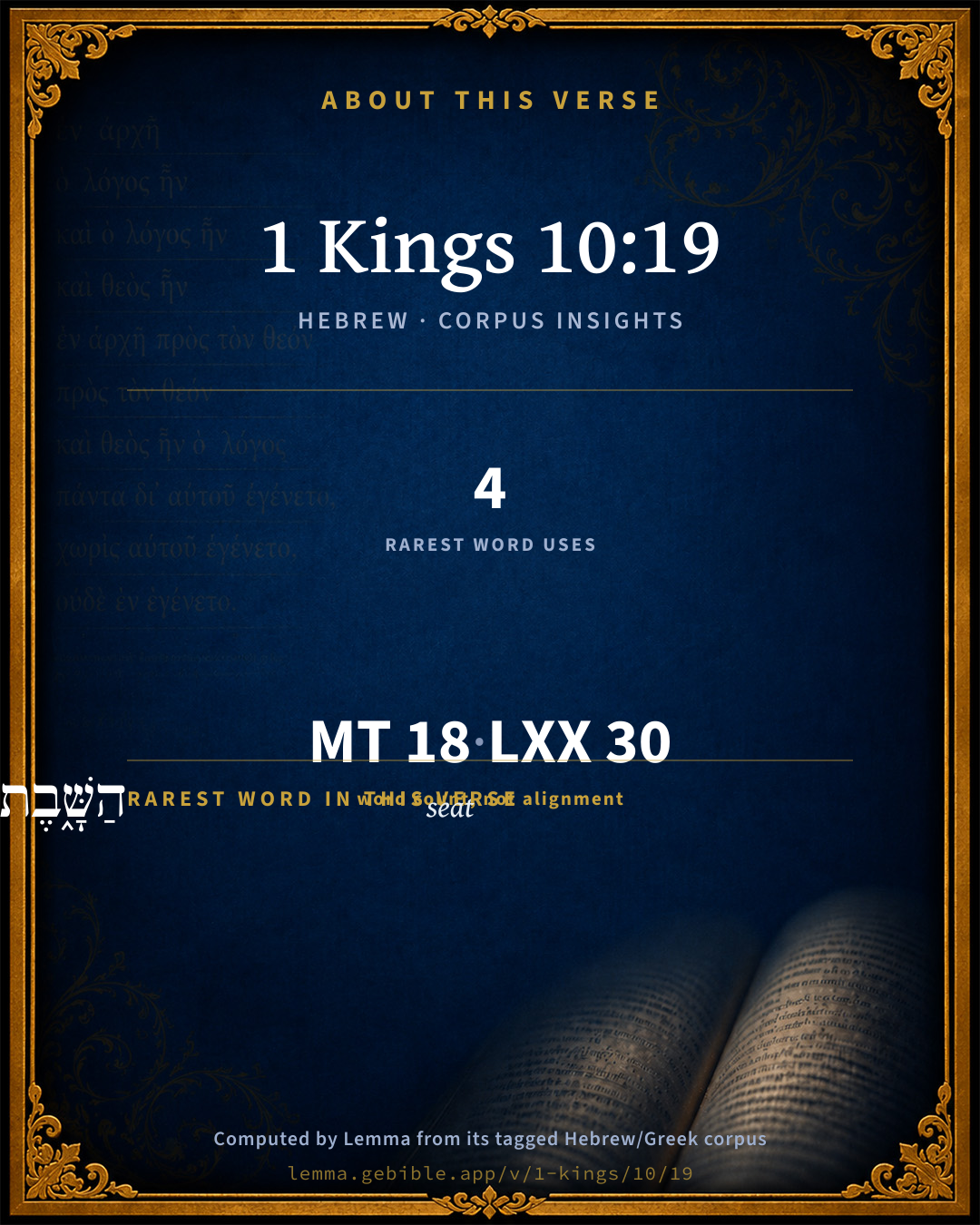
The rarest word here is הַשָּׁ֑בֶת seat H7675 — appearing just 4 times in the whole Hebrew Bible.

Shared distinctive vocabulary

הַשָּׁ֑בֶת seat H7675 occurs in 4 verses of the Hebrew Bible. Also found in:

Grammatical profile

  • 1 verb
  • 9 nouns
  • 3 adjectives
  • 2 pronouns
  • 3 prepositions

Verb forms

  • עֹמְדִ֖ים Qal · Participle Active

Repetition

Words recur within this verse — often emphatic in Hebrew:

  • לַכִּסֵּ֗ה throne H3678 ×2
  • וְיָדֹ֛ת hand H3027 ×2
  • מִזֶּ֥ה this H2088 ×2

Hebrew & Septuagint length

In English translation the verse runs 36 words from the Hebrew and 33 from the Septuagint (LXX English) — closely comparable.

A rough comparison of the two English renderings, which tokenize alike — not a word-level alignment.

Word counts can differ between the Hebrew and the Greek without any difference in meaning — e.g. the Hebrew direct-object marker אֵת has no separate Greek word, and Greek often adds the article ὁ.

In the original languages it is 18 Hebrew tokens and 30 Greek tokens — but the two are counted differently (Hebrew bundles its prefixes and suffixes into one token; the Greek is in lemma form), so that isn’t a like-for-like length.

Hebrew and Greek witnesses Masoretic Hebrew ↔ Greek Septuagint

The same verse in the two great witnesses to the Old Testament, shown verse-for-verse.

These are two independent witnesses, not word-aligned to each other, and the Septuagint is shown in lemma (dictionary) form.

Hebrew 1 Kings 10:19 Masoretic · Westminster Leningrad Codex

שֵׁ֧שׁ מַעֲל֣וֹת לַכִּסֵּ֗ה וְרֹאשׁ עָגֹ֤ל לַכִּסֵּה֙ מֵאַֽחֲרָ֔יו וְיָדֹ֛ת מִזֶּ֥ה וּמִזֶּ֖ה אֶל מְק֣וֹם הַשָּׁ֑בֶת וּשְׁנַ֣יִם אֲרָי֔וֹת עֹמְדִ֖ים אֵ֥צֶל הַיָּדֽוֹת

There were six steps to the throne, and the top of the throne was round behind; and there were stays on either side by the place of the seat, and two lions standing beside the stays.

World English Bible · Public Domain

Greek LXX 1 Kings 10:19 Septuagint · lemma form

ἕξ ἀναβαθμός ὁ θρόνος καί προτομή μόσχος ὁ θρόνος ἐκ ὁ ὀπίσω αὐτός καί χείρ ἔνθεν καί ἔνθεν ἐπί ὁ τόπος ὁ καθέδρα καί δύο λέων ἵστημι παρά ὁ χείρ

The throne had six steps, and calves in bold relief to the throne behind it, and side-pieces on either hand of the place of the seat, and two lions standing by the side-pieces,

LXX2012 (modern English Septuagint) · Public Domain

On this verse, The Cambridge Bible for Schools and Colleges discusses the Septuagint’s reading. Read the note in Commentary ↓

Hebrew: Westminster Leningrad Codex (CC BY 4.0). Greek: Septuagint (public domain); English from LXX2012 (modern English Septuagint) (Public Domain). How the Septuagint differs from the Hebrew →

Targum (Aramaic paraphrase)

1

The Targum is the ancient Jewish Aramaic paraphrase of the Hebrew Scriptures — an interpretive translation, not the Hebrew text itself. Onkelos (literal) and Pseudo-Jonathan (expansive) render the Torah, and Jonathan the Prophets. Coverage is partial: where no permissively-licensed English translation exists for a verse, only the Aramaic is shown. This is verse-level text, not a word-by-word alignment to the Hebrew.

  1. Targum Jonathan Prophets (Joshua–Malachi)
    שִׁיתָּא דַרְגִין לְכוּרְסַיָא וְרֵישׁ סְגַלְגַל לְכוּרְסַיָא מֵאַחֲרוֹהִי וְאַשְׁדָתָא מִכָּא וּמִכָּא עַל אֲתַר מוֹתָבָא וּתְרֵין אַרְיְוָן קַיְמִין בִּסְטַר אַשְׁדָתָא:

    (no public-domain English translation for this verse)

    Targum Jonathan — Aramaic: “Mikraot Gedolot” (public domain). English: “Sefaria Community Translation” (CC0 1.0 (public-domain dedication)); “London "Chaldee Paraphrase," 1871” (public domain). Text via Sefaria.

Commentary

Notes on 1 Kings 10:19 from classic Christian and Jewish commentators (each source and its license shown beneath its notes). The classic Christian expositions comment on the surrounding passage and are grouped to its opening verse, so a note may address several verses; the Jewish commentaries on the Tanakh (Rashi and others) are per-verse, so they appear only where the commentator wrote on this verse.

Lemma curates 59 commentaries, every one of them public domain or Creative Commons licensed, each selected and text-cleaned for this edition rather than reprinted as found. About our sources →

Trapp's Complete Commentary

John Trapp

1Ki 10:19 The throne had six steps, and the top of the throne [was] round behind: and [there were] stays on either side on the place of the seat, and two lions stood beside the stays.

Ver. 19. The throne had six steps.] Whereby when the king ascended to his throne, he was imminded both of his dignity and duty; since Sedes prima et vita ima, would be incongruous and reproachful.

And the top of the throne, &c.] The canopy encircled the king’s head, for his greater ease and state, and to note God’s protection.

And there were stays.] Heb., Hands, to rest his arms on.

And two lions stood beside the stays.] To show that his throne should not easily be overturned.

John Trapp, A Commentary or Exposition upon All the Books of the Old and New Testament (1647–1656) — public domain. Text from a community e-Sword module.

Geneva Bible (1599)

Geneva Bible translators

As the chair bows, or places to lean upon.

Geneva Bible (1599) marginal notes — public domain. Text via Bolls.life.

Adam Clarke's Commentary

Verse 19. The throne was round behind: and there were stays on either side] This description seems to indicate that the throne was in the form of one of our ancient round-topped, two-armed chairs. This throne or chair of state was raised on a platform, the ascent to which consisted of six steps. What we call stays is in the Hebrew ידת yadoth, hands, which serves to confirm the conjecture above.

Adam Clarke's Commentary on the Bible (1810–1826) — public domain. Text from a community e-Sword/MySword module.

The Cambridge Bible for Schools and Colleges

gen. ed. J. J. S. Perowne

19. And the top of the throne was round behind] The word ‘top’ is literally ‘head,’ and points to some erection in the nature of a canopy or baldachino. The roundness here spoken of might either be from the sides of the back being curved inward as they rose up, or from the canopy being arched from behind. This portion of the description is omitted in 2Ch_9:18, but there is added, what we have not here, that ‘a footstool of gold’ was joined to the throne. Josephus omits all mention of the throne, and the LXX. has προτομαὶ μόσχων, i.e. ‘heads (projections) of calves,’ having taken צָנוֹל = ‘round’ as if it were עֵנֶל ‘a calf.’

The Cambridge Bible for Schools and Colleges (gen. ed. J. J. S. Perowne; Cambridge University Press, 1878–1918) — public domain. Text from a community e-Sword module.

John Gill's Exposition

The throne had six steps,.... Up to the footstool of the throne, which was of gold, Ch2 9:18 and was high, that everyone in court might see him, and the better hear the sentence he gave:

and the top of the throne was round behind; had a semicircle at the top of it, like an alcove:

and there were stays on either side on the place of the seat; or "hands" (q), such as the arms of a chair, to lean and rest upon:

and two lions stood beside the stays; which were not only ornamental, and for support of the stays, but expressive of majesty, and of undaunted courage and resolution to do justice, and of the danger such expose themselves to, who oppose magistrates in the discharge of their office; and in which Solomon was a type of Christ, the lion of the tribe of Judah; and for the same reasons were the like portraits on the steps, as follows.

(q) "manus", V. L. Montanus, &c. "brachiola", Sept. in 2 Chron. ix. 18.

John Gill's Exposition of the Whole Bible (1746–1763) — public domain (CC PDM 1.0). Text via the HelloAO Bible API.

Albert Barnes' Notes on the Bible

Representations of thrones are frequent in the Egyptian and Assyrian sculptures. They have no steps up to them, but frequently stand upon square bases. The back appears to be flat at the top, not rounded. Assyrian thrones have “stays” or arms on either side, and they stand generally upon lion’s feet. They are always accompanied by a footstool.

Lions stood beside the stays - The arms of Assyrian thrones are occasionally supported by figures of animals. The throne of Rameses II at Medinet Abou has a sphinx at the side and a lion below the sphinx. The figure of the lion is naturally adopted by any imaginative race as an emblem of sovereignty. In the present case its adoption seems to have grown directly out of the poetic imagery of inspired prophets, who, living before the time of Solomon, had compared Israel Num 23:24; Num 24:9, and more particularly Judah Gen 49:9, to a lion. The “twelve lions” of 1Ki 10:20 were probably intended to be emblematic of the twelve tribes. Josephus adds to the description of Solomon’s throne here given, that the seat was supported by a golden ox or bull, with its head turned over its shoulder. As the lion was especially emblematic of Judah, so was the ox or bull of Ephraim. (Hos 4:16; Hos 10:11; Jer 31:18, etc.)

Albert Barnes' Notes on the Bible (1834–1885) — public domain. Text from a community e-Sword/MySword module.

Haydock's Catholic Bible Commentary

Behind, like an alcove, (Haydock) placed in the porch of the palace, chap. vii. 8. --- Hands, for the elbows to rest on. In Paralipomenon, St. Jerome translates, "little" arms. The feet might also be made in this shape. Josephus ([Antiquities?] viii. 5.) represents them as forming the seat: (Calmet) and the Septuagint place them on each side: "the fore-parts of oxen, projecting from the back of the throne, and hands on the throne, on each side of the seat." In Paralipomenon also, we find a foot-stool of gold. (Haydock)

George Leo Haydock (1774–1849), Haydock's Catholic Family Bible and Commentary, 1859 edition — public domain. Excludes Psalms (Douay-Rheims chapter numbering differs from Protestant) and Deuterocanonical books (Catholic canon only).

Matthew Poole's English Annotations

Round behind; made like the half of a circle.

Two lions: these and the following lions seem added, to express either the tribe from which Solomon sprung, compared to a lion, Gen 49:9; or rather, that majesty and power wherewith a prince is adorned and armed, which his subjects cannot resist; or the duty of a prince in the execution of judgment, which ought to be done with great courage and magnanimity.

Matthew Poole's English Annotations on the Holy Bible (1683–1685) — public domain. Text from a community e-Sword/MySword module.

Whedon's Commentary on the Bible

Daniel D. Whedon

19. Top of the throne was round behind — That is, it had a curved, or rounded back.

Stays — The arms, as those of an easy chair, on which the king, when seated, might rest his hands or arms. This throne, with all its imposing surroundings, was set in the porch described at 1Ki_7:7.

Daniel D. Whedon (gen. ed.), Commentary on the Old and New Testaments (1874–1909) — public domain. Text from a community e-Sword module.

The Pulpit Commentary

The throne had six steps "The characteristic feature in the royal throne was its elevation" (Dict. Bib. ill. p. 1493); cf., Isa_6:1 and the top Heb. head of the throne was round behind same word ch. 7:23, 24. Thenius and Bahr understand it of an arched or rounded canopy attached to the back; Keil supposes that the back was arched or rounded in form: and there were stays Heb. hands, i.e., arms on either side on the place of the seat see drawing of Assyrian throne in Layard"s "Nineveh," 2:301; Dict. Bib. 52. p. 1494, and two liens probably of wood overlaid with gold. Cf. Jer_10:3, 4 stood beside the stays.

The Pulpit Commentary (1880–1919), ed. H.D.M. Spence-Jones & Joseph S. Exell — public domain. Text from a community e-Sword module.

John Wesley's Explanatory Notes

Round - Made like the half of a circle.

John Wesley, Explanatory Notes Upon the Whole Bible (1754–1765) — public domain. Text via the GEBible commentary corpus.

Rashi

Rabbi Shlomo Yitzchaki (Rashi)

Six steps. Steps by which to go up [to it], and the top of the throne, was circular, where the king sits.

From behind. The throne was wide, and the steps were to the front and to the width, to the back was the seat, higher than the throne, was a round place.

And there were arm-rests on each side. On which to support his arms, like two gold rails from end to end, extending on the right and on the left.

There were two lions. Of gold. The entire plan of the throne is described in the Aggadah of Megillas Esther.

Rashi on the Tanakh — English translations: “The Judaica Press complete Tanach with Rashi, translated by A. J. Rosenberg” (CC BY 4.0); “Pentateuch with Rashi's commentary by M. Rosenbaum and A.M. Silbermann, 1929-1934” (public domain); “The Metsudah Tanach series, Lakewood, N.J” (CC BY 4.0); and “The Book of Joshua, Metsudah Publications, 1997” (CC BY 4.0). Text via Sefaria.

Lesson kit

Teaching starters — assembled from the data on this page, not authored interpretation. Every prompt links to the verse data it draws on. Edit before teaching.

1 Kings, in the Historical, opens this verse with 18 words (15 distinct Hebrew lemmas). Its most distinctive word is shebeth (“seat”). A historical commentator’s framing appears above. Read the whole chapter for the surrounding context.

Discussion questions

  1. How does “seat” (shebeth) shape what this verse is saying?
  2. 2 Samuel 23:7 shares the word «seat» with this verse. How do the two illuminate each other?
  3. “throne” occurs 2× in this one verse. What is the effect of the repetition?
  4. These translations render this verse differently. What is at stake in choosing one wording over another?
  5. The verb «עֹמְדִ֖ים» is Qal Participle Active. How does its form color the action?
  6. Reading how Trapp's Complete Commentary and Geneva Bible (1599) read this verse, where do the two commentators agree and where do they part?

Things to notice

Reading settings

Reading text

Shown beneath each verse's original-language words.

Old Testament
Old Testament edition

Read the OT as the Masoretic Hebrew (MT) or the Greek Septuagint (LXX).

English shown for the Greek Septuagint (in the Hebrew ↔ Greek comparison).

Comparing translations? Open the Compare panel on any verse page to stack up to four side by side.