Exodus 26:17

Hebrew (Westminster Leningrad Codex) Exodus 26:17 appears in the Hebrew Old Testament. The text above is from the Westminster Leningrad Codex. Each word links to its Strong’s number, a concise gloss, and parsing drawn from the Open Scriptures Hebrew Bible morphology. Click any word for its full Brown-Driver-Briggs (BDB) entry.
Download image
Cite this verse

Exodus 26:17 (World English Bible). Public Domain. Lemma interlinear Bible study tool, https://lemma.gebible.app/v/exodus/26/17.

Show BibTeX & RIS
BibTeX
RIS
English Translation
There shall be two tenons in each board, joined to one another: thus shall you make for all the boards of the tent.
World English Bible · Public Domain
Highlights
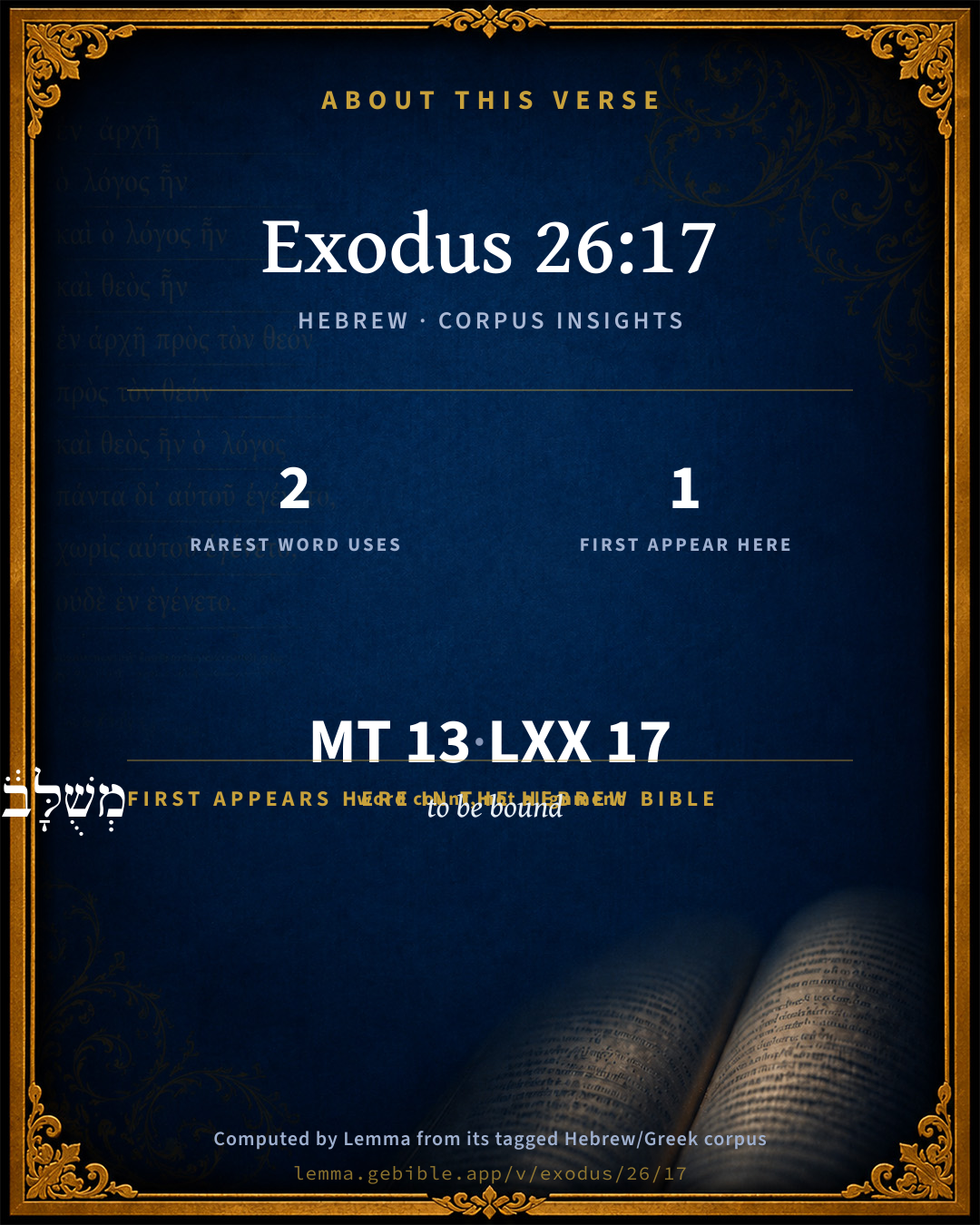
  • 1 first appearance in the Hebrew Bible
Full analysis ↓
Download a study sheet

One document with this verse’s original text, its word-by-word gloss line, the meaning frame, cross-references with their text, attributed commentary, and full source and license credits — printable, and it pastes into notes with its structure intact.

This verse Autodidact and up

Study sheet (.html) Plain text (.txt)

A passage Seminary Student

Up to 50 verses in one chapter. A passage sheet keeps up to 6 commentary sources and 12 cross-references per verse, in the order this page ranks them, and says so on the sheet whenever that leaves anything out. Ask for a single verse and you get the Autodidact verse sheet above.

Everything on this page stays free to read, with no account — the sheet is a download of what is already on screen, not access to it.

Want to remove ads? Support Godless Engineer
Compare translations 3

The same verse in 3 English versions, stacked beneath the original-language interlinear above. Click any original word for its lexicon entry.

Each is an independent rendering of the whole verse — the interlinear is not word-aligned to these translations.

Highlighted words mark where these versions differ — a whole-verse word diff, not a word-by-word alignment.

  • World English Bible Public Domain
    There shall be two tenons in each board, joined to one another: thus shall you make for all the boards of the tent.
  • King James Version Public Domain
    Two tenons shall there be in one board, set in order one against another: thus shalt thou make for all the boards of the tabernacle.
  • unfoldingWord Literal Text CC BY-SA 4.0
    There shall be two tenons in each frame for joining a woman to her sister. Thus you shall make all of the frames of the Dwelling.

unfoldingWord Literal Text — © unfoldingWord, licensed CC BY-SA 4.0. Word-aligned USFM3 via Door43 (git.door43.org/unfoldingWord/en_ult).

Versions to compare (up to 4)

3 of 4 selected

Show all 18 translations

Every available English version of this verse, each an independent rendering of the whole verse.

  • World English Bible Public Domain
    There shall be two tenons in each board, joined to one another: thus shall you make for all the boards of the tent.
  • Berean Standard Bible Public Domain
    Two tenons must be connected to each other for each frame. Make all the frames of the tabernacle in this way.
  • Majority Standard Bible Public Domain
    Two tenons must be connected to each other for each frame. Make all the frames of the tabernacle in this way.
  • King James Version Public Domain
    Two tenons shall there be in one board, set in order one against another: thus shalt thou make for all the boards of the tabernacle.
  • American Standard Version (1901) Public Domain
    Two tenons shall there be in each board, joined one to another: thus shalt thou make for all the boards of the tabernacle.
  • Revised Version (1885) Public Domain
    Two tenons shall there be in each board, joined one to another: thus shalt thou make for all the boards of the tabernacle.
  • Geneva Bible (1599) Public Domain
    Two tenons shalbe in one boarde set in order as the feete of a ladder, one against an other: thus shalt thou make for all the boardes of the Tabernacle.
  • Douay-Rheims (1899) Public Domain
    In the sides of the boards shall be made two mortises, whereby one board may be joined to another board: and after this manner shall all the boards be prepared.
  • Young's Literal Translation Public Domain
    two handles `are' to the one board, joined one unto another; so thou dost make for all the boards of the tabernacle;
  • Literal Standard Version CC BY-SA 4.0
    two handles [are] to one board, joined to one another; so you make for all the boards of the Dwelling Place;
  • Unlocked Literal Bible CC BY-SA 4.0
    There must be two wooden pegs in each frame for joining the frames to each other. You are to make all the tabernacle's frames in this way.
  • unfoldingWord Literal Text CC BY-SA 4.0
    There shall be two tenons in each frame for joining a woman to her sister. Thus you shall make all of the frames of the Dwelling.
  • Darby Bible Public Domain
    One board shall have two tenons, connected one with the other: thus shalt thou make for all the boards of the tabernacle.
  • World Messianic Bible Public Domain
    There shall be two tenons in each board, joined to one another: thus you shall make for all the boards of the tabernacle.
  • Webster's Bible Public Domain
    Two tenons shall there be in one board, set in order one against another: thus shalt thou make for all the boards of the tabernacle.
  • Free Bible Version CC BY-SA 4.0
    Each frame will have two pegs so the frames can be connected to each other. Make all the frames of the Tabernacle like this.
  • Bible in Basic English Public Domain
    Every board is to be joined to the one nearest to it by two tongues, and so for every board in the House.
  • JPS Tanakh (1917) Public Domain
    Two tenons shall there be in each board, joined one to another; thus shalt thou make for all the boards of the tabernacle.

Literal Standard Version (2020), Covenant Press — licensed CC BY-SA 4.0. Text via the HelloAO Bible API (eBible.org). Unlocked Literal Bible (unfoldingWord) — licensed CC BY-SA 4.0. Text via the HelloAO Bible API (eBible.org). unfoldingWord Literal Text — © unfoldingWord, licensed CC BY-SA 4.0. Word-aligned USFM3 via Door43 (git.door43.org/unfoldingWord/en_ult). Free Bible Version, Dr. Jonathan Gallagher — licensed CC BY-SA 4.0. Text via the HelloAO Bible API (eBible.org).

Word by word

More ways to search: Search by grammar → Find every occurrence → Compare this word →

Practice this passage: Drill this verse → Learn its vocabulary →

מְשֻׁלָּבֹ֔ת
shâlab
H7947
“bound”
Verb, Pual, Participle Passive, Feminine, Plural, Absolute
Part of Speech
Verb
Stem
Pual
Form
Participle Passive
Gender
Feminine
Number
Plural
State
Absolute
Full BDB Definition

Origin: a primitive root

TWOT: 2390

(Pual) to be bound, be joined, be joined together
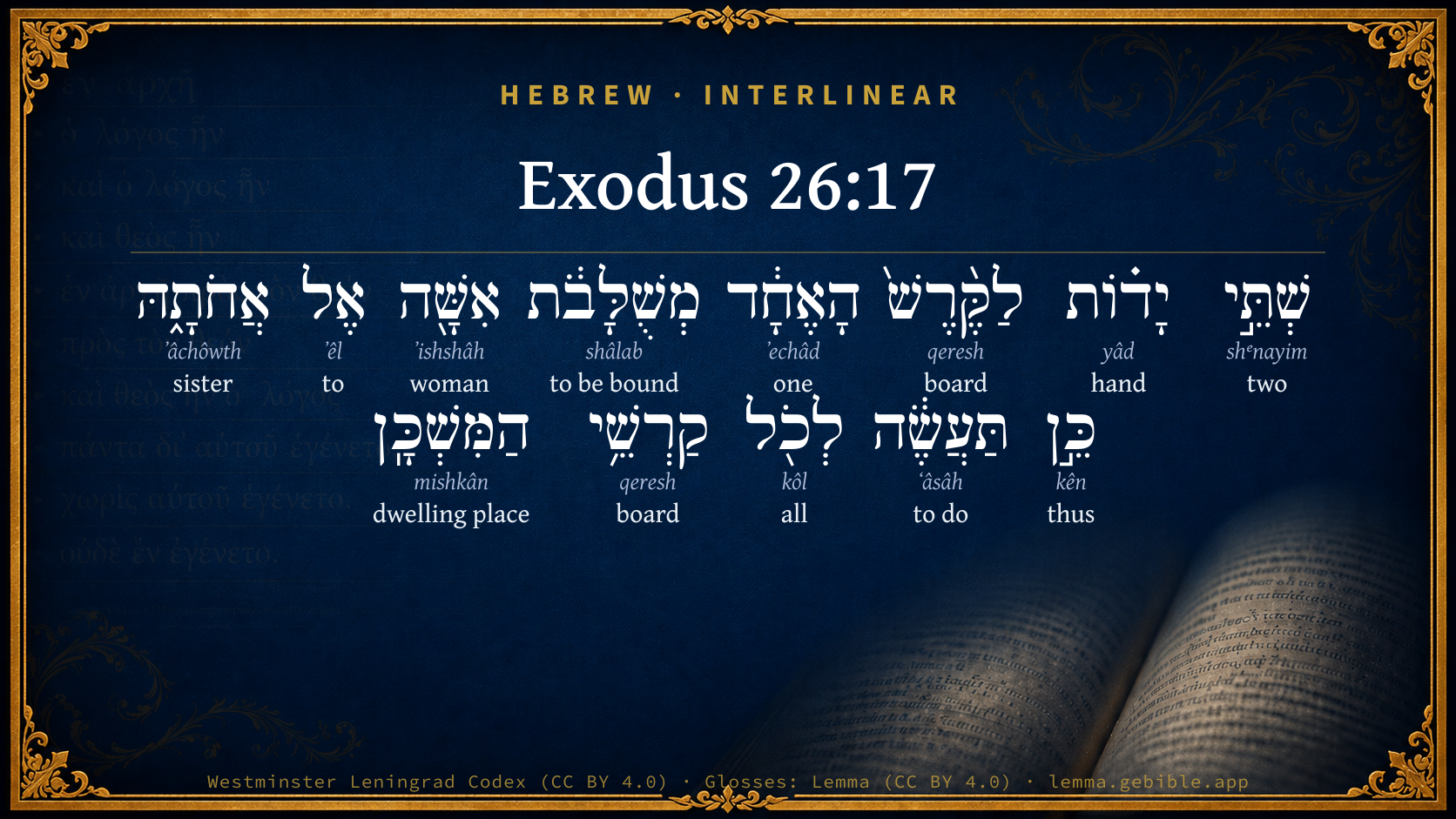
  1. שְׁתֵּ֣י shᵉnayim H8147 “two” Adjective, Cardinal number, Feminine, Dual, Construct
  2. יָד֗וֹת yâd H3027 “hands” Noun, Common, Both, Plural, Absolute
  3. לַקֶּ֨רֶשׁ֙ qeresh H7175 “to/for the · board” Preposition, Determined + Noun, Common, Masculine, Singular, Absolute
  4. הָאֶחָ֔ד ʼechâd H259 “the · one” Particle, Definite Article + Adjective, Cardinal number, Masculine, Singular, Absolute
  5. אִשָּׁ֖ה ʼishshâh H802 “woman” Noun, Common, Feminine, Singular, Absolute
  6. אֶל ʼêl H413 “to” Preposition
  7. אֲחֹתָ֑הּ ʼâchôwth H269 “sister · her” Noun, Common, Feminine, Singular, Construct + Suffix, Personal, 3rd Person, Feminine, Singular
  8. כֵּ֣ן kên H3651 “thus” Particle, Demonstrative
  9. תַּעֲשֶׂ֔ה ʻâsâh H6213 “to do” Verb, Qal, Imperfect, 2nd Person, Masculine, Singular
  10. לְכֹ֖ל kôl H3605 “to/for · all of” Preposition + Noun, Common, Masculine, Singular, Construct
  11. קַרְשֵׁ֥י qeresh H7175 “boards of” Noun, Common, Masculine, Plural, Construct
  12. הַמִּשְׁכָּֽן mishkân H4908 “the · dwelling place” Particle, Definite Article + Noun, Common, Masculine, Singular, Absolute

About this verse

These counts appear in no published source. They are computed here, from the morphology-tagged text and Lemma’s own curated glosses. What Lemma adds →

13
words
12
distinct lemmas
Pentateuch
section

Notable vocabulary

The rarest word here is מְשֻׁלָּבֹ֔ת to be bound H7947 — appearing just 2 times in the whole Hebrew Bible.

First appearance in Scripture

This word makes its first canonical appearance in the Hebrew Bible here:

  • מְשֻׁלָּבֹ֔ת to be bound H7947

Shared distinctive vocabulary

מְשֻׁלָּבֹ֔ת to be bound H7947 occurs in 2 verses of the Hebrew Bible. Also found in:

Grammatical profile

  • 2 verbs
  • 7 nouns
  • 2 adjectives
  • 1 preposition
  • 1 particle

Verb forms

  • מְשֻׁלָּבֹ֔ת Pual · Participle Passive
  • תַּעֲשֶׂ֔ה Qal · Imperfect

Repetition

A word recurs within this verse — often emphatic in Hebrew:

  • לַקֶּ֨רֶשׁ֙ board H7175 ×2

Hebrew & Septuagint length

In English translation the verse runs 23 words from the Hebrew and 25 from the Septuagint (LXX English) — closely comparable.

A rough comparison of the two English renderings, which tokenize alike — not a word-level alignment.

Word counts can differ between the Hebrew and the Greek without any difference in meaning — e.g. the Hebrew direct-object marker אֵת has no separate Greek word, and Greek often adds the article ὁ.

In the original languages it is 13 Hebrew tokens and 17 Greek tokens — but the two are counted differently (Hebrew bundles its prefixes and suffixes into one token; the Greek is in lemma form), so that isn’t a like-for-like length.

Cross-references

3

Topical passages linked to Exodus 26:17 in the Treasury of Scripture Knowledge — connected by theme and wording, ordered by reader-vote popularity; previews shown in the World English Bible.

  • Exodus 26:19 You shall make forty sockets of silver under the twenty boards; two sockets under one board for its two tenons, and two sockets under another board for its two tenons.
  • Exodus 36:22 Each board had two tenons, joined one to another. He made all the boards of the tent this way.
  • Exodus 36:24 He made forty sockets of silver under the twenty boards; two sockets under one board for its two tenons, and two sockets under another board for its two tenons.

Cross-references courtesy of OpenBible.info (CC BY 4.0).

Hebrew and Greek witnesses Masoretic Hebrew ↔ Greek Septuagint

The same verse in the two great witnesses to the Old Testament, shown verse-for-verse.

These are two independent witnesses, not word-aligned to each other, and the Septuagint is shown in lemma (dictionary) form.

Hebrew Exodus 26:17 Masoretic · Westminster Leningrad Codex

שְׁתֵּ֣י יָד֗וֹת לַקֶּ֨רֶשׁ֙ הָאֶחָ֔ד מְשֻׁלָּבֹ֔ת אִשָּׁ֖ה אֶל אֲחֹתָ֑הּ כֵּ֣ן תַּעֲשֶׂ֔ה לְכֹ֖ל קַרְשֵׁ֥י הַמִּשְׁכָּֽן

There shall be two tenons in each board, joined to one another: thus shall you make for all the boards of the tent.

World English Bible · Public Domain

Greek LXX Exodus 26:17 Septuagint · lemma form

δύο ἀγκωνίσκος ὁ στῦλος ὁ εἷς ἀντιπίπτω ἕτερος ὁ ἕτερος οὕτως ποιέω πᾶς ὁ στῦλος ὁ σκηνή

Two joints shall you make in one post, answering the one to the other: so shall you do to all the posts of the tabernacle.

LXX2012 (modern English Septuagint) · Public Domain

Hebrew: Westminster Leningrad Codex (CC BY 4.0). Greek: Septuagint (public domain); English from LXX2012 (modern English Septuagint) (Public Domain). How the Septuagint differs from the Hebrew →

Targum (Aramaic paraphrase)

2

The Targum is the ancient Jewish Aramaic paraphrase of the Hebrew Scriptures — an interpretive translation, not the Hebrew text itself. Onkelos (literal) and Pseudo-Jonathan (expansive) render the Torah, and Jonathan the Prophets. Coverage is partial: where no permissively-licensed English translation exists for a verse, only the Aramaic is shown. This is verse-level text, not a word-by-word alignment to the Hebrew.

  1. Targum Onkelos Torah (Genesis–Deuteronomy)
    תַּרְתֵּין צִירִין לְדַפָּא חַד מְשַׁלְבִין חֲדָא לָקֳבֵל חֲדָא כֵּן תַּעְבֵּד לְכֹל דַפֵּי מַשְׁכְּנָא:

    (no public-domain English translation for this verse)

    Targum Onkelos — Aramaic: “Onkelos Genesis” (public domain); “Onkelos Exodus” (public domain); “Onkelos Leviticus” (public domain); “Onkelos Numbers” (public domain); “Onkelos Deuteronomy” (public domain). English: “Sefaria Community Translation” (CC0 1.0 (public-domain dedication)); “J.W. Etheridge. The Targums of Onkelos and Jonathan Ben Uzziel on the Pentateuch. London: Longmans, Green, 1862” (public domain). Text via Sefaria.

  2. Targum Pseudo-Jonathan Torah (Genesis–Deuteronomy)
    תַּרְתֵּין צִירִין לְלוּחָא חָד מְכַוְונִין צְטַר חָד בְּגוֹ חַד הֵיכְדֵין תַּעֲבֵיד לְכָל לוּחֵי מַשְׁכְּנָא

    Two tenons to one board, each in its side answering to the other: so shalt thou do for all the boards of the tabernacle.

    Targum Pseudo-Jonathan — Aramaic: “Targum Jonathan on Genesis” (public domain); “Targum Jonathan on Exodus” (public domain); “Targum Jonathan on Leviticus” (public domain); “Targum Jonathan on Numbers” (public domain); “Targum Jonathan on Deuteronomy” (public domain). English: “The Targum of Jonathan ben Uzziel, trans. J. W. Etheridge, London, 1862” (public domain). Text via Sefaria.

Commentary

Notes on Exodus 26:17 from classic Christian and Jewish commentators (each source and its license shown beneath its notes). The classic Christian expositions comment on the surrounding passage and are grouped to its opening verse, so a note may address several verses; the Jewish commentaries on the Tanakh (Rashi and others) are per-verse, so they appear only where the commentator wrote on this verse.

Lemma curates 59 commentaries, every one of them public domain or Creative Commons licensed, each selected and text-cleaned for this edition rather than reprinted as found. About our sources →

Ellicott's Commentary for English Readers

(17) Two tenons.—By “tenons” here are meant projections, probably round, from the end of each plank, made to fit into holes prepared for them in the “sockets.” They were to be “set in order one against another”: i.e., placed regularly at certain intervals, so that each corresponded in position to its fellow.

A Bible Commentary for English Readers, edited by Charles John Ellicott (1878–1897) — public domain. Text from a community e-Sword module.

The Cambridge Bible for Schools and Colleges

gen. ed. J. J. S. Perowne

17. tenons] lit. hands, used fig. of supports: cf. 1Ki_7:32-33 (EVV. axletrees; rather, diagonal stays under the body of the laver, holding the axles in their places), 35 (supports of the basin at the top), 36 (corrupt dittography from v. 35: see Skinner’s note in the Century Bible), Exo_10:16 (of the ‘arms’ of a throne). These ‘hands,’ or tenons, as ordinarily understood, were pegs projecting underneath the bottom of the boards, to hold them firm in their sockets (v. 19).

joined] the word (only here and in the ||, Exo_36:22) means joined by a cross-piece (cf. the cognate shĕlabbim, 1Ki_7:28-29†, ‘cross-pieces,’ or ‘cross-rails’ [see Skinner’s note: in EVV. misrendered ledges], and the post-Bibl. shĕlîbâh, the ‘rung’ of a ladder), clamped together. The tenons of each board (or frame) were secured in their places by a clamp of metal underneath the bottom of the board.

Kennedy, however (p. 660a), understands the ‘hands’ not of tenons, but of the upright sides of the ‘frame’ themselves, and would render vv. 15–17 thus: ‘And thou shalt make the frames for the Dwelling of acacia wood, standing up,—10 cubits the length of a frame, and 1½ cubits the breadth of a frame,—namely, two uprights for [so rightly, for EVV. in] each frame, joined one to another by cross-rails [see the illustr.]: thus shalt thou make for all the frames of the Dwelling.’ The translation is quite legitimate (for there is in the Heb. no ‘shall be’ in either v. 16 or v. 17), and the explanation clever: but it is difficult to feel certain that such ‘uprights’ would be called hands in Heb. The sense ‘frames’ for ḳĕrâshim is not dependent upon it; and it is perhaps safer to adhere to the usual rend, ‘tenons.’

The Cambridge Bible for Schools and Colleges (gen. ed. J. J. S. Perowne; Cambridge University Press, 1878–1918) — public domain. Text from a community e-Sword module.

John Gill's Exposition

And thou shalt make the boards for the tabernacle,.... As in the manner before described, so in number as follows:

twenty boards on the south side southward; which being a cubit and a half broad, made the length of the tabernacle fifteen yards according to the common account; but if these were cubits of twenty one inches, then its length was much greater.

John Gill's Exposition of the Whole Bible (1746–1763) — public domain (CC PDM 1.0). Text via the HelloAO Bible API.

Haydock's Catholic Bible Commentary

Mortises, (incastraturæ). Hebrew, "tenons," which corresponded with the former. (Calmet)

George Leo Haydock (1774–1849), Haydock's Catholic Family Bible and Commentary, 1859 edition — public domain. Excludes Psalms (Douay-Rheims chapter numbering differs from Protestant) and Deuterocanonical books (Catholic canon only).

Matthew Poole's English Annotations

Two tenons, Heb. hands, i.e. parts of the boards, so cut and framed that like hands they may take hold of and be fastened into the sockets, Exo 26:19.

Matthew Poole's English Annotations on the Holy Bible (1683–1685) — public domain. Text from a community e-Sword/MySword module.

Whedon's Commentary on the Bible

Daniel D. Whedon

17. Two tenons — Small projections from the bottom of each board to set in the sockets mentioned in Exo_26:19.

Daniel D. Whedon (gen. ed.), Commentary on the Old and New Testaments (1874–1909) — public domain. Text from a community e-Sword module.

The Pulpit Commentary

Two tenons. Literally, "hands." Projecting rods, such as those common in our dinner tables, seem to be meant. They may have been of metal, let into the boards to a certain depth, and projecting several inches beyond them. Or, possibly, they may have been of acacia wood. In one boardi.e. "In each board no doubt, at the bottom of each. Set in order one against the other. Arranged, i.e. , at regular intervals, the position of each corresponding to the position of its fellow.

The Pulpit Commentary (1880–1919), ed. H.D.M. Spence-Jones & Joseph S. Exell — public domain. Text from a community e-Sword module.

Keil & Delitzsch

C. F. Keil & F. Delitzsch

Every board was to have two ידות (lit., hands or holders) to hold them upright, pegs therefore; and they were to be "bound to one another" (משׁלּב, from שׁלב in Chald. to connect, hence שׁלבּים in Kg1 7:28, the corner plates that hold together the four sides of a chest), not "pegged into one another," but joined together by a fastening dovetailed into the pegs, by which the latter were fastened still more firmly to the boards, and therefore had greater holding power than if each one had been simply sunk into the edge of the board.

Keil & Delitzsch — Biblical Commentary on the Old Testament (1861–1891) — public domain (CC PDM 1.0). Text via the HelloAO Bible API. (Old Testament only.)

Rashi

Rabbi Shlomo Yitzchaki (Rashi)

שתי ידות לקרש האחד TWO TENONS THERE SHALL BE IN ONE BOARD — They cut out the lower part of the boards in the middle to a height of one cubit leaving one fourth of its width on the one side and one fourth of it on the other side. These pieces on each side of the boards were the ידות, the tenons. Thus the part cut out was one half of the breadth of the board (¾ cubit) in its centre. Now these tenons they fixed into the sockets which were made hollow. The sockets were one cubit in height and they lay in a line forty of them, one close against the other. The tenons of the boards that were fixed into the sockets were then cut away on three sides, the depth of the portions thus cut away being equal to the thickness of the rim of the sockets, so that when the boards were fixed in the sockets the wood of the board would cover the entire top of the socket. For if this were not so (if the tenons were not cut away on their outside edge) there would have been a space between one board and the next equal to the thickness of the rims of two sockets which would have separated them. That is what is meant when it says, (v. 24) “and they shall be coupled together beneath” — that they should cut away the sides of the tenons in order that the boards should join closely one to the other.

משלבת means made like the rungs (שליבה) of a ladder and separated from each other and planed at their ends in order that they could be inserted into the hollow of the sockets like a rung which is fixed in the hole in the ladder’s uprights.

אשה אל אחתה ONE TO THE OTHER — i. e. the tenons should correspond exactly one to the other; the meaning is that the portions cut away from the fronts and backs shall be precisely equal, one portion cut away having the same measurement as another portion cut away in order that of two tenons one should not diverge from a straight line towards the front and the other diverge towards the outside (the back) in reference to the thickness of the board which was one cubit. The Targum renders ידות by צירין, pivots, because they resembled, in one respect, the pivots of a door which are inserted in the hole in the threshold.

Rashi on the Tanakh — English translations: “The Judaica Press complete Tanach with Rashi, translated by A. J. Rosenberg” (CC BY 4.0); “Pentateuch with Rashi's commentary by M. Rosenbaum and A.M. Silbermann, 1929-1934” (public domain); “The Metsudah Tanach series, Lakewood, N.J” (CC BY 4.0); and “The Book of Joshua, Metsudah Publications, 1997” (CC BY 4.0). Text via Sefaria.

Ramban (Nachmanides)

Rabbi Moshe ben Nachman (Ramban / Nachmanides)

TWO TENONS SHALL THERE BE IN EACH BOARD. Rashi wrote: “He cut out the lower part of the board in the middle to a height of one cubit, and he left one quarter of its width on the one side and one quarter of it on the other side. These [pieces on each side] are the yadoth (the tenons). The part cut out between the tenons was one half of the breadth of the board, and these tenons they fixed into the sockets which were hollowed out. The sockets were one cubit in height, forty of them fitting closely one to the other. The tenons of the boards which were fixed into the sockets were cut away on three sides, the width of the portions cut away being equal to the thickness of the rim of the sockets, so that when the boards [were fitted into the sockets, the wood of the board] would cover the entire top of the socket. For if this were not so [if the same thickness were not cut away from the tenons], there would have been a space between one board and the other equal to the thickness of the rims of the two sockets which would have separated them. This is what is meant when it is said, And they shall be coupled together beneath, meaning, that they should cut away the sides of the tenons so that the boards should fit closely one to the other.” So I found the language of the Rabbi.But I wonder! If the part cut away in the middle was half of the breadth of the board [as Rashi has it] — measuring four and a half handbreadths — it follows that the thickness of the rim of each socket must be the same as a fourth of the breadth of the board, which is two handbreadths and a thumb, in order that the thickness [of the rims] of the two sockets should cover the part cut away in the middle, which is half of the breadth of the board, and thus there would be no space between one socket and the other. But if so, if you cut away the boards on three sides in that way, there would be nothing left [for the tenons], since the rims of the sockets were alike on all sides! Moreover, the Rabbi [Rashi] brought proof further on in Verse 20, stating: “Thus it is taught in the Mishnah of ‘The structure of the Tabernacle:' The order of arranging the boards for making the Tabernacle was as follows: He made the sockets hollow and cut away from (and he cuts away) — “and he cuts away a quarter on one side and a quarter on the other side.” Ramban will then ask: if in addition to these two quarters which he cuts away at the sides he also cuts away in the middle half of the width of the board — then there is nothing left for the tenons! Mizrachi answers that Rashi’s understanding of the Beraitha was that the expression “a quarter on one side etc.” does not refer to the cutting away but to what is “left” at the sides of the board as tenons. The translation would then be: “and he cuts the board at the bottom, [leaving] a quarter on one side and a quarter on the other.” To understand the text of Ramban though requires the first translation as above. the board at the bottom a quarter of its width on one side and a quarter on the other, and the cut-away portion in the middle totalled one half of its width. Thus they made for each board two tenons like two rungs of a ladder, and these they fixed into the two sockets.” But if one takes this Beraitha too in its ordinary sense, it would result in something exceedingly astonishing. For if he cuts away from the board a quarter on each side, and in the middle he cuts away half of the breadth of the board, then the whole bottom part [to the height of a cubit] is cut away, and nothing is left of it at all [to serve as a tenon]! In my opinion, however, this Beraitha did not specify the size of the amount cut away, since the Torah also gave no measurements for the thickness of the rims of the sockets. Therefore what the Rabbis [in this Beraitha] said is that he cut away a quarter of the total amount of the board on one side in order to cover one rim of the socket, and another quarter he cut away on the other side; and in the middle of the board he cut away half of the total amount cut away from the whole board, in order to cover the rims of the two sockets.But according to all opinions it still needs to be clarified further, because the Tabernacle at the bottom to the height of a cubit was not wide ten cubits, cubits (Verse 16). But because of the cutting away at the bottom to the height of a cubit for the tenons, its size was reduced to nine cubits high, as it lay on top of the sockets! since the thickness of the two sockets, one on each side, reduced its size! Perhaps there is no objection to that. And in the words of Rashi we read: “He cut away from the thickness of the tenons inside, out of the board which was a cubit thick, according to the thickness of the rims of the sockets”. This is correct, but it is not mentioned in the Beraitha.

MESHULAVOTH ISHAH EL ACHOTHAH’ (SET IN ORDER ONE TO ANOTHER). “Meshulavoth means made like shlivoth (rungs of) a ladder. One to another, this means that they should correspond exactly one to the other, and should be separated from each other, and so planed at their ends that they may be inserted into the hollow of the sockets, just like a rung enters the holes of a ladder’s uprights; further, that the portions cut away [from the boards] in their fronts and backs should be alike, one identical to the other, in order that there should not be two tenons, one of which extends towards the front and the other towards the back in relation to the thickness of the board which was one cubit.” This is Rashi’s language. Thus according to Rashi the word meshulavoth refers back to the tenons, that they be planed at their ends so that they enter the hollow of the sockets, and ishah el achothah (one to the other) refers only to the boards, that they be fitted close together. But the Hebrew word krashim (boards) is masculine, and therefore it should have rather said ish el achiv [“one to the other” — in the masculine form]! — which is in the feminine form. Perhaps [Rashi] will interpret ishah el achothah as meaning that the shlivoth [literally: “the rungs” but here referring to the yadoth, the tenons — a feminine form] correspond exactly one with the other, and the thickness of wood cut away from each of the tenons be exactly alike, for in that way the boards will fit closely together. Now the tenons were not planed in a sloping fashion, for the hollow of the sockets was alike in each of them; they were cut only on their sides in order that the boards fit closely one to another.But in the Beraitha on the work of the Tabernacle I found the following text: “Two sanin (‘pegs’) [as explained further] projected from the boards, two from each of them, fitting into corresponding holes, for it is said, meshulavoth ishah el achothah. These are the words of Rabbi Nechemyah. For Rabbi Nechemyah says: It should not have said meshulavoth; what does Scripture teach us then by using that word? It is to teach us that he make them like the rungs of an Egyptian ladder.” Now the meaning of the word sanin is similar to the device they make in chests to tighten and hold the boards together, a sort of wooden peg, somewhat like that which we have been taught in the Mishnah of Keilim: “If [two boards] were fastened together with sanin (pegs) or joints they need not be plastered in the middle.” In the Talmud they likewise speak of “reeds and sanin.” Accordingly it would appear that Scripture is telling us that he is to make a projection on the side of the board, like a sort of “male shafts,” and on the opposite side of the board next to it he is to make a corresponding cavity into which the arrow-head is set. The same he is to do on the other board, thus dovetailing each board twice [one on each side]. Meshulavoth ishah el achothah is thus a reference to these shlivoth (pegs) themselves [and not to the tenons as Rashi has it], and is here properly in the feminine form [ishah el achothah, because of the word shlivah which is feminine]. And so did the Sages make mention of this term in the feminine: “The shlivah (rundle) slipped from under him;” “In a ladder it depends on the material of shlivothav (its steps).” And even though we find the plural of this word in the masculine form — between ‘hashlabim’ (the stays) — it is like nashim (women) and pilagshim (concubines) whose plural form is in the masculine.

KEIDMAH MIZRACHAH’ (ON THE EAST SIDE EASTWARD). (east) is not found in connection with the boards, as the Tabernacle on that side had only a curtain. Hence Ramban chose a verse from the following chapter which mentions kedem, and then he will revert to the theme of the boards, and explain the terms negbah, teimanah (the south side, southward) mentioned here in the following Verse 18. The reason for this expression is that the Sacred Language calls the east kedem, just as it is said, And ye shall measure without the city for the side of ‘keidmah’ (east) two thousand cubits, and calls the west achor (back), just as it is said, Behold, I go ‘kedem’ (forward), but He is not there, v’achor (and backward), but I cannot perceive Him. Similarly: As far as ‘ha’achron’ (the hinder) sea, which means the western sea. Both [kedem and achor] are borrowed terms, as the Sacred Language adopts these substitute forms from the standpoint of a person who turns to the light of the sun [thus calling the east panim, “face,” because his face is turned eastward to the rising sun, and the west achor, “back,” because his back is then to the west]. Similarly it says, and they went l’achor (backward) and not ‘l’panim’ (forward). And the south is called negev (dry, parched) because the land is dried up on account of the heat. At times Scripture mentions the borrowed term and then explains it by name. Thus it says keidmah, a term which is borrowed, and explains it by saying mizrachah (eastward), (east) is not found in connection with the boards, as the Tabernacle on that side had only a curtain. Hence Ramban chose a verse from the following chapter which mentions kedem, and then he will revert to the theme of the boards, and explain the terms negbah, teimanah (the south side, southward) mentioned here in the following Verse 18. which is the name itself. Similarly, it says negbah, which is the borrowed name, and explains it by its proper name — teimanah (southward). And the west is called by the substitute name yam [which also means “sea”] because the language adopted it from the standpoint of the people living in the Land of Israel to whom the Great Sea is on the west. The north on the other hand has no by-name, and is so called tzaphon [which means “hidden”] because the sun never appears on that side. The south is called darom, just as it is said, The wind goeth toward ‘darom’ (the south), and turneth about into the north. It is really a double word [dor rum — “it abides in the height,” a reference to the sun that always reaches its greatest height on that side], with one letter reish missing because of the combination of two similar letters: dor rum, which means that the sun [always] moves at its highest point on that side. The south is also called yamin [which means “right”] and the north is called smol [meaning “left”] with reference to a man who turns eastward [to face the light of the rising sun, in which case his right hand is to the south, and his left to the north], as I have mentioned.The secret of these names is known from the mystic speculations on the Chariot on high [i.e. the vision of Ezekiel of the Divine Chariot]. Likewise, [the secret of] the name for the west which is yam (sea) is known from that which the Rabbis have said: “The Divine Glory is in the west,” for the yam alludes to “the wisdom of Solomon,” just as the Rabbis have said in the Midrash: “Yam always signifies Torah, as it is said, and broader than ‘yam’ (the sea).” I intend to mention this in the section of V’zoth Habrachah on the verse, possess thou ‘yam’ (the sea) and the south, Verse 23. if my Creator will bless me to reach there.

Ramban (Nachmanides) on the Tanakh — English translation: “Commentary on the Torah by Ramban (Nachmanides). Translated and annotated by Charles B. Chavel. New York, Shilo Pub. House, 1971-1976” (CC BY 4.0). Text via Sefaria.

Lesson kit

Teaching starters — assembled from the data on this page, not authored interpretation. Every prompt links to the verse data it draws on. Edit before teaching.

Exodus, in the Pentateuch, opens this verse with 13 words (12 distinct Hebrew lemmas). Its most distinctive word is shâlab (“to be bound”). A historical commentator’s framing appears above. Read the whole chapter for the surrounding context.

Discussion questions

  1. The word shâlab carries the sense “to be bound.” How does it shape the verse?
  2. The word “to be bound” first appears here in Scripture. What is being introduced at this debut?
  3. Exodus 36:22 shares the word «to be bound» with this verse. How do the two illuminate each other?
  4. “board” occurs 2× in this one verse. What is the effect of the repetition?
  5. The translations on this page render this verse differently — a whole-verse word diff, not a word-by-word alignment. What might account for the different wordings?
  6. The verb «מְשֻׁלָּבֹ֔ת» is Pual Participle Passive. How does its form color the action?
  7. Reading how Ellicott's Commentary for English Readers and The Cambridge Bible for Schools and Colleges read this verse, where do the two commentators agree and where do they part?

Things to notice

Reading settings

Reading text

Shown beneath each verse's original-language words.

Old Testament
Old Testament edition

Read the OT as the Masoretic Hebrew (MT) or the Greek Septuagint (LXX).

English shown for the Greek Septuagint (in the Hebrew ↔ Greek comparison).

Comparing translations? Open the Compare panel on any verse page to stack up to four side by side.