Zechariah 13:8

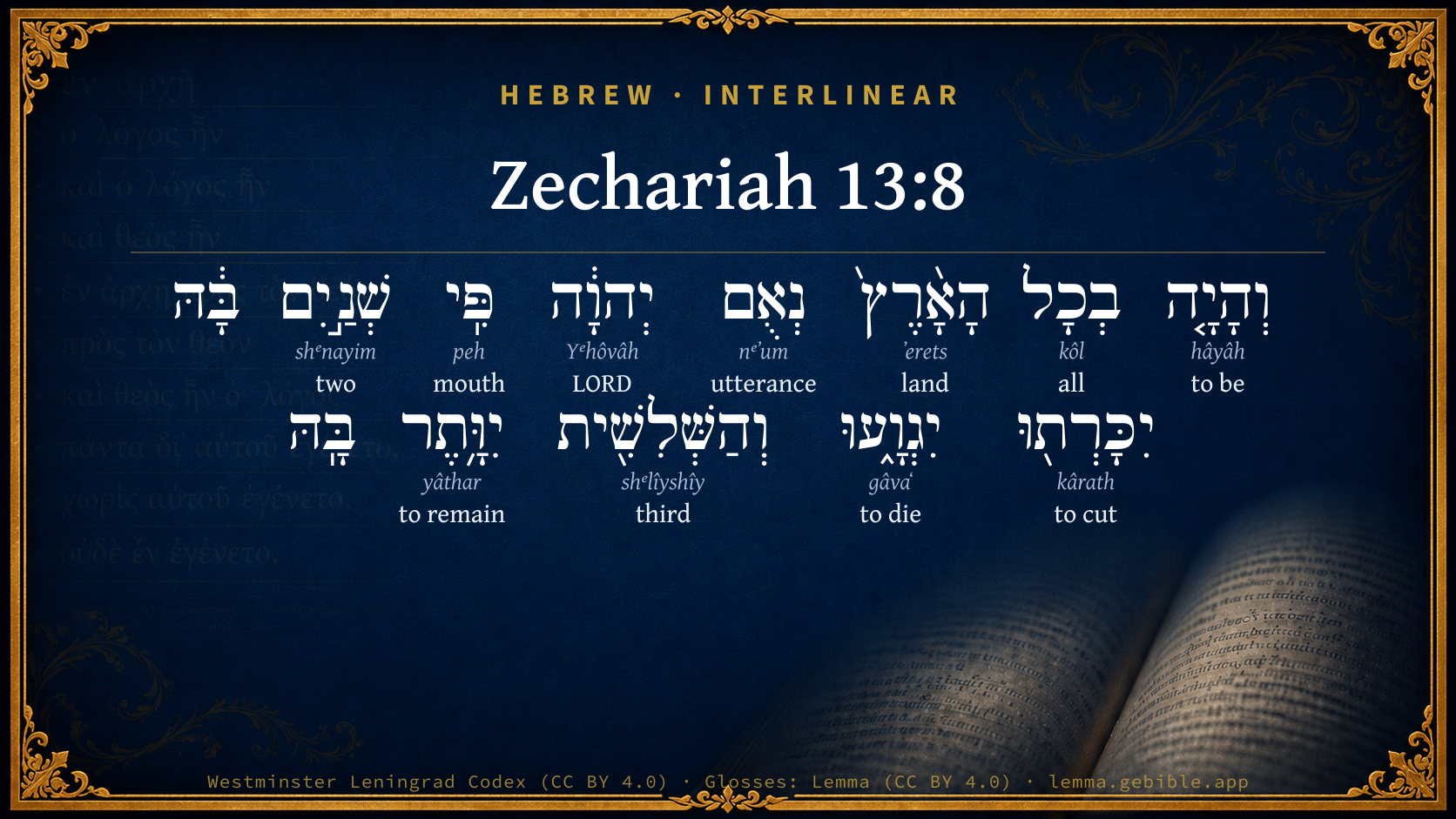
Hebrew (Westminster Leningrad Codex) Zechariah 13:8 appears in the Hebrew Old Testament. The text above is from the Westminster Leningrad Codex. Each word links to its Strong’s number, a concise gloss, and parsing drawn from the Open Scriptures Hebrew Bible morphology. Click any word for its full Brown-Driver-Briggs (BDB) entry.
Download image
Cite this verse

Zechariah 13:8 (World English Bible). Public Domain. Lemma interlinear Bible study tool, https://lemma.gebible.app/v/zechariah/13/8.

Show BibTeX & RIS
BibTeX
RIS
English Translation
It shall happen that in all the land," says Yahweh, Two parts in it will be cut off and die; But the third will be left in it.
World English Bible · Public Domain
Download a study sheet

One document with this verse’s original text, its word-by-word gloss line, the meaning frame, cross-references with their text, attributed commentary, and full source and license credits — printable, and it pastes into notes with its structure intact.

This verse Autodidact and up

Study sheet (.html) Plain text (.txt)

A passage Seminary Student

Up to 50 verses in one chapter. A passage sheet keeps up to 6 commentary sources and 12 cross-references per verse, in the order this page ranks them, and says so on the sheet whenever that leaves anything out. Ask for a single verse and you get the Autodidact verse sheet above.

Everything on this page stays free to read, with no account — the sheet is a download of what is already on screen, not access to it.

Want to remove ads? Support Godless Engineer
Compare translations 3

The same verse in 3 English versions, stacked beneath the original-language interlinear above. Click any original word for its lexicon entry.

Each is an independent rendering of the whole verse — the interlinear is not word-aligned to these translations.

Highlighted words mark where these versions differ — a whole-verse word diff, not a word-by-word alignment.

  • World English Bible Public Domain
    It shall happen that in all the land," says Yahweh, Two parts in it will be cut off and die; But the third will be left in it.
  • King James Version Public Domain
    And it shall come to pass, that in all the land, saith the LORD, two parts therein shall be cut off and die; but the third shall be left therein.
  • unfoldingWord Literal Text CC BY-SA 4.0
    And it will be in all the land”—the declaration of Yahweh— “two parts in it will be cut off will expire, and the third will be left in it.

unfoldingWord Literal Text — © unfoldingWord, licensed CC BY-SA 4.0. Word-aligned USFM3 via Door43 (git.door43.org/unfoldingWord/en_ult).

Versions to compare (up to 4)

3 of 4 selected

Show all 18 translations

Every available English version of this verse, each an independent rendering of the whole verse.

  • World English Bible Public Domain
    It shall happen that in all the land," says Yahweh, Two parts in it will be cut off and die; But the third will be left in it.
  • Berean Standard Bible Public Domain
    And in all the land, declares the LORD, two-thirds will be cut off and perish, but a third will be left in it.
  • Majority Standard Bible Public Domain
    And in all the land, declares the LORD, two-thirds will be cut off and perish, but a third will be left in it.
  • King James Version Public Domain
    And it shall come to pass, that in all the land, saith the LORD, two parts therein shall be cut off and die; but the third shall be left therein.
  • American Standard Version (1901) Public Domain
    And it shall come to pass, that in all the land, saith Jehovah, two parts therein shall be cut off and die; but the third shall be left therein.
  • Revised Version (1885) Public Domain
    And it shall come to pass, that in all the land, saith the LORD, two parts therein shall be cut off and die; but the third shall be left therein.
  • Geneva Bible (1599) Public Domain
    And in all the land, sayeth the Lord, two partes therein shall be cut off, and die: but the third shall be left therein.
  • Douay-Rheims (1899) Public Domain
    And there shall be in all the earth, saith the Lord, two parts in it shall be scattered, and shall perish: but the third part shall be left therein.
  • Young's Literal Translation Public Domain
    And it hath come to pass, In all the land, an affirmation of Jehovah, Two parts in it are cut off -- they expire, And the third is left in it.
  • Literal Standard Version CC BY-SA 4.0
    And it has come to pass, || In all the land,” a declaration of YHWH, || “Two parts in it are cut off—they expire, || And the third is left in it.
  • Unlocked Literal Bible CC BY-SA 4.0
    Then it will come about that throughout all the land—this is Yahweh's declaration— that two-thirds of it will be cut off! Those people will perish; only one-third will remain there.
  • unfoldingWord Literal Text CC BY-SA 4.0
    And it will be in all the land”—the declaration of Yahweh— “two parts in it will be cut off will expire, and the third will be left in it.
  • Darby Bible Public Domain
    And it shall come to pass in all the land, saith Jehovah, two parts therein shall be cut off [and] die; but the third shall be left therein.
  • World Messianic Bible Public Domain
    It shall happen that in all the land,” says the LORD, “two parts in it will be cut off and die; but the third will be left in it.
  • Webster's Bible Public Domain
    And it shall come to pass, that in all the land, saith the LORD, two parts therein shall be cut off and die; but the third shall be left therein.
  • Free Bible Version CC BY-SA 4.0
    Two thirds of the people of the land will be cut down, only one third will remain, says the Lord.
  • Bible in Basic English Public Domain
    And it will come about that in all the land, says the Lord, two parts of it will be cut off and come to an end; but the third will be still living there.
  • JPS Tanakh (1917) Public Domain
    And it shall come to pass, that in all the land, saith the LORD, two parts therein shall be cut off and die; but the third shall be left therein.

Literal Standard Version (2020), Covenant Press — licensed CC BY-SA 4.0. Text via the HelloAO Bible API (eBible.org). Unlocked Literal Bible (unfoldingWord) — licensed CC BY-SA 4.0. Text via the HelloAO Bible API (eBible.org). unfoldingWord Literal Text — © unfoldingWord, licensed CC BY-SA 4.0. Word-aligned USFM3 via Door43 (git.door43.org/unfoldingWord/en_ult). Free Bible Version, Dr. Jonathan Gallagher — licensed CC BY-SA 4.0. Text via the HelloAO Bible API (eBible.org).

Word by word

More ways to search: Search by grammar → Find every occurrence → Compare this word →

Practice this passage: Drill this verse → Learn its vocabulary →

יִגְוָ֑עוּ
gâvaʻ
H1478
“to die”
Verb, Qal, Imperfect, 3rd Person, Masculine, Plural
Part of Speech
Verb
Stem
Qal
Form
Imperfect
Person
3rd Person
Gender
Masculine
Number
Plural
Full BDB Definition

Origin: a primitive root

TWOT: 328

to expire, die, perish, give up the ghost, yield up the ghost, be dead, be ready to die - (Qal) to expire, die, be about to die
  1. וְהָיָ֤ה hâyâh H1961 “and · to be” Conjunction + Verb, Qal, Sequential Perfect, 3rd Person, Masculine, Singular
  2. בְכָל kôl H3605 “in/at · all of” Preposition + Noun, Common, Masculine, Singular, Construct
  3. הָאָ֨רֶץ֙ ʼerets H776 “the · land” Particle, Definite Article + Noun, Common, Both, Singular, Absolute
  4. נְאֻם nᵉʼum H5002 “utterance of” Noun, Common, Masculine, Singular, Construct
  5. יְהוָ֔ה Yᵉhôvâh H3068 “LORD” Noun, Proper
  6. פִּֽי peh H6310 “mouth of” Noun, Common, Masculine, Singular, Construct
  7. שְׁנַ֣יִם shᵉnayim H8147 “two” Adjective, Cardinal number, Masculine, Dual, Absolute
  8. יִכָּרְת֖וּ kârath H3772 “to cut” Verb, Niphal, Imperfect, 3rd Person, Masculine, Plural
  9. וְהַשְּׁלִשִׁ֖ית shᵉlîyshîy H7992 “and · the · third” Conjunction + Particle, Definite Article + Noun, Common, Feminine, Singular, Absolute
  10. יִוָּ֥תֶר yâthar H3498 “to remain” Verb, Niphal, Imperfect, 3rd Person, Masculine, Singular

About this verse

These counts appear in no published source. They are computed here, from the morphology-tagged text and Lemma’s own curated glosses. What Lemma adds →

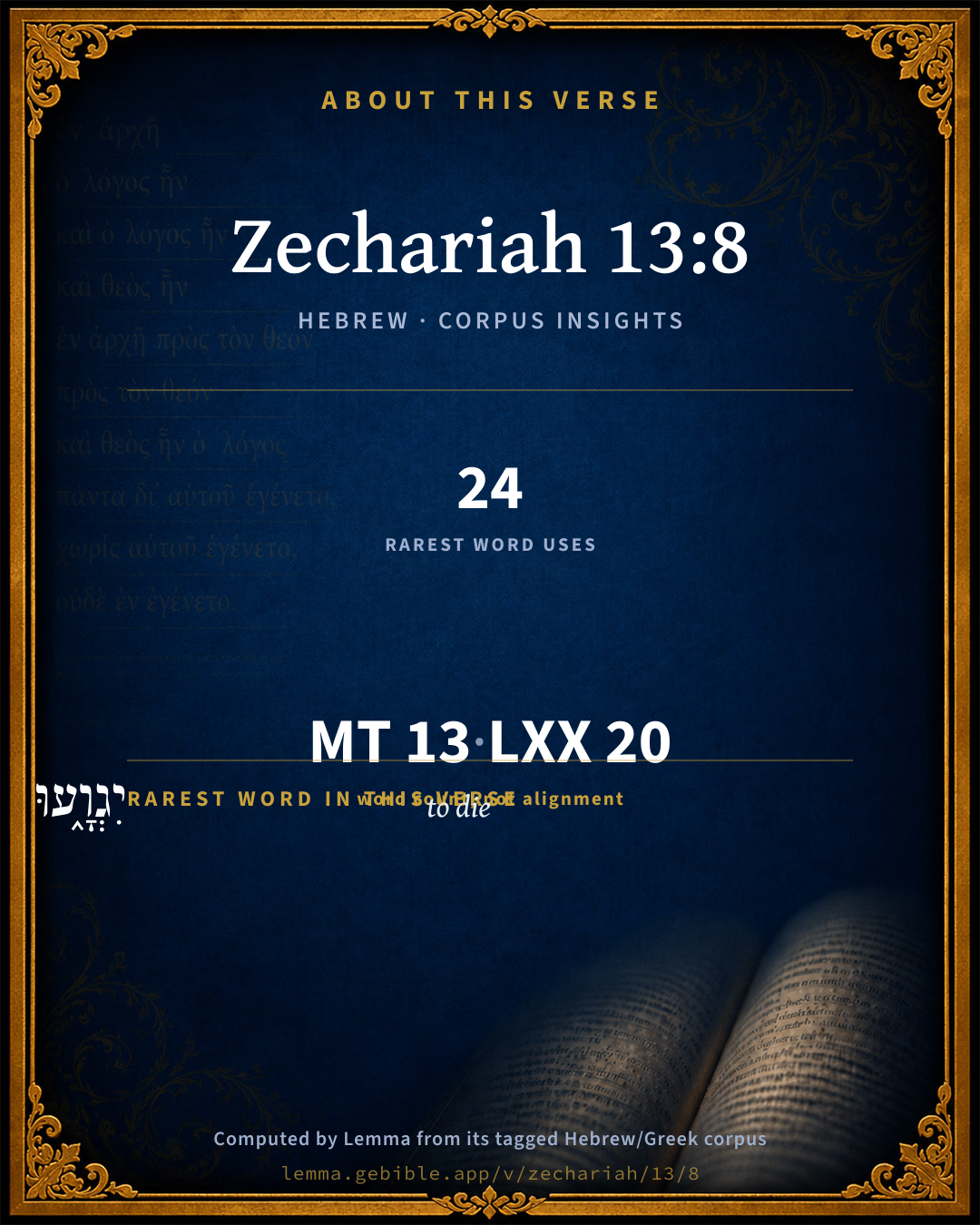
13
words
11
distinct lemmas
Prophets
section

Notable vocabulary

The rarest word here is יִגְוָ֑עוּ to die H1478 — appearing just 24 times in the whole Hebrew Bible.

Shared distinctive vocabulary

יִגְוָ֑עוּ to die H1478 occurs in 23 verses of the Hebrew Bible. Also found in:

Grammatical profile

  • 4 verbs
  • 6 nouns
  • 1 adjective
  • 2 prepositions

Verb forms

  • וְהָיָ֤ה Qal · Sequential Perfect
  • יִכָּרְת֖וּ Niphal · Imperfect
  • יִגְוָ֑עוּ Qal · Imperfect
  • יִוָּ֥תֶר Niphal · Imperfect

Hebrew & Septuagint length

In English translation the verse runs 28 words from the Hebrew and 30 from the Septuagint (LXX English) — closely comparable.

A rough comparison of the two English renderings, which tokenize alike — not a word-level alignment.

Word counts can differ between the Hebrew and the Greek without any difference in meaning — e.g. the Hebrew direct-object marker אֵת has no separate Greek word, and Greek often adds the article ὁ.

In the original languages it is 13 Hebrew tokens and 20 Greek tokens — but the two are counted differently (Hebrew bundles its prefixes and suffixes into one token; the Greek is in lemma form), so that isn’t a like-for-like length.

Cross-references

31

Topical passages linked to Zechariah 13:8 in the Treasury of Scripture Knowledge — connected by theme and wording, ordered by reader-vote popularity; previews shown in the World English Bible.

  • Ezekiel 5:12 A third part of you shall die with the pestilence, and with famine shall they be consumed in the midst of you; and a third part shall fall by the sword round about you; and a third part I will scatter to all the winds, and will draw out a sword after them.
  • Revelation 16:19 The great city was divided into three parts, and the cities of the nations fell. Babylon the great was remembered in the sight of God, to give to her the cup of the wine of the fierceness of his wrath.
  • Ezekiel 5:2–4 A third part shall you burn in the fire in the midst of the city, when the days of the siege are fulfilled; and you shall take a third part, and strike with the sword round about it; and a third part you shall scatter to the wind, and I will draw out a sword after them.
  • Malachi 4:1–3 "For, behold, the day comes, it burns as a furnace; and all the proud, and all who work wickedness, will be stubble; and the day that comes will burn them up," says Yahweh of Hosts, "that it shall leave them neither root nor branch.
  • Revelation 8:7–12 The first sounded, and there followed hail and fire, mixed with blood, and they were thrown to the earth. One third of the earth was burnt up, and one third of the trees were burnt up, and all green grass was burnt up.
  • Matthew 24:21–22 for then there will be great oppression, such as has not been from the beginning of the world until now, no, nor ever will be.
  • Luke 23:28–30 But Jesus, turning to them, said, "Daughters of Jerusalem, don't weep for me, but weep for yourselves and for your children.
  • 1 Thessalonians 2:15–16 who killed both the Lord Jesus and their own prophets, and drove us out, and didn't please God, and are contrary to all men;
  • Deuteronomy 28:49–68 Yahweh will bring a nation against you from far, from the end of the earth, as the eagle flies; a nation whose language you shall not understand;
  • Isaiah 6:13 If there are yet a tenth in it, It also shall in turn be eaten up: As a terebinth, and as an oak, whose stock remains, when they are felled; So the holy seed is its stock."
  • Daniel 9:27 He shall make a firm covenant with many for one week: and in the midst of the week he shall cause the sacrifice and the offering to cease; and on the wing of abominations [shall come] one who makes desolate; and even to the full end, and that determined, shall [wrath] be poured out on the desolate.
  • Joel 2:31–32 The sun will be turned into darkness, And the moon into blood, Before the great and terrible day of Yahweh comes.
  • Amos 9:8–9 Behold, the eyes of the Lord Yahweh are on the sinful kingdom, and I will destroy it from off the surface of the earth; except that I will not utterly destroy the house of Jacob," says Yahweh.
  • Zechariah 11:6–9 For I will no more pity the inhabitants of the land," says Yahweh; "but, behold, I will deliver the men everyone into his neighbor's hand, and into the hand of his king. They will strike the land, and out of their hand I will not deliver them."
  • Zechariah 14:1–2 Behold, a day of Yahweh comes, when your spoil will be divided in your midst.
  • Matthew 23:35–37 that on you may come all the righteous blood shed on the earth, from the blood of righteous Abel to the blood of Zachariah son of Barachiah, whom you killed between the sanctuary and the altar.
  • Mark 13:20 Unless the Lord had shortened the days, no flesh would have been saved; but for the sake of the chosen ones, whom he picked out, he shortened the days.
  • Luke 19:41–44 When he drew near, he saw the city and wept over it,
  • Isaiah 65:12–15 I will destine you to the sword, and you shall all bow down to the slaughter; because when I called, you did not answer; when I spoke, you did not hear; but you did that which was evil in my eyes, and chose that in which I didn't delight.
  • Isaiah 66:4–6 I also will choose their delusions, and will bring their fears on them; because when I called, none did answer; when I spoke, they did not hear: but they did that which was evil in my eyes, and chose that in which I didn't delight.
  • Isaiah 66:24 They shall go forth, and look on the dead bodies of the men who have transgressed against me: for their worm shall not die, neither shall their fire be quenched; and they shall be an abhorring to all flesh.
  • Jeremiah 30:11 For I am with you, says Yahweh, to save you: for I will make a full end of all the nations where I have scattered you, but I will not make a full end of you; but I will correct you in measure, and will in no way leave you unpunished.
  • Malachi 3:1–2 "Behold, I send my messenger, and he will prepare the way before me; and the Lord, whom you seek, will suddenly come to his temple; and the messenger of the covenant, whom you desire, behold, he comes!" says Yahweh of hosts.
  • Malachi 3:5 I will come near to you to judgment; and I will be a swift witness against the sorcerers, and against the adulterers, and against the perjurers, and against those who oppress the hireling in his wages, the widow, and the fatherless, and who deprive the foreigner of justice, and don't fear me," says Yahweh of Hosts.
  • Matthew 3:10–12 "Even now the axe lies at the root of the trees. Therefore, every tree that doesn't bring forth good fruit is cut down, and cast into the fire.
  • Matthew 21:43–44 "Therefore I tell you, the Kingdom of God will be taken away from you, and will be given to a nation bringing forth its fruits.
  • Matthew 22:7 When the king heard that, he was angry, and he sent his armies, destroyed those murderers, and burned their city.
  • Luke 20:16–18 He will come and destroy these farmers, and will give the vineyard to others." When they heard it, they said, "May it never be!"
  • Luke 21:20–24 "But when you see Jerusalem surrounded by armies, then know that its desolation is at hand.
  • Romans 11:1–5 I ask then, Did God reject his people? May it never be! For I also am an Israelite, a descendant of Abraham, of the tribe of Benjamin.
  • Romans 9:27–29 Isaiah cries concerning Israel, "If the number of the children of Israel are as the sand of the sea, It is the remnant who will be saved;

Cross-references courtesy of OpenBible.info (CC BY 4.0).

Hebrew and Greek witnesses Masoretic Hebrew ↔ Greek Septuagint

The same verse in the two great witnesses to the Old Testament, shown verse-for-verse.

These are two independent witnesses, not word-aligned to each other, and the Septuagint is shown in lemma (dictionary) form.

Hebrew Zechariah 13:8 Masoretic · Westminster Leningrad Codex

וְהָיָ֤ה בְכָל הָאָ֨רֶץ֙ נְאֻם יְהוָ֔ה פִּֽי שְׁנַ֣יִם בָּ֔הּ יִכָּרְת֖וּ יִגְוָ֑עוּ וְהַשְּׁלִשִׁ֖ית יִוָּ֥תֶר בָּֽהּ

It shall happen that in all the land," says Yahweh, Two parts in it will be cut off and die; But the third will be left in it.

World English Bible · Public Domain

Greek LXX Zechariah 13:8 Septuagint · lemma form

καί εἰμί ἐν πᾶς ὁ γῆ λέγω κύριος ὁ δύο μέρος ἐκὀλεθρεύω καί ἐκλείπω ὁ δέ τρίτος ὑπολείπω ἐν αὐτός

And it shall come to pass, that in all the land, says the Lord, two parts thereof shall be cut off and perish; but the third shall be left therein.

LXX2012 (modern English Septuagint) · Public Domain

Hebrew: Westminster Leningrad Codex (CC BY 4.0). Greek: Septuagint (public domain); English from LXX2012 (modern English Septuagint) (Public Domain). How the Septuagint differs from the Hebrew →

Targum (Aramaic paraphrase)

1

The Targum is the ancient Jewish Aramaic paraphrase of the Hebrew Scriptures — an interpretive translation, not the Hebrew text itself. Onkelos (literal) and Pseudo-Jonathan (expansive) render the Torah, and Jonathan the Prophets. Coverage is partial: where no permissively-licensed English translation exists for a verse, only the Aramaic is shown. This is verse-level text, not a word-by-word alignment to the Hebrew.

  1. Targum Jonathan Prophets (Joshua–Malachi)
    וִיהֵי בְּכָל אַרְעָא אֲמַר יְיָ תְּרֵין חוּלְקִין דְבָהּ יִשְׁתֵּיצוּן יְסוּפוּן (וּתְלִיתָאָה) יִשְׁתָּאֵר בָּהּ:

    (no public-domain English translation for this verse)

    Targum Jonathan — Aramaic: “Mikraot Gedolot” (public domain). English: “Sefaria Community Translation” (CC0 1.0 (public-domain dedication)); “London "Chaldee Paraphrase," 1871” (public domain). Text via Sefaria.

Commentary

Notes on Zechariah 13:8 from classic Christian and Jewish commentators (each source and its license shown beneath its notes). The classic Christian expositions comment on the surrounding passage and are grouped to its opening verse, so a note may address several verses; the Jewish commentaries on the Tanakh (Rashi and others) are per-verse, so they appear only where the commentator wrote on this verse.

Lemma curates 59 commentaries, every one of them public domain or Creative Commons licensed, each selected and text-cleaned for this edition rather than reprinted as found. About our sources →

Trapp's Complete Commentary

John Trapp

Zec 13:8 And it shall come to pass, [that] in all the land, saith the LORD, two parts therein shall be cut off [and] die; but the third shall be left therein.

Ver. 8. Two parts therein shall be cut off and die] q.d. They shall, they shall, however strange or incredible this sad tidings seems to you; it shall be even so, take my word for it. "Behold the severity of God," Rom 11:22. In the Greek it is the resection, or, cutting off (αποτομιαν), as a surgeon cutteth off proud and dead flesh. "The just Lord is in the midst thereof; he will not do iniquity," &c., Zep 3:5. Fiat iustitia, ruat coelum, Let justice be done, let the heavens be destroyed, may seem to be his motto. In point of justice he stands not upon multitudes, Psa 9:17. It is all one to him "whether against a nation or against a man only," Job 34:29. National sins bring national plagues; heinous sins heavy punishments. In the universal deluge God swept away all, as if he had blotted out that part of his title, "The Lord, the Lord, gracious, merciful," &c., and had taken up that of Attilas, Orbis flagellum, the world’s scourge. Sodom’s sins were multiplied above measure; "therefore God took them away as he saw good," Eze 16:49-50; and hath thrown them out (προκεινται), as St Jude speaketh, for an example suffering the vengeance of eternal fire. Herodotus, a heathen historian, saith the very same of the destruction of Troy, viz. that the ruins and rubbish thereof are set forth for an example of that noted rule, that God greatly punisheth great offences, and that heinous sins bring hideous plagues. Here we have two parts of three cut off in the land of Judea; as it happened at the last destruction thereof by the Romans; at which time more than a million of men perished, see Mat 24:21. {See Trapp on "Mat 24:21"} And what think we shall become of Babylon the Great? Her sins reach up to heaven, whereunto they are even glued and fastened, as the word εκολληθησαν signifies, Rev 18:5, therefore she shall be brought down to hell with Capernaum (for flagitium et flagellum sicut acus et filium), therefore shall her plagues come in one day to confute their fond conceit of an eternal empire, death, and mourning, and famine, and she shall be utterly overthrown with fire; for strong is the Lord God who judgeth her, full able to effect it, seem it to Babel’s brats never so improbable or impossible, Rev 18:18. It was never besieged since it became Papal, but it was taken; whereas before it was held invincible. Sin that lieth at the bottom will easily undermine and overturn the walls, though never so strong built; as the voice from heaven told Phocas the murderer. The blood of that innocent Lamb of God lies heavily upon the whole nation of the Jews to this day. Their last devastation and present dismal dispersion is such, as that one of their own Rabbis concludes from thence that their Messiah must needs be come; and they must needs suffer so much for killing him.

But the third shall be left therein] A holy remnant kept for a reserve. Good husbands cast out all their grain into the oven, but keep some for seed. "But yet in it shall be a tenth," saith another prophet, Isa 6:13 : there shall be "two or three berries in the top of a tree, four or five in the outmost branches," Isa 17:6. God’s elect are so very few, that the world shall wonder, Isa 8:18, and even hoot to see Christ’s flock so very little, little, as our Saviour speaks, Luk 12:22, as Israel stood like two little flocks of kids, when the Syrians filled the country, 1Ki 20:27. There were but a few names in Sardis; and many bad in the best Churches; as at Philippi, Php 3:18. Christ wondered at one good Nathanael, as rara avis in terris; a rare bird in the earth, and when he comes, shall he find faith? How many, think you, shall be saved in this city? saith Chrysostom, in his fourth sermon to the people at Antioch. It will be a hard speech to you, but I will speak it: Though there be so many thousands, yet there cannot be found a hundred that shall be saved. And I doubt about them, too. And again, in his third sermon upon the Acts, he breaks out into this speech, Non arbitror inter sacerdotes multos esse qui salvi fiant, I do not think that there are many, no, not among the ministry, that can be saved, since many are called, but few are chosen; like as all the people were called together by Samuel, but Saul only was chosen king. Only the called according to purpose are elected, and shall be glorified, Rom 8:28-29. Christ at the last day will do as Joshua did to find out who had stolen the Babylonish garment; there were many brought together, and all to find out one, Jos 7:16-21 So, all shall then appear; out of them a small number deducted, that have heard of Christ. Out of them, those that have professed him, and out of them, those that have professed him in sincerity, and these will be Mithe mispar, a small few indeed. Hence they are called pearls, which are but few to the number of pebbles; jewels, which are but little to the lumber; strangers, that are nothing so many as homedwellers; sons of God, and of the royal blood; and of such there are but a few to common subjects. They are as a fold in a wide field; as a garden in a wild waste. Rari quippe boni, saith the poet (Juvenal). And Pauci sunt qui philosophantur, few there are who philosophize, saith Ulpian, the lawyer.

John Trapp, A Commentary or Exposition upon All the Books of the Old and New Testament (1647–1656) — public domain. Text from a community e-Sword module.

Scofield Reference Notes

C. I. Scofield

And it shall come to pass

Zechariah 13 now returns to the subject of Zec 12:10. Zec 13:8; Zec 13:9 refer to the sufferings of the remnant; Isa 1:9; Rom 11:5 preceding the great battle. Zechariah 14. is a recapitulation of the whole matter. The order is:

(1) The gathering of the nation, Zec 13:2 (see "Armageddon," Rev 16:14 (See Scofield "Rev 19:11")

(2) the deliverance, Zec 13:3;

(3) the return of Christ to the Mount of Olives, and the physical change of the scene, Zec 13:4-8;

(4) the setting up of the kingdom, and full earthly blessing, Zec 13:9-9.

The Scofield Reference Bible (1917 edition), notes by C. I. Scofield — public domain. Text from a community e-Sword module.

Tyndale Open Study Notes

Tyndale Open Resources

13:8 Two-thirds . . . one-third: The divine judgment would be catastrophic, but God would preserve a remnant and forgive their sin (see Isa 65:9; Jer 50:20; Ezek 5:2-12; Rev 9:15-18).

Tyndale Open Study Notes — © Tyndale Open Resources, licensed CC BY-SA 4.0. Text via the HelloAO Bible API.

Geneva Bible (1599)

Geneva Bible translators

The greatest part shall have no portion of these blessings, and yet they that shall enjoy them, shall be tried with great afflictions, so that it shall be known that only God’s power and his mercies do preserve them.

Geneva Bible (1599) marginal notes — public domain. Text via Bolls.life.

Jamieson, Fausset & Brown

Robert Jamieson, A. R. Fausset & David Brown

Two-thirds of the Jewish nation were to perish in the Roman wars, and a third to survive. Probably from the context (Zac 14:2-9), which has never yet been fulfilled, the destruction of the two-thirds (literally, "the proportion of two," or "portion of two") and the saving of the remnant, the one-third, are still future, and to be fulfilled under Antichrist.

Jamieson, Fausset & Brown — Commentary Critical and Explanatory on the Whole Bible (1871) — public domain (CC PDM 1.0). Text via the HelloAO Bible API.

Adam Clarke's Commentary

Verse 8. Two parts therein shall be cut off] In the war with the Romans.

But the third shall be left] Those who believe on the Lord Jesus Christ shall be preserved alive; and not one of these perished in the siege, or afterwards, by those wars.

Adam Clarke's Commentary on the Bible (1810–1826) — public domain. Text from a community e-Sword/MySword module.

John Calvin's Commentaries

He goes on with the same subject; for he reminds the faithful, that though God had resolved to restore his Church, and though his blessing would be evident, yet very heavy afflictions were not far distant; as though he had said, “God will give you a serene heaven and a bland air, that the land may bring forth its fruit; but still there is a heavy tempest impelling, and ye shall not be exempt from storms and hail. But when God has laid waste a part of the land, he will bless you with corn and wine, so that you shall have sufficient support.” So also in this place he says, “God will protect his Church, and will also be propitious to it, for he will wash away all the filth of wickedness, and will give to you faithful pastors, when he has removed the impostures of Satan: but in the meantime most grievous afflictions await you, and a hard state of things, and difficult to be borne, must be expected; for God will appear as though he intended to destroy his people: such will be the scattering.”

For this reason he says, that there will be through the whole land the most grievous calamities: Two parts, he says, shall die; the third only shall remain

We now see how all these things agree, and how the Prophet’s words harmonise. In short, he means, that what he had before promised respecting the future favor of God, does not belong indifferently to all, or to the whole body of the people, but to the faithful, whom God will in a wonderful manner deliver from ruin; for of the people God will only save the third part, as he had already resolved to destroy the other two parts. The intention of the Prophet is now by no means doubtful.

But we hence conclude, that what God daily promises to his Church is not to be extended indiscriminately to all, for many falsely profess his name: but he knows his own, as Paul says, and therefore exhorts them to depart from iniquity. (2 Timothy 2:16.) Let us then know that promises of God’s favor do not appertain to hypocrites: for though he has decreed to deal kindly and graciously with his Church, he yet continues to diminish it, so that the third part only remains safe. Whenever then we speak of God’s mercy towards his Church, and of his aid and help, let us ever bear in mind the cleansing of which Zechariah now speaks, that God will reserve the third part, while the greater portion ever runs headlong into ruin. It is then enough that the third part should be delivered from destruction. But this verse, as it has already appeared, ought to be applied to the kingdom of Christ.

Literally we read, the mouth of the two; but פי, pi, is to be taken metaphorically for part or portion. A part then of the two in it, or two parts in it, (the plural is joined with the singular, as often is the case,) shall perish, shall be cut off. The verb כרת, caret, means to cut off; and then גוע, guo, signifies to die or to sink. Though he understands the same things by the two words, it is not yet an unmeaning repetition; for it might have seemed hard and unreasonable that only a third part of God’s people should remain. This diminution of the Church might have disturbed the minds of many, and might have appeared incredible: hence the Prophet, in order to confirm what in itself seemed a paradox, says, they shall die, they shall perish; it has been so decreed, and you are not to contend with God; for given up to ruin shall the greater number be, while a few only shall remain: the third part then shall remain in it. It follows —

John Calvin's Commentaries (1540-1563) — public domain. Text from the Calvin Translation Society English edition (1840s-50s) via the Christian Classics Ethereal Library (ccel.org). Calvin's coverage is partial (roughly two-thirds of the Bible); uncommented books and verses are honest gaps, never fabricated. The 19th-century editor's footnotes and remarks are omitted so the notes are faithfully Calvin's own voice.

Ellicott's Commentary for English Readers

(8) The land.—viz., of Israel. (Comp. Zec_14:9.)

A Bible Commentary for English Readers, edited by Charles John Ellicott (1878–1897) — public domain. Text from a community e-Sword module.

The Cambridge Bible for Schools and Colleges

gen. ed. J. J. S. Perowne

8. in all the land] i.e. of Palestine, which agrees with the view taken above that “the flock” is the Jewish church and people.

two parts] Comp. 2Sa_8:2. This was terribly fulfilled in the destruction of Jerusalem by the Romans.

The Cambridge Bible for Schools and Colleges (gen. ed. J. J. S. Perowne; Cambridge University Press, 1878–1918) — public domain. Text from a community e-Sword module.

John Gill's Exposition

And it shall come to pass, that in all the land, saith the Lord,.... Either in all the land of Israel, as Kimchi interprets it; or rather in all the world, as Aben Ezra and others; for this prophecy seems to have respect, not to the calamities of the Jews at the destruction of Jerusalem, after the death of Christ, when a few were saved, a remnant according to the election of grace, yet so as by fire, for whose sake the days of tribulation were shortened; but to the external state of the church, and the trouble of it throughout Christendom, about the time of the destruction of antichrist:

two parts therein shall be cut off and die; all hypocrites, formalists, and outward court worshippers; who seem as if they would be at this time two thirds of the professors of true religion; who will not be able to stand the hour of temptation that will come upon all the earth, to try the inhabitants of it; which will be the last struggle of the beast of Rome, Rev 3:10 but will be twice dead, plucked up by the roots; will die to the profession of religion, and be cut off from the people of God, and have no more a name with them:

but the third shall be left therein; the few names in Sardis, which have not defiled their garments; the hundred forty and four thousand that will stand with Christ, and by him, on Mount Zion, being redeemed from among men, Rev 3:4 compare with this Rev 16:19.

John Gill's Exposition of the Whole Bible (1746–1763) — public domain (CC PDM 1.0). Text via the HelloAO Bible API.

Albert Barnes' Notes on the Bible

In all the land, two parts therein shall be cut off and die - “In all the land of Israel,” says a Jewish interpreter; (Kimchi); “ - the land, in which the Good Shepherd had been slain and the sheep scattered, “that upon you.” our Lord had said, “may come all the righteous blood.” As David punished Moab, “with two lines measured he to put to death, and with one full line to keep alive” 2Sa 8:2; and Ezekiel prophesied, “A third part of thee shall die with the pestilence, and with famine shall they be consumed in the midst of thee: and a third part shall fall by the sword round about thee” Eze 5:12; so now, the greater part should be destroyed, but a remnant should be saved. “But the third part shall be left therein. Even so then at this present time also,” Paul says, “there is a remnant according to the election of grace” Rom 11:5. Osorius: “The third part only shall be saved from the common destruction; yet not so, that they should suppose that glory was to be obtained amid ease.”

Albert Barnes' Notes on the Bible (1834–1885) — public domain. Text from a community e-Sword/MySword module.

Haydock's Catholic Bible Commentary

Third. The greatest part of mankind will be lost. (Haydock) --- The few Jews who embrace the faith will be absorbed in the Gentile converts, and suffered to live, though proved by persecutions, while the rest shall be exterminated. Both shall lose their name, and be styled Christians. (Calmet) --- Those who adhere to Judaism, or to paganism, cannot be saved. This is the privilege only of Christian Catholics, who live piously, and are selected by God’s grace. (Worthington)

George Leo Haydock (1774–1849), Haydock's Catholic Family Bible and Commentary, 1859 edition — public domain. Excludes Psalms (Douay-Rheims chapter numbering differs from Protestant) and Deuterocanonical books (Catholic canon only).

Matthew Poole's English Annotations

This verse may be a prediction of the great slaughter Titus made among the Jews, and also an emblem of the multitudes of them that perish, and paucity of them that are saved.

In all the land of Judea, or the whole world.

Two parts; not precisely two, but, more largely, the greater part by far.

Shall be cut off and die, a temporal death, by the sword of Titus, or an eternal death under unbelief and rejecting Christ.

But the third, i.e. a remnant, the lesser part, yet as many as are chosen, shall be left therein; shall escape or be preserved and saved.

Matthew Poole's English Annotations on the Holy Bible (1683–1685) — public domain. Text from a community e-Sword/MySword module.

The Pulpit Commentary

In all the land; i.e. Palestine, the country in which the good Shepherd tended his flock (Zec 11), and which is a figure of the kingdom of God. (comp. Zec_12:12 Zec_14:9, Zec_14:10) Two parts therein shall be cut off and die; literally, the mouth, i.e. the portion of two, as Deu_21:17 2Ki_2:9, where it denotes the double portion inherited by the firstborn. The inheritance is divided into three portions, of which two parts are given over to death. Compare a similar allotment in the case of the Moabites. (2Sa_8:2) The doomed portion is supposed to represent the multitudes who perished at the siege of Jerusalem. This may be; but by analogy it stands for those who shall not accept the Messiah or be purified by suffering, even as Christ said, "Many are called, but few chosen". (Mat_20:16; comp. Mat_3:12) The third. This third part represents the faithful among the Jews, (Rom_11:5) and the Christian Church gathered out of all nations. (comp. Isa_6:13; and especially Eze_5:2, Eze_5:12)

The Pulpit Commentary (1880–1919), ed. H.D.M. Spence-Jones & Joseph S. Exell — public domain. Text from a community e-Sword module.

John Wesley's Explanatory Notes

Two parts - Not precisely two, but the greater part shall die a temporal death, by the sword of Titus, or in eternal death under unbelief. The third - A remnant, the lesser part, shall escape or be preserved.

John Wesley, Explanatory Notes Upon the Whole Bible (1754–1765) — public domain. Text via the GEBible commentary corpus.

unfoldingWord translationNotes

Door43 World Missions Community

this is Yahweh's declaration

Yahweh speaks of himself by name to express the certainty of what he is declaring. See how you translated this in Zechariah 1:4. AT: "this is what Yahweh has declared" or "this is what I, Yahweh, have declared" (See: First, Second, or Third Person)

that two-thirds of it will be cut off! Those people will perish; only one-third will remain there

People being killed is spoken of as if they are cut off like cloth is cut from a garment or a branch is cut from a plant. AT: "that two out of every three people will die! Only one person out of three will remain in the land" (See: Metaphor and Fractions)

I will bring that third through the fire

Metal is passed through fire in order to purify or harden it. This expression serves here as a metaphor for exposing the people to suffering in order that they may become more faithful to God. (See: Metaphor)

refine them as silver is refined; I will test them as gold is tested

Refining refers to making precious metals such as silver more pure. Metals such as silver and gold are tested in order to discover how pure or strong they are. Both refining and testing are here metaphors for making the people more faithful to God. (See: Metaphor)

They will call on my name

Here "name" represents Yahweh. AT: "They will call out to me" (See: Metonymy)

translationWords

Yahweh

declare

cut off

perish

fire

silver

gold

test

call

name

people group

God

unfoldingWord translationNotes — © Distant Shores Media and the Door43 World Missions Community, licensed CC BY-SA 4.0. Source: git.door43.org/Door43/en_tn.

Rashi

Rabbi Shlomo Yitzchaki (Rashi)

and the third shall remain therein They shall proselytize and live.

Rashi on the Tanakh — English translations: “The Judaica Press complete Tanach with Rashi, translated by A. J. Rosenberg” (CC BY 4.0); “Pentateuch with Rashi's commentary by M. Rosenbaum and A.M. Silbermann, 1929-1934” (public domain); “The Metsudah Tanach series, Lakewood, N.J” (CC BY 4.0); and “The Book of Joshua, Metsudah Publications, 1997” (CC BY 4.0). Text via Sefaria.

Lesson kit

Teaching starters — assembled from the data on this page, not authored interpretation. Every prompt links to the verse data it draws on. Edit before teaching.

Zechariah, in the Prophets, opens this verse with 13 words (11 distinct Hebrew lemmas). Its most distinctive word is gâvaʻ (“to die”). A historical commentator’s framing appears above. Read the whole chapter for the surrounding context.

Discussion questions

  1. What does “to die” (gâvaʻ) contribute to the verse as a whole?
  2. How does Genesis 6:17, which shares the word «to die», read alongside this verse?
  3. The translations on this page render this verse differently — a whole-verse word diff, not a word-by-word alignment. What might account for the different wordings?
  4. «וְהָיָ֤ה» is a Qal Sequential Perfect verb. How does that grammatical form shape the action described?
  5. Compare how Trapp's Complete Commentary and Scofield Reference Notes read this verse. Where do they agree or differ?

Things to notice

Reading settings

Reading text

Shown beneath each verse's original-language words.

Old Testament
Old Testament edition

Read the OT as the Masoretic Hebrew (MT) or the Greek Septuagint (LXX).

English shown for the Greek Septuagint (in the Hebrew ↔ Greek comparison).

Comparing translations? Open the Compare panel on any verse page to stack up to four side by side.