
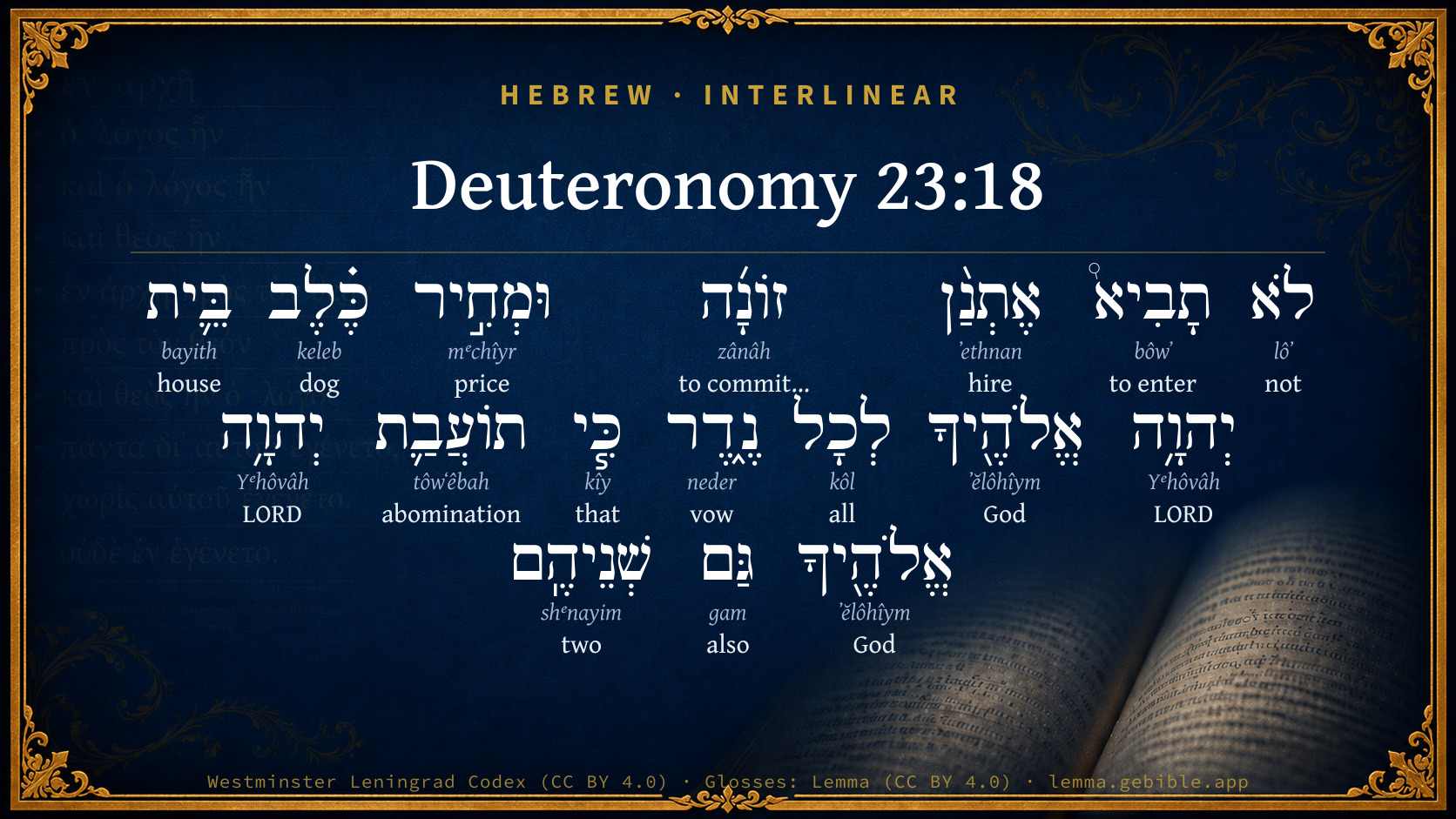
Deuteronomy 23:18

Hebrew (Westminster Leningrad Codex) Deuteronomy 23:18 appears in the Hebrew Old Testament. The text above is from the Westminster Leningrad Codex. Each word links to its Strong’s number, a concise gloss, and parsing drawn from the Open Scriptures Hebrew Bible morphology. Click any word for its full Brown-Driver-Briggs (BDB) entry.
Download image
Cite this verse

Deuteronomy 23:18 (World English Bible). Public Domain. Lemma interlinear Bible study tool, https://lemma.gebible.app/v/deuteronomy/23/18.

Show BibTeX & RIS
BibTeX
RIS
English Translation
You shall not bring the hire of a prostitute, or the wages of a dog, into the house of Yahweh your God for any vow: for even both these are an abomination to Yahweh your God.
World English Bible · Public Domain
Highlights
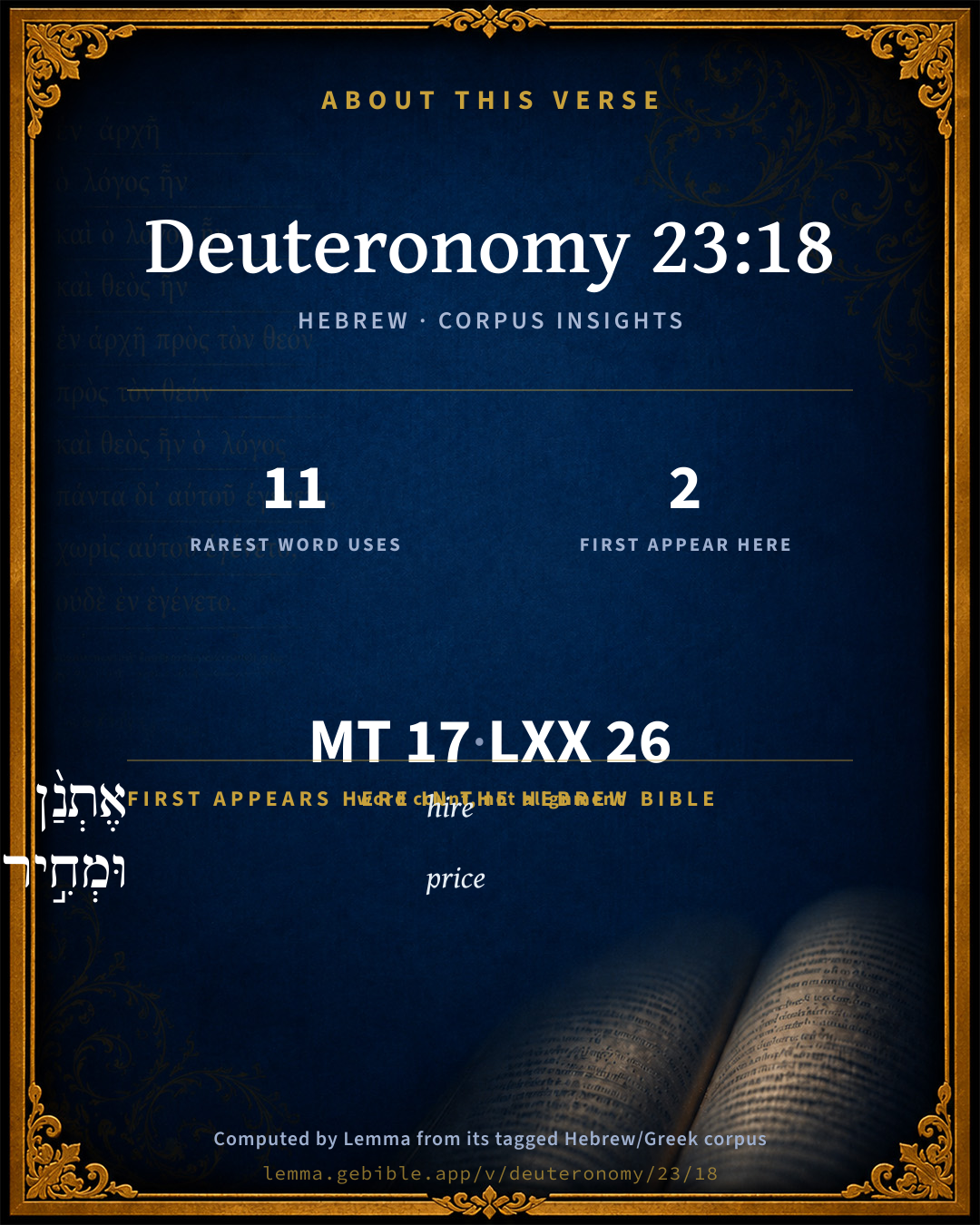
  • 2 first appearances in the Hebrew Bible
Full analysis ↓
Download a study sheet

One document with this verse’s original text, its word-by-word gloss line, the meaning frame, cross-references with their text, attributed commentary, and full source and license credits — printable, and it pastes into notes with its structure intact.

This verse Autodidact and up

Study sheet (.html) Plain text (.txt)

A passage Seminary Student

Up to 50 verses in one chapter. A passage sheet keeps up to 6 commentary sources and 12 cross-references per verse, in the order this page ranks them, and says so on the sheet whenever that leaves anything out. Ask for a single verse and you get the Autodidact verse sheet above.

Everything on this page stays free to read, with no account — the sheet is a download of what is already on screen, not access to it.

Want to remove ads? Support Godless Engineer
Compare translations 3

The same verse in 3 English versions, stacked beneath the original-language interlinear above. Click any original word for its lexicon entry.

Each is an independent rendering of the whole verse — the interlinear is not word-aligned to these translations.

Highlighted words mark where these versions differ — a whole-verse word diff, not a word-by-word alignment.

  • World English Bible Public Domain
    You shall not bring the hire of a prostitute, or the wages of a dog, into the house of Yahweh your God for any vow: for even both these are an abomination to Yahweh your God.
  • King James Version Public Domain
    Thou shalt not bring the hire of a whore, or the price of a dog, into the house of the LORD thy God for any vow: for even both these are abomination unto the LORD thy God.
  • unfoldingWord Literal Text CC BY-SA 4.0
    You shall not bring the wages of a prostitute or the price of a dog the house of Yahweh your God for any vow; for even both of them abominations to Yahweh your God.

unfoldingWord Literal Text — © unfoldingWord, licensed CC BY-SA 4.0. Word-aligned USFM3 via Door43 (git.door43.org/unfoldingWord/en_ult).

Versions to compare (up to 4)

3 of 4 selected

Show all 18 translations

Every available English version of this verse, each an independent rendering of the whole verse.

  • World English Bible Public Domain
    You shall not bring the hire of a prostitute, or the wages of a dog, into the house of Yahweh your God for any vow: for even both these are an abomination to Yahweh your God.
  • Berean Standard Bible Public Domain
    You must not bring the wages of a prostitute, whether female or male, into the house of the LORD your God to fulfill any vow, because both are detestable to the LORD your God.
  • Majority Standard Bible Public Domain
    You must not bring the wages of a prostitute, whether female or male, into the house of the LORD your God to fulfill any vow, because both are detestable to the LORD your God.
  • King James Version Public Domain
    Thou shalt not bring the hire of a whore, or the price of a dog, into the house of the LORD thy God for any vow: for even both these are abomination unto the LORD thy God.
  • American Standard Version (1901) Public Domain
    Thou shalt not bring the hire of a harlot, or the wages of a dog, into the house of Jehovah thy God for any vow: for even both these are an abomination unto Jehovah thy God.
  • Revised Version (1885) Public Domain
    Thou shalt not bring the hire of a whore, or the wages of a dog, into the house of the LORD thy God for any vow: for even both these are an abomination unto the LORD thy God.
  • Geneva Bible (1599) Public Domain
    Thou shalt neyther bring the hyre of a whore, nor the price of a dogge into the house of the Lord thy God for any vow: for euen both these are abomination vnto the Lord thy God.
  • Douay-Rheims (1899) Public Domain
    Thou shalt not offer the hire of a strumpet, nor the price of a dog, in the house of the Lord thy God, whatsoever it be that thou hast vowed: because both these are an abomination to the Lord thy God.
  • Young's Literal Translation Public Domain
    thou dost not bring a gift of a whore, or a price of a dog, into the house of Jehovah thy God, for any vow; for the abomination of Jehovah thy God `are' even both of them.
  • Literal Standard Version CC BY-SA 4.0
    you do not bring the wage of a whore or the price of a dog into the house of your God YHWH for any vow; for even both of them [are] an abomination [to] your God YHWH.
  • Unlocked Literal Bible CC BY-SA 4.0
    You must not bring the wages of a prostitute or the wages of a dog into the house of Yahweh your God for any vow; for both these are abominations to Yahweh your God.
  • unfoldingWord Literal Text CC BY-SA 4.0
    You shall not bring the wages of a prostitute or the price of a dog the house of Yahweh your God for any vow; for even both of them abominations to Yahweh your God.
  • Darby Bible Public Domain
    Thou shalt not bring the hire of a harlot, or the price of a dog, into the house of Jehovah thy God for any vow; for even both these are an abomination to Jehovah thy God.
  • World Messianic Bible Public Domain
    You shall not bring the hire of a prostitute, or the wages of a male prostitute, into the house of the LORD your God for any vow; for both of these are an abomination to the LORD your God.
  • Webster's Bible Public Domain
    Thou shalt not bring the hire of a harlot, or the price of a dog into the house of the LORD thy God for any vow: for even both these are abomination to the LORD thy God.
  • Free Bible Version CC BY-SA 4.0
    Don't bring into the house of the Lord your God any money from a prostitute, whether a woman or a man, using it to fulfill a promise to the Lord, for both are offensive to the Lord your God.
  • Bible in Basic English Public Domain
    Do not take into the house of the Lord your God, as an offering for an oath, the price of a loose woman or the money given to one used for sex purposes in the worship of the gods: for these two things are disgusting to the Lord your God.
  • JPS Tanakh (1917) Public Domain
    (23-19) Thou shalt not bring the hire of a harlot, or the price of a dog, into the house of the LORD thy God for any vow; for even both these are an abomination unto the LORD thy God.

Literal Standard Version (2020), Covenant Press — licensed CC BY-SA 4.0. Text via the HelloAO Bible API (eBible.org). Unlocked Literal Bible (unfoldingWord) — licensed CC BY-SA 4.0. Text via the HelloAO Bible API (eBible.org). unfoldingWord Literal Text — © unfoldingWord, licensed CC BY-SA 4.0. Word-aligned USFM3 via Door43 (git.door43.org/unfoldingWord/en_ult). Free Bible Version, Dr. Jonathan Gallagher — licensed CC BY-SA 4.0. Text via the HelloAO Bible API (eBible.org).

Word by word

More ways to search: Search by grammar → Find every occurrence → Compare this word →

Practice this passage: Drill this verse → Learn its vocabulary →

אֶתְנַ֨ן
ʼethnan
H868
“hire of”
Noun, Common, Masculine, Singular, Construct
Part of Speech
Noun
Type
Common
Gender
Masculine
Number
Singular
State
Construct
Full BDB Definition

Origin: the same as H866

TWOT: 2529a

hire of prostitute, price - hire (of harlot) - of idolatrous Israel, Jerusalem, Tyre (figuratively)
  1. לֹא lôʼ H3808 “not” Particle, Negative
  2. תָבִיא֩ bôwʼ H935 “to enter” Verb, Hiphil, Imperfect, 2nd Person, Masculine, Singular
  3. זוֹנָ֜ה zânâh H2181 “committing fornication” Verb, Qal, Participle Active, Feminine, Singular, Absolute
  4. וּמְחִ֣יר mᵉchîyr H4242 “and · price of” Conjunction + Noun, Common, Masculine, Singular, Construct
  5. כֶּ֗לֶב keleb H3611 “dog” Noun, Common, Masculine, Singular, Absolute
  6. בֵּ֛ית bayith H1004 “house of” Noun, Common, Masculine, Singular, Construct
  7. יְהוָ֥ה Yᵉhôvâh H3068 “LORD” Noun, Proper
  8. אֱלֹהֶ֖יךָ ʼĕlôhîym H430 “God(s) · your” Noun, Common, Masculine, Plural, Construct + Suffix, Personal, 2nd Person, Masculine, Singular
  9. לְכָל kôl H3605 “to/for · all of” Preposition + Noun, Common, Masculine, Singular, Construct
  10. נֶ֑דֶר neder H5088 “vow” Noun, Common, Masculine, Singular, Absolute
  11. כִּ֧י kîy H3588 “that” Conjunction
  12. תוֹעֲבַ֛ת tôwʻêbah H8441 “abomination of” Noun, Common, Feminine, Singular, Construct
  13. יְהוָ֥ה Yᵉhôvâh H3068 “LORD” Noun, Proper
  14. אֱלֹהֶ֖יךָ ʼĕlôhîym H430 “God(s) · your” Noun, Common, Masculine, Plural, Construct + Suffix, Personal, 2nd Person, Masculine, Singular
  15. גַּם gam H1571 “also” Particle, Accusative
  16. שְׁנֵיהֶֽם shᵉnayim H8147 “two · their” Adjective, Cardinal number, Masculine, Dual, Construct + Suffix, Personal, 3rd Person, Masculine, Plural

About this verse

These counts appear in no published source. They are computed here, from the morphology-tagged text and Lemma’s own curated glosses. What Lemma adds →

17
words
15
distinct lemmas
Pentateuch
section

Notable vocabulary

The rarest word here is אֶתְנַ֨ן hire H868 — appearing just 11 times in the whole Hebrew Bible.

First appearance in Scripture

These words make their first canonical appearance in the Hebrew Bible here:

  • אֶתְנַ֨ן hire H868
  • וּמְחִ֣יר price H4242

Shared distinctive vocabulary

אֶתְנַ֨ן hire H868 occurs in 8 verses of the Hebrew Bible. Also found in:

Grammatical profile

  • 2 verbs
  • 11 nouns
  • 1 adjective
  • 1 conjunction
  • 2 particles

Verb forms

  • תָבִיא֩ Hiphil · Imperfect
  • זוֹנָ֜ה Qal · Participle Active

Repetition

Words recur within this verse — often emphatic in Hebrew:

  • יְהוָ֥ה LORD H3068 ×2
  • אֱלֹהֶ֖יךָ God H430 ×2

Hebrew & Septuagint length

In English translation the verse runs 36 words from the Hebrew and 37 from the Septuagint (LXX English) — closely comparable.

A rough comparison of the two English renderings, which tokenize alike — not a word-level alignment.

Word counts can differ between the Hebrew and the Greek without any difference in meaning — e.g. the Hebrew direct-object marker אֵת has no separate Greek word, and Greek often adds the article ὁ.

In the original languages it is 17 Hebrew tokens and 26 Greek tokens — but the two are counted differently (Hebrew bundles its prefixes and suffixes into one token; the Greek is in lemma form), so that isn’t a like-for-like length.

Cross-references

13

Topical passages linked to Deuteronomy 23:18 in the Treasury of Scripture Knowledge — connected by theme and wording, ordered by reader-vote popularity; previews shown in the World English Bible.

  • Philippians 3:2 Beware of the dogs, beware of the evil workers, beware of the false circumcision.
  • Revelation 22:15 Outside are the dogs, the sorcerers, the sexually immoral, the murderers, the idolaters, and everyone who loves and practices falsehood.
  • Matthew 7:6 "Don't give that which is holy to the dogs, neither throw your pearls before the pigs, lest perhaps they trample them under their feet, and turn and tear you to pieces.
  • Leviticus 18:22 "'You shall not lie with a man, as with a woman. That is detestible.
  • Psalms 5:4–6 For you are not a God who has pleasure in wickedness. Evil can't live with you.
  • Isaiah 61:8 For I, Yahweh, love justice, I hate robbery with iniquity; and I will give them their recompense in truth, and I will make an everlasting covenant with them.
  • Ezekiel 16:33 They give gifts to all prostitutes; but you give your gifts to all your lovers, and bribe them, that they may come to you on every side for your prostitution.
  • Deuteronomy 23:21 When you shall vow a vow to Yahweh your God, you shall not be slack to pay it: for Yahweh your God will surely require it of you; and it would be sin in you.
  • Psalms 22:16 For dogs have surrounded me. A company of evil-doers have enclosed me. They pierced my hands and my feet.
  • Proverbs 26:11 As a dog that returns to his vomit, So is a fool who repeats his folly.
  • Isaiah 56:10–11 His watchmen are blind, they are all without knowledge; they are all mute dogs, they can't bark; dreaming, lying down, loving to slumber.
  • Habakkuk 1:13 You who have purer eyes than to see evil, and who cannot look on perversity, why do you tolerate those who deal treacherously, and keep silent when the wicked swallows up the man who is more righteous than he,
  • 2 Peter 2:22 But it has happened to them according to the true proverb, "The dog turns to his own vomit again," and "the sow that had washed to wallowing in the mire."

Cross-references courtesy of OpenBible.info (CC BY 4.0).

Hebrew and Greek witnesses Masoretic Hebrew ↔ Greek Septuagint

The same verse in the two great witnesses to the Old Testament, shown verse-for-verse.

These are two independent witnesses, not word-aligned to each other, and the Septuagint is shown in lemma (dictionary) form.

Hebrew Deuteronomy 23:18 Masoretic · Westminster Leningrad Codex

לֹא תָבִיא֩ אֶתְנַ֨ן זוֹנָ֜ה וּמְחִ֣יר כֶּ֗לֶב בֵּ֛ית יְהוָ֥ה אֱלֹהֶ֖יךָ לְכָל נֶ֑דֶר כִּ֧י תוֹעֲבַ֛ת יְהוָ֥ה אֱלֹהֶ֖יךָ גַּם שְׁנֵיהֶֽם

You shall not bring the hire of a prostitute, or the wages of a dog, into the house of Yahweh your God for any vow: for even both these are an abomination to Yahweh your God.

World English Bible · Public Domain

Greek LXX Deuteronomy 23:18 Septuagint · lemma form

οὐ εἰμί πόρνη ἀπό θυγάτηρ ἰσραήλ καί οὐ εἰμί πορνεύω ἀπό υἱός ἰσραήλ οὐ εἰμί τελεσφόρος ἀπό θυγάτηρ ἰσραήλ καί οὐ εἰμί τελίσκομαι ἀπό υἱός ἰσραήλ

You shall not bring the hire of a harlot, nor the price of a dog into the house of the Lord your God, for any vow; because even both are an abomination to the Lord your God.

LXX2012 (modern English Septuagint) · Public Domain

Hebrew: Westminster Leningrad Codex (CC BY 4.0). Greek: Septuagint (public domain); English from LXX2012 (modern English Septuagint) (Public Domain). How the Septuagint differs from the Hebrew →

Targum (Aramaic paraphrase)

2

The Targum is the ancient Jewish Aramaic paraphrase of the Hebrew Scriptures — an interpretive translation, not the Hebrew text itself. Onkelos (literal) and Pseudo-Jonathan (expansive) render the Torah, and Jonathan the Prophets. Coverage is partial: where no permissively-licensed English translation exists for a verse, only the Aramaic is shown. This is verse-level text, not a word-by-word alignment to the Hebrew.

  1. Targum Onkelos Torah (Genesis–Deuteronomy)
    לָא תְהֵי אִתְּתָא מִבְּנַת יִשְׂרָאֵל לִגְבָר עָבֵד וְלָא יִסַב גַבְרָא מִבְּנֵי יִשְׂרָאֵל אִתְּתָא אָמָא

    (no public-domain English translation for this verse)

    Targum Onkelos — Aramaic: “Onkelos Genesis” (public domain); “Onkelos Exodus” (public domain); “Onkelos Leviticus” (public domain); “Onkelos Numbers” (public domain); “Onkelos Deuteronomy” (public domain). English: “Sefaria Community Translation” (CC0 1.0 (public-domain dedication)); “J.W. Etheridge. The Targums of Onkelos and Jonathan Ben Uzziel on the Pentateuch. London: Longmans, Green, 1862” (public domain). Text via Sefaria.

  2. Targum Pseudo-Jonathan Torah (Genesis–Deuteronomy)
    לָא תִפְסוּן בְּנָתֵיכוֹן לְמֶהֱוֵי נְפָקַת בָּרָא וְלָא יִתְפַּס גַּבְרָא בַּר יִשְרָאֵל יַת גַּרְמֵיהּ בִּזְנוּ

    You shall not profane your daughters to make them harlots; nor shall any man of Israel debase himself by fornication.

    Targum Pseudo-Jonathan — Aramaic: “Targum Jonathan on Genesis” (public domain); “Targum Jonathan on Exodus” (public domain); “Targum Jonathan on Leviticus” (public domain); “Targum Jonathan on Numbers” (public domain); “Targum Jonathan on Deuteronomy” (public domain). English: “The Targum of Jonathan ben Uzziel, trans. J. W. Etheridge, London, 1862” (public domain). Text via Sefaria.

Commentary

Notes on Deuteronomy 23:18 from classic Christian and Jewish commentators (each source and its license shown beneath its notes). The classic Christian expositions comment on the surrounding passage and are grouped to its opening verse, so a note may address several verses; the Jewish commentaries on the Tanakh (Rashi and others) are per-verse, so they appear only where the commentator wrote on this verse.

Lemma curates 59 commentaries, every one of them public domain or Creative Commons licensed, each selected and text-cleaned for this edition rather than reprinted as found. About our sources →

Trapp's Complete Commentary

John Trapp

Deu 23:18 Thou shalt not bring the hire of a whore, or the price of a dog, into the house of the LORD thy God for any vow: for even both these [are] abomination unto the LORD thy God.

Ver. 18. Nor the price of a dog.] Plutarch tells us that it was not permitted to a dog to enter into the chief tower or temple at Athens, for his heat in venery and ill savour. {a} The Hebrews understand this text literally, according to Isa 66:3. Others metaphorically, as Rev 22:15, either of impudent cynics, such as Antisthenes, that shame not to commit uncleanness in the sight of others; these are worse than Absalom. {2Sa 16:22} Or else of Sodomites, buggerers, Meritorii, as they call them, men that have put off all manhood, and are become dogs, worse than dogs. "Am I a dog’s head?" said Abner to Ishbosheth {2Sa 3:8} - that is, shamelessly lecherous.

{a} δια του ακολαστου και δυσωδους. - Plut. Eλληνικ.

John Trapp, A Commentary or Exposition upon All the Books of the Old and New Testament (1647–1656) — public domain. Text from a community e-Sword module.

Joseph Benson's Commentary

Deu 23:18. The hire of a whore — It was a custom among the idolatrous nations for prostitutes to dedicate to the honour of their false gods some part of what they had earned by prostitution. In opposition to which abominable practice this law is thought to have been instituted. Or the price of a dog — It is not easy to give any satisfactory account why these two, the price of a whore, and of a dog, are associated in the same law. Thus much seems clear, (from Num 18:15,) that the price of a dog is not here rejected because the dog is an unclean creature. Some have thought it is because the dog was worshipped by the Egyptians; that God, to draw his people from or guard them against idolatry, casts this contempt upon that creature in refusing the price it should be sold for. But the most natural sense of the passage seems to be, to take the word dog here in a figurative sense, for the sodomite, or whoremonger, before mentioned, such persons being not improperly styled dogs, on account of their shameless incontinency and brutal manners. Accordingly, men of canine, beastly natures, are called dogs, Mat 15:26; 2Pe 2:22;

Rev 22:15.

Joseph Benson's Commentary on the Old and New Testaments (1811–1818) — public domain. Text from a community e-Sword module.

Tyndale Open Study Notes

Tyndale Open Resources

23:18 a man: The Hebrew word (literally a dog) was a derogatory term for homosexual men, who often took part in Canaanite religious ceremonies.

Tyndale Open Study Notes — © Tyndale Open Resources, licensed CC BY-SA 4.0. Text via the HelloAO Bible API.

Geneva Bible (1599)

Geneva Bible translators

Forbidding hereby that any gain gotten of evil things should be applied to the service of God, Mic. 2:7.

Geneva Bible (1599) marginal notes — public domain. Text via Bolls.life.

Adam Clarke's Commentary

Verse 18. The hire of a whore, or the price of a dog] Many public prostitutes dedicated to their gods a part of their impure earnings; and some of these prostitutes were publicly kept in the temple of Venus Melytta, whose gains were applied to the support of her abominable worship.

Adam Clarke's Commentary on the Bible (1810–1826) — public domain. Text from a community e-Sword/MySword module.

Ellicott's Commentary for English Readers

(18) The hire of a whore.—Even a lamb or a kid might not be sacrificed for them, if obtained as the wages of sin (Gen_38:17).

The price of a dog.—The ass might be redeemed with a lamb, and the lamb could be sacrificed. The dog could not be treated thus. Yet “the dogs under the table eat of the children’s crumbs.” But there is a “dog that turns to his own vcmit again,” and of these it is written that “without are dogs and sorcerers, and whoremongers, and murderers, and idolaters, and whosoever loveth and maketh a lie” (Rev_22:15).

A Bible Commentary for English Readers, edited by Charles John Ellicott (1878–1897) — public domain. Text from a community e-Sword module.

John Gill's Exposition

Thou shall not bring the hire of a whore,.... Which was given to her as a reward for the use of her body:

or the price of a dog; not of the firstborn of a dog, the price for the redemption of it, as some; nor for the loan of a hunting dog, or a shepherd's dog for breed, as Josephus (z) interprets this law. Abarbinel understands it figuratively of a sodomite, comparable to a dog, for his uncleanness and impudence; see Rev 22:15; and the price of such an one the gain he got by the prostitution of his body to unnatural lusts; and so as the hire of a whore answers to one in Deu 23:17, the price of a dog to a sodomite here; and in this he is followed by some, nor is it a sense to be despised; though the Jews (a) understand it literally of a dog, and of the exchange of another creature with that; so Onkelos renders it,"the exchange of a dog:''now neither of these might a man bring

into the house of the Lord thy God for any vow; that is, when a man vowed to offer any sacrifice to the Lord, it was not to be anything that was given to a whore as her hire; as, for instance, as Jarchi, if he gave her for her hire a lamb, it was not fit to be offered; which agrees with the Jewish (b) canons,"what is the hire of a whore? if one says to a whore, take this lamb for thy hire, though an hundred, they are all forbidden; and so if one says to his neighbour, lo, this lamb is thine, that thine handmaid may lie with my a servant, Rabbi says it is not the hire of a whore, but the wise men say it is.--If he gives her money, lo, this is free; wines, oils, and fine flour, and the like, that are offered on the altar, are forbidden; (but the commentators say (c), wheat, olives, and grapes, out of which fine flour, oil, and wine are made, are free;) if he gives her consecrated things, lo, these are free, birds, they are forbidden.''Now this law seems to be made in opposition to the customs and practices of the Phoenicians and Canaanites, whose land the Israelites were going to inhabit; whose women, as we are told (d), used to prostitute themselves in the temples of their idols, and dedicate there the hire of their bodies to their gods, thinking thereby to appease their deities and obtain good things for themselves; and the like did the. Babylonians and Assyrians; See Gill on Mic 1:7; so it is asked (e),"what is the price of a dog? if a man says to his neighbour, take this lamb for that dog; so if two partners divide, one takes ten (lambs), and the other nine and a dog; what is in lieu of the dog is forbidden, but those that are taken with him are free:''a whore and a dog are fitly put together, because both are libidinous, impure, and impudent; perhaps the vileness and baseness of the creature is chiefly regarded in this law, to keep up the credit and veneration of sacrifices as sacred things; and it may be in reference to the worship of this creature, as by the Egyptians, who are said to worship a dog, their god Anubis (f), the image of which had a dog's head on it; or to its being offered in sacrifice to idols, as it was by others; the Colophonians sacrificed the whelps of dogs to their goddess Enodius, as others did to Enyalius or Mars (g):

for even both these are an abomination to the Lord thy God; both the hire of the whore and the price of the dog, when brought as a sacrifice to him; the one being a breach of the moral law, and the other tending to bring into contempt the sacrifices of the ceremonial law, if not a favouring idolatry, than which nothing is more abominable to God, who cannot endure anything evil, base, and impure.

(z) Antiqu. l. 4. c. 8. sect. 9. (a) In R. Sol. Urbin. Ohel Moed, fol. 28. 2. (b) Misn. Temurah, c. 6. sect. 2, 4. (c) Maimon. & Bartenora in ib. (d) Athanasius contra Gentes, p. 21. (e) Misn. ut supra, (b)) sect. 3. (f) "Oppida tota canem venerantur", Juvenal. Satyr. 15. l. 8. "latrator Anubis", Virgil Aeneid. l. 8. prope finem. (g) Pausanias in Laconic. sive, l. 3. p. 188.

John Gill's Exposition of the Whole Bible (1746–1763) — public domain (CC PDM 1.0). Text via the HelloAO Bible API.

Albert Barnes' Notes on the Bible

Another Gentile practice, connected with the one alluded to in the preceding verse, is here forbidden. The word “dog” is figurative (compare Rev 22:15), and equivalent to the “sodomite” of the verse preceding.

Albert Barnes' Notes on the Bible (1834–1885) — public domain. Text from a community e-Sword/MySword module.

Haydock's Catholic Bible Commentary

Dog. Many explain this in a figurative sense, as we have done in the last verse, to denote the public impudence by which some thought to honour their gods. (Haydock) --- Such impiety the Lord abhors, though practiced by all the surrounding nations, as ancient records unanimously attest. How incredible soever it might otherwise appear, that a false notion of religion, joined to a natural depravity, could prompt people to such excesses, we cannot call in question the veracity of so many historians. See Herodotus i, and ii.; Just.[Justinian?], xviii. 6.; Eusebius, præp. iv. 6.; St. Augustine, City of God iv. 10; and the sacred writers, Baruch vi. 42., and Proverbs xix. 13. The Rabbins explain dog literally, and observe that a prostitute, or one who has had any commerce with a man with whom it was not lawful for her to marry, could not offer what she had thus gained to the Lord, nor what had been received in exchange for a dog. Josephus ([Antiquities?] iv. 8,) understands it of such hunting or shepherds’ dogs as had been lent for hire to propagate the breed. Maimonides thinks that what the strumpet had received in kind, could not be presented, but with the price of it she might buy suitable victims. But Josephus and Philo admit of no such exceptions. They reject all sorts of presents made by strumpets, in detestation of their crimes; and it was probably from the same motive that the Jews concluded it was unlawful to put the price of blood into the treasury of the temple, Matthew xxvii. 6. In the Christian Church, the offerings of public sinners were not received, even to be distributed among the poor. These would not even take an alms from the hands of St. Afra, while she remained a courtesan of Augsbourg. Even the pagan emperor, Severus, refused to admit into the sacred treasury the tribute arising from such unworthy means. (Lamprid.) --- Some believe that Moses forbids the price of a dog to be presented, as the Egyptians had a sovereign respect for dogs; and many nations offered them in sacrifice, particularly for expiation. All the Greeks purified themselves, by making a dog be carried round them. (Bochart, p. 1, B. ii. 56.) Isaias (lxvi. 3,) seems to insinuate that dogs were sometimes immolated. St. Augustine, (q. 38,) and others, believe that dogs are not to be redeemed, as the first-born of other things are, probably because they were too mean, and the price to insignificant to purchase another victim. But we may adhere to the explication which was first proposed. (Calmet) --- Both. The dog was an unclean animal, and strumpets defiled their own bodies, and draw down the indignation of that God, who is a pure Spirit, and loves chaste souls. Without are dogs and sorcerers, and unchaste, and murderers, and servers of idols. (Apocalypse xxii. 15.) (Haydock)

George Leo Haydock (1774–1849), Haydock's Catholic Family Bible and Commentary, 1859 edition — public domain. Excludes Psalms (Douay-Rheims chapter numbering differs from Protestant) and Deuterocanonical books (Catholic canon only).

Matthew Poole's English Annotations

This is opposed to the practice of the Gentiles, who allowed both such persons and their oblations they made out of their wicked and infamous gains; and some of them kept lewd women, who prostituted themselves in the temples, and to the honour of their false gods, and offered part of their profit to them. See Mic 1:7; Bar 6:43; Herodotus in the end of his first book, and Strabo in his eighth book. The price of a dog; either,

1. Properly; the dog being a vile and contemptible creature in those eastern parts, 1Sa 17:43; 24:14; 2Sa 3:8; Ecc 9:4, and unclean by God’s designation, which yet should have been redeemed by virtue of that law. Num 18:15, had it not been for this prohibition. And this may be here prohibited, either,

1. That by this one instance, put for all others of the like kind, they might be taught not to offer to God what cost them nothing, or was worth nothing. Or,

2. To bring contempt upon the creature, which divers of the Gentiles offered up to their gods, and the Egyptians worshipped as gods. Or,

3. That by comparing whores and dogs together, and equalling the prices of them, he might expose whores to the highest disgrace and infamy. Or,

II. Metaphorically, as that word is oft used in Scripture, as 1Sa 24:14; Psa 22:16,20; Isa 56:10,11; Mt 7:6; Phi 3:2; and particularly it is used for unclean or filthy persons, 2Pe 2:22; Rev 22:15; as Horace also calls whores bitches; which name doth most properly agree to them in respect of that impudence, and filthiness, and insatiableness, for which both of them are branded. And this sense may seem most proper in this place, because it agrees with all the other expressions; and as the hire of a whore answers to the whore, Deu 23:17, so the price of a dog may seem to answer to the sodomite, Deu 23:17, and so all concerned the same thing, whereas the price of a dog, properly so called, may seem to be quite incongruous, and foreign to the place. It is true which is objected, that lawgivers use to deliver their laws in proper, and not in metaphorical terms, to prevent mistake and ambiguity; but there seems to be no great danger of mistake here, where the metaphor is so clearly explained and determined by so many words joined with it. For any vow; and much less in other sacrifices, which being of a higher nature, and prescribed by God, must needs require more exactness than those which depended much upon a man’s will and choice, as vows and free-will offerings did. Both these, i.e. the whore and the dog, and therefore the price of either of them cannot be acceptable. And this may seem to favour the latter opinion, that the dog is here taken metaphorically rather than properly, because there is no mention in the law (save in this place which is in question) of any abominableness of a dog unto God, more than of an ass, or any other unclean creature; but how abominable sodomites are to God is sufficiently evident from other scriptures, and from undeniable reasons.

Matthew Poole's English Annotations on the Holy Bible (1683–1685) — public domain. Text from a community e-Sword/MySword module.

Whedon's Commentary on the Bible

Daniel D. Whedon

18. Thou shalt not bring the hire — The wages of prostitution were not, as among the heathen, to be devoted to religious purposes. The word rendered dog in our version is equivalent to the sodomite of the preceding verse.

Daniel D. Whedon (gen. ed.), Commentary on the Old and New Testaments (1874–1909) — public domain. Text from a community e-Sword module.

The Pulpit Commentary

Unacceptable offerings.

The value of religious offerings in God"s sight is not measured by their magnitude, nor by splendor, but by the spiritual motive that originates them.

I GOD HAS NO SEED OF HUMAN OFFERINGS. He is absolutely independent of his creatures. "The gold and silver" are already his. If he had need of these things, he would create them. The advantage of religious offerings belongs to man. The offerer is the party blest. Spiritual benefits (not to be measured or weighed in earthly balances) are obtained in exchange.

II ILL-GOTTEN GAINS ARE BY HIM REJECTED. To accept such would be to connive at wickedness. It is often for this profane end that men bring them. They hope thereby to make the residue the more safe, and a base calling the more respectable. In a word, they desire to take God into unhallowed partnership with themselves. To him this can be only abomination a stench in his nostrils.

III RELIGIOUS OFFERINGS ARE MEASURED BY THEIR MORAL WORTH. The mite of the widow was estimated by the genuine love that inspired it. It was a solid nugget of spiritual affection. Seldom has the love of the human heart been so completely converted into a material gift. It was but one remove from creation. That widow would have poured out her very soul in creating gifts for God if she might. It is this sterling and practical love which God values. Offerings that are not the exponents of grateful feeling are nothing worth. God has a scale of moral arithmetic, and all religious offerings are placed in the balances of the sanctuary. D.

The Pulpit Commentary (1880–1919), ed. H.D.M. Spence-Jones & Joseph S. Exell — public domain. Text from a community e-Sword module.

John Wesley's Explanatory Notes

The hire of a whore - This is opposed to the practice of the Gentiles, who allowed both such persons and the oblations they made out of their infamous gains; and some of them kept lewd women, who prostituted themselves in the temples, to the honour of their false Gods, and offered part of their profit to them. Or the price of a dog - It seems to mean, of a whoremonger or sodomite. Such are called dogs, Rev. xxii, 15. And it is not improbable they are called so here. From these God would not accept of any offering.

John Wesley, Explanatory Notes Upon the Whole Bible (1754–1765) — public domain. Text via the GEBible commentary corpus.

Rashi

Rabbi Shlomo Yitzchaki (Rashi)

לא תהיה קדשה THERE SHALL BE NO קדשה [OF THE DAUGHTERS OF ISRAEL] — i.e. a prostitute, — one who is devoted to and ever ready for illicit intercourse (cf. Rashi on Genesis 38:21 s. v. הקדשה; Rashi on Exodus 19:22 s. v. יתקדשו).

AND THERE SHALL BE NO קדש (OF THE SONS OF ISRAEL] — one ever ready for pederasty (Sanhedrin 54b). Onkelos, however, rendered the verse by לא תהא אתתא מבני ישראל לגבר עבר, “A woman of the daughters of Israel shall not become the wife of a slave”. Such a woman may also be termed a קדשה. because she, too, becomes a prostitute to illicit intercourse, since no marriage ceremony with her (קידושין) can for him have a hold on her (can be a valid ceremony), — for you see, they (the slaves) are compared to asses, as it is said, (Genesis 22:5), “Abide ye here עם החמור”, which is taken to mean (Kiddushin 68a), “[Abide ye here] עם החמור", “O ye peop1e who are like asses”. And the second half of the verse Onkelos renders by ולא יסב גברא מבני ישראל אתתא אמה “and no man of Israel shall marry a bondwoman”, which is also an adequate translation, since he, too, becomes a קדש, “one devoted to illicit intercourse” through her, since every intercourse with her is an illicit intercourse, since his marriage to her is not binding (cf. Rashi on Kiddushin 69a s. v. או דיעבד קאמר‎).

Rashi on the Tanakh — English translations: “The Judaica Press complete Tanach with Rashi, translated by A. J. Rosenberg” (CC BY 4.0); “Pentateuch with Rashi's commentary by M. Rosenbaum and A.M. Silbermann, 1929-1934” (public domain); “The Metsudah Tanach series, Lakewood, N.J” (CC BY 4.0); and “The Book of Joshua, Metsudah Publications, 1997” (CC BY 4.0). Text via Sefaria.

Ramban (Nachmanides)

Rabbi Moshe ben Nachman (Ramban / Nachmanides)

THERE SHALL BE NO ‘K’DEISHAH’ OF THE DAUGHTERS OF ISRAEL — “one who is devoted to and always prepared for illicit intercourse. NOR SHALL THERE BE A ‘KADEISH’ OF THE SONS OF ISRAEL — one who is always prepared for pederasty.” This is Rashi’s language. Now, if this prohibition constitutes an admonition against the woman so engaged and warns her against being “devoted to and always prepared for illicit intercourse,” then an unmarried woman who has [illicit] intercourse with a man unpremeditatedly and secretly is not among those guilty of transgressing a negative commandment! So also in the matter of the kadeish, why did Rashi mention that he is devoted to “and always prepared” [for such sin] — even one who permits himself to be so abused in an innermost chamber is guilty of extirpation [if there are no witnesses] and death by the court [if there are witnesses]! Moreover, it would have been proper for Scripture to state, “There shall not be among you a k’deishah, nor shall there be among you a kadeish,” for the expressions of the daughters of Israel and of the sons of Israel make it appear that the verse discusses another nation!It appears to me concerning this prohibition that it constitutes an admonition addressed to the members of the court that they should not permit one of the daughters of Israel to sit in public view at the crossroads for the purpose of illicit intercourse, or prepare herself a tent of prostitution as is customary in foreign lands where they sit at the door with timbrels and harps, similar to what is written, Take a harp, go about the city, thou harlot long forgotten; make sweet melody, sing many songs, that thou mayest be remembered. And similarly Scripture warns the court concerning a kadeish. And in line with the plain meaning of Scripture, even if he should lie with women in a tent which he prepared himself for such illicit relations or that he should sit in public view at the crossroads [on the lookout for such women], he warned the court [against permitting such activities].It appears to me that such is the opinion of Onkelos [who rendered the verse: “A woman of the daughters of Israel shall not become the wife of a slave, and no man of Israel shall marry a bondwoman”]. is one who is devoted to, and always ready for illicit intercourse” is different from that of Onkelos. The same is with regard to a kadeish. But he [Onkelos] combined with this prohibition the matter of a slave and bondwoman who live with Israelites in [common law] marriage, because everyone knows concerning this slave who married the daughter of an Israelite that his betrothal of her is invalid and yet she remains with him like a wife with her husband, and if so she is a k’deishah in broad daylight.Now, I have seen in the Sifre the following text: 260. “There shall be no ‘k’deishah’ of the daughters of Israel — you are not admonished against it with respect to the nations. Nor shall there be a ‘kadeish’ of the sons of Israel — you are not admonished against it with respect to the nations. Now, I could have reasoned: if the k’deishah [commits] a minor transgression [seeing that the punishment for violation of this prohibition is stripes] yet you are warned against it in Israel, is it not logical that [the crime of] the stringent kadeish [which is punished] by extirpation and death by the court, as explained above] be forbidden in Israel! [Why then was it necessary to state, nor shall there be a ‘kadeish’ of the sons of Israel?] Or vice versa: if the kadeish commits a stringent [crime, yet] you are not admonished against it among the nations, is it not logical that you should not be admonished against the minor k’deishah with respect to the nations etc.” we could not have derived from the stricter kadeish, and the exclusion of the nations regarding the prohibition of kadeish we could not have derived from the same exclusion regarding the lighter prohibition of k’deishah. Hence both admonitions had to be stated. From this text of the Sifre it would appear that the interpretation of the Rabbis does not agree with that of Onkelos, for according to his rendition there is nothing stricter about the kadeish than the k’deishah [since the prohibition against a slave marrying a Jewish woman is of equal stringency to that of a Jewish man marrying a bondwoman]. Moreover, what does the Sifre mean by, “you are not admonished against it with respect to the nations” [according to Onkelos’ interpretation]? Similarly, if the interpretation [of the Sifre] of the term kadeish were to have been “the male who is the subject of pederasty” as in the interpretation of Rabbi Yishmael in Tractate Sanhedrin, then in that case too, the Sifre could not have said “you are not admonished against it with respect to the nations,” for he who permits himself to be so abused by a heathen is liable to stoning!Rather, it appears that the opinion of the master of this Beraitha is as we have mentioned. Scripture warns the court that a woman may not stand at the crossroads for illicit intercourse, for there she will prostitute herself with those who are forbidden to her, relatives and strangers, for they cover their faces in order to have illicit relations even with their brothers and relatives, this being the sense of what Scripture states, When Judah saw her, he thought her to be a harlot, for she had covered her face Similarly he warns the court against him who is ready to be abused by males, similar to what is written, And there was also sodomy in the Land; they did according to all the abominations of the nations. Now, aside from the admonition against those who commit the sin, he warns the court here that they should not permit a sodomite to stand on the road [ready for such abuse], as is known of them in the land of Egypt that they stand on the road with covered faces like women to do this abominable act. Now the Rabbis interpreted in this Beraitha [i.e., the Sifre quoted above] that we are not admonished concerning others except for ourselves if they do so with one another, for only in matters of idolatry are we admonished with respect to the nations.The terms kadeish and k’deishah, in the opinion of the commentators,. are an expression of readiness, for they found this usage in the verse, I have commanded ‘lim’kudashai’ (My devoted ones). So also, ‘hikdish’ (He hath prepared) His guests; ‘kadshu’ (prepare ye) war against her. And in my opinion these are all expressions of “holiness” [consecration], for he who separates himself from illicit sexual relations is called “holy,” just as it is said, They shall not take a woman that is a harlot, or profaned; neither shall they take a woman sent away from her husband, for he is ‘holy’ unto his G-d. Thus the woman who guards herself from forbidden relations and lewdness is called k’doshah (holy), while she who separates herself from holiness and becomes defiled with illicit sexual relations is called k’deishah. This is comparable to the usage customary in the [Sacred] Language [to use the same root-letters to express the negative as well as the positive], as for example: and all mine increase ‘th’shareish’ (it would root out); means “a root,” and here it means the opposite: “uproot.” ‘v’dishnu’ (and they shall take away the ashes) from the altar. (ashes) is used to indicate the opposite: “to take away the ashes.” For the known harlot, the defiled one of name and full of tumult is separated from all holiness. This name [k’deishah] applies to her only because she is always ready for this abomination, for she has no moment for propriety and holiness at all. And the expression ‘hikdish’ His guests is a figurative expression, for he who makes a feast consecrates his guests and cleanses them so that they should not defile the table and the bread, as it is said, he is unclean; surely he is not clean. So also ‘kadshu’ war against her means that they should cleanse themselves, like one who cleanses his guests in order that scholarly people [who are meticulous in observing the laws of purity] should not separate themselves from them.

Ramban (Nachmanides) on the Tanakh — English translation: “Commentary on the Torah by Ramban (Nachmanides). Translated and annotated by Charles B. Chavel. New York, Shilo Pub. House, 1971-1976” (CC BY 4.0). Text via Sefaria.

Lesson kit

Teaching starters — assembled from the data on this page, not authored interpretation. Every prompt links to the verse data it draws on. Edit before teaching.

Deuteronomy, in the Pentateuch, opens this verse with 17 words (15 distinct Hebrew lemmas). Its most distinctive word is ʼethnan (“hire”). A historical commentator’s framing appears above. Read the whole chapter for the surrounding context.

Discussion questions

  1. The word ʼethnan carries the sense “hire.” How does it shape the verse?
  2. 2 words make their first appearance in Scripture here. What does this debut establish?
  3. How does Isaiah 23:17, which shares the word «hire», read alongside this verse?
  4. What does the repetition of “LORD” (2× in this one verse) do in this verse?
  5. The translations on this page render this verse differently — a whole-verse word diff, not a word-by-word alignment. What might account for the different wordings?
  6. «תָבִיא֩» is a Hiphil Imperfect verb. How does that grammatical form shape the action described?
  7. Compare how Trapp's Complete Commentary and Joseph Benson's Commentary read this verse. Where do they agree or differ?

Things to notice

Reading settings

Reading text

Shown beneath each verse's original-language words.

Old Testament
Old Testament edition

Read the OT as the Masoretic Hebrew (MT) or the Greek Septuagint (LXX).

English shown for the Greek Septuagint (in the Hebrew ↔ Greek comparison).

Comparing translations? Open the Compare panel on any verse page to stack up to four side by side.