Exodus 18:3

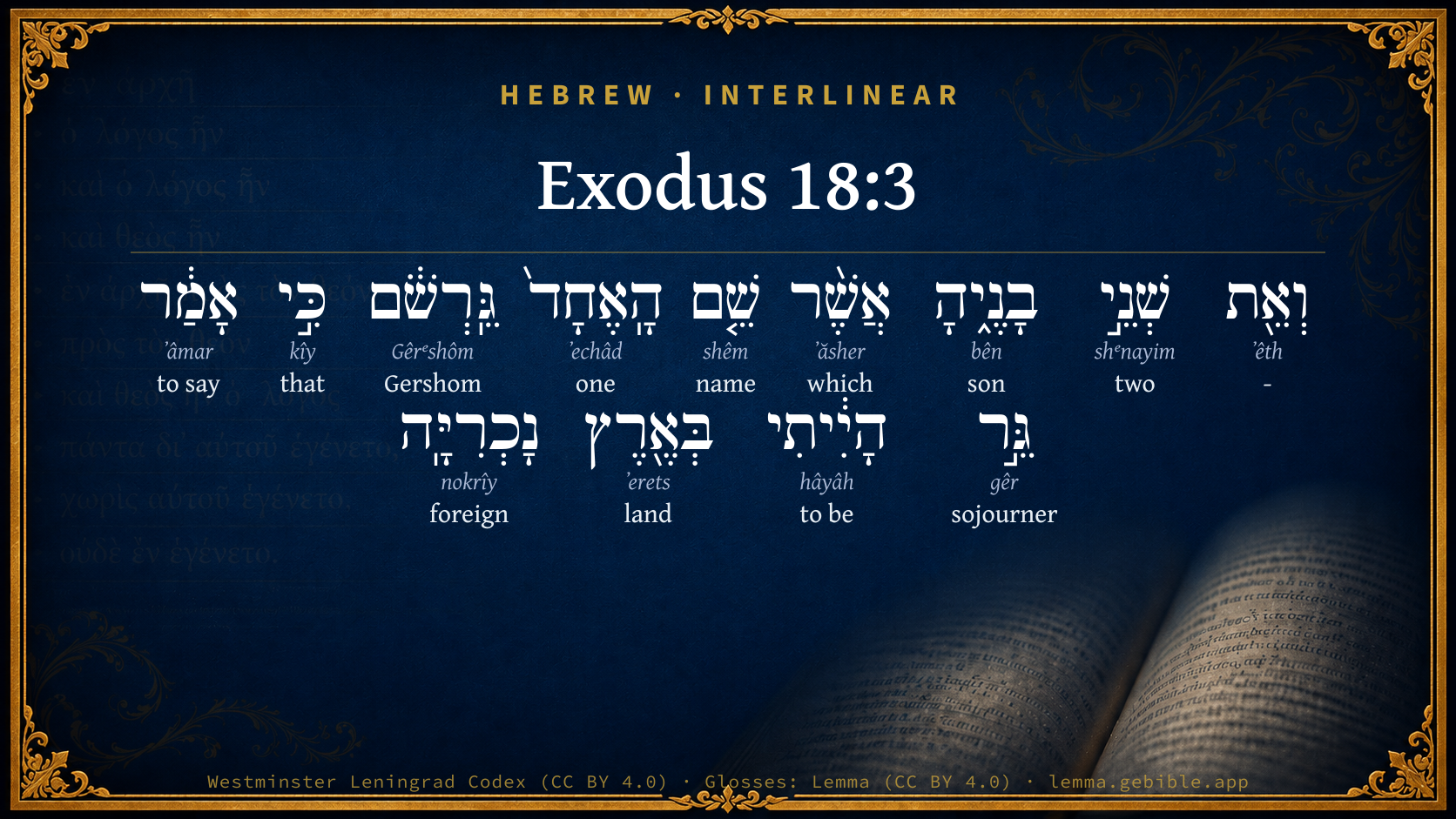
Hebrew (Westminster Leningrad Codex) Exodus 18:3 appears in the Hebrew Old Testament. The text above is from the Westminster Leningrad Codex. Each word links to its Strong’s number, a concise gloss, and parsing drawn from the Open Scriptures Hebrew Bible morphology. Click any word for its full Brown-Driver-Briggs (BDB) entry.
Download image
Cite this verse

Exodus 18:3 (World English Bible). Public Domain. Lemma interlinear Bible study tool, https://lemma.gebible.app/v/exodus/18/3.

Show BibTeX & RIS
BibTeX
RIS
English Translation
and her two sons. The name of one son was Gershom, for Moses said, "I have lived as a foreigner in a foreign land".
World English Bible · Public Domain
Download a study sheet

One document with this verse’s original text, its word-by-word gloss line, the meaning frame, cross-references with their text, attributed commentary, and full source and license credits — printable, and it pastes into notes with its structure intact.

This verse Autodidact and up

Study sheet (.html) Plain text (.txt)

A passage Seminary Student

Up to 50 verses in one chapter. A passage sheet keeps up to 6 commentary sources and 12 cross-references per verse, in the order this page ranks them, and says so on the sheet whenever that leaves anything out. Ask for a single verse and you get the Autodidact verse sheet above.

Everything on this page stays free to read, with no account — the sheet is a download of what is already on screen, not access to it.

Want to remove ads? Support Godless Engineer
Compare translations 3

The same verse in 3 English versions, stacked beneath the original-language interlinear above. Click any original word for its lexicon entry.

Each is an independent rendering of the whole verse — the interlinear is not word-aligned to these translations.

Highlighted words mark where these versions differ — a whole-verse word diff, not a word-by-word alignment.

  • World English Bible Public Domain
    and her two sons. The name of one son was Gershom, for Moses said, "I have lived as a foreigner in a foreign land".
  • King James Version Public Domain
    And her two sons; of which the name of the one was Gershom; for he said, I have been an alien in a strange land:
  • unfoldingWord Literal Text CC BY-SA 4.0
    and her two sons; one of whose names was Gershom, for he had said, “I have been a sojourner in a foreign land.”

unfoldingWord Literal Text — © unfoldingWord, licensed CC BY-SA 4.0. Word-aligned USFM3 via Door43 (git.door43.org/unfoldingWord/en_ult).

Versions to compare (up to 4)

3 of 4 selected

Show all 18 translations

Every available English version of this verse, each an independent rendering of the whole verse.

  • World English Bible Public Domain
    and her two sons. The name of one son was Gershom, for Moses said, "I have lived as a foreigner in a foreign land".
  • Berean Standard Bible Public Domain
    along with her two sons. One son was named Gershom, for Moses had said, “I have been a foreigner in a foreign land.”
  • Majority Standard Bible Public Domain
    along with her two sons. One son was named Gershom, for Moses had said, “I have been a foreigner in a foreign land.”
  • King James Version Public Domain
    And her two sons; of which the name of the one was Gershom; for he said, I have been an alien in a strange land:
  • American Standard Version (1901) Public Domain
    and her two sons; of whom the name of the one was Gershom; for he said, I have been a sojourner in a foreign land:
  • Revised Version (1885) Public Domain
    and her two sons; of which the name of the one was Gershom; for he said, I have been a sojourner in a strange land:
  • Geneva Bible (1599) Public Domain
    And her two sonnes, (whereof the one was called Gershom: for he sayd, I haue bene an aliant in a strange land:
  • Douay-Rheims (1899) Public Domain
    And her two sons, of whom one was called Gersam, his father saying: I have been a stranger in a foreign country.
  • Young's Literal Translation Public Domain
    and her two sons, of whom the name of the one `is' Gershom, for he said, `a sojourner I have been in a strange land:'
  • Literal Standard Version CC BY-SA 4.0
    and her two sons, of whom the name of one [is] Gershom, for he said, “I have been a sojourner in a strange land”;
  • Unlocked Literal Bible CC BY-SA 4.0
    and her two sons; the name of the one son was Gershom, for Moses had said, “I have been a foreigner in a foreign land.”
  • unfoldingWord Literal Text CC BY-SA 4.0
    and her two sons; one of whose names was Gershom, for he had said, “I have been a sojourner in a foreign land.”
  • Darby Bible Public Domain
    and her two sons, of whom the name of the one was Gershom -- for he said, I have been a sojourner in a foreign land,
  • World Messianic Bible Public Domain
    and her two sons. The name of one son was Gershom, for Moses said, “I have lived as a foreigner in a foreign land”.
  • Webster's Bible Public Domain
    And her two sons; of which the name of the one was Gershom; (for he said, I have been an alien in a strange land:)
  • Free Bible Version CC BY-SA 4.0
    together with her two sons. One son was named Gershom, for Moses had said, “I have been a foreigner in a foreign land.”
  • Bible in Basic English Public Domain
    And her two sons, one of whom was named Gershom, for he said, I have been living in a strange land:
  • JPS Tanakh (1917) Public Domain
    and her two sons; of whom the name of the one was Gershom; for he said: 'I have been a stranger in a strange land';

Literal Standard Version (2020), Covenant Press — licensed CC BY-SA 4.0. Text via the HelloAO Bible API (eBible.org). Unlocked Literal Bible (unfoldingWord) — licensed CC BY-SA 4.0. Text via the HelloAO Bible API (eBible.org). unfoldingWord Literal Text — © unfoldingWord, licensed CC BY-SA 4.0. Word-aligned USFM3 via Door43 (git.door43.org/unfoldingWord/en_ult). Free Bible Version, Dr. Jonathan Gallagher — licensed CC BY-SA 4.0. Text via the HelloAO Bible API (eBible.org).

Word by word

More ways to search: Search by grammar → Find every occurrence → Compare this word →

Practice this passage: Drill this verse → Learn its vocabulary →

גֵּֽרְשֹׁ֔ם
Gêrᵉshôm
H1647
“Gershom”
Noun, Proper
Part of Speech
Noun
Type
Proper
Full BDB Definition

Origin: for H1648

TWOT: None

Gershom = "foreigner" - firstborn son of Moses and Zipporah - firstborn son of Levi - a son of the priestly family of Phinehas who returned from exile with Ezra
  1. וְאֵ֖ת ʼêth H853 “and · -” Conjunction + Particle, Direct Object
  2. שְׁנֵ֣י shᵉnayim H8147 “two” Adjective, Cardinal number, Masculine, Dual, Construct
  3. בָנֶ֑יהָ bên H1121 “sons · her” Noun, Common, Masculine, Plural, Construct + Suffix, Personal, 3rd Person, Feminine, Singular
  4. אֲשֶׁ֨ר ʼăsher H834 “which” Particle, Relative
  5. שֵׁ֤ם shêm H8034 “name of” Noun, Common, Masculine, Singular, Construct
  6. הָֽאֶחָד֙ ʼechâd H259 “the · one” Particle, Definite Article + Adjective, Cardinal number, Masculine, Singular, Absolute
  7. כִּ֣י kîy H3588 “that” Conjunction
  8. אָמַ֔ר ʼâmar H559 “to say” Verb, Qal, Perfect, 3rd Person, Masculine, Singular
  9. גֵּ֣ר gêr H1616 “sojourner” Noun, Common, Masculine, Singular, Absolute
  10. הָיִ֔יתִי hâyâh H1961 “to be” Verb, Qal, Perfect, 1st Person, Common, Singular
  11. בְּאֶ֖רֶץ ʼerets H776 “in/at · land” Preposition + Noun, Common, Both, Singular, Absolute
  12. נָכְרִיָּֽה nokrîy H5237 “foreign” Adjective, Adjective, Feminine, Singular, Absolute

About this verse

These counts appear in no published source. They are computed here, from the morphology-tagged text and Lemma’s own curated glosses. What Lemma adds →

13
words
13
distinct lemmas
Pentateuch
section

Notable vocabulary

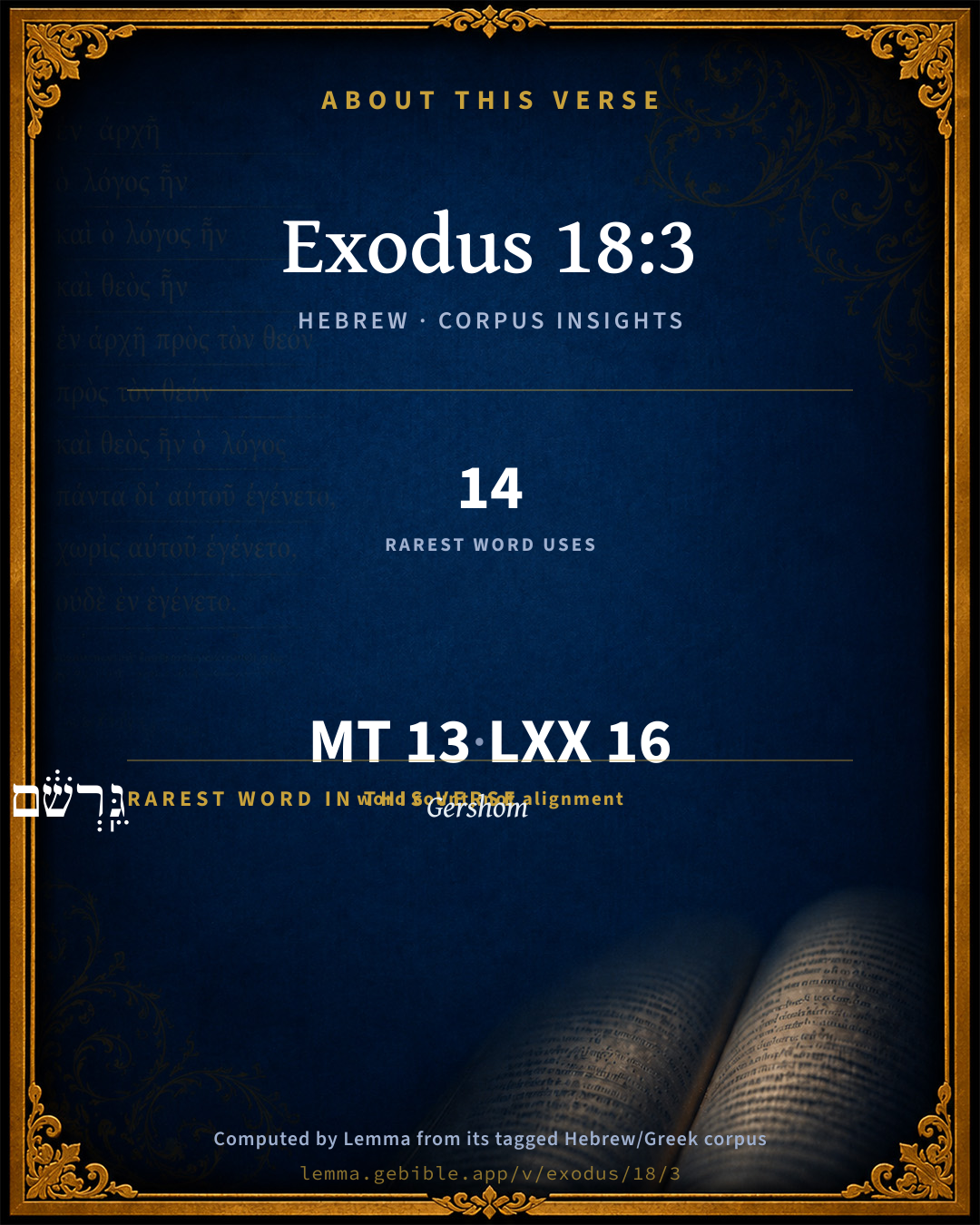
The rarest word here is גֵּֽרְשֹׁ֔ם Gershom H1647 — appearing just 14 times in the whole Hebrew Bible.

Shared distinctive vocabulary

גֵּֽרְשֹׁ֔ם Gershom H1647 occurs in 14 verses of the Hebrew Bible. Also found in:

Grammatical profile

  • 2 verbs
  • 5 nouns
  • 3 adjectives
  • 1 conjunction
  • 2 particles

Verb forms

  • אָמַ֔ר Qal · Perfect
  • הָיִ֔יתִי Qal · Perfect

Hebrew & Septuagint length

In English translation the verse runs 24 words from the Hebrew and 23 from the Septuagint (LXX English) — closely comparable.

A rough comparison of the two English renderings, which tokenize alike — not a word-level alignment.

Word counts can differ between the Hebrew and the Greek without any difference in meaning — e.g. the Hebrew direct-object marker אֵת has no separate Greek word, and Greek often adds the article ὁ.

In the original languages it is 13 Hebrew tokens and 16 Greek tokens — but the two are counted differently (Hebrew bundles its prefixes and suffixes into one token; the Greek is in lemma form), so that isn’t a like-for-like length.

Cross-references

6

Topical passages linked to Exodus 18:3 in the Treasury of Scripture Knowledge — connected by theme and wording, ordered by reader-vote popularity; previews shown in the World English Bible.

  • Exodus 2:22 She bore a son, and he named him Gershom, for he said, "I have lived as a foreigner in a foreign land."
  • Acts 7:29 Moses fled at this saying, and became a stranger in the land of Midian, where he became the father of two sons.
  • Exodus 4:20 Moses took his wife and his sons, and set them on a donkey, and he returned to the land of Egypt. Moses took God's rod in his hand.
  • Psalms 39:12 "Hear my prayer, Yahweh, and give ear to my cry. Don't be silent at my tears. For I am a stranger with you, A foreigner, as all my fathers were.
  • Hebrews 11:13 These all died in faith, not having received the promises, but having seen them and embraced them from afar, and having confessed that they were strangers and pilgrims on the earth.
  • 1 Peter 2:11 Beloved, I beg you as foreigners and pilgrims, to abstain from fleshly lusts, which war against the soul;

Cross-references courtesy of OpenBible.info (CC BY 4.0).

Hebrew and Greek witnesses Masoretic Hebrew ↔ Greek Septuagint

The same verse in the two great witnesses to the Old Testament, shown verse-for-verse.

These are two independent witnesses, not word-aligned to each other, and the Septuagint is shown in lemma (dictionary) form.

Hebrew Exodus 18:3 Masoretic · Westminster Leningrad Codex

וְאֵ֖ת שְׁנֵ֣י בָנֶ֑יהָ אֲשֶׁ֨ר שֵׁ֤ם הָֽאֶחָד֙ גֵּֽרְשֹׁ֔ם כִּ֣י אָמַ֔ר גֵּ֣ר הָיִ֔יתִי בְּאֶ֖רֶץ נָכְרִיָּֽה

and her two sons. The name of one son was Gershom, for Moses said, "I have lived as a foreigner in a foreign land".

World English Bible · Public Domain

Greek LXX Exodus 18:3 Septuagint · lemma form

καί ὁ δύο υἱός αὐτός ὄνομα ὁ εἷς αὐτός γηρσαμ λέγω πάροικος εἰμί ἐν γῆ ἀλλότριος

and her two sons: the name of the one was Gersam, his father saying, I was a sojourner in a strange land; —

LXX2012 (modern English Septuagint) · Public Domain

Hebrew: Westminster Leningrad Codex (CC BY 4.0). Greek: Septuagint (public domain); English from LXX2012 (modern English Septuagint) (Public Domain). How the Septuagint differs from the Hebrew →

Targum (Aramaic paraphrase)

2

The Targum is the ancient Jewish Aramaic paraphrase of the Hebrew Scriptures — an interpretive translation, not the Hebrew text itself. Onkelos (literal) and Pseudo-Jonathan (expansive) render the Torah, and Jonathan the Prophets. Coverage is partial: where no permissively-licensed English translation exists for a verse, only the Aramaic is shown. This is verse-level text, not a word-by-word alignment to the Hebrew.

  1. Targum Onkelos Torah (Genesis–Deuteronomy)
    וְיָת תְּרֵין בְּנָהָא דִי שׁוּם חַד גֵרְשֹׁם אֲרֵי אֲמַר דַיָר הֲוֵיתִי בְּאַרְעָא נוּכְרָאָה:

    (no public-domain English translation for this verse)

    Targum Onkelos — Aramaic: “Onkelos Genesis” (public domain); “Onkelos Exodus” (public domain); “Onkelos Leviticus” (public domain); “Onkelos Numbers” (public domain); “Onkelos Deuteronomy” (public domain). English: “Sefaria Community Translation” (CC0 1.0 (public-domain dedication)); “J.W. Etheridge. The Targums of Onkelos and Jonathan Ben Uzziel on the Pentateuch. London: Longmans, Green, 1862” (public domain). Text via Sefaria.

  2. Targum Pseudo-Jonathan Torah (Genesis–Deuteronomy)
    וְיַת תְּרֵין בְּנָהָא דְּשׁוּם חָד גֵּרְשׁוֹם אֲרוּם אָמַר דַּיָּיר הֲוֵיתִי בְּאַרְעָא נוּכְרָאָה דְלָא דִידִי הוּא

    and his two sons, the name of the one of whom was Gershom, Because He had said, I am a dweller in a strange land which is not mine;

    Targum Pseudo-Jonathan — Aramaic: “Targum Jonathan on Genesis” (public domain); “Targum Jonathan on Exodus” (public domain); “Targum Jonathan on Leviticus” (public domain); “Targum Jonathan on Numbers” (public domain); “Targum Jonathan on Deuteronomy” (public domain). English: “The Targum of Jonathan ben Uzziel, trans. J. W. Etheridge, London, 1862” (public domain). Text via Sefaria.

Commentary

Notes on Exodus 18:3 from classic Christian and Jewish commentators (each source and its license shown beneath its notes). The classic Christian expositions comment on the surrounding passage and are grouped to its opening verse, so a note may address several verses; the Jewish commentaries on the Tanakh (Rashi and others) are per-verse, so they appear only where the commentator wrote on this verse.

Lemma curates 59 commentaries, every one of them public domain or Creative Commons licensed, each selected and text-cleaned for this edition rather than reprinted as found. About our sources →

Trapp's Complete Commentary

John Trapp

Exo 18:3 And her two sons; of which the name of the one [was] Gershom; for he said, I have been an alien in a strange land:

Ver. 3. In a strange land.] {See Trapp on "Exo 2:22"}

John Trapp, A Commentary or Exposition upon All the Books of the Old and New Testament (1647–1656) — public domain. Text from a community e-Sword module.

Joseph Benson's Commentary

Exo 18:3. The name of one was Gershom — A stranger, designing thereby not only a memorial of his own condition, but a memorandum to his son of his, for we are all strangers upon earth.

Joseph Benson's Commentary on the Old and New Testaments (1811–1818) — public domain. Text from a community e-Sword module.

MacLaren's Expositions of Holy Scripture

Alexander MacLaren

Exodus

GERSHOM AND ELIEZER

Exo 18:3 - - Exo 18:4.

In old times parents often used to give expression to their hopes or their emotions in the names of their children. Very clearly that was the case in Moses’ naming of his two sons, who seem to have been the whole of his family. The significance of each name is appended to it in the text. The explanation of the first is, ‘For he said, I have been an alien in a strange land’; and that of the second, ‘For the God of my fathers, said he, was mine help, and delivered me from the sword of Pharaoh.’ These two names give us a pathetic glimpse of the feelings with which Moses began his exile, and of the better thoughts into which these gradually cleared. The first child’s name expresses his father’s discontent, and suggests the bitter contrast between Sinai and Egypt; the court and the sheepfold; the gloomy, verdureless, gaunt peaks of Sinai, blazing in the fierce sunshine, and the cool, luscious vegetation of Goshen, the land for cattle. The exile felt himself all out of joint with his surroundings, and so he called the little child that came to him ‘Gershom,’ which, according to one explanation, means ‘banishment,’ and, according to another {a kind of punning etymology}, means ‘a stranger here’; in the other case expressing the same sense of homelessness and want of harmony with his surroundings. But as the years went on, Moses began to acclimatise himself, and to become more reconciled to his position and to see things more as they really were. So, when the second child is born, all his murmuring has been hushed, and he looks beyond circumstances, and lays his hand upon God. ‘And the name of the second was Eliezer, for, he said, the God of my fathers was my help.’

Now, there are the two main streams of thought that filled these forty years; and it was worth while to put Moses into the desert for all that time, and to break off the purposes and hopes of his life sharp and short, and to condemn him to comparative idleness, or work that was all unfitted to bring out his special powers, for that huge scantling out of his life, one-third of the whole of it, in order that there might be burnt into him, not either of these two thoughts separately, but the two of them in their blessed conjunction; ‘I am a stranger here’; ‘God is my Help.’ And so these are the thoughts which, in like juxtaposition, ought to be ours; and in higher fashion with regard to the former of them than was experienced by Moses. Let me say a word or two about each of these two things. Let us think of the strangers, and of the divine helper that is with the strangers.

I. ‘A stranger here.’

Now, that is true, in the deepest sense, about all men; for the one thing that makes the difference between the man and the beast is that the beast is perfectly at home in his surroundings, and gets all that he needs out of them, and finds in them a field for all that he can do, and is fully developed to the very highest point of his capacity by what people nowadays call the ‘environment’ in which he is put. But the very opposite is the case in regard to us men. ‘Foxes have holes,’ and they are quite comfortable there; ‘and the birds of the air have roosting-places,’ and tuck their heads under their wings and go to sleep without a care and without a consciousness. ‘But the Son of man,’ the ideal Humanity as well as the realised ideal in the person of Jesus Christ, ‘hath not where to lay His head.’ No; because He is so ‘much better than they.’ Their immunity from care is not a prerogative-it is an inferiority. We are plunged into the midst of a scene of things which obviously does not match our capacities. There is a great deal more in every man than can ever find a field of expression, of work, or of satisfaction in anything beneath the stars. And no man that understands, even superficially, his own character, his own requirements, can fail to feel in his sane and quiet moments, when the rush of temptation and the illusions of this fleeting life have lost their grip upon him: ‘This is not the place that can bring out all that is in me, or that can yield me all that I desire.’ Our capacities transcend the present, and the experiences of the present are all unintelligible, unless the true end of every human life is not here at all, but in another region, for which these experiences are fitting us.

But, then, the temptations of life, the strong appeals of flesh and sense, the duties which in their proper place are lofty and elevating and refining, and put out of their place, are contemptible and degrading, all come in to make it hard for any of us to keep clearly before us what our consciousness tells us when it is strongly appealed to, that we are strangers and sojourners here and that this is not ‘our rest, because it is polluted.’ Therefore it comes to be the great glory and blessedness of the Christian Revelation that it obviously shifts the centre for us, and makes that future, and not this present, the aim for which, and in the pursuit of which, we are to live. So, Christian people, in a far higher sense than Moses, who only felt himself ‘a stranger there,’ because he did not like Midian as well as Egypt, have to say, ‘We are strangers here’; and the very aim, in one aspect, of our Christian discipline of ourselves is that we shall keep vivid, in the face of all the temptations to forget it, this consciousness of being away from our true home.

One means of doing that is to think rather oftener than the most of us do, about our true home. You have heard, I dare say, of half-reclaimed gipsies, who for a while have been coaxed out of the free life of the woods and the moors, and have gone into settled homes. After a while there has come over them a rush of feeling, a remembrance of how blessed it used to be out in the open and away from the squalor and filth where men ‘sit and hear each other groan’ and they have flung off ‘as if they were fetters’ the trappings of ‘civilisation,’ and gone back to liberty. That is what we ought to do-not going back from the higher to the lower, but smitten with what the Germans call the heimweh, the home-sickness, that makes us feel that we must get clearer sight of that land to which we truly belong.

Do you think about it, do you feel that where Jesus Christ is, is your home? I have no doubt that most of you have, or have had, dear ones here on earth about whom you could say that, ‘Where my husband, my wife is; where my beloved is, or my children are, that is my home, wherever my abode may be.’ Are you, Christian people, saying the same thing about heaven and Jesus Christ? Do you feel that you are strangers here, not only because you, reflecting upon your character and capacities and on human life, see that all these require another life for their explanation and development, but because your hearts are knit to Him, and ‘where your treasure is there your heart is also’; and where your heart is there you are? We go home when we come into communion with Jesus Christ. Do you ever, in the course of the rush of your daily work, think about the calm city beyond the sea, and about its King, and that you belong to it? ‘Our citizenship is in heaven’ and here we are strangers.

II. Now let me say a word about the other child’s name.

‘God is Helper.’ We do not know what interval of time elapsed between the birth of these two children. There are some indications that the second of them was in years very much the junior. Perhaps the transition from the mood represented in the one name to that represented in the other, was a long and slow process. But be that as it may, note the connection between these two names. You can never say ‘We are strangers here’ without feeling a little prick of pain, unless you say too ‘God is my Helper.’ There is a beautiful variation of the former word which will occur to many of you, I have no doubt, in one of the old psalms: ‘I am a stranger with Thee, and a sojourner, as were all my fathers.’ There is the secret that takes away all the mourning, all the possible discomfort and pain, out of the thought: ‘Here we have no continuing city,’ and makes it all blessed. It does not matter whether we are in a foreign land or no, if we have that Companion with us. His presence will make blessedness in Midian, or in Thebes. It does not matter whether it is Goshen or the wilderness, if the Lord is by our side. So sweetness is breathed into the thought, and bitterness is sucked out of it, when the name of the second child is braided into the name of the first; and we can contemplate quietly all else of tragic and limiting and sad that is involved in the thought that we are sojourners and pilgrims, when we say ‘Yes! we are; but the Lord is my Helper.’

Then, on the other hand, we shall never say and feel ‘the Lord is my Helper,’ as we ought to do, until we have got deep in our hearts, and settled in our consciousness, the other conviction that we are strangers here. It is only when we realise that there is no other permanence for us that we put out our hands and grasp at the Eternal, in order not to be swept away upon the dark waves of the rushing stream of Time. It is only when all other props are stricken from us that we rest our whole weight upon that one strong central pillar, which can never be moved. Learn that God helps, for that makes it possible to say ‘I am a stranger,’ and not to weep. Learn that you are strangers, for that stimulates to take God for out help. Just as when the floods are out, men are driven to the highest ground to save their lives; so when the billows of the waters of time are seen to be rolling over all creatural things, we take our flight to the Rock of Ages. Put the two together, and they fit one another and strengthen us.

This second conviction was the illuminating light upon a perplexed and problematic past. Moses, when he fled from Egypt, thought that his life’s work was rent in twain. He had believed that his brethren would have seen that it was God’s purpose to use him as the deliverer. For the sake of being such, he had surrendered the court and its delights. But on his young ambition and innocent enthusiasm there came this douche of cold water, which lasted for forty years, and sent him away into the wilderness, to be a shepherd under an Arab sheikh, with nothing to look forward to. At first he said, ‘This is not what I was meant for; I am out of my element here.’ But before the forty years were over he said, ‘The God of my father was my help, and He delivered me from the sword of Pharaoh.’ What had looked a disaster turned out to be a deliverance, a manifestation of divine help, and not a hindrance. He had got far enough away from that past to look at it sanely, that is to say gratefully. So we, when we get far enough away from our sorrows, can look back at them, sometimes even here on earth, and say, ‘The mercy of the Lord compassed me about.’ Here is the key that unlocks all the perplexities of providence, ‘The Lord was my Helper.’

And that conviction will steady and uphold a man in a present, however dark. It was no small exercise of his faith and patience that the great lawgiver should for so many years have such unworthy work to do as he had in Midian. But even then he gathered into his heart this confidence, and brought summer about him into the mid-winter of his life, and light into the midst of darkness; ‘for he said’-even then, when there was no work for him to do that seemed much to need a divine help-’the Lord is my Helper.’

And so, however dark may be our present moment, and however obscure or repulsive our own tasks, let us fall back upon that old word, ‘Thou hast been my Help; leave me not, neither forsake me, O God of my salvation.’

When Moses named his boy, his gratitude was allied with faith in favours to come; and when he said ‘was,’ he meant also ‘will be.’ And he was right. He dreamt very little of what was coming, but this confidence that was expressed in his second child’s name was warranted by that great future that lay before him, though he did not know it. When the pinch came his confidence faltered. It was easy to say ‘The Lord is my Helper,’ when there was nothing very special for which God’s help was needed, and nothing harder to do than to look after a few sheep in the wilderness. But when God said to him, ‘Go and stand before Pharaoh,’ Moses for the moment forgot all about God’s being his helper, and was full of all manner of cowardly excuses, which, like the excuses of a great many more of us for not doing our plain duty, took the shape of a very engaging modesty and diffidence as to his capacities. But God said to him, ‘Surely I will be with thee.’ He gave him back ‘Eliezer’ in a little different form. ‘You used to say that I was your helper. What has become of your faith now? Has it all evaporated when the trial comes? Surely I will be with thee.’ If we will set ourselves to our tasks, not doubting God’s help, we shall have occasion in the event to be sure that God did help us.

So, brethren, let us cherish these two thoughts, and never keep them apart, and God will be, as our good old hymn has it-

‘Our help while troubles last,

And our eternal home.’

Alexander MacLaren, Expositions of Holy Scripture (1904–1910) — public domain. Text from a community e-Sword module.

Adam Clarke's Commentary

Verse 3. The name of the one was Gershom] See Clarke on Ex 2:22.

Adam Clarke's Commentary on the Bible (1810–1826) — public domain. Text from a community e-Sword/MySword module.

Ellicott's Commentary for English Readers

(3)Gershom.—See Note on Exo_2:22.

A Bible Commentary for English Readers, edited by Charles John Ellicott (1878–1897) — public domain. Text from a community e-Sword module.

The Cambridge Bible for Schools and Colleges

gen. ed. J. J. S. Perowne

3. I have been a sojourner in a foreign land] Repeated verbatim from Exo_2:22. Eliezer is mentioned only here.

The Cambridge Bible for Schools and Colleges (gen. ed. J. J. S. Perowne; Cambridge University Press, 1878–1918) — public domain. Text from a community e-Sword module.

John Gill's Exposition

And her two sons,.... Those also Jethro took along with him and his daughter:

of which the name of the one was Gershom; which seems to be his firstborn, Exo 2:22, his name signifies a desolate stranger, as some, or, "there I was a stranger": the reason of which name follows agreeably thereunto:

for he said, I have been an alien in a strange land; meaning, not the land of Egypt, where he was born, and had lived forty years; but in the land of Midian, where he was when this son of his was born; and which name was given him partly to keep up the memory of his flight to Midian, and partly to instruct his son, that Midian, though his native place, was not his proper country where he was to dwell, but another, even the land of Canaan.

John Gill's Exposition of the Whole Bible (1746–1763) — public domain (CC PDM 1.0). Text via the HelloAO Bible API.

Whedon's Commentary on the Bible

Daniel D. Whedon

3. Gershom — See on Exo_2:22.

Daniel D. Whedon (gen. ed.), Commentary on the Old and New Testaments (1874–1909) — public domain. Text from a community e-Sword module.

The Pulpit Commentary

And her two sons. That Zipporah had borne Moses at least two sons before his return to Egypt from Midian, had appeared from Exo_4:20. The name of the one, Gershom, and the ground of it, had been declared in Exo_2:22. The repetition here may be accounted for by the present chapter having been originally a distinct and separate composition, written on a distinct roll, and subsequently incorporated by Moses into his great work.

The Pulpit Commentary (1880–1919), ed. H.D.M. Spence-Jones & Joseph S. Exell — public domain. Text from a community e-Sword module.

John Wesley's Explanatory Notes

The name of one was Gershom - A stranger, designing thereby not only a memorial of his own condition, but a memorandum to this son of his, for we are all strangers upon earth.

John Wesley, Explanatory Notes Upon the Whole Bible (1754–1765) — public domain. Text via the GEBible commentary corpus.

Ramban (Nachmanides)

Rabbi Moshe ben Nachman (Ramban / Nachmanides)

AND HER TWO SONS; OF WHOM THE NAME OF THE ONE WAS GERSHOM. Even though this is not the place where [the narrative of] their birth is told, Scripture here explains the names of the two sons [of Moses — Gershom and Eliezer —] because there was no opportunity to mention the name of Eliezer at his birth, as I have explained in Seder V’eileh Shemoth. Here, Scripture wanted to mention the kindness that the Holy One, blessed be He, had shown to Moses, who was a stranger in a strange land. [When he named his second son], he gave thanks there to G-d for having delivered him from the sword of Pharaoh when he fled from before him, 2:15. [and for making him] now king over Israel, and [because] He drowned Pharaoh and his people in the sea.The sense of the expression for he said, I have been a stranger, etc. is connected with Moses, who is mentioned in the first verse, [and not with Jethro, who is mentioned in the second verse]. Similarly, the following verse, And the name of the other was Eliezer: for the G-d of my father was my help, is connected with the expression for he said, [found in the verse before us. It thus reads: “And the name of the other was Eliezer; for he said: for the G-d, etc.”] There are many cases like that.

Ramban (Nachmanides) on the Tanakh — English translation: “Commentary on the Torah by Ramban (Nachmanides). Translated and annotated by Charles B. Chavel. New York, Shilo Pub. House, 1971-1976” (CC BY 4.0). Text via Sefaria.

Lesson kit

Teaching starters — assembled from the data on this page, not authored interpretation. Every prompt links to the verse data it draws on. Edit before teaching.

Exodus, in the Pentateuch, opens this verse with 13 words (13 distinct Hebrew lemmas). Its most distinctive word is Gêrᵉshôm (“Gershom”). A historical commentator’s framing appears above. Read the whole chapter for the surrounding context.

Discussion questions

  1. How does “Gershom” (Gêrᵉshôm) shape what this verse is saying?
  2. Exodus 2:22 shares the word «Gershom» with this verse. How do the two illuminate each other?
  3. These translations render this verse differently; the difference is in the English rendering, not the original. What questions does that raise?
  4. The verb «אָמַ֔ר» is Qal Perfect. How does its form color the action?
  5. Reading how Trapp's Complete Commentary and Joseph Benson's Commentary read this verse, where do the two commentators agree and where do they part?

Things to notice

Reading settings

Reading text

Shown beneath each verse's original-language words.

Old Testament
Old Testament edition

Read the OT as the Masoretic Hebrew (MT) or the Greek Septuagint (LXX).

English shown for the Greek Septuagint (in the Hebrew ↔ Greek comparison).

Comparing translations? Open the Compare panel on any verse page to stack up to four side by side.