
Numbers 7:17

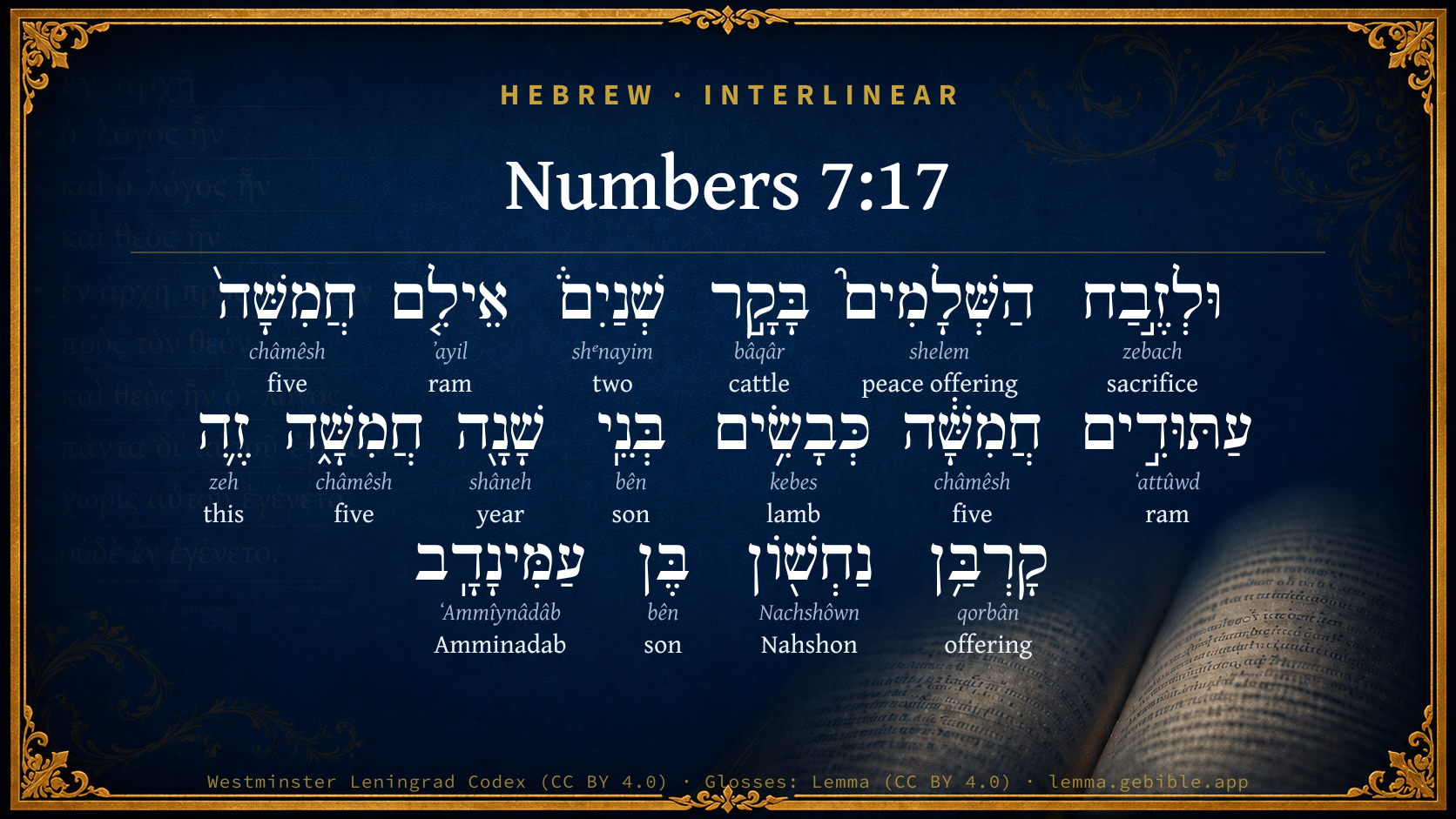
Hebrew (Westminster Leningrad Codex) Numbers 7:17 appears in the Hebrew Old Testament. The text above is from the Westminster Leningrad Codex. Each word links to its Strong’s number, a concise gloss, and parsing drawn from the Open Scriptures Hebrew Bible morphology. Click any word for its full Brown-Driver-Briggs (BDB) entry.
Download image
Cite this verse

Numbers 7:17 (World English Bible). Public Domain. Lemma interlinear Bible study tool, https://lemma.gebible.app/v/numbers/7/17.

Show BibTeX & RIS
BibTeX
RIS
English Translation
and for the sacrifice of peace offerings, two oxen, five rams, five male goats, and five male lambs a year old. This was the offering of Nahshon the son of Amminadab.
World English Bible · Public Domain
Download a study sheet

One document with this verse’s original text, its word-by-word gloss line, the meaning frame, cross-references with their text, attributed commentary, and full source and license credits — printable, and it pastes into notes with its structure intact.

This verse Autodidact and up

Study sheet (.html) Plain text (.txt)

A passage Seminary Student

Up to 50 verses in one chapter. A passage sheet keeps up to 6 commentary sources and 12 cross-references per verse, in the order this page ranks them, and says so on the sheet whenever that leaves anything out. Ask for a single verse and you get the Autodidact verse sheet above.

Everything on this page stays free to read, with no account — the sheet is a download of what is already on screen, not access to it.

Want to remove ads? Support Godless Engineer
Compare translations 3

The same verse in 3 English versions, stacked beneath the original-language interlinear above. Click any original word for its lexicon entry.

Each is an independent rendering of the whole verse — the interlinear is not word-aligned to these translations.

Highlighted words mark where these versions differ — a whole-verse word diff, not a word-by-word alignment.

  • World English Bible Public Domain
    and for the sacrifice of peace offerings, two oxen, five rams, five male goats, and five male lambs a year old. This was the offering of Nahshon the son of Amminadab.
  • King James Version Public Domain
    And for a sacrifice of peace offerings, two oxen, five rams, five he goats, five lambs of the first year: this was the offering of Nahshon the son of Amminadab.
  • unfoldingWord Literal Text CC BY-SA 4.0
    and for the sacrifice of the peace offering two cattle, five rams, five male goats, five male lambs (sons of a year). This the offering of Nahshon, the son of Amminadab.

unfoldingWord Literal Text — © unfoldingWord, licensed CC BY-SA 4.0. Word-aligned USFM3 via Door43 (git.door43.org/unfoldingWord/en_ult).

Versions to compare (up to 4)

3 of 4 selected

Show all 18 translations

Every available English version of this verse, each an independent rendering of the whole verse.

  • World English Bible Public Domain
    and for the sacrifice of peace offerings, two oxen, five rams, five male goats, and five male lambs a year old. This was the offering of Nahshon the son of Amminadab.
  • Berean Standard Bible Public Domain
    and a peace offering of two oxen, five rams, five male goats, and five male lambs a year old. This was the offering of Nahshon son of Amminadab.
  • Majority Standard Bible Public Domain
    and a peace offering of two oxen, five rams, five male goats, and five male lambs a year old. This was the offering of Nahshon son of Amminadab.
  • King James Version Public Domain
    And for a sacrifice of peace offerings, two oxen, five rams, five he goats, five lambs of the first year: this was the offering of Nahshon the son of Amminadab.
  • American Standard Version (1901) Public Domain
    and for the sacrifice of peace-offerings, two oxen, five rams, five he-goats, five he-lambs a year old: this was the oblation of Nahshon the son of Amminadab.
  • Revised Version (1885) Public Domain
    and for the sacrifice of peace offerings, two oxen, five rams, five he-goats, five he-lambs of the first year: this was the oblation of Nahshon the son of Amminadab.
  • Geneva Bible (1599) Public Domain
    And for peace offrings, two bullockes, fiue rams, fiue hee goates, and fiue lambes of a yeere olde: this was the offring of Nahshon the sonne of Amminadab.
  • Douay-Rheims (1899) Public Domain
    A little mortar of ten sides of gold full of incense:
  • Young's Literal Translation Public Domain
    and for a sacrifice of the peace-offerings two oxen, five rams, five he-goats, five lambs, sons of a year; this `is' the offering of Nahshon son of Amminadab.
  • Literal Standard Version CC BY-SA 4.0
    and for a sacrifice of the peace-offerings: two oxen, five rams, five male goats, five lambs, sons of a year; this [is] the offering of Nahshon son of Amminadab.
  • Unlocked Literal Bible CC BY-SA 4.0
    He gave two oxen, five rams, five male goats, and five male lambs that were a year old, as the sacrifice for a fellowship offering. This was the sacrifice of Nahshon son of Amminadab.
  • unfoldingWord Literal Text CC BY-SA 4.0
    and for the sacrifice of the peace offering two cattle, five rams, five male goats, five male lambs (sons of a year). This the offering of Nahshon, the son of Amminadab.
  • Darby Bible Public Domain
    and for a sacrifice of peace-offering, two oxen, five rams, five he-goats, five yearling lambs. This was the offering of Nahshon the son of Amminadab.
  • World Messianic Bible Public Domain
    and for the sacrifice of peace offerings, two head of cattle, five rams, five male goats, and five male lambs a year old. This was the offering of Nahshon the son of Amminadab.
  • Webster's Bible Public Domain
    And for a sacrifice of peace-offerings, two oxen, five rams, five he-goats, five lambs of the first year; this was the offering of Nahshon the son of Amminadab.
  • Free Bible Version CC BY-SA 4.0
    and a peace offering of two oxen, five rams, five male goats, and five one-year-old male lambs. This was the offering of Nahshon, son of Amminadab.
  • Bible in Basic English Public Domain
    And for the peace-offerings, two oxen, five male sheep, five he-goats, five he-lambs of the first year: this was the offering of Nahshon, the son of Amminadab.
  • JPS Tanakh (1917) Public Domain
    and for the sacrifice of peace-offerings, two oxen, five rams, five he-goats, five he-lambs of the first year. This was the offering of Nahshon the son of Amminadab.

Literal Standard Version (2020), Covenant Press — licensed CC BY-SA 4.0. Text via the HelloAO Bible API (eBible.org). Unlocked Literal Bible (unfoldingWord) — licensed CC BY-SA 4.0. Text via the HelloAO Bible API (eBible.org). unfoldingWord Literal Text — © unfoldingWord, licensed CC BY-SA 4.0. Word-aligned USFM3 via Door43 (git.door43.org/unfoldingWord/en_ult). Free Bible Version, Dr. Jonathan Gallagher — licensed CC BY-SA 4.0. Text via the HelloAO Bible API (eBible.org).

Word by word

More ways to search: Search by grammar → Find every occurrence → Compare this word →

Practice this passage: Drill this verse → Learn its vocabulary →

נַחְשׁ֖וֹן
Nachshôwn
H5177
“Nahshon”
Noun, Proper
Part of Speech
Noun
Type
Proper
Full BDB Definition

Origin: from H5172

TWOT: None

Nahshon = "enchanter" - son of Amminadab and prince of the Judah at the first numbering in the wilderness; 5th in descent from Judah in the genealogy of Christ
  1. וּלְזֶ֣בַח zebach H2077 “and · to/for · sacrifice of” Conjunction + Preposition + Noun, Common, Masculine, Singular, Construct
  2. הַשְּׁלָמִים֮ shelem H8002 “the · peace offerings” Particle, Definite Article + Noun, Common, Masculine, Plural, Absolute
  3. בָּקָ֣ר bâqâr H1241 “cattle” Noun, Common, Both, Singular, Absolute
  4. שְׁנַיִם֒ shᵉnayim H8147 “two” Adjective, Cardinal number, Masculine, Dual, Absolute
  5. אֵילִ֤ם ʼayil H352 “rams” Noun, Common, Masculine, Plural, Absolute
  6. חֲמִשָּׁה֙ châmêsh H2568 “five” Adjective, Cardinal number, Masculine, Singular, Absolute
  7. עַתּוּדִ֣ים ʻattûwd H6260 “rams” Noun, Common, Masculine, Plural, Absolute
  8. חֲמִשָּׁ֔ה châmêsh H2568 “five” Adjective, Cardinal number, Masculine, Singular, Absolute
  9. כְּבָשִׂ֥ים kebes H3532 “lambs” Noun, Common, Masculine, Plural, Absolute
  10. בְּנֵֽי bên H1121 “sons of” Noun, Common, Masculine, Plural, Construct
  11. שָׁנָ֖ה shâneh H8141 “year” Noun, Common, Feminine, Singular, Absolute
  12. חֲמִשָּׁ֑ה châmêsh H2568 “five” Adjective, Cardinal number, Masculine, Singular, Absolute
  13. זֶ֛ה zeh H2088 “this” Pronoun, Demonstrative, Masculine, Singular
  14. קָרְבַּ֥ן qorbân H7133 “offering of” Noun, Common, Masculine, Singular, Construct
  15. בֶּן bên H1121 “son of” Noun, Common, Masculine, Singular, Construct
  16. עַמִּינָדָֽב ʻAmmîynâdâb H5992 “Amminadab” Noun, Proper

About this verse

These counts appear in no published source. They are computed here, from the morphology-tagged text and Lemma’s own curated glosses. What Lemma adds →

17
words
14
distinct lemmas
Pentateuch
section

Notable vocabulary

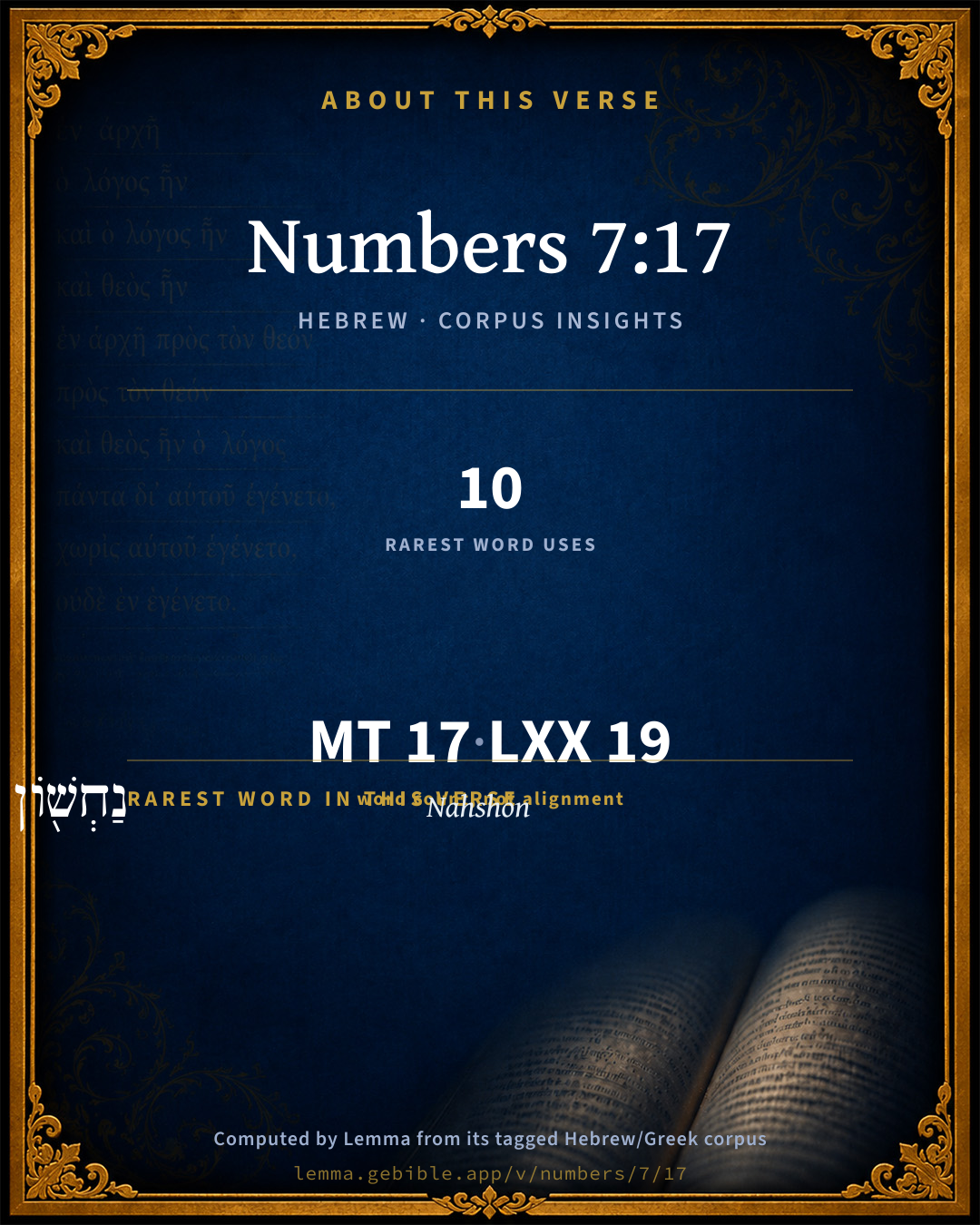
The rarest word here is נַחְשׁ֖וֹן Nahshon H5177 — appearing just 10 times in the whole Hebrew Bible.

Shared distinctive vocabulary

נַחְשׁ֖וֹן Nahshon H5177 occurs in 9 verses of the Hebrew Bible. Also found in:

Grammatical profile

  • 12 nouns
  • 4 adjectives
  • 1 pronoun

Repetition

Words recur within this verse — often emphatic in Hebrew:

  • חֲמִשָּׁה֙ five H2568 ×3
  • בְּנֵֽי son H1121 ×2

Hebrew & Septuagint length

In English translation the verse runs 31 words from the Hebrew and 29 from the Septuagint (LXX English) — closely comparable.

A rough comparison of the two English renderings, which tokenize alike — not a word-level alignment.

Word counts can differ between the Hebrew and the Greek without any difference in meaning — e.g. the Hebrew direct-object marker אֵת has no separate Greek word, and Greek often adds the article ὁ.

In the original languages it is 17 Hebrew tokens and 19 Greek tokens — but the two are counted differently (Hebrew bundles its prefixes and suffixes into one token; the Greek is in lemma form), so that isn’t a like-for-like length.

Cross-references

2

Topical passages linked to Numbers 7:17 in the Treasury of Scripture Knowledge — connected by theme and wording, ordered by reader-vote popularity; previews shown in the World English Bible.

  • Leviticus 3:1–17 "'If his offering is a sacrifice of peace offerings; if he offers it from the herd, whether male or female, he shall offer it without blemish before Yahweh.
  • 2 Corinthians 5:19–21 namely, that God was in Christ reconciling the world to himself, not reckoning to them their trespasses, and having committed to us the word of reconciliation.

Cross-references courtesy of OpenBible.info (CC BY 4.0).

Hebrew and Greek witnesses Masoretic Hebrew ↔ Greek Septuagint

The same verse in the two great witnesses to the Old Testament, shown verse-for-verse.

These are two independent witnesses, not word-aligned to each other, and the Septuagint is shown in lemma (dictionary) form.

Hebrew Numbers 7:17 Masoretic · Westminster Leningrad Codex

וּלְזֶ֣בַח הַשְּׁלָמִים֮ בָּקָ֣ר שְׁנַיִם֒ אֵילִ֤ם חֲמִשָּׁה֙ עַתּוּדִ֣ים חֲמִשָּׁ֔ה כְּבָשִׂ֥ים בְּנֵֽי שָׁנָ֖ה חֲמִשָּׁ֑ה זֶ֛ה קָרְבַּ֥ן נַחְשׁ֖וֹן בֶּן עַמִּינָדָֽב

and for the sacrifice of peace offerings, two oxen, five rams, five male goats, and five male lambs a year old. This was the offering of Nahshon the son of Amminadab.

World English Bible · Public Domain

Greek LXX Numbers 7:17 Septuagint · lemma form

καί εἰς θυσία σωτήριον δάμαλις δύο κριός πέντε τράγος πέντε ἀμνάς ἐνιαύσιος πέντε οὗτος ὁ δῶρον ναασσων υἱός αμιναδαβ

And for a sacrifice of peace-offering, two heifers, five rams, five he goats, five ewe-lambs of a year old: this was the gift of Naasson the son of Aminadab.

LXX2012 (modern English Septuagint) · Public Domain

Hebrew: Westminster Leningrad Codex (CC BY 4.0). Greek: Septuagint (public domain); English from LXX2012 (modern English Septuagint) (Public Domain). How the Septuagint differs from the Hebrew →

Targum (Aramaic paraphrase)

2

The Targum is the ancient Jewish Aramaic paraphrase of the Hebrew Scriptures — an interpretive translation, not the Hebrew text itself. Onkelos (literal) and Pseudo-Jonathan (expansive) render the Torah, and Jonathan the Prophets. Coverage is partial: where no permissively-licensed English translation exists for a verse, only the Aramaic is shown. This is verse-level text, not a word-by-word alignment to the Hebrew.

  1. Targum Onkelos Torah (Genesis–Deuteronomy)
    וּלְנִכְסַת קוּדְשַׁיָּא תּוֹרִין תְּרֵין דִּכְרִין חַמְשָׁא גְּדָיֵי חַמְשָׁא אִמְּרִין בְּנֵי שַׁתָּא חַמְשָׁא דֵּין קֻרְבָּנָא דְנַחְשׁוֹן בַּר עַמִּינָדָב

    (no public-domain English translation for this verse)

    Targum Onkelos — Aramaic: “Onkelos Genesis” (public domain); “Onkelos Exodus” (public domain); “Onkelos Leviticus” (public domain); “Onkelos Numbers” (public domain); “Onkelos Deuteronomy” (public domain). English: “Sefaria Community Translation” (CC0 1.0 (public-domain dedication)); “J.W. Etheridge. The Targums of Onkelos and Jonathan Ben Uzziel on the Pentateuch. London: Longmans, Green, 1862” (public domain). Text via Sefaria.

  2. Targum Pseudo-Jonathan Torah (Genesis–Deuteronomy)
    וּלְנִכְסַת קוּדְשַׁיָא תּוֹרִין תְּרֵין דִכְרִין חַמְשָׁא בַּרְחֵי חַמְשָׁא אִמְרִין בְּנֵי שְׁנָה חַמְשָׁא דֵין סֵדֶר קוּרְבָּנָא דִי יְקָרֵיב מִנִכְסוֹי נַחְשׁוֹן בַּר עַמִינָדָב

    and for consecrated victims, two oxen, five rams, five goats, lambs of the year five: this is the order of the oblation which Nachshon bar Amminadab offered of his wealth.

    Targum Pseudo-Jonathan — Aramaic: “Targum Jonathan on Genesis” (public domain); “Targum Jonathan on Exodus” (public domain); “Targum Jonathan on Leviticus” (public domain); “Targum Jonathan on Numbers” (public domain); “Targum Jonathan on Deuteronomy” (public domain). English: “The Targum of Jonathan ben Uzziel, trans. J. W. Etheridge, London, 1862” (public domain). Text via Sefaria.

Commentary

Notes on Numbers 7:17 from classic Christian and Jewish commentators (each source and its license shown beneath its notes). The classic Christian expositions comment on the surrounding passage and are grouped to its opening verse, so a note may address several verses; the Jewish commentaries on the Tanakh (Rashi and others) are per-verse, so they appear only where the commentator wrote on this verse.

Lemma curates 59 commentaries, every one of them public domain or Creative Commons licensed, each selected and text-cleaned for this edition rather than reprinted as found. About our sources →

Trapp's Complete Commentary

John Trapp

Num 7:17 And for a sacrifice of peace offerings, two oxen, five rams, five he goats, five lambs of the first year: this [was] the offering of Nahshon the son of Amminadab.

Ver. 17. And for peace offerings.] Sacrifices of all sorts they brought, whereby, having made their peace, they kept a feast with joy before the Lord, for his mercy to them through the merits of his Son.

John Trapp, A Commentary or Exposition upon All the Books of the Old and New Testament (1647–1656) — public domain. Text from a community e-Sword module.

Joseph Benson's Commentary

Num 7:17. Peace-offerings — This sacrifice was the last, and on a part of it the people feasted, in token of communion and reconciliation with God in consequence of their renewed repentance and dedication of themselves, signified by the former sacrifices. See on Lev 3:1.

Joseph Benson's Commentary on the Old and New Testaments (1811–1818) — public domain. Text from a community e-Sword module.

John Gill's Exposition

On the second day Nethaneel the son of Zuar, prince of Issachar, did offer. See Num 1:8.

.

Numbers 7:19

num 7:19

num 7:19

num 7:19He offered for his offering one silver charger,.... See Gill on Num 7:13.

John Gill's Exposition of the Whole Bible (1746–1763) — public domain (CC PDM 1.0). Text via the HelloAO Bible API.

Matthew Poole's English Annotations

Peace-offerings are more numerous, because the princes and priests, and some of the people, did make a feast before the Lord out of them, and celebrated it with great rejoicing.

Matthew Poole's English Annotations on the Holy Bible (1683–1685) — public domain. Text from a community e-Sword/MySword module.

Whedon's Commentary on the Bible

Daniel D. Whedon

17. Peace offerings — See Leviticus 3, and Lev_7:11-21, notes.

Daniel D. Whedon (gen. ed.), Commentary on the Old and New Testaments (1874–1909) — public domain. Text from a community e-Sword module.

The Pulpit Commentary

For a sacrifice of peace offerings. See Lev_3:1, Lev_3:6, Lev_3:12. These were the most multiplied, as befitted an occasion of joy and of thankful communion with the God of Israel.

The Pulpit Commentary (1880–1919), ed. H.D.M. Spence-Jones & Joseph S. Exell — public domain. Text from a community e-Sword module.

John Wesley's Explanatory Notes

Peace-offerings - Which are more numerous because the princes and priests, and some of the people made a feast before the Lord out of them.

John Wesley, Explanatory Notes Upon the Whole Bible (1754–1765) — public domain. Text via the GEBible commentary corpus.

Lesson kit

Teaching starters — assembled from the data on this page, not authored interpretation. Every prompt links to the verse data it draws on. Edit before teaching.

Numbers, in the Pentateuch, opens this verse with 17 words (14 distinct Hebrew lemmas). Its most distinctive word is Nachshôwn (“Nahshon”). A historical commentator’s framing appears above. Read the whole chapter for the surrounding context.

Discussion questions

  1. What does “Nahshon” (Nachshôwn) contribute to the verse as a whole?
  2. How does Exodus 6:23, which shares the word «Nahshon», read alongside this verse?
  3. What does the repetition of “five” (3× in this one verse) do in this verse?
  4. The translations on this page render this verse differently — a whole-verse word diff, not a word-by-word alignment. What might account for the different wordings?
  5. Compare how Trapp's Complete Commentary and Joseph Benson's Commentary read this verse. Where do they agree or differ?

Things to notice

Reading settings

Reading text

Shown beneath each verse's original-language words.

Old Testament
Old Testament edition

Read the OT as the Masoretic Hebrew (MT) or the Greek Septuagint (LXX).

English shown for the Greek Septuagint (in the Hebrew ↔ Greek comparison).

Comparing translations? Open the Compare panel on any verse page to stack up to four side by side.