
Exodus 28:11

Hebrew (Westminster Leningrad Codex) Exodus 28:11 appears in the Hebrew Old Testament. The text above is from the Westminster Leningrad Codex. Each word links to its Strong’s number, a concise gloss, and parsing drawn from the Open Scriptures Hebrew Bible morphology. Click any word for its full Brown-Driver-Briggs (BDB) entry.
Download image
Cite this verse

Exodus 28:11 (World English Bible). Public Domain. Lemma interlinear Bible study tool, https://lemma.gebible.app/v/exodus/28/11.

Show BibTeX & RIS
BibTeX
RIS
English Translation
With the work of an engraver in stone, like the engravings of a signet, shall you engrave the two stones, according to the names of the children of Israel: you shall make them to be enclosed in settings of gold.
World English Bible · Public Domain
Highlights
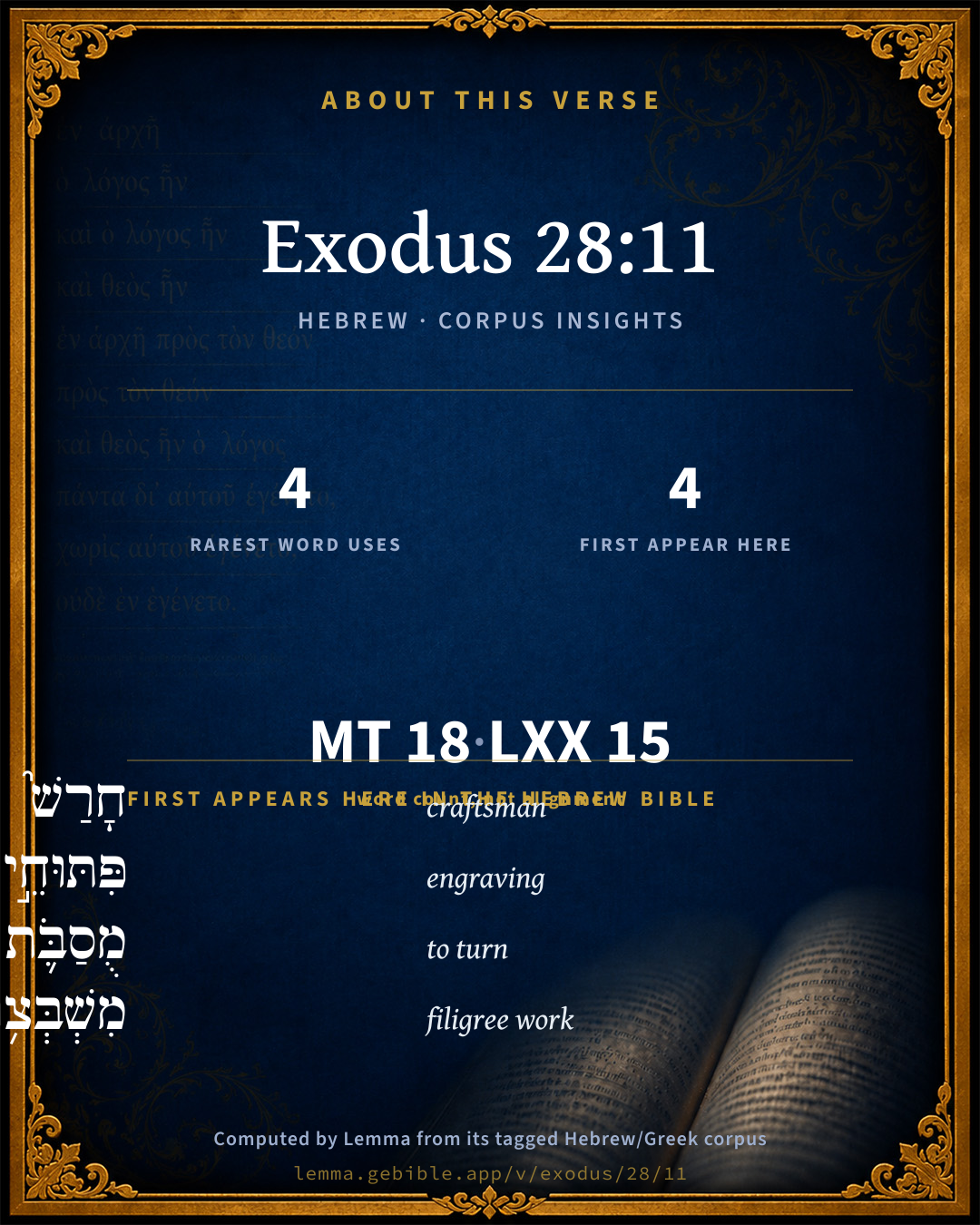
  • 4 first appearances in the Hebrew Bible
Full analysis ↓
Download a study sheet

One document with this verse’s original text, its word-by-word gloss line, the meaning frame, cross-references with their text, attributed commentary, and full source and license credits — printable, and it pastes into notes with its structure intact.

This verse Autodidact and up

Study sheet (.html) Plain text (.txt)

A passage Seminary Student

Up to 50 verses in one chapter. A passage sheet keeps up to 6 commentary sources and 12 cross-references per verse, in the order this page ranks them, and says so on the sheet whenever that leaves anything out. Ask for a single verse and you get the Autodidact verse sheet above.

Everything on this page stays free to read, with no account — the sheet is a download of what is already on screen, not access to it.

Want to remove ads? Support Godless Engineer
Compare translations 3

The same verse in 3 English versions, stacked beneath the original-language interlinear above. Click any original word for its lexicon entry.

Each is an independent rendering of the whole verse — the interlinear is not word-aligned to these translations.

Highlighted words mark where these versions differ — a whole-verse word diff, not a word-by-word alignment.

  • World English Bible Public Domain
    With the work of an engraver in stone, like the engravings of a signet, shall you engrave the two stones, according to the names of the children of Israel: you shall make them to be enclosed in settings of gold.
  • King James Version Public Domain
    With the work of an engraver in stone, like the engravings of a signet, shalt thou engrave the two stones with the names of the children of Israel: thou shalt make them to be set in ouches of gold.
  • unfoldingWord Literal Text CC BY-SA 4.0
    You shall engrave the two stones with the names of the sons of Israel—the work of a craftsman of stone, the engravings of a signet. You shall make them surrounded with ornamental settings of gold.

unfoldingWord Literal Text — © unfoldingWord, licensed CC BY-SA 4.0. Word-aligned USFM3 via Door43 (git.door43.org/unfoldingWord/en_ult).

Versions to compare (up to 4)

3 of 4 selected

Show all 18 translations

Every available English version of this verse, each an independent rendering of the whole verse.

  • World English Bible Public Domain
    With the work of an engraver in stone, like the engravings of a signet, shall you engrave the two stones, according to the names of the children of Israel: you shall make them to be enclosed in settings of gold.
  • Berean Standard Bible Public Domain
    Engrave the names of the sons of Israel on the two stones the way a gem cutter engraves a seal. Then mount the stones in gold filigree settings.
  • Majority Standard Bible Public Domain
    Engrave the names of the sons of Israel on the two stones the way a gem cutter engraves a seal. Then mount the stones in gold filigree settings.
  • King James Version Public Domain
    With the work of an engraver in stone, like the engravings of a signet, shalt thou engrave the two stones with the names of the children of Israel: thou shalt make them to be set in ouches of gold.
  • American Standard Version (1901) Public Domain
    With the work of an engraver in stone, like the engravings of a signet, shalt thou engrave the two stones, according to the names of the children of Israel: thou shalt make them to be inclosed in settings of gold.
  • Revised Version (1885) Public Domain
    With the work of an engraver in stone, like the engravings of a signet, shalt thou engrave the two stones, according to the names of the children of Israel: thou shalt make them to be enclosed in ouches of gold.
  • Geneva Bible (1599) Public Domain
    Thou shalt cause to graue the two stones according to the names of the children of Israel by a grauer of signets, that worketh and graueth in stone, and shalt make them to be set and embossed in golde.
  • Douay-Rheims (1899) Public Domain
    With the work of an engraver and the graving of a jeweller, thou shalt engrave them with the names of the children of Israel, set in gold and compassed about:
  • Young's Literal Translation Public Domain
    the work of an engraver in stone, openings of a signet, thou dost open the two stones by the names of the sons of Israel; turned round, embroidered `with' gold, thou dost make them.
  • Literal Standard Version CC BY-SA 4.0
    the work of an engraver of stone, [as] engravings of a signet—you engrave the names of the sons of Israel on the two stones; encompassing, you make them [with] filigrees of gold.
  • Unlocked Literal Bible CC BY-SA 4.0
    With the work of an engraver in stone, like the engraving on a signet, you must engrave the two stones with the names of Israel's twelve sons. You must mount the stones in settings of gold.
  • unfoldingWord Literal Text CC BY-SA 4.0
    You shall engrave the two stones with the names of the sons of Israel—the work of a craftsman of stone, the engravings of a signet. You shall make them surrounded with ornamental settings of gold.
  • Darby Bible Public Domain
    According to the work of an engraver in stone, as the engravings of a seal, shalt thou engrave the two stones with the names of the sons of Israel; surrounded by enclosures of gold shalt thou make them.
  • World Messianic Bible Public Domain
    With the work of an engraver in stone, like the engravings of a signet, you shall engrave the two stones, according to the names of the children of Israel. You shall make them to be enclosed in settings of gold.
  • Webster's Bible Public Domain
    With the work of an engraver in stone, like the engravings of a signet, shalt thou engrave the two stones with the names of the children of Israel: thou shalt make them to be set in ouches of gold.
  • Free Bible Version CC BY-SA 4.0
    Engrave the names on the two stones the same way a jeweler engraves a personal seal. Then place the stones in ornamental gold settings.
  • Bible in Basic English Public Domain
    With the work of a jeweller, like the cutting of a stamp, the names of the children of Israel are to be cut on them, and they are to be fixed in twisted frames of gold.
  • JPS Tanakh (1917) Public Domain
    With the work of an engraver in stone, like the engravings of a signet, shalt thou engrave the two stones, according to the names of the children of Israel; thou shalt make them to be inclosed in settings of gold.

Literal Standard Version (2020), Covenant Press — licensed CC BY-SA 4.0. Text via the HelloAO Bible API (eBible.org). Unlocked Literal Bible (unfoldingWord) — licensed CC BY-SA 4.0. Text via the HelloAO Bible API (eBible.org). unfoldingWord Literal Text — © unfoldingWord, licensed CC BY-SA 4.0. Word-aligned USFM3 via Door43 (git.door43.org/unfoldingWord/en_ult). Free Bible Version, Dr. Jonathan Gallagher — licensed CC BY-SA 4.0. Text via the HelloAO Bible API (eBible.org).

Word by word

More ways to search: Search by grammar → Find every occurrence → Compare this word →

Practice this passage: Drill this verse → Learn its vocabulary →

מֻסַבֹּ֛ת
mûwçabbâh
H4142
“turned”
Verb, Hophal, Participle Passive, Feminine, Plural, Construct
Part of Speech
Verb
Stem
Hophal
Form
Participle Passive
Gender
Feminine
Number
Plural
State
Construct
Full BDB Definition

Origin: from H4141

TWOT: 1456b

(Hophal) - to be turned - surrounded, set (participle)
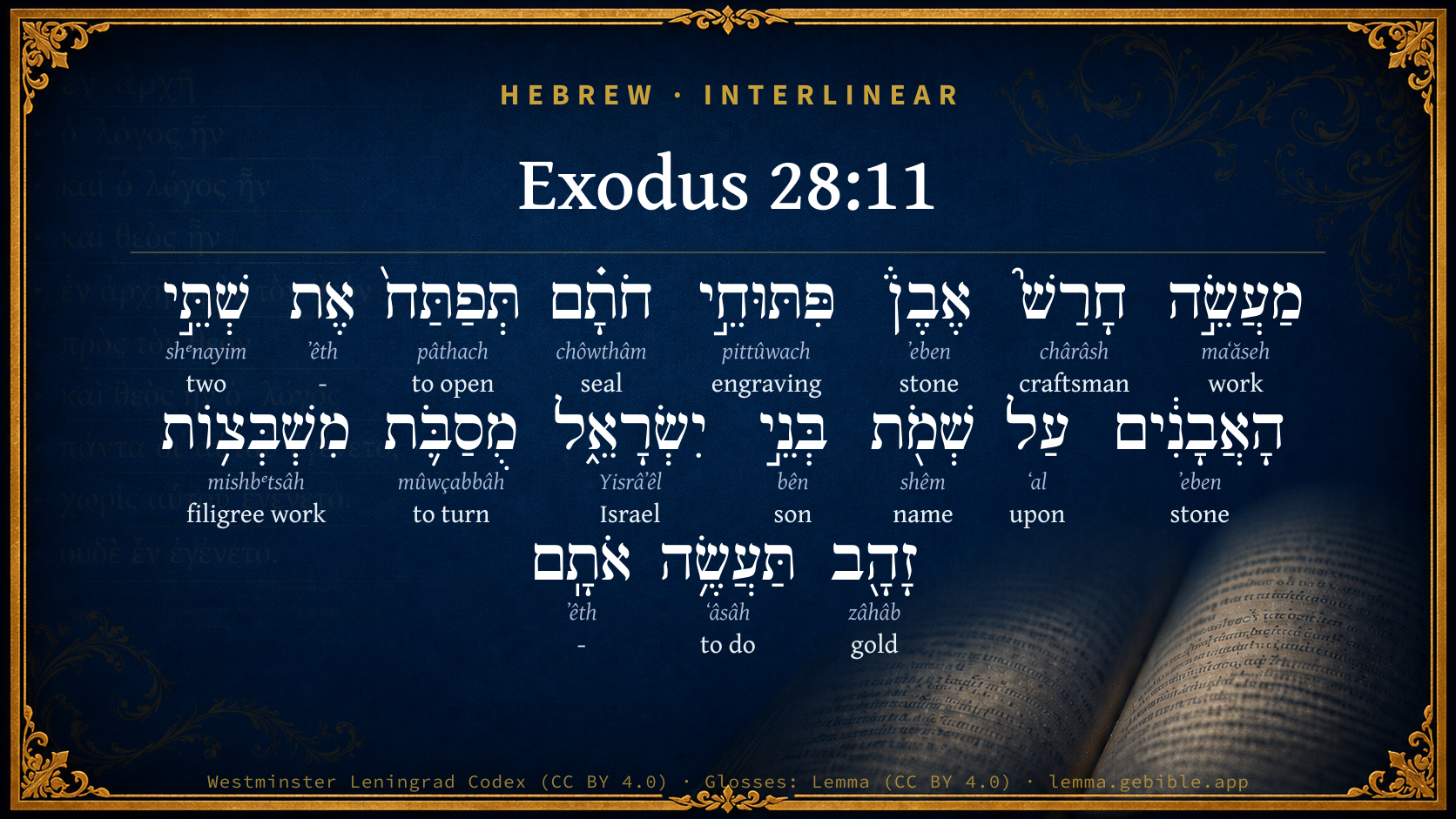
  1. מַעֲשֵׂ֣ה maʻăseh H4639 “work of” Noun, Common, Masculine, Singular, Construct
  2. חָרַשׁ֮ chârâsh H2796 “craftsman of” Noun, Common, Masculine, Singular, Construct
  3. אֶבֶן֒ ʼeben H68 “stone” Noun, Common, Feminine, Singular, Absolute
  4. פִּתּוּחֵ֣י pittûwach H6603 “engravings of” Noun, Common, Masculine, Plural, Construct
  5. חֹתָ֗ם chôwthâm H2368 “seal” Noun, Common, Masculine, Singular, Absolute
  6. תְּפַתַּח֙ pâthach H6605 “to open” Verb, Piel, Imperfect, 2nd Person, Masculine, Singular
  7. אֶת ʼêth H853 “-” Particle, Direct Object
  8. שְׁתֵּ֣י shᵉnayim H8147 “two” Adjective, Cardinal number, Feminine, Dual, Construct
  9. הָאֲבָנִ֔ים ʼeben H68 “the · stones” Particle, Definite Article + Noun, Common, Feminine, Plural, Absolute
  10. עַל ʻal H5921 “upon” Preposition
  11. שְׁמֹ֖ת shêm H8034 “names of” Noun, Common, Masculine, Plural, Construct
  12. בְּנֵ֣י bên H1121 “sons of” Noun, Common, Masculine, Plural, Construct
  13. יִשְׂרָאֵ֑ל Yisrâʼêl H3478 “Israel” Noun, Proper
  14. מִשְׁבְּצ֥וֹת mishbᵉtsâh H4865 “filigree work of” Noun, Common, Feminine, Plural, Construct
  15. זָהָ֖ב zâhâb H2091 “gold” Noun, Common, Masculine, Singular, Absolute
  16. תַּעֲשֶׂ֥ה ʻâsâh H6213 “to do” Verb, Qal, Imperfect, 2nd Person, Masculine, Singular
  17. אֹתָֽם ʼêth H853 “- · them” Particle, Direct Object + Suffix, Personal, 3rd Person, Masculine, Plural

About this verse

These counts appear in no published source. They are computed here, from the morphology-tagged text and Lemma’s own curated glosses. What Lemma adds →

18
words
16
distinct lemmas
Pentateuch
section

Notable vocabulary

The rarest word here is מֻסַבֹּ֛ת to turn H4142 — appearing just 4 times in the whole Hebrew Bible.

First appearance in Scripture

These words make their first canonical appearance in the Hebrew Bible here:

  • חָרַשׁ֮ craftsman H2796
  • פִּתּוּחֵ֣י engraving H6603
  • מֻסַבֹּ֛ת to turn H4142
  • מִשְׁבְּצ֥וֹת filigree work H4865

Shared distinctive vocabulary

מֻסַבֹּ֛ת to turn H4142 occurs in 4 verses of the Hebrew Bible. Also found in:

Grammatical profile

  • 3 verbs
  • 11 nouns
  • 1 adjective
  • 1 preposition
  • 2 particles

Verb forms

  • תְּפַתַּח֙ Piel · Imperfect
  • מֻסַבֹּ֛ת Hophal · Participle Passive
  • תַּעֲשֶׂ֥ה Qal · Imperfect

Repetition

A word recurs within this verse — often emphatic in Hebrew:

  • אֶבֶן֒ stone H68 ×2

Hebrew & Septuagint length

In English translation the verse runs 40 words from the Hebrew and 29 from the Septuagint (LXX English) — closely comparable.

A rough comparison of the two English renderings, which tokenize alike — not a word-level alignment.

Word counts can differ between the Hebrew and the Greek without any difference in meaning — e.g. the Hebrew direct-object marker אֵת has no separate Greek word, and Greek often adds the article ὁ.

In the original languages it is 18 Hebrew tokens and 15 Greek tokens — but the two are counted differently (Hebrew bundles its prefixes and suffixes into one token; the Greek is in lemma form), so that isn’t a like-for-like length.

Cross-references

13

Topical passages linked to Exodus 28:11 in the Treasury of Scripture Knowledge — connected by theme and wording, ordered by reader-vote popularity; previews shown in the World English Bible.

  • Exodus 28:13–14 You shall make settings of gold,
  • Exodus 28:21 The stones shall be according to the names of the children of Israel, twelve, according to their names; like the engravings of a signet, everyone according to his name, they shall be for the twelve tribes.
  • Exodus 28:25 The other two ends of the two braided chains you shall put on the two settings, and put them on the shoulder-pieces of the ephod in the forepart of it.
  • Exodus 28:36 "You shall make a plate of pure gold, and engrave on it, like the engravings of a signet, 'HOLY TO YAHWEH.'
  • Exodus 39:6 They worked the onyx stones, enclosed in settings of gold, engraved with the engravings of a signet, according to the names of the children of Israel.
  • Exodus 39:13 and the fourth row, a chrysolite, an onyx, and a jasper. They were enclosed in gold settings.
  • Exodus 39:18 The other two ends of the two braided chains they put on the two settings, and put them on the shoulder-pieces of the ephod, in the front of it.
  • Jeremiah 22:24 As I live, says Yahweh, though Coniah the son of Jehoiakim king of Judah were the signet on my right hand, yet would I pluck you there;
  • Zechariah 3:9 For, behold, the stone that I have set before Joshua; on one stone are seven eyes: behold, I will engrave the engraving of it,' says Yahweh of Hosts, 'and I will remove the iniquity of that land in one day.
  • Ephesians 1:13 in whom you also, having heard the word of the truth, the Gospel of your salvation,--in whom, having also believed, you were sealed with the Holy Spirit of promise,
  • Ephesians 4:30 Don't grieve the Holy Spirit of God, in whom you were sealed for the day of redemption.
  • 2 Timothy 2:19 However God's firm foundation stands, having this seal, "The Lord knows those who are his," and, "Let every one who names the name of the Lord depart from unrighteousness."
  • Revelation 7:2 I saw another angel ascend from the sunrise, having the seal of the living God. He cried with a loud voice to the four angels to whom it was given to harm the earth and the sea,

Cross-references courtesy of OpenBible.info (CC BY 4.0).

Hebrew and Greek witnesses Masoretic Hebrew ↔ Greek Septuagint

The same verse in the two great witnesses to the Old Testament, shown verse-for-verse.

These are two independent witnesses, not word-aligned to each other, and the Septuagint is shown in lemma (dictionary) form.

Hebrew Exodus 28:11 Masoretic · Westminster Leningrad Codex

מַעֲשֵׂ֣ה חָרַשׁ֮ אֶבֶן֒ פִּתּוּחֵ֣י חֹתָ֗ם תְּפַתַּח֙ אֶת שְׁתֵּ֣י הָאֲבָנִ֔ים עַל שְׁמֹ֖ת בְּנֵ֣י יִשְׂרָאֵ֑ל מֻסַבֹּ֛ת מִשְׁבְּצ֥וֹת זָהָ֖ב תַּעֲשֶׂ֥ה אֹתָֽם

With the work of an engraver in stone, like the engravings of a signet, shall you engrave the two stones, according to the names of the children of Israel: you shall make them to be enclosed in settings of gold.

World English Bible · Public Domain

Greek LXX Exodus 28:11 Septuagint · lemma form

ἔργον λιθουργικός τέχνη γλύμμα σφραγίς διαγλύφω ὁ δύο λίθος ἐπί ὁ ὄνομα ὁ υἱός ἰσραήλ

It shall be the work of the stone-engraver's art; as the graving of a seal you shall engrave the two stones with the names of the children of Israel.

LXX2012 (modern English Septuagint) · Public Domain

On this verse, The Cambridge Bible for Schools and Colleges discusses the Septuagint’s reading. Read the note in Commentary ↓

Hebrew: Westminster Leningrad Codex (CC BY 4.0). Greek: Septuagint (public domain); English from LXX2012 (modern English Septuagint) (Public Domain). How the Septuagint differs from the Hebrew →

Targum (Aramaic paraphrase)

2

The Targum is the ancient Jewish Aramaic paraphrase of the Hebrew Scriptures — an interpretive translation, not the Hebrew text itself. Onkelos (literal) and Pseudo-Jonathan (expansive) render the Torah, and Jonathan the Prophets. Coverage is partial: where no permissively-licensed English translation exists for a verse, only the Aramaic is shown. This is verse-level text, not a word-by-word alignment to the Hebrew.

  1. Targum Onkelos Torah (Genesis–Deuteronomy)
    עוֹבַד אֳמָן אֶבֶן טָבָא כְּתַב מְפָרַשׁ כִּגְלֹף דְעִזְקָא תִגְלוֹף יָת תַּרְתֵּין אַבְנַיָא עַל שְׁמָהַת בְּנֵי יִשְׂרָאֵל מְשַׁקְעָן מְרַמְצָן דִדְהַב תַּעְבֵּד יָתְהוֹן:

    (no public-domain English translation for this verse)

    Targum Onkelos — Aramaic: “Onkelos Genesis” (public domain); “Onkelos Exodus” (public domain); “Onkelos Leviticus” (public domain); “Onkelos Numbers” (public domain); “Onkelos Deuteronomy” (public domain). English: “Sefaria Community Translation” (CC0 1.0 (public-domain dedication)); “J.W. Etheridge. The Targums of Onkelos and Jonathan Ben Uzziel on the Pentateuch. London: Longmans, Green, 1862” (public domain). Text via Sefaria.

  2. Targum Pseudo-Jonathan Torah (Genesis–Deuteronomy)
    עוֹבַד אוּמַן יֶהֶוְיַין מַרְגְּלַיְיתָא גְּלוּף חָקִיק וּמְפָרֵשׁ הֵי כִּגְלוֹף דְּעִזְקָא תִּגְלוֹף יַת תַּרְתֵּין מַרְגְּלִיָיתָא עַל שְׁמָהַת בְּנֵי יִשְרָאֵל מַקְפַן בְּאוּמַנְוַתְהוֹן מְרַמְצָן דִּדְהַב תַּעֲבֵיד יַתְהוֹן

    The engraved gems shall be the work of the artificer, engraven, and the engraving be distinct as the engraving of a ring; thou shalt engrave the two gems according to the names of the sons of Israel in their work round about; inset in gold shalt thou make them.

    Targum Pseudo-Jonathan — Aramaic: “Targum Jonathan on Genesis” (public domain); “Targum Jonathan on Exodus” (public domain); “Targum Jonathan on Leviticus” (public domain); “Targum Jonathan on Numbers” (public domain); “Targum Jonathan on Deuteronomy” (public domain). English: “The Targum of Jonathan ben Uzziel, trans. J. W. Etheridge, London, 1862” (public domain). Text via Sefaria.

Commentary

Notes on Exodus 28:11 from classic Christian and Jewish commentators (each source and its license shown beneath its notes). The classic Christian expositions comment on the surrounding passage and are grouped to its opening verse, so a note may address several verses; the Jewish commentaries on the Tanakh (Rashi and others) are per-verse, so they appear only where the commentator wrote on this verse.

Lemma curates 59 commentaries, every one of them public domain or Creative Commons licensed, each selected and text-cleaned for this edition rather than reprinted as found. About our sources →

Joseph Benson's Commentary

Exo 28:11. Ouches — Hollow places, such as are made in gold rings, to receive and hold the precious stones.

Joseph Benson's Commentary on the Old and New Testaments (1811–1818) — public domain. Text from a community e-Sword module.

Adam Clarke's Commentary

Verse 11. Like the engravings of a signet] So signets or seals were in use at this time, and engraving on precious stones was then an art, and this art, which was one of the most elegant and ornamental, was carried in ancient times to a very high pitch of perfection, and particularly among the ancient Greeks; such a pitch of perfection as has never been rivalled, and cannot now be even well imitated. And it is very likely that the Greeks themselves borrowed this art from the ancient Hebrews, as we know it flourished in Egypt and Palestine long before it was known in Greece.

Adam Clarke's Commentary on the Bible (1810–1826) — public domain. Text from a community e-Sword/MySword module.

Ellicott's Commentary for English Readers

(11) The engravings of a signet.—Compare Note 2 on Exo_28:9. Signets had been already mentioned in Gen_38:18; Gen_38:25; Gen_41:42. Those of Egypt were for the most part rings, with cylindrical bezels turning upon an axis. Those of Babylonia were cylinders, which were commonly worn by a string round the wrist. The engraving of the Babylonian cylinders is frequently of a very fine quality.

Thou shalt make them to be set in ouches of gold.—The setting intended seems to have been a sort of open or filigree work, such as is very common in Egyptian ornaments of the time. The term “ouche”—more properly “nouch”—is derived from the old French “nouche,”a buckle or clasp (see Skeat’s Etymol. Dict., §5).

A Bible Commentary for English Readers, edited by Charles John Ellicott (1878–1897) — public domain. Text from a community e-Sword module.

The Cambridge Bible for Schools and Colleges

gen. ed. J. J. S. Perowne

11. the engravings of a signet] Seal engraving of precious stones was an art practised from very remote times in both Babylonia and Egypt.

ouches] filigree settings, or, in one word, rosettes. (LXX. in v. 13 ἀσπιδίσκαι, ‘little shields’). ‘Ouch’ (‘an ouch’ for ‘a nouch,’ by a mistaken division of words [cf. an apron for a napron, an adder for a nadder, umpire for numpire; and conversely newt for ewt, notch for otch], Fr. nouche, a buckle or clasp) is an old word for the frame in which precious stones were set, used also for the jewels themselves; cf. 2 Henry IV. ii. 4. 53 ‘Your brooches, pearls, and ouches’ (Aldis Wright, Bible Word-Book, s.v.). The Heb. root means to chequer or plait (see on v. 39): hence what is probably meant is ‘settings of filigree work’: the gold was first beaten out into thin sheets, which were afterwards cut up into narrow strips (see Exo_39:3); these were then formed into filigree work by a delicate process of soldering, and used as a setting for jewels (Kennedy, DB. iii. 636). Rosettes would probably express the general meaning with sufficient accuracy.

The Cambridge Bible for Schools and Colleges (gen. ed. J. J. S. Perowne; Cambridge University Press, 1878–1918) — public domain. Text from a community e-Sword module.

John Gill's Exposition

With the work of an engraver in stone,.... Not in common but precious stones: Moses was not to do this himself, as it could not be supposed he should, but he was to employ an engraver, whose business it was, and one that was capable of doing it in a professional manner:

like the engravings of a signet shall thou engrave the two stones with the names of the children of Israel: as in signets or seals, by which impressions are made on wax, the letters or figures are cut deep, that they might on the wax stand out; so it seems the letters of the names of the children of Israel were cut in these stones: this shows that engraving on precious stones is very old, and the ancients indeed are said to excel in this art:

thou shalt make them to be set in ouches of gold; in beazils or sockets, such as precious stones in rings are set in; these with the stones in them served as buttons to fasten together the hinder and fore part of the ephod on the shoulder pieces of it.

John Gill's Exposition of the Whole Bible (1746–1763) — public domain (CC PDM 1.0). Text via the HelloAO Bible API.

Matthew Poole's English Annotations

Hollow places, such as are made in golden rings to receive and hold the precious stones which are put in them.

Matthew Poole's English Annotations on the Holy Bible (1683–1685) — public domain. Text from a community e-Sword/MySword module.

The Pulpit Commentary

With the work of an engraver. Rather, "an artificer." The engravings of a signet. Signets in Egypt were ordinarily rings, on the bezel of which the name of the owner was inscribed. Some were of solid gold; others with cylindrical bezels of glass or hard stone. On the early use of such signet rings in Egypt see Gen_41:42. Cylinders, strung round the wrist and engraved with a name and titles, were common in Mesopotamia from B.C. 2000. Ouches of gold. Settings in open-work or filagree seem to be intended a kind of setting which is very common in Egyptian ornaments.

The Pulpit Commentary (1880–1919), ed. H.D.M. Spence-Jones & Joseph S. Exell — public domain. Text from a community e-Sword module.

John Wesley's Explanatory Notes

Ouches - Hollow places, such as are made in gold rings, to receive and hold the precious stones.

John Wesley, Explanatory Notes Upon the Whole Bible (1754–1765) — public domain. Text via the GEBible commentary corpus.

Rashi

Rabbi Shlomo Yitzchaki (Rashi)

מעשה חרש אבן means THE WORK OF AN ARTIFICER IN STONES. This word חרש is in close connection (i. e. in the construct state) with the word that follows it and therefore it is punctuated with Patach in its last syllable. Similar is, (Isaiah 44:13) “The חָרַשׁ עצים stretcheth out a line” i. e. the worker in wood. So, also, (Isaiah 44:12) “the worker in (חָרַשׁ) iron maketh an axe.” All these examples of חָרַשׁ are in close connection with the words that follows them and are therefore punctuated with Patach.

פתוחי חותם LIKE THE ENGRAVINGS OF A SIGNET — Understand this as the Targum renders it: a distinct writing like the engraving of a signet-ring: the letters were incised in them just as one incises the seals of a ring which are used to seal letters — a clear and distinct writing.

על שמות — This is the same as בשמות “with the names of”.

מסבת משבצות SURROUNDED WITH SETTINGS [OF GOLD] — Thou shalt make the stones to be surrounded by gold settings: the meaning is that they should make as a setting for each stone a kind of indentation in the gold, of the same size as the stone and sink it in the setting; thus the setting surrounds the stone on all sides. That setting they attached to the shoulder-pieces of the ephod.

Rashi on the Tanakh — English translations: “The Judaica Press complete Tanach with Rashi, translated by A. J. Rosenberg” (CC BY 4.0); “Pentateuch with Rashi's commentary by M. Rosenbaum and A.M. Silbermann, 1929-1934” (public domain); “The Metsudah Tanach series, Lakewood, N.J” (CC BY 4.0); and “The Book of Joshua, Metsudah Publications, 1997” (CC BY 4.0). Text via Sefaria.

Lesson kit

Teaching starters — assembled from the data on this page, not authored interpretation. Every prompt links to the verse data it draws on. Edit before teaching.

Exodus, in the Pentateuch, opens this verse with 18 words (16 distinct Hebrew lemmas). Its most distinctive word is mûwçabbâh (“to turn”). A historical commentator’s framing appears above. Read the whole chapter for the surrounding context.

Discussion questions

  1. How does “to turn” (mûwçabbâh) shape what this verse is saying?
  2. 4 words here appear for the first time in Scripture. What is being introduced at this debut?
  3. Exodus 39:6 shares the word «to turn» with this verse. How do the two illuminate each other?
  4. “stone” occurs 2× in this one verse. What is the effect of the repetition?
  5. These translations render this verse differently; the difference is in the English rendering, not the original. What questions does that raise?
  6. The verb «תְּפַתַּח֙» is Piel Imperfect. How does its form color the action?
  7. Reading how Joseph Benson's Commentary and Adam Clarke's Commentary read this verse, where do the two commentators agree and where do they part?

Things to notice

Reading settings

Reading text

Shown beneath each verse's original-language words.

Old Testament
Old Testament edition

Read the OT as the Masoretic Hebrew (MT) or the Greek Septuagint (LXX).

English shown for the Greek Septuagint (in the Hebrew ↔ Greek comparison).

Comparing translations? Open the Compare panel on any verse page to stack up to four side by side.