
Deuteronomy 21:17

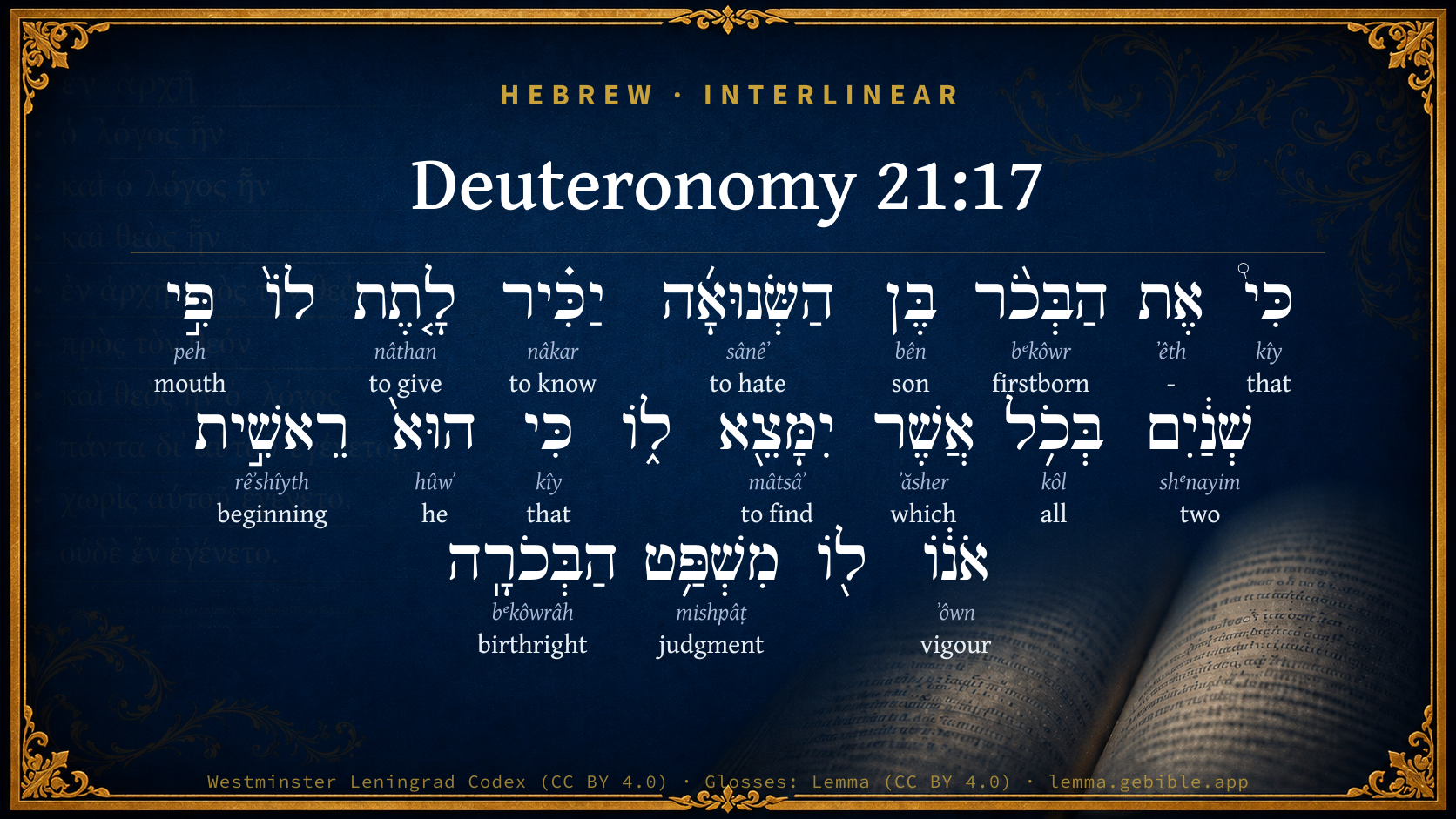
Hebrew (Westminster Leningrad Codex) Deuteronomy 21:17 appears in the Hebrew Old Testament. The text above is from the Westminster Leningrad Codex. Each word links to its Strong’s number, a concise gloss, and parsing drawn from the Open Scriptures Hebrew Bible morphology. Click any word for its full Brown-Driver-Briggs (BDB) entry.
Download image
Cite this verse

Deuteronomy 21:17 (World English Bible). Public Domain. Lemma interlinear Bible study tool, https://lemma.gebible.app/v/deuteronomy/21/17.

Show BibTeX & RIS
BibTeX
RIS
English Translation
but he shall acknowledge the firstborn, the son of the hated, by giving him a double portion of all that he has; for he is the beginning of his strength; the right of the firstborn is his.
World English Bible · Public Domain
Download a study sheet

One document with this verse’s original text, its word-by-word gloss line, the meaning frame, cross-references with their text, attributed commentary, and full source and license credits — printable, and it pastes into notes with its structure intact.

This verse Autodidact and up

Study sheet (.html) Plain text (.txt)

A passage Seminary Student

Up to 50 verses in one chapter. A passage sheet keeps up to 6 commentary sources and 12 cross-references per verse, in the order this page ranks them, and says so on the sheet whenever that leaves anything out. Ask for a single verse and you get the Autodidact verse sheet above.

Everything on this page stays free to read, with no account — the sheet is a download of what is already on screen, not access to it.

Want to remove ads? Support Godless Engineer
Compare translations 3

The same verse in 3 English versions, stacked beneath the original-language interlinear above. Click any original word for its lexicon entry.

Each is an independent rendering of the whole verse — the interlinear is not word-aligned to these translations.

Highlighted words mark where these versions differ — a whole-verse word diff, not a word-by-word alignment.

  • World English Bible Public Domain
    but he shall acknowledge the firstborn, the son of the hated, by giving him a double portion of all that he has; for he is the beginning of his strength; the right of the firstborn is his.
  • King James Version Public Domain
    But he shall acknowledge the son of the hated for the firstborn, by giving him a double portion of all that he hath: for he is the beginning of his strength; the right of the firstborn is his.
  • unfoldingWord Literal Text CC BY-SA 4.0
    But, he shall recognize the firstborn, the son of the hated, giving to him a double portion of all that is found of his; for he the beginning of his strength; the regulation of the firstborn his.

unfoldingWord Literal Text — © unfoldingWord, licensed CC BY-SA 4.0. Word-aligned USFM3 via Door43 (git.door43.org/unfoldingWord/en_ult).

Versions to compare (up to 4)

3 of 4 selected

Show all 18 translations

Every available English version of this verse, each an independent rendering of the whole verse.

  • World English Bible Public Domain
    but he shall acknowledge the firstborn, the son of the hated, by giving him a double portion of all that he has; for he is the beginning of his strength; the right of the firstborn is his.
  • Berean Standard Bible Public Domain
    Instead, he must acknowledge the firstborn, the son of his unloved wife, by giving him a double portion of all that he has. For that son is the firstfruits of his father’s strength; the right of the firstborn belongs to him.
  • Majority Standard Bible Public Domain
    Instead, he must acknowledge the firstborn, the son of his unloved wife, by giving him a double portion of all that he has. For that son is the firstfruits of his father’s strength; the right of the firstborn belongs to him.
  • King James Version Public Domain
    But he shall acknowledge the son of the hated for the firstborn, by giving him a double portion of all that he hath: for he is the beginning of his strength; the right of the firstborn is his.
  • American Standard Version (1901) Public Domain
    but he shall acknowledge the first-born, the son of the hated, by giving him a double portion of all that he hath; for he is the beginning of his strength; the right of the first-born is his.
  • Revised Version (1885) Public Domain
    but he shall acknowledge the firstborn, the son of the hated, by giving him a double portion of all that he hath: for he is the beginning of his strength; the right of the firstborn is his.
  • Geneva Bible (1599) Public Domain
    But he shall acknowledge the sonne of the hated for the first borne, and giue him double portion of all that he hath: for hee is the first of his strength, and to him belongeth the right of the first borne.
  • Douay-Rheims (1899) Public Domain
    But he shall acknowledge the son of the hated for the firstborn, and shall give him a double portion of all he hath: for this is the first of his children, and to him are due the first birthrights.
  • Young's Literal Translation Public Domain
    But the first-born, son of the hated one, he doth acknowledge, to give to him a double portion of all that is found with him, for he `is' the beginning of his strength; to him `is' the right of the first-born.
  • Literal Standard Version CC BY-SA 4.0
    But the firstborn, son of the hated one, he acknowledges, to give to him a double portion of all that is found with him, for he [is] the beginning of his strength; to him [is] the right of the firstborn.
  • Unlocked Literal Bible CC BY-SA 4.0
    Instead, he must acknowledge the firstborn, the son of the hated wife, by giving him a double portion of all that he possesses; for that son is the beginning of his strength; the right of the firstborn belongs to him.
  • unfoldingWord Literal Text CC BY-SA 4.0
    But, he shall recognize the firstborn, the son of the hated, giving to him a double portion of all that is found of his; for he the beginning of his strength; the regulation of the firstborn his.
  • Darby Bible Public Domain
    but he shall acknowledge as firstborn the son of the hated, by giving him a double portion of all that is found with him; for he is the firstfruits of his vigour: the right of the firstborn is his.
  • World Messianic Bible Public Domain
    but he shall acknowledge the firstborn, the son of the hated, by giving him a double portion of all that he has; for he is the beginning of his strength. The right of the firstborn is his.
  • Webster's Bible Public Domain
    But he shall acknowledge the son of the hated for the first-born, by giving him a double portion of all that he hath: for he is the beginning of his strength; the right of the first-born is his.
  • Free Bible Version CC BY-SA 4.0
    No. He is to recognize the firstborn, the son of the wife he doesn't love through the usual custom of giving him a double portion of all that he owns. The firstborn son is the firstfruits of his father's strength, and so the rights of the firstborn are his.
  • Bible in Basic English Public Domain
    But he is to give his first son his birthright, and twice as great a part of his property: for he is the first-fruits of his strength and the right of the first son is his.
  • JPS Tanakh (1917) Public Domain
    but he shall acknowledge the first-born, the son of the hated, by giving him a double portion of all that he hath; for he is the first-fruits of his strength, the right of the first-born is his.

Literal Standard Version (2020), Covenant Press — licensed CC BY-SA 4.0. Text via the HelloAO Bible API (eBible.org). Unlocked Literal Bible (unfoldingWord) — licensed CC BY-SA 4.0. Text via the HelloAO Bible API (eBible.org). unfoldingWord Literal Text — © unfoldingWord, licensed CC BY-SA 4.0. Word-aligned USFM3 via Door43 (git.door43.org/unfoldingWord/en_ult). Free Bible Version, Dr. Jonathan Gallagher — licensed CC BY-SA 4.0. Text via the HelloAO Bible API (eBible.org).

Word by word

More ways to search: Search by grammar → Find every occurrence → Compare this word →

Practice this passage: Drill this verse → Learn its vocabulary →

אֹנ֔וֹ
ʼôwn
H202
“vigour · his”
Noun, Common, Masculine, Singular, Construct + Suffix, Personal, 3rd Person, Masculine, Singular
Part of Speech
Noun
Type
Common
Gender
Masculine
Number
Singular
State
Construct
Full BDB Definition

Origin: probably from the same as H205 (in the sense of effort, but successful)

TWOT: 49a

vigour, generative power - wealth - physical strength (of men and behemoth)
  1. כִּי֩ kîy H3588 “that” Conjunction
  2. אֶת ʼêth H853 “-” Particle, Direct Object
  3. הַבְּכֹ֨ר bᵉkôwr H1060 “the · firstborn” Particle, Definite Article + Noun, Common, Masculine, Singular, Absolute
  4. בֶּן bên H1121 “son of” Noun, Common, Masculine, Singular, Construct
  5. הַשְּׂנוּאָ֜ה sânêʼ H8130 “the · hated” Particle, Definite Article + Verb, Qal, Participle Passive, Feminine, Singular, Absolute
  6. יַכִּ֗יר nâkar H5234 “to know” Verb, Hiphil, Imperfect, 3rd Person, Masculine, Singular
  7. לָ֤תֶת nâthan H5414 “to give” Preposition + Verb, Qal, Infinitive Construct
  8. פִּ֣י peh H6310 “mouth of” Noun, Common, Masculine, Singular, Construct
  9. שְׁנַ֔יִם shᵉnayim H8147 “two” Adjective, Cardinal number, Masculine, Dual, Absolute
  10. בְּכֹ֥ל kôl H3605 “in/at · all” Preposition + Noun, Common, Masculine, Singular, Absolute
  11. אֲשֶׁר ʼăsher H834 “which” Particle, Relative
  12. יִמָּצֵ֖א mâtsâʼ H4672 “to find” Verb, Niphal, Imperfect, 3rd Person, Masculine, Singular
  13. כִּי kîy H3588 “that” Conjunction
  14. הוּא֙ hûwʼ H1931 “he” Pronoun, Personal, 3rd Person, Masculine, Singular
  15. רֵאשִׁ֣ית rêʼshîyth H7225 “beginning of” Noun, Common, Feminine, Singular, Construct
  16. מִשְׁפַּ֥ט mishpâṭ H4941 “judgment of” Noun, Common, Masculine, Singular, Construct
  17. הַבְּכֹרָֽה bᵉkôwrâh H1062 “the · birthright” Particle, Definite Article + Noun, Common, Both, Singular, Absolute

About this verse

These counts appear in no published source. They are computed here, from the morphology-tagged text and Lemma’s own curated glosses. What Lemma adds →

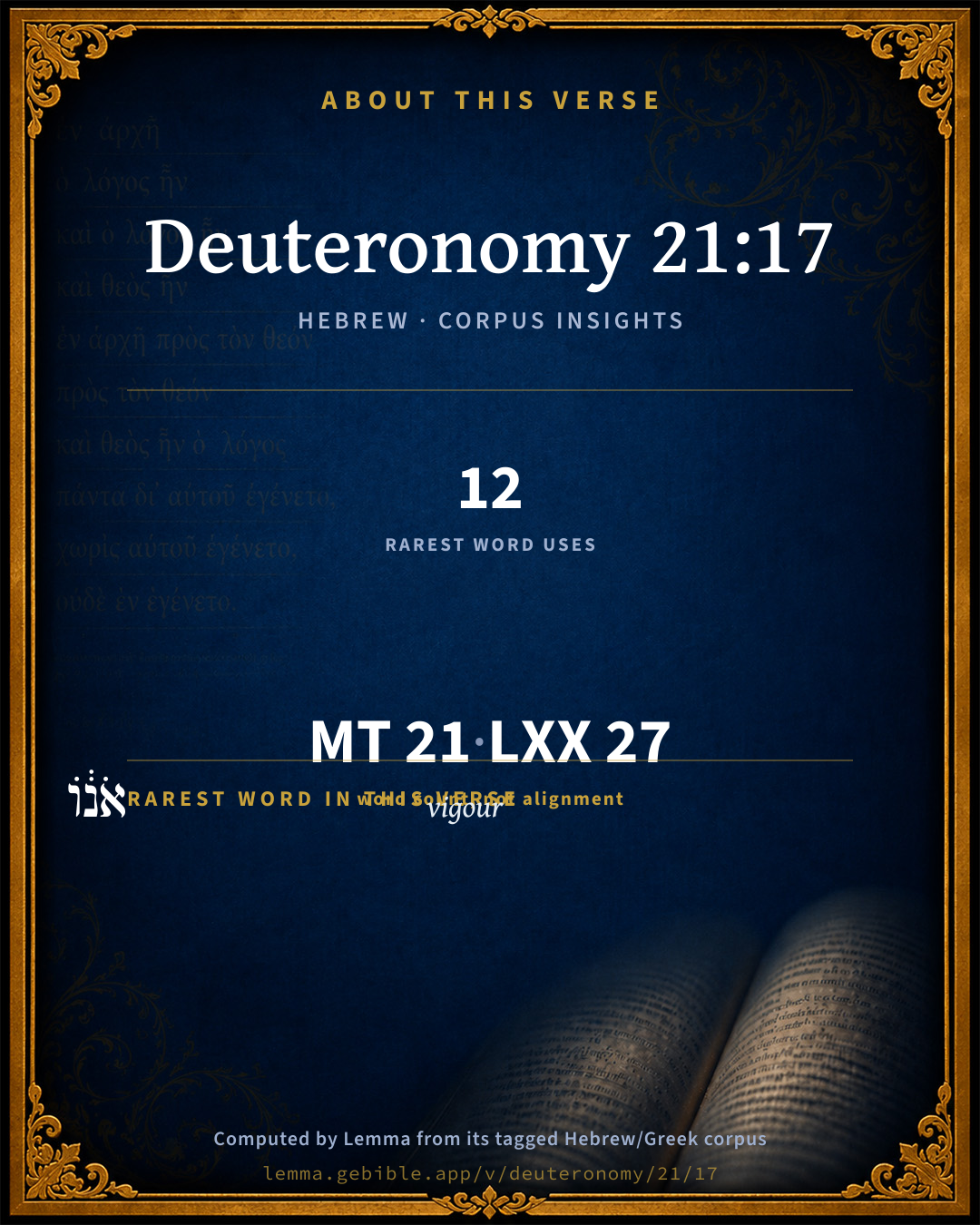
21
words
17
distinct lemmas
Pentateuch
section

Notable vocabulary

The rarest word here is אֹנ֔וֹ vigour H202 — appearing just 12 times in the whole Hebrew Bible.

Shared distinctive vocabulary

אֹנ֔וֹ vigour H202 occurs in 12 verses of the Hebrew Bible. Also found in:

Grammatical profile

  • 4 verbs
  • 8 nouns
  • 1 adjective
  • 1 pronoun
  • 3 prepositions
  • 2 conjunctions
  • 2 particles

Verb forms

  • הַשְּׂנוּאָ֜ה Qal · Participle Passive
  • יַכִּ֗יר Hiphil · Imperfect
  • לָ֤תֶת Qal · Infinitive Construct
  • יִמָּצֵ֖א Niphal · Imperfect

Repetition

A word recurs within this verse — often emphatic in Hebrew:

  • כִּי֩ that H3588 ×2

Hebrew & Septuagint length

In English translation the verse runs 37 words from the Hebrew and 38 from the Septuagint (LXX English) — closely comparable.

A rough comparison of the two English renderings, which tokenize alike — not a word-level alignment.

Word counts can differ between the Hebrew and the Greek without any difference in meaning — e.g. the Hebrew direct-object marker אֵת has no separate Greek word, and Greek often adds the article ὁ.

In the original languages it is 21 Hebrew tokens and 27 Greek tokens — but the two are counted differently (Hebrew bundles its prefixes and suffixes into one token; the Greek is in lemma form), so that isn’t a like-for-like length.

Cross-references

5

Topical passages linked to Deuteronomy 21:17 in the Treasury of Scripture Knowledge — connected by theme and wording, ordered by reader-vote popularity; previews shown in the World English Bible.

  • Genesis 49:3 "Reuben, you are my firstborn, my might, and the beginning of my strength; The pre-eminence of dignity, and the pre-eminence of power.
  • Genesis 25:31–34 Jacob said, "First, sell me your birthright."
  • 1 Chronicles 5:1–2 The sons of Reuben the firstborn of Israel (for he was the firstborn; but, because he defiled his father's couch, his birthright was given to the sons of Joseph the son of Israel; and the genealogy is not to be reckoned after the birthright.
  • Psalms 105:36 He struck also all the firstborn in their land, The first fruits of all their manhood.
  • Genesis 25:5–6 Abraham gave all that he had to Isaac,

Cross-references courtesy of OpenBible.info (CC BY 4.0).

Hebrew and Greek witnesses Masoretic Hebrew ↔ Greek Septuagint

The same verse in the two great witnesses to the Old Testament, shown verse-for-verse.

These are two independent witnesses, not word-aligned to each other, and the Septuagint is shown in lemma (dictionary) form.

Hebrew Deuteronomy 21:17 Masoretic · Westminster Leningrad Codex

כִּי֩ אֶת הַבְּכֹ֨ר בֶּן הַשְּׂנוּאָ֜ה יַכִּ֗יר לָ֤תֶת לוֹ֙ פִּ֣י שְׁנַ֔יִם בְּכֹ֥ל אֲשֶׁר יִמָּצֵ֖א ל֑וֹ כִּי הוּא֙ רֵאשִׁ֣ית אֹנ֔וֹ ל֖וֹ מִשְׁפַּ֥ט הַבְּכֹרָֽה

but he shall acknowledge the firstborn, the son of the hated, by giving him a double portion of all that he has; for he is the beginning of his strength; the right of the firstborn is his.

World English Bible · Public Domain

Greek LXX Deuteronomy 21:17 Septuagint · lemma form

ἀλλά ὁ πρωτότοκος υἱός ὁ μισέω ἐπιγιγνώσκω δίδωμι αὐτός διπλοῦς ἀπό πᾶς ὅς ἄν εὑρίσκω αὐτός ὅτι οὗτος εἰμί ἀρχή τέκνον αὐτός καί οὗτος καταἥκω ὁ πρωτοτόκιον

But he shall acknowledge the firstborn of the hated one to give to him double of all things which shall be found by him, because he is the first of his children, and to him belongs the birthright.

LXX2012 (modern English Septuagint) · Public Domain

On this verse, The Cambridge Bible for Schools and Colleges discusses the Septuagint’s reading. Read the note in Commentary ↓

Hebrew: Westminster Leningrad Codex (CC BY 4.0). Greek: Septuagint (public domain); English from LXX2012 (modern English Septuagint) (Public Domain). How the Septuagint differs from the Hebrew →

Targum (Aramaic paraphrase)

2

The Targum is the ancient Jewish Aramaic paraphrase of the Hebrew Scriptures — an interpretive translation, not the Hebrew text itself. Onkelos (literal) and Pseudo-Jonathan (expansive) render the Torah, and Jonathan the Prophets. Coverage is partial: where no permissively-licensed English translation exists for a verse, only the Aramaic is shown. This is verse-level text, not a word-by-word alignment to the Hebrew.

  1. Targum Onkelos Torah (Genesis–Deuteronomy)
    אֲרֵי יָת בּוּכְרָא בַר שְׂנִיאֲתָא יַפְרַשׁ לְמִתַּן לֵהּ תַּרְתֵּין חָלָקִין בְּכֹל דִי יִשְׁתְּכַח לֵהּ אֲרֵי הוּא רֵישׁ תָּקְפֵּהּ לֵהּ חָזְיָא בְכֵרוּתָא

    (no public-domain English translation for this verse)

    Targum Onkelos — Aramaic: “Onkelos Genesis” (public domain); “Onkelos Exodus” (public domain); “Onkelos Leviticus” (public domain); “Onkelos Numbers” (public domain); “Onkelos Deuteronomy” (public domain). English: “Sefaria Community Translation” (CC0 1.0 (public-domain dedication)); “J.W. Etheridge. The Targums of Onkelos and Jonathan Ben Uzziel on the Pentateuch. London: Longmans, Green, 1862” (public domain). Text via Sefaria.

  2. Targum Pseudo-Jonathan Torah (Genesis–Deuteronomy)
    אֲרוּם יַת בּוּכְרָא בִּיר סְנֵיתָא יְהוֹדַע לְכוֹלָא דְהוּא בּוּכְרָא לְמִתַּן לֵיהּ תְּרֵין חוּלְקִין בְּכָל מַה דְּמִשְׁתְּכַח גַּבֵּיהּ אֲרוּם הוּא שֵׁירוֹי תוּקְפֵיהּ לֵיהּ חַזְיָא בְּכֵירוּתָא

    but (let him acknowledge) the birthright of the son of her who is disliked, and all that belongeth to it, to give him the double portion of all that may be found with him, because he is the beginning of his strength, and to him pertaineth the birthright.

    Targum Pseudo-Jonathan — Aramaic: “Targum Jonathan on Genesis” (public domain); “Targum Jonathan on Exodus” (public domain); “Targum Jonathan on Leviticus” (public domain); “Targum Jonathan on Numbers” (public domain); “Targum Jonathan on Deuteronomy” (public domain). English: “The Targum of Jonathan ben Uzziel, trans. J. W. Etheridge, London, 1862” (public domain). Text via Sefaria.

Commentary

Notes on Deuteronomy 21:17 from classic Christian and Jewish commentators (each source and its license shown beneath its notes). The classic Christian expositions comment on the surrounding passage and are grouped to its opening verse, so a note may address several verses; the Jewish commentaries on the Tanakh (Rashi and others) are per-verse, so they appear only where the commentator wrote on this verse.

Lemma curates 59 commentaries, every one of them public domain or Creative Commons licensed, each selected and text-cleaned for this edition rather than reprinted as found. About our sources →

Trapp's Complete Commentary

John Trapp

Deu 21:17 But he shall acknowledge the son of the hated [for] the firstborn, by giving him a double portion of all that he hath: for he [is] the beginning of his strength; the right of the firstborn [is] his.

Ver. 17. A double portion.] According to this phrase, Elisha {2Ki 2:9} doth not desire a greater measure of the spirit than rested upon his master; but only to excel the other children of the prophets by a right of the firstborn.

John Trapp, A Commentary or Exposition upon All the Books of the Old and New Testament (1647–1656) — public domain. Text from a community e-Sword module.

Geneva Bible (1599)

Geneva Bible translators

As much as to two of the others.

Except he be unworthy, as was Reuben Jacob’s son.

Geneva Bible (1599) marginal notes — public domain. Text via Bolls.life.

The Cambridge Bible for Schools and Colleges

gen. ed. J. J. S. Perowne

17. acknowledge] Grätz by adding one consonant reads, make him the first-born.

a double portion] Heb. mouth or mouthful, of two, only here and 2Ki_2:9, Zec_13:8; cp. hand or handful, Gen_43:34.

beginning of his strength] Gen_49:3.

and his is the right of the firstborn] So some Heb. MSS, Sam. LXX, etc.

The Cambridge Bible for Schools and Colleges (gen. ed. J. J. S. Perowne; Cambridge University Press, 1878–1918) — public domain. Text from a community e-Sword module.

John Gill's Exposition

But he shall acknowledge the son of the hated for the firstborn,.... Own him and declare him to be so, both by his will and the division of goods by him; or he shall "separate" him, as Onkelos; distinguish him from all his other sons, and make known to all, as the Targum of Jonathan, that he is his firstborn:

by giving him a double portion of all that he hath; or, "that is found with him" (t); which he was in the possession of when he made his will, or divided his goods; and so refers not to what might come into his hands afterwards, or should be his in reversion afterwards; in this the firstborn had not his double portion, only in what his father was for the present possessed of; so that if a man had two sons, his goods were divided into three parts, and the firstborn took two parts, and the other the third; if three sons, they were divided into four parts, of which the firstborn had two parts, and the others each of them one; if four sons, they were divided into five parts, and the firstborn took two, and the other three one apiece, and so in proportion; the division was made according to their number:

for he is the beginning of his strength; as Jacob said, of Reuben; see Gill on Gen 49:3 the right of the firstborn is his; before this law was given, there was a birthright, or a privilege belonging to the firstborn, which gave him the preeminence in the family to his brethren; but whether he was entitled to a double portion of goods, previous to this law, is not certain; however, by this it was his right, and might not be alienated from him; for, according to the Jewish canons (u),"if a man say, such an one my son, the firstborn, shall not take the double portion, and my son such an one shall not inherit with his brethren, he says nothing, cause he disposes contrary to what is written in the law.''This law of the firstborn in the mystery of it may respect our Lord Jesus Christ, the firstborn of God, and the firstborn of Mary; and who had a double portion of the gifts and grace of the Spirit, or rather the Spirit without measure, the oil of gladness he was anointed with above his fellows, and is the firstborn among many brethren, among whom in all things he has the preeminence; and also the elect of God, the church of the firstborn, whose names are written in heaven, who have a double portion, both temporal and spiritual things, the promise of this life and that to come, grace here and glory hereafter; and the ultimate glory is but one inheritance, they all share alike in, being equally children, and all firstborn; and it may have regard also to the Jewish and Gentile churches, the former was the beloved wife, the latter some time not beloved, and yet the children of the Gentile church have a larger measure of the Spirit than those of the jewish church had; see Rom 9:25.

(t) "quod inventum fuerit ei", Pagninus, Montanus., (u) Misn. Bava Bathra, c. 8. sect. 5.

John Gill's Exposition of the Whole Bible (1746–1763) — public domain (CC PDM 1.0). Text via the HelloAO Bible API.

Haydock's Catholic Bible Commentary

Double portion. If a person left six children, his effects were divided into seven equal parts, and the eldest son received two of them, though others think that he was entitled to one-half of the whole, (Calmet) in order to enable him to support the dignity of the family, (Haydock) and the greater expenses which he had to incur for sacrifices and solemn feasts. (Grotius) --- If he were dead, his children or heirs were entitled to his portion. This was the prerogative of the first-born, 1 Paralipomenon v. 2. (Selden) --- The right to the priesthood, if they might have claimed it before the law, was now given to the family of Aaron. Females had no privilege above one another. They received equal shares, when there was no male issue, Numbers xxxvi. (Haydock) --- First. Hebrew, "the beginning of his strength." See Genesis xlix. 3.

George Leo Haydock (1774–1849), Haydock's Catholic Family Bible and Commentary, 1859 edition — public domain. Excludes Psalms (Douay-Rheims chapter numbering differs from Protestant) and Deuterocanonical books (Catholic canon only).

Matthew Poole's English Annotations

Acknowledge, i.e. make it appear that he owns him.

Double portion; for the phrase, see 2Ki 2:9; Zec 13:8; and for the thing, see Gen 25:31; 1Ch 5:1.

The beginning of his strength, i.e. the first evidence of his manly strength and ability for procreation.

Matthew Poole's English Annotations on the Holy Bible (1683–1685) — public domain. Text from a community e-Sword/MySword module.

The Pulpit Commentary

A double portion; literally, a mouth of two; i.e. a portion (so "mouth" is used in 2Ki_2:9; Zec_13:8) equal to that of two; consequently, the firstborn inherited twice as much as any of the other sons. Amongst all nations and from the earliest times, the right of the eldest son to pre-eminence among his brethren has been recognized; and in legislating for Israel, Moses so far simply sanctioned a usage he found already existing; the assignment, however, of a double share in the inheritance to the eldest son is a new and special provision, mentioned only here. Beginning of his strength. (cf. Gen_49:3)

The Pulpit Commentary (1880–1919), ed. H.D.M. Spence-Jones & Joseph S. Exell — public domain. Text from a community e-Sword module.

Rashi

Rabbi Shlomo Yitzchaki (Rashi)

פי שנים A DOUBLE PORTION — i.e. a portion equal to those of two brothers together (Sifrei Devarim 217:2-4).

בכל אשר ימצא לו [BUT HE SHALL ACKNOWLEDGE THE SON OF THE HATED FOR THE FIRSTBORN, BY GIVING HIM A DOUBLE PORTION] OF ALL THAT SHALL BE FOUND WITH HIM — From here the Rabbis derived the law that the firstborn does not receive a double share of what is due to come after the death of the father (as, e.g., a debt or a legacy that were payable to his father on a certain date, before which, however, the father died — technically termed ראוי), as he does of what is actually held in possession by the father (מוחזק) (Sifrei Devarim 217:6; Bekhorot 51b).

Rashi on the Tanakh — English translations: “The Judaica Press complete Tanach with Rashi, translated by A. J. Rosenberg” (CC BY 4.0); “Pentateuch with Rashi's commentary by M. Rosenbaum and A.M. Silbermann, 1929-1934” (public domain); “The Metsudah Tanach series, Lakewood, N.J” (CC BY 4.0); and “The Book of Joshua, Metsudah Publications, 1997” (CC BY 4.0). Text via Sefaria.

Lesson kit

Teaching starters — assembled from the data on this page, not authored interpretation. Every prompt links to the verse data it draws on. Edit before teaching.

Deuteronomy, in the Pentateuch, opens this verse with 21 words (17 distinct Hebrew lemmas). Its most distinctive word is ʼôwn (“vigour”). A historical commentator’s framing appears above. Read the whole chapter for the surrounding context.

Discussion questions

  1. How does “vigour” (ʼôwn) shape what this verse is saying?
  2. Genesis 49:3 shares the word «vigour» with this verse. How do the two illuminate each other?
  3. “that” occurs 2× in this one verse. What is the effect of the repetition?
  4. These translations render this verse differently. What is at stake in choosing one wording over another?
  5. The verb «הַשְּׂנוּאָ֜ה» is Qal Participle Passive. How does its form color the action?
  6. Reading how Trapp's Complete Commentary and Geneva Bible (1599) read this verse, where do the two commentators agree and where do they part?

Things to notice

Reading settings

Reading text

Shown beneath each verse's original-language words.

Old Testament
Old Testament edition

Read the OT as the Masoretic Hebrew (MT) or the Greek Septuagint (LXX).

English shown for the Greek Septuagint (in the Hebrew ↔ Greek comparison).

Comparing translations? Open the Compare panel on any verse page to stack up to four side by side.