Leviticus 14:4

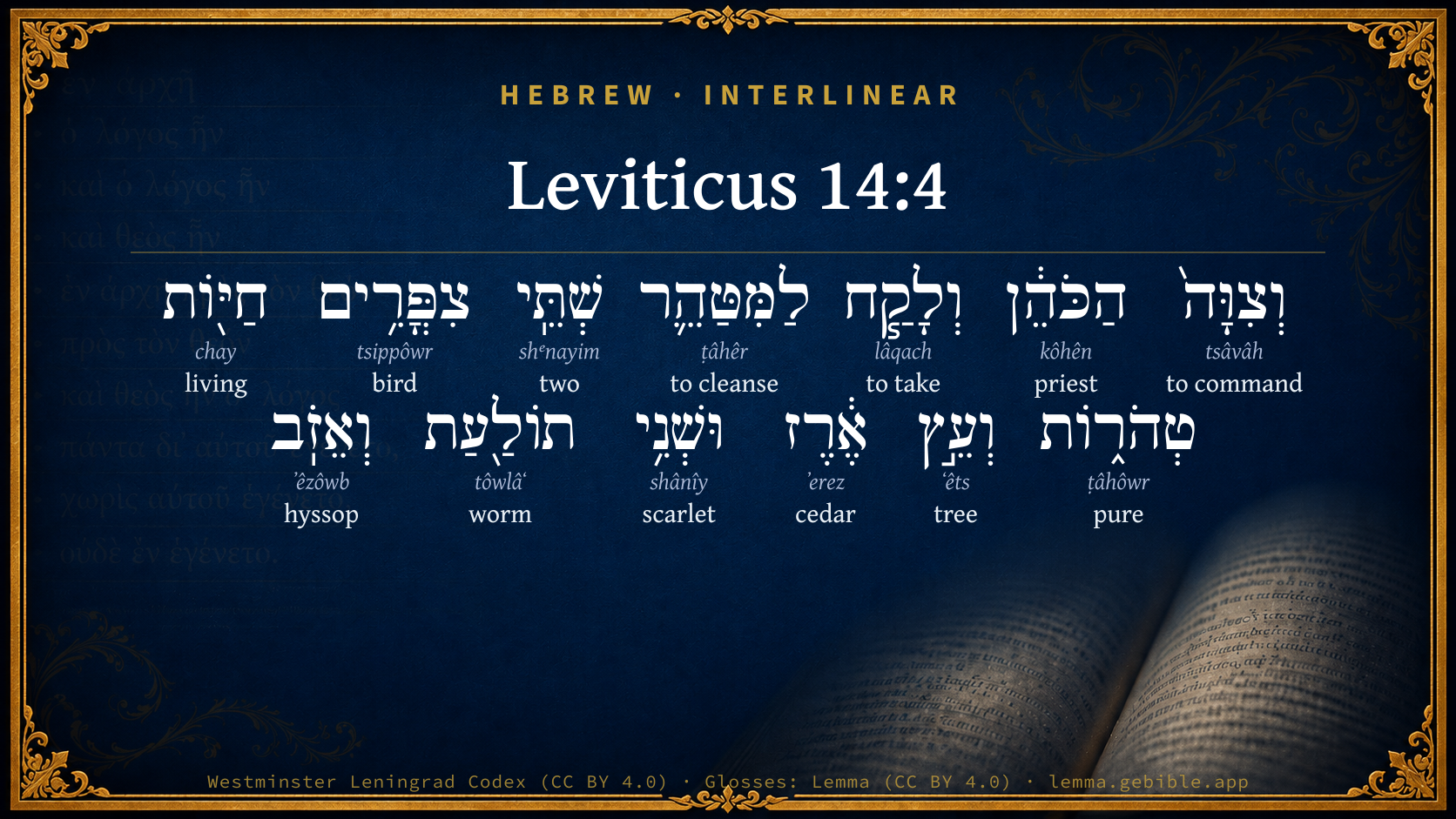
Hebrew (Westminster Leningrad Codex) Leviticus 14:4 appears in the Hebrew Old Testament. The text above is from the Westminster Leningrad Codex. Each word links to its Strong’s number, a concise gloss, and parsing drawn from the Open Scriptures Hebrew Bible morphology. Click any word for its full Brown-Driver-Briggs (BDB) entry.
Download image
Cite this verse

Leviticus 14:4 (World English Bible). Public Domain. Lemma interlinear Bible study tool, https://lemma.gebible.app/v/leviticus/14/4.

Show BibTeX & RIS
BibTeX
RIS
English Translation
then the priest shall command them to take for him who is to be cleansed two living clean birds, and cedar wood, and scarlet, and hyssop.
World English Bible · Public Domain
Highlights
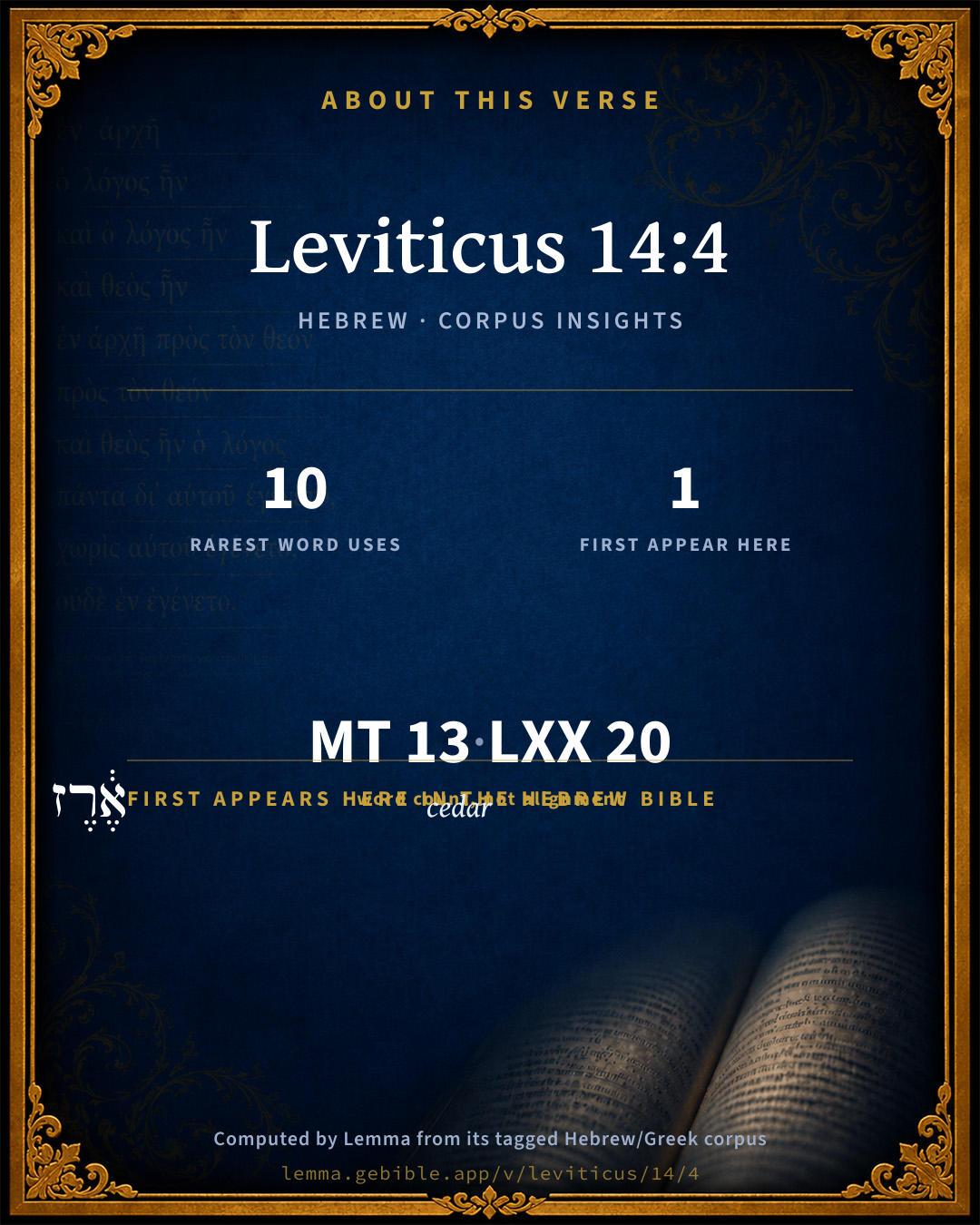
  • 1 first appearance in the Hebrew Bible
Full analysis ↓
Download a study sheet

One document with this verse’s original text, its word-by-word gloss line, the meaning frame, cross-references with their text, attributed commentary, and full source and license credits — printable, and it pastes into notes with its structure intact.

This verse Autodidact and up

Study sheet (.html) Plain text (.txt)

A passage Seminary Student

Up to 50 verses in one chapter. A passage sheet keeps up to 6 commentary sources and 12 cross-references per verse, in the order this page ranks them, and says so on the sheet whenever that leaves anything out. Ask for a single verse and you get the Autodidact verse sheet above.

Everything on this page stays free to read, with no account — the sheet is a download of what is already on screen, not access to it.

Want to remove ads? Support Godless Engineer
Compare translations 3

The same verse in 3 English versions, stacked beneath the original-language interlinear above. Click any original word for its lexicon entry.

Each is an independent rendering of the whole verse — the interlinear is not word-aligned to these translations.

Highlighted words mark where these versions differ — a whole-verse word diff, not a word-by-word alignment.

  • World English Bible Public Domain
    then the priest shall command them to take for him who is to be cleansed two living clean birds, and cedar wood, and scarlet, and hyssop.
  • King James Version Public Domain
    Then shall the priest command to take for him that is to be cleansed two birds alive and clean, and cedar wood, and scarlet, and hyssop:
  • unfoldingWord Literal Text CC BY-SA 4.0
    Then the priest shall command, and he shall take for the person who is being cleansed two live, clean birds and wood of cedar and scarlet of worm and hyssop.

unfoldingWord Literal Text — © unfoldingWord, licensed CC BY-SA 4.0. Word-aligned USFM3 via Door43 (git.door43.org/unfoldingWord/en_ult).

Versions to compare (up to 4)

3 of 4 selected

Show all 18 translations

Every available English version of this verse, each an independent rendering of the whole verse.

  • World English Bible Public Domain
    then the priest shall command them to take for him who is to be cleansed two living clean birds, and cedar wood, and scarlet, and hyssop.
  • Berean Standard Bible Public Domain
    the priest shall order that two live clean birds, cedar wood, scarlet yarn, and hyssop be brought for the one to be cleansed.
  • Majority Standard Bible Public Domain
    the priest shall order that two live clean birds, cedar wood, scarlet yarn, and hyssop be brought for the one to be cleansed.
  • King James Version Public Domain
    Then shall the priest command to take for him that is to be cleansed two birds alive and clean, and cedar wood, and scarlet, and hyssop:
  • American Standard Version (1901) Public Domain
    then shall the priest command to take for him that is to be cleansed two living clean birds, and cedar wood, and scarlet, and hyssop:
  • Revised Version (1885) Public Domain
    then shall the priest command to take for him that is to be cleansed two living clean birds, and cedar wood, and scarlet, and hyssop:
  • Geneva Bible (1599) Public Domain
    Then shall the Priest commaund to take for him that is clensed, two sparrowes aliue and cleane, and cedar wood and a skarlet lace, and hyssope.
  • Douay-Rheims (1899) Public Domain
    Shall command him that is to be purified, to offer for himself two living sparrows, which it is lawful to eat, and cedar wood, and scarlet, and hyssop.
  • Young's Literal Translation Public Domain
    and the priest hath commanded, and he hath taken for him who is to be cleansed, two clean living birds, and cedar wood, and scarlet, and hyssop.
  • Literal Standard Version CC BY-SA 4.0
    and the priest has commanded, and he has taken for him who is to be cleansed, two clean living birds, and cedar wood, and scarlet, and hyssop.
  • Unlocked Literal Bible CC BY-SA 4.0
    Then the priest will command that the one to be cleansed must take two live, clean birds, cedar wood, scarlet yarn, and hyssop.
  • unfoldingWord Literal Text CC BY-SA 4.0
    Then the priest shall command, and he shall take for the person who is being cleansed two live, clean birds and wood of cedar and scarlet of worm and hyssop.
  • Darby Bible Public Domain
    then shall the priest command to take for him that is to be cleansed two clean living birds, and cedar-wood, and scarlet, and hyssop.
  • World Messianic Bible Public Domain
    then the priest shall command them to take for him who is to be cleansed two living clean birds, cedar wood, scarlet, and hyssop.
  • Webster's Bible Public Domain
    Then shall the priest command to take for him that is to be cleansed two birds alive, and clean, and cedar-wood, and scarlet, and hyssop.
  • Free Bible Version CC BY-SA 4.0
    the priest shall have two ceremonially clean birds brought to him, with some cedar wood, crimson thread, and hyssop, on behalf of the person to be made clean.
  • Bible in Basic English Public Domain
    Then the priest is to give orders to take, for him who is to be made clean, two living clean birds and some cedar wood and red thread and hyssop.
  • JPS Tanakh (1917) Public Domain
    then shall the priest command to take for him that is to be cleansed two living clean birds, and cedar-wood, and scarlet, and hyssop.

Literal Standard Version (2020), Covenant Press — licensed CC BY-SA 4.0. Text via the HelloAO Bible API (eBible.org). Unlocked Literal Bible (unfoldingWord) — licensed CC BY-SA 4.0. Text via the HelloAO Bible API (eBible.org). unfoldingWord Literal Text — © unfoldingWord, licensed CC BY-SA 4.0. Word-aligned USFM3 via Door43 (git.door43.org/unfoldingWord/en_ult). Free Bible Version, Dr. Jonathan Gallagher — licensed CC BY-SA 4.0. Text via the HelloAO Bible API (eBible.org).

Word by word

More ways to search: Search by grammar → Find every occurrence → Compare this word →

Practice this passage: Drill this verse → Learn its vocabulary →

וְאֵזֹֽב
ʼêzôwb
H231
“and · hyssop”
Conjunction + Noun, Common, Masculine, Singular, Absolute
Part of Speech
Conjunction + Noun
Type
Common
Gender
Masculine
Number
Singular
State
Absolute
Full BDB Definition

Origin: probably of foreign derivation

TWOT: 55

hyssop, a plant used for medicinal and religious purposes
  1. וְצִוָּה֙ tsâvâh H6680 “and · to command” Conjunction + Verb, Piel, Sequential Perfect, 3rd Person, Masculine, Singular
  2. הַכֹּהֵ֔ן kôhên H3548 “the · priest” Particle, Definite Article + Noun, Common, Masculine, Singular, Absolute
  3. וְלָקַ֧ח lâqach H3947 “and · to take” Conjunction + Verb, Qal, Sequential Perfect, 3rd Person, Masculine, Singular
  4. לַמִּטַּהֵ֛ר ṭâhêr H2891 “to/for the · cleansing” Preposition, Determined + Verb, Hithpael, Participle Active, Masculine, Singular, Absolute
  5. שְׁתֵּֽי shᵉnayim H8147 “two” Adjective, Cardinal number, Feminine, Dual, Construct
  6. צִפֳּרִ֥ים tsippôwr H6833 “birds” Noun, Common, Both, Plural, Absolute
  7. חַיּ֖וֹת chay H2416 “living” Adjective, Adjective, Feminine, Plural, Absolute
  8. טְהֹר֑וֹת ṭâhôwr H2889 “pure” Adjective, Adjective, Feminine, Plural, Absolute
  9. וְעֵ֣ץ ʻêts H6086 “and · tree of” Conjunction + Noun, Common, Masculine, Singular, Construct
  10. אֶ֔רֶז ʼerez H730 “cedar” Noun, Common, Masculine, Singular, Absolute
  11. וּשְׁנִ֥י shânîy H8144 “and · scarlet of” Conjunction + Noun, Common, Masculine, Singular, Construct
  12. תוֹלַ֖עַת tôwlâʻ H8438 “worm” Noun, Common, Feminine, Singular, Absolute

About this verse

These counts appear in no published source. They are computed here, from the morphology-tagged text and Lemma’s own curated glosses. What Lemma adds →

13
words
13
distinct lemmas
Pentateuch
section

Notable vocabulary

The rarest word here is וְאֵזֹֽב hyssop H231 — appearing just 10 times in the whole Hebrew Bible.

First appearance in Scripture

This word makes its first canonical appearance in the Hebrew Bible here:

  • אֶ֔רֶז cedar H730

Shared distinctive vocabulary

וְאֵזֹֽב hyssop H231 occurs in 10 verses of the Hebrew Bible. Also found in:

Grammatical profile

  • 3 verbs
  • 7 nouns
  • 3 adjectives

Verb forms

  • וְצִוָּה֙ Piel · Sequential Perfect
  • וְלָקַ֧ח Qal · Sequential Perfect
  • לַמִּטַּהֵ֛ר Hithpael · Participle Active

Hebrew & Septuagint length

In English translation the verse runs 26 words from the Hebrew and 27 from the Septuagint (LXX English) — closely comparable.

A rough comparison of the two English renderings, which tokenize alike — not a word-level alignment.

Word counts can differ between the Hebrew and the Greek without any difference in meaning — e.g. the Hebrew direct-object marker אֵת has no separate Greek word, and Greek often adds the article ὁ.

In the original languages it is 13 Hebrew tokens and 20 Greek tokens — but the two are counted differently (Hebrew bundles its prefixes and suffixes into one token; the Greek is in lemma form), so that isn’t a like-for-like length.

Cross-references

10

Topical passages linked to Leviticus 14:4 in the Treasury of Scripture Knowledge — connected by theme and wording, ordered by reader-vote popularity; previews shown in the World English Bible.

  • Numbers 19:6 and the priest shall take cedar-wood, and hyssop, and scarlet, and cast it into the midst of the burning of the heifer.
  • Leviticus 14:6 As for the living bird, he shall take it, and the cedar wood, and the scarlet, and the hyssop, and shall dip them and the living bird in the blood of the bird that was killed over the running water.
  • Hebrews 9:19 For when every commandment had been spoken by Moses to all the people according to the law, he took the blood of the calves and the goats, with water and scarlet wool and hyssop, and sprinkled both the book itself and all the people,
  • Exodus 12:22 You shall take a bunch of hyssop, and dip it in the blood that is in the basin, and strike the lintel and the two side-posts with the blood that is in the basin; and none of you shall go out of the door of his house until the morning.
  • Psalms 51:7 Purify me with hyssop, and I will be clean. Wash me, and I will be whiter than snow.
  • Leviticus 1:14 "'If his offering to Yahweh is a burnt offering of birds, then he shall offer his offering of turtledoves, or of young pigeons.
  • Leviticus 5:7 "'If he can't afford a lamb, then he shall bring his trespass offering for that in which he has sinned, two turtledoves, or two young pigeons, to Yahweh; one for a sin offering, and the other for a burnt offering.
  • Leviticus 12:8 If she cannot afford a lamb, then she shall take two turtledoves, or two young pigeons; the one for a burnt offering, and the other for a sin offering: and the priest shall make atonement for her, and she shall be clean.'"
  • Leviticus 14:49–52 To cleanse the house he shall take two birds, and cedar wood, and scarlet, and hyssop.
  • Numbers 19:18 and a clean person shall take hyssop, and dip it in the water, and sprinkle it on the tent, and on all the vessels, and on the persons who were there, and on him who touched the bone, or the slain, or the dead, or the grave:

Cross-references courtesy of OpenBible.info (CC BY 4.0).

Hebrew and Greek witnesses Masoretic Hebrew ↔ Greek Septuagint

The same verse in the two great witnesses to the Old Testament, shown verse-for-verse.

These are two independent witnesses, not word-aligned to each other, and the Septuagint is shown in lemma (dictionary) form.

Hebrew Leviticus 14:4 Masoretic · Westminster Leningrad Codex

וְצִוָּה֙ הַכֹּהֵ֔ן וְלָקַ֧ח לַמִּטַּהֵ֛ר שְׁתֵּֽי צִפֳּרִ֥ים חַיּ֖וֹת טְהֹר֑וֹת וְעֵ֣ץ אֶ֔רֶז וּשְׁנִ֥י תוֹלַ֖עַת וְאֵזֹֽב

then the priest shall command them to take for him who is to be cleansed two living clean birds, and cedar wood, and scarlet, and hyssop.

World English Bible · Public Domain

Greek LXX Leviticus 14:4 Septuagint · lemma form

καί προςτάσσω ὁ ἱερεύς καί λαμβάνω ὁ καθαρίζω δύο ὀρνίθιον ζάω καθαρός καί ξύλον κέδρινος καί κλώθω κόκκινος καί ὕσσωπος

And the priest shall give directions, and they shall take for him that is cleansed two clean live birds, and cedar wood, and spun scarlet, and hyssop.

LXX2012 (modern English Septuagint) · Public Domain

On this verse, Jamieson, Fausset & Brown discusses the Septuagint’s reading. Read the note in Commentary ↓

Hebrew: Westminster Leningrad Codex (CC BY 4.0). Greek: Septuagint (public domain); English from LXX2012 (modern English Septuagint) (Public Domain). How the Septuagint differs from the Hebrew →

Targum (Aramaic paraphrase)

2

The Targum is the ancient Jewish Aramaic paraphrase of the Hebrew Scriptures — an interpretive translation, not the Hebrew text itself. Onkelos (literal) and Pseudo-Jonathan (expansive) render the Torah, and Jonathan the Prophets. Coverage is partial: where no permissively-licensed English translation exists for a verse, only the Aramaic is shown. This is verse-level text, not a word-by-word alignment to the Hebrew.

  1. Targum Onkelos Torah (Genesis–Deuteronomy)
    וִיפַקֵד כַּהֲנָא וְיִסַב לְמִדַכֵּי תַּרְתֵּין צִפֳּרִין חַיִין דָכְיָן וְאָעָא דְאַרְזָא וּצְבַע זְהוֹרִי וְאֵזוֹבָא

    (no public-domain English translation for this verse)

    Targum Onkelos — Aramaic: “Onkelos Genesis” (public domain); “Onkelos Exodus” (public domain); “Onkelos Leviticus” (public domain); “Onkelos Numbers” (public domain); “Onkelos Deuteronomy” (public domain). English: “Sefaria Community Translation” (CC0 1.0 (public-domain dedication)); “J.W. Etheridge. The Targums of Onkelos and Jonathan Ben Uzziel on the Pentateuch. London: Longmans, Green, 1862” (public domain). Text via Sefaria.

  2. Targum Pseudo-Jonathan Torah (Genesis–Deuteronomy)
    וְיַפְקֵד כַּהֲנָא וְיִסַב לִדְמִדַכֵּי תְּרֵין צִפּוֹרִין חַיָּין וְדַכְיָין וְקֵיסָא דְאַרְזָא וּצְבַע זְהוֹרִי וְאֵיזוֹבָא

    Then the priest shall direct that he who is to be cleansed take two birds, alive and clean, and wood of the cedar, and scarlet (wool), and hyssop.

    Targum Pseudo-Jonathan — Aramaic: “Targum Jonathan on Genesis” (public domain); “Targum Jonathan on Exodus” (public domain); “Targum Jonathan on Leviticus” (public domain); “Targum Jonathan on Numbers” (public domain); “Targum Jonathan on Deuteronomy” (public domain). English: “The Targum of Jonathan ben Uzziel, trans. J. W. Etheridge, London, 1862” (public domain). Text via Sefaria.

Commentary

Notes on Leviticus 14:4 from classic Christian and Jewish commentators (each source and its license shown beneath its notes). The classic Christian expositions comment on the surrounding passage and are grouped to its opening verse, so a note may address several verses; the Jewish commentaries on the Tanakh (Rashi and others) are per-verse, so they appear only where the commentator wrote on this verse.

Lemma curates 59 commentaries, every one of them public domain or Creative Commons licensed, each selected and text-cleaned for this edition rather than reprinted as found. About our sources →

The Cambridge Bible for Schools and Colleges

gen. ed. J. J. S. Perowne

4–7. The priest was to see that two living clean birds were brought. The Heb. word is ẓippôr, which is used of the birds of Abraham’s sacrifice (Gen_15:10) and of clean birds generally (Deu_14:11). In Psa_84:3 [Hebrews 4], Psa_102:7 [Hebrews 8] it is translated ‘sparrow,’ and A.V. mg. of Lev_14:4 has ‘sparrows,’ following the traditional interpretation, and Vulg. These birds were employed in a ceremony which was without the camp, and the blood was not brought to the altar.

cedar wood, and scarlet, and hyssop] The cedar and hyssop were bound together by a scarlet band of wool. From 1Ki_4:33 it appears that cedar and hyssop were regarded as two extremes in respect of size among trees: the cedar is a symbol of health and vigour (Psa_92:12); it is used figuratively of the great ones of the earth (Jdg_9:15; Isa_14:8; Isa_37:24), not without reference to the haughtiness of those occupying such high positions (Isa_2:13; Eze_31:3; Eze_31:10). Hence some Jewish writers have seen in the cedar a figure of pride punished by a visitation of leprosy, while the hyssop signified that humility which was necessary to obtain forgiveness, and the removal of the stroke.

The cedar is noted for its durability, and the oil of the cedar was employed as a preservative; the Egyptians used it for embalming. This power of arresting decay may be regarded as akin to that shewn in restoring the tainted flesh of the leper. The scarlet colour has been generally taken as representing the blood, or the life which has been bestowed on one who was regarded as dead (Num_12:12). The hyssop seems to have been chosen for the purpose of sprinkling (Lev_14:7, cp. Exo_12:22). The Mishna orders that the cedar wood should be a cubit in length, and that the hyssop shall not be Greek or Roman hyssop, or desert hyssop, or any hyssop with a distinctive name (Tal. Bab. Neg. xiv. § 6).

The Cambridge Bible for Schools and Colleges (gen. ed. J. J. S. Perowne; Cambridge University Press, 1878–1918) — public domain. Text from a community e-Sword module.

Trapp's Complete Commentary

John Trapp

Lev 14:4 Then shall the priest command to take for him that is to be cleansed two birds alive [and] clean, and cedar wood, and scarlet, and hyssop:

Ver. 4. Command to take.] That the leper might show his thankfulness to Jehovah his physician, as he is called. {Exo 15:26} See Mat 8:4. Men pray and pay physicians of their bodies, who yet do but officiose occidere many times. And shall God have nothing? Must he ask as once, Where are the other nine? Shall we not turn again with Naaman now cleansed, and offer our service, renounce our idols, dedicate all we are and have to the God of Israel?

Two birds.] Or sparrows, whereof two were sold for a farthing: to show how lightly set by Christ is in the world, whose blood nevertheless is more worth than a thousand worlds.

John Trapp, A Commentary or Exposition upon All the Books of the Old and New Testament (1647–1656) — public domain. Text from a community e-Sword module.

Albert Barnes' Notes on the Bible

These birds were provided by the priest for the man. They were not, like the offerings for the altar, brought by the man himself (compare Lev 14:4 with Lev 14:10), they were not presented nor brought near the sanctuary, nor was any portion of them offered on the altar.

Cedar wood, and scarlet, and hyssop - These three substances were used as the common materials in rites of purification (compare Exo 12:22; Num 19:8; Psa 51:7; Heb 9:19): the “cedar”, or juniper, the resin or turpentine of which was a preservative against decay, and employed in medicines for elephantiasis and other skin diseases: the “scarlet”, a “tongue,” or band, of twice-dyed scarlet wool, with which the living bird, the hyssop, and the cedar wood were tied together when they were dipped into the blood and water: the color expressing the rosiness associated with health and vital energy: and the “hyssop” (see Exo 12:22), probably the Caper plant, whose cleansing virtues as a medicine, and use in the treatment of ulcers and diseases of the skin allied to leprosy, were known to the ancients. It has been conjectured that the scarlet band was used to tie the hyssop upon the cedar, so as to make a sort of brush, such as would be convenient for sprinkling.

Albert Barnes' Notes on the Bible (1834–1885) — public domain. Text from a community e-Sword/MySword module.

Joseph Benson's Commentary

Lev 14:4. Two birds — The one to represent Christ as dying for his sins, the other to represent him as rising again for his purification or justification. Alive and clean — Allowed for food and for sacrifice. Cedar-wood — A stick of cedar, to which the hyssop and one of the birds were tied by the scarlet thread. Cedar seems to be chosen, to denote that the leper was now freed from that corruption which his leprosy had brought upon him, that kind of wood being in a manner incorruptible. Scarlet — A thread of wool of a scarlet colour, to represent both the leper’s sinfulness, and the blood of Christ, and the happy change of the leper’s colour and complexion, which before was wan and loathsome, now sprightly and beautiful. Hyssop — The fragrant smell of which signified the cure of the leper’s ill scent.

Joseph Benson's Commentary on the Old and New Testaments (1811–1818) — public domain. Text from a community e-Sword module.

Tyndale Open Study Notes

Tyndale Open Resources

14:4 The items listed here were part of the cleansing ritual involving the ashes of the red heifer (Num 19:6), but their exact significance is unknown. See also Heb 9:18-22. Hyssop was a small plant used for sprinkling blood (Exod 12:22) and in purification rites (Num 19:18).

Tyndale Open Study Notes — © Tyndale Open Resources, licensed CC BY-SA 4.0. Text via the HelloAO Bible API.

Geneva Bible (1599)

Geneva Bible translators

Or, little birds.

Of birds which were permitted to be eaten.

Geneva Bible (1599) marginal notes — public domain. Text via Bolls.life.

Jamieson, Fausset & Brown

Robert Jamieson, A. R. Fausset & David Brown

two birds--literally, "sparrows." The Septuagint, however, renders the expression "little birds"; and it is evident that it is to be taken in this generic sense from their being specified as "clean"--a condition which would have been altogether superfluous to mention in reference to sparrows. In all the offerings prescribed in the law, Moses ordered only common and accessible birds; and hence we may presume that he points here to such birds as sparrows or pigeons, as in the desert it might have been very difficult to procure wild birds alive.

cedar-wood, and scarlet, and hyssop--The cedar here meant was certainly not the famous tree of Lebanon, and it is generally supposed to have been the juniper, as several varieties of that shrub are found growing abundantly in the clefts and crevices of the Sinaitic mountains. A stick of this shrub was bound to a bunch of hyssop by a scarlet ribbon, and the living bird was to be so attached to it, that when they dipped the branches in the water, the tail of the bird might also be moistened, but not the head nor the wings, that it might not be impeded in its flight when let loose.

Jamieson, Fausset & Brown — Commentary Critical and Explanatory on the Whole Bible (1871) — public domain (CC PDM 1.0). Text via the HelloAO Bible API.

Adam Clarke's Commentary

Verse 4. Two birds alive and clean, c.] Whether these birds were sparrows, or turtledoves, or pigeons, we know not probably any kind of clean bird, or bird proper to be eaten, might be used on this occasion, though it is more likely that turtle-doves or pigeons were employed, because these appear to have been the only birds offered in sacrifice. Of the cedarwood, hyssop, clean bird, and scarlet wool or fillet, were made an aspergillum, or instrument to sprinkle with. The cedar-wood served for the handle, the hyssop and living bird were attached to it by means of the scarlet wool or crimson fillet. The bird was so bound to this handle as that its tail should be downwards, in order to be dipped into the blood of the bird that had been killed. The whole of this made an instrument for the sprinkling of this blood, and when this business was done, the living bird was let loose, and permitted to go whithersoever it would. In this ceremony, according to some rabbins, "the living bird signified that the dead flesh of the leper was restored to soundness; the cedar-wood, which is not easily corrupted, that he was healed of his putrefaction; the scarlet thread, wool, or fillet, that he was restored to his good complexion; and the hyssop, which was purgative and odoriferous, that the disease was completely removed, and the bad scent that accompanied it entirely gone." Ainsworth, Dodd, and others, have given many of these rabbinical conceits. Of all these purifications, and their accompanying circumstances, we may safely say, because authorized by the New Testament so to do, that they pointed out the purification of the soul through the atonement and Spirit of Christ; but to run analogies between the type and the thing typified is difficult, and precarious. The general meaning and design we sufficiently understand; the particulars are not readily ascertainable, and consequently of little importance; had they been otherwise, they would have been pointed out.

Adam Clarke's Commentary on the Bible (1810–1826) — public domain. Text from a community e-Sword/MySword module.

Ellicott's Commentary for English Readers

(4) Then shall the priest command to take.—Literally, And the priest shall command, and he shall take, that is, the leper shall take. To avoid the ambiguity as to the person, the translators of the Authorised Version adopted the rendering in the text. As the relatives of the cured leper procured the things prescribed for the purification, some of the ancient versions render it, And they shall take.

Two birds alive and clean.—These were either sparrows, doves, turtledoves, or any other birds, provided they belonged to the clean species described in Leviticus 11. According to the canons which obtained during the second Temple, the birds had to be sparrows, and the reason assigned for it was that as leprosy was regarded as a Divine punishment for calumny, such birds were selected as were proverbial for their constant twitter. Hence the rendering of sparrow in the Latin Vulgate, and in the Margin of the Authorised Version.

And cedar wood.—This had to be a foot and a half long, and a quarter of the foot of the bed in thickness. Though this wood was primarily chosen for its antiseptic properties, which made it peculiarly suitable for the occasion, still, belonging to the loftiest of trees (Pss. 2:13, Pss. 27:24; Amo_2:9), it also was designed to symbolise the haughtiness of mind which called down the affliction of leprosy.

And scarlet.—This was probably a band of scarlet wool with which the cedar and the hyssop were tied together. In later times the woollen band had to be the weight of a shekel, or weighing thirty-two grains of barley. It was taken to symbolise the purified and now healthy blood.

And hyssop.—This, according to the canons which obtained in the time of Christ, had at least to be a handbreadth in size. It could not be the so-called Greek, or the ornamental, or Roman, or wild hyssop, or any other hyssop which was distinguished by the name of the place where it grew, but had to be the common hyssop which grew in gardens. Though, like the cedar wood, it was primarily used on these occasions for its aromatic properties, yet this diminutive shrub was also most probably designed to symbolise the humility of the cured leper. Hence ancient tradition tells us, “Cedar wood and hyssop, the highest and the lowest, give the leper purity. Why these? Because pride was the cause of the distemper, which cannot be cured till man becomes humble, and keeps himself as low as hyssop.” Cedar wood, hyssop, and scarlet were also burnt with the red heifer (Num_19:6), and were generally employed in purifications (Heb_9:19). Hence the Psalmist prays, “Purge me with hyssop, and I shall be clean” (Psa_51:17).

A Bible Commentary for English Readers, edited by Charles John Ellicott (1878–1897) — public domain. Text from a community e-Sword module.

John Gill's Exposition

Then shall the priest command to take for him that is to be cleansed,.... The command is by the priest, the taking is by any man, as Ben Gersom observes; anyone whom he shall command, the leper himself, or his friends. Aben Ezra interprets it, the priest shall take of his own; but he adds, there are some that explain it, the leper shall give them to him, namely, what follows:

two birds alive, and clean; any sort of birds, to whom this description agrees; for not any particular sort are pointed out, as "sparrows" (w), as some render the word, or any other; because either they must be clean or unclean; if unclean, then not to be used; if clean, then this descriptive character is used in vain. These were to be alive, taken alive with the hand, and not shot dead; and this also excepts such as were torn, as Jarchi, or any ways maimed and unsound, and not likely to live; and they were to be "clean", such as were so according to a law given in a preceding chapter; they were to be none of those unclean birds there mentioned; and, according to the Misnah (x), they were to be alike in sight and height, and in price and value, and to be taken together; and, by the same tradition, they were to be two birds of liberty, that is, not such as were kept tame in cages, but such as fly abroad in the fields, These birds may be considered as a type of Christ, who compares himself to a hen, Mat 23:37; and "birds" may denote his swiftness and readiness to help his people, his tenderness and compassion towards them in distress, and his weakness and frailty in human nature, and his meanness and despicableness in the eyes of men; and these being "alive", the character well agrees with him, who is the living God, the living. Redeemer, the Mediator that has life in himself, and for his people; and as man, now lives, and will live for evermore, and is the author and giver of life, natural, spiritual, and eternal. And the birds being clean, may denote the purity and holiness of Christ, and so his fitness to be a sacrifice, and his suitableness as food for his people: and the number two may signify either his two natures, divine and human, in both which he lives, and is pure and holy; or his two estates of humiliation and exaltation; or his death by the slain bird, and his resurrection by the living bard, of which more hereafter:

and the cedar wood, and scarlet, and hyssop; a stick of cedar, as Jarchi; it was proper it should be of such a size, as to be known to be cedar wood, but was not to be too heavy for the priest to sprinkle with it, as Ben Gersom; and the same writer observes, it ought to have a leaf on the top of it, that it might appear to be cedar: according to the Misnah (y), it was to be a cubit long, and the fourth part of a bed's foot thick: "scarlet" was either wool dyed of that colour, or crimson, so Jarchi; or a scarlet thread or line with which the hyssop was bound and fastened to the cedar wood; and, according to the above tradition (z), the "hyssop" was to be neither counterfeit nor wild, nor Greek, nor Roman, nor any that had any epithet to it, but common simple hyssop; and, as Gersom says, there was not to be less than an handful of it. The signification of these is variously conjectured; according to Abarbinel, they have respect to the nature of the leprosy, and as opposite to it; that as the two live birds signified restoration to his former state, when he had been like one dead, so the cedar wood, being incorruptible and durable, showed that the putrefaction of humours was cured; the scarlet, that the blood was purged, and hence the true colour of the face returned again, and a ruddy and florid countenance as before; and the hyssop being of a savoury smell, that the disagreeable scent and stench were gone: but others think there is a moral meaning in them, that the cedar being the highest of trees, and the scarlet colour coming from a worm, and the hyssop the lowest of plants, see Kg1 4:33; the "cedar wood" may denote the pride and haughtiness of spirit the leprosy is the punishment of, as in Miriam, Gehazi, Uzziah, and the family of Joab: and the worm that gives the scarlet colour, and the hyssop, may signify that humility that becomes a leper that is cleansed, so Jarchi: but they will bear a more evangelical sense, and may have respect either to Christ; the cedar wood may be an emblem of the incorruption of Christ, and of the durable efficacy of his death; the scarlet, of his bloody sufferings, his flaming love to his people, expressed thereby, and the nature of those sins and sinners being of a scarlet die, for whom he suffered; and the hyssop, of the purgative nature of his blood, which cleanses from all sin: or else to the graces of his Spirit; faith may be signified by the cedar wood, which is in some strong, and in all precious and durable; love by scarlet, of a flaming colour, as strong love is like coals of fire, that give a most vehement flame; and hope by hyssop, which is but a lowly, yet lively grace; or faith may be set forth by them all, by the cedar wood for its continuance, by scarlet for its working by love, and by hyssop for its purifying use, as it deals with the blood of Christ.

(w) "duos passeres", V. L. (x) Negaim, c. 14. sect. 5. (y) Negaim, c. 14. sect. 6. (z) Ibid.

John Gill's Exposition of the Whole Bible (1746–1763) — public domain (CC PDM 1.0). Text via the HelloAO Bible API.

Haydock's Catholic Bible Commentary

Sparrows. Hebrew tsipporim. Septuagint, "little birds," which the law only determines must be clean; such probably as might be procured most easily. The leper was to present them, and kill one. But the priest sprinkled with its blood the other bird, which was tied with a scarlet ribband to the cedar-wood and hyssop, in such a manner that its head and wings were not much wet, as it as to fly away. (Calmet) --- The cedar prevents putrefaction, the hyssop is very odoriferous, the scarlet and the bird denote beauty and life, which qualities the leper must acquire. So the penitent regains the virtues he had lost, with interest. (Tirinus)

George Leo Haydock (1774–1849), Haydock's Catholic Family Bible and Commentary, 1859 edition — public domain. Excludes Psalms (Douay-Rheims chapter numbering differs from Protestant) and Deuterocanonical books (Catholic canon only).

Matthew Poole's English Annotations

Two birds; the one to represent Christ as dying for his sins, the other to represent him as rising again for his purification or justification.

Clean; allowed for food and for sacrifice.

Cedar wood; a stick of cedar, to which the hyssop and one of the birds was tied by the scarlet thread. Cedar seems to be chosen, to note that the leper was now freed from that putrefaction or corruption which his leprosy had brought upon him, that kind of wood being in a manner incorruptible.

Scarlet; a thread of wool of a scarlet colour, Heb 9:19, to represent both the leper’s sinfulness, Isa 1:18, and the blood of Christ, and the happy change of the leper’s colour and complexion, which before was wan and loathsome, now sprightly and beautiful.

Hyssop, chosen partly for its fragrant smell, which signified the cure of the leper’s ill scent, and partly for conveniency in the use of sprinkling. See Exo 12:22.

Matthew Poole's English Annotations on the Holy Bible (1683–1685) — public domain. Text from a community e-Sword/MySword module.

Whedon's Commentary on the Bible

Daniel D. Whedon

4. Command to take for him — Literally, the priest shall command, and he (the leper) shall take for him, cleansing himself. The leper was not to be perfectly passive in his being cleansed, but he was enjoined to co-operate with the priest. Thus the sinner is to present by faith the blood of Christ with which he is to be purified.

Two birds — Of any kind, provided they be clean, that is, fit for food. Lev_11:13-28. The Vulgate says passeres, sparrows. If limited to these the word “clean” would be out of place, since individuals would be clean if their species were so. The Seventy use a diminutive form, “little birds.” Tradition adds that they must not be reared in a cage, but wild birds.

Cedar wood — The piece, according to Jewish law, was to be long enough to constitute a handle. The oxyderus, or Phenician juniper, which abounds in the Sinaitic Peninsula, is doubtless intended. Vitruvius speaks of the antiseptic properties of the oil of juniper. It may well typify the keeping power of divine grace. 1Pe_1:5.

Scarlet — Here is an attribute without a substance, which must be supplied — wool, the Seventy, “spun wool.” The colour is properly crimson obtained from the coccus insect found on the boughs of the ilex. Furst suggests that the proper translation in this place is, a crimson piece of cloth, in which to enfold the hyssop and cedar wood.

This colour sometimes symbolizes mortal sins. Isa_1:18. It may here typify the blood of the Lamb, faith in which makes sinners whiter than snow. Rev_7:14.

Hyssop — Hebrew ezob. See Exo_12:22, note. Later researches identify it with the origanum maru, a plant of a highly aromatic odour, many stalks growing from one root so that the hand could easily gather in a single grasp a bunch all ready for use. It grows on the walls of all the terraces in Syria and Palestine. But Stanley and Tristram argue for the caper, or asaf, as the same as the ezob.

Daniel D. Whedon (gen. ed.), Commentary on the Old and New Testaments (1874–1909) — public domain. Text from a community e-Sword module.

The Pulpit Commentary

Cedar wood, and scarlet, and hyssop. "Cedar wood, and hyssop, and scarlet" are also to be burnt with the red heifer for the ashes for the water of separation, (Num_19:6) and they appear to have been commonly employed in purifications. (Heb_9:19) The antiseptic properties of cedar made it peculiarly suitable for such occasions. The hyssop "was probably not the plant which we call hyssop, the Hyssopus officinalis. for it is uncertain whether this is to be found in Syria and Arabia, but a species of origanum resembling hyssop, the Arabian zater, either wild marjoram, or a kind of thyme". (Keil on Exo_12:21) The Psalmist"s cry, "Purge me with hyssop, and I shall be chart", (Psa_51:7) shows the common use to which it was put. In the present case, the sweet smell both of the wood (one cubit"s length of which was used) and of the herb would have still further adapted them for symbolizing the redemption of the leper"s flesh from corruption and putrefaction. The scarlet was probably a band of scarlet wool with which the cedar and the hyssop were tied not to the bird (for we have no account of their being after, wards removed), but (as in the burning of the red heifer) one to the other. The colour of the wool was appropriate, not only because it was about to be dipped in the blood and water, but also because it symbolized the purified and now healthy blood.

Vers. 4-9. Admission (or readmission).

When leprosy had departed from the flesh, he who had been, but no longer remained, a leper was, in the sight of Jehovah and of his people, still ceremonially unclean. He was in a bodily condition which made him readmissible to Divine and human fellowship, but he must first "be cleansed" (verse 4) before he would be readmitted. The ceremonies here prescribed give a picture of our readmission to the favour of God and the fellowship of his people.

I SACRIFICE OF ANOTHER"S LIFE. As a "clean bird" (verse 4) was taken and its blood was shed (verse 5), as the life-blood of the pure and innocent creature was poured out that the leper might be clean and pure in the sight of God, so is the life-blood of the spotless Lamb shed for us. There must be for our acceptance and admission, or readmission after backsliding, a "sacrifice for sin.

II PERSONAL APPLICATION OF THAT SACRIFICE. "He shall sprinkle upon him that is to be cleansed... seven times" (verse 7). "The living bird" was to be "dipped in the blood of the bird that was killed." Here is the truth that if the "blood of Christ" is to be effectual for our salvation, it must be applied to our individual conscience. We who seek to be cleansed from all iniquity and condemnation, must ourselves personally apply for mercy through the shed blood of the Redeemer. By an act of living faith we must bathe in the "fountain opened for sin and for uncleanness.

III PERSONAL PUTTING AWAY OF DEFILEMENT, The leper was to "wash his clothes, and shave off all his hair, and wash himself in water, that he may be clean." And again, after a week"s interval, was to shave and to wash, removing all his hair, even to the eyebrows (verse 9); everything about him that could in any possible way be defiled by the plague was to be carefully removed. So, if we are to be admitted (or readmitted) to God"s favour and man"s communion, we must deliberately put away from ourselves, from heart and life, every evil way, everything which is, or may be, tainted with iniquity. (2Ti_2:19)

IV DIVINE ACKNOWLEDGMENT OF OUR INTEGRITY. Everything here pointed to the fact that the Divine Ruler of Israel was prepared to acknowledge the cleanness of the leper. The water was to be "running water" (verse 5) pure, as opposed to that which was stagnant and foul; "cedar wood" was to be used (verse 6), type of that which is fragrant and healthful; the "scarlet" wool (verse 6) hinted the red and healthy blood, which had been impure but was so no longer; "hyssop" (verse 6) was suggestive of fragrance; but that which, above all, was indicative of God"s acknowledgment of the wholeness of the leper was the action respecting the living bird: that was released, let "loose into the open field" (verse 7). This either signified that the uncleanness of the leper was borne away on the wings of the bird, where it should never be found again, (a similar institution to the scapegoat, Lev_16:22, Lev_16:23) or that the leper was thenceforth free to go whithersoever he pleased. Either way, it expressed symbolically the truth that there was reinstatement for the man who had been healed in the privileges he had forfeited. We have in the Scriptures every possible assurance that "repentance toward God, and faith toward our Lord Jesus Christ," are followed by fullness of Divine favour. The returned prodigal has the kiss of reconciliation, the ring and robe of honour, and the feast of joy. "Being justified by faith, we have peace with God... and rejoice in hope of the glory of God". (Rom_5:1, Rom_5:2) The soul that is healed of its sore disease is pronounced clean in the sight of God, and is free of its Father"s house, to enter its many rooms and partake of its many joys. C.

The Pulpit Commentary (1880–1919), ed. H.D.M. Spence-Jones & Joseph S. Exell — public domain. Text from a community e-Sword module.

John Wesley's Explanatory Notes

Two birds - The one to represent Christ as dying for his sins, the other to represent him as rising again for his purification or justification. Clean - Allowed for food and for sacrifice. Cedar- wood - A stick of cedar, to which the hyssop and one of the birds was tied by the scarlet thread. Cedar seems to be chosen, to note that the leper was now freed from that corruption which his leprosy had brought upon him, that kind of wood being in a manner incorruptible. Scarlet - A thread of wool of a scarlet colour, to represent both the leper's sinfulness, and the blood of Christ, and the happy change of the leper's colour and complexion, which before was wan and loathsome, now sprightly and beautiful. Hyssop - The fragrant smell of which, signified the cure of the leper's ill scent.

John Wesley, Explanatory Notes Upon the Whole Bible (1754–1765) — public domain. Text via the GEBible commentary corpus.

Scofield Reference Notes

C. I. Scofield

birds

The bird slain, and the live bird, dipped in blood and released, present the two aspects of salvation in Rom 4:25 "delivered for our offences, and raised again for our justification."

The Scofield Reference Bible (1917 edition), notes by C. I. Scofield — public domain. Text from a community e-Sword module.

Rashi

Rabbi Shlomo Yitzchaki (Rashi)

חיות LIVING [BIRDS] — This term excludes רפות‎ט, birds that suffer from some fatal organic disease (חיות does not only mean “living”, but also “capable of continuing to live”).

הרות‎ט CLEAN — This term excludes an unclean bird (of a species that may not be eaten) (cf. Chullin 140a). Because the plagues of leprosy come as a punishment for slander, which is done by chattering, therefore birds are compulsory for his (the leper’s) purification, because these chatter, as it were, continuously with a twittering sound (Arakhin 16b).

ועץ ארז AND CEDAR WOOD — This lofty tree was used because plagues come also as a punishment for haughtiness (cf. Arakhin 16a).

ושני תולעת ואזוב AND CRIMSON AND HYSSOP — What is the remedy he should use, that he may be healed? Let him, abandoning pride, regard himself lowly as a worm (תולעת) and as hyssop (cf. Midrash Tanchuma, Metzora 3).

עץ ארז means a stick of cedar wood (not a cedar tree).

שני תולעת — a strip of wool dyed crimson.

Rashi on the Tanakh — English translations: “The Judaica Press complete Tanach with Rashi, translated by A. J. Rosenberg” (CC BY 4.0); “Pentateuch with Rashi's commentary by M. Rosenbaum and A.M. Silbermann, 1929-1934” (public domain); “The Metsudah Tanach series, Lakewood, N.J” (CC BY 4.0); and “The Book of Joshua, Metsudah Publications, 1997” (CC BY 4.0). Text via Sefaria.

Ramban (Nachmanides)

Rabbi Moshe ben Nachman (Ramban / Nachmanides)

THEN SHALL THE PRIEST COMMAND TO TAKE FOR HIM THAT IS TO BE CLEANSED TWO LIVING, CLEAN ‘TZIPORIM’ (BIRDS). “Living, this excludes birds which are treifah. according to the accepted opinion (see Note 9 below), is an animal or bird suffering from one of certain organic diseases from which it is bound to die within twelve months, even though it be ritually slaughtered. Thus the word living excludes a bird which will die from a disease. Ramban further on will comment on this point. Clean, this excludes a bird unfit for food. Since the plagues of leprosy came as a punishment for slander, which is done by chattering, therefore Scripture required for the leper’s cleansing that he bring birds which always twitter with a chirping sound.” This is Rashi’s language.Now in view of the fact that Rashi wrote, “Clean, this excludes a bird which is unfit for food,” we can deduce that the [unqualified] term tziporim does not denote a permissible species of birds, but is instead a generic term for all birds [those permissible as food and those forbidden]. If so, the question appears: what is this “chirping” that they found [among the tziporim]? For there are many birds among which there is none that openeth the mouth, or chirpeth! Moreover, the interpretation [which Rashi quoted]: “Living, this excludes birds which are treifah,” according to the accepted opinion (see Note 9 below), is an animal or bird suffering from one of certain organic diseases from which it is bound to die within twelve months, even though it be ritually slaughtered. Thus the word living excludes a bird which will die from a disease. Ramban further on will comment on this point. is really subject to a controversy of opinion, animal or bird can in fact survive for more than one year. and according to the Sage who says that a treifah according to the accepted opinion (see Note 9 below), is an animal or bird suffering from one of certain organic diseases from which it is bound to die within twelve months, even though it be ritually slaughtered. Thus the word living excludes a bird which will die from a disease. Ramban further on will comment on this point. can survive, this interpretation [of Rashi] is not correct. And in the Torath Kohanim we find this interpretation: 1:12. “Living, not slaughtered. Clean, not unfit for food. Clean, not treifoth.” means not slaughtered; clean means not unfit for food.’ Then [the Tanna] says that according to the Midrash thereof, clean means not treifah, since that it may not be of a forbidden species, we know already from the word tzipor. This Sage further holds that a treifah can survive, and therefore birds which are treifah are not excluded by the word living,” but instead are excluded by the term clean. Now the scholars who follow the simple meaning of Scripture. say that every kind of bird [whether permissible as food or forbidden] is called tzipor, as is evidenced by the verses which state: ‘tzipor’ (the fowl) of the air, and the fish of the sea; every ‘tzipor’ (bird) of every sort; And thou son of man … speak ‘l’tzipor’ (unto the birds) of every sort. Similarly, it says, and ‘hatzipor’ (the birds) he did not divide, with reference to the turtle-doves and young pigeons, Verse 9. [which are permissible birds, thus proving that the term tzipor is used with reference to both permissible and forbidden birds].The correct interpretation appears to me to be that the term tzipor is a generic term for all small birds that rise early in the morning to chirp and to sing, the term being associated with the Aramaic word tzaphra (morning). Similarly, the expression let him return v’yitzpor’ means, and arise “early in the morning.” The expression ‘tzipor’ (the fowl of) the air is said with reference to these small birds, because it is mostly they that fly high in the air. Every ‘tzipor’ (bird) of every sort refers to two kinds, all the little ones and the big ones. If a ‘kan tzipor’ (bird’s nest) chance to be before thee speaks about the little ones which are many [and therefore likely to chance to be there], to teach that even when they are young, the finder must exercise mercy towards them. Similarly, therein ‘tziporim’ (the birds) make nests [means the little ones], for it is they that dwell on the boughs of the cedars of the Lebanon. Speak ‘l’tzipor’ (unto the birds) of every sort means that even the little ones should gather upon [the flesh of the mighty that have fallen in battle], for the big marauding birds will come by themselves. Similarly, Wilt thou play with him [the leviathan] ‘katzipor’ (as with a bird)? Or wilt thou bind him for thy maidens? [refers to the little birds], for it is the way of young boys to play with little birds. The language of the Sages also follows that usage: Any statue which bears in its hand a staff or ‘tzipor’ (a bird) must be to a small bird that can easily be caught. Rabbeinu Chananel explains the text of the Gemara in the following words: “he holds the whole world in his hand as one holds a bird.” Here too the reference is to a small bird that the holder can easily control in the palm of his hand. [one may not derive any benefit from, since these objects indicate that the statue is worshipped as an idol]; “If a man wove into a garment one sit’s length of a Nazirite’s hair [from which one is forbidden to derive any benefit], the garment is to be burnt,” is the distance between the tips of the outstretched thumb and forefinger. [and when the Sages of the Gemara raised the question, “why is this small piece not neutralized by the larger part of the garment?” it was answered that this is a case where he wove into the garment “the form of] a tziporta” [a small bird, which made the whole garment more valuable, and therefore it is not neutralized by the larger part thereof, and hence must be burnt]. From this too it is clear that the term tzipor denotes a small bird. The Sages also speak of “tziporoth (birds of) the vineyard [however small].” (birds of) the vineyard, whether alive or dead, [he is liable], however small [the size be].” It is thus clear that the word tzipor is used by the Sages to mean a small bird, which even when alive is “however small.” They also said: “the meat of tziporim (birds) brings back a sickness to a sick man [who is recovering, and makes it worse” refers to a small bird, Ramban now begins to elucidate further that it means both a permissible and forbidden species of bird. Here in the text of Berachoth it definitely means a permissible bird, but further it will be shown that it may mean also a forbidden bird. thus indicating that the term tzipor refers to a bird which one may eat]. Scripture further states, All ‘tzipor’ (birds) that are clean ye may eat, meaning all these many species of [permissible] birds, thus including [the living bird sent away by] the leper [into the open field as permissible food], (Deuteronomy 14:11), meaning any bird of a permissible species that is found may be eaten, now if the living bird of the leper were forbidden to be eaten, the Torah would not command the bird to be sent off, as this could involve a possible offense [since if the bird were not in fact permitted to be eaten, one might catch it without knowing that it had been used by the leper, and eat it]! Now, concludes Ramban, this permission is based in the Talmud on the word ‘all’ (‘All birds etc.) as explained above. This proves that the word tzipor, such as found here in the text before us, does not of itself only mean a permissible kind of bird. Rather, since it is a term for both the permissible and forbidden kind, it was therefore necessary for the Torath Kohanim here to establish that the leper’s bird must be of a permissible species, from the word clean qualifying tziporim. by means of the word kol (‘All’ birds that are clean ye may eat). And the verse which states, But these are they of which ye shall not eat: the great vulture, and the bearded vulture, and the osprey means “a small” bird, whether of a permissible or forbidden kind, Ramban finds this verse difficult, since the expression of them [in translation of the verse: “of which”] apparently refers back to ‘kol tzipor’ (birds) mentioned in the previous verse [11], and yet it mentions here (in Verse 12) big birds like the great vulture, etc. In addition, the word tzipor in Verse 11 is explicitly qualified by the word ‘t’horah,’ thus excluding the great vulture. Ramban’s answer follows in the text, where he explains that the expression of them does not refer back to ‘kol tzipor’ (all birds) previously mentioned, but rather means “of their flesh,” i.e., the flesh of these big birds about to be mentioned — the great vulture, etc. is [to be understood] as if it said, “and these are they, from the flesh of which ye may not eat.” It is for this reason [i.e., since the term tzipor includes both permissible and forbidden birds], that the Sages found it necessary to interpret: 1:12. “Clean, not forbidden birds” [but they would not have been able to derive it if the word tziporim had not been qualified]. In any case it is clear that tziporim are the small chirping birds. Similarly, Yea, the ‘tzipor’ hath found a house, and the swallow a nest for herself also indicates that the word tzipor is not a name for all birds [for otherwise why should the verse mention both tzipor and the swallow, if the term tzipor already includes all birds]. Likewise, Wherein tziporim (the birds) make their nests, the stork makes the fir-tree her house, 104:17. [indicates that tziporim does not include all birds, since the verse proceeds also to mention some specific birds].It would appear from the words of our Sages that all birds permissible as food are called tzipor, but the leper was commanded to bring tziporei dror [“free birds,” a term which, as explained further on means birds which live in the house as well as in the field], for we have been taught in the Torath Kohanim: 5:13. “And he shall let go the living bird out of the city into the open field. Rabbi Yosei the Galilean said: ‘This means a bird that lives outside all cities. And what kind of bird is it? It is the bird called dror’” [the free bird that lives in the house as well as in the field]. It is on the basis of this interpretation of the Rabbis that they further mentioned [in connection with the leper’s birds] that they “chatter” [since it is usually these free birds which twitter].It is possible that the requirement that the birds be of “the free” kind is a commandment [which is to be observed if possible, but is not indispensable], so that if it has already been done, they are all valid [whether free or unfree]. Therefore the Sages in the Torath Kohanim 1:12. found it necessary to exclude forbidden bird’s [which do not possess this characteristic of living in the house and in the field]. And so we have been taught in a Mishnah of Tractate Negaim: “And he [the leper] brought two birds that are of the free type of bird.” And it is furthermore taught there:, 5. “It is a commandment that the two birds of the leper should be alike in appearance, in size and in value, and that they should be brought at the same time. Yet even if they are not alike, they are valid. If one was slaughtered and it was found that it was not a ‘free bird,’ he should buy a partner for the second one.” The reason [why he must buy a partner for the second one] although [as we have said above] if it has already been done, all birds [whether free or unfree] are valid, is that if they were of two different kinds [as in this case, where the slaughtered one was a non-dror, and the living one a dror], they are invalid. And in the Chapter Eilu Treifoth ” among cattle. It is the third chapter of Tractate Chullin. The text quoted here is found there on 62 a. For the word treifah, see above, Note 7. the Sages of the Gemara have said: “A bird which scratches, is valid to be used for the purification of the leper. This is the white-bellied swallow concerning which Rabbi Eliezer and the Sages differed” [as explained further on]. From these texts [it is clear] that the birds for the purification of the leper are not limited to one species, and that the purification is not to be done with any permissible bird, but rather the commandment is that it be done only with those birds that are dror, that is to say, “which live in the house as well as in the field.” Therefore the Rabbis said [in the above-quoted text] with reference to the white-bellied swallow, that since according to the Sages it is a bird which may be eaten, it is also valid for the purification of the leper, as it is included within [the category of those birds that are] dror [living in the house as well as in the field]. Yet nonetheless all permissible birds [even those that are not “free birds”] are valid, if the purification of the leper has already been done with them, since they are all included within the phrase, two living clean birds.And we have been taught in the Sifre: 103. See in Seder Vayikra Note 121, on Sifre. “Rabbi Yashiyah said: ‘Wherever it says in Scripture tzipor, it speaks of a permissible bird.’ Said Rabbi Yitzchak: ‘A permissible bird is called oph (fowl) and also tzipor (bird), but a forbidden one is only called oph’.” Similarly the Rabbis mentioned also in the Gemara [of Tractate Chullin], in the Chapter Shilu’ach Hakan, where they resolved that the term living [two ‘living’ clean birds] means “the ends of whose limbs ‘live’ (exist), thus excluding birds from whom a limb is missing.” Similarly [permissible] birds which are treifah according to the accepted opinion (see Note 9 below), is an animal or bird suffering from one of certain organic diseases from which it is bound to die within twelve months, even though it be ritually slaughtered. Thus the word living excludes a bird which will die from a disease. Ramban further on will comment on this point. are invalid [for the purification of the leper]. The Rabbis also interpreted there the term clean [two living ‘clean’ birds] to exclude those birds which are of a permissible species but are forbidden to be eaten [for some special reason], such as birds belonging to a person of a city that went astray, or a fowl that killed a human being, or those that have been exchanged for an idol. use, just as the original idol may not be made any use of. This interpretation was derived by the Sages from the very language itself, since the term tzipor denotes only a permissible bird. It is clear then from this text, that all permissible birds [whether they are of the dror-type or not] are included within the category of tzipor.I have further seen in the Yerushalmi of Tractate Nazir i.e., the Jerusalem Talmud. The academies in Babylon flourished for many centuries longer. Their teachings were later compiled [about the year 475 of Common Era] and are known as the Babylonian Talmud. To this day Talmudic study is almost exclusively devoted to the Babylonian Talmud, so that any tractate of the Talmud generally cited, is that of the Babylonian Talmud, unless specified as in the case before us: “the Yerushalmi of Tractate” so-and-so. A tradition has it that after the redaction of the Jerusalem Talmud, its Sages went down as a group to Babylon, and most of their teachings were incorporated into the text of the Babylonian Talmud. This explains why Talmudic study throughout the ages was concentrated almost entirely upon the Babylonian Talmud, while only the outstanding Rabbis of the generations devoted their studies also to the Jerusalem Talmud. that the Sages of the Gemara said: “But does an impure Nazirite really bring tziporim? (birds),’ Rabbi Meir says that he becomes a Nazirite etc.” The reason for this opinion of Rabbi Meir was explained there in the Gemara by Resh Lakish, that it is because a Nazirite whose consecration has been defiled, must bring tziporim as an atonement (Numbers 6:9-11). On this explanation of Resh Lakish, the Gemara asked: “But does a Nazirite really bring tziporim? It is turtle-doves or young pigeons that he brings!” In other words, tziporim means birds which are of a forbidden kind, while the Nazirite must bring birds which are permissible to be eaten! So how could the reason Resh Lakish advanced to explain Rabbi Meir’s opinion be correct, since tziporim (forbidden birds) are not used at all by a Nazirite! — Ramban is thus beginning at this point to refute his own explanation which he had set forth, namely, that tzipor refers only to a permissible bird, since it is evident from the Yerushalmi that tzipor means a forbidden bird! The final solution of the Yerushalmi follows. It is turtle-doves or young pigeons that he brings! [To this question the reply was made:] ‘There are some authorities who teach that all edible birds are called tziporim, and there are other authorities that teach that all birds, whether permissible or forbidden, are called tziporim.’”, becomes a Nazirite even according to those authorities that hold that the term tziporim denotes all kinds of birds, permissible ones or forbidden ones, for since it also denotes permissible birds, his intention was those birds that may be brought upon the altar (P’nei Moshe). Thus we are now left with a divergence of opinion [as to what the term tzipor denotes]! Yet it is possible that the name applies only to the small birds. This appears so in the Gemara from what the Rabbis have said in Tractate Sotah: [In the process of his purification the leper is commanded to] “bring a sufficient amount of water that the bird’s blood may remain discernible in it.. On this the Sages commented that the vessel must contain just enough water that the blood of the bird is discernible in it. And how much etc. (see text). And how much is this? The fourth of a log.” Upon this the Sages queried: “If the bird was a large one so that the blood thereof ‘pushed away’ the water [so that it was imperceptible], or the bird was a small one so that its blood was ‘pushed away’ by the water [so that the blood was indiscernible], what is the ruling on these cases?” On these questions [the Rabbis of the Talmud] explained: “All standard measures laid down by the Sages were fixed with precision. The Sages estimated with reference to a ‘free bird’ that you will not find one so big that the blood thereof will ‘push away’ the water, nor will you find one so small that the blood thereof will be ‘pushed away’ by the water.” Now if all kinds of permissible birds were valid for [the purification of the leper], there are some birds the blood of which would “push away” many logim of water! Perhaps the Sages established the above standard only with reference to a “free bird” which one is commanded to bring if this is possible, according to the interpretation of Rabbi Yosei the Galilean, [but if the purification has already been done with a large bird, it is also valid]. It has already been mentioned in the Gemara: “Perhaps he saw a large tziporo (bird) and he called it gamal (camel).” includes also large birds, and hence the above-mentioned explanation that it refers only to small birds is incorrect.The correct [and final] conclusion which emerges from all this discussion is that we say on the basis of this interpretation that any bird which is not a “free one” is invalid for the purification of the leper, even if the purification has already been done, since in the Mishnah thereof, 5. it was not taught: “It is a commandment [to be fulfilled if possible] that the birds should be ‘free birds,’ but even if they were not ‘free birds,’ they are valid,” as it taught concerning the requirement of equality [in appearance, size and value, that “even if they are not alike, they are valid”]; also, the correct conclusion is that all birds that are “free birds” are those that chatter. And that which the Rabbis said in the Torath Kohanim, 1:12. “Clean, not those forbidden as food,” -characteristic of the bird is indispensable in the purification of the leper, meaning that if the birds did not have this quality of living in the house as well as in the field, the purification is invalid even if already done, why was it necessary for the Torath Kohanim to point to a special Scriptural source for the exclusion of forbidden birds; for such birds are not of the kind that live in the house as well as in the field, and we have said that if the birds lack this characteristic, the purification is invalid?” Ramban answers that we must perforce say that even among forbidden birds there are some species that do have this characteristic of being able to live in the house as well as in the field, and hence it was necessary for the Torath Kohanim to exclude them by means of a special expression in the verse. is because even among the forbidden birds there are some species that possess this quality of dror [living in the house as well as in the field], such as the white-bellied swallow according to Rabbi Eliezer. Or perhaps the meaning of the Torath Kohanim is that it excludes those birds [whose prohibition is not because they belong to the forbidden species, but because of special circumstances] which make them “forbidden to you,” such as those birds which are nonetheless forbidden [as food or benefit, because they belonged to a person of a city that had gone astray, or those that have been exchanged for an idol], use, just as the original idol may not be made any use of. or those which are treifah, according to the accepted opinion (see Note 9 below), is an animal or bird suffering from one of certain organic diseases from which it is bound to die within twelve months, even though it be ritually slaughtered. Thus the word living excludes a bird which will die from a disease. Ramban further on will comment on this point. just as the Rabbis resolved in the Gemara in the Chapter Shilu’ach Hakan. This is the correct interpretation in my eyes. In the Agadah of the [Midrash] Rabbah we find this statement: “Rabbi Yehudah the son of Rabbi Simon said: These birds [brought by the leper for his purification] are noisy ones, symbolic of he who speaks slander [and as a punishment for which, the slanderer is stricken with leprosy]. Said the Holy One, blessed be He, ‘Let that which is accompanied by sound [namely, these noisy birds] come to bring atonement for the evil sound [of the slanderer].’ And Rabbi Yehoshua the son of Levi said: The birds [brought by the leper for his purification] are of the ‘free kind’ [that live in the house as well as in the field] and thus ate of the leper’s bread and drank of his water. Now the following statement follows logically with stronger reason etc.” ).

AND CEDAR-WOOD, AND SCARLET, AND HYSSOP. Rabbi Abraham ibn Ezra commented that “[the cedar-wood and the hyssop] represent the tallest and the lowest in species of vegetation, as is evidenced by the words of wisdom of Solomon. [Solomon] spoke of trees, from the cedar that is in Lebanon even unto the hyssop that springeth out of the wall (I Kings 5:13). The inference is clearly that Solomon’s wisdom encompassed all vegetation, from highest to lowest. Thus the law of the leper and the law of the house stricken with leprosy and the [law of] impurity [conveyed by] a corpse are closely related, and they resemble the Passover in Egypt. And the meaning of the expression into the open field is to an uninhabitated place, so that no infection might be caused.” [Thus far are the words of Ibn Ezra.].And in the Torath Kohanim the Rabbis have said: 2:5. “Into the open field, this means that he is not to stand in Joppa [which is on the sea] and let it go into the sea, nor is he to stand in Gabbath [a city which is on the edge of the desert] and let it go into the desert.” Now if so, [that he may not let it go into the sea or into the desert], then the reason why it is sent into the open field is like the secret of the goat sent to Azazel, except that there it is sent for Azazel into the wilderness, and here it is sent to the flying [destructive spirits] of the field. I will yet explain this with the help of G-d.

Ramban (Nachmanides) on the Tanakh — English translation: “Commentary on the Torah by Ramban (Nachmanides). Translated and annotated by Charles B. Chavel. New York, Shilo Pub. House, 1971-1976” (CC BY 4.0). Text via Sefaria.

Lesson kit

Teaching starters — assembled from the data on this page, not authored interpretation. Every prompt links to the verse data it draws on. Edit before teaching.

Leviticus, in the Pentateuch, opens this verse with 13 words (13 distinct Hebrew lemmas). Its most distinctive word is ʼêzôwb (“hyssop”). A historical commentator’s framing appears above. Read the whole chapter for the surrounding context.

Discussion questions

  1. What does “hyssop” (ʼêzôwb) contribute to the verse as a whole?
  2. This is the first place “cedar” appears in Scripture (first appears here). What does its debut here establish?
  3. How does Exodus 12:22, which shares the word «hyssop», read alongside this verse?
  4. These translations render this verse differently. What is at stake in choosing one wording over another?
  5. «וְצִוָּה֙» is a Piel Sequential Perfect verb. How does that grammatical form shape the action described?
  6. Compare how The Cambridge Bible for Schools and Colleges and Trapp's Complete Commentary read this verse. Where do they agree or differ?

Things to notice

Reading settings

Reading text

Shown beneath each verse's original-language words.

Old Testament
Old Testament edition

Read the OT as the Masoretic Hebrew (MT) or the Greek Septuagint (LXX).

English shown for the Greek Septuagint (in the Hebrew ↔ Greek comparison).

Comparing translations? Open the Compare panel on any verse page to stack up to four side by side.