Ezekiel 43:16

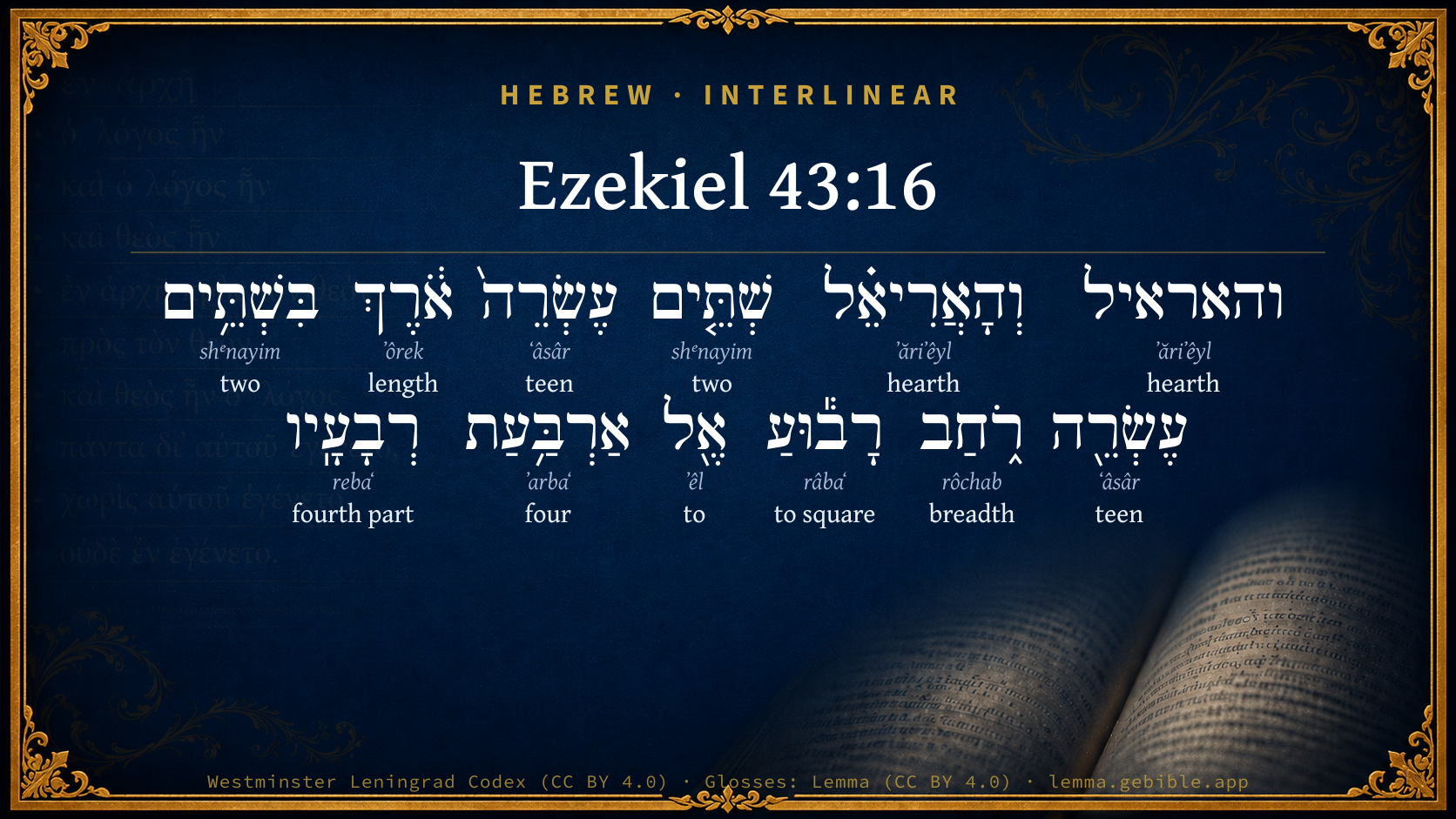
Hebrew (Westminster Leningrad Codex) Ezekiel 43:16 appears in the Hebrew Old Testament. The text above is from the Westminster Leningrad Codex. Each word links to its Strong’s number, a concise gloss, and parsing drawn from the Open Scriptures Hebrew Bible morphology. Click any word for its full Brown-Driver-Briggs (BDB) entry.
Download image
Cite this verse

Ezekiel 43:16 (World English Bible). Public Domain. Lemma interlinear Bible study tool, https://lemma.gebible.app/v/ezekiel/43/16.

Show BibTeX & RIS
BibTeX
RIS
English Translation
The altar hearth shall be twelve [cubits] long by twelve broad, square in the four sides of it.
World English Bible · Public Domain
Download a study sheet

One document with this verse’s original text, its word-by-word gloss line, the meaning frame, cross-references with their text, attributed commentary, and full source and license credits — printable, and it pastes into notes with its structure intact.

This verse Autodidact and up

Study sheet (.html) Plain text (.txt)

A passage Seminary Student

Up to 50 verses in one chapter. A passage sheet keeps up to 6 commentary sources and 12 cross-references per verse, in the order this page ranks them, and says so on the sheet whenever that leaves anything out. Ask for a single verse and you get the Autodidact verse sheet above.

Everything on this page stays free to read, with no account — the sheet is a download of what is already on screen, not access to it.

Want to remove ads? Support Godless Engineer
Compare translations 3

The same verse in 3 English versions, stacked beneath the original-language interlinear above. Click any original word for its lexicon entry.

Each is an independent rendering of the whole verse — the interlinear is not word-aligned to these translations.

Highlighted words mark where these versions differ — a whole-verse word diff, not a word-by-word alignment.

  • World English Bible Public Domain
    The altar hearth shall be twelve [cubits] long by twelve broad, square in the four sides of it.
  • King James Version Public Domain
    And the altar shall be twelve cubits long, twelve broad, square in the four squares thereof.
  • unfoldingWord Literal Text CC BY-SA 4.0
    The hearth is twelve cubits in length and twelve cubits in width, a square.

unfoldingWord Literal Text — © unfoldingWord, licensed CC BY-SA 4.0. Word-aligned USFM3 via Door43 (git.door43.org/unfoldingWord/en_ult).

Versions to compare (up to 4)

3 of 4 selected

Show all 18 translations

Every available English version of this verse, each an independent rendering of the whole verse.

  • World English Bible Public Domain
    The altar hearth shall be twelve [cubits] long by twelve broad, square in the four sides of it.
  • Berean Standard Bible Public Domain
    The altar hearth shall be square at its four corners, twelve cubits long and twelve cubits wide.
  • Majority Standard Bible Public Domain
    The altar hearth shall be square at its four corners, twelve cubits long and twelve cubits wide.
  • King James Version Public Domain
    And the altar shall be twelve cubits long, twelve broad, square in the four squares thereof.
  • American Standard Version (1901) Public Domain
    And the altar hearth shall be twelve `cubits' long by twelve broad, square in the four sides thereof.
  • Revised Version (1885) Public Domain
    And the altar hearth shall be twelve cubits long by twelve broad, square in the four sides thereof.
  • Geneva Bible (1599) Public Domain
    And the altar shalbe twelue cubites long, and twelue broade, and fouresquare in the foure corners thereof.
  • Douay-Rheims (1899) Public Domain
    And the Ariel itself was four cubits: and from the Ariel upward were four horns.
  • Young's Literal Translation Public Domain
    And the altar `is' twelve long by twelve broad, square in its four squares.
  • Literal Standard Version CC BY-SA 4.0
    And the altar [is] twelve long by twelve broad, square in its four sides.
  • Unlocked Literal Bible CC BY-SA 4.0
    The hearth is twelve cubits in length and twelve cubits in width, a square.
  • unfoldingWord Literal Text CC BY-SA 4.0
    The hearth is twelve cubits in length and twelve cubits in width, a square.
  • Darby Bible Public Domain
    And the hearth of ùGod was twelve [cubits] long, by twelve broad, square in the four sides thereof.
  • World Messianic Bible Public Domain
    The altar hearth shall be twelve cubits long by twelve wide, square in its four sides.
  • Webster's Bible Public Domain
    And the altar shall be twelve cubits long, twelve broad, square in the four squares of it.
  • Free Bible Version CC BY-SA 4.0
    The altar hearth shall be square, its four sides each measuring twelve cubits.
  • Bible in Basic English Public Domain
    And the fireplace is twelve cubits long and twelve cubits wide, square on its four sides.
  • JPS Tanakh (1917) Public Domain
    And the hearth shall be twelve cubits long by twelve broad, square in the four sides thereof.

Literal Standard Version (2020), Covenant Press — licensed CC BY-SA 4.0. Text via the HelloAO Bible API (eBible.org). Unlocked Literal Bible (unfoldingWord) — licensed CC BY-SA 4.0. Text via the HelloAO Bible API (eBible.org). unfoldingWord Literal Text — © unfoldingWord, licensed CC BY-SA 4.0. Word-aligned USFM3 via Door43 (git.door43.org/unfoldingWord/en_ult). Free Bible Version, Dr. Jonathan Gallagher — licensed CC BY-SA 4.0. Text via the HelloAO Bible API (eBible.org).

Word by word

More ways to search: Search by grammar → Find every occurrence → Compare this word →

Practice this passage: Drill this verse → Learn its vocabulary →

והאראיל
ʼăriʼêyl
H741
“and · the · hearth”
Conjunction + Particle, Definite Article + Noun, Common, Masculine, Singular, Absolute
Part of Speech
Conjunction + Particle + Noun
Type
Common
Gender
Masculine
Number
Singular
State
Absolute
Full BDB Definition

Origin: either by transposition for H739 or, more probably, an orthographical variation for H2025

TWOT: 159a

hearth, altar hearth, altar
  1. וְהָאֲרִיאֵ֗ל ʼăriʼêyl H741 “and · the · hearth” Conjunction + Particle, Definite Article + Noun, Common, Masculine, Singular, Absolute
  2. שְׁתֵּ֤ים shᵉnayim H8147 “two” Adjective, Cardinal number, Feminine, Dual, Absolute
  3. עֶשְׂרֵה֙ ʻâsâr H6240 “teen” Adjective, Cardinal number, Feminine, Singular, Absolute
  4. אֹ֔רֶךְ ʼôrek H753 “length” Noun, Common, Masculine, Singular, Absolute
  5. בִּשְׁתֵּ֥ים shᵉnayim H8147 “in/at · two” Preposition + Adjective, Cardinal number, Feminine, Dual, Absolute
  6. עֶשְׂרֵ֖ה ʻâsâr H6240 “teen” Adjective, Cardinal number, Feminine, Singular, Absolute
  7. רֹ֑חַב rôchab H7341 “breadth” Noun, Common, Masculine, Singular, Absolute
  8. רָב֕וּעַ râbaʻ H7251 “squared” Verb, Qal, Participle Passive, Masculine, Singular, Absolute
  9. אֶ֖ל ʼêl H413 “to” Preposition
  10. אַרְבַּ֥עַת ʼarbaʻ H702 “four” Adjective, Cardinal number, Masculine, Singular, Construct
  11. רְבָעָֽיו rebaʻ H7253 “sides · his” Noun, Common, Masculine, Plural, Construct + Suffix, Personal, 3rd Person, Masculine, Singular

About this verse

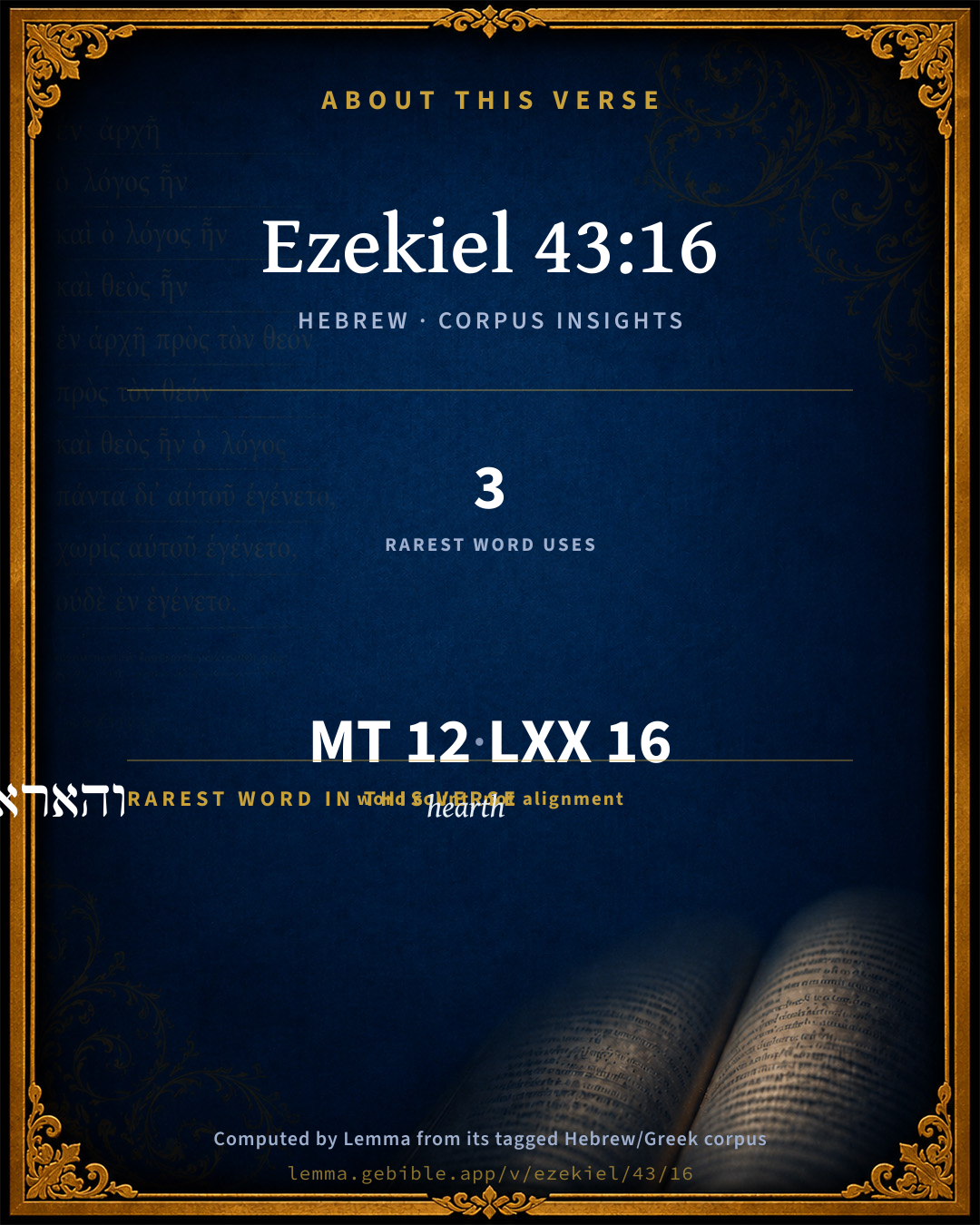
These counts appear in no published source. They are computed here, from the morphology-tagged text and Lemma’s own curated glosses. What Lemma adds →

12
words
9
distinct lemmas
Prophets
section

Notable vocabulary

The rarest word here is והאראיל hearth H741 — appearing just 3 times in the whole Hebrew Bible.

Shared distinctive vocabulary

והאראיל hearth H741 occurs in 2 verses of the Hebrew Bible. Also found in:

Grammatical profile

  • 1 verb
  • 5 nouns
  • 5 adjectives
  • 1 preposition

Verb forms

  • רָב֕וּעַ Qal · Participle Passive

Repetition

Words recur within this verse — often emphatic in Hebrew:

  • והאראיל hearth H741 ×2
  • שְׁתֵּ֤ים two H8147 ×2
  • עֶשְׂרֵה֙ teen H6240 ×2

Hebrew & Septuagint length

In English translation the verse runs 18 words from the Hebrew and 21 from the Septuagint (LXX English) — closely comparable.

A rough comparison of the two English renderings, which tokenize alike — not a word-level alignment.

Word counts can differ between the Hebrew and the Greek without any difference in meaning — e.g. the Hebrew direct-object marker אֵת has no separate Greek word, and Greek often adds the article ὁ.

In the original languages it is 12 Hebrew tokens and 16 Greek tokens — but the two are counted differently (Hebrew bundles its prefixes and suffixes into one token; the Greek is in lemma form), so that isn’t a like-for-like length.

Cross-references

4

Topical passages linked to Ezekiel 43:16 in the Treasury of Scripture Knowledge — connected by theme and wording, ordered by reader-vote popularity; previews shown in the World English Bible.

  • Exodus 27:1 "You shall make the altar of acacia wood, five cubits long, and five cubits broad; the altar shall be foursquare: and its height shall be three cubits.
  • Exodus 38:1–2 He made the altar of burnt offering of acacia wood. It was square. Its length was five cubits, its breadth was five cubits, and its height was three cubits.
  • 2 Chronicles 4:1 Moreover he made an altar of brass, twenty cubits the length of it, and twenty cubits the breadth of it, and ten cubits the height of it.
  • Ezra 3:3 They set the altar on its base; for fear was on them because of the peoples of the countries: and they offered burnt offerings thereon to Yahweh, even burnt offerings morning and evening.

Cross-references courtesy of OpenBible.info (CC BY 4.0).

Hebrew and Greek witnesses Masoretic Hebrew ↔ Greek Septuagint

The same verse in the two great witnesses to the Old Testament, shown verse-for-verse.

These are two independent witnesses, not word-aligned to each other, and the Septuagint is shown in lemma (dictionary) form.

Hebrew Ezekiel 43:16 Masoretic · Westminster Leningrad Codex

והאראיל וְהָאֲרִיאֵ֗ל שְׁתֵּ֤ים עֶשְׂרֵה֙ אֹ֔רֶךְ בִּשְׁתֵּ֥ים עֶשְׂרֵ֖ה רֹ֑חַב רָב֕וּעַ אֶ֖ל אַרְבַּ֥עַת רְבָעָֽיו

The altar hearth shall be twelve [cubits] long by twelve broad, square in the four sides of it.

World English Bible · Public Domain

Greek LXX Ezekiel 43:16 Septuagint · lemma form

καί ὁ αριηλ πηχύς δώδεκα μῆκος ἐπί πῆχυς δώδεκα πλάτος τετράγωνος ἐπί ὁ τέσσαρες μέρος αὐτός

And the altar shall be of the length of twelve cubits, by twelve cubits in breadth, square upon its four sides.

LXX2012 (modern English Septuagint) · Public Domain

Hebrew: Westminster Leningrad Codex (CC BY 4.0). Greek: Septuagint (public domain); English from LXX2012 (modern English Septuagint) (Public Domain). How the Septuagint differs from the Hebrew →

Targum (Aramaic paraphrase)

1

The Targum is the ancient Jewish Aramaic paraphrase of the Hebrew Scriptures — an interpretive translation, not the Hebrew text itself. Onkelos (literal) and Pseudo-Jonathan (expansive) render the Torah, and Jonathan the Prophets. Coverage is partial: where no permissively-licensed English translation exists for a verse, only the Aramaic is shown. This is verse-level text, not a word-by-word alignment to the Hebrew.

  1. Targum Jonathan Prophets (Joshua–Malachi)
    וּמַדְבְּחָא תַּרְתָּא עַסְרֵי אוּרְכָּא בְּתַרְתָּא עַסְרֵי פּוּתְיָא מְרֻבַּע עַל אַרְבְּעָא סִיטְרוֹהִי:

    (no public-domain English translation for this verse)

    Targum Jonathan — Aramaic: “Mikraot Gedolot” (public domain). English: “Sefaria Community Translation” (CC0 1.0 (public-domain dedication)); “London "Chaldee Paraphrase," 1871” (public domain). Text via Sefaria.

Commentary

Notes on Ezekiel 43:16 from classic Christian and Jewish commentators (each source and its license shown beneath its notes). The classic Christian expositions comment on the surrounding passage and are grouped to its opening verse, so a note may address several verses; the Jewish commentaries on the Tanakh (Rashi and others) are per-verse, so they appear only where the commentator wrote on this verse.

Lemma curates 59 commentaries, every one of them public domain or Creative Commons licensed, each selected and text-cleaned for this edition rather than reprinted as found. About our sources →

Trapp's Complete Commentary

John Trapp

Eze 43:16 And the altar [shall be] twelve [cubits] long, twelve broad, square in the four squares thereof.

Ver. 16. Square in the four squares thereof.] Christ, the Christian altar, is complete, firm, and fixed.

John Trapp, A Commentary or Exposition upon All the Books of the Old and New Testament (1647–1656) — public domain. Text from a community e-Sword module.

Jamieson, Fausset & Brown

Robert Jamieson, A. R. Fausset & David Brown

square in the four squares--square on the four sides of its squares [FAIRBAIRN].

Jamieson, Fausset & Brown — Commentary Critical and Explanatory on the Whole Bible (1871) — public domain (CC PDM 1.0). Text via the HelloAO Bible API.

The Cambridge Bible for Schools and Colleges

gen. ed. J. J. S. Perowne

16. The preceding measurements have referred to height. Those referring to breadth or area are now given. The altar-hearth or platform was 12 cubits square.

four squares thereof] four sides thereof. So Eze_43:17.

The Cambridge Bible for Schools and Colleges (gen. ed. J. J. S. Perowne; Cambridge University Press, 1878–1918) — public domain. Text from a community e-Sword module.

John Gill's Exposition

And the altar shall be twelve cubits long, twelve broad,.... The length of it, from east to west, was twelve cubits; and the breadth, from north to south, was the same; so that it was a proper foursquare, as follows: Christ the altar, or the doctrine of his sacrifice and satisfaction for the sins of men, is the doctrine of the twelve apostles of Christ, and embraced by the twelve times twelve, the 144,000 that belong unto him:

square in the four squares thereof; as the altar in the tabernacle, and Solomon's temple, were, Exo 27:1, denoting the largeness of Christ's sacrifice, the perfection of it, and its stability and permanency, to take away the sin, of his people.

John Gill's Exposition of the Whole Bible (1746–1763) — public domain (CC PDM 1.0). Text via the HelloAO Bible API.

Albert Barnes' Notes on the Bible

altar - Ariel was to be an exact square on all sides. Compare Exo 27:1; Rev 21:16.

Albert Barnes' Notes on the Bible (1834–1885) — public domain. Text from a community e-Sword/MySword module.

Matthew Poole's English Annotations

The altar; that which in the 15th verse is precisely determined to be the altar, the uppermost and least settle.

Twelve cubits long, twelve broad; all exact square, by which we may know the dimensions of the other two; the first of the two was wider by two cubits, and longer by two cubits, than the highest, and the lowest was as much greater and larger than the middlemost. The highest twelve cubits square, the middle fourteen cubits square, and the lowest sixteen cubits square.

Matthew Poole's English Annotations on the Holy Bible (1683–1685) — public domain. Text from a community e-Sword/MySword module.

The Pulpit Commentary

Vers. 16, 17 The measurements that now begin concern the breadth of the altar, and proceed from above downwards. First the altar, or, hearth of God (Hebrew, ariel) was twelve cubits long and twelve broad, i.e. was square in the four squares (or, sides) thereof, or a perfect square. (Exo_27:1; Rev_21:16) Next the settle, or, enclosure (Hebrew, hrz) of ver. 14, was fourteen cubits long, and fourteen broad in the four squares (or, sides) thereof; the fourteen being made up of the twelve cubits of the altar-hearth"s side with one cubit of ledge from the settle all round. The only question is to which "settle," the upper or the under, reference is made. Some expositors, identifying the greater Azarah with the Harel, i.e. the "upper settle," with "the mount of God" or the base of the hearth, make the altar height only seven cubits from the ground to the hearth. The general belief, however, is that they cannot be so identified. Among interpreters who distinguish them, Kliefoth, with whom Smend agrees, holds the "settle" in this verse to be the harel, or "mount of God," which extended (Smend says with a hek. or "gutter") one cubit on each side beyond the ariel, or "hearth of God," so that the "mount of God," on which the" hearth of God" rested, was fourteen cubits square. Then, assuming a similar extension of one cubit at each stage in the greater azarah, the lesser azarah, and the hek, or ground bottom he finds the surface of the greater azarah to be sixteen, of the lesser azarah eighteen, and of the ground bottom twenty cubits square. Keil, with whom Schroder and Currey agree, objects to this as involving too much of arbitrary assumption, and takes the" settle" of this verse to mean the lower azarah; so that no additional measurements are required beyond those given in the text. If the square surface of the greater azarah be considered as having been the same as that of the harel, so that their sides were continuous, then, as the "ground bottom" extended one cubit on each side beyond the lower azarsh, the altar at its base was a square of sixteen cubits. Comparing now these measurements with those of the altar of burnt offering in the tabernacle and the temple, one finds that the former was only five cubits square and three cubits high, (Exo_27:1) while the latter was twenty cubits broad, but only ten cubits high, (2Ch_4:1) which awakes the suspicion that the different views above noted have been insensibly influenced by a desire on the part of their authors to make them harmonize with the measurements of the temple. But there does not appear sufficient reason why the measurements of Ezekiel"s altar should have agreed with those of Solomon"s rather than with those of Moses", The border (or, parapet) of half a cubit which ran round the ledge, or bottom, of a cubit, at the foot of the lower azarah was clearly designed, not for the protection of the priest officiating, but for ornament. The stairs (or, steps ), mention of which closes the description, mark a departure, not from the pattern of the Solomonic temple, in which the altar must have had steps (see Keil"s "Biblische Archaologie," p. 141), but from the pattern of the tabernacle, in which altar-steps were disallowed (Exo_20:26) and did not exist. (Exo_38:1-7) But if, as Jewish tradition asserts, the pest-exilic altar had no steps as Ezekiel"s had, having been reached by an inclined plane, because in the so-called book of the covenant steps were forbidden, how does this harmonize with the theory that Ezekiel"s vision temple was designed as a model for the post-exilic temple? And why, if the priest-code was the composition of a writer who worked in the spirit and on the lines of Ezekiel, should it have omitted to assign steps to the tabernacle altar?

The Pulpit Commentary (1880–1919), ed. H.D.M. Spence-Jones & Joseph S. Exell — public domain. Text from a community e-Sword module.

Rashi

Rabbi Shlomo Yitzchaki (Rashi)

And the altar hearth shall be twelve [cubits in] length The [entire] place for the woodpile was twenty-four [cubits] by twenty-four [cubits] and this [section] was twelve by twelve.

to [each of] its four sides [i.e.,] he measured twelve [cubits] from its center to every side. Behold [it was] 24 [cubits] by 24 [cubits]. So is it clear from Zebahim (61b), and so have we learned in Tractate Middoth (3:1): The altar [of the second Temple] was 32 by 32 [cubits]. It extended upward a cubit and receded a cubitforming the baseleaving it 30 by 30 [cubits]. It extended upward five [cubits] and receded a cubitthis is the circuitleaving 28 by 28 [cubits]. The area for the horns was a cubit here and a cubit there, leaving 26 by 26 [cubits]. The area for the priests to walk was a cubit here and a cubit there, leaving 24 by 24 [cubits]the place for the woodpiles.

Rashi on the Tanakh — English translations: “The Judaica Press complete Tanach with Rashi, translated by A. J. Rosenberg” (CC BY 4.0); “Pentateuch with Rashi's commentary by M. Rosenbaum and A.M. Silbermann, 1929-1934” (public domain); “The Metsudah Tanach series, Lakewood, N.J” (CC BY 4.0); and “The Book of Joshua, Metsudah Publications, 1997” (CC BY 4.0). Text via Sefaria.

Lesson kit

Teaching starters — assembled from the data on this page, not authored interpretation. Every prompt links to the verse data it draws on. Edit before teaching.

Ezekiel, in the Prophets, opens this verse with 12 words (9 distinct Hebrew lemmas). Its most distinctive word is ʼăriʼêyl (“hearth”). A historical commentator’s framing appears above. Read the whole chapter for the surrounding context.

Discussion questions

  1. What does “hearth” (ʼăriʼêyl) contribute to the verse as a whole?
  2. How does Ezekiel 43:15, which shares the word «hearth», read alongside this verse?
  3. What does the repetition of “hearth” (2× in this one verse) do in this verse?
  4. These translations render this verse differently. What is at stake in choosing one wording over another?
  5. «רָב֕וּעַ» is a Qal Participle Passive verb. How does that grammatical form shape the action described?
  6. Compare how Trapp's Complete Commentary and Jamieson, Fausset & Brown read this verse. Where do they agree or differ?

Things to notice

Reading settings

Reading text

Shown beneath each verse's original-language words.

Old Testament
Old Testament edition

Read the OT as the Masoretic Hebrew (MT) or the Greek Septuagint (LXX).

English shown for the Greek Septuagint (in the Hebrew ↔ Greek comparison).

Comparing translations? Open the Compare panel on any verse page to stack up to four side by side.