
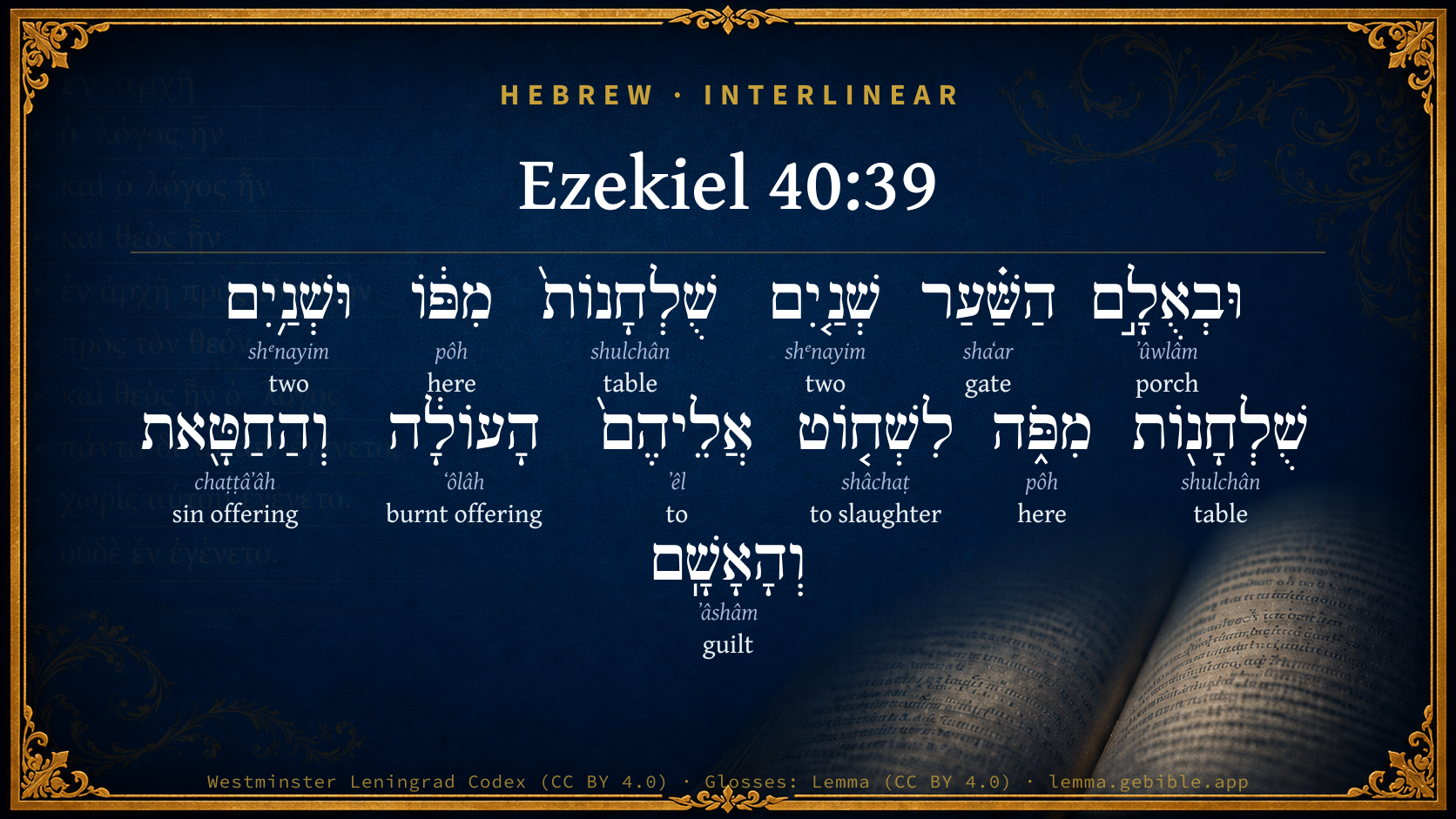
Ezekiel 40:39

Hebrew (Westminster Leningrad Codex) Ezekiel 40:39 appears in the Hebrew Old Testament. The text above is from the Westminster Leningrad Codex. Each word links to its Strong’s number, a concise gloss, and parsing drawn from the Open Scriptures Hebrew Bible morphology. Click any word for its full Brown-Driver-Briggs (BDB) entry.
Download image
Cite this verse

Ezekiel 40:39 (World English Bible). Public Domain. Lemma interlinear Bible study tool, https://lemma.gebible.app/v/ezekiel/40/39.

Show BibTeX & RIS
BibTeX
RIS
English Translation
In the porch of the gate were two tables on this side, and two tables on that side, to kill thereon the burnt offering and the sin-offering and the trespass-offering.
World English Bible · Public Domain
Download a study sheet

One document with this verse’s original text, its word-by-word gloss line, the meaning frame, cross-references with their text, attributed commentary, and full source and license credits — printable, and it pastes into notes with its structure intact.

This verse Autodidact and up

Study sheet (.html) Plain text (.txt)

A passage Seminary Student

Up to 50 verses in one chapter. A passage sheet keeps up to 6 commentary sources and 12 cross-references per verse, in the order this page ranks them, and says so on the sheet whenever that leaves anything out. Ask for a single verse and you get the Autodidact verse sheet above.

Everything on this page stays free to read, with no account — the sheet is a download of what is already on screen, not access to it.

Want to remove ads? Support Godless Engineer
Compare translations 3

The same verse in 3 English versions, stacked beneath the original-language interlinear above. Click any original word for its lexicon entry.

Each is an independent rendering of the whole verse — the interlinear is not word-aligned to these translations.

Highlighted words mark where these versions differ — a whole-verse word diff, not a word-by-word alignment.

  • World English Bible Public Domain
    In the porch of the gate were two tables on this side, and two tables on that side, to kill thereon the burnt offering and the sin-offering and the trespass-offering.
  • King James Version Public Domain
    And in the porch of the gate were two tables on this side, and two tables on that side, to slay thereon the burnt offering and the sin offering and the trespass offering.
  • unfoldingWord Literal Text CC BY-SA 4.0
    There were two tables on each side of each portico, on which the burnt offering was slaughtered, and also the sin offering and the guilt offering.

unfoldingWord Literal Text — © unfoldingWord, licensed CC BY-SA 4.0. Word-aligned USFM3 via Door43 (git.door43.org/unfoldingWord/en_ult).

Versions to compare (up to 4)

3 of 4 selected

Show all 18 translations

Every available English version of this verse, each an independent rendering of the whole verse.

  • World English Bible Public Domain
    In the porch of the gate were two tables on this side, and two tables on that side, to kill thereon the burnt offering and the sin-offering and the trespass-offering.
  • Berean Standard Bible Public Domain
    Inside the portico of the gateway were two tables on each side, on which the burnt offerings, sin offerings, and guilt offerings were to be slaughtered.
  • Majority Standard Bible Public Domain
    Inside the portico of the gateway were two tables on each side, on which the burnt offerings, sin offerings, and guilt offerings were to be slaughtered.
  • King James Version Public Domain
    And in the porch of the gate were two tables on this side, and two tables on that side, to slay thereon the burnt offering and the sin offering and the trespass offering.
  • American Standard Version (1901) Public Domain
    And in the porch of the gate were two tables on this side, and two tables on that side, to slay thereon the burnt-offering and the sin-offering and the trespass-offering.
  • Revised Version (1885) Public Domain
    And in the porch of the gate were two tables on this side, and two tables on that side, to slay thereon the burnt offering and the sin offering and the guilt offering.
  • Geneva Bible (1599) Public Domain
    And in the porch of the gate stoode two tables on this side, and two tables on that side, vpon the which they slew the burnt offring, and the sinne offring, and the trespas offring.
  • Douay-Rheims (1899) Public Domain
    And in the porch of the gate were two tables on this side, and two tables on that side: that the holocaust, and the sin offering, and the trespass offering might be slain thereon.
  • Young's Literal Translation Public Domain
    And in the porch of the gate `are' two tables on this side, and two tables on that side, to slaughter on them the burnt-offering, and the sin-offering, and the guilt-offering;
  • Literal Standard Version CC BY-SA 4.0
    And in the porch of the gate [are] two tables on this side and two tables on that side, to slaughter on them the burnt-offering, and the sin-offering, and the guilt-offering;
  • Unlocked Literal Bible CC BY-SA 4.0
    There were two tables on each side of each portico, on which the burnt offering was slaughtered, and also the sin offering and the guilt offering.
  • unfoldingWord Literal Text CC BY-SA 4.0
    There were two tables on each side of each portico, on which the burnt offering was slaughtered, and also the sin offering and the guilt offering.
  • Darby Bible Public Domain
    And in the porch of the gate were two tables on this side, and two tables on that side, to slay thereon the burnt-offering and the sin-offering and the trespass-offering.
  • World Messianic Bible Public Domain
    In the porch of the gate were two tables on this side and two tables on that side, on which to kill the burnt offering, the sin offering, and the trespass offering.
  • Webster's Bible Public Domain
    And in the porch of the gate were two tables on this side, and two tables on that side, to slay upon it the burnt-offering and the sin-offering and the trespass-offering.
  • Free Bible Version CC BY-SA 4.0
    Inside the gateway porch were two tables on both sides, where the sacrificial animals were slaughtered for burnt offerings, sin offerings, and guilt offerings.
  • Bible in Basic English Public Domain
    And in the covered way of the doorway there were two tables on this side and two tables on that side, on which the burned offering and the sin-offering and the offering for error were put to death:
  • JPS Tanakh (1917) Public Domain
    And in the porch of the gate were two tables on this side, and two tables on that side, to slay thereon the burnt-offering and the sin-offering and the guilt-offering.

Literal Standard Version (2020), Covenant Press — licensed CC BY-SA 4.0. Text via the HelloAO Bible API (eBible.org). Unlocked Literal Bible (unfoldingWord) — licensed CC BY-SA 4.0. Text via the HelloAO Bible API (eBible.org). unfoldingWord Literal Text — © unfoldingWord, licensed CC BY-SA 4.0. Word-aligned USFM3 via Door43 (git.door43.org/unfoldingWord/en_ult). Free Bible Version, Dr. Jonathan Gallagher — licensed CC BY-SA 4.0. Text via the HelloAO Bible API (eBible.org).

Word by word

More ways to search: Search by grammar → Find every occurrence → Compare this word →

Practice this passage: Drill this verse → Learn its vocabulary →

וּבְאֻלָ֣ם
ʼûwlâm
H197
“and · in/at · porch of”
Conjunction + Preposition + Noun, Common, Masculine, Singular, Construct
Part of Speech
Conjunction + Preposition + Noun
Type
Common
Gender
Masculine
Number
Singular
State
Construct
Full BDB Definition

Origin: from H481 (in the sense of tying)

TWOT: 45c

porch - in Solomon's temple - in Solomon's palace - in temple of Ezekiel's vision
  1. הַשַּׁ֗עַר shaʻar H8179 “the · gate” Particle, Definite Article + Noun, Common, Masculine, Singular, Absolute
  2. שְׁנַ֤יִם shᵉnayim H8147 “two” Adjective, Cardinal number, Masculine, Dual, Absolute
  3. שֻׁלְחָנוֹת֙ shulchân H7979 “tables” Noun, Common, Masculine, Plural, Absolute
  4. מִפּ֔וֹ pôh H6311 “from · here” Preposition + Adverb
  5. וּשְׁנַ֥יִם shᵉnayim H8147 “and · two” Conjunction + Adjective, Cardinal number, Masculine, Dual, Absolute
  6. שֻׁלְחָנ֖וֹת shulchân H7979 “tables” Noun, Common, Masculine, Plural, Absolute
  7. מִפֹּ֑ה pôh H6311 “from · here” Preposition + Adverb
  8. לִשְׁח֤וֹט shâchaṭ H7819 “to slaughter” Preposition + Verb, Qal, Infinitive Construct
  9. אֲלֵיהֶם֙ ʼêl H413 “to · them” Preposition + Suffix, Personal, 3rd Person, Masculine, Plural
  10. הָעוֹלָ֔ה ʻôlâh H5930 “the · burnt offering” Particle, Definite Article + Noun, Common, Feminine, Singular, Absolute
  11. וְהַחַטָּ֖את chaṭṭâʼâh H2403 “and · the · sin offering” Conjunction + Particle, Definite Article + Noun, Common, Feminine, Singular, Absolute
  12. וְהָאָשָֽׁם ʼâshâm H817 “and · the · guilt” Conjunction + Particle, Definite Article + Noun, Common, Masculine, Singular, Absolute

About this verse

These counts appear in no published source. They are computed here, from the morphology-tagged text and Lemma’s own curated glosses. What Lemma adds →

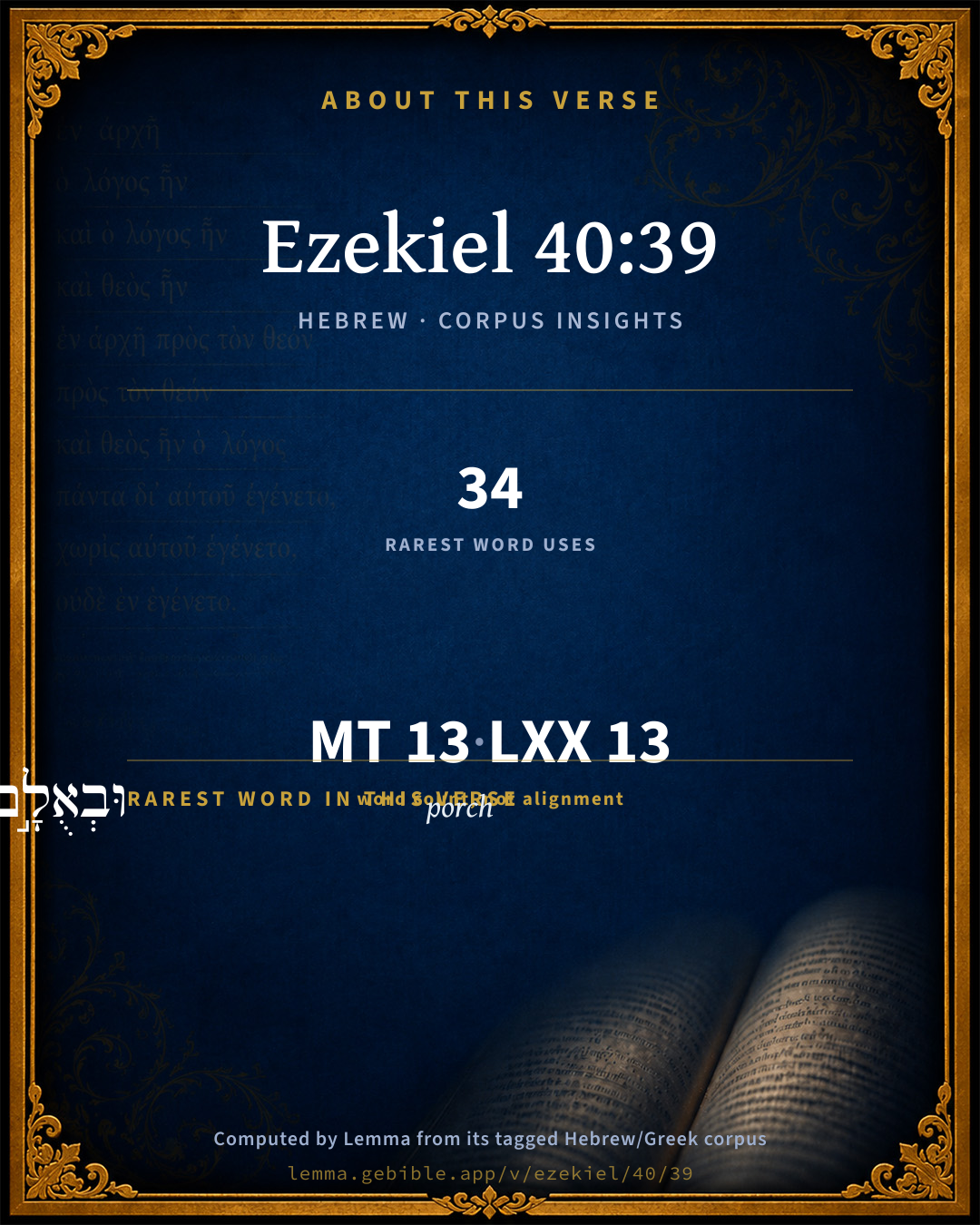
13
words
10
distinct lemmas
Prophets
section

Shared distinctive vocabulary

וּבְאֻלָ֣ם porch H197 occurs in 29 verses of the Hebrew Bible. Also found in:

Grammatical profile

  • 1 verb
  • 7 nouns
  • 2 adjectives
  • 1 preposition
  • 2 adverbs

Verb forms

  • לִשְׁח֤וֹט Qal · Infinitive Construct

Repetition

Words recur within this verse — often emphatic in Hebrew:

  • שְׁנַ֤יִם two H8147 ×2
  • שֻׁלְחָנוֹת֙ table H7979 ×2
  • מִפּ֔וֹ here H6311 ×2

Hebrew & Septuagint length

In English translation the verse runs 30 words from the Hebrew and 11 from the Septuagint (LXX English) — the Septuagint runs noticeably shorter here. See the side-by-side →

A rough comparison of the two English renderings, which tokenize alike — not a word-level alignment.

Word counts can differ between the Hebrew and the Greek without any difference in meaning — e.g. the Hebrew direct-object marker אֵת has no separate Greek word, and Greek often adds the article ὁ.

In the original languages it is 13 Hebrew tokens and 13 Greek tokens — but the two are counted differently (Hebrew bundles its prefixes and suffixes into one token; the Greek is in lemma form), so that isn’t a like-for-like length.

Cross-references

18

Topical passages linked to Ezekiel 40:39 in the Treasury of Scripture Knowledge — connected by theme and wording, ordered by reader-vote popularity; previews shown in the World English Bible.

  • Leviticus 1:3–17 "'If his offering is a burnt offering from the herd, he shall offer a male without blemish. He shall offer it at the door of the Tent of Meeting, that he may be accepted before Yahweh.
  • Leviticus 4:2–3 "Speak to the children of Israel, saying, 'If anyone sins unintentionally, in any of the things which Yahweh has commanded not to be done, and does any one of them:
  • Ezekiel 46:2 The prince shall enter by the way of the porch of the gate outside, and shall stand by the post of the gate; and the priests shall prepare his burnt-offering and his peace-offerings, and he shall worship at the threshold of the gate: then he shall go forth; but the gate shall not be shut until the evening.
  • Leviticus 4:13–35 "'If the whole congregation of Israel sins, and the thing is hidden from the eyes of the assembly, and they have done any of the things which Yahweh has commanded not to be done, and are guilty;
  • Leviticus 5:6–13 and he shall bring his trespass offering to Yahweh for his sin which he has sinned, a female from the flock, a lamb or a goat, for a sin offering; and the priest shall make atonement for him concerning his sin.
  • Leviticus 6:6 He shall bring his trespass offering to Yahweh, a ram without blemish from the flock, according to your estimation, for a trespass offering, to the priest.
  • Leviticus 7:1–2 "'This is the law of the trespass offering. It is most holy.
  • Isaiah 53:5 But he was pierced for our transgressions, he was crushed for our iniquities; the punishment that brought our peace was on him; and by his wounds we are healed.
  • Isaiah 53:10 Yet it pleased Yahweh to bruise him; he has put him to grief: when you shall make his soul an offering for sin, he shall see [his] seed, he shall prolong his days, and the pleasure of Yahweh shall prosper in his hand.
  • Ezekiel 40:42 There were four tables for the burnt offering, of hewn stone, a cubit and a half long, and a cubit and a half broad, and one cubit high; whereupon they laid the instruments with which they killed the burnt offering and the sacrifice.
  • Ezekiel 41:22 The altar was of wood, three cubits high, and the length of it two cubits; and the corners of it, and the length of it, and the walls of it, were of wood: and he said to me, This is the table that is before Yahweh.
  • Ezekiel 42:13 Then said he to me, The north chambers and the south chambers, which are before the separate place, they are the holy chambers, where the priests who are near to Yahweh shall eat the most holy things: there shall they lay the most holy things, and the meal-offering, and the sin-offering, and the trespass-offering; for the place is holy.
  • Ezekiel 44:16 they shall enter into my sanctuary, and they shall come near to my table, to minister to me, and they shall keep my charge.
  • Malachi 1:7 You offer polluted bread on my altar. You say, 'How have we polluted you?' In that you say, 'Yahweh's table contemptible.'
  • Malachi 1:12 "But you profane it, in that you say, 'Yahweh's table is polluted, and its fruit, even its food, is contemptible.'
  • Luke 22:30 that you may eat and drink at my table in my Kingdom. You will sit on thrones, judging the twelve tribes of Israel."
  • 1 Corinthians 10:16–21 The cup of blessing which we bless, isn't it a communion of the blood of Christ? The bread which we break, isn't it a communion of the body of Christ?
  • 2 Corinthians 5:21 For him who knew no sin he made to be sin on our behalf; so that in him we might become the righteousness of God.

Cross-references courtesy of OpenBible.info (CC BY 4.0).

Hebrew and Greek witnesses Masoretic Hebrew ↔ Greek Septuagint

The same verse in the two great witnesses to the Old Testament, shown verse-for-verse.

Here the Septuagint runs noticeably shorter than the Hebrew — LXX2012 (modern English Septuagint) 11 words vs World English Bible 30. A rough length comparison of the two English translations, not a word-level alignment — read both below.

These are two independent witnesses, not word-aligned to each other, and the Septuagint is shown in lemma (dictionary) form.

Hebrew Ezekiel 40:39 Masoretic · Westminster Leningrad Codex

וּבְאֻלָ֣ם הַשַּׁ֗עַר שְׁנַ֤יִם שֻׁלְחָנוֹת֙ מִפּ֔וֹ וּשְׁנַ֥יִם שֻׁלְחָנ֖וֹת מִפֹּ֑ה לִשְׁח֤וֹט אֲלֵיהֶם֙ הָעוֹלָ֔ה וְהַחַטָּ֖את וְהָאָשָֽׁם

In the porch of the gate were two tables on this side, and two tables on that side, to kill thereon the burnt offering and the sin-offering and the trespass-offering.

World English Bible · Public Domain

Greek LXX Ezekiel 40:39 Septuagint · lemma form

ὁ δεύτερος ἔκρυσις ὅπως σφάζω ἐν αὐτός ὁ ὑπέρ ἁμαρτία καί ὑπέρ ἄγνοια

that they might kill in it the sin-offerings, and the trespass-offerings.

LXX2012 (modern English Septuagint) · Public Domain

On this verse, The Cambridge Bible for Schools and Colleges discusses the Septuagint’s reading. Read the note in Commentary ↓

Hebrew: Westminster Leningrad Codex (CC BY 4.0). Greek: Septuagint (public domain); English from LXX2012 (modern English Septuagint) (Public Domain). How the Septuagint differs from the Hebrew →

Targum (Aramaic paraphrase)

1

The Targum is the ancient Jewish Aramaic paraphrase of the Hebrew Scriptures — an interpretive translation, not the Hebrew text itself. Onkelos (literal) and Pseudo-Jonathan (expansive) render the Torah, and Jonathan the Prophets. Coverage is partial: where no permissively-licensed English translation exists for a verse, only the Aramaic is shown. This is verse-level text, not a word-by-word alignment to the Hebrew.

  1. Targum Jonathan Prophets (Joshua–Malachi)
    וּבְאוּלַמָא דְתַרְעָא תְּרֵין פָּתוֹרִין מִכָּא וּתְרֵין פָּתוֹרִין מִכָּא לְמִכַּס עֲלֵיהוֹן עֲלָתָא וְחַטָאתָא וְאַשָׁמָא:

    (no public-domain English translation for this verse)

    Targum Jonathan — Aramaic: “Mikraot Gedolot” (public domain). English: “Sefaria Community Translation” (CC0 1.0 (public-domain dedication)); “London "Chaldee Paraphrase," 1871” (public domain). Text via Sefaria.

Commentary

Notes on Ezekiel 40:39 from classic Christian and Jewish commentators (each source and its license shown beneath its notes). The classic Christian expositions comment on the surrounding passage and are grouped to its opening verse, so a note may address several verses; the Jewish commentaries on the Tanakh (Rashi and others) are per-verse, so they appear only where the commentator wrote on this verse.

Lemma curates 59 commentaries, every one of them public domain or Creative Commons licensed, each selected and text-cleaned for this edition rather than reprinted as found. About our sources →

Trapp's Complete Commentary

John Trapp

Eze 40:39 And in the porch of the gate [were] two tables on this side, and two tables on that side, to slay thereon the burnt offering and the sin offering and the trespass offering.

Ver. 39. Two tables.] See on Eze 40:38.

John Trapp, A Commentary or Exposition upon All the Books of the Old and New Testament (1647–1656) — public domain. Text from a community e-Sword module.

Joseph Benson's Commentary

Eze 40:39-40. In the porch of the gate were two tables, &c. — Those expositors who, by the word gates, in Eze 40:38, understand both the north and south gates, render the sense of these two verses perspicuously thus: In the porch of one gate (namely, that on the south) were two tables on this side, and two tables on that side, &c. And at the outer side of the step of the entry of the north gate were two tables; which interpretation agrees very well with what follows, Eze 40:41, Four tables were on this side, and four on that side. But they that understand these verses to be only a description of the north gate (on which side of the altar the sacrifices were commonly killed) suppose that two tables were on each side, as a person came into the porch of the gate, and two on each side of the inner part of the gate that looked toward the altar.

Joseph Benson's Commentary on the Old and New Testaments (1811–1818) — public domain. Text from a community e-Sword module.

Matthew Henry's Commentary

In these verses we have an account,

I. Of the tables that were in the porch of the gates of the inner court. We find no description of the altars of burnt-offerings in the midst of that court till Eze 43:13. But, because the one altar under the law was to be exchanged for a multitude of tables under the gospel, here is early notice taken of the tables, at our entrance into the inner court; for till we come to partake of the table of the Lord we are but professors at large; our admission to that is our entrance into the inner court. But in this gospel-temple we meet with no altar till after the glory of the Lord has taken possession of it, for Christ is our altar, that sanctifies every gift. Here were eight tables provided, whereon to slay the sacrifices, Eze 40:41. We read not of any tables for this purpose either in the tabernacle or in Solomon's temple. But here they are provided, to intimate the multitude of spiritual sacrifices that should be brought to God's house in gospel-times, and the multitude of hands that should be employed in offering up those sacrifices. Here were the shambles for the altar; here were the dressers on which they laid the flesh of the sacrifice, the knives with which they cut it up, and the hooks on which they hung it up, that it might be ready to be offered on the altar (Eze 40:43), and there also they washed the burnt-offerings (Eze 40:38), to intimate that before we draw near to God's altar we must have every thing in readiness, must wash our hands, our hearts, those spiritual sacrifices, and so compass God's altar.

II. The use that some of the chambers mentioned before were put to. 1. Some were for the singers, Eze 40:44. It should seem they were first provided for before any other that attended this temple-service, to intimate, not only that the singing of psalms should still continue a gospel-ordinance, but that the gospel should furnish all that embrace it with abundant matter for joy and praise, and give them occasion to break forth into singing, which is often foretold concerning gospel times, Psa 96:1; Psa 98:1. Christians should be singers. Blessed are those that dwell in God's house, they will be still praising him. 2. Others of them were for the priests, both those that kept the charge of the house, to cleanse it, and to see that none came into it to pollute it, and to keep it in good repair (Eze 40:45), and those that kept the charge of the altar (Eze 40:46), that came near to the Lord to minister to him. God will find convenient lodging for all his servants. Those that do the work of his house shall enjoy the comforts of it.

III. Of the inner court, the court of the priests, which was fifty yards square, Eze 40:47. The altar that was before the house was placed in the midst of this court, over-against the three gates, and, standing in a direct line with the three gates of the outer court, when the gates were set open all the people in the outer court might through them be spectators of the service done at the altar. Christ is both our altar and our sacrifice, to whom we must look with an eye of faith in all our approaches to God, and he is salvation in the midst of the earth (Psa 74:12), to be looked unto from all quarters.

IV. Of the porch of the house. The temple is called the house, emphatically, as if no other house were worthy to be called so. Before this house there was a porch, to teach us not to rush hastily and inconsiderately into the presence of God, but gradually, that is, gravely, and with solemnity, passing first through the outer court, then the inner, then the porch, ere we enter into the house. Between this porch and the altar was a place where the priests used to pray, Joe 2:17. In the porch, besides the posts on which the doors were hung, there were pillars, probably for state and ornament, like Jachin and Boaz - He will establish; in him is strength, Eze 40:49. In the gospel church every thing is strong and firm, and every thing ought to be kept in its place and to be done decently and in order.

Matthew Henry's Commentary on the Whole Bible (1708–1710) — public domain (CC PDM 1.0). Text via the HelloAO Bible API.

Adam Clarke's Commentary

Verse 39. The porch of the gate] The north gate of the court of the priests. See Q in the plan. See Clarke on Eze 48:35.

Two tables] Some say of marble. See dddd in the plan. See Clarke on Eze 48:35.

Adam Clarke's Commentary on the Bible (1810–1826) — public domain. Text from a community e-Sword/MySword module.

Ellicott's Commentary for English Readers

(39) In the porch.—The preposition admits the sense of either in or by, but as the porch was very small for two tables on either side, and as a thoroughfare would be an inconvenient place for the slaughter of the victims, it is better to take the sense of by. The four tables were arranged, two on either side, near the porch.

A Bible Commentary for English Readers, edited by Charles John Ellicott (1878–1897) — public domain. Text from a community e-Sword module.

The Cambridge Bible for Schools and Colleges

gen. ed. J. J. S. Perowne

39. The verse states what was in the porch, in antithesis to Eze_40:38. Possibly the words “to slay thereon” are used generally, not of the actual slaughtering, but of the manipulation of the flesh of the victims. In Eze_40:41 it is said that there were eight tables on which they slew, four of which were certainly outside the porch. If the burnt, sin and trespass offerings (LXX. omits burnt offerings here) were slain in the porch, there would remain only the peace offerings to slay outside.

The Cambridge Bible for Schools and Colleges (gen. ed. J. J. S. Perowne; Cambridge University Press, 1878–1918) — public domain. Text from a community e-Sword module.

John Gill's Exposition

And the four tables were of hewn stone,.... These are either the same tables as before, the four that were on one side, and the four that were on the other; they were all made of hewn stone: in the second temple they were made of marble; so it is said in the Misnah (q),

"the marble tables were between the pillars;''

and they were made of marble, as the commentators (r) say, because that cools the flesh, and preserves it from corruption: they were both decent and durable; and may denote the continuance of the ordinance of the Lord's supper till his second coming; and which is a decent and becoming ordinance, as well as perpetual: or these were other four tables, as Cocceius thinks; and which he places without the porch, near the cell or chamber, where the burnt offering was washed, Eze 40:38, and these are said to be for that, as follows,

for the burnt offering: and also for the sin offering, and for the trespass offering, though they are not mentioned:

of a cubit and an half long, and a cubit and an half broad; just a foursquare:

and one cubit high; these were the dimensions of each table:

whereupon also they laid the instruments wherewith they slew the burnt offering and the sacrifice: the knives with which they slew the creatures offered, and cut them to pieces, and the bowls and basins in which they received their blood; these were laid upon the tables, as the sacrifices were: and may signify, that in the ordinance of the Lord's supper are not only represented the sacrifice of Christ, but the means, instruments, causes, and occasion of it; the sins of his people, for which he was wounded and bruised in his body, and with which he was pierced in his soul; and here we may look on him whom we have thus pierced, and mourn; and yet rejoice that there is healing by his stripes, pardon by his blood, and atonement by his sacrifice.

(q) Tamid, c. 3. sect. 5. & Middot, c. 3. sect. 5. (r) Maimon. & Bartenora in ib.

John Gill's Exposition of the Whole Bible (1746–1763) — public domain (CC PDM 1.0). Text via the HelloAO Bible API.

Albert Barnes' Notes on the Bible

In the porch - Not under the covered portico, which was only ten cubits broad Eze 40:9, but in the angles formed by the porch and gate-front. If the gate-building projected with its porch forward on to the pavement of the inner court, the tables were fitly placed for carrying out the directions of the Law.

Albert Barnes' Notes on the Bible (1834–1885) — public domain. Text from a community e-Sword/MySword module.

Matthew Poole's English Annotations

Though the words seem so express, yet doubt is made whether any table were in the very porch itself, and think they would cumber the passage, but sure where only the priests in course of ministration entered, there would be no great crowd; therefore I conceive that these two pairs of tables were set in the very porch of the gate, which is the letter of the text.

Matthew Poole's English Annotations on the Holy Bible (1683–1685) — public domain. Text from a community e-Sword/MySword module.

The Pulpit Commentary

Vers. 39-42The tables. These were twelve in number, of which eight were used for slaughtering purposes, i.e. either for slaying the sacrifices or for laying upon them the carcasses of the slaughtered victims; and the remaining four for depositing thereon the instruments employed in killing the animals. Of the eight, four stood within the porch of the gate, two on each side, and four without two on the side as one goeth up to the entry of the north gate; rather, at the shoulder to one going up to the gate opening towards the north, i.e. on the outside of the porch north wall; and two on the other side or shoulder, i.e. on the outside of the porch south wall. This determines the gate in question to have been, not the north gate, as the Authorized Version has conjectured, but the east gate, whose side walls looked towards the north and south. The third quaternion of tables appears to have been planted at the steps, presumably two on" each side, i.e. if with Kliefoth, Keil, and Schroder, hlwOl be translated "at the ascent," or "going up," i.e. at the staircase (comp. ver. 26). If, however, with the Authorized and Revised Versions, Ewald, Hengstenberg, Smend, and others, hlwl be read "for the burnt offering," then the exact position of the tables is left undetermined, though in any case they must have been near the slaughtering-tables. As they were designed for heavy instruments, they were constructed of hewn stones a cubit and a half long, a cubit and a half broad, and one cubit high; from which it may be argued the eight previously mentioned were made of wood.

Sacrifices in the new temple.

As we read the dry details of the city that is to be rebuilt and its new temple, we are suddenly pulled up by a startling item. Among the various arrangements of the ancient temple that are to be revived, provision is made for the sacrificial rites. There are to be sacrifices in the new temple. The burnt offering and the sin offering and the trespass offering are all to be there. Then sacrifices will be needed after the restoration. It might have been supposed that these would now be dispensed with, since sin was put away and the people were re-dedicated to God. But as a matter of fact, the temple ritual was never before cultivated with. such assiduity and elaborateness.

I WE NEED REPEATED REDEDICATION OF OUR LIVES TO GOD. The burnt offering signified the self-dedication of the man who presented it. It was given whole, to show that he had surrendered his all to God; it was consumed by fire, to suggest that he was to make this surrender complete in depth, intensity, and reality, as well as in comprehensiveness. Now, to have made this offering once for all did not suffice. It had to be continually renewed. The dedication of Israel to God in the restoration to their land could not be accepted as sufficient if it were done once for all. It had to be made over and over again. So is it with the Christian"s offering of himself. When thinking of his great, decisive step, he may exclaim, in Doddddge"s well-known words

"Tis done, the great transaction"s done: I am my Lord"s, and he is mine.

Yet if he rests satisfied with having once taken that step, he will soon find himself slipping back from his high resolve. We must continually renew our self-dedication to Christ. The sacrament of baptism, which signifies the first dedication, is taken but once; but it is followed by that of the Lord"s Supper, which suggests renewal of dedication in deliberate intention, as when the Roman soldier took the oath of allegiance to his general. This sacrament we repeat many times.

II WE NEED REPEATED CLEANSING FROM SIN. There were to be sin and trespass offerings in the new temple. This fact is startling and most painful. Even while the people are returning, penitent and restored, provision has to be made for future falls and sins.

1. Christian people sin. We know that this is only too true of all Christian people. There is no sinless soul on earth. "If we say we have no sin, we deceive ourselves, and the truth is not in us". (1Jn_1:8) The foresight of the fact is no excuse for us; for God does not make his children sin he endeavors to save them from it. Thus Christ predicted Peter"s fall although he had prayed that his disciple might be kept faithful. (Luk_22:31, Luk_22:32)

2. God has provided for the recovery of Christians when they sin. There were to be sacrifices in the restored temple. This arrangement shows the wonderful long-suffering mercy of God. The same mercy is displayed towards Christians. It is a shame that they who have once washed their robes and made them white in the blood of the Lamb should again stain them with the ruin of sin. Yet as this is done, God provides even again for cleansing not now by repeated sacrifices, but by the eternal efficacy of the one perfect Sacrifice. "And if any man sin, we have an Advocate with the Father, Jesus Christ the Righteous: and he is the Propitiation for our. (1Jn_2:2, 1Jn_2:3)

The Pulpit Commentary (1880–1919), ed. H.D.M. Spence-Jones & Joseph S. Exell — public domain. Text from a community e-Sword module.

Rashi

Rabbi Shlomo Yitzchaki (Rashi)

And in the hall of the gate [i.e., of] the Northern [Gate].

two tables in its east and two in its west, and although they extended into the Outer Court area, their sanctity was as [great as] those things of the Inner [Court area].

Rashi on the Tanakh — English translations: “The Judaica Press complete Tanach with Rashi, translated by A. J. Rosenberg” (CC BY 4.0); “Pentateuch with Rashi's commentary by M. Rosenbaum and A.M. Silbermann, 1929-1934” (public domain); “The Metsudah Tanach series, Lakewood, N.J” (CC BY 4.0); and “The Book of Joshua, Metsudah Publications, 1997” (CC BY 4.0). Text via Sefaria.

Lesson kit

Teaching starters — assembled from the data on this page, not authored interpretation. Every prompt links to the verse data it draws on. Edit before teaching.

Ezekiel, in the Prophets, opens this verse with 13 words (10 distinct Hebrew lemmas). Its most distinctive word is ʼûwlâm (“porch”). The Greek Septuagint runs shorter here. A historical commentator’s framing appears above. Read the whole chapter for the surrounding context.

Discussion questions

  1. The word ʼûwlâm carries the sense “porch.” How does it shape the verse?
  2. How does 1 Kings 6:3, which shares the word «porch», read alongside this verse?
  3. What does the repetition of “two” (2× in this one verse) do in this verse?
  4. The Septuagint runs shorter here than the Hebrew. What might account for the difference?
  5. These translations render this verse differently; the difference is in the English rendering, not the original. What questions does that raise?
  6. «לִשְׁח֤וֹט» is a Qal Infinitive Construct verb. How does that grammatical form shape the action described?
  7. Compare how Trapp's Complete Commentary and Joseph Benson's Commentary read this verse. Where do they agree or differ?

Things to notice

Reading settings

Reading text

Shown beneath each verse's original-language words.

Old Testament
Old Testament edition

Read the OT as the Masoretic Hebrew (MT) or the Greek Septuagint (LXX).

English shown for the Greek Septuagint (in the Hebrew ↔ Greek comparison).

Comparing translations? Open the Compare panel on any verse page to stack up to four side by side.