
Leviticus 14:10

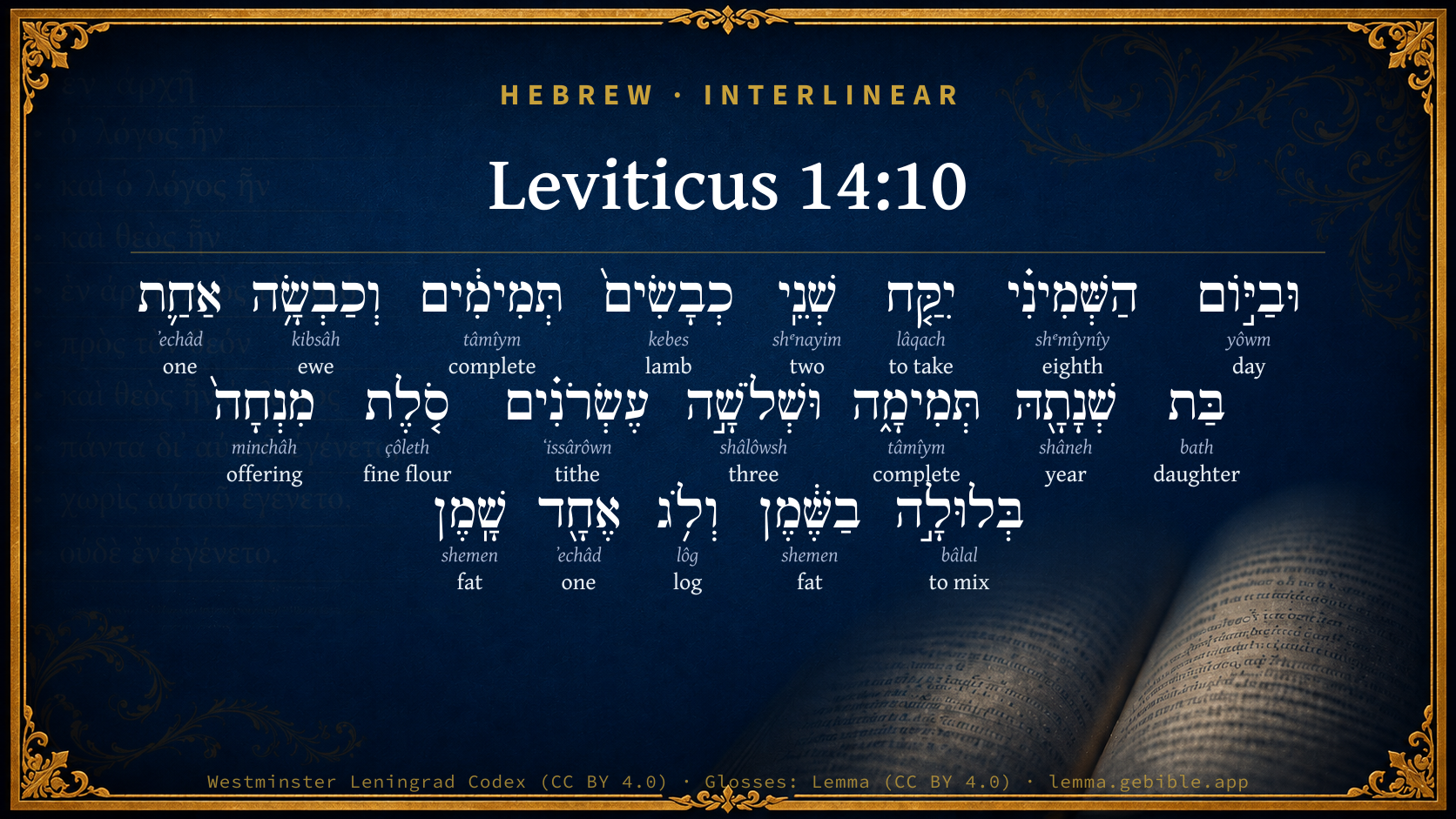
Hebrew (Westminster Leningrad Codex) Leviticus 14:10 appears in the Hebrew Old Testament. The text above is from the Westminster Leningrad Codex. Each word links to its Strong’s number, a concise gloss, and parsing drawn from the Open Scriptures Hebrew Bible morphology. Click any word for its full Brown-Driver-Briggs (BDB) entry.
Download image
Cite this verse

Leviticus 14:10 (World English Bible). Public Domain. Lemma interlinear Bible study tool, https://lemma.gebible.app/v/leviticus/14/10.

Show BibTeX & RIS
BibTeX
RIS
English Translation
"On the eighth day he shall take two male lambs without blemish, and one ewe lamb a year old without blemish, and three tenths of an ephah of fine flour for a meal offering, mingled with oil, and one log of oil.
World English Bible · Public Domain
Highlights
  • 1 first appearance in the Hebrew Bible
Full analysis ↓
Download a study sheet

One document with this verse’s original text, its word-by-word gloss line, the meaning frame, cross-references with their text, attributed commentary, and full source and license credits — printable, and it pastes into notes with its structure intact.

This verse Autodidact and up

Study sheet (.html) Plain text (.txt)

A passage Seminary Student

Up to 50 verses in one chapter. A passage sheet keeps up to 6 commentary sources and 12 cross-references per verse, in the order this page ranks them, and says so on the sheet whenever that leaves anything out. Ask for a single verse and you get the Autodidact verse sheet above.

Everything on this page stays free to read, with no account — the sheet is a download of what is already on screen, not access to it.

Want to remove ads? Support Godless Engineer
Compare translations 3

The same verse in 3 English versions, stacked beneath the original-language interlinear above. Click any original word for its lexicon entry.

Each is an independent rendering of the whole verse — the interlinear is not word-aligned to these translations.

Highlighted words mark where these versions differ — a whole-verse word diff, not a word-by-word alignment.

  • World English Bible Public Domain
    "On the eighth day he shall take two male lambs without blemish, and one ewe lamb a year old without blemish, and three tenths of an ephah of fine flour for a meal offering, mingled with oil, and one log of oil.
  • King James Version Public Domain
    And on the eighth day he shall take two he lambs without blemish, and one ewe lamb of the first year without blemish, and three tenth deals of fine flour for a meat offering, mingled with oil, and one log of oil.
  • unfoldingWord Literal Text CC BY-SA 4.0
    And on the eighth day, he shall take two perfect lambs and one lamb, a perfect daughter of her year, and three tenth parts of flour, a grain offering mixed with oil, and one log of oil.

unfoldingWord Literal Text — © unfoldingWord, licensed CC BY-SA 4.0. Word-aligned USFM3 via Door43 (git.door43.org/unfoldingWord/en_ult).

Versions to compare (up to 4)

3 of 4 selected

Show all 18 translations

Every available English version of this verse, each an independent rendering of the whole verse.

  • World English Bible Public Domain
    "On the eighth day he shall take two male lambs without blemish, and one ewe lamb a year old without blemish, and three tenths of an ephah of fine flour for a meal offering, mingled with oil, and one log of oil.
  • Berean Standard Bible Public Domain
    On the eighth day he is to bring two unblemished male lambs, an unblemished ewe lamb a year old, a grain offering of three-tenths of an ephah of fine flour mixed with olive oil, and one log of olive oil.
  • Majority Standard Bible Public Domain
    On the eighth day he is to bring two unblemished male lambs, an unblemished ewe lamb a year old, a grain offering of three-tenths of an ephah of fine flour mixed with olive oil, and one log of olive oil.
  • King James Version Public Domain
    And on the eighth day he shall take two he lambs without blemish, and one ewe lamb of the first year without blemish, and three tenth deals of fine flour for a meat offering, mingled with oil, and one log of oil.
  • American Standard Version (1901) Public Domain
    And on the eighth day he shall take two he-lambs without blemish, and one ewe-lamb a year old without blemish, and three tenth parts `of an ephah' of fine flour for a meal-offering, mingled with oil, and one log of oil.
  • Revised Version (1885) Public Domain
    And on the eighth day he shall take two he-lambs without blemish, and one ewe-lamb of the first year without blemish, and three tenth parts of an ephah of fine flour for a meal offering, mingled with oil, and one log of oil.
  • Geneva Bible (1599) Public Domain
    Then in the eight day he shall take two hee lambes without blemish, and an ewe lambe of a yere olde without blemish, and three tenth deales of fine flower for a meate offering, mingled with oyle, and a pint of oyle.
  • Douay-Rheims (1899) Public Domain
    On the eighth day he shall take two lambs without blemish, and an ewe of a year old without blemish, and three tenths of flour tempered with oil for a sacrifice, and a sextary of oil apart.
  • Young's Literal Translation Public Domain
    `And on the eighth day he taketh two lambs, perfect ones, and one ewe-lamb, daughter of a year, a perfect one, and three tenth deals of flour `for' a present, mixed with oil, and one log of oil.
  • Literal Standard Version CC BY-SA 4.0
    And on the eighth day he takes two lambs, perfect ones, and one ewe-lamb, daughter of a year, a perfect one, and three-tenth parts of flour [for] a present, mixed with oil, and one log of oil.
  • Unlocked Literal Bible CC BY-SA 4.0
    On the eighth day he must take two male lambs without blemish, one female lamb a year old without blemish, and three-tenths of an ephah of fine flour mixed with oil as a grain offering, and one log of oil.
  • unfoldingWord Literal Text CC BY-SA 4.0
    And on the eighth day, he shall take two perfect lambs and one lamb, a perfect daughter of her year, and three tenth parts of flour, a grain offering mixed with oil, and one log of oil.
  • Darby Bible Public Domain
    And on the eighth day he shall take two he-lambs without blemish, and one yearling ewe-lamb without blemish, and three tenth parts of fine flour mingled with oil, for an oblation, and one log of oil.
  • World Messianic Bible Public Domain
    “On the eighth day he shall take two male lambs without defect, one ewe lamb a year old without defect, three tenths of an efah of fine flour for a meal offering, mixed with oil, and one log of oil.
  • Webster's Bible Public Domain
    And on the eighth day he shall take two he-lambs without blemish, and one ewe-lamb of the first year without blemish, and three tenth-parts of fine flour for a meat-offering, mingled with oil, and one log of oil.
  • Free Bible Version CC BY-SA 4.0
    On the eighth day they are to bring two male lambs and one female lamb, all a year old and without defects; a grain offering consisting of three-tenths of an ephah of the best flour mixed with olive oil, and one ‘log’ of olive oil.
  • Bible in Basic English Public Domain
    And on the eighth day let him take two male lambs, without any marks on them, and one female lamb of the first year, without a mark, and three tenth parts of an ephah of the best meal, mixed with oil, and one log of oil.
  • JPS Tanakh (1917) Public Domain
    And on the eighth day he shall take two he-lambs without blemish, and one ewe-lamb of the first year without blemish, and three tenth parts of an ephah of fine flour for a meal-offering, mingled with oil, and one log of oil.

Literal Standard Version (2020), Covenant Press — licensed CC BY-SA 4.0. Text via the HelloAO Bible API (eBible.org). Unlocked Literal Bible (unfoldingWord) — licensed CC BY-SA 4.0. Text via the HelloAO Bible API (eBible.org). unfoldingWord Literal Text — © unfoldingWord, licensed CC BY-SA 4.0. Word-aligned USFM3 via Door43 (git.door43.org/unfoldingWord/en_ult). Free Bible Version, Dr. Jonathan Gallagher — licensed CC BY-SA 4.0. Text via the HelloAO Bible API (eBible.org).

Word by word

More ways to search: Search by grammar → Find every occurrence → Compare this word →

Practice this passage: Drill this verse → Learn its vocabulary →

וְלֹ֥ג
lôg
H3849
“and · log”
Conjunction + Noun, Common, Masculine, Singular, Absolute
Part of Speech
Conjunction + Noun
Type
Common
Gender
Masculine
Number
Singular
State
Absolute
Full BDB Definition

Origin: from an unused root apparently meaning to deepen or hollow [like H3537 ]

TWOT: 1076

log - a liquid measure equal to about one half litre
  1. וּבַיּ֣וֹם yôwm H3117 “and · in/at the · day” Conjunction + Preposition, Determined + Noun, Common, Masculine, Singular, Absolute
  2. הַשְּׁמִינִ֗י shᵉmîynîy H8066 “the · eighth” Particle, Definite Article + Adjective, Ordinal number, Masculine, Singular, Absolute
  3. יִקַּ֤ח lâqach H3947 “to take” Verb, Qal, Imperfect, 3rd Person, Masculine, Singular
  4. שְׁנֵֽי shᵉnayim H8147 “two” Adjective, Cardinal number, Masculine, Dual, Construct
  5. כְבָשִׂים֙ kebes H3532 “lambs” Noun, Common, Masculine, Plural, Absolute
  6. תְּמִימִ֔ים tâmîym H8549 “complete” Adjective, Adjective, Masculine, Plural, Absolute
  7. וְכַבְשָׂ֥ה kibsâh H3535 “and · ewe” Conjunction + Noun, Common, Feminine, Singular, Absolute
  8. אַחַ֛ת ʼechâd H259 “one” Adjective, Cardinal number, Feminine, Singular, Absolute
  9. בַּת bath H1323 “daughter of” Noun, Common, Feminine, Singular, Construct
  10. שְׁנָתָ֖הּ shâneh H8141 “year · her” Noun, Common, Feminine, Singular, Construct + Suffix, Personal, 3rd Person, Feminine, Singular
  11. תְּמִימָ֑ה tâmîym H8549 “complete” Adjective, Adjective, Feminine, Singular, Absolute
  12. וּשְׁלֹשָׁ֣ה shâlôwsh H7969 “and · three” Conjunction + Adjective, Cardinal number, Masculine, Singular, Absolute
  13. עֶשְׂרֹנִ֗ים ʻissârôwn H6241 “tithes” Noun, Common, Masculine, Plural, Absolute
  14. סֹ֤לֶת çôleth H5560 “fine flour” Noun, Common, Feminine, Singular, Absolute
  15. מִנְחָה֙ minchâh H4503 “offering” Noun, Common, Feminine, Singular, Absolute
  16. בְּלוּלָ֣ה bâlal H1101 “mixed” Verb, Qal, Participle Passive, Feminine, Singular, Absolute
  17. בַשֶּׁ֔מֶן shemen H8081 “in/at the · fat” Preposition, Determined + Noun, Common, Masculine, Singular, Absolute
  18. אֶחָ֖ד ʼechâd H259 “one” Adjective, Cardinal number, Masculine, Singular, Absolute
  19. שָֽׁמֶן shemen H8081 “fat” Noun, Common, Masculine, Singular, Absolute

About this verse

These counts appear in no published source. They are computed here, from the morphology-tagged text and Lemma’s own curated glosses. What Lemma adds →

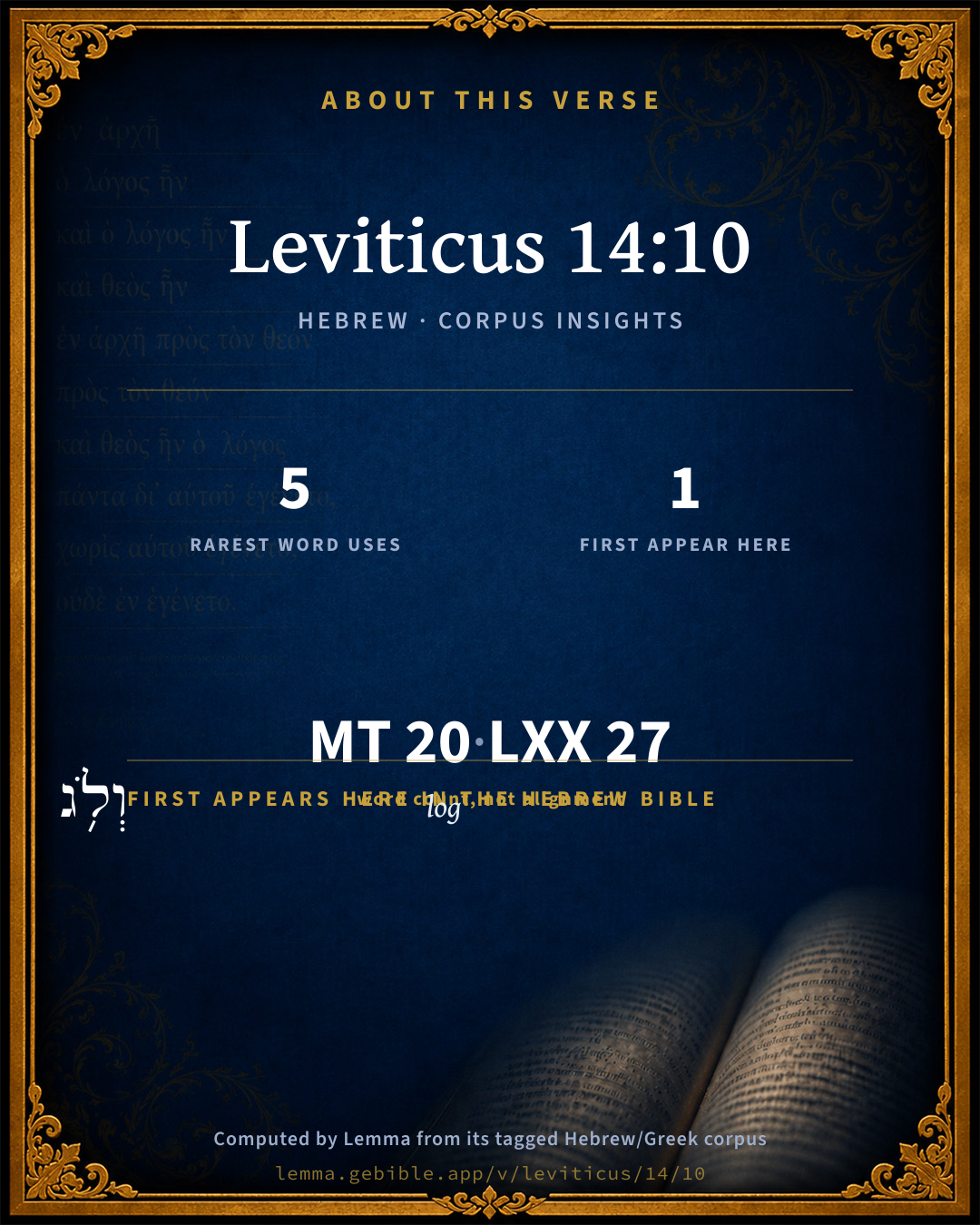
20
words
17
distinct lemmas
Pentateuch
section

Notable vocabulary

The rarest word here is וְלֹ֥ג log H3849 — appearing just 5 times in the whole Hebrew Bible.

First appearance in Scripture

This word makes its first canonical appearance in the Hebrew Bible here:

Shared distinctive vocabulary

וְלֹ֥ג log H3849 occurs in 5 verses of the Hebrew Bible. Also found in:

Grammatical profile

  • 2 verbs
  • 11 nouns
  • 7 adjectives

Verb forms

  • יִקַּ֤ח Qal · Imperfect
  • בְּלוּלָ֣ה Qal · Participle Passive

Repetition

Words recur within this verse — often emphatic in Hebrew:

  • תְּמִימִ֔ים complete H8549 ×2
  • אַחַ֛ת one H259 ×2
  • בַשֶּׁ֔מֶן fat H8081 ×2

Hebrew & Septuagint length

In English translation the verse runs 42 words from the Hebrew and 42 from the Septuagint (LXX English) — the same length.

A rough comparison of the two English renderings, which tokenize alike — not a word-level alignment.

Word counts can differ between the Hebrew and the Greek without any difference in meaning — e.g. the Hebrew direct-object marker אֵת has no separate Greek word, and Greek often adds the article ὁ.

In the original languages it is 20 Hebrew tokens and 27 Greek tokens — but the two are counted differently (Hebrew bundles its prefixes and suffixes into one token; the Greek is in lemma form), so that isn’t a like-for-like length.

Cross-references

23

Topical passages linked to Leviticus 14:10 in the Treasury of Scripture Knowledge — connected by theme and wording, ordered by reader-vote popularity; previews shown in the World English Bible.

  • Leviticus 2:1 "'When anyone offers an offering of a meal offering to Yahweh, his offering shall be of fine flour; and he shall pour oil on it, and put frankincense on it.
  • Leviticus 14:12 "The priest shall take one of the male lambs, and offer him for a trespass offering, with the log of oil, and wave them for a wave offering before Yahweh.
  • Leviticus 14:15 The priest shall take some of the log of oil, and pour it into the palm of his own left hand.
  • Leviticus 14:21 "If he is poor, and can't afford so much, then he shall take one male lamb for a trespass offering to be waved, to make atonement for him, and one tenth of an ephah of fine flour mingled with oil for a meal offering, and a log of oil;
  • Matthew 8:4 Jesus said to him, "See that you tell nobody, but go, show yourself to the priest, and offer the gift that Moses commanded, as a testimony to them."
  • Mark 1:44 and said to him, "See you say nothing to anybody, but go show yourself to the priest, and offer for your cleansing the things which Moses commanded, for a testimony to them."
  • Luke 5:14 He charged him to tell no one, "But go your way, and show yourself to the priest, and offer for your cleansing according to what Moses commanded, for a testimony to them."
  • Exodus 29:40 and with the one lamb a tenth part of an ephah of fine flour mixed with the fourth part of a hin of beaten oil, and the fourth part of a hin of wine for a drink-offering.
  • Leviticus 1:10 "'If his offering is from the flock, from the sheep, or from the goats, for a burnt offering, he shall offer a male without blemish.
  • Leviticus 2:11 "'No meal offering, which you shall offer to Yahweh, shall be made with yeast; for you shall burn no yeast, nor any honey, as an offering made by fire to Yahweh.
  • Leviticus 2:13 Every offering of your meal offering you shall season with salt; neither shall you allow the salt of the covenant of your God to be lacking from your meal offering. With all your offerings you shall offer salt.
  • Leviticus 4:32 "'If he brings a lamb as his offering for a sin offering, he shall bring a female without blemish.
  • Leviticus 9:1 It happened on the eighth day, that Moses called Aaron and his sons, and the elders of Israel;
  • Leviticus 14:23–24 "On the eighth day he shall bring them for his cleansing to the priest, to the door of the Tent of Meeting, before Yahweh.
  • Leviticus 15:13–14 "'When he who has a discharge is cleansed of his discharge, then he shall count to himself seven days for his cleansing, and wash his clothes; and he shall bathe his flesh in running water, and shall be clean.
  • Leviticus 23:13 The meal offering with it shall be two tenth parts of an ephah of fine flour mingled with oil, an offering made by fire to Yahweh for a sweet savor; and the drink offering with it shall be of wine, the fourth part of a hin.
  • Numbers 6:14 and he shall offer his offering to Yahweh, one male lamb a year old without blemish for a burnt offering, and one ewe lamb a year old without blemish for a sin offering, and one ram without blemish for peace offerings,
  • Numbers 15:4–15 then shall he who offers his offering offer to Yahweh a meal-offering of a tenth part [of an ephah] of fine flour mixed with the fourth part of a hin of oil:
  • Numbers 28:20 and their meal-offering, fine flour mixed with oil: three tenth parts shall you offer for a bull, and two tenth parts for the ram;
  • John 1:29 The next day, he saw Jesus coming to him, and said, "Behold, the Lamb of God, who takes away the sin of the world!
  • John 6:33 For the bread of God is that which comes down out of heaven, and gives life to the world."
  • John 6:51 I am the living bread which came down out of heaven. If anyone eats of this bread, he will live forever. Yes, the bread which I will give for the life of the world is my flesh."
  • 1 Peter 1:19 but with precious blood, as of a lamb without spot, the blood of Christ;

Cross-references courtesy of OpenBible.info (CC BY 4.0).

Hebrew and Greek witnesses Masoretic Hebrew ↔ Greek Septuagint

The same verse in the two great witnesses to the Old Testament, shown verse-for-verse.

These are two independent witnesses, not word-aligned to each other, and the Septuagint is shown in lemma (dictionary) form.

Hebrew Leviticus 14:10 Masoretic · Westminster Leningrad Codex

וּבַיּ֣וֹם הַשְּׁמִינִ֗י יִקַּ֤ח שְׁנֵֽי כְבָשִׂים֙ תְּמִימִ֔ים וְכַבְשָׂ֥ה אַחַ֛ת בַּת שְׁנָתָ֖הּ תְּמִימָ֑ה וּשְׁלֹשָׁ֣ה עֶשְׂרֹנִ֗ים סֹ֤לֶת מִנְחָה֙ בְּלוּלָ֣ה בַשֶּׁ֔מֶן וְלֹ֥ג אֶחָ֖ד שָֽׁמֶן

"On the eighth day he shall take two male lambs without blemish, and one ewe lamb a year old without blemish, and three tenths of an ephah of fine flour for a meal offering, mingled with oil, and one log of oil.

World English Bible · Public Domain

Greek LXX Leviticus 14:10 Septuagint · lemma form

καί ὁ ἡμέρα ὁ ὄγδοος λαμβάνω δύο ἀμνός ἐνιαύσιος ἄμωμος καί πρόβατον ἐνιαύσιος ἄμωμος καί τρεῖς δέκατος σεμίδαλις εἰς θυσία φυράω ἐν ἔλαιον καί κοτύλη ἔλαιον εἷς

And on the eighth day he shall take two lambs without spot of a year old, and one ewe lamb without spot of a year old, and three-tenths of fine flour for sacrifice kneaded with oil, and one small cup of oil.

LXX2012 (modern English Septuagint) · Public Domain

Hebrew: Westminster Leningrad Codex (CC BY 4.0). Greek: Septuagint (public domain); English from LXX2012 (modern English Septuagint) (Public Domain). How the Septuagint differs from the Hebrew →

Targum (Aramaic paraphrase)

2

The Targum is the ancient Jewish Aramaic paraphrase of the Hebrew Scriptures — an interpretive translation, not the Hebrew text itself. Onkelos (literal) and Pseudo-Jonathan (expansive) render the Torah, and Jonathan the Prophets. Coverage is partial: where no permissively-licensed English translation exists for a verse, only the Aramaic is shown. This is verse-level text, not a word-by-word alignment to the Hebrew.

  1. Targum Onkelos Torah (Genesis–Deuteronomy)
    וּבְיוֹמָא תְמִינָאָה יִסַב תְּרֵין אִמְרִין שַׁלְמִין וְאִמַרְתָּא חֲדָא בַּת שַׁתָּא שְׁלֶמְתָּא וּתְלָתָא עֶסְרוֹנִין סֻלְתָּא מִנְחָתָא דְפִילָא בִמְשַׁח וְלֻגָא חַד דְמִשְׁחָא

    (no public-domain English translation for this verse)

    Targum Onkelos — Aramaic: “Onkelos Genesis” (public domain); “Onkelos Exodus” (public domain); “Onkelos Leviticus” (public domain); “Onkelos Numbers” (public domain); “Onkelos Deuteronomy” (public domain). English: “Sefaria Community Translation” (CC0 1.0 (public-domain dedication)); “J.W. Etheridge. The Targums of Onkelos and Jonathan Ben Uzziel on the Pentateuch. London: Longmans, Green, 1862” (public domain). Text via Sefaria.

  2. Targum Pseudo-Jonathan Torah (Genesis–Deuteronomy)
    וּבְיוֹמָא תְּמִינָאָה יִסַב תְּרֵין אִמְרִין שַׁלְמִין וְאִמַרְתָּא חֲדָא בַּר שַׁתָּא שְׁלֵימְתָּא וּתְלָתָא עֶסְרוֹנִין סְמִידָא לְמִנְחָתָאפְּתִיכָא בִּמְשַׁח זֵיתָא וְלוּגָא חֲדָא דִמְשַׁח זֵיתָא

    And on the eighth day let him take two lambs unblemished, and one ewe lamb of the year unblemished; and three-tenths of flour for the mincha mingled with olive oil, and one log of olive oil.

    Targum Pseudo-Jonathan — Aramaic: “Targum Jonathan on Genesis” (public domain); “Targum Jonathan on Exodus” (public domain); “Targum Jonathan on Leviticus” (public domain); “Targum Jonathan on Numbers” (public domain); “Targum Jonathan on Deuteronomy” (public domain). English: “The Targum of Jonathan ben Uzziel, trans. J. W. Etheridge, London, 1862” (public domain). Text via Sefaria.

Commentary

Notes on Leviticus 14:10 from classic Christian and Jewish commentators (each source and its license shown beneath its notes). The classic Christian expositions comment on the surrounding passage and are grouped to its opening verse, so a note may address several verses; the Jewish commentaries on the Tanakh (Rashi and others) are per-verse, so they appear only where the commentator wrote on this verse.

Lemma curates 59 commentaries, every one of them public domain or Creative Commons licensed, each selected and text-cleaned for this edition rather than reprinted as found. About our sources →

Ellicott's Commentary for English Readers

(10) And on the eighth day.—Though restored to social intercourse with his fellow brethren, the recovered leper could not at once be admitted to the privileges of the sanctuary, but had to bring on the eighth day three kinds of sacrifices: viz., a trespass offering, a sin offering, and a burnt offering. The lamb for the sin offering had not only to be without blemish (see Lev_1:3), but of the first year (see Lev_12:6).

And three tenth deals of fine flour.—Each of these three sacrifices is to be accompanied by a meat offering, consisting of a tenth part of an ephah (which is an omer) of flour. The omer, which is the same as “the tenth deal” (see Exo_16:36), as it is here called, is equal to 43⅕ eggs, or about four pints. Ordinarily a meat offering did not accompany the trespass offering or the sin offering, and only one omer was brought with a lamb (see Num_15:4); but according to the administrators of the law during the second Temple, three omers are here prescribed as a substitute for the drink offering which should have accompanied the two expiatory sacrifices. For the manner in which the meat offering was prepared, see Lev_11:1-4.

And one log of oil.—This oil, as we see afterwards (see Lev_14:15, &c.), was used to sprinkle seven times before the Lord, to sanctify the ear, the hand, the foot, and the head of the restored leper. The measure log, which occurs four times in this section (Lev_14:10; Lev_14:12; Lev_14:15; Lev_14:21), is not to be found in any other part of the Hebrew Scriptures. According to the authorities at the time of Christ, a “log” is equal to six hen’s eggs.

A Bible Commentary for English Readers, edited by Charles John Ellicott (1878–1897) — public domain. Text from a community e-Sword module.

Trapp's Complete Commentary

John Trapp

Lev 14:10 And on the eighth day he shall take two he lambs without blemish, and one ewe lamb of the first year without blemish, and three tenth deals of fine flour [for] a meat offering, mingled with oil, and one log of oil.

Ver. 10. He shall take two he lambs.] That by these sacrifices he might be taught to seek for the cleansing of his soul, together with the healing of his body; that there might be mens sana in corpore sano, a cure done on both inside and outside too.

John Trapp, A Commentary or Exposition upon All the Books of the Old and New Testament (1647–1656) — public domain. Text from a community e-Sword module.

Joseph Benson's Commentary

Lev 14:10. Two he-lambs, and one ewe-lamb — For three kinds of sacrifice, namely, a trespass-offering, a sin-offering, and a burnt-offering. Flour for a meal-offering — For to each of these sacrifices there was a meal or bread- offering appropriated, consisting of a tenth part of an ephah of fine flour. Mingled with oil — This is added as a fit sign of God’s grace and mercy, and of the leper’s being healed. A log is a measure containing about six egg-shells full.

Joseph Benson's Commentary on the Old and New Testaments (1811–1818) — public domain. Text from a community e-Sword module.

Geneva Bible (1599)

Geneva Bible translators

Which hath no imperfection in any member.

This measure in Hebrew, is called Log, and contained six eggs in measure.

Geneva Bible (1599) marginal notes — public domain. Text via Bolls.life.

Matthew Henry's Commentary

Observe, I. To complete the purification of the leper, on the eighth day, after the former solemnity performed without the camp, and, as it should seem, before he returned to his own habitation, he was to attend at the door of the tabernacle, and was there to be presented to the Lord, with his offering, Lev 14:11. Observe here, 1. That the mercies of God oblige us to present ourselves to him, Rom 12:1. 2. When God has restored us to the liberty of ordinances again, after restraint by sickness, distance, or otherwise, we should take the first opportunity of testifying our respect to God, and our affection to his sanctuary, by a diligent improvement of the liberty we are restored to. When Christ had healed the impotent man, he soon after found him in the temple, Joh 5:14. When Hezekiah asks, What is the sign that I shall go up to the house of the Lord? he means, "What is the sign that I shall recover?" intimating that if God restored him his health, so that he should be able to go abroad, the house of the Lord should be the first place he would go to. 3. When we present ourselves before the Lord we must present our offerings, devoting to God with ourselves all we have and can do. 4. Both we and our offerings must be presented before the Lord by the priest that made us clean, even our Lord Jesus, else neither we nor they can be accepted.

II. Three lambs the cleansed leper was to bring, with a meat-offering, and a log of oil, which was about half a pint. Now, 1. Most of the ceremony peculiar to this case was about the trespass-offering, the lamb for which was offered first, Lev 14:12. And, besides the usual rites with which the trespass-offering was offered, some of the blood was to be put upon the ear, and thumb, and great toe, of the leper that was to be cleansed (Lev 14:14), the very same ceremony that was used in the consecration of the priests, Lev 8:23, Lev 8:24. It was a mortification to them to see the same purification necessary for them that was for a leper. The Jews say that the leper stood without the gate of the tabernacle and the priest within, and thus the ceremony was performed through the gate, signifying that now he was admitted with other Israelites to attend in the courts of the Lord's house again, and was as welcome as ever; though he had been a leper, and though perhaps the name might stick by him as long as he lived (as we read of one who probably was cleansed by our Lord Jesus, who yet afterwards is called Simon the leper, Mat 26:6), yet he was as freely admitted as ever to communion with God and man. After the blood of the offering had been put with the priest's finger upon the extremities of the body, to include the whole, some of the oil that he brought, which was first waved and then sprinkled before the Lord, was in like manner put in the same places upon the blood. "The blood" (says the learned bishop Patrick) "seems to have been a token of forgiveness, the oil of healing," for God first forgiveth our iniquities and then healeth our diseases, Psa 103:3. See Isa 38:17. Wherever the blood of Christ is applied for justification the oil of the Spirit is applied for sanctification; for these two are inseparable and both necessary to our acceptance with God. Nor shall our former leprosy, if it be healed by repentance, be any bar to these glorious privileges. Cleansed lepers are as welcome to the blood and the oil as consecrated priests. Such were some of you, but you are washed. When the leper was sprinkled the water must have blood in it (Lev 14:5), when he was anointed the oil must have blood under it, to signify that all the graces and comforts of the Spirit, all his purifying dignifying influences, are owing to the death of Christ: it is by his blood alone that we are sanctified. 2. Besides this there must be a sin-offering and a burnt-offering, a lamb for each, Lev 14:19, Lev 14:20. By each of these offerings, it is said, the priests shall make atonement for him. (1.) His moral guilt shall be removed; the sin for which the leprosy was sent shall be pardoned, and all the sins he had been guilty of in his afflicted state. Note, The removal of any outward trouble is then doubly comfortable to us when at the same time God gives us some assurance of the forgiveness of our sins. If we receive the atonement, we have reason to rejoice, Rom 5:11. (2.) His ceremonial pollution shall be removed, which had kept him from the participation of the holy things. And this is called making an atonement for him, because our restoration to the privileges of God's children, typified hereby, is owing purely to the great propitiation. When the atonement is made for him he shall be clean, both to his own satisfaction and to his reputation among his neighbours; he shall retrieve both his credit and his comfort, and both these true penitents become entitled to, both ease and honour, by their interest in the atonement. The burnt-offering, besides the atonement that was made by it, was a thankful acknowledgment of God's mercy to him: and the more immediate the hand of God was both in the sickness and in the cure the more reason he had thus to give glory to him, and thus, as our Saviour speaks (Mar 1:44), to offer for his cleansing all those things which Moses commanded for a testimony unto them.

Matthew Henry's Commentary on the Whole Bible (1708–1710) — public domain (CC PDM 1.0). Text via the HelloAO Bible API.

Jamieson, Fausset & Brown

Robert Jamieson, A. R. Fausset & David Brown

on the eighth day he shall take two he lambs without blemish, and one ewe-lamb of the first year without blemish--The purification of the leper was not completed till at the end of seven days, after the ceremonial of the birds [Lev 14:4-7] and during which, though permitted to come into the camp, he had to tarry abroad out of his tent [Lev 14:8], from which he came daily to appear at the door of the tabernacle with the offerings required. He was presented before the Lord by the priest that made him clean. And hence it has always been reckoned among pious people the first duty of a patient newly restored from a long and dangerous sickness to repair to the church to offer his thanksgiving, where his body and soul, in order to be an acceptable offering, must be presented by our great Priest, whose blood alone makes any clean. The offering was to consist of two lambs, the one was to be a sin offering, and an ephah of fine flour (two pints equals one-tenth), and one log (half pint) of oil (Lev 2:1). One of the lambs was for a trespass offering, which was necessary from the inherent sin of his nature or from his defilement of the camp by his leprosy previous to his expulsion; and it is remarkable that the blood of the trespass offering was applied exactly in the same particular manner to the extremities of the restored leper, as that of the ram in the consecration of the priests [Lev 8:23]. The parts sprinkled with this blood were then anointed with oil--a ceremony which is supposed to have borne this spiritual import: that while the blood was a token of forgiveness, the oil was an emblem of healing--as the blood of Christ justifies, the influence of the Spirit sanctifies. Of the other two lambs the one was to be a sin offering and the other a burnt offering, which had also the character of a thank offering for God's mercy in his restoration. And this was considered to make atonement "for him"; that is, it removed that ceremonial pollution which had excluded him from the enjoyment of religious ordinances, just as the atonement of Christ restores all who are cleansed through faith in His sacrifice to the privileges of the children of God.

Jamieson, Fausset & Brown — Commentary Critical and Explanatory on the Whole Bible (1871) — public domain (CC PDM 1.0). Text via the HelloAO Bible API.

Adam Clarke's Commentary

Verse 10. Two he-lambs] One for a trespass-offering, Le 14:12, the other for a burnt-offering, Le 14:19-20.

One ewe-lamb] This was for a sin-offering, Le 14:19.

Three tenth deals] Three parts of an ephah, or three omers; See all these measures explained, Clarke "Ex 16:16". The three tenth deals of flour were for a minchah, meat or gratitude-offering, Le 14:20. The sin-offering was for his impurity; the trespass-offering for his transgression; and the gratitude-offering for his gracious cleansing. These constituted the offering which each was ordered to bring to the priest; see Mt 8:4.

Adam Clarke's Commentary on the Bible (1810–1826) — public domain. Text from a community e-Sword/MySword module.

The Cambridge Bible for Schools and Colleges

gen. ed. J. J. S. Perowne

10. On the following (the eighth) day he brings his sacrifice to the usual place, the entrance to the Tent of Meeting. In the Temple the leper, after bathing in a chamber at the N.W. corner of the Court of the Women, was brought to the gate of Nicanor, between the Court of the Women and the Court of Israel, where he presented his offerings.

tenth parts of an ephah] See on Lev_23:17. For ‘parts’ A.V. has ‘deals,’ a substantive of the same meaning, but now surviving as such only in the common phrase, ‘a great deal,’ although the verb is still in ordinary use. Cp. dole, and the German Teil, portion.

log] a liquid measure approximately equal to an English pint.

The ritual here enjoined is peculiar:

(1) The first offering is a Guilt-Offering—a he-lamb.

(2) The whole lamb is waved with the log of oil before the Lord.

(3) The blood of the sacrifice and the oil are applied to the leper with a ceremonial similar to that used at the consecration of the priests (Lev_8:12; Lev_8:23 f., Lev_8:30).

The he-lamb was of the first year, and younger than the ram usually brought for a Guilt-Offering; the waving of the whole animal was unusual; certain parts only of a sacrifice were waved, and the ceremony of waving was not practised with the Guilt-Offering and Sin-Offering. So that in respect of the animal employed, the act of waving, and the matter waved, this sacrifice was different from the ordinary Guilt-Offering.

The Nazirite who had been defiled by a dead body brought a Sin-Offering, a Burnt-Offering, and a Guilt-Offering; they were offered in this order, and no special regulations about the Guilt-Offering are given (Num_6:10-12). But in the case of the leper, the fact that the Guilt-Offering is brought first, with an accompanying ritual of marked significance, invests this sacrifice with a special importance and distinguishes it from the Guilt-Offering brought by the Nazirite. The Guilt-Offering with its accompanying ritual is the prominent feature in the leper’s sanctuary service. It seems to imply that the disease of leprosy had removed him who had been smitten from the ‘kingdom of priests’ (Exo_19:6); that a re-consecration was necessary, before he could again take his place among his brethren. But it may also mean that leprosy was thought to imply some sin for which atonement must be made by fine or compensation.

The reason why this sacrifice should be a Guilt-Offering is not apparent. The distinctive character of the Guilt-Offering was that it involved restitution for wrong done, whether in respect of ‘the holy things of the Lord’ (Lev_5:15), or against a neighbour (Lev_6:2 f.). As the Nazirite had vowed a period of separation, it might be considered that the defilement of that separation (Num_6:12), though involuntary, was a wrong done in respect of ‘the holy things of the Lord’; but it seems doubtful whether the leper’s enforced absence from the sanctuary during the period of his uncleanness can be so regarded. If it is urged that every Israelite in virtue of his priesthood (Exo_19:6) is dedicated to the service of God, then a Guilt-Offering would be required after any prolonged illness, and after cases of lengthened uncleanness such as those mentioned in chs. 12 and 15; but no Guilt-Offering is prescribed for these persons. Can there be here a remnant of some older practice of which no certain traces survive? The Heb. word ’âshâm, used for the Guilt-Offering in P, is applied in the older literature to certain offerings and fines (1Sa_6:3; 2Ki_12:17). Was an ’âshâm or money payment required in earlier times on the recovery of a leper? This would explain the demand for a Guilt-Offering in P.

The Cambridge Bible for Schools and Colleges (gen. ed. J. J. S. Perowne; Cambridge University Press, 1878–1918) — public domain. Text from a community e-Sword module.

John Gill's Exposition

And on the eighth day,.... From the leper's first appearance before the priest, and the day after the above things were done, in Lev 14:9,

he shall take two he lambs without blemish; the one for a trespass offering, and the other for a burnt offering; and both typical of Christ the Lamb of God, without spot and blemish:

and one ewe lamb of the first year without blemish; for a sin offering, a type of Christ also:

and three tenth deals of fine flour, for a meat offering, mingled with oil; that is, three tenth parts of an ephah, or three omers; one of which was as much, or more than a man could eat in a day, see Exo 16:36; there were three of these to answer to and accompany the three lambs for sacrifice, just such a quantity was allotted to the lambs of the daily sacrifice, Exo 29:40; typical, likewise of Christ, who is the true bread, and whose flesh is meat indeed:

and one log of oil; to be used as after directed: this measure was about half a pint, and is an emblem of the grace and Spirit of God, received by the saints in measure, and is the same with the oil of gladness, poured on Christ without measure, Psa 45:7.

John Gill's Exposition of the Whole Bible (1746–1763) — public domain (CC PDM 1.0). Text via the HelloAO Bible API.

Albert Barnes' Notes on the Bible

Two young rams from one to three years old (not lambs), a ewe lamb in her first year (see Lev 12:6), three-tenth parts of an ephah (something over ten pints and a half) of fine flour mingled with oil, and a log (about half a pint; see Lev 19:35) of oil. The priest presented both the man and his offerings to Yahweh at the entrance of the tent of meeting. See Lev 1:3.

Albert Barnes' Notes on the Bible (1834–1885) — public domain. Text from a community e-Sword/MySword module.

Haydock's Catholic Bible Commentary

A sextary; Hebrew log: a measure of liquids, which was the twelfth part of a hin; and held about as much as six eggs. (Challoner) --- For each of the victims a sacrifice of flour and oil was required. (Haydock)

George Leo Haydock (1774–1849), Haydock's Catholic Family Bible and Commentary, 1859 edition — public domain. Excludes Psalms (Douay-Rheims chapter numbering differs from Protestant) and Deuterocanonical books (Catholic canon only).

Matthew Poole's English Annotations

Oil is added here as a fit sign of God’s grace and mercy, and of the leper’s healing.

Log, a measure for liquid things containing six eggshells-full.

Matthew Poole's English Annotations on the Holy Bible (1683–1685) — public domain. Text from a community e-Sword/MySword module.

Whedon's Commentary on the Bible

Daniel D. Whedon

10. Eighth day — See Lev_9:1, note.

Two lambs — The Hebrew term applies to young sheep till three years old. If it be of the first year the fact is expressly stated.

Without blemish — See Lev_1:3, note.

Three tenth deals — Three omers, about nine quarts: R.V., “three tenth parts of an ephah.” See Lev_23:13, note.

Meat offering — See chap. ii, notes.

One log of oil — The term “log” is transferred from the Hebrew. It contained the twelfth part of a hin, or six egg-shells=.833 of a pint. This olive oil was to be applied to the person of the cleansed leper. Whilst other requisites for the final cleansing varied, according to his ability, this was invariable, because of its typical significance — the unction of the Holy Ghost.

Daniel D. Whedon (gen. ed.), Commentary on the Old and New Testaments (1874–1909) — public domain. Text from a community e-Sword module.

The Pulpit Commentary

On the eighth day he shall take two he lambs without blemish, and one ewe lamb of the first year without blemish, and three tenth deals of fine flour. Every sacrifice is to be provided and offered by the restored leper, except the peace offering. It is certainly singular that the peace offering should be omitted, and that the trespass offering should be required. The former fact may be accounted for by the supposition that though the peace offering was not required, the late leper was, after his other sacrifices, put in a position where he might offer it when he would of his own free will. But the requirement of the trespass offering is more difficult to explain. What wrong had the leper done? and what satisfaction had he to make? The usual answer to this question is that he had wronged Jehovah in that, however involuntarily, he had failed to bring him the offerings and service which he would have brought had he not been excluded from the comp. But this is a very forced explanation, and it is incompatible with other parts of the Law. For the leper was not the only unclean person who, owing to his uncleanness, was prevented from offering his gifts and worship at the tabernacle or temple. The woman who had an issue of blood for twelve years (Luk_8:43) during that time would have been excluded from the sanctuary. But no trespass offering is required of those that have been unclean through issues. We must therefore, look for some other explanation of the requirement in the case of the cleansed leper. And a simpler one is at hand. Leprosy was the type of sin or all sin whatsoever. When, therefore, the expiatory sacrifices were demanded, both kinds the trespass offering and the sin offering had to be offered, because expiation had to be made for the uncleanness which represented all unrighteousness trespasses as well as sins. It might be that the man had not committed a trespass; he might also not hive committed sin; but he had been stricken with the foul disease which symbolized both one and the other, and therefore he had to offer on his cleansing the sacrifice appropriate to each. There is a difference in the ritual of the trespass offering in the present ease, intended perhaps to distinguish it from those trespass offerings which were made when a man had in his mind a certain wrong or injury which he had committed, and for which he wished to make compensation. On this occasion

(1) the animal presented was not required to be of a particular value, as in the ordinary trespass offerings;

(2) it was waved, whereas the ordinary trespass offerings were not waved;

(3) it was waved by the priest, whereas other wave offerings were waved not by the priest, but by the offerer, whose bands were guided by the priests. Nor

(4) did the offering of oil accompany the presentation of other trespass offerings. For whatever reason it be, the most characteristic feature of the sacrificial cleansing of the leper is the trespass offering, and the way that it was dealt with.

Vers. 10-20. Final rites of readmission.

By the series of final rites of restoration recorded in these verses, the leper once more took his place as one of a holy nation admitted to the presence of God: he was "presented before the Lord at the door of the tabernacle," etc. (verse 10). His formal acceptance at the house of the Lord, and entrance again on the privileges of the peculiar people, reminds us that our entrance, whether in the first instance or after backsliding and return, upon the fullness of sacred privilege must be

I ATTENDED WITH HUMILITY. The leper was to bring his sin offering, which must be slain in the holy place (verses 13, 19). Over the head of the animal he was to confess his sin, and then, with his guilt thus transferred, the blood of the sin offering atoned for past wrong. All approaches to God by the human spirit should be accompanied with a sense of unworthiness. "Blessed are the poor in spirit: for theirs is the kingdom of heaven". (Mat_5:3)

II IS THE SPIRIT OF CONSECRATION. The leper was to bring his burnt offering as well as his sin offering (verses 13, 19, 20). By this he symbolically presented himself wholly unto the Lord, laid himself on the altar of sacred service. When we turn, or return unto God it must be in the sprat" " of full, unreserved dedication. We are to present our bodies a living sacrifice, holy, acceptable unto God, our reasonable (i.e. rational, spiritual) service". (Rom_12:1)

III IN THE SPIRIT OF THANKFUL JOY. The leper was to bring "three tenth deals of line flour for a meat offering, mingled with oil" (verses 10, 20). This was a sacrifice of praise and thanksgiving, rendered under a sense of deep indebtedness for Divine bounty. It was certainly suitable enough in the case of the leper, whose malady had been removed by the healing hand of God. Nor is the consciousness of our deep indebtedness, the presentation of our utmost thanks, one whit less becoming, less demanded and required of God, when we come to his house, or to the table of the Lord, after months or years, or (it may be) a life of absence, negligence, estrangement, it should be with hearts overflowing with holy gratitude and. sacred joy that we present ourselves before him.

IV WITH A SENSE OF GOD"S FULL ACCEPTANCE OF OUR WHOLE HEART AND LIFE. There was one very significant ceremony through which the leper who was being cleansed had to pass: the priest was to put some of the blood of the trespass offering upon the tip of the right ear, and the thumb of the right hand, and the great toe of the right foot (verse 14). Afterwards the priest did the same thing with the oil, pouring the remnant of the oil upon the leper"s head (verses 17, 18). The application of the blood of atonement to these bodily extremities indicated God"s acceptance of the leper throughout the entire man; every part of him was now holy unto the Lord; even every part of that bodily frame which had been the very picture and type of all uncleanness. The application of the oil denoted that the leper was thenceforth to regard himself as God"s accepted servant in every sphere of human action; he was to be:

1. A reverent waiter and watcher before God, eagerly learning his will.

2. An active, industrious minister, doing his work in every way open tohim.

3. A conscientious exemplar, walking in the ways of the Lord blameless.We, too, returning unto God, pleading the blood of the Lamb, offering ourselves unto him, reverently rejoicing in his mercy, are to understand and realize that

(1) God accepts us unreservedly as his own, and

(2) expects us to be eager to serve him in every open waylearning, labouring, living to his praise. C.

Vers. 10-32. The cleansing of the leper ceremony in the tabernacle.

The ceremonies for the cleansing of the leper were distributed into two series. The first were conducted "outside the comp." This suggests that the leper must be taken not only as a type of sinners in general, but of the "sinners of the Gentiles" in particular. (comp. Heb_13:10-12) The ceremony in the tabernacle, therefore, must refer to the reception of the Gentiles by the gospel into the fellowship of the saints. We notice

I THE PRESENTATION.

1. This took place on the eighth day.

(1) The ceremonies in the camp extended over seven days, on the last of which the leper was then pronounced clean. He was now, therefore, eligible to leave his alienation, and mingle with the children of Israel as a fellow-citizen.

(2) Entering the sanctuary, he came into Church recognition. For the court of the priests represented the Church in the visible part. (see on Lev_8:10-12) This was on the eighth day, which, in the week, corresponds with the first day, a day so memorable for great events of the gospel that, as the "Lord"s day," it came to replace the Jewish "sabbath". (see on Lev_9:1-7) The Hebrew term for eight (tnm shemenah, is derived from (m shemen, fat or oil; and the oil and fat so extensively used in connection with the offerings and baptisms of the Law represented the Spirit of God in his illuminations and joy-inspiring, graces. The eighth day, or day of oil, was, therefore, appropriately the emblem of the "days of the Son of man," the dispensations of the Spirit.

2. He was introduced by the priest.

(1) He was presented "before the Lord" (verse 11). As a commoner might be presented by a peer to a monarch at a levee, so was the leper presented by the priest to the Lord, who, in his Shechinah, was enthroned upon the mercy-seat. So are the spiritual priests of the gospel introduced by the Great High Priest of our profession. (see Heb_10:21, Heb_10:22)

(2) Being recognized by the King of glory, he became fit for the best society, and could freely mingle with the congregation of Israel, or princes of God. So when God accepts the sinner, though he had been a sinner of the Gentiles, that becomes his passport to the Church. (see Act_10:47)

3. The leper did not appear empty.

(1) It would have been a departure from all precedent in the East to be presented to a monarch without bringing gifts. When the Queen of Sheba came to Solomon, she was laden with rich presents. (1Ki_10:10)

(2) But when we crone into the presence of God, what have we to bring? The leper brought three blemishless lambs; one for a trespass offering, another for a sin offering, and the third for a burnt offering. He brought also three tenth-deals of fine flour mingled with oil, for a bread offering, together with a log of oil. And we can bring Christ, with the Spirit of his grace, the antitypes.

(3) But "shall we offer unto the Lord that which cost us nothing?" There was a commercial value in the gifts of the leper; but our "Gift" is "unspeakable," infinitely above all merchandise, such as we could never procure for ourselves. With him we must consecrate ourselves, and our property "as God may prosper us". (Rom_12:1 1Co_16:2)

II THE CEREMONIES OF THE PRESENTATION.

1. The sacrifices were of all the kinds.

(1) The lamb for the trespass offering. This was to make atonement for transgression, in order to justification.

(2) The ewe-lamb for a sin offering. This was to make atonement for impurity, in order to sanctification.

(3) The burnt offering, to make atonement for irreverences and imperfections in adoration. And with this was associated the bread offering, to express gratitude and communion.

(4) The order is admirable. When our trespasses are forgiven, and our hearts cleansed from sin, then are we in the moral state to adore with gratitude.

2. The baptisms were ample.

(1) The washings at the laver in the tabernacle appear to have been exclusively those of the sacrifices and priests. The baptisms of the Israelites were in their dwellings. (Luk_11:38) The leper was washed with water outside the comp. Cornelius and his company, in whom the kingdom of heaven was opened to the Gentiles by Peter"s key, received the baptism of the Holy Ghost before they had any visible Church recognition. (Act_10:44-48)

(2) The leper"s baptisms of blood began outside the comp. The blood of the bird was there seven times sprinkled upon the leper. But now, in the tabernacle, he is again sprinkled with the blood of the trespass offering. It was put on the tip of his right ear, to engage him in future to hear the Law of God; on the thumb of his right hand, to engage him to do the will of God; and on the great toe of his right foot, to engage him to walk in his holy ways.

(3) As there was no baptism of water ministered to the leper in the tabernacle, so was there no baptism of oil ministered to him outside the comp. Coming into the sanctuary, he sees the oil first "sprinkled seven times before the Lord" (verse 16). Then oil was put upon him over the blood on the tip of his right ear, the thumb of his right hand, and the great toe of his right foot (verse 17). The remnant of the oil was then poured upon his head. In this an "atonement was made for him before the Lord" (verse 18). Bishop Patrick says, "The blood seems to have been a token of forgiveness; the oil of healing." Together they show the intimate connection between the Son of God and the Spirit of God in the work of redemption and salvation.

3. The circumstances of the poor are considered.

(1) He may substitute doves for the lambs of the burnt offering and sin offering, and one tenth-deal of flour for three. "My son, give me thine heart;" and with that the calves of thy lips shall be accepted instead of the calves of the stall.

(2) But the lamb of the trespass offering he must bring. "This may well be looked upon as a figure of the Lamb of God, who alone taketh away the sins of the whole world" (Old Bible). J.A.M.

The Pulpit Commentary (1880–1919), ed. H.D.M. Spence-Jones & Joseph S. Exell — public domain. Text from a community e-Sword module.

John Wesley's Explanatory Notes

Oil is added as a fit sign of God's grace and mercy, and of the leper's healing. A log is a measure containing six egg-shells full.

John Wesley, Explanatory Notes Upon the Whole Bible (1754–1765) — public domain. Text via the GEBible commentary corpus.

unfoldingWord translationNotes

Door43 World Missions Community

he must take

Here "he" refers to the man who was cleansed.

ephah

One ephah is 22 liters. (See: Biblical Volume)

log

One log is 0.31 liters. (See: Biblical Volume)

the person who is to be cleansed

This can be translated in active form. AT: "the person he is cleansing" (See: Active or Passive)

translationWords

lamb

blemish

oil

grain

sacrifice

priest

clean

Yahweh

tent of meeting

unfoldingWord translationNotes — © Distant Shores Media and the Door43 World Missions Community, licensed CC BY-SA 4.0. Source: git.door43.org/Door43/en_tn.

Rashi

Rabbi Shlomo Yitzchaki (Rashi)

וכבשה אחת AND ONE EWE-LAMB for a sin-offering.

ושלשה עשרנים AND THREE TENTH DEALS [OF FLOUR] — as the drink-offerings of these three he-lambs (Menachot 91a) — because the sin-offering and the guilt-offering of the leper require drink-offerings (although they are not required with other sin- and guilt-offerings).

ולג אחד שמן AND ONE LOG OF OIL — to sprinkle on his behalf before the Lord seven times (cf. v. 17), and to put of it upon the tip of his ear and for putting it upon his thumbs (v. 25).

Rashi on the Tanakh — English translations: “The Judaica Press complete Tanach with Rashi, translated by A. J. Rosenberg” (CC BY 4.0); “Pentateuch with Rashi's commentary by M. Rosenbaum and A.M. Silbermann, 1929-1934” (public domain); “The Metsudah Tanach series, Lakewood, N.J” (CC BY 4.0); and “The Book of Joshua, Metsudah Publications, 1997” (CC BY 4.0). Text via Sefaria.

Ramban (Nachmanides)

Rabbi Moshe ben Nachman (Ramban / Nachmanides)

AND ON THE EIGHTH DAY HE SHALL TAKE TWO HE-LAMBS WITHOUT BLEMISH, AND ONE EWE-LAMB. Scripture has not explained what is to be done with the two he-lambs and the one ewe-lamb. However, it mentioned concerning one of the he-lambs that the priest offer it as a guilt-offering, and further mentioned that he should offer up the sin-offering, and afterward he shall slaughter the burnt-offering. This is because He has already mentioned in the section of Vayikra that the sin-offering should be a female, and that every burnt-offering should be a male., 1:3; 10. Therefore there was no need here to speak at length, it being known that [since the first he-lamb was a guilt-offering], the second he-lamb would be the burnt-offering, and the ewe-lamb would be the sin-offering.

Ramban (Nachmanides) on the Tanakh — English translation: “Commentary on the Torah by Ramban (Nachmanides). Translated and annotated by Charles B. Chavel. New York, Shilo Pub. House, 1971-1976” (CC BY 4.0). Text via Sefaria.

Lesson kit

Teaching starters — assembled from the data on this page, not authored interpretation. Every prompt links to the verse data it draws on. Edit before teaching.

Leviticus, in the Pentateuch, opens this verse with 20 words (17 distinct Hebrew lemmas). Its most distinctive word is lôg (“log”). A historical commentator’s framing appears above. Read the whole chapter for the surrounding context.

Discussion questions

  1. How does “log” (lôg) shape what this verse is saying?
  2. The word “log” first appears here in Scripture. What is being introduced at this debut?
  3. Leviticus 14:12 shares the word «log» with this verse. How do the two illuminate each other?
  4. “complete” occurs 2× in this one verse. What is the effect of the repetition?
  5. These translations render this verse differently; the difference is in the English rendering, not the original. What questions does that raise?
  6. The verb «יִקַּ֤ח» is Qal Imperfect. How does its form color the action?
  7. Reading how Ellicott's Commentary for English Readers and Trapp's Complete Commentary read this verse, where do the two commentators agree and where do they part?

Things to notice

Reading settings

Reading text

Shown beneath each verse's original-language words.

Old Testament
Old Testament edition

Read the OT as the Masoretic Hebrew (MT) or the Greek Septuagint (LXX).

English shown for the Greek Septuagint (in the Hebrew ↔ Greek comparison).

Comparing translations? Open the Compare panel on any verse page to stack up to four side by side.