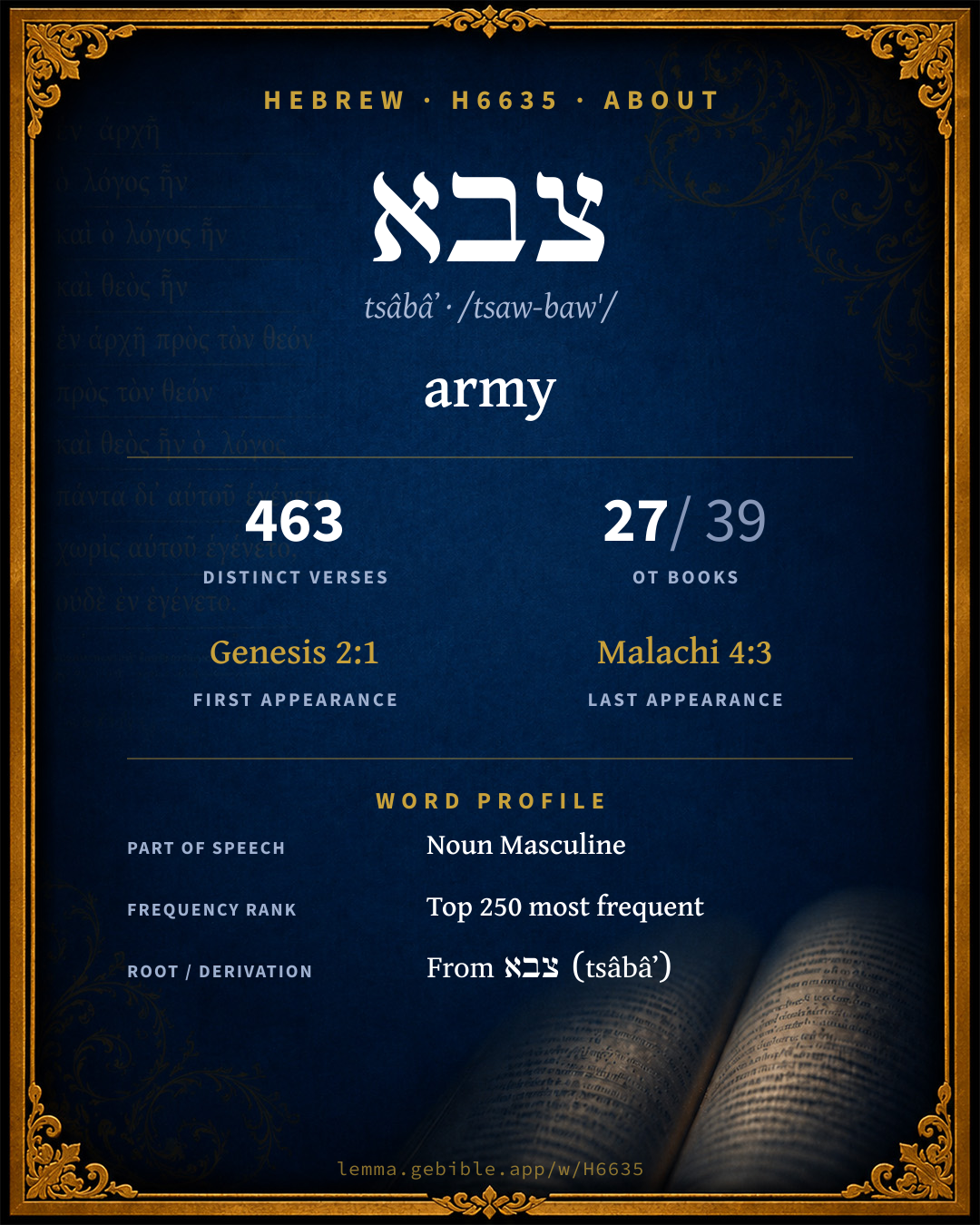
צָבָא
army
also: war, warfare, host fuller range ↓
Full lexicon entry — Brown-Driver-Briggs (BDB)
From Brown-Driver-Briggs (BDB)
Where this word appears
See every Absolute-state word in the Hebrew Bible →
Grammar key — what these labels mean
Part of speech
- Noun
- A naming word — a person, place, thing, or idea.
Noun type
- Common
- A common noun — a general class of person, place, or thing (“king,” “city,” “water”), not a specific name.
State
- Absolute
- The independent form of a noun, not bound to a following word.
- Construct
- A noun bound to a following noun in a possessive / “of” relationship (the construct chain).
Gender
- Both
- Attested as both masculine and feminine.
Number
- Plural
- More than one (in Hebrew, generally three or more).
- Singular
- One.
Grammatical forms
- Noun, Common, Both, Plural, Absolute 288 times (59%)
- Noun, Common, Both, Singular, Absolute 93 times (19%)
- Noun, Common, Both, Singular, Construct 78 times (16%)
- Noun, Common, Both, Plural, Construct 28 times (6%)
Parsed forms decoded from the imported morphology (morphhb / Westminster Leningrad Codex — WLC text public domain, morphhb tagging CC BY 4.0), counted across 487 parsed occurrences — not distinct verses.
Page 1 of 3 — showing verses 1–200 of 463 distinct verses where H6635 appears, across 27 books. Click any verse to open its interlinear word-by-word view. Verse text shown in the World English Bible for context — . Each verse’s Hebrew form is shown with its reference; the English is not keyword-highlighted, since the data carries no word-level English alignment. Use “Compare translations” on any verse to read it across multiple English versions. This concordance covers the Hebrew Bible; Septuagint (Greek Old Testament) occurrences are not indexed here.
Genesis 4 verses
- Genesis 2:1 צְבָאָֽ/ם n c bs cs + sfx pers 3mp The heavens and the earth were finished, and all the host of them.
- Genesis 21:22 צְבָא֔/וֹ n c bs cs + sfx pers 3ms It happened at that time, that Abimelech and Phicol the captain of his host spoke to Abraham, saying, "God is with you in all that you do.
- Genesis 21:32 צְבָא֔/וֹ n c bs cs + sfx pers 3ms So they made a covenant at Beersheba. Abimelech rose up with Phicol, the captain of his host, and they returned into the land of the Philistines.
- Genesis 26:26 צְבָאֽ/וֹ n c bs cs + sfx pers 3ms Then Abimelech went to him from Gerar, and Ahuzzath his friend, and Phicol the captain of his host.
Exodus 5 verses
- Exodus 6:26 צִבְאֹתָֽ/ם n c bp cs + sfx pers 3mp These are that Aaron and Moses, to whom Yahweh said, "Bring out the children of Israel from the land of Egypt according to their hosts."
- Exodus 7:4 צִבְאֹתַ֜/י n c bp cs + sfx pers 1cs But Pharaoh will not listen to you, and I will lay my hand on Egypt, and bring forth my hosts, my people the children of Israel, out of the land of Egypt by great judgments.
- Exodus 12:17 צִבְאוֹתֵי/כֶ֖ם n c bp cs + sfx pers 2mp You shall observe the feast of unleavened bread; for in this same day have I brought your hosts out of the land of Egypt: therefore shall you observe this day throughout your generations by an ordinance forever.
- Exodus 12:41 צִבְא֥וֹת n c bp cs It happened at the end of four hundred thirty years, even the same day it happened, that all the hosts of Yahweh went out from the land of Egypt.
- Exodus 12:51 צִבְאֹתָֽ/ם n c bp cs + sfx pers 3mp It happened the same day, that Yahweh brought the children of Israel out of the land of Egypt by their hosts.
Numbers 71 verses
- Numbers 1:3 צָבָ֖א לְ/צִבְאֹתָ֖/ם n c bs prep + n c bp cs + sfx pers 3mp from twenty years old and upward, all who are able to go out to war in Israel. You and Aaron shall number them by their divisions.
- Numbers 1:20 צָבָֽא n c bs The children of Reuben, Israel's firstborn, their generations, by their families, by their fathers' houses, according to the number of the names, one by one, every male from twenty years old and upward, all who were able to go out to war;
- Numbers 1:22 צָבָֽא n c bs Of the children of Simeon, their generations, by their families, by their fathers' houses, those who were numbered of it, according to the number of the names, one by one, every male from twenty years old and upward, all who were able to go out to war;
- Numbers 1:24 צָבָֽא n c bs Of the children of Gad, their generations, by their families, by their fathers' houses, according to the number of the names, from twenty years old and upward, all who were able to go out to war;
- Numbers 1:26 צָבָֽא n c bs Of the children of Judah, their generations, by their families, by their fathers' houses, according to the number of the names, from twenty years old and upward, all who were able to go out to war;
- Numbers 1:28 צָבָֽא n c bs Of the children of Issachar, their generations, by their families, by their fathers' houses, according to the number of the names, from twenty years old and upward, all who were able to go out to war;
- Numbers 1:30 צָבָֽא n c bs Of the children of Zebulun, their generations, by their families, by their fathers' houses, according to the number of the names, from twenty years old and upward, all who were able to go out to war;
- Numbers 1:32 צָבָֽא n c bs Of the children of Joseph, of the children of Ephraim, their generations, by thir families, by their fathers' houses, according to the number of the names, from twenty years old and upward, all who were able to go out to war;
- Numbers 1:34 צָבָֽא n c bs Of the children of Manasseh, their generations, by their families, by their fathers' houses, according to the number of the names, from twenty years old and upward, all who were able to go out to war;
- Numbers 1:36 צָבָֽא n c bs Of the children of Benjamin, their generations, by their families, by their fathers' houses, according to the number of the names, from twenty years old and upward, all who were able to go out to war;
- Numbers 1:38 צָבָֽא n c bs Of the children of Dan, their generations, by their families, by their fathers' houses, according to the number of the names, from twenty years old and upward, all who were able to go forth to war;
- Numbers 1:40 צָבָֽא n c bs Of the children of Asher, their generations, by their families, by their fathers' houses, according to the number of the names, from twenty years old and upward, all who were able to go forth to war;
- Numbers 1:42 צָבָֽא n c bs Of the children of Naphtali, their generations, by their families, by their fathers' houses, according to the number of the names, from twenty years old and upward, all who were able to go forth to war;
- Numbers 1:45 צָבָ֖א n c bs So all those who were numbered of the children of Israel by their fathers' houses, from twenty years old and upward, all who were able to go out to war in Israel;
- Numbers 1:52 לְ/צִבְאֹתָֽ/ם prep + n c bp cs + sfx pers 3mp The children of Israel shall pitch their tents, every man by his own camp, and every man by his own standard, according to their divisions.
- Numbers 2:3 לְ/צִבְאֹתָ֑/ם prep + n c bp cs + sfx pers 3mp Those who encamp on the east side toward the sunrise shall be of the standard of the camp of Judah, according to their divisions: and the prince of the children of Judah shall be Nahshon the son of Amminadab.
- Numbers 2:4 וּ/צְבָא֖/וֹ conj + n c bs cs + sfx pers 3ms His division, and those who were numbered of them, were seventy-four thousand six hundred.
- Numbers 2:6 וּ/צְבָא֖/וֹ conj + n c bs cs + sfx pers 3ms His division, and those who were numbered of it, were fifty-four thousand four hundred.
- Numbers 2:8 וּ/צְבָא֖/וֹ conj + n c bs cs + sfx pers 3ms His division, and those who were numbered of it, were fifty-seven thousand four hundred.
- Numbers 2:9 לְ/צִבְאֹתָ֑/ם prep + n c bp cs + sfx pers 3mp All who were numbered of the camp of Judah were one hundred eighty-six thousand four hundred, according to their divisions. They shall set out first.
- Numbers 2:10 לְ/צִבְאֹתָ֑/ם prep + n c bp cs + sfx pers 3mp "On the south side shall be the standard of the camp of Reuben according to their divisions. The prince of the children of Reuben shall be Elizur the son of Shedeur.
- Numbers 2:11 וּ/צְבָא֖/וֹ conj + n c bs cs + sfx pers 3ms His division, and those who were numbered of it, were forty-six thousand five hundred.
- Numbers 2:13 וּ/צְבָא֖/וֹ conj + n c bs cs + sfx pers 3ms His division, and those who were numbered of them, were fifty-nine thousand three hundred.
- Numbers 2:15 וּ/צְבָא֖/וֹ conj + n c bs cs + sfx pers 3ms His division, and those who were numbered of them, were forty-five thousand six hundred fifty.
- Numbers 2:16 לְ/צִבְאֹתָ֑/ם prep + n c bp cs + sfx pers 3mp "All who were numbered of the camp of Reuben were one hundred fifty-one thousand four hundred fifty, according to their hosts. They shall set out second.
- Numbers 2:18 לְ/צִבְאֹתָ֖/ם prep + n c bp cs + sfx pers 3mp "On the west side shall be the standard of the camp of Ephraim according to their divisions: and the prince of the children of Ephraim shall be Elishama the son of Ammihud.
- Numbers 2:19 וּ/צְבָא֖/וֹ conj + n c bs cs + sfx pers 3ms His division, and those who were numbered of them, were forty thousand five hundred.
- Numbers 2:21 וּ/צְבָא֖/וֹ conj + n c bs cs + sfx pers 3ms His division, and those who were numbered of them, were thirty-two thousand two hundred.
- Numbers 2:23 וּ/צְבָא֖/וֹ conj + n c bs cs + sfx pers 3ms His host, and those who were numbered of them, were thirty-five thousand four hundred.
- Numbers 2:24 לְ/צִבְאֹתָ֑/ם prep + n c bp cs + sfx pers 3mp "All who were numbered of the camp of Ephraim were one hundred eight thousand one hundred, according to their divisions. They shall set out third.
- Numbers 2:25 לְ/צִבְאֹתָ֑/ם prep + n c bp cs + sfx pers 3mp "On the north side shall be the standard of the camp of Dan according to their divisions: and the prince of the children of Dan shall be Ahiezer the son of Ammishaddai.
- Numbers 2:26 וּ/צְבָא֖/וֹ conj + n c bs cs + sfx pers 3ms His division, and those who were numbered of them, were sixty-two thousand seven hundred.
- Numbers 2:28 וּ/צְבָא֖/וֹ conj + n c bs cs + sfx pers 3ms His division, and those who were numbered of them, were forty-one thousand and five hundred.
- Numbers 2:30 וּ/צְבָא֖/וֹ conj + n c bs cs + sfx pers 3ms His division, and those who were numbered of them, were fifty-three thousand four hundred.
- Numbers 2:32 לְ/צִבְאֹתָ֔/ם prep + n c bp cs + sfx pers 3mp These are those who were numbered of the children of Israel by their fathers' houses. All who were numbered of the camps according to their hosts were six hundred three thousand five hundred fifty.
- Numbers 4:3 לַ/צָּבָ֔א prep det + n c bs from thirty years old and upward even until fifty years old, all who enter into the service, to do the work in the Tent of Meeting.
- Numbers 4:23 צָבָ֔א n c bs from thirty years old and upward until fifty years old shall you number them; all who enter in to wait on the service, to do the work in the Tent of Meeting.
- Numbers 4:30 לַ/צָּבָ֔א prep det + n c bs from thirty years old and upward even to fifty years old shall you number them, everyone who enters on the service, to do the work of the Tent of Meeting.
- Numbers 4:35 לַ/צָּבָ֔א prep det + n c bs from thirty years old and upward even to fifty years old, everyone who entered into the service, for work in the Tent of Meeting.
- Numbers 4:39 לַ/צָּבָ֔א prep det + n c bs from thirty years old and upward even to fifty years old, everyone who entered into the service, for work in the Tent of Meeting,
- Numbers 4:43 לַ/צָּבָ֔א prep det + n c bs from thirty years old and upward even to fifty years old, everyone who entered into the service, for work in the Tent of Meeting,
- Numbers 8:24 צָבָ֔א n c bs "This is that which belongs to the Levites: from twenty-five years old and upward they shall go in to wait on the service in the work of the Tent of Meeting;
- Numbers 8:25 מִ/צְּבָ֣א prep + n c bs cs and from the age of fifty years they shall cease waiting on the work, and shall serve no more,
- Numbers 10:14 לְ/צִבְאֹתָ֑/ם צְבָא֔/וֹ prep + n c bp cs + sfx pers 3mp n c bs cs + sfx pers 3ms In the first [place] the standard of the camp of the children of Judah set forward according to their hosts: and over his host was Nahshon the son of Amminadab.
- Numbers 10:15 צְבָ֔א n c bs cs Over the host of the tribe of the children of Issachar was Nethanel the son of Zuar.
- Numbers 10:16 צְבָ֔א n c bs cs Over the host of the tribe of the children of Zebulun was Eliab the son of Helon.
- Numbers 10:18 לְ/צִבְאֹתָ֑/ם צְבָא֔/וֹ prep + n c bp cs + sfx pers 3mp n c bs cs + sfx pers 3ms The standard of the camp of Reuben set forward according to their hosts: and over his host was Elizur the son of Shedeur.
- Numbers 10:19 צְבָ֔א n c bs cs Over the host of the tribe of the children of Simeon was Shelumiel the son of Zurishaddai.
- Numbers 10:20 צְבָ֖א n c bs cs Over the host of the tribe of the children of Gad was Eliasaph the son of Deuel.
- Numbers 10:22 לְ/צִבְאֹתָ֑/ם צְבָא֔/וֹ prep + n c bp cs + sfx pers 3mp n c bs cs + sfx pers 3ms The standard of the camp of the children of Ephraim set forward according to their hosts: and over his host was Elishama the son of Ammihud.
- Numbers 10:23 צְבָ֔א n c bs cs Over the host of the tribe of the children of Manasseh was Gamaliel the son of Pedahzur.
- Numbers 10:24 צְבָ֔א n c bs cs Over the host of the tribe of the children of Benjamin was Abidan the son of Gideoni.
- Numbers 10:25 לְ/צִבְאֹתָ֑/ם צְבָא֔/וֹ prep + n c bp cs + sfx pers 3mp n c bs cs + sfx pers 3ms The standard of the camp of the children of Dan, which was the rearward of all the camps, set forward according to their hosts: and over his host was Ahiezer the son of Ammishaddai.
- Numbers 10:26 צְבָ֔א n c bs cs Over the host of the tribe of the children of Asher was Pagiel the son of Ochran.
- Numbers 10:27 צְבָ֔א n c bs cs Over the host of the tribe of the children of Naphtali was Ahira the son of Enan.
- Numbers 10:28 לְ/צִבְאֹתָ֑/ם prep + n c bp cs + sfx pers 3mp Thus were the travels of the children of Israel according to their hosts; and they set forward.
- Numbers 26:2 צָבָ֖א n c bs Take the sum of all the congregation of the children of Israel, from twenty years old and upward, by their fathers' houses, all who are able to go forth to war in Israel.
- Numbers 31:3 לַ/צָּבָ֑א prep det + n c bs Moses spoke to the people, saying, Arm you men from among you for the war, that they may go against Midian, to execute Yahweh's vengeance on Midian.
- Numbers 31:4 לַ/צָּבָֽא prep det + n c bs Of every tribe one thousand, throughout all the tribes of Israel, shall you send to the war.
- Numbers 31:5 צָבָֽא n c bs So there were delivered, out of the thousands of Israel, a thousand of every tribe, twelve thousand armed for war.
- Numbers 31:6 לַ/צָּבָ֑א לַ/צָּבָ֔א prep det + n c bs prep det + n c bs Moses sent them, one thousand of every tribe, to the war, them and Phinehas the son of Eleazar the priest, to the war, with the vessels of the sanctuary and the trumpets for the alarm in his hand.
- Numbers 31:14 מִ/צְּבָ֥א prep + n c bs cs Moses was angry with the officers of the host, the captains of thousands and the captains of hundreds, who came from the service of the war.
- Numbers 31:21 הַ/צָּבָ֔א ptcl def.art + n c bs Eleazar the priest said to the men of war who went to the battle, This is the statute of the law which Yahweh has commanded Moses:
- Numbers 31:27 לַ/צָּבָ֑א prep det + n c bs and divide the prey into two parts: between the men skilled in war, who went out to battle, and all the congregation.
- Numbers 31:28 לַ/צָּבָ֔א prep det + n c bs Levy a tribute to Yahweh of the men of war who went out to battle: one soul of five hundred, [both] of the persons, and of the oxen, and of the donkeys, and of the flocks:
- Numbers 31:32 הַ/צָּבָ֑א ptcl def.art + n c bs Now the prey, over and above the booty which the men of war took, was six hundred seventy-five thousand sheep,
- Numbers 31:36 בַּ/צָּבָ֑א prep det + n c bs The half, which was the portion of those who went out to war, was in number three hundred thirty-seven thousand five hundred sheep:
- Numbers 31:48 הַ/צָּבָ֑א ptcl def.art + n c bs The officers who were over the thousands of the host, the captains of thousands, and the captains of hundreds, came near to Moses;
- Numbers 31:53 הַ/צָּבָ֔א ptcl def.art + n c bs ([For] the men of war had taken booty, every man for himself.)
- Numbers 32:27 צָבָ֛א n c bs but your servants will pass over, every man who is armed for war, before Yahweh to battle, as my lord says.
- Numbers 33:1 לְ/צִבְאֹתָ֑/ם prep + n c bp cs + sfx pers 3mp These are the journeys of the children of Israel, when they went forth out of the land of Egypt by their hosts under the hand of Moses and Aaron.
Deuteronomy 4 verses
- Deuteronomy 4:19 צְבָ֣א n c bs cs and lest you lift up your eyes to the sky, and when you see the sun and the moon and the stars, even all the host of the sky, you are drawn away and worship them, and serve them, which Yahweh your God has allotted to all the peoples under the whole sky.
- Deuteronomy 17:3 צְבָ֥א n c bs cs and has gone and served other gods, and worshiped them, or the sun, or the moon, or any of the host of the sky, which I have not commanded;
- Deuteronomy 20:9 צְבָא֖וֹת n c bp It shall be, when the officers have made an end of speaking to the people, that they shall appoint captains of hosts at the head of the people.
- Deuteronomy 24:5 בַּ/צָּבָ֔א prep det + n c bs When a man takes a new wife, he shall not go out in the host, neither shall he be charged with any business: he shall be free at home one year, and shall cheer his wife whom he has taken.
Joshua 5 verses
- Joshua 4:13 הַ/צָּבָ֑א ptcl def.art + n c bs about forty thousand ready armed for war passed over before Yahweh to battle, to the plains of Jericho.
- Joshua 5:14 צְבָֽא n c bs cs He said, No; but [as] prince of the host of Yahweh am I now come. Joshua fell on his face to the earth, and did worship, and said to him, What says my lord to his servant?
- Joshua 5:15 צְבָ֨א n c bs cs The prince of Yahweh's host said to Joshua, Put off your shoe from off your foot; for the place whereon you stand is holy. Joshua did so.
- Joshua 22:12 לַ/צָּבָֽא prep det + n c bs When the children of Israel heard of it, the whole congregation of the children of Israel gathered themselves together at Shiloh, to go up against them to war.
- Joshua 22:33 לַ/צָּבָ֔א prep det + n c bs The thing pleased the children of Israel; and the children of Israel blessed God, and spoke no more of going up against them to war, to destroy the land in which the children of Reuben and the children of Gad lived.
Judges 4 verses
- Judges 4:2 צְבָא/וֹ֙ n c bs cs + sfx pers 3ms Yahweh sold them into the hand of Jabin king of Canaan, who reigned in Hazor; the captain of whose host was Sisera, who lived in Harosheth of the Gentiles.
- Judges 4:7 צְבָ֣א n c bs cs I will draw to you, to the river Kishon, Sisera, the captain of Jabin's army, with his chariots and his multitude; and I will deliver him into your hand.
- Judges 8:6 לִֽ/צְבָאֲ/ךָ֖ prep + n c bs cs + sfx pers 2ms The princes of Succoth said, Are the hands of Zebah and Zalmunna now in your hand, that we should give bread to your army?
- Judges 9:29 צְבָאֲ/ךָ֖ n c bs cs + sfx pers 2ms Would that this people were under my hand! then would I remove Abimelech. He said to Abimelech, Increase your army, and come out.
1 Samuel 10 verses
- 1 Samuel 1:3 צְבָא֖וֹת n c bp This man went up out of his city from year to year to worship and to sacrifice to Yahweh of Hosts in Shiloh. The two sons of Eli, Hophni and Phinehas, priests to Yahweh, were there.
- 1 Samuel 1:11 צְבָא֜וֹת n c bp She vowed a vow, and said, Yahweh of hosts, if you will indeed look on the affliction of your handmaid, and remember me, and not forget your handmaid, but will give to your handmaid a man-child, then I will give him to Yahweh all the days of his life, and there shall no razor come on his head.
- 1 Samuel 4:4 צְבָא֖וֹת n c bp So the people sent to Shiloh; and they brought from there the ark of the covenant of Yahweh of Hosts, who sits [above] the cherubim: and the two sons of Eli, Hophni and Phinehas, were there with the ark of the covenant of God.
- 1 Samuel 12:9 צְבָ֨א n c bs cs But they forgot Yahweh their God; and he sold them into the hand of Sisera, captain of the host of Hazor, and into the hand of the Philistines, and into the hand of the king of Moab; and they fought against them.
- 1 Samuel 14:50 צְבָא/וֹ֙ n c bs cs + sfx pers 3ms and the name of Saul's wife was Ahinoam the daughter of Ahimaaz. The name of the captain of his host was Abner the son of Ner, Saul's uncle.
- 1 Samuel 15:2 צְבָא֔וֹת n c bp Thus says Yahweh of Hosts, I have marked that which Amalek did to Israel, how he set himself against him in the way, when he came up out of Egypt.
- 1 Samuel 17:45 צְבָא֔וֹת n c bp Then said David to the Philistine, You come to me with a sword, and with a spear, and with a javelin: but I come to you in the name of Yahweh of hosts, the God of the armies of Israel, whom you have defied.
- 1 Samuel 17:55 הַ/צָּבָ֔א ptcl def.art + n c bs When Saul saw David go forth against the Philistine, he said to Abner, the captain of the host, Abner, whose son is this youth? Abner said, As your soul lives, O king, I can't tell.
- 1 Samuel 26:5 צְבָא֑/וֹ n c bs cs + sfx pers 3ms David arose, and came to the place where Saul had encamped; and David saw the place where Saul lay, and Abner the son of Ner, the captain of his host: and Saul lay within the place of the wagons, and the people were encamped round about him.
- 1 Samuel 28:1 לַ/צָּבָ֔א prep det + n c bs It happened in those days, that the Philistines gathered their hosts together for warfare, to fight with Israel. Achish said to David, Know you assuredly, that you shall go out with me in the host, you and your men.
2 Samuel 15 verses
- 2 Samuel 2:8 צָבָ֖א n c bs Now Abner the son of Ner, captain of Saul's host, had taken Ish-bosheth the son of Saul, and brought him over to Mahanaim;
- 2 Samuel 3:23 הַ/צָּבָ֥א ptcl def.art + n c bs When Joab and all the host who was with him had come, they told Joab, saying, Abner the son of Ner came to the king, and he has sent him away, and he is gone in peace.
- 2 Samuel 5:10 צְבָא֖וֹת n c bp David grew greater and greater; for Yahweh, the God of hosts, was with him.
- 2 Samuel 6:2 צְבָא֛וֹת n c bp David arose, and went with all the people who were with him, from Baale Judah, to bring up from there the ark of God, which is called by the Name, even the name of Yahweh of Hosts who sits [above] the cherubim.
- 2 Samuel 6:18 צְבָאֽוֹת n c bp When David had made an end of offering the burnt offering and the peace-offerings, he blessed the people in the name of Yahweh of Hosts.
- 2 Samuel 7:8 צְבָא֔וֹת n c bp Now therefore thus shall you tell my servant David, Thus says Yahweh of Hosts, I took you from the sheep pen, from following the sheep, that you should be prince over my people, over Israel;
- 2 Samuel 7:26 צְבָא֔וֹת n c bp Let your name be magnified forever, saying, Yahweh of hosts is God over Israel; and the house of your servant David shall be established before you.
- 2 Samuel 7:27 צְבָא֜וֹת n c bp For you, Yahweh of Hosts, the God of Israel, have revealed to your servant, saying, I will build you a house: therefore has your servant found in his heart to pray this prayer to you.
- 2 Samuel 8:16 הַ/צָּבָ֑א ptcl def.art + n c bs Joab the son of Zeruiah was over the host; and Jehoshaphat the son of Ahilud was recorder;
- 2 Samuel 10:7 הַ/צָּבָ֖א ptcl def.art + n c bs When David heard of it, he sent Joab, and all the host of the mighty men.
- 2 Samuel 10:16 צְבָ֥א n c bs cs Hadarezer sent, and brought out the Syrians who were beyond the River: and they came to Helam, with Shobach the captain of the host of Hadarezer at their head.
- 2 Samuel 10:18 צְבָא֛/וֹ n c bs cs + sfx pers 3ms The Syrians fled before Israel; and David killed of the Syrians [the men of] seven hundred chariots, and forty thousand horsemen, and struck Shobach the captain of their host, so that he died there.
- 2 Samuel 17:25 הַ/צָּבָ֑א ptcl def.art + n c bs Absalom set Amasa over the host instead of Joab. Now Amasa was the son of a man, whose name was Ithra the Israelite, who went in to Abigail the daughter of Nahash, sister to Zeruiah, Joab's mother.
- 2 Samuel 19:13 צָבָ֞א n c bs Say you to Amasa, Aren't you my bone and my flesh? God do so to me, and more also, if you aren't captain of the host before me continually in the room of Joab.
- 2 Samuel 20:23 הַ/צָּבָ֖א ptcl def.art + n c bs Now Joab was over all the host of Israel; and Benaiah the son of Jehoiada was over the Cherethites and over the Pelethites;
1 Kings 13 verses
- 1 Kings 1:19 הַ/צָּבָ֑א ptcl def.art + n c bs and he has slain oxen and fatlings and sheep in abundance, and has called all the sons of the king, and Abiathar the priest, and Joab the captain of the host; but he hasn't called Solomon your servant.
- 1 Kings 1:25 הַ/צָּבָא֙ ptcl def.art + n c bs For he is gone down this day, and has slain oxen and fatlings and sheep in abundance, and has called all the king's sons, and the captains of the host, and Abiathar the priest; and, behold, they are eating and drinking before him, and say, [Long] live king Adonijah.
- 1 Kings 2:5 צִבְא֣וֹת n c bp cs Moreover you know also what Joab the son of Zeruiah did to me, even what he did to the two captains of the hosts of Israel, to Abner the son of Ner, and to Amasa the son of Jether, whom he killed, and shed the blood of war in peace, and put the blood of war on his sash that was about his loins, and in his shoes that were on his feet.
- 1 Kings 2:32 צְבָ֣א צְבָ֥א n c bs cs n c bs cs Yahweh will return his blood on his own head, because he fell on two men more righteous and better than he, and killed them with the sword, and my father David didn't know it, [to wit], Abner the son of Ner, captain of the host of Israel, and Amasa the son of Jether, captain of the host of Judah.
- 1 Kings 2:35 הַ/צָּבָ֑א ptcl def.art + n c bs The king put Benaiah the son of Jehoiada in his room over the host; and Zadok the priest did the king put in the room of Abiathar.
- 1 Kings 4:4 הַ/צָּבָ֑א ptcl def.art + n c bs and Benaiah the son of Jehoiada was over the host; and Zadok and Abiathar were priests;
- 1 Kings 11:15 הַ/צָּבָ֔א ptcl def.art + n c bs For it happened, when David was in Edom, and Joab the captain of the host was gone up to bury the slain, and had struck every male in Edom
- 1 Kings 11:21 הַ/צָּבָ֑א ptcl def.art + n c bs When Hadad heard in Egypt that David slept with his fathers, and that Joab the captain of the host was dead, Hadad said to Pharaoh, Let me depart, that I may go to my own country.
- 1 Kings 16:16 צָבָ֧א n c bs The people who were encamped heard say, Zimri has conspired, and has also struck the king: therefore all Israel made Omri, the captain of the host, king over Israel that day in the camp.
- 1 Kings 18:15 צְבָא֔וֹת n c bp Elijah said, As Yahweh of Hosts lives, before whom I stand, I will surely show myself to him today.
- 1 Kings 19:10 צְבָא֗וֹת n c bp He said, I have been very jealous for Yahweh, the God of hosts; for the children of Israel have forsaken your covenant, thrown down your altars, and slain your prophets with the sword: and I, even I only, am left; and they seek my life, to take it away.
- 1 Kings 19:14 צְבָא֗וֹת n c bp He said, I have been very jealous for Yahweh, the God of hosts; for the children of Israel have forsaken your covenant, thrown down your altars, and slain your prophets with the sword; and I, even I only, am left; and they seek my life, to take it away.
- 1 Kings 22:19 צְבָ֤א n c bs cs [Micaiah] said, Therefore hear you the word of Yahweh: I saw Yahweh sitting on his throne, and all the host of heaven standing by him on his right hand and on his left.
2 Kings 10 verses
- 2 Kings 3:14 צְבָאוֹת֙ n c bp Elisha said, As Yahweh of Hosts lives, before whom I stand, surely, were it not that I regard the presence of Jehoshaphat the king of Judah, I would not look toward you, nor see you.
- 2 Kings 4:13 הַ/צָּבָ֑א ptcl def.art + n c bs He said to him, Say now to her, Behold, you have been careful for us with all this care; what is to be done for you? would you be spoken for to the king, or to the captain of the host? She answered, I dwell among my own people.
- 2 Kings 5:1 צְבָ֨א n c bs cs Now Naaman, captain of the host of the king of Syria, was a great man with his master, and honorable, because by him Yahweh had given victory to Syria: he was also a mighty man of valor, [but he was] a leper.
- 2 Kings 17:16 צְבָ֣א n c bs cs They forsook all the commandments of Yahweh their God, and made them molten images, even two calves, and made an Asherah, and worshiped all the host of the sky, and served Baal.
- 2 Kings 19:31 צְבָא֖וֹת n c bp For out of Jerusalem shall go forth a remnant, and out of Mount Zion those who shall escape: the zeal of Yahweh shall perform this.
- 2 Kings 21:3 צְבָ֣א n c bs cs For he built again the high places which Hezekiah his father had destroyed; and he reared up altars for Baal, and made an Asherah, as did Ahab king of Israel, and worshiped all the host of the sky, and served them.
- 2 Kings 21:5 צְבָ֣א n c bs cs He built altars for all the host of the sky in the two courts of the house of Yahweh.
- 2 Kings 23:4 צְבָ֣א n c bs cs The king commanded Hilkiah the high priest, and the priests of the second order, and the keepers of the threshold, to bring forth out of the temple of Yahweh all the vessels that were made for Baal, and for the Asherah, and for all the host of the sky, and he burned them outside of Jerusalem in the fields of the Kidron, and carried the ashes of them to Bethel.
- 2 Kings 23:5 צְבָ֥א n c bs cs He put down the idolatrous priests, whom the kings of Judah had ordained to burn incense in the high places in the cities of Judah, and in the places round about Jerusalem; those also who burned incense to Baal, to the sun, and to the moon, and to the planets, and to all the host of the sky.
- 2 Kings 25:19 הַ/צָּבָ֔א ptcl def.art + n c bs and out of the city he took an officer who was set over the men of war; and five men of those who saw the king's face, who were found in the city; and the scribe, the captain of the host, who mustered the people of the land; and sixty men of the people of the land, who were found in the city.
1 Chronicles 26 verses
- 1 Chronicles 5:18 צָבָֽא n c bs The sons of Reuben, and the Gadites, and the half-tribe of Manasseh, of valiant men, men able to bear buckler and sword, and to shoot with bow, and skillful in war, were forty-four thousand seven hundred and sixty, that were able to go forth to war.
- 1 Chronicles 7:4 צְבָ֣א n c bs cs With them, by their generations, after their fathers' houses, were bands of the host for war, thirty-six thousand; for they had many wives and sons.
- 1 Chronicles 7:11 צָבָ֖א n c bs All these were sons of Jediael, according to the heads of their fathers' [houses], mighty men of valor, seventeen thousand and two hundred, who were able to go forth in the host for war.
- 1 Chronicles 7:40 בַּ/צָּבָא֙ prep det + n c bs All these were the children of Asher, heads of the fathers' houses, choice and mighty men of valor, chief of the princes. The number of them reckoned by genealogy for service in war was twenty-six thousand men.
- 1 Chronicles 11:9 צְבָא֖וֹת n c bp David grew greater and greater; for Yahweh of Hosts was with him.
- 1 Chronicles 12:8 צָבָא֙ n c bs Of the Gadites there separated themselves to David to the stronghold in the wilderness, mighty men of valor, men trained for war, that could handle shield and spear; whose faces were like the faces of lions, and they were as swift as the roes on the mountains;
- 1 Chronicles 12:14 הַ/צָּבָ֑א ptcl def.art + n c bs These of the sons of Gad were captains of the host: he who was least was equal to one hundred, and the greatest to one thousand.
- 1 Chronicles 12:21 בַּ/צָּבָֽא prep det + n c bs They helped David against the band of rovers: for they were all mighty men of valor, and were captains in the host.
- 1 Chronicles 12:23 לַ/צָּבָ֔א prep det + n c bs These are the numbers of the heads of those who were armed for war, who came to David to Hebron, to turn the kingdom of Saul to him, according to the word of Yahweh.
- 1 Chronicles 12:24 צָבָֽא n c bs The children of Judah who bore shield and spear were six thousand and eight hundred, armed for war.
- 1 Chronicles 12:25 לַ/צָּבָ֔א prep det + n c bs Of the children of Simeon, mighty men of valor for the war, seven thousand and one hundred.
- 1 Chronicles 12:33 צָבָ֗א n c bs Of Zebulun, such as were able to go out in the host, who could set the battle in array, with all manner of instruments of war, fifty thousand, and who could order [the battle array, and were] not of double heart.
- 1 Chronicles 12:36 צָבָ֛א n c bs Of Asher, such as were able to go out in the host, who could set the battle in array, forty thousand.
- 1 Chronicles 12:37 צְבָ֣א n c bs cs On the other side of the Jordan, of the Reubenites, and the Gadites, and of the half-tribe of Manasseh, with all manner of instruments of war for the battle, one hundred twenty thousand.
- 1 Chronicles 17:7 צְבָא֔וֹת n c bp Now therefore thus shall you tell my servant David, Thus says Yahweh of Hosts, I took you from the sheep pen, from following the sheep, that you should be prince over my people Israel:
- 1 Chronicles 17:24 צְבָאוֹת֙ n c bp Let your name be established and magnified forever, saying, Yahweh of Hosts is the God of Israel, even a God to Israel: and the house of David your servant is established before you.
- 1 Chronicles 18:15 הַ/צָּבָ֑א ptcl def.art + n c bs Joab the son of Zeruiah was over the host; and Jehoshaphat the son of Ahilud was recorder;
- 1 Chronicles 19:8 צָבָ֖א n c bs When David heard of it, he sent Joab, and all the host of the mighty men.
- 1 Chronicles 19:16 צְבָ֥א n c bs cs When the Syrians saw that they were put to the worse before Israel, they sent messengers, and drew forth the Syrians who were beyond the River, with Shophach the captain of the host of Hadarezer at their head.
- 1 Chronicles 19:18 הַ/צָּבָ֖א ptcl def.art + n c bs The Syrians fled before Israel; and David killed of the Syrians [the men of] seven thousand chariots, and forty thousand footmen, and killed Shophach the captain of the host.
- 1 Chronicles 20:1 הַ/צָּבָ֜א ptcl def.art + n c bs It happened, at the time of the return of the year, at the time when kings go out [to battle], that Joab led forth the army, and wasted the country of the children of Ammon, and came and besieged Rabbah. But David stayed at Jerusalem. Joab struck Rabbah, and overthrew it.
- 1 Chronicles 25:1 הַ/צָּבָ֜א ptcl def.art + n c bs Moreover, David and the captains of the host set apart for the service certain of the sons of Asaph, and of Heman, and of Jeduthun, who should prophesy with harps, with psalteries, and with cymbals: and the number of those who did the work according to their service was:
- 1 Chronicles 26:26 הַ/צָּבָֽא ptcl def.art + n c bs This Shelomoth and his brothers were over all the treasures of the dedicated things, which David the king, and the heads of the fathers' [houses], the captains over thousands and hundreds, and the captains of the host, had dedicated.
- 1 Chronicles 27:3 הַ/צְּבָא֖וֹת ptcl def.art + n c bp [He was] of the children of Perez, the chief of all the captains of the host for the first month.
- 1 Chronicles 27:5 הַ/צָּבָ֤א ptcl def.art + n c bs The third captain of the host for the third month was Benaiah, the son of Jehoiada the priest, chief: and in his division were twenty-four thousand.
- 1 Chronicles 27:34 צָבָ֥א n c bs and after Ahithophel was Jehoiada the son of Benaiah, and Abiathar: and the captain of the king's host was Joab.
2 Chronicles 12 verses
- 2 Chronicles 17:18 צָבָֽא n c bs and next to him Jehozabad and with him one hundred eighty thousand ready prepared for war.
- 2 Chronicles 18:18 צְבָ֤א n c bs cs [Micaiah] said, Therefore hear you the word of Yahweh: I saw Yahweh sitting on his throne, and all the host of heaven standing on his right hand and on his left.
- 2 Chronicles 25:5 צָבָ֔א n c bs Moreover Amaziah gathered Judah together, and ordered them according to their fathers' houses, under captains of thousands and captains of hundreds, even all Judah and Benjamin: and he numbered them from twenty years old and upward, and found them three hundred thousand chosen men, able to go forth to war, who could handle spear and shield.
- 2 Chronicles 25:7 צְבָ֣א n c bs cs But there came a man of God to him, saying, O king, don't let the army of Israel go with you; for Yahweh is not with Israel, [to wit], with all the children of Ephraim.
- 2 Chronicles 26:11 צָבָ֣א n c bs Moreover Uzziah had an army of fighting men, who went out to war by bands, according to the number of their reckoning made by Jeiel the scribe and Maaseiah the officer, under the hand of Hananiah, one of the king's captains.
- 2 Chronicles 26:13 צָבָ֜א n c bs Under their hand was an army, three hundred thousand and seven thousand and five hundred, who made war with mighty power, to help the king against the enemy.
- 2 Chronicles 26:14 הַ/צָּבָ֗א ptcl def.art + n c bs Uzziah prepared for them, even for all the host, shields, and spears, and helmets, and coats of mail, and bows, and stones for slinging.
- 2 Chronicles 28:9 הַ/צָּבָא֙ ptcl def.art + n c bs But a prophet of Yahweh was there, whose name was Oded: and he went out to meet the host that came to Samaria, and said to them, Behold, because Yahweh, the God of your fathers, was angry with Judah, he has delivered them into your hand, and you have slain them in a rage which has reached up to heaven.
- 2 Chronicles 28:12 הַ/צָּבָֽא ptcl def.art + n c bs Then certain of the heads of the children of Ephraim, Azariah the son of Johanan, Berechiah the son of Meshillemoth, and Jehizkiah the son of Shallum, and Amasa the son of Hadlai, stood up against those who came from the war,
- 2 Chronicles 33:3 צְבָ֣א n c bs cs For he built again the high places which Hezekiah his father had broken down; and he reared up altars for the Baals, and made Asheroth, and worshiped all the host of the sky, and served them.
- 2 Chronicles 33:5 צְבָ֣א n c bs cs He built altars for all the host of the sky in the two courts of the house of Yahweh.
- 2 Chronicles 33:11 הַ/צָּבָא֙ ptcl def.art + n c bs Therefore Yahweh brought on them the captains of the host of the king of Assyria, who took Manasseh in chains, and bound him with fetters, and carried him to Babylon.
Nehemiah 1 verse
Job 3 verses
- Job 7:1 צָבָ֣א n c bs "Isn't a man forced to labor on earth? Aren't his days like the days of a hired hand?
- Job 10:17 וְ/צָבָ֣א conj + n c bs You renew your witnesses against me, And increase your indignation on me. Changes and warfare are with me.
- Job 14:14 צְבָאִ֣/י n c bs cs + sfx pers 1cs If a man dies, shall he live again? All the days of my warfare would I wait, Until my release should come.
Psalms 23 verses
- Psalms 24:10 צְבָא֑וֹת n c bp Who is this King of glory? Yahweh of Hosts, He is the King of glory. Selah.
- Psalms 33:6 צְבָאָֽ/ם n c bs cs + sfx pers 3mp By Yahweh's word the heavens were made; All their host by the breath of his mouth.
- Psalms 44:9 בְּ/צִבְאוֹתֵֽי/נוּ prep + n c bp cs + sfx pers 1cp But now you rejected us, and brought us to dishonor, And don't go out with our armies.
- Psalms 46:7 צְבָא֣וֹת n c bp Yahweh of Hosts is with us. The God of Jacob is our refuge. Selah.
- Psalms 46:11 צְבָא֣וֹת n c bp Yahweh of Hosts is with us. The God of Jacob is our refuge. Selah.
- Psalms 48:8 צְ֭בָאוֹת n c bp As we have heard, so we have seen, In the city of Yahweh of Hosts, in the city of our God. God will establish it forever. Selah.
- Psalms 59:5 צְבָא֡וֹת n c bp You, Yahweh God of hosts, the God of Israel, Rouse yourself to punish the nations. Show no mercy to the wicked traitors. Selah.
- Psalms 60:10 בְּ/צִבְאוֹתֵֽי/נוּ prep + n c bp cs + sfx pers 1cp Haven't you, God, rejected us? You don't go out with our armies, God.
- Psalms 68:11 צָבָ֥א n c bs The Lord announced the word. The ones who proclaim it are a great company.
- Psalms 68:12 צְ֭בָאוֹת n c bp "Kings of armies flee! They flee!" She who waits at home divides the spoil,
- Psalms 69:6 צְבָ֫א֥וֹת n c bp Don't let those who wait for you be shamed through me, Lord Yahweh of Hosts. Don't let those who seek you be brought to dishonor through me, God of Israel.
- Psalms 80:4 צְבָא֑וֹת n c bp Yahweh God of hosts, How long will you be angry against the prayer of your people?
- Psalms 80:7 צְבָא֣וֹת n c bp Turn us again, God of hosts. Cause your face to shine, And we will be saved.
- Psalms 80:14 צְבָאוֹת֮ n c bp Turn again, we beg you, God of hosts. Look down from heaven, and see, and visit this vine,
- Psalms 80:19 צְבָא֣וֹת n c bp Turn us again, Yahweh God of hosts. Cause your face to shine, and we will be saved.
- Psalms 84:1 צְבָאֽוֹת n c bp How lovely are your dwellings, Yahweh of Hosts!
- Psalms 84:3 צְבָא֑וֹת n c bp Yes, the sparrow has found a home, And the swallow a nest for herself, where she may have her young, Near your altars, Yahweh of Hosts, my King, and my God.
About this entry
At a glance — auto-summarized from this page’s data, not written by a person. Every figure links to its source below. This summary describes the numbers; it doesn’t interpret them.
צבא (tsâbâʼ) is a Hebrew noun most often rendered “army.” Translators differ — “hosts” in the King James Version, then “armies” (unfoldingWord Literal Text), as the renderings breakdown shows. With 463 verses in 27 books, it is a common word in the Hebrew Bible. It first appears in Genesis 2:1. Beyond its headline sense, its full sense range takes in “war”, “warfare”, and “host”. For the data behind this summary, explore the sense tree and the renderings breakdown below.
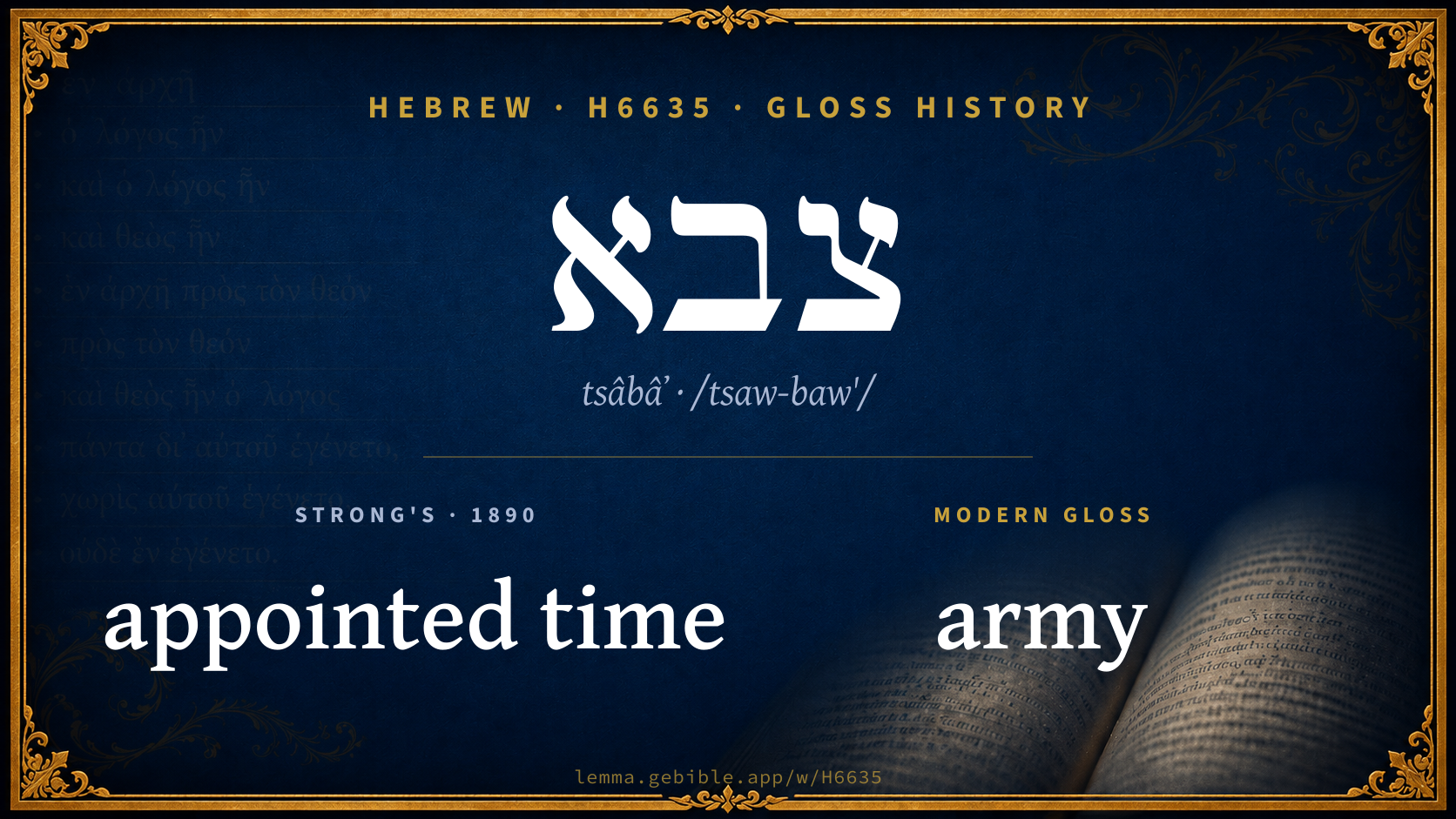
Gloss history
Strong's 1890 vs modern scholarship
About this word
Strong's H6635 catalogs a Hebrew word from the Hebrew Old Testament.
These counts are not copied from any lexicon or concordance. They are computed here, from the morphology-tagged Hebrew Old Testament. What Lemma adds →
- 463
- distinct verses
- The word appears in 463 distinct verses.
- 27 / 39
- OT books
- The word appears in 27 of 39 Old Testament books.
- #105
- by frequency
- Top 250 most frequent Hebrew words (rank 105 of 8,640 Hebrew words by occurrence).
View all 463 occurrences in the concordance →
By section of the Old Testament
By traditional corpus
Conventional, traditional groupings — biblical authorship is debated, so this is a traditional corpus grouping, not an authorship claim. Each share is this word’s portion of its verses in that division of the Hebrew canon. Each figure is a share of the word’s 463 distinct verses.
- Prophets (Nevi'im) 309 verses · 67%
- Torah (Pentateuch) 84 verses · 18%
- Writings (Ketuvim) 70 verses · 15%
How translations render this word
Counts come from each version’s own published word-to-Strong’s tagging or interlinear alignment — an approximate guide to how each version renders this word, not a word-level alignment the data otherwise carries. Because each total is that version’s own tagged count, the per-version totals vary from one another and need not match the appearance or distinct-verse counts above. These counts may also differ from a printed concordance because Lemma counts each distinctly tagged rendering and does not collapse phrase taggings into a single head-word total. This is a fixed set of word-tagged versions (KJV, ASV, BSB, ULT) and does not change with the reading translation you choose elsewhere. Each version’s license is shown beside its name below (and on Sources).
BDB lists this Strong’s number as 3 distinct words (homographs). Each count above pools all of them and is not split by sense — see the Senses section below. A low-frequency rendering may belong to a different one of those words, not the primary meaning.
- King James Version†: Hosts 288×, Host 56×, War 39×
- American Standard Version†: Hosts 288×, Host 56×, War 31×
- Berean Standard Bible†: Hosts 285×, Army 64×, Host 22×
- unfoldingWord Literal Text†: Armies 189×, Army 89×, Hosts 56×
King James Version Public Domain
Renders H6635 across 483† tagged occurrences — most commonly:
Plus other, less common renderings. Plus 25 renderings that appear only once — usually multi-word phrases or single function words the recovered tagging swept in, not distinct renderings. Not rendered by a distinct English word in 2 further occurrences.
American Standard Version Public Domain
Renders H6635 across 483† tagged occurrences — most commonly:
Plus other, less common renderings. Plus 34 renderings that appear only once — usually multi-word phrases or single function words the recovered tagging swept in, not distinct renderings.
Berean Standard Bible Public Domain
Renders H6635 across 466† tagged occurrences — most commonly:
Plus 25 renderings that appear only once — usually multi-word phrases or single function words the recovered tagging swept in, not distinct renderings. Not rendered by a distinct English word in 17 further occurrences.
unfoldingWord Literal Text CC BY-SA 4.0
Renders H6635 across 439† tagged occurrences — most commonly:
Plus 15 renderings that appear only once — usually multi-word phrases or single function words the recovered tagging swept in, not distinct renderings.
17 senses and sub-senses in the full BDB
Hebrew verbs can shift meaning by stem (binyan): Qal is the basic action, Niphal is often passive or reflexive, Piel often intensifies or makes it factitive, and Hiphil is typically causative. The senses below are grouped under the stem BDB assigns to each.
What do BDB’s symbols mean?
BDB uses these scholarly abbreviations:
| Symbol | Meaning |
|---|---|
| 𝔊 | the Septuagint (the ancient Greek translation, LXX) |
| 𝔙 | the Vulgate (the Latin translation) |
| 𝔖 | the Syriac version (the Peshitta) |
| 𝔗 | the Targum (the Aramaic translation) |
| ψ | the Psalms |
| √ | root (the underlying root or stem) |
| ‖ | parallel passage (a synonymous or contrasted parallel) |
| † | the dagger: every passage where the word occurs is cited |
The 17 senses and sub-senses the full Brown-Driver-Briggs lexicon distinguishes for this word, in lexicon order (not ranked by frequency), with BDB’s own verbatim wording and sub-sense lettering. Shown in Hebrew script with BDB’s own scholarly abbreviations. The condensed entry is in the Lexicon Entry tab. See also the Forms in the corpus table below.
צבא I wage war, serve (Sab. צֿבא wage war with, also n. army, campaign HomChrest. 125 CIS iv. 299, 1. 2 DHM VOJ i. 28
Qal
- Pf. 3 mpl. צָֽבְאוּ Ex 38:8 Zc 14:12; Impf. 3 mpl. יִצְבְּאוּ Nu 31:7; Inf. cstr. לִצְבֹּא Is 31:4; לִצְבֹא Nu 4:23; 8:24; Pt. pl. צֹבְאִים Nu 31:42; Is 29:7, 8; sf. צֹבֶיהָ Is 29:7 (Ges§ 75 oo; Di צָרֶיהָ); fpl. צֹבְאֹת Ex 38:8; צֹבְאוֹת 1 S 2:22;— e.g. Exodus 38:8
- 1. wage war, fight, c. עַל against, Nu 31:7 (P) Is 29:7, 8; 31:4; Zc 14:12, c. sf. Is 29:7 (?); abs. Nu 31:42 (P). e.g. Numbers 31:7
- 2. serve at sacred tent, Levites, c. acc. צָבָא Nu 4:23; 8:24 (P); women Ex 38:8(×2) (P) 1 S 2:22. e.g. Numbers 4:23
Hiphil
- Pt. הַמַּצְבִּא אֶת־עַם וגו׳ 2 K 25:19 = Je 52:25 muster. e.g. 2 Kings 25:19
צבא II
- 1. army, host:
- a. organized for war Ju 8:6; 9:29 (J) Is 34:2; Je 51:3; 2 Ch 28:9; צְבָאוֹ his host Nu 2:4, 6 + 10 times 2 (P), לְצִבְאֹתָם 1:3, 52; 2:3, 9 + 11 times 2, 10, 33:1 (P); אַלְפֵי הצ׳ 31:48 (P); צ׳ ישׂראל 2 Ch 25:7; חֵיל (ה)צ׳ 1 Ch 20:1; 2 Ch 26:13; גְּדוּדֵי צ׳ 1 Ch 7:4; כל־הצבא 2 S 3:23; 10:7; 1 Ch 19:8; 2 Ch 26:14; שַׂר (ה)צ׳ captain of (the) host Gn 21:22, 32 (E) 26:26 (J) Ju 4:2, 7; 1 S 12:9 + 21 times; שָׂרֵי (ה)צבא 1 K 1:25 (but read שַׂר), 1 Ch 25:1; 26:26; 2 Ch 33:11; שָׂרִים בצ׳ 1 Ch 12:22; שָׂרֵי (ה)צבאות Dt 20:9; 1 K 2:5; 1 Ch 27:3; רָאשֵׁי הצ׳ 1 Ch 12:14; מַלְכֵי צבאות ψ 68:13; עַל (ה)צ׳ over the host (as captain) Nu 10:14, 15 + 10 times Nu 10 (P), 2 S 8:16 = 1 Ch 18:15; 2 S 17:25; 1 K 2:35; 4:4; אל־כל הצ׳ 2 S 20:23 (אל for על); עַל־צִבְאֹתָם Ex 6:26; 12:51 (P); הוציא צבאות lead out armies Ex 7:4; 12:17 (P); יצא צ׳ army goes forth (to war) Ex 12:41; 1 Ch 7:11; לֹא תֵצֵא בְּצִבְאוֹתֵינוּ ψ 44:10, of י׳ going with our armies = 60:12 = 108:12; fig. of great number, צבא רב 68:12.—On חֲלִיפוֹת וְצָבָא Jb 10:17 v. Di; Bu proposes תַּחֲלֵף צְבָאֲ(ךָ) i.e. thou dost renew (thine) army against me. e.g. Judges 8:6
- b. host (organized body) of angels (cf. Lu 2:13), צבא השׁמים (כל) all the host of heaven 1 K 22:19 = 2 Ch 18:18; Ne 9:6; כל צבאיו ψ 103:21; 148:2; צבא הַמָּרוֹם Is 24:21 host of the high (angel-princes; ‖ earthly monarchs); צבא השׁמים Dn 8:10, הצבא v 10 (al. vb fig. of Israel); שׂר צ׳ י׳ captain of the host of י׳ Jos 5:14, 15 (theophanic angel); שׂר הצבא Dn 8:11 (angel-prince of Israel, others, God). e.g. 1 Kings 22:19
- c. of sun, moon and stars, כל צבא השׁמים Dt 4:19; 17:3; 2 K 17:16; 21:3, 5 = 2 Ch 33:3, 5; 2 K 23:4, 5 Je 8:2; 19:13 (all as objects of worship), Is 34:4; צ׳ השׁמים Je 33:22; Zp 1:5; כל צבאם Ne 9:6 ψ 33:6; Is 34:4; 45:12; צבאם Is 40:26.—Je 3:19 v. i. צְבִי. e.g. Deuteronomy 4:19
- d. of the entire creation, כל צבאם Gn 2:1. e.g. Genesis 2:1
- 2. war, warfare, service: יָצָא צָבָא go out to war Nu 1:3, 20 + 12 times Nu 1, 26:2 (P) 1 Ch 5:18; 7:11; 12:33, 36; 2 Ch 25:5; 26:11; יצא בצ׳ Nu 31:36 (P) Dt 24:5; יצא לצ׳ Nu 31:27, 28 (P); עלה לצ׳ go up to war Jos 22:12, 33 (P); בא מצ׳ come from war Nu 31:14; 2 Ch 28:12; קבץ לצ׳ 1 S 28:1; שׁלח לצ׳ Nu 31:4, 6(×2) (P); התיחשׂם בּצ׳ 1 Ch 7:40; צ׳ תִנָּתֵן Dn 8:12; אַנְשֵׁי (ה)צ׳ men of war Nu 31:21, 53 (P) 1 Ch 12:9, cf. עַם הצ׳ Nu 31:32 (P); v. also II. חלץ; גִבּוֹרֵי חַיִל לצ׳ 1 Ch 12:25; כְּלֵי צ׳ 1 Ch 12:37 instruments of war. e.g. Numbers 1:3
- 3. service:
- a. of Levites in sacred places Nu 4:3, 23, 30, 35, 39, 43; 8:24, 25; קֹדֶשׁ וְצָבָא Dn 8:13 (al. as v 11, 1 b). e.g. Numbers 4:3
- b. of hard service of troubled life Jb 7:1; 14:14; Is 40:2 Dn 10:1. e.g. Job 7:1
- 4. צְבָאוֹת, in name of י׳ as God of war, prob. first in time of warlike David (some connect with sacred ark, but ark older), explained יהוה צבאות אֱלֹהֵי מערכות ישׂראל 1 S 17:45 י׳ Sebaoth God of the battle array of Israel (the thought of angels and stars as army of God is later); e.g. 1 Samuel 17:45
- a. earliest form c. art.: י׳ אֱלֹהֵי הַצְּבָאוֹת Am 3:13; 6:14; 9:5 (אֱלֹהֵי om. by error, cf. We), Ho 12:6. e.g. Amos 3:13
- b. without art., definite by usage, י׳ אֱלֹהֵי צְבָאוֹת 2 S 5:10; Am 5:14, 15, 16; 6:8; 1 K 19:10, 14; Je 5:14; 15:16 ψ 89:9; י׳ אֱלֹהֵי צְבָאֹת אֱלֹהֵי יִשְׂרָאֵל Je 35:17; 38:17; 44:7; 2 S 7:27 = 1 Ch 17:24; Is 21:10; 37:16; 1st אֱלֹהֵי om. Je 7:3, 21 + 30 times Je; Zp 2:9; י׳ אלהים צ׳ אלהי ישׂראל ψ 59:6 (אלהים variant of י׳); י׳ א׳ צ׳ שְׁמוֹ, י׳ God of hosts his name Am 4:13; 5:27, later reduced to י׳ צ׳ שְׁמוֹ Is 47:4; 48:2; 51:15; 54:5; Je 10:16; 31:35 + 6 times Je. e.g. 2 Samuel 5:10
- c. as n.pr. Sebaoth: י׳ צבאות, י׳ Sebaoth (Lord of hosts, Vrss, owing to Qr אֲדֹנָי, but this never cstr. אֲדֹנֵי; al. י׳ of hosts, but י׳ is n.pr.; צ׳ for earlier אלהי צ׳; cf. Σαβαωθ Ja 5:4; Rom 9:29): 1 S 1:3, 11; 4:4; 15:2; 17:45; 2 S 6:2, 18; 7:8, 26; 1 K 18:15; 2 K 3:14; 19:31; 1 Ch 11:9; 17:7 ψ 24:10 + 6 times ψψ, Mi 4:4; Na 2:14; 3:5 Hb 2:13; Zp 2:10; Is 1:9; 2:12; 5:7, 9, 16, 24 + 35 times Is 6–39; Is 2 only 44:6; 45:13; Je 6:6, 9; 8:3; 9:6, 16 + 26 times Je, Hg 1:2, 5 + 12 times Hg, Zc 1:3(×3), 4 + 40 times Zc 1–8; 9:15 + 8 times 10–14, Mal 1:4, 6, 8 + 21 times Mal; האדון י׳ צ׳ Is 1:24 + 4 times Is (incl. 10:16 Baer Gi > van d. H. אֲדֹנָי for י׳); אֲדֹנָי י׳ צ׳ 3:15 + (on these phr. v. אָדוֹן 1, 6); אלהים צ׳ (א׳ later Qr for orig. י׳) ψ 80:8, 15; י׳ אלהים צ׳ (earlier י׳ + later [inserted] א׳) ψ 80:5, 20; 84:9.—cf. Driver Hastings DB (1900), Lord of Hosts and reff., Löhr Amos (Belhefte zur ZAW iv (1900), 38–67). e.g. 1 Samuel 1:3
Senses from the full Brown-Driver-Briggs lexicon (Brown, Driver, Briggs; Oxford 1906 — public domain), digitized via Sefaria, supplemented by the OpenScriptures HebrewLexicon (CC BY 4.0). Full attribution on Sources.
Word origin
I. vb. wage war, serve (Sab. צֿבא wage war with, also n. army, campaign HomChrest. 125 CIS iv. 299, 1. 2 DHM VOJ i. 28; Ethiopic ጸብአ: (> ፀብአ:) wage war; Assyrian ṣâbu, man, soldier; NöZMG xl (1886), 726 al. cp. (on account of Sab. Ethiopic ץֿ) Arabic ضَبَأَ conceal oneself, hence lie in wait; this is phonetically suitable, but better in meaning would be صَبَأَ go or come forth (against one), etc., so Thes LagBN 21; Frä232 cp. صَبِىٌّ young man);—
II. n.m. 2 Ch 28:9 (poss. f. Is 40:2; Dn 8:12, but v. Albr ZAW xv (1895), 319; Bev Dn) army, war, warfare;—abs. צ׳ Nu 1:3 + (מִצָּבָה Zc 9:8 v. p. 663 a); cstr. צְבָא Nu 10:15 +; sf. צְבָאִי Jb 14:14; צְבָאֲךָ Ju 8:9; 9:29; צְבָאָיו ψ 103:21; 148:2 (Kt צבאו; so read prob. in both), etc.; pl. צְבָאוֹת Nu 20:9 + 278 times; cstr. צִבְאוֹת Ex 12:41 + 2 times; sf. צִבְאֹתַי 7:4; צִבְאֹתָם 6:26 +, etc.;—
I. v. further i, ii. צְבִי.
— Brown-Driver-Briggs (Oxford 1906, public domain), digitized via Sefaria, supplemented by the OpenScriptures HebrewLexicon (CC BY 4.0). See Sources.
Derived from צבא (tsâbâʼ) (H6633) — to wage war.
Jastrow Dictionary
A second Hebrew/Aramaic lexicon for comparison, covering Aramaic and post-biblical (Talmudic, Targumic, Midrashic) usage that the biblical-Hebrew BDB does not. Matched by lemma rather than by Strong’s number, so a lemma may carry more than one Jastrow headword (shown separately below), and the entries cover usage well beyond the Bible.
צַבָּא
- ch. = צָב I. Targ. O. Lev. XI, 29 (v. Berl. Targ. O. II, p. 34).
צִבָּא
- , v. צִיבָּא
צָבָא
- , v. צבי h. a. ch.
צָבָא ²
- צבא to join, follow, v. צָוָה a. צָבַת)service; army, host. Gen. R. s. 10 שלשה צבאים הן צ׳ לשמים וכ׳ there are three kinds of services, there is a service for heaven and earth (ref. to Gen. II, 1); צ׳ לתלמידים there is a service for students (ref. to Job XIV, 14); צ׳ ליסורים a service (message) for sufferings (ref. to ib. VII,. Ib. זכה צ׳ לו אם לאו צ׳ עליו if he is favored, a host (of divine powers) is for him; if not, a host (of hostile forces) is against him. Cant. R. to II, 7 (ref. to צבאות, ib.) בצ׳ של מעלה ובצ׳ של מטה by the host above (the angels) and by the host below (humanity). Ib. אם תשמרו … כצ׳ של מעלה וכ׳ if you guard mine oath, I will make you resemble the host above; if not, I will make you resemble the host below (the animals). Keth. 3ᵇ דאמרי שר צ׳ בא לעיר it was said, a (Roman) general is coming to the place (and will seize things for his maintenance); a. fr.—Pl. צְבָאִים; (fem.) צְבָאוֹת. Gen. R. l. c., v. supra. Ib. הרבה צ׳ מינה וכ׳ the Lord has appointed many hosts (messengers) to revenge the wrongs &c. Cant. R. l. c. בשתי צ׳ וכ׳ he adjured them by the two hosts (v. supra). Ib. בצ׳ … שעשו צביוני וכ׳ ‘by the hosts’, that means the patriarchs who did my will &c. Num. R. s. 2 והם צִבְאוֹתַי and they (the Israelites) are my hosts. Ib. שהם היו צִבְאוֹתָיו וכ׳ they were his hosts, and he wanted to count them &c. Ib. כך צ׳ יש לי בעולמי וכ׳ so and so many troops have I that do my will; a. fr.—(אלהים) ה׳ צבאות the Lord of Hosts. Targ. Jer. V, 14; a. e.—Ber. 7ᵃ.—[צְבָאִים, pl. of צְבִי, q. v.] e.g. Genesis 2:1
צבי
- to swell. Y. B. Kam. VIII, beg. 6ᵇ אם כוייו … וצָבַת if one burnt a person with a heated spit on the palm of his hand, and it swelled; ib. על ראשו וצבת, (read וצבה) a. e.—[Ber. 6ᵇ לִצְבּוֹת Ar., v. צָבַת.]
- same. Y. Sot. V, beg. 20ᵃ (line 20) מים מגולין שתה ונ׳ (ed. Krot. שתת ונצבית, corr. acc.) he drank uncovered water (poisoned by a serpent) and his belly was swollen. Ib. (line 25) שתת ונִצְבֵּית she drank &c.
- 1. to cause to swell. Lev. R. s. 17; Yalk. Ps. 808 [read:] ולא צִבִּיתִים, v. עוֹנָה II.
- 2. to cause the appearance of being swollen. Tosef. Peah IV, 14 המְצַבֶּה את כריסו he that feigns a swollen belly; Y. ib. VIII, 21ᵇ top המְצַבֵּא; Keth. 68ᵃ המצב׳ את בטנו.
A Dictionary of the Targumim, the Talmud Babli and Yerushalmi, and the Midrashic Literature (Marcus Jastrow; London, Luzac, 1903) — Public Domain. Digitized via Sefaria. Digitized via Sefaria. Full attribution on Sources.
Forms in the corpus
The 91 distinct written forms H6635 takes in the Hebrew Bible, most frequent first — each parse links to that state’s occurrences in the concordance. Hebrew forms include their vowel points and cantillation, so a single lemma takes many written forms.
The 60 most common forms are shown; 31 rarer forms follow in the full concordance.
Same root — word family
Other BDB entries built from the same root as H6635, grouped by Strong’s listed origin. These share a root / origin per the lexicon — not necessarily a shared meaning. Each links to that word’s own entry.
Derives from
Proper names from this root
People and places named from this root — a name, not an additional meaning of the word.
Compare all same-root words → 1 of the same-root words is a proper name (a person or place). They share a root, not necessarily a meaning.
Septuagint verse parallels
This word appears in 432 verses that also exist in the Greek Old Testament (Septuagint), out of the 463 Hebrew verses it occurs in. You can read those verses in Greek by switching the Old Testament edition to the Septuagint.
Read these verses in the Septuagint
- Genesis 2:1
- Exodus 6:26
- Numbers 1:3
- Deuteronomy 4:19
- Joshua 4:13
- Judges 4:2
- 1 Samuel 1:3
- 2 Samuel 2:8
- 1 Kings 1:19
- 2 Kings 3:14
- 1 Chronicles 5:18
- 2 Chronicles 17:18
This is a verse-level parallel only — the same verses exist in both the Hebrew and Greek Old Testaments. No word-level Hebrew↔Greek correspondence is claimed: the data carries no such alignment, so no Greek word is shown as this Hebrew word’s translation. Coverage is not total — the Septuagint omits the deuterocanon and renumbers the Psalms, so some Hebrew verses have no direct Greek parallel.