
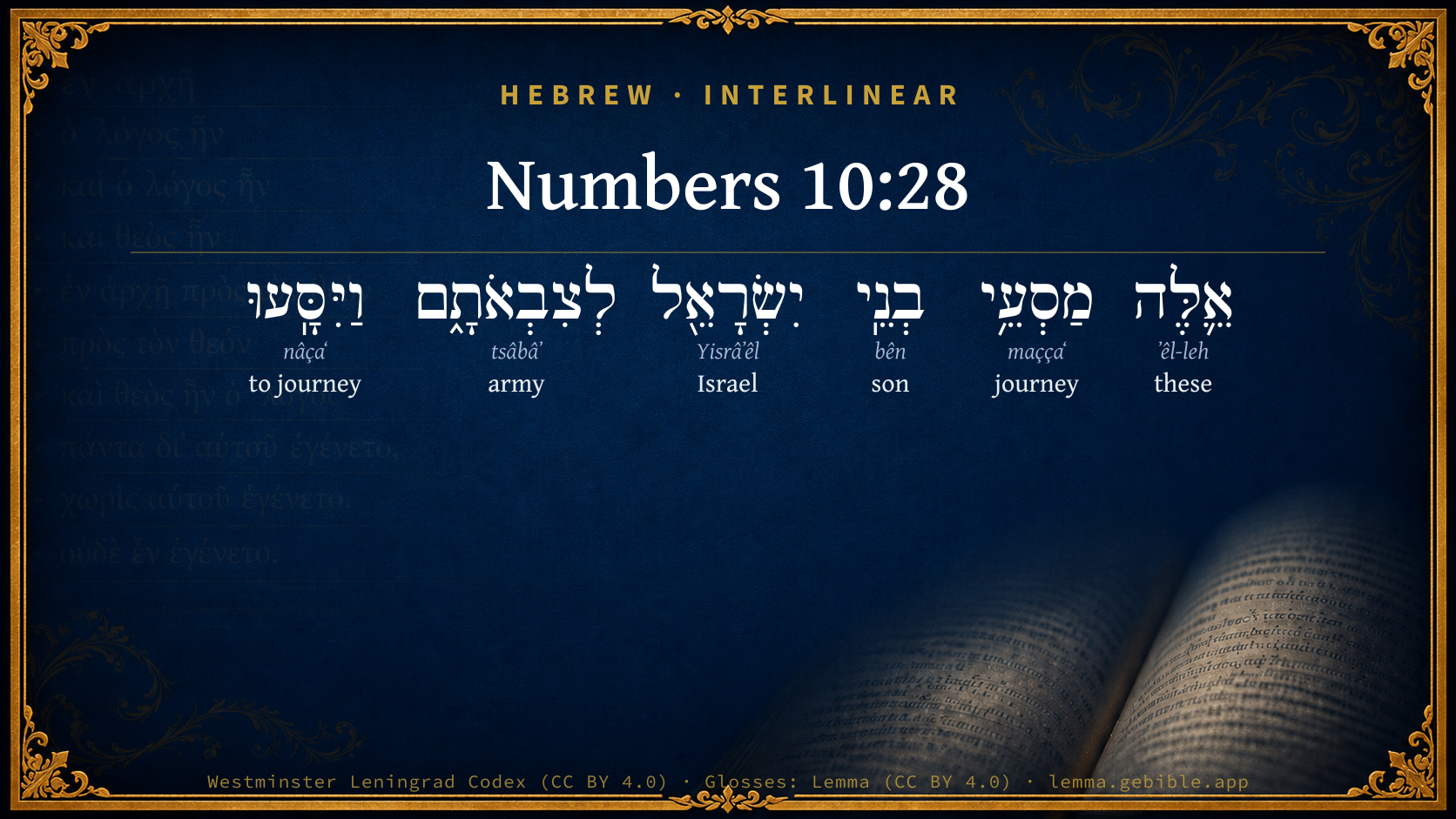
Numbers 10:28

Hebrew (Westminster Leningrad Codex) Numbers 10:28 appears in the Hebrew Old Testament. The text above is from the Westminster Leningrad Codex. Each word links to its Strong’s number, a concise gloss, and parsing drawn from the Open Scriptures Hebrew Bible morphology. Click any word for its full Brown-Driver-Briggs (BDB) entry.
Download image
Cite this verse

Numbers 10:28 (World English Bible). Public Domain. Lemma interlinear Bible study tool, https://lemma.gebible.app/v/numbers/10/28.

Show BibTeX & RIS
BibTeX
RIS
English Translation
Thus were the travels of the children of Israel according to their hosts; and they set forward.
World English Bible · Public Domain
Download a study sheet

One document with this verse’s original text, its word-by-word gloss line, the meaning frame, cross-references with their text, attributed commentary, and full source and license credits — printable, and it pastes into notes with its structure intact.

This verse Autodidact and up

Study sheet (.html) Plain text (.txt)

A passage Seminary Student

Up to 50 verses in one chapter. A passage sheet keeps up to 6 commentary sources and 12 cross-references per verse, in the order this page ranks them, and says so on the sheet whenever that leaves anything out. Ask for a single verse and you get the Autodidact verse sheet above.

Everything on this page stays free to read, with no account — the sheet is a download of what is already on screen, not access to it.

Want to remove ads? Support Godless Engineer
Compare translations 3

The same verse in 3 English versions, stacked beneath the original-language interlinear above. Click any original word for its lexicon entry.

Each is an independent rendering of the whole verse — the interlinear is not word-aligned to these translations.

Highlighted words mark where these versions differ — a whole-verse word diff, not a word-by-word alignment.

  • World English Bible Public Domain
    Thus were the travels of the children of Israel according to their hosts; and they set forward.
  • King James Version Public Domain
    Thus were the journeyings of the children of Israel according to their armies, when they set forward.
  • unfoldingWord Literal Text CC BY-SA 4.0
    These were the departures of the sons of Israel according to their armies. And they set out.

unfoldingWord Literal Text — © unfoldingWord, licensed CC BY-SA 4.0. Word-aligned USFM3 via Door43 (git.door43.org/unfoldingWord/en_ult).

Versions to compare (up to 4)

3 of 4 selected

Show all 18 translations

Every available English version of this verse, each an independent rendering of the whole verse.

  • World English Bible Public Domain
    Thus were the travels of the children of Israel according to their hosts; and they set forward.
  • Berean Standard Bible Public Domain
    This was the order of march for the Israelite divisions as they set out.
  • Majority Standard Bible Public Domain
    This was the order of march for the Israelite divisions as they set out.
  • King James Version Public Domain
    Thus were the journeyings of the children of Israel according to their armies, when they set forward.
  • American Standard Version (1901) Public Domain
    Thus were the journeyings of the children of Israel according to their hosts; and they set forward.
  • Revised Version (1885) Public Domain
    Thus were the journeyings of the children of Israel according to their hosts; and they set forward.
  • Geneva Bible (1599) Public Domain
    These were the remouings of the children of Israel according to their armies, whe they marched.
  • Douay-Rheims (1899) Public Domain
    This was the order of the camps, and marches of the children of Israel by their troops, when they set forward.
  • Young's Literal Translation Public Domain
    These `are' journeyings of the sons of Israel by their hosts -- and they journey.
  • Literal Standard Version CC BY-SA 4.0
    These [are] the journeys of the sons of Israel by their hosts when they journey.
  • Unlocked Literal Bible CC BY-SA 4.0
    This is the way that the armies of the people of Israel set out on their journey.
  • unfoldingWord Literal Text CC BY-SA 4.0
    These were the departures of the sons of Israel according to their armies. And they set out.
  • Darby Bible Public Domain
    These were the settings forward of the children of Israel according to their hosts: so did they set forward.
  • World Messianic Bible Public Domain
    Thus were the travels of the children of Israel according to their armies; and they went forward.
  • Webster's Bible Public Domain
    Thus were the journeyings of the children of Israel according to their armies, when they moved forward.
  • Free Bible Version CC BY-SA 4.0
    This was the order in which the Israelite tribal divisions moved out.
  • Bible in Basic English Public Domain
    This was the order in which the children of Israel were journeying by armies; so they went forward.
  • JPS Tanakh (1917) Public Domain
    Thus were the journeyings of the children of Israel according to their hosts. — And they set forward.

Literal Standard Version (2020), Covenant Press — licensed CC BY-SA 4.0. Text via the HelloAO Bible API (eBible.org). Unlocked Literal Bible (unfoldingWord) — licensed CC BY-SA 4.0. Text via the HelloAO Bible API (eBible.org). unfoldingWord Literal Text — © unfoldingWord, licensed CC BY-SA 4.0. Word-aligned USFM3 via Door43 (git.door43.org/unfoldingWord/en_ult). Free Bible Version, Dr. Jonathan Gallagher — licensed CC BY-SA 4.0. Text via the HelloAO Bible API (eBible.org).

Word by word

More ways to search: Search by grammar → Find every occurrence → Compare this word →

Practice this passage: Drill this verse → Learn its vocabulary →

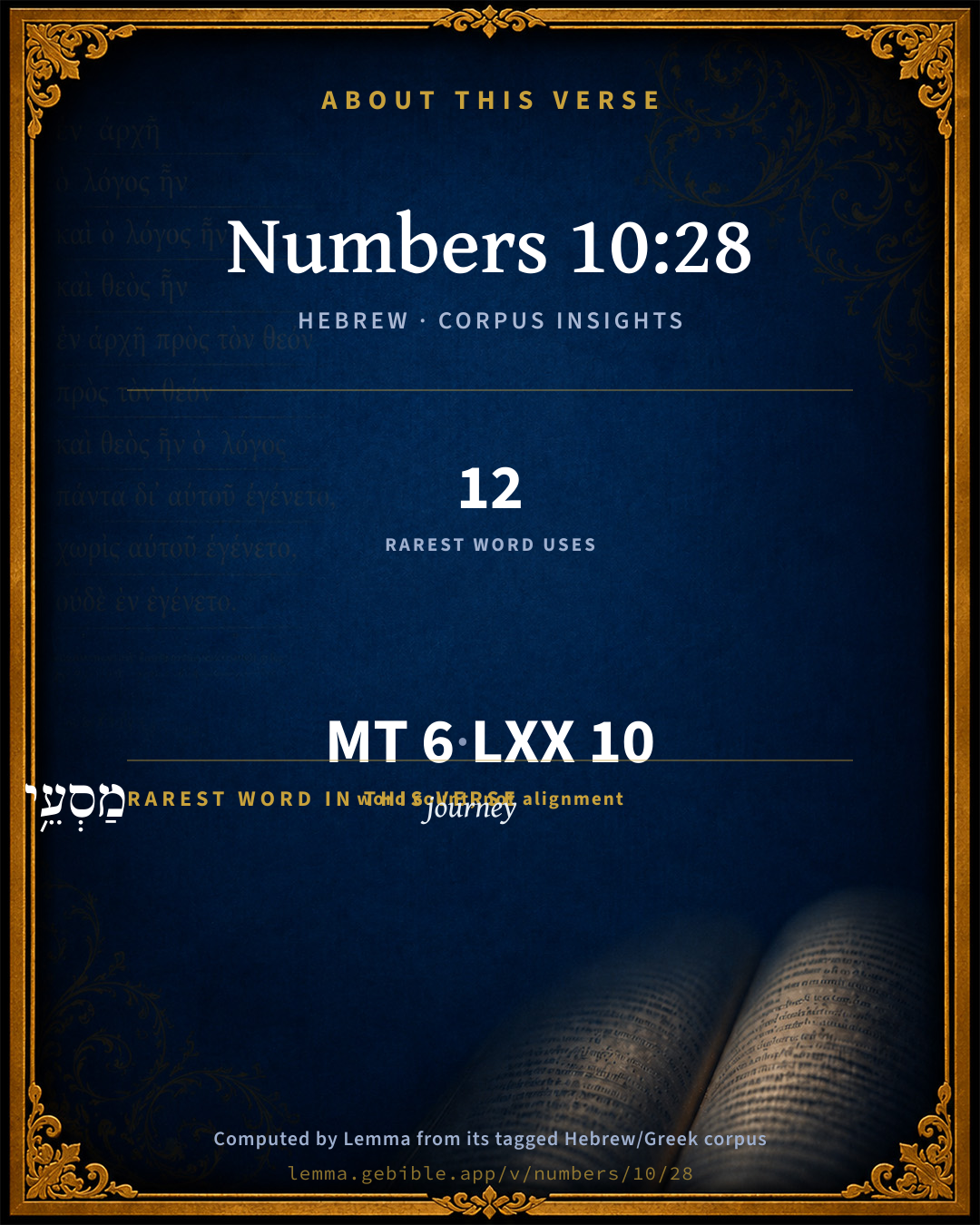
About this verse

These counts appear in no published source. They are computed here, from the morphology-tagged text and Lemma’s own curated glosses. What Lemma adds →

6
words
6
distinct lemmas
Pentateuch
section

Notable vocabulary

The rarest word here is מַסְעֵ֥י journey H4550 — appearing just 12 times in the whole Hebrew Bible.

Shared distinctive vocabulary

מַסְעֵ֥י journey H4550 occurs in 11 verses of the Hebrew Bible. Also found in:

Grammatical profile

  • 1 verb
  • 4 nouns
  • 1 pronoun

Verb forms

  • וַיִּסָּֽעוּ Qal · Sequential Imperfect

Hebrew & Septuagint length

In English translation the verse runs 17 words from the Hebrew and 16 from the Septuagint (LXX English) — closely comparable.

A rough comparison of the two English renderings, which tokenize alike — not a word-level alignment.

Word counts can differ between the Hebrew and the Greek without any difference in meaning — e.g. the Hebrew direct-object marker אֵת has no separate Greek word, and Greek often adds the article ὁ.

In the original languages it is 6 Hebrew tokens and 10 Greek tokens — but the two are counted differently (Hebrew bundles its prefixes and suffixes into one token; the Greek is in lemma form), so that isn’t a like-for-like length.

Cross-references

7

Topical passages linked to Numbers 10:28 in the Treasury of Scripture Knowledge — connected by theme and wording, ordered by reader-vote popularity; previews shown in the World English Bible.

  • Numbers 2:34 Thus the children of Israel did. According to all that Yahweh commanded Moses, so they encamped by their standards, and so they set out, everyone by their families, according to their fathers' houses.
  • Numbers 10:35–36 It happened, when the ark set forward, that Moses said, Rise up, Yahweh, and let your enemies be scattered; and let those who hate you flee before you.
  • Numbers 24:4–5 He says, who hears the words of God, Who sees the vision of the Almighty, Falling down, and having his eyes open:
  • Song of Solomon 6:10 Who is she who looks forth as the morning, Beautiful as the moon, Clear as the sun, Awesome as an army with banners?
  • 1 Corinthians 14:33 for God is not a God of confusion, but of peace. As in all the assemblies of the saints,
  • 1 Corinthians 14:40 Let all things be done decently and in order.
  • Colossians 2:5 For though I am absent in the flesh, yet am I with you in the spirit, rejoicing and seeing your order, and the steadfastness of your faith in Christ.

Cross-references courtesy of OpenBible.info (CC BY 4.0).

Hebrew and Greek witnesses Masoretic Hebrew ↔ Greek Septuagint

The same verse in the two great witnesses to the Old Testament, shown verse-for-verse.

These are two independent witnesses, not word-aligned to each other, and the Septuagint is shown in lemma (dictionary) form.

Hebrew Numbers 10:28 Masoretic · Westminster Leningrad Codex

אֵ֛לֶּה מַסְעֵ֥י בְנֵֽי יִשְׂרָאֵ֖ל לְצִבְאֹתָ֑ם וַיִּסָּֽעוּ

Thus were the travels of the children of Israel according to their hosts; and they set forward.

World English Bible · Public Domain

Greek LXX Numbers 10:28 Septuagint · lemma form

οὗτος ὁ στρατιά υἱός ἰσραήλ καί ἐκαἴρω σύν δύναμις αὐτός

These are the armies of the children of Israel; and they set forward with their forces.

LXX2012 (modern English Septuagint) · Public Domain

Hebrew: Westminster Leningrad Codex (CC BY 4.0). Greek: Septuagint (public domain); English from LXX2012 (modern English Septuagint) (Public Domain). How the Septuagint differs from the Hebrew →

Targum (Aramaic paraphrase)

2

The Targum is the ancient Jewish Aramaic paraphrase of the Hebrew Scriptures — an interpretive translation, not the Hebrew text itself. Onkelos (literal) and Pseudo-Jonathan (expansive) render the Torah, and Jonathan the Prophets. Coverage is partial: where no permissively-licensed English translation exists for a verse, only the Aramaic is shown. This is verse-level text, not a word-by-word alignment to the Hebrew.

  1. Targum Onkelos Torah (Genesis–Deuteronomy)
    אִלֵין מַטְלָנֵי בְּנֵי יִשְׂרָאֵל לְחֵילֵיהוֹן וּנְטָלוּ

    (no public-domain English translation for this verse)

    Targum Onkelos — Aramaic: “Onkelos Genesis” (public domain); “Onkelos Exodus” (public domain); “Onkelos Leviticus” (public domain); “Onkelos Numbers” (public domain); “Onkelos Deuteronomy” (public domain). English: “Sefaria Community Translation” (CC0 1.0 (public-domain dedication)); “J.W. Etheridge. The Targums of Onkelos and Jonathan Ben Uzziel on the Pentateuch. London: Longmans, Green, 1862” (public domain). Text via Sefaria.

  2. Targum Pseudo-Jonathan Torah (Genesis–Deuteronomy)
    אִלֵין מַטְלָנֵי בְּנֵי יִשְרָאֵל לְחֵילֵיהוֹן וְאִסְתַּלֵק עֲנַן יְקָרָא מֵעִילַוֵי מַשְׁכְּנָא וּנְטָלוּ

    These are the journeys of the children of Israel by their hosts; the Cloud of Glory was lifted up from above the tabernacle, and they went forward.

    Targum Pseudo-Jonathan — Aramaic: “Targum Jonathan on Genesis” (public domain); “Targum Jonathan on Exodus” (public domain); “Targum Jonathan on Leviticus” (public domain); “Targum Jonathan on Numbers” (public domain); “Targum Jonathan on Deuteronomy” (public domain). English: “The Targum of Jonathan ben Uzziel, trans. J. W. Etheridge, London, 1862” (public domain). Text via Sefaria.

Commentary

Notes on Numbers 10:28 from classic Christian and Jewish commentators (each source and its license shown beneath its notes). The classic Christian expositions comment on the surrounding passage and are grouped to its opening verse, so a note may address several verses; the Jewish commentaries on the Tanakh (Rashi and others) are per-verse, so they appear only where the commentator wrote on this verse.

Lemma curates 59 commentaries, every one of them public domain or Creative Commons licensed, each selected and text-cleaned for this edition rather than reprinted as found. About our sources →

Geneva Bible (1599)

Geneva Bible translators

This was the order of their host when they removed.

Geneva Bible (1599) marginal notes — public domain. Text via Bolls.life.

Ellicott's Commentary for English Readers

(28) When they set forward.—Better, and they set forward.

A Bible Commentary for English Readers, edited by Charles John Ellicott (1878–1897) — public domain. Text from a community e-Sword module.

John Gill's Exposition

And it shall be, if thou go with us, yea, it shall be,.... This repetition is for the confirmation of it, more strongly assuring him of what follows:

that what goodness the Lord shall do unto us, the same will we do unto thee; signifying that whatsoever they enjoyed in the land of Canaan he should have his share with them: the Targum of Jonathan adds,"in the division of the land;''Jarchi says, when the land was divided, the fatness of Jericho was given to the sons of Jethro, to Jonadab, the son of Rechab, see Jdg 1:16; from whence, however, as well as from other places, Jdg 4:11; it appears that the posterity of this man had a settlement in the land of Canaan, and from his silence it may be thought that he was prevailed upon to go along with Moses; or if he departed into his own country, as he said he would, he returned again; at least some of his children did.

John Gill's Exposition of the Whole Bible (1746–1763) — public domain (CC PDM 1.0). Text via the HelloAO Bible API.

The Pulpit Commentary

Thus were the journeyings. Rather, "these were the journeyings," the marchings of the various hosts of which the nation was composed. The question may here be asked, which is considered more at large in the Introduction, how it was possible for a nation of more than two million souls, containing the usual proportion of aged people, women, and children, to march as here represented, in compact columns closely following one another, without straggling, without confusion, without incalculable suffering and loss of life. That the line of march was intended to be compact and unbroken is plain (amongst other things) from the directions given about the tabernacle. The fabric was sent on in advance with the evident intent that it should be reared up and ready to receive the holy things by the time they arrived. Yet between the fabric and the furniture there marched more than half a million of people (the camp of Reuben), all of whom had to reach the camping ground and turn off to the right before the Kohathites could rejoin their brethren. Now discipline and drill will do wonders in the way of ordering and expediting the movements even of vast multitudes, if they are thoroughly under control; the family organization also of the tribes, and the long leisure which they had enjoyed at Sinai, gave every opportunity of perfecting the necessary discipline. But it is clear that no discipline could make such an arrangement as the one above mentioned feasible under the ordinary circumstances of human life. It would be absolutely necessary to eliminate all the casualties and all the sicknesses which would naturally clog and hinder the march of such a multitude, in order that it might be compressed within the required limits of time and space. Have we any ground for supposing that these casualties and sicknesses were eliminated? In answering this question we must clearly distinguish between the journey from Sinai to Kadesh, on the borders of Palestine, which was a journey of only eleven days, (Deu_1:2) and the subsequent wanderings of the people of Israel. It is the eleven days" journey only with which we are concerned, because it was for this journey only that provision was made and orders were given by the God of Israel. During the subsequent years of wandering and of excommunication, there can be no doubt that the marching orders fell into abeyance as entirely as the sacrificial system and the rite of circumcision itself. During these years the various camps may have scattered themselves abroad, marched, and halted very much as the circumstances of the day demanded. But that this was not and could not be the case during the short journey which should have landed them in Canaan is obvious from the whole tone, as well as from the particular details, of the commandments considered above. It is further to be borne in mind that the Divine promise and undertaking at the exodus was, impliedly if not explicitly, to bring the whole people, one and all, small and great, safely to their promised home. When the Psalmist asserts (Psa_105:37) that "there was not one feeble person among their tribes," he does not go beyond what is plainly intimated in the narrative. If of their cattle "not a hoof" must be left behind, lest the absolute character of the deliverance be marred, how much more necessary was it that not a soul be abandoned to Egyptian vengeance? And how could all depart unless all were providentially saved from sickness and infirmity? But the same necessity (the necessity of his own goodness) held good when the exodus was accomplished. God could not bring any individual in Israel out of Egypt only to perish in the wilderness, unless it were through his own default, he who had brought them out with so lavish a display of miraculous power was (we may say with reverence) bound also to bring them in; else they had been actual losers by obedience, and his word had not been kept to them. Under a covenant and a dispensation which assuredly did not look one hand"s breadth beyond the present life, it must have seemed to be of the essence of the promise which they believed that not one of them should die or have to be left behind. And as the death or loss of one of God"s people would have vitiated the temporal promise to thegn, so also it would have vitiated the eternal promise to us. For they were ensamples of us, and confessedly what was done for them was done at least as much for our sakes as for theirs. Now the promise of God is manifest unto every one that is included within his new covenant, viz., to bring him safely at last unto the heavenly Canaan, and that in spite of every danger, if only he do not draw back. The whole analogy, therefore, and the typical meaning of the exodus would be overthrown if any single Israelite who had crossed the Red Sea failed to enter into rest, save as the consequence of his own sin. We conclude, therefore, with some confidence that the ordinary incidents of mortality were providentially excluded from the present march, as from the previous interval; that none fell sick, none became helpless, none died a natural death. We know that the great difficulty of a sufficient supply of food was miraculously met; we know that in numberless respects the passage from Egypt to Canaan was hedged about with supernatural aids. Is there any difficulty in supposing that he who gave them bread to eat and water to drink, who led them by a cloudy and a fiery pillar, could also give them health and strength to "walk and not be weary"? Is it unreasonable to imagine that he who spake in his tender pity of the flight from Judaea to Pella, "Woe to them that are with child, and to them that give suck in those days," miraculously restrained for that season the natural increase of his people?

The Pulpit Commentary (1880–1919), ed. H.D.M. Spence-Jones & Joseph S. Exell — public domain. Text from a community e-Sword module.

Rashi

Rabbi Shlomo Yitzchaki (Rashi)

אלה מסעי means: This is the order, of their journeyings (i.e. these words do not mean, “these are the stations”, as the introductory words of chapter Numbers 33:1, where the names of the stations are enumerated; here Scripture merely intends to state that this was the order which they had to keep when journeying).

ויסעו AND THEY JOURNEYED means, on the very same day mentioned at the beginning of the chapter did they set off.

Rashi on the Tanakh — English translations: “The Judaica Press complete Tanach with Rashi, translated by A. J. Rosenberg” (CC BY 4.0); “Pentateuch with Rashi's commentary by M. Rosenbaum and A.M. Silbermann, 1929-1934” (public domain); “The Metsudah Tanach series, Lakewood, N.J” (CC BY 4.0); and “The Book of Joshua, Metsudah Publications, 1997” (CC BY 4.0). Text via Sefaria.

Lesson kit

Teaching starters — assembled from the data on this page, not authored interpretation. Every prompt links to the verse data it draws on. Edit before teaching.

Numbers, in the Pentateuch, opens this verse with 6 words (6 distinct Hebrew lemmas). Its most distinctive word is maççaʻ (“journey”). A historical commentator’s framing appears above. Read the whole chapter for the surrounding context.

Discussion questions

  1. How does “journey” (maççaʻ) shape what this verse is saying?
  2. How does Genesis 13:3, which shares the word «journey», read alongside this verse?
  3. The translations on this page render this verse differently — a whole-verse word diff, not a word-by-word alignment. What might account for the different wordings?
  4. «וַיִּסָּֽעוּ» is a Qal Sequential Imperfect verb. How does that grammatical form shape the action described?
  5. Compare how Geneva Bible (1599) and Ellicott's Commentary for English Readers read this verse. Where do they agree or differ?

Things to notice

Reading settings

Reading text

Shown beneath each verse's original-language words.

Old Testament
Old Testament edition

Read the OT as the Masoretic Hebrew (MT) or the Greek Septuagint (LXX).

English shown for the Greek Septuagint (in the Hebrew ↔ Greek comparison).

Comparing translations? Open the Compare panel on any verse page to stack up to four side by side.