
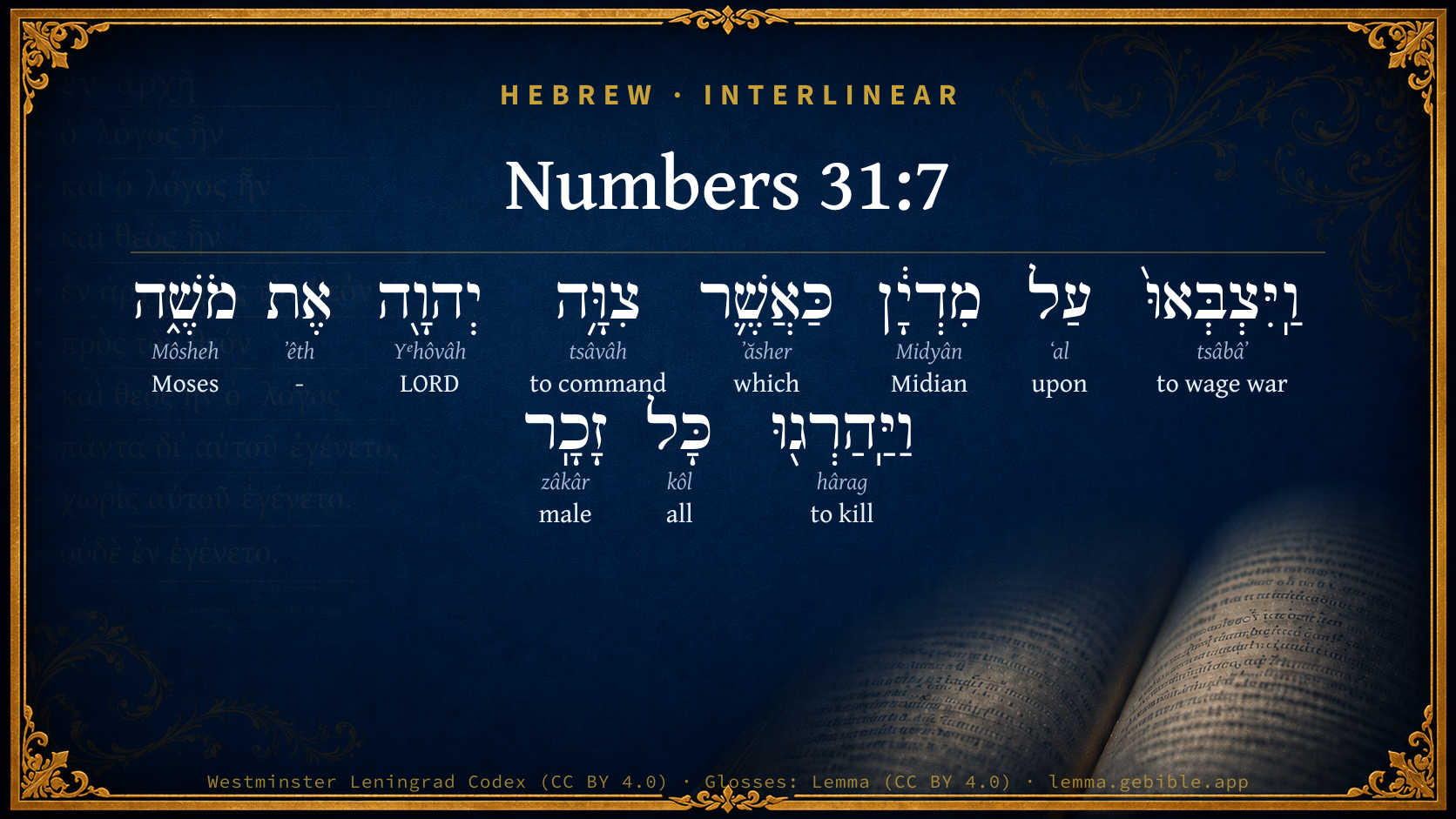
Numbers 31:7

Hebrew (Westminster Leningrad Codex) Numbers 31:7 appears in the Hebrew Old Testament. The text above is from the Westminster Leningrad Codex. Each word links to its Strong’s number, a concise gloss, and parsing drawn from the Open Scriptures Hebrew Bible morphology. Click any word for its full Brown-Driver-Briggs (BDB) entry.
Download image
Cite this verse

Numbers 31:7 (World English Bible). Public Domain. Lemma interlinear Bible study tool, https://lemma.gebible.app/v/numbers/31/7.

Show BibTeX & RIS
BibTeX
RIS
English Translation
They warred against Midian, as Yahweh commanded Moses; and they killed every male.
World English Bible · Public Domain
Download a study sheet

One document with this verse’s original text, its word-by-word gloss line, the meaning frame, cross-references with their text, attributed commentary, and full source and license credits — printable, and it pastes into notes with its structure intact.

This verse Autodidact and up

Study sheet (.html) Plain text (.txt)

A passage Seminary Student

Up to 50 verses in one chapter. A passage sheet keeps up to 6 commentary sources and 12 cross-references per verse, in the order this page ranks them, and says so on the sheet whenever that leaves anything out. Ask for a single verse and you get the Autodidact verse sheet above.

Everything on this page stays free to read, with no account — the sheet is a download of what is already on screen, not access to it.

Want to remove ads? Support Godless Engineer
Compare translations 3

The same verse in 3 English versions, stacked beneath the original-language interlinear above. Click any original word for its lexicon entry.

Each is an independent rendering of the whole verse — the interlinear is not word-aligned to these translations.

Highlighted words mark where these versions differ — a whole-verse word diff, not a word-by-word alignment.

  • World English Bible Public Domain
    They warred against Midian, as Yahweh commanded Moses; and they killed every male.
  • King James Version Public Domain
    And they warred against the Midianites, as the LORD commanded Moses; and they slew all the males.
  • unfoldingWord Literal Text CC BY-SA 4.0
    And they waged war against Midian, just as Yahweh had commanded Moses, and they slew every male.

unfoldingWord Literal Text — © unfoldingWord, licensed CC BY-SA 4.0. Word-aligned USFM3 via Door43 (git.door43.org/unfoldingWord/en_ult).

Versions to compare (up to 4)

3 of 4 selected

Show all 18 translations

Every available English version of this verse, each an independent rendering of the whole verse.

  • World English Bible Public Domain
    They warred against Midian, as Yahweh commanded Moses; and they killed every male.
  • Berean Standard Bible Public Domain
    Then they waged war against Midian, as the LORD had commanded Moses, and they killed every male.
  • Majority Standard Bible Public Domain
    Then they waged war against Midian, as the LORD had commanded Moses, and they killed every male.
  • King James Version Public Domain
    And they warred against the Midianites, as the LORD commanded Moses; and they slew all the males.
  • American Standard Version (1901) Public Domain
    And they warred against Midian, as Jehovah commanded Moses; and they slew every male.
  • Revised Version (1885) Public Domain
    And they warred against Midian, as the LORD commanded Moses; and they slew every male.
  • Geneva Bible (1599) Public Domain
    And they warred against Midian, as the Lord had commanded Moses, and slue all the males.
  • Douay-Rheims (1899) Public Domain
    And when they had fought against the Madianites and had overcome them, they slew all the men.
  • Young's Literal Translation Public Domain
    And they war against Midian, as Jehovah hath commanded Moses, and slay every male;
  • Literal Standard Version CC BY-SA 4.0
    And they war against Midian, as YHWH has commanded Moses, and slay every male;
  • Unlocked Literal Bible CC BY-SA 4.0
    They fought against Midian, as Yahweh had commanded Moses. They killed every man.
  • unfoldingWord Literal Text CC BY-SA 4.0
    And they waged war against Midian, just as Yahweh had commanded Moses, and they slew every male.
  • Darby Bible Public Domain
    And they warred against Midian, as Jehovah had commanded Moses, and slew all the males.
  • World Messianic Bible Public Domain
    They fought against Midian, as the LORD commanded Moses. They killed every male.
  • Webster's Bible Public Domain
    And they warred against the Midianites, as the LORD commanded Moses; and they slew all the males.
  • Free Bible Version CC BY-SA 4.0
    They attacked the Midianites, as the Lord had told Moses to do, and they killed all the men.
  • Bible in Basic English Public Domain
    And they made war on Midian, as the Lord gave orders to Moses; and they put to death every male.
  • JPS Tanakh (1917) Public Domain
    And they warred against Midian, as the LORD commanded Moses; and they slew every male.

Literal Standard Version (2020), Covenant Press — licensed CC BY-SA 4.0. Text via the HelloAO Bible API (eBible.org). Unlocked Literal Bible (unfoldingWord) — licensed CC BY-SA 4.0. Text via the HelloAO Bible API (eBible.org). unfoldingWord Literal Text — © unfoldingWord, licensed CC BY-SA 4.0. Word-aligned USFM3 via Door43 (git.door43.org/unfoldingWord/en_ult). Free Bible Version, Dr. Jonathan Gallagher — licensed CC BY-SA 4.0. Text via the HelloAO Bible API (eBible.org).

Word by word

More ways to search: Search by grammar → Find every occurrence → Compare this word →

Practice this passage: Drill this verse → Learn its vocabulary →

וַֽיִּצְבְּאוּ֙
tsâbâʼ
H6633
“and · to wage war”
Conjunction + Verb, Qal, Sequential Imperfect, 3rd Person, Masculine, Plural
Part of Speech
Conjunction + Verb
Stem
Qal
Form
Sequential Imperfect
Person
3rd Person
Gender
Masculine
Number
Plural
Full BDB Definition

Origin: a primitive root

TWOT: 1865

to go forth, wage war, fight, serve - (Qal) - to wage war, fight, go forth to war - to serve (at sacred tent) - (Hiphil) to cause to go forth, muster
  1. עַל ʻal H5921 “upon” Preposition
  2. מִדְיָ֔ן Midyân H4080 “Midian” Noun, Proper
  3. כַּאֲשֶׁ֛ר ʼăsher H834 “like/as · which” Preposition + Particle, Relative
  4. צִוָּ֥ה tsâvâh H6680 “to command” Verb, Piel, Perfect, 3rd Person, Masculine, Singular
  5. יְהוָ֖ה Yᵉhôvâh H3068 “LORD” Noun, Proper
  6. אֶת ʼêth H853 “-” Particle, Direct Object
  7. מֹשֶׁ֑ה Môsheh H4872 “Moses” Noun, Proper
  8. וַיַּֽהַרְג֖וּ hârag H2026 “and · to kill” Conjunction + Verb, Qal, Sequential Imperfect, 3rd Person, Masculine, Plural
  9. כָּל kôl H3605 “all of” Noun, Common, Masculine, Singular, Construct
  10. זָכָֽר zâkâr H2145 “male” Adjective, Adjective, Masculine, Singular, Absolute

About this verse

These counts appear in no published source. They are computed here, from the morphology-tagged text and Lemma’s own curated glosses. What Lemma adds →

11
words
11
distinct lemmas
Pentateuch
section

Notable vocabulary

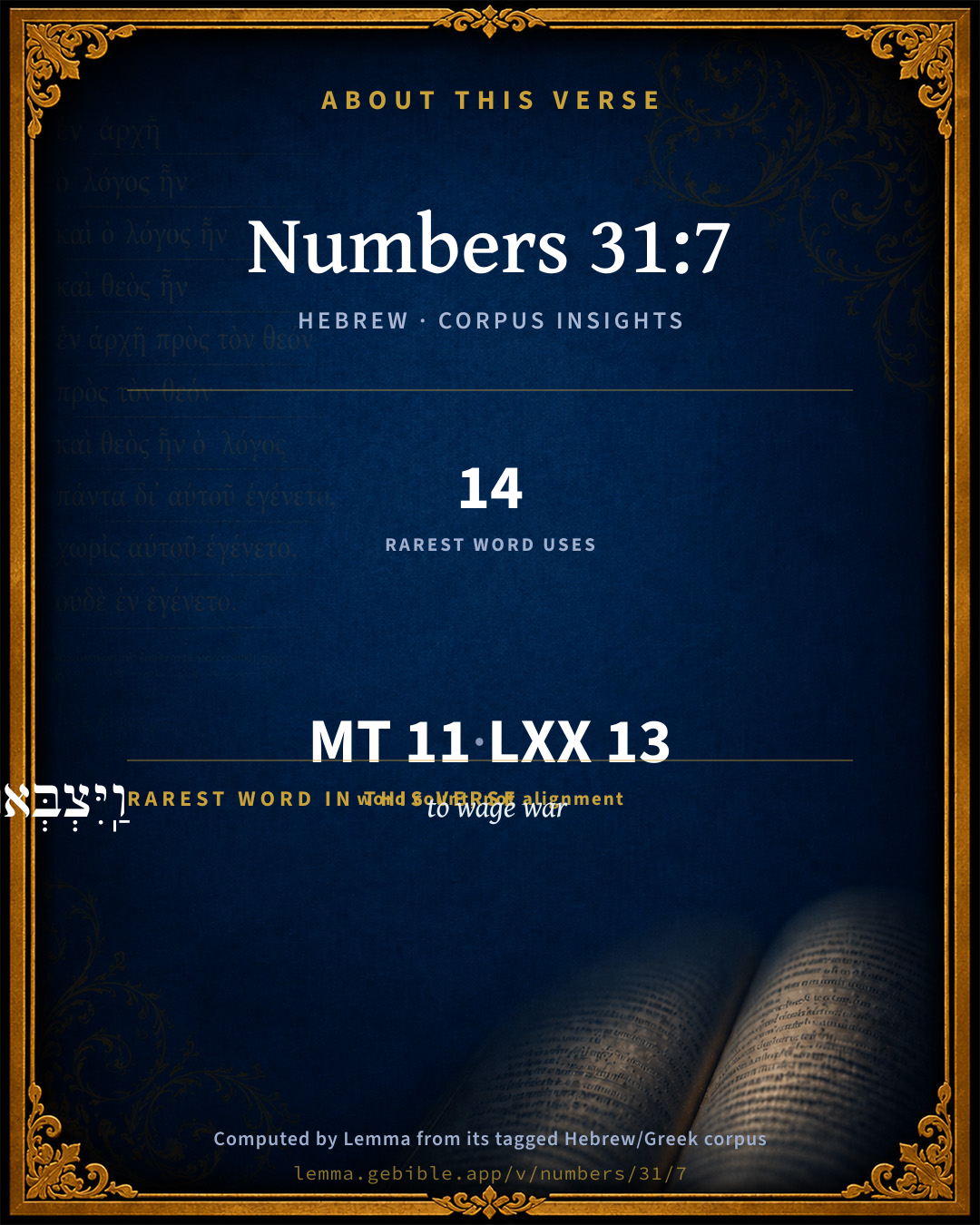
The rarest word here is וַֽיִּצְבְּאוּ֙ to wage war H6633 — appearing just 14 times in the whole Hebrew Bible.

Shared distinctive vocabulary

וַֽיִּצְבְּאוּ֙ to wage war H6633 occurs in 12 verses of the Hebrew Bible. Also found in:

Grammatical profile

  • 3 verbs
  • 4 nouns
  • 1 adjective
  • 1 preposition
  • 2 particles

Verb forms

  • וַֽיִּצְבְּאוּ֙ Qal · Sequential Imperfect
  • צִוָּ֥ה Piel · Perfect
  • וַיַּֽהַרְג֖וּ Qal · Sequential Imperfect

Hebrew & Septuagint length

In English translation the verse runs 13 words from the Hebrew and 18 from the Septuagint (LXX English) — closely comparable.

A rough comparison of the two English renderings, which tokenize alike — not a word-level alignment.

Word counts can differ between the Hebrew and the Greek without any difference in meaning — e.g. the Hebrew direct-object marker אֵת has no separate Greek word, and Greek often adds the article ὁ.

In the original languages it is 11 Hebrew tokens and 13 Greek tokens — but the two are counted differently (Hebrew bundles its prefixes and suffixes into one token; the Greek is in lemma form), so that isn’t a like-for-like length.

Cross-references

6

Topical passages linked to Numbers 31:7 in the Treasury of Scripture Knowledge — connected by theme and wording, ordered by reader-vote popularity; previews shown in the World English Bible.

  • Judges 21:11 This is the thing that you shall do: you shall utterly destroy every male, and every woman who has lain by man.
  • 1 Kings 11:15–16 For it happened, when David was in Edom, and Joab the captain of the host was gone up to bury the slain, and had struck every male in Edom
  • 1 Samuel 27:9 David struck the land, and saved neither man nor woman alive, and took away the sheep, and the oxen, and the donkeys, and the camels, and the clothing; and he returned, and came to Achish.
  • Deuteronomy 20:13–14 and when Yahweh your God delivers it into your hand, you shall strike every male of it with the edge of the sword:
  • Judges 6:1–2 The children of Israel did that which was evil in the sight of Yahweh: and Yahweh delivered them into the hand of Midian seven years.
  • Judges 6:33 Then all the Midianites and the Amalekites and the children of the east assembled themselves together; and they passed over, and encamped in the valley of Jezreel.

Cross-references courtesy of OpenBible.info (CC BY 4.0).

Hebrew and Greek witnesses Masoretic Hebrew ↔ Greek Septuagint

The same verse in the two great witnesses to the Old Testament, shown verse-for-verse.

These are two independent witnesses, not word-aligned to each other, and the Septuagint is shown in lemma (dictionary) form.

Hebrew Numbers 31:7 Masoretic · Westminster Leningrad Codex

וַֽיִּצְבְּאוּ֙ עַל מִדְיָ֔ן כַּאֲשֶׁ֛ר צִוָּ֥ה יְהוָ֖ה אֶת מֹשֶׁ֑ה וַיַּֽהַרְג֖וּ כָּל זָכָֽר

They warred against Midian, as Yahweh commanded Moses; and they killed every male.

World English Bible · Public Domain

Greek LXX Numbers 31:7 Septuagint · lemma form

καί παρατάσσω ἐπί μαδιαν καθά ἐντέλλομαι κύριος ὁ μωυσῆς καί ἀποκτείνω πᾶς ἀρσενικός

And they set themselves in array against Madian, as the Lord commanded Moses; and they killed every male.

LXX2012 (modern English Septuagint) · Public Domain

Hebrew: Westminster Leningrad Codex (CC BY 4.0). Greek: Septuagint (public domain); English from LXX2012 (modern English Septuagint) (Public Domain). How the Septuagint differs from the Hebrew →

Targum (Aramaic paraphrase)

2

The Targum is the ancient Jewish Aramaic paraphrase of the Hebrew Scriptures — an interpretive translation, not the Hebrew text itself. Onkelos (literal) and Pseudo-Jonathan (expansive) render the Torah, and Jonathan the Prophets. Coverage is partial: where no permissively-licensed English translation exists for a verse, only the Aramaic is shown. This is verse-level text, not a word-by-word alignment to the Hebrew.

  1. Targum Onkelos Torah (Genesis–Deuteronomy)
    וְאִתְחַיָילוּ עַל מִדְיָן כְּמָא דְפַקֵיד יְיָ יָת משֶׁה וּקְטָלוּ כָּל דְכוּרָא

    (no public-domain English translation for this verse)

    Targum Onkelos — Aramaic: “Onkelos Genesis” (public domain); “Onkelos Exodus” (public domain); “Onkelos Leviticus” (public domain); “Onkelos Numbers” (public domain); “Onkelos Deuteronomy” (public domain). English: “Sefaria Community Translation” (CC0 1.0 (public-domain dedication)); “J.W. Etheridge. The Targums of Onkelos and Jonathan Ben Uzziel on the Pentateuch. London: Longmans, Green, 1862” (public domain). Text via Sefaria.

  2. Targum Pseudo-Jonathan Torah (Genesis–Deuteronomy)
    וְאִתְחַיָילוּן עַל מִדְיָן אַקְפוּהָ מִתְּלַת טְרִיגוּנָהָא הֵיכְמָא דְפַקֵיד יְיָ יַת משֶׁה וּקְטָלוּ כָּל דְכוּרָא

    And they warred against Midian, circumventing them from three corners, as the Lord had instructed Mosheh, and they killed every male;

    Targum Pseudo-Jonathan — Aramaic: “Targum Jonathan on Genesis” (public domain); “Targum Jonathan on Exodus” (public domain); “Targum Jonathan on Leviticus” (public domain); “Targum Jonathan on Numbers” (public domain); “Targum Jonathan on Deuteronomy” (public domain). English: “The Targum of Jonathan ben Uzziel, trans. J. W. Etheridge, London, 1862” (public domain). Text via Sefaria.

Commentary

Notes on Numbers 31:7 from classic Christian and Jewish commentators (each source and its license shown beneath its notes). The classic Christian expositions comment on the surrounding passage and are grouped to its opening verse, so a note may address several verses; the Jewish commentaries on the Tanakh (Rashi and others) are per-verse, so they appear only where the commentator wrote on this verse.

Lemma curates 59 commentaries, every one of them public domain or Creative Commons licensed, each selected and text-cleaned for this edition rather than reprinted as found. About our sources →

Joseph Benson's Commentary

Num 31:7-8. They slew all the males — That is, they slew those who were in the fight, and who did not save themselves by flight. As a nation they had forfeited their lives to the laws of God, and he, as judge of all the earth, had given command that the sentence of his laws should be executed on the guilty. Le Clerc properly observes, that there was this material difference between the wars of other nations and those of the Jews, that the former followed the bent of their own passions; whereas the Jews were only the ministers or executioners of divine justice, most evidently appointed to this work by God himself, as he manifested by a train of miracles wrought among and for them, such as had never been known on the earth before. So that no consequence can be deduced from their conduct in their wars, to warrant the like conduct in other people. Balaam also they slew — He suffered justly, for being the wicked instrument of seducing the Israelites from their allegiance to Jehovah.

Joseph Benson's Commentary on the Old and New Testaments (1811–1818) — public domain. Text from a community e-Sword module.

Tyndale Open Study Notes

Tyndale Open Resources

31:7 The Israelites killed all of the Midianite men in the particular groups they attacked from their camp in the plains of Moab (31:12), not all of the people who were part of the larger Midianite confederation (cp. Judg 6–8). The number of animals and virgins mentioned in Num 31:32-35 indicates that the 12,000 Hebrews fought a sizable enemy force.

Tyndale Open Study Notes — © Tyndale Open Resources, licensed CC BY-SA 4.0. Text via the HelloAO Bible API.

Jamieson, Fausset & Brown

Robert Jamieson, A. R. Fausset & David Brown

they slew all the males--This was in accordance with a divine order in all such cases (Deu 20:13). But the destruction appears to have been only partial--limited to those who were in the neighborhood of the Hebrew camp and who had been accomplices in the villainous plot of Baal-peor (Num 25:1-3), while a large portion of the Midianites were absent on their pastoral wanderings or had saved themselves by flight. (Compare Jdg 6:1).

Jamieson, Fausset & Brown — Commentary Critical and Explanatory on the Whole Bible (1871) — public domain (CC PDM 1.0). Text via the HelloAO Bible API.

Ellicott's Commentary for English Readers

(7) They slew all the males.—The reference appears to be to those who were engaged in the war. The words do not refer to the whole of the male population, as appears from Num_31:17; and it is probable that many of the Midianites who were not engaged in the war withdrew from the scene of conflict. The reference in this verse, unless the words are inserted proleptically, seems to be to the whole of the adult males who fell into the hands of the Israelites during the war.

A Bible Commentary for English Readers, edited by Charles John Ellicott (1878–1897) — public domain. Text from a community e-Sword module.

The Cambridge Bible for Schools and Colleges

gen. ed. J. J. S. Perowne

7. they slew every male] An imaginative description of success. If it were historically true, Midian would have disappeared from history; but they are found not long afterwards as one of Israel’s most troublesome neighbours (Judges 6-8).

7–12. In this ideal picture of the war nothing is said of the place where the battle was fought, nor the length of time occupied by it, nor any details of the fight. It was a rapid and sweeping conquest.

The Cambridge Bible for Schools and Colleges (gen. ed. J. J. S. Perowne; Cambridge University Press, 1878–1918) — public domain. Text from a community e-Sword module.

John Gill's Exposition

And they warred against the Midianites, as the Lord commanded Moses,.... Whether the Midianites came out against them with an army, and there was a pitched battle between them, is not certain; however the Israelites committed acts of hostility upon them, by entering their cities, plundering their houses, and slaying the inhabitants of them; the Targum of Jonathan is,"they warred against Midian, and surrounded it in the three corners of it, as the Lord commanded Moses;''for, as Maimonides (b) observes from tradition,"when they besiege a city to take it, they do not surround it in the four corners of it, but in the three corners of it, and leave a place to flee out, that everyone that would might escape for his life, as it is said, "and they warred against Midian, as the Lord commanded Moses"; by report, or from tradition, it is learnt that so he commanded him;''that is, in such a manner to besiege a city; but for this there is only tradition, for it is not mentioned among the rules after directed to in such a case, Deu 20:10,

and they slew all the males; which fell into their hands; for, no doubt, there were multitudes that made their escape, since in later times we read of the Midianites, as a very powerful people, and very distressing to Israel, Jdg 6:1 these, as Aben Ezra observes, they slew, were such as were grown up, for as for their little ones, them they spared and carried captive, Num 31:9.

(b) Hilchot Melacim, c. 6. sect. 7.

John Gill's Exposition of the Whole Bible (1746–1763) — public domain (CC PDM 1.0). Text via the HelloAO Bible API.

Matthew Poole's English Annotations

Namely, all whom they took in that war, or all who lived in those parts; for it is probable (and was then very usual) some colonies of them were sent forth to remoter places, which therefore had no hand either in their former sin, or ill this present ruin, of whom we read after this, Jdg 6. And herein they did according to God’s own order concerning such people, Deu 20:13; only their fault was, that they did not consider the special reason and great obligation which they had to involve the women in the destruction, for which reason Moses blames them afterward, Num 31:15,16.

Matthew Poole's English Annotations on the Holy Bible (1683–1685) — public domain. Text from a community e-Sword/MySword module.

John Wesley's Explanatory Notes

All the males - Namely all who lived in those parts, for colonies of them, were sent forth to remoter places, which therefore had no hand either in their former sin, or in this present ruling. And herein they did according to God's own order concerning such people, Deut. xx, 13, only their fault was, that they did not consider the special reason which they had to involve the women in the destruction.

John Wesley, Explanatory Notes Upon the Whole Bible (1754–1765) — public domain. Text via the GEBible commentary corpus.

Keil & Delitzsch

C. F. Keil & F. Delitzsch

Of the campaign itself, the results are all that is recorded. No doubt it terminated with a great battle, in which the Midianites were taken unawares and completely routed. As it was a war of vengeance of Jehovah, the victors slew all the males, i.e., all the adult males, as the sequel shows, without quarter; and "upon those that were slain," i.e., in addition to them, the five Midianitsh kings and Balaam, who first advised the Midianites, according to Num 31:16, to tempt the Israelites to idolatry. The five kings were chiefs of the larger or more powerful of the Midianitish tribes, as Zur is expressly said to have been in Num 25:15. In Jos 13:21 they are called "vassals of Sihon," because Sihon had subjugated them and made them tributary when he first conquered the land. The women and children of the Midianites were led away prisoners; and their cattle (behemah, beasts of draft and burden, as in Exo 20:10), and their flocks, and their goods taken away as spoil. The towns in their dwellings, and all their villages (tiroth, tent-villages, as in Gen 25:16), were burnt down. The expression "towns in their dwellings" leads to the conclusion that the towns were not the property of the Midianites themselves, who were a nomad people, but that they originally belonged in all probability to the Moabites, and had been taken possession of by the Amorites under Sihon. This is confirmed by Jos 13:21, according to which these five Midianitish vassals of Sihon dwelt in the land, i.e., in the kingdom of Sihon. This also serves to explain why the conquest on their country is not mentioned in the account before us, although it is stated in Joshua (l.c.), that it was allotted to the Reubenites with the kingdom of Sihon.

Keil & Delitzsch — Biblical Commentary on the Old Testament (1861–1891) — public domain (CC PDM 1.0). Text via the HelloAO Bible API. (Old Testament only.)

Lesson kit

Teaching starters — assembled from the data on this page, not authored interpretation. Every prompt links to the verse data it draws on. Edit before teaching.

Numbers, in the Pentateuch, opens this verse with 11 words (11 distinct Hebrew lemmas). Its most distinctive word is tsâbâʼ (“to wage war”). A historical commentator’s framing appears above. Read the whole chapter for the surrounding context.

Discussion questions

  1. What does “to wage war” (tsâbâʼ) contribute to the verse as a whole?
  2. How does Exodus 38:8, which shares the word «to wage war», read alongside this verse?
  3. These translations render this verse differently. What is at stake in choosing one wording over another?
  4. «וַֽיִּצְבְּאוּ֙» is a Qal Sequential Imperfect verb. How does that grammatical form shape the action described?
  5. Compare how Joseph Benson's Commentary and Tyndale Open Study Notes read this verse. Where do they agree or differ?

Things to notice

Reading settings

Reading text

Shown beneath each verse's original-language words.

Old Testament
Old Testament edition

Read the OT as the Masoretic Hebrew (MT) or the Greek Septuagint (LXX).

English shown for the Greek Septuagint (in the Hebrew ↔ Greek comparison).

Comparing translations? Open the Compare panel on any verse page to stack up to four side by side.