
Numbers 1:45

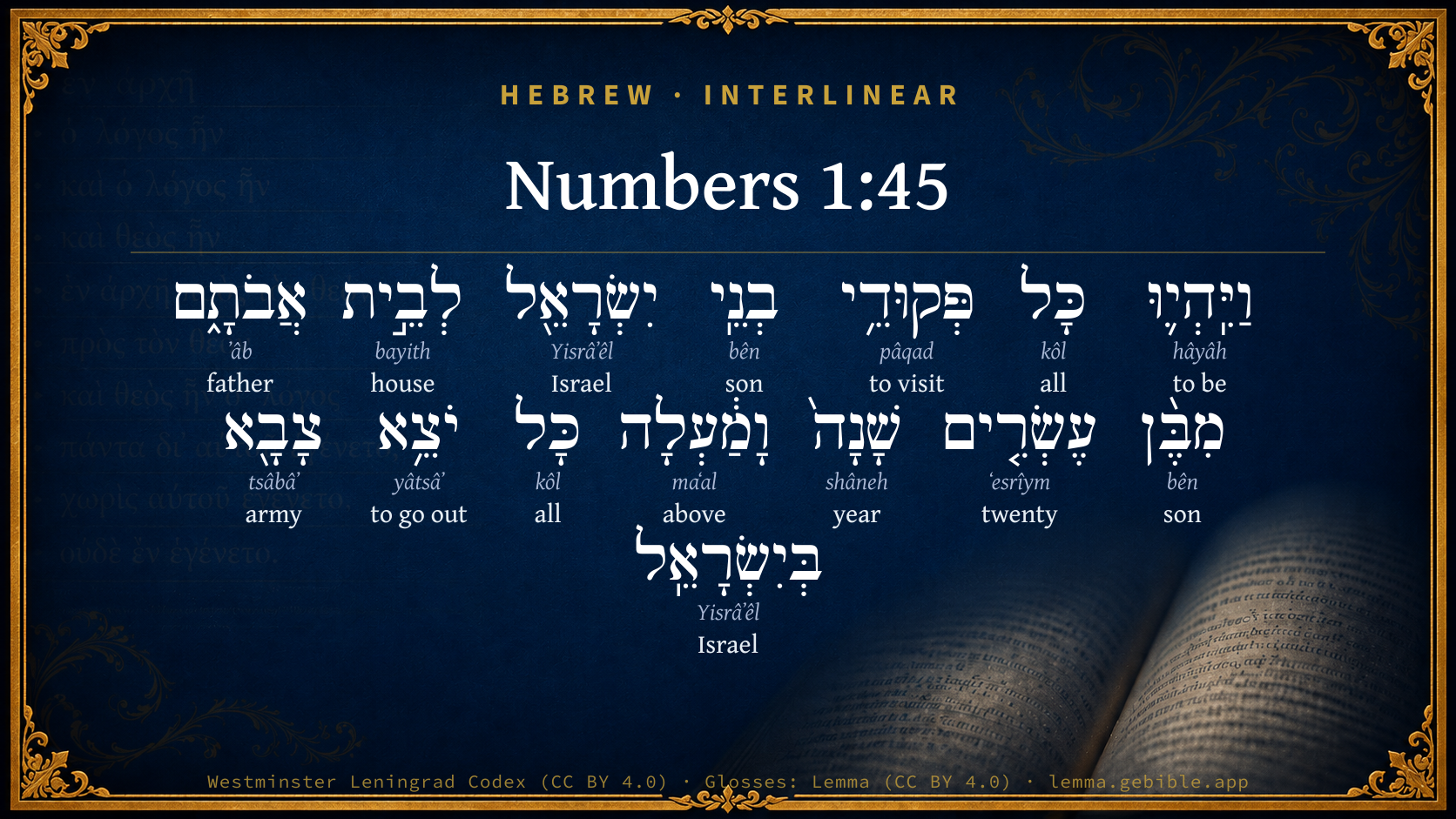
Hebrew (Westminster Leningrad Codex) Numbers 1:45 appears in the Hebrew Old Testament. The text above is from the Westminster Leningrad Codex. Each word links to its Strong’s number, a concise gloss, and parsing drawn from the Open Scriptures Hebrew Bible morphology. Click any word for its full Brown-Driver-Briggs (BDB) entry.
Download image
Cite this verse

Numbers 1:45 (World English Bible). Public Domain. Lemma interlinear Bible study tool, https://lemma.gebible.app/v/numbers/1/45.

Show BibTeX & RIS
BibTeX
RIS
English Translation
So all those who were numbered of the children of Israel by their fathers' houses, from twenty years old and upward, all who were able to go out to war in Israel;
World English Bible · Public Domain
Download a study sheet

One document with this verse’s original text, its word-by-word gloss line, the meaning frame, cross-references with their text, attributed commentary, and full source and license credits — printable, and it pastes into notes with its structure intact.

This verse Autodidact and up

Study sheet (.html) Plain text (.txt)

A passage Seminary Student

Up to 50 verses in one chapter. A passage sheet keeps up to 6 commentary sources and 12 cross-references per verse, in the order this page ranks them, and says so on the sheet whenever that leaves anything out. Ask for a single verse and you get the Autodidact verse sheet above.

Everything on this page stays free to read, with no account — the sheet is a download of what is already on screen, not access to it.

Want to remove ads? Support Godless Engineer
Compare translations 3

The same verse in 3 English versions, stacked beneath the original-language interlinear above. Click any original word for its lexicon entry.

Each is an independent rendering of the whole verse — the interlinear is not word-aligned to these translations.

Highlighted words mark where these versions differ — a whole-verse word diff, not a word-by-word alignment.

  • World English Bible Public Domain
    So all those who were numbered of the children of Israel by their fathers' houses, from twenty years old and upward, all who were able to go out to war in Israel;
  • King James Version Public Domain
    So were all those that were numbered of the children of Israel, by the house of their fathers, from twenty years old and upward, all that were able to go forth to war in Israel;
  • unfoldingWord Literal Text CC BY-SA 4.0
    And they were all the counted ones of the sons of Israel according to the house of their fathers, from a son of 20 years and upward, everyone who goes out to war in Israel.

unfoldingWord Literal Text — © unfoldingWord, licensed CC BY-SA 4.0. Word-aligned USFM3 via Door43 (git.door43.org/unfoldingWord/en_ult).

Versions to compare (up to 4)

3 of 4 selected

Show all 18 translations

Every available English version of this verse, each an independent rendering of the whole verse.

  • World English Bible Public Domain
    So all those who were numbered of the children of Israel by their fathers' houses, from twenty years old and upward, all who were able to go out to war in Israel;
  • Berean Standard Bible Public Domain
    So all the Israelites twenty years of age or older who could serve in Israel’s army were counted according to their families.
  • Majority Standard Bible Public Domain
    So all the Israelites twenty years of age or older who could serve in Israel’s army were counted according to their families.
  • King James Version Public Domain
    So were all those that were numbered of the children of Israel, by the house of their fathers, from twenty years old and upward, all that were able to go forth to war in Israel;
  • American Standard Version (1901) Public Domain
    So all they that were numbered of the children of Israel by their fathers' houses, from twenty years old and upward, all that were able to go forth to war in Israel;
  • Revised Version (1885) Public Domain
    So all they that were numbered of the children of Israel by their fathers’ houses, from twenty years old and upward, all that were able to go forth to war in Israel;
  • Geneva Bible (1599) Public Domain
    So this was all the summe of the sonnes of Israel, by the houses of their fathers, from twenty yeere olde and aboue, all that went to the warre in Israel,
  • Douay-Rheims (1899) Public Domain
    And the whole number of the children of Israel by their houses and families, from twenty years old and upward, that were able to go to war,
  • Young's Literal Translation Public Domain
    And they are, all those numbered of the sons of Israel, by the house of their fathers, from a son of twenty years and upward, every one going out to the host in Israel,
  • Literal Standard Version CC BY-SA 4.0
    And they are, all those numbered of the sons of Israel, by the house of their fathers, from a son of twenty years and upward, everyone going out to the host in Israel,
  • Unlocked Literal Bible CC BY-SA 4.0
    So all the men of Israel from twenty years old and older, all who could fight in war, were counted in each of their families.
  • unfoldingWord Literal Text CC BY-SA 4.0
    And they were all the counted ones of the sons of Israel according to the house of their fathers, from a son of 20 years and upward, everyone who goes out to war in Israel.
  • Darby Bible Public Domain
    And all those that were numbered of the children of Israel, according to their fathers' houses, from twenty years old and upward, all that went forth to military service in Israel,
  • World Messianic Bible Public Domain
    So all those who were counted of the children of Israel by their fathers’ houses, from twenty years old and upward, all who were able to go out to war in Israel—
  • Webster's Bible Public Domain
    So were all those that were numbered of the children of Israel, by the house of their fathers, from twenty years old and upward, all that were able to go forth to war in Israel;
  • Free Bible Version CC BY-SA 4.0
    In this way all the Israelite men aged twenty or older who were able to serve in Israel's army were registered according to their families.
  • Bible in Basic English Public Domain
    So all those who were numbered of the children of Israel, by their families, all those of twenty years old and over who were able to go to war,
  • JPS Tanakh (1917) Public Domain
    And all those that were numbered of the children of Israel by their fathers' houses, from twenty years old and upward, all that were able to go forth to war in Israel;

Literal Standard Version (2020), Covenant Press — licensed CC BY-SA 4.0. Text via the HelloAO Bible API (eBible.org). Unlocked Literal Bible (unfoldingWord) — licensed CC BY-SA 4.0. Text via the HelloAO Bible API (eBible.org). unfoldingWord Literal Text — © unfoldingWord, licensed CC BY-SA 4.0. Word-aligned USFM3 via Door43 (git.door43.org/unfoldingWord/en_ult). Free Bible Version, Dr. Jonathan Gallagher — licensed CC BY-SA 4.0. Text via the HelloAO Bible API (eBible.org).

Word by word

More ways to search: Search by grammar → Find every occurrence → Compare this word →

Practice this passage: Drill this verse → Learn its vocabulary →

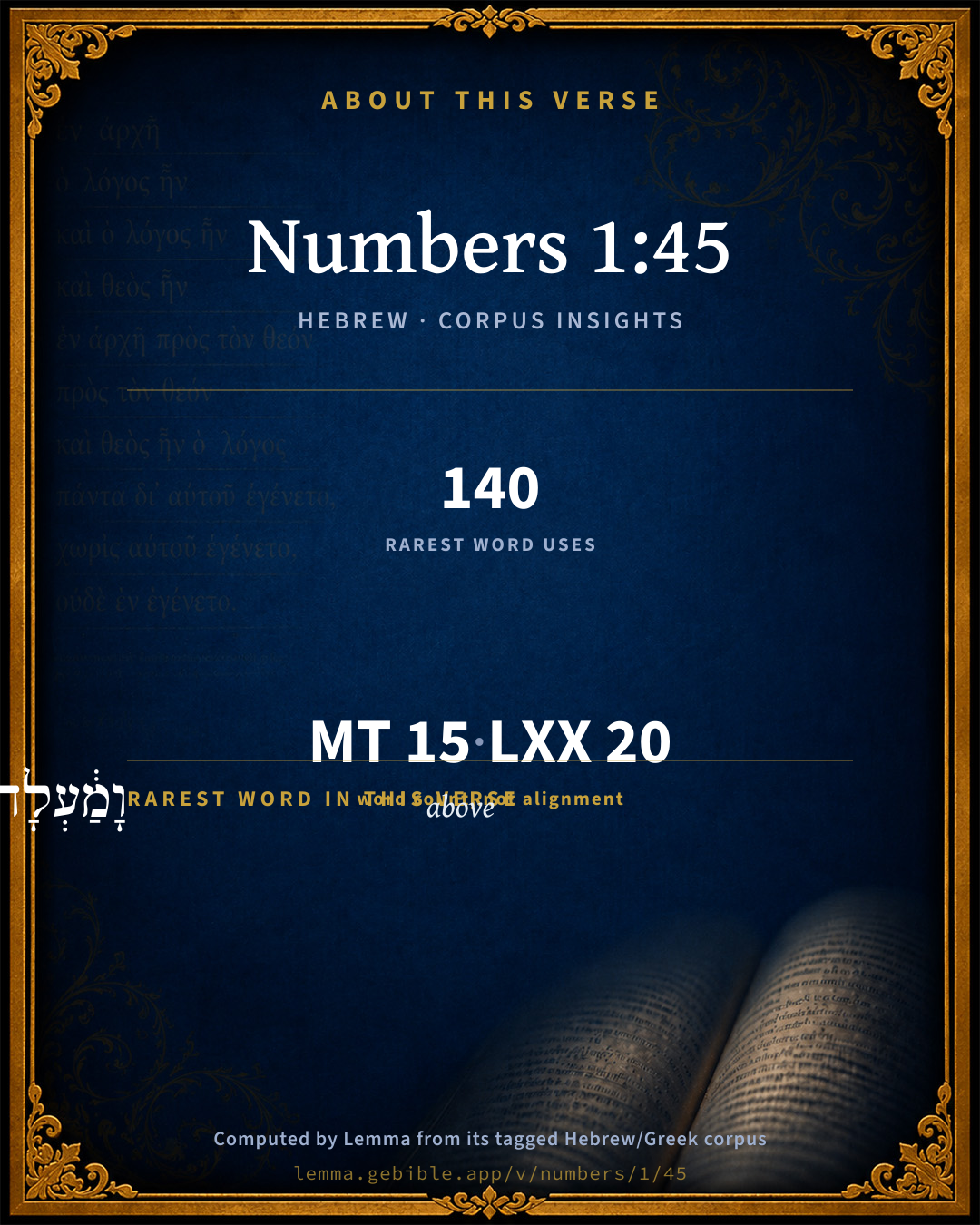
וָמַ֔עְלָה
maʻal
H4605
“and · above · toward”
Conjunction + Adverb + Suffix, Demonstrative
Part of Speech
Conjunction + Adverb
Full BDB Definition

Origin: from H5927

TWOT: 1624k

higher part, upper part (substantive) - above (adverb) - on the top of, above, on higher ground than (preposition) - upwards, higher, above (with locative)
  1. וַיִּֽהְי֛וּ hâyâh H1961 “and · to be” Conjunction + Verb, Qal, Sequential Imperfect, 3rd Person, Masculine, Plural
  2. כָּל kôl H3605 “all of” Noun, Common, Masculine, Singular, Construct
  3. פְּקוּדֵ֥י pâqad H6485 “visited” Verb, Qal, Participle Passive, Masculine, Plural, Construct
  4. בְנֵֽי bên H1121 “sons of” Noun, Common, Masculine, Plural, Construct
  5. יִשְׂרָאֵ֖ל Yisrâʼêl H3478 “Israel” Noun, Proper
  6. לְבֵ֣ית bayith H1004 “to/for · house of” Preposition + Noun, Common, Masculine, Singular, Construct
  7. אֲבֹתָ֑ם ʼâb H1 “fathers · their” Noun, Common, Masculine, Plural, Construct + Suffix, Personal, 3rd Person, Masculine, Plural
  8. מִבֶּ֨ן bên H1121 “from · son of” Preposition + Noun, Common, Masculine, Singular, Construct
  9. עֶשְׂרִ֤ים ʻesrîym H6242 “twenty” Adjective, Cardinal number, Both, Plural, Absolute
  10. שָׁנָה֙ shâneh H8141 “year” Noun, Common, Feminine, Singular, Absolute
  11. כָּל kôl H3605 “all of” Noun, Common, Masculine, Singular, Construct
  12. יֹצֵ֥א yâtsâʼ H3318 “going out” Verb, Qal, Participle Active, Masculine, Singular, Absolute
  13. צָבָ֖א tsâbâʼ H6635 “army” Noun, Common, Both, Singular, Absolute
  14. בְּיִשְׂרָאֵֽל Yisrâʼêl H3478 “in/at · Israel” Preposition + Noun, Proper

About this verse

These counts appear in no published source. They are computed here, from the morphology-tagged text and Lemma’s own curated glosses. What Lemma adds →

15
words
12
distinct lemmas
Pentateuch
section

Grammatical profile

  • 3 verbs
  • 10 nouns
  • 1 adjective
  • 1 adverb

Verb forms

  • וַיִּֽהְי֛וּ Qal · Sequential Imperfect
  • פְּקוּדֵ֥י Qal · Participle Passive
  • יֹצֵ֥א Qal · Participle Active

Repetition

Words recur within this verse — often emphatic in Hebrew:

  • כָּל all H3605 ×2
  • בְנֵֽי son H1121 ×2
  • יִשְׂרָאֵ֖ל Israel H3478 ×2

Hebrew & Septuagint length

In English translation the verse runs 32 words from the Hebrew and 33 from the Septuagint (LXX English) — closely comparable.

A rough comparison of the two English renderings, which tokenize alike — not a word-level alignment.

Word counts can differ between the Hebrew and the Greek without any difference in meaning — e.g. the Hebrew direct-object marker אֵת has no separate Greek word, and Greek often adds the article ὁ.

In the original languages it is 15 Hebrew tokens and 20 Greek tokens — but the two are counted differently (Hebrew bundles its prefixes and suffixes into one token; the Greek is in lemma form), so that isn’t a like-for-like length.

Hebrew and Greek witnesses Masoretic Hebrew ↔ Greek Septuagint

The same verse in the two great witnesses to the Old Testament, shown verse-for-verse.

These are two independent witnesses, not word-aligned to each other, and the Septuagint is shown in lemma (dictionary) form.

Hebrew Numbers 1:45 Masoretic · Westminster Leningrad Codex

וַיִּֽהְי֛וּ כָּל פְּקוּדֵ֥י בְנֵֽי יִשְׂרָאֵ֖ל לְבֵ֣ית אֲבֹתָ֑ם מִבֶּ֨ן עֶשְׂרִ֤ים שָׁנָה֙ וָמַ֔עְלָה כָּל יֹצֵ֥א צָבָ֖א בְּיִשְׂרָאֵֽל

So all those who were numbered of the children of Israel by their fathers' houses, from twenty years old and upward, all who were able to go out to war in Israel;

World English Bible · Public Domain

Greek LXX Numbers 1:45 Septuagint · lemma form

καί γίγνομαι πᾶς ὁ ἐπίσκεψις υἱός ἰσραήλ σύν δύναμις αὐτός ἀπό εἰκοσαετής καί ἐπάνω πᾶς ὁ ἐκπορεύομαι παρατάσσω ἐν ἰσραήλ

And the whole numbering of the children of Israel with their host from twenty years old and upward, every one that goes out to set himself in battle array in Israel, came to

LXX2012 (modern English Septuagint) · Public Domain

Hebrew: Westminster Leningrad Codex (CC BY 4.0). Greek: Septuagint (public domain); English from LXX2012 (modern English Septuagint) (Public Domain). How the Septuagint differs from the Hebrew →

Targum (Aramaic paraphrase)

2

The Targum is the ancient Jewish Aramaic paraphrase of the Hebrew Scriptures — an interpretive translation, not the Hebrew text itself. Onkelos (literal) and Pseudo-Jonathan (expansive) render the Torah, and Jonathan the Prophets. Coverage is partial: where no permissively-licensed English translation exists for a verse, only the Aramaic is shown. This is verse-level text, not a word-by-word alignment to the Hebrew.

  1. Targum Onkelos Torah (Genesis–Deuteronomy)
    וַהֲווֹ כָּל מִנְיָנֵי בְנֵי יִשְׂרָאֵל לְבֵית אֲבָהַתְהוֹן מִבַּר עַשְׂרִין שְׁנִין וּלְעֵלָא כָּל נָפֵק חֵילָא בְּיִשְׂרָאֵל

    (no public-domain English translation for this verse)

    Targum Onkelos — Aramaic: “Onkelos Genesis” (public domain); “Onkelos Exodus” (public domain); “Onkelos Leviticus” (public domain); “Onkelos Numbers” (public domain); “Onkelos Deuteronomy” (public domain). English: “Sefaria Community Translation” (CC0 1.0 (public-domain dedication)); “J.W. Etheridge. The Targums of Onkelos and Jonathan Ben Uzziel on the Pentateuch. London: Longmans, Green, 1862” (public domain). Text via Sefaria.

  2. Targum Pseudo-Jonathan Torah (Genesis–Deuteronomy)
    וַהֲווֹ כָּל סְכוּמֵי מִנְיָינֵי בְנֵי יִשְרָאֵל לְבֵית אַבְהַתְהוֹן מִבַּר עַשְרִין שְׁנִין וּלְעֵילָא כָּל נָפִיק חֵילָא בְּיִשְרָאֵל

    (no public-domain English translation for this verse)

    Targum Pseudo-Jonathan — Aramaic: “Targum Jonathan on Genesis” (public domain); “Targum Jonathan on Exodus” (public domain); “Targum Jonathan on Leviticus” (public domain); “Targum Jonathan on Numbers” (public domain); “Targum Jonathan on Deuteronomy” (public domain). English: “The Targum of Jonathan ben Uzziel, trans. J. W. Etheridge, London, 1862” (public domain). Text via Sefaria.

Commentary

Notes on Numbers 1:45 from classic Christian and Jewish commentators (each source and its license shown beneath its notes). The classic Christian expositions comment on the surrounding passage and are grouped to its opening verse, so a note may address several verses; the Jewish commentaries on the Tanakh (Rashi and others) are per-verse, so they appear only where the commentator wrote on this verse.

Lemma curates 59 commentaries, every one of them public domain or Creative Commons licensed, each selected and text-cleaned for this edition rather than reprinted as found. About our sources →

Jamieson, Fausset & Brown

Robert Jamieson, A. R. Fausset & David Brown

all they that were numbered were six hundred thousand, &c.--What an astonishing increase from seventy-five persons who went down to Egypt about two hundred fifteen years before [see on Gen 46:8], and who were subjected to the greatest privations and hardships! And yet this enumeration was restricted to men from twenty years and upwards [Num 1:3]. Including women, children, and old men, together with the Levites, the whole population of Israel, on the ordinary principles of computation, amounted to about 2,400,000.

Jamieson, Fausset & Brown — Commentary Critical and Explanatory on the Whole Bible (1871) — public domain (CC PDM 1.0). Text via the HelloAO Bible API.

John Gill's Exposition

So were all those that were numbered of the children of Israel,.... Of all the tribes, excepting Levi, that is, all the sums of the number of the children of Israel; all put together made the sum total given in the next verse:

by the house of their fathers, from twenty years old and upward, all that were able to go forth to war in Israel; all in every tribe, family, and house, that were above twenty years of age, healthful and strong, and fit for war.

John Gill's Exposition of the Whole Bible (1746–1763) — public domain (CC PDM 1.0). Text via the HelloAO Bible API.

The Pulpit Commentary

HOMILIES BY E.S. PROUT Vers. 45-50. "Differences of administrations" in the service of God.

The different departments of service appointed to the host of Israel and to the Levites remind us of similar diversities in national and Church life at present.

I THE SERVICE OF THE SWORD.

II THE SUPERIOR SERVICE OF THE SANCTUARY.

I 1. The apparent strength of the Israelites was according to the number of its soldiers. So with a nation and its bread-winners, or with a Church and its active workers. The "mixed multitude", (representing hangers-on, idlers, grumblers; Num_11:4) not reckoned or "mustered": only true Israelites can be relied on.

2. Their aggregation by tribes illustrates the value of natural affinities in Christian work (verses 18, 20, 22, etc.). This truth may be applied

(1) To Christian nationalities, whether of a European or Asiatic type: e.g., Chinese Churches should not be cast in English moulds.

(2) To Christian denominations, which may work best as separate, yet allied denominations, each having its own methods and rallying round the standard of some special truth. We are reminded also of

3. The value of noble Church traditions. "The house of their fathers" had a special honour in the eyes of every patriotic Israelite. So with British Christians: e.g., attachment of Episcopalians to the Church of the Protestant martyrs, and of other Christians to the Churches of Puritan, Covenanting, Nonconforming, or Methodist ancestors. (Psa_22:4, 5 34:4)

II The Levites were not mustered as soldiers, but were active in another department of service. The ark and its ministries were symbols of the source of the nation"s strength. Their valuable services are described as a "warfare". (Num_4:23, marg.) Just as in a nation, it is not the hand-workers only that are a source of strength and wealth, but thinkers, writers, lecturers, preachers also, so in a Church the least prominent may not be the least useful. (Cf. 1Co_12:12-28) The Levites pitched nearest the tabernacle (verses 52, 53), "that there be no wrath," etc. Simeons and Annas in the temple, invalids "dwelling in the secret place of the Most High," may not be "numbered" among the workers of the Church, but may have power with God and prevail as intercessors for their brethren. P.

The Pulpit Commentary (1880–1919), ed. H.D.M. Spence-Jones & Joseph S. Exell — public domain. Text from a community e-Sword module.

Ramban (Nachmanides)

Rabbi Moshe ben Nachman (Ramban / Nachmanides)

AND ALL THOSE THAT WERE NUMBERED OF THE CHILDREN OF ISRAEL BY THEIR FATHERS’ HOUSES … ALL THAT WERE ABLE TO GO FORTH TO WAR IN ISRAEL. It was necessary for Scripture to state the collective number of the people although it had already stated the individual numbers [of each of the tribes], because Moses and Aaron were commanded to ascertain the total number of the people counted, as well as the number of [people in] each tribe, for such is the way of kings when they take a census of their people.However I have not understood the reason for this commandment, namely why the Holy One, blessed be He, commanded [that they should ascertain the number of the people]. For whilst there was indeed a need for them [the people] to establish their relationship to the [individual] tribes because of the [division of the tribes of Israel according to four] standards, I cannot understand why G-d commanded that they find out the number [of men in each tribe]. Perhaps it was in order to proclaim His mercy over them, for it was with [only] threescore and ten persons that their fathers went down into Egypt, and now they were as the sand of the sea, so many men [above] the age of twenty [not to mention the women and children]. After every epidemic and plague He counted them again in order that they should know that it is He that increaseth the nations; He woundeth, and His hands make whole., 5:18. It is for this reason that our Rabbis have said: “Because of His abundant love for them He counts them every now and then.” Furthermore, he who comes before the father of the prophets, and his brother [Aaron] the holy one of the Eternal and becomes known to them by name, receives thereby a merit and life, because he has come in the council of the people and in the register of the house of Israel,. Ramban, as indicated, applies it in the positive, namely, that those possessing merit will be included in the council of G-d’s people and be written in the register of the house of Israel. It is possible that Ramban also hints to the concluding part of that verse: neither shall they enter into the Land of Israel, thus intimating that those who are deserving of reward will enter into the Land. and he receives a part in the merits of the community by being included in their numbers. Similarly, each of the people receive a special merit through being counted by number before Moses and Aaron, for they will set their eyes upon them for good, and intercede on their behalf for mercy, [just as it is said], The Eternal, the G-d of your fathers, make you a thousand times so many more as ye are, and He will not reduce your numbers, and the shekels shall be a redemption for your souls. And in Bamidbar Sinai Rabbah I have seen the following text: “According to the number of names … by their polls. The Holy One, blessed be He, told Moses to count them each with respect and [to treat] each one of them with [the honor due to] greatness. [Thus He said]: You shall not say to the head of the family: ‘How many people are there in your family? How many sons do you have?’ but they are each to pass before you with awe and in respect, and you shall count them. — It is with reference to this that it is written, according to the number of names, from twenty years old and upward, by their polls. ” It is also possible for us to say that [the reason for ascertaining their numbers] was similar to the practice of governments before fighting a war, since they were now ready to enter into the Land and to fight against the kings of the Amorite that were on the other side of the Jordan [eastward] and all the others, as Moses said [unto Hobab], We are journeying unto the place of which the Eternal said: This I will give unto you. Therefore Moses and the princes [of the tribes] had to know the number of those armed for war, and also the numbers of each and every tribe, [in order to decide] what to command each of them in the plains of Moab [when drawing up] the battle-lines, for the Torah does not rely on the miracle of one chasing a thousand. This is the purport of the expression, all that go forth to the host in Israel, namely that the census was for the purpose of [determining the number of] men that will go forth to war; and also so that he should distribute the Land to them according to their numbers, and should know how many parts will be allotted to them of the Land that they capture, since if not for the affair of the spies, they would have entered the Land immediately.

Ramban (Nachmanides) on the Tanakh — English translation: “Commentary on the Torah by Ramban (Nachmanides). Translated and annotated by Charles B. Chavel. New York, Shilo Pub. House, 1971-1976” (CC BY 4.0). Text via Sefaria.

Lesson kit

Teaching starters — assembled from the data on this page, not authored interpretation. Every prompt links to the verse data it draws on. Edit before teaching.

Numbers, in the Pentateuch, opens this verse with 15 words (12 distinct Hebrew lemmas). Its most distinctive word is maʻal (“above”). A historical commentator’s framing appears above. Read the whole chapter for the surrounding context.

Discussion questions

  1. The word maʻal carries the sense “above.” How does it shape the verse?
  2. “all” occurs 2× in this one verse. What is the effect of the repetition?
  3. The translations on this page render this verse differently — a whole-verse word diff, not a word-by-word alignment. What might account for the different wordings?
  4. The verb «וַיִּֽהְי֛וּ» is Qal Sequential Imperfect. How does its form color the action?
  5. Reading how Jamieson, Fausset & Brown and John Gill's Exposition read this verse, where do the two commentators agree and where do they part?

Things to notice

Reading settings

Reading text

Shown beneath each verse's original-language words.

Old Testament
Old Testament edition

Read the OT as the Masoretic Hebrew (MT) or the Greek Septuagint (LXX).

English shown for the Greek Septuagint (in the Hebrew ↔ Greek comparison).

Comparing translations? Open the Compare panel on any verse page to stack up to four side by side.