
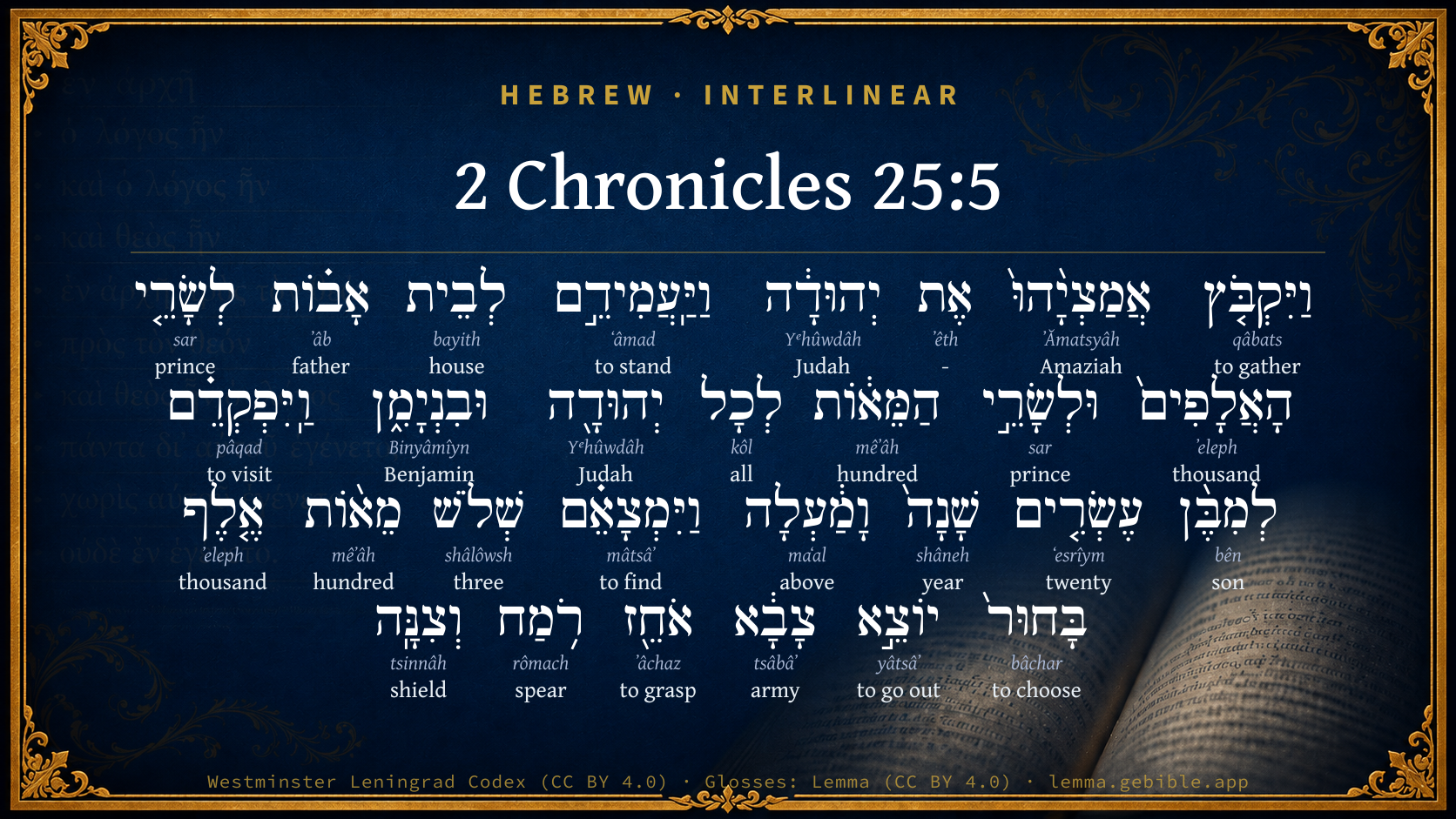
2 Chronicles 25:5

Hebrew (Westminster Leningrad Codex) 2 Chronicles 25:5 appears in the Hebrew Old Testament. The text above is from the Westminster Leningrad Codex. Each word links to its Strong’s number, a concise gloss, and parsing drawn from the Open Scriptures Hebrew Bible morphology. Click any word for its full Brown-Driver-Briggs (BDB) entry.
Download image
Cite this verse

2 Chronicles 25:5 (World English Bible). Public Domain. Lemma interlinear Bible study tool, https://lemma.gebible.app/v/2-chronicles/25/5.

Show BibTeX & RIS
BibTeX
RIS
English Translation
Moreover Amaziah gathered Judah together, and ordered them according to their fathers' houses, under captains of thousands and captains of hundreds, even all Judah and Benjamin: and he numbered them from twenty years old and upward, and found them three hundred thousand chosen men, able to go forth to war, who could handle spear and shield.
World English Bible · Public Domain
Download a study sheet

One document with this verse’s original text, its word-by-word gloss line, the meaning frame, cross-references with their text, attributed commentary, and full source and license credits — printable, and it pastes into notes with its structure intact.

This verse Autodidact and up

Study sheet (.html) Plain text (.txt)

A passage Seminary Student

Up to 50 verses in one chapter. A passage sheet keeps up to 6 commentary sources and 12 cross-references per verse, in the order this page ranks them, and says so on the sheet whenever that leaves anything out. Ask for a single verse and you get the Autodidact verse sheet above.

Everything on this page stays free to read, with no account — the sheet is a download of what is already on screen, not access to it.

Want to remove ads? Support Godless Engineer
Compare translations 3

The same verse in 3 English versions, stacked beneath the original-language interlinear above. Click any original word for its lexicon entry.

Each is an independent rendering of the whole verse — the interlinear is not word-aligned to these translations.

Highlighted words mark where these versions differ — a whole-verse word diff, not a word-by-word alignment.

  • World English Bible Public Domain
    Moreover Amaziah gathered Judah together, and ordered them according to their fathers' houses, under captains of thousands and captains of hundreds, even all Judah and Benjamin: and he numbered them from twenty years old and upward, and found them three hundred thousand chosen men, able to go forth to war, who could handle spear and shield.
  • King James Version Public Domain
    Moreover Amaziah gathered Judah together, and made them captains over thousands, and captains over hundreds, according to the houses of their fathers, throughout all Judah and Benjamin: and he numbered them from twenty years old and above, and found them three hundred thousand choice men, able to go forth to war, that could handle spear and shield.
  • unfoldingWord Literal Text CC BY-SA 4.0
    And Amaziah gathered Judah, and he appointed them according to the house of the fathers, for chiefs of thousands and for chiefs of hundreds for all of Judah and Benjamin. And he mustered them from a son of 20 years and upward. And he found them, 300,000 chosen, going out to war grasping spear and large shield.

unfoldingWord Literal Text — © unfoldingWord, licensed CC BY-SA 4.0. Word-aligned USFM3 via Door43 (git.door43.org/unfoldingWord/en_ult).

Versions to compare (up to 4)

3 of 4 selected

Show all 18 translations

Every available English version of this verse, each an independent rendering of the whole verse.

  • World English Bible Public Domain
    Moreover Amaziah gathered Judah together, and ordered them according to their fathers' houses, under captains of thousands and captains of hundreds, even all Judah and Benjamin: and he numbered them from twenty years old and upward, and found them three hundred thousand chosen men, able to go forth to war, who could handle spear and shield.
  • Berean Standard Bible Public Domain
    Then Amaziah gathered the people of Judah and assigned them according to their families to commanders of thousands and of hundreds. And he numbered those twenty years of age or older throughout Judah and Benjamin and found 300,000 chosen men able to serve in the army, bearing the spear and shield.
  • Majority Standard Bible Public Domain
    Then Amaziah gathered the people of Judah and assigned them according to their families to commanders of thousands and of hundreds. And he numbered those twenty years of age or older throughout Judah and Benjamin and found 300,000 chosen men able to serve in the army, bearing the spear and shield.
  • King James Version Public Domain
    Moreover Amaziah gathered Judah together, and made them captains over thousands, and captains over hundreds, according to the houses of their fathers, throughout all Judah and Benjamin: and he numbered them from twenty years old and above, and found them three hundred thousand choice men, able to go forth to war, that could handle spear and shield.
  • American Standard Version (1901) Public Domain
    Moreover Amaziah gathered Judah together, and ordered them according to their fathers' houses, under captains of thousands and captains of hundreds, even all Judah and Benjamin: and he numbered them from twenty years old and upward, and found them three hundred thousand chosen men, able to go forth to war, that could handle spear and shield.
  • Revised Version (1885) Public Domain
    Moreover Amaziah gathered Judah together, and ordered them according to their fathers’ houses, under captains of thousands and captains of hundreds, even all Judah and Benjamin: and he numbered them from twenty years old and upward, and found them three hundred thousand chosen men, able to go forth to war, that could handle spear and shield.
  • Geneva Bible (1599) Public Domain
    And Amaziah assembled Iudah, and made them captaines ouer thousandes, and captaines ouer hundreths, according to the houses of their fathers, thorowout all Iudah and Beniamin: and he nombred them from twentie yeere olde and aboue, and founde among them three hundreth thousand chosen men, to goe foorth to the warre, and to handle speare and shield.
  • Douay-Rheims (1899) Public Domain
    Amasias therefore gathered Juda together, and appointed them by families, and captains of thousands and of hundreds in all Juda, and Benjamin: and he numbered them from twenty years old and upwards, and found three hundred thousand young men that could go out to battle, and could hold the spear and shield.
  • Young's Literal Translation Public Domain
    And Amaziah gathereth Judah, and appointeth them, according to the house of the fathers, for heads of the thousands, and for heads of the hundreds, for all Judah and Benjamin; and he inspecteth them from a son of twenty years and upward, and findeth them three hundred thousand chosen ones, going forth to the host, holding spear and target.
  • Literal Standard Version CC BY-SA 4.0
    And Amaziah gathers Judah and appoints them according to the house of the fathers, for heads of the thousands and for heads of the hundreds, for all Judah and Benjamin; and he inspects them from a son of twenty years and upward, and finds them [to be] three hundred thousand chosen ones, going forth to the host, holding spear and buckler.
  • Unlocked Literal Bible CC BY-SA 4.0
    Moreover, Amaziah gathered Judah together, and registered them by their ancestors' houses, under commanders of thousands and commanders of hundreds—all of Judah and Benjamin. He numbered them from twenty years old and upward, and found them to be 300,000 chosen men, able to go to war, who could handle spear and shield.
  • unfoldingWord Literal Text CC BY-SA 4.0
    And Amaziah gathered Judah, and he appointed them according to the house of the fathers, for chiefs of thousands and for chiefs of hundreds for all of Judah and Benjamin. And he mustered them from a son of 20 years and upward. And he found them, 300,000 chosen, going out to war grasping spear and large shield.
  • Darby Bible Public Domain
    And Amaziah gathered Judah together and arranged them according to the fathers' houses, according to the captains of thousands and the captains of hundreds, throughout Judah and Benjamin; and he numbered them from twenty years old and upwards, and found them three hundred thousand choice men, able for military service, that could handle spear and target.
  • World Messianic Bible Public Domain
    Moreover Amaziah gathered Judah together and ordered them according to their fathers’ houses, under captains of thousands and captains of hundreds, even all Judah and Benjamin. He counted them from twenty years old and upward, and found that there were three hundred thousand chosen men, able to go out to war, who could handle spear and shield.
  • Webster's Bible Public Domain
    Moreover, Amaziah assembled Judah, and made them captains over thousands, and captains over hundreds, according to the houses of their fathers, throughout all Judah and Benjamin: and he numbered them from twenty years old and above, and found them three hundred thousand choice men, able to go forth to war, that could handle spear and shield.
  • Free Bible Version CC BY-SA 4.0
    Then Amaziah called up the people of Judah for military service, and assigned them by families to commanders of thousands and of hundreds. He also took a census of those twenty years of age and older throughout Judah and Benjamin, and found there were 300,000 first-rate fighting men who could use spear and shield.
  • Bible in Basic English Public Domain
    Then Amaziah got all Judah together and put them in order by their families, even all Judah and Benjamin, under captains of thousands and captains of hundreds: and he had those of twenty years old and over numbered, and they came to three hundred thousand of the best fighting-men, trained for war and in the use of the spear and the body-cover.
  • JPS Tanakh (1917) Public Domain
    Moreover Amaziah gathered Judah together, and ordered them according to their fathers' houses, under captains of thousands and captains of hundreds, even all Judah and Benjamin; and he numbered them from twenty years old and upward, and found them three hundred thousand chosen men, able to go forth to war, that could handle spear and shield.

Literal Standard Version (2020), Covenant Press — licensed CC BY-SA 4.0. Text via the HelloAO Bible API (eBible.org). Unlocked Literal Bible (unfoldingWord) — licensed CC BY-SA 4.0. Text via the HelloAO Bible API (eBible.org). unfoldingWord Literal Text — © unfoldingWord, licensed CC BY-SA 4.0. Word-aligned USFM3 via Door43 (git.door43.org/unfoldingWord/en_ult). Free Bible Version, Dr. Jonathan Gallagher — licensed CC BY-SA 4.0. Text via the HelloAO Bible API (eBible.org).

Word by word

More ways to search: Search by grammar → Find every occurrence → Compare this word →

Practice this passage: Drill this verse → Learn its vocabulary →

רֹ֥מַח
rômach
H7420
“spear”
Noun, Common, Masculine, Singular, Absolute
Part of Speech
Noun
Type
Common
Gender
Masculine
Number
Singular
State
Absolute
Full BDB Definition

Origin: from an unused root meaning to hurl

TWOT: 2172

spear, lance
  1. וַיִּקְבֹּ֤ץ qâbats H6908 “and · to gather” Conjunction + Verb, Qal, Sequential Imperfect, 3rd Person, Masculine, Singular
  2. אֲמַצְיָ֨הוּ֙ ʼĂmatsyâh H558 “Amaziah” Noun, Proper
  3. אֶת ʼêth H853 “-” Particle, Direct Object
  4. יְהוּדָ֔ה Yᵉhûwdâh H3063 “Judah” Noun, Proper
  5. וַיַּֽעֲמִידֵ֣ם ʻâmad H5975 “and · to stand · them” Conjunction + Verb, Hiphil, Sequential Imperfect, 3rd Person, Masculine, Singular + Suffix, Personal, 3rd Person, Masculine, Plural
  6. לְבֵית bayith H1004 “to/for · house of” Preposition + Noun, Common, Masculine, Singular, Construct
  7. אָב֗וֹת ʼâb H1 “fathers” Noun, Common, Masculine, Plural, Absolute
  8. לְשָׂרֵ֤י sar H8269 “to/for · princes of” Preposition + Noun, Common, Masculine, Plural, Construct
  9. הָאֲלָפִים֙ ʼeleph H505 “the · thousand” Particle, Definite Article + Adjective, Cardinal number, Both, Plural, Absolute
  10. וּלְשָׂרֵ֣י sar H8269 “and · to/for · princes of” Conjunction + Preposition + Noun, Common, Masculine, Plural, Construct
  11. הַמֵּא֔וֹת mêʼâh H3967 “the · hundred” Particle, Definite Article + Adjective, Cardinal number, Both, Plural, Absolute
  12. לְכָל kôl H3605 “to/for · all of” Preposition + Noun, Common, Masculine, Singular, Construct
  13. יְהוּדָ֖ה Yᵉhûwdâh H3063 “Judah” Noun, Proper
  14. וּבִנְיָמִ֑ן Binyâmîyn H1144 “and · Benjamin” Conjunction + Noun, Proper
  15. וַֽיִּפְקְדֵ֗ם pâqad H6485 “and · to visit · them” Conjunction + Verb, Qal, Sequential Imperfect, 3rd Person, Masculine, Singular + Suffix, Personal, 3rd Person, Masculine, Plural
  16. לְמִבֶּ֨ן bên H1121 “to/for · from · son of” Preposition + Preposition + Noun, Common, Masculine, Singular, Construct
  17. עֶשְׂרִ֤ים ʻesrîym H6242 “twenty” Adjective, Cardinal number, Both, Plural, Absolute
  18. שָׁנָה֙ shâneh H8141 “year” Noun, Common, Feminine, Singular, Absolute
  19. וָמַ֔עְלָה maʻal H4605 “and · above · toward” Conjunction + Adverb + Suffix, Demonstrative
  20. וַיִּמְצָאֵ֗ם mâtsâʼ H4672 “and · to find · them” Conjunction + Verb, Qal, Sequential Imperfect, 3rd Person, Masculine, Singular + Suffix, Personal, 3rd Person, Masculine, Plural
  21. שְׁלֹשׁ shâlôwsh H7969 “three” Adjective, Cardinal number, Feminine, Singular, Absolute
  22. מֵא֨וֹת mêʼâh H3967 “hundred” Adjective, Cardinal number, Both, Plural, Absolute
  23. אֶ֤לֶף ʼeleph H505 “thousand” Adjective, Cardinal number, Both, Singular, Absolute
  24. בָּחוּר֙ bâchar H977 “chosen” Verb, Qal, Participle Passive, Masculine, Singular, Absolute
  25. יוֹצֵ֣א yâtsâʼ H3318 “going out” Verb, Qal, Participle Active, Masculine, Singular, Absolute
  26. צָבָ֔א tsâbâʼ H6635 “army” Noun, Common, Both, Singular, Absolute
  27. אֹחֵ֖ז ʼâchaz H270 “grasping” Verb, Qal, Participle Active, Masculine, Singular, Absolute
  28. וְצִנָּֽה tsinnâh H6793 “and · shield” Conjunction + Noun, Common, Feminine, Singular, Absolute

About this verse

These counts appear in no published source. They are computed here, from the morphology-tagged text and Lemma’s own curated glosses. What Lemma adds →

29
words
25
distinct lemmas
Historical
section

Notable vocabulary

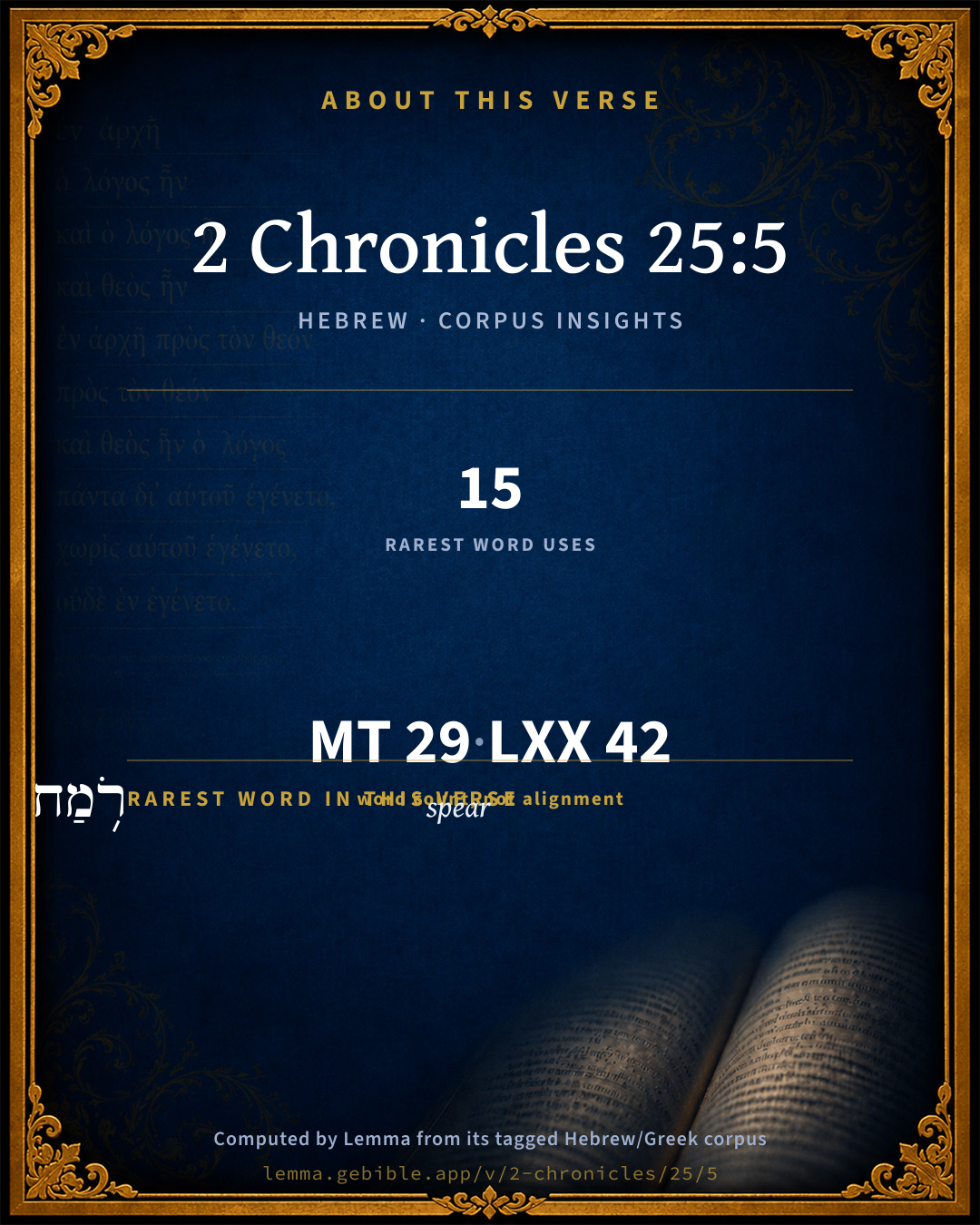
The rarest word here is רֹ֥מַח spear H7420 — appearing just 15 times in the whole Hebrew Bible.

Shared distinctive vocabulary

רֹ֥מַח spear H7420 occurs in 15 verses of the Hebrew Bible. Also found in:

Grammatical profile

  • 7 verbs
  • 14 nouns
  • 6 adjectives
  • 1 adverb
  • 1 particle

Verb forms

  • וַיִּקְבֹּ֤ץ Qal · Sequential Imperfect
  • וַיַּֽעֲמִידֵ֣ם Hiphil · Sequential Imperfect
  • וַֽיִּפְקְדֵ֗ם Qal · Sequential Imperfect
  • וַיִּמְצָאֵ֗ם Qal · Sequential Imperfect
  • בָּחוּר֙ Qal · Participle Passive
  • יוֹצֵ֣א Qal · Participle Active
  • אֹחֵ֖ז Qal · Participle Active

Repetition

Words recur within this verse — often emphatic in Hebrew:

  • יְהוּדָ֔ה Judah H3063 ×2
  • לְשָׂרֵ֤י prince H8269 ×2
  • הָאֲלָפִים֙ thousand H505 ×2
  • הַמֵּא֔וֹת hundred H3967 ×2

Hebrew & Septuagint length

In English translation the verse runs 56 words from the Hebrew and 56 from the Septuagint (LXX English) — the same length.

A rough comparison of the two English renderings, which tokenize alike — not a word-level alignment.

Word counts can differ between the Hebrew and the Greek without any difference in meaning — e.g. the Hebrew direct-object marker אֵת has no separate Greek word, and Greek often adds the article ὁ.

In the original languages it is 29 Hebrew tokens and 42 Greek tokens — but the two are counted differently (Hebrew bundles its prefixes and suffixes into one token; the Greek is in lemma form), so that isn’t a like-for-like length.

Cross-references

9

Topical passages linked to 2 Chronicles 25:5 in the Treasury of Scripture Knowledge — connected by theme and wording, ordered by reader-vote popularity; previews shown in the World English Bible.

  • Numbers 1:3 from twenty years old and upward, all who are able to go out to war in Israel. You and Aaron shall number them by their divisions.
  • 2 Chronicles 17:14–18 This was the numbering of them according to their fathers' houses: Of Judah, the captains of thousands: Adnah the captain, and with him mighty men of valor three hundred thousand;
  • 2 Chronicles 11:1 When Rehoboam was come to Jerusalem, he assembled the house of Judah and Benjamin, one hundred eighty thousand chosen men, who were warriors, to fight against Israel, to bring the kingdom again to Rehoboam.
  • Exodus 18:25 Moses chose able men out of all Israel, and made them heads over the people, rulers of thousands, rulers of hundreds, rulers of fifties, and rulers of tens.
  • 1 Samuel 8:12 and he will appoint them to him for captains of thousands, and captains of fifties; and [he will set some] to plow his ground, and to reap his harvest, and to make his instruments of war, and the instruments of his chariots.
  • 1 Chronicles 13:1 David consulted with the captains of thousands and of hundreds, even with every leader.
  • 1 Chronicles 27:1 Now the children of Israel after their number, the heads of fathers' [houses] and the captains of thousands and of hundreds, and their officers who served the king, in any matter of the divisions which came in and went out month by month throughout all the months of the year--of every division were twenty-four thousand.
  • 2 Chronicles 14:8 Asa had an army that bore bucklers and spears, out of Judah three hundred thousand; and out of Benjamin, that bore shields and drew bows, two hundred eighty thousand: all these were mighty men of valor.
  • 2 Chronicles 26:13 Under their hand was an army, three hundred thousand and seven thousand and five hundred, who made war with mighty power, to help the king against the enemy.

Cross-references courtesy of OpenBible.info (CC BY 4.0).

Hebrew and Greek witnesses Masoretic Hebrew ↔ Greek Septuagint

The same verse in the two great witnesses to the Old Testament, shown verse-for-verse.

These are two independent witnesses, not word-aligned to each other, and the Septuagint is shown in lemma (dictionary) form.

Hebrew 2 Chronicles 25:5 Masoretic · Westminster Leningrad Codex

וַיִּקְבֹּ֤ץ אֲמַצְיָ֨הוּ֙ אֶת יְהוּדָ֔ה וַיַּֽעֲמִידֵ֣ם לְבֵית אָב֗וֹת לְשָׂרֵ֤י הָאֲלָפִים֙ וּלְשָׂרֵ֣י הַמֵּא֔וֹת לְכָל יְהוּדָ֖ה וּבִנְיָמִ֑ן וַֽיִּפְקְדֵ֗ם לְמִבֶּ֨ן עֶשְׂרִ֤ים שָׁנָה֙ וָמַ֔עְלָה וַיִּמְצָאֵ֗ם שְׁלֹשׁ מֵא֨וֹת אֶ֤לֶף בָּחוּר֙ יוֹצֵ֣א צָבָ֔א אֹחֵ֖ז רֹ֥מַח וְצִנָּֽה

Moreover Amaziah gathered Judah together, and ordered them according to their fathers' houses, under captains of thousands and captains of hundreds, even all Judah and Benjamin: and he numbered them from twenty years old and upward, and found them three hundred thousand chosen men, able to go forth to war, who could handle spear and shield.

World English Bible · Public Domain

Greek LXX 2 Chronicles 25:5 Septuagint · lemma form

καί συνἄγω αμασιας ὁ οἶκος ἰουδά καί ἀναἵστημι αὐτός κατά οἶκος πατριά αὐτός εἰς χιλίαρχος καί ἑκατόνταρχος ἐν πᾶς ἰουδά καί ἰερουσαλήμ καί ἀριθμέω αὐτός ἀπό εἰκοσαετής καί ἐπάνω καί εὑρίσκω αὐτός τριακόσιοι χιλίας δυνατός ἐκἔρχομαι εἰς πόλεμος κρατέω δόρυ καί θυρεός

And Amasias assembled the house of Juda, and appointed them according to the houses of their families for captains of thousands and captains of hundreds in all Juda and Jerusalem: and he numbered them from twenty years old and upwards, and found them three hundred thousand able to go out to war, holding spear and shield.

LXX2012 (modern English Septuagint) · Public Domain

Hebrew: Westminster Leningrad Codex (CC BY 4.0). Greek: Septuagint (public domain); English from LXX2012 (modern English Septuagint) (Public Domain). How the Septuagint differs from the Hebrew →

Commentary

Notes on 2 Chronicles 25:5 from classic Christian and Jewish commentators (each source and its license shown beneath its notes). The classic Christian expositions comment on the surrounding passage and are grouped to its opening verse, so a note may address several verses; the Jewish commentaries on the Tanakh (Rashi and others) are per-verse, so they appear only where the commentator wrote on this verse.

Lemma curates 59 commentaries, every one of them public domain or Creative Commons licensed, each selected and text-cleaned for this edition rather than reprinted as found. About our sources →

Jamieson, Fausset & Brown

Robert Jamieson, A. R. Fausset & David Brown

HAVING HIRED AN ARMY OF ISRAELITES AGAINST THE EDOMITES, AT THE WORD OF A PROPHET HE LOSES A HUNDRED TALENTS AND DISMISSES THEM. (Ch2 25:5-10)

Amaziah . . . made captains, &c.--As all who were capable of bearing arms were liable to serve, it was quite natural in making up the muster-roll to class them according to their respective families and to appoint the officers of each corps from the same quarter; so that all the soldiers who formed a regiment were brothers, relatives, friends. Thus the Hebrew troops were closely linked together, and had strong inducements to keep steady in their ranks.

found them three hundred thousand choice men--This was only a fourth part of Jehoshaphat's army (Ch2 17:14-19), showing how sadly the kingdom of Judah had, in the space of eighty-two years, been reduced in population by foreign wars, no less than by internal corruptions. But the full amount of Amaziah's troops may not be here stated.

Jamieson, Fausset & Brown — Commentary Critical and Explanatory on the Whole Bible (1871) — public domain (CC PDM 1.0). Text via the HelloAO Bible API.

Ellicott's Commentary for English Readers

AMAZIAH’S MILITARY STRENGTH, AND CONQUEST OF EDOM

(2Ch_25:5-13).

This section is for the most part peculiar to Chronicles. In Kings the conquest of Edom is recorded in a single verse (2Ki_14:7).

(5) And made them captains over thousands.—Rather, And made them stand (marshalled them) according to father houses, to wit, according to the captains of thousands and according to the captains of hundreds of all Judah and Benjamin.

Numbered.—Mustered.

Twenty years old.—The military age: Num_1:2-3; 1Ch_27:23.

Three hundred thousand.—A total immensely below that of the forces of Jehoshaphat (2Ch_17:14-18), and not much more than half that of Asa’s (2Ch_14:8). All these high numbers are no doubt suspicious; but a certain relative propriety is observable in the present instance, inasmuch as the country had suffered great losses by the disastrous wars of Jehoram, Ahaziah, Joash.

Able to go forth to war.—Literally, going out in the host. (See Num. l.c.)

That could handle spear and shield.—Grasping lance and target, i.e., heavy-armed warriors. (Comp. 1Ch_12:8.)

A Bible Commentary for English Readers, edited by Charles John Ellicott (1878–1897) — public domain. Text from a community e-Sword module.

Trapp's Complete Commentary

John Trapp

2Ch 25:5 Moreover Amaziah gathered Judah together, and made them captains over thousands, and captains over hundreds, according to the houses of [their] fathers, throughout all Judah and Benjamin: and he numbered them from twenty years old and above, and found them three hundred thousand choice [men, able] to go forth to war, that could handle spear and shield.

Ver. 5. Three hundred thousand choice men.] His great-grandfather Jehoshaphat had eleven hundred thousand. Their idolatry and evil practices had wasted and weakened them.

John Trapp, A Commentary or Exposition upon All the Books of the Old and New Testament (1647–1656) — public domain. Text from a community e-Sword module.

Tyndale Open Study Notes

Tyndale Open Resources

25:5 The inclusion of Benjamin in this listing of military officers indicates that this tribe was part of the kingdom of Judah at that time.

Tyndale Open Study Notes — © Tyndale Open Resources, licensed CC BY-SA 4.0. Text via the HelloAO Bible API.

Geneva Bible (1599)

Geneva Bible translators

So many as were able men to bear weapons and go to the war.

Geneva Bible (1599) marginal notes — public domain. Text via Bolls.life.

Adam Clarke's Commentary

Verse 5. Gathered Judah together] He purposed to avenge himself of the Syrians, but wished to know his military strength before he came to a rupture.

Adam Clarke's Commentary on the Bible (1810–1826) — public domain. Text from a community e-Sword/MySword module.

The Cambridge Bible for Schools and Colleges

gen. ed. J. J. S. Perowne

5–10 (not in Kings). Amaziah prepares for War

5. and made them … and Benjamin] R.V. and ordered them according to their fathers’ houses, under captains of thousands and captains of hundreds, even all Judah and Benjamin.

three hundred thousand] These were spearmen and correspond in number with Asa’s spearmen (2Ch_14:8).

choice men] R.V. chosen men.

The Cambridge Bible for Schools and Colleges (gen. ed. J. J. S. Perowne; Cambridge University Press, 1878–1918) — public domain. Text from a community e-Sword module.

John Gill's Exposition

He hired also one hundred thousand mighty men of valour out of Israel,.... The ten tribes, judging his own army not sufficient for his expedition against the Edomites he was meditating:

for one hundred talents of silver; which amounted to 35,300 pounds sterling, and according to Beckius (e) were about five florins and a half to each soldier.

(e) Not. in Targum in loc.

John Gill's Exposition of the Whole Bible (1746–1763) — public domain (CC PDM 1.0). Text via the HelloAO Bible API.

Albert Barnes' Notes on the Bible

Three hundred thousand - Asa’s army had been nearly twice as numerous, amounting to 580, 000 2Ch 14:8. The diminution was due, in part, to wars 2Ch 21:8, 2Ch 21:16; 2Ch 24:23-24; in part, to the general decadence of the kingdom.

Albert Barnes' Notes on the Bible (1834–1885) — public domain. Text from a community e-Sword/MySword module.

Haydock's Catholic Bible Commentary

Families. The officers were well acquainted with their soldiers; (C.) and all were more interested for each other’s welfare, (D.) than they are in the present system. C. --- Young. Prot. "choice men, able to go." H.

George Leo Haydock (1774–1849), Haydock's Catholic Family Bible and Commentary, 1859 edition — public domain. Excludes Psalms (Douay-Rheims chapter numbering differs from Protestant) and Deuterocanonical books (Catholic canon only).

The Pulpit Commentary

This and the following five verses are entirely omitted in the parallel, which contents itself with giving in its ver. 7, in fewer words, but with the supplement of other matter, what is contained in our ver. 11. Found them three hundred thousand. Compare Asa"s "five hundred and eighty thousand", (2Ch_14:8) and Jehoshaphat"s "eleven hundred and sixty thousand". (2Ch_17:14-19; see note, however, on these verses, and the improbability of numbers so high) The Hebrew text of the second clause of this verse simply says, "he set them" ( or placed them according to fathers" houses, under captains, etc., glancing most naturally at Num_1:2-54; Num_2:1-34. Twenty years old and above. (comp. 1Ch_27:23)

Vers. 5-9.

Gold, and the favour of God.

There is something which approaches, if it does not amount to, the ludicrous in the question so solemnly proposed by Amaziah, "But what shall we do for the hundred talents which I have given to the army of Israel?" Could it be the right thing and the wise thing to sacrifice all that money? Were a hundred talents to be thrown away? Supposing he defeated the enemy without the help of these mercenaries, would it not be a mortifying thing that he had spent such a sum to no purpose? But Amaziah was so situated that he had to make the choice which has so often to be made; he had to choose between sacrificing his money or forfeiting the favour of his God. He had the wisdom to accept the former alternative, and to believe the prophet, that the Lord was "able to give him more than this." On the choice which we make, when this question comes up for settlement by ourselves, there hang great issues. Wherefore let us well consider

I THE LIMITATIONS TO THE VALUE OF GOLD. Gold serves many useful purposes; through it we can secure the necessaries and the comforts of life, the conditions of education, the advantages of good society; but its power is very limited, after all.

1. Its possession, so far from ensuring happiness, often entails muchburdensomeness, and always imposes a heavy responsibility.

2. Its tenure is slight and short; an accident or a revolution, impossible toforesee, may take it suddenly away, and at death it must be relinquished.

3. It is wholly powerless in the presence of some of the sadder and graverevils of our life.

4. It tempts to indolence and indulgence, and it may be doubted whether itdoes not spoil more lives than it brightens and blesses.

II THE BOUNDLESS BLESSEDNESS OF THE FAVOUR OF GOD. The Lord was not only able to give Amaziah "much more than this," much more than "a hundred talents of silver," but he was able to bless him in ways which were incomparably superior to such material enrichment. And so is he able and most willing to bless us. Willingly should we part with gold and silver at his bidding, to be true and loyal disciples to our Master, to preserve our spiritual integrity; for if we do this "for Christ"s sake and the gospel"s" (Mar_8:35) there will be for us ample and most abundant compensation for what we lose.

1. The peace of God, which passes understanding, and which surpasses allmaterial values.

2. The positive and active friendship of our Lord, and of the good and true.

3. A life of noble and fruitful service.

4. A death of hope.

5. A future of immortal glory. In view of these things, we need not begreatly concerned about the less of a hundred or a thousand talents. C.

Vers. 5-13.

A campaign against the Edomites.

I WARLIKE PREPARATIONS. (Vers. 5, 6.)

1. The army mustered. "Amaziah gathered Judah together;" i.e. collected for review, probably in Jerusalem, all in the southern kingdom who were capable of bearing arms.

2. The army organized. "He made them captains over thousands, and captains over hundreds, according to the houses of their fathers, throughout all Judah and Benjamin." Compare Samuel"s prediction, (1Sa_8:12) and Moses" practice (Num_31:14; Deu_1:15) Order and subordination indispensable to the efficiency of a host. Since the days of Jehoiada (2Ch_23:1; 2Ki_11:15) the army had probably become disorganized.

3. The army numbered. "And he numbered them from twenty years old and above, and found them three hundred thousand choice men a considerably smaller force than Asa led out against Zerah, (2Ch_14:8) or than Jehoshaphat possessed. (2Ch_17:14-18) The explanation is, either that only the flower of Amaziah"s troops, the picked men of the army, were numbered, or the force had been diminished by the disastrous wars of the preceding reigns. What is next stated renders this probable.

4. The army increased. "He hired also a hundred thousand mighty men of valour out of Israel for a hundred talents of silver" ( if the talent be valued at

II PROPHETIC WARNINGS. (Vers. 7, 8.) The prophet"s name is not given, but his admonition is:

1. A dissuasive. Against allowing Israel to accompany the army of Judah to battle. If the king"s recollection of former alliances with the northern kingdom did not remind him of the unadvisedness of the course he was contemplating (2Ch_18:28 2Ch_20:35 2Ch_22:5; 1Ki_22:29; 2Ki_3:7) the earnestness of Jehovah"s messenger might have startled him.

2. A reason. Jehovah was not with Israel, not with any of the sons of Ephraim, because of their defection into idolatry. What had been true of Rehoboam, (2Ch_12:5) what had been threatened to Asa, (2Ch_15:2) what had been the case with Judah in the previous reign, (2Ch_24:20) was the habitual and seemingly permanent condition of the northern people. They had forsaken God, and he had in turn forsaken them. To seek the help of Israel, therefore, was to seek help in a quarter where no help was, rather whence hurt alone could proceed. It is hardly doubtful that the people of God err in asking the assistance of God"s enemies for their schemes, whether those schemes be material such as church-building, or spiritual such as propagating the gospel, and whether that aid be in the form of money, influence, or men. The Jews who returned from Babylon would not accept assistance from the Samaritans in building their temple. (Ezr_4:3) Should the Church of Jesus Christ accept the aid of the unbelieving world?

3. An alternative, or an exhortation. "If thou wilt go i.e. with these northern allies, then go, do valiantly, be strong for the battle," i.e. do your best the language of irony; or, according to another rendering (Ewald, Bertheau, Keil), "If thou wilt go, go alone, do valiantly, be strong for the battle" But in this case the force of the first clause is lost, as there was no question as to "going" or "not going" put before Amaziah, but merely as to "going with" or "without Israel.

4. A threatening or a promise. "God shall cast thee down before the enemy," or "God shall (not) cast thee down before the enemy," the word "not" being supplied. If Amaziah went depending on the assistance of his mercenaries, he would lose the battle; if he left them behind and went forth with only his own forces, he would prove victorious. The great lesson Jehovah was constantly, by means of his prophets (Isa_26:3, Isa_26:4; Jer_39:18 Jer_42:11; Nah_1:7) and the events of his providence, striving to impress upon Israel and Judah was that of exclusive reliance upon himself, as the only means of ensuring their safety and continued prosperity; (2Ch_20:20) the same lesson is urgently required by Christians (Rom_15:13; Eph_2:8)

5. An argument. "God hath power to help or to cast down to help his people without allies, as he helped Jehoshaphat, (2Ch_20:22) (2Ch_14:12) and Abijah; (2Ch_13:15) or to cast down his people, even in spite of allies, as he did formerly with Joash, (2Ch_24:24) with Jehoshaphat, (1Ki_22:36) and with Rehoboam, (2Ch_13:9) and afterwards with Ahaz. (2Ch_28:16-19)

III KINGLY EXCUSES. (Ver. 9.)

1. Proposed. Amaziah felt a difficulty about complying with the prophet"s counsel. He might send back his allies to Joash in Jezreel or Samaria; but what about his talents? These his royal brother would not be likely to return. He might go to battle without his hired troops, but who would give

2. him his silver moneys? One hundred talents was a large sum to lose even for a king. Amaziah was of Shylock"s mind, "You take my house when you do take the prop that doth sustain my house" ("Merchant of Venice," act 4. sc. 1). Like the Jew who lamented more over the loss of his ducats his "Christian ducats," "a sealed bag, two sealed bags of ducats, of double ducats and jewels than the flight of his daughter, Amaziah mourned less the idea of parting with his mercenaries than the fact that they would carry with them his precious talents.

3. Answered. The man of God might have replied

(1) that even if he kept his allies his hundred talents were lost, while he would certainly lose the battle in addition; or

(2) that if he parted with his hirelings he would prove victorious, which would more than compensate for the loss of his talents; but the man of God responded

(3) that Jehovah, if he pleased, could give him much more than a hundred talents. He said not, indeed, that Jehovah would give him more than he would lose, because considerations of money do not enter into questions of right and wrong. The moral quality of an action is not determined by its financial results. Simply the prophet stated that Jehovah could give the king much more than a hundred talents, which was true, since the silver and the gold were his (1Ch_29:11, 1Ch_29:12; Hag_2:8) and he gave them to whomsoever he would (Pro_30:8; Ecc_5:19; Psa_127:1, Psa_127:2)

IV FIELD OPERATIONS. (Vers. 10-12.)

1. The dismissal of the mercenaries. The army out of Ephraim was separated from his own troops and sent home to Israel. Whether the king, in discharging them, was actuated by cupidity, the desire of getting back his talents with interest, or by fear, the dread of losing the battle, the step he took was right, being such as the man of God demanded, prudent as the issue of the campaign showed, and bold as the situation required. It was certain to excite the ire of the northern warriors, and according to the Chronicler it did: "they returned home in fierce anger." Well-doing on the part of good men may stir the wrath of others, to whom it may at times appear insulting; nevertheless, the path of duty must be adhered to, though it should lead to the estrangement of friends no less than to the loss of ducats.

2. The advance of the army of Judah. Amaziah took courage, added to his faith fortitude, as Christians are exhorted to do in the campaign of life, (2Pe_1:5) and led his forces out with no ally but Jehovah, as far as the Valley of Salt (2Sa_8:13; 1Ch_18:12) a plain about two miles broad, south of the Dead Sea, absolutely devoid of vegetation, now called El-Ghor (Robinson). There he encountered the Edomites, or children of Mount Seir, who had revolted from Judah in the days of Jehoram (2Ch_21:8; 2Ki_8:20) and whose subjugation was the object of the present campaign.

3. The defeat of the Edomites.

(1) The destruction of their army. Ten thousand soldiers were killed, ten thousand prisoners taken.

(2) The capture of their capital. Selah, "Rock", (Isa_16:1) the well-known Petra or Rock city, was taken, and its name changed to Joktheel, or "conquered by God". (2Ki_14:7) This remarkable city was situated in a valley (Es Sik, "the cleft;" called by the Arabs Wady Musa) running from north to south, about three quarters of a mile long, and enclosed on all sides by precipitous sandstone rocks of variegated hues, rising in some parts to a height of eight hundred or a thousand feet. (For a description of Petra, see Stanley"s "Sinai and Palestine," pp. 87, etc.; "Picturesque Palestine," vol. 3. pp. 214, etc.; "Forty Days in the Desert," p. 128.)

(3) The slaughter of their people. If Amaziah"s prisoners were hurled from the cliffs of Petra, their death must have been simply appalling.

V UNFRIENDLY RETALIATONS. (Ver. 13.)

1. By whom. ? The soldiers of the Israelitish army sent back by Amaziah. The Samaritans, whose aid Zerubbabel declined, "weakened the hands of the people of Judah and troubled them in building"; (Ezr_4:4) and the unbelieving world would oppose, harass, and hinder the Church of Christ even more than it does, were it separated as it should be from the Church"s. (Joh_15:19) But better the world"s opposition, hatred, and revenge, with God"s help, favour, and blessing, than the world"s cooperation, friendship, and approbation, with God"s displeasure, withdrawal, and antagonism.

1. For what? For not being allowed to go to battle with Judah against Edom. An insufficient cause, since they lost nothing of their pay, while they saved their lives. Their honour, it may be supposed, was wounded; and the

2. world holds a wound to one"s honour to be a greater stroke than a buffet to one"s person or a loss to one"s purse. But Christ"s followers ought not to take their code of morals from the world!

3. On whom? The cities of Judah and their inhabitants, from Samaria unto Beth-horon, now Beit-Ur. (2Ch_8:5) Though these had no part in the offence, they must nevertheless share in the penalty. If Amaziah had done the soldiers wrong, Amaziah should have given them redress in his own person. But nations have hardly yet learnt to discriminate between offending sovereigns and offenceless subjects, When those quarrel they can only heal their friends by setting these to cut each other"s throats or blow each other into eternity by means of guns and cannons!

4. How far? To the taking of three thousand men and much spoil. Whether this devastation of the northern cities of Judah occurred while the Israelitish soldiers were returning home to Samaria, or, as seems more likely, when Amaziah was in Edom (Bertheau, Keil), is uncertain; that it subsequently led to a war between the two kingdoms is undoubted.

Learn:

1. The folly of entering on any enterprise in which God cannot aid.

2. The sin of resorting to means of which Heaven cannot approve.

3. The sufficiency of God"s help without creature-aids.

4. The duty of withdrawing from wicked schemes, even though doing soshould entail financial loss.

5. The impossibility of settling questions of right and wrong by calculationsof profit and loss.

6. The insignificance of money loss as compared with loss of Divine helpand favour.

7. The immense indebtedness of the world to Christianity, even whilerejecting it. W.

The Pulpit Commentary (1880–1919), ed. H.D.M. Spence-Jones & Joseph S. Exell — public domain. Text from a community e-Sword module.

unfoldingWord translationNotes

Door43 World Missions Community

gathered Judah together

Here "Judah" refers to the people who lived in Judah. AT: "gathered the people of Judah together" (See: Metonymy)

registered them ... numbered them

He had someone write their names on an official list.

by their ancestors' houses

Here the word "houses" is a metonym for the families that lived in them. AT: "by their ancestors' families" (See: Metonymy)

commanders of thousands and commanders of hundreds

Possible meanings are 1) these numbers represent the exact amount of soldiers that these commanders led. AT: "commanders of 1,000 soldiers and commanders of 100 soldiers" or 2) the words translated as "thousands" and "hundreds" do not represent exact numbers, but are the names of larger and smaller military divisions. AT: "commanders of large military divisions and commanders of smaller military divisions" See how you translated a similar phrase in 2 Chronicles 1:2. (See: Numbers)

all of Judah and Benjamin

Here "Judah" and "Benjamin" refer to the people who lived in the wider kingdom of Judah. AT: "all the people of Judah and Benjamin" (See: Metonymy)

twenty years old and upward

Here numbers that were larger than twenty are spoken of as if they were higher. AT: "20 years old and older" (See: Metaphor)

found them to be

"learned that there were"

300,000 ... 100,000

"three hundred thousand ... one hundred thousand" (See: Numbers)

chosen men

"capable soldiers" or "skilled warriors"

one hundred talents of silver

"100 talents of silver." You may convert this to a modern measure. AT: "about thirty-three hundred kilograms of silver" or "about 3,300 kilograms of silver" (See: Numbers and Biblical Weight)

translationWords

Judah

house

command

Benjamin

kingdom of Israel

silver

unfoldingWord translationNotes — © Distant Shores Media and the Door43 World Missions Community, licensed CC BY-SA 4.0. Source: git.door43.org/Door43/en_tn.

Lesson kit

Teaching starters — assembled from the data on this page, not authored interpretation. Every prompt links to the verse data it draws on. Edit before teaching.

2 Chronicles, in the Historical, opens this verse with 29 words (25 distinct Hebrew lemmas). Its most distinctive word is rômach (“spear”). A historical commentator’s framing appears above. Read the whole chapter for the surrounding context.

Discussion questions

  1. How does “spear” (rômach) shape what this verse is saying?
  2. Numbers 25:7 shares the word «spear» with this verse. How do the two illuminate each other?
  3. “Judah” occurs 2× in this one verse. What is the effect of the repetition?
  4. These translations render this verse differently; the difference is in the English rendering, not the original. What questions does that raise?
  5. The verb «וַיִּקְבֹּ֤ץ» is Qal Sequential Imperfect. How does its form color the action?
  6. Reading how Jamieson, Fausset & Brown and Ellicott's Commentary for English Readers read this verse, where do the two commentators agree and where do they part?

Things to notice

Reading settings

Reading text

Shown beneath each verse's original-language words.

Old Testament
Old Testament edition

Read the OT as the Masoretic Hebrew (MT) or the Greek Septuagint (LXX).

English shown for the Greek Septuagint (in the Hebrew ↔ Greek comparison).

Comparing translations? Open the Compare panel on any verse page to stack up to four side by side.