Judges 4:7

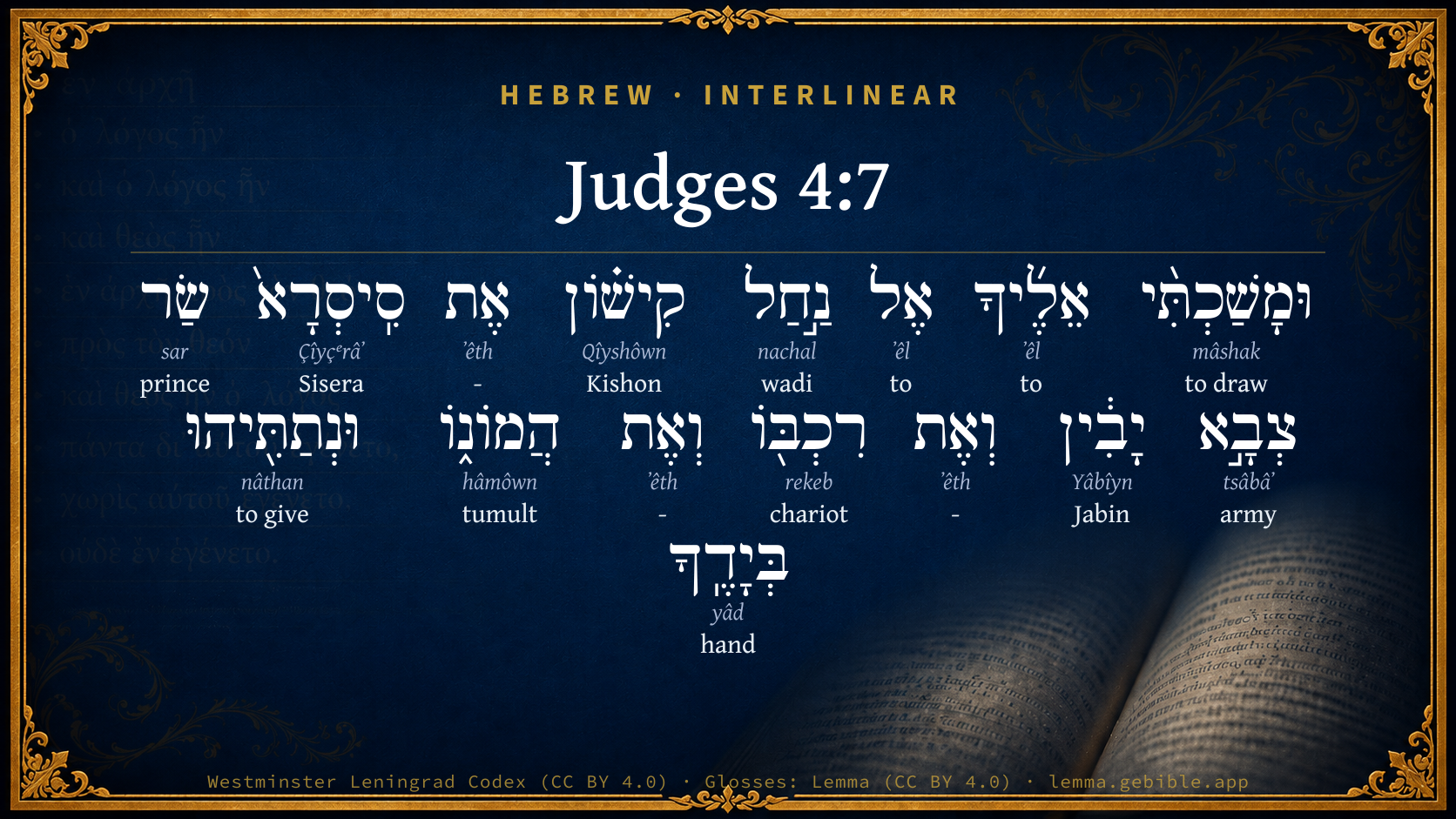
Hebrew (Westminster Leningrad Codex) Judges 4:7 appears in the Hebrew Old Testament. The text above is from the Westminster Leningrad Codex. Each word links to its Strong’s number, a concise gloss, and parsing drawn from the Open Scriptures Hebrew Bible morphology. Click any word for its full Brown-Driver-Briggs (BDB) entry.
Download image
Cite this verse

Judges 4:7 (World English Bible). Public Domain. Lemma interlinear Bible study tool, https://lemma.gebible.app/v/judges/4/7.

Show BibTeX & RIS
BibTeX
RIS
English Translation
I will draw to you, to the river Kishon, Sisera, the captain of Jabin's army, with his chariots and his multitude; and I will deliver him into your hand.
World English Bible · Public Domain
Highlights
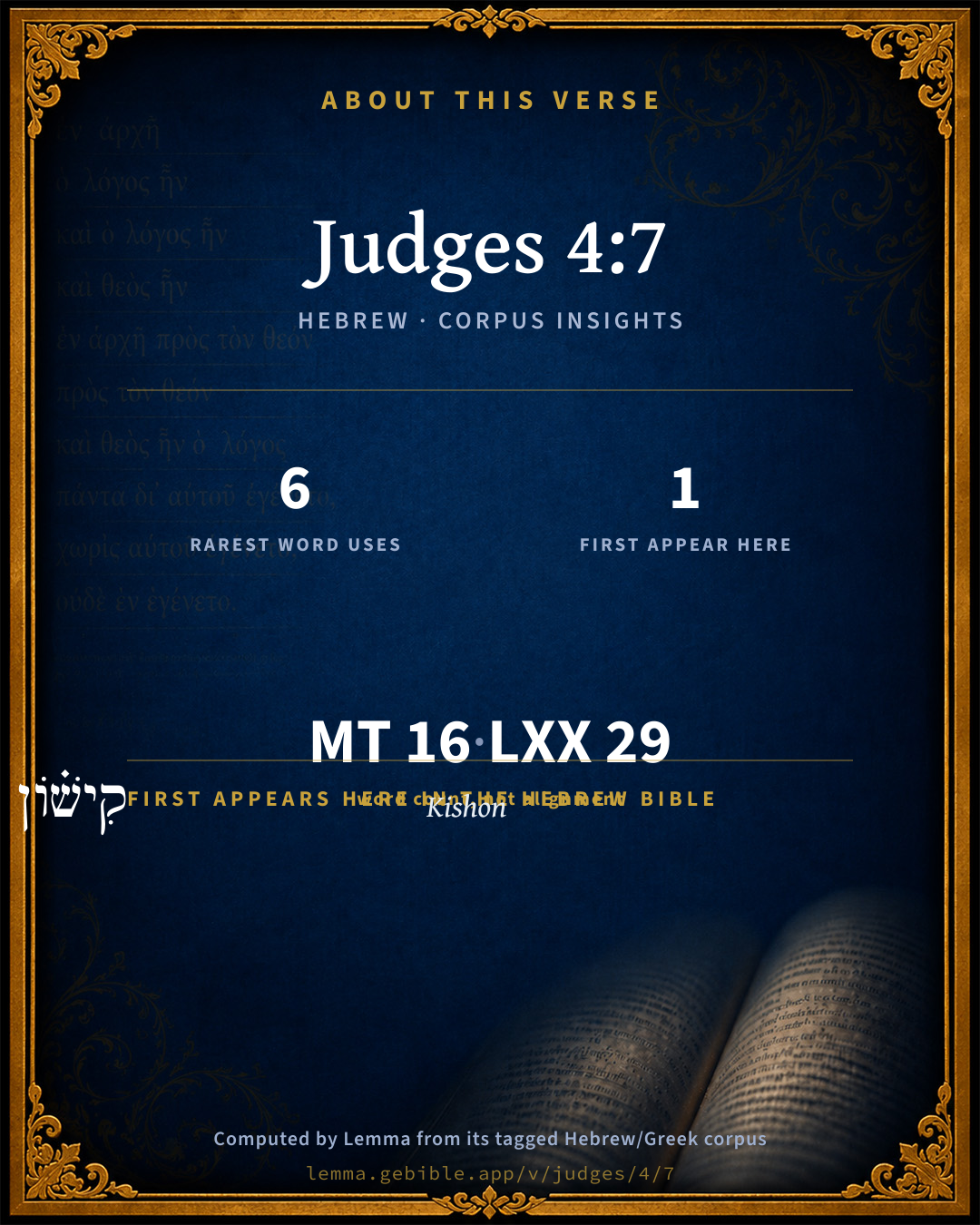
  • 1 first appearance in the Hebrew Bible
Full analysis ↓
Download a study sheet

One document with this verse’s original text, its word-by-word gloss line, the meaning frame, cross-references with their text, attributed commentary, and full source and license credits — printable, and it pastes into notes with its structure intact.

This verse Autodidact and up

Study sheet (.html) Plain text (.txt)

A passage Seminary Student

Up to 50 verses in one chapter. A passage sheet keeps up to 6 commentary sources and 12 cross-references per verse, in the order this page ranks them, and says so on the sheet whenever that leaves anything out. Ask for a single verse and you get the Autodidact verse sheet above.

Everything on this page stays free to read, with no account — the sheet is a download of what is already on screen, not access to it.

Want to remove ads? Support Godless Engineer
Compare translations 3

The same verse in 3 English versions, stacked beneath the original-language interlinear above. Click any original word for its lexicon entry.

Each is an independent rendering of the whole verse — the interlinear is not word-aligned to these translations.

Highlighted words mark where these versions differ — a whole-verse word diff, not a word-by-word alignment.

  • World English Bible Public Domain
    I will draw to you, to the river Kishon, Sisera, the captain of Jabin's army, with his chariots and his multitude; and I will deliver him into your hand.
  • King James Version Public Domain
    And I will draw unto thee to the river Kishon Sisera, the captain of Jabin's army, with his chariots and his multitude; and I will deliver him into thine hand.
  • unfoldingWord Literal Text CC BY-SA 4.0
    and I will draw out to you, to the wadi of Kishon, Sisera, the commander of the army of Jabin, and his chariotry and his multitude, and I will give him into your hand’?”

unfoldingWord Literal Text — © unfoldingWord, licensed CC BY-SA 4.0. Word-aligned USFM3 via Door43 (git.door43.org/unfoldingWord/en_ult).

Versions to compare (up to 4)

3 of 4 selected

Show all 18 translations

Every available English version of this verse, each an independent rendering of the whole verse.

  • World English Bible Public Domain
    I will draw to you, to the river Kishon, Sisera, the captain of Jabin's army, with his chariots and his multitude; and I will deliver him into your hand.
  • Berean Standard Bible Public Domain
    And I will draw out Sisera the commander of Jabin’s army, his chariots, and his troops to the River Kishon, and I will deliver him into your hand.’”
  • Majority Standard Bible Public Domain
    And I will draw out Sisera the commander of Jabin’s army, his chariots, and his troops to the River Kishon, and I will deliver him into your hand.’”
  • King James Version Public Domain
    And I will draw unto thee to the river Kishon Sisera, the captain of Jabin's army, with his chariots and his multitude; and I will deliver him into thine hand.
  • American Standard Version (1901) Public Domain
    And I will draw unto thee, to the river Kishon, Sisera, the captain of Jabin's army, with his chariots and his multitude; and I will deliver him into thy hand.
  • Revised Version (1885) Public Domain
    And I will draw unto thee to the river Kishon Sisera, the captain of Jabin’s army, with his chariots and his multitude; and I will deliver him into thine hand.
  • Geneva Bible (1599) Public Domain
    And I wil drawe vnto thee to the riuer Kishon Sisera, the captaine of Iabins armie with his charets, and his multitude, and wil deliuer him into thine hand.
  • Douay-Rheims (1899) Public Domain
    And I will bring unto thee in the place of the torrent Cison, Sisara the general of Jabin's army, and his chariots, and all his multitude, and will deliver them into thy hand.
  • Young's Literal Translation Public Domain
    and I have drawn unto thee, unto the brook Kishon, Sisera, head of the host of Jabin, and his chariot, and his multitude, and have given him into thy hand.'
  • Literal Standard Version CC BY-SA 4.0
    and I have drawn to you, to the Brook of Kishon, Sisera, head of the host of Jabin, and his chariot, and his multitude, and have given him into your hand.”
  • Unlocked Literal Bible CC BY-SA 4.0
    I will draw out Sisera, the commander of Jabin's army, to meet you by the Kishon River, with his chariots and his army, and I will give you victory over him.'”
  • unfoldingWord Literal Text CC BY-SA 4.0
    and I will draw out to you, to the wadi of Kishon, Sisera, the commander of the army of Jabin, and his chariotry and his multitude, and I will give him into your hand’?”
  • Darby Bible Public Domain
    And I will draw out Sis'era, the general of Jabin's army, to meet you by the river Kishon with his chariots and his troops; and I will give him into your hand.'"
  • World Messianic Bible Public Domain
    I will draw to you, to the river Kishon, Sisera, the captain of Jabin’s army, with his chariots and his multitude; and I will deliver him into your hand.’”
  • Webster's Bible Public Domain
    And I will draw to thee, to the river Kishon, Sisera the captain of Jabin's army, with his chariots and his multitude; and I will deliver him into thy hand.
  • Free Bible Version CC BY-SA 4.0
    I will bring Sisera, the commander of Jabin's army, with his chariots and his troops to the Kishon River, and hand him over to you.’”
  • Bible in Basic English Public Domain
    And I will make Sisera, the captain of Jabin's army, with his war-carriages and his forces, come against you at the river Kishon, where I will give him into your hands.
  • JPS Tanakh (1917) Public Domain
    And I will draw unto thee to the brook Kishon Sisera, the captain of Jabin's army, with his chariots and his multitude; and I will deliver him into thy hand.

Literal Standard Version (2020), Covenant Press — licensed CC BY-SA 4.0. Text via the HelloAO Bible API (eBible.org). Unlocked Literal Bible (unfoldingWord) — licensed CC BY-SA 4.0. Text via the HelloAO Bible API (eBible.org). unfoldingWord Literal Text — © unfoldingWord, licensed CC BY-SA 4.0. Word-aligned USFM3 via Door43 (git.door43.org/unfoldingWord/en_ult). Free Bible Version, Dr. Jonathan Gallagher — licensed CC BY-SA 4.0. Text via the HelloAO Bible API (eBible.org).

Word by word

More ways to search: Search by grammar → Find every occurrence → Compare this word →

Practice this passage: Drill this verse → Learn its vocabulary →

קִישׁ֗וֹן
Qîyshôwn
H7028
“Kishon”
Noun, Proper
Part of Speech
Noun
Type
Proper
Full BDB Definition

Origin: from H6983

TWOT: None

Kishon = "winding" - a river in central Palestine; scene of the defeat of Sisera by the Israelites in the time of the judges and the destruction of the prophets of Baal by Elijah
  1. וּמָשַׁכְתִּ֨י mâshak H4900 “and · to draw” Conjunction + Verb, Qal, Sequential Perfect, 1st Person, Common, Singular
  2. אֵלֶ֜יךָ ʼêl H413 “to · you” Preposition + Suffix, Personal, 2nd Person, Masculine, Singular
  3. אֶל ʼêl H413 “to” Preposition
  4. נַ֣חַל nachal H5158 “wadi of” Noun, Common, Masculine, Singular, Construct
  5. אֶת ʼêth H853 “-” Particle, Direct Object
  6. סִֽיסְרָא֙ Çîyçᵉrâʼ H5516 “Sisera” Noun, Proper
  7. שַׂר sar H8269 “prince of” Noun, Common, Masculine, Singular, Construct
  8. צְבָ֣א tsâbâʼ H6635 “army of” Noun, Common, Both, Singular, Construct
  9. יָבִ֔ין Yâbîyn H2985 “Jabin” Noun, Proper
  10. וְאֶת ʼêth H853 “and · -” Conjunction + Particle, Direct Object
  11. רִכְבּ֖וֹ rekeb H7393 “chariot · his” Noun, Common, Masculine, Singular, Construct + Suffix, Personal, 3rd Person, Masculine, Singular
  12. וְאֶת ʼêth H853 “and · -” Conjunction + Particle, Direct Object
  13. הֲמוֹנ֑וֹ hâmôwn H1995 “tumult · his” Noun, Common, Masculine, Singular, Construct + Suffix, Personal, 3rd Person, Masculine, Singular
  14. וּנְתַתִּ֖יהוּ nâthan H5414 “and · to give · him” Conjunction + Verb, Qal, Sequential Perfect, 1st Person, Common, Singular + Suffix, Personal, 3rd Person, Masculine, Singular
  15. בְּיָדֶֽךָ yâd H3027 “in/at · hand · your” Preposition + Noun, Common, Both, Singular, Construct + Suffix, Personal, 2nd Person, Masculine, Singular

About this verse

These counts appear in no published source. They are computed here, from the morphology-tagged text and Lemma’s own curated glosses. What Lemma adds →

16
words
13
distinct lemmas
Historical
section

Notable vocabulary

The rarest word here is קִישׁ֗וֹן Kishon H7028 — appearing just 6 times in the whole Hebrew Bible.

First appearance in Scripture

This word makes its first canonical appearance in the Hebrew Bible here:

  • קִישׁ֗וֹן Kishon H7028

Shared distinctive vocabulary

קִישׁ֗וֹן Kishon H7028 occurs in 5 verses of the Hebrew Bible. Also found in:

Grammatical profile

  • 2 verbs
  • 9 nouns
  • 2 prepositions
  • 3 particles

Verb forms

  • וּמָשַׁכְתִּ֨י Qal · Sequential Perfect
  • וּנְתַתִּ֖יהוּ Qal · Sequential Perfect

Repetition

A word recurs within this verse — often emphatic in Hebrew:

  • אֵלֶ֜יךָ to H413 ×2

Hebrew & Septuagint length

In English translation the verse runs 29 words from the Hebrew and 33 from the Septuagint (LXX English) — closely comparable.

A rough comparison of the two English renderings, which tokenize alike — not a word-level alignment.

Word counts can differ between the Hebrew and the Greek without any difference in meaning — e.g. the Hebrew direct-object marker אֵת has no separate Greek word, and Greek often adds the article ὁ.

In the original languages it is 16 Hebrew tokens and 29 Greek tokens — but the two are counted differently (Hebrew bundles its prefixes and suffixes into one token; the Greek is in lemma form), so that isn’t a like-for-like length.

Cross-references

14

Topical passages linked to Judges 4:7 in the Treasury of Scripture Knowledge — connected by theme and wording, ordered by reader-vote popularity; previews shown in the World English Bible.

  • Judges 5:21 The river Kishon swept them away, That ancient river, the river Kishon. My soul, march on with strength.
  • 1 Kings 18:40 and Elijah said to them, Take the prophets of Baal; don't let one of them escape. They took them; and Elijah brought them down to the brook Kishon, and killed them there.
  • Psalms 83:9–10 Do to them as you did to Midian, As to Sisera, as to Jabin, at the river Kishon;
  • Ezekiel 38:10–16 Thus says the Lord Yahweh: It shall happen in that day, that things shall come into your mind, and you shall devise an evil device:
  • Exodus 14:4 I will harden Pharaoh's heart, and he will follow after them; and I will get honor over Pharaoh, and over all his host; and the Egyptians shall know that I am Yahweh." They did so.
  • Exodus 21:13 but not if it is unintentional, but God allows it to happen: then I will appoint you a place where he shall flee.
  • Joshua 8:7 and you shall rise up from the ambush, and take possession of the city: for Yahweh your God will deliver it into your hand.
  • Joshua 10:8 Yahweh said to Joshua, Don't fear them: for I have delivered them into your hands; there shall not a man of them stand before you.
  • Judges 4:14 Deborah said to Barak, Up; for this is the day in which Yahweh has delivered Sisera into your hand; hasn't Yahweh gone out before you? So Barak went down from Mount Tabor, and ten thousand men after him.
  • 1 Samuel 24:10 Behold, this day your eyes have seen how that Yahweh had delivered you today into my hand in the cave: and some bade me kill you; but [my eye] spared you; and I said, I will not put forth my hand against my lord; for he is Yahweh's anointed.
  • 1 Samuel 24:18 You have declared this day how that you have dealt well with me, because when Yahweh had delivered me up into your hand, you didn't kill me.
  • Joel 3:11–14 Hurry and come, all you surrounding nations, And gather yourselves together." Cause your mighty ones to come down there, Yahweh.
  • Joshua 11:20 For it was of Yahweh to harden their hearts, to come against Israel in battle, that he might utterly destroy them, that they might have no favor, but that he might destroy them, as Yahweh commanded Moses.
  • Joshua 11:6 Yahweh said to Joshua, Don't be afraid because of them; for tomorrow at this time will I deliver them up all slain before Israel: you shall hamstring their horses, and burn their chariots with fire.

Cross-references courtesy of OpenBible.info (CC BY 4.0).

Hebrew and Greek witnesses Masoretic Hebrew ↔ Greek Septuagint

The same verse in the two great witnesses to the Old Testament, shown verse-for-verse.

These are two independent witnesses, not word-aligned to each other, and the Septuagint is shown in lemma (dictionary) form.

Hebrew Judges 4:7 Masoretic · Westminster Leningrad Codex

וּמָשַׁכְתִּ֨י אֵלֶ֜יךָ אֶל נַ֣חַל קִישׁ֗וֹן אֶת סִֽיסְרָא֙ שַׂר צְבָ֣א יָבִ֔ין וְאֶת רִכְבּ֖וֹ וְאֶת הֲמוֹנ֑וֹ וּנְתַתִּ֖יהוּ בְּיָדֶֽךָ

I will draw to you, to the river Kishon, Sisera, the captain of Jabin's army, with his chariots and his multitude; and I will deliver him into your hand.

World English Bible · Public Domain

Greek LXX Judges 4:7 Septuagint · lemma form

καί ἐπιἄγω πρός σύ εἰς ὁ χειμάρρους κισων ὁ σισαρα ἄρχων ὁ δύναμις ιαβιν καί ὁ ἅρμα αὐτός καί ὁ πλῆθος αὐτός καί παραδίδωμι αὐτός εἰς ὁ χείρ σύ

And I will bring to you to the torrent of Kison Sisara the captain of the host of Jabin, and his chariots, and his multitude, and I will deliver them into your hands.

LXX2012 (modern English Septuagint) · Public Domain

On this verse, Ellicott's Commentary for English Readers discusses the Septuagint’s reading. Read the note in Commentary ↓

Hebrew: Westminster Leningrad Codex (CC BY 4.0). Greek: Septuagint (public domain); English from LXX2012 (modern English Septuagint) (Public Domain). How the Septuagint differs from the Hebrew →

Targum (Aramaic paraphrase)

1

The Targum is the ancient Jewish Aramaic paraphrase of the Hebrew Scriptures — an interpretive translation, not the Hebrew text itself. Onkelos (literal) and Pseudo-Jonathan (expansive) render the Torah, and Jonathan the Prophets. Coverage is partial: where no permissively-licensed English translation exists for a verse, only the Aramaic is shown. This is verse-level text, not a word-by-word alignment to the Hebrew.

  1. Targum Jonathan Prophets (Joshua–Malachi)
    וֶאֱתַתֵּיב עַל יְדָךְ לְנַחְלָא דְקִישׁוֹן יַת סִיסְרָא רַב חֵילָא דְיָבִין וְיַת רְתִיכוֹהִי וְיַת מַשִׁרְיָתֵיהּ וְאֶמְסְרִנֵהּ בִידָךְ:

    (no public-domain English translation for this verse)

    Targum Jonathan — Aramaic: “Mikraot Gedolot” (public domain). English: “Sefaria Community Translation” (CC0 1.0 (public-domain dedication)); “London "Chaldee Paraphrase," 1871” (public domain). Text via Sefaria.

Commentary

Notes on Judges 4:7 from classic Christian and Jewish commentators (each source and its license shown beneath its notes). The classic Christian expositions comment on the surrounding passage and are grouped to its opening verse, so a note may address several verses; the Jewish commentaries on the Tanakh (Rashi and others) are per-verse, so they appear only where the commentator wrote on this verse.

Lemma curates 59 commentaries, every one of them public domain or Creative Commons licensed, each selected and text-cleaned for this edition rather than reprinted as found. About our sources →

Trapp's Complete Commentary

John Trapp

Jdg 4:7 And I will draw unto thee to the river Kishon Sisera, the captain of Jabin’s army, with his chariots and his multitude; and I will deliver him into thine hand.

Ver. 7. And I will draw unto thee … Sisera.] Verbis pelliciam, I will persuade, I will incline his heart.

“ Ducunt volentem fata, nolentem trahunt. ”

John Trapp, A Commentary or Exposition upon All the Books of the Old and New Testament (1647–1656) — public domain. Text from a community e-Sword module.

Joseph Benson's Commentary

Jdg 4:7. Draw to thee — By my secret and powerful providence, ordering and overruling his inclinations. In fixing the very place, she gave him a sign which might confirm his faith when he came to engage.

Joseph Benson's Commentary on the Old and New Testaments (1811–1818) — public domain. Text from a community e-Sword module.

Geneva Bible (1599)

Geneva Bible translators

Or, valley.

Geneva Bible (1599) marginal notes — public domain. Text via Bolls.life.

Ellicott's Commentary for English Readers

(7) To the river Kishon.—This word rendered “river” is nachal, which means rather “a torrent-bed” or “water-course,” the Arabic wady, the Italian fiumara—such as the bed of the Kedron and the Rhinocolura. (LXX. cheimarrous, Vulg. torrens.) The river is always prominently mentioned in connection with this great victory (Psa_83:9), because the overwhelming defeat of Canaan was due in great measure to the providential swelling of the torrent-waters, which turned its banks into a morass and rendered the iron chariots worse than useless. It contributed in the same way to the defeat of the Turks in the battle of Mount Tabor, April, 1799. The river is now called the Mukatta, i.e., “the river of slaughter.” It rises partly in Mount Tabor and flows into the Bay of Acre, under Mount Carmel. (Comp. 1Ki_18:40.) The plain of Jezreel (Esdraelon), through which it flows, has been in all ages the battle-field of Palestine.

A Bible Commentary for English Readers, edited by Charles John Ellicott (1878–1897) — public domain. Text from a community e-Sword module.

The Cambridge Bible for Schools and Colleges

gen. ed. J. J. S. Perowne

7. The overthrow of the enemy is predicted with prophetic authority; cf. Exo_14:4.

the river Kishon] Jdg_4:13, Jdg_5:21, now called Nahr el-Muḳaṭṭa‘, rises from the hills near Jenin (En-gannim), and flows “in a muddy trench, unseen five yards away” (G. A. Smith, Hist. Geogr., p. 382), parallel to the Carmel range, draining the Great Plain, and empties itself into the sea near Ḥaifa. A northern branch rises to the W. of Tabor.

the captain of Jabin’s army] See on Jdg_4:1.

The Cambridge Bible for Schools and Colleges (gen. ed. J. J. S. Perowne; Cambridge University Press, 1878–1918) — public domain. Text from a community e-Sword module.

John Gill's Exposition

And I will draw unto thee,.... Which are the words of the Lord by Deborah, as are the preceding, signifying, that by the secret and powerful influence of his providence he would so order things, and the circumstances of them; and so powerfully operate on the mind and heart of the Canaanitish general as to engage him to come

to the river Kishon, Sisera the captain of Jabin's army, with his chariots, and his multitude; called the ancient river, the river Kishon, Jdg 5:21. According to Mr. Maundrell (c), the fountain of it was near the valley, at the bottom of Mount Tabor, where Barak was to have his army in readiness to attack Sisera; and which river, according to the same traveller (d) cuts his way down the middle of the plain of and then continuing his course close by the side of Mount Carmel, falls into the sea at a place called with which agrees the account of Mr. Sandys (e), says it flows from the mountains of Tabor and Hermon, and, gliding by the north skirts of Carmel, discharges itself into the sea. This river is supposed to be the Chorsaeus of Ptolemy (f): hither the Lord in his providence would incline the mind of Sisera to come with his large army and chariots, and give Barak an opportunity to fall upon him:

and I will deliver him into thine hand; not his person only, but his numerous hosts, and his nine hundred chariots.

(c) Journey from Aleppo, &c. p. 115. (d) Ib. p. 57. (e) Travels, l. 3. p. 158. Ed. 5. (f) Geograph. l. 5. c. 15.

John Gill's Exposition of the Whole Bible (1746–1763) — public domain (CC PDM 1.0). Text via the HelloAO Bible API.

Albert Barnes' Notes on the Bible

The brook or stream Kishon (Nahr Mukutta), so called from its winding course, caused by the dead level of the plain of Esdraelon through which it flows, rises, in respect to one of its sources or feeders, in Mount Tabor, and flows nearly due west through the plain, under Mount Carmel, and into the Bay of Acre. In the early or eastern part of its course, before it is recruited by the springs on Carmel, it is nothing but a torrent, often dry, but liable to swell very suddenly and dangerously, and to overflow its banks in early spring, after rain or the melting of snow. The ground on the banks of the Kishon near Megiddo (Mujedd’a, see Jos 12:21 note) becomes an impassable morass under the same circumstances, and would be particularly dangerous to a large number of chariots.

Albert Barnes' Notes on the Bible (1834–1885) — public domain. Text from a community e-Sword/MySword module.

Haydock's Catholic Bible Commentary

Hand. Cison flows through a luxuriant vale or champaign country, on the south of Mount Thabor, whence Barac came rushing down the rocks and precipices upon the army of Sisara, chap. v. 15. (Calmet) --- This general was delivered into the hand of Barac, to be routed, though he was afterwards slain by the hand of Jahel, ver. 9., and 21. (Haydock)

George Leo Haydock (1774–1849), Haydock's Catholic Family Bible and Commentary, 1859 edition — public domain. Excludes Psalms (Douay-Rheims chapter numbering differs from Protestant) and Deuterocanonical books (Catholic canon only).

Matthew Poole's English Annotations

I will draw unto thee, by my secret and powerful providence, ordering and overruling his inclinations that way.

Matthew Poole's English Annotations on the Holy Bible (1683–1685) — public domain. Text from a community e-Sword/MySword module.

Whedon's Commentary on the Bible

Daniel D. Whedon

7. I will draw unto thee… Sisera — She speaks in the name of Jehovah, who has power to influence human hearts, and turn them whithersoever he will.

River Kishon — See on Jdg_5:21.

With his chariots — Rather, and his chariots. Jehovah disposed the events and controlled the issues of this war so as to bring victory to his people. In drawing Sisera’s hosts and chariots towards Barak, and along the Kishon, Jehovah prepared the way for their utter ruin by means of the driving tempest and the swelling flood. Compare Jdg_5:4-5; Jdg_5:20-22.

Daniel D. Whedon (gen. ed.), Commentary on the Old and New Testaments (1874–1909) — public domain. Text from a community e-Sword module.

John Wesley's Explanatory Notes

Draw to Thee - By my secret and powerful providence, ordering and over-ruling his inclinations that way. In fixing the very place, she gave him a sign, which might confirm his faith, when he came to engage.

John Wesley, Explanatory Notes Upon the Whole Bible (1754–1765) — public domain. Text via the GEBible commentary corpus.

Radak

Rabbi David Kimhi (Radak)

And I will draw: He said that Sisera's astrologists saw that he would not leave that war, as he would be defeated if he came out [to it]; but the Holy One, blessed be He, drew his heart to go out. And this is [the meaning of] what He said, "And I will draw." But Yonatan translated it as...

Radak on the Tanakh — English translations: “Sefaria Community Translation” (CC0 1.0 (public-domain dedication)); “Eliyahu Munk, HaChut Hameshulash” (CC BY 4.0); “Rabbi Mike Feuer, Jerusalem Anthology” (CC BY 4.0); and “R. David Kimhi on the first book of Psalms, Translated by R.G. Finch, London, 1919” (public domain). Text via Sefaria.

Lesson kit

Teaching starters — assembled from the data on this page, not authored interpretation. Every prompt links to the verse data it draws on. Edit before teaching.

Judges, in the Historical, opens this verse with 16 words (13 distinct Hebrew lemmas). Its most distinctive word is Qîyshôwn (“Kishon”). A historical commentator’s framing appears above. Read the whole chapter for the surrounding context.

Discussion questions

  1. What does “Kishon” (Qîyshôwn) contribute to the verse as a whole?
  2. This is the first place “Kishon” appears in Scripture (first appears here). What does its debut here establish?
  3. How does Judges 4:13, which shares the word «Kishon», read alongside this verse?
  4. What does the repetition of “to” (2× in this one verse) do in this verse?
  5. These translations render this verse differently. What is at stake in choosing one wording over another?
  6. «וּמָשַׁכְתִּ֨י» is a Qal Sequential Perfect verb. How does that grammatical form shape the action described?
  7. Compare how Trapp's Complete Commentary and Joseph Benson's Commentary read this verse. Where do they agree or differ?

Things to notice

Reading settings

Reading text

Shown beneath each verse's original-language words.

Old Testament
Old Testament edition

Read the OT as the Masoretic Hebrew (MT) or the Greek Septuagint (LXX).

English shown for the Greek Septuagint (in the Hebrew ↔ Greek comparison).

Comparing translations? Open the Compare panel on any verse page to stack up to four side by side.