
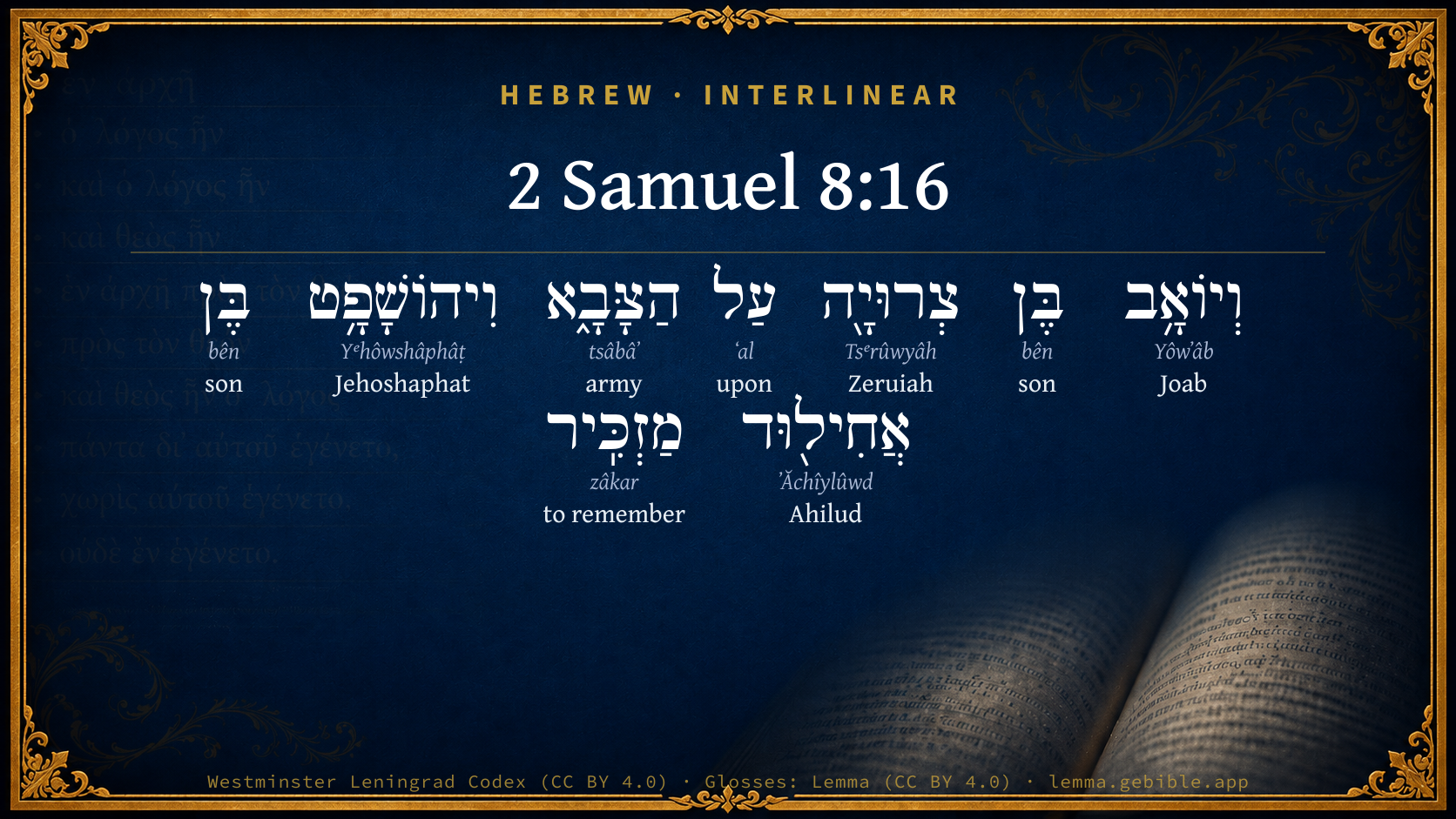
2 Samuel 8:16

Hebrew (Westminster Leningrad Codex) 2 Samuel 8:16 appears in the Hebrew Old Testament. The text above is from the Westminster Leningrad Codex. Each word links to its Strong’s number, a concise gloss, and parsing drawn from the Open Scriptures Hebrew Bible morphology. Click any word for its full Brown-Driver-Briggs (BDB) entry.
Download image
Cite this verse

2 Samuel 8:16 (World English Bible). Public Domain. Lemma interlinear Bible study tool, https://lemma.gebible.app/v/2-samuel/8/16.

Show BibTeX & RIS
BibTeX
RIS
English Translation
Joab the son of Zeruiah was over the host; and Jehoshaphat the son of Ahilud was recorder;
World English Bible · Public Domain
Highlights
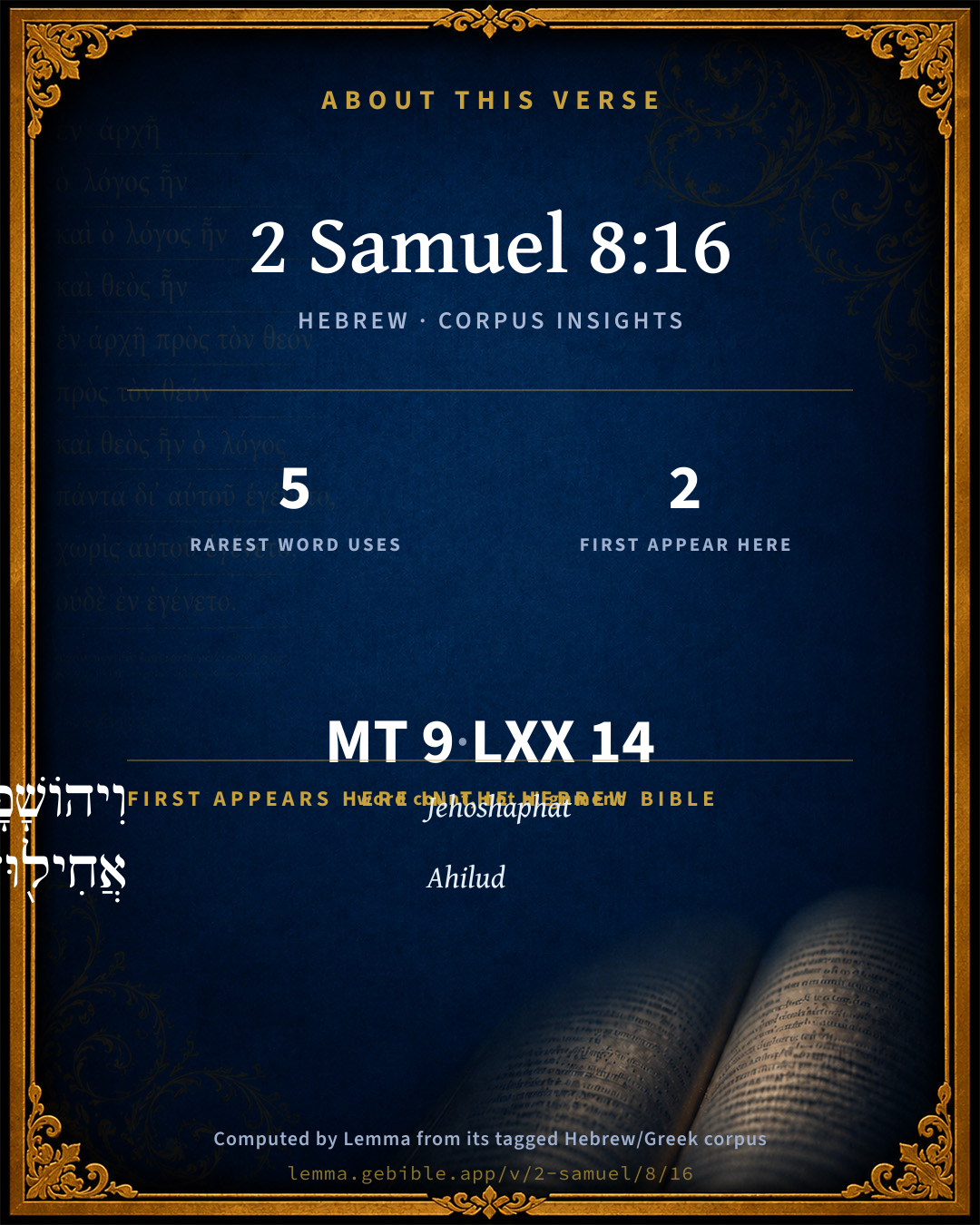
  • 2 first appearances in the Hebrew Bible
Full analysis ↓
Download a study sheet

One document with this verse’s original text, its word-by-word gloss line, the meaning frame, cross-references with their text, attributed commentary, and full source and license credits — printable, and it pastes into notes with its structure intact.

This verse Autodidact and up

Study sheet (.html) Plain text (.txt)

A passage Seminary Student

Up to 50 verses in one chapter. A passage sheet keeps up to 6 commentary sources and 12 cross-references per verse, in the order this page ranks them, and says so on the sheet whenever that leaves anything out. Ask for a single verse and you get the Autodidact verse sheet above.

Everything on this page stays free to read, with no account — the sheet is a download of what is already on screen, not access to it.

Want to remove ads? Support Godless Engineer
Compare translations 3

The same verse in 3 English versions, stacked beneath the original-language interlinear above. Click any original word for its lexicon entry.

Each is an independent rendering of the whole verse — the interlinear is not word-aligned to these translations.

Highlighted words mark where these versions differ — a whole-verse word diff, not a word-by-word alignment.

  • World English Bible Public Domain
    Joab the son of Zeruiah was over the host; and Jehoshaphat the son of Ahilud was recorder;
  • King James Version Public Domain
    And Joab the son of Zeruiah was over the host; and Jehoshaphat the son of Ahilud was recorder;
  • unfoldingWord Literal Text CC BY-SA 4.0
    And Joab, the son of Zeruiah, over the army, and Jehoshaphat, the son of Ahilud, the recorder.

unfoldingWord Literal Text — © unfoldingWord, licensed CC BY-SA 4.0. Word-aligned USFM3 via Door43 (git.door43.org/unfoldingWord/en_ult).

Versions to compare (up to 4)

3 of 4 selected

Show all 18 translations

Every available English version of this verse, each an independent rendering of the whole verse.

  • World English Bible Public Domain
    Joab the son of Zeruiah was over the host; and Jehoshaphat the son of Ahilud was recorder;
  • Berean Standard Bible Public Domain
    Joab son of Zeruiah was over the army; Jehoshaphat son of Ahilud was the recorder;
  • Majority Standard Bible Public Domain
    Joab son of Zeruiah was over the army; Jehoshaphat son of Ahilud was the recorder;
  • King James Version Public Domain
    And Joab the son of Zeruiah was over the host; and Jehoshaphat the son of Ahilud was recorder;
  • American Standard Version (1901) Public Domain
    And Joab the son of Zeruiah was over the host; and Jehoshaphat the son of Ahilud was recorder;
  • Revised Version (1885) Public Domain
    And Joab the son of Zeruiah was over the host; and Jehoshaphat the son of Ahilud was recorder:
  • Geneva Bible (1599) Public Domain
    And Ioab the sonne of Zeruiah was ouer the hoste, and Ioshaphat the sonne of Ahilud was recorder.
  • Douay-Rheims (1899) Public Domain
    And Joab the son of Sarvia was over the army: and Josaphat the son of Ahilud was recorder:
  • Young's Literal Translation Public Domain
    and Joab son of Zeruiah `is' over the host, and Jehoshaphat son of Ahilud `is' remembrancer,
  • Literal Standard Version CC BY-SA 4.0
    and Joab son of Zeruiah [is] over the host, and Jehoshaphat son of Ahilud [is] remembrancer,
  • Unlocked Literal Bible CC BY-SA 4.0
    Joab son of Zeruiah was the commander of the army, and Jehoshaphat son of Ahilud was recorder.
  • unfoldingWord Literal Text CC BY-SA 4.0
    And Joab, the son of Zeruiah, over the army, and Jehoshaphat, the son of Ahilud, the recorder.
  • Darby Bible Public Domain
    And Joab the son of Zeruiah was over the host; and Jehoshaphat the son of Ahilud was chronicler;
  • World Messianic Bible Public Domain
    Joab the son of Zeruiah was over the army, Jehoshaphat the son of Ahilud was recorder,
  • Webster's Bible Public Domain
    And Joab the son of Zeruiah was over the host; and Jehoshaphat the son of Ahilud was recorder;
  • Free Bible Version CC BY-SA 4.0
    Joab, son of Zeruiah, was the army commander, and Jehoshaphat, son of Ahilud, kept the official records.
  • Bible in Basic English Public Domain
    And Joab, the son of Zeruiah, was chief of the army; and Jehoshaphat, the son of Ahilud, was keeper of the records;
  • JPS Tanakh (1917) Public Domain
    And Joab the son of Zeruiah was over the host; and Jehoshaphat the son of Ahilud was recorder;

Literal Standard Version (2020), Covenant Press — licensed CC BY-SA 4.0. Text via the HelloAO Bible API (eBible.org). Unlocked Literal Bible (unfoldingWord) — licensed CC BY-SA 4.0. Text via the HelloAO Bible API (eBible.org). unfoldingWord Literal Text — © unfoldingWord, licensed CC BY-SA 4.0. Word-aligned USFM3 via Door43 (git.door43.org/unfoldingWord/en_ult). Free Bible Version, Dr. Jonathan Gallagher — licensed CC BY-SA 4.0. Text via the HelloAO Bible API (eBible.org).

Word by word

More ways to search: Search by grammar → Find every occurrence → Compare this word →

Practice this passage: Drill this verse → Learn its vocabulary →

About this verse

These counts appear in no published source. They are computed here, from the morphology-tagged text and Lemma’s own curated glosses. What Lemma adds →

9
words
8
distinct lemmas
Historical
section

Notable vocabulary

The rarest word here is אֲחִיל֖וּד Ahilud H286 — appearing just 5 times in the whole Hebrew Bible.

First appearance in Scripture

These words make their first canonical appearance in the Hebrew Bible here:

  • וִיהוֹשָׁפָ֥ט Jehoshaphat H3092
  • אֲחִיל֖וּד Ahilud H286

Shared distinctive vocabulary

אֲחִיל֖וּד Ahilud H286 occurs in 5 verses of the Hebrew Bible. Also found in:

Grammatical profile

  • 1 verb
  • 7 nouns
  • 1 preposition

Verb forms

  • מַזְכִּֽיר Hiphil · Participle Active

Repetition

A word recurs within this verse — often emphatic in Hebrew:

Hebrew & Septuagint length

In English translation the verse runs 17 words from the Hebrew and 21 from the Septuagint (LXX English) — closely comparable.

A rough comparison of the two English renderings, which tokenize alike — not a word-level alignment.

Word counts can differ between the Hebrew and the Greek without any difference in meaning — e.g. the Hebrew direct-object marker אֵת has no separate Greek word, and Greek often adds the article ὁ.

In the original languages it is 9 Hebrew tokens and 14 Greek tokens — but the two are counted differently (Hebrew bundles its prefixes and suffixes into one token; the Greek is in lemma form), so that isn’t a like-for-like length.

Cross-references

5

Topical passages linked to 2 Samuel 8:16 in the Treasury of Scripture Knowledge — connected by theme and wording, ordered by reader-vote popularity; previews shown in the World English Bible.

  • 1 Kings 4:3 Elihoreph and Ahijah, the sons of Shisha, scribes; Jehoshaphat the son of Ahilud, the recorder;
  • 1 Chronicles 11:6 David said, Whoever strikes the Jebusites first shall be chief and captain. Joab the son of Zeruiah went up first, and was made chief.
  • 2 Samuel 19:13 Say you to Amasa, Aren't you my bone and my flesh? God do so to me, and more also, if you aren't captain of the host before me continually in the room of Joab.
  • 2 Samuel 20:23–24 Now Joab was over all the host of Israel; and Benaiah the son of Jehoiada was over the Cherethites and over the Pelethites;
  • 1 Chronicles 18:15–17 Joab the son of Zeruiah was over the host; and Jehoshaphat the son of Ahilud was recorder;

Cross-references courtesy of OpenBible.info (CC BY 4.0).

Hebrew and Greek witnesses Masoretic Hebrew ↔ Greek Septuagint

The same verse in the two great witnesses to the Old Testament, shown verse-for-verse.

These are two independent witnesses, not word-aligned to each other, and the Septuagint is shown in lemma (dictionary) form.

Hebrew 2 Samuel 8:16 Masoretic · Westminster Leningrad Codex

וְיוֹאָ֥ב בֶּן צְרוּיָ֖ה עַל הַצָּבָ֑א וִיהוֹשָׁפָ֥ט בֶּן אֲחִיל֖וּד מַזְכִּֽיר

Joab the son of Zeruiah was over the host; and Jehoshaphat the son of Ahilud was recorder;

World English Bible · Public Domain

Greek LXX 2 Samuel 8:16 Septuagint · lemma form

καί ιωαβ υἱός σαρουιας ἐπί ὁ στρατιά καί ιωσαφατ υἱός αχια ἐπί ὁ ὑπόμνημα

And Joab the son of Saruia was over the host; and Josaphat the son of Achilud was keeper of the records.

LXX2012 (modern English Septuagint) · Public Domain

On this verse, Keil & Delitzsch discusses the Septuagint’s reading. Read the note in Commentary ↓

Hebrew: Westminster Leningrad Codex (CC BY 4.0). Greek: Septuagint (public domain); English from LXX2012 (modern English Septuagint) (Public Domain). How the Septuagint differs from the Hebrew →

Targum (Aramaic paraphrase)

1

The Targum is the ancient Jewish Aramaic paraphrase of the Hebrew Scriptures — an interpretive translation, not the Hebrew text itself. Onkelos (literal) and Pseudo-Jonathan (expansive) render the Torah, and Jonathan the Prophets. Coverage is partial: where no permissively-licensed English translation exists for a verse, only the Aramaic is shown. This is verse-level text, not a word-by-word alignment to the Hebrew.

  1. Targum Jonathan Prophets (Joshua–Malachi)
    וְיוֹאָב בַּר צְרוּיָה מְמַנָא עַל חֵילָא וִיהוֹשָׁפָט בַּר אֲחִילוּד מְמַנָא עַל דָכְרָנַיָא:

    (no public-domain English translation for this verse)

    Targum Jonathan — Aramaic: “Mikraot Gedolot” (public domain). English: “Sefaria Community Translation” (CC0 1.0 (public-domain dedication)); “London "Chaldee Paraphrase," 1871” (public domain). Text via Sefaria.

Commentary

Notes on 2 Samuel 8:16 from classic Christian and Jewish commentators (each source and its license shown beneath its notes). The classic Christian expositions comment on the surrounding passage and are grouped to its opening verse, so a note may address several verses; the Jewish commentaries on the Tanakh (Rashi and others) are per-verse, so they appear only where the commentator wrote on this verse.

Lemma curates 59 commentaries, every one of them public domain or Creative Commons licensed, each selected and text-cleaned for this edition rather than reprinted as found. About our sources →

Trapp's Complete Commentary

John Trapp

2Sa 8:16 And Joab the son of Zeruiah [was] over the host; and Jehoshaphat the son of Ahilud [was] recorder;

Ver. 16. Was over the host.] This honour he had purchased by his valour, {1Ch 11:6} but forfeited by his blood-guiltiness.

And Jehoshaphat … was recorder.] Or, Chancellor of the kingdom, or chief chronicler.

John Trapp, A Commentary or Exposition upon All the Books of the Old and New Testament (1647–1656) — public domain. Text from a community e-Sword module.

Joseph Benson's Commentary

2Sa 8:16. Jehoshaphat was recorder — That is, the remembrancer, or writer of chronicles, as is generally thought; “an employment,” says Dr. Delaney, “of no mean estimation in the eastern world, where it was customary with kings to keep daily registers of all the transactions of their reigns; and a trust which, whosoever discharged to purpose, must be let into the true springs and secrets of action; and, consequently, must be received into the utmost confidence.” Some, however, rather suppose, that by the recorder, the treasurer is intended, who examined all the accounts, and kept records of them.

Joseph Benson's Commentary on the Old and New Testaments (1811–1818) — public domain. Text from a community e-Sword module.

Geneva Bible (1599)

Geneva Bible translators

Or, writer of Chronicles.

Geneva Bible (1599) marginal notes — public domain. Text via Bolls.life.

Jamieson, Fausset & Brown

Robert Jamieson, A. R. Fausset & David Brown

Joab . . . was over the host--by virtue of a special promise (Sa2 5:8).

recorder--historiographer or daily annalist, an office of great trust and importance in Eastern countries.

Jamieson, Fausset & Brown — Commentary Critical and Explanatory on the Whole Bible (1871) — public domain (CC PDM 1.0). Text via the HelloAO Bible API.

Adam Clarke's Commentary

Verse 16. Joab - was over the host] General and commander-in-chief over all the army.

Ahilud - recorder] מזכיר mazkir, remembrancer; one who kept a strict journal of all the proceedings of the king and operations of his army; a chronicler. See the margin.

Adam Clarke's Commentary on the Bible (1810–1826) — public domain. Text from a community e-Sword/MySword module.

Ellicott's Commentary for English Readers

(16) Was recorder.—This was a different office from that of “the scribe” (filled by Seraiah), and appears from 2Ki_18:18-37; 2Ch_34:8, to have been one of considerable importance. (Comp. also Est_6:1.) His duty is supposed to have been something like that of the modern “chancellor,” and he not only registered the king’s decrees, but was his adviser. The same person continued to fill the office in the early years of Solomon’s reign (1Ki_4:3).

A Bible Commentary for English Readers, edited by Charles John Ellicott (1878–1897) — public domain. Text from a community e-Sword module.

The Cambridge Bible for Schools and Colleges

gen. ed. J. J. S. Perowne

16. recorder] Or, remembrancer, a state officer of high rank, who seems not only to have kept a record of events, but to have acted as the king’s adviser. His importance is indicated by 2Ki_18:18; 2Ki_18:37, where he appears as one of the king’s representatives, and 2Ch_34:8, where he is mentioned as one of the commissioners for restoring the Temple. The traveller Chardin describes a similar officer of the Persian court, whose duty it is to furnish the king and his ministers with an account of all important events that take place in the kingdom, and to keep a record of them, and also to register the royal acts and decrees. Travels, III., p. 328.

The Cambridge Bible for Schools and Colleges (gen. ed. J. J. S. Perowne; Cambridge University Press, 1878–1918) — public domain. Text from a community e-Sword module.

John Gill's Exposition

And Joab the son of Zeruiah was over the host,.... Which was not only owing to his relation to David, being his sister's son, but to his promise that whoever smote the Jebusites first should be chief and captain; that is, should have the command of the army under him; this Joab did; and so was entitled to this office, and was put into it, and continued in it, Ch1 11:6,

and Jehoshaphat the son of Ahilud was recorder; of memorable events, who kept a diary of whatsoever remarkable happened, which were digested into a chronicle, history, or annals; see Est 6:1; so the Targum, he"was appointed over the memorials;''or book of memorials, as Kimchi interprets it; that is, to take care of it, and see that everything worthy of notice was inserted in it; or was "remembrancer" (g); one that put the king in mind what was to be done every day, or in certain cases, and so R. Isaiah explains it, the king's counsellor; some take him to be chancellor, as Luther and others (h).

(g) "commemorans", Montanus; "commemorator", Syr. Ar. "memorans, sive reducens in memoriam", Vatablus. (h) Vid. Beckium in Targ. 1 Chron. xviii. 15.

John Gill's Exposition of the Whole Bible (1746–1763) — public domain (CC PDM 1.0). Text via the HelloAO Bible API.

Albert Barnes' Notes on the Bible

For a similar account of the officers of Solomon’s kingdom, see 1Ki 4:1-6, where Jehoshaphat is still the recorder, and Benaiah is advanced to be captain of the host in the room of Joab. The recorder seems to have been a high officer of state, a kind of chancellor, whose office was to keep a record of the events of the kingdom for the king’s information, and hence, he would naturally be the king’s adviser. See Est 6:1-2; Isa 36:22; 2Ch 34:8. Such an officer is found among the ancient Egyptians and Persians.

Ahimelech the son of Abiathar - According to 1Sa 22:9-23, Abiathar, Zadok’s colleague, was the son of Ahimelech. Abiathar the son of Ahimelech continued to be priest through the reign of David. (Compare also 1Ki 1:7, 1Ki 1:42; 1Ki 2:22-27.) It almost necessarily follows that there is some error in the text.

The scribe - Or secretary of state 2Ki 12:10; 2Ki 18:37, different from the military scribe (Jdg 5:14 note).

2Sa 8:18

The Cherethites and the Pelethites - See the marginal reference note.

Chief rulers - The word כהן kôhên, here rendered a “chief ruler,” is the regular word for a priest. In the early days of the monarchy the word כהן kôhên had not quite lost its etymological sense, from the root meaning to minister, or manage affairs, though in later times its technical sense alone survived.

Albert Barnes' Notes on the Bible (1834–1885) — public domain. Text from a community e-Sword/MySword module.

Haydock's Catholic Bible Commentary

Sarvia, sister of David, 1 Paralipomenon ii. 16. --- Army. Joab had acquired such influence over it, that his power was formidable even to David. He was a great warrior, and had contributed more than any other person to establish the throne of his uncle; but he was devoid of justice, and not much unlike Achilles. Jura negat sibi nata, nihil non arrogat armis. (Horace)

(Grotius) --- Recorder, or chancellor. (Challoner) --- A commentariis. (Aquila) --- "Remembrancer," (Haydock) or the person who kept a journal of all memorable transactions. The kings of Persia employed people to keep such journals, 1 Esdras iv. 15., and Esther vi. 1. (Josephus, [Antiquities?] xi. 2.) --- The power of these writers was very great, Judges v. 14., and 4 Kings xviii. 18. (Calmet) --- Reference is often made to their "words of days." They had also to present petitions and memorials from the people. (Menochius)

George Leo Haydock (1774–1849), Haydock's Catholic Family Bible and Commentary, 1859 edition — public domain. Excludes Psalms (Douay-Rheims chapter numbering differs from Protestant) and Deuterocanonical books (Catholic canon only).

Matthew Poole's English Annotations

Joab having doubtless declared his repentance for his former crimes, and having done eminent service for his country, and having received the chief command by virtue of David’s promise and contract, 2Sa 5:8, was still continued in his place.

Recorder; either, first, The writer of chronicles. But it is not likely he would have been put among the great officers of state and church. Or, secondly, The treasurer, who examined all the accounts, and kept records of them. Or, thirdly, The king’s counsellor, as Ahithophel is called, 2Sa 15:12; 1Ch 27:33, who was to bring things of moment to the king’s mind and remembrance, and to admonish him from time to time of things fit to be done. See 1Ki 4:3; 2Ki 18:18.

Matthew Poole's English Annotations on the Holy Bible (1683–1685) — public domain. Text from a community e-Sword/MySword module.

Whedon's Commentary on the Bible

Daniel D. Whedon

DAVID’S OFFICIALS, 2Sa_8:15-18.

16. Joab — See notes on 2Sa_2:13; 2Sa_2:18.

Jehoshaphat… recorder — This was an officer of high rank in the ancient Eastern courts, whose especial duty was to preserve such records as are referred to in Ezr_6:1; Est_6:1. He kept an accurate record of all the items of importance that occurred in the kingdom.

Daniel D. Whedon (gen. ed.), Commentary on the Old and New Testaments (1874–1909) — public domain. Text from a community e-Sword module.

The Pulpit Commentary

Joab... was over the host. Twice in this book we have lists of David"s chief officers here and at the end of ch. 20. The present lint belongs to the period of David"s greatest prosperity, when all went well with him in peace and war, and when Jehovah had elevated him to the unique rank of Messianic king a distinction which belonged to him personally, and was inherited by none of his successors. Between it and the second list there lies a tragic tale of sin and shame, of crime and merited punishment, of the realm rising in rebellion against the adulterous king, and of his own family breaking away from the bends of godly discipline, and giving way to licentiousness, to bloodshed, and to parricidal ambition. But probably David"s character had then gained in spirituality and singleness of heart; whereas now prosperity must already have begun its work of sapping the foundations of his moral nature. Joab, who had been stripped of his command for the murder of Abner, had regained it by his bravery at the capture of Jerusalem. We have seen also that David entrusted to him the building of Jerusalem, and apparently he was prime minister in all matters except probably the king"s judicial functions. Jehoshaphat was recorder; literally, remembrancer. It was his office to reduce the king"s decrees to writing, and also to see that they were carried into execution. Probably after they had been committed to writing, they were laid before the king for his approval, and, when confirmed by his hand or seal, were entered in the book of remembrance.

The Pulpit Commentary (1880–1919), ed. H.D.M. Spence-Jones & Joseph S. Exell — public domain. Text from a community e-Sword module.

John Wesley's Explanatory Notes

Recorder - The treasurer, who examined all the accounts, and kept records of them.

John Wesley, Explanatory Notes Upon the Whole Bible (1754–1765) — public domain. Text via the GEBible commentary corpus.

Keil & Delitzsch

C. F. Keil & F. Delitzsch

The chief ministers were the following: - Joab (see at Sa2 2:18) was "over the army," i.e., commander-in-chief. Jehoshaphat the son of Ahilud, of whom nothing further is known, was mazcir, chancellor; not merely the national annalist, according to the Septuagint and Vulgate (ἐπὶ τῶν ὑπομνημάτην, ὑπομνηματόγραφος; a commentariis), i.e., the recorder of the most important incidents and affairs of the nation, but an officer resembling the magister memoriae of the later Romans, or the waka nuvis of the Persian court, who keeps a record of everything that takes place around the king, furnishes him with an account of all that occurs in the kingdom, places his vis upon all the king's commands, and keeps a special protocol of all these things (vid., Chardin, Voyages v. p. 258, and Paulsen, Regierung der Morgenlnder, pp. 279-80).

Keil & Delitzsch — Biblical Commentary on the Old Testament (1861–1891) — public domain (CC PDM 1.0). Text via the HelloAO Bible API. (Old Testament only.)

Rashi

Rabbi Shlomo Yitzchaki (Rashi)

Recorder [of halachic cases]. [He] announced which [case] was to come before him [Dovid] first for it to be ruled on first.

Rashi on the Tanakh — English translations: “The Judaica Press complete Tanach with Rashi, translated by A. J. Rosenberg” (CC BY 4.0); “Pentateuch with Rashi's commentary by M. Rosenbaum and A.M. Silbermann, 1929-1934” (public domain); “The Metsudah Tanach series, Lakewood, N.J” (CC BY 4.0); and “The Book of Joshua, Metsudah Publications, 1997” (CC BY 4.0). Text via Sefaria.

Lesson kit

Teaching starters — assembled from the data on this page, not authored interpretation. Every prompt links to the verse data it draws on. Edit before teaching.

2 Samuel, in the Historical, opens this verse with 9 words (8 distinct Hebrew lemmas). Its most distinctive word is ʼĂchîylûwd (“Ahilud”). A historical commentator’s framing appears above. Read the whole chapter for the surrounding context.

Discussion questions

  1. The word ʼĂchîylûwd carries the sense “Ahilud.” How does it shape the verse?
  2. 2 words here appear for the first time in Scripture. What is being introduced at this debut?
  3. 2 Samuel 20:24 shares the word «Ahilud» with this verse. How do the two illuminate each other?
  4. “son” occurs 2× in this one verse. What is the effect of the repetition?
  5. The translations on this page render this verse differently — a whole-verse word diff, not a word-by-word alignment. What might account for the different wordings?
  6. The verb «מַזְכִּֽיר» is Hiphil Participle Active. How does its form color the action?
  7. Reading how Trapp's Complete Commentary and Joseph Benson's Commentary read this verse, where do the two commentators agree and where do they part?

Things to notice

Reading settings

Reading text

Shown beneath each verse's original-language words.

Old Testament
Old Testament edition

Read the OT as the Masoretic Hebrew (MT) or the Greek Septuagint (LXX).

English shown for the Greek Septuagint (in the Hebrew ↔ Greek comparison).

Comparing translations? Open the Compare panel on any verse page to stack up to four side by side.