
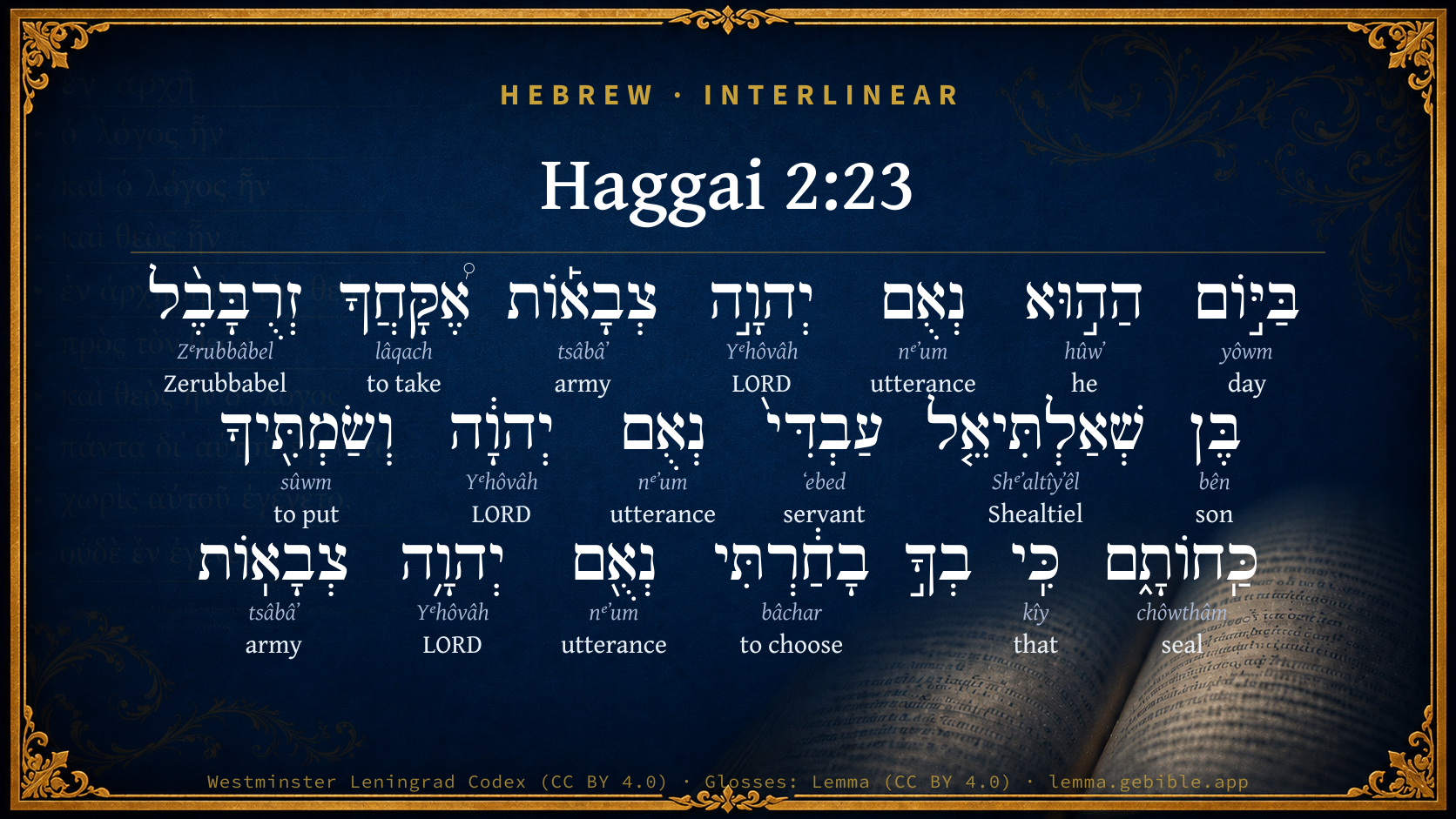
Haggai 2:23

Hebrew (Westminster Leningrad Codex) Haggai 2:23 appears in the Hebrew Old Testament. The text above is from the Westminster Leningrad Codex. Each word links to its Strong’s number, a concise gloss, and parsing drawn from the Open Scriptures Hebrew Bible morphology. Click any word for its full Brown-Driver-Briggs (BDB) entry.
Download image
Cite this verse

Haggai 2:23 (World English Bible). Public Domain. Lemma interlinear Bible study tool, https://lemma.gebible.app/v/haggai/2/23.

Show BibTeX & RIS
BibTeX
RIS
English Translation
In that day, says Yahweh of Hosts, will I take you, Zerubbabel, my servant, the son of Shealtiel,' says Yahweh, 'and will make you as a signet, for I have chosen you,' says Yahweh of Hosts."
World English Bible · Public Domain
Download a study sheet

One document with this verse’s original text, its word-by-word gloss line, the meaning frame, cross-references with their text, attributed commentary, and full source and license credits — printable, and it pastes into notes with its structure intact.

This verse Autodidact and up

Study sheet (.html) Plain text (.txt)

A passage Seminary Student

Up to 50 verses in one chapter. A passage sheet keeps up to 6 commentary sources and 12 cross-references per verse, in the order this page ranks them, and says so on the sheet whenever that leaves anything out. Ask for a single verse and you get the Autodidact verse sheet above.

Everything on this page stays free to read, with no account — the sheet is a download of what is already on screen, not access to it.

Want to remove ads? Support Godless Engineer
Compare translations 3

The same verse in 3 English versions, stacked beneath the original-language interlinear above. Click any original word for its lexicon entry.

Each is an independent rendering of the whole verse — the interlinear is not word-aligned to these translations.

Highlighted words mark where these versions differ — a whole-verse word diff, not a word-by-word alignment.

  • World English Bible Public Domain
    In that day, says Yahweh of Hosts, will I take you, Zerubbabel, my servant, the son of Shealtiel,' says Yahweh, 'and will make you as a signet, for I have chosen you,' says Yahweh of Hosts."
  • King James Version Public Domain
    In that day, saith the LORD of hosts, will I take thee, O Zerubbabel, my servant, the son of Shealtiel, saith the LORD, and will make thee as a signet: for I have chosen thee, saith the LORD of hosts.
  • unfoldingWord Literal Text CC BY-SA 4.0
    On that day’—the declaration of Yahweh of Armies—‘I will take you, Zerubbabel son of Shealtiel, my servant’—the declaration of Yahweh—‘and I will make you like a signet ring, for I have chosen you’—the declaration of Yahweh of Armies!”

unfoldingWord Literal Text — © unfoldingWord, licensed CC BY-SA 4.0. Word-aligned USFM3 via Door43 (git.door43.org/unfoldingWord/en_ult).

Versions to compare (up to 4)

3 of 4 selected

Show all 18 translations

Every available English version of this verse, each an independent rendering of the whole verse.

  • World English Bible Public Domain
    In that day, says Yahweh of Hosts, will I take you, Zerubbabel, my servant, the son of Shealtiel,' says Yahweh, 'and will make you as a signet, for I have chosen you,' says Yahweh of Hosts."
  • Berean Standard Bible Public Domain
    On that day, declares the LORD of Hosts, I will take you, My servant, Zerubbabel son of Shealtiel, declares the LORD, and I will make you like My signet ring, for I have chosen you, declares the LORD of Hosts.”
  • Majority Standard Bible Public Domain
    On that day, declares the LORD of Hosts, I will take you, My servant, Zerubbabel son of Shealtiel, declares the LORD, and I will make you like My signet ring, for I have chosen you, declares the LORD of Hosts.”
  • King James Version Public Domain
    In that day, saith the LORD of hosts, will I take thee, O Zerubbabel, my servant, the son of Shealtiel, saith the LORD, and will make thee as a signet: for I have chosen thee, saith the LORD of hosts.
  • American Standard Version (1901) Public Domain
    In that day, saith Jehovah of hosts, will I take thee, O Zerubbabel, my servant, the son of Shealtiel, saith Jehovah, and will make thee as a signet; for I have chosen thee, saith Jehovah of hosts.
  • Revised Version (1885) Public Domain
    In that day, saith the LORD of hosts, will I take thee, O Zerubbabel, my servant, the son of Shealtiel, saith the LORD, and will make thee as a signet: for I have chosen thee, saith the LORD of hosts.
  • Geneva Bible (1599) Public Domain
    And I will ouerthrowe the throne of kingdomes, and I wil destroy the strength of the kingdomes of the heathen, and I wil ouerthrowe the charets, and those that ride in them, and the horse and the riders shall come downe, euery one by the sword of his brother.
  • Douay-Rheims (1899) Public Domain
    And I will overthrow the throne of kingdoms, and will destroy the strength of the kingdom of the Gentiles: and I will overthrow the chariot, and him that rideth therein: and the horses and their riders shall come down, every one by the sword of his brother.
  • Young's Literal Translation Public Domain
    In that day -- an affirmation of Jehovah of Hosts, I take thee, Zerubbabel, son of Shealtiel, My servant -- an affirmation of Jehovah, And have set thee as a signet, for on thee I have fixed, An affirmation of Jehovah of Hosts!
  • Literal Standard Version CC BY-SA 4.0
    In that day,” a declaration of YHWH of Hosts, || “I take you, Zerubbabel, son of Shealtiel, My servant,” || A declaration of YHWH, || “And have set you as a signet, || For I have fixed on you,” || A declaration of YHWH of Hosts!
  • Unlocked Literal Bible CC BY-SA 4.0
    On that day—this is the declaration of Yahweh of hosts—I will take you, Zerubbabel son of Shealtiel, as my servant—this is Yahweh's declaration. I will make you like a signet ring, for I have chosen you! —this is the declaration of Yahweh of hosts!'”
  • unfoldingWord Literal Text CC BY-SA 4.0
    On that day’—the declaration of Yahweh of Armies—‘I will take you, Zerubbabel son of Shealtiel, my servant’—the declaration of Yahweh—‘and I will make you like a signet ring, for I have chosen you’—the declaration of Yahweh of Armies!”
  • Darby Bible Public Domain
    In that day, saith Jehovah of hosts, will I take thee, Zerubbabel son of Shealtiel, my servant, saith Jehovah, and will make thee as a signet; for I have chosen thee, saith Jehovah of hosts.
  • World Messianic Bible Public Domain
    In that day, says the LORD of Hosts, I will take you, Zerubbabel my servant, the son of Shealtiel,’ says the LORD, ‘and will make you like a signet ring, for I have chosen you,’ says the LORD of Hosts.”
  • Webster's Bible Public Domain
    In that day, saith the LORD of hosts, will I take thee, O Zerubbabel, my servant, the son of Shealtiel, saith the LORD, and will make thee as a signet; for I have chosen thee, saith the LORD of hosts.
  • Free Bible Version CC BY-SA 4.0
    On that day, says the Lord, I will take you, Zerubbabel, son of Shealtiel, my servant, and make you like my signet ring, for I have chosen you. So declares the Lord Almighty.
  • Bible in Basic English Public Domain
    In that day, says the Lord of armies, I will take you, O Zerubbabel, my servant, the son of Shealtiel, says the Lord, and will make you as a jewelled ring: for I have taken you to be mine, says the Lord of armies.
  • JPS Tanakh (1917) Public Domain
    In that day, saith the LORD of hosts, will I take thee, O Zerubbabel, My servant, the son of Shealtiel, saith the LORD, and will make thee as a signet; for I have chosen thee, saith the LORD of hosts.'

Literal Standard Version (2020), Covenant Press — licensed CC BY-SA 4.0. Text via the HelloAO Bible API (eBible.org). Unlocked Literal Bible (unfoldingWord) — licensed CC BY-SA 4.0. Text via the HelloAO Bible API (eBible.org). unfoldingWord Literal Text — © unfoldingWord, licensed CC BY-SA 4.0. Word-aligned USFM3 via Door43 (git.door43.org/unfoldingWord/en_ult). Free Bible Version, Dr. Jonathan Gallagher — licensed CC BY-SA 4.0. Text via the HelloAO Bible API (eBible.org).

Word by word

More ways to search: Search by grammar → Find every occurrence → Compare this word →

Practice this passage: Drill this verse → Learn its vocabulary →

שְׁאַלְתִּיאֵ֤ל
Shᵉʼaltîyʼêl
H7597
“Shealtiel”
Noun, Proper
Part of Speech
Noun
Type
Proper
Full BDB Definition

Origin: from H7592 and H410

TWOT: None

Shealtiel or Salathiel = "I have asked of God" - father of Zerubbabel - son of king Jehoiachin or Jeconiah or Coniah of Judah and uncle of Zerubbabel
  1. בַּיּ֣וֹם yôwm H3117 “in/at the · day” Preposition, Determined + Noun, Common, Masculine, Singular, Absolute
  2. הַה֣וּא hûwʼ H1931 “the · he” Particle, Definite Article + Pronoun, Personal, 3rd Person, Masculine, Singular
  3. נְאֻם nᵉʼum H5002 “utterance of” Noun, Common, Masculine, Singular, Construct
  4. יְהוָ֣ה Yᵉhôvâh H3068 “LORD” Noun, Proper
  5. צְבָא֡וֹת tsâbâʼ H6635 “armies” Noun, Common, Both, Plural, Absolute
  6. אֶ֠קָּחֲךָ lâqach H3947 “to take · you” Verb, Qal, Imperfect, 1st Person, Common, Singular + Suffix, Personal, 2nd Person, Masculine, Singular
  7. זְרֻבָּבֶ֨ל Zᵉrubbâbel H2216 “Zerubbabel” Noun, Proper
  8. בֶּן bên H1121 “son of” Noun, Common, Masculine, Singular, Construct
  9. עַבְדִּי֙ ʻebed H5650 “servant · my” Noun, Common, Masculine, Singular, Construct + Suffix, Personal, 1st Person, Common, Singular
  10. נְאֻם nᵉʼum H5002 “utterance of” Noun, Common, Masculine, Singular, Construct
  11. יְהוָ֔ה Yᵉhôvâh H3068 “LORD” Noun, Proper
  12. וְשַׂמְתִּ֖יךָ sûwm H7760 “and · to put · you” Conjunction + Verb, Qal, Perfect, 1st Person, Common, Singular + Suffix, Personal, 2nd Person, Masculine, Singular
  13. כַּֽחוֹתָ֑ם chôwthâm H2368 “like/as the · seal” Preposition, Determined + Noun, Common, Masculine, Singular, Absolute
  14. כִּֽי kîy H3588 “that” Conjunction
  15. בָחַ֔רְתִּי bâchar H977 “to choose” Verb, Qal, Perfect, 1st Person, Common, Singular
  16. נְאֻ֖ם nᵉʼum H5002 “utterance of” Noun, Common, Masculine, Singular, Construct
  17. יְהוָ֥ה Yᵉhôvâh H3068 “LORD” Noun, Proper
  18. צְבָאֽוֹת tsâbâʼ H6635 “armies” Noun, Common, Both, Plural, Absolute

About this verse

These counts appear in no published source. They are computed here, from the morphology-tagged text and Lemma’s own curated glosses. What Lemma adds →

20
words
14
distinct lemmas
Prophets
section

Notable vocabulary

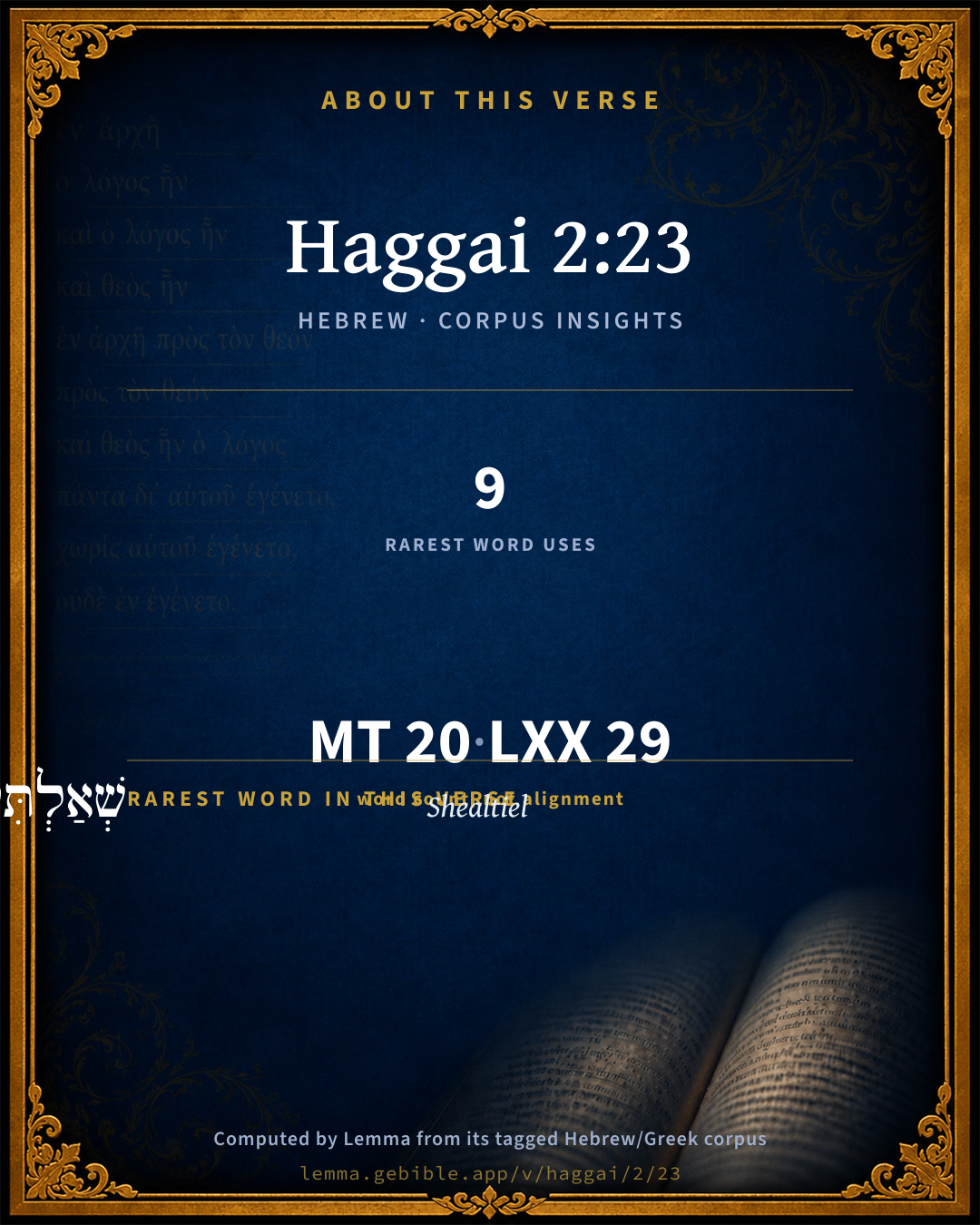
The rarest word here is שְׁאַלְתִּיאֵ֤ל Shealtiel H7597 — appearing just 9 times in the whole Hebrew Bible.

Shared distinctive vocabulary

שְׁאַלְתִּיאֵ֤ל Shealtiel H7597 occurs in 9 verses of the Hebrew Bible. Also found in:

Grammatical profile

  • 3 verbs
  • 14 nouns
  • 1 pronoun
  • 1 preposition
  • 1 conjunction

Verb forms

  • אֶ֠קָּחֲךָ Qal · Imperfect
  • וְשַׂמְתִּ֖יךָ Qal · Perfect
  • בָחַ֔רְתִּי Qal · Perfect

Repetition

Words recur within this verse — often emphatic in Hebrew:

  • נְאֻם utterance H5002 ×3
  • יְהוָ֣ה LORD H3068 ×3
  • צְבָא֡וֹת army H6635 ×2

Hebrew & Septuagint length

In English translation the verse runs 36 words from the Hebrew and 45 from the Septuagint (LXX English) — closely comparable.

A rough comparison of the two English renderings, which tokenize alike — not a word-level alignment.

Word counts can differ between the Hebrew and the Greek without any difference in meaning — e.g. the Hebrew direct-object marker אֵת has no separate Greek word, and Greek often adds the article ὁ.

In the original languages it is 20 Hebrew tokens and 29 Greek tokens — but the two are counted differently (Hebrew bundles its prefixes and suffixes into one token; the Greek is in lemma form), so that isn’t a like-for-like length.

Cross-references

10

Topical passages linked to Haggai 2:23 in the Treasury of Scripture Knowledge — connected by theme and wording, ordered by reader-vote popularity; previews shown in the World English Bible.

  • Isaiah 43:10 You are my witnesses, says Yahweh, and my servant whom I have chosen; that you may know and believe me, and understand that I am he: before me there was no God formed, neither shall there be after me.
  • Isaiah 42:1 Behold, my servant, whom I uphold; my chosen, in whom my soul delights: I have put my Spirit on him; he will bring forth justice to the Gentiles.
  • Song of Solomon 8:6 Set me as a seal on your heart, As a seal on your arm; For love is strong as death. Jealousy is as cruel as Sheol; Its flashes are flashes of fire, A very flame of Yahweh.
  • Jeremiah 22:24 As I live, says Yahweh, though Coniah the son of Jehoiakim king of Judah were the signet on my right hand, yet would I pluck you there;
  • Zechariah 4:6–14 Then he answered and spoke to me, saying, "This is the word of Yahweh to Zerubbabel, saying, 'Not by might, nor by power, but by my Spirit,' says Yahweh of Hosts.
  • Matthew 12:18 "Behold, my servant whom I have chosen; My beloved in whom my soul is well pleased: I will put my Spirit on him. He will proclaim justice to the Gentiles.
  • 1 Peter 2:4 coming to him, a living stone, rejected indeed by men, but chosen by God, precious.
  • John 6:27 Don't work for the food which perishes, but for the food which remains to eternal life, which the Son of Man will give to you. For God the Father has sealed him."
  • 2 Timothy 2:19 However God's firm foundation stands, having this seal, "The Lord knows those who are his," and, "Let every one who names the name of the Lord depart from unrighteousness."
  • Isaiah 49:1–3 Listen, isles, to me; and listen, you peoples, from far: Yahweh has called me from the womb; from the bowels of my mother has he made mention of my name:

Cross-references courtesy of OpenBible.info (CC BY 4.0).

Hebrew and Greek witnesses Masoretic Hebrew ↔ Greek Septuagint

The same verse in the two great witnesses to the Old Testament, shown verse-for-verse.

These are two independent witnesses, not word-aligned to each other, and the Septuagint is shown in lemma (dictionary) form.

Hebrew Haggai 2:23 Masoretic · Westminster Leningrad Codex

בַּיּ֣וֹם הַה֣וּא נְאֻם יְהוָ֣ה צְבָא֡וֹת אֶ֠קָּחֲךָ זְרֻבָּבֶ֨ל בֶּן שְׁאַלְתִּיאֵ֤ל עַבְדִּי֙ נְאֻם יְהוָ֔ה וְשַׂמְתִּ֖יךָ כַּֽחוֹתָ֑ם כִּֽי בְךָ֣ בָחַ֔רְתִּי נְאֻ֖ם יְהוָ֥ה צְבָאֽוֹת

In that day, says Yahweh of Hosts, will I take you, Zerubbabel, my servant, the son of Shealtiel,' says Yahweh, 'and will make you as a signet, for I have chosen you,' says Yahweh of Hosts."

World English Bible · Public Domain

Greek LXX Haggai 2:23 Septuagint · lemma form

ἐν ὁ ἡμέρα ἐκεῖνος λέγω κύριος παντοκράτωρ λαμβάνω σύ ζοροβαβελ ὁ ὁ σαλαθιηλ ὁ δοῦλος ἐγώ λέγω κύριος καί τίθημι σύ ὡς σφραγίς διότι σύ αἱρετίζω λέγω κύριος παντοκράτωρ

and I will overthrow the thrones of kings, and I will destroy the power of the kings of the nations; and I will overthrow chariots and riders; and the horses and their riders shall come down, every one by the sword striving against his brother.

LXX2012 (modern English Septuagint) · Public Domain

Hebrew: Westminster Leningrad Codex (CC BY 4.0). Greek: Septuagint (public domain); English from LXX2012 (modern English Septuagint) (Public Domain). How the Septuagint differs from the Hebrew →

Targum (Aramaic paraphrase)

1

The Targum is the ancient Jewish Aramaic paraphrase of the Hebrew Scriptures — an interpretive translation, not the Hebrew text itself. Onkelos (literal) and Pseudo-Jonathan (expansive) render the Torah, and Jonathan the Prophets. Coverage is partial: where no permissively-licensed English translation exists for a verse, only the Aramaic is shown. This is verse-level text, not a word-by-word alignment to the Hebrew.

  1. Targum Jonathan Prophets (Joshua–Malachi)
    בְּעִדָנָא הַהִיא אֲמַר יְיָ צְבָאוֹת אֲקַרְבִינָךְ זְרֻבָּבֶל בַּר שְׁאַלְתִּיאֵל עַבְדִי אֲמַר יְיָ וְאַשְׁרִינָךְ כִּגְלוֹף דְעִזְקָא עַל יַד אֲרֵי בָךְ אִתְרְעֵיתִי אֲמַר יְיָ צְבָאוֹת:

    (no public-domain English translation for this verse)

    Targum Jonathan — Aramaic: “Mikraot Gedolot” (public domain). English: “Sefaria Community Translation” (CC0 1.0 (public-domain dedication)); “London "Chaldee Paraphrase," 1871” (public domain). Text via Sefaria.

Commentary

Notes on Haggai 2:23 from classic Christian and Jewish commentators (each source and its license shown beneath its notes). The classic Christian expositions comment on the surrounding passage and are grouped to its opening verse, so a note may address several verses; the Jewish commentaries on the Tanakh (Rashi and others) are per-verse, so they appear only where the commentator wrote on this verse.

Lemma curates 59 commentaries, every one of them public domain or Creative Commons licensed, each selected and text-cleaned for this edition rather than reprinted as found. About our sources →

Trapp's Complete Commentary

John Trapp

Hag 2:23 In that day, saith the LORD of hosts, will I take thee, O Zerubbabel, my servant, the son of Shealtiel, saith the LORD, and will make thee as a signet: for I have chosen thee, saith the LORD of hosts.

Ver. 23. I will take thee, O Zerubbabel] That is, O Christ, of whom Zerubbabel was both a father and a figure, Luk 3:27 Zec 4:10 "I will take thee," that is, I will advance and exalt thee. See this expounded and applied by that great apostle, Php 2:5-12.

And will make thee as a signet] That is, I will highly esteem thee, inviolably keep thee, and entirely love thee, Son 8:6 Jer 22:24, and all my people in thee, and for thee, Isa 49:16.

For I have chosen thee] As Isa 42:1. Quoniam in te mihi complacui, saith the Chaldee. For in thee I am well pleased, as Mat 3:17. See the note there.

Saith the Lord of hosts] This is three different times set down in this one verse, for our greater assurance and confirmation of our faith. I shall close up all with that observation of divines, that all the prophets (except Jonah and Nahum) expressly end in some prophecy concerning Christ. He being their mark at which all of them chiefly aimed. Indeed, he is both mark and matter of both Old and New Testament. And therefore if we profit in teaching, hearing, reading, we must have the eye of our mind turned toward Christ, as the faces of the cherubims were toward the mercy-seat. Do this, if ever you will do well.

John Trapp, A Commentary or Exposition upon All the Books of the Old and New Testament (1647–1656) — public domain. Text from a community e-Sword module.

The Biblical Illustrator

Joseph S. Exell

Hag_2:23

Will make thee a signet: for I have chosen thee.

Gods acceptance of Zerubbabel

This text acquaints us with Gods gracious purpose to magnify Zerubbabel, and to put honour upon him. Consider it in a threefold notion,

I. As a prophecy. Directed to Zerubbabel, acquainting him with the future events in the world, and what shall betide him, and his people under him. It is the privilege of His Church, and chosen ones; they have those arcana imperii made known unto them. It is His care for them to settle, and support them against future events.

II. As a promise. It betokens good to him. It is a reward assured to Zerubbabel for what he had done. He had been zealous for his God, for His temple and worship; a promise of his future advancement. In a mystical sense the text is understood of Christ. The text is a Royal Charter made to Zerubbabel Here is the time set; in that day. The person to be advanced; Zerubbabel, My servant. The author of the advancement; that is God. The advancement itself; I will make thee a signet. The ground and reason; for I have chosen thee. The ratification of this promise; it is sealed with the seal of the living God. Apply this text to ourselves.

1. It is our comfort that we may do so, that we stand in such terms with God, that the promises to His ancient people may, with good warrant, be applied and transferred to us,

2. Is it not a blessing and comfort that we have a Zerubbabel to be prince and captain of this people of God? (By Zerubbabel the preacher here refers to Charles I.) (Geo. Stradling, S. T. P.)

The Biblical Illustrator, edited by Joseph S. Exell (c. 1880s–1900s) — public domain. Text from a community e-Sword module.

Joseph Benson's Commentary

Hag 2:23. In that day will I take thee, O Zerubbabel, &c. — Amidst the commotions which I will cause in the world, I will so order it, that Judea shall remain safe under thy government, O Zerubbabel, and thy successors, and be molested by none. A signet, or seal, particularly a royal one, is kept with great care; therefore the promise of making Zerubbabel as a signet, signified keeping him safe, or preserving him as a person of great estimation. For I have chosen thee — To be the ruler of my people. This whole prophecy, from Hag 2:21, addressed to Zerubbabel, is considered by Bishop Chandler, Mr. Lowth, and many others, as parallel to that contained in Hag 2:6-9; that the same commotions and shaking of nations are intended in both passages; and therefore that by Zerubbabel here, the Messiah, typified by him, is chiefly intended. That the prediction could not be properly and fully accomplished in Zerubbabel, personally considered, is evident, as in all likelihood he did not live many years after the finishing of the temple, and certainly did not see any of those great changes here foretold; and therefore the Messiah must be here described under the name of Zerubbabel, as he elsewhere is under that of David. He is, indeed, the signet on God’s right hand; for all power is given to him, and derived from him, he being constituted Head of the church, and Judge of the world. In him the great charter of the gospel is signed and sanctified, and it is in him that all the promises of God are yea and amen. And what is foretold, Hag 2:22, respecting the overthrow of the throne of kingdoms, may probably ultimately refer to his second coming, or to that illustrious display of divine power, whereby a period shall be put to all anti-christian empires, and the kingdoms of this world shall be made the kingdoms of our God and of his Christ, Dan 2:44; Rev 11:15.

Joseph Benson's Commentary on the Old and New Testaments (1811–1818) — public domain. Text from a community e-Sword module.

Tyndale Open Study Notes

Tyndale Open Resources

2:23 The signet ring was a symbol of kingship. An engraved stone set in a gold or silver finger ring was used to seal or endorse official documents. The image here emphasizes the divine authority invested in Zerubbabel and assures the people of God’s continuing involvement in the political process (despite the failures of the Hebrew monarchs). The designation of Zerubbabel as the signet of the Lord no doubt rekindled expectations for the Messiah, since Zerubbabel was a descendant of King David. Yet the declaration ultimately points beyond Zerubbabel (see study note on 2:21) to one of his descendants (see Matt 1:12; Luke 1:32-33; 3:27).

Tyndale Open Study Notes — © Tyndale Open Resources, licensed CC BY-SA 4.0. Text via the HelloAO Bible API.

Geneva Bible (1599)

Geneva Bible translators

Hereby he showeth that there shall be no let or hindrance, when God will make this wonderful restitution of his Church.

Geneva Bible (1599) marginal notes — public domain. Text via Bolls.life.

Jamieson, Fausset & Brown

Robert Jamieson, A. R. Fausset & David Brown

take thee--under My protection and to promote thee and thy people to honor (Psa 78:70).

a signet-- (Sol 8:6; Jer 22:24). A ring with a seal on it; the legal representative of the owner; generally of precious stones and gold, &c., and much valued. Being worn on the finger, it was an object of constant regard. In all which points of view the theocratic people, and their representative, Zerubbabel the type, and Messiah his descendant the Antitype, are regarded by God. The safety of Israel to the end is guaranteed in Messiah, in whom God hath chosen them as His own (Isa 42:1; Isa 43:10; Isa 44:1; Isa 49:3). So the spiritual Israel is sealed in their covenant head by His Spirit (Co2 1:20, Co2 1:22; Eph 1:4, Eph 1:13-14). All is ascribed, not to the merits of Zerubbabel, but to God's gratuitous choice. Christ is the "signet" on God's hand: always in the Father's presence, ever pleasing in his sight. The signet of an Eastern monarch was the sign of delegated authority; so Christ (Mat 28:18; Joh 5:22-23).

Next: Zechariah Introduction

Jamieson, Fausset & Brown — Commentary Critical and Explanatory on the Whole Bible (1871) — public domain (CC PDM 1.0). Text via the HelloAO Bible API.

Adam Clarke's Commentary

Verse 23. In that day, saith the Lord] Some think, says this same learned writer, that Zerubbabel is put here for his people and posterity: but it may well be said that the commotions foretold began in the rebellion of Babylon, which Darius besieged and took; and exercised great cruelties upon its inhabitants. - Herod. lib. iii., sec. 220. Justin. i. 10. Prideaux places this event in the fifth year of Darius; others with more probability, in the eighth year. Compare Zec 2:9.

And will make thee as a signet] I will exalt thee to high dignity, power, and trust, of which the seal was the instrument or sign in those days. Thou shalt be under my peculiar care, and shalt be to me very precious. See Jer 22:24; Cant. Son 8:6; and see the notes on these two places.

For I have chosen thee] He had an important and difficult work to do, and it was necessary that he should be assured of God's especial care and protection during the whole.

ON the three last verses of this prophecy a sensible and pious correspondent sends me the following illustration, which I cheerfully insert. Though in many respects different from that given above, yet I believe that the kingdom of Christ is particularly designed in this prophecy.

"I think there is an apparent difficulty in this passage, because the wars of the Persians and Babylonians were not so interesting to the rising commonwealth of the Jews as many subsequent events of less note in the world, but which were more directly levelled at their own national prosperity; and yet neither the one nor the other could be termed 'a shaking of the heavens and the earth, and an overthrow of the throne of kingdoms.'

"I know not if the following view may be admitted as an explanation of this difficult passage. I take 'the shaking of the heavens and earth' here (as in Hag 2:6) to have a more distant and comprehensive meaning than can belong to Zerubbabel's time, or to his immediate posterity; and that it extends not only to the overthrow of kingdoms then existing, but of the future great monarchies of the world; and not excepting even the civil and ecclesiastical establishments of the Jews themselves. For I take 'the heavens,' in the prophetic language, uniformly to denote the true Church, and never the superstitions and idols of the nations.

"What, then, are we to understand by the promise made to Zerubbabel, 'I will make thee as a signet?' In the first place, the restitution of the religious and civil polity of the people of Israel, conformably to the promises afterwards given in the four first chapters of Zechariah. And, secondly, as the royal signet is the instrument by which kings give validity to laws, and thereby unity and consistence to their empire; so Jehovah, the God and King of Israel, condescends to promise he will employ Zerubbabel as his instrument of gathering and uniting the people again as a distinguished nation; and that such should be the permanency of their political existence, that, whilst other nations and mighty empires should be overthrown, and their very name blotted out under heaven, the Jews should ever remain a distinct people, even in the wreck of their own government, and the loss of all which rendered their religion splendid and attractive.

"In confirmation of this interpretation, I would refer to the threatening denounced against Jeconiah, (called Coniah, Jer 22:24,) the last reigning king of Judah, and the progenitor of Zerubbabel. I apprehend I may be authorized to read Jer 22:24 thus: 'As I live, saith the Lord, though Coniah, the son of Jehoiakim, king of Judah, be the signet upon my right hand, yet will I pluck thee thence, and I will give thee into the hand of them that seek thy life,' c.

"If it be considered that the kings of Judah were in an especial and peculiar manner the delegates of Jehovah, governing in his name and by his authority, a peculiar propriety will appear in their being resembled to signets, or royal seals contained in rings. Compare Ge 41:42 Es 3:10; Es 3:12; Es 8:2; Es 8:8; Da 6:7. And the promise to Zerubbabel will be equivalent to those which clearly predict the preservation of the Jewish people by the Divine command. see Zec 2:4-13; and the faithfulness of God to his covenant concerning the Messiah, who should be born of the seed of Abraham, and in the family of David, of whose throne he was the rightful Proprietor.

"According to this view, by the promise, 'In that day; - I will make thee as a signet,' c., must be understood, that the preservation of the Jews as a distinct people, when all the great empires of the heathen were overthrown, would manifest the honour now conferred on Zerubbabel as the instrument of their restoration after the Babylonish captivity. Thus the promise to Abraham, Ge 12:2-3, 'I will make of thee a great nation - and in thee shall all families of the earth be blessed,' evidently referred to a very distant future period and the honour connected with it could not be enjoyed by Abraham during his mortal life." - M. A. B.

I think, however, that we have lived to see the spirit of this prophecy fulfilled. The earth has been shaken another shaking, and time shall be swallowed up in eternity.

Adam Clarke's Commentary on the Bible (1810–1826) — public domain. Text from a community e-Sword/MySword module.

Ellicott's Commentary for English Readers

(23) Signet.—On the figure of the signet-ring applied to one on whom confidence and affection are bestowed, see Son_8:6; Jer_22:24.

A Bible Commentary for English Readers, edited by Charles John Ellicott (1878–1897) — public domain. Text from a community e-Sword module.

The Cambridge Bible for Schools and Colleges

gen. ed. J. J. S. Perowne

23. will I take thee] In such expressions as this (comp. Deu_4:20; 2Ki_14:21; 2Ki_23:30) the word “take” simply introduces the following action. It has not therefore the sense which some have here given it, “I will take thee into my care and protection.”

as a signet] This promise is referred to by the writer of the Book Ecclesiasticus, in his panegyric of the “famous men” of his nation: “How shall we magnify Zorobabel? even he was as a signet on the right hand,” ch. Sir_49:11. Among the Orientals great honour and importance attached to signets or seals. They were often “engraved stones pierced through their length and hung by a string or chain from the arm or neck, or set in rings for the finger” (Son_8:6; Jer_22:24). “The custom prevalent among the Babylonians of carrying seals is mentioned by Herodotus i. 195 … and the signet ring is noticed as an ordinary part of a man’s equipment in the case of Judah (Gen_38:18), who probably, like many modern Arabs, wore it suspended by a string (rendered ‘bracelets’ in E. V.) from his neck or arm.” Dict. of Bible, Art. Seal.

I have chosen thee] “With these words the Messianic promise made to David was transferred to Zerubbabel and his family among David’s descendants, and would be fulfilled in his person in just the same way as the promise given to David, that God would make him the highest among the kings of the earth (Psa_89:27). The fulfilment culminates in Jesus Christ, the son of David, and descendant of Zerubbabel (Mat_1:12; Luk_3:27), in whom Zerubbabel was made the signetring of Jehovah. Jesus Christ has raised up the kingdom of His father David again, and of His kingdom there will be no end (Luk_1:32-33). Even though it may appear oppressed and deeply humiliated for the time by the power of the kingdoms of the heathen, it will never be crushed and destroyed, but will break in pieces all these kingdoms, and destroy them, and will itself endure for ever (Dan_2:44; Heb_12:28; 1Co_15:24).” Keil ad loc. Clark’s Theological Library.

The Cambridge Bible for Schools and Colleges (gen. ed. J. J. S. Perowne; Cambridge University Press, 1878–1918) — public domain. Text from a community e-Sword module.

Albert Barnes' Notes on the Bible

I will make thee as a signet - God reverses to Zerubbabel the sentence on Jeconiah for his impiety. To Jeconiah He had said Jer 22:24, “though he were the signet upon My right hand, yet would I pluck thee thence; and I will give thee into the hand of them that seek thy life.” The signet was very precious to its owner, never parted with, or only to those to whom authority was delegated (as by Pharaoh to Joseph Gen 41:42, or by Ahasuerus to Haman Est 3:10 and then to Mordecai Est 8:2.); through it his will was expressed. Hence, the spouse in the Canticles says, Son 8:6. “Set me, as a seal upon thy heart, as a seal upon thy arm.” The signet also was an ornament to him who wore it. “God is glorianfied in His saints;” 2Th 1:10. by Zerubbabel in the building of His house. He gave him estimation with Cyrus, who entrusted him with the return of his people, and made him (who would have been the successor to the throne of Judah, had the throne been re-established) his governor over the restored people.

God promises to him and his descendants protection amid all shaking of empires. “He was a type of Christ in bringing back the people from Babylon, as Christ delivered us from sin death and hell: he built the temple, as Christ built the Church; he protected his people against the Samaritans who would hinder the building, as Christ protects His Church: he was dear and joined to God, as Christ was united to Him, and hypostatically united and joined His Humanity to the Word. The true Zerubbabel then, i. e., Christ, the son and antitype of Zerubbabel, is the signet in the hand of the Father, both passively and actively, whereby God impresses His own Majesty thoughts and words and His own Image on men angels and all creatures.” “The Son is the Image of God the Father, having His entire and exact likeness, and in His own beauty beaming forth the nature of the Father. In Him too God seals us also to His own likeness, since, being conformed to Christ, we gain the image of God.” “Christ, as the Apostle says, is Heb 1:3 “the Image of the invisible God, the brightness of His Glory and the express Image of His Person,” who, as the Word and Seal and express Image, seals it on others. Christ is here called a signet, as Man not as God. For it was His Manhood which He took of the flesh and race of Zerubbabel. He is then, in His Manhood, the signet of God;

1) as being hypostatically united with the Son of God;

2) because the Word impressed on His Humanity the likeness of Himself, His knowledge, virtue, holiness, thoughts, words, acts and conversation;

3) because the Man Christ was the seal, i. e., the most evident sign and witness of the attributes of God, His power, justice, wisdom, and especially His exceeding love for man. For, that God might show this, He willed that His Son should be Incarnate. Christ thus Incarnate is as a seal, in which we see expressed and depicted the love power justice wisdom etc. of God;

4) because Christ as a seal, attested and certified to us the will of God, His doctrine law commands, i. e., those which He promulgated and taught in the Gospel.

“No one,” John saith Joh 1:18, “hath seen God at any time: the Only-Begotten Son Who is the Image the Father, He hath declared Him.” Hence, God gave to Christ the power of working miracles, that He might confirm His words as by a seal, and demonstrate that they were revealed and enjoined to Him by God, as it is in John Joh 6:27, “Him hath God the Father sealed.” “Christ is also the seal of God, because by His impress, i. e., the faith grace virtue and conversation from Him and by the impress in Baptism and the other sacraments, “He willed to conform us to the Image of His Son,” Rom 8:29. that 1Co 15:49, “as we have borne the image of the earthly Adam, we mnay also bear the image of the heavenly.” Then, Christ, like a seal, seals and guards His faithful against all temptations and enemies. The seal of Christ is the Cross, according to that of Ezekiel, “Seal a mark upon the foreheads of the men who sigh,” and in the Revelation Rev 7:2, “I saw another Angel having the seal of the living God.” For the Cross guardeth us against the temptations of the flesh, the world and the devil, and makes us followers, soldiers, and martyrs of Christ crucified. Whence the Apostle says, Gal 6:17. “I bear in my body the marks of the Lord Jesus.”

“This is said without doubt of the Messiah, the expected;” says even a Jewish controversialist , “who shall be of the seed of Zerubbabel; and therefore this promise was not fulfilled at all in himself: for at the time of this prophecy he had aforetime been governor of Judah, and afterward he did not rise to any higher dignity than what he was up to that day: and in like way we find that God said to Abraham our father in the covenant between the pieces, Gen 15:7, Gen 15:18. “I am the Lord who brought thee out of Ur of the Chaldees to give thee this land to inherit it,” and beyond doubt this covenant was confirmed of God to the seed of Abraham, as lie Himself explained it there afterward, when He said, “In that day God made a covenant with Abraham, saying, To thy seed have I given this land etc.,” and many like these.

Abarbanel had laid down the right principles, though of necessity misapplied. “Zerubbabel did not reign in Jerusalem and did not rule in it, neither lie nor any man of his seed; but immediately after the building of the house, he returned to Babylon and died there in his captivity, and how saith he, ‘In that day I will take thee?’ For after the fall of the kingdom of Persia Zerubbabel is not known for any greatness, and his name is not mentioned in the world. Where then will be the meaning of ‘And I will place thee as a signet, for thee have I chosen?’ For the signet is as the seal-ring which a man putteth on his hand, it departeth not from it, night or day. And when was this fulfilled in Zerubbabel? But the true meaning, in my opinion, is, that God showed Zerubbabel that this very second house would not abide, for after him should come another captivity, and of this he says, ‘I shake the heaven etc.,’ and afterward, after a long time, will God take His vengeance of these nations ‘which have devoured Jacob and laid waste his dwelling place;’ and so he says ‘I will overthrow the thrones, etc.,’ and He sheweth him further that the king who shall rule over Israel at the time of the redemption is the Messiah of the seed of Zerubbabel and of the house of David; and God saw good to shew him all this to comfort him and to speak to his heart; and it is as if he said to him, ‘It is true that thou shalt not reign in the time of the second temple, nor any of thy seed, but in that day when God shall overthrow the throne of the kingdoms of the nations, when He gathereth His people Israel and redeemeth them, then shalt thou reign over My people, for of thy seed shall he be who ruleth from Israel at that time forever, and therefore he saith, ‘I will take thee, O Zerubabbel etc.,’ for because the Messiah was to be of his seed he saith, that he will take him; and this is as he says, Eze 37:24. ‘And David My servant shall be a prince to them forever;’ for the very Messiah, he shall be David, he shall be Zerubbabel, because he shall be a scion going forth out of their hewn trunk” Isa 11:1.

For I have chosen thee - God’s forecoming love is the ground of all the acceptableness of His creature 1Jo 4:19. “We love Him, because He first loved us.” Zerubbabel was a devoted servant of God. God acknowledges his faithfulness. Only, the beginning of all was with God. God speaks of the nearness to Himself which He had given him. But in two words He cuts off all possible boastfulhess of His creature. Zerubbabel was all this, not of himself, but “because God had chosen” him. Even the sacred manhood of our Lord (it is acknowledged as a theological truth) was not chosen for any foreseen merits, but for the great love, with which God the Father chose it, and God the Son willed to be in such wise incarnate, and God the Holy Spirit willed that that Holy Thing should be conceived of Him. So God says of Him Isa 42:1, “Behold My Servant whom I uphold, Mine elect in whom My soul delighteth;” and God bare witness to Him Mat 3:17; Mat 17:5, “This is My Beloved Son in whom I am well pleased.”

Albert Barnes' Notes on the Bible (1834–1885) — public domain. Text from a community e-Sword/MySword module.

Matthew Poole's English Annotations

In that day; during those days of troubles, wars, and destruction, and particularly towards the end of them. I will take thee; advance, honour, defend, and own. O Zerubbabel: personally understood it respecteth the beginning of those days. Politically understood, it refers to all those times in which God promiseth he would, and indeed did, preserve, guide, and honour such governors of his people, who were as Zerubbabel was; somewhat of which promise and performance you may observe in the times succeeding unto, and through, the Maccabees’ times. Typically this refers to Christ, and the setting up of is kingdom, shadowed out by the government of Zerubbabel. My servant: the style changed seems to point to him who was God’s most beloved servant, Isa 42:1; 52:13. The son of Shealtiel, who was one of the progenitors of the Messiah, Mat 1:12; Luk 3:27. Will make thee as a signet: which is very highly valued, carefully kept, and used to confirm and ratify gifts, edicts, and patents, Dan 6:17. So shall the antitypical Zerubbabel, the Messiah, be advanced, loved, and inviolably preserved King, and supreme over his church, for he is the chosen One, the beloved One, in whom God was well pleased, as the Chaldee paraphrast, and Mat 3:17.

Matthew Poole's English Annotations on the Holy Bible (1683–1685) — public domain. Text from a community e-Sword/MySword module.

The Pulpit Commentary

In that day. When the heathen nations of the earth are overthrown, Israel shall be safe, and be the more exalted by the Divine favour and protection. Will I take. The verb simply serves to introduce the following act as one of importance, and does not signify, "take under my protection". (comp. Deu_4:20; 2Ki_14:21; Keil) My servant. An honourable title used especially of David (1Ki_11:13, (Jer_33:21, etc.) and his future successors. (Eze_34:23, etc.; Eze_37:24) Make thee as a signet. I will make thee most precious in my sight. (comp. Son_8:6) Among Orientals the signet ring was an article of great importance and value. (see Rev_5:1 Rev_9:4; and "Dict. of the Bible," art. "Seal The allusion is particularly appropriate here, because Zerubbabel is set at the head of the nation in the place of his grandfather(?) Jeconiah, whose rejection from the monarchy had been couched in these terms: "As I live, saith the Lord, though Coniah the son of Jehoiakim King of Judah were the signet upon my right hand, yet would I pluck thee thence". (Jer_22:24) The Son of Sirach, in his praise of great men, refers to this premise," How shall we magnify Zorobabel? even he was as a signet on the right hand" (Ecc 49:11). The signet, too, is the sign of authority (Gen_41:42; Est_3:10) so Zerubbabel has authority delegated to him from God, the type of him who said, "All things are delivered unto me of my Father". (Mat_11:27) "The true Zerubbabel, i.e. Christ, the Son and Antitype of Zerubbabel, is the signet in the hand of the Father, both passively and actively, whereby God impresses his own majesty, thought, and words, and his own image, on men, angels, and all creatures" (Corn. a Lapide ap. Pusey). I have chosen thee. This is not a personal assurance only to Zerubbabel, for neither he nor his natural seed reigned in Jerusalem, or rose to any special eminence in the kingdoms of this world. The fulfilment must be looked for in his spiritual progeny and in Christ. Promises are often made in Scripture to individuals which are accomplished only in their descendants; witness those made to Abraham and the other patriarchs, the prophecies of Jacob to his sons, and many others of a similar nature in the Old Testament, Those large promises made to David in old time, that his seed should endure forever, that hie throne should be as the sun before God (Psa_89:36, Psa_89:37; 2Sa_7:16) were now passed on to Zerubbabel and to his line, because of him was to spring Messiah, in whom alone these wide predictions find their fulfilment, "He shall be great, and shall be called the Son of the Highest: and the Lord God shall give unto him the throne of his father David: and he shall reign over the house of Jacob forever; and of his kingdom there shall be no end". (Luk_1:32, Luk_1:33)

Zerubbabel the son of Shealtiel.

I THE SUBJECT OF A SPECIAL DIVINE. CALLING. This alluded to in the words, "I have chosen thee, saith the Lord of hosts." By this was meant, not merely that his birth in Babylon, preservation and growth to manhood, high esteem and favour among his countrymen and with Cyrus, as well as obvious natural abilities, had all come about in accordance with that general providence by which God appoints to all men the times of their coming into life and of their going out at death, (Ecc_3:1, Ecc_3:2) the bounds of their habitation, (Act_17:26) and the particular circumstances of their lot; (Psa_16:6) but, in addition to this, that God bad specially selected, endowed, and trained him for the office into which he had been thrust, that of leading the people forth from Babylon, and for the work he had now to do, that of laying the foundations, not of a second temple merely, but of a second empire. What Haggai wished to impress upon Zerubbabel was that the position be occupied at the head of the new community was one that had come to him, not by accident, but, as in the earlier cases of Abraham, (Isa_41:2) Moses, (Exo_3:10) and Cyrus, (Isa_44:28) by Divine appointment. One can imagine theinspiration a thought like that must have imparted to Zerubbabel, the stimulus it must have given to every good impulse of his heart, the elevation and dignity it must have lent to even the least significant action he performed. Similar inspiration, stimulus, and dignity might be enjoyed by all, were all to realize that "the steps of a good man are ordered by the, (Psa_37:23) and that for each man"s life there is a plan existing in the mind of God, into which each will be surely guided, if only he will meekly put himself into the hand of God. (Psa_25:9)

II THE POSSESSOR OF A LOFTY FAITH. This distinction may be claimed for Zerubbabel, though not assigned a place in the magnificent picture gallery of Hebrews 11.; because it is difficult to see how Zerubbabel, being the man he was, a descendant of the royal line of David, and located where he was in the prosperous city of Babylon, and situated as he was in the manifest enjoyment of the Persian monarch"s favour, would have acted as he did, had he not been possessed of faith. In comparison with those who remained behind in Babylon, but a handful set forth to seek the land of their fathers; and it is little probable that Zerubbabel would have cast in his lot with the pilgrims, had he not been persuaded that the movement was of God, that the journey upon which they were about to enter had been marked out for them by Heaven, and that the insignificant and feeble company itself was a true representative of Jehovah"s Church upon the earth. That spirit, it may be added, which was preheat in Zerubbabel, the spirit of faith, which can recognize the superiority of things spiritual and religious to things earthly and secular, that is not ashamed to espouse the cause of truth and righteousness on earth, however humble and obscure, because it is the truth of God, and that is always ready, when the voice of God cries within the soul, "Who will go for us?" to respond, "Here am I, Lord; send me!" lies at the basis of all true greatness in the soul.

III AN EXAMPLE OF INDOMITABLE COURAGE. Few things rarer, even among Christians, than a fortitude that can brave all difficulties and defy all oppositions, especially in matters of religion. Yet is nothing more indispensable. Thousands of brilliant schemes, private as well as public, in Church as in state, have come to nothing for want of manly resolution to go on with them and carry them through. Had Zerubbabel been a craven, he never would have done so outwardly foolish a thing as join himself with a handful of pilgrims who proposed to quit their comfortable homes long and perilous journey to a and prosperous estates in Babylon, and undertake a promised land on the other side of the Syrian desert. Nor, had he been a weakling, would he have succeeded in carrying these pilgrims in safety to their destination. Traced out on a modern map, it seems not a far journey between Babylon and Jerusalem. Most likely Zerubbabel took the road that Abraham bad travelled by when he departed from Ur of the Chaldees, moved northwards to Haran, rounded the head of the Syrian desert, and came down upon Palestine by Damascus. Yet to Abraham, with his comparatively small company, the feat must have been immensely easier than it could have been to Zerubbabel, with fifty thousand heads of families and nearly a quarter of a million souls in all to take charge of. But with the help of God and his own stout heart he did it. It was a feat only second to that of Moses, who brought their fathers out of Egypt, led them through the scorching and fiery wilderness, and set them down at the gate of Canaan. Nor again, unless Zerubbabel had been a hero who was not easily discouraged, could he have brought the temple to completion, working, as he did, with a company of builders who became alarmed at every menace uttered against them by the people of the land, and who threw down their tools on encountering the smallest resistance. So difficult was the task to keep them at their work, and so formidable were the obstacles he had to encounter, that Zechariah, a younger prophet than Haggai, likened the work he had to do to the levelling of a great mountain, encouraging him at the same time with the assurance that it would be levelled, "Who art thou, O great mountain? before Zerubbabel thou shalt become a plain." And become a plain it did. Reinforced by a fresh company of builders who came up from Babylon under the leadership of Ezra, Zerubbabel and his band pushed on the work till it was finished, and the temple received its topstone with shoutings of "Grace, grace unto it". (Ezr_7:6-8; Zec_4:7)

IV AN ILLUSTRATION OF CONSPICUOUS PROMOTION. A great honour was conferred on Zerubbabel when chosen by Jehovah to be his servant, and as such appointed the leader of his people. A greater when assured that God would graciously assist him until the task assigned to him had been successfully carried through. The greatest when, in reward for his faithful service, it was promised that he and his would be sharers in the future Messianic glory reserved for Israel; for this is what the clause means, "I will make thee as a signet ring, O Zerubbabel, my servant." It lends a remarkable interest to this verse of Haggai to be told that in recent excavations upon Temple Hill, a ring has been discovered with the name of Haggai inscribed upon it ("Recent Discoveries on the Temple Hill," pp. 7880). In the eyes of Orientals the finger ring, or signet, was regarded as a valuable possession, to lose which was esteemed a dire calamity. To speak of one as a signet ring was to assure him of tender regard and watchful preservation. Reversing the threat pronounced against Jeconiah, the last King of Judah, and the grandfather of Zerubbabel, (Jer_22:24) Jehovah promises that Zerubbabel shall be as a signet ring upon his own finger, i.e. shall be indissolubly associated with himself and regarded with sincere affection; and this promise may be said to have been fulfilled, so far as Zerubbabel was concerned, in that he was henceforth inseparably linked with the history of God"s people, and in fact constituted an ancestor of Messiah, who afterwards sprang from his line. But as the day when the promised distinction should be Conferred on Zerubbabel was expressly specified as the day when the process begun by Jehovah of shaking the heavens and the earth should have been brought to a completion, at which time Zerubbabel should have been long dead, it becomes obvious that the promise must be understood as having reached its highest fulfi1ment in Zerubbabel"s distinguished descendant, who should then be made Jehovah"s signet ring, in reward for a greater work of emancipation and temple building than had been performed by Zerubbabel. And in this reward all share who, whether before his coming or since, have been fellow workers with him by serving the will of God in their day and generation.

LESSONS.

1. The value of great men to their own age and to the world atlarge.

2. The certainty of a Divine fore-ordination m ordinary life.

3. The impossibility of faithful work on earth losing its reward.

The Pulpit Commentary (1880–1919), ed. H.D.M. Spence-Jones & Joseph S. Exell — public domain. Text from a community e-Sword module.

John Wesley's Explanatory Notes

My servant - A type of him who was God's most beloved servant. As a signet - Which is very highly valued, and carefully kept. So shall the antitypical Zerubbabel, the Messiah, be advanced, loved, and inviolably preserved king, and supreme over his church. He is indeed the signet on God's right-hand. For all power is given to him, and derived from him. In him the great charter of the gospel is signed, and sanctified, and it is in him, that all the promises of God are yea and amen.

John Wesley, Explanatory Notes Upon the Whole Bible (1754–1765) — public domain. Text via the GEBible commentary corpus.

unfoldingWord translationNotes

Door43 World Missions Community

On that day

"On the day I choose to act"

this is the declaration of Yahweh of hosts

Yahweh speaks of himself by name to express the certainty of what he is declaring. See how you translated this in Haggai 1:9. AT: "this is what Yahweh of hosts has declared" or "this is what I, Yahweh of hosts, have declared" (See: First, Second, or Third Person)

Zerubbabel ... Shealtiel

See how you translated these men's names in Haggai 1:1. (See: How to Translate Names)

this is Yahweh's declaration

Yahweh speaks of himself by name to express the certainty of what he is declaring. See how you translated this in Haggai 1:9. AT: "this is what Yahweh has declared" or "this is what I, Yahweh, have declared" (See: First, Second, or Third Person)

I will make you like a signet ring

Kings used a signet ring to seal documents to show that they truly had his authority. Zerubbabel would have authority from Yahweh because he would speak Yahweh's words. (See: Simile)

translationWords

servant

seal

chosen one

unfoldingWord translationNotes — © Distant Shores Media and the Door43 World Missions Community, licensed CC BY-SA 4.0. Source: git.door43.org/Door43/en_tn.

Rashi

Rabbi Shlomo Yitzchaki (Rashi)

and I will make you as a signet In contrast to what was decreed upon his father Jeconiah (Jer. 22: 24): “As I live, says the Lord, though Coniah the son of Jehoiakim, king of Judah, be a signet on My right hand, from there I will remove you.” [Jeremiah further] states there (ibid. 22:30): “Inscribe this man childless.” We learn that his repentance availed [Jeconiah], and Zerubbabel was born to him, and he was made as a signet.

Rashi on the Tanakh — English translations: “The Judaica Press complete Tanach with Rashi, translated by A. J. Rosenberg” (CC BY 4.0); “Pentateuch with Rashi's commentary by M. Rosenbaum and A.M. Silbermann, 1929-1934” (public domain); “The Metsudah Tanach series, Lakewood, N.J” (CC BY 4.0); and “The Book of Joshua, Metsudah Publications, 1997” (CC BY 4.0). Text via Sefaria.

Lesson kit

Teaching starters — assembled from the data on this page, not authored interpretation. Every prompt links to the verse data it draws on. Edit before teaching.

Haggai, in the Prophets, opens this verse with 20 words (14 distinct Hebrew lemmas). Its most distinctive word is Shᵉʼaltîyʼêl (“Shealtiel”). A historical commentator’s framing appears above. Read the whole chapter for the surrounding context.

Discussion questions

  1. The word Shᵉʼaltîyʼêl carries the sense “Shealtiel.” How does it shape the verse?
  2. 1 Chronicles 3:17 shares the word «Shealtiel» with this verse. How do the two illuminate each other?
  3. “utterance” occurs 3× in this one verse. What is the effect of the repetition?
  4. These translations render this verse differently; the difference is in the English rendering, not the original. What questions does that raise?
  5. The verb «אֶ֠קָּחֲךָ» is Qal Imperfect. How does its form color the action?
  6. Reading how Trapp's Complete Commentary and The Biblical Illustrator read this verse, where do the two commentators agree and where do they part?

Things to notice

Reading settings

Reading text

Shown beneath each verse's original-language words.

Old Testament
Old Testament edition

Read the OT as the Masoretic Hebrew (MT) or the Greek Septuagint (LXX).

English shown for the Greek Septuagint (in the Hebrew ↔ Greek comparison).

Comparing translations? Open the Compare panel on any verse page to stack up to four side by side.