
2 Samuel 10:16

Hebrew (Westminster Leningrad Codex) 2 Samuel 10:16 appears in the Hebrew Old Testament. The text above is from the Westminster Leningrad Codex. Each word links to its Strong’s number, a concise gloss, and parsing drawn from the Open Scriptures Hebrew Bible morphology. Click any word for its full Brown-Driver-Briggs (BDB) entry.
Download image
Cite this verse

2 Samuel 10:16 (World English Bible). Public Domain. Lemma interlinear Bible study tool, https://lemma.gebible.app/v/2-samuel/10/16.

Show BibTeX & RIS
BibTeX
RIS
English Translation
Hadarezer sent, and brought out the Syrians who were beyond the River: and they came to Helam, with Shobach the captain of the host of Hadarezer at their head.
World English Bible · Public Domain
Highlights
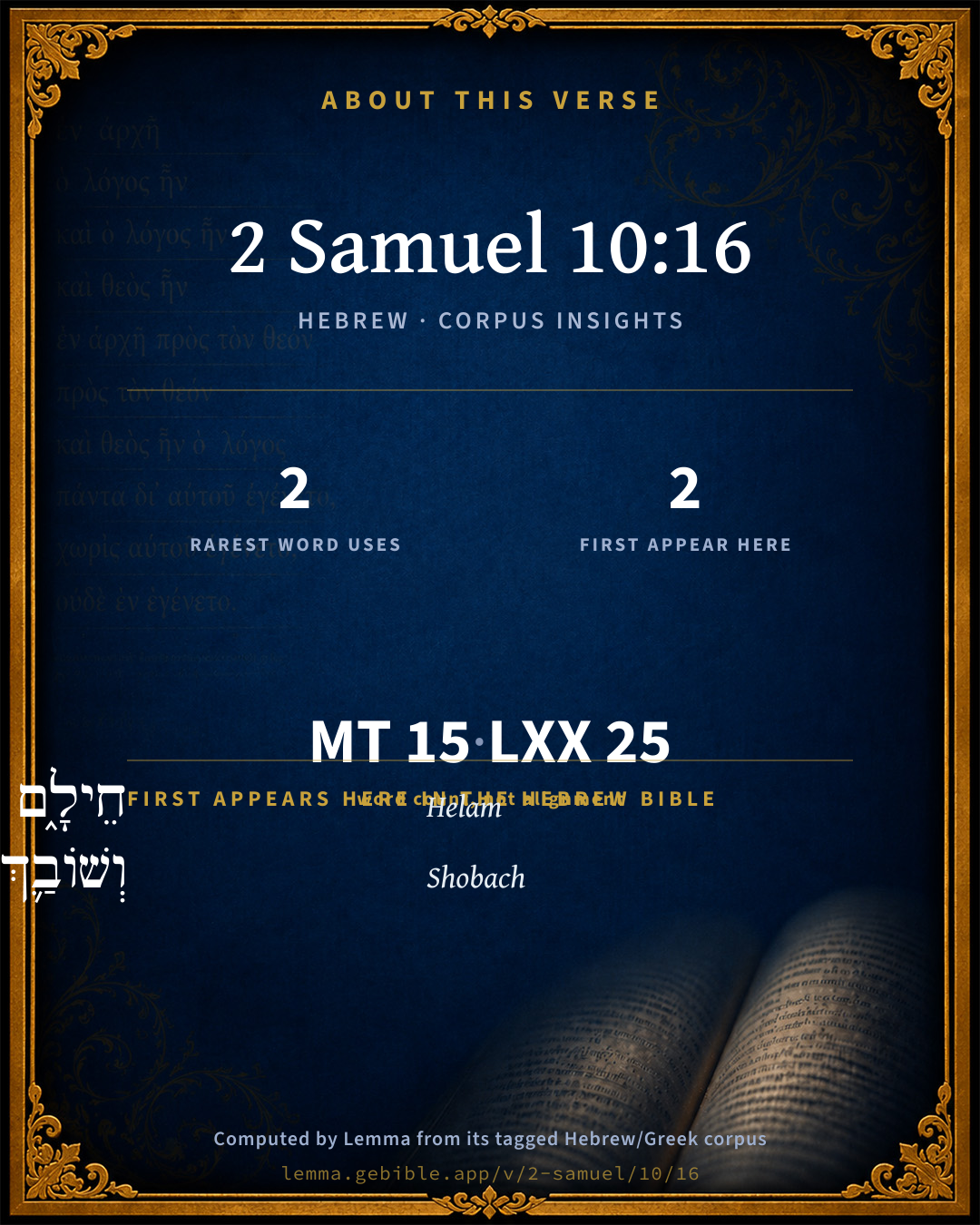
  • 2 first appearances in the Hebrew Bible
Full analysis ↓
Download a study sheet

One document with this verse’s original text, its word-by-word gloss line, the meaning frame, cross-references with their text, attributed commentary, and full source and license credits — printable, and it pastes into notes with its structure intact.

This verse Autodidact and up

Study sheet (.html) Plain text (.txt)

A passage Seminary Student

Up to 50 verses in one chapter. A passage sheet keeps up to 6 commentary sources and 12 cross-references per verse, in the order this page ranks them, and says so on the sheet whenever that leaves anything out. Ask for a single verse and you get the Autodidact verse sheet above.

Everything on this page stays free to read, with no account — the sheet is a download of what is already on screen, not access to it.

Want to remove ads? Support Godless Engineer
Compare translations 3

The same verse in 3 English versions, stacked beneath the original-language interlinear above. Click any original word for its lexicon entry.

Each is an independent rendering of the whole verse — the interlinear is not word-aligned to these translations.

Highlighted words mark where these versions differ — a whole-verse word diff, not a word-by-word alignment.

  • World English Bible Public Domain
    Hadarezer sent, and brought out the Syrians who were beyond the River: and they came to Helam, with Shobach the captain of the host of Hadarezer at their head.
  • King James Version Public Domain
    And Hadarezer sent, and brought out the Syrians that were beyond the river: and they came to Helam; and Shobach the captain of the host of Hadarezer went before them.
  • unfoldingWord Literal Text CC BY-SA 4.0
    And Hadadezer sent, and he brought out Aram that from beyond the River, and they came Helam. And Shobach, the commander of the army of Hadadezer, to their faces.

unfoldingWord Literal Text — © unfoldingWord, licensed CC BY-SA 4.0. Word-aligned USFM3 via Door43 (git.door43.org/unfoldingWord/en_ult).

Versions to compare (up to 4)

3 of 4 selected

Show all 18 translations

Every available English version of this verse, each an independent rendering of the whole verse.

  • World English Bible Public Domain
    Hadarezer sent, and brought out the Syrians who were beyond the River: and they came to Helam, with Shobach the captain of the host of Hadarezer at their head.
  • Berean Standard Bible Public Domain
    Hadadezer sent messengers to bring more Arameans from beyond the Euphrates, and they came to Helam with Shobach the commander of Hadadezer’s army leading them.
  • Majority Standard Bible Public Domain
    Hadadezer sent messengers to bring more Arameans from beyond the Euphrates, and they came to Helam with Shobach the commander of Hadadezer’s army leading them.
  • King James Version Public Domain
    And Hadarezer sent, and brought out the Syrians that were beyond the river: and they came to Helam; and Shobach the captain of the host of Hadarezer went before them.
  • American Standard Version (1901) Public Domain
    And Hadarezer sent, and brought out the Syrians that were beyond the River: and they came to Helam, with Shobach the captain of the host of Hadarezer at their head.
  • Revised Version (1885) Public Domain
    And Hadarezer sent, and brought out the Syrians that were beyond the River: and they came to Helam, with Shobach the captain of the host of Hadarezer at their head.
  • Geneva Bible (1599) Public Domain
    And Hadarezer sent, and brought out the Aramites that were beyond the Riuer: and they came to Helam, and Shobach the captaine of the hoste of Hadarezer went before them.
  • Douay-Rheims (1899) Public Domain
    And Adarezer sent and fetched the Syrians, that were beyond the river, and brought over their army: and Sobach, the captain of the host of Adarezer, was their general.
  • Young's Literal Translation Public Domain
    and Hadadezer sendeth, and bringeth out Aram which `is' beyond the River, and they come in to Helam, and Shobach head of the host of Hadadezer `is' before them.
  • Literal Standard Version CC BY-SA 4.0
    and Hadadezer sends, and brings out Aram which [is] beyond the River, and they come to Helam, and Shobach, head of the host of Hadadezer, [is] before them.
  • Unlocked Literal Bible CC BY-SA 4.0
    Then Hadarezer sent for Aramean troops from beyond the Euphrates River. They came to Helam, and Shobak, the commander of Hadarezer's army, went before them.
  • unfoldingWord Literal Text CC BY-SA 4.0
    And Hadadezer sent, and he brought out Aram that from beyond the River, and they came Helam. And Shobach, the commander of the army of Hadadezer, to their faces.
  • Darby Bible Public Domain
    And Hadarezer sent, and drew forth the Syrians that were beyond the river; and they came to Helam; and Shobach the captain of the host of Hadarezer [went] before them.
  • World Messianic Bible Public Domain
    Hadadezer sent and brought out the Syrians who were beyond the River; and they came to Helam, with Shobach the captain of the army of Hadadezer at their head.
  • Webster's Bible Public Domain
    And Hadarezer sent, and brought out the Syrians that were beyond the river: and they came to Helam; and Shobach the captain of the host of Hadarezer went before them.
  • Free Bible Version CC BY-SA 4.0
    Hadadezer sent for more Arameans to be brought from beyond the Euphrates River. They arrived in Helam under the leadership of Shobach, commander of Hadadezer's army.
  • Bible in Basic English Public Domain
    And Hadadezer sent for the Aramaeans who were on the other side of the River: and they came to Helam, with Shobach, the captain of Hadadezer's army, at their head.
  • JPS Tanakh (1917) Public Domain
    And Hadadezer sent, and brought out the Arameans that were beyond the River; and they came to Helam, with Shobach the captain of the host of Hadadezer at their head.

Literal Standard Version (2020), Covenant Press — licensed CC BY-SA 4.0. Text via the HelloAO Bible API (eBible.org). Unlocked Literal Bible (unfoldingWord) — licensed CC BY-SA 4.0. Text via the HelloAO Bible API (eBible.org). unfoldingWord Literal Text — © unfoldingWord, licensed CC BY-SA 4.0. Word-aligned USFM3 via Door43 (git.door43.org/unfoldingWord/en_ult). Free Bible Version, Dr. Jonathan Gallagher — licensed CC BY-SA 4.0. Text via the HelloAO Bible API (eBible.org).

Word by word

More ways to search: Search by grammar → Find every occurrence → Compare this word →

Practice this passage: Drill this verse → Learn its vocabulary →

חֵילָ֑ם
Chêylâm
H2431
“Helam”
Noun, Proper
Part of Speech
Noun
Type
Proper
Full BDB Definition

Origin: from H2428

TWOT: None

Helam = "stronghold" - a place east of the Jordan, west of the Euphrates, in Gilead, at which the Syrians under Hadarezer were defeated by David
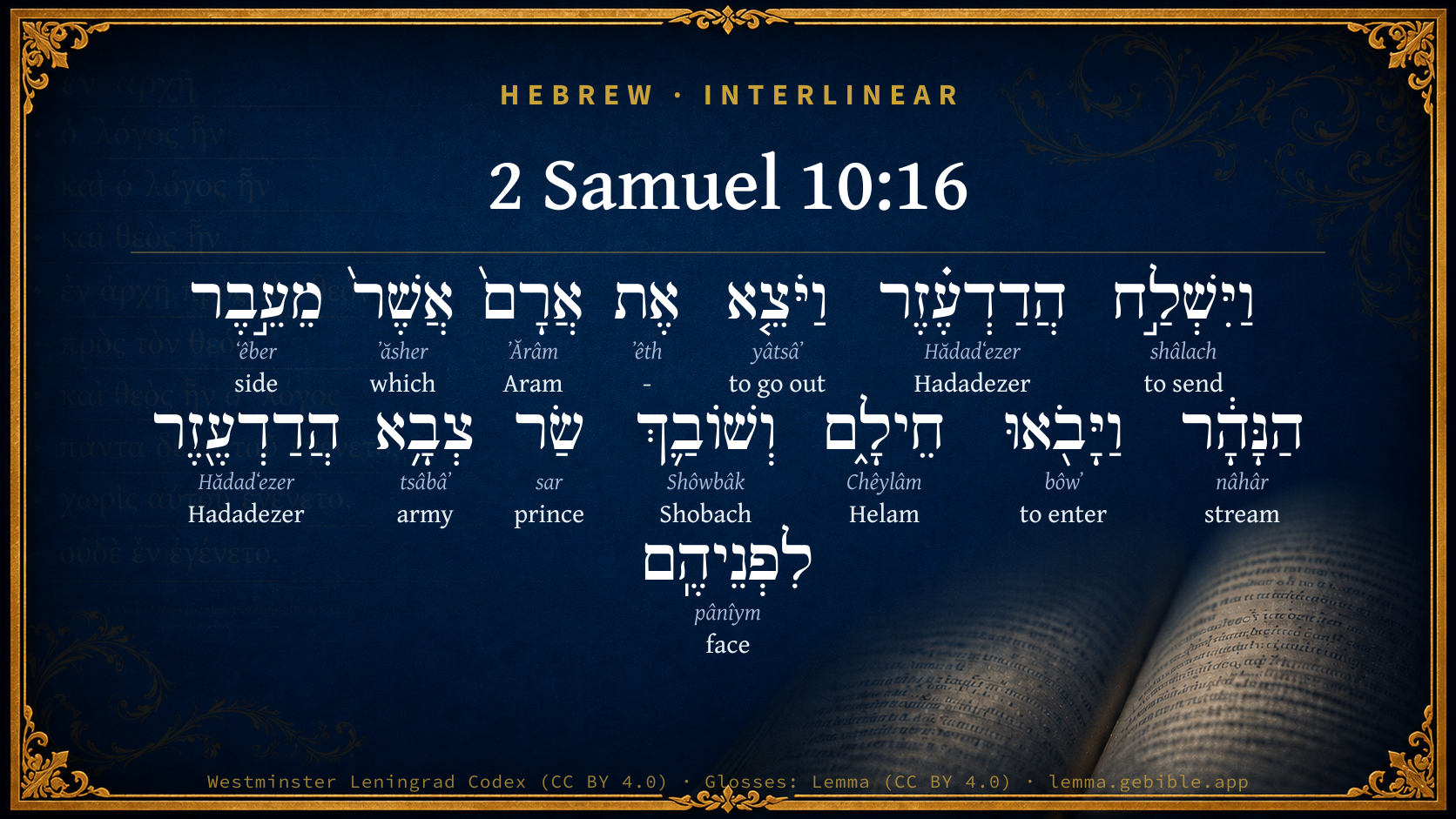
  1. וַיִּשְׁלַ֣ח shâlach H7971 “and · to send” Conjunction + Verb, Qal, Sequential Imperfect, 3rd Person, Masculine, Singular
  2. הֲדַדְעֶ֗זֶר Hădadʻezer H1909 “Hadadezer” Noun, Proper
  3. וַיֹּצֵ֤א yâtsâʼ H3318 “and · to go out” Conjunction + Verb, Hiphil, Sequential Imperfect, 3rd Person, Masculine, Singular
  4. אֶת ʼêth H853 “-” Particle, Direct Object
  5. אֲרָם֙ ʼĂrâm H758 “Aram” Noun, Proper
  6. אֲשֶׁר֙ ʼăsher H834 “which” Particle, Relative
  7. מֵעֵ֣בֶר ʻêber H5676 “from · side of” Preposition + Noun, Common, Masculine, Singular, Construct
  8. הַנָּהָ֔ר nâhâr H5104 “the · stream” Particle, Definite Article + Noun, Common, Masculine, Singular, Absolute
  9. וַיָּבֹ֖אוּ bôwʼ H935 “and · to enter” Conjunction + Verb, Qal, Sequential Imperfect, 3rd Person, Masculine, Plural
  10. וְשׁוֹבַ֛ךְ Shôwbâk H7731 “and · Shobach” Conjunction + Noun, Proper
  11. שַׂר sar H8269 “prince of” Noun, Common, Masculine, Singular, Construct
  12. צְבָ֥א tsâbâʼ H6635 “army of” Noun, Common, Both, Singular, Construct
  13. הֲדַדְעֶ֖זֶר Hădadʻezer H1909 “Hadadezer” Noun, Proper
  14. לִפְנֵיהֶֽם pânîym H6440 “to/for · face(s) · their” Preposition + Noun, Common, Both, Plural, Construct + Suffix, Personal, 3rd Person, Masculine, Plural

About this verse

These counts appear in no published source. They are computed here, from the morphology-tagged text and Lemma’s own curated glosses. What Lemma adds →

15
words
14
distinct lemmas
Historical
section

Notable vocabulary

The rarest word here is חֵילָ֑ם Helam H2431 — appearing just 2 times in the whole Hebrew Bible.

First appearance in Scripture

These words make their first canonical appearance in the Hebrew Bible here:

  • חֵילָ֑ם Helam H2431
  • וְשׁוֹבַ֛ךְ Shobach H7731

Shared distinctive vocabulary

חֵילָ֑ם Helam H2431 occurs in 2 verses of the Hebrew Bible. Also found in:

Grammatical profile

  • 3 verbs
  • 10 nouns
  • 2 particles

Verb forms

  • וַיִּשְׁלַ֣ח Qal · Sequential Imperfect
  • וַיֹּצֵ֤א Hiphil · Sequential Imperfect
  • וַיָּבֹ֖אוּ Qal · Sequential Imperfect

Repetition

A word recurs within this verse — often emphatic in Hebrew:

  • הֲדַדְעֶ֗זֶר Hadadezer H1909 ×2

Hebrew & Septuagint length

In English translation the verse runs 29 words from the Hebrew and 33 from the Septuagint (LXX English) — closely comparable.

A rough comparison of the two English renderings, which tokenize alike — not a word-level alignment.

Word counts can differ between the Hebrew and the Greek without any difference in meaning — e.g. the Hebrew direct-object marker אֵת has no separate Greek word, and Greek often adds the article ὁ.

In the original languages it is 15 Hebrew tokens and 25 Greek tokens — but the two are counted differently (Hebrew bundles its prefixes and suffixes into one token; the Greek is in lemma form), so that isn’t a like-for-like length.

Cross-references

4

Topical passages linked to 2 Samuel 10:16 in the Treasury of Scripture Knowledge — connected by theme and wording, ordered by reader-vote popularity; previews shown in the World English Bible.

  • 1 Chronicles 19:16 When the Syrians saw that they were put to the worse before Israel, they sent messengers, and drew forth the Syrians who were beyond the River, with Shophach the captain of the host of Hadarezer at their head.
  • 2 Samuel 8:3–8 David struck also Hadadezer the son of Rehob, king of Zobah, as he went to recover his dominion at the River.
  • 1 Chronicles 18:3 David struck Hadarezer king of Zobah to Hamath, as he went to establish his dominion by the river Euphrates.
  • 1 Chronicles 18:5 When the Syrians of Damascus came to help Hadarezer king of Zobah, David struck of the Syrians twenty-two thousand men.

Cross-references courtesy of OpenBible.info (CC BY 4.0).

Hebrew and Greek witnesses Masoretic Hebrew ↔ Greek Septuagint

The same verse in the two great witnesses to the Old Testament, shown verse-for-verse.

These are two independent witnesses, not word-aligned to each other, and the Septuagint is shown in lemma (dictionary) form.

Hebrew 2 Samuel 10:16 Masoretic · Westminster Leningrad Codex

וַיִּשְׁלַ֣ח הֲדַדְעֶ֗זֶר וַיֹּצֵ֤א אֶת אֲרָם֙ אֲשֶׁר֙ מֵעֵ֣בֶר הַנָּהָ֔ר וַיָּבֹ֖אוּ חֵילָ֑ם וְשׁוֹבַ֛ךְ שַׂר צְבָ֥א הֲדַדְעֶ֖זֶר לִפְנֵיהֶֽם

Hadarezer sent, and brought out the Syrians who were beyond the River: and they came to Helam, with Shobach the captain of the host of Hadarezer at their head.

World English Bible · Public Domain

Greek LXX 2 Samuel 10:16 Septuagint · lemma form

καί ἀποστέλλω αδρααζαρ καί συνἄγω ὁ συρία ὁ ἐκ ὁ πέραν ὁ ποταμός χαλαμακ καί παραγίγνομαι αιλαμ καί σωβακ ἄρχω ὁ δύναμις αδρααζαρ ἔμπροσθεν αὐτός

And Adraazar sent and gathered the Syrians from the other side of the river Chalamak, and they came to Aelam; and Sobac the captain of the host of Adraazar was at their head.

LXX2012 (modern English Septuagint) · Public Domain

On this verse, The Pulpit Commentary discusses the Septuagint’s reading. Read the note in Commentary ↓

Hebrew: Westminster Leningrad Codex (CC BY 4.0). Greek: Septuagint (public domain); English from LXX2012 (modern English Septuagint) (Public Domain). How the Septuagint differs from the Hebrew →

Targum (Aramaic paraphrase)

1

The Targum is the ancient Jewish Aramaic paraphrase of the Hebrew Scriptures — an interpretive translation, not the Hebrew text itself. Onkelos (literal) and Pseudo-Jonathan (expansive) render the Torah, and Jonathan the Prophets. Coverage is partial: where no permissively-licensed English translation exists for a verse, only the Aramaic is shown. This is verse-level text, not a word-by-word alignment to the Hebrew.

  1. Targum Jonathan Prophets (Joshua–Malachi)
    וּשְׁלַח הֲדַדְעֶזֶר וְאַפֵּיק יַת אֱנַשׁ אֲרָם דְמֵעִבַּר פְּרָת וַאֲתוֹ לְחֵילָם וְשׁוֹבַךְ רַב חֵילָא דְהֲדַדְעֶזֶר קֳדָמֵיהוֹן:

    (no public-domain English translation for this verse)

    Targum Jonathan — Aramaic: “Mikraot Gedolot” (public domain). English: “Sefaria Community Translation” (CC0 1.0 (public-domain dedication)); “London "Chaldee Paraphrase," 1871” (public domain). Text via Sefaria.

Commentary

Notes on 2 Samuel 10:16 from classic Christian and Jewish commentators (each source and its license shown beneath its notes). The classic Christian expositions comment on the surrounding passage and are grouped to its opening verse, so a note may address several verses; the Jewish commentaries on the Tanakh (Rashi and others) are per-verse, so they appear only where the commentator wrote on this verse.

Lemma curates 59 commentaries, every one of them public domain or Creative Commons licensed, each selected and text-cleaned for this edition rather than reprinted as found. About our sources →

Trapp's Complete Commentary

John Trapp

2Sa 10:16 And Hadarezer sent, and brought out the Syrians that [were] beyond the river: and they came to Helam; and Shobach the captain of the host of Hadarezer [went] before them.

Ver. 16. And Hadarezar sent.] He is elsewhere called Hadadezar: Daleth and Resh ( ã and ø) being letters very like one to another. Hence some collect probably that the Hebrew letters had the same figure of old as now they have, and therefore were not the same with the Samaritan charactars. The Samaritan Jod is one of the largest; but the Hebrew Jod is one of the least letters, whence that of our Saviour. {Mat 5:18} {Hebrew Text Note}

And they came to Helam.] A place nowhere else mentioned in Scripture. Perhaps it was the same town of the Arabes Trachonitae, {a} which Ptolemy calleth Alamtha.

{a} Junius.

John Trapp, A Commentary or Exposition upon All the Books of the Old and New Testament (1647–1656) — public domain. Text from a community e-Sword module.

Tyndale Open Study Notes

Tyndale Open Resources

10:16 Hadadezer: See study note on 10:1. • Helam is unknown. • Apparently David had extended his empire as far north as the Euphrates River (see also study note on 8:3).

Tyndale Open Study Notes — © Tyndale Open Resources, licensed CC BY-SA 4.0. Text via the HelloAO Bible API.

Geneva Bible (1599)

Geneva Bible translators

Or, Hadarezer.

Or, Euphrates.

Geneva Bible (1599) marginal notes — public domain. Text via Bolls.life.

Jamieson, Fausset & Brown

Robert Jamieson, A. R. Fausset & David Brown

THE SYRIANS DEFEATED. (Sa2 10:15-19)

Hadarezer sent and brought out the Syrians that were beyond the river--This prince had enjoyed a breathing time after his defeat (Sa2 8:3). But alarmed at the increasing power and greatness of David, as well as being an ally of the Ammonites, he levied a vast army not only in Syria, but in Mesopotamia, to invade the Hebrew kingdom. Shobach, his general, in pursuance of this design, had marched his troops as far as Kelam, a border town of eastern Manasseh, when David, crossing the Jordan by forced marches, suddenly surprised, defeated, and dispersed them. As a result of this great and decisive victory, all the petty kingdoms of Syria submitted and became his tributaries (see on Ch1 19:1).

Next: 2 Samuel Chapter 11

Jamieson, Fausset & Brown — Commentary Critical and Explanatory on the Whole Bible (1871) — public domain (CC PDM 1.0). Text via the HelloAO Bible API.

Adam Clarke's Commentary

Verse 16. The Syrians that were beyond the river] That is, the Euphrates.

Hadarezer] This is the same that was overthrown by David, 2Sa 8:3 and there called Hadadezer; which is the reading here of about thirty of Kennicott's and De Rossi's MSS. But the ר resh and ד daleth are easily interchanged.

Adam Clarke's Commentary on the Bible (1810–1826) — public domain. Text from a community e-Sword/MySword module.

Ellicott's Commentary for English Readers

(16) Hadarezer.—On the form of the name see Note on 2Sa_8:3. He felt the importance of the defeat he had sustained, and now evidently made an effort to rally all his forces, even calling together vassal tribes from beyond the Euphrates.

They came to Helam.—The Hebrew word here is not necessarily a proper name, and might be translated their host; but as the name unquestionably occurs in 2Sa_10:17, it is better taken as a proper name here also. It is entirely omitted in Chronicles. Its exact situation is unknown, but from 2Sa_8:3; 1Ch_18:3, it is plain that it was in the general direction of the Euphrates and not very far from Hamath.

A Bible Commentary for English Readers, edited by Charles John Ellicott (1878–1897) — public domain. Text from a community e-Sword module.

The Cambridge Bible for Schools and Colleges

gen. ed. J. J. S. Perowne

15–19. Renewed attack of the Syrians. Their total defeat

16. And Hadarezer sent, &c.] The correct form of his name is probably Hadadezer. See note on ch. 2Sa_8:3. He now mustered his vassals and tributaries (2Sa_10:19) from beyond “the river,” i.e. the Euphrates. “Brought out” = caused to take the field: it is the causative voice of the verb “to go out,” which is the technical term for going out to war (1Sa_8:20; 2Sa_11:1).

and they came to Helam] The words might be translated and their force came; but on the whole it is preferable to take Helam as a proper name, as in 2Sa_10:17. It has been proposed to identify it with Alamata, a town west of the Euphrates, but it is nowhere else mentioned, and its site is quite uncertain. This clause is omitted in Chronicles, where also in place of and came to Helam in the next verse we read and came upon them, so that the name of the place is altogether omitted there.

The Cambridge Bible for Schools and Colleges (gen. ed. J. J. S. Perowne; Cambridge University Press, 1878–1918) — public domain. Text from a community e-Sword module.

John Gill's Exposition

And Hadarezer sent,.... The same with Hadadezer, Sa2 8:3, who was at the head of this confederacy, and to whom the rest of the kings of Syria were servants, Sa2 10:19,

and brought out the Syrians that were beyond the river; the river Phrat or Euphrates, as the Targum; so the Arabic version and Josephus (y), who says, that he hired them:

and they came to Helam; which, according to the same writer, was king of the Syrians beyond Euphrates; but it seems to be the name of a place, where was the general rendezvous of the Syrian army. Junius conjectures that it is the same with the Alamatha of Ptolemy (z), which he places with the Trachonite Arabs near the Euphrates:

and Shobach the captain of the host of Hadarezer went before them: before the whole combined army, which according to Josephus (a), consisted of eighty thousand foot, and ten thousand horse: this general is called Shophach, Ch1 19:16 the letters "B" and "P" being of the same pronunciation in the Hebrew tongue, as Kimchi observes, though it is there read "Shobach", in the Syriac and Arabic versions; he was no doubt a very able, valiant, and skilful general, since he is particularly mentioned by name, and whose name was then famous; the Arabic version calls him a spear bearer of Hadarezer.

(y) Ut supra, (Antiqu. l. 7. c. 6.) sect. 3. (z) Geograph. l. 5. c. 15. (a) Ut supra. (Antiqu. l. 7. c. 6. sect. 3.)

John Gill's Exposition of the Whole Bible (1746–1763) — public domain (CC PDM 1.0). Text via the HelloAO Bible API.

Albert Barnes' Notes on the Bible

Helam - The place is unknown. Some prefer the translation of the Latin Vulgate: “their host came.”

Albert Barnes' Notes on the Bible (1834–1885) — public domain. Text from a community e-Sword/MySword module.

Matthew Poole's English Annotations

Hadarezer; the same with Hadadezer, 2Sa 8:3.

The Syrians that were beyond the river; who having engaged themselves in the former expedition, as was noted before, were now obliged to proceed in their own defence, being also persuaded and hired to this second expedition, 2Sa 10:19. Shobach, or Shopach, 1Ch 19:16.

Matthew Poole's English Annotations on the Holy Bible (1683–1685) — public domain. Text from a community e-Sword/MySword module.

Whedon's Commentary on the Bible

Daniel D. Whedon

16. Brought out the Syrians… beyond the river — By which act he seems to have lost his dominion in that border. See 2Sa_8:3. When the Syrian cities beyond the Euphrates learned that their king had been smitten by the army of David they openly renounced their allegiance to the kingdom of Zobah.

Helam — A place somewhere beyond the Jordan, and probably near the borders of Syria; but its situation has never been discovered.

Shobach the captain — Who was to Hadarezer’s army what Joab was to David’s.

Daniel D. Whedon (gen. ed.), Commentary on the Old and New Testaments (1874–1909) — public domain. Text from a community e-Sword module.

The Pulpit Commentary

Hadarezer. (see note on 2Sa_8:3) Hadarezer probably had been well content to let his subjects receive the pay of the Ammonites, and extend his empire at their cost. But as paramount king in Aram, the defeat of the mercenaries obliged him to make the war a national affair, and undertake the management of it himself. He therefore summons troops from all the Aramean states on both sides of the Euphrates, and places his own general, Shobach, in command, and makes Helam the place of gathering. Helam. No such place is known, and the word might mean "their army," in which case the translation would be, "and they came in full force." The Vulgate takes it in this way, but makes the verb the causative singular, and translates, "and he brought their army." On the other hand, the LXX, the Syriac, and the Chaldee make it a proper name here, as even the Vulgate necessarily does in ver. 17, where there can be no doubt. In the parallel place (1Ch_19:16, 1Ch_19:17) it is omitted in the first place, and in the second we find in its stead, "upon them." Either, therefore, the chronicler did not know of such a place, or the text is corrupt. Ewald and others suppose that Helam may be identified with Alamata; but we learn 1Ch_18:3 that the battle was fought near Hamath, and Alamata is on the Euphrates, too far away for David to have made his attack there.

The Pulpit Commentary (1880–1919), ed. H.D.M. Spence-Jones & Joseph S. Exell — public domain. Text from a community e-Sword module.

Rashi

Rabbi Shlomo Yitzchaki (Rashi)

Shovach the commander of Hadarezer's aray. Because he was very mighty and powerful, he is mentioned by name.

Rashi on the Tanakh — English translations: “The Judaica Press complete Tanach with Rashi, translated by A. J. Rosenberg” (CC BY 4.0); “Pentateuch with Rashi's commentary by M. Rosenbaum and A.M. Silbermann, 1929-1934” (public domain); “The Metsudah Tanach series, Lakewood, N.J” (CC BY 4.0); and “The Book of Joshua, Metsudah Publications, 1997” (CC BY 4.0). Text via Sefaria.

Lesson kit

Teaching starters — assembled from the data on this page, not authored interpretation. Every prompt links to the verse data it draws on. Edit before teaching.

2 Samuel, in the Historical, opens this verse with 15 words (14 distinct Hebrew lemmas). Its most distinctive word is Chêylâm (“Helam”). A historical commentator’s framing appears above. Read the whole chapter for the surrounding context.

Discussion questions

  1. What does “Helam” (Chêylâm) contribute to the verse as a whole?
  2. 2 words make their first appearance in Scripture here. What does this debut establish?
  3. How does 2 Samuel 10:17, which shares the word «Helam», read alongside this verse?
  4. What does the repetition of “Hadadezer” (2× in this one verse) do in this verse?
  5. The translations on this page render this verse differently — a whole-verse word diff, not a word-by-word alignment. What might account for the different wordings?
  6. «וַיִּשְׁלַ֣ח» is a Qal Sequential Imperfect verb. How does that grammatical form shape the action described?
  7. Compare how Trapp's Complete Commentary and Tyndale Open Study Notes read this verse. Where do they agree or differ?

Things to notice

Reading settings

Reading text

Shown beneath each verse's original-language words.

Old Testament
Old Testament edition

Read the OT as the Masoretic Hebrew (MT) or the Greek Septuagint (LXX).

English shown for the Greek Septuagint (in the Hebrew ↔ Greek comparison).

Comparing translations? Open the Compare panel on any verse page to stack up to four side by side.