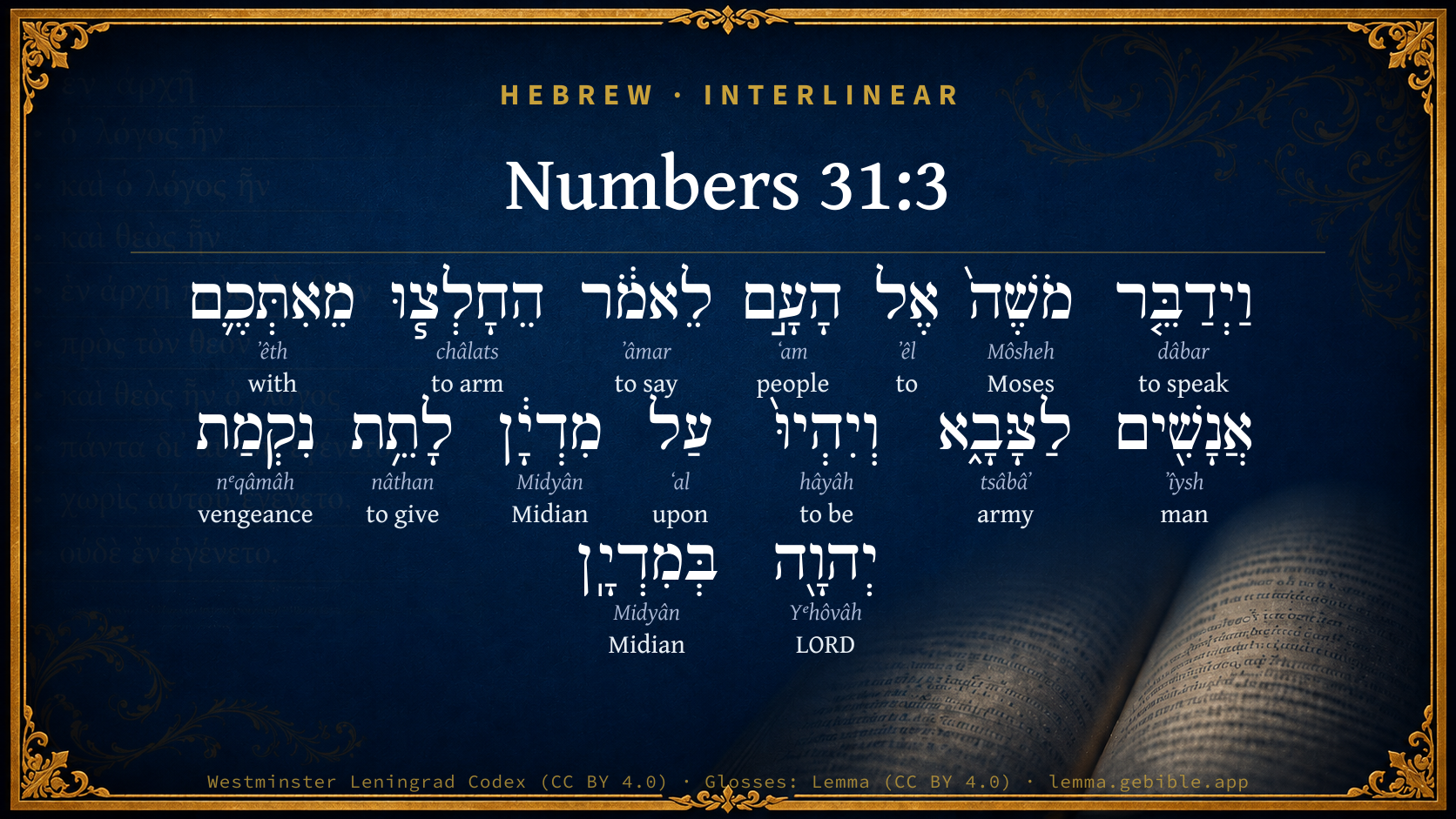
Numbers 31:3

Hebrew (Westminster Leningrad Codex) Numbers 31:3 appears in the Hebrew Old Testament. The text above is from the Westminster Leningrad Codex. Each word links to its Strong’s number, a concise gloss, and parsing drawn from the Open Scriptures Hebrew Bible morphology. Click any word for its full Brown-Driver-Briggs (BDB) entry.
Download image
Cite this verse

Numbers 31:3 (World English Bible). Public Domain. Lemma interlinear Bible study tool, https://lemma.gebible.app/v/numbers/31/3.

Show BibTeX & RIS
BibTeX
RIS
English Translation
Moses spoke to the people, saying, Arm you men from among you for the war, that they may go against Midian, to execute Yahweh's vengeance on Midian.
World English Bible · Public Domain
Download a study sheet

One document with this verse’s original text, its word-by-word gloss line, the meaning frame, cross-references with their text, attributed commentary, and full source and license credits — printable, and it pastes into notes with its structure intact.

This verse Autodidact and up

Study sheet (.html) Plain text (.txt)

A passage Seminary Student

Up to 50 verses in one chapter. A passage sheet keeps up to 6 commentary sources and 12 cross-references per verse, in the order this page ranks them, and says so on the sheet whenever that leaves anything out. Ask for a single verse and you get the Autodidact verse sheet above.

Everything on this page stays free to read, with no account — the sheet is a download of what is already on screen, not access to it.

Want to remove ads? Support Godless Engineer
Compare translations 3

The same verse in 3 English versions, stacked beneath the original-language interlinear above. Click any original word for its lexicon entry.

Each is an independent rendering of the whole verse — the interlinear is not word-aligned to these translations.

Highlighted words mark where these versions differ — a whole-verse word diff, not a word-by-word alignment.

  • World English Bible Public Domain
    Moses spoke to the people, saying, Arm you men from among you for the war, that they may go against Midian, to execute Yahweh's vengeance on Midian.
  • King James Version Public Domain
    And Moses spake unto the people, saying, Arm some of yourselves unto the war, and let them go against the Midianites, and avenge the LORD of Midian.
  • unfoldingWord Literal Text CC BY-SA 4.0
    And Moses spoke to the people, saying, “Equip yourselves, some of the men with you, for the war. And they will be against Midian to give the vengeance of Yahweh on Midian.

unfoldingWord Literal Text — © unfoldingWord, licensed CC BY-SA 4.0. Word-aligned USFM3 via Door43 (git.door43.org/unfoldingWord/en_ult).

Versions to compare (up to 4)

3 of 4 selected

Show all 18 translations

Every available English version of this verse, each an independent rendering of the whole verse.

  • World English Bible Public Domain
    Moses spoke to the people, saying, Arm you men from among you for the war, that they may go against Midian, to execute Yahweh's vengeance on Midian.
  • Berean Standard Bible Public Domain
    So Moses told the people, “Arm some of your men for war, that they may go against the Midianites and execute the LORD’s vengeance on them.
  • Majority Standard Bible Public Domain
    So Moses told the people, “Arm some of your men for war, that they may go against the Midianites and execute the LORD’s vengeance on them.
  • King James Version Public Domain
    And Moses spake unto the people, saying, Arm some of yourselves unto the war, and let them go against the Midianites, and avenge the LORD of Midian.
  • American Standard Version (1901) Public Domain
    And Moses spake unto the people, saying, Arm ye men from among you for the war, that they may go against Midian, to execute Jehovah's vengeance on Midian.
  • Revised Version (1885) Public Domain
    And Moses spake unto the people, saying, Arm ye men from among you for the war, that they may go against Midian, to execute the LORD’S vengeance on Midian.
  • Geneva Bible (1599) Public Domain
    And Moses spake to the people, saying, Harnesse some of you vnto warre, and let them goe against Midian, to execute the vengeance of the Lord against Midian.
  • Douay-Rheims (1899) Public Domain
    And Moses forthwith said: Arm of you men to fight, who may take the revenge of the Lord on the Madianites.
  • Young's Literal Translation Public Domain
    And Moses speaketh unto the people, saying, `Be ye armed some of you for the host, and they are against Midian, to put the vengeance of Jehovah on Midian;
  • Literal Standard Version CC BY-SA 4.0
    And Moses speaks to the people, saying, “Arm men from [among] you for the war, and they are against Midian, to put the vengeance of YHWH on Midian;
  • Unlocked Literal Bible CC BY-SA 4.0
    So Moses spoke to the people. He said, “Arm some of your men for war so they may go against Midian and carry out Yahweh's vengeance on it.
  • unfoldingWord Literal Text CC BY-SA 4.0
    And Moses spoke to the people, saying, “Equip yourselves, some of the men with you, for the war. And they will be against Midian to give the vengeance of Yahweh on Midian.
  • Darby Bible Public Domain
    And Moses spoke to the people, saying, Arm from amongst you men for military service, that they go against Midian to execute Jehovah's vengeance upon Midian.
  • World Messianic Bible Public Domain
    Moses spoke to the people, saying, “Arm men from among you for war, that they may go against Midian, to execute the LORD’s vengeance on Midian.
  • Webster's Bible Public Domain
    And Moses spoke to the people, saying, Arm some of yourselves for the war, and let them go against the Midianites, and avenge the LORD on Midian.
  • Free Bible Version CC BY-SA 4.0
    Moses instructed the people, “Have some of your men get ready for battle, so they can go and attack the Midianites and carry out the Lord's punishment on them.
  • Bible in Basic English Public Domain
    So Moses said to the people, Let men from among you be armed for war to put into effect against Midian the Lord's punishment on them.
  • JPS Tanakh (1917) Public Domain
    And Moses spoke unto the people, saying: 'Arm ye men from among you for the war, that they may go against Midian, to execute the LORD'S vengeance on Midian.

Literal Standard Version (2020), Covenant Press — licensed CC BY-SA 4.0. Text via the HelloAO Bible API (eBible.org). Unlocked Literal Bible (unfoldingWord) — licensed CC BY-SA 4.0. Text via the HelloAO Bible API (eBible.org). unfoldingWord Literal Text — © unfoldingWord, licensed CC BY-SA 4.0. Word-aligned USFM3 via Door43 (git.door43.org/unfoldingWord/en_ult). Free Bible Version, Dr. Jonathan Gallagher — licensed CC BY-SA 4.0. Text via the HelloAO Bible API (eBible.org).

Word by word

More ways to search: Search by grammar → Find every occurrence → Compare this word →

Practice this passage: Drill this verse → Learn its vocabulary →

נִקְמַת
nᵉqâmâh
H5360
“vengeance of”
Noun, Common, Feminine, Singular, Construct
Part of Speech
Noun
Type
Common
Gender
Feminine
Number
Singular
State
Construct
Full BDB Definition

Origin: from H5359

TWOT: 1413b

vengeance - vengeance (by God, by Israel, by enemies of Israel)
  1. וַיְדַבֵּ֤ר dâbar H1696 “and · to speak” Conjunction + Verb, Piel, Sequential Imperfect, 3rd Person, Masculine, Singular
  2. מֹשֶׁה֙ Môsheh H4872 “Moses” Noun, Proper
  3. אֶל ʼêl H413 “to” Preposition
  4. הָעָ֣ם ʻam H5971 “the · people” Particle, Definite Article + Noun, Common, Masculine, Singular, Absolute
  5. לֵאמֹ֔ר ʼâmar H559 “to say” Preposition + Verb, Qal, Infinitive Construct
  6. הֵחָלְצ֧וּ châlats H2502 “arm” Verb, Niphal, Imperative, 2nd Person, Masculine, Plural
  7. מֵאִתְּכֶ֛ם ʼêth H854 “from · with · you” Preposition + Preposition + Suffix, Personal, 2nd Person, Masculine, Plural
  8. אֲנָשִׁ֖ים ʼîysh H376 “men” Noun, Common, Masculine, Plural, Absolute
  9. לַצָּבָ֑א tsâbâʼ H6635 “to/for the · army” Preposition, Determined + Noun, Common, Both, Singular, Absolute
  10. וְיִהְיוּ֙ hâyâh H1961 “and · to be” Conjunction + Verb, Qal, Imperfect, 3rd Person, Masculine, Plural
  11. עַל ʻal H5921 “upon” Preposition
  12. מִדְיָ֔ן Midyân H4080 “Midian” Noun, Proper
  13. לָתֵ֥ת nâthan H5414 “to give” Preposition + Verb, Qal, Infinitive Construct
  14. יְהוָ֖ה Yᵉhôvâh H3068 “LORD” Noun, Proper
  15. בְּמִדְיָֽן Midyân H4080 “in/at · Midian” Preposition + Noun, Proper

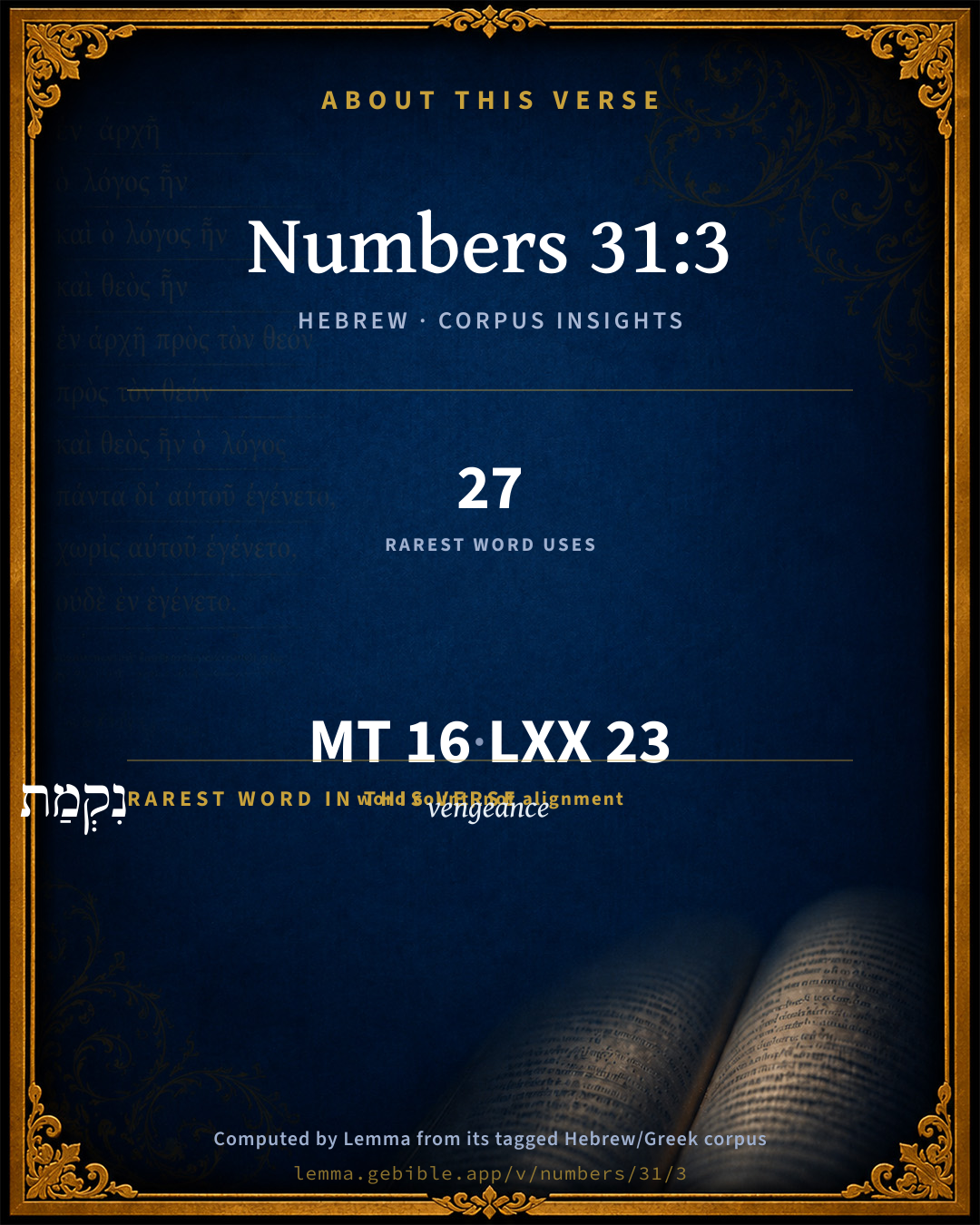
About this verse

These counts appear in no published source. They are computed here, from the morphology-tagged text and Lemma’s own curated glosses. What Lemma adds →

16
words
15
distinct lemmas
Pentateuch
section

Shared distinctive vocabulary

נִקְמַת vengeance H5360 occurs in 22 verses of the Hebrew Bible. Also found in:

Grammatical profile

  • 5 verbs
  • 8 nouns
  • 3 prepositions

Verb forms

  • וַיְדַבֵּ֤ר Piel · Sequential Imperfect
  • לֵאמֹ֔ר Qal · Infinitive Construct
  • הֵחָלְצ֧וּ Niphal · Imperative
  • וְיִהְיוּ֙ Qal · Imperfect
  • לָתֵ֥ת Qal · Infinitive Construct

Repetition

A word recurs within this verse — often emphatic in Hebrew:

  • מִדְיָ֔ן Midian H4080 ×2

Hebrew & Septuagint length

In English translation the verse runs 27 words from the Hebrew and 29 from the Septuagint (LXX English) — closely comparable.

A rough comparison of the two English renderings, which tokenize alike — not a word-level alignment.

Word counts can differ between the Hebrew and the Greek without any difference in meaning — e.g. the Hebrew direct-object marker אֵת has no separate Greek word, and Greek often adds the article ὁ.

In the original languages it is 16 Hebrew tokens and 23 Greek tokens — but the two are counted differently (Hebrew bundles its prefixes and suffixes into one token; the Greek is in lemma form), so that isn’t a like-for-like length.

Cross-references

11

Topical passages linked to Numbers 31:3 in the Treasury of Scripture Knowledge — connected by theme and wording, ordered by reader-vote popularity; previews shown in the World English Bible.

  • Leviticus 26:25 I will bring a sword upon you, that will execute the vengeance of the covenant; and you will be gathered together within your cities: and I will send the pestilence among you; and you will be delivered into the hand of the enemy.
  • Exodus 17:9–13 Moses said to Joshua, "Choose men for us, and go out, fight with Amalek. Tomorrow I will stand on the top of the hill with God's rod in my hand."
  • Exodus 17:16 He said, "Yah has sworn: 'Yahweh will have war with Amalek from generation to generation.'"
  • Numbers 25:11 Phinehas, the son of Eleazar, the son of Aaron the priest, has turned my wrath away from the children of Israel, in that he was jealous with my jealousy among them, so that I didn't consume the children of Israel in my jealousy.
  • Numbers 25:13 and it shall be to him, and to his seed after him, the covenant of an everlasting priesthood; because he was jealous for his God, and made atonement for the children of Israel.
  • Judges 5:2 For that the leaders took the lead in Israel, For that the people offered themselves willingly, Bless you Yahweh.
  • Judges 5:23 Curse you Meroz, said the angel of Yahweh. Curse you bitterly the inhabitants of it, Because they didn't come to the help of Yahweh, To the help of Yahweh against the mighty.
  • 2 Kings 9:7 You shall strike the house of Ahab your master, that I may avenge the blood of my servants the prophets, and the blood of all the servants of Yahweh, at the hand of Jezebel.
  • 2 Kings 10:30 Yahweh said to Jehu, Because you have done well in executing that which is right in my eyes, [and] have done to the house of Ahab according to all that was in my heart, your sons of the fourth generation shall sit on the throne of Israel.
  • Jeremiah 46:10 For that day is [a day] of the Lord, Yahweh of Hosts, a day of vengeance, that he may avenge him of his adversaries: and the sword shall devour and be satiate, and shall drink its fill of their blood; for the Lord, Yahweh of hosts, has a sacrifice in the north country by the river Euphrates.
  • Jeremiah 50:28 The voice of those who flee and escape out of the land of Babylon, to declare in Zion the vengeance of Yahweh our God, the vengeance of his temple.

Cross-references courtesy of OpenBible.info (CC BY 4.0).

Hebrew and Greek witnesses Masoretic Hebrew ↔ Greek Septuagint

The same verse in the two great witnesses to the Old Testament, shown verse-for-verse.

These are two independent witnesses, not word-aligned to each other, and the Septuagint is shown in lemma (dictionary) form.

Hebrew Numbers 31:3 Masoretic · Westminster Leningrad Codex

וַיְדַבֵּ֤ר מֹשֶׁה֙ אֶל הָעָ֣ם לֵאמֹ֔ר הֵחָלְצ֧וּ מֵאִתְּכֶ֛ם אֲנָשִׁ֖ים לַצָּבָ֑א וְיִהְיוּ֙ עַל מִדְיָ֔ן לָתֵ֥ת נִקְמַת יְהוָ֖ה בְּמִדְיָֽן

Moses spoke to the people, saying, Arm you men from among you for the war, that they may go against Midian, to execute Yahweh's vengeance on Midian.

World English Bible · Public Domain

Greek LXX Numbers 31:3 Septuagint · lemma form

καί λαλέω μωυσῆς πρός ὁ λαός λέγω ἐκὁπλίζω ἐκ σύ ἀνήρ παρατάσσω ἔναντι κύριος ἐπί μαδιαν ἀποδίδωμι ἐκδίκησις παρά ὁ κύριος ὁ μαδιαν

And Moses spoke to the people, saying, Arm some of you, and set yourselves in array before the Lord against Madian, to inflict vengeance on Madian from the Lord.

LXX2012 (modern English Septuagint) · Public Domain

Hebrew: Westminster Leningrad Codex (CC BY 4.0). Greek: Septuagint (public domain); English from LXX2012 (modern English Septuagint) (Public Domain). How the Septuagint differs from the Hebrew →

Targum (Aramaic paraphrase)

2

The Targum is the ancient Jewish Aramaic paraphrase of the Hebrew Scriptures — an interpretive translation, not the Hebrew text itself. Onkelos (literal) and Pseudo-Jonathan (expansive) render the Torah, and Jonathan the Prophets. Coverage is partial: where no permissively-licensed English translation exists for a verse, only the Aramaic is shown. This is verse-level text, not a word-by-word alignment to the Hebrew.

  1. Targum Onkelos Torah (Genesis–Deuteronomy)
    וּמַלֵיל משֶׁה עִם עַמָא לְמֵימָר זְרִיזוּ מִנְכוֹן גֻבְרִין לְחֵילָא וִיהוֹן עַל מִדְיָן לְמִתַּן פּוּרְעֲנוּת דִין עַמָא דַיְיָ בְּמִדְיָן

    (no public-domain English translation for this verse)

    Targum Onkelos — Aramaic: “Onkelos Genesis” (public domain); “Onkelos Exodus” (public domain); “Onkelos Leviticus” (public domain); “Onkelos Numbers” (public domain); “Onkelos Deuteronomy” (public domain). English: “Sefaria Community Translation” (CC0 1.0 (public-domain dedication)); “J.W. Etheridge. The Targums of Onkelos and Jonathan Ben Uzziel on the Pentateuch. London: Longmans, Green, 1862” (public domain). Text via Sefaria.

  2. Targum Pseudo-Jonathan Torah (Genesis–Deuteronomy)
    וּמַלֵיל משֶׁה עִם עַמָא לְמֵימָר אִזְדַרְזוּ לְוַותְכוֹן גוּבְרִין לְחֵילָא וִיהוֹן מְסַדְרִין סִדְרֵי קְרָבָא עַל מִדְיָן לְמִתַּן פּוּרְעָנוּת עַמָא דַיְיָ בְּמִדְיָן

    And Moses spake with the people, saying: Arm of you men, for the host to make war against Midian, to give the people of the Lord avengement upon Midian;

    Targum Pseudo-Jonathan — Aramaic: “Targum Jonathan on Genesis” (public domain); “Targum Jonathan on Exodus” (public domain); “Targum Jonathan on Leviticus” (public domain); “Targum Jonathan on Numbers” (public domain); “Targum Jonathan on Deuteronomy” (public domain). English: “The Targum of Jonathan ben Uzziel, trans. J. W. Etheridge, London, 1862” (public domain). Text via Sefaria.

Commentary

Notes on Numbers 31:3 from classic Christian and Jewish commentators (each source and its license shown beneath its notes). The classic Christian expositions comment on the surrounding passage and are grouped to its opening verse, so a note may address several verses; the Jewish commentaries on the Tanakh (Rashi and others) are per-verse, so they appear only where the commentator wrote on this verse.

Lemma curates 59 commentaries, every one of them public domain or Creative Commons licensed, each selected and text-cleaned for this edition rather than reprinted as found. About our sources →

Trapp's Complete Commentary

John Trapp

Num 31:3 And Moses spake unto the people, saying, Arm some of yourselves unto the war, and let them go against the Midianites, and avenge the LORD of Midian.

Ver. 3. Arm some of yourselves unto the war.] Lactantius {a} being, according to his name, a mild and gentle man, abhorred bloodshed, thought it not lawful for a just man to be a warrior, whose justice was his warfare. But this was his error; Patres legendi sunt cum venia; God bids here, Arm yourselves, &c. Indeed it is utterly unlawful for men wilfully to thrust themselves into unnecessary wars: and it is reported in the life of Augustine, that he would never pray for such. But when God sounds the alarm, as here, "Cursed is he that doeth this work of the Lord negligently: Cursed is he that keepeth back his sword from blood." {Jer 48:10}

{a} Instit., lib. vi. cap. 20.

John Trapp, A Commentary or Exposition upon All the Books of the Old and New Testament (1647–1656) — public domain. Text from a community e-Sword module.

Joseph Benson's Commentary

Num 31:3. Avenge the Lord — What in the preceding verse is termed avenging Israel, is here called avenging the Lord, because by their idolatry and lewdness, and by seducing God’s people into rebellion against him, they had offered a high affront to him. God’s great care was to avenge the Israelites, and Moses’s chief desire was to avenge God, rather than himself or the people.

Joseph Benson's Commentary on the Old and New Testaments (1811–1818) — public domain. Text from a community e-Sword module.

Tyndale Open Study Notes

Tyndale Open Resources

31:3-5 Each tribe contributed 1,000 men for the battle, which enabled all of them to gain experience in combat and share in the victory.

Tyndale Open Study Notes — © Tyndale Open Resources, licensed CC BY-SA 4.0. Text via the HelloAO Bible API.

Geneva Bible (1599)

Geneva Bible translators

As he had commanded, Num. 25:17, declaring also that the injury done against his people is done against him.

Geneva Bible (1599) marginal notes — public domain. Text via Bolls.life.

Jamieson, Fausset & Brown

Robert Jamieson, A. R. Fausset & David Brown

Arm some of yourselves--This order was issued but a short time before the death of Moses. The announcement to him of that approaching event [Num 31:2] seems to have accelerated, rather than retarded, his warlike preparations.

Jamieson, Fausset & Brown — Commentary Critical and Explanatory on the Whole Bible (1871) — public domain (CC PDM 1.0). Text via the HelloAO Bible API.

Adam Clarke's Commentary

Verse 3. Avenge the Lord of Midian.] It was God's quarrel, not their own, that they were now to take up. These people were idolaters; idolatry is an offence against GOD; the civil power has no authority to meddle with what belongs to Him, without especial directions, certified in the most unequivocal way. Private revenge, extension of territory, love of plunder, were to have no place in this business; the Lord is to be avenged; and through HIM the children of Israel, (Nu 31:2), because their souls as well as their bodies had been well nigh ruined by their idolatry.

Adam Clarke's Commentary on the Bible (1810–1826) — public domain. Text from a community e-Sword/MySword module.

Ellicott's Commentary for English Readers

(3) Arm some of yourselves . . . —Better, Arm from among you (or, from those with you) men for the war. The details of the selection are contained in the next verse.

A Bible Commentary for English Readers, edited by Charles John Ellicott (1878–1897) — public domain. Text from a community e-Sword module.

John Gill's Exposition

And Moses spake unto the people, saying,.... In obedience to the divine command; this must be supposed to be spoken to the heads or princes of the tribes:

arm some of yourselves unto the war: not the whole body of the militia, 600,000 men and upwards, only some of them, and these choice and select men; and, according to the Jewish writers, good men, who, detesting the sins of lewdness and idolatry, would more strictly and severely avenge themselves on the Midianites for drawing their brethren into those sins, whereby they fell; and so Jarchi calls them righteous men:

and let them go against the Midianites, and avenge the Lord of Midian: what the Lord calls the vengeance of the Israelites, Moses calls the vengeance of the Lord, because they were the Lord's people, and his cause and theirs the same: and because the sins they were drawn into by the Midianites were not only against themselves, and to their prejudice, but against the Lord and to the dishonour of his name.

John Gill's Exposition of the Whole Bible (1746–1763) — public domain (CC PDM 1.0). Text via the HelloAO Bible API.

Albert Barnes' Notes on the Bible

Avenge the Lord of Midian - The war against the Midianites was no ordinary war. It was indeed less a war than the execution of a divine sentence against a most guilty people.

Doubtless there were many among the Midianites who were personally guiltless as regards Israel. But the rulers deliberately adopted the counsel of Balaam against Israel, and their behests had been but too readily obeyed by their subjects. The sin therefore was national, and the retribution could be no less so.

But the commission of the Israelites in the text must not be conceived as a general license to slay. They had no discretion to kill or to spare. They were bidden to exterminate without mercy, and brought back to their task Num 31:14 when they showed signs of flinching from it. They had no alternarive in this and similar matters except to fulfill the commands of God; an awful but doubtless salutary manifestation, as was afterward the slaughter of the Canaanites, of God’s wrath against sin; and a type of the future extermination of sin and sinners from His kingdom.

Albert Barnes' Notes on the Bible (1834–1885) — public domain. Text from a community e-Sword/MySword module.

Matthew Poole's English Annotations

For the affront and injury which they offered to God, partly by their own idolatry and lewdness, and partly by seducing God’s people into rebellion against him. God’s great care was to

avenge the Israelites, Num 31:2, and Moses’s chief desire was to avenge God rather than himself or the people. Withal he doth hereby insinuate, that God and his people have the same cause, the same friends and enemies.

Matthew Poole's English Annotations on the Holy Bible (1683–1685) — public domain. Text from a community e-Sword/MySword module.

Whedon's Commentary on the Bible

Daniel D. Whedon

3. Arm some of yourselves — The strong faith of Moses that Jehovah would signally interpose in behalf of Israel is seen in the order to call out but one fiftieth of the army, though Midian, judging from the five kings slain, and the greatness of the spoils, was a mighty foe.

Avenge the Lord — It was pre-eminently Jehovah’s war in vindication of his own honour, for he who touches his people touches the apple of his eye.

Daniel D. Whedon (gen. ed.), Commentary on the Old and New Testaments (1874–1909) — public domain. Text from a community e-Sword module.

The Pulpit Commentary

Avenge the Lord of Midian. God, speaking to Moses, had commanded a war of vengeance; Moses, speaking to the people, is careful to command a war of religious vengeance. In seducing the people of the Lord the Midianites had insulted and injured the majesty of God himself. On the question why Midian only, and not Moab also, was punished see on Num_25:17. It is to be remembered that, however hateful the sins of licentiousness and idolatry may be, they have never aroused by themselves the exterminating wrath of God. Midian was smitten because he had deliberately used these sins as weapons wherewith to take the life of Israel.

The Pulpit Commentary (1880–1919), ed. H.D.M. Spence-Jones & Joseph S. Exell — public domain. Text from a community e-Sword module.

John Wesley's Explanatory Notes

Avenge ye the Lord - For the affront which they offered to God, by their own idolatry and lewdness, and by seducing God's people into rebellion against him. God's great care was to avenge the Israelites, ver. 2, and Moses's chief desire was to avenge God rather than himself or the people.

John Wesley, Explanatory Notes Upon the Whole Bible (1754–1765) — public domain. Text via the GEBible commentary corpus.

Keil & Delitzsch

C. F. Keil & F. Delitzsch

To carry out this revenge, Moses had 1000 men of each tribe delivered (ימּסרוּ, see at Num 31:16) from the families (alaphim, see Num 1:16) of the tribes, and equipped for war; and these he sent to the army (into the war) along with Phinehas the son of Eleazar the high priest, who carried the holy vessels, viz., the alarm-trumpets, in his hand. Phinehas was attached to the army, not as the leader of the soldiers, but as the high priest with the holy trumpets (Num 10:9), because the war was a holy war of the congregation against the enemies of themselves and their God. Phinehas had so distinguished himself by the zeal which he had displayed against the idolaters (Num 25:7), that it was impossible to find any other man in all the priesthood to attach to the army, who would equal him in holy zeal, or be equally qualified to inspire the army with zeal for the holy conflict. "The holy vessels" cannot mean the ark of the covenant on account of the plural, which would be inapplicable to it; nor the Urim and Thummim, because Phinehas was not yet high priest, and the expression כּלי would also be unsuitable to these. The allusion can only be to the trumpets mentioned immediately afterwards, the ו before חצצרות being the ו explic., "and in fact." Phinehas took these in his hand, because the Lord had assigned them to His congregation, to bring them into remembrance before Him in time of war, and to ensure His aid (Num 10:9).

Keil & Delitzsch — Biblical Commentary on the Old Testament (1861–1891) — public domain (CC PDM 1.0). Text via the HelloAO Bible API. (Old Testament only.)

unfoldingWord translationNotes

Door43 World Missions Community

Arm some of your men for war

"Give weapons to some of your men"

go against Midian and carry out Yahweh's vengeance on it

"go fight a war against the Midianites and punish them for what they did to us"

a thousand ... twelve thousand

"1,000 ... 12,000" (See: Numbers)

Israel's thousands of men

"the thousands of Israel's men"

one thousand was provided from each tribe

This can be stated in active form. AT: "every tribe sent 1,000 men to war" (See: Active or Passive)

twelve thousand men armed for war

All 12 tribes sent men, including the tribe of Levi. Each tribe sent 1,000 men into battle. (See: Assumed Knowledge and Implicit Information)

translationWords

avenge

tribe

unfoldingWord translationNotes — © Distant Shores Media and the Door43 World Missions Community, licensed CC BY-SA 4.0. Source: git.door43.org/Door43/en_tn.

Rashi

Rabbi Shlomo Yitzchaki (Rashi)

וידבר משה וגו׳ AND MOSES SPAKE etc. — Although he had heard (v. 2) that his death was associated with this matter, he did it gladly and did not delay (Sifrei Bamidbar 157:2).

החלצו — Understand this as the Targum does in the sense of “equipped (חלוצי) for war”, armed.

אנשים MEN — righteous men, and similar is, (Exodus 17:9) “Choose men for us”, and so, too, (Deuteronomy 1:13) “men wise and well-known” (Midrash Tanchuma, Matot 3).

‎'נקמת ה‎ “THE VENGEANCE OF THE LORD” — [This is really equivalent to the expression God had employed (v.2), “the vengeance of the children of Israel”], because whoever attacks Israel is as though he attacks the Holy One blessed be He.

Rashi on the Tanakh — English translations: “The Judaica Press complete Tanach with Rashi, translated by A. J. Rosenberg” (CC BY 4.0); “Pentateuch with Rashi's commentary by M. Rosenbaum and A.M. Silbermann, 1929-1934” (public domain); “The Metsudah Tanach series, Lakewood, N.J” (CC BY 4.0); and “The Book of Joshua, Metsudah Publications, 1997” (CC BY 4.0). Text via Sefaria.

Lesson kit

Teaching starters — assembled from the data on this page, not authored interpretation. Every prompt links to the verse data it draws on. Edit before teaching.

Numbers, in the Pentateuch, opens this verse with 16 words (15 distinct Hebrew lemmas). Its most distinctive word is nᵉqâmâh (“vengeance”). A historical commentator’s framing appears above. Read the whole chapter for the surrounding context.

Discussion questions

  1. What does “vengeance” (nᵉqâmâh) contribute to the verse as a whole?
  2. How does Numbers 31:2, which shares the word «vengeance», read alongside this verse?
  3. What does the repetition of “Midian” (2× in this one verse) do in this verse?
  4. The translations on this page render this verse differently — a whole-verse word diff, not a word-by-word alignment. What might account for the different wordings?
  5. «וַיְדַבֵּ֤ר» is a Piel Sequential Imperfect verb. How does that grammatical form shape the action described?
  6. Compare how Trapp's Complete Commentary and Joseph Benson's Commentary read this verse. Where do they agree or differ?

Things to notice

Reading settings

Reading text

Shown beneath each verse's original-language words.

Old Testament
Old Testament edition

Read the OT as the Masoretic Hebrew (MT) or the Greek Septuagint (LXX).

English shown for the Greek Septuagint (in the Hebrew ↔ Greek comparison).

Comparing translations? Open the Compare panel on any verse page to stack up to four side by side.