
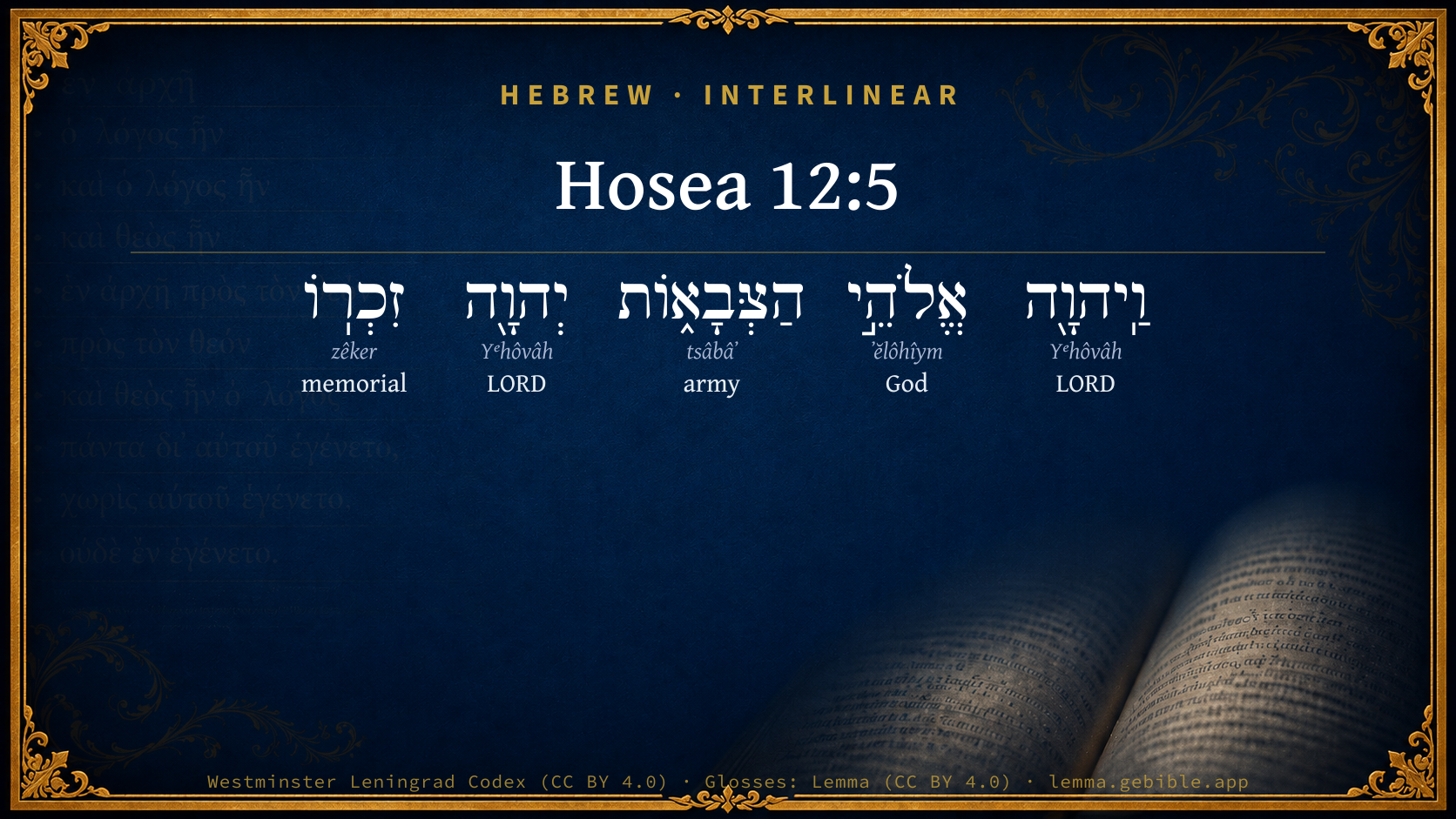
Hosea 12:5

Hebrew (Westminster Leningrad Codex) Hosea 12:5 appears in the Hebrew Old Testament. The text above is from the Westminster Leningrad Codex. Each word links to its Strong’s number, a concise gloss, and parsing drawn from the Open Scriptures Hebrew Bible morphology. Click any word for its full Brown-Driver-Briggs (BDB) entry.
Download image
Cite this verse

Hosea 12:5 (World English Bible). Public Domain. Lemma interlinear Bible study tool, https://lemma.gebible.app/v/hosea/12/5.

Show BibTeX & RIS
BibTeX
RIS
English Translation
Even Yahweh, the God of hosts; Yahweh is his name of renown!
World English Bible · Public Domain
Download a study sheet

One document with this verse’s original text, its word-by-word gloss line, the meaning frame, cross-references with their text, attributed commentary, and full source and license credits — printable, and it pastes into notes with its structure intact.

This verse Autodidact and up

Study sheet (.html) Plain text (.txt)

A passage Seminary Student

Up to 50 verses in one chapter. A passage sheet keeps up to 6 commentary sources and 12 cross-references per verse, in the order this page ranks them, and says so on the sheet whenever that leaves anything out. Ask for a single verse and you get the Autodidact verse sheet above.

Everything on this page stays free to read, with no account — the sheet is a download of what is already on screen, not access to it.

Want to remove ads? Support Godless Engineer
Compare translations 3

The same verse in 3 English versions, stacked beneath the original-language interlinear above. Click any original word for its lexicon entry.

Each is an independent rendering of the whole verse — the interlinear is not word-aligned to these translations.

Highlighted words mark where these versions differ — a whole-verse word diff, not a word-by-word alignment.

  • World English Bible Public Domain
    Even Yahweh, the God of hosts; Yahweh is his name of renown!
  • King James Version Public Domain
    Even the LORD God of hosts; the LORD is his memorial.
  • unfoldingWord Literal Text CC BY-SA 4.0
    And Yahweh, the God of armies— Yahweh his memorial name.

unfoldingWord Literal Text — © unfoldingWord, licensed CC BY-SA 4.0. Word-aligned USFM3 via Door43 (git.door43.org/unfoldingWord/en_ult).

Versions to compare (up to 4)

3 of 4 selected

Show all 18 translations

Every available English version of this verse, each an independent rendering of the whole verse.

  • World English Bible Public Domain
    Even Yahweh, the God of hosts; Yahweh is his name of renown!
  • Berean Standard Bible Public Domain
    the LORD is the God of Hosts—the LORD is His name of renown.
  • Majority Standard Bible Public Domain
    the LORD God of Hosts, the LORD is His name of renown.
  • King James Version Public Domain
    Even the LORD God of hosts; the LORD is his memorial.
  • American Standard Version (1901) Public Domain
    even Jehovah, the God of hosts; Jehovah is his memorial `name'.
  • Revised Version (1885) Public Domain
    even the LORD, the God of hosts; the LORD is his memorial.
  • Geneva Bible (1599) Public Domain
    Yea, the Lord God of hostes, the Lord is himselfe his memoriall.
  • Douay-Rheims (1899) Public Domain
    Even the Lord the God of hosts, the Lord is his memorial.
  • Young's Literal Translation Public Domain
    Even Jehovah, God of the Hosts, Jehovah `is' His memorial.
  • Literal Standard Version CC BY-SA 4.0
    Even YHWH, God of the Hosts, YHWH [is] His memorial.
  • Unlocked Literal Bible CC BY-SA 4.0
    This is Yahweh, the God of hosts; “Yahweh” is his name to be called on.
  • unfoldingWord Literal Text CC BY-SA 4.0
    And Yahweh, the God of armies— Yahweh his memorial name.
  • Darby Bible Public Domain
    -- even Jehovah, the God of hosts, -- Jehovah is his memorial.
  • World Messianic Bible Public Domain
    even the LORD, the God of Hosts. The LORD is his name of renown!
  • Webster's Bible Public Domain
    \\12:4\\Yes, he had power over the angel, and prevailed: he wept, and made supplication to him: he found him in Beth-el, and there he spoke with us;
  • Free Bible Version CC BY-SA 4.0
    the Lord God Almighty, the Lord is his memorable name!
  • Bible in Basic English Public Domain
    He had a fight with the angel and overcame him; he made request for grace to him with weeping; he came face to face with him in Beth-el and there his words came to him;
  • JPS Tanakh (1917) Public Domain
    (12-6) But the LORD, the God of hosts, the LORD is His name.

Literal Standard Version (2020), Covenant Press — licensed CC BY-SA 4.0. Text via the HelloAO Bible API (eBible.org). Unlocked Literal Bible (unfoldingWord) — licensed CC BY-SA 4.0. Text via the HelloAO Bible API (eBible.org). unfoldingWord Literal Text — © unfoldingWord, licensed CC BY-SA 4.0. Word-aligned USFM3 via Door43 (git.door43.org/unfoldingWord/en_ult). Free Bible Version, Dr. Jonathan Gallagher — licensed CC BY-SA 4.0. Text via the HelloAO Bible API (eBible.org).

Word by word

More ways to search: Search by grammar → Find every occurrence → Compare this word →

Practice this passage: Drill this verse → Learn its vocabulary →

About this verse

These counts appear in no published source. They are computed here, from the morphology-tagged text and Lemma’s own curated glosses. What Lemma adds →

5
words
4
distinct lemmas
Prophets
section

Notable vocabulary

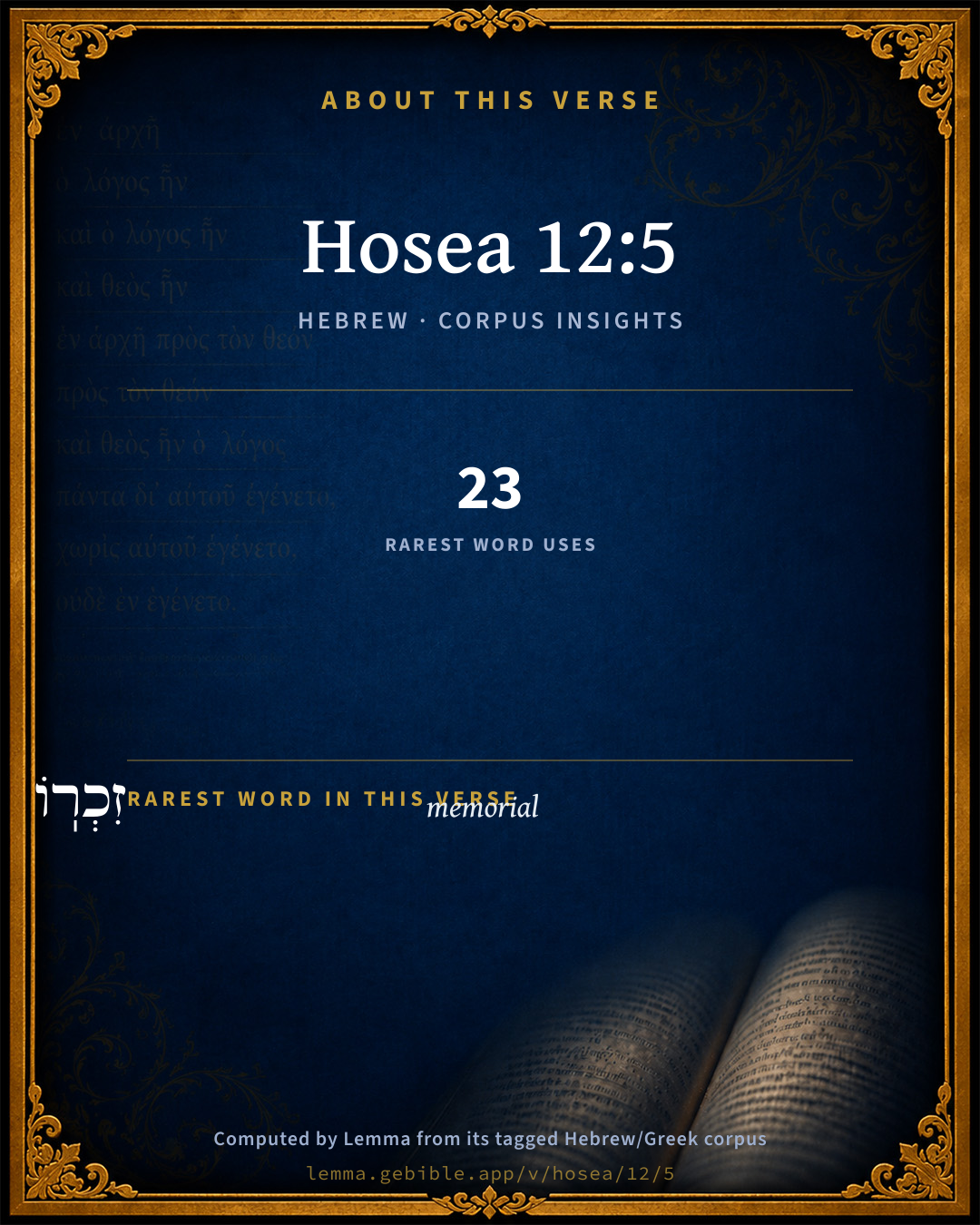
The rarest word here is זִכְרֽוֹ memorial H2143 — appearing just 23 times in the whole Hebrew Bible.

Shared distinctive vocabulary

זִכְרֽוֹ memorial H2143 occurs in 23 verses of the Hebrew Bible. Also found in:

Grammatical profile

  • 5 nouns

Repetition

A word recurs within this verse — often emphatic in Hebrew:

  • וַֽיהוָ֖ה LORD H3068 ×2

Hebrew & Septuagint length

In English translation the verse runs 12 words from the Hebrew and 9 from the Septuagint (LXX English) — closely comparable.

A rough comparison of the two English renderings, which tokenize alike — not a word-level alignment.

Word counts can differ between the Hebrew and the Greek without any difference in meaning — e.g. the Hebrew direct-object marker אֵת has no separate Greek word, and Greek often adds the article ὁ.

Cross-references

5

Topical passages linked to Hosea 12:5 in the Treasury of Scripture Knowledge — connected by theme and wording, ordered by reader-vote popularity; previews shown in the World English Bible.

  • Exodus 3:15 God said moreover to Moses, "You shall tell the children of Israel this, 'Yahweh, the God of your fathers, the God of Abraham, the God of Isaac, and the God of Jacob, has sent me to you.' This is my name forever, and this is my memorial to all generations.
  • Psalms 135:13 Your name, Yahweh, endures forever; Your renown, Yahweh, throughout all generations.
  • Isaiah 42:8 I am Yahweh, that is my name; and my glory will I not give to another, neither my praise to engraved images.
  • Genesis 28:16 Jacob awakened out of his sleep, and he said, "Surely Yahweh is in this place, and I didn't know it."
  • Genesis 32:30 Jacob called the name of the place Peniel: for, he said, "I have seen God face to face, and my life is preserved."

Cross-references courtesy of OpenBible.info (CC BY 4.0).

Hebrew and Greek witnesses Masoretic Hebrew ↔ Greek Septuagint

The same verse in the two great witnesses to the Old Testament, shown verse-for-verse.

These are two independent witnesses, not word-aligned to each other, and the Septuagint is shown in lemma (dictionary) form.

Hebrew Hosea 12:5 Masoretic · Westminster Leningrad Codex

וַֽיהוָ֖ה אֱלֹהֵ֣י הַצְּבָא֑וֹת יְהוָ֖ה זִכְרֽוֹ

Even Yahweh, the God of hosts; Yahweh is his name of renown!

World English Bible · Public Domain

Greek LXX Hosea 12:5 Septuagint · lemma form

καί ἐνἰσχύω μετά ἄγγελος καί δύναμαι κλαίω καί δέω ἐγώ ἐν ὁ οἶκος ων εὑρίσκω ἐγώ καί ἐκεῖ λαλέω πρός αὐτός

But the Lord God Almighty shall be his memorial.

LXX2012 (modern English Septuagint) · Public Domain

Hebrew: Westminster Leningrad Codex (CC BY 4.0). Greek: Septuagint (public domain); English from LXX2012 (modern English Septuagint) (Public Domain). How the Septuagint differs from the Hebrew →

Targum (Aramaic paraphrase)

1

The Targum is the ancient Jewish Aramaic paraphrase of the Hebrew Scriptures — an interpretive translation, not the Hebrew text itself. Onkelos (literal) and Pseudo-Jonathan (expansive) render the Torah, and Jonathan the Prophets. Coverage is partial: where no permissively-licensed English translation exists for a verse, only the Aramaic is shown. This is verse-level text, not a word-by-word alignment to the Hebrew.

  1. Targum Jonathan Prophets (Joshua–Malachi)
    וְאִתְרַבְרַב עִם מַלְאֲכָא וִיכִיל בְּכָא וּבְעָא מִנֵיהּ בְּבֵית אַל אִתְגְלֵי עֲלוֹהִי וְתַמָן יְמַלֵיל עִמָנָא:

    (no public-domain English translation for this verse)

    Targum Jonathan — Aramaic: “Mikraot Gedolot” (public domain). English: “Sefaria Community Translation” (CC0 1.0 (public-domain dedication)); “London "Chaldee Paraphrase," 1871” (public domain). Text via Sefaria.

Commentary

Notes on Hosea 12:5 from classic Christian and Jewish commentators (each source and its license shown beneath its notes). The classic Christian expositions comment on the surrounding passage and are grouped to its opening verse, so a note may address several verses; the Jewish commentaries on the Tanakh (Rashi and others) are per-verse, so they appear only where the commentator wrote on this verse.

Lemma curates 59 commentaries, every one of them public domain or Creative Commons licensed, each selected and text-cleaned for this edition rather than reprinted as found. About our sources →

Trapp's Complete Commentary

John Trapp

Hos 12:5 Even the LORD God of hosts; the LORD [is] his memorial.

Ver. 5. Even the Lord God of hosts] Lo, he it is who promised, who spake with us at Bethel; even that Jehovah, who is himself unchangeable and Almighty; whose promises are eternal and infallible; who will perform with his hand what he hath spoken with his mouth, to the thousandth generation of those that return unto him. Concerning God’s name, Jehovah, {See Trapp on "Mal 3:6"} Concerning his title, God of hosts, {See Trapp on "Mal 3:17"} Doct. 1.

The Lord is his memorial] Jehovah is that nomen maiestativum (as Tertullian hath it), that holy and reverend name of God, Psa 111:9, whereby he will be known and remembered, Exo 3:15, which place doth notably illustrate this. True it is that the Jews, to countenance their conceit of the ineffability of this name Jehovah, do corrupt that text; and for this is my name, Legnolam, for ever, they read, this is my name, Legnalam, to be concealed. Where it is well observed by one, how cross the superstition of men is to the will of God. They, in a pretended reverence to God, will not so much as mention this name, because they say it is a name that God so much glorieth in; and yet the text saith, this name is God’s memorial; it is the name by which he would be remembered to all generations, as that which setteth forth his glory more than any other name whatsoever. So that when we would have a holy memorial of God (and to remember him is every whit as needful as to draw breath, saith an ancient, tam Dei meminisse opus est quam respirare. Nazianzen) we need no images or other unwarrantable helps: the meditation of the name Jehovah, and the import of it, will be of singular use that way. Papists have their pictures and their memories, as they call them; idolaters feign to themselves various representations and remembrances. "Behind the doors also and the posts hast thou set up thy remembrances," Isa 57:8, where God’s law should have been written, according to Deu 6:9; Deu 11:12, and whereas God’s name should have been remembered, Psa 135:13 Psa 102:12.

John Trapp, A Commentary or Exposition upon All the Books of the Old and New Testament (1647–1656) — public domain. Text from a community e-Sword module.

The Biblical Illustrator

Joseph S. Exell

Hos_12:5

Even the Lord God of hosts; the Lord is his memorial.

The name Jehovah as a memorial

To stir them up to present duty, Hosea describes God, who did all this, and spake to Jacob, as the true God and God of armies. It teaches--

1. Christ is, without all controversy true God, the same in essence and equal in power and glory with the Father; for this Angel (verse 4) is even Jehovah, the God of hosts.

2. Great is their advantage and their dignity who have converse and keep communion with God, who hath being of Himself, and who hath all creatures ready as hosts at His command, as there is need. For this sets out Jacobs advantage, that in his wrestlings and other intercourse he had to do with the Lord God of hosts.

3. God is unchangeably still the same, as kind, able, and exorable to His people as ever He was at any time, if they would come and make use of Him; for He did all that to Jacob, not only for present use, but that, proving Himself to be Jehovah, this might be His memorial for the use of His Church in all generations; and upon this ground it is that in the next verse they are exhorted to turn to Him. See Exo_3:15.

4. The Lord needs no images to keep up a memorial of Him; but His name and nature are manifested in His word and works sufficiently to keep them who converse with these in remembrance of Him; for Jehovah, and His manifesting Himself to be so, is His memorial. (George Hutcheson.)

The Biblical Illustrator, edited by Joseph S. Exell (c. 1880s–1900s) — public domain. Text from a community e-Sword module.

The Preacher's Complete Homiletical Commentary

Joseph S. Exell (gen. ed.)

CRITICAL NOTES.]

Hos_12:5. Lord] A name which implies constancy, by which God is distinguished and ever remembered (Exo_3:15; Psa_135:13).

HOMILETICS

THE MEMORIAL NAME.—Hos_12:5

When Jacob felt the power of his antagonist he asked, “Tell me, I pray thee, thy name.” To those who neglect what is plain and useful, and pry into things which do not concern them, the revelation is withheld; but to the earnest petitioner God gives blessings and encouragement. Here the name is unfolded in significance and splendour.

I. The name in its absolute perfection. “The Lord.” Jehovah, the true and living God, distinguished from idols, and deserving the homage of his creatures.

1. Lord by creation. Greater proprietary right over us than we have over one another. The Lord our Maker.

2. Lord by redemption. This is a greater claim than creation. He had only to speak to make us; he suffered, gave his Son, to redeem us. “Ye are not your own, for ye are bought with a price.”

3. Lord by choice. His people do not resist his claims, nor serve other gods. They willingly submit to him as their “Master and Lord.”

II. The name in its universal relation. “God of Hosts.” Of all things visible and invisible, of angels and heavenly spirits, of all creation, “the host of heaven and earth” (Gen_2:1). This indicates—

1. Supreme government. He has all power, directs and sustains all creatures, and rules all things by his own will.

2. Supreme order. “Order is heaven’s first law.” He keeps all things in subordination, and by him all things consist or stand together.

3. Constant obedience. He leads his people, his armies, organized and equipped, like Israel leaving Egypt. He reigns over them, enthroned in affection, and renders their service natural, pleasant, and delightful. “A son honoureth his father, and a servant his master” (Mal_1:6).

4. Continual triumph. The hosts of the Lord are in a state of martial discipline, to contend for the cause and fight the battles of their captain. The cause of truth is a warfare. Christian life is “fighting the good fight of faith.” The world is a foe to the believer, and sin is deadly opposed to holiness. But the Lord God of hosts has omnipotent power and infinite resources. He will rule until all enemies are put under his feet.

III. The name in its continual manifestation. “The Lord is his memorial.” The name Jehovah expresses his nature, and will ever be what it has been, a memorial to men. God is ever to be remembered in his merciful and unchanging attributes (Exo_3:15). We need no images nor unlawful helps to remind us of God. His works and ways declare his wisdom, truth, and love. He will be to us what he was to Jacob and Moses, and all his people the same yesterday, to-day, and for ever. In this name lies a fulness and sufficiency which the exigencies of life will reveal. How little have we known of it in prayer and practical life! Seek to know more, and get hope, strength, and success in Christian work. “Thy name, O Lord, endureth for ever, and thy memorial, O Lord, throughout all generations.”

ILLUSTRATIONS TO CHAPTER 12

Hos_12:5. God. When holy Augustine walked by the sea-side, wrapt in the meditation of God and of his ways, he heard a voice which bade him lade the ocean with a cockle-shell. We may sooner drain the ocean with such a shell, or with a spoon, than the perfections of God with our largest understandings [Caryl]. A king is there where his court is, where his train and retinue are; so God the Lord of Hosts is there specially present where the heavenly guard, the blessed angels, keep their station and rendezvous [Mede].

The Preacher's Complete Homiletical Commentary (gen. ed. Joseph S. Exell; Funk & Wagnalls, c. 1892) — public domain (pre-1929). A full-Bible homiletical/sermon-outline anthology covering 65 of 66 books (2 John is absent from the source module). Text from a community e-Sword module.

Jamieson, Fausset & Brown

Robert Jamieson, A. R. Fausset & David Brown

Lord God--JEHOVAH, a name implying His immutable constancy to His promises. From the Hebrew root, meaning "existence." "He that is, was, and is to be," always the same (Heb 13:8; Rev 1:4, Rev 1:8; compare Exo 3:14-15; Exo 6:3). As He was unchangeable in His favor to Jacob, so will He be to His believing posterity.

of hosts--which Israel foolishly worshipped. Jehovah has all the hosts (saba) or powers of heaven and earth at His command, so that He is as all-powerful, as He is faithful, to fulfil His promises (Psa 135:6; Amo 5:27).

memorial--the name expressive of the character in which God was ever to be remembered (Psa 135:13).

Jamieson, Fausset & Brown — Commentary Critical and Explanatory on the Whole Bible (1871) — public domain (CC PDM 1.0). Text via the HelloAO Bible API.

Adam Clarke's Commentary

Verse 5. The Lord is his memorial.] He is the same God as when Jacob so successfully wrestled with him.

Adam Clarke's Commentary on the Bible (1810–1826) — public domain. Text from a community e-Sword/MySword module.

Ellicott's Commentary for English Readers

(5) Lord God of hosts.—See Cheyne’s Isaiah, vol. 1, pp. 11, 12, and Nowack’s commentary on this passage. Probably the hosts were the stars which were conceived of as celestial spirits standing upon or above Jehovah’s throne in Micaiah’s vision, on the right hand and on the left (1Ki_22:19). These are to be identified, in all probability, with the sons of God (Gen_6:2), described in Job_1:6 as presenting themselves in council before Jehovah. In Psa_103:21 they are described as God’s ministers; also in Psa_104:4, quoted in Heb_1:7.

His memorial—i.e., his name. (See Notes on Exo_3:15; Exo_6:3.) Jehovah—i.e., the self-existent One who nevertheless came into personal relations with Israel.

A Bible Commentary for English Readers, edited by Charles John Ellicott (1878–1897) — public domain. Text from a community e-Sword module.

The Cambridge Bible for Schools and Colleges

gen. ed. J. J. S. Perowne

5. Even the Lord God of hosts, &c.] The Hebrew runs more abruptly, ‘And Jehovah’ &c., i.e. ‘and the name of Him who spoke with Jacob is Jehovah.’ ‘Jehovah’ to the prophets conveys the ideas of almightiness, unchangeableness, and faithfulness (comp. Isa_41:4; Mal_3:6). ‘God of Hosts’ is a title specially characteristic of the regal period; the hosts were (1) the stars, (2) the armies of Israel (see the commentators on Isa_1:24).

his memorial] i.e. his name; comp. Exo_3:15 ‘This is my memorial unto all generations.’

The Cambridge Bible for Schools and Colleges (gen. ed. J. J. S. Perowne; Cambridge University Press, 1878–1918) — public domain. Text from a community e-Sword module.

John Gill's Exposition

Even the Lord God of hosts,.... The God Jacob had power over, the Angel he prevailed with, to whom he made supplication with weeping, and who spake with him and his in Bethel, is he whose name is Jehovah; who is the true and living God, the Lord of hosts and armies both in heaven and in earth; of all the angels in heaven, and the legions of them; and of the church militant, and all the saints, who are the good soldiers of Christ, his spiritual militia; and he is the Captain of the Lord's host, and of their salvation, and to whom all the numerous hosts of creatures, be they what they will, are subject: this is observed, to set off the greatness of the person Jacob wrestled with, and his wondrous grace, in condescending to be overpowered by him:

the Lord is his memorial: or his name, Jehovah, which belongs to this angel, the Son of God, as to his divine Father; and which is expressive of his divine existence, of his eternity and immutability; this is his memorial, or the remembrancer of him; which puts his people in all ages in remembrance of him, what he is, what an infinite, almighty, and all sufficient Being he is; and he is always to be believed in, and trusted to, and to be served, adored, and worshipped. The Targum adds, to every generation and generation.

John Gill's Exposition of the Whole Bible (1746–1763) — public domain (CC PDM 1.0). Text via the HelloAO Bible API.

Albert Barnes' Notes on the Bible

Even the Lord God of Hosts, the Lord is His memorial - The word, here as translated and written Lord, is the special and, so to say, the proper Name of God, that which He gave to Himself, and which declares His Being. God Himself authoritatively explained its meaning. When Moses inquired of Him, what he should say to Israel, when they should ask him, “what is the Name of the God of their fathers,” who, he was to tell them, had sent him to them, “God said ... I Am That I Am ... thus shalt thou say, I Am” (EHYeH) “hath sent me unto you; and God said again unto Moses, Thus shalt thou say unto the children of Israel, The Lord” (literally, He is, YeHeWeH , “God of your fathers, the God of Abraham, the God of Isaac, and the God of Jacob, hath sent me unto you; This is My Name forever, and this is My memorial unto all generations” Exo 3:13-15.

I am, expresses self-existence; He who alone is. I am that I am, expresses His unchangeableness, the necessary attribute of the Self-existent, who, since He is, ever is all which He is. “To Be,” says Augustine , “is a name of unchangeableness. For all things which are changed, cease to be what they were, and begin to be what they were not. True Being, pure Being, genuine Being, no one hath, save He who changeth not. He hath Being to whom it is said, “Thou shalt change them and they shall be changed, but Thou art the Same.” What is, I am that I am, but, I am Eternal? What is, I am that I am, save, I cannot be changed? No creature, no heaven, no earth, no angel, “nor Power, nor Throne, nor Dominion, nor Principality.” This then being the name of eternity, it is somewhat more, than He vouchsafed to him a name of mercy, “I am the God of Abraham, the God of Isaac, the God of Jacob. That,” He is in Himself, “this,” to us.

If he willed only to be That which he is in Himself, what should we be? Since Moses understood, when it was said to him, I am that I am, He who is hath sent me unto you, he believed that this was much to people, he saw that this was far removed from people. For whose hath understood, as he ought, That which is, and which truly is, and, in whatever degree, hath even transiently, as by a lightning flash, been irradiated by the light of the One True Essence, sees himself far below, in the utmost farness of removal and unlikeness.” This, the Self-existent, the Unchangeable, was the meaning of God’s ancient Name, by which He was known to the patriarchs, although they had not in act seen His unchangeableness, for theirs was a life of faith, hoping for what they saw not. The word, He is, when used of Him by His creatures, expresses the same which He says of Himself, I AM. This He willed to be “His memorial forever.” This the way in which He willed that we should believe in Him and think of Him as He who is, the Self-existing, the Self-Same.

The way of pronouncing that Name is lost . The belief has continued, wherever the Lord is named. For by the Lord we mean the Unchangeable God. That belief is contradicted, whenever people use the name “Jehovah,” to speak of God, as though the belief in Him under the Old Testament differed from that of the New Testament. Perhaps God allowed it to be lost, that people might not make so familiar with it, as they do with the word “Jehovah,” or use it irreverently and in an anti-Christian manner, as some now employ other ways of pronouncing it. The Jews, even before the time of our Lord, ordinarily ceased to pronounce it. In the translations of the Old Testament, and in the Apocrypha, the words, “the Lord,” were substituted for it. Jewish tradition states, that in later times the Name was pronounced in the temple only, by the priests, on pronouncing the blessing commanded by God in the law . On the great Day of Atonement, it was said that the high priest pronounced it ten times , and that when the people heard it, they fell on their faces, saying, “Blessed be the glorious name of His kingdom forever and ever” . They say, however, that in the time of Simeon the Just (i. e., ), Jaddua, who died about 322 b.c., the high priests themselves disused it, for fear of its being pronounced by some irreverent person .

Our Lord Himself sanctioned I the disuse of it, (as did the inspired Apostles yet more frequently,) since, in quoting places of the Old Testament in which it occurs, He uses instead of it the Name, “the Lord” . It stands, throughout the Old Testament, as the Name which speaks of God in relation to His people, that He ever is; and, since He ever is, then He is unchangeably to us, all which He ever was, “The Same, yesterday and today and forever” Heb 13:8.

He then who appeared to Jacob, and who, in Jacob, spake to all the posterity of Jacob, was God; whether it was (as almost all the early fathers thought ), God the Son, who thus appeared in human form to the patriarchs, Moses, Joshua, and in the time of the Judges, under the name of “the Angel of the Lord,” or whether it was the Father. God Almighty thus accustomed man to see the form of Man, and to know and believe that it was God. He it was, the prophet explains, “the Lord,” i. e., the Self existent, the Unchangeable, “Who was, and is and is to come” Rev 1:4, Rev 1:8, who alone is, and from whom are all things , “the Fullness of Being, both of His own, and of all His creatures, the boundless Ocean of all which is, of wisdom, of glory, of love, of all good.”

The Lord of Hosts - that is, of all things visible and invisible, of the angels and heavenly spirits, and of all things animate and inanimate, which, in the history of the Creation, are called “the host of heaven and earth” Gen 2:1, the one host of God. This was the way in which He willed to be had in mind, thought of, remembered. On the one hand then, as relates to Ephraim’s sin, not by the calves, nor by any other created thing, did He will to be represented to people’s minds or thoughts. On the other hand, as relates to God’s mercies, since He, who revealed Himself to Jacob, was the unchangeable God, Israel had no cause to fear, if he returned to the faith of Jacob, whom God there accepted. Whence it follows;

Albert Barnes' Notes on the Bible (1834–1885) — public domain. Text from a community e-Sword/MySword module.

Haydock's Catholic Bible Commentary

Memorial, and the object of worship; or this great Jehovah spoke to Jacob.

George Leo Haydock (1774–1849), Haydock's Catholic Family Bible and Commentary, 1859 edition — public domain. Excludes Psalms (Douay-Rheims chapter numbering differs from Protestant) and Deuterocanonical books (Catholic canon only).

Matthew Poole's English Annotations

Even, or and, he that appeared and spake, who promised the blessing, and commanded the reformation at Beth-el, was

the Lord, Jehovah, the eternal and unchangeable God, who still promiseth with like commands.

God of hosts; who can both perform his promise and execute his threat, who is a most terrible enemy and most desirable friend, all being to us as he is.

The Lord, Jehovah, repeated for confirmation, is his memorial; by this he will be known, by this name, by such methods of his sovereignty and grace, Exo 3:15.

Matthew Poole's English Annotations on the Holy Bible (1683–1685) — public domain. Text from a community e-Sword/MySword module.

The Pulpit Commentary

Even the Lord God of hosts; the Lord is his memorial. Here we have at once a confirmation and a pledge of previous promises. Jacob had wronged Esau, and thereby incurred his displeasure; he had offended God by the injury inflicted on his brother. He is consequently in a position of peril with respect to both God and man; he repented of his sin, and with many and hitter tears supplicated safety salvation in the highest sense. Jacob, or Israel, in Hosea"s time were involved in greater guilt and exposed to greater danger; the same unfailing remedy is recommended to them, and the same way of safety is laid open before them; let them only repent, turn to the Lord, and with tears of genuine sorrow seek his face and favor free; and the prospect would soon brighten before them. The Name of God was a sufficient guarantee: he is Jehovah the Everlasting, and therefore Unchanging One the same to Jacob"s posterity as he had been to the patriarch himself, equally ready to accept their repentance and equally willing to bless them with safety and salvation. He is God of hosts, and thus the Almighty One, governing all creatures, guiding all events, commanding all powers both heavenly and earthly, and ruling the whole history of humanity. His name is a remembrancer of all this, and thus his people were assured that he neither lacks the will nor the power to bless them with all needful blessings, and do them greatest good. The name of an individual is that whereby he is known; on mention of his name the memory of him is recalled. The mention of the Divine Name not only reminds us of his being and Godhead, but recalls to our memory his attributes. Rashi has the following brief comment on this verse: "As I have been from the beginning, so am I now; and if ye had walked with me in uprightness as Jacob our father, I would have dealt with you as dealt with him." Thus to Abram in a land of strangers, imperiled and defenseless, God revealed himself as God Almighty; to Moses, after centuries of unfulfilled promise, he made himself known as the Unchanging One, still challenging the confidence of his people; to Hosea he brings to mind his unchanging counsel in regard to all the events of time and his unlimited control over all the realms of space and their inhabitants, and so the suitability of his attributes to the multiplied necessities and varying circumstances of his people.

"Even the Lord God of hosts; the Lord is his memorial.

The God who appeared to Jacob, who conversed with him in reference to his posterity as well as himself, and whom Jacob found at Bethel, was the God of Jacob"s succeeding race; the God against whom they had trespassed, but to whom they are now urged to turn.

(1) That God is Jehovah, the self-existing One whose title is "I am that I am," which is a sort of paraphrase of the name Jehovah. He is the first of all beings, the greatest of all beings, supreme over all beings, whose being is without limit of time-everlasting, and without bound of space; infinite, having all being in himself, and giving to all creatures life and breath and all things. He is Jehovah, the ever living and never-changing God, the same in kindness, the same in covenant relation to his people, and the same in accessibility. What he did to Jacob he was ready to do for the posterity of the patriarch, yea, he is willing to do to all people that call upon him in truth, seeking his face and favor free.

(2) He is, moreover, God of hosts; the armies of heaven are at his command, the inhabitants of the earth are subject to his will, the powers of nature and all the forces of the universe are under his control. This expression is employed in allusion to those hosts of God that met him after he had wrestled with God, after his name had been changed, and of whom we read, "The angels of God met him. And when Jacob saw them, he said, This is God"s host," and in relation to whom he called the place Mahanaim, the two camps or hosts of God.

(3) Jehovah is his memorial. Men short-lived and mortal raise monuments to keep up their remembrance; but the name Jehovah is the Divine memorial, the name by which he wishes to be remembered through all generations, as he says elsewhere, "This is my name for ever, and this is my memorial to all generations." This term may have reference to the memorial stone which Jacob had set up for a pillar, to keep up the remembrance of the gracious vision that had been vouchsafed to him, and as a memorial of his vow.

(4) The case of Jacob proves the need we have of a memorial to help our memories; for oh, how deceitful our hearts are; how treacherous our memories in the things of God! We need helps, and means, and memorials, and remembrancers. Pictures are not needed for this purpose, images are not needed. God"s name, as indicating his nature, is sufficient memorial of him; his Word and his works are to keep men in remembrance of him. The name Jehovah is God"s memorial; every time we read, or hear, or speak that name, we are reminded of the glory and greatness of him who is the first and best of beings, as also of his goodness and grace. We are reminded by that name of the unchangeableness of his nature and his never-ceasing mercy to man the same to the posterity of Jacob as to the patriarch himself, the same to us as to our forefathers, the God of our fathers being still the God of their succeeding race. "There is no shortening of his power and no darkening of his glory, but with whatsoever power God has wrought, in whatsoever glory he has appeared, in former times, he may manifest the same for us now.

V THE PRACTICAL APPLICATION OF THE PRECEDING STATEMENTS. The application which the prophet makes of the subject is introduced with a "therefore." This "therefore" gathers up the several foregoing thoughts into one urgent appeal.

1. Motives to repentance. By the fact of Jacob"s wrestling with God and the success of this spiritual struggle, by the memorial of the name Jehovah as an index of the unchanging mercifulness of his nature, and by the implied spiritual declension of his descendants, the people of both the northern and southern kingdoms in general and each individual in particular are earnestly admonished to turn to God, their fathers" God, their own God, as it is stated, "Therefore turn thou to thy God.

2. Fruits meet for repentance. The amendment answerable to repentance comprises the duties of the so-called second table of the Law. Justice and mercy may be regarded as a summary.

(1) The golden rule of all justice is that royal law of Christ, "All things whatsoever ye would that men should do to you, do ye even so to them; for this is the Law and the prophets." It would be out of place to enter into the details of justice; this one principle includes all, it is plain to all, it is applicable to all; it comprehends princes and people, masters and servants, brothers and sisters; it extends to all stations and relations, it is unvarying in its application to all persons in all matters and at all times; it embraces not only all the business transactions of buyers and sellers, but all situations and stations in which we can stand towards oar brother man, whether as inferiors or superiors or equals; it is a rule easily understood, easily put in practice, and commends itself to every man"s conscience. Thus reading the Scripture text before us in the light of our Lord"s teaching, we have a rule of justice easily accommodated to all cases, and of ready adaptation to all the vast variety of circumstances that bring us into relation with our fellow-creatures. In this duty of keeping judgment or justice, which is the same word (mishpat) in the original, you have only to make the case of your fellow-man your own, to conceive circumstances changed with him and yourself in his position; and then whatever you could reasonably expect of him, supposing yourself to be in his circumstances, that do to the utmost of your ability to every child of man. This principle not only includes that more obvious duty of acting justly in all the transactions of life which the apostle enjoins, saying, "Let no man go beyond or defraud his brother," but also prohibits those acts of injustice that might not chance to fall within the bounds of human law or of civil enactments, by awarding to every one his due honor to whom honor is due, fear to whom fear, tribute to whom tribute, instruction to the ignorant, relief to the oppressed, bowels of compassion to the poor, and, in the words of Solomon, by withholding not good (of whatever kind) from them to whom it is due.

(2) Strict justice is much, very much more than, alas! is often dispensed; yet it is not enough. There must be mercy too, and mercy tempering justice. When we have done full justice to a fellow-being we have not done all that God requires of us towards our fellow-creature; he has other claims upon us, and God has given him those claims. Reversing the order of the words according to the parallel passage in Micah, "Do justly and love mercy," we may say, "Just first and kind next" is the requirement of this Scripture; "Just first and then generous" is a common saying. We might exact strict justice for ourselves, standing upon our bond like him of old and demanding our pound of flesh, we might exact what is justly our due, but what benevolence would not and mercy could not claim, and so verify the old Latin proverb about the "height of justice being the height of injury;" but the requirement of mercy prohibits and prevents that. Then, O man, love mercy it is the characteristic of your heavenly Father, who is the Father and Fountain of mercies; love mercy, that generous, large-hearted benevolence which does good according to its power to all men under all circumstances, "especially to them who are of the household of faith;" love mercy, that heaven-born principle which, if even an enemy hunger, feeds him, if he thirst gives him drink, if he be naked clothes him. "And," to borrow the well-known words, "as in the course of justice none of us should see salvation, we do therefore pray for mercy, and that same prayer cloth teach us all to render the deeds of mercy.

(3) Further, we are not only to do justly and to love mercy, but to delight therein. Thus we shall not only do some acts of justice and perform some acts of mercy, but keep them both; mercy first, as having the pre-eminence and being the consummation of justice the one the fruit, and the other the root. In this way we are required to keep mercy and justice, that is, to observe uniformly and practice habitually mercy and justice. For a pattern of mercy, read the parable of the good Samaritan; for the opposite, the story of Hazael, and the parable of the man who owed ten thousand talents.

VI TRUE REPENTANCE INCLUDES, AS ITS NATURAL EFFECT AND TRUE EVIDENCE, THE PERFORMANCE OF OUR DUTY TO GOD AS WELL AS TO MAN. The former duty is here expressed in the words "wait on thy God continually" The connection of the words is very suggestive. Repentance is put to a practical test and its sincerity proved; the proof consists of a right discharge of the duties we owe both to man and God. The duties to man are put first, because we not infrequently find persons showing a zeal for the outward ordinances of religious worship and yet neglectful of mercy and judgment to their fellow-creatures; and, on the other hand, such duties are never discharged aright where God is not truly worshipped; they may be determined by fits and starts, but Dot steadily and continuously as the keeping of them requires, unless there is genuine godliness. Thus morality has its root in religion, and religion without morality is only a name without reality. In order, therefore, to keep, in the sense of regularly observing mercy and justice, there must be continual waiting upon God.

VII THE NATURE OF WAITING ON GOD. Waiting on God implies want and weakness and danger on our part, as also that God is the Source of fullness, of strength, and of sufficiency. It also implies service. "As the eyes of servants look unto the hand of their masters, and as the eyes of a maiden unto the hand of her mistress, so our eyes wait upon the Lord our God." Waiting on God denotes waiting on him in expectation, trusting in him for help, looking to him for deliverance.

1. The whole of religion is at times summed up in the expression, "waiting on God;" in this sense the psalmist uses the words three times in a single psalm. After confessing his own faith in God, he prayed for all that possessed like precious faith, saying, "Let none that wait on thee be ashamed." Again, addressing God his Savior and supplicating Divine guidance and Divine instruction, he says, "On thee do I wait all the day." And a third time, referring to the might and multitude of his enemies and supplicating deliverance, he pleads his own relationship to God, using the same words, "for I wait on thee," and adding, "Redeem Israel, O God, out of all his troubles." Similarly in the Book of the Prophet Isaiah, in reference to the spread of the true religion, not only over the broad continents and countries of earth, but throughout those multitudinous and distant islands that rise in beauty and rest in sunshine amid the wild waves of ocean that roll and rage around them, we read, "He shall set judgment in the earth," and "The isles shall wait for his law.

2. Reasons for and motives to waiting on God. There is good reason for waiting on God. God is the God of providence, and therefore all wait upon him. "The eyes of all wait upon thee, and thou givest them their meat in due season; thou openest thy hand, and satisfiest the wants of every living thing." He is the Author of every good gift and of every perfect boon, ruling the changing year, making everything beautiful in its season, causing the sun to rise and the shower to fall, and by that gentle shower and genial sunshine preserving to our use the kindly fruits of the earth; all his people acknowledge his goodness and wait upon his bounty. "Are there any among the vanities of the Gentiles," asks Jeremiah, "that can cause rain? or can the heavens give showers? Art thou not he, O Lord our God? therefore we will wait upon thee, for thou hast made all these things." He is the God of grace and salvation especially, and therefore we wait upon him; thus Israel says, "I have waited for thy salvation, O Lord;" and in like manner the good old Simeon, who is called a just and devout man, is represented as" waiting for the consolation of Israel: and the Holy Ghost was upon him." He is the God of mercy, in him compassions flow; and therefore it is our privilege as well as our duty to wait upon him, and say in the language of ancient piety, "And now, Lord, what wait I for? my hope is in thee; deliver me from all my transgressions, make me not the reproach of the foolish.

3. Manner of waiting on God and exhortation to the duty. Wait on the Lord in faith, for without faith it is impossible to please him, and whatever is not of faith is sin. Wait on the Lord in prayer; "In all things by prayer and supplication... let your requests be made known unto God," for he heareth prayer, and unto him shall all flesh come. Wait on the Lord in patience, and let patience have its perfect work; "for patience worketh experience and, experience hope." Wait on the Lord with resignation; say in your heart as you pray with your lips, "Thy will, O God, be done; It is the Lord; let him do what seemeth him good." Wait on him in the ordinances which he has appointed, reverencing his sanctuary, keeping holy his day of rest, observing those seasons of communion, which are green spots in the desert, where the good Shepherd feeds his flock, making them to lie down in green pastures, leading them by still waters, and causing them to rest at noon. Wait on him by fulfilling the vows of God, which are upon you, paying those vows in spite of the world, and in sight of God"s people all. Wait on the Lord in your family, and wherever you have a house let God have an altar; and let the incense of prayer and praise regularly ascend from that altar to the God and Father of all the families of the earth. Wait on him in closet prayer, entering thy chamber, shutting to the door, praying to your Father who heareth in secret, and who will reward you openly. Wait on the Lord, not occasionally merely, but continually; not in certain spasmodic efforts, but habitually; not after long intervals, but at all times. Wait on the Lord, and you will thereby renew your strength. There were giants in the earth in days of old. A terrible struggle once took place, as we read in classic story, between two lusty giants. Prodigious they were in strength, fearful in prowess; they struggled hard and wrestled long, but one of them, every time he touched the earth, renewed thereby his strength and prevailed over his antagonist. We need not stop to inquire whether the story be a fiction or a fact; it matters not, as it serves equally well the purposes of illustration. Scripture records a fact which that fiction illustrates. The giant renewed, his strength every time he touched the earth; the believer renews his strength, not by touching earth or groveling among the things thereof, but by laying hold of the throne of grace in heaven and waiting on the Lord.

The Pulpit Commentary (1880–1919), ed. H.D.M. Spence-Jones & Joseph S. Exell — public domain. Text from a community e-Sword module.

John Wesley's Explanatory Notes

The Lord God of hosts - He that appeared and spake, who promised the blessing and commanded the reformation at Beth-el was Jehovah, the eternal and unchangeable God; who can perform his promise, and execute his threat, who is a most terrible enemy, and most desirable friend. The Lord - Jehovah, repeated for confirmation. His memorial - By this he will be known.

John Wesley, Explanatory Notes Upon the Whole Bible (1754–1765) — public domain. Text via the GEBible commentary corpus.

unfoldingWord translationNotes

Door43 World Missions Community

General Information:

Hosea the prophet is speaking.

is his name to be called on

This can be stated in active form. Here "name" represents the entire character of God. AT: "is his name to which we pray" or "is his name by which we worship him" (See: Active or Passive and Metonymy)

Keep covenantal faithfulness and justice

This refers to obeying God's law and doing what is right.

translationWords

Yahweh

Yahweh of hosts

God

covenant faithfulness

just

unfoldingWord translationNotes — © Distant Shores Media and the Door43 World Missions Community, licensed CC BY-SA 4.0. Source: git.door43.org/Door43/en_tn.

Rashi

Rabbi Shlomo Yitzchaki (Rashi)

he wept i.e., the angel wept. [from Chullin 92a]

and beseeched him When he said to him, “I will not let you go unless you bless me” (Gen. 32:26), and the angel was begging him, “Let me go now. Eventually, the Holy One, blessed be He, will reveal Himself to you in Bethel, and there you will find Him, and there He will speak with us, and He and I will agree with you concerning the blessings that Isaac blessed you.” Now that angel was Esau’s genius, and he was contesting the blessings.

Rashi on the Tanakh — English translations: “The Judaica Press complete Tanach with Rashi, translated by A. J. Rosenberg” (CC BY 4.0); “Pentateuch with Rashi's commentary by M. Rosenbaum and A.M. Silbermann, 1929-1934” (public domain); “The Metsudah Tanach series, Lakewood, N.J” (CC BY 4.0); and “The Book of Joshua, Metsudah Publications, 1997” (CC BY 4.0). Text via Sefaria.

Lesson kit

Teaching starters — assembled from the data on this page, not authored interpretation. Every prompt links to the verse data it draws on. Edit before teaching.

Hosea, in the Prophets, opens this verse with 5 words (4 distinct Hebrew lemmas). Its most distinctive word is zêker (“memorial”). A historical commentator’s framing appears above. Read the whole chapter for the surrounding context.

Discussion questions

  1. The word zêker carries the sense “memorial.” How does it shape the verse?
  2. Exodus 3:15 shares the word «memorial» with this verse. How do the two illuminate each other?
  3. “LORD” occurs 2× in this one verse. What is the effect of the repetition?
  4. The translations on this page render this verse differently — a whole-verse word diff, not a word-by-word alignment. What might account for the different wordings?
  5. Reading how Trapp's Complete Commentary and The Biblical Illustrator read this verse, where do the two commentators agree and where do they part?

Things to notice

Reading settings

Reading text

Shown beneath each verse's original-language words.

Old Testament
Old Testament edition

Read the OT as the Masoretic Hebrew (MT) or the Greek Septuagint (LXX).

English shown for the Greek Septuagint (in the Hebrew ↔ Greek comparison).

Comparing translations? Open the Compare panel on any verse page to stack up to four side by side.