

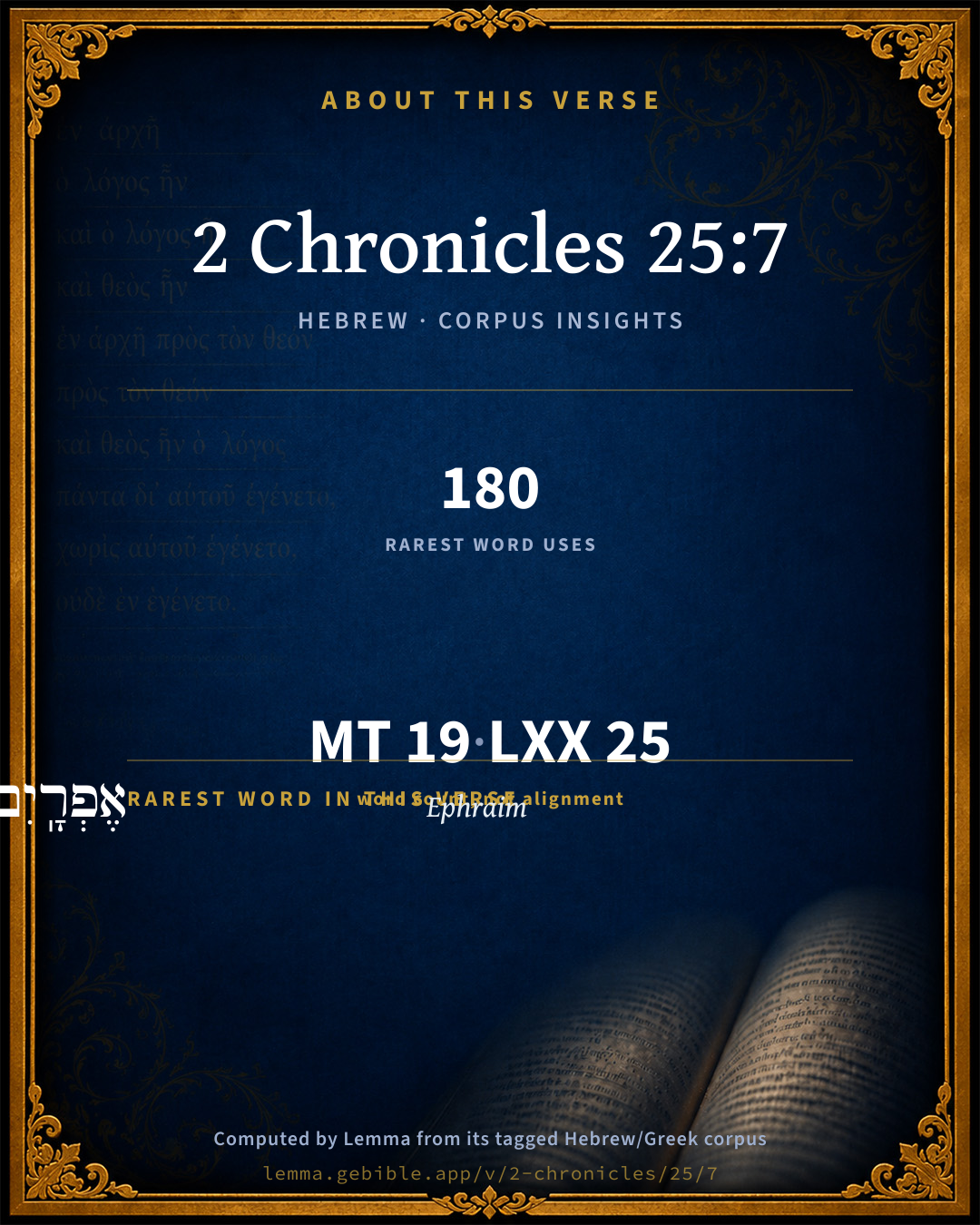
2 Chronicles 25:7

Hebrew (Westminster Leningrad Codex) 2 Chronicles 25:7 appears in the Hebrew Old Testament. The text above is from the Westminster Leningrad Codex. Each word links to its Strong’s number, a concise gloss, and parsing drawn from the Open Scriptures Hebrew Bible morphology. Click any word for its full Brown-Driver-Briggs (BDB) entry.
Download image
Cite this verse

2 Chronicles 25:7 (World English Bible). Public Domain. Lemma interlinear Bible study tool, https://lemma.gebible.app/v/2-chronicles/25/7.

Show BibTeX & RIS
BibTeX
RIS
English Translation
But there came a man of God to him, saying, O king, don't let the army of Israel go with you; for Yahweh is not with Israel, [to wit], with all the children of Ephraim.
World English Bible · Public Domain
Download a study sheet

One document with this verse’s original text, its word-by-word gloss line, the meaning frame, cross-references with their text, attributed commentary, and full source and license credits — printable, and it pastes into notes with its structure intact.

This verse Autodidact and up

Study sheet (.html) Plain text (.txt)

A passage Seminary Student

Up to 50 verses in one chapter. A passage sheet keeps up to 6 commentary sources and 12 cross-references per verse, in the order this page ranks them, and says so on the sheet whenever that leaves anything out. Ask for a single verse and you get the Autodidact verse sheet above.

Everything on this page stays free to read, with no account — the sheet is a download of what is already on screen, not access to it.

Want to remove ads? Support Godless Engineer
Compare translations 3

The same verse in 3 English versions, stacked beneath the original-language interlinear above. Click any original word for its lexicon entry.

Each is an independent rendering of the whole verse — the interlinear is not word-aligned to these translations.

Highlighted words mark where these versions differ — a whole-verse word diff, not a word-by-word alignment.

  • World English Bible Public Domain
    But there came a man of God to him, saying, O king, don't let the army of Israel go with you; for Yahweh is not with Israel, [to wit], with all the children of Ephraim.
  • King James Version Public Domain
    But there came a man of God to him, saying, O king, let not the army of Israel go with thee; for the LORD is not with Israel, to wit, with all the children of Ephraim.
  • unfoldingWord Literal Text CC BY-SA 4.0
    But a man of God came to him, saying, “O King, do not let the army of Israel go with you, for Yahweh is not with Israel, all the sons of Ephraim.

unfoldingWord Literal Text — © unfoldingWord, licensed CC BY-SA 4.0. Word-aligned USFM3 via Door43 (git.door43.org/unfoldingWord/en_ult).

Versions to compare (up to 4)

3 of 4 selected

Show all 18 translations

Every available English version of this verse, each an independent rendering of the whole verse.

  • World English Bible Public Domain
    But there came a man of God to him, saying, O king, don't let the army of Israel go with you; for Yahweh is not with Israel, [to wit], with all the children of Ephraim.
  • Berean Standard Bible Public Domain
    But a man of God came to him and said, “O king, do not let the army of Israel go with you, for the LORD is not with Israel—not with any of the Ephraimites.
  • Majority Standard Bible Public Domain
    But a man of God came to him and said, “O king, do not let the army of Israel go with you, for the LORD is not with Israel—not with any of the Ephraimites.
  • King James Version Public Domain
    But there came a man of God to him, saying, O king, let not the army of Israel go with thee; for the LORD is not with Israel, to wit, with all the children of Ephraim.
  • American Standard Version (1901) Public Domain
    But there came a man of God to him, saying, O king, let not the army of Israel go with thee; for Jehovah is not with Israel, `to wit', with all the children of Ephraim.
  • Revised Version (1885) Public Domain
    But there came a man of God to him, saying, O king, let not the army of Israel go with thee; for the LORD is not with Israel, to wit, with all the children of Ephraim.
  • Geneva Bible (1599) Public Domain
    But a man of God came to him, saying, O King, let not the armie of Israel goe with thee: for the Lord is not with Israel, neither with all the house of Ephraim.
  • Douay-Rheims (1899) Public Domain
    But a man of God came to him, and said: O king, let not the army of Israel go out with thee, for the Lord is not with Israel, and all the children of Ephraim:
  • Young's Literal Translation Public Domain
    and a man of God hath come in unto him, saying, `O king, the host of Israel doth not go with thee; for Jehovah is not with Israel -- all the sons of Ephraim;
  • Literal Standard Version CC BY-SA 4.0
    and a man of God has come to him, saying, “O king, the host of Israel does not go with you; for YHWH is not with Israel—all the sons of Ephraim;
  • Unlocked Literal Bible CC BY-SA 4.0
    But a man of God came to him and said, “King, do not let the army of Israel go with you, for Yahweh is not with Israel—none of the people of Ephraim.
  • unfoldingWord Literal Text CC BY-SA 4.0
    But a man of God came to him, saying, “O King, do not let the army of Israel go with you, for Yahweh is not with Israel, all the sons of Ephraim.
  • Darby Bible Public Domain
    But there came a man of God to him, saying, O king, let not the host of Israel go with thee; for Jehovah is not with Israel, [with] all the children of Ephraim.
  • World Messianic Bible Public Domain
    A man of God came to him, saying, “O king, don’t let the army of Israel go with you, for the LORD is not with Israel, with all the children of Ephraim.
  • Webster's Bible Public Domain
    But there came a man of God to him, saying, O king, let not the army of Israel go with thee; for the LORD is not with Israel, to wit, with all the children of Ephraim.
  • Free Bible Version CC BY-SA 4.0
    But a man of God came to him and said, “Your Majesty, don't let this army of Israel join you, for the Lord is not with Israel, with these sons of Ephraim!
  • Bible in Basic English Public Domain
    But a man of God came to him, saying, O king, let not the army of Israel go with you; for the Lord is not with Israel, that is, the children of Ephraim.
  • JPS Tanakh (1917) Public Domain
    But there came a man of God to him, saying: 'O king, let not the army of Israel go with thee; for the LORD is not with Israel, even with all the children of Ephraim.

Literal Standard Version (2020), Covenant Press — licensed CC BY-SA 4.0. Text via the HelloAO Bible API (eBible.org). Unlocked Literal Bible (unfoldingWord) — licensed CC BY-SA 4.0. Text via the HelloAO Bible API (eBible.org). unfoldingWord Literal Text — © unfoldingWord, licensed CC BY-SA 4.0. Word-aligned USFM3 via Door43 (git.door43.org/unfoldingWord/en_ult). Free Bible Version, Dr. Jonathan Gallagher — licensed CC BY-SA 4.0. Text via the HelloAO Bible API (eBible.org).

Word by word

More ways to search: Search by grammar → Find every occurrence → Compare this word →

Practice this passage: Drill this verse → Learn its vocabulary →

אֶפְרָֽיִם
ʼEphrayim
H669
“Ephraim”
Noun, Proper
Part of Speech
Noun
Type
Proper
Full BDB Definition

Origin: dual of H672

TWOT: None

Ephraim = "double ash-heap: I shall be doubly fruitful" - second son of Joseph, blessed by him and given preference over first son, Manasseh - the tribe, Ephraim - the mountain country of Ephraim - sometimes used name for the northern kingdom (Hosea or Isaiah) - a city near Baal-hazor - a chief gate of Jerusalem
  1. וְאִ֣ישׁ ʼîysh H376 “and · man of” Conjunction + Noun, Common, Masculine, Singular, Construct
  2. הָאֱלֹהִ֗ים ʼĕlôhîym H430 “the · God(s)” Particle, Definite Article + Noun, Common, Masculine, Plural, Absolute
  3. בָּ֤א bôwʼ H935 “to enter” Verb, Qal, Perfect, 3rd Person, Masculine, Singular
  4. אֵלָיו֙ ʼêl H413 “to · him” Preposition + Suffix, Personal, 3rd Person, Masculine, Singular
  5. לֵאמֹ֔ר ʼâmar H559 “to say” Preposition + Verb, Qal, Infinitive Construct
  6. הַמֶּ֕לֶךְ melek H4428 “the · king” Particle, Definite Article + Noun, Common, Masculine, Singular, Absolute
  7. אַל ʼal H408 “not” Particle, Negative
  8. יָבֹ֥א bôwʼ H935 “to enter” Verb, Qal, Jussive, 3rd Person, Masculine, Singular
  9. עִמְּךָ֖ ʻim H5973 “with · you” Preposition + Suffix, Personal, 2nd Person, Masculine, Singular
  10. צְבָ֣א tsâbâʼ H6635 “army of” Noun, Common, Both, Singular, Construct
  11. יִשְׂרָאֵ֑ל Yisrâʼêl H3478 “Israel” Noun, Proper
  12. כִּ֣י kîy H3588 “that” Conjunction
  13. אֵ֤ין ʼayin H369 “nothing” Particle, Negative
  14. יְהוָה֙ Yᵉhôvâh H3068 “LORD” Noun, Proper
  15. עִם ʻim H5973 “with” Preposition
  16. יִשְׂרָאֵ֔ל Yisrâʼêl H3478 “Israel” Noun, Proper
  17. כֹּ֖ל kôl H3605 “all of” Noun, Common, Masculine, Singular, Construct
  18. בְּנֵ֥י bên H1121 “sons of” Noun, Common, Masculine, Plural, Construct

About this verse

These counts appear in no published source. They are computed here, from the morphology-tagged text and Lemma’s own curated glosses. What Lemma adds →

19
words
16
distinct lemmas
Historical
section

Grammatical profile

  • 3 verbs
  • 10 nouns
  • 3 prepositions
  • 1 conjunction
  • 2 particles

Verb forms

  • בָּ֤א Qal · Perfect
  • לֵאמֹ֔ר Qal · Infinitive Construct
  • יָבֹ֥א Qal · Jussive

Repetition

Words recur within this verse — often emphatic in Hebrew:

  • בָּ֤א to enter H935 ×2
  • יִשְׂרָאֵ֑ל Israel H3478 ×2
  • עִמְּךָ֖ with H5973 ×2

Hebrew & Septuagint length

In English translation the verse runs 35 words from the Hebrew and 34 from the Septuagint (LXX English) — closely comparable.

A rough comparison of the two English renderings, which tokenize alike — not a word-level alignment.

Word counts can differ between the Hebrew and the Greek without any difference in meaning — e.g. the Hebrew direct-object marker אֵת has no separate Greek word, and Greek often adds the article ὁ.

In the original languages it is 19 Hebrew tokens and 25 Greek tokens — but the two are counted differently (Hebrew bundles its prefixes and suffixes into one token; the Greek is in lemma form), so that isn’t a like-for-like length.

Cross-references

10

Topical passages linked to 2 Chronicles 25:7 in the Treasury of Scripture Knowledge — connected by theme and wording, ordered by reader-vote popularity; previews shown in the World English Bible.

  • 2 Chronicles 19:2 Jehu the son of Hanani the seer went out to meet him, and said to king Jehoshaphat, Should you help the wicked, and love those who hate Yahweh? for this thing wrath is on you from before Yahweh.
  • 2 Samuel 12:1 Yahweh sent Nathan to David. He came to him, and said to him, "There were two men in one city; the one rich, and the other poor.
  • 1 Kings 12:28 Whereupon the king took counsel, and made two calves of gold; and he said to them, It is too much for you to go up to Jerusalem: see your gods, Israel, which brought you up out of the land of Egypt.
  • 1 Kings 13:1 Behold, there came a man of God out of Judah by the word of Yahweh to Beth El: and Jeroboam was standing by the altar to burn incense.
  • 2 Chronicles 13:12 Behold, God is with us at our head, and his priests with the trumpets of alarm to sound an alarm against you. Children of Israel, don't you fight against Yahweh, the God of your fathers; for you shall not prosper.
  • Isaiah 28:1–3 Woe to the crown of pride of the drunkards of Ephraim, and to the fading flower of his glorious beauty, which is on the head of the fat valley of those who are overcome with wine!
  • Hosea 5:13–15 When Ephraim saw his sickness, And Judah his wound, Then Ephraim went to Assyria, And sent to king Jareb: But he is not able to heal you, Neither will he cure you of your wound.
  • Hosea 9:13 Ephraim, like I have seen Tyre, is planted in a pleasant place; But Ephraim will bring out his children to the killer.
  • 1 Timothy 6:11 But you, man of God, flee these things, and follow after righteousness, godliness, faith, love, patience, and gentleness.
  • 2 Timothy 3:17 that the man of God may be complete, thoroughly equipped for every good work.

Cross-references courtesy of OpenBible.info (CC BY 4.0).

Hebrew and Greek witnesses Masoretic Hebrew ↔ Greek Septuagint

The same verse in the two great witnesses to the Old Testament, shown verse-for-verse.

These are two independent witnesses, not word-aligned to each other, and the Septuagint is shown in lemma (dictionary) form.

Hebrew 2 Chronicles 25:7 Masoretic · Westminster Leningrad Codex

וְאִ֣ישׁ הָאֱלֹהִ֗ים בָּ֤א אֵלָיו֙ לֵאמֹ֔ר הַמֶּ֕לֶךְ אַל יָבֹ֥א עִמְּךָ֖ צְבָ֣א יִשְׂרָאֵ֑ל כִּ֣י אֵ֤ין יְהוָה֙ עִם יִשְׂרָאֵ֔ל כֹּ֖ל בְּנֵ֥י אֶפְרָֽיִם

But there came a man of God to him, saying, O king, don't let the army of Israel go with you; for Yahweh is not with Israel, [to wit], with all the children of Ephraim.

World English Bible · Public Domain

Greek LXX 2 Chronicles 25:7 Septuagint · lemma form

καί ἄνθρωπος ὁ θεός ἔρχομαι πρός αὐτός λέγω βασιλεύς οὐ πορεύομαι μετά σύ δύναμις ἰσραήλ ὅτι οὐ εἰμί κύριος μετά ἰσραήλ πᾶς ὁ υἱός ἐφράιμ

And there came a man of God to him, saying, O king, let not the host of Israel go with you; for the Lord is not with Israel, even all the sons of Ephraim.

LXX2012 (modern English Septuagint) · Public Domain

Hebrew: Westminster Leningrad Codex (CC BY 4.0). Greek: Septuagint (public domain); English from LXX2012 (modern English Septuagint) (Public Domain). How the Septuagint differs from the Hebrew →

Commentary

Notes on 2 Chronicles 25:7 from classic Christian and Jewish commentators (each source and its license shown beneath its notes). The classic Christian expositions comment on the surrounding passage and are grouped to its opening verse, so a note may address several verses; the Jewish commentaries on the Tanakh (Rashi and others) are per-verse, so they appear only where the commentator wrote on this verse.

Lemma curates 59 commentaries, every one of them public domain or Creative Commons licensed, each selected and text-cleaned for this edition rather than reprinted as found. About our sources →

Trapp's Complete Commentary

John Trapp

2Ch 25:7 But there came a man of God to him, saying, O king, let not the army of Israel go with thee; for the LORD [is] not with Israel, [to wit, with] all the children of Ephraim.

Ver. 7. But there came a man of God to him.] This was, say the Hebrews, {a} Amos, the father of the prophet Isaiah, being brother to Amaziah; but that is but a conjecture.

Let not the army.] What marvel that Christians prevail so little against the Turks, considering what soldiers they make use of!

{a} Sedar Olam.

John Trapp, A Commentary or Exposition upon All the Books of the Old and New Testament (1647–1656) — public domain. Text from a community e-Sword module.

Joseph Benson's Commentary

2Ch 25:7-8. Let not the army of Israel go with thee — It is comfortable to employ those who, we have reason to hope, have an interest in heaven; but dangerous associating with those from whom the Lord is departed. For the Lord is not with Israel — He hath forsaken them; and prosperity shall not attend thy counsels and undertakings, if thou joinest thyself with them. But if thou wilt go, do it — It is an ironical concession, like that of Micaiah to Ahab, Go and prosper.

Joseph Benson's Commentary on the Old and New Testaments (1811–1818) — public domain. Text from a community e-Sword module.

Tyndale Open Study Notes

Tyndale Open Resources

25:7-8 The phrase a man of God was a way to refer to a prophet (as in Deut 33:1; 1 Sam 2:27; 9:6-10; 1 Kgs 13:1-31). • The kingdom of Israel was politically foreign and spiritually apostate. Relying on Israel’s troops for military strength would bring spiritual compromise and God’s opposition.

Tyndale Open Study Notes — © Tyndale Open Resources, licensed CC BY-SA 4.0. Text via the HelloAO Bible API.

Geneva Bible (1599)

Geneva Bible translators

And therefore to think to have help of them, whom the Lord favoreth not, is to cast off the help of the Lord.

Geneva Bible (1599) marginal notes — public domain. Text via Bolls.life.

Jamieson, Fausset & Brown

Robert Jamieson, A. R. Fausset & David Brown

there came a man of God--sent to dissuade Amaziah from the course he was following, on the ground that "the Lord is not with Israel." This statement was perfectly intelligible to the king. But the historian, writing long after, thought it might require explanation, and therefore added the comment, "with all the children of Ephraim." Idolatry had long been the prevailing religion in that kingdom, and Ephraim its headquarters. As to the other part of the prophet's advice (Ch2 25:8), considerable obscurity hangs over it, as the text stands; and hence some able critics have suggested the insertion of "not" in the middle clause, so that the verse will be thus: "But if thou wilt go [alone], do, be strong for the battle; God shall not make thee fall before the enemy."

Jamieson, Fausset & Brown — Commentary Critical and Explanatory on the Whole Bible (1871) — public domain (CC PDM 1.0). Text via the HelloAO Bible API.

Adam Clarke's Commentary

Verse 7. The Lord is not with Israel] "The WORD of the Lord is not the helper of the Israelites, nor of the kingdom of the tribe of Ephraim." - Targum.

Adam Clarke's Commentary on the Bible (1810–1826) — public domain. Text from a community e-Sword/MySword module.

Ellicott's Commentary for English Readers

(7) The Lord is not with Israel.—Comp. 2Ch_19:2; 2Ch_20:37; also 2Ch_16:7.

To wit, with all the children of Ephraim.—Added as an explanation of the term Israel. Ephraim was the name of the northern kingdom (Hos_5:11; Hos_5:14; Hos_6:4, and passim).

A Bible Commentary for English Readers, edited by Charles John Ellicott (1878–1897) — public domain. Text from a community e-Sword module.

The Cambridge Bible for Schools and Colleges

gen. ed. J. J. S. Perowne

7. the Lord is not with Israel] Cp. 2Ch_13:8-12.

The Cambridge Bible for Schools and Colleges (gen. ed. J. J. S. Perowne; Cambridge University Press, 1878–1918) — public domain. Text from a community e-Sword module.

John Gill's Exposition

But if thou wilt go, do it, be strong for the battle,.... An ironical expression; if thou wilt not be advised, take them with thee, and try what thou canst do; exert all thy courage, and use thy military skill, and mark the issue:

God shall make thee fall before the enemy; notwithstanding the number of thy troops, and those of thy auxiliaries; though some take them to be spoken seriously, and read the words, "but go thou"; that is, alone, without the hired troops, and fight boldly and courageously; or otherwise "God shall make thee fall", &c.

for God hath power to help and to cast down; to help with a few, and to cast down with many; to help without the hired Israelites, and to cast down with them.

John Gill's Exposition of the Whole Bible (1746–1763) — public domain (CC PDM 1.0). Text via the HelloAO Bible API.

Matthew Poole's English Annotations

The Lord is not with Israel; he hath forsaken them, and for their sakes will curse thy forces, if thou joinest thyself with them.

Matthew Poole's English Annotations on the Holy Bible (1683–1685) — public domain. Text from a community e-Sword/MySword module.

The Pulpit Commentary

(See foregoing chapter, ver. 19.) The name of this man of God does not transpire. To wit, with. These three words, all in italic type, if entirely omitted, and not even the preposition adopted, as in the Revised Version, into the ordinary type, will leave the intention of the writer clearer rather than less clear.

The Pulpit Commentary (1880–1919), ed. H.D.M. Spence-Jones & Joseph S. Exell — public domain. Text from a community e-Sword module.

John Wesley's Explanatory Notes

Let not, &c. - It is comfortable to employ those, who we have reason to hope, have an interest in heaven, but dangerous associating with those from whom the Lord is departed.

John Wesley, Explanatory Notes Upon the Whole Bible (1754–1765) — public domain. Text via the GEBible commentary corpus.

Scofield Reference Notes

C. I. Scofield

Ephraim

Used in a collective sense for the northern ten-tribe kingdom, called also "Israel."

The Scofield Reference Bible (1917 edition), notes by C. I. Scofield — public domain. Text from a community e-Sword module.

unfoldingWord translationNotes

Door43 World Missions Community

a man of God

"a prophet of God"

Israel ... the people of Ephraim

These are two names for the same group people.

throw you down before the enemy ... throw down

Here the prophet speaks of military defeat as if the king would be thrown down on the ground. AT: "enable your enemy to defeat you ... defeat" (See: Metaphor)

translationWords

God

Ephraim

power

unfoldingWord translationNotes — © Distant Shores Media and the Door43 World Missions Community, licensed CC BY-SA 4.0. Source: git.door43.org/Door43/en_tn.

Rashi

Rabbi Shlomo Yitzchaki (Rashi)

for God is not with Israel, all the sons of Ephraim because Jeroboam was of the tribe of Ephraim, and he was the first to cause Israel to sin. And in every generation thereafter he remained a stumbling block for them, for they worshipped the golden calves of Jeroboam.

Rashi on the Tanakh — English translations: “The Judaica Press complete Tanach with Rashi, translated by A. J. Rosenberg” (CC BY 4.0); “Pentateuch with Rashi's commentary by M. Rosenbaum and A.M. Silbermann, 1929-1934” (public domain); “The Metsudah Tanach series, Lakewood, N.J” (CC BY 4.0); and “The Book of Joshua, Metsudah Publications, 1997” (CC BY 4.0). Text via Sefaria.

Lesson kit

Teaching starters — assembled from the data on this page, not authored interpretation. Every prompt links to the verse data it draws on. Edit before teaching.

2 Chronicles, in the Historical, opens this verse with 19 words (16 distinct Hebrew lemmas). Its most distinctive word is ʼEphrayim (“Ephraim”). A historical commentator’s framing appears above. Read the whole chapter for the surrounding context.

Discussion questions

  1. The word ʼEphrayim carries the sense “Ephraim.” How does it shape the verse?
  2. 2 Chronicles 19:2 shares this passage’s theme. How do the two illuminate each other?
  3. “to enter” occurs 2× in this one verse. What is the effect of the repetition?
  4. These translations render this verse differently; the difference is in the English rendering, not the original. What questions does that raise?
  5. The verb «בָּ֤א» is Qal Perfect. How does its form color the action?
  6. Reading how Trapp's Complete Commentary and Joseph Benson's Commentary read this verse, where do the two commentators agree and where do they part?

Things to notice

Reading settings

Reading text

Shown beneath each verse's original-language words.

Old Testament
Old Testament edition

Read the OT as the Masoretic Hebrew (MT) or the Greek Septuagint (LXX).

English shown for the Greek Septuagint (in the Hebrew ↔ Greek comparison).

Comparing translations? Open the Compare panel on any verse page to stack up to four side by side.