
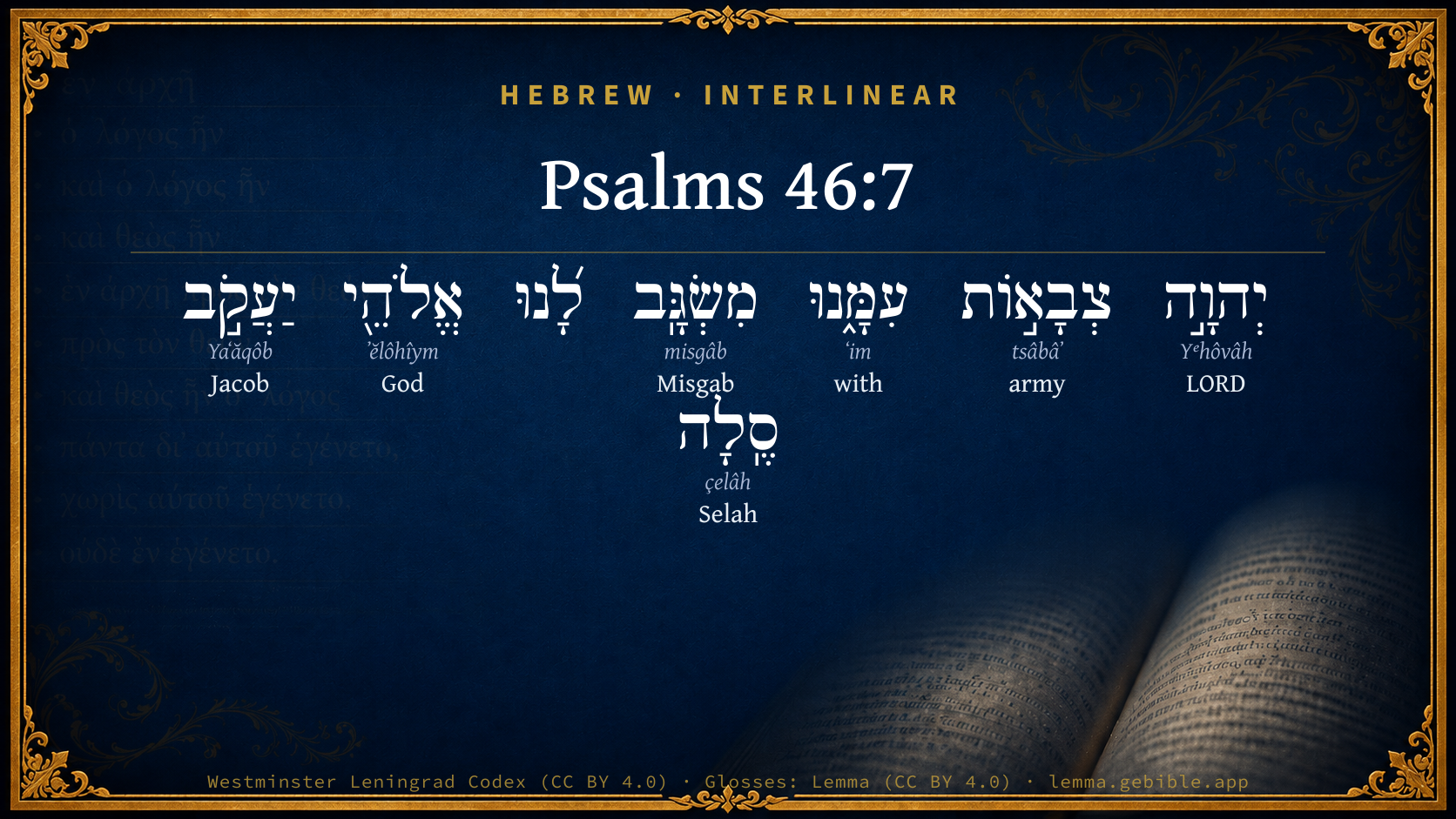
Psalms 46:7

Hebrew (Westminster Leningrad Codex) Psalms 46:7 appears in the Hebrew Old Testament. The text above is from the Westminster Leningrad Codex. Each word links to its Strong’s number, a concise gloss, and parsing drawn from the Open Scriptures Hebrew Bible morphology. Click any word for its full Brown-Driver-Briggs (BDB) entry.
Download image
Cite this verse

Psalms 46:7 (World English Bible). Public Domain. Lemma interlinear Bible study tool, https://lemma.gebible.app/v/psalms/46/7.

Show BibTeX & RIS
BibTeX
RIS
English Translation
Yahweh of Hosts is with us. The God of Jacob is our refuge. Selah.
World English Bible · Public Domain
Download a study sheet

One document with this verse’s original text, its word-by-word gloss line, the meaning frame, cross-references with their text, attributed commentary, and full source and license credits — printable, and it pastes into notes with its structure intact.

This verse Autodidact and up

Study sheet (.html) Plain text (.txt)

A passage Seminary Student

Up to 50 verses in one chapter. A passage sheet keeps up to 6 commentary sources and 12 cross-references per verse, in the order this page ranks them, and says so on the sheet whenever that leaves anything out. Ask for a single verse and you get the Autodidact verse sheet above.

Everything on this page stays free to read, with no account — the sheet is a download of what is already on screen, not access to it.

Want to remove ads? Support Godless Engineer
Compare translations 3

The same verse in 3 English versions, stacked beneath the original-language interlinear above. Click any original word for its lexicon entry.

Each is an independent rendering of the whole verse — the interlinear is not word-aligned to these translations.

Highlighted words mark where these versions differ — a whole-verse word diff, not a word-by-word alignment.

  • World English Bible Public Domain
    Yahweh of Hosts is with us. The God of Jacob is our refuge. Selah.
  • King James Version Public Domain
    The LORD of hosts is with us; the God of Jacob is our refuge. Selah.
  • unfoldingWord Literal Text CC BY-SA 4.0
    Yahweh of Armies with us; the God of Jacob a stronghold to us. Selah

unfoldingWord Literal Text — © unfoldingWord, licensed CC BY-SA 4.0. Word-aligned USFM3 via Door43 (git.door43.org/unfoldingWord/en_ult).

Versions to compare (up to 4)

3 of 4 selected

Show all 18 translations

Every available English version of this verse, each an independent rendering of the whole verse.

  • World English Bible Public Domain
    Yahweh of Hosts is with us. The God of Jacob is our refuge. Selah.
  • Berean Standard Bible Public Domain
    The LORD of Hosts is with us; the God of Jacob is our fortress. Selah
  • Majority Standard Bible Public Domain
    The LORD of Hosts is with us; the God of Jacob is our fortress. Selah
  • King James Version Public Domain
    The LORD of hosts is with us; the God of Jacob is our refuge. Selah.
  • American Standard Version (1901) Public Domain
    Jehovah of hosts is with us; The God of Jacob is our refuge. Selah
  • Revised Version (1885) Public Domain
    The LORD of hosts is with us; the God of Jacob is our refuge. Selah
  • Geneva Bible (1599) Public Domain
    The Lord of hostes is with vs: the God of Iaakob is our refuge. Selah.
  • Douay-Rheims (1899) Public Domain
    Nations were troubled, and kingdoms were bowed down: he uttered his voice, the earth trembled.
  • Young's Literal Translation Public Domain
    Jehovah of Hosts `is' with us, A tower for us `is' the God of Jacob. Selah.
  • Literal Standard Version CC BY-SA 4.0
    YHWH of Hosts [is] with us, || The God of Jacob [is] a tower for us. Selah.
  • Unlocked Literal Bible CC BY-SA 4.0
    Yahweh of hosts is with us; the God of Jacob is our refuge. Selah
  • unfoldingWord Literal Text CC BY-SA 4.0
    Yahweh of Armies with us; the God of Jacob a stronghold to us. Selah
  • Darby Bible Public Domain
    Jehovah of hosts is with us; the God of Jacob is our high fortress. Selah.
  • World Messianic Bible Public Domain
    The LORD of Hosts is with us. The God of Jacob is our refuge. Selah.
  • Webster's Bible Public Domain
    \\46:6\\The heathen raged, the kingdoms were moved: he uttered his voice, the earth melted.
  • Free Bible Version CC BY-SA 4.0
    The Lord Almighty is with us; the God of Jacob protects us. Selah.
  • Bible in Basic English Public Domain
    The Lord of armies is with us; the God of Jacob is our high tower. (Selah.)
  • JPS Tanakh (1917) Public Domain
    (46-8) The LORD of hosts is with us; the God of Jacob is our high tower. Selah

Literal Standard Version (2020), Covenant Press — licensed CC BY-SA 4.0. Text via the HelloAO Bible API (eBible.org). Unlocked Literal Bible (unfoldingWord) — licensed CC BY-SA 4.0. Text via the HelloAO Bible API (eBible.org). unfoldingWord Literal Text — © unfoldingWord, licensed CC BY-SA 4.0. Word-aligned USFM3 via Door43 (git.door43.org/unfoldingWord/en_ult). Free Bible Version, Dr. Jonathan Gallagher — licensed CC BY-SA 4.0. Text via the HelloAO Bible API (eBible.org).

Word by word

More ways to search: Search by grammar → Find every occurrence → Compare this word →

Practice this passage: Drill this verse → Learn its vocabulary →

About this verse

These counts appear in no published source. They are computed here, from the morphology-tagged text and Lemma’s own curated glosses. What Lemma adds →

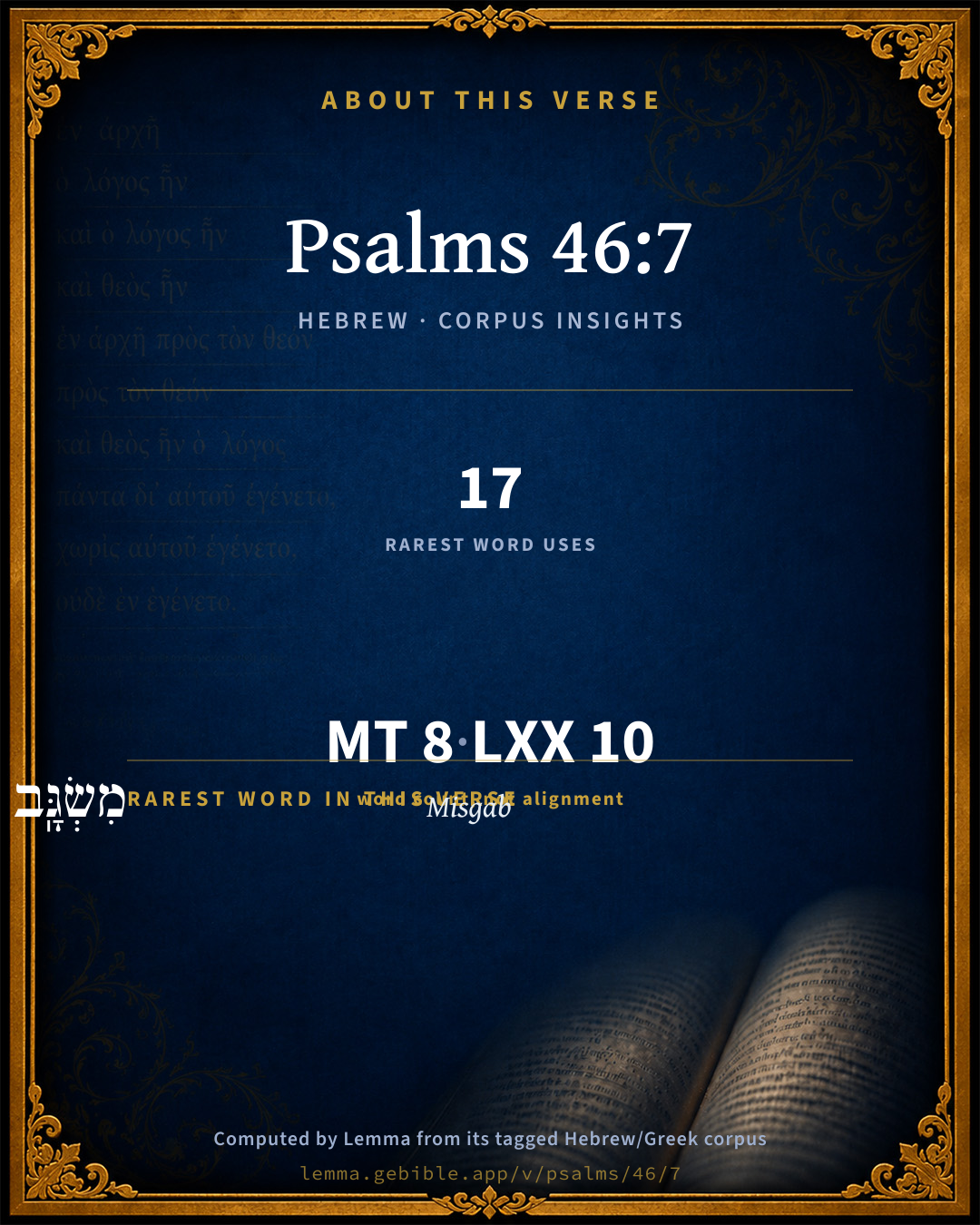
8
words
7
distinct lemmas
Wisdom
section

Notable vocabulary

The rarest word here is מִשְׂגָּֽב Misgab H4869 — appearing just 17 times in the whole Hebrew Bible.

Shared distinctive vocabulary

מִשְׂגָּֽב Misgab H4869 occurs in 16 verses of the Hebrew Bible. Also found in:

Grammatical profile

  • 5 nouns
  • 2 prepositions
  • 1 particle

Hebrew & Septuagint length

In English translation the verse runs 14 words from the Hebrew and 15 from the Septuagint (LXX English) — closely comparable.

A rough comparison of the two English renderings, which tokenize alike — not a word-level alignment.

Word counts can differ between the Hebrew and the Greek without any difference in meaning — e.g. the Hebrew direct-object marker אֵת has no separate Greek word, and Greek often adds the article ὁ.

In the original languages it is 8 Hebrew tokens and 10 Greek tokens — but the two are counted differently (Hebrew bundles its prefixes and suffixes into one token; the Greek is in lemma form), so that isn’t a like-for-like length.

Cross-references

8

Topical passages linked to Psalms 46:7 in the Treasury of Scripture Knowledge — connected by theme and wording, ordered by reader-vote popularity; previews shown in the World English Bible.

  • Romans 8:31 What then shall we say about these things? If God is for us, who can be against us?
  • Psalms 9:9 Yahweh will also be a high tower for the oppressed; A high tower in times of trouble.
  • Numbers 14:9 Only don't rebel against Yahweh, neither fear the people of the land; for they are bread for us: their defense is removed from over them, and Yahweh is with us: don't fear them.
  • 2 Chronicles 13:12 Behold, God is with us at our head, and his priests with the trumpets of alarm to sound an alarm against you. Children of Israel, don't you fight against Yahweh, the God of your fathers; for you shall not prosper.
  • Matthew 28:20 teaching them to observe all things that I commanded you. Behold, I am with you always, even to the end of the age." Amen.
  • Isaiah 8:10 Take counsel together, and it shall be brought to nothing; speak the word, and it shall not stand: for God is with us.
  • 2 Timothy 4:22 The Lord Jesus Christ be with your spirit. Grace be with you. Amen.
  • Psalms 46:11 Yahweh of Hosts is with us. The God of Jacob is our refuge. Selah.

Cross-references courtesy of OpenBible.info (CC BY 4.0).

Hebrew and Greek witnesses Masoretic Hebrew ↔ Greek Septuagint

The same verse in the two great witnesses to the Old Testament, shown verse-for-verse.

You’re reading Greek Psalm 45 (Hebrew Psalm 46). The Septuagint counts the superscription, so verse numbers can differ from the Hebrew — chapter-level alignment, not verse-by-verse. Numbering follows Rahlfs.

These are two independent witnesses, not word-aligned to each other, and the Septuagint is shown in lemma (dictionary) form.

Hebrew Psalms 46:7 Masoretic · Westminster Leningrad Codex

יְהוָ֣ה צְבָא֣וֹת עִמָּ֑נוּ מִשְׂגָּֽב לָ֝נוּ אֱלֹהֵ֖י יַעֲקֹ֣ב סֶֽלָה

Yahweh of Hosts is with us. The God of Jacob is our refuge. Selah.

World English Bible · Public Domain

Greek LXX Greek Psalm 45:7 Septuagint · lemma form

ταράσσω ἔθνος κλίνω βασιλεία δίδωμι φωνή αὐτός σαλεύω ὁ γῆ

The Lord of hosts is with us; the God of Jacob is our helper. Pause.

LXX2012 (modern English Septuagint) · Public Domain

On this verse, The Cambridge Bible for Schools and Colleges discusses the Septuagint’s reading. Read the note in Commentary ↓

Hebrew: Westminster Leningrad Codex (CC BY 4.0). Greek: Septuagint (public domain); English from LXX2012 (modern English Septuagint) (Public Domain). How the Septuagint differs from the Hebrew →

Commentary

Notes on Psalms 46:7 from classic Christian and Jewish commentators (each source and its license shown beneath its notes). The classic Christian expositions comment on the surrounding passage and are grouped to its opening verse, so a note may address several verses; the Jewish commentaries on the Tanakh (Rashi and others) are per-verse, so they appear only where the commentator wrote on this verse.

Lemma curates 59 commentaries, every one of them public domain or Creative Commons licensed, each selected and text-cleaned for this edition rather than reprinted as found. About our sources →

Trapp's Complete Commentary

John Trapp

Psa 46:7 The LORD of hosts [is] with us; the God of Jacob [is] our refuge. Selah.

Ver. 7. The Lord of hosts is with us] Even the Lord, who commandeth far other hosts and armies than the enemy hath any; and this they shall see by our spiritual security.

The God of Jacob is our refuge] Heb. our high tower, such as our enemies cannot come at. When he calleth him the God of Jacob he hath respect to the promises, saith Vatablus; God’s power and goodness are the Church’s Jachin and Boaz.

John Trapp, A Commentary or Exposition upon All the Books of the Old and New Testament (1647–1656) — public domain. Text from a community e-Sword module.

J. A. Alexander on Psalms

Joseph Addison Alexander

8. (Psa 46:7). Jehovah of Hosts (is) with us; a refuge for us (is) the God of Jacob. Selah. Notwithstanding these commotions and dangers, the divine protection makes us perfectly secure. Jehovah of Hosts, the God of the Universe, and especially of heaven. See above, on Ps. xxiv. 10, and below, on Ps. xlviii. 9 (8). With us. Compare the name Immanuel, Isa. viii. 8. A refuge, literally a high place, a place beyond the reach of ene- mies and dangers. See above, on Ps. ix. 10 (9), xviii. 3 (2). God of Jacob. See above, oh Ps. xxiv. 6.

Joseph Addison Alexander, The Psalms Translated and Explained (1850) — public domain. Text from a community e-Sword module.

Tyndale Open Study Notes

Tyndale Open Resources

46:7 This refrain reminds readers of the identity of the God of Zion. • among us: Hebrew ‘immanu, part of the name Immanuel, “God with us” (Isa 7:14; 8:8; Matt 1:23).

Tyndale Open Study Notes — © Tyndale Open Resources, licensed CC BY-SA 4.0. Text via the HelloAO Bible API.

Geneva Bible (1599)

Geneva Bible translators

They are assured that God can and will defend his Church from all dangers and enemies.

Geneva Bible (1599) marginal notes — public domain. Text via Bolls.life.

Jamieson, Fausset & Brown

Robert Jamieson, A. R. Fausset & David Brown

with us--on our side; His presence is terror to our enemies, safety to us.

refuge--high place (Psa 9:9; compare also Psa 24:6, Psa 24:10).

Jamieson, Fausset & Brown — Commentary Critical and Explanatory on the Whole Bible (1871) — public domain (CC PDM 1.0). Text via the HelloAO Bible API.

Adam Clarke's Commentary

Verse 7. The Lord of hosts is with us] We, feeble Jews, were but a handful of men; but the Lord of hosts - the God of armies, was on our side. Him none could attack with hope of success, and his legions could not be over-thrown.

The God of Jacob] The God who appeared to Jacob in his distress, and saved him out of all his troubles, appeared also for us his descendants, and has amply proved to us that he has not forgotten his covenant.

Adam Clarke's Commentary on the Bible (1810–1826) — public domain. Text from a community e-Sword/MySword module.

John Calvin's Commentaries

7. Jehovah of armies is with us. In this verse we are taught how we shall be able to apply to our own use the things which the Scriptures everywhere record concerning the infinite power of God. We shall be able to do this when we believe ourselves to be of the number of those whom God has embraced with his fatherly love, and whom he will cherish. The Psalmist again alludes, in terms of commendation, to the adoption by which Israel was separated from the common condition of all the other nations of the earth. And, indeed, apart from this, the description of the power of God would only inspire us with dread. Confident boasting, then, arises from this, that God has chosen us for his peculiar people, to show forth his power in preserving and defending us. On this account, the prophet, after having celebrated the power of God by calling him the God of armies, immediately adds another epithet, the God of Jacob, by which he confirms the covenant made of old time with Abraham, that his posterity, to whom the inheritance of the promised grace belongs, should not doubt that God was favorable to them also. That our faith may rest truly and firmly in God, we must take into consideration at the same time these two parts of his character — his immeasurable power, by which he is able to subdue the whole world under him; and his fatherly love which he has manifested in his word. When these two things are joined together, there is nothing which can hinder our faith from defying all the enemies which may rise up against us, nor must we doubt that God will succor us, since he has promised to do it; and as to power, he is sufficiently able also to fulfill his promise, for he is the God of armies. From this we learn, that those persons err egregiously in the interpretation of Scripture, who leave in entire suspense the application of all that is said concerning the power of God, and do not rest assured that he will be a Father to them, inasmuch as they are of his flock, and partakers of the adoption.

John Calvin's Commentaries (1540-1563) — public domain. Text from the Calvin Translation Society English edition (1840s-50s) via the Christian Classics Ethereal Library (ccel.org). Calvin's coverage is partial (roughly two-thirds of the Bible); uncommented books and verses are honest gaps, never fabricated. The 19th-century editor's footnotes and remarks are omitted so the notes are faithfully Calvin's own voice.

Ellicott's Commentary for English Readers

(7) Lord of hosts.—See Note on Psa_24:10.

Refuge.—Rightly in the margin with idea of height, as giving security.

A Bible Commentary for English Readers, edited by Charles John Ellicott (1878–1897) — public domain. Text from a community e-Sword module.

The Cambridge Bible for Schools and Colleges

gen. ed. J. J. S. Perowne

7. The refrain corresponds to Isaiah’s watchword Immanuel, ‘God is with us’ (Isa_7:14; Isa_8:8; Isa_8:10). The name Jehovah is retained (or has been restored) here even in the Elohistic collection in the familiar title Jehovah of hosts. This great title Jehovah Tsebâôth or ‘Lord of hosts’ was characteristic of the regal and prophetic period. Originally it may have designated Jehovah as “the God of the armies of Israel” (1Sa_17:45), Who went forth with His people’s hosts to battle (Psa_44:9; Psa_60:10). But as the phrase “host of heaven” was used for the celestial bodies (Gen_2:1), and celestial beings (1Ki_22:19), the meaning of the title was extended to designate Jehovah as the ruler of the heavenly powers, the supreme Sovereign of the universe. Hence one of the renderings of it in the LXX is Κύριος παντοκράτωρ, Lord Almighty, or rather, Lord All-Sovereign. See add. note on 1 Sam., p. 235. The title is a favourite one with Isaiah, and its use here is significant. He whose command all the hosts of heaven obey is Israel’s ally. Cp. 2Ki_6:16 ff.

the God of Jacob] A title suggesting the thought of Jehovah’s providential care for the great ancestor of the nation, a thought upon which Hosea dwells (Psa_12:2 ff.).

our refuge] Or, our high fortress: the same word as that in Psa_9:9; Psa_18:2; Psa_48:3; Isa_33:16. Cp. the use of the cognate verb in Psa_20:1. “The Name of the God of Jacob set thee up on high.”

The Cambridge Bible for Schools and Colleges (gen. ed. J. J. S. Perowne; Cambridge University Press, 1878–1918) — public domain. Text from a community e-Sword module.

John Gill's Exposition

The Lord of hosts is with us,.... The Targum is, "the Word of the Lord of hosts". He whose name is Immanuel, which is, by interpretation, "God with us", Mat 1:23; who is King of kings, and Lord of lords; who has all creatures in heaven and earth at his command, whom all the hosts of angels obey; he is on the side of his people, and therefore they have nothing to fear from all the hosts and armies of men; seeing more are they that are for them than they that are against them;

the God of Jacob is our refuge. As, in the former clause, the argument against fear of men is taken from the power of God, and the extent of his dominion, here it is taken from the grace of God, and his people's covenant interest in him: for by Jacob is meant the church of God, and all true believers, who are Israelites indeed; the Lord is the refuge and shelter of such in all times of distress and trouble, and therefore they need not fear; See Gill on Psa 46:1.

Selah; on this word; see Gill on Psa 3:2.

John Gill's Exposition of the Whole Bible (1746–1763) — public domain (CC PDM 1.0). Text via the HelloAO Bible API.

Albert Barnes' Notes on the Bible

The Lord of hosts - The God commanding, ordering, marshalling the hosts of heaven - the angels, and the starry worlds. See the notes at Isa 1:9. Compare Psa 24:10. The reference here is to God considered as having control over all “armies,” or all that can be regarded and described as a marshalled host, in earth and in heaven. Having such a Being, therefore, for a protector, they had nothing to fear. See Psa 46:11.

Is with us - Is on our side; is our defender. The Hebrew phrase used here is employed in Isa 7:14 (notes); Isa 8:8 (notes), to describe the Messiah. See the notes at those passages.

The God of Jacob - See the notes at Psa 24:6. The meaning is, The God whom Jacob acknowedged, and whom he found to be his friend, is with us.

Is our refuge - literally, a high place, as a tower, far above the reach of enemies. See Psa 9:9, note; Psa 18:2, note. So the margin, “an high place for us.”

Albert Barnes' Notes on the Bible (1834–1885) — public domain. Text from a community e-Sword/MySword module.

The Treasury of David

Charles H. Spurgeon

Ver. 7. The Lord of hosts is with us. This is the reason for all Zion's security, and for the overthrow of her foes. The Lord rules the angels, the stars, the elements, and all the hosts of heaven; and the heaven of heavens are under his sway. The armies of men though they know it not are made to subserve his will. This Generalissimo of the forces of the land, and the Lord High Admiral of the seas, is on our sideour august ally; woe unto those who fight against him, for they shall fly like smoke before the wind when he gives the word to scatter them. The God of Jacob is our refuge, Immanuel is Jehovah of Hosts, and Jacob's God is our high place of defence. When this glad verse is sung to music worthy of such a jubilate, well may the singers pause and the players wait awhile to tune their instruments again; here, therefore, fitly stands that solemn, stately, peaceful note of rest, SELAH.

Ver. 7. The Lord of hosts is with us. There be three sorts of God's special presence, all which may be justly accounted the church's privilege. First, his glorious presence, or his presence testified by eminent glory, and the residence thereof. Thus God is said to be in heaven differentially, so as he is not anywhere else; and heaven is therefore called his throne or dwelling place 1Ki 8:39; as a king is nowhere so majestically as upon his throne, or in his chair of state; and this is so great a privilege of the church as that she comes not to enjoy it, unless she be triumphant in heaven, and therefore is not the presence here intended. Secondly, his gracious presence, or his presence testified by tokens of his grace and favour toward a people, whether visible as in the temple where he chose to place his name, and wherein above all places he would be worshipped, in which respect he is said to dwell between the cherubim 2Sa 6:2; or spiritual tokens of his grace, as assistance and acceptance in the duties of his worship, together with enjoyment and benefit of his ordinances. Thus he is present with his church and people in times of the gospel: "Where two or three are gathered together in my name, there am I in the midst of them." Mt 18:20. This kind of presence is a privilege of the church militant, that he will be with her in holy and spiritual administrations and ordinances; yet this is not the presence principally intended here. Thirdly, the providential presence, or his presence testified by acts of special providence, wherein the power, wisdom or any other of God's attributes are eminently put forth, either by way of assistance or defence fro a people. Thus the Lord was present with Israel in the wilderness by the pillar of fore and of a cloud Ex 13:21; "And the Lord went before them by day in a pillar of cloud, to lead them the way; and by night in a pillar of fire, to give them light." And as this presence was intended for a guide, so was it also for a defence to his people against their enemies, and at which their enemies the Egyptians were troubled. Ex 15:20. By this kind of presence the Lord is with his church militant, in reference to her external regiment, and more especially in her warfare, standing up for her and with her against her enemies; and this is the church's privilege in these words, The Lord of hosts is with us. John Strickland, B.D. (1601-1670), in a Sermon, entitled, "Immanuel, "1644.

Ver. 7. The God of Jacob. If any shall ask me, Why then the God of Jacob more than the God of Isaac? Though it might suffice that the Spirit of God is pleased so to speak, yet Mr. Calvin gives this reason, the covenant of grace was more solemnly made and publicly ratified with Abraham and Jacob, than it was with Isaac, and therefore when he will be looked upon as a God in covenant with his people, he holds forth himself more frequently by the name of the God of Abraham, and the God of Jacob, than of the God of Isaac; albeit sometimes he is pleased to take upon him that style also. John Strickland.

Ver. 7. Our refuge. Our refuge, or stronghold, where the church, as a ship in quiet haven, amy anchor and ride safe; or it may be a metaphor from the dens or burrows, where weaponless creatures find shelter, when they are hunted and pursued by their enemies, as Pr 30:26, "The conies are but a feeble folk, yet make they their houses in the rocks." They are safe in the rock if they can get thither, though never so weak in themselves. So the church, though pursued by bloody enemies, and though weak in herself, if yet she get under the wing of the God of Jacob, she may be fearless, for she is safe there. He is our refuge. It were to undervalue God, if we should fear the creatures, when he is with us. Antigonus, when he overheard his soldiers reckoning how many their enemies were, he steps in unto them suddenly, demanding, "And how many do you reckon me for?" John Strickland.

None.

Psalms 46:8*

Charles H. Spurgeon's The Treasury of David (1869–1885) — public domain. Psalms only. Text from a community e-Sword/MySword module.

Whedon's Commentary on the Bible

Daniel D. Whedon

7. A refrain, as in Psa_46:1; Psa_46:11, which see.

Daniel D. Whedon (gen. ed.), Commentary on the Old and New Testaments (1874–1909) — public domain. Text from a community e-Sword module.

The Pulpit Commentary

The Lord of hosts is with us. (comp. 2Ch_15:2 Isa_8:8, Isa_8:10) This is the ground of assurance. Our God, Jehovah, is "the Lord of hosts one who has countless angels at his command. (2Ki_6:16, 17 Psa_68:17 Mat_26:53) And he is "with us on our side, ready to help. The God of Jacob is our Refuge; i.e. our covenant God, the God who entered into covenant with our fathers, Abraham, Isaac, and Jacob.

The Pulpit Commentary (1880–1919), ed. H.D.M. Spence-Jones & Joseph S. Exell — public domain. Text from a community e-Sword module.

John Wesley's Explanatory Notes

Raged - Against God, and against his people. Uttered - He spake to them in his wrath. The earth - The inhabitants of the earth were consumed.

John Wesley, Explanatory Notes Upon the Whole Bible (1754–1765) — public domain. Text via the GEBible commentary corpus.

Rashi

Rabbi Shlomo Yitzchaki (Rashi)

Nations have stirred Heb. המו, an expression of stirring.

shall melt Shall melt - so explained Menachem, similar to (Exod. 15:15), “all the inhabitants of Canaan melted (נמוגו),” and to (Ezek. 21: 12), “every heart will melt (למוג).” But Dunash explained it as an expression of movement, as in (I Sam. 14:16), “the multitude was wandering (נמוג), and it was coming closer,” and so in every instance.

Rashi on the Tanakh — English translations: “The Judaica Press complete Tanach with Rashi, translated by A. J. Rosenberg” (CC BY 4.0); “Pentateuch with Rashi's commentary by M. Rosenbaum and A.M. Silbermann, 1929-1934” (public domain); “The Metsudah Tanach series, Lakewood, N.J” (CC BY 4.0); and “The Book of Joshua, Metsudah Publications, 1997” (CC BY 4.0). Text via Sefaria.

Lesson kit

Teaching starters — assembled from the data on this page, not authored interpretation. Every prompt links to the verse data it draws on. Edit before teaching.

Psalms, in the Wisdom, opens this verse with 8 words (7 distinct Hebrew lemmas). Its most distinctive word is misgâb (“Misgab”). A historical commentator’s framing appears above. Read the whole chapter for the surrounding context.

Discussion questions

  1. How does “Misgab” (misgâb) shape what this verse is saying?
  2. How does 2 Samuel 22:3, which shares the word «Misgab», read alongside this verse?
  3. The translations on this page render this verse differently — a whole-verse word diff, not a word-by-word alignment. What might account for the different wordings?
  4. Compare how Trapp's Complete Commentary and J. A. Alexander on Psalms read this verse. Where do they agree or differ?

Things to notice

Reading settings

Reading text

Shown beneath each verse's original-language words.

Old Testament
Old Testament edition

Read the OT as the Masoretic Hebrew (MT) or the Greek Septuagint (LXX).

English shown for the Greek Septuagint (in the Hebrew ↔ Greek comparison).

Comparing translations? Open the Compare panel on any verse page to stack up to four side by side.