
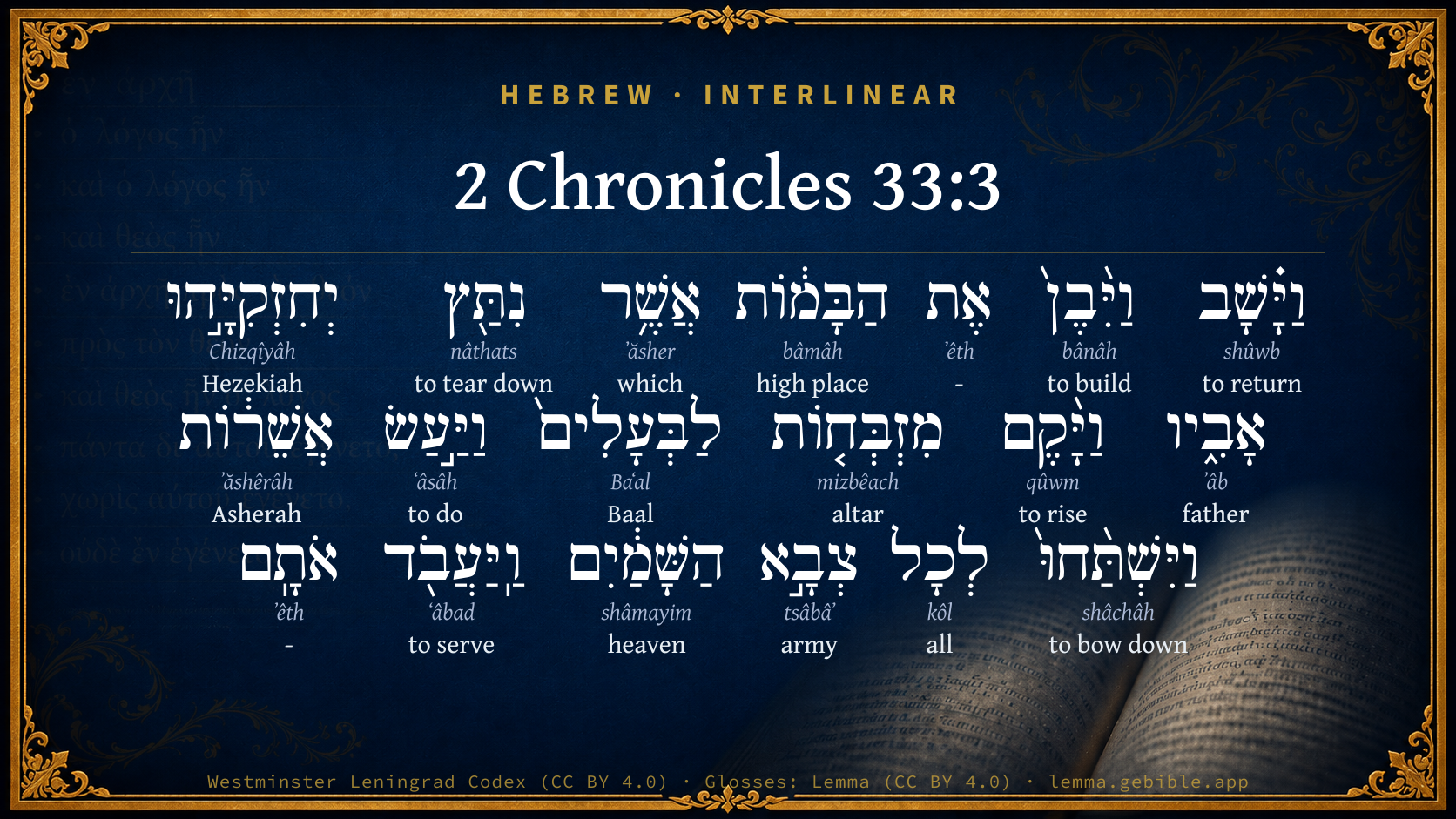
2 Chronicles 33:3

Hebrew (Westminster Leningrad Codex) 2 Chronicles 33:3 appears in the Hebrew Old Testament. The text above is from the Westminster Leningrad Codex. Each word links to its Strong’s number, a concise gloss, and parsing drawn from the Open Scriptures Hebrew Bible morphology. Click any word for its full Brown-Driver-Briggs (BDB) entry.
Download image
Cite this verse

2 Chronicles 33:3 (World English Bible). Public Domain. Lemma interlinear Bible study tool, https://lemma.gebible.app/v/2-chronicles/33/3.

Show BibTeX & RIS
BibTeX
RIS
English Translation
For he built again the high places which Hezekiah his father had broken down; and he reared up altars for the Baals, and made Asheroth, and worshiped all the host of the sky, and served them.
World English Bible · Public Domain
Download a study sheet

One document with this verse’s original text, its word-by-word gloss line, the meaning frame, cross-references with their text, attributed commentary, and full source and license credits — printable, and it pastes into notes with its structure intact.

This verse Autodidact and up

Study sheet (.html) Plain text (.txt)

A passage Seminary Student

Up to 50 verses in one chapter. A passage sheet keeps up to 6 commentary sources and 12 cross-references per verse, in the order this page ranks them, and says so on the sheet whenever that leaves anything out. Ask for a single verse and you get the Autodidact verse sheet above.

Everything on this page stays free to read, with no account — the sheet is a download of what is already on screen, not access to it.

Want to remove ads? Support Godless Engineer
Compare translations 3

The same verse in 3 English versions, stacked beneath the original-language interlinear above. Click any original word for its lexicon entry.

Each is an independent rendering of the whole verse — the interlinear is not word-aligned to these translations.

Highlighted words mark where these versions differ — a whole-verse word diff, not a word-by-word alignment.

  • World English Bible Public Domain
    For he built again the high places which Hezekiah his father had broken down; and he reared up altars for the Baals, and made Asheroth, and worshiped all the host of the sky, and served them.
  • King James Version Public Domain
    For he built again the high places which Hezekiah his father had broken down, and he reared up altars for Baalim, and made groves, and worshipped all the host of heaven, and served them.
  • unfoldingWord Literal Text CC BY-SA 4.0
    And he turned and built the high places that Hezekiah his father had torn down, and he erected altars to the Baals, and he made Asheroth, and he bowed down to all the host of the heavens, and he served them.

unfoldingWord Literal Text — © unfoldingWord, licensed CC BY-SA 4.0. Word-aligned USFM3 via Door43 (git.door43.org/unfoldingWord/en_ult).

Versions to compare (up to 4)

3 of 4 selected

Show all 18 translations

Every available English version of this verse, each an independent rendering of the whole verse.

  • World English Bible Public Domain
    For he built again the high places which Hezekiah his father had broken down; and he reared up altars for the Baals, and made Asheroth, and worshiped all the host of the sky, and served them.
  • Berean Standard Bible Public Domain
    For he rebuilt the high places that his father Hezekiah had torn down, and he raised up altars for the Baals and made Asherah poles. And he worshiped and served all the host of heaven.
  • Majority Standard Bible Public Domain
    For he rebuilt the high places that his father Hezekiah had torn down, and he raised up altars for the Baals and made Asherah poles. And he worshiped and served all the host of heaven.
  • King James Version Public Domain
    For he built again the high places which Hezekiah his father had broken down, and he reared up altars for Baalim, and made groves, and worshipped all the host of heaven, and served them.
  • American Standard Version (1901) Public Domain
    For he built again the high places which Hezekiah his father had broken down; and he reared up altars for the Baalim, and made Asheroth, and worshipped all the host of heaven, and served them.
  • Revised Version (1885) Public Domain
    For he built again the high places which Hezekiah his father had broken down; and he reared up altars for the Baalim, and made Asheroth, and worshipped all the host of heaven, and served them.
  • Geneva Bible (1599) Public Domain
    For he went backe and built the hie places, which Hezekiah his father had broken downe: and he set vp altars for Baalim, and made groues, and worshipped all the hoste of the heauen, and serued them.
  • Douay-Rheims (1899) Public Domain
    And he turned, and built again the high places which Ezechias his father had destroyed: and he built altars to Baalim, and made groves, and he adored all the host of heaven, and worshipped them.
  • Young's Literal Translation Public Domain
    and he turneth and buildeth the high places that Hezekiah his father hath broken down, and raiseth altars for Baalim, and maketh shrines, and boweth himself to all the host of the heavens, and serveth them.
  • Literal Standard Version CC BY-SA 4.0
    and he turns and builds the high places that his father Hezekiah has broken down, and raises altars for Ba‘alim, and makes Asherim, and bows himself to all the host of the heavens, and serves them.
  • Unlocked Literal Bible CC BY-SA 4.0
    For he rebuilt the high places that his father Hezekiah had torn down, and he built altars for the Baals, he made Asherah poles, and he bowed down to all the stars of heaven and worshiped them.
  • unfoldingWord Literal Text CC BY-SA 4.0
    And he turned and built the high places that Hezekiah his father had torn down, and he erected altars to the Baals, and he made Asheroth, and he bowed down to all the host of the heavens, and he served them.
  • Darby Bible Public Domain
    And he built again the high places that Hezekiah his father had broken down; and he reared up altars to the Baals, and made Asherahs, and worshipped all the host of heaven and served them.
  • World Messianic Bible Public Domain
    For he built again the high places which Hezekiah his father had broken down; and he raised up altars for the Baals, made Asheroth, and worshiped all the army of the sky, and served them.
  • Webster's Bible Public Domain
    For he built again the high places which Hezekiah his father had broken down; and he reared up altars for Baalim, and made groves, and worshiped all the host of heaven, and served them.
  • Free Bible Version CC BY-SA 4.0
    He rebuilt the high places that his father Hezekiah had destroyed, and he made altars for the Baals and set up Asherah poles. He worshiped the sun, moon, and stars and served them.
  • Bible in Basic English Public Domain
    For he put up again the high places which had been pulled down by his father Hezekiah; and he made altars for the Baals, and pillars of wood, and was a worshipper and servant of all the stars of heaven;
  • JPS Tanakh (1917) Public Domain
    For he built again the high places which Hezekiah his father had broken down; and he reared up altars for the Baalim, and made Asheroth, and worshipped all the host of heaven, and served them.

Literal Standard Version (2020), Covenant Press — licensed CC BY-SA 4.0. Text via the HelloAO Bible API (eBible.org). Unlocked Literal Bible (unfoldingWord) — licensed CC BY-SA 4.0. Text via the HelloAO Bible API (eBible.org). unfoldingWord Literal Text — © unfoldingWord, licensed CC BY-SA 4.0. Word-aligned USFM3 via Door43 (git.door43.org/unfoldingWord/en_ult). Free Bible Version, Dr. Jonathan Gallagher — licensed CC BY-SA 4.0. Text via the HelloAO Bible API (eBible.org).

Word by word

More ways to search: Search by grammar → Find every occurrence → Compare this word →

Practice this passage: Drill this verse → Learn its vocabulary →

אֲשֵׁר֔וֹת
ʼăshêrâh
H842
“Asherah”
Noun, Proper
Part of Speech
Noun
Type
Proper
Full BDB Definition

Origin: from H833

TWOT: 183h

Ashera(h) = "groves (for idol worship)" - a Babylonian (Astarte)-Canaanite goddess (of fortune and happiness), the supposed consort of Baal, her images - the goddess, goddesses - her images - sacred trees or poles set up near an altar
  1. וַיָּ֗שָׁב shûwb H7725 “and · to return” Conjunction + Verb, Qal, Sequential Imperfect, 3rd Person, Masculine, Singular
  2. וַיִּ֨בֶן֙ bânâh H1129 “and · to build” Conjunction + Verb, Qal, Sequential Imperfect, 3rd Person, Masculine, Singular
  3. אֶת ʼêth H853 “-” Particle, Direct Object
  4. הַבָּמ֔וֹת bâmâh H1116 “the · high places” Particle, Definite Article + Noun, Common, Feminine, Plural, Absolute
  5. אֲשֶׁ֥ר ʼăsher H834 “which” Particle, Relative
  6. נִתַּ֖ץ nâthats H5422 “to tear down” Verb, Piel, Perfect, 3rd Person, Masculine, Singular
  7. יְחִזְקִיָּ֣הוּ Chizqîyâh H2396 “Hezekiah” Noun, Proper
  8. אָבִ֑יו ʼâb H1 “father · his” Noun, Common, Masculine, Singular, Construct + Suffix, Personal, 3rd Person, Masculine, Singular
  9. וַיָּ֨קֶם qûwm H6965 “and · to rise” Conjunction + Verb, Hiphil, Sequential Imperfect, 3rd Person, Masculine, Singular
  10. מִזְבְּח֤וֹת mizbêach H4196 “altars” Noun, Common, Masculine, Plural, Absolute
  11. לַבְּעָלִים֙ Baʻal H1168 “to/for the · Baal” Preposition, Determined + Noun, Proper
  12. וַיַּ֣עַשׂ ʻâsâh H6213 “and · to do” Conjunction + Verb, Qal, Sequential Imperfect, 3rd Person, Masculine, Singular
  13. וַיִּשְׁתַּ֨חוּ֙ shâchâh H7812 “and · to bow down” Conjunction + Verb, Hithpael, Sequential Imperfect, 3rd Person, Masculine, Singular
  14. לְכָל kôl H3605 “to/for · all of” Preposition + Noun, Common, Masculine, Singular, Construct
  15. צְבָ֣א tsâbâʼ H6635 “army of” Noun, Common, Both, Singular, Construct
  16. הַשָּׁמַ֔יִם shâmayim H8064 “the · heaven(s)” Particle, Definite Article + Noun, Common, Masculine, Plural, Absolute
  17. וַֽיַּעֲבֹ֖ד ʻâbad H5647 “and · to serve” Conjunction + Verb, Qal, Sequential Imperfect, 3rd Person, Masculine, Singular
  18. אֹתָֽם ʼêth H853 “- · them” Particle, Direct Object + Suffix, Personal, 3rd Person, Masculine, Plural

About this verse

These counts appear in no published source. They are computed here, from the morphology-tagged text and Lemma’s own curated glosses. What Lemma adds →

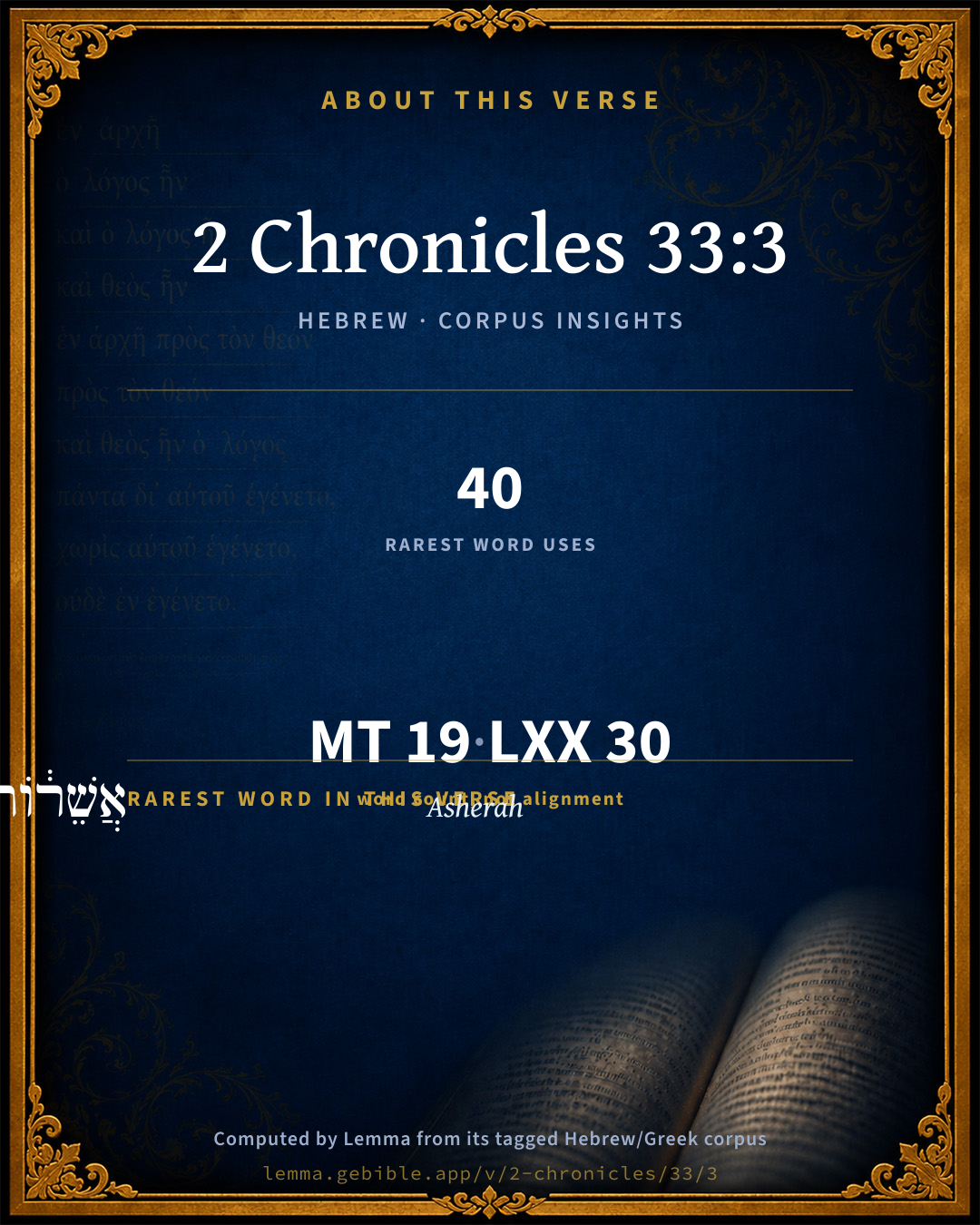
19
words
18
distinct lemmas
Historical
section

Shared distinctive vocabulary

אֲשֵׁר֔וֹת Asherah H842 occurs in 40 verses of the Hebrew Bible. Also found in:

Grammatical profile

  • 7 verbs
  • 9 nouns
  • 3 particles

Verb forms

  • וַיָּ֗שָׁב Qal · Sequential Imperfect
  • וַיִּ֨בֶן֙ Qal · Sequential Imperfect
  • נִתַּ֖ץ Piel · Perfect
  • וַיָּ֨קֶם Hiphil · Sequential Imperfect
  • וַיַּ֣עַשׂ Qal · Sequential Imperfect
  • וַיִּשְׁתַּ֨חוּ֙ Hithpael · Sequential Imperfect
  • וַֽיַּעֲבֹ֖ד Qal · Sequential Imperfect

Hebrew & Septuagint length

In English translation the verse runs 36 words from the Hebrew and 34 from the Septuagint (LXX English) — closely comparable.

A rough comparison of the two English renderings, which tokenize alike — not a word-level alignment.

Word counts can differ between the Hebrew and the Greek without any difference in meaning — e.g. the Hebrew direct-object marker אֵת has no separate Greek word, and Greek often adds the article ὁ.

In the original languages it is 19 Hebrew tokens and 30 Greek tokens — but the two are counted differently (Hebrew bundles its prefixes and suffixes into one token; the Greek is in lemma form), so that isn’t a like-for-like length.

Cross-references

20

Topical passages linked to 2 Chronicles 33:3 in the Treasury of Scripture Knowledge — connected by theme and wording, ordered by reader-vote popularity; previews shown in the World English Bible.

  • Deuteronomy 16:21 You shall not plant you an Asherah of any kind of tree beside the altar of Yahweh your God, which you shall make you.
  • Deuteronomy 17:3 and has gone and served other gods, and worshiped them, or the sun, or the moon, or any of the host of the sky, which I have not commanded;
  • 2 Chronicles 31:1 Now when all this was finished, all Israel who were present went out to the cities of Judah, and broke in pieces the pillars, and hewed down the Asherim, and broke down the high places and the altars out of all Judah and Benjamin, in Ephraim also and Manasseh, until they had destroyed them all. Then all the children of Israel returned, every man to his possession, into their own cities.
  • 2 Chronicles 30:14 They arose and took away the altars that were in Jerusalem, and all the altars for incense took they away, and cast them into the brook Kidron.
  • 2 Kings 18:4 He removed the high places, and broke the pillars, and cut down the Asherah: and he broke in pieces the brazen serpent that Moses had made; for to those days the children of Israel did burn incense to it; and he called it Nehushtan.
  • 2 Kings 23:5–6 He put down the idolatrous priests, whom the kings of Judah had ordained to burn incense in the high places in the cities of Judah, and in the places round about Jerusalem; those also who burned incense to Baal, to the sun, and to the moon, and to the planets, and to all the host of the sky.
  • Ecclesiastes 9:18 Wisdom is better than weapons of war; but one sinner destroys much good.
  • Jeremiah 19:13 and the houses of Jerusalem, and the houses of the kings of Judah, which are defiled, shall be as the place of Topheth, even all the houses on whose roofs they have burned incense to all the host of the sky, and have poured out drink-offerings to other gods.
  • Zephaniah 1:5 those who worship the host of the sky on the housetops, those who worship and swear by Yahweh and also swear by Malcam,
  • Deuteronomy 4:19 and lest you lift up your eyes to the sky, and when you see the sun and the moon and the stars, even all the host of the sky, you are drawn away and worship them, and serve them, which Yahweh your God has allotted to all the peoples under the whole sky.
  • Judges 2:11–13 The children of Israel did that which was evil in the sight of Yahweh, and served the Baals;
  • 1 Kings 14:23 For they also built them high places, and pillars, and Asherim, on every high hill, and under every green tree;
  • 2 Kings 21:3 For he built again the high places which Hezekiah his father had destroyed; and he reared up altars for Baal, and made an Asherah, as did Ahab king of Israel, and worshiped all the host of the sky, and served them.
  • 2 Kings 23:11 He took away the horses that the kings of Judah had given to the sun, at the entrance of the house of Yahweh, by the chamber of Nathan-melech the chamberlain, which was in the precincts; and he burned the chariots of the sun with fire.
  • 2 Chronicles 28:2–4 but he walked in the ways of the kings of Israel, and made also molten images for the Baals.
  • 2 Chronicles 32:12 Has not the same Hezekiah taken away his high places and his altars, and commanded Judah and Jerusalem, saying, You shall worship before one altar, and on it shall you burn incense?
  • Ecclesiastes 2:19 Who knows whether he will be a wise man or a fool? Yet he will have rule over all of my labor in which I have labored, and in which I have shown myself wise under the sun. This also is vanity.
  • Jeremiah 8:2 and they shall spread them before the sun, and the moon, and all the host of the sky, which they have loved, and which they have served, and after which they have walked, and which they have sought, and which they have worshiped: they shall not be gathered, nor be buried, they shall be for dung on the surface of the earth.
  • Jeremiah 17:2 while their children remember their altars and their Asherim by the green trees on the high hills.
  • Acts 7:42 But God turned, and gave them up to serve the host of the sky, as it is written in the book of the prophets, 'Did you offer to me slain animals and sacrifices Forty years in the wilderness, O house of Israel?

Cross-references courtesy of OpenBible.info (CC BY 4.0).

Hebrew and Greek witnesses Masoretic Hebrew ↔ Greek Septuagint

The same verse in the two great witnesses to the Old Testament, shown verse-for-verse.

These are two independent witnesses, not word-aligned to each other, and the Septuagint is shown in lemma (dictionary) form.

Hebrew 2 Chronicles 33:3 Masoretic · Westminster Leningrad Codex

וַיָּ֗שָׁב וַיִּ֨בֶן֙ אֶת הַבָּמ֔וֹת אֲשֶׁ֥ר נִתַּ֖ץ יְחִזְקִיָּ֣הוּ אָבִ֑יו וַיָּ֨קֶם מִזְבְּח֤וֹת לַבְּעָלִים֙ וַיַּ֣עַשׂ אֲשֵׁר֔וֹת וַיִּשְׁתַּ֨חוּ֙ לְכָל צְבָ֣א הַשָּׁמַ֔יִם וַֽיַּעֲבֹ֖ד אֹתָֽם

For he built again the high places which Hezekiah his father had broken down; and he reared up altars for the Baals, and made Asheroth, and worshiped all the host of the sky, and served them.

World English Bible · Public Domain

Greek LXX 2 Chronicles 33:3 Septuagint · lemma form

καί ἐπιστρέφω καί οἰκοδομέω ὁ ὑψηλός ὅς κατασπάω εζεκιας ὁ πατήρ αὐτός καί ἵστημι στήλη ὁ βααλιμ καί ποιέω ἄλσος καί προςκυνέω πᾶς ὁ στρατιά ὁ οὐρανός καί δουλεύω αὐτός

And he returned and built the high places, which his father Ezekias had pulled down, and set up images to Baalim, and made groves, and worshipped all the host of heaven, and served them.

LXX2012 (modern English Septuagint) · Public Domain

Hebrew: Westminster Leningrad Codex (CC BY 4.0). Greek: Septuagint (public domain); English from LXX2012 (modern English Septuagint) (Public Domain). How the Septuagint differs from the Hebrew →

Commentary

Notes on 2 Chronicles 33:3 from classic Christian and Jewish commentators (each source and its license shown beneath its notes). The classic Christian expositions comment on the surrounding passage and are grouped to its opening verse, so a note may address several verses; the Jewish commentaries on the Tanakh (Rashi and others) are per-verse, so they appear only where the commentator wrote on this verse.

Lemma curates 59 commentaries, every one of them public domain or Creative Commons licensed, each selected and text-cleaned for this edition rather than reprinted as found. About our sources →

Trapp's Complete Commentary

John Trapp

2Ch 33:3 For he built again the high places which Hezekiah his father had broken down, and he reared up altars for Baalim, and made groves, and worshipped all the host of heaven, and served them.

Ver. 3. For he built again.] Heb., He returned, and built. He returned, but not to God. Whilst his father lived, he seemed to hate the high places; but now he changed his mind, but for the worse: profecit in peius. See 2Ki 21:3.

He worshipped all the host of heaven.] So do those, after a sort, that attribute to the stars more than is meet.

John Trapp, A Commentary or Exposition upon All the Books of the Old and New Testament (1647–1656) — public domain. Text from a community e-Sword module.

Adam Clarke's Commentary

Verse 3. Altars for Baalim] The SUN and MOON. And made groves, אשרות Asheroth, Astarte, VENUS; the host of heaven, all the PLANETS and STARS. These were the general objects of his devotion.

Adam Clarke's Commentary on the Bible (1810–1826) — public domain. Text from a community e-Sword/MySword module.

Ellicott's Commentary for English Readers

(3) For.—And. (See margin.)

Broken down.—2Ch_23:17; 2Ch_31:1 (“threw down”). Kings has “destroyed” (‘ibbad).

Baalim.—The Baals—i.e., the different images of Baal. Kings has the singular, both here and in the next word, “groves,” or rather Asheras (‘Ashçrôth; Kings, ‘Ashçrah). The latter plural is rhetorical: Manasseh made such things as Asheras. (Comp. also the use of the plural in 2Ch_32:31, and the passages there referred to.) Kings adds: “as Ahab king of Israel made.”

A Bible Commentary for English Readers, edited by Charles John Ellicott (1878–1897) — public domain. Text from a community e-Sword module.

The Cambridge Bible for Schools and Colleges

gen. ed. J. J. S. Perowne

3. Baalim] R.V. the Baalim. Baal was the title of the supreme God of the Canaanites, who was worshipped in different places under somewhat different aspects; hence the plural (“Baalim”) here. The altars would be distributed through the country to suit the convenience of the people.

groves] R.V. Asheroth; cp. 2Ch_14:3 (note).

the host of heaven] Cp. 2Ki_17:16; Jer_8:2.

The Cambridge Bible for Schools and Colleges (gen. ed. J. J. S. Perowne; Cambridge University Press, 1878–1918) — public domain. Text from a community e-Sword module.

Haydock's Catholic Bible Commentary

The host of heaven. The sun, moon, and stars, (Ch.) in imitation of the Phœnicians and ancient Chanaanites.

George Leo Haydock (1774–1849), Haydock's Catholic Family Bible and Commentary, 1859 edition — public domain. Excludes Psalms (Douay-Rheims chapter numbering differs from Protestant) and Deuterocanonical books (Catholic canon only).

The Pulpit Commentary

He built again; literally, returned and built the ordinary Hebrew idiom for "took again to building," etc. Made groves; i.e. as often before the stocks that set forth Ashtoreth. (Deu_16:21) The parallel gives prominence to the one Asherah, ten times offensive, as set up in the house of the Lord (ver. 7 there). The mention of his pantheon of the host of heaven is an addition to the wickedness of former wicked kings. It is also noted in the parallel.

The Pulpit Commentary (1880–1919), ed. H.D.M. Spence-Jones & Joseph S. Exell — public domain. Text from a community e-Sword module.

Lesson kit

Teaching starters — assembled from the data on this page, not authored interpretation. Every prompt links to the verse data it draws on. Edit before teaching.

2 Chronicles, in the Historical, opens this verse with 19 words (18 distinct Hebrew lemmas). Its most distinctive word is ʼăshêrâh (“Asherah”). A historical commentator’s framing appears above. Read the whole chapter for the surrounding context.

Discussion questions

  1. The word ʼăshêrâh carries the sense “Asherah.” How does it shape the verse?
  2. How does Exodus 34:13, which shares the word «Asherah», read alongside this verse?
  3. These translations render this verse differently. What is at stake in choosing one wording over another?
  4. «וַיָּ֗שָׁב» is a Qal Sequential Imperfect verb. How does that grammatical form shape the action described?
  5. Compare how Trapp's Complete Commentary and Adam Clarke's Commentary read this verse. Where do they agree or differ?

Things to notice

Reading settings

Reading text

Shown beneath each verse's original-language words.

Old Testament
Old Testament edition

Read the OT as the Masoretic Hebrew (MT) or the Greek Septuagint (LXX).

English shown for the Greek Septuagint (in the Hebrew ↔ Greek comparison).

Comparing translations? Open the Compare panel on any verse page to stack up to four side by side.