
1 Kings 22:19

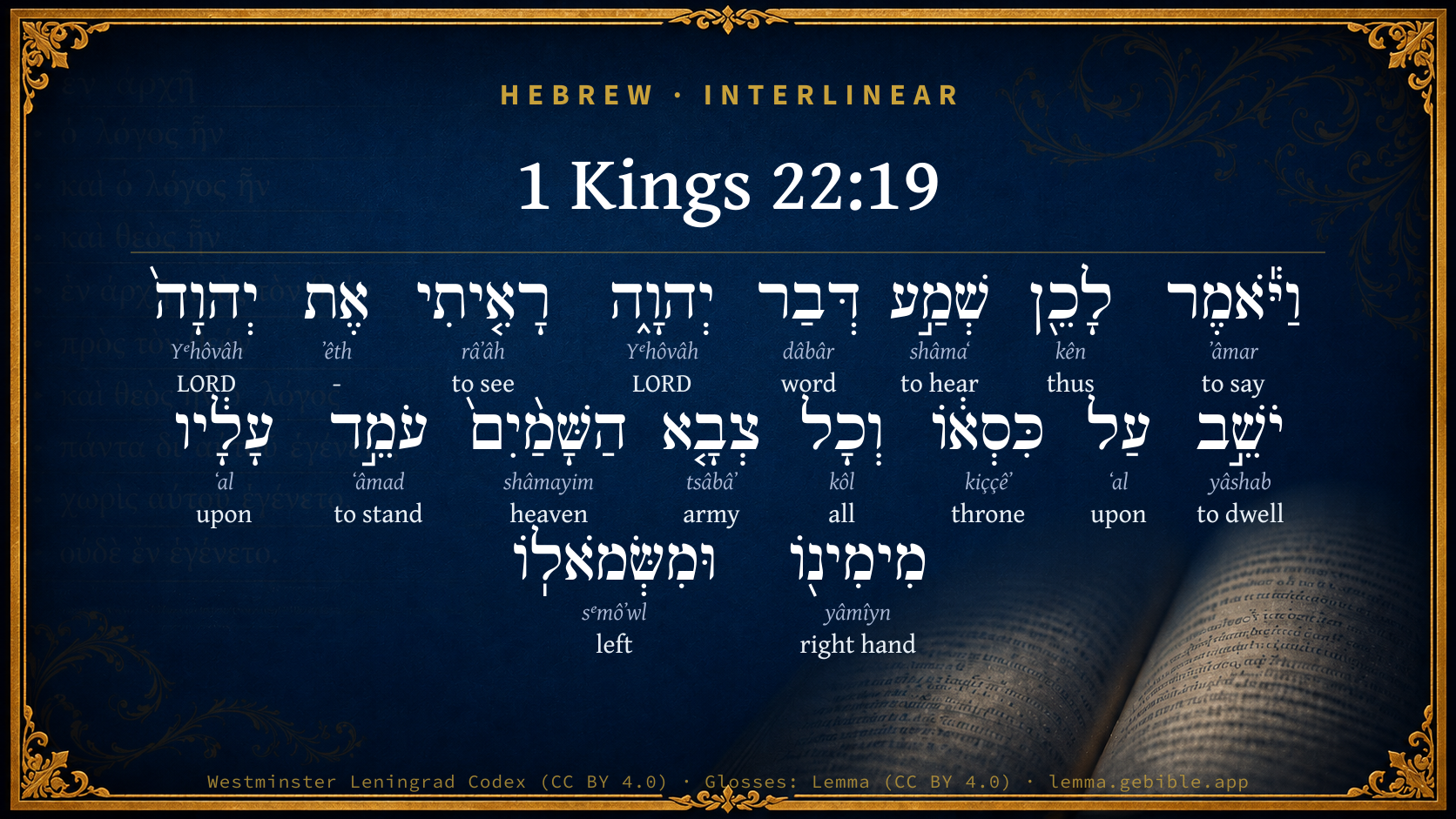
Hebrew (Westminster Leningrad Codex) 1 Kings 22:19 appears in the Hebrew Old Testament. The text above is from the Westminster Leningrad Codex. Each word links to its Strong’s number, a concise gloss, and parsing drawn from the Open Scriptures Hebrew Bible morphology. Click any word for its full Brown-Driver-Briggs (BDB) entry.
Download image
Cite this verse

1 Kings 22:19 (World English Bible). Public Domain. Lemma interlinear Bible study tool, https://lemma.gebible.app/v/1-kings/22/19.

Show BibTeX & RIS
BibTeX
RIS
English Translation
[Micaiah] said, Therefore hear you the word of Yahweh: I saw Yahweh sitting on his throne, and all the host of heaven standing by him on his right hand and on his left.
World English Bible · Public Domain
Download a study sheet

One document with this verse’s original text, its word-by-word gloss line, the meaning frame, cross-references with their text, attributed commentary, and full source and license credits — printable, and it pastes into notes with its structure intact.

This verse Autodidact and up

Study sheet (.html) Plain text (.txt)

A passage Seminary Student

Up to 50 verses in one chapter. A passage sheet keeps up to 6 commentary sources and 12 cross-references per verse, in the order this page ranks them, and says so on the sheet whenever that leaves anything out. Ask for a single verse and you get the Autodidact verse sheet above.

Everything on this page stays free to read, with no account — the sheet is a download of what is already on screen, not access to it.

Want to remove ads? Support Godless Engineer
Compare translations 3

The same verse in 3 English versions, stacked beneath the original-language interlinear above. Click any original word for its lexicon entry.

Each is an independent rendering of the whole verse — the interlinear is not word-aligned to these translations.

Highlighted words mark where these versions differ — a whole-verse word diff, not a word-by-word alignment.

  • World English Bible Public Domain
    [Micaiah] said, Therefore hear you the word of Yahweh: I saw Yahweh sitting on his throne, and all the host of heaven standing by him on his right hand and on his left.
  • King James Version Public Domain
    And he said, Hear thou therefore the word of the LORD: I saw the LORD sitting on his throne, and all the host of heaven standing by him on his right hand and on his left.
  • unfoldingWord Literal Text CC BY-SA 4.0
    And he said, “Therefore, hear the word of Yahweh. I saw Yahweh sitting on his throne, and the whole army of the heavens was standing beside him on his right and on his left.

unfoldingWord Literal Text — © unfoldingWord, licensed CC BY-SA 4.0. Word-aligned USFM3 via Door43 (git.door43.org/unfoldingWord/en_ult).

Versions to compare (up to 4)

3 of 4 selected

Show all 18 translations

Every available English version of this verse, each an independent rendering of the whole verse.

  • World English Bible Public Domain
    [Micaiah] said, Therefore hear you the word of Yahweh: I saw Yahweh sitting on his throne, and all the host of heaven standing by him on his right hand and on his left.
  • Berean Standard Bible Public Domain
    Micaiah continued, “Therefore hear the word of the LORD: I saw the LORD sitting on His throne, and all the host of heaven standing by Him on His right and on His left.
  • Majority Standard Bible Public Domain
    Micaiah continued, “Therefore hear the word of the LORD: I saw the LORD sitting on His throne, and all the host of heaven standing by Him on His right and on His left.
  • King James Version Public Domain
    And he said, Hear thou therefore the word of the LORD: I saw the LORD sitting on his throne, and all the host of heaven standing by him on his right hand and on his left.
  • American Standard Version (1901) Public Domain
    And `Micaiah' said, Therefore hear thou the word of Jehovah: I saw Jehovah sitting on his throne, and all the host of heaven standing by him on his right hand and on his left.
  • Revised Version (1885) Public Domain
    And he said, Therefore hear thou the word of the LORD: I saw the LORD sitting on his throne, and all the host of heaven standing by him on his right hand and on his left.
  • Geneva Bible (1599) Public Domain
    Againe he said, Heare thou therefore the worde of the Lord. I sawe the Lord sit on his throne, and all the hoste of heauen stood about him on his right hand and on his left hand.
  • Douay-Rheims (1899) Public Domain
    And he added and said: Hear thou therefore the word of the Lord: I saw the Lord sitting on his throne, and all the army of heaven standing by him on the right hand and on the left:
  • Young's Literal Translation Public Domain
    And he saith, `Therefore, hear a word of Jehovah; I have seen Jehovah sitting on His throne, and all the host of the heavens standing by Him, on His right and on His left;
  • Literal Standard Version CC BY-SA 4.0
    And he says, “Therefore, hear a word of YHWH! I have seen YHWH sitting on His throne, and all the host of the heavens standing by Him, on His right and on His left;
  • Unlocked Literal Bible CC BY-SA 4.0
    Then Micaiah said, “Therefore hear the word of Yahweh: I saw Yahweh sitting on his throne, and all the host of heaven were standing by him on his right hand and on his left.
  • unfoldingWord Literal Text CC BY-SA 4.0
    And he said, “Therefore, hear the word of Yahweh. I saw Yahweh sitting on his throne, and the whole army of the heavens was standing beside him on his right and on his left.
  • Darby Bible Public Domain
    And he said, Hear therefore the word of Jehovah: I saw Jehovah sitting upon his throne, and all the host of heaven standing by him, on his right hand and on his left;
  • World Messianic Bible Public Domain
    Micaiah said, “Therefore hear the LORD’s word. I saw the LORD sitting on his throne, and all the army of heaven standing by him on his right hand and on his left.
  • Webster's Bible Public Domain
    And he said, Hear thou therefore the word of the LORD: I saw the LORD sitting on his throne, and all the host of heaven standing by him on his right hand and on his left.
  • Free Bible Version CC BY-SA 4.0
    Micaiah went on to say, “So listen to what the Lord says. I saw the Lord sitting on his throne, surrounded by the whole army of heaven standing to his right and to his left.
  • Bible in Basic English Public Domain
    And he said, Give ear now to the word of the Lord: I saw the Lord seated on his seat of power, with all the army of heaven in their places round him at his right hand and at his left.
  • JPS Tanakh (1917) Public Domain
    And he said: 'Therefore hear thou the word of the LORD. I saw the LORD sitting on His throne, and all the host of heaven standing by Him on His right hand and on his left.

Literal Standard Version (2020), Covenant Press — licensed CC BY-SA 4.0. Text via the HelloAO Bible API (eBible.org). Unlocked Literal Bible (unfoldingWord) — licensed CC BY-SA 4.0. Text via the HelloAO Bible API (eBible.org). unfoldingWord Literal Text — © unfoldingWord, licensed CC BY-SA 4.0. Word-aligned USFM3 via Door43 (git.door43.org/unfoldingWord/en_ult). Free Bible Version, Dr. Jonathan Gallagher — licensed CC BY-SA 4.0. Text via the HelloAO Bible API (eBible.org).

Word by word

More ways to search: Search by grammar → Find every occurrence → Compare this word →

Practice this passage: Drill this verse → Learn its vocabulary →

וּמִשְּׂמֹאלֽוֹ
sᵉmôʼwl
H8040
“and · from · left · his”
Conjunction + Preposition + Noun, Common, Masculine, Singular, Construct + Suffix, Personal, 3rd Person, Masculine, Singular
Part of Speech
Conjunction + Preposition + Noun
Type
Common
Gender
Masculine
Number
Singular
State
Construct
Full BDB Definition

Origin: a primitive word [rather perhaps from the same as H8071 (by insertion of the aleph) through the idea of wrapping up]

TWOT: 2267a

the left, the left hand, the left side - left - left hand - north (as one faces east)
  1. וַיֹּ֕אמֶר ʼâmar H559 “and · to say” Conjunction + Verb, Qal, Sequential Imperfect, 3rd Person, Masculine, Singular
  2. לָכֵ֖ן kên H3651 “to/for · thus” Preposition + Adverb
  3. שְׁמַ֣ע shâmaʻ H8085 “hear” Verb, Qal, Imperative, 2nd Person, Masculine, Singular
  4. דְּבַר dâbâr H1697 “word of” Noun, Common, Masculine, Singular, Construct
  5. יְהוָ֑ה Yᵉhôvâh H3068 “LORD” Noun, Proper
  6. רָאִ֤יתִי râʼâh H7200 “to see” Verb, Qal, Perfect, 1st Person, Common, Singular
  7. אֶת ʼêth H853 “-” Particle, Direct Object
  8. יְהוָה֙ Yᵉhôvâh H3068 “LORD” Noun, Proper
  9. יֹשֵׁ֣ב yâshab H3427 “dwelling” Verb, Qal, Participle Active, Masculine, Singular, Absolute
  10. עַל ʻal H5921 “upon” Preposition
  11. כִּסְא֔וֹ kiççêʼ H3678 “throne · his” Noun, Common, Masculine, Singular, Construct + Suffix, Personal, 3rd Person, Masculine, Singular
  12. וְכָל kôl H3605 “and · all of” Conjunction + Noun, Common, Masculine, Singular, Construct
  13. צְבָ֤א tsâbâʼ H6635 “army of” Noun, Common, Both, Singular, Construct
  14. הַשָּׁמַ֨יִם֙ shâmayim H8064 “the · heaven(s)” Particle, Definite Article + Noun, Common, Masculine, Plural, Absolute
  15. עֹמֵ֣ד ʻâmad H5975 “standing” Verb, Qal, Participle Active, Masculine, Singular, Absolute
  16. עָלָ֔יו ʻal H5921 “upon · him” Preposition + Suffix, Personal, 3rd Person, Masculine, Singular
  17. מִימִינ֖וֹ yâmîyn H3225 “from · right hand · his” Preposition + Noun, Common, Feminine, Singular, Construct + Suffix, Personal, 3rd Person, Masculine, Singular

About this verse

These counts appear in no published source. They are computed here, from the morphology-tagged text and Lemma’s own curated glosses. What Lemma adds →

18
words
16
distinct lemmas
Historical
section

Shared distinctive vocabulary

וּמִשְּׂמֹאלֽוֹ left H8040 occurs in 53 verses of the Hebrew Bible. Also found in:

Grammatical profile

  • 5 verbs
  • 9 nouns
  • 2 prepositions
  • 1 adverb
  • 1 particle

Verb forms

  • וַיֹּ֕אמֶר Qal · Sequential Imperfect
  • שְׁמַ֣ע Qal · Imperative
  • רָאִ֤יתִי Qal · Perfect
  • יֹשֵׁ֣ב Qal · Participle Active
  • עֹמֵ֣ד Qal · Participle Active

Repetition

Words recur within this verse — often emphatic in Hebrew:

  • יְהוָ֑ה LORD H3068 ×2
  • עַל upon H5921 ×2

Hebrew & Septuagint length

In English translation the verse runs 33 words from the Hebrew and 46 from the Septuagint (LXX English) — closely comparable.

A rough comparison of the two English renderings, which tokenize alike — not a word-level alignment.

Word counts can differ between the Hebrew and the Greek without any difference in meaning — e.g. the Hebrew direct-object marker אֵת has no separate Greek word, and Greek often adds the article ὁ.

Cross-references

23

Topical passages linked to 1 Kings 22:19 in the Treasury of Scripture Knowledge — connected by theme and wording, ordered by reader-vote popularity; previews shown in the World English Bible.

  • Job 2:1 Again it happened on the day when the sons of God came to present themselves before Yahweh, that Satan came also among them to present himself before Yahweh.
  • Job 1:6 Now it happened on the day when the sons of God came to present themselves before Yahweh, that Satan also came among them.
  • Daniel 7:9–10 I saw until thrones were placed, and one who was ancient of days sat: his clothing was white as snow, and the hair of his head like pure wool; his throne was fiery flames, [and] the wheels of it burning fire.
  • Isaiah 6:1–3 In the year that king Uzziah died, I saw the Lord sitting on a throne, high and lifted up; and his train filled the temple.
  • Matthew 18:10 See that you don't despise one of these little ones, for I tell you that in heaven their angels always see the face of my Father who is in heaven.
  • Psalms 103:20–21 Praise Yahweh, you angels of his, Who are mighty in strength, who fulfill his word, Obeying the voice of his word.
  • 2 Chronicles 18:18–22 [Micaiah] said, Therefore hear you the word of Yahweh: I saw Yahweh sitting on his throne, and all the host of heaven standing on his right hand and on his left.
  • Ezekiel 1:26–28 Above the expanse that was over their heads was the likeness of a throne, as the appearance of a sapphire stone; and on the likeness of the throne was a likeness as the appearance of a man on it above.
  • Ezekiel 13:2 Son of man, prophesy against the prophets of Israel who prophesy, and say you to those who prophesy out of their own heart, Hear you the word of Yahweh:
  • Hebrews 1:7 Of the angels he says, "Who makes his angels winds, And his servants a flame of fire."
  • Hebrews 1:14 Aren't they all ministering spirits, sent out to do service for the sake of those who will inherit salvation?
  • Revelation 4:2–3 Immediately I was in the Spirit. Behold, there was a throne set in heaven, and one sitting on the throne
  • Isaiah 1:10 Hear the word of Yahweh, you rulers of Sodom! Listen to the law of our God, you people of Gomorrah!
  • Isaiah 28:14 Why hear the word of Yahweh, you scoffers, that rule this people that is in Jerusalem:
  • Amos 7:16 Now therefore listen to the word of Yahweh: 'You say, Don't prophesy against Israel, and don't preach against the house of Isaac.'
  • Hebrews 12:22 But you have come to Mount Zion, and to the city of the living God, the heavenly Jerusalem, and to innumerable hosts of angels,
  • Jeremiah 2:4 Hear you the word of Yahweh, O house of Jacob, and all the families of the house of Israel:
  • Jeremiah 29:20 Hear you therefore the word of Yahweh, all you of the captivity, whom I have sent away from Jerusalem to Babylon.
  • Jeremiah 42:15 now therefore hear you the word of Yahweh, O remnant of Judah: Thus says Yahweh of Hosts, the God of Israel, If you indeed set your faces to enter into Egypt, and go to sojourn there;
  • Zechariah 1:10 The man who stood among the myrtle trees answered, "They are the ones Yahweh has sent to go back and forth through the earth."
  • Matthew 25:31 "But when the Son of Man comes in his glory, and all the holy angels with him, then he will sit on the throne of his glory.
  • Acts 7:55–56 But he, being full of the Holy Spirit, looked up steadfastly into heaven, and saw the glory of God, and Jesus standing on the right hand of God,
  • Revelation 5:11 I saw, and I heard something like a voice of many angels around the throne, the living creatures, and the elders; and the number of them was ten thousands of ten thousands, and thousands of thousands;

Cross-references courtesy of OpenBible.info (CC BY 4.0).

Hebrew and Greek witnesses Masoretic Hebrew ↔ Greek Septuagint

The same verse in the two great witnesses to the Old Testament, shown verse-for-verse.

These are two independent witnesses, not word-aligned to each other, and the Septuagint is shown in lemma (dictionary) form.

Hebrew 1 Kings 22:19 Masoretic · Westminster Leningrad Codex

וַיֹּ֕אמֶר לָכֵ֖ן שְׁמַ֣ע דְּבַר יְהוָ֑ה רָאִ֤יתִי אֶת יְהוָה֙ יֹשֵׁ֣ב עַל כִּסְא֔וֹ וְכָל צְבָ֤א הַשָּׁמַ֨יִם֙ עֹמֵ֣ד עָלָ֔יו מִימִינ֖וֹ וּמִשְּׂמֹאלֽוֹ

[Micaiah] said, Therefore hear you the word of Yahweh: I saw Yahweh sitting on his throne, and all the host of heaven standing by him on his right hand and on his left.

World English Bible · Public Domain

Greek LXX 1 Kings 22:19 Septuagint · lemma form

καί εἶπον μιχαιας οὐ οὕτως οὐ ἐγώ ἀκούω ῥῆμα κύριος οὐ οὕτως ὁράω ὁ κύριος θεός ἰσραήλ καταἧμαι ἐπί θρόνος αὐτός καί πᾶς ὁ στρατιά ὁ οὐρανός ἵστημι περί αὐτός ἐκ δεξιός αὐτός καί ἐκ εὐώνυμος αὐτός

And Michaias said, Not so, it is not I: hear the word of the Lord; it is not so. I saw the God of Israel sitting on his throne, and all the host of heaven stood about him on his right hand and on his left.

LXX2012 (modern English Septuagint) · Public Domain

On this verse, The Cambridge Bible for Schools and Colleges discusses the Septuagint’s reading. Read the note in Commentary ↓

Hebrew: Westminster Leningrad Codex (CC BY 4.0). Greek: Septuagint (public domain); English from LXX2012 (modern English Septuagint) (Public Domain). How the Septuagint differs from the Hebrew →

Targum (Aramaic paraphrase)

1

The Targum is the ancient Jewish Aramaic paraphrase of the Hebrew Scriptures — an interpretive translation, not the Hebrew text itself. Onkelos (literal) and Pseudo-Jonathan (expansive) render the Torah, and Jonathan the Prophets. Coverage is partial: where no permissively-licensed English translation exists for a verse, only the Aramaic is shown. This is verse-level text, not a word-by-word alignment to the Hebrew.

  1. Targum Jonathan Prophets (Joshua–Malachi)
    וַאֲמַר בְּכֵן קַבֵּיל פִּתְגָמָא דַייָ חֲזֵיתִי יַת יְקָרָא דַייָ שְׁרֵי עַל כּוּרְסֵיהּ וְכָל חֵילֵי שְׁמַיָא קַיְמִין קֳדָמוֹהִי מִימִינֵיהּ וּמִסְמָלֵיהּ:

    (no public-domain English translation for this verse)

    Targum Jonathan — Aramaic: “Mikraot Gedolot” (public domain). English: “Sefaria Community Translation” (CC0 1.0 (public-domain dedication)); “London "Chaldee Paraphrase," 1871” (public domain). Text via Sefaria.

Commentary

Notes on 1 Kings 22:19 from classic Christian and Jewish commentators (each source and its license shown beneath its notes). The classic Christian expositions comment on the surrounding passage and are grouped to its opening verse, so a note may address several verses; the Jewish commentaries on the Tanakh (Rashi and others) are per-verse, so they appear only where the commentator wrote on this verse.

Lemma curates 59 commentaries, every one of them public domain or Creative Commons licensed, each selected and text-cleaned for this edition rather than reprinted as found. About our sources →

Trapp's Complete Commentary

John Trapp

1Ki 22:19 And he said, Hear thou therefore the word of the LORD: I saw the LORD sitting on his throne, and all the host of heaven standing by him on his right hand and on his left.

Ver. 19. Hear thou therefore the word of the Lord.] Hear something more than yet thou hast heard. So when Jehoiakim had cut Jeremiah’s roll with a pen knife, and cast it into the fire, Baruch, by the prophet’s appointment, wrote a new copy, and added besides thereunto many like words. {Jer 36:23}

I saw the Lord sitting on his throne.] See 1Ki 22:10. So when Moses had seen God at the burning bush, how little cared he for Pharaoh’s frowns and threats!

On his right hand, and on his left.] We should in this sort represent God to our minds in the entrance of our prayers; Omnino oportet nos orationis tempore curiam intrare caelestem, in qua Rex regum stellato sedet solio, circundante innumerabili, et ineffabili beatorum spirituum exercitu. Quanta ergo cum reverentia, quanto timore, &c. {a}

{a} Bernard.

John Trapp, A Commentary or Exposition upon All the Books of the Old and New Testament (1647–1656) — public domain. Text from a community e-Sword module.

The Biblical Illustrator

Joseph S. Exell

1Ki_22:19

I saw the Lord sitting on His throne.

Council in heaven

We read elsewhere of war in heaven. The text suggests a different subject, apparently connected with it, namely, council in heaven. Micaiah describes what he saw as a vision. We are presented with one of the most imposing descriptions of the heavenly conclave which Holy Scripture contains. It is one of those rare occasions when we are permitted to learn how in the councils of heaven the things of our earth are ordered. Men are unwilling to believe a Providence; they trace out cause and effect, and this they deem sufficient. The text shows that cause and effect indeed are but the results of Gods decree, and it teaches us how He directs also even individual circumstances. In this way it may be a natural effect of a natural cause which shall bring a plague within a certain city or village, and yet God shall direct who shall fall by it, and who escape, The cause of death may be natural; the individual application is providential. You, then, are the subjects of Satans malignity, of the love of God, and of the wonder and ministrations of angels t It may be, that at this very hour a council is proceeding in heaven which may secure blessings of the highest order for you or for our land. Not impossible but that our arch-enemy too yet presents himself in that blessed assembly, and pointing to the many national sins of our country, or to our individual transgressions, may be prompt with a slander, followed by the suggestion, I will go and deceive them yet more, and so I will destroy them entirely! St. Paul meant something when he spake of wrestling not so much against flesh and blood as against principalities and powers, and spiritual wickedness in high places. (G. Venables.)

A prophets vision and a kings blindness

(with 1Ki_22:8):--Now in these two utterances, spoken by Ahab on the one hand and by Micaiah on the other, you see the cause of the difference between the two men. One man has a clear vision that leads to goodness, to pure life, to holy character, and to undying courage; the other man is blinded by his sins so that his vision is darkened, and he goes from folly to folly until he ends his life in shame and ignominy, because he hates the truth and will not hear it nor heed it. Here are some very important lessons for us as Christians.

1. The duties of life will not all be pleasant. We Shall sometimes be required to do very unpleasant things; but if, like this brave prophet, we have a clear vision of the Lord on His throne, and recognise that God has the first claim to our service, then we shall be able to do unpleasant duties in a brave and cheerful spirit, because we are pleasing God.

2. We are only fitted to do Christian work in the right spirit when like Micaiah, we seek to please the Lord, having Him always before our eyes. I have noticed that when I have witnessed the falling away in service on the part of a Christian it has almost universally come from a lessening of true devotion. A man ceases to pray with regularity; he becomes absorbed in business or pleasure; sets his mind on material things, until his thought is taken away from God. He does not see the Lord, and so he becomes indifferent to earnest Christian effort.

3. The man who looks upon the Lord as his God, his Heavenly Father, his Saviour, will feel that earthly affairs are of very small moment compared to the importance of spiritual victories. He will feel that it is infinitely more important to be good than it is to be rich. The man who has looked upon the face of God in loving reverence before he goes forth to his work in the morning will not be a fit subject to delude into taking bribes, or into receiving fraudulent money either in business or in politics.

4. He who sees the Lord in daily communion finds God a present help in every time of trouble. (L A. Banks, D. D.)

The Biblical Illustrator, edited by Joseph S. Exell (c. 1880s–1900s) — public domain. Text from a community e-Sword module.

Joseph Benson's Commentary

1Ki 22:19. And he said, Hear thou therefore the word of the Lord — Because thou givest credit to thy false prophets, and disbelievest my words, as if they were but the suggestions of my own fancy, and of hatred to thy person, I will give thee a distinct and true account of the whole matter in God’s name and presence. I saw the Lord sitting on his throne — Not with his bodily eyes certainly, for with them he could not see God, but with the eyes of his mind, or rather in a vision. For we must by no means look upon what follows as the relation of an affair really transacted, but merely as an account of a symbolical vision, like that of Peter, (Acts 10.,) when he saw heaven opened, and a certain vessel descending unto him; whereby Micaiah was informed how it came to pass that so many prophets prophesied falsely, or contrary to what the event of things would prove; which was, that these prophets were influenced, not by the Spirit of God, which is the spirit of truth, but by an evil spirit, a spirit of error and falsehood, of flattery and dissimulation. For we should form most unjust ideas of the truth and holiness of God, if we supposed he would really send a spirit of lying into any of his prophets, which they could not distinguish from true inspiration; for this would be to confound false prophecy with true, and to make God the author of moral evil, which he can in no way or manner ever be. It would have been to overturn the whole authority of prophecy; for, if the true prophets had been once actuated by a false spirit, there would have been an end of placing any dependance on them for the future. The whole foundation of their authority would have been overthrown.

Joseph Benson's Commentary on the Old and New Testaments (1811–1818) — public domain. Text from a community e-Sword module.

Tyndale Open Study Notes

Tyndale Open Resources

22:19-23 Micaiah explained that God had allowed a lying spirit of prophecy to mislead Ahab to bring about his death. In his sovereignty, God used the counsel of Ahab’s false prophets to accomplish his will.

Tyndale Open Study Notes — © Tyndale Open Resources, licensed CC BY-SA 4.0. Text via the HelloAO Bible API.

Geneva Bible (1599)

Geneva Bible translators

Meaning, his Angels.

Geneva Bible (1599) marginal notes — public domain. Text via Bolls.life.

Adam Clarke's Commentary

Verse 19. I saw the Lord sitting on his throne] This is a mere parable, and only tells in figurative language, what was in the womb of providence, the events which were shortly to take place, the agents employed in them, and the permission on the part of God for these agents to act. Micaiah did not choose to say before this angry and impious king, "Thy prophets are all liars; and the devil, the father of lies, dwells in them;" but he represents the whole by this parable, and says the same truths in language as forcible, but less offensive.

Adam Clarke's Commentary on the Bible (1810–1826) — public domain. Text from a community e-Sword/MySword module.

Ellicott's Commentary for English Readers

(19-22) The symbolic vision of Micaiah, which naturally recalls the well-known description in Job_1:6-12 of the intercourse of Satan with the Lord Himself, is to be taken as a symbol, and nothing more. (Josephus, characteristically enough, omits it altogether.) The one idea to be conveyed is the delusion of the false prophets by a spirit of evil, as a judgment of God on Ahab’s sin, and on their degradation of the prophetic office. The imagery is borrowed from the occasion. It is obviously drawn from the analogy of a royal court, where, as is the case before Micaiah’s eyes, the king seeks counsel against his enemies.

A Bible Commentary for English Readers, edited by Charles John Ellicott (1878–1897) — public domain. Text from a community e-Sword module.

The Cambridge Bible for Schools and Colleges

gen. ed. J. J. S. Perowne

19. And he said] After these words the LXX. adds οὐχ οὕτως οὐκ ἐγώ, ‘Not so, I do not.’ Here we can discern how the insertion was made. The next word in the Hebrew text is לכן= Therefore. This the translators have taken for לא כן = not so, and have put in the οὐκ ἐγὼ to round off the sense. Apparently they must have seen or thought they saw the same reading in 1Ki_22:17 above, for there they have made a similar insertion.

Hear thou therefore] R.V. Therefore hear thou. Conforming to the order of the Hebrew, and the order in 2 Chronicles.

I saw the Lord] A vision in which Micaiah had been shewn the heavenly council-chamber. Jehovah was sitting as ruler of the universe, and all ministers waiting around to speed at His bidding. These are the ministering spirits of Heb_1:14. But they also discharge other ministry, as when the angel of the Lord destroyed David’s people (2Sa_24:16) or the army of Sennacherib (2Ki_19:35).

The Cambridge Bible for Schools and Colleges (gen. ed. J. J. S. Perowne; Cambridge University Press, 1878–1918) — public domain. Text from a community e-Sword module.

John Gill's Exposition

And the Lord said unto him, wherewith?.... What way and method did he propose, to persuade Ahab to go up to Ramoth? the Lord is introduced in this visionary narrative as asking this question, not as ignorant of the scheme of the evil spirit, but in order to bring it out, and lead on to the following account:

and he said, I will go forth, and I will be a lying spirit in the mouth of all his prophets; put them on encouraging Ahab to go up, and promising him success, as he had in former battles with the king of Syria, and which might both encourage them to give forth such a prediction, and him to believe it to be true; this proposal was quite agreeable to the character of the devil, as the father of lies:

and he said, thou shalt persuade him, and prevail also; not only make use of this artifice to persuade, but succeed also; the Lord knew that what he should suggest to the prophets, and they should deliver to Ahab, would be agreeable to his inclination, nor would he do anything in the course of his providence to hinder its taking effect:

go forth, and do so; which was giving leave to try his skill in the art of persuasion, in which he knew he would succeed, and bring on the righteous judgment of God upon Ahab; with this compare Joh 13:27.

John Gill's Exposition of the Whole Bible (1746–1763) — public domain (CC PDM 1.0). Text via the HelloAO Bible API.

Albert Barnes' Notes on the Bible

David’s Psalms had familiarised the Israelites with Yahweh sitting upon a throne in the heavens (Psa 9:7; Psa 11:4; Psa 45:6; Psa 103:19, etc.); but to be allowed to see in vision the ineffable glory of the Almighty thus seated, was a rare favor. It was granted to Isaiah, to Daniel (marginal references), to Ezekiel Eze 1:26, and in Christian times to Stephen Act 7:56, and John Rev 4:2.

Albert Barnes' Notes on the Bible (1834–1885) — public domain. Text from a community e-Sword/MySword module.

Haydock's Catholic Bible Commentary

He, Micheas, added, (Menochius) not fearing the king’s displeasure, who seemed to regard his former denunciation as an effect of his ill-will. Hence he explains his vision more at large. God often conforms to our ideas, and even prejudices. The people were then accustomed to look upon him as a king, environed with his army of good and evil spirits; the one at his right-hand, to execute his designs of mercy, and the other at his left, to execute his judgments. Job (i. 6, 12.) speaks in the like manner. We know that God stands in need of no counsellors; (Romans xi. 34.) and that the angels of satan have no place in heaven, Isaias xiv. 12., Apocalypse xii. 9., and Jude 6.

George Leo Haydock (1774–1849), Haydock's Catholic Family Bible and Commentary, 1859 edition — public domain. Excludes Psalms (Douay-Rheims chapter numbering differs from Protestant) and Deuterocanonical books (Catholic canon only).

Matthew Poole's English Annotations

Because thou givest credit to thy false prophets, and distrustest my words, as if they were but the suggestions of my own fancy, and hatred of thy person, I will give thee a distinct and true account of the whole matter, in God’s name and presence.

I saw the Lord, by the eyes of my mind; for he could not see the Lord with bodily eyes.

The host of heaven, i.e. the angels, who are oft called God’s host or hosts, because of their great number, excellent order, and constant readiness to attend upon God, and to execute his commands. See Gen 2:1; Psa 103:21; 148:2. These angels were both good and bad; the one possibly on his right, the other on his left hand. Nor is it strange that the devils are called the host of heaven, if you consider, first, That their original seat was in heaven, and men in Scripture are oft called by the name of the place from whence they came. Secondly, That the name of heaven is oft given to all that part of the world which is above the earth, and among the rest to the air, as Gen 1:20; 7:11; 8:2; 27:28; Deu 4:11; 11:11, where the devil’s residence and dominion lies, Eph 2:2; and that both Michael and his angels, and the dragon and his angels, are said to be and to wage war in heaven, Rev 12:7, i.e. either the air, or the church. And this place is not to be understood as if Micaiah had seen with his bodily eyes the Lord and his angels sitting in the third heaven; but that he saw a representation of the Divine presence in the air, attended with good and bad angels.

Standing by him, in the posture of ministers, to receive and execute his commands.

Matthew Poole's English Annotations on the Holy Bible (1683–1685) — public domain. Text from a community e-Sword/MySword module.

Whedon's Commentary on the Bible

Daniel D. Whedon

19. I saw the Lord — Here is a vision worthy of Isaiah or Ezekiel.

All the host of heaven standing by him — The prophet drew his imagery from the very scene before him. The kings on their thrones, and the surrounding host assembled at the gate of Samaria, were representative of the King of kings sitting on his throne and surrounded by the host of ministering spirits who do his will in the armies of heaven and among the inhabitants of the earth.

Daniel D. Whedon (gen. ed.), Commentary on the Old and New Testaments (1874–1909) — public domain. Text from a community e-Sword module.

The Pulpit Commentary

And he said, Hear thou in 2Ch_18:18, Hear ye therefore The LXX has oujc outwv, whence it would almost appear that they had the text Ke al before them (Bahr). But kel; is every way to be preferred. It is emphatic by position, and the meaning is, "Since you will have it that my words are prompted by malice, hear the message I have for you," etc. the word of the Lord. I saw the Lord It is not implied (Wordsworth) that he had any direct and objective vision of God, such as, (Exo_34:5) Elijah, or St. Stephen. He here declares what he may have seen in dream or trance. (Cf. Rev_1:10 Rev_4:2; Isaiah Eze_1:1) It was a real but inner vision (Keil). In its interpretation the caution of Peter Martyr is carefully to be borne in mind; Omnia haec dicuntur ajnqrwpopaqwv sitting on his throne It was natural for some of the commentators to see in these words a reference to the two kings then sitting in their royal apparel, each upon his throne. But it is very doubtful whether any such thought was present in the mind of the speaker, who, imply relates a vision of the past, and all the host of heaven The celestial powers, cherubim, angels, archangels, who surround the Lord of glory. That there can be no reference to the sun, moon, and stars, notwithstanding that these are called "the host of heaven" in Deu_4:19, Deu_17:3, is clear from the next words. The expression is to be explained by Gen_32:1, 2 standing by him wyl for the meaning, (see Gen_18:8) on his right hand and on his left. The resemblance of this vision to that of Isaiah (1Ki_6:1-8) must not be overlooked.

The Pulpit Commentary (1880–1919), ed. H.D.M. Spence-Jones & Joseph S. Exell — public domain. Text from a community e-Sword module.

John Wesley's Explanatory Notes

He said - I will give thee a distinct and true account of the whole matter, in God's name and presence. I saw - By the eyes of my mind: for he could not see the Lord with bodily eyes. The Host - The angels, both good and bad, the one possibly on his right, the other on his left hand. Nor is it strange that the devils are called the host of heaven; if you consider, first, that their original seat was in heaven. Secondly, that the name of heaven is often given to all that part of the world which is above the earth, and among the rest, to the air, and where the devil's residence and dominion lies, Eph. ii, 2, and that both Michael and his angels, and the Dragon and his angels, are said to be, and to wage war in heaven, Rev. xii, 7, either the air, or the church.

John Wesley, Explanatory Notes Upon the Whole Bible (1754–1765) — public domain. Text via the GEBible commentary corpus.

Rashi

Rabbi Shlomo Yitzchaki (Rashi)

To His right and to His left. Is there “left” in Heaven? Is it not stated, “The right hand of Adonoy’s is exalted, the right hand of Adonoy performs deeds of valor,” [and,] “Your right hand, Adonoy, is adorned with power; Your right hand, Adonoy, crushes the enemy”? But rather, these are on the right and these are on the left. Those on the right present the case for the defense and those on the left present the case for the prosecution.

Rashi on the Tanakh — English translations: “The Judaica Press complete Tanach with Rashi, translated by A. J. Rosenberg” (CC BY 4.0); “Pentateuch with Rashi's commentary by M. Rosenbaum and A.M. Silbermann, 1929-1934” (public domain); “The Metsudah Tanach series, Lakewood, N.J” (CC BY 4.0); and “The Book of Joshua, Metsudah Publications, 1997” (CC BY 4.0). Text via Sefaria.

Lesson kit

Teaching starters — assembled from the data on this page, not authored interpretation. Every prompt links to the verse data it draws on. Edit before teaching.

1 Kings, in the Historical, opens this verse with 18 words (16 distinct Hebrew lemmas). Its most distinctive word is sᵉmôʼwl (“left”). A historical commentator’s framing appears above. Read the whole chapter for the surrounding context.

Discussion questions

  1. How does “left” (sᵉmôʼwl) shape what this verse is saying?
  2. How does Genesis 13:9, which shares the word «left», read alongside this verse?
  3. What does the repetition of “LORD” (2× in this one verse) do in this verse?
  4. These translations render this verse differently. What is at stake in choosing one wording over another?
  5. «וַיֹּ֕אמֶר» is a Qal Sequential Imperfect verb. How does that grammatical form shape the action described?
  6. Compare how Trapp's Complete Commentary and The Biblical Illustrator read this verse. Where do they agree or differ?

Things to notice

Reading settings

Reading text

Shown beneath each verse's original-language words.

Old Testament
Old Testament edition

Read the OT as the Masoretic Hebrew (MT) or the Greek Septuagint (LXX).

English shown for the Greek Septuagint (in the Hebrew ↔ Greek comparison).

Comparing translations? Open the Compare panel on any verse page to stack up to four side by side.