
Numbers 10:25

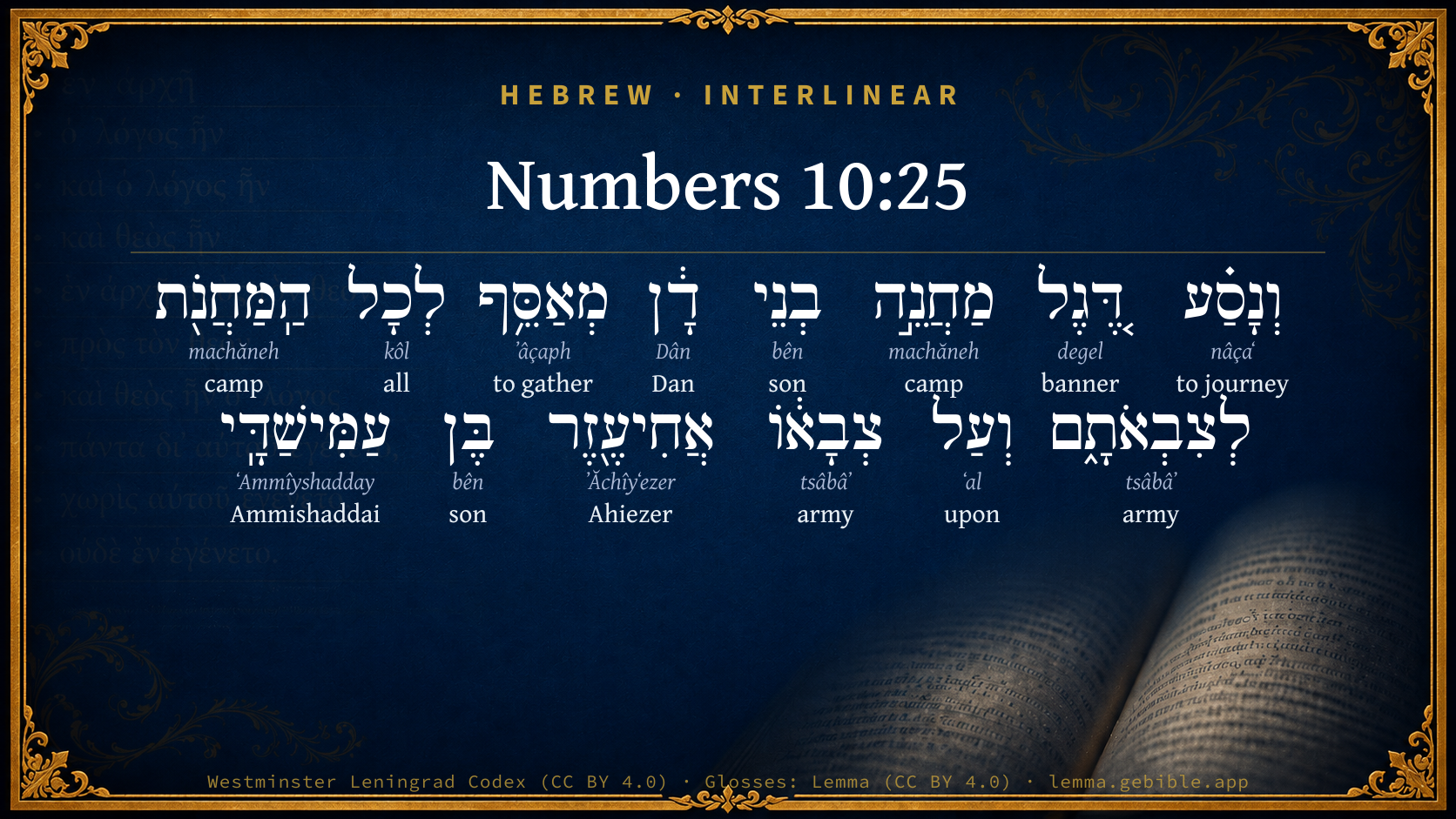
Hebrew (Westminster Leningrad Codex) Numbers 10:25 appears in the Hebrew Old Testament. The text above is from the Westminster Leningrad Codex. Each word links to its Strong’s number, a concise gloss, and parsing drawn from the Open Scriptures Hebrew Bible morphology. Click any word for its full Brown-Driver-Briggs (BDB) entry.
Download image
Cite this verse

Numbers 10:25 (World English Bible). Public Domain. Lemma interlinear Bible study tool, https://lemma.gebible.app/v/numbers/10/25.

Show BibTeX & RIS
BibTeX
RIS
English Translation
The standard of the camp of the children of Dan, which was the rearward of all the camps, set forward according to their hosts: and over his host was Ahiezer the son of Ammishaddai.
World English Bible · Public Domain
Download a study sheet

One document with this verse’s original text, its word-by-word gloss line, the meaning frame, cross-references with their text, attributed commentary, and full source and license credits — printable, and it pastes into notes with its structure intact.

This verse Autodidact and up

Study sheet (.html) Plain text (.txt)

A passage Seminary Student

Up to 50 verses in one chapter. A passage sheet keeps up to 6 commentary sources and 12 cross-references per verse, in the order this page ranks them, and says so on the sheet whenever that leaves anything out. Ask for a single verse and you get the Autodidact verse sheet above.

Everything on this page stays free to read, with no account — the sheet is a download of what is already on screen, not access to it.

Want to remove ads? Support Godless Engineer
Compare translations 3

The same verse in 3 English versions, stacked beneath the original-language interlinear above. Click any original word for its lexicon entry.

Each is an independent rendering of the whole verse — the interlinear is not word-aligned to these translations.

Highlighted words mark where these versions differ — a whole-verse word diff, not a word-by-word alignment.

  • World English Bible Public Domain
    The standard of the camp of the children of Dan, which was the rearward of all the camps, set forward according to their hosts: and over his host was Ahiezer the son of Ammishaddai.
  • King James Version Public Domain
    And the standard of the camp of the children of Dan set forward, which was the rearward of all the camps throughout their hosts: and over his host was Ahiezer the son of Ammishaddai.
  • unfoldingWord Literal Text CC BY-SA 4.0
    And the banner of the camp of the sons of Dan, the one gathering for all the camps, set out according to their armies: and over his army was Ahiezer, the son of Ammishaddai.

unfoldingWord Literal Text — © unfoldingWord, licensed CC BY-SA 4.0. Word-aligned USFM3 via Door43 (git.door43.org/unfoldingWord/en_ult).

Versions to compare (up to 4)

3 of 4 selected

Show all 18 translations

Every available English version of this verse, each an independent rendering of the whole verse.

  • World English Bible Public Domain
    The standard of the camp of the children of Dan, which was the rearward of all the camps, set forward according to their hosts: and over his host was Ahiezer the son of Ammishaddai.
  • Berean Standard Bible Public Domain
    Finally, the divisions of the camp of Dan set out under their standard, serving as the rear guard for all units, with Ahiezer son of Ammishaddai in command.
  • Majority Standard Bible Public Domain
    Finally, the divisions of the camp of Dan set out under their standard, serving as the rear guard for all units, with Ahiezer son of Ammishaddai in command.
  • King James Version Public Domain
    And the standard of the camp of the children of Dan set forward, which was the rearward of all the camps throughout their hosts: and over his host was Ahiezer the son of Ammishaddai.
  • American Standard Version (1901) Public Domain
    And the standard of the camp of the children of Dan, which was the rearward of all the camps, set forward according to their hosts: and over his host was Ahiezer the son of Ammishaddai.
  • Revised Version (1885) Public Domain
    And the standard of the camp of the children of Dan, which was the rearward of all the camps, set forward according to their hosts: and over his host was Ahiezer the son of Ammishaddai.
  • Geneva Bible (1599) Public Domain
    Last, the standerd of the hoste of the children of Dan marched, gathering all ye hostes according to their armies: and ouer his bande was Ahiezer the sonne of Ammishaddai.
  • Douay-Rheims (1899) Public Domain
    The last of all the camp marched the sons of Dan by their troops, in whose army the prince was Ahiezer the son of Ammisaddai.
  • Young's Literal Translation Public Domain
    And the standard of the camp of the sons of Dan hath journeyed (rearward to all the camps), by their hosts, and over its host `is' Ahiezer son of Ammishaddai.
  • Literal Standard Version CC BY-SA 4.0
    And the standard of the camp of the sons of Dan has journeyed (rearward to all the camps), by their hosts, and over its host [is] Ahiezer son of Ammishaddai.
  • Unlocked Literal Bible CC BY-SA 4.0
    The armies that camped under the banner of Dan's descendants set out last. Ahiezer son of Ammishaddai led Dan's army.
  • unfoldingWord Literal Text CC BY-SA 4.0
    And the banner of the camp of the sons of Dan, the one gathering for all the camps, set out according to their armies: and over his army was Ahiezer, the son of Ammishaddai.
  • Darby Bible Public Domain
    And the standard of the camp of the children of Dan set forward, the rear-guard of all the camps according to their hosts, and over his host was Ahiezer the son of Ammishaddai;
  • World Messianic Bible Public Domain
    The standard of the camp of the children of Dan, which was the rear guard of all the camps, set forward according to their armies. Ahiezer the son of Ammishaddai was over his army.
  • Webster's Bible Public Domain
    And the standard of the camp of the children of Dan moved forward, which was the rear-ward of all the camps throughout their hosts: and over his host was Ahiezer the son of Ammishaddai.
  • Free Bible Version CC BY-SA 4.0
    Lastly came the divisions of Dan who marched out under their flag, defending the rear of all the tribal groups, with Ahiezer, son of Ammishaddai, in charge.
  • Bible in Basic English Public Domain
    And the flag of the children of Dan, whose tents were moved last of all, went forward with their armies: and at the head of his army was Ahiezer, the son of Ammishaddai.
  • JPS Tanakh (1917) Public Domain
    And the standard of the camp of the children of Dan, which was the rearward of all the camps, set forward according to their hosts; and over his host was Ahiezer the son of Ammishaddai.

Literal Standard Version (2020), Covenant Press — licensed CC BY-SA 4.0. Text via the HelloAO Bible API (eBible.org). Unlocked Literal Bible (unfoldingWord) — licensed CC BY-SA 4.0. Text via the HelloAO Bible API (eBible.org). unfoldingWord Literal Text — © unfoldingWord, licensed CC BY-SA 4.0. Word-aligned USFM3 via Door43 (git.door43.org/unfoldingWord/en_ult). Free Bible Version, Dr. Jonathan Gallagher — licensed CC BY-SA 4.0. Text via the HelloAO Bible API (eBible.org).

Word by word

More ways to search: Search by grammar → Find every occurrence → Compare this word →

Practice this passage: Drill this verse → Learn its vocabulary →

עַמִּישַׁדָּֽי
ʻAmmîyshadday
H5996
“Ammishaddai”
Noun, Proper
Part of Speech
Noun
Type
Proper
Full BDB Definition

Origin: from H5971 and H7706

TWOT: None

Ammishaddai = "my kinsman is Almighty" - father of Ahiezer, prince of the tribe of Dan at the time of the exodus
  1. וְנָסַ֗ע nâçaʻ H5265 “and · to journey” Conjunction + Verb, Qal, Sequential Perfect, 3rd Person, Masculine, Singular
  2. דֶּ֚גֶל degel H1714 “banner of” Noun, Common, Masculine, Singular, Construct
  3. מַחֲנֵ֣ה machăneh H4264 “camp of” Noun, Common, Both, Singular, Construct
  4. בְנֵי bên H1121 “sons of” Noun, Common, Masculine, Plural, Construct
  5. דָ֔ן Dân H1835 “Dan” Noun, Proper
  6. מְאַסֵּ֥ף ʼâçaph H622 “gathering” Verb, Piel, Participle Active, Masculine, Singular, Absolute
  7. לְכָל kôl H3605 “to/for · all of” Preposition + Noun, Common, Masculine, Singular, Construct
  8. הַֽמַּחֲנֹ֖ת machăneh H4264 “the · camps” Particle, Definite Article + Noun, Common, Both, Plural, Absolute
  9. לְצִבְאֹתָ֑ם tsâbâʼ H6635 “to/for · armies · their” Preposition + Noun, Common, Both, Plural, Construct + Suffix, Personal, 3rd Person, Masculine, Plural
  10. וְעַל ʻal H5921 “and · upon” Conjunction + Preposition
  11. צְבָא֔וֹ tsâbâʼ H6635 “army · his” Noun, Common, Both, Singular, Construct + Suffix, Personal, 3rd Person, Masculine, Singular
  12. אֲחִיעֶ֖זֶר ʼĂchîyʻezer H295 “Ahiezer” Noun, Proper
  13. בֶּן bên H1121 “son of” Noun, Common, Masculine, Singular, Construct

About this verse

These counts appear in no published source. They are computed here, from the morphology-tagged text and Lemma’s own curated glosses. What Lemma adds →

14
words
11
distinct lemmas
Pentateuch
section

Notable vocabulary

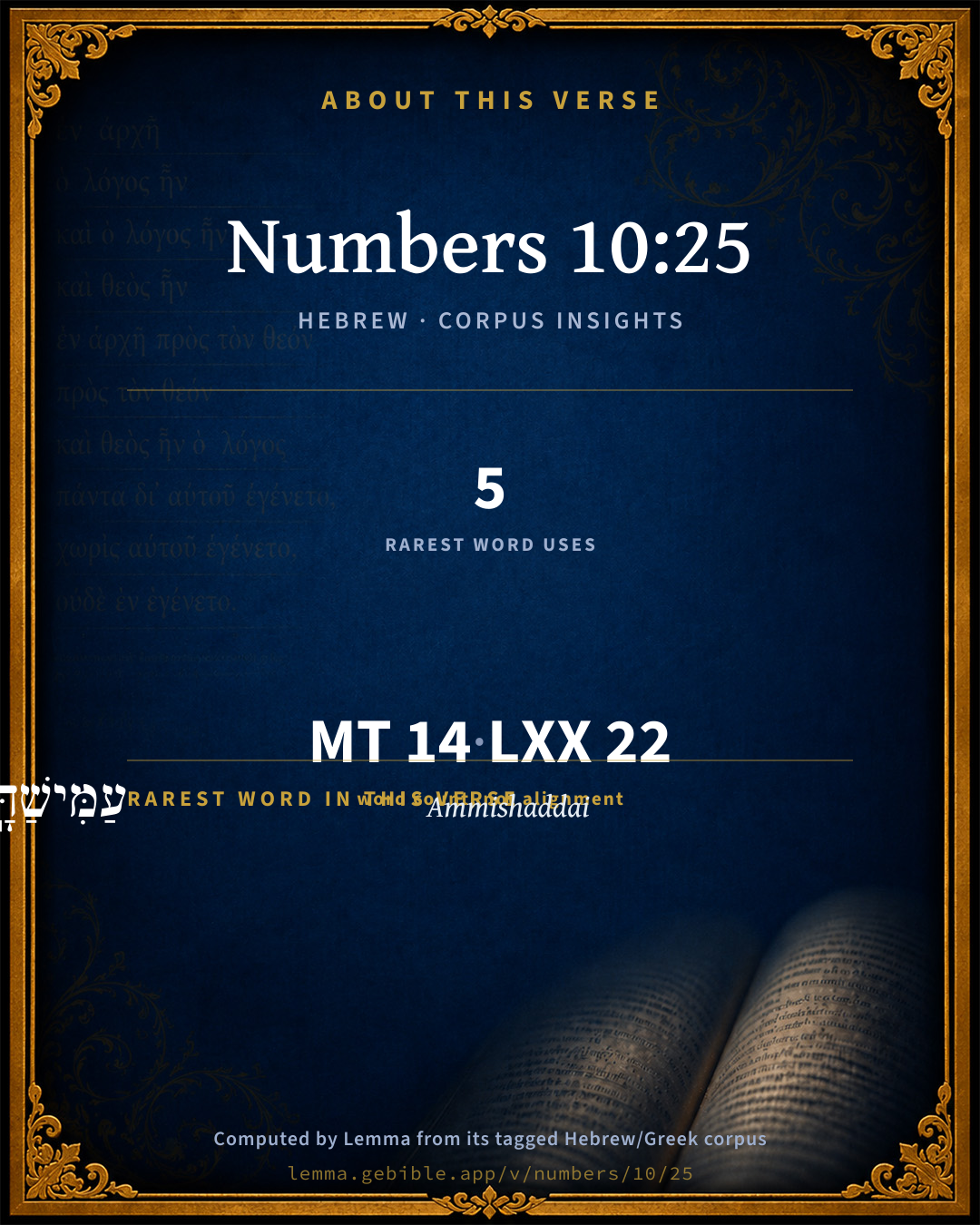
The rarest word here is עַמִּישַׁדָּֽי Ammishaddai H5996 — appearing just 5 times in the whole Hebrew Bible.

Shared distinctive vocabulary

עַמִּישַׁדָּֽי Ammishaddai H5996 occurs in 5 verses of the Hebrew Bible. Also found in:

Grammatical profile

  • 2 verbs
  • 11 nouns
  • 1 preposition

Verb forms

  • וְנָסַ֗ע Qal · Sequential Perfect
  • מְאַסֵּ֥ף Piel · Participle Active

Repetition

Words recur within this verse — often emphatic in Hebrew:

  • מַחֲנֵ֣ה camp H4264 ×2
  • בְנֵי son H1121 ×2
  • לְצִבְאֹתָ֑ם army H6635 ×2

Hebrew & Septuagint length

In English translation the verse runs 34 words from the Hebrew and 33 from the Septuagint (LXX English) — closely comparable.

A rough comparison of the two English renderings, which tokenize alike — not a word-level alignment.

Word counts can differ between the Hebrew and the Greek without any difference in meaning — e.g. the Hebrew direct-object marker אֵת has no separate Greek word, and Greek often adds the article ὁ.

In the original languages it is 14 Hebrew tokens and 22 Greek tokens — but the two are counted differently (Hebrew bundles its prefixes and suffixes into one token; the Greek is in lemma form), so that isn’t a like-for-like length.

Cross-references

9

Topical passages linked to Numbers 10:25 in the Treasury of Scripture Knowledge — connected by theme and wording, ordered by reader-vote popularity; previews shown in the World English Bible.

  • Joshua 6:9 The armed men went before the priests who blew the trumpets, and the rearward went after the ark, [the priests] blowing the trumpets as they went.
  • Numbers 1:12 Of Dan: Ahiezer the son of Ammishaddai.
  • Genesis 49:16–17 "Dan will judge his people, As one of the tribes of Israel.
  • Numbers 2:25–31 "On the north side shall be the standard of the camp of Dan according to their divisions: and the prince of the children of Dan shall be Ahiezer the son of Ammishaddai.
  • Numbers 7:66 On the tenth day Ahiezer the son of Ammishaddai, prince of the children of Dan
  • Numbers 26:42–51 These are the sons of Dan after their families: of Shuham, the family of the Shuhamites. These are the families of Dan after their families.
  • Deuteronomy 25:17–18 Remember what Amalek did to you by the way as you came forth out of Egypt;
  • Isaiah 52:12 For you shall not go out in haste, neither shall you go by flight: for Yahweh will go before you; and the God of Israel will be your rearward.
  • Isaiah 58:8 Then shall your light break forth as the morning, and your healing shall spring forth speedily; and your righteousness shall go before you; the glory of Yahweh shall by your rearward.

Cross-references courtesy of OpenBible.info (CC BY 4.0).

Hebrew and Greek witnesses Masoretic Hebrew ↔ Greek Septuagint

The same verse in the two great witnesses to the Old Testament, shown verse-for-verse.

These are two independent witnesses, not word-aligned to each other, and the Septuagint is shown in lemma (dictionary) form.

Hebrew Numbers 10:25 Masoretic · Westminster Leningrad Codex

וְנָסַ֗ע דֶּ֚גֶל מַחֲנֵ֣ה בְנֵי דָ֔ן מְאַסֵּ֥ף לְכָל הַֽמַּחֲנֹ֖ת לְצִבְאֹתָ֑ם וְעַל צְבָא֔וֹ אֲחִיעֶ֖זֶר בֶּן עַמִּישַׁדָּֽי

The standard of the camp of the children of Dan, which was the rearward of all the camps, set forward according to their hosts: and over his host was Ahiezer the son of Ammishaddai.

World English Bible · Public Domain

Greek LXX Numbers 10:25 Septuagint · lemma form

καί ἐκαἴρω τάγμα παρεμβολή υἱός δαν ἔσχατο πᾶς ὁ παρεμβολή σύν δύναμις αὐτός καί ἐπί ὁ δύναμις αὐτός αχιεζερ ὁ ὁ αμισαδαι

And the order of the camp of the sons of Dan shall set forward the last of all the camps, with their forces: and over their forces was Achiezer the son of Amisadai.

LXX2012 (modern English Septuagint) · Public Domain

Hebrew: Westminster Leningrad Codex (CC BY 4.0). Greek: Septuagint (public domain); English from LXX2012 (modern English Septuagint) (Public Domain). How the Septuagint differs from the Hebrew →

Targum (Aramaic paraphrase)

2

The Targum is the ancient Jewish Aramaic paraphrase of the Hebrew Scriptures — an interpretive translation, not the Hebrew text itself. Onkelos (literal) and Pseudo-Jonathan (expansive) render the Torah, and Jonathan the Prophets. Coverage is partial: where no permissively-licensed English translation exists for a verse, only the Aramaic is shown. This is verse-level text, not a word-by-word alignment to the Hebrew.

  1. Targum Onkelos Torah (Genesis–Deuteronomy)
    וּנְטַל טֵקַס מַשְׁרִית בְּנֵי דָן מַכְנִישׁ לְכָל מַשִׁרְיָתָא לְחֵילֵיהוֹן וְעַל חֵילֵהּ אֲחִיעֶזֶר בַּר עַמִישַׁדָי

    (no public-domain English translation for this verse)

    Targum Onkelos — Aramaic: “Onkelos Genesis” (public domain); “Onkelos Exodus” (public domain); “Onkelos Leviticus” (public domain); “Onkelos Numbers” (public domain); “Onkelos Deuteronomy” (public domain). English: “Sefaria Community Translation” (CC0 1.0 (public-domain dedication)); “J.W. Etheridge. The Targums of Onkelos and Jonathan Ben Uzziel on the Pentateuch. London: Longmans, Green, 1862” (public domain). Text via Sefaria.

  2. Targum Pseudo-Jonathan Torah (Genesis–Deuteronomy)
    וּנְטַל טֵיקַס מַשִׁרְיַית בְּנֵי דָן מַכְנִישׁ לְכָל מַשִׁרְיָיתָא לְחֵילֵיהוֹן וְרַבָּא דְהַוָה מְמַנֵי עַל חֵילְוַות שִׁבְטֵיהּ דִבְנֵי דָן אֲחִיעֶזֶר בַּר עַמִישַׁדָי

    And the standard of the camps of the Beni Dan went forward, completing all the camps according to their hosts; and the Rabba set over his host was Ahiezer bar Ammishaddai;

    Targum Pseudo-Jonathan — Aramaic: “Targum Jonathan on Genesis” (public domain); “Targum Jonathan on Exodus” (public domain); “Targum Jonathan on Leviticus” (public domain); “Targum Jonathan on Numbers” (public domain); “Targum Jonathan on Deuteronomy” (public domain). English: “The Targum of Jonathan ben Uzziel, trans. J. W. Etheridge, London, 1862” (public domain). Text via Sefaria.

Commentary

Notes on Numbers 10:25 from classic Christian and Jewish commentators (each source and its license shown beneath its notes). The classic Christian expositions comment on the surrounding passage and are grouped to its opening verse, so a note may address several verses; the Jewish commentaries on the Tanakh (Rashi and others) are per-verse, so they appear only where the commentator wrote on this verse.

Lemma curates 59 commentaries, every one of them public domain or Creative Commons licensed, each selected and text-cleaned for this edition rather than reprinted as found. About our sources →

Trapp's Complete Commentary

John Trapp

Num 10:25 And the standard of the camp of the children of Dan set forward, [which was] the rereward of all the camps throughout their hosts: and over his host [was] Ahiezer the son of Ammishaddai.

Ver. 25. The rearward of all the camp.] Called the gathering host. {Jos 6:9} Because to their charge was committed the care of gathering together the lame, faint, and feeble, and to look that nothing was lost, or left behind. And to this David seems to allude. {Psa 27:10} Compare Isa 58:8; Isa 52:12.

John Trapp, A Commentary or Exposition upon All the Books of the Old and New Testament (1647–1656) — public domain. Text from a community e-Sword module.

Geneva Bible (1599)

Geneva Bible translators

Leaving none behind, nor any of the former that fainted in the way.

Geneva Bible (1599) marginal notes — public domain. Text via Bolls.life.

John Gill's Exposition

And Moses said unto Hobab, the son of Raguel the Midianite,

Moses's father in law,.... Some think this Hobab was the same with Jethro, whose father's name was Raguel or Reuel; so Jarchi and Ben Gersom; but rather Raguel or Reuel, and Jethro, seem to be the same, and was Moses's father-in-law, and this Hobab was the son of him, and brother of Zipporah, Moses's wife; and the same relation is designed whether the word is rendered his "father-in-law" or his "wife's brother", so Aben Ezra; as it may be either; if the former, then it may be joined to Raguel, if the latter, then to Hobab: Jethro or Raguel, Moses's father-in-law, came to see him as soon as he came to Horeb, and after some short stay with him returned to Midian, and left this his son Hobab, who remained with Moses unto this time; but now, as Israel was about to remove from the wilderness of Sinai, he showed a disposition to return to his own country, when Moses addressed him in order to persuade him to continue with them:

we are journeying unto the place of which the Lord said, I will give it you; that is, the land of Canaan, which God had promised to Abraham, Isaac, and Jacob, and to their posterity: Moses puts himself among the children of Israel as journeying towards Canaan, with an expectation to possess it; for as yet the decree, as Jarchi observes, was not made, or made manifest, that he should not enter it; or he said this, as others think, because he would not discourage the Israelites nor Hobab, who might argue from thence, that if he, by whom God had brought Israel out of Egypt, and had done such wonders by him, should not enter into the good! and, how should they? but as yet Moses himself knew not that he should not enter into it; however, he speaks of it as a certain thing, that God had promised to give it to Israel, and it might be depended upon; and now they were just going to set forward in their journey, in order to take possession of it, he entreats that Hobab would go with them:

come thou with us, and we will do thee good; by giving him a part of the spoils of their enemies, and a settlement in the land:

for the Lord hath spoken good concerning Israel; and he is faithful, who has promised and will perform.

John Gill's Exposition of the Whole Bible (1746–1763) — public domain (CC PDM 1.0). Text via the HelloAO Bible API.

Whedon's Commentary on the Bible

Daniel D. Whedon

25. The rearward of all the camps — Literally, the gatherer. The division on the north side of the camp, under the lead of the tribe of Dan, was to pick up all the stragglers and the feeble ones, and to close up the rear. See Jos_6:9, note.

Daniel D. Whedon (gen. ed.), Commentary on the Old and New Testaments (1874–1909) — public domain. Text from a community e-Sword module.

The Pulpit Commentary

The rereward of all the camps. Literally, "the collector," or "the gatherer, of all the camps." The word is applied by Isaiah to God himself (Isa_52:12 Isa_58:8) as to him that "gathereth the outcasts of Israel." Dan may have been the collector of all the camps simply in the sense that his host closed in all the others from behind, and in pitching completed the full number.

Under any ordinary circumstances, however (see next note) the work of the rear-guard in collecting stragglers and in taking charge of such as had fainted by the way must have been arduous and important in the extreme.

The Pulpit Commentary (1880–1919), ed. H.D.M. Spence-Jones & Joseph S. Exell — public domain. Text from a community e-Sword module.

unfoldingWord translationNotes

Door43 World Missions Community

The armies that camped under the banner of Dan's descendants

This refers to the armies of the tribes under the division of Dan: Dan, Asher, and Naphtali.

Ahiezer son of Ammishaddai

See how you translated this man's name in Numbers 1:12.

Pagiel son of Okran

See how you translated this man's name in Numbers 1:13.

Ahira son of Enan

See how you translated this man's name in Numbers 1:15.

translationWords

Dan

descend

son

Asher

Naphtali

people group

Israel

unfoldingWord translationNotes — © Distant Shores Media and the Door43 World Missions Community, licensed CC BY-SA 4.0. Source: git.door43.org/Door43/en_tn.

Rashi

Rabbi Shlomo Yitzchaki (Rashi)

מאסף לכל המחנת [THEN THE BANNER OF THE CAMP OF THE CHILDREN OF DAN SET FORWARD] WHICH WAS THE GATHERER OF ALL THE CAMPS — The Talmud Yerushalmi Eruvin 5:1 has the following statement: Because the tribe of Dan consisted of numerous troops (i. e. was more numerous than each of the other tribes, except Judah which marched on the front, cf. Chapter II), it marched in the rear so that if anyone of the other tribes lost anything, he (Dan) restored it to him. (מאסף לכל המחנת therefore means “the one who gathered in everything belonging to all the camps”.) — There is one authority that holds that they traveled in formation like a box (i.e. in a military square) and derives this from the text, (Numbers 2:17) “just as they encamp so shall they journey”, and there is another authority that maintains that they traveled in a straight line like a beam, and derives this from the statement that Dan was “the gatherer of all the camps”.

Rashi on the Tanakh — English translations: “The Judaica Press complete Tanach with Rashi, translated by A. J. Rosenberg” (CC BY 4.0); “Pentateuch with Rashi's commentary by M. Rosenbaum and A.M. Silbermann, 1929-1934” (public domain); “The Metsudah Tanach series, Lakewood, N.J” (CC BY 4.0); and “The Book of Joshua, Metsudah Publications, 1997” (CC BY 4.0). Text via Sefaria.

Lesson kit

Teaching starters — assembled from the data on this page, not authored interpretation. Every prompt links to the verse data it draws on. Edit before teaching.

Numbers, in the Pentateuch, opens this verse with 14 words (11 distinct Hebrew lemmas). Its most distinctive word is ʻAmmîyshadday (“Ammishaddai”). A historical commentator’s framing appears above. Read the whole chapter for the surrounding context.

Discussion questions

  1. How does “Ammishaddai” (ʻAmmîyshadday) shape what this verse is saying?
  2. Numbers 1:12 shares the word «Ammishaddai» with this verse. How do the two illuminate each other?
  3. “camp” occurs 2× in this one verse. What is the effect of the repetition?
  4. These translations render this verse differently. What is at stake in choosing one wording over another?
  5. The verb «וְנָסַ֗ע» is Qal Sequential Perfect. How does its form color the action?
  6. Reading how Trapp's Complete Commentary and Geneva Bible (1599) read this verse, where do the two commentators agree and where do they part?

Things to notice

Reading settings

Reading text

Shown beneath each verse's original-language words.

Old Testament
Old Testament edition

Read the OT as the Masoretic Hebrew (MT) or the Greek Septuagint (LXX).

English shown for the Greek Septuagint (in the Hebrew ↔ Greek comparison).

Comparing translations? Open the Compare panel on any verse page to stack up to four side by side.