
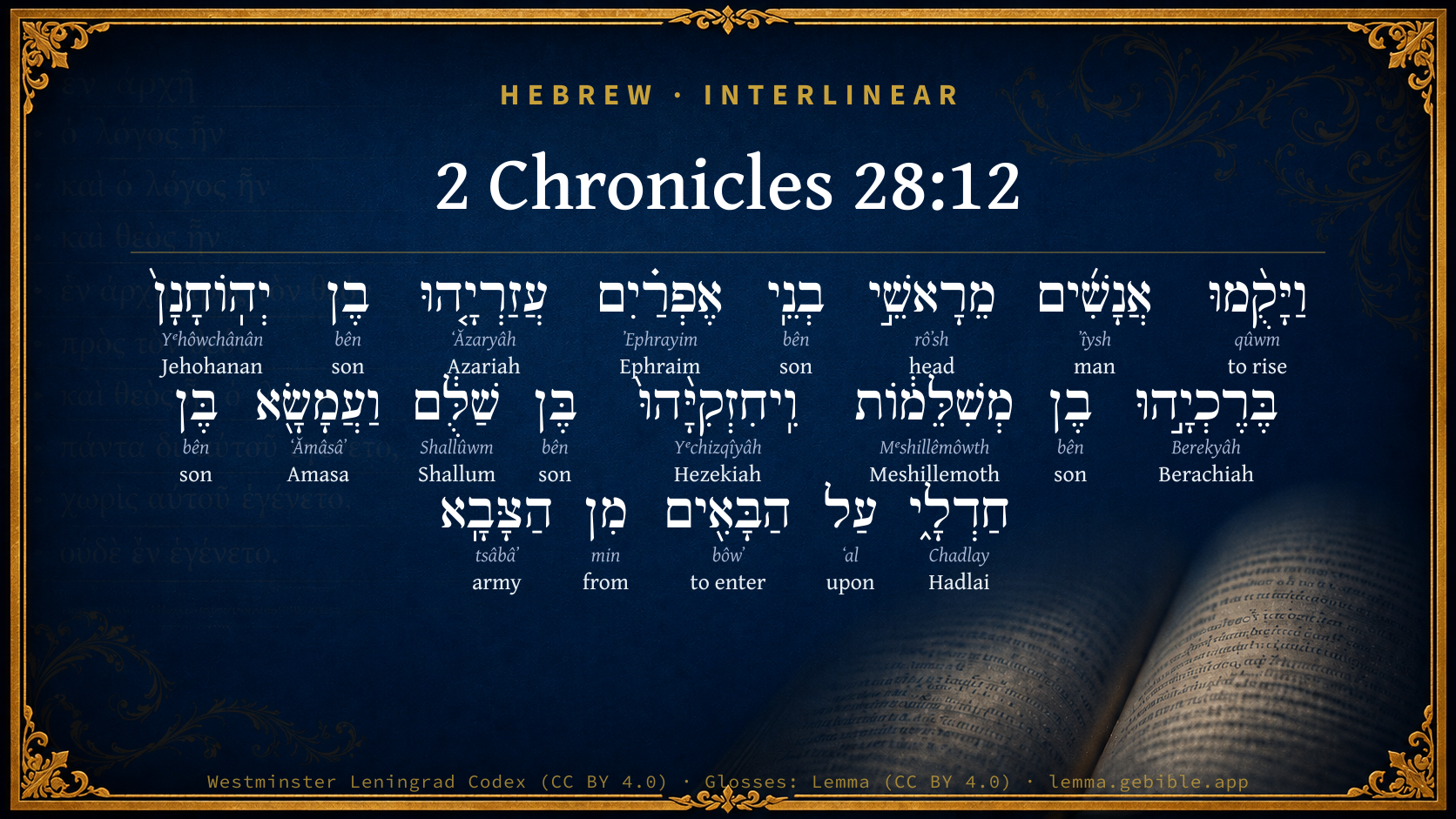
2 Chronicles 28:12

Hebrew (Westminster Leningrad Codex) 2 Chronicles 28:12 appears in the Hebrew Old Testament. The text above is from the Westminster Leningrad Codex. Each word links to its Strong’s number, a concise gloss, and parsing drawn from the Open Scriptures Hebrew Bible morphology. Click any word for its full Brown-Driver-Briggs (BDB) entry.
Download image
Cite this verse

2 Chronicles 28:12 (World English Bible). Public Domain. Lemma interlinear Bible study tool, https://lemma.gebible.app/v/2-chronicles/28/12.

Show BibTeX & RIS
BibTeX
RIS
English Translation
Then certain of the heads of the children of Ephraim, Azariah the son of Johanan, Berechiah the son of Meshillemoth, and Jehizkiah the son of Shallum, and Amasa the son of Hadlai, stood up against those who came from the war,
World English Bible · Public Domain
Highlights
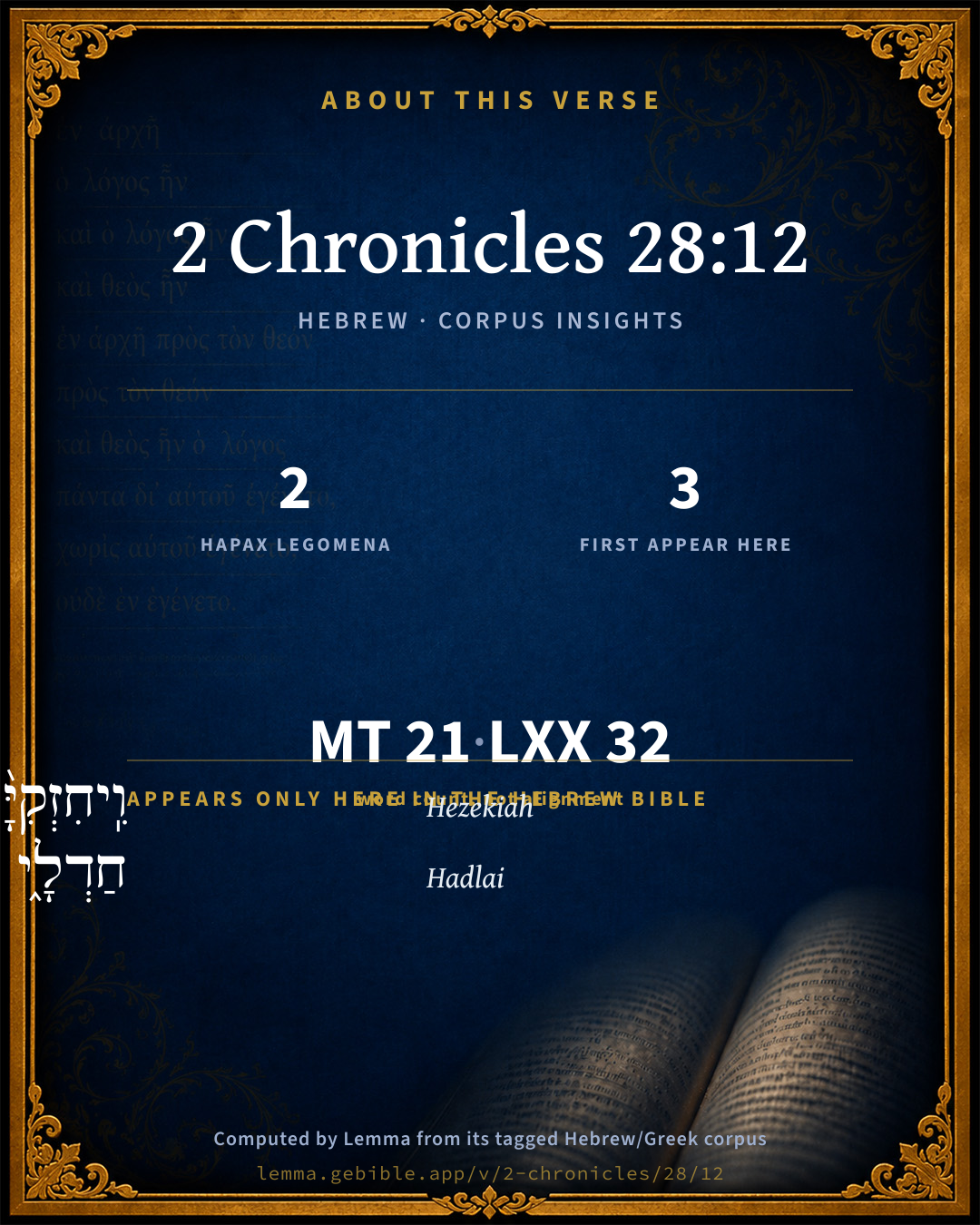
  • 2 hapax legomena — only here in the Hebrew Bible
  • 3 first appearances in the Hebrew Bible
Full analysis ↓
Download a study sheet

One document with this verse’s original text, its word-by-word gloss line, the meaning frame, cross-references with their text, attributed commentary, and full source and license credits — printable, and it pastes into notes with its structure intact.

This verse Autodidact and up

Study sheet (.html) Plain text (.txt)

A passage Seminary Student

Up to 50 verses in one chapter. A passage sheet keeps up to 6 commentary sources and 12 cross-references per verse, in the order this page ranks them, and says so on the sheet whenever that leaves anything out. Ask for a single verse and you get the Autodidact verse sheet above.

Everything on this page stays free to read, with no account — the sheet is a download of what is already on screen, not access to it.

Want to remove ads? Support Godless Engineer
Compare translations 3

The same verse in 3 English versions, stacked beneath the original-language interlinear above. Click any original word for its lexicon entry.

Each is an independent rendering of the whole verse — the interlinear is not word-aligned to these translations.

Highlighted words mark where these versions differ — a whole-verse word diff, not a word-by-word alignment.

  • World English Bible Public Domain
    Then certain of the heads of the children of Ephraim, Azariah the son of Johanan, Berechiah the son of Meshillemoth, and Jehizkiah the son of Shallum, and Amasa the son of Hadlai, stood up against those who came from the war,
  • King James Version Public Domain
    Then certain of the heads of the children of Ephraim, Azariah the son of Johanan, Berechiah the son of Meshillemoth, and Jehizkiah the son of Shallum, and Amasa the son of Hadlai, stood up against them that came from the war,
  • unfoldingWord Literal Text CC BY-SA 4.0
    And men rose from the heads of the sons of Ephraim—Azariah the son of Jehohanan, Berechiah the son of Meshillemoth, and Jehizkiah the son of Shallum, and Amasa the son of Hadlai—against the ones coming from the army.

unfoldingWord Literal Text — © unfoldingWord, licensed CC BY-SA 4.0. Word-aligned USFM3 via Door43 (git.door43.org/unfoldingWord/en_ult).

Versions to compare (up to 4)

3 of 4 selected

Show all 18 translations

Every available English version of this verse, each an independent rendering of the whole verse.

  • World English Bible Public Domain
    Then certain of the heads of the children of Ephraim, Azariah the son of Johanan, Berechiah the son of Meshillemoth, and Jehizkiah the son of Shallum, and Amasa the son of Hadlai, stood up against those who came from the war,
  • Berean Standard Bible Public Domain
    Then some of the leaders of the Ephraimites—Azariah son of Jehohanan, Berechiah son of Meshillemoth, Jehizkiah son of Shallum, and Amasa son of Hadlai—stood in opposition to those arriving from the war.
  • Majority Standard Bible Public Domain
    Then some of the leaders of the Ephraimites—Azariah son of Jehohanan, Berechiah son of Meshillemoth, Jehizkiah son of Shallum, and Amasa son of Hadlai—stood in opposition to those arriving from the war.
  • King James Version Public Domain
    Then certain of the heads of the children of Ephraim, Azariah the son of Johanan, Berechiah the son of Meshillemoth, and Jehizkiah the son of Shallum, and Amasa the son of Hadlai, stood up against them that came from the war,
  • American Standard Version (1901) Public Domain
    Then certain of the heads of the children of Ephraim, Azariah the son of Johanan, Berechiah the son of Meshillemoth, and Jehizkiah the son of Shallum, and Amasa the son of Hadlai, stood up against them that came from the war,
  • Revised Version (1885) Public Domain
    Then certain of the heads of the children of Ephraim, Azariah the son Johanan, Berechiah the son of Meshillemoth, and Jehizkiah the son of Shallum, and Amasa the son of Hadlai, stood up against them that came from the war,
  • Geneva Bible (1599) Public Domain
    Wherefore certaine of the chiefe of the children of Ephraim, Azariah the sonne of Iehohanan, Berechiah the sonne of Meshillemoth, and Iehizkiah the sonne of Shallum, and Amasa the sonne of Hadlai, stood vp against them that came from the warre,
  • Douay-Rheims (1899) Public Domain
    Then some of the chief men of the sons of Ephraim, Azarias the son of Johanan, Barachias the son of Mosollamoth, Ezechias the son of Sellum, and Amasa the son of Adali, stood up against them that came from the war.
  • Young's Literal Translation Public Domain
    And certain of the heads of the sons of Ephraim (Azariah son of Johanan, Berechiah son of Meshillemoth, and Jehizkiah son of Shallum, and Amasa son of Hadlai), rise up against those coming in from the host,
  • Literal Standard Version CC BY-SA 4.0
    And certain of the heads of the sons of Ephraim (Azariah son of Johanan, Berechiah son of Meshillemoth, and Jehizkiah son of Shallum, and Amasa son of Hadlai), rise up against those coming in from the host,
  • Unlocked Literal Bible CC BY-SA 4.0
    Then certain leaders of the people of Ephraim—Azariah son of Jehohanan, Berechiah son of Meshillemoth, Jehizkiah son of Shallum, and Amasa son of Hadlai, stood up against those who came back from the war.
  • unfoldingWord Literal Text CC BY-SA 4.0
    And men rose from the heads of the sons of Ephraim—Azariah the son of Jehohanan, Berechiah the son of Meshillemoth, and Jehizkiah the son of Shallum, and Amasa the son of Hadlai—against the ones coming from the army.
  • Darby Bible Public Domain
    And certain of the heads of the children of Ephraim, Azariah the son of Johanan, Berechiah the son of Meshillemoth, and Hezekiah the son of Shallum, and Amasa the son of Hadlai, stood up against them that came from the war,
  • World Messianic Bible Public Domain
    Then some of the heads of the children of Ephraim, Azariah the son of Yochanan, Berechiah the son of Meshillemoth, Jehizkiah the son of Shallum, and Amasa the son of Hadlai, stood up against those who came from the war,
  • Webster's Bible Public Domain
    Then certain of the heads of the children of Ephraim, Azariah the son of Johanan, Berechiah the son of Meshillemoth, and Jehizkiah the son of Shallum, and Amasa the son of Hadlai, stood up against them that came from the war.
  • Free Bible Version CC BY-SA 4.0
    Some of the leaders of the people of Ephraim —Azariah, son of Jehohanan, Berechiah, son of Meshillemoth, Jehizkiah, son of Shallum, and Amasa, son of Hadlai—stood up in opposition against those returning from the war.
  • Bible in Basic English Public Domain
    Then certain of the heads of the children of Ephraim, Azariah, the son of Johanan, Berechiah, the son of Meshillemoth Jehizkiah, the son of Shallum, and Amasa the son of Hadlai, put themselves against those who had come from the war,
  • JPS Tanakh (1917) Public Domain
    Then certain of the heads of the children of Ephraim, Azariah the son of Jehohanan, Berechiah the son of Meshillemoth, and Jehizkiah the son of Shallum, and Amasa the son of Hadlai, stood up against them that came from the war,

Literal Standard Version (2020), Covenant Press — licensed CC BY-SA 4.0. Text via the HelloAO Bible API (eBible.org). Unlocked Literal Bible (unfoldingWord) — licensed CC BY-SA 4.0. Text via the HelloAO Bible API (eBible.org). unfoldingWord Literal Text — © unfoldingWord, licensed CC BY-SA 4.0. Word-aligned USFM3 via Door43 (git.door43.org/unfoldingWord/en_ult). Free Bible Version, Dr. Jonathan Gallagher — licensed CC BY-SA 4.0. Text via the HelloAO Bible API (eBible.org).

Word by word

More ways to search: Search by grammar → Find every occurrence → Compare this word →

Practice this passage: Drill this verse → Learn its vocabulary →

וִֽיחִזְקִיָּ֨הוּ֙
Yᵉchizqîyâh
H3169
“and · Hezekiah”
Conjunction + Noun, Proper
Part of Speech
Conjunction + Noun
Type
Proper
Full BDB Definition

Origin: from H3388 and H3050

TWOT: None

Hezekiah or Jehizkiah = "Jehovah has made strong" - son of king Ahaz by Abi or Abijah and the 12th king of Judah; his reign was characterised by his godly conduct; reigned for 29 years - head of a family of returning exiles in the time of Nehemiah - an Ephraimite in the time of Ahaz
  1. וַיָּקֻ֨מוּ qûwm H6965 “and · to rise” Conjunction + Verb, Qal, Sequential Imperfect, 3rd Person, Masculine, Plural
  2. אֲנָשִׁ֜ים ʼîysh H376 “men” Noun, Common, Masculine, Plural, Absolute
  3. מֵרָאשֵׁ֣י rôʼsh H7218 “from · heads of” Preposition + Noun, Common, Masculine, Plural, Construct
  4. בְנֵֽי bên H1121 “sons of” Noun, Common, Masculine, Plural, Construct
  5. אֶפְרַ֗יִם ʼEphrayim H669 “Ephraim” Noun, Proper
  6. עֲזַרְיָ֤הוּ ʻĂzaryâh H5838 “Azariah” Noun, Proper
  7. בֶן bên H1121 “son of” Noun, Common, Masculine, Singular, Construct
  8. יְהֽוֹחָנָן֙ Yᵉhôwchânân H3076 “Jehohanan” Noun, Proper
  9. בֶּרֶכְיָ֣הוּ Berekyâh H1296 “Berachiah” Noun, Proper
  10. בֶן bên H1121 “son of” Noun, Common, Masculine, Singular, Construct
  11. מְשִׁלֵּמ֔וֹת Mᵉshillêmôwth H4919 “Meshillemoth” Noun, Proper
  12. בֶּן bên H1121 “son of” Noun, Common, Masculine, Singular, Construct
  13. שַׁלֻּ֔ם Shallûwm H7967 “Shallum” Noun, Proper
  14. וַעֲמָשָׂ֖א ʻĂmâsâʼ H6021 “and · Amasa” Conjunction + Noun, Proper
  15. בֶּן bên H1121 “son of” Noun, Common, Masculine, Singular, Construct
  16. חַדְלָ֑י Chadlay H2311 “Hadlai” Noun, Proper
  17. עַל ʻal H5921 “upon” Preposition
  18. הַבָּאִ֖ים bôwʼ H935 “the · entering” Particle, Definite Article + Verb, Qal, Participle Active, Masculine, Plural, Absolute
  19. מִן min H4480 “from” Preposition
  20. הַצָּבָֽא tsâbâʼ H6635 “the · army” Particle, Definite Article + Noun, Common, Both, Singular, Absolute

About this verse

These counts appear in no published source. They are computed here, from the morphology-tagged text and Lemma’s own curated glosses. What Lemma adds →

21
words
17
distinct lemmas
Historical
section

Notable vocabulary

2 hapax legomena — words that appear only here in the entire Hebrew Bible:

  • וִֽיחִזְקִיָּ֨הוּ֙ Hezekiah H3169
  • חַדְלָ֑י Hadlai H2311

First appearance in Scripture

These words make their first canonical appearance in the Hebrew Bible here:

  • מְשִׁלֵּמ֔וֹת Meshillemoth H4919
  • וִֽיחִזְקִיָּ֨הוּ֙ Hezekiah H3169
  • חַדְלָ֑י Hadlai H2311

Shared distinctive vocabulary

מְשִׁלֵּמ֔וֹת Meshillemoth H4919 occurs in 2 verses of the Hebrew Bible. Also found in:

Grammatical profile

  • 2 verbs
  • 17 nouns
  • 2 prepositions

Verb forms

  • וַיָּקֻ֨מוּ Qal · Sequential Imperfect
  • הַבָּאִ֖ים Qal · Participle Active

Repetition

A word recurs within this verse — often emphatic in Hebrew:

  • בְנֵֽי son H1121 ×5

Hebrew & Septuagint length

In English translation the verse runs 41 words from the Hebrew and 40 from the Septuagint (LXX English) — closely comparable.

A rough comparison of the two English renderings, which tokenize alike — not a word-level alignment.

Word counts can differ between the Hebrew and the Greek without any difference in meaning — e.g. the Hebrew direct-object marker אֵת has no separate Greek word, and Greek often adds the article ὁ.

In the original languages it is 21 Hebrew tokens and 32 Greek tokens — but the two are counted differently (Hebrew bundles its prefixes and suffixes into one token; the Greek is in lemma form), so that isn’t a like-for-like length.

Cross-references

2

Topical passages linked to 2 Chronicles 28:12 in the Treasury of Scripture Knowledge — connected by theme and wording, ordered by reader-vote popularity; previews shown in the World English Bible.

  • 1 Chronicles 28:1 David assembled all the princes of Israel, the princes of the tribes, and the captains of the companies who served the king by division, and the captains of thousands, and the captains of hundreds, and the rulers over all the substance and possessions of the king and of his sons, with the officers, and the mighty men, even all the mighty men of valor, to Jerusalem.
  • Jeremiah 26:6 then will I make this house like Shiloh, and will make this city a curse to all the nations of the earth.

Cross-references courtesy of OpenBible.info (CC BY 4.0).

Hebrew and Greek witnesses Masoretic Hebrew ↔ Greek Septuagint

The same verse in the two great witnesses to the Old Testament, shown verse-for-verse.

These are two independent witnesses, not word-aligned to each other, and the Septuagint is shown in lemma (dictionary) form.

Hebrew 2 Chronicles 28:12 Masoretic · Westminster Leningrad Codex

וַיָּקֻ֨מוּ אֲנָשִׁ֜ים מֵרָאשֵׁ֣י בְנֵֽי אֶפְרַ֗יִם עֲזַרְיָ֤הוּ בֶן יְהֽוֹחָנָן֙ בֶּרֶכְיָ֣הוּ בֶן מְשִׁלֵּמ֔וֹת וִֽיחִזְקִיָּ֨הוּ֙ בֶּן שַׁלֻּ֔ם וַעֲמָשָׂ֖א בֶּן חַדְלָ֑י עַל הַבָּאִ֖ים מִן הַצָּבָֽא

Then certain of the heads of the children of Ephraim, Azariah the son of Johanan, Berechiah the son of Meshillemoth, and Jehizkiah the son of Shallum, and Amasa the son of Hadlai, stood up against those who came from the war,

World English Bible · Public Domain

Greek LXX 2 Chronicles 28:12 Septuagint · lemma form

καί ἀναἵστημι ἄρχων ἀπό ὁ υἱός ἐφράιμ ουδια ὁ ὁ ιωανου καί βαραχιας ὁ ὁ μοσολαμωθ καί εζεκιας ὁ ὁ σελλημ καί αμασιας ὁ ὁ χοδλι ἐπί ὁ ἔρχομαι ἀπό ὁ πόλεμος

And the chiefs of the sons of Ephraim rose up, Udias the son of Joanas, and Barachias the son of Mosolamoth, and Ezekias the son of Sellem, and Amasias the son of Eldai, against those that came from the war,

LXX2012 (modern English Septuagint) · Public Domain

Hebrew: Westminster Leningrad Codex (CC BY 4.0). Greek: Septuagint (public domain); English from LXX2012 (modern English Septuagint) (Public Domain). How the Septuagint differs from the Hebrew →

Commentary

Notes on 2 Chronicles 28:12 from classic Christian and Jewish commentators (each source and its license shown beneath its notes). The classic Christian expositions comment on the surrounding passage and are grouped to its opening verse, so a note may address several verses; the Jewish commentaries on the Tanakh (Rashi and others) are per-verse, so they appear only where the commentator wrote on this verse.

Lemma curates 59 commentaries, every one of them public domain or Creative Commons licensed, each selected and text-cleaned for this edition rather than reprinted as found. About our sources →

Trapp's Complete Commentary

John Trapp

2Ch 28:12 Then certain of the heads of the children of Ephraim, Azariah the son of Johanan, Berechiah the son of Meshillemoth, and Jehizkiah the son of Shallum, and Amasa the son of Hadlai, stood up against them that came from the war,

Ver. 12. Then certain of the heads.] So mightily did the word of God in the mouth of this one prophet work upon them; although he used not the Lord’s name unto them, because he thought them, saith Jerome, for their idolatries, unworthy.

John Trapp, A Commentary or Exposition upon All the Books of the Old and New Testament (1647–1656) — public domain. Text from a community e-Sword module.

Geneva Bible (1599)

Geneva Bible translators

Which tribe was now greatest, and had most authority.

Geneva Bible (1599) marginal notes — public domain. Text via Bolls.life.

Ellicott's Commentary for English Readers

(12) Children of Ephraim.—The ten tribes, as a political whole, are often designated as “Ephraim” by the prophets of that age, e.g., Hosea and Isaiah.

Stood up against.—The Hebrew phrase usually means opposed; here confronted or came before those who were coming from the host.

A Bible Commentary for English Readers, edited by Charles John Ellicott (1878–1897) — public domain. Text from a community e-Sword module.

John Gill's Exposition

Then certain of the heads of the children of Ephraim,.... Of the principal men of the ten tribes, whose names follow:

Azariah the son of Johanan, Berechiah the son of Meshillemoth, and Jehizkiah the son of Shallum, and Amasa the son of Hadlai, stood up against them that came from the war; who were bringing the captives and spoils to Samaria; but these princes, being influenced by what the prophet said, hindered their proceeding any further.

John Gill's Exposition of the Whole Bible (1746–1763) — public domain (CC PDM 1.0). Text via the HelloAO Bible API.

Albert Barnes' Notes on the Bible

“Ephraim” is used herein the generic sense so common in the prophets, as synonymous with the ten tribes.

Albert Barnes' Notes on the Bible (1834–1885) — public domain. Text from a community e-Sword/MySword module.

The Pulpit Commentary

Oded"s appeal, and forcible but most temperate and pertinent argument of the previous verses, was addressed to those who led the returning army, flushed with victory and haughty with their captives led in triumph, and, as ver. 15 shows, cruelly, and with every deprivation of clothes and of shoes, etc. It now, however, fortunately meets with most welcome practical support from those (certain of the heads of the children of Ephraim) who had not had a hand in what had been done, and now stood by, in some measure like umpires. They, at any rate, are convinced, partly perhaps in that their blood was not hot with the battles that had been. We do not know particulars of these four worthier men, whose names, with their fathers", are here "expressed" (ver. 15). They were evidently conscious of their past sins, had fear toward God, were not of those who, sinning, hastened to sin yet more; but they wished to flee from the wrath to come, the "fierce wrath," already impending. Ephraim. (see note on 2Ch_25:7)

The Pulpit Commentary (1880–1919), ed. H.D.M. Spence-Jones & Joseph S. Exell — public domain. Text from a community e-Sword module.

unfoldingWord translationNotes

Door43 World Missions Community

Azariah son of Jehohanan, Berechiah son of Meshillemoth, Jehizkiah son of Shallum, and Amasa son of Hadlai

These are all names of men. (See: How to Translate Names)

stood up against those who came back from the war

The phrase "stood up against" is an idiom that means to confront or to oppose. AT: "confronted those who came back from the war" or "opposed those who came back from the war" (See: Idiom)

something that will bring on us sin

The leaders speak of doing something that will cause them to be guilty of sin as if it were sin were an object that the action brings upon them. AT: "something that will cause us to be guilty of sinning" (See: Metaphor)

there is fierce wrath against Israel

This phrase implies that it is Yahweh's fierce wrath that is against Israel. The words "fierce wrath" can be translated with a verbal phrase. AT: "Yahweh is extremely angry with the people of Israel" (See: Assumed Knowledge and Implicit Information and Abstract Nouns)

translationWords

trespass

unfoldingWord translationNotes — © Distant Shores Media and the Door43 World Missions Community, licensed CC BY-SA 4.0. Source: git.door43.org/Door43/en_tn.

Lesson kit

Teaching starters — assembled from the data on this page, not authored interpretation. Every prompt links to the verse data it draws on. Edit before teaching.

2 Chronicles, in the Historical, opens this verse with 21 words (17 distinct Hebrew lemmas). Its most distinctive word is Yᵉchizqîyâh (“Hezekiah”). A historical commentator’s framing appears above. Read the whole chapter for the surrounding context.

Discussion questions

  1. How does “Hezekiah” (Yᵉchizqîyâh) shape what this verse is saying?
  2. 2 words here appear nowhere else in the Hebrew Bible. Why might the author reach for such rare wording?
  3. 3 words make their first appearance in Scripture here. What does this debut establish?
  4. How does Nehemiah 11:13, which shares the word «Meshillemoth», read alongside this verse?
  5. What does the repetition of “son” (5× in this one verse) do in this verse?
  6. The translations on this page render this verse differently — a whole-verse word diff, not a word-by-word alignment. What might account for the different wordings?
  7. «וַיָּקֻ֨מוּ» is a Qal Sequential Imperfect verb. How does that grammatical form shape the action described?
  8. Compare how Trapp's Complete Commentary and Geneva Bible (1599) read this verse. Where do they agree or differ?

Things to notice

  • 2 words in this verse appear nowhere else in the Hebrew Bible.
  • 3 words make their first canonical appearance in Scripture here.
  • This verse counts 21 Hebrew ↔ 32 Greek words.
  • These translations choose different wording for 21 words in this verse.
  • “son” occurs 5× in this single verse.

Reading settings

Reading text

Shown beneath each verse's original-language words.

Old Testament
Old Testament edition

Read the OT as the Masoretic Hebrew (MT) or the Greek Septuagint (LXX).

English shown for the Greek Septuagint (in the Hebrew ↔ Greek comparison).

Comparing translations? Open the Compare panel on any verse page to stack up to four side by side.