
2 Chronicles 33:11

Hebrew (Westminster Leningrad Codex) 2 Chronicles 33:11 appears in the Hebrew Old Testament. The text above is from the Westminster Leningrad Codex. Each word links to its Strong’s number, a concise gloss, and parsing drawn from the Open Scriptures Hebrew Bible morphology. Click any word for its full Brown-Driver-Briggs (BDB) entry.
Download image
Cite this verse

2 Chronicles 33:11 (World English Bible). Public Domain. Lemma interlinear Bible study tool, https://lemma.gebible.app/v/2-chronicles/33/11.

Show BibTeX & RIS
BibTeX
RIS
English Translation
Therefore Yahweh brought on them the captains of the host of the king of Assyria, who took Manasseh in chains, and bound him with fetters, and carried him to Babylon.
World English Bible · Public Domain
Download a study sheet

One document with this verse’s original text, its word-by-word gloss line, the meaning frame, cross-references with their text, attributed commentary, and full source and license credits — printable, and it pastes into notes with its structure intact.

This verse Autodidact and up

Study sheet (.html) Plain text (.txt)

A passage Seminary Student

Up to 50 verses in one chapter. A passage sheet keeps up to 6 commentary sources and 12 cross-references per verse, in the order this page ranks them, and says so on the sheet whenever that leaves anything out. Ask for a single verse and you get the Autodidact verse sheet above.

Everything on this page stays free to read, with no account — the sheet is a download of what is already on screen, not access to it.

Want to remove ads? Support Godless Engineer
Compare translations 3

The same verse in 3 English versions, stacked beneath the original-language interlinear above. Click any original word for its lexicon entry.

Each is an independent rendering of the whole verse — the interlinear is not word-aligned to these translations.

Highlighted words mark where these versions differ — a whole-verse word diff, not a word-by-word alignment.

  • World English Bible Public Domain
    Therefore Yahweh brought on them the captains of the host of the king of Assyria, who took Manasseh in chains, and bound him with fetters, and carried him to Babylon.
  • King James Version Public Domain
    Wherefore the LORD brought upon them the captains of the host of the king of Assyria, which took Manasseh among the thorns, and bound him with fetters, and carried him to Babylon.
  • unfoldingWord Literal Text CC BY-SA 4.0
    And Yahweh brought against them the chiefs of the army which belonged to the king of Assyria. And they captured Manasseh in chains, and they bound him in bronze, and they took him to Babylon.

unfoldingWord Literal Text — © unfoldingWord, licensed CC BY-SA 4.0. Word-aligned USFM3 via Door43 (git.door43.org/unfoldingWord/en_ult).

Versions to compare (up to 4)

3 of 4 selected

Show all 18 translations

Every available English version of this verse, each an independent rendering of the whole verse.

  • World English Bible Public Domain
    Therefore Yahweh brought on them the captains of the host of the king of Assyria, who took Manasseh in chains, and bound him with fetters, and carried him to Babylon.
  • Berean Standard Bible Public Domain
    So the LORD brought against them the military commanders of the king of Assyria, who captured Manasseh, put a hook in his nose, bound him with bronze shackles, and took him to Babylon.
  • Majority Standard Bible Public Domain
    So the LORD brought against them the military commanders of the king of Assyria, who captured Manasseh, put a hook in his nose, bound him with bronze shackles, and took him to Babylon.
  • King James Version Public Domain
    Wherefore the LORD brought upon them the captains of the host of the king of Assyria, which took Manasseh among the thorns, and bound him with fetters, and carried him to Babylon.
  • American Standard Version (1901) Public Domain
    Wherefore Jehovah brought upon them the captains of the host of the king of Assyria, who took Manasseh in chains, and bound him with fetters, and carried him to Babylon.
  • Revised Version (1885) Public Domain
    Wherefore the LORD brought upon them the captains of the host of the king of Assyria, which took Manasseh in chains, and bound him with fetters, and carried him to Babylon.
  • Geneva Bible (1599) Public Domain
    Wherefore the Lord brought vpon them the captaines of the hoste of the King of Asshur, which tooke Manasseh and put him in fetters, and bound him in chaines, and caryed him to Babel.
  • Douay-Rheims (1899) Public Domain
    Therefore he brought upon them the captains of the army of the king of the Assyrians: and they took Manasses, and carried him bound with chains and fetters to Babylon.
  • Young's Literal Translation Public Domain
    and Jehovah bringeth in against them the heads of the host that the king of Asshur hath, and they capture Manasseh among the thickets, and bind him with brazen fetters, and cause him to go to Babylon.
  • Literal Standard Version CC BY-SA 4.0
    and YHWH brings in against them the heads of the host that the king of Asshur has, and they capture Manasseh among the thickets, and bind him with bronze chains, and cause him to go to Babylon.
  • Unlocked Literal Bible CC BY-SA 4.0
    So Yahweh brought on them the commanders of the army of the king of Assyria, who took Manasseh in chains, bound him with fetters, and took him off to Babylon.
  • unfoldingWord Literal Text CC BY-SA 4.0
    And Yahweh brought against them the chiefs of the army which belonged to the king of Assyria. And they captured Manasseh in chains, and they bound him in bronze, and they took him to Babylon.
  • Darby Bible Public Domain
    And Jehovah brought upon them the captains of the host of the king of Assyria, who took Manasseh with fetters, and bound him with chains of brass, and carried him to Babylon.
  • World Messianic Bible Public Domain
    Therefore the LORD brought on them the captains of the army of the king of Assyria, who took Manasseh in chains, bound him with fetters, and carried him to Babylon.
  • Webster's Bible Public Domain
    Wherefore the LORD brought upon them the captains of the army of the king of Assyria, who took Manasseh among the thorns, and bound him with fetters, and carried him to Babylon.
  • Free Bible Version CC BY-SA 4.0
    So the Lord sent the armies of Assyria with their commanders to attack them. The Assyrians captured Manasseh, put a hook through his nose, put bronze shackles on him, and took him away to Babylon.
  • Bible in Basic English Public Domain
    So the Lord sent against them the captains of the army of Assyria, who made Manasseh a prisoner and took him away in chains to Babylon.
  • JPS Tanakh (1917) Public Domain
    Wherefore the LORD brought upon them the captains of the host of the king of Assyria, who took Manasseh with hooks, and bound him with fetters, and carried him to Babylon.

Literal Standard Version (2020), Covenant Press — licensed CC BY-SA 4.0. Text via the HelloAO Bible API (eBible.org). Unlocked Literal Bible (unfoldingWord) — licensed CC BY-SA 4.0. Text via the HelloAO Bible API (eBible.org). unfoldingWord Literal Text — © unfoldingWord, licensed CC BY-SA 4.0. Word-aligned USFM3 via Door43 (git.door43.org/unfoldingWord/en_ult). Free Bible Version, Dr. Jonathan Gallagher — licensed CC BY-SA 4.0. Text via the HelloAO Bible API (eBible.org).

Word by word

More ways to search: Search by grammar → Find every occurrence → Compare this word →

Practice this passage: Drill this verse → Learn its vocabulary →

בַּחֹחִ֑ים
chôwach
H2336
“in/at the · thorns”
Preposition, Determined + Noun, Common, Masculine, Plural, Absolute
Part of Speech
Preposition + Noun
Type
Common
Gender
Masculine
Number
Plural
State
Absolute
Full BDB Definition

Origin: from an unused root apparently meaning to pierce

TWOT: 620a , 620b

thorn, brier, bramble, thornbush, thicket - hook, ring, fetter
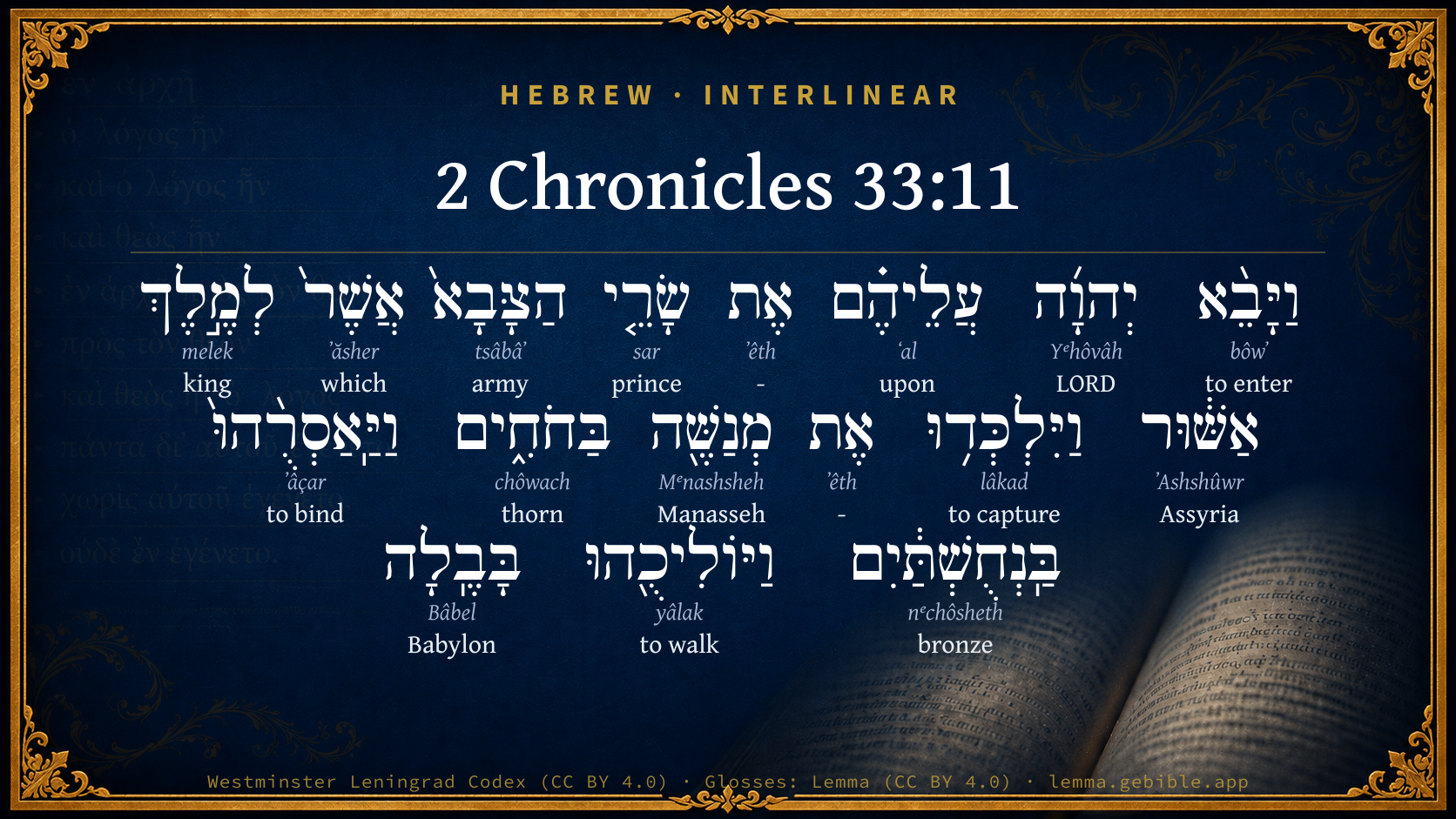
  1. וַיָּבֵ֨א bôwʼ H935 “and · to enter” Conjunction + Verb, Hiphil, Sequential Imperfect, 3rd Person, Masculine, Singular
  2. יְהוָ֜ה Yᵉhôvâh H3068 “LORD” Noun, Proper
  3. עֲלֵיהֶ֗ם ʻal H5921 “upon · them” Preposition + Suffix, Personal, 3rd Person, Masculine, Plural
  4. אֶת ʼêth H853 “-” Particle, Direct Object
  5. שָׂרֵ֤י sar H8269 “princes of” Noun, Common, Masculine, Plural, Construct
  6. הַצָּבָא֙ tsâbâʼ H6635 “the · army” Particle, Definite Article + Noun, Common, Both, Singular, Absolute
  7. אֲשֶׁר֙ ʼăsher H834 “which” Particle, Relative
  8. לְמֶ֣לֶךְ melek H4428 “to/for · king of” Preposition + Noun, Common, Masculine, Singular, Construct
  9. אַשּׁ֔וּר ʼAshshûwr H804 “Assyria” Noun, Proper
  10. וַיִּלְכְּד֥וּ lâkad H3920 “and · to capture” Conjunction + Verb, Qal, Sequential Imperfect, 3rd Person, Masculine, Plural
  11. אֶת ʼêth H853 “-” Particle, Direct Object
  12. מְנַשֶּׁ֖ה Mᵉnashsheh H4519 “Manasseh” Noun, Proper
  13. וַיַּֽאַסְרֻ֨הוּ֙ ʼâçar H631 “and · to bind · him” Conjunction + Verb, Qal, Sequential Imperfect, 3rd Person, Masculine, Plural + Suffix, Personal, 3rd Person, Masculine, Singular
  14. בַּֽנְחֻשְׁתַּ֔יִם nᵉchôsheth H5178 “in/at the · bronze fetters” Preposition, Determined + Noun, Common, Feminine, Dual, Absolute
  15. וַיּוֹלִיכֻ֖הוּ yâlak H3212 “and · to walk · him” Conjunction + Verb, Hiphil, Sequential Imperfect, 3rd Person, Masculine, Plural + Suffix, Personal, 3rd Person, Masculine, Singular
  16. בָּבֶֽלָה Bâbel H894 “Babylon · toward” Noun, Proper + Suffix, Demonstrative

About this verse

These counts appear in no published source. They are computed here, from the morphology-tagged text and Lemma’s own curated glosses. What Lemma adds →

17
words
16
distinct lemmas
Historical
section

Notable vocabulary

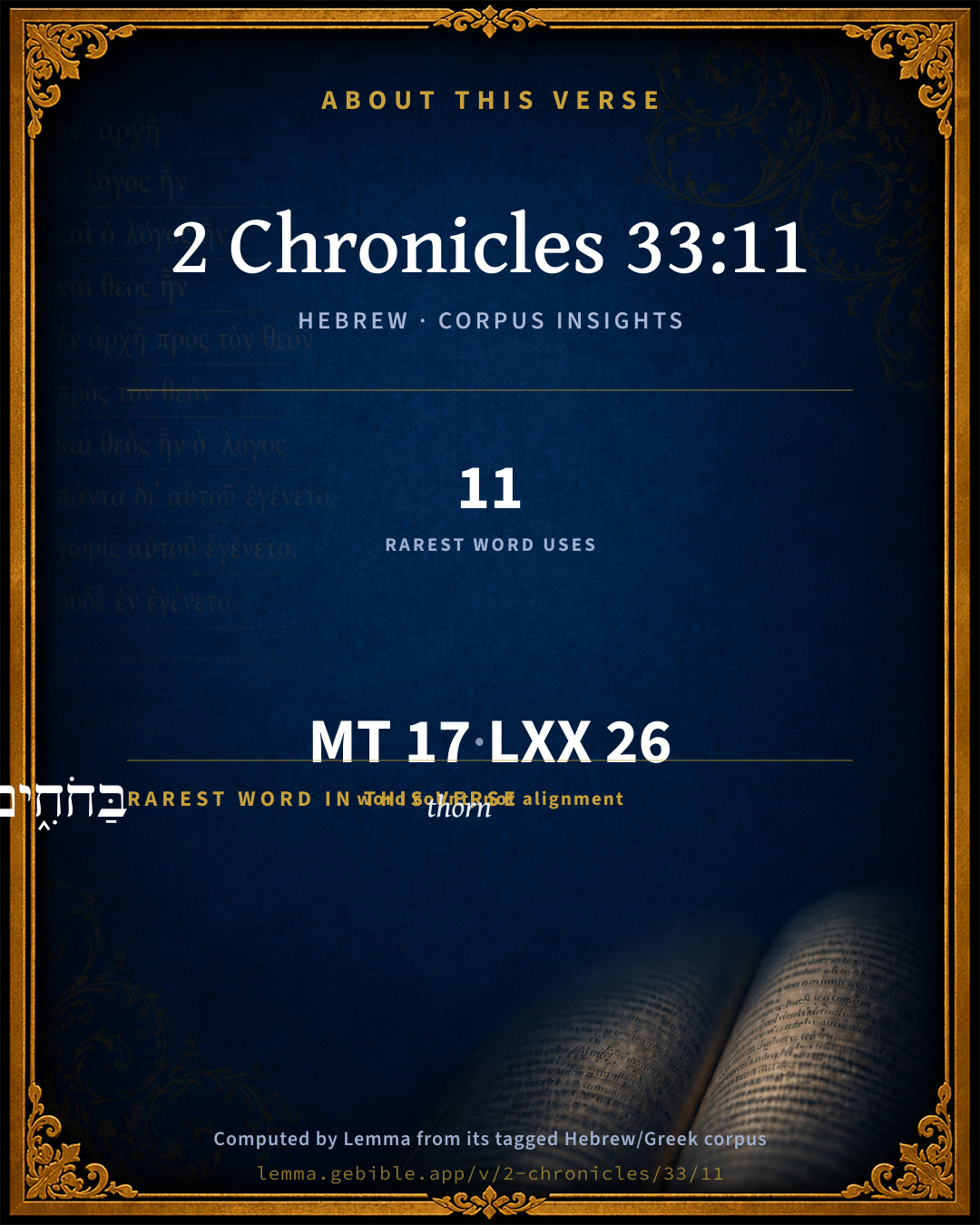
The rarest word here is בַּחֹחִ֑ים thorn H2336 — appearing just 11 times in the whole Hebrew Bible.

Shared distinctive vocabulary

בַּחֹחִ֑ים thorn H2336 occurs in 9 verses of the Hebrew Bible. Also found in:

Grammatical profile

  • 4 verbs
  • 9 nouns
  • 1 preposition
  • 3 particles

Verb forms

  • וַיָּבֵ֨א Hiphil · Sequential Imperfect
  • וַיִּלְכְּד֥וּ Qal · Sequential Imperfect
  • וַיַּֽאַסְרֻ֨הוּ֙ Qal · Sequential Imperfect
  • וַיּוֹלִיכֻ֖הוּ Hiphil · Sequential Imperfect

Hebrew & Septuagint length

In English translation the verse runs 30 words from the Hebrew and 32 from the Septuagint (LXX English) — closely comparable.

A rough comparison of the two English renderings, which tokenize alike — not a word-level alignment.

Word counts can differ between the Hebrew and the Greek without any difference in meaning — e.g. the Hebrew direct-object marker אֵת has no separate Greek word, and Greek often adds the article ὁ.

In the original languages it is 17 Hebrew tokens and 26 Greek tokens — but the two are counted differently (Hebrew bundles its prefixes and suffixes into one token; the Greek is in lemma form), so that isn’t a like-for-like length.

Cross-references

14

Topical passages linked to 2 Chronicles 33:11 in the Treasury of Scripture Knowledge — connected by theme and wording, ordered by reader-vote popularity; previews shown in the World English Bible.

  • Deuteronomy 28:36 Yahweh will bring you, and your king whom you shall set over you, to a nation that you have not known, you nor your fathers; and there shall you serve other gods, wood and stone.
  • 2 Chronicles 36:6 Against him came up Nebuchadnezzar king of Babylon, and bound him in fetters, to carry him to Babylon.
  • 1 Samuel 13:6 When the men of Israel saw that they were in a strait (for the people were distressed), then the people did hide themselves in caves, and in thickets, and in rocks, and in coverts, and in pits.
  • 2 Kings 23:33 Pharaoh Necoh put him in bonds at Riblah in the land of Hamath, that he might not reign in Jerusalem; and put the land to a tribute of one hundred talents of silver, and a talent of gold.
  • 2 Kings 25:6 Then they took the king, and carried him up to the king of Babylon to Riblah; and they gave judgment on him.
  • Nehemiah 9:32 Now therefore, our God, the great, the mighty, and the awesome God, who keep covenant and loving kindness, don't let all the travail seem little before you, that has come on us, on our kings, on our princes, and on our priests, and on our prophets, and on our fathers, and on all your people, since the time of the kings of Assyria to this day.
  • Nehemiah 9:37 It yields much increase to the kings whom you have set over us because of our sins: also they have power over our bodies, and over our cattle, at their pleasure, and we are in great distress.
  • Job 36:8–11 If they are bound in fetters, And are taken in the cords of afflictions,
  • Psalms 107:10–14 Some sat in darkness and in the shadow of death, Being bound in affliction and iron,
  • Isaiah 5:26–30 He will lift up a banner to the nations from far, And he will whistle for them from the end of the earth. Behold, they will come speedily and swiftly.
  • Isaiah 7:18–20 It will happen in that day that Yahweh will whistle for the fly that is in the uttermost part of the rivers of Egypt, and for the bee that is in the land of Assyria.
  • Isaiah 10:8 For he says, Aren't my princes all of them kings?
  • Isaiah 36:9 How then can you turn away the face of one captain of the least of my master's servants, and put your trust on Egypt for chariots and for horsemen?
  • Lamentations 3:7 He has walled me about, that I can't go forth; he has made my chain heavy.

Cross-references courtesy of OpenBible.info (CC BY 4.0).

Hebrew and Greek witnesses Masoretic Hebrew ↔ Greek Septuagint

The same verse in the two great witnesses to the Old Testament, shown verse-for-verse.

These are two independent witnesses, not word-aligned to each other, and the Septuagint is shown in lemma (dictionary) form.

Hebrew 2 Chronicles 33:11 Masoretic · Westminster Leningrad Codex

וַיָּבֵ֨א יְהוָ֜ה עֲלֵיהֶ֗ם אֶת שָׂרֵ֤י הַצָּבָא֙ אֲשֶׁר֙ לְמֶ֣לֶךְ אַשּׁ֔וּר וַיִּלְכְּד֥וּ אֶת מְנַשֶּׁ֖ה בַּחֹחִ֑ים וַיַּֽאַסְרֻ֨הוּ֙ בַּֽנְחֻשְׁתַּ֔יִם וַיּוֹלִיכֻ֖הוּ בָּבֶֽלָה

Therefore Yahweh brought on them the captains of the host of the king of Assyria, who took Manasseh in chains, and bound him with fetters, and carried him to Babylon.

World English Bible · Public Domain

Greek LXX 2 Chronicles 33:11 Septuagint · lemma form

καί ἄγω κύριος ἐπί αὐτός ὁ ἄρχων ὁ δύναμις βασιλεύς ασσουρ καί καταλαμβάνω ὁ μανασσή ἐν δεσμός καί δέω αὐτός ἐν πέδη καί ἄγω εἰς βαβυλών

And the Lord brought upon them the captains of the host of the king of Assyria, and they took Manasses in bonds, and bound him in fetters, and brought him to Babylon.

LXX2012 (modern English Septuagint) · Public Domain

On this verse, Ellicott's Commentary for English Readers discusses the Septuagint’s reading. Read the note in Commentary ↓

Hebrew: Westminster Leningrad Codex (CC BY 4.0). Greek: Septuagint (public domain); English from LXX2012 (modern English Septuagint) (Public Domain). How the Septuagint differs from the Hebrew →

Commentary

Notes on 2 Chronicles 33:11 from classic Christian and Jewish commentators (each source and its license shown beneath its notes). The classic Christian expositions comment on the surrounding passage and are grouped to its opening verse, so a note may address several verses; the Jewish commentaries on the Tanakh (Rashi and others) are per-verse, so they appear only where the commentator wrote on this verse.

Lemma curates 59 commentaries, every one of them public domain or Creative Commons licensed, each selected and text-cleaned for this edition rather than reprinted as found. About our sources →

Matthew Henry's Commentary

We have seen Manasseh by his wickedness undoing the good that his father had done; here we have him by repentance undoing the evil that he himself had done. It is strange that this was not so much as mentioned in the book of Kings, nor does any thing appear there to the contrary but that he persisted and perished in his son. But perhaps the reason was because the design of that history was to show the wickedness of the nation which brought destruction upon them; and this repentance of Manasseh and the benefit of it, being personal only and not national, is overlooked there; yet here it is fully related, and a memorable instance it is of the riches of God's pardoning mercy and the power of his renewing grace. Here is,

I. The occasion of Manasseh's repentance, and that was his affliction. In his distress he did not (like king Ahaz) trespass yet more against God, but humbled himself and returned to God. Sanctified afflictions often prove happy means of conversion. What his distress was we are told, Ch2 33:11. God brought a foreign enemy upon him; the king of Babylon, that courted his father who faithfully served God, invaded him now that he had treacherously departed from God. He is here called king of Assyria, because he had made himself master of Assyria, which he would the more easily do for the defeat of Sennacherib's army, and its destruction before Jerusalem. He aimed at the treasures which the ambassadors had seen, and all those precious things; but God sent him to chastise a sinful people, and subdue a straying prince. The captain took Manasseh among the thorns, in some bush or other, perhaps in his garden, where he had hid himself. Or it is spoken figuratively: he was perplexed in his counsels and embarrassed in his affairs. He was, as we say, in the briers, and knew not which way to extricate himself, and so became an easy prey to the Assyrian captains, who no doubt plundered his house and took away what they pleased, as Isaiah had foretold, Kg2 20:17, Kg2 20:18. What was Hezekiah's pride was their prey. They bound Manasseh, who had been held before with the cords of his own iniquity, and carried him prisoner to Babylon. About what time of his reign this was we are not told; the Jews say it was in his twenty-second year.

II. The expressions of his repentance (Ch2 33:12, Ch2 33:13): When he was in affliction he had time to bethink himself and reason enough too. He saw what he had brought himself to by his sin. He found the gods he had served unable to help him. He knew that repentance was the only way of restoring his affairs; and therefore to him he returned from whom he had revolted. 1. He was convinced the Jehovah is the only living and true God: Then he knew (that is, he believed and considered) that the Lord he was God. He might have known it at a less expense if he would have given due attention and credit to the word written and preached: but it was better to pay thus dearly for the knowledge of God than to perish in ignorance and unbelief. Had he been a prince in the palace of Babylon, it is probable he would have been confirmed in his idolatry; but, being a captive in the prisons of Babylon, he was convinced of it and reclaimed from it. 2. He applied to him as his God now, renouncing all others, and resolving to cleave to him only, the God of his fathers, and a God on covenant with him. 3. He humbled himself greatly before him, was truly sorry for his sins, ashamed of them, and afraid of the wrath of God. It becomes sinners to humble themselves before the face of that God whom they have offended. It becomes sufferers to humble themselves under the hand of that God who corrects them, and to accept the punishment of their iniquity. Our hearts should be humbled under humbling providences; then we accommodate ourselves to them, and answer God's end in them. 4. He prayed to him for the pardon of sin and the return of his favour. Prayer is the relief of penitents, the relief of the afflicted. That is a good prayer, and very pertinent in this case, which we find among the apocryphal books, entitled, The prayer of Manasses, king of Judah, when he was holden captive in Babylon. Whether it was his or no is uncertain; if it was, in it he gives glory to God as the God of their fathers and their righteous seed, as the Creator of the world, a God whose anger is insupportable, and yet his merciful promise unmeasurable. He pleads that God has promised repentance and forgiveness to those that have sinned, and has appointed repentance unto sinners, that they may be saved, not unto the just, as to Abraham, Isaac, and Jacob, but to me (says he) that am a sinner; for I have sinned above the number of the sands of the sea: so he confesses his sin largely, and aggravates it. He prays, Forgive me, O Lord! forgive me, and destroy me not; he pleads, Thou art the God of those that repent, etc., and concludes, Therefore I will praise thee for ever, etc.

III. God's gracious acceptance of his repentance: God was entreated of him, and heard his supplication. Though affliction drive us to God, he will not therefore reject us if in sincerity we seek him, for afflictions are sent on purpose to bring us to him. As a token of God's favour to him, he made a way for his escape. Afflictions are continued no longer than till they have done their work. When Manasseh is brought back to his God and to his duty he shall soon be brought back to his kingdom. See how ready God is to accept and welcome returning sinners, and how swift to show mercy. Let not great sinners despair, when Manasseh himself, upon his repentance, found favour with God; in him God showed forth a pattern of long-suffering, as Ti1 1:16; Isa 1:18.

IV. The fruits meet for repentance which he brought forth after his return to his own land, Ch2 33:15, Ch2 33:16. 1. He turned from his sins. He took away the strange gods, the images of them, and that idol (whatever it was) which he had set up with so much solemnity in the house of the Lord, as if it had been master of that house. He cast out all the idolatrous altars that were in the mount of the house and in Jerusalem, as detestable things. Now (we hope) he loathed them as much as ever he had loved them, and said to them, Get you hence, Isa 30:22. "What have I to do any more with idols? I have had enough of them." 2. He returned to his duty; for he repaired the altar of the Lord, which had either been abused and broken down by some of the idolatrous priests, or, at least, neglected and gone out of repair. He sacrificed thereon peace-offerings to implore God's favour, and thank-offerings to praise him for his deliverance. Nay, he now used his power to reform his people, as before he had abused it to corrupt them: He commanded Judah to serve the Lord God of Israel. Note, Those that truly repent of their sins will not only return to God themselves, but will do all they can to recover those that have by their example been seduced and drawn away from God; else they do not thoroughly (as they ought) undo what they have done amiss, nor make the plaster as wide as the wound. We find that he prevailed to bring them off from their false gods, but not from their high places, Ch2 33:17. They still sacrificed in them, yet to the Lord their God only; Manasseh could not carry the reformation so far as he had carried the corruption. It is an easy thing to debauch men's manners, but not so easy to reform them again.

V. His prosperity, in some measure, after his repentance. He might plainly see it was sin that ruined him; for, when he returned to God in a way of duty, God returned to him in a way of mercy: and then he built a wall about the city of David (Ch2 33:14), for by sin he had unwalled it and exposed it to the enemy. He also put captains of war in the fenced cities for the security of his country. Josephus says that all the rest of his time he was so changed for the better that he was looked upon as a very happy man.

Lastly, Here is the conclusion of his history. The heads of those things for a full narrative of which we are referred to the other writings that were then extant are more than of any of the kings, Ch2 33:18, Ch2 33:19. A particular account, it seems, was kept, 1. Of all his sin, and his trespass, the high places he built, the groves and images he set up, before he was humbled. Probably this was taken from his own confession which he made of his sin when God gave him repentance, and which he left upon record, in a book entitled, The words of the seers. To those seers that spoke to him (Ch2 33:18) to reprove him for his sin he sent his confession when he repented, to be inserted in their memoirs, as a token of his gratitude to them for their kindness in reproving him. Thus it becomes penitents to take shame to themselves, to give thanks to their reprovers, and warning to others. 2. Of the words of the seers that spoke to him in the name of the Lord (Ch2 33:10, Ch2 33:18), the reproofs they gave him for his sin and their exhortations to repentance. Note, Sinners ought to consider, that, how little notice soever they take of them, an account is kept of the words of the seers that speak to them from God to admonish them of their sins, warn them of their danger, and call them to their duty, which will be produced against them in the great day. 3. Of his prayer to God (this is twice mentioned as a remarkable thing) and how God was entreated of him. This was written for the generations to come, that the people that should be created might praise the Lord for his readiness to receive returning prodigals. Notice is taken of the place of his burial, not in the sepulchres of the kings, but in his own house; he was buried privately, and nothing of that honour was done him at his death that was done to his father. Penitents may recover their comfort sooner than their credit.

Matthew Henry's Commentary on the Whole Bible (1708–1710) — public domain (CC PDM 1.0). Text via the HelloAO Bible API.

Jamieson, Fausset & Brown

Robert Jamieson, A. R. Fausset & David Brown

HE IS CARRIED UNTO BABYLON, WHERE HE HUMBLES HIMSELF BEFORE GOD, AND IS RESTORED TO HIS KINGDOM. (Ch2 33:11-19)

the captains of the host of the king of Assyria--This king was Esar-haddon. After having devoted the first years of his reign to the consolidation of his government at home, he turned his attention to repair the loss of the tributary provinces west of the Euphrates, which, on the disaster and death of Sennacherib, had taken the opportunity of shaking off the Assyrian yoke. Having overrun Palestine and removed the remnant that were left in the kingdom of Israel, he despatched his generals, the chief of whom was Tartan (Isa 20:1), with a portion of his army for the reduction of Judah also. In a successful attack upon Jerusalem, they took multitudes of captives, and got a great prize, including the king himself, among the prisoners.

took Manasseh among the thorns--This may mean, as is commonly supposed, that he had hid himself among a thicket of briers and brambles. We know that the Hebrews sometimes took refuge from their enemies in thickets (Sa1 13:6). But, instead of the Hebrew, Bacochim, "among the thorns", some versions read Bechayim, "among the living", and so the passage would be "took him alive."

bound him with fetters, and carried him to Babylon--The Hebrew word rendered "fetters" denotes properly two chains of brass. The humiliating state in which Manasseh appeared before the Assyrian monarch may be judged of by a picture on a tablet in the Khorsabad palace, representing prisoners led bound into the king's presence. "The captives represented appear to be inhabitants of Palestine. Behind the prisoners stand four persons with inscriptions on the lower part of their tunics; the first two are bearded, and seem to be accusers; the remaining two are nearly defaced; but behind the last appears the eunuch, whose office it seems to be to usher into the presence of the king those who are permitted to appear before him. He is followed by another person of the same race as those under punishment; his hands are manacled, and on his ankles are strong rings fastened together by a heavy bar" [Nineveh and Its Palaces]. No name is given, and, therefore, no conclusion can be drawn that the figure represents Manasseh. But the people appear to be Hebrews, and this pictorial scene will enable us to imagine the manner in which the royal captive from Judah was received in the court of Babylon. Esar-haddon had established his residence there; for though from the many revolts that followed the death of his father, he succeeded at first only to the throne of Assyria, yet having some time previous to his conquest of Judah, recovered possession of Babylon, this enterprising king had united under his sway the two empires of Babylon and Chaldea and transferred the seat of his government to Babylon.

Jamieson, Fausset & Brown — Commentary Critical and Explanatory on the Whole Bible (1871) — public domain (CC PDM 1.0). Text via the HelloAO Bible API.

Ellicott's Commentary for English Readers

(11) Wherefore.—And.

The captains of the host of the king of Assyria.—The generals of Esarhaddon, or rather, perhaps, of Assurbanipal. The former, who reigned from 681-668 B.C. , has recorded the fact that Manasseh was his vassal. He says: “And I assembled the kings of the land of Hatti, and the marge of the sea, Baal king of Tyre, Me-na-si-e (or Mi-in-si-e) king of Ya-u-di (i.e., Judah), Qa-us-gabri, king of Edom,” &c. “Altogether, twenty-two kings of the land of Hatti [Syria], the coast of the sea, and the middle of the sea, all of them, I caused to hasten,” &c. Assurbanipal has left a list which is identical with that of Esarhaddon, except that it gives different names for the kings of Arvad and Ammon. It thus appears that Manasseh paid tribute to him as well as to his father. Schrader (K.A.T., p. 367, seq.) thinks that Manasseh was at least suspected of being implicated along with the other princes of Phoenicia-Palestine in the revolt of Assurbanipars brother Samar-sum-ukin (circ. 648-647 B.C. ) in which Elam, Gutium, and Meroë also participated; and that he was carried to Babylon, to clear himself of suspicion, and to give assurances of his fidelity to the great king.

Which took Manasseh among the thorns.—And they took Manasseh prisoner with the hooks (ba-ḫôḫîm). The hooks might be such as the Assyrian kings were wont to pass through the nostrils and lips of their more distinguished prisoners. Comp. Isa_37:29, “I will put my hook in thy nose, and my bridle in thy lips;” and comp. Amo_4:2, “He will take you away with hooks, and your posterity with fish-hooks.” Comp. also Job_41:2, “Canst thou bore his jaw with a hook?” [The LXX., Vulg., Targ. render the word “chains.” Syriac confuses the word with chayyîm, “life,” and renders “took Manasseh in his life.”] Perhaps, however, the meaning is, and they took Manasseh prisoner at Hohim. There is no reason why Hohim should not be a local name, as well as Coz (1Ch_4:8).

And bound him with fetters.—With the double chain of bronze, as the Philistines bound Samson (Jdg_16:21). So Sennacherib relates: “Suzubu king of Babylon, in the battle alive their hands took him; in fetters of bronze they put him, and to my presence brought him. In the great gate in the midst of the city of Nineveh I bound him fast.” This happened in 695 B.C., only a few years before the similar captivity of Manasseh.

And carried him.—Caused him to go, or led him away.

To Babylon.—Where Assurbanipal was holding his court at the time, as he appears to have done after achieving the overthrow of his brother the rebellious viceroy, and assuming the title of king of Babylon himself.

MANASSEH’S CAPTIVITY AND REPENTANCE—HIS RESTORATION AND REFORMS (2Ch_33:11-17).

This section is peculiar to the Chronicle, and none has excited more scepticism among modern critics. The progress of cuneiform research, however, has proved the perfect possibility of the facts most disputed, viz., the captivity and subsequent restoration of Manasseh.

A Bible Commentary for English Readers, edited by Charles John Ellicott (1878–1897) — public domain. Text from a community e-Sword module.

Trapp's Complete Commentary

John Trapp

2Ch 33:11 Wherefore the LORD brought upon them the captains of the host of the king of Assyria, which took Manasseh among the thorns, and bound him with fetters, and carried him to Babylon.

Ver. 11. Wherefore the Lord brought upon them.] Manasseh, though son to good Hezekiah, and one of our Saviour’s progenitors, was not spared; and shall other such sinners go unpunished? Never think it.

Of the king of Assyria.] Of the king of Babylon, saith Josephus: but herein, saith Lyra, there is no difference. Assyria was the beginning of the Babylonish monarchy.

Which took Manasseh among the thorns.] Or, Thistles, as 2Ki 14:9. Thither he had now fled to hide himself, who erst had faced the heavens, and opposed with crest and breast whatsoever stood in the way of his sins and lusts. The prophet Isaiah he had sawn asunder, if all be true that is storied of him. Now himself was carried bound to Babylon, and there put into a brazen vessel full of holes, saith Jerome, and therein tormented by fire put about it. At other times he was fed, saith Chrysostom, {a} but with so much barley bread in a day, and so much water mingled with vinegar, as might keep him alive: being all the while bound with chains in the prison house, and this of itself was misery enough for a king to endure. We know the proverb, Si non sis qui fueris, non est cur velis vivere.

{a} Hom. i. in Matt,

John Trapp, A Commentary or Exposition upon All the Books of the Old and New Testament (1647–1656) — public domain. Text from a community e-Sword module.

Joseph Benson's Commentary

2Ch 33:11. The Lord brought upon them the captains of the host of the king of Assyria — Some suppose that Esar-haddon, the successor of Sennacherib, king of Assyria, is here meant, and that, in consequence of the royal family failing in Babylon, he found means to bring that kingdom under his yoke again; or that, by force of arms, or some other means, he recovered it from Merodach-Baladan. They say that he held it thirteen years, and that it was during this time that Manasseh was taken and carried captive to Babylon. Others think it more probable that the king of Babylon is here called the king of Assyria, because he had added Assyria to his empire, and that having been informed by his ambassadors of the great riches which were in Hezekiah’s treasures at Jerusalem, and being assured of Manasseh’s degeneracy from the piety of his father, and from that God whose power alone made Hezekiah formidable, he thought this a fit season to invade Manasseh’s kingdom, which the Jews say he did, in the twenty- second year of his reign. Which took Manasseh among the thorns — In some thicket where he thought to have hid himself from the Assyrians till he could make an escape: or, as the Hebrew בחוחים, bachochim, may be rendered, with hooks, metaphorically speaking; or, in his forts, that is, in one of them.

Joseph Benson's Commentary on the Old and New Testaments (1811–1818) — public domain. Text from a community e-Sword module.

Tyndale Open Study Notes

Tyndale Open Resources

33:11 A nose ring caused not only pain but complete humiliation. Assyrian records portray such treatment of their prisoners.

Tyndale Open Study Notes — © Tyndale Open Resources, licensed CC BY-SA 4.0. Text via the HelloAO Bible API.

The Cambridge Bible for Schools and Colleges

gen. ed. J. J. S. Perowne

11. Assyria] No Assyrian inscription at present known speaks of the captivity of Manasseh, but we have monumental evidence that there was a great insurrection against Asshur-bani-pal, the grandson of Sennacherib, in which Western Asia (and perhaps Manasseh) was involved. The restoration of Manasseh after this to his kingdom is not incredible, for Neco I. of Egypt was first put in fetters and afterwards sent back to Egypt. (Schrader, Keilinschriften und das AT., pp. 366 ff.)

among the thorns] R.V., in chains, but better, with hooks (as R.V. mg.); cp. 2Ki_19:28 (= Isa_37:29). Assyrian kings sometimes thrust a book into the nostrils of their captives and so led them about. The practice is illustrated on many Assyrian reliefs in the British Museum. The same mistranslation (“thorn” for “hook”) occurs in Job_41:2 [40:26, Heb.], cp. R.V.

to Babylon] Nineveh, not Babylon, was the capital of Assyria, but as Asshur-bani-pal at times resided in Babylon, there is nothing improbable in any important prisoner of his being carried thither.

11–13 (not in 2 Kin.). The Punishment of Manasseh, and his Repentance

For a discussion of the historical probabilities of this account see the Introduction, § 8.

The Cambridge Bible for Schools and Colleges (gen. ed. J. J. S. Perowne; Cambridge University Press, 1878–1918) — public domain. Text from a community e-Sword module.

John Gill's Exposition

And when he was in affliction,.... In prison; however, in fetters; according to the Targum, the Chaldeans made an instrument of brass with holes in it, and put him in it, and fire about it, something like the brasen bull of Perillus; and the above Arabian writer (k) calls it a tower of brass:

he besought the Lord his God; by prayer and supplication:

and humbled himself greatly before the Lord God of his fathers; confessing his sins, expressing great sorrow and repentance for them.

(k) Abulph. & Suidas, ib. (Hist. Dynast. Dyn. 3. p. 67.)

John Gill's Exposition of the Whole Bible (1746–1763) — public domain (CC PDM 1.0). Text via the HelloAO Bible API.

Albert Barnes' Notes on the Bible

The Assyrian monuments contain no record of this expedition; but there can be little doubt that it fell into the reign of Esarhaddon (2Ki 19:37 note), who reigned at least thirteen years. Esarhaddon mentions Manasseh among his tributaries; and he was the only king of Assyria who, from time to time, held his court at Babylon.

Among the thorns - Translate - “ with rings;” and see 2Ki 19:28 note.

Albert Barnes' Notes on the Bible (1834–1885) — public domain. Text from a community e-Sword/MySword module.

Haydock's Catholic Bible Commentary

Captains; probably Tharthan. the year of the world 3328. About five years before, Asarhaddon had made himself master of Babylon, to which place the captive king was brought, in the 22d year of his reign, 4 K. xx. 10., &c. and Isaias xxii. --- And carried. Heb. "among the thorns, and bound him with fetters (Protestants) of brass; (Junius; &c.) or, "they took Manasses with a hook," insidiously. He might have retired to some desert place, as the Israelites did, to avoid the fury of the Philistines, 1 K. xiii. 6. C. --- Chains. Vatable says, "two." M.

George Leo Haydock (1774–1849), Haydock's Catholic Family Bible and Commentary, 1859 edition — public domain. Excludes Psalms (Douay-Rheims chapter numbering differs from Protestant) and Deuterocanonical books (Catholic canon only).

Matthew Poole's English Annotations

Among the thorns; in some thicket where he thought to hide himself from the Assyrians till he could make an escape, as the Israelites formerly used to do, 1Sa 13:6. Or, with hooks; a metaphorical expression. Or, in his forts, i.e. in one of them.

Carried him to Babylon; either therefore Esar-haddon, Sennacherib’s successor, had recovered Babylon from Merodach-baladan; or rather, the king of Babylon is here called

the king of Assyria, because at this time he had added Assyria to his empire; who having been informed by his ambassadors of the great riches which were in Hezekiah’s treasures at Jerusalem, which he was desirous to enjoy; and withal, being assured of Manasseh’s degeneracy from the piety and virtue of his father, and from that God whose power alone made Hezekiah formidable, he thought this a fit season to invade Manasseh’s kingdom; which he did with success.

Matthew Poole's English Annotations on the Holy Bible (1683–1685) — public domain. Text from a community e-Sword/MySword module.

Whedon's Commentary on the Bible

Daniel D. Whedon

11. The captains of the host of the king of Assyria — This king of Assyria was Esar-haddon, the son and successor of Sennacherib. This we learn from the statement that they carried him to Babylon, for Esar-haddon was the only Assyrian monarch, so far as we can find, who had a palace and held his court at Babylon. Also, in an inscription now in the British Museum, Esar-haddon says: “I transported into Assyria men and women innumerable. I counted among the vassals of my realm twelve kings of Syria, beyond the mountains, Balou, king of Tyre, Minasi, king of Judah,” etc. The king himself seems not to have been present in person at the capture of Manasseh, but left it to the management of the captains of his host.

Took Manasseh among the thorns — Rather, took him with hooks; an ignominious and humiliating mode of dealing with a distinguished and offensive captive, which prevailed among the Assyrians. See 2Ki_19:28, note.

Bound him with fetters — Hebrew, with double brass. See note on Jdg_16:21. It was this bitter treatment that speedily led the captive king to humble himself before God, and repent of his sins.

Daniel D. Whedon (gen. ed.), Commentary on the Old and New Testaments (1874–1909) — public domain. Text from a community e-Sword module.

The Pulpit Commentary

The contents of this and the following six verses (to the seventeenth) are not in the parallel, though their place there is plain. That parallel, however, supplies in its ver. 16 a very forcible narration of the evil conduct of Manasseh in Jerusalem itself, so that he "filled" it with "innocent blood" from "one end to another." The King of Assyria; i.e. either Esarhaddon, B.C. 680, or (though it is not probable) his son, Assurbanipal, B.C. 667-647. Among the thorns; i.e. with hooks or rings (so 2Ki_19:28, where the same word is used; as also in Isa_37:29; Eze_19:4, 9 29:4 38:4)

Vers. 11-17.

Manasseh"s repentance.

I ITS IMPELLING CAUSE.

1. The grace of God. That the regeneration and conversion of a soul is a work of Divine grace is taught hardly less clearly in the Old Testament (Deu_30:6; 1Ki_8:58; Psa_110:3; Jer_13:23 Jer_24:7 Jer_31:33; Eze_11:19; Zec_12:10) than in the New (Joh_1:13 Joh 3:3Jn_1:6:44, Joh_6:63, Joh_6:65; Eph_2:1-10 Eph_5:14; Php_1:6)

2. The judgments of Providence. "The Lord brought upon him and his people the captains of the host of the King of Assyria" (ver. 11).

(1) The King of Assyria here referred to was either Esarhaddon (B.C. 681668), who succeeded Sennacherib, and therefore was contemporary with Manasseh during the first years of his reign (Sayce, "Fresh Light," etc., p. 152; Rawlinson, "Egypt and Babylon," p. 25); or Esarhad-den"s son and successor, Assur-bani-pal, B.C. 668 the Sardanapalus of the Greeks (Schrader, "Die Keilinschriften," p. 367; Kleinert, in Riehm"s "Handworterbuch," p. 948). An inscription of the former monarch mentions Manasseh King of Judah as one of his tributaries ("Records," etc., 3:107), while a similar inscription of the latter sovereign introduces as one of his tributaries the same Manasseh King of Judah (Schrader, p. 355).

(2) The occasion of this expedition against Manasseh is not specified. If it happened under Esarhaddon, the monuments afford no information of any rising of the Palestinian states against Assyrian supremacy during his reign Rawlinson ("Kings of Israel and Judah," p. 207) conjectures that he mayhave "entered into negotiations with Tirhakah of Egypt;" if under Assur-bani-pal, Manasseh may have been suspected of sympathizing with Saulmugina of Babylon, Assur-bani-pal"s rebellious brother, who about B.C. 648 (and therefore when Manasseh had been forty years upon thethrone) endeavoured to assert his independence.

(3) The capture and deportation of Manasseh, whom the Assyrian king"s generals "took in chains," or "with hooks," and "bound with fetters," accords exactly with the representations given by the monuments. "The practice of bringing prisoners of importance into the presence of a conquering monarch by means of a thong attached to a hook or ring passed through their upper or their under lip, or both, is illustrated by the sculptures both of Babylonia and Assyria. Sargon is seen in his palace at Khorsahad receiving prisoners whose lips are thus perforated; and one of the few Babylonian sculptures still extant shows us a vizier conducting into the presence of a monarch two captives held in durance in the same way. Cruel and barbarous as such treatment of a captured king seems to us, there is no doubt that it was an Assyrian usage. To put a hook in a man"s mouth and a bridle in his jaws (2Ki_19:28) was no mere metaphor expressive of defeat and capture, but a literal description of a practice that was common in the age and country a practice from which their royal rank did not exempt even captured monarchs" (Rawlinson, "Egypt and Babylon," p. 27). The "Annals of Assur-bani-pal" speak of two Cimmerian chiefs whom Gyges King of Lydia, "in strong fetters of iron and bonds of iron, bound and with numerous presents caused to bring to his (Assur-bani-pal"s) presence" ("Records," etc., 1:70).

(4) The destination of Manasseh"s deportation Babylon instead of Nineveh, as one might have supposed is explained by the circumstance that Esarhaddon and Assur-bani-pal both assumed to themselves the title of "King of Assyria and Babylon," and instead of governing Babylon by means of a viceroy, themselves resided there a part of the year in a palace built by the former (Sayce, "Fresh Light," p. 152; Rawlinson, "Egypt and Babylon," p. 25; Smith, "Assyrian Discoveries," p. 316; Schrader, "Keilinsehriften," p. 368).

II ITS ACCOMPANYING SIGNS.

1. Humility. "He humbled himself greatly before the Lord God of his fathers" (ver. 12). This grace, beautiful in all who come before God (Job_25:5, Job_25:6; Ecc_5:2) is absolutely indispensable to a penitent (Job_40:4; Isa_6:5; Rom_7:18) and is the certain highway to spiritual promotion (Pro_15:33; Isa_66:2; Luk_18:13, Luk_18:14)

2. Prayer. "He besought the Lord his God" (ver. 12); "he prayed unto him" (ver. 13) no doubt with the language and feeling of

(1) confession, acknowledging his trespasses (Job_7:20; Psa_32:5; Isa_59:12; Eze_9:6; Dan_9:5)

(2) submission, owning the just judgment of God upon himself and his people, without which no repentance can be sincere (Eze_9:1-3; Psa_51:4; Dan_9:7)

(3) supplication, entreating Jehovah"s favour and forgiveness, and in proof thereof restoration to his land and kingdom (compare Manasseh"s prayer in the Apocrypha).

III ITS CONSEQUENT FRUITS.

1. Acceptance. Jehovah "was entreated of him, and heard his supplication, and brought him again to Jerusalem into his kingdom" (ver. 13). So God still listens to the cries of sincere penitents when they call upon him for

2. forgiveness and salvation, for emancipation from the condemnation of the Law and the enslaving yoke of sin (Job_33:27, Job_33:28; Isa_4:6 Jer_3:12-14; Luk_18:14; Jam_4:8) That Manasseh should have been restored to his throne and kingdom harmonized well with the mild character of Esarhaddon, who appears from the monuments to have accorded similar treatment to a son of Meredach-Baladan, and to an Aramaean chief of the Gambalu, both of whom on submitting to his authority were forgiven and reinstated in their former positions (Rawlinson, "Egypt and Babylon," pp. 27, 28). Like clemency was extended by Assur-bani-pal to the King of Arvad"s Vakinlu"s sons, who, on kissing the great king"s feet after their father"s death, were favourably received Azibahal the eldest being appointed to the kingdom of Arvad, and the others presented with clothing of linen and bracelets of gold ("Records," etc., 1:69). Tammaritu King of Elam likewise experienced the great king"s favour on making humble submission and acknowledgment of his offence (ibid., p. 78).

3. Illumination. "Then Manasseh knew that Jehovah he was God" (ver. 13).

(1) The discovery Manasseh made was true even before he made it, at the very time when he thought it to be false. That Jehovah alone was God had been distinctly claimed by Jehovah himself, (Exo_9:14 Exo_20:3) by, (Deu_4:35) by Hannah, (1Sa_2:2) by David, (2Sa_7:22) by Solomon, (1Ki_8:23, 1Ki_8:60) and by Isaiah. (Isa_44:5, Isa_44:6, Isa_44:21) So the fact that men may sometimes say or thinkthere is no God (Psa_14:1) does not prove that there is none.

(2) The ignorance of this sublime truth of the unity and soleity of Jehovah lay at the basis of Manasseh"s devotion to idolatry. So the "Gentiles walk in the vanity of their minds through the ignorance that is in them". (Eph_4:17, Eph_4:18)

(3) Manasseh"s apprehension of this truth was rather the result than the cause of his repentance. Manasseh turned to God when in distress out of a sense of sin, with an earnest desire after mercy, and (it may be assumed) with a sincere resolution after new obedience. It is not certain that at that stage he realized the theological fact that Jehovah alone was God. This dawned on him first, it would seem, in all its clearness when, in answer to his prayer, he became a conscious recipient of the Divine mercy. His experience in dealing with Jehovah so different from that he had been acquainted with in serving idols convinced him that these were nothing, and that Jehovah alone was God; and the discovery of this truth rendered his relapse into idolatry impossible. So men never clearly know God till they become participants of his mercy.

1. Reformation. "He took away the strange gods, and the idol out of the house of the Lord (ver. 7), and all the altars that he had built in the mount of the house of the Lord, and cast them out of the city" (ver. 15). Compare the earlier reformations of Joash, (2Ch_23:17) and Hezekiah, (2Ch_31:1) and the later of Josiah. (2Ch_34:3, 2Ch_34:4) So in every case of true conversion there must be a putting away of known sin (Isa_1:16 Isa_55:7; Mat_3:8)

2. Separation. The people continued to sacrifice on the high places, though only unto the Lord their God (ver. 17). On their part it was a compromise. Willing to advance half-way on the path of reformation, they would not make a clean severance between themselves and idolatry. Manasseh did not so.

3. Consecration. "He repaired the altar of the Lord, and sacrificed thereon peace offerings and thank offerings" (ver. 16). So far as he himself was concerned, he was done with the high places; and his regal authority, backed up by his personal example, he faithfully employed to induce his subjects to have done with them also.

LESSONS.

1. The benefits and design of affliction.

2. The value and use of prayer.

3. The graciousness of God towards penitents.

4. The marvellous illumination that comes with the new life.

5. The certainty that holiness will flow from a personal experienceof mercy.

6. The intermixture of imperfection with the best services of saints. W.

The Pulpit Commentary (1880–1919), ed. H.D.M. Spence-Jones & Joseph S. Exell — public domain. Text from a community e-Sword module.

John Wesley's Explanatory Notes

To Babylon - The king of Babylon is here called the king of Assyria, because he had added Assyria to his empire, who having been informed by his ambassadors of the great riches which were in Hezekiah's treasures at Jerusalem, and being assured of Manasseh's degeneracy from the piety of his father, and from that God whose power alone made Hezekiah formidable, he thought this a fit season to invade Manasseh's kingdom. The Jews say, in the twenty second year of his reign.

John Wesley, Explanatory Notes Upon the Whole Bible (1754–1765) — public domain. Text via the GEBible commentary corpus.

Keil & Delitzsch

C. F. Keil & F. Delitzsch

As Manasseh would not hear the words of the prophets, the Lord brought upon him the captains of the host of the king of Assyria. These "took him with hooks, and bound him with double chains of brass, and brought him to Babylon." בחוחים ילכּדוּ signifies neither, they took him prisoner in thorns (hid in the thorns), nor in a place called Chochim (which is not elsewhere found), but they took him with hooks. חוח denotes the hook or ring which was drawn through the gills of large fish when taken (Job 41:2), and is synonymous with חח (Kg2 19:28; Eze 19:4), a ring which was passed through the noses of wild beasts to subdue and lead them. The expression is figurative, as in the passages quoted from the prophets. Manasseh is represented as an unmanageable beast, which the Assyrian generals took and subdued by a ring in the nose. The figurative expression is explained by the succeeding clause: they bound him with double chains. נחשׁתּים are double fetters of brass, with which the feet of prisoners were bound (Sa2 3:34; Jdg 16:21; Ch2 36:6, etc.).

Keil & Delitzsch — Biblical Commentary on the Old Testament (1861–1891) — public domain (CC PDM 1.0). Text via the HelloAO Bible API. (Old Testament only.)

Kretzmann's Popular Commentary

Paul E. Kretzmann

Manasseh’s Punishment and Repentance

v. 11. Wherefore the Lord brought upon them the captains of the host of the king of Assyria, according to Assyrian monuments, King Assurbanipal (or Esar-haddon), which took Manasseh among the thorns, that is, in fetters, and bound him with fetters, with double brass chains, and carried him to Babylon, which at that time was under the jurisdiction of the king of Assyria, the capital of one of the tributary countries.

v. 12. And when he was in affliction, in this shameful captivity, he besought the Lord, his God, in true sorrow over his apostasy, and humbled himself greatly before the God of his fathers,

v. 13. and prayed unto Him, confessing his great sins and asking for mercy; and He was intreated of him, and heard his supplication, and brought him again to Jerusalem into his kingdom. In restoring Manasseh to his kingdom, as a tributary monarch, the Assyrian king undoubtedly was influenced by political motives, principally that of making Judah a buffer state against Egypt, Assyria’s rival for supremacy. Then Manasseh knew that the Lord, He was God; he acknowledged Him as his Lord and Ruler, and followed His word.

v. 14. Now, after this he built a wall without the City of David, probably the one on which Hezekiah had done some work, on the west side of Gihon, in the valley, even to the entering in of the Fish Gate, this outer wall thus running from the northeast corner of Zion in a northerly direction and then crossing over the valley to make a junction with the main wall near the upper fort, in the place where the Temple might be most easily attacked, and compassed about Ophel, on the southern slope of the Temple mount, and raised it up a very great height, and put captains of war in all the fenced cities of Judah, veteran commanders.

v. 15. And he took away the strange gods, and the idol out of the house of the Lord, and all the altars that he had built in the mount of the house of the Lord and in Jerusalem, v. 4-5:7, and cast them out of the city, he removed the worst abominations, though by no means all.

v. 16. And he repaired the altar of the Lord, the altar of burnt offerings, and sacrificed thereon peace-offerings and thank offerings, in order to renew the covenant relation, and commanded Judah to serve the Lord God of Israel.

v. 17. Nevertheless, the people did sacrifice still in the high places, the sanctuaries on the hills, yet unto the Lord, their God, only. This act did not always imply idolatry, but often led to the practice of it.

v. 18. Now, the rest of the acts of Manasseh and his prayer unto his God, made at the time of his conversion while in captivity, and the words of the seers that spake to him in the name of the Lord God of Israel, behold, they are written in the Book of the Kings of Israel, from which the inspired writer culled the information here offered.

v. 19. His prayer also, and how God was intreated of him, and all his sins, and his trespass, and the places wherein he built high places, and set up groves, Asherah-pillars, and graven images, before he was humbled, behold, they are written among the sayings of the seers, in the history of Hosai. In the latter part of his reign, Manasseh is an example of a person who turns to the Lord in true repentance and is accepted by the Lord. At the same time, his history contains a warning not to deny the faith and risk eternal rejection, for we do not know when God’s period of grace will be at an end.

Paul E. Kretzmann, Popular Commentary of the Bible (1921–1924) — public domain. Text from a community e-Sword module.

Lesson kit

Teaching starters — assembled from the data on this page, not authored interpretation. Every prompt links to the verse data it draws on. Edit before teaching.

2 Chronicles, in the Historical, opens this verse with 17 words (16 distinct Hebrew lemmas). Its most distinctive word is chôwach (“thorn”). A historical commentator’s framing appears above. Read the whole chapter for the surrounding context.

Discussion questions

  1. How does “thorn” (chôwach) shape what this verse is saying?
  2. 2 Kings 14:9 shares the word «thorn» with this verse. How do the two illuminate each other?
  3. The translations on this page render this verse differently — a whole-verse word diff, not a word-by-word alignment. What might account for the different wordings?
  4. The verb «וַיָּבֵ֨א» is Hiphil Sequential Imperfect. How does its form color the action?
  5. Reading how Matthew Henry's Commentary and Jamieson, Fausset & Brown read this verse, where do the two commentators agree and where do they part?

Things to notice

Reading settings

Reading text

Shown beneath each verse's original-language words.

Old Testament
Old Testament edition

Read the OT as the Masoretic Hebrew (MT) or the Greek Septuagint (LXX).

English shown for the Greek Septuagint (in the Hebrew ↔ Greek comparison).

Comparing translations? Open the Compare panel on any verse page to stack up to four side by side.