
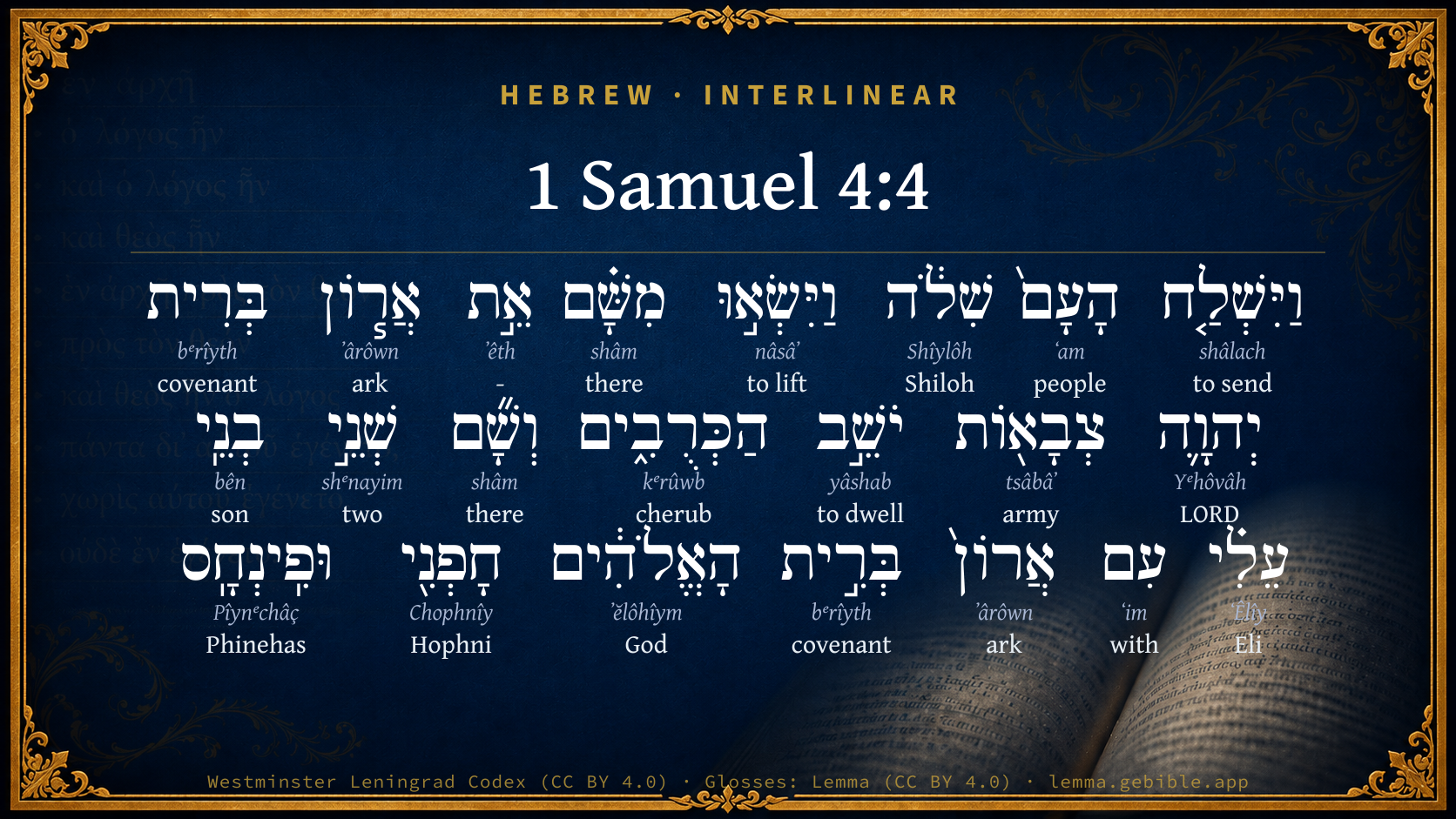
1 Samuel 4:4

Hebrew (Westminster Leningrad Codex) 1 Samuel 4:4 appears in the Hebrew Old Testament. The text above is from the Westminster Leningrad Codex. Each word links to its Strong’s number, a concise gloss, and parsing drawn from the Open Scriptures Hebrew Bible morphology. Click any word for its full Brown-Driver-Briggs (BDB) entry.
Download image
Cite this verse

1 Samuel 4:4 (World English Bible). Public Domain. Lemma interlinear Bible study tool, https://lemma.gebible.app/v/1-samuel/4/4.

Show BibTeX & RIS
BibTeX
RIS
English Translation
So the people sent to Shiloh; and they brought from there the ark of the covenant of Yahweh of Hosts, who sits [above] the cherubim: and the two sons of Eli, Hophni and Phinehas, were there with the ark of the covenant of God.
World English Bible · Public Domain
Download a study sheet

One document with this verse’s original text, its word-by-word gloss line, the meaning frame, cross-references with their text, attributed commentary, and full source and license credits — printable, and it pastes into notes with its structure intact.

This verse Autodidact and up

Study sheet (.html) Plain text (.txt)

A passage Seminary Student

Up to 50 verses in one chapter. A passage sheet keeps up to 6 commentary sources and 12 cross-references per verse, in the order this page ranks them, and says so on the sheet whenever that leaves anything out. Ask for a single verse and you get the Autodidact verse sheet above.

Everything on this page stays free to read, with no account — the sheet is a download of what is already on screen, not access to it.

Want to remove ads? Support Godless Engineer
Compare translations 3

The same verse in 3 English versions, stacked beneath the original-language interlinear above. Click any original word for its lexicon entry.

Each is an independent rendering of the whole verse — the interlinear is not word-aligned to these translations.

Highlighted words mark where these versions differ — a whole-verse word diff, not a word-by-word alignment.

  • World English Bible Public Domain
    So the people sent to Shiloh; and they brought from there the ark of the covenant of Yahweh of Hosts, who sits [above] the cherubim: and the two sons of Eli, Hophni and Phinehas, were there with the ark of the covenant of God.
  • King James Version Public Domain
    So the people sent to Shiloh, that they might bring from thence the ark of the covenant of the LORD of hosts, which dwelleth between the cherubim: and the two sons of Eli, Hophni and Phinehas, were there with the ark of the covenant of God.
  • unfoldingWord Literal Text CC BY-SA 4.0
    So the people sent to Shiloh, and they carried from there the Box of the Covenant of Yahweh of Armies, sitter on the cherubim. And the two sons of Eli, Hophni and Phinehas, there with the Box of the Covenant of God.

unfoldingWord Literal Text — © unfoldingWord, licensed CC BY-SA 4.0. Word-aligned USFM3 via Door43 (git.door43.org/unfoldingWord/en_ult).

Versions to compare (up to 4)

3 of 4 selected

Show all 18 translations

Every available English version of this verse, each an independent rendering of the whole verse.

  • World English Bible Public Domain
    So the people sent to Shiloh; and they brought from there the ark of the covenant of Yahweh of Hosts, who sits [above] the cherubim: and the two sons of Eli, Hophni and Phinehas, were there with the ark of the covenant of God.
  • Berean Standard Bible Public Domain
    So the people sent men to Shiloh, and they brought back the ark of the covenant of the LORD of Hosts, who sits enthroned between the cherubim. And the two sons of Eli, Hophni and Phinehas, were there with the ark of the covenant of God.
  • Majority Standard Bible Public Domain
    So the people sent men to Shiloh, and they brought back the ark of the covenant of the LORD of Hosts, who sits enthroned between the cherubim. And the two sons of Eli, Hophni and Phinehas, were there with the ark of the covenant of God.
  • King James Version Public Domain
    So the people sent to Shiloh, that they might bring from thence the ark of the covenant of the LORD of hosts, which dwelleth between the cherubim: and the two sons of Eli, Hophni and Phinehas, were there with the ark of the covenant of God.
  • American Standard Version (1901) Public Domain
    So the people sent to Shiloh; and they brought from thence the ark of the covenant of Jehovah of hosts, who sitteth `above' the cherubim: and the two sons of Eli, Hophni and Phinehas, were there with the ark of the covenant of God.
  • Revised Version (1885) Public Domain
    So the people sent to Shiloh, and they brought from thence the ark of the covenant of the LORD of hosts, which sitteth upon the cherubim: and the two sons of Eli, Hophni and Phinehas, were there with the ark of the covenant of God.
  • Geneva Bible (1599) Public Domain
    Then the people sent to Shiloh, and brought from thence the Arke of the couenant of the Lord of hostes, who dwelleth betweene the Cherubims: and there were the two sonnes of Eli, Hophni, and Phinehas, with the Arke of the couenant of God.
  • Douay-Rheims (1899) Public Domain
    So the people sent to Silo, and they brought from thence the ark of the covenant of the Lord of hosts sitting upon the cherubims: and the two sons of Heli, Ophni and Phinees, were with the ark of the covenant of God.
  • Young's Literal Translation Public Domain
    And the people sendeth to Shiloh, and they take up thence the ark of the covenant of Jehovah of Hosts, inhabiting the cherubs, and there `are' two sons of Eli, with the ark of the covenant of God, Hophni and Phinehas.
  • Literal Standard Version CC BY-SA 4.0
    And the people send to Shiloh, and they take from there the Ark of the Covenant of YHWH of Hosts, inhabiting the cherubim, and there [are] two sons of Eli with the Ark of the Covenant of God, Hophni and Phinehas.
  • Unlocked Literal Bible CC BY-SA 4.0
    So the people sent men to Shiloh; from there they carried the ark of the covenant of Yahweh of hosts, who sits above the cherubim. The two sons of Eli, Hophni and Phinehas, were there with the ark of the covenant of God.
  • unfoldingWord Literal Text CC BY-SA 4.0
    So the people sent to Shiloh, and they carried from there the Box of the Covenant of Yahweh of Armies, sitter on the cherubim. And the two sons of Eli, Hophni and Phinehas, there with the Box of the Covenant of God.
  • Darby Bible Public Domain
    So the people sent to Shiloh, and they brought from thence the ark of the covenant of Jehovah of hosts, who sitteth between the cherubim; and the two sons of Eli, Hophni and Phinehas, were there by the ark of the covenant of God.
  • World Messianic Bible Public Domain
    So the people sent to Shiloh, and they brought from there the ark of the covenant of the LORD of Hosts, who sits above the cherubim; and the two sons of Eli, Hophni and Phinehas, were there with the ark of the covenant of God.
  • Webster's Bible Public Domain
    So the people sent to Shiloh, that they might bring from thence the ark of the covenant of the LORD of hosts, who dwelleth between the cherubim: and the two sons of Eli, Hophni and Phinehas, were there with the ark of the covenant of God.
  • Free Bible Version CC BY-SA 4.0
    So the army sent men to Shiloh, and they brought back the Ark of the Lord Almighty's Agreement, he who sits on his throne between the cherubim. Hophni and Phinehas, the two sons of Eli, were there with the Ark of the God's Agreement.
  • Bible in Basic English Public Domain
    So the people sent to Shiloh and got the ark of the agreement of the Lord of armies whose resting-place is between the winged ones; and Hophni and Phinehas, the two sons of Eli, were there with the ark of God's agreement.
  • JPS Tanakh (1917) Public Domain
    So the people sent to Shiloh, and they brought from thence the ark of the covenant of the LORD of hosts, who sitteth upon the cherubim; and the two sons of Eli, Hophni and Phinehas, were there with the ark of the covenant of God.

Literal Standard Version (2020), Covenant Press — licensed CC BY-SA 4.0. Text via the HelloAO Bible API (eBible.org). Unlocked Literal Bible (unfoldingWord) — licensed CC BY-SA 4.0. Text via the HelloAO Bible API (eBible.org). unfoldingWord Literal Text — © unfoldingWord, licensed CC BY-SA 4.0. Word-aligned USFM3 via Door43 (git.door43.org/unfoldingWord/en_ult). Free Bible Version, Dr. Jonathan Gallagher — licensed CC BY-SA 4.0. Text via the HelloAO Bible API (eBible.org).

Word by word

More ways to search: Search by grammar → Find every occurrence → Compare this word →

Practice this passage: Drill this verse → Learn its vocabulary →

חָפְנִ֖י
Chophnîy
H2652
“Hophni”
Noun, Proper
Part of Speech
Noun
Type
Proper
Full BDB Definition

Origin: from H2651

TWOT: None

Hophni = "pugilist" - one of the two sons of Eli who were priests at Shiloh and were noted for their brutality and lust; their sinfulness provoked a curse against their father's house and were judged by the Lord when they took the ark into battle; the ark was lost and both brothers were killed and Eli died when he heard the news
  1. וַיִּשְׁלַ֤ח shâlach H7971 “and · to send” Conjunction + Verb, Qal, Sequential Imperfect, 3rd Person, Masculine, Singular
  2. הָעָם֙ ʻam H5971 “the · people” Particle, Definite Article + Noun, Common, Masculine, Singular, Absolute
  3. שִׁלֹ֔ה Shîylôh H7887 “Shiloh” Noun, Proper
  4. וַיִּשְׂא֣וּ nâsâʼ H5375 “and · to lift” Conjunction + Verb, Qal, Sequential Imperfect, 3rd Person, Masculine, Plural
  5. מִשָּׁ֗ם shâm H8033 “from · there” Preposition + Adverb
  6. אֵ֣ת ʼêth H853 “-” Particle, Direct Object
  7. אֲר֧וֹן ʼârôwn H727 “ark of” Noun, Common, Both, Singular, Construct
  8. בְּרִית bᵉrîyth H1285 “covenant of” Noun, Common, Feminine, Singular, Construct
  9. יְהוָ֛ה Yᵉhôvâh H3068 “LORD” Noun, Proper
  10. צְבָא֖וֹת tsâbâʼ H6635 “armies” Noun, Common, Both, Plural, Absolute
  11. יֹשֵׁ֣ב yâshab H3427 “dwelling” Verb, Qal, Participle Active, Masculine, Singular, Construct
  12. הַכְּרֻבִ֑ים kᵉrûwb H3742 “the · cherubim” Particle, Definite Article + Noun, Common, Masculine, Plural, Absolute
  13. וְשָׁ֞ם shâm H8033 “and · there” Conjunction + Adverb
  14. שְׁנֵ֣י shᵉnayim H8147 “two” Adjective, Cardinal number, Masculine, Dual, Construct
  15. בְנֵֽי bên H1121 “sons of” Noun, Common, Masculine, Plural, Construct
  16. עֵלִ֗י ʻÊlîy H5941 “Eli” Noun, Proper
  17. עִם ʻim H5973 “with” Preposition
  18. אֲרוֹן֙ ʼârôwn H727 “ark of” Noun, Common, Both, Singular, Construct
  19. בְּרִ֣ית bᵉrîyth H1285 “covenant of” Noun, Common, Feminine, Singular, Construct
  20. הָאֱלֹהִ֔ים ʼĕlôhîym H430 “the · God(s)” Particle, Definite Article + Noun, Common, Masculine, Plural, Absolute
  21. וּפִֽינְחָֽס Pîynᵉchâç H6372 “and · Phinehas” Conjunction + Noun, Proper

About this verse

These counts appear in no published source. They are computed here, from the morphology-tagged text and Lemma’s own curated glosses. What Lemma adds →

22
words
19
distinct lemmas
Historical
section

Notable vocabulary

The rarest word here is חָפְנִ֖י Hophni H2652 — appearing just 5 times in the whole Hebrew Bible.

Shared distinctive vocabulary

חָפְנִ֖י Hophni H2652 occurs in 5 verses of the Hebrew Bible. Also found in:

Grammatical profile

  • 3 verbs
  • 14 nouns
  • 1 adjective
  • 1 preposition
  • 2 adverbs
  • 1 particle

Verb forms

  • וַיִּשְׁלַ֤ח Qal · Sequential Imperfect
  • וַיִּשְׂא֣וּ Qal · Sequential Imperfect
  • יֹשֵׁ֣ב Qal · Participle Active

Repetition

Words recur within this verse — often emphatic in Hebrew:

  • מִשָּׁ֗ם there H8033 ×2
  • אֲר֧וֹן ark H727 ×2
  • בְּרִית covenant H1285 ×2

Hebrew & Septuagint length

In English translation the verse runs 44 words from the Hebrew and 33 from the Septuagint (LXX English) — closely comparable.

A rough comparison of the two English renderings, which tokenize alike — not a word-level alignment.

Word counts can differ between the Hebrew and the Greek without any difference in meaning — e.g. the Hebrew direct-object marker אֵת has no separate Greek word, and Greek often adds the article ὁ.

In the original languages it is 22 Hebrew tokens and 25 Greek tokens — but the two are counted differently (Hebrew bundles its prefixes and suffixes into one token; the Greek is in lemma form), so that isn’t a like-for-like length.

Cross-references

13

Topical passages linked to 1 Samuel 4:4 in the Treasury of Scripture Knowledge — connected by theme and wording, ordered by reader-vote popularity; previews shown in the World English Bible.

  • 2 Samuel 6:2 David arose, and went with all the people who were with him, from Baale Judah, to bring up from there the ark of God, which is called by the Name, even the name of Yahweh of Hosts who sits [above] the cherubim.
  • Numbers 7:89 When Moses went into the Tent of Meeting to speak with Yahweh, he heard his voice speaking to him from above the mercy seat that was on the ark of the Testimony, from between the two cherubim: and he spoke to him.
  • Psalms 80:1 Hear us, Shepherd of Israel, You who lead Joseph like a flock, You who sit above the cherubim, shine forth.
  • Psalms 99:1 Yahweh reigns! Let the peoples tremble. He sits enthroned among the cherubim. Let the earth be moved.
  • 2 Kings 19:15 Hezekiah prayed before Yahweh, and said, Yahweh, the God of Israel, who sit [above] the cherubim, you are the God, even you alone, of all the kingdoms of the earth; you have made heaven and earth.
  • Exodus 25:18–22 You shall make two cherubim of hammered gold. You shall make them at the two ends of the mercy seat.
  • Numbers 4:5 When the camp moves forward, Aaron shall go in, and his sons, and they shall take down the veil of the screen, and cover the ark of the Testimony with it,
  • Numbers 4:15 "When Aaron and his sons have finished covering the sanctuary, and all the furniture of the sanctuary, as the camp moves forward; after that, the sons of Kohath shall come to carry it: but they shall not touch the sanctuary, lest they die. These things are the burden of the sons of Kohath in the Tent of Meeting.
  • 1 Samuel 2:12–17 Now the sons of Eli were base men; they didn't know Yahweh.
  • 1 Samuel 2:22 Now Eli was very old; and he heard all that his sons did to all Israel, and how that they lay with the women who served at the door of the tent of meeting.
  • Psalms 50:16–17 But to the wicked God says, "What right do you have to declare my statutes, That you have taken my covenant on your lips,
  • Malachi 1:9 "Now, please entreat the favor of God, that he may be gracious to us. With this, will he accept any of you?" says Yahweh of Hosts.
  • Acts 19:15–16 The evil spirit answered, "Jesus I know, and Paul I know, but who are you?"

Cross-references courtesy of OpenBible.info (CC BY 4.0).

Hebrew and Greek witnesses Masoretic Hebrew ↔ Greek Septuagint

The same verse in the two great witnesses to the Old Testament, shown verse-for-verse.

These are two independent witnesses, not word-aligned to each other, and the Septuagint is shown in lemma (dictionary) form.

Hebrew 1 Samuel 4:4 Masoretic · Westminster Leningrad Codex

וַיִּשְׁלַ֤ח הָעָם֙ שִׁלֹ֔ה וַיִּשְׂא֣וּ מִשָּׁ֗ם אֵ֣ת אֲר֧וֹן בְּרִית יְהוָ֛ה צְבָא֖וֹת יֹשֵׁ֣ב הַכְּרֻבִ֑ים וְשָׁ֞ם שְׁנֵ֣י בְנֵֽי עֵלִ֗י עִם אֲרוֹן֙ בְּרִ֣ית הָאֱלֹהִ֔ים חָפְנִ֖י וּפִֽינְחָֽס

So the people sent to Shiloh; and they brought from there the ark of the covenant of Yahweh of Hosts, who sits [above] the cherubim: and the two sons of Eli, Hophni and Phinehas, were there with the ark of the covenant of God.

World English Bible · Public Domain

Greek LXX 1 Samuel 4:4 Septuagint · lemma form

καί ἀποστέλλω ὁ λαός εἰς σηλωμ καί αἴρω ἐκεῖθεν ὁ κιβωτός κύριος καταἧμαι χερουβιμ καί ἀμφότεροι ὁ υἱός ηλι μετά ὁ κιβωτός οφνι καί φινεες

And the people sent to Selom, and they take thence the ark of the Lord who dwells between the cherubs: and both the sons of Heli, Ophni and Phinees, were with the ark.

LXX2012 (modern English Septuagint) · Public Domain

Hebrew: Westminster Leningrad Codex (CC BY 4.0). Greek: Septuagint (public domain); English from LXX2012 (modern English Septuagint) (Public Domain). How the Septuagint differs from the Hebrew →

Targum (Aramaic paraphrase)

1

The Targum is the ancient Jewish Aramaic paraphrase of the Hebrew Scriptures — an interpretive translation, not the Hebrew text itself. Onkelos (literal) and Pseudo-Jonathan (expansive) render the Torah, and Jonathan the Prophets. Coverage is partial: where no permissively-licensed English translation exists for a verse, only the Aramaic is shown. This is verse-level text, not a word-by-word alignment to the Hebrew.

  1. Targum Jonathan Prophets (Joshua–Malachi)
    וּשְׁלַח עַמָא לְשִׁילֹה וּנְטָלוּ מִתַּמָן יַת אֲרוֹן קְיָמָא דַייָ צְבָאוֹת דִשְׁכִינְתֵּהּ שַׁרְיָא עֵיל מִן כְּרוּבַיָא וְתַמָן תְּרֵין בְּנֵי עֵלִי עִם אֲרוֹן קְיָמָא דַייָ חָפְנִי וּפִינְחָס:

    (no public-domain English translation for this verse)

    Targum Jonathan — Aramaic: “Mikraot Gedolot” (public domain). English: “Sefaria Community Translation” (CC0 1.0 (public-domain dedication)); “London "Chaldee Paraphrase," 1871” (public domain). Text via Sefaria.

Commentary

Notes on 1 Samuel 4:4 from classic Christian and Jewish commentators (each source and its license shown beneath its notes). The classic Christian expositions comment on the surrounding passage and are grouped to its opening verse, so a note may address several verses; the Jewish commentaries on the Tanakh (Rashi and others) are per-verse, so they appear only where the commentator wrote on this verse.

Lemma curates 59 commentaries, every one of them public domain or Creative Commons licensed, each selected and text-cleaned for this edition rather than reprinted as found. About our sources →

Trapp's Complete Commentary

John Trapp

1Sa 4:4 So the people sent to Shiloh, that they might bring from thence the ark of the covenant of the LORD of hosts, which dwelleth [between] the cherubims: and the two sons of Eli, Hophni and Phinehas, [were] there with the ark of the covenant of God.

Ver. 4. So the people sent to Shiloh.] This they did presumptuously and profanely, of their own head, not consulting with God, or waiting for his warrant: for they said, "We are lords," and they acted as if they had been petty gods within themselves, &c. When the beginning is carnal confidence, the end is usually shame of any business, even of this life.

And the two sons of Eli, Hophni and Phinehas, were there with the ark.] Josephus addeth, that their father Eli charged them to live and die with it; and if it were lost, never to look him in the face more. H ταν η επι ταν, said she to her son, when she gave him his shield: Either bring it back from the battle, or be thou brought back dead upon it. Let us resolve either to live with the gospel, or to die for it.

John Trapp, A Commentary or Exposition upon All the Books of the Old and New Testament (1647–1656) — public domain. Text from a community e-Sword module.

The Biblical Illustrator

Joseph S. Exell

1Sa_4:4

So the people sent to Shiloh.

Shiloh and its lessons

This subject forms an impressive chapter in the history of Israel. Eli was now the theocratic judge of the Hebrew commonwealth, and its administration centered round Shiloh, where he dwelt and the ark was kept, and its statutes observed. Let us glance at the steps which led to disaster.

1. Family discipline neglected. It is often the case, as true today as then, that men are so busy with money making or important trusts, as to be almost strangers to their own households and ignorant of the habits of their children.

2. Disobedient children. They were careless of religion, but careful of tithes. They helped themselves to as much of the sacrifices as they wanted, whether the offerer would or no; and as a result men abhorred the offerings of the Lord. Family discipline is too great when children are full grown and their habits strong.

3. Religion slighted. A nation suffers more from the sins of its rulers and priests than from the sins of an equal number of private men who are simply hewers of wood and carriers of water. The sins of the former are fashionable; those of the latter are vulgar and contemptible.

4. Vain confidence. And all Israel shouted with a great shout, so that the earth rang again. But courage is not of the sword and spear and shibboleth, of bow and banner and boasting, neither of the giant frame and muscle; it is of the heart and spirit. It is the unconquerable will, and the heart conscious of right, prodigal of life for its defence, that makes one man able to chase a thousand, and two to put ten thousand to flight.

5. National calamity. It is not religiosity that saves, but spirituality.

6. Providence. Mans extremity is Gods opportunity. God will take care of His ark as well as of His people. (Homiletic Review.)

The Biblical Illustrator, edited by Joseph S. Exell (c. 1880s–1900s) — public domain. Text from a community e-Sword module.

Tyndale Open Study Notes

Tyndale Open Resources

4:4 Lord of Heaven’s Armies: See study note on 1:3. • enthroned between the cherubim: A representation of God’s glorious presence hovered over the Ark in the Most Holy Place (God’s “throne room”). • The involvement of Eli’s sons, Hophni and Phinehas, foreshadows the disaster that ensued (see 3:11-14).

Tyndale Open Study Notes — © Tyndale Open Resources, licensed CC BY-SA 4.0. Text via the HelloAO Bible API.

Geneva Bible (1599)

Geneva Bible translators

For he used to appear to the Israelites between the cherubim over the Ark of the covenant, Exod. 25:17.

Geneva Bible (1599) marginal notes — public domain. Text via Bolls.life.

Adam Clarke's Commentary

Verse 4. The Lord of hosts] See on 1Sa 1:3.

Dwelleth between the cherubims] Of what shape the cherubim were, we know not; but there was one of these representative figures placed at each end of the ark of the covenant; and between them, on the lid or cover of that ark, which was called the propitiatory or mercy-seat, the shechinah, or symbol of the Divine presence, was said to dwell. They thought, therefore, if they had the ark, they must necessarily have the presence and influence of Jehovah.

Adam Clarke's Commentary on the Bible (1810–1826) — public domain. Text from a community e-Sword/MySword module.

Ellicott's Commentary for English Readers

(4) So the people sent to Shiloh.—There was, no doubt, in the minds of the elders, the memory of many a glorious victory gained in the old heroic days of Moses and Joshua in the presence of their sacred Ark; but then God was with His people, and the sacred Ark of the Covenant served as a reminder of His ever-presence with them; now they had been disloyal to their unseen King, His very sanctuary had become infamous as the centre of vice, and His ministers were chiefly known as the prominent examples of covetousness and immorality, and the Ark had become only a symbol of the broken covenant.

It was in vain that the grand battle hymn of Israel was raised as in the old days when the Ark set forward: “Rise up, Lord, and let Thine enemies be scattered, and let them that hate Thee flee before Thee” (Num_10:35).

Were there with the ark.—This Note respecting the guardians of the Ark is sufficient to account for the terrible discomfiture of Israel. The conduct and general life and example of their priestly leaders have already been indicated. What a contrast the writer of the Book bitterly puts down in his memoirs here—the glorious but now deserted earthly throne of God, and its guardians, the wicked, abandoned priests!

A Bible Commentary for English Readers, edited by Charles John Ellicott (1878–1897) — public domain. Text from a community e-Sword module.

The Cambridge Bible for Schools and Colleges

gen. ed. J. J. S. Perowne

4. that they might bring] Rather, and brought.

the ark of the covenant of the Lord of hosts, which dwelleth between the cherubims] Or, who sitteth enthroned upon the cherubim. The full title is chosen to describe the Ark (a) as the symbol of the covenant between Jehovah and Israel, in virtue of which they expected his help unconditionally; (b) as the seat of the presence of the Lord of Hosts, which they thought would infallibly accompany it, and ensure victory to the armies of Israel. Cp. note on 1Sa_4:21.

the two sons of Eli … were there with the ark] It seems best to follow the Sept. and Vulg. in omitting the word ‘there.’ The narrative requires the statement that Hophni and Phinehas accompanied the Ark, not merely that they were at Shiloh, which we know already.

rang again] Cp. 1Ki_1:45.

The Cambridge Bible for Schools and Colleges (gen. ed. J. J. S. Perowne; Cambridge University Press, 1878–1918) — public domain. Text from a community e-Sword module.

John Gill's Exposition

So the people sent to Shiloh,.... They liked the proposal of the elders, took their advice, and joined with them in a message to Eli the high priest at Shiloh:

that they might bring from thence the ark of the covenant of the Lord of hosts, which dwelleth between the cherubim; which overshadowed the mercy seat that was upon the ark, and was the residence of the divine Majesty; wherefore having this with them, they concluded they should have the presence of God with them, and so success, see Psa 53:1.

and the two sons of Eli, Hophni and Phinehas, were there with the ark of the covenant of God; these, either with or without the leave of Eli, took the ark out of the tabernacle, and carried it on their shoulders to the camp, or however attended it there, being borne by other priests or Levites; and by this means they were brought into the camp, and so to battle, to meet their doom there; according to Bunting (d), it was carried by them forty two miles.

(d) Travels of the Patriarchs, &c. p. 123.

John Gill's Exposition of the Whole Bible (1746–1763) — public domain (CC PDM 1.0). Text via the HelloAO Bible API.

Albert Barnes' Notes on the Bible

The people sent - The expression is very indicative of the political state so frequently noted by the writer of the Book of Judges, “In those days there was no king in Israel.”

Albert Barnes' Notes on the Bible (1834–1885) — public domain. Text from a community e-Sword/MySword module.

Haydock's Catholic Bible Commentary

Ark. On this extraordinary emergency they thought it lawful. (Abulensis, q. 6.) --- They easily obtained the consent of Heli; and his sons went to take it down, and to attend it to the army, as he was incapable of doing duty. We know not what ceremonies were used, nor whether the brothers acted as high priests alternately. (Calmet) --- Cherubim. The Scripture often represents God in this manner, Exodus xxv. 22., Psalm xvii. 10., and Ezechiel x. 1. The commonality of the Jews attributed bodies to the angels, but to denote that they were not like those with which we are acquainted, they called them cherubim, or complex and unusual figures. (Calmet)

George Leo Haydock (1774–1849), Haydock's Catholic Family Bible and Commentary, 1859 edition — public domain. Excludes Psalms (Douay-Rheims chapter numbering differs from Protestant) and Deuterocanonical books (Catholic canon only).

Matthew Poole's English Annotations

That they might bring from thence the ark; which it may seem they should not have done without asking counsel of God, which they might easily have done by Samuel.

Hophni and Phinehas were there; either, first, in the camp; or rather, secondly, in Shiloh.

With the ark; attending upon it, instead of their aged father.

Matthew Poole's English Annotations on the Holy Bible (1683–1685) — public domain. Text from a community e-Sword/MySword module.

Whedon's Commentary on the Bible

Daniel D. Whedon

4. Between the cherubim — The word cherubim is plural, and needs not the final s, as some Bibles have. For the allusion, see Exo_25:22.

Daniel D. Whedon (gen. ed.), Commentary on the Old and New Testaments (1874–1909) — public domain. Text from a community e-Sword module.

The Pulpit Commentary

Which dwelleth between the cherubims. Literally, "which sitteth, i.e. is enthroned, upon the cherubim." The idea is not that of Jehovah"s habitation, but of his seat in state as Israel"s King. In bringing the ark they brought to the camp the throne of Jehovah, as their theocratic Ruler; but the two sons of Eli, Hophni and Phinehas, were there with the ark, representing the immorality of the nation, whose very priests were abandoned men. We are not to suppose that there was any fault in the manner of bringing, because it is said that the people sent that they might bring the ark from Shiloh. Levites may have carried it, and priests with the Urim and Thummim have had the charge of every detail. But there was the ill-omened conjuncture of personal immorality with superstitious reverence for mere material symbols, and thereby the presence of the ark only insured, in the moral government of God, Israel"s defeat.

The Pulpit Commentary (1880–1919), ed. H.D.M. Spence-Jones & Joseph S. Exell — public domain. Text from a community e-Sword module.

John Wesley's Explanatory Notes

Bring the ark - This they should not have done without asking counsel of God.

John Wesley, Explanatory Notes Upon the Whole Bible (1754–1765) — public domain. Text via the GEBible commentary corpus.

Lesson kit

Teaching starters — assembled from the data on this page, not authored interpretation. Every prompt links to the verse data it draws on. Edit before teaching.

1 Samuel, in the Historical, opens this verse with 22 words (19 distinct Hebrew lemmas). Its most distinctive word is Chophnîy (“Hophni”). A historical commentator’s framing appears above. Read the whole chapter for the surrounding context.

Discussion questions

  1. How does “Hophni” (Chophnîy) shape what this verse is saying?
  2. 1 Samuel 1:3 shares the word «Hophni» with this verse. How do the two illuminate each other?
  3. “there” occurs 2× in this one verse. What is the effect of the repetition?
  4. The translations on this page render this verse differently — a whole-verse word diff, not a word-by-word alignment. What might account for the different wordings?
  5. The verb «וַיִּשְׁלַ֤ח» is Qal Sequential Imperfect. How does its form color the action?
  6. Reading how Trapp's Complete Commentary and The Biblical Illustrator read this verse, where do the two commentators agree and where do they part?

Things to notice

Reading settings

Reading text

Shown beneath each verse's original-language words.

Old Testament
Old Testament edition

Read the OT as the Masoretic Hebrew (MT) or the Greek Septuagint (LXX).

English shown for the Greek Septuagint (in the Hebrew ↔ Greek comparison).

Comparing translations? Open the Compare panel on any verse page to stack up to four side by side.