1 Samuel 15:2

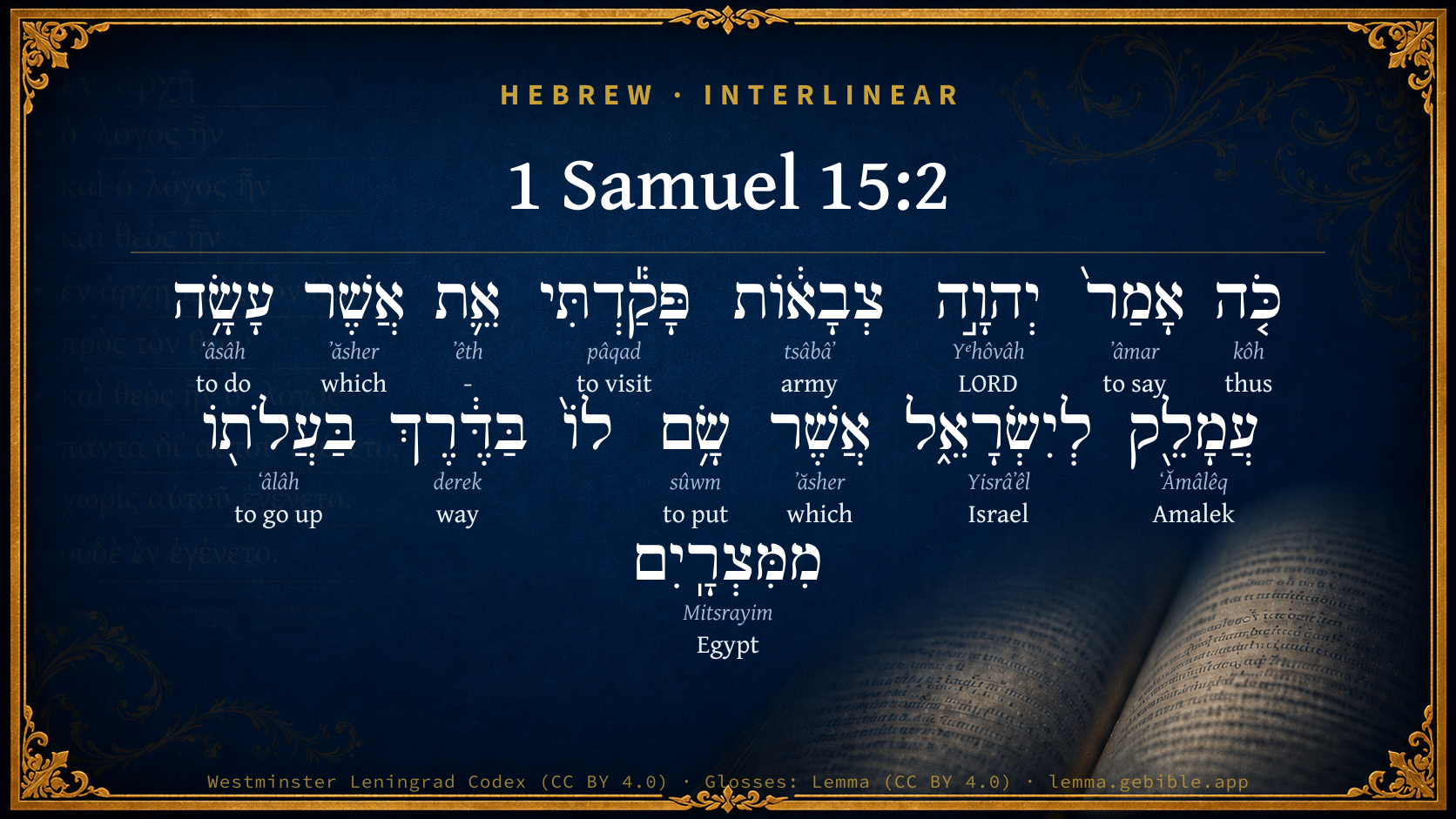
Hebrew (Westminster Leningrad Codex) 1 Samuel 15:2 appears in the Hebrew Old Testament. The text above is from the Westminster Leningrad Codex. Each word links to its Strong’s number, a concise gloss, and parsing drawn from the Open Scriptures Hebrew Bible morphology. Click any word for its full Brown-Driver-Briggs (BDB) entry.
Download image
Cite this verse

1 Samuel 15:2 (World English Bible). Public Domain. Lemma interlinear Bible study tool, https://lemma.gebible.app/v/1-samuel/15/2.

Show BibTeX & RIS
BibTeX
RIS
English Translation
Thus says Yahweh of Hosts, I have marked that which Amalek did to Israel, how he set himself against him in the way, when he came up out of Egypt.
World English Bible · Public Domain
Download a study sheet

One document with this verse’s original text, its word-by-word gloss line, the meaning frame, cross-references with their text, attributed commentary, and full source and license credits — printable, and it pastes into notes with its structure intact.

This verse Autodidact and up

Study sheet (.html) Plain text (.txt)

A passage Seminary Student

Up to 50 verses in one chapter. A passage sheet keeps up to 6 commentary sources and 12 cross-references per verse, in the order this page ranks them, and says so on the sheet whenever that leaves anything out. Ask for a single verse and you get the Autodidact verse sheet above.

Everything on this page stays free to read, with no account — the sheet is a download of what is already on screen, not access to it.

Want to remove ads? Support Godless Engineer
Compare translations 3

The same verse in 3 English versions, stacked beneath the original-language interlinear above. Click any original word for its lexicon entry.

Each is an independent rendering of the whole verse — the interlinear is not word-aligned to these translations.

Highlighted words mark where these versions differ — a whole-verse word diff, not a word-by-word alignment.

  • World English Bible Public Domain
    Thus says Yahweh of Hosts, I have marked that which Amalek did to Israel, how he set himself against him in the way, when he came up out of Egypt.
  • King James Version Public Domain
    Thus saith the LORD of hosts, I remember that which Amalek did to Israel, how he laid wait for him in the way, when he came up from Egypt.
  • unfoldingWord Literal Text CC BY-SA 4.0
    Thus says Yahweh of Armies, ‘I observed what Amalek did to Israel when he set against him in the way in his coming up from Egypt.

unfoldingWord Literal Text — © unfoldingWord, licensed CC BY-SA 4.0. Word-aligned USFM3 via Door43 (git.door43.org/unfoldingWord/en_ult).

Versions to compare (up to 4)

3 of 4 selected

Show all 18 translations

Every available English version of this verse, each an independent rendering of the whole verse.

  • World English Bible Public Domain
    Thus says Yahweh of Hosts, I have marked that which Amalek did to Israel, how he set himself against him in the way, when he came up out of Egypt.
  • Berean Standard Bible Public Domain
    This is what the LORD of Hosts says: ‘I witnessed what the Amalekites did to the Israelites when they ambushed them on their way up from Egypt.
  • Majority Standard Bible Public Domain
    This is what the LORD of Hosts says: ‘I witnessed what the Amalekites did to the Israelites when they opposed them on their way up from Egypt.
  • King James Version Public Domain
    Thus saith the LORD of hosts, I remember that which Amalek did to Israel, how he laid wait for him in the way, when he came up from Egypt.
  • American Standard Version (1901) Public Domain
    Thus saith Jehovah of hosts, I have marked that which Amalek did to Israel, how he set himself against him in the way, when he came up out of Egypt.
  • Revised Version (1885) Public Domain
    Thus saith the LORD of hosts, I have marked that which Amalek did to Israel, how he set himself against him in the way, when he came up out of Egypt.
  • Geneva Bible (1599) Public Domain
    Thus saith the Lord of hostes, I remember what Amalek did to Israel, howe they laide waite for the in ye way, as they came vp from Egypt.
  • Douay-Rheims (1899) Public Domain
    Thus saith the Lord of hosts: I have reckoned up all that Amalec hath done to Israel: I how he opposed them in the way when they came up out of Egypt.
  • Young's Literal Translation Public Domain
    `Thus said Jehovah of Hosts, I have looked after that which Amalek did to Israel, that which he laid for him in the way in his going up out of Egypt.
  • Literal Standard Version CC BY-SA 4.0
    Thus said YHWH of Hosts: I have looked after that which Amalek did to Israel, that which he laid for him in the way in his going up out of Egypt.
  • Unlocked Literal Bible CC BY-SA 4.0
    This is what Yahweh of hosts says, 'I have noted what Amalek did to Israel in opposing them on the way, when they came up from Egypt.
  • unfoldingWord Literal Text CC BY-SA 4.0
    Thus says Yahweh of Armies, ‘I observed what Amalek did to Israel when he set against him in the way in his coming up from Egypt.
  • Darby Bible Public Domain
    Thus saith Jehovah of hosts: I have considered what Amalek did to Israel, how he set himself against him in the way, when he came up from Egypt.
  • World Messianic Bible Public Domain
    The LORD of Hosts says, ‘I remember what Amalek did to Israel, how he set himself against him on the way when he came up out of Egypt.
  • Webster's Bible Public Domain
    Thus saith the LORD of hosts, I remember that which Amalek did to Israel, how he laid wait for him in the way, when he came up from Egypt.
  • Free Bible Version CC BY-SA 4.0
    This is what the Lord Almighty says: I observed what the Amalekites did to Israel when they ambushed them on their way from Egypt.
  • Bible in Basic English Public Domain
    The Lord of armies says, I will give punishment to Amalek for what he did to Israel, fighting against him on the way when Israel came out of Egypt.
  • JPS Tanakh (1917) Public Domain
    Thus saith the LORD of hosts: I remember that which Amalek did to Israel, how he set himself against him in the way, when he came up out of Egypt.

Literal Standard Version (2020), Covenant Press — licensed CC BY-SA 4.0. Text via the HelloAO Bible API (eBible.org). Unlocked Literal Bible (unfoldingWord) — licensed CC BY-SA 4.0. Text via the HelloAO Bible API (eBible.org). unfoldingWord Literal Text — © unfoldingWord, licensed CC BY-SA 4.0. Word-aligned USFM3 via Door43 (git.door43.org/unfoldingWord/en_ult). Free Bible Version, Dr. Jonathan Gallagher — licensed CC BY-SA 4.0. Text via the HelloAO Bible API (eBible.org).

Word by word

More ways to search: Search by grammar → Find every occurrence → Compare this word →

Practice this passage: Drill this verse → Learn its vocabulary →

עֲמָלֵ֖ק
ʻĂmâlêq
H6002
“Amalek”
Noun, Proper
Part of Speech
Noun
Type
Proper
Full BDB Definition

Origin: probably of foreign origin

TWOT: None

Amalek = "dweller in a valley" - son of Eliphaz by his concubine Timnah, grandson of Esau, and progenitor of a tribe of people in southern Canaan - descendants of Amalek
  1. כֹּ֤ה kôh H3541 “thus” Adverb
  2. אָמַר֙ ʼâmar H559 “to say” Verb, Qal, Perfect, 3rd Person, Masculine, Singular
  3. יְהוָ֣ה Yᵉhôvâh H3068 “LORD” Noun, Proper
  4. צְבָא֔וֹת tsâbâʼ H6635 “armies” Noun, Common, Both, Plural, Absolute
  5. פָּקַ֕דְתִּי pâqad H6485 “to visit” Verb, Qal, Perfect, 1st Person, Common, Singular
  6. אֵ֛ת ʼêth H853 “-” Particle, Direct Object
  7. אֲשֶׁר ʼăsher H834 “which” Particle, Relative
  8. עָשָׂ֥ה ʻâsâh H6213 “to do” Verb, Qal, Perfect, 3rd Person, Masculine, Singular
  9. לְיִשְׂרָאֵ֑ל Yisrâʼêl H3478 “to/for · Israel” Preposition + Noun, Proper
  10. אֲשֶׁר ʼăsher H834 “which” Particle, Relative
  11. שָׂ֥ם sûwm H7760 “to put” Verb, Qal, Perfect, 3rd Person, Masculine, Singular
  12. בַּדֶּ֔רֶךְ derek H1870 “in/at the · way” Preposition, Determined + Noun, Common, Both, Singular, Absolute
  13. בַּעֲלֹת֖וֹ ʻâlâh H5927 “in/at · to go up · him” Preposition + Verb, Qal, Infinitive Construct + Suffix, Personal, 3rd Person, Masculine, Singular
  14. מִמִּצְרָֽיִם Mitsrayim H4714 “from · Egypt” Preposition + Noun, Proper

About this verse

These counts appear in no published source. They are computed here, from the morphology-tagged text and Lemma’s own curated glosses. What Lemma adds →

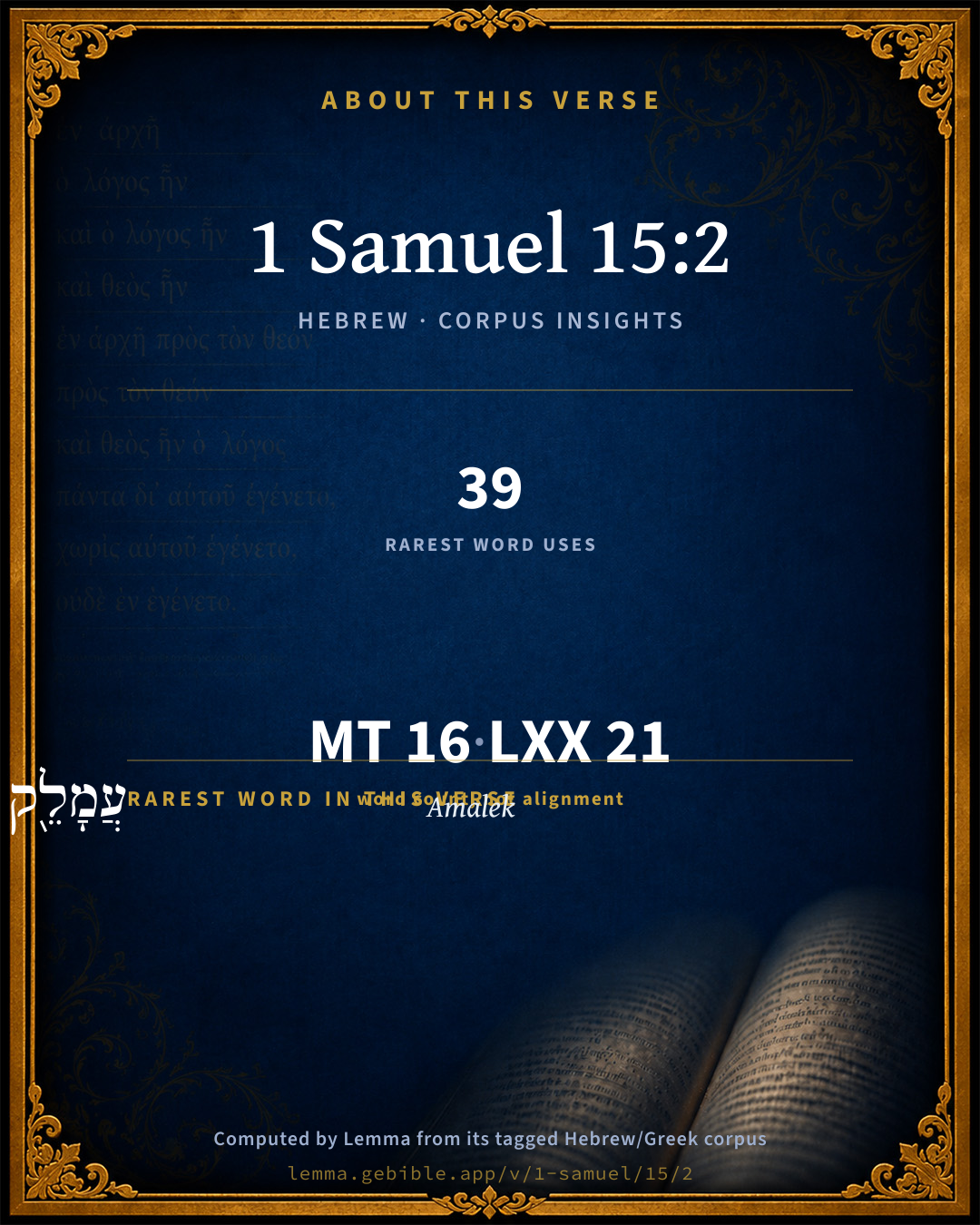
16
words
14
distinct lemmas
Historical
section

Shared distinctive vocabulary

עֲמָלֵ֖ק Amalek H6002 occurs in 37 verses of the Hebrew Bible. Also found in:

Grammatical profile

  • 5 verbs
  • 6 nouns
  • 1 preposition
  • 1 adverb
  • 3 particles

Verb forms

  • אָמַר֙ Qal · Perfect
  • פָּקַ֕דְתִּי Qal · Perfect
  • עָשָׂ֥ה Qal · Perfect
  • שָׂ֥ם Qal · Perfect
  • בַּעֲלֹת֖וֹ Qal · Infinitive Construct

Repetition

A word recurs within this verse — often emphatic in Hebrew:

  • אֲשֶׁר which H834 ×2

Hebrew & Septuagint length

In English translation the verse runs 30 words from the Hebrew and 31 from the Septuagint (LXX English) — closely comparable.

A rough comparison of the two English renderings, which tokenize alike — not a word-level alignment.

Word counts can differ between the Hebrew and the Greek without any difference in meaning — e.g. the Hebrew direct-object marker אֵת has no separate Greek word, and Greek often adds the article ὁ.

In the original languages it is 16 Hebrew tokens and 21 Greek tokens — but the two are counted differently (Hebrew bundles its prefixes and suffixes into one token; the Greek is in lemma form), so that isn’t a like-for-like length.

Cross-references

5

Topical passages linked to 1 Samuel 15:2 in the Treasury of Scripture Knowledge — connected by theme and wording, ordered by reader-vote popularity; previews shown in the World English Bible.

  • Deuteronomy 25:17–19 Remember what Amalek did to you by the way as you came forth out of Egypt;
  • Exodus 17:8–16 Then Amalek came and fought with Israel in Rephidim.
  • Numbers 24:20 He looked at Amalek, and took up his parable, and said, Amalek was the first of the nations; But his latter end shall come to destruction.
  • Hosea 7:2 They don't consider in their hearts that I remember all their wickedness. Now their own deeds have engulfed them. They are before my face.
  • Amos 8:7 Yahweh has sworn by the pride of Jacob, "Surely I will never forget any of their works.

Cross-references courtesy of OpenBible.info (CC BY 4.0).

Hebrew and Greek witnesses Masoretic Hebrew ↔ Greek Septuagint

The same verse in the two great witnesses to the Old Testament, shown verse-for-verse.

These are two independent witnesses, not word-aligned to each other, and the Septuagint is shown in lemma (dictionary) form.

Hebrew 1 Samuel 15:2 Masoretic · Westminster Leningrad Codex

כֹּ֤ה אָמַר֙ יְהוָ֣ה צְבָא֔וֹת פָּקַ֕דְתִּי אֵ֛ת אֲשֶׁר עָשָׂ֥ה עֲמָלֵ֖ק לְיִשְׂרָאֵ֑ל אֲשֶׁר שָׂ֥ם לוֹ֙ בַּדֶּ֔רֶךְ בַּעֲלֹת֖וֹ מִמִּצְרָֽיִם

Thus says Yahweh of Hosts, I have marked that which Amalek did to Israel, how he set himself against him in the way, when he came up out of Egypt.

World English Bible · Public Domain

Greek LXX 1 Samuel 15:2 Septuagint · lemma form

ὅδε εἶπον κύριος σαβαωθ νῦν ἐκδικέω ὅς ποιέω αμαληκ ὁ ἰσραήλ ὡς ἀποἀντάω αὐτός ἐν ὁ ὁδός ἀναβαίνω αὐτός ἐκ αἴγυπτος

Thus said the Lord of hosts, Now will I take vengeance for what Amalec did to Israel, when he met him in the way as he came up out of Egypt.

LXX2012 (modern English Septuagint) · Public Domain

Hebrew: Westminster Leningrad Codex (CC BY 4.0). Greek: Septuagint (public domain); English from LXX2012 (modern English Septuagint) (Public Domain). How the Septuagint differs from the Hebrew →

Targum (Aramaic paraphrase)

1

The Targum is the ancient Jewish Aramaic paraphrase of the Hebrew Scriptures — an interpretive translation, not the Hebrew text itself. Onkelos (literal) and Pseudo-Jonathan (expansive) render the Torah, and Jonathan the Prophets. Coverage is partial: where no permissively-licensed English translation exists for a verse, only the Aramaic is shown. This is verse-level text, not a word-by-word alignment to the Hebrew.

  1. Targum Jonathan Prophets (Joshua–Malachi)
    כִּדְנַן אֲמַר יְיָ צְבָאוֹת דְכִירְנָא יַת דַעֲבַד עֲמָלֵק לְיִשְׂרָאֵל דִכְמַן לֵיהּ בְּאוֹרְחָא בְּמִיסְקֵיהּ מִמִצְרָיִם:

    (no public-domain English translation for this verse)

    Targum Jonathan — Aramaic: “Mikraot Gedolot” (public domain). English: “Sefaria Community Translation” (CC0 1.0 (public-domain dedication)); “London "Chaldee Paraphrase," 1871” (public domain). Text via Sefaria.

Commentary

Notes on 1 Samuel 15:2 from classic Christian and Jewish commentators (each source and its license shown beneath its notes). The classic Christian expositions comment on the surrounding passage and are grouped to its opening verse, so a note may address several verses; the Jewish commentaries on the Tanakh (Rashi and others) are per-verse, so they appear only where the commentator wrote on this verse.

Lemma curates 59 commentaries, every one of them public domain or Creative Commons licensed, each selected and text-cleaned for this edition rather than reprinted as found. About our sources →

Trapp's Complete Commentary

John Trapp

1Sa 15:2 Thus saith the LORD of hosts, I remember [that] which Amalek did to Israel, how he laid [wait] for him in the way, when he came up from Egypt.

Ver. 2. Thus saith the Lord of hosts.] Who judgeth righteously, {Jer 11:20} and is able to save and to destroy.

I remember that which Amalek did to Israel.] Though it be four hundred years since, and I may seem to have forgotten it. It is ill angering the Ancient of Days; his forbearance is no quittance. Heb., I have reviewed.

How he laid wait for him in the way.] Smiting all the feeble and wearied: and so answering his name Amalek, which signifieth a licking people. {a}

{a} Populus Lingens.

John Trapp, A Commentary or Exposition upon All the Books of the Old and New Testament (1647–1656) — public domain. Text from a community e-Sword module.

The Biblical Illustrator

Joseph S. Exell

1Sa_15:2-3

Thus saith the Lord of Hosts, I remember that which Amalek did to Israel.

National sins and national punishments

We turn from Saul to the case of those against whom he was sent. Thus saith the Lord of hosts, I remember that which Amalek did to Israel, how he laid wait for him in the way, when he came up from Egypt. Then God does remember sin. He not only notices it, but remembers it. A lengthened period had transpired since the Amalekites had thus manifested their sympathy with the enemies of Israel, by throwing hindrances in the way of Gods chosen people as they came out of Egypt to Canaan. And, to all appearance, their sin might have been regarded as consigned to oblivion. But God had declared that it should not be forgotten. (Exo_17:14, Deu_25:17-19.) Upon the oblivion of four centuries there broke the awful tones of Almighty Justice: I remember that, which Amalek did From that Infinite Mind there had been no obliteration of the crime; clear as the day on which it had been committed, that sin stood out to view. I remember. Divine forbearance with generation after generation had been long, but upon them that forbearance had been lost, and it is evident they had not profited by it. They still remained the foes of Israel; their conduct as a nation was marked by excessive cruelty; and it was a horrible notoriety which their king had obtained for the multitudes of mothers whom, in his bloodthirstiness, his sword had rendered childless. In the determination on the part of God now to punish, the utterance of which was prefaced by those emphatic words, I remember, we are distinctly taught the lesson that the conduct of nations is a point to which the eye of God is directed, and that it is the matter for which His just penalty will be reserved. Whole nations come within the reach of His rod. By the individuals composing a community, and whose personal welfare or woe is necessarily identified with the condition of the community, there is a great danger that national sin should be regarded rather as an abstraction than as a reality, rather as an ideal than a substantial criminality. But it is not thus that God, in the incident before us, deals with it. He affixes it, as a substantive charge, upon the community. We have a rule here to which we find no exception. But nowhere does this rule meet with so fearful an exemplification as in the case of that very people whose guardian God showed Himself to be in this act of visiting Amaleks transgression--that very Israel on whose behalf He was now standing up to repel insult and to avenge injury. I remember--read it in those seventy years exile from the land which had been given for an inheritance--that long and dreary period, during which Zions history was thus announced in plaintive tones by the prophet, How doth the city sit solitary, that was full of people! how is she become as a widow! etc. I remember--read it in its reiterated and double-telling tones in that second destruction which succeeded a second opportunity given to the Hebrew people of a sound national repentance and reformation--that second opportunity which was lost when formalism was substituted for spiritual religion. Hark to the words of mingled compassion and judgment which fall from His lips as He stands over against the city and wasps, O Jerusalem, Jerusalem, thou that killest the prophets, etc. If national sin brings with it national calamity, then the lengthening out Of our prosperity must depend on the caution which is exercised, lest any sin should be permitted and indulged, until it shall become distinctive of our national character. Is there nothing among ourselves over which there floats, audible to the men who seek the best welfare of their country and deprecate its woe, the sound of that sentence, I remember? Are not its murmurs to be heard at this moment, amid political excitements and difficulties of administration? I remember the Sabbaths which are systematically broken by those who take their pleasure on my holy day. I remember the intemperance of those who rise up early in the morning that they may follow strong drink; that continue until night, till wine inflame them. I remember the want of truthfulness in the manner of conducting business, the unjust advantages taken of the buyer, the false representations made by the seller, although my word has declared that a false balance is abomination to the Lord, but a just weight is His delight. I remember the concealed iniquity of men who, with a fancied impunity, perpetrated the foulest crimes, reckless of every consideration but that of inconvenient exposure. Our patriotism, to be effective, must be of the right stamp; and to prove itself of this stamp it must itself consent to learn its lessons from that chief source of all instruction, the Scriptures--confirmed, as the sacred teachings are, by the dispensations of Divine Providence There may be a diversity in the manner in which individuals may have been guilty, in reference to the sum total of the public guilt. Some may have been the direct actors, and others may have been partakers in their sins. From all which has been stated it will follow--

1. That it is a duty constantly incumbent upon us, as members of the community, to inquire into our personal relation to that public criminality of which God says, I remember it, and to make it the matter of our individual repentance and humiliation. If personally, and through Gods grace, these things cannot be described as committed by me, yet do I give any sanction to them in others? Do I protest against them? Do I exert my influence to lessen their amount?

2. The sins of nations, which call down wrath, being thus the accumulation of the sins of individuals, those will do most to prevent public calamity, to ensure national prosperity, and thus will do most for their country, who make a stand for God against that which would displease Him; who, in their own immediate spheres, seek, in dependence upon His grace, to yield to His authority, and to illustrate His religion; and who let their light so shine before men that they may see their good works, and glorify their Father which is in heaven. Personal religion is the best patriotism. The fear of God pervading mens hearts is the surest provision against national calamity, because it is the opposite of national sin. Go, then, and exercise your civil privileges, your social rights, in the fear of the God of nations. Set Him at your right hand. (J. A. Miller.)

The commission of judgment

The Amalekites are supposed by some to have descended from Amalek grandson of Esau (Gen_36:12) But against this view it may he forcibly objected:

1. That a nation so powerful and so widely diffused, could scarcely have sprung up in so short a period;

2. That the seat of Esau and his posterity was much more easterly than the realm of the Amalekites; and

3. That it is not easy to suppose such near relatives of Israel exposed to such a doom, while Edom and Moab were so scrupulously spared on account of their relationship. But it is not improbable that a brave and warlike chief like Esau might, through his family, wield a powerful influence among the desert tribes, and even supply them with a name. The matter, however, is not of importance, compared with the consideration of their crime and its punishment. The assault of the Amalekites was an offence of high aggravation. It was made when Israel had newly entered on their wanderings (Exo_17:8-16); and as the first onset of enemies it was marked by singular audacity, and attended with peculiar danger to Israel. They were ringleaders They broke the peace, and inaugurated a hostile dealing with the people. Moreover, their attack was entirely unprovoked. Besides the manner of attack was treacherous and cruel (Deu_25:17-19), he smote the hindmost of thee, even all that were feeble behind thee, when thou wast faint and weary. Hence, in Deu_25:18, the real point of the charge against Amalek is this: he feared not God.

There was something peculiarly daring and insolent in his conduct. He seems to have deliberately chosen the earliest period of assaulting them, undismayed by the terrible doings of the past, and undeterred by the pledged protection and guidance of the future. It was an eager and determined defiance of the God of Israel. Such an attitude and bearing must be providentially taken notice of. The sovereign Lord will set Himself right at once with the nations. His counsel shall stand. The daring sinners have despised His covenant with Israel; He will meet this by another covenant regarding them. Their destruction is decided by oath. Such is the whole case against Amalek. It might seem as if the bare statement of it were enough to vindicate the Divine dealing with them. But inasmuch as ungodly men have inveighed against this dealing, and have drawn from it dark colours wherewith to sketch a gloomy caricature of the Most High; and, particularly, inasmuch as natural feeling even in the good is ever liable to a relapse into disloyal sympathy with offending fellows, a few further remarks on the subject may do some useful service.

1. Whatever objection may be raised against the dealings of God in the case of Amalek applies equally to innumerable similar cases. Take, for example, the destruction of Lisbon by an earthquake in 1755. Here we find actually occurring substantially the same woe that was denounced against Amalek. There is the same sudden, violent, widespread, indiscriminate ruin. The only differences are these: The destruction affected only a portion of the people; and the instrument employed was a blind material force, instead of an army of rational and moral beings. But these affect not the real identity of the two cases. On the question of justice, or of mercy, they fall into the same category. He who impeaches the justice of Amaleks overthrow must be prepared in consistency to carry his condemnation over the whole breadth of Gods providential government. To slay a great criminal, fierce, malignant, and strong, was in one view an act of self-defence, in another, an act of retribution; and to do it at the command of a holy God was a teat and a training of the highest spiritual affections of a creature.

2. No individual Amalekite suffered more than he deserved. To this it will be immediately answered: This is impossible, for children were involved in the doom of adult sinners. We own the fact, and the difficulty growing out of it. We are persuaded, moreover, that no reasoning of man shall ever fully dissipate the mysterious darkness that hangs about the death of infants. But the mystery and gloom refer mainly to the fact, not to the matter of its occurrence. It is indeed a sad and awful thing to see young buds torn violently from the stem of life by the rude hand of war. But, alas! the hand of other spoilers has made larger havoc. Disease has filled, by millions, more infant graves than war. Will they who cavil at the commanded slaughter of the sword explain and vindicate the larger mortality of disease? They call the ills of infancy natural. It is a gross mistake. They are unnatural, abnormal, manifestly punitive. And when we say punitive, we approach nearer a solution of the great problem--instead of, as some affirm, adding to its gloom. For whether does it present, most difficulty, to view this wide-wasting death of yet irresponsible beings as the infliction of pure sovereignty, or as the result of violated law! Is it not clear that when we interpose the idea of a federal relationship, a principle of representation, by which sin transmits its doom, as by natural descent it transmits its virus, to each rising generation, we have advanced a step outwards from the dark nucleus of the difficulty.

3. The visitation of vengeance was a valuable means of moral influence. To Israels heart it was fitted to carry impressive conviction of Gods immovable determination to carry out, His purposes of love, to be their bulwark against surrounding heathenism, and to preserve them for the glories and the happiness of the future. To Israels conscience it was fraught with most powerful stimulus--awfully reminding them of the lofty supremacy, unswerving veracity, and unsparing righteousness of their God. And so this dreadful sentence of extermination is most useful. The Lord has need of it. It is one of a series of judgments that lift their terrible tops in sight of hostile heathenism, and stand as sentinels of God around the sacred people. Human life is a sacred thing. But He surely knows this full well who has so carefully hedged it about, who marks even a sparrows fall, and who has in gratuitous tenderness left yet to this abode of rebels its music and its flowers. And the honour of that mighty Lord, the safety of His people, the accomplishment of His grand remedial designs, are immeasurably more sacred. (P. Richardson, B. A.)

The Biblical Illustrator, edited by Joseph S. Exell (c. 1880s–1900s) — public domain. Text from a community e-Sword module.

Tyndale Open Study Notes

Tyndale Open Resources

15:2 Lord of Heaven’s Armies: See study note on 1:3. • to settle accounts: In Moses’ time, the nation of Amalek had inhabited southern Judah and the Negev area south of Judah. As Israel traveled to Canaan, the Amalekites preyed on the sick and the weak and those traveling at the rear. They were the first people to attack Israel after the exodus from Egypt, for which God had promised to judge them (Exod 17:8-16; Deut 25:17-19).

Tyndale Open Study Notes — © Tyndale Open Resources, licensed CC BY-SA 4.0. Text via the HelloAO Bible API.

Jamieson, Fausset & Brown

Robert Jamieson, A. R. Fausset & David Brown

Amalek--the powerful tribe which inhabited the country immediately to the eastward of the northern Cushites. Their territory extended over the whole of the eastern portion of the desert of Sinai to Rephidim--the earliest opponent (Deu 25:18; Exo 17:8-16) --the hereditary and restless enemy of Israel (Num 14:45; Jdg 3:13; Jdg 6:3), and who had not repented (Sa1 14:48) of their bitter and sleepless hatred during the five hundred years that had elapsed since their doom was pronounced. Being a people of nomadic habits, they were as plundering and dangerous as the Bedouin Arabs, particularly to the southern tribes. The national interest required, and God, as KING OF ISRAEL, decreed that this public enemy should be removed. Their destruction was to be without reservation or exception.

I remember--I am reminded of what Amalek did--perhaps by the still remaining trophy or memorial erected by Moses (Exo 17:15-16).

Jamieson, Fausset & Brown — Commentary Critical and Explanatory on the Whole Bible (1871) — public domain (CC PDM 1.0). Text via the HelloAO Bible API.

Adam Clarke's Commentary

Verse 2. I remember that which Amalek did] The Amalekites were a people of Arabia Petraea, who had occupied a tract of country on the frontiers of Egypt and Palestine. They had acted with great cruelty towards the Israelites on their coming out of Egypt. (See Ex 17:8, and the notes there.) They came upon them when they were faint and weary, and smote the hindermost of the people-those who were too weak to keep up with the rest. (See De 25:18) .And God then purposed that Amalek, as a nation, should be blotted out from under heaven; which purpose was now fulfilled by Saul upwards of four hundred years afterwards!

Adam Clarke's Commentary on the Bible (1810–1826) — public domain. Text from a community e-Sword/MySword module.

Ellicott's Commentary for English Readers

(2) That which Amalek did to Israel.—The Amalekites were a fierce, untameable race of wanderers, who roamed at large through those deserts which lie between Southern Judea and the Egyptian frontier. They were descended from Esau’s grandson, Amalek. Not long after the exodus from Egypt, they attacked and cruelly harassed the almost defenceless rear-guard of Israel in the desert of Rephidim. They were then, at the prayer of Moses, defeated by Joshua; but, for this cowardly unprovoked attack, solemnly doomed to destruction. In the prophecy of Balaam they are alluded to as the first of the nations who opposed the Lord’s people. During the stormy ages that followed, the hand of Amalek seems to have been constantly lifted against Israel, and we read of them perpetually as allied to their relentless foes.

A Bible Commentary for English Readers, edited by Charles John Ellicott (1878–1897) — public domain. Text from a community e-Sword module.

The Cambridge Bible for Schools and Colleges

gen. ed. J. J. S. Perowne

2. I remember] Rather, I have reviewed, or, considered. Vulg. recensui.

that which Amalek did to Israel] The origin of the powerful tribe of the Amalekites is uncertain. According to one view they had migrated from the East: according to another they were the descendants of Esau’s grandson Amalek (Gen_36:12). They were a nomad people, roaming over the wilderness which lies to the south and south-west of Palestine and stretches down into the peninsula of Sinai. They disputed the passage of the Israelites, but were signally defeated at Rephidim (Exo_17:8). Upon a later occasion they joined with the Canaanites, and were victorious in a battle near Hormah (Num_14:45). In league with the Moabites (Jdg_3:13) and Midianites (Jdg_6:3) they continued to harass the Israelites alter their entrance into Canaan. As the first of the heathen nations who opposed the progress of God’s people after the Exodus they were doomed to utter destruction (Exo_17:16; Num_24:20; Deu_25:17-19), and the time had now come for the execution of this sentence.

The Cambridge Bible for Schools and Colleges (gen. ed. J. J. S. Perowne; Cambridge University Press, 1878–1918) — public domain. Text from a community e-Sword module.

John Gill's Exposition

Thus saith the Lord of hosts,.... Of the celestial host of angels, and of the army of Israel, yea, of all the armies of the earth: this is premised to engage the attention of Saul:

I remember that which Amalek did to Israel; four hundred years ago:

how he laid wait for him in the way when he came up from Egypt; in the valley of Rephidim, just before they came to Mount Sinai, and fell upon the rear of them, and smote the feeble, and faint, and weary, see

John Gill's Exposition of the Whole Bible (1746–1763) — public domain (CC PDM 1.0). Text via the HelloAO Bible API.

Albert Barnes' Notes on the Bible

Compare the marginal references. It appears 1Sa 14:48 that this expedition against Amalek was not made without fresh provocation. Probably some incursion similar to that described in 1 Sam. 30 was made by them upon the south country at a time when they thought the Israelites were weakened by their contests with the Philistines.

Albert Barnes' Notes on the Bible (1834–1885) — public domain. Text from a community e-Sword/MySword module.

Haydock's Catholic Bible Commentary

Reckoned up. God speaks in a human manner, as if he had been reading the history of ancient times, Exodus xvii. 14. (Menochius) --- The Amalecites had treated Israel with inhumanity, above 400 years before. God’s vengeance is often slow, but only so much the more terrible. (Calmet) --- Hebrew pakadti, I have visited, or will punish and remember.

George Leo Haydock (1774–1849), Haydock's Catholic Family Bible and Commentary, 1859 edition — public domain. Excludes Psalms (Douay-Rheims chapter numbering differs from Protestant) and Deuterocanonical books (Catholic canon only).

Matthew Poole's English Annotations

I seem to have forgotten, but now I will show that I remember, and now will revenge, those old injuries done four hundred years ago, which now I will punish in their children; which was the more just, because they continued in their parents’ cruel practices, below, 1Sa 15:33. In the way when he came up from Egypt; when he was newly come out of cruel and long bondage, and was now weak, and weary, and faint, and hungry, Deu 25:18; and therefore it was barbarous and inhuman, instead of that pity which even nature prompted them to afford, to add affliction to the afflicted; it was also horrid impiety to fight against God himself, and to lift up their hand in a manner against the Lord’s throne, as some translate these words, Exo 17:16, whilst they struck at that people which God had brought forth in so stupendous and miraculous a way.

Matthew Poole's English Annotations on the Holy Bible (1683–1685) — public domain. Text from a community e-Sword/MySword module.

Whedon's Commentary on the Bible

Daniel D. Whedon

2. I remember — The bitter wars and ancient wrongs against the people of Jehovah are not forgotten by him. And shall he not avenge his own elect? Luk_18:7.

Daniel D. Whedon (gen. ed.), Commentary on the Old and New Testaments (1874–1909) — public domain. Text from a community e-Sword module.

The Pulpit Commentary

Amalek. The Amalekites were a fierce race of nomads who inhabited the desert to the south of Judaea towards Egypt. They were, and still continue to be in their descendants, the Bedouins, an untamable race of savages, whose delight is in robbery and plunder. Between them and Israel there was bitter hostility occasioned by their having attacked the people immediately after the Exodus, (Exo_17:8-16) and the command there given to exterminate them is repeated now, probably in consequence of their raids having become more numerous and sanguinary under their present king, as we gather from ver. 33. The reference to a war with the Amalektes in 1Sa_14:48 no doubt refers to this expedition, as we have there a mere summary of Saul"s military enterprises. I remember. Literally, "I have visited;" but the sense of remembering seems confirmed by such passages as Gen_21:1 Gen_1:24; Isa_23:17 Isa_26:16. TheSeptuagint, however, and Aquila, give a very good sense: "I have considered, "thought over." How he laid wait for him in the way. There is no idea in the Hebrew of ambuscade or treachery. It is simply, "How he set himself in the way against him," i.e. opposed, withstood him, tried to bar his progress.

The Pulpit Commentary (1880–1919), ed. H.D.M. Spence-Jones & Joseph S. Exell — public domain. Text from a community e-Sword module.

John Wesley's Explanatory Notes

I remember - Now I will revenge those old injuries of the Amalekites on their children: who continue in their parents practices. Came from Egypt - When he was newly come out of cruel and long bondage, and was now weak, and weary, and faint, and hungry, Deut. xxv, 18, and therefore it was barbarous instead of that pity which even Nature prompted them to afford, to add affliction to the afflicted; it was also horrid impiety to fight against God himself and to lift up their hand in a manner against the Lord's throne, whilst they struck at that people which God had brought forth in so stupendous a way.

John Wesley, Explanatory Notes Upon the Whole Bible (1754–1765) — public domain. Text via the GEBible commentary corpus.

Lesson kit

Teaching starters — assembled from the data on this page, not authored interpretation. Every prompt links to the verse data it draws on. Edit before teaching.

1 Samuel, in the Historical, opens this verse with 16 words (14 distinct Hebrew lemmas). Its most distinctive word is ʻĂmâlêq (“Amalek”). A historical commentator’s framing appears above. Read the whole chapter for the surrounding context.

Discussion questions

  1. How does “Amalek” (ʻĂmâlêq) shape what this verse is saying?
  2. Genesis 36:12 shares the word «Amalek» with this verse. How do the two illuminate each other?
  3. “which” occurs 2× in this one verse. What is the effect of the repetition?
  4. These translations render this verse differently. What is at stake in choosing one wording over another?
  5. The verb «אָמַר֙» is Qal Perfect. How does its form color the action?
  6. Reading how Trapp's Complete Commentary and The Biblical Illustrator read this verse, where do the two commentators agree and where do they part?

Things to notice

Reading settings

Reading text

Shown beneath each verse's original-language words.

Old Testament
Old Testament edition

Read the OT as the Masoretic Hebrew (MT) or the Greek Septuagint (LXX).

English shown for the Greek Septuagint (in the Hebrew ↔ Greek comparison).

Comparing translations? Open the Compare panel on any verse page to stack up to four side by side.