
Numbers 1:32

Hebrew (Westminster Leningrad Codex) Numbers 1:32 appears in the Hebrew Old Testament. The text above is from the Westminster Leningrad Codex. Each word links to its Strong’s number, a concise gloss, and parsing drawn from the Open Scriptures Hebrew Bible morphology. Click any word for its full Brown-Driver-Briggs (BDB) entry.
Download image
Cite this verse

Numbers 1:32 (World English Bible). Public Domain. Lemma interlinear Bible study tool, https://lemma.gebible.app/v/numbers/1/32.

Show BibTeX & RIS
BibTeX
RIS
English Translation
Of the children of Joseph, of the children of Ephraim, their generations, by thir families, by their fathers' houses, according to the number of the names, from twenty years old and upward, all who were able to go out to war;
World English Bible · Public Domain
Download a study sheet

One document with this verse’s original text, its word-by-word gloss line, the meaning frame, cross-references with their text, attributed commentary, and full source and license credits — printable, and it pastes into notes with its structure intact.

This verse Autodidact and up

Study sheet (.html) Plain text (.txt)

A passage Seminary Student

Up to 50 verses in one chapter. A passage sheet keeps up to 6 commentary sources and 12 cross-references per verse, in the order this page ranks them, and says so on the sheet whenever that leaves anything out. Ask for a single verse and you get the Autodidact verse sheet above.

Everything on this page stays free to read, with no account — the sheet is a download of what is already on screen, not access to it.

Want to remove ads? Support Godless Engineer
Compare translations 3

The same verse in 3 English versions, stacked beneath the original-language interlinear above. Click any original word for its lexicon entry.

Each is an independent rendering of the whole verse — the interlinear is not word-aligned to these translations.

Highlighted words mark where these versions differ — a whole-verse word diff, not a word-by-word alignment.

  • World English Bible Public Domain
    Of the children of Joseph, of the children of Ephraim, their generations, by thir families, by their fathers' houses, according to the number of the names, from twenty years old and upward, all who were able to go out to war;
  • King James Version Public Domain
    Of the children of Joseph, namely, of the children of Ephraim, by their generations, after their families, by the house of their fathers, according to the number of the names, from twenty years old and upward, all that were able to go forth to war;
  • unfoldingWord Literal Text CC BY-SA 4.0
    Of the sons of Joseph: of the sons of Ephraim, their generations according to their clans, according to the house of their fathers, by the number of the names, from a son of 20 years and upward, everyone who goes out to war,

unfoldingWord Literal Text — © unfoldingWord, licensed CC BY-SA 4.0. Word-aligned USFM3 via Door43 (git.door43.org/unfoldingWord/en_ult).

Versions to compare (up to 4)

3 of 4 selected

Show all 18 translations

Every available English version of this verse, each an independent rendering of the whole verse.

  • World English Bible Public Domain
    Of the children of Joseph, of the children of Ephraim, their generations, by thir families, by their fathers' houses, according to the number of the names, from twenty years old and upward, all who were able to go out to war;
  • Berean Standard Bible Public Domain
    From the sons of Joseph: From the sons of Ephraim, according to the records of their clans and families, counting the names of all those twenty years of age or older who could serve in the army,
  • Majority Standard Bible Public Domain
    From the sons of Joseph: From the sons of Ephraim, according to the records of their clans and families, counting the names of all those twenty years of age or older who could serve in the army,
  • King James Version Public Domain
    Of the children of Joseph, namely, of the children of Ephraim, by their generations, after their families, by the house of their fathers, according to the number of the names, from twenty years old and upward, all that were able to go forth to war;
  • American Standard Version (1901) Public Domain
    Of the children of Joseph, `namely', of the children of Ephraim, their generations, by their families, by their fathers' houses, according to the number of the names, from twenty years old and upward, all that were able to go forth to war;
  • Revised Version (1885) Public Domain
    Of the children of Joseph, namely, of the children of Ephraim, their generations, by their families, by their fathers’ houses, according to the number of the names, from twenty years old and upward, all that were able to go forth to war;
  • Geneva Bible (1599) Public Domain
    Of the sonnes of Ioseph, namely of the sonnes of Ephraim by their generations, by their families, and by the houses of their fathers, according to the nomber of their names, from twentie yeere olde and aboue, all that went foorth to warre:
  • Douay-Rheims (1899) Public Domain
    Of the sons of Joseph, namely, of the sons of Ephraim, by the generations and families and houses of their kindreds, were reckoned up by the names of every one, from twenty years old and upward, all that were able to go forth to war,
  • Young's Literal Translation Public Domain
    Of the sons of Joseph -- of the sons of Ephraim -- their births, by their families, by the house of their fathers, in the number of names, from a son of twenty years and upward, every one going out to the host --
  • Literal Standard Version CC BY-SA 4.0
    Of the sons of Joseph: of the sons of Ephraim—their births, by their families, by the house of their fathers, in the number of names, from a son of twenty years and upward, everyone going out to the host—
  • Unlocked Literal Bible CC BY-SA 4.0
    From the descendants of Ephraim son of Joseph were counted all the names of each and every man twenty years old or older able to go to war, from the records of their ancestor's clans and families.
  • unfoldingWord Literal Text CC BY-SA 4.0
    Of the sons of Joseph: of the sons of Ephraim, their generations according to their clans, according to the house of their fathers, by the number of the names, from a son of 20 years and upward, everyone who goes out to war,
  • Darby Bible Public Domain
    Of the sons of Joseph: of the children of Ephraim: their generations, after their families, according to their fathers' houses, by the number of the names, from twenty years old and upward, all that went forth to military service:
  • World Messianic Bible Public Domain
    Of the children of Joseph: of the children of Ephraim, their generations, by their families, by their fathers’ houses, according to the number of the names, from twenty years old and upward, all who were able to go out to war:
  • Webster's Bible Public Domain
    Of the children of Joseph, namely, of the children of Ephraim, by their generations, after their families, by the house of their fathers, according to the number of the names, from twenty years old and upward, all that were able to go forth to war;
  • Free Bible Version CC BY-SA 4.0
    The descendants of Joseph: the descendants of Ephraim, men aged twenty or older, were recorded by name according to the genealogical records of their tribe and families. All those registered who could serve in the army
  • Bible in Basic English Public Domain
    The generations of the sons of Joseph were numbered by their families and their fathers' houses, every male of twenty years old and over who was able to go to war;
  • JPS Tanakh (1917) Public Domain
    Of the children of Joseph, namely, of the children of Ephraim, their generations, by their families, by their fathers' houses, according to the number of names, from twenty years old and upward, all that were able to go forth to war;

Literal Standard Version (2020), Covenant Press — licensed CC BY-SA 4.0. Text via the HelloAO Bible API (eBible.org). Unlocked Literal Bible (unfoldingWord) — licensed CC BY-SA 4.0. Text via the HelloAO Bible API (eBible.org). unfoldingWord Literal Text — © unfoldingWord, licensed CC BY-SA 4.0. Word-aligned USFM3 via Door43 (git.door43.org/unfoldingWord/en_ult). Free Bible Version, Dr. Jonathan Gallagher — licensed CC BY-SA 4.0. Text via the HelloAO Bible API (eBible.org).

Word by word

More ways to search: Search by grammar → Find every occurrence → Compare this word →

Practice this passage: Drill this verse → Learn its vocabulary →

תּוֹלְדֹתָ֥ם
tôwlᵉdâh
H8435
“generations · their”
Noun, Common, Feminine, Plural, Construct + Suffix, Personal, 3rd Person, Masculine, Plural
Part of Speech
Noun
Type
Common
Gender
Feminine
Number
Plural
State
Construct
Full BDB Definition

Origin: from H3205

TWOT: 867g

descendants, results, proceedings, generations, genealogies - account of men and their descendants - genealogical list of one's descendants - one's contemporaries - course of history (of creation etc) - begetting or account of heaven (metaphorically)
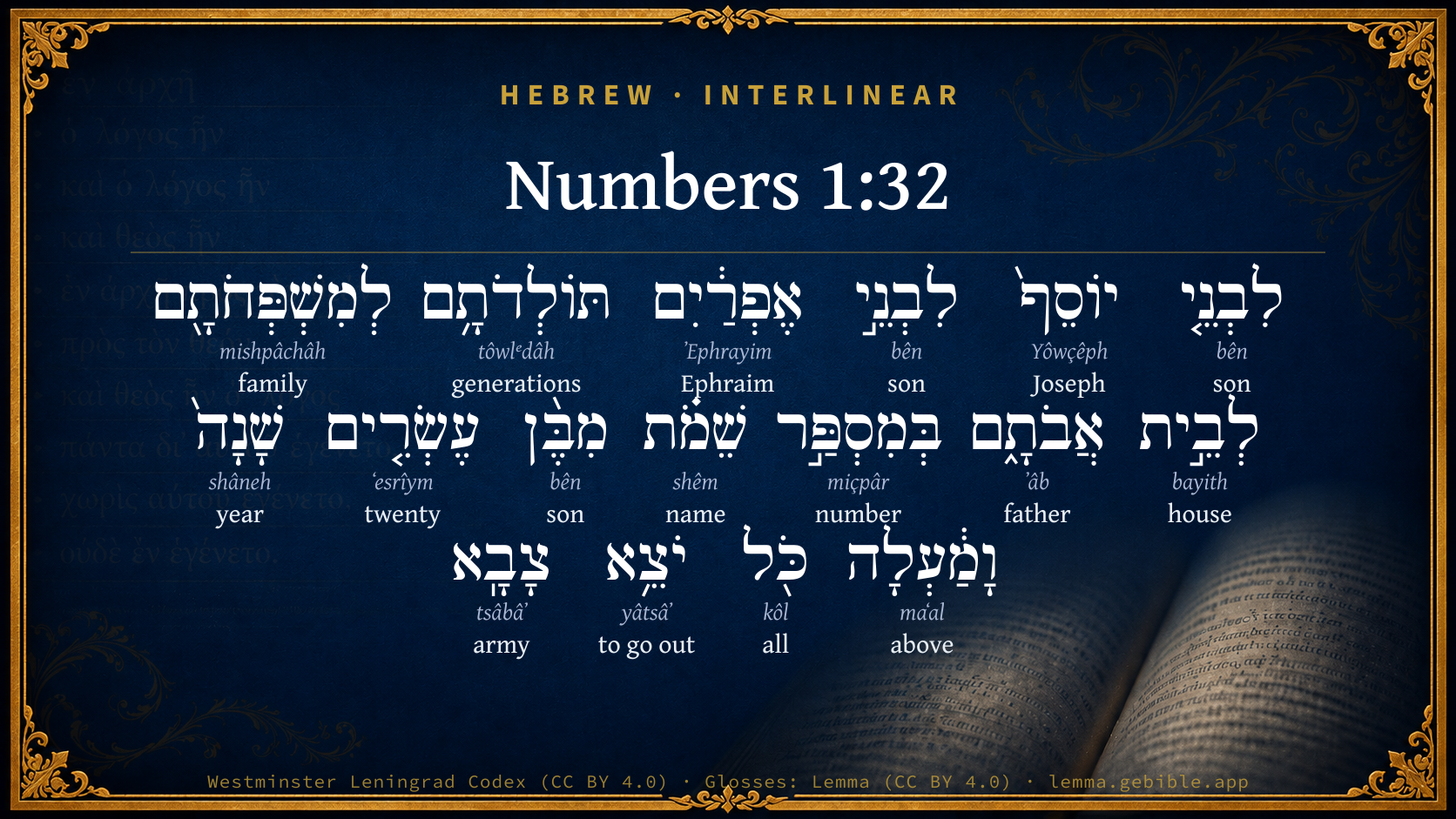
  1. לִבְנֵ֤י bên H1121 “to/for · sons of” Preposition + Noun, Common, Masculine, Plural, Construct
  2. יוֹסֵף֙ Yôwçêph H3130 “Joseph” Noun, Proper
  3. לִבְנֵ֣י bên H1121 “to/for · sons of” Preposition + Noun, Common, Masculine, Plural, Construct
  4. אֶפְרַ֔יִם ʼEphrayim H669 “Ephraim” Noun, Proper
  5. לְמִשְׁפְּחֹתָ֖ם mishpâchâh H4940 “to/for · families · their” Preposition + Noun, Common, Feminine, Plural, Construct + Suffix, Personal, 3rd Person, Masculine, Plural
  6. לְבֵ֣ית bayith H1004 “to/for · house of” Preposition + Noun, Common, Masculine, Singular, Construct
  7. אֲבֹתָ֑ם ʼâb H1 “fathers · their” Noun, Common, Masculine, Plural, Construct + Suffix, Personal, 3rd Person, Masculine, Plural
  8. בְּמִסְפַּ֣ר miçpâr H4557 “in/at · number of” Preposition + Noun, Common, Masculine, Singular, Construct
  9. שֵׁמֹ֗ת shêm H8034 “names” Noun, Common, Masculine, Plural, Absolute
  10. מִבֶּ֨ן bên H1121 “from · son of” Preposition + Noun, Common, Masculine, Singular, Construct
  11. עֶשְׂרִ֤ים ʻesrîym H6242 “twenty” Adjective, Cardinal number, Both, Plural, Absolute
  12. שָׁנָה֙ shâneh H8141 “year” Noun, Common, Feminine, Singular, Absolute
  13. וָמַ֔עְלָה maʻal H4605 “and · above · toward” Conjunction + Adverb + Suffix, Demonstrative
  14. כֹּ֖ל kôl H3605 “all of” Noun, Common, Masculine, Singular, Construct
  15. יֹצֵ֥א yâtsâʼ H3318 “going out” Verb, Qal, Participle Active, Masculine, Singular, Construct
  16. צָבָֽא tsâbâʼ H6635 “army” Noun, Common, Both, Singular, Absolute

About this verse

These counts appear in no published source. They are computed here, from the morphology-tagged text and Lemma’s own curated glosses. What Lemma adds →

17
words
15
distinct lemmas
Pentateuch
section

Shared distinctive vocabulary

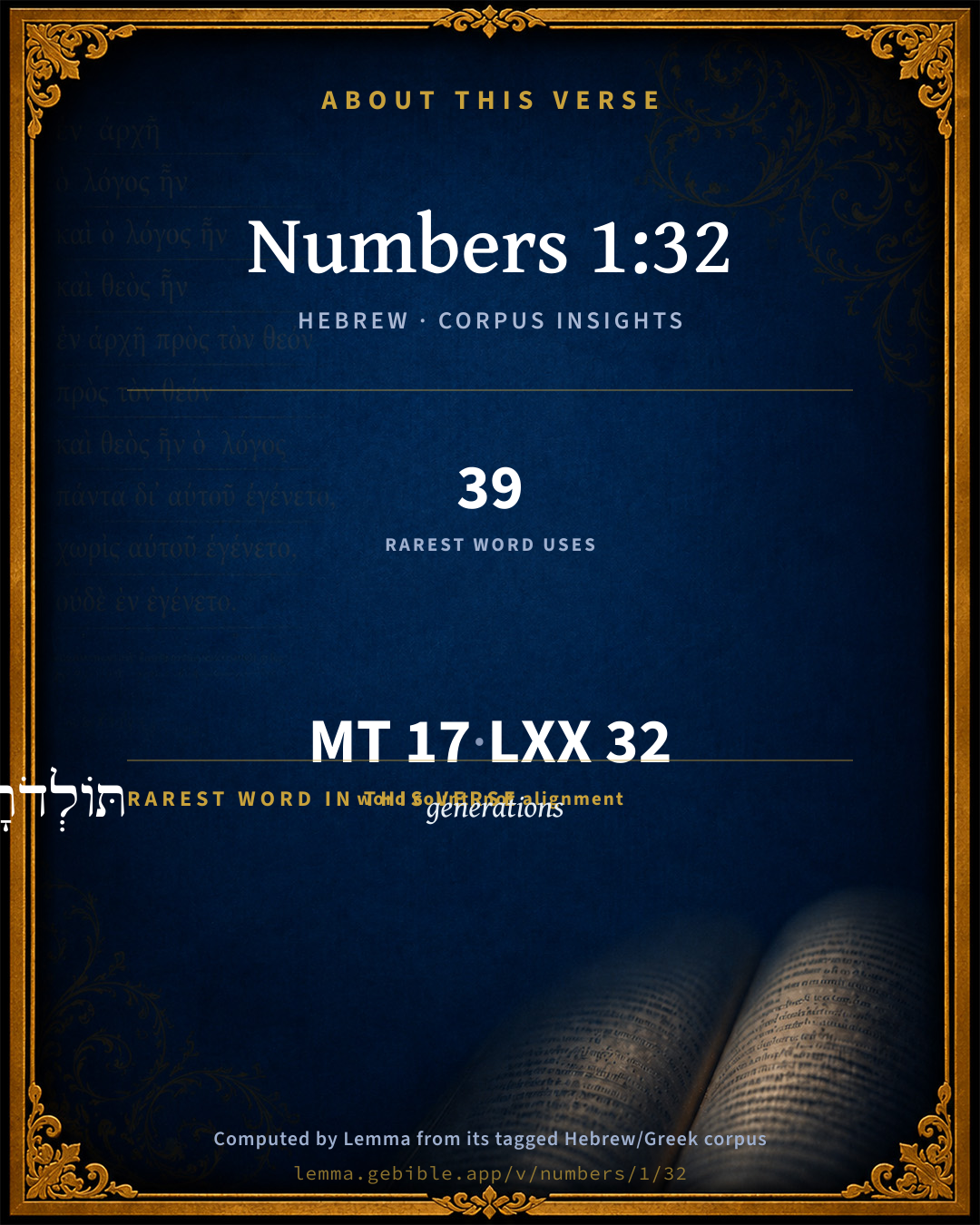
תּוֹלְדֹתָ֥ם generations H8435 occurs in 39 verses of the Hebrew Bible. Also found in:

Grammatical profile

  • 1 verb
  • 14 nouns
  • 1 adjective
  • 1 adverb

Verb forms

  • יֹצֵ֥א Qal · Participle Active

Repetition

A word recurs within this verse — often emphatic in Hebrew:

  • לִבְנֵ֤י son H1121 ×3

Hebrew & Septuagint length

In English translation the verse runs 41 words from the Hebrew and 47 from the Septuagint (LXX English) — closely comparable.

A rough comparison of the two English renderings, which tokenize alike — not a word-level alignment.

Word counts can differ between the Hebrew and the Greek without any difference in meaning — e.g. the Hebrew direct-object marker אֵת has no separate Greek word, and Greek often adds the article ὁ.

In the original languages it is 17 Hebrew tokens and 32 Greek tokens — but the two are counted differently (Hebrew bundles its prefixes and suffixes into one token; the Greek is in lemma form), so that isn’t a like-for-like length.

Cross-references

9

Topical passages linked to Numbers 1:32 in the Treasury of Scripture Knowledge — connected by theme and wording, ordered by reader-vote popularity; previews shown in the World English Bible.

  • Numbers 26:35–37 These are the sons of Ephraim after their families: of Shuthelah, the family of the Shuthelahites; of Becher, the family of the Becherites; of Tahan, the family of the Tahanites.
  • Deuteronomy 33:17 The firstborn of his herd, majesty is his; His horns are the horns of the wild-ox: With them he shall push the peoples all of them, [even] the ends of the earth: They are the ten thousands of Ephraim, They are the thousands of Manasseh.
  • Genesis 30:24 She named him Joseph, saying, "May Yahweh add another son to me."
  • Genesis 37:1–36 Jacob lived in the land of his father's travels, in the land of Canaan.
  • Genesis 39:1–23 Joseph was brought down to Egypt. Potiphar, an officer of Pharaoh's, the captain of the guard, an Egyptian, bought him from the hand of the Ishmaelites that had brought him down there.
  • Genesis 46:20 To Joseph in the land of Egypt were born Manasseh and Ephraim, whom Asenath, the daughter of Potiphera, priest of On, bore to him.
  • Genesis 48:1–22 It happened after these things, that someone said to Joseph, "Behold, your father is sick." He took with him his two sons, Manasseh and Ephraim.
  • Genesis 49:22–26 "Joseph is a fruitful vine, A fruitful vine by a spring; His branches run over the wall.
  • Numbers 2:18–19 "On the west side shall be the standard of the camp of Ephraim according to their divisions: and the prince of the children of Ephraim shall be Elishama the son of Ammihud.

Cross-references courtesy of OpenBible.info (CC BY 4.0).

Hebrew and Greek witnesses Masoretic Hebrew ↔ Greek Septuagint

The same verse in the two great witnesses to the Old Testament, shown verse-for-verse.

These are two independent witnesses, not word-aligned to each other, and the Septuagint is shown in lemma (dictionary) form.

Hebrew Numbers 1:32 Masoretic · Westminster Leningrad Codex

לִבְנֵ֤י יוֹסֵף֙ לִבְנֵ֣י אֶפְרַ֔יִם תּוֹלְדֹתָ֥ם לְמִשְׁפְּחֹתָ֖ם לְבֵ֣ית אֲבֹתָ֑ם בְּמִסְפַּ֣ר שֵׁמֹ֗ת מִבֶּ֨ן עֶשְׂרִ֤ים שָׁנָה֙ וָמַ֔עְלָה כֹּ֖ל יֹצֵ֥א צָבָֽא

Of the children of Joseph, of the children of Ephraim, their generations, by thir families, by their fathers' houses, according to the number of the names, from twenty years old and upward, all who were able to go out to war;

World English Bible · Public Domain

Greek LXX Numbers 1:32 Septuagint · lemma form

ὁ υἱός μανασσή κατά συγγένεια αὐτός κατά δῆμος αὐτός κατά οἶκος πατριά αὐτός κατά ἀριθμός ὄνομα αὐτός κατά κεφαλή αὐτός πᾶς ἀρσενικός ἀπό εἰκοσαετής καί ἐπάνω πᾶς ὁ ἐκπορεύομαι ἐν ὁ δύναμις

For the sons of Manasse according to their kindred, according to their divisions, according to the houses of their families, according to the number of their names, according to their polls, all males from twenty years old and upward, every one that goes out with the host,

LXX2012 (modern English Septuagint) · Public Domain

Hebrew: Westminster Leningrad Codex (CC BY 4.0). Greek: Septuagint (public domain); English from LXX2012 (modern English Septuagint) (Public Domain). How the Septuagint differs from the Hebrew →

Targum (Aramaic paraphrase)

2

The Targum is the ancient Jewish Aramaic paraphrase of the Hebrew Scriptures — an interpretive translation, not the Hebrew text itself. Onkelos (literal) and Pseudo-Jonathan (expansive) render the Torah, and Jonathan the Prophets. Coverage is partial: where no permissively-licensed English translation exists for a verse, only the Aramaic is shown. This is verse-level text, not a word-by-word alignment to the Hebrew.

  1. Targum Onkelos Torah (Genesis–Deuteronomy)
    לִבְנֵי יוֹסֵף לִבְנֵי אֶפְרַיִם תּוּלְדַתְהוֹן לְזַרְעֲיַתְהוֹן לְבֵית אֲבָהַתְהוֹן בְּמִנְיַן שְׁמָהָן מִבַּר עַשְׂרִין שְׁנִין וּלְעֵלָא כֹּל נָפֵק חֵילָא

    (no public-domain English translation for this verse)

    Targum Onkelos — Aramaic: “Onkelos Genesis” (public domain); “Onkelos Exodus” (public domain); “Onkelos Leviticus” (public domain); “Onkelos Numbers” (public domain); “Onkelos Deuteronomy” (public domain). English: “Sefaria Community Translation” (CC0 1.0 (public-domain dedication)); “J.W. Etheridge. The Targums of Onkelos and Jonathan Ben Uzziel on the Pentateuch. London: Longmans, Green, 1862” (public domain). Text via Sefaria.

  2. Targum Pseudo-Jonathan Torah (Genesis–Deuteronomy)
    לִבְנוֹי דְיוֹסֵף לִבְנוֹי דְאֶפְרַיִם יִחוּסֵיהוֹן לִגְנִיסַתְהוֹן לְבֵית אַבְהַתְהוֹן בְּמִנְיַן שְׁמָהָן לְגוּלְגְלַתְהוֹן כָּל דְכוּרָא מִבַּר עַשְרִין שְׁנִין וּלְעֵילָא כָּל נָפִיק חֵילָא

    of the family of the Beni Joseph of the family of the Beni Ephraim, after the generation of their fathers' house, in the number of their names by their polls, every male from twenty years and upward,

    Targum Pseudo-Jonathan — Aramaic: “Targum Jonathan on Genesis” (public domain); “Targum Jonathan on Exodus” (public domain); “Targum Jonathan on Leviticus” (public domain); “Targum Jonathan on Numbers” (public domain); “Targum Jonathan on Deuteronomy” (public domain). English: “The Targum of Jonathan ben Uzziel, trans. J. W. Etheridge, London, 1862” (public domain). Text via Sefaria.

Commentary

Notes on Numbers 1:32 from classic Christian and Jewish commentators (each source and its license shown beneath its notes). The classic Christian expositions comment on the surrounding passage and are grouped to its opening verse, so a note may address several verses; the Jewish commentaries on the Tanakh (Rashi and others) are per-verse, so they appear only where the commentator wrote on this verse.

Lemma curates 59 commentaries, every one of them public domain or Creative Commons licensed, each selected and text-cleaned for this edition rather than reprinted as found. About our sources →

John Gill's Exposition

Of the children of Joseph, namely, of the children of Ephraim, by their generations,.... See Gill on Num 1:20.

.

Numbers 1:33

num 1:33

num 1:33

num 1:33Those that were numbered of them, even of the tribe of Ephraim, were forty thousand and five hundred. 40,500 men. See Gill on Num 1:20.

John Gill's Exposition of the Whole Bible (1746–1763) — public domain (CC PDM 1.0). Text via the HelloAO Bible API.

The Pulpit Commentary

Of the children of Joseph. Both are numbered as separate tribes, but Ephraim already takes precedence, not as being larger, which is not considered in this list, but according to prophecy. (Gen_48:5, Gen_48:14)

The Pulpit Commentary (1880–1919), ed. H.D.M. Spence-Jones & Joseph S. Exell — public domain. Text from a community e-Sword module.

unfoldingWord translationNotes

Door43 World Missions Community

were counted all the names of each and every man ... clans and families

The phrase "were counted" can be stated in active form. This long phrase is repeated multiple times in the census. See how you translated it in Numbers 1:20. AT: "they counted all the names of each and every man ... clans and families" (See: Active or Passive)

40,500 men

"forty thousand five hundred men" (See: Numbers)

translationWords

descend

Ephraim

Joseph (OT)

unfoldingWord translationNotes — © Distant Shores Media and the Door43 World Missions Community, licensed CC BY-SA 4.0. Source: git.door43.org/Door43/en_tn.

Ramban (Nachmanides)

Rabbi Moshe ben Nachman (Ramban / Nachmanides)

OF THE CHILDREN OF JOSEPH, NAMELY, OF THE CHILDREN OF EPHRAIM. Scripture mentioned Ephraim before Menasheh, and stated Joseph’s relationship to him [which it does not do in the case of Menasheh], and similarly later [Scripture gave Ephraim precedence] at the [division of the tribes according to their] standards, by making him master of the standard, [whilst Menasheh is mentioned merely as one of the two tribes gathered around him], because in accordance with Jacob’s blessing he was to be [given the honor accorded to] the firstborn, and his brother [Menasheh] was to be second to him. Moreover, the sons of Ephraim were more numerous than those of Menasheh [and hence Ephraim was mentioned first]. But at the second census in the plains of Moab Scripture mentioned Menasheh first, because at that time his sons were more numerous [than those of Ephraim], Verse 34), whilst Ephraim had only 32,500 (ibid., Verse 37). and [also because] they took their inheritance first., 32:33). Similarly when mentioning the princes of the Land [who were to take possession of the Land for their respective tribes] Scripture mentioned Menasheh first, and also Joseph’s relationship to him., 34:23: Of the children of Joseph; of the tribe of the children of Menasheh. In the following verse Scripture mentions the prince of the children of Ephraim. In [the story of] the spies, however, Scripture mentioned Ephraim first, and Joseph’s relationship it stated only in referring to the tribe of Menasheh., 13:8, 11. It appears to me by way of homiletic exposition that it is on account of the evil report that Joseph brought [to his father] concerning his brothers that Scripture, [in the story of the spies], associates with him the spy who [was among those who] spread the evil report [about the Land, namely the spy from the tribe of Menasheh, whereas the spy from the tribe of Ephraim was Joshua the son of Nun, who was not among those who spread the evil report]. Or it may be that Scripture [in relating the story of the spies] gave honor to both [tribes who were descended from Joseph], and Ephraim had sufficient honor in its prince [Joshua the son of Nun who ministered to Moses, therefore Scripture mentioned the honor of descent from Joseph only in the case of Menasheh].

Ramban (Nachmanides) on the Tanakh — English translation: “Commentary on the Torah by Ramban (Nachmanides). Translated and annotated by Charles B. Chavel. New York, Shilo Pub. House, 1971-1976” (CC BY 4.0). Text via Sefaria.

Lesson kit

Teaching starters — assembled from the data on this page, not authored interpretation. Every prompt links to the verse data it draws on. Edit before teaching.

Numbers, in the Pentateuch, opens this verse with 17 words (15 distinct Hebrew lemmas). Its most distinctive word is tôwlᵉdâh (“generations”). A historical commentator’s framing appears above. Read the whole chapter for the surrounding context.

Discussion questions

  1. How does “generations” (tôwlᵉdâh) shape what this verse is saying?
  2. Genesis 2:4 shares the word «generations» with this verse. How do the two illuminate each other?
  3. “son” occurs 3× in this one verse. What is the effect of the repetition?
  4. These translations render this verse differently; the difference is in the English rendering, not the original. What questions does that raise?
  5. The verb «יֹצֵ֥א» is Qal Participle Active. How does its form color the action?
  6. Reading how John Gill's Exposition and The Pulpit Commentary read this verse, where do the two commentators agree and where do they part?

Things to notice

Reading settings

Reading text

Shown beneath each verse's original-language words.

Old Testament
Old Testament edition

Read the OT as the Masoretic Hebrew (MT) or the Greek Septuagint (LXX).

English shown for the Greek Septuagint (in the Hebrew ↔ Greek comparison).

Comparing translations? Open the Compare panel on any verse page to stack up to four side by side.