
1 Samuel 26:5

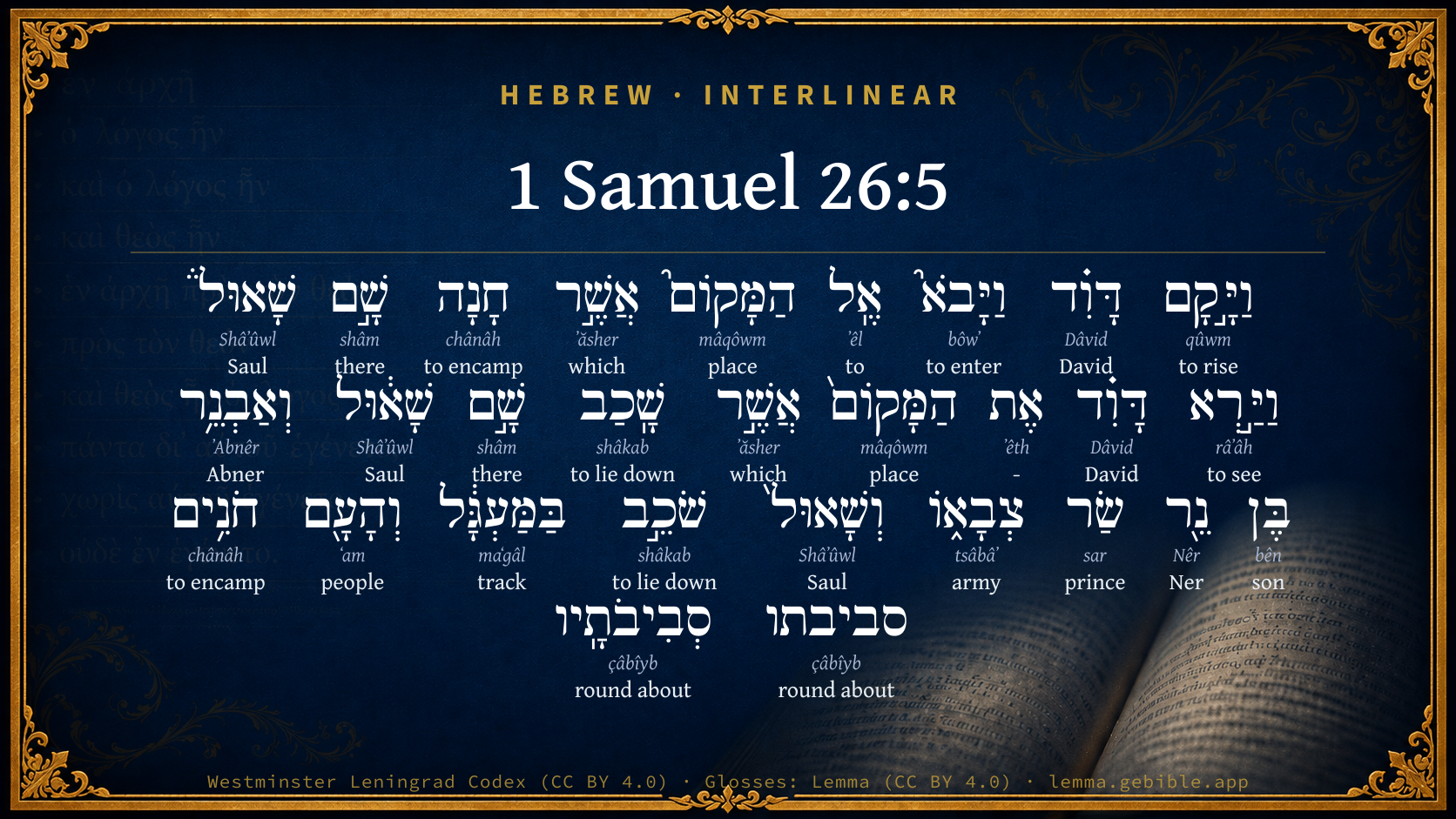
Hebrew (Westminster Leningrad Codex) 1 Samuel 26:5 appears in the Hebrew Old Testament. The text above is from the Westminster Leningrad Codex. Each word links to its Strong’s number, a concise gloss, and parsing drawn from the Open Scriptures Hebrew Bible morphology. Click any word for its full Brown-Driver-Briggs (BDB) entry.
Download image
Cite this verse

1 Samuel 26:5 (World English Bible). Public Domain. Lemma interlinear Bible study tool, https://lemma.gebible.app/v/1-samuel/26/5.

Show BibTeX & RIS
BibTeX
RIS
English Translation
David arose, and came to the place where Saul had encamped; and David saw the place where Saul lay, and Abner the son of Ner, the captain of his host: and Saul lay within the place of the wagons, and the people were encamped round about him.
World English Bible · Public Domain
Download a study sheet

One document with this verse’s original text, its word-by-word gloss line, the meaning frame, cross-references with their text, attributed commentary, and full source and license credits — printable, and it pastes into notes with its structure intact.

This verse Autodidact and up

Study sheet (.html) Plain text (.txt)

A passage Seminary Student

Up to 50 verses in one chapter. A passage sheet keeps up to 6 commentary sources and 12 cross-references per verse, in the order this page ranks them, and says so on the sheet whenever that leaves anything out. Ask for a single verse and you get the Autodidact verse sheet above.

Everything on this page stays free to read, with no account — the sheet is a download of what is already on screen, not access to it.

Want to remove ads? Support Godless Engineer
Compare translations 3

The same verse in 3 English versions, stacked beneath the original-language interlinear above. Click any original word for its lexicon entry.

Each is an independent rendering of the whole verse — the interlinear is not word-aligned to these translations.

Highlighted words mark where these versions differ — a whole-verse word diff, not a word-by-word alignment.

  • World English Bible Public Domain
    David arose, and came to the place where Saul had encamped; and David saw the place where Saul lay, and Abner the son of Ner, the captain of his host: and Saul lay within the place of the wagons, and the people were encamped round about him.
  • King James Version Public Domain
    And David arose, and came to the place where Saul had pitched: and David beheld the place where Saul lay, and Abner the son of Ner, the captain of his host: and Saul lay in the trench, and the people pitched round about him.
  • unfoldingWord Literal Text CC BY-SA 4.0
    And David arose and came to the place where Saul had camped there. And David saw the place where Saul lay there, and Abner, the son of Ner, the commander of his army. And Saul lay within the wagon-track, and the people were camped around him.

unfoldingWord Literal Text — © unfoldingWord, licensed CC BY-SA 4.0. Word-aligned USFM3 via Door43 (git.door43.org/unfoldingWord/en_ult).

Versions to compare (up to 4)

3 of 4 selected

Show all 18 translations

Every available English version of this verse, each an independent rendering of the whole verse.

  • World English Bible Public Domain
    David arose, and came to the place where Saul had encamped; and David saw the place where Saul lay, and Abner the son of Ner, the captain of his host: and Saul lay within the place of the wagons, and the people were encamped round about him.
  • Berean Standard Bible Public Domain
    Then David set out and went to the place where Saul had camped. He saw the place where Saul and Abner son of Ner, the general of his army, had lain down. Saul was lying inside the inner circle of the camp, with the troops camped around him.
  • Majority Standard Bible Public Domain
    Then David set out and went to the place where Saul had camped. He saw the place where Saul and Abner son of Ner, the general of his army, had lain down. Saul was lying inside the inner circle of the camp, with the troops camped around him.
  • King James Version Public Domain
    And David arose, and came to the place where Saul had pitched: and David beheld the place where Saul lay, and Abner the son of Ner, the captain of his host: and Saul lay in the trench, and the people pitched round about him.
  • American Standard Version (1901) Public Domain
    And David arose, and came to the place where Saul had encamped; and David beheld the place where Saul lay, and Abner the son of Ner, the captain of his host: and Saul lay within the place of the wagons, and the people were encamped round about him.
  • Revised Version (1885) Public Domain
    And David arose, and came to the place where Saul had pitched: and David beheld the place where Saul lay, and Abner the son of Ner, the captain of his host: and Saul lay within the place of the wagons, and the people pitched round about him.
  • Geneva Bible (1599) Public Domain
    Then Dauid arose, and came to the place where Saul had pitched, and when Dauid beheld the place where Saul lay, and Abner the sonne of Ner which was his chiefe captaine, (for Saul lay in the fort, and the people pitched round about him)
  • Douay-Rheims (1899) Public Domain
    And David arose secretly, and came to the place where Saul was: and when he had beheld the place, wherein Saul slept, and Abner the son of Ner, the captain of his army, and Saul sleeping in a tent, and the rest of the multitude round about him,
  • Young's Literal Translation Public Domain
    and David riseth, and cometh in unto the place where Saul hath encamped, and David seeth the place where Saul hath lain, and Abner son of Ner, head of his host, and Saul is lying in the path, and the people are encamping round about him.
  • Literal Standard Version CC BY-SA 4.0
    and David rises, and comes to the place where Saul has encamped, and David sees the place where Saul has lain, and Abner son of Ner, head of his host, and Saul is lying in the path, and the people are encamping around him.
  • Unlocked Literal Bible CC BY-SA 4.0
    David arose and went to the place where Saul had camped; he saw the place where Saul lay, and Abner son of Ner, the general of his army; Saul lay in the camp, and the people were camped around him, all asleep.
  • unfoldingWord Literal Text CC BY-SA 4.0
    And David arose and came to the place where Saul had camped there. And David saw the place where Saul lay there, and Abner, the son of Ner, the commander of his army. And Saul lay within the wagon-track, and the people were camped around him.
  • Darby Bible Public Domain
    And David arose and came to the place where Saul had encamped; and David beheld the place where Saul lay, and Abner the son of Ner, the captain of his host; and Saul lay within the wagon-defence, and the people were encamped round about him.
  • World Messianic Bible Public Domain
    Then David arose and came to the place where Saul had encamped; and David saw the place where Saul lay, with Abner the son of Ner, the captain of his army. Saul lay within the place of the wagons, and the people were encamped around him.
  • Webster's Bible Public Domain
    And David arose, and came to the place where Saul had encamped; and David beheld the place where Saul lay, and Abner, the son of Ner, the captain of his host: and Saul lay in the trench, and the people pitched around him.
  • Free Bible Version CC BY-SA 4.0
    One night David got up and went over to Saul's camp and saw where Saul was sleeping, along with Abner, son of Ner, the army commander. Saul was lying in the middle of the camp with his men all around him.
  • Bible in Basic English Public Domain
    And David got up and came to the place where Saul's tents were: and David had a view of the place where Saul was sleeping with Abner, the son of Ner, the captain of his army: and Saul was sleeping inside the ring of carts, and the tents of the people were all round him.
  • JPS Tanakh (1917) Public Domain
    And David arose, and came to the place where Saul had pitched; and David beheld the place where Saul lay, and Abner the son of Ner, the captain of his host; and Saul lay within the barricade, and the people pitched round about him.

Literal Standard Version (2020), Covenant Press — licensed CC BY-SA 4.0. Text via the HelloAO Bible API (eBible.org). Unlocked Literal Bible (unfoldingWord) — licensed CC BY-SA 4.0. Text via the HelloAO Bible API (eBible.org). unfoldingWord Literal Text — © unfoldingWord, licensed CC BY-SA 4.0. Word-aligned USFM3 via Door43 (git.door43.org/unfoldingWord/en_ult). Free Bible Version, Dr. Jonathan Gallagher — licensed CC BY-SA 4.0. Text via the HelloAO Bible API (eBible.org).

Word by word

More ways to search: Search by grammar → Find every occurrence → Compare this word →

Practice this passage: Drill this verse → Learn its vocabulary →

נֵ֖ר
Nêr
H5369
“Ner”
Noun, Proper
Part of Speech
Noun
Type
Proper
Full BDB Definition

Origin: the same as H5216

TWOT: 1333a

Ner = "lamp" - son of Jehiel, father of Kish, and grandfather of king Saul - father of Abner, the uncle of Saul - perhaps the same as 1
  1. וַיָּ֣קָם qûwm H6965 “and · to rise” Conjunction + Verb, Qal, Sequential Imperfect, 3rd Person, Masculine, Singular
  2. דָּוִ֗ד Dâvid H1732 “David” Noun, Proper
  3. וַיָּבֹא֮ bôwʼ H935 “and · to enter” Conjunction + Verb, Qal, Sequential Imperfect, 3rd Person, Masculine, Singular
  4. אֶֽל ʼêl H413 “to” Preposition
  5. הַמָּקוֹם֮ mâqôwm H4725 “the · place” Particle, Definite Article + Noun, Common, Masculine, Singular, Absolute
  6. אֲשֶׁ֣ר ʼăsher H834 “which” Particle, Relative
  7. חָנָה chânâh H2583 “to encamp” Verb, Qal, Perfect, 3rd Person, Masculine, Singular
  8. שָׁ֣ם shâm H8033 “there” Adverb
  9. שָׁאוּל֒ Shâʼûwl H7586 “Saul” Noun, Proper
  10. וַיַּ֣רְא râʼâh H7200 “and · to see” Conjunction + Verb, Qal, Sequential Imperfect, 3rd Person, Masculine, Singular
  11. דָּוִ֗ד Dâvid H1732 “David” Noun, Proper
  12. אֶת ʼêth H853 “-” Particle, Direct Object
  13. הַמָּקוֹם֙ mâqôwm H4725 “the · place” Particle, Definite Article + Noun, Common, Masculine, Singular, Absolute
  14. אֲשֶׁ֣ר ʼăsher H834 “which” Particle, Relative
  15. שָֽׁכַב shâkab H7901 “to lie down” Verb, Qal, Perfect, 3rd Person, Masculine, Singular
  16. שָׁ֣ם shâm H8033 “there” Adverb
  17. שָׁא֔וּל Shâʼûwl H7586 “Saul” Noun, Proper
  18. וְאַבְנֵ֥ר ʼAbnêr H74 “and · Abner” Conjunction + Noun, Proper
  19. בֶּן bên H1121 “son of” Noun, Common, Masculine, Singular, Construct
  20. שַׂר sar H8269 “prince of” Noun, Common, Masculine, Singular, Construct
  21. צְבָא֑וֹ tsâbâʼ H6635 “army · his” Noun, Common, Both, Singular, Construct + Suffix, Personal, 3rd Person, Masculine, Singular
  22. וְשָׁאוּל֙ Shâʼûwl H7586 “and · Saul” Conjunction + Noun, Proper
  23. שֹׁכֵ֣ב shâkab H7901 “lying down” Verb, Qal, Participle Active, Masculine, Singular, Absolute
  24. בַּמַּעְגָּ֔ל maʻgâl H4570 “in/at the · track” Preposition, Determined + Noun, Common, Masculine, Singular, Absolute
  25. וְהָעָ֖ם ʻam H5971 “and · the · people” Conjunction + Particle, Definite Article + Noun, Common, Masculine, Singular, Absolute
  26. חֹנִ֥ים chânâh H2583 “encamping” Verb, Qal, Participle Active, Masculine, Plural, Absolute
  27. סביבתו çâbîyb H5439 “round about · his” Noun, Common, Both, Singular, Construct + Suffix, Personal, 3rd Person, Masculine, Singular
  28. סְבִיבֹתָֽיו çâbîyb H5439 “surroundings · his” Noun, Common, Both, Plural, Construct + Suffix, Personal, 3rd Person, Masculine, Singular

About this verse

These counts appear in no published source. They are computed here, from the morphology-tagged text and Lemma’s own curated glosses. What Lemma adds →

29
words
20
distinct lemmas
Historical
section

Notable vocabulary

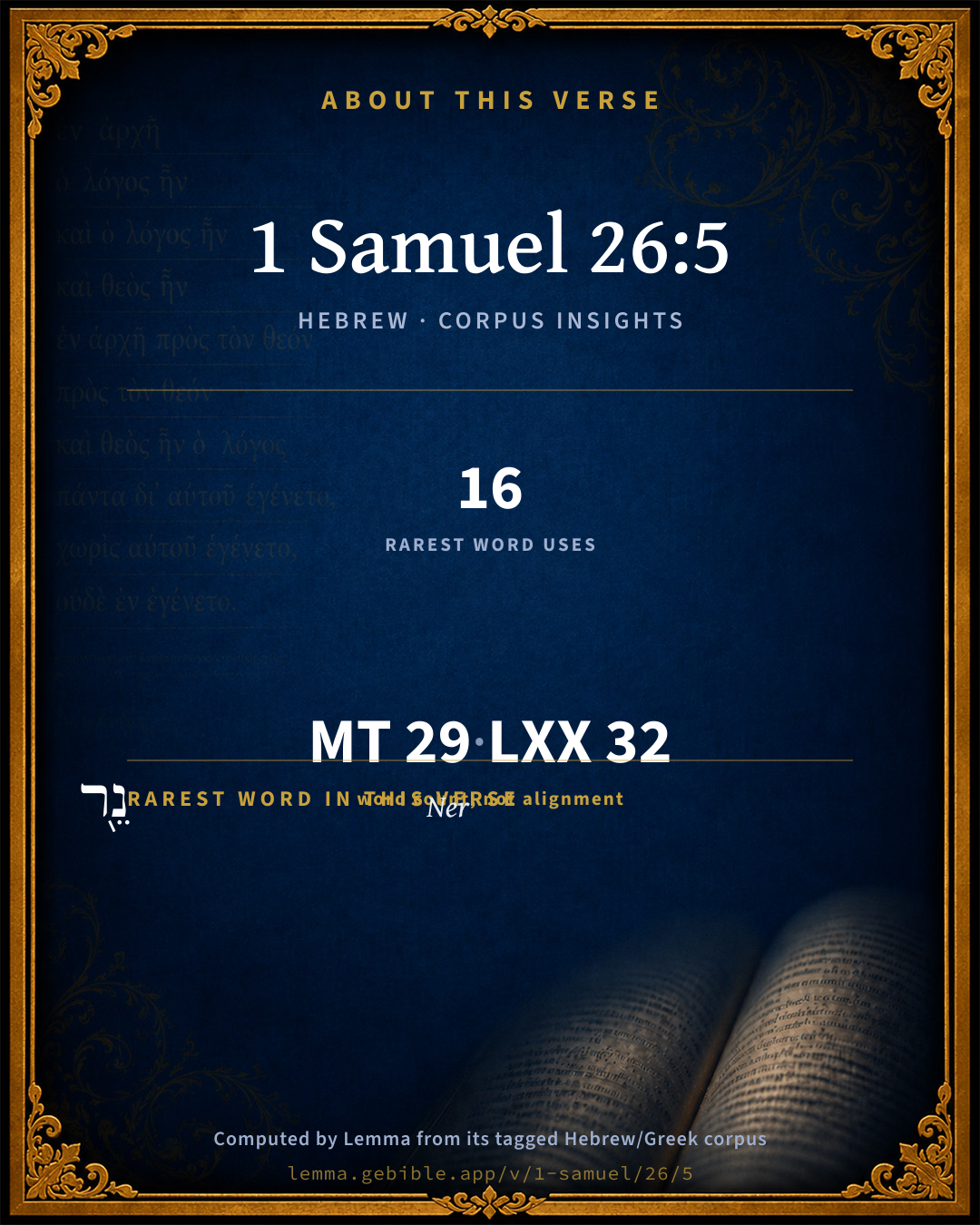
The rarest word here is נֵ֖ר Ner H5369 — appearing just 16 times in the whole Hebrew Bible.

Shared distinctive vocabulary

נֵ֖ר Ner H5369 occurs in 16 verses of the Hebrew Bible. Also found in:

Grammatical profile

  • 7 verbs
  • 16 nouns
  • 1 preposition
  • 2 adverbs
  • 3 particles

Verb forms

  • וַיָּ֣קָם Qal · Sequential Imperfect
  • וַיָּבֹא֮ Qal · Sequential Imperfect
  • חָנָה Qal · Perfect
  • וַיַּ֣רְא Qal · Sequential Imperfect
  • שָֽׁכַב Qal · Perfect
  • שֹׁכֵ֣ב Qal · Participle Active
  • חֹנִ֥ים Qal · Participle Active

Repetition

Words recur within this verse — often emphatic in Hebrew:

  • שָׁאוּל֒ Saul H7586 ×3
  • דָּוִ֗ד David H1732 ×2
  • הַמָּקוֹם֮ place H4725 ×2
  • חָנָה to encamp H2583 ×2
  • שָׁ֣ם there H8033 ×2
  • שָֽׁכַב to lie down H7901 ×2
  • סביבתו round about H5439 ×2
  • אֲשֶׁ֣ר which H834 ×2

Hebrew & Septuagint length

In English translation the verse runs 47 words from the Hebrew and 42 from the Septuagint (LXX English) — closely comparable.

A rough comparison of the two English renderings, which tokenize alike — not a word-level alignment.

Word counts can differ between the Hebrew and the Greek without any difference in meaning — e.g. the Hebrew direct-object marker אֵת has no separate Greek word, and Greek often adds the article ὁ.

In the original languages it is 29 Hebrew tokens and 32 Greek tokens — but the two are counted differently (Hebrew bundles its prefixes and suffixes into one token; the Greek is in lemma form), so that isn’t a like-for-like length.

Cross-references

9

Topical passages linked to 1 Samuel 26:5 in the Treasury of Scripture Knowledge — connected by theme and wording, ordered by reader-vote popularity; previews shown in the World English Bible.

  • 1 Samuel 17:55 When Saul saw David go forth against the Philistine, he said to Abner, the captain of the host, Abner, whose son is this youth? Abner said, As your soul lives, O king, I can't tell.
  • 1 Samuel 14:50–51 and the name of Saul's wife was Ahinoam the daughter of Ahimaaz. The name of the captain of his host was Abner the son of Ner, Saul's uncle.
  • 1 Samuel 17:20 David rose up early in the morning, and left the sheep with a keeper, and took, and went, as Jesse had commanded him; and he came to the place of the wagons, as the host which was going forth to the fight shouted for the battle.
  • 1 Samuel 9:1 Now there was a man of Benjamin, whose name was Kish, the son of Abiel, the son of Zeror, the son of Becorath, the son of Aphiah, the son of a Benjamite, a mighty man of valor.
  • 2 Samuel 2:8–12 Now Abner the son of Ner, captain of Saul's host, had taken Ish-bosheth the son of Saul, and brought him over to Mahanaim;
  • 2 Samuel 3:7–8 Now Saul had a concubine, whose name was Rizpah, the daughter of Aiah: and [Ish-bosheth] said to Abner, Why have you gone in to my father's concubine?
  • 2 Samuel 3:27 When Abner was returned to Hebron, Joab took him aside into the midst of the gate to speak with him quietly, and struck him there in the body, so that he died, for the blood of Asahel his brother.
  • 2 Samuel 3:33–38 The king lamented for Abner, and said, Should Abner die as a fool dies?
  • 1 Chronicles 9:39 Ner became the father of Kish; and Kish became the father of Saul; and Saul became the father of Jonathan, and Malchishua, and Abinadab, and Eshbaal.

Cross-references courtesy of OpenBible.info (CC BY 4.0).

Hebrew and Greek witnesses Masoretic Hebrew ↔ Greek Septuagint

The same verse in the two great witnesses to the Old Testament, shown verse-for-verse.

These are two independent witnesses, not word-aligned to each other, and the Septuagint is shown in lemma (dictionary) form.

Hebrew 1 Samuel 26:5 Masoretic · Westminster Leningrad Codex

וַיָּ֣קָם דָּוִ֗ד וַיָּבֹא֮ אֶֽל הַמָּקוֹם֮ אֲשֶׁ֣ר חָנָה שָׁ֣ם שָׁאוּל֒ וַיַּ֣רְא דָּוִ֗ד אֶת הַמָּקוֹם֙ אֲשֶׁ֣ר שָֽׁכַב שָׁ֣ם שָׁא֔וּל וְאַבְנֵ֥ר בֶּן נֵ֖ר שַׂר צְבָא֑וֹ וְשָׁאוּל֙ שֹׁכֵ֣ב בַּמַּעְגָּ֔ל וְהָעָ֖ם חֹנִ֥ים סביבתו סְבִיבֹתָֽיו

David arose, and came to the place where Saul had encamped; and David saw the place where Saul lay, and Abner the son of Ner, the captain of his host: and Saul lay within the place of the wagons, and the people were encamped round about him.

World English Bible · Public Domain

Greek LXX 1 Samuel 26:5 Septuagint · lemma form

καί ἀναἵστημι δαυίδ λάθρα καί εἰςπορεύομαι εἰς ὁ τόπος οὗ καταεὔδω ἐκεῖ σαούλ καί ἐκεῖ αβεννηρ υἱός νηρ ἀρχιστράτηγος αὐτός καί σαούλ καταεὔδω ἐν λαμπήνη καί ὁ λαός παρα ἐνβάλλω κύκλος αὐτός

And David arose secretly, and goes into the place where Saul was sleeping, and there was Abenner the son of Ner, the captain of his host: and Saul was sleeping in a chariot, and the people had encamped along round about him.

LXX2012 (modern English Septuagint) · Public Domain

On this verse, Ellicott's Commentary for English Readers discusses the Septuagint’s reading. Read the note in Commentary ↓

Hebrew: Westminster Leningrad Codex (CC BY 4.0). Greek: Septuagint (public domain); English from LXX2012 (modern English Septuagint) (Public Domain). How the Septuagint differs from the Hebrew →

Targum (Aramaic paraphrase)

1

The Targum is the ancient Jewish Aramaic paraphrase of the Hebrew Scriptures — an interpretive translation, not the Hebrew text itself. Onkelos (literal) and Pseudo-Jonathan (expansive) render the Torah, and Jonathan the Prophets. Coverage is partial: where no permissively-licensed English translation exists for a verse, only the Aramaic is shown. This is verse-level text, not a word-by-word alignment to the Hebrew.

  1. Targum Jonathan Prophets (Joshua–Malachi)
    וְקָם דָוִד וַאֲתָא לְאַתְרָא דִי שְׁרָא תָמָן שָׁאוּל וַחֲזָא דָוִד יַת אַתְרָא דִשְׁכַב תַּמָן שָׁאוּל וְאַבְנֵר בַּר נֵר רַב חֵילֵיהּ וְשָׁאוּל שְׁכִיב בְּכַרְכּוּמָא וְעַמָא שָׁרָן סַחֲרָנוֹהִי:

    (no public-domain English translation for this verse)

    Targum Jonathan — Aramaic: “Mikraot Gedolot” (public domain). English: “Sefaria Community Translation” (CC0 1.0 (public-domain dedication)); “London "Chaldee Paraphrase," 1871” (public domain). Text via Sefaria.

Commentary

Notes on 1 Samuel 26:5 from classic Christian and Jewish commentators (each source and its license shown beneath its notes). The classic Christian expositions comment on the surrounding passage and are grouped to its opening verse, so a note may address several verses; the Jewish commentaries on the Tanakh (Rashi and others) are per-verse, so they appear only where the commentator wrote on this verse.

Lemma curates 59 commentaries, every one of them public domain or Creative Commons licensed, each selected and text-cleaned for this edition rather than reprinted as found. About our sources →

Jamieson, Fausset & Brown

Robert Jamieson, A. R. Fausset & David Brown

DAVID STAYS ABISHAI FROM KILLING SAUL, BUT TAKES HIS SPEAR AND CRUSE. (1Sa. 26:5-25)

Saul lay in the trench, and the people pitched round about him--Among the nomad people of the East, the encampments are usually made in a circular form. The circumference is lined by the baggage and the men, while the chief's station is in the center, whether he occupy a tent or not. His spear, stuck in the ground, indicates his position. Similar was the disposition of Saul's camp--in this hasty expedition he seems to have carried no tent, but to have slept on the ground. The whole troop was sunk in sleep around him.

Jamieson, Fausset & Brown — Commentary Critical and Explanatory on the Whole Bible (1871) — public domain (CC PDM 1.0). Text via the HelloAO Bible API.

Trapp's Complete Commentary

John Trapp

1Sa 26:5 And David arose, and came to the place where Saul had pitched: and David beheld the place where Saul lay, and Abner the son of Ner, the captain of his host: and Saul lay in the trench, and the people pitched round about him.

Ver. 5. And came to the place.] He came privily, saith the Vulgate, and as some think, in a disguise; as Alexander once did into the camp of King Porus: but surely not without a divine instinct, like as Gideon went to the host of the Midianites. {Jdg 7:9-11}

And Saul lay in the trench.] Or, In the midst of the carriages; in ambitu plaustrorum, for safety’s sake; and in the midst of this people, which yet could not secure him. Henry IV, of France, was stabbed by a traitor in the midst of all his forces; so little trust is there to [be put in] men or means.

John Trapp, A Commentary or Exposition upon All the Books of the Old and New Testament (1647–1656) — public domain. Text from a community e-Sword module.

Joseph Benson's Commentary

1Sa 26:5. David came to the place where Saul had pitched — Within sight of it; where he might observe how he lay. Saul lay in a trench — Hebrews במעגלbammanggal, in the carriage, or rather, within the circle of the carriages, that he might be safe from any sudden attack.

Joseph Benson's Commentary on the Old and New Testaments (1811–1818) — public domain. Text from a community e-Sword module.

MacLaren's Expositions of Holy Scripture

Alexander MacLaren

1 Samuel

LOVE AND REMORSE

1Sa 26:5 - 1Sa 26:12; 1Sa 26:21 - 1Sa 26:25.

It is fashionable at present to regard this incident and the other instance of David’s sparing Saul, when in his power, as two versions of one event. But it if not improbable that the hunted outlaw should twice have taken refuge in the same place, or that his hiding-place should have been twice betrayed. He had but a small choice of safe retreats, and the Ziphites had motive for a second betrayal in the fact of the first, and of its failure to secure David’s capture. The whole cast of the two incidents is so different that it is impossible to see how the one could have been evolved from the other, and either they are both true, or they are both unhistorical, or, at best, are both the product of fancy working on, and arbitrarily filling up, a very meagre skeleton of fact. Many of the advocates of the identity of the incident at the bottom of the two accounts would accept the latter explanation; we take the former.

Saul had three thousand men with him; David had left his little troop ‘in the wilderness,’ and seems to have come with only his two companions, Ahimelech and his own nephew, Abishai, to reconnoitre. He sees, from some height, the camp, with the transport wagons making a kind of barricade in the centre-just as camps are still arranged in South Africa and elsewhere,-and Saul established therein as in a rude fortification. A bold thought flashes into his mind as he looks. Perhaps he remembered Gideon’s daring visit to the camp of Midian. He will go down, and not only into the camp, but ‘to Saul,’ through the ranks and over the barrier. What to do he does not say, but the two fierce fighters beside him think of only one thing as sufficient motive for such an adventure. Abishai volunteers to go with him; no doubt Ahimelech would have been ready also, but two were enough, and three would only have increased risk. So they lay close hid till night fell, and then stole down through the sleeping ranks with silent movements, like a couple of Indians on the war-trail, climbed the barricade, and stood at last where Saul lay, with his spear, as the emblem of kingship, stuck upright at his head, and a cruse of water for slaking thirst, if he awoke, beside him. Those who should have been his guards lay sleeping round him, for a ‘deep sleep from Jehovah was fallen upon them.’ What a vivid, strange picture it is, and how characteristic of the careless discipline of unscientific Eastern warfare!

The tigerish lust for blood awoke in Abishai. Whatever sad, pitying, half-tender thoughts stirred in David as he looked at the mighty form of Saul, with limbs relaxed in slumber, and perhaps some of the gloom and evil passions charmed out of his face, his nephew’s only thought was,’ What a fair mark! what an easy blow!’ He was brutally eager to strike once, and truculently sure that his arm would make sure that once would be enough. He was religious too, after a strange fierce fashion. God-significantly he does not say ‘Jehovah’; his religion was only the vague belief in a deity-had delivered Saul into David’s hands, and it would be a kind of sin not to kill him. How many bloody tragedies that same unnatural alliance of religion and murderous hate has varnished over! Very beautifully does David’s spirit contrast with this. Abishai represents the natural impulse of us all-to strike at our enemies when we can, to meet hate with hate, and do to another the evil that he would do to us.

David here, though he could be fierce and cruel enough sometimes, and had plenty of the devil in him, listens to his nobler self, which listens to God, and, at a time when everything tempted him to avenge himself, resists and overcomes. He is here a saint after the New Testament pattern. Abishai had, in effect, said, ‘Thou shalt love thy neighbour, and hate thine enemy.’ David’s finely-tuned ear heard, long before they were spoken on earth, the great Christian words, 11 say unto you, Love your enemies; do good to them that hate you.’ He knew that Saul had been ‘rejected,’ but he was ‘Jehovah’s anointed,’ and the unction which had rested on that sleeping head lingered still. It was not for David to be the executor of God’s retribution. He left himself and his cause in Jehovah’s hands, and no doubt it was with sorrow and pitying love, not altogether quenched by Saul’s mad hate, that he foresaw that the life which he spared now was certain one day to be smitten. We may well learn the lesson of this story, and apply it to the small antagonisms and comparatively harmless enmities which may beset our more quiet lives. David in Saul’s ‘laager,’ Stephen outside the wall, alike lead up our thoughts to Jesus’ prayer,’ Father, forgive them; for they know not what they do.’

The carrying off of the spear and the cruse was a couch of almost humour, and it, with the ironical taunt flung across the valley to Abner, gives relief to the strain of emotion in the story. Saul’s burst of passionate remorse is morbid, paroxysmal, like his fits of fury, and is sure to foam itself away. The man had no self-control. He had let wild, ungoverned moods master him, and was truly ‘possessed.’ One passion indulged had pushed him over the precipice into insanity, or something like it. Let us take care not to let any passion, emotion, or mood get the upper hand. ‘That way madness lies.’ ‘He that hath no rule over his own spirit is like a city that is broken down, without walls.’

And let us not confound remorse with repentance ‘The sorrow of the world worketh death.’ Saul grovelled in agony that day, but tomorrow he was raging again with more than the old frenzy of hate. Many a man says, ‘I have played the fool,’ and yet goes on playing it again when the paroxysm of remorse has stormed itself out. David’s answer was by no means effusive, for he had learned how little Saul’s regrets were to be trusted. He takes no notice of the honeyed words of invitation to return, and will not this time venture to take back the spear and cruse, as he had done, on the previous occasion, the skirt of Saul’s robe. He solemnly appeals to Jehovah’s righteous judgment to determine his and Saul’s respective ‘righteousness and faithfulness.’ He is silent as to what that judgment may have in reserve for Saul, but for himself he is calmly conscious that, in the matter of sparing Saul’s life, he has done right, and expects that God will deliver him ‘out of all tribulation.’ That is not self-righteous boasting, although it does not exactly smack of the Christian spirit; but it is faith clinging to the confidence that God is ‘not unrighteous to forget’ his servant’s obedience, and that the innocent will not always be the oppressor’s victim.

What a strange, bewildered, self-contradictory chaos of belief and intention is revealed in poor, miserable Saul’s parting words! He blesses the man whom he is hunting to slay. He knows that all his wild efforts to destroy him are foredoomed to failure, and that David ‘shall surely prevail’; and yet he cannot give up fighting against the inevitable,-that is, against God. How many of us are doing the very same thing-rushing on in a course of life which we know, when we are sane, to be dead against God’s will, and therefore doomed to utter collapse some day!

Alexander MacLaren, Expositions of Holy Scripture (1904–1910) — public domain. Text from a community e-Sword module.

Tyndale Open Study Notes

Tyndale Open Resources

26:5 Abner son of Ner: See study note on 20:25.

Tyndale Open Study Notes — © Tyndale Open Resources, licensed CC BY-SA 4.0. Text via the HelloAO Bible API.

Adam Clarke's Commentary

Verse 5. David arose] As David and his men knew the country, they had many advantages over Saul and his men; and no doubt could often watch them without being discovered.

Saul lay in the trench] The word במעגל bammaegal, which we translate in the trench, and in the margin in the midst of his carriages, is rendered by some in a ring of carriages, and by others in the circle, i.e., which was formed by his troops. Luther himself translates it wagenburg, a fortress formed of wagons or carriages.

As עגל agal signifies any thing round, it may here refer to a round pavilion or tent made for Saul, or else to the form of his camp. The Arabs, to the present day, always form a circle in their encampments, and put their principal officers in the centre.

Adam Clarke's Commentary on the Bible (1810–1826) — public domain. Text from a community e-Sword/MySword module.

Ellicott's Commentary for English Readers

(5) And David arose.—Immediately after the scouts informed him of the purpose of Saul, and of the near proximity of the royal army David seems to have resolved upon that night adventure which resulted in the episode told in this twenty-sixth chapter.

In the trench.—The English Version (Margin) has, “in the midst of his carriages”; Keil renders, “by the wagon rampart”; The LXX. translate the Hebrew word by “covered chariots.” The meaning is, no doubt, that the king lay down within the barricade or rampart formed by the baggage wagons.

A Bible Commentary for English Readers, edited by Charles John Ellicott (1878–1897) — public domain. Text from a community e-Sword module.

The Cambridge Bible for Schools and Colleges

gen. ed. J. J. S. Perowne

5–12. Saul’s life again in David’s power

5. in the trench] See on 1Sa_17:20. The Sept. rendering “in a chariot” is a mistake.

The Cambridge Bible for Schools and Colleges (gen. ed. J. J. S. Perowne; Cambridge University Press, 1878–1918) — public domain. Text from a community e-Sword module.

John Gill's Exposition

And David arose, and came to the place where Saul had pitched,.... Came near it, within sight of it; so that he could take a view of it with his naked eye, and observe where and in what manner he was encamped:

and David beheld the place where Saul lay, and Abner the son of Ner,

the captain of his host; where he and his general had their quarters in the camp:

and Saul lay in the trench; or circuit; not in the foss or ditch thrown up, in which an army sometimes lies entrenched; but this is to be understood either of the camp itself, so called, as Ben Gersom, Abarbinel, and Ben Melech think, because it lay in a circular form, that all comers to it on every side might be seen; or else a sort of fortress all around the camp, made of carriages joined together; and as the word signifies a carriage, cart or chariot, it may design the chariot in which Saul slept, as kings have been used to do when not in their houses; and to this the Septuagint agrees, which uses a word that Procopius Gazaeus says signifies one kind of a chariot, and is used of a chariot drawn by mules, in the Greek version of Isa 66:20; Grotius observes, kings used to sleep in chariots where there were no houses; See Gill on Sa1 17:20; though he rather seems to have slept, "sub die", in the open air:

and the people pitched round about him; both for the sake of honour, and for his greater security; this shows it could not be the loss he laid in, for then they could not pitch around him.

John Gill's Exposition of the Whole Bible (1746–1763) — public domain (CC PDM 1.0). Text via the HelloAO Bible API.

Haydock's Catholic Bible Commentary

Tent, or covered chariot, such as the Scythians use in their marches, (Justin i.) or in a "royal tent." Septuagint Greek: lampene, (Pollux.; Menochius) "richly ornamented," (Lucifer of Cagliari) "in the midst" (Aquila) of his troops. (Calmet) --- David might see all was quiet from an eminence, or he might be informed by his spies. (Menochius)

George Leo Haydock (1774–1849), Haydock's Catholic Family Bible and Commentary, 1859 edition — public domain. Excludes Psalms (Douay-Rheims chapter numbering differs from Protestant) and Deuterocanonical books (Catholic canon only).

Matthew Poole's English Annotations

Came to the place where Saul had pitched; came near to the skirts of Saul’s camp; which he might easily discover from some neighboring hill or wood, and yet not be discerned himself. And it is probable he came thither disguised, and towards night.

Saul lay in the trench, encompassed with his carriages for better security. Compare 1Sa 17:20.

Matthew Poole's English Annotations on the Holy Bible (1683–1685) — public domain. Text from a community e-Sword/MySword module.

Whedon's Commentary on the Bible

Daniel D. Whedon

5. David arose — Probably just after dark.

Beheld the place where Saul lay — David was not content with the report of his men; he wished to survey the situation with his own eyes.

The trench — The wagon rampart. See note on 1Sa_17:20.

Daniel D. Whedon (gen. ed.), Commentary on the Old and New Testaments (1874–1909) — public domain. Text from a community e-Sword module.

The Pulpit Commentary

David arose. It seems as if David could scarcely believe that Saul would thus a second time pursue him; but when the scouts informed him that it was really so, he went in person to reconnoitre Saul"s comp. From the opposite hill he was able to see that he lay in the trench, i.e. the barricade formed by the wagons. At night Saul"s place would be in the centre, with Abner near him, while the rest would lie sleeping around, but all of them within the rampart. When David reconnoitred them they would probably be arranging their wagons to form this barricade.

The Pulpit Commentary (1880–1919), ed. H.D.M. Spence-Jones & Joseph S. Exell — public domain. Text from a community e-Sword module.

John Wesley's Explanatory Notes

The Ziphites - Probably Saul would have pursued David no more, had not these wretches set him on.

John Wesley, Explanatory Notes Upon the Whole Bible (1754–1765) — public domain. Text via the GEBible commentary corpus.

unfoldingWord translationNotes

Door43 World Missions Community

David arose and went

"David took action and he went"

Abner ... Ner

These are the names of men. (See: How to Translate Names)

translationWords

David

Saul (OT)

people group

unfoldingWord translationNotes — © Distant Shores Media and the Door43 World Missions Community, licensed CC BY-SA 4.0. Source: git.door43.org/Door43/en_tn.

Lesson kit

Teaching starters — assembled from the data on this page, not authored interpretation. Every prompt links to the verse data it draws on. Edit before teaching.

1 Samuel, in the Historical, opens this verse with 29 words (20 distinct Hebrew lemmas). Its most distinctive word is Nêr (“Ner”). A historical commentator’s framing appears above. Read the whole chapter for the surrounding context.

Discussion questions

  1. How does “Ner” (Nêr) shape what this verse is saying?
  2. How does 1 Samuel 14:50, which shares the word «Ner», read alongside this verse?
  3. What does the repetition of “Saul” (3× in this one verse) do in this verse?
  4. These translations render this verse differently. What is at stake in choosing one wording over another?
  5. «וַיָּ֣קָם» is a Qal Sequential Imperfect verb. How does that grammatical form shape the action described?
  6. Compare how Jamieson, Fausset & Brown and Trapp's Complete Commentary read this verse. Where do they agree or differ?

Things to notice

Reading settings

Reading text

Shown beneath each verse's original-language words.

Old Testament
Old Testament edition

Read the OT as the Masoretic Hebrew (MT) or the Greek Septuagint (LXX).

English shown for the Greek Septuagint (in the Hebrew ↔ Greek comparison).

Comparing translations? Open the Compare panel on any verse page to stack up to four side by side.