1 Kings 18:15

Hebrew (Westminster Leningrad Codex) 1 Kings 18:15 appears in the Hebrew Old Testament. The text above is from the Westminster Leningrad Codex. Each word links to its Strong’s number, a concise gloss, and parsing drawn from the Open Scriptures Hebrew Bible morphology. Click any word for its full Brown-Driver-Briggs (BDB) entry.
Download image
Cite this verse

1 Kings 18:15 (World English Bible). Public Domain. Lemma interlinear Bible study tool, https://lemma.gebible.app/v/1-kings/18/15.

Show BibTeX & RIS
BibTeX
RIS
English Translation
Elijah said, As Yahweh of Hosts lives, before whom I stand, I will surely show myself to him today.
World English Bible · Public Domain
Download a study sheet

One document with this verse’s original text, its word-by-word gloss line, the meaning frame, cross-references with their text, attributed commentary, and full source and license credits — printable, and it pastes into notes with its structure intact.

This verse Autodidact and up

Study sheet (.html) Plain text (.txt)

A passage Seminary Student

Up to 50 verses in one chapter. A passage sheet keeps up to 6 commentary sources and 12 cross-references per verse, in the order this page ranks them, and says so on the sheet whenever that leaves anything out. Ask for a single verse and you get the Autodidact verse sheet above.

Everything on this page stays free to read, with no account — the sheet is a download of what is already on screen, not access to it.

Want to remove ads? Support Godless Engineer
Compare translations 3

The same verse in 3 English versions, stacked beneath the original-language interlinear above. Click any original word for its lexicon entry.

Each is an independent rendering of the whole verse — the interlinear is not word-aligned to these translations.

Highlighted words mark where these versions differ — a whole-verse word diff, not a word-by-word alignment.

  • World English Bible Public Domain
    Elijah said, As Yahweh of Hosts lives, before whom I stand, I will surely show myself to him today.
  • King James Version Public Domain
    And Elijah said, As the LORD of hosts liveth, before whom I stand, I will surely show myself unto him to day.
  • unfoldingWord Literal Text CC BY-SA 4.0
    And Elijah said, “The life of Yahweh of Armies, to whose face I stand, surely today I will show myself to him.”

unfoldingWord Literal Text — © unfoldingWord, licensed CC BY-SA 4.0. Word-aligned USFM3 via Door43 (git.door43.org/unfoldingWord/en_ult).

Versions to compare (up to 4)

3 of 4 selected

Show all 18 translations

Every available English version of this verse, each an independent rendering of the whole verse.

  • World English Bible Public Domain
    Elijah said, As Yahweh of Hosts lives, before whom I stand, I will surely show myself to him today.
  • Berean Standard Bible Public Domain
    Then Elijah said, “As surely as the LORD of Hosts lives, before whom I stand, I will present myself to Ahab today.”
  • Majority Standard Bible Public Domain
    Then Elijah said, “As surely as the LORD of Hosts lives, before whom I stand, I will present myself to Ahab today.”
  • King James Version Public Domain
    And Elijah said, As the LORD of hosts liveth, before whom I stand, I will surely show myself unto him to day.
  • American Standard Version (1901) Public Domain
    And Elijah said, As Jehovah of hosts liveth, before whom I stand, I will surely show myself unto him to-day.
  • Revised Version (1885) Public Domain
    And Elijah said, As the LORD of hosts liveth, before whom I stand, I will surely shew myself unto him today.
  • Geneva Bible (1599) Public Domain
    And Eliiah said, As the Lord of hostes liueth, before whome I stand, I will surely shewe my selfe vnto him this day.
  • Douay-Rheims (1899) Public Domain
    And Elias said: As the Lord of hosts liveth, before whose face I stand, this day I will shew myself unto him.
  • Young's Literal Translation Public Domain
    And Elijah saith, `Jehovah of Hosts liveth, before whom I have stood, surely to-day I appear unto him.'
  • Literal Standard Version CC BY-SA 4.0
    And Elijah says, “YHWH of Hosts lives, before whom I have stood, surely I appear to him today.”
  • Unlocked Literal Bible CC BY-SA 4.0
    Then Elijah responded, “As Yahweh of hosts lives, before whom I stand, I will surely show myself to Ahab today.”
  • unfoldingWord Literal Text CC BY-SA 4.0
    And Elijah said, “The life of Yahweh of Armies, to whose face I stand, surely today I will show myself to him.”
  • Darby Bible Public Domain
    And Elijah said, As Jehovah of hosts liveth, before whom I stand, I will certainly shew myself to him to-day.
  • World Messianic Bible Public Domain
    Elijah said, “As the LORD of Hosts lives, before whom I stand, I will surely show myself to him today.”
  • Webster's Bible Public Domain
    And Elijah said, As the LORD of hosts liveth, before whom I stand, I will surely show myself to him to-day.
  • Free Bible Version CC BY-SA 4.0
    Elijah replied, “As the Lord Almighty lives, the one I serve, I will definitely appear before Ahab today.”
  • Bible in Basic English Public Domain
    And Elijah said, By the life of the Lord of armies, whose servant I am, I will certainly let him see me today.
  • JPS Tanakh (1917) Public Domain
    And Elijah said: 'As the LORD of hosts liveth, before whom I stand, I will surely show myself unto him to-day.'

Literal Standard Version (2020), Covenant Press — licensed CC BY-SA 4.0. Text via the HelloAO Bible API (eBible.org). Unlocked Literal Bible (unfoldingWord) — licensed CC BY-SA 4.0. Text via the HelloAO Bible API (eBible.org). unfoldingWord Literal Text — © unfoldingWord, licensed CC BY-SA 4.0. Word-aligned USFM3 via Door43 (git.door43.org/unfoldingWord/en_ult). Free Bible Version, Dr. Jonathan Gallagher — licensed CC BY-SA 4.0. Text via the HelloAO Bible API (eBible.org).

Word by word

More ways to search: Search by grammar → Find every occurrence → Compare this word →

Practice this passage: Drill this verse → Learn its vocabulary →

אֵֽלִיָּ֔הוּ
ʼÊlîyâh
H452
“Elijah”
Noun, Proper
Part of Speech
Noun
Type
Proper
Full BDB Definition

Origin: from H410 and H3050

TWOT: None

Elijah or Eliah = "my God is Jehovah" or " Yah(u) is God" - the great prophet of the reign of Ahab - Benjamite son of Jeroham - a son of Elam with foreign wife during exile - a son of Harim, and priest, with foreign wife during exile
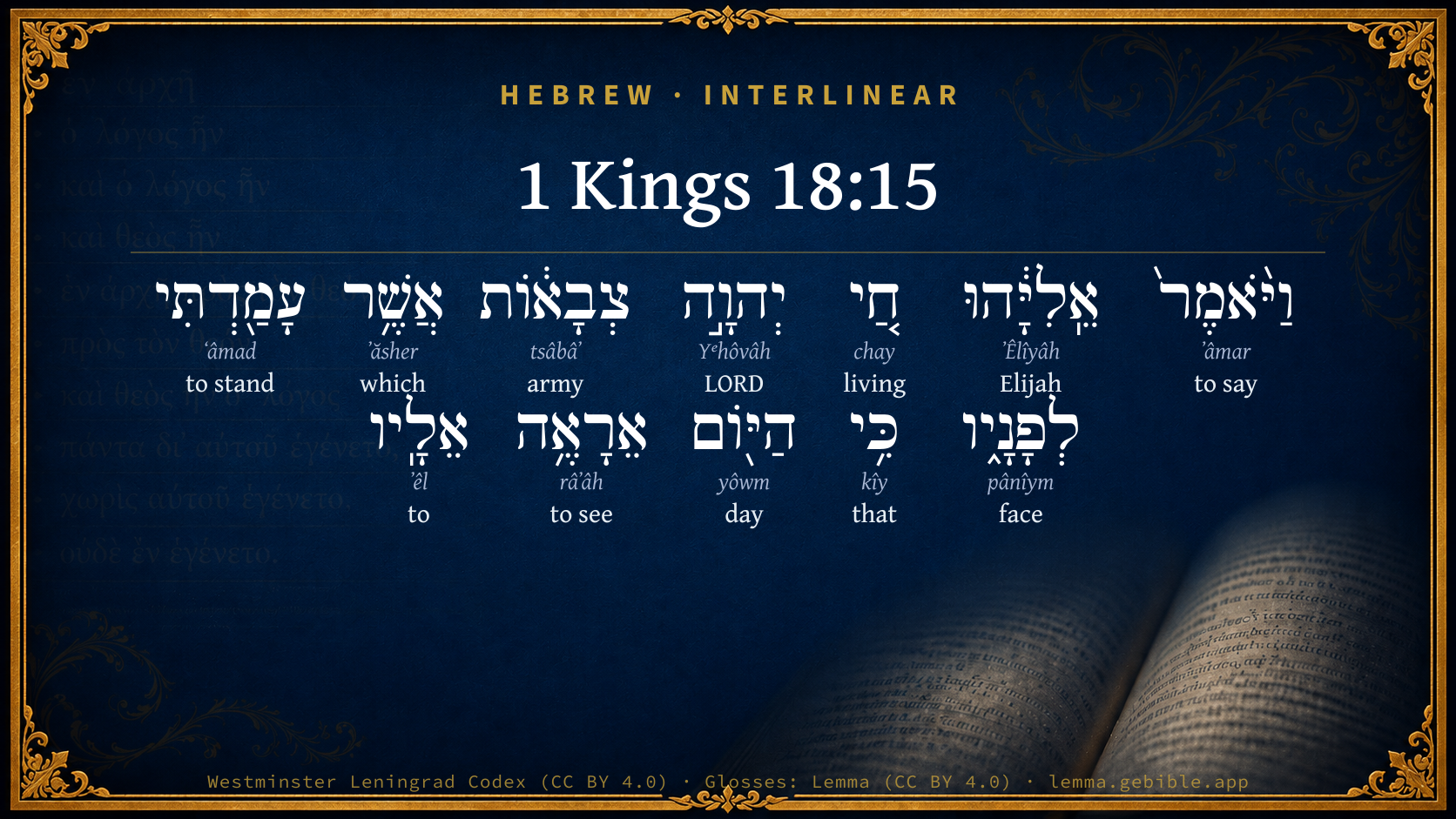
  1. וַיֹּ֨אמֶר֙ ʼâmar H559 “and · to say” Conjunction + Verb, Qal, Sequential Imperfect, 3rd Person, Masculine, Singular
  2. חַ֚י chay H2416 “living” Adjective, Adjective, Masculine, Singular, Absolute
  3. יְהוָ֣ה Yᵉhôvâh H3068 “LORD” Noun, Proper
  4. צְבָא֔וֹת tsâbâʼ H6635 “armies” Noun, Common, Both, Plural, Absolute
  5. אֲשֶׁ֥ר ʼăsher H834 “which” Particle, Relative
  6. עָמַ֖דְתִּי ʻâmad H5975 “to stand” Verb, Qal, Perfect, 1st Person, Common, Singular
  7. לְפָנָ֑יו pânîym H6440 “to/for · face(s) · his” Preposition + Noun, Common, Both, Plural, Construct + Suffix, Personal, 3rd Person, Masculine, Singular
  8. כִּ֥י kîy H3588 “that” Conjunction
  9. הַיּ֖וֹם yôwm H3117 “the · day” Particle, Definite Article + Noun, Common, Masculine, Singular, Absolute
  10. אֵרָאֶ֥ה râʼâh H7200 “to see” Verb, Niphal, Imperfect, 1st Person, Common, Singular
  11. אֵלָֽיו ʼêl H413 “to · him” Preposition + Suffix, Personal, 3rd Person, Masculine, Singular

About this verse

These counts appear in no published source. They are computed here, from the morphology-tagged text and Lemma’s own curated glosses. What Lemma adds →

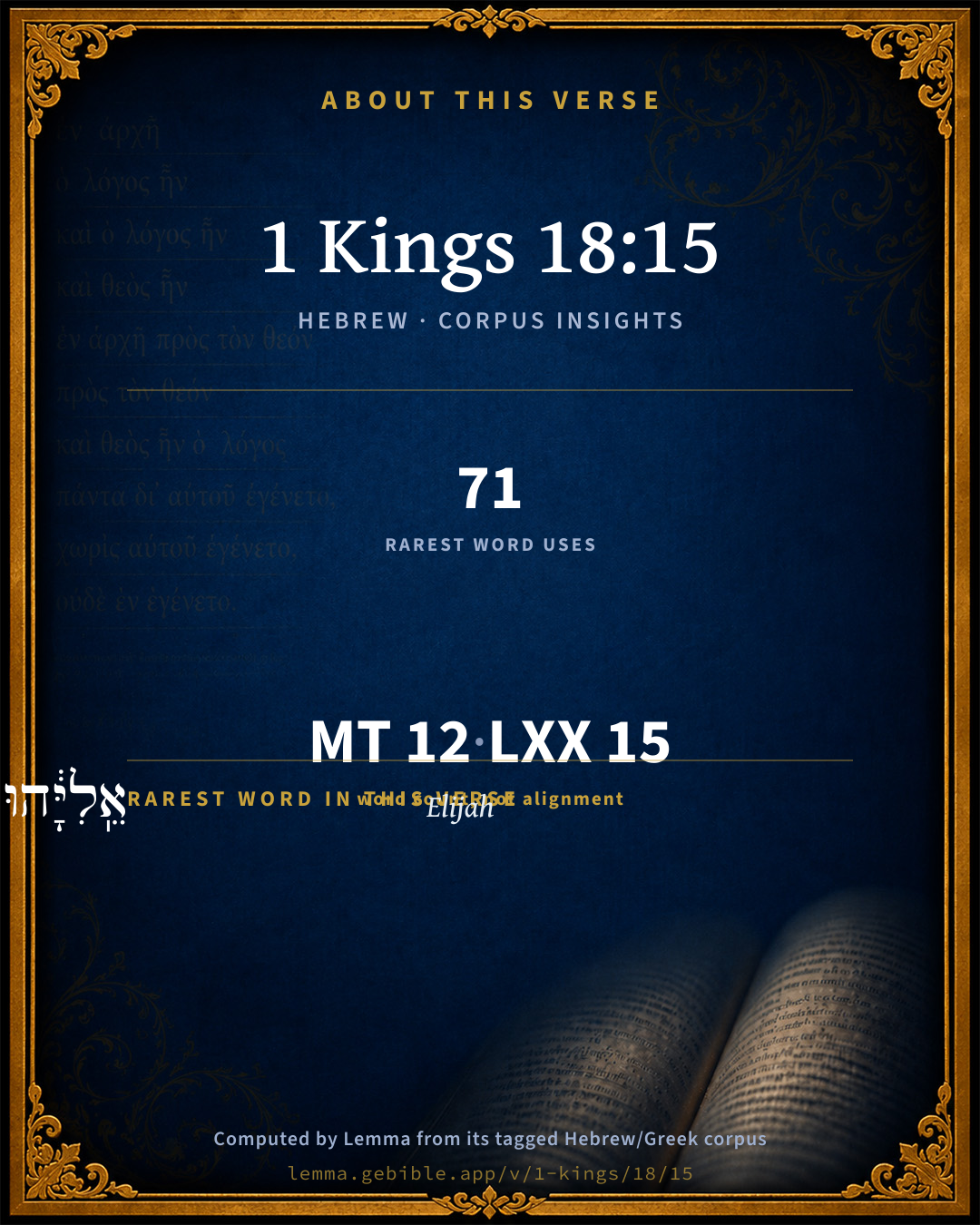
12
words
12
distinct lemmas
Historical
section

Grammatical profile

  • 3 verbs
  • 5 nouns
  • 1 adjective
  • 1 preposition
  • 1 conjunction
  • 1 particle

Verb forms

  • וַיֹּ֨אמֶר֙ Qal · Sequential Imperfect
  • עָמַ֖דְתִּי Qal · Perfect
  • אֵרָאֶ֥ה Niphal · Imperfect

Hebrew & Septuagint length

In English translation the verse runs 19 words from the Hebrew and 19 from the Septuagint (LXX English) — the same length.

A rough comparison of the two English renderings, which tokenize alike — not a word-level alignment.

Word counts can differ between the Hebrew and the Greek without any difference in meaning — e.g. the Hebrew direct-object marker אֵת has no separate Greek word, and Greek often adds the article ὁ.

In the original languages it is 12 Hebrew tokens and 15 Greek tokens — but the two are counted differently (Hebrew bundles its prefixes and suffixes into one token; the Greek is in lemma form), so that isn’t a like-for-like length.

Cross-references

15

Topical passages linked to 1 Kings 18:15 in the Treasury of Scripture Knowledge — connected by theme and wording, ordered by reader-vote popularity; previews shown in the World English Bible.

  • 1 Kings 17:1 Elijah the Tishbite, who was of the foreigners of Gilead, said to Ahab, As Yahweh, the God of Israel, lives, before whom I stand, there shall not be dew nor rain these years, but according to my word.
  • 1 Kings 18:10 As Yahweh your God lives, there is no nation or kingdom, where my lord has not sent to seek you: and when they said, He is not here, he took an oath of the kingdom and nation, that they didn't find you.
  • Genesis 2:1 The heavens and the earth were finished, and all the host of them.
  • Deuteronomy 1:38 Joshua the son of Nun, who stands before you, he shall go in there: encourage you him; for he shall cause Israel to inherit it.
  • Deuteronomy 4:19 and lest you lift up your eyes to the sky, and when you see the sun and the moon and the stars, even all the host of the sky, you are drawn away and worship them, and serve them, which Yahweh your God has allotted to all the peoples under the whole sky.
  • Job 25:3 Can his armies be counted? On whom does his light not arise?
  • Psalms 24:8–10 Who is the King of glory? Yahweh strong and mighty, Yahweh mighty in battle.
  • Psalms 103:21 Praise Yahweh, all you hosts of his, You servants of his, who do his pleasure.
  • Psalms 148:2–3 Praise him, all his angels! Praise him, all his host!
  • Isaiah 6:3 One called to another, and said, "Holy, holy, holy, is Yahweh of Hosts! The whole earth is full of his glory!"
  • Isaiah 51:7–8 Listen to me, you who know righteousness, the people in whose heart is my law; don't you fear the reproach of men, neither be you dismayed at their insults.
  • Jeremiah 8:2 and they shall spread them before the sun, and the moon, and all the host of the sky, which they have loved, and which they have served, and after which they have walked, and which they have sought, and which they have worshiped: they shall not be gathered, nor be buried, they shall be for dung on the surface of the earth.
  • Luke 1:19 The angel answered him, "I am Gabriel, who stands in the presence of God. I was sent to speak to you, and to bring you this good news.
  • Luke 2:13–14 Suddenly, there was with the angel a multitude of the heavenly host praising God, and saying,
  • Hebrews 6:16–17 For men indeed swear by a greater one, and in every dispute of theirs the oath is final for confirmation.

Cross-references courtesy of OpenBible.info (CC BY 4.0).

Hebrew and Greek witnesses Masoretic Hebrew ↔ Greek Septuagint

The same verse in the two great witnesses to the Old Testament, shown verse-for-verse.

These are two independent witnesses, not word-aligned to each other, and the Septuagint is shown in lemma (dictionary) form.

Hebrew 1 Kings 18:15 Masoretic · Westminster Leningrad Codex

וַיֹּ֨אמֶר֙ אֵֽלִיָּ֔הוּ חַ֚י יְהוָ֣ה צְבָא֔וֹת אֲשֶׁ֥ר עָמַ֖דְתִּי לְפָנָ֑יו כִּ֥י הַיּ֖וֹם אֵרָאֶ֥ה אֵלָֽיו

Elijah said, As Yahweh of Hosts lives, before whom I stand, I will surely show myself to him today.

World English Bible · Public Domain

Greek LXX 1 Kings 18:15 Septuagint · lemma form

καί εἶπον ηλιου ζάω κύριος ὁ δύναμις ὅς παραἵστημι ἐνώπιον αὐτός ὅτι σήμερον ὁράω αὐτός

And Eliu said, As the Lord of Hosts before whom I stand lives, today I will appear before him.

LXX2012 (modern English Septuagint) · Public Domain

Hebrew: Westminster Leningrad Codex (CC BY 4.0). Greek: Septuagint (public domain); English from LXX2012 (modern English Septuagint) (Public Domain). How the Septuagint differs from the Hebrew →

Targum (Aramaic paraphrase)

1

The Targum is the ancient Jewish Aramaic paraphrase of the Hebrew Scriptures — an interpretive translation, not the Hebrew text itself. Onkelos (literal) and Pseudo-Jonathan (expansive) render the Torah, and Jonathan the Prophets. Coverage is partial: where no permissively-licensed English translation exists for a verse, only the Aramaic is shown. This is verse-level text, not a word-by-word alignment to the Hebrew.

  1. Targum Jonathan Prophets (Joshua–Malachi)
    וַאֲמַר אֵלִיָהוּ קַיָם הוּא יְיָ צְבָאוֹת דִי מְשַׁמֵשְׁנָא קֳדָמוֹהִי אֲרֵי יוֹמָא דֵין אִתְחַזֵי לֵיהּ:

    (no public-domain English translation for this verse)

    Targum Jonathan — Aramaic: “Mikraot Gedolot” (public domain). English: “Sefaria Community Translation” (CC0 1.0 (public-domain dedication)); “London "Chaldee Paraphrase," 1871” (public domain). Text via Sefaria.

Commentary

Notes on 1 Kings 18:15 from classic Christian and Jewish commentators (each source and its license shown beneath its notes). The classic Christian expositions comment on the surrounding passage and are grouped to its opening verse, so a note may address several verses; the Jewish commentaries on the Tanakh (Rashi and others) are per-verse, so they appear only where the commentator wrote on this verse.

Lemma curates 59 commentaries, every one of them public domain or Creative Commons licensed, each selected and text-cleaned for this edition rather than reprinted as found. About our sources →

Trapp's Complete Commentary

John Trapp

1Ki 18:15 And Elijah said, [As] the LORD of hosts liveth, before whom I stand, I will surely shew myself unto him to day.

Ver. 15. I will surely show myself unto him today.] Though he be never so much incensed against me. The fear of God putteth out the fear of any mortal wight, as the sunbeams do the fire on the hearth. When Gardiner, bishop of Winchester, said to Dr Taylor, martyr, Art thou come, thou villain? how darest thou look me in the face for shame? knowest thou not who I am? Yes, quoth Taylor, I know who you are: you are Dr Gardiner, bishop of Winchester, and Lord Chancellor, yet but a mortal man, I think. But if I should be afraid of your lordly looks, why fear you not God the Lord of us all? How dare you, for shame, look any Christian man in the face, seeing ye have forsaken the truth, denied our Saviour Christ and his word, and done contrary to your own word and writing? &c. Thus that valiant martyr, like another Elias. {a}

{a} Act. and Mon.

John Trapp, A Commentary or Exposition upon All the Books of the Old and New Testament (1647–1656) — public domain. Text from a community e-Sword module.

Joseph Benson's Commentary

1Ki 18:15-16. As the Lord of hosts liveth — Who commands all creatures in heaven and earth. He mentions this title as his shield, under the protection of which he durst venture to come, and did come, into Ahab’s presence; before whom I stand — Whom I serve as one of his ministers; I will surely show myself to him to-day — For a greater king than he, the Lord of all things, will preserve me. So Obadiah went to meet Ahab — The solemn oath of Elijah made him readily obey; as convincing him fully that the prophet seriously intended to see Ahab, which he before suspected he did not. No doubt it was a great surprise to Ahab to hear that Elijah, whom he had so long sought and not found, was now found without seeking.

Joseph Benson's Commentary on the Old and New Testaments (1811–1818) — public domain. Text from a community e-Sword module.

Geneva Bible (1599)

Geneva Bible translators

By my presence I will declare that thou hast told him the truth.

Geneva Bible (1599) marginal notes — public domain. Text via Bolls.life.

The Cambridge Bible for Schools and Colleges

gen. ed. J. J. S. Perowne

15. I will surely shew myself unto him to day] With this assurance Obadiah is satisfied, and goes to find Ahab.

The Cambridge Bible for Schools and Colleges (gen. ed. J. J. S. Perowne; Cambridge University Press, 1878–1918) — public domain. Text from a community e-Sword module.

John Gill's Exposition

And it came to pass when Ahab saw Elijah,.... As soon as he came up to him, and knew who he was; Abarbinel thinks, because his hair was grown so long that Ahab did not know him certainly, and therefore put the following question:

that Ahab said unto him, art thou he that troubleth Israel? by opposing the religion of Baal, which prevailed among them; but chiefly rain being withheld from them according to his word, and at his prayer.

John Gill's Exposition of the Whole Bible (1746–1763) — public domain (CC PDM 1.0). Text via the HelloAO Bible API.

Matthew Poole's English Annotations

As the Lord of hosts liveth; the Lord of all the creatures, which are called God’s hosts, Gen 2:1; Deu 4:19; Psa 103:21; Psa 148:2, and are all subject to his command. He mentions this title as his shield, under the protection whereof he did and durst venture to come into Ahab’s presence.

Matthew Poole's English Annotations on the Holy Bible (1683–1685) — public domain. Text from a community e-Sword/MySword module.

The Pulpit Commentary

And Elijah said, As the Lord of hosts liveth, before whom I stand This formula should be compared with that ofis 1Ki_17:1. The repetition is suggestive as exhibiting the habit of the man. He was the ready and patient slave of Jehovah. The twOabx apparently introduced not so much to "elevate the solemnity of the oath" (Keil, Bahr) for surely Elijah would wish to make the affirmation of, 1Ki_17:1 as strong and solemn as possible nor yet to convey the meaning that "it is not Baal or Ashtaroth who are the rulers of the heavenly bodies" (Wordsworth) for Obadiah knew that perfectly well, but because it was thus better adapted for a believer. In addressing Ahab it suited Elijah"s purpose better to give prominence to the idea that Jehovah was "the God of Israel", I win surely show myself unto him today.

The Pulpit Commentary (1880–1919), ed. H.D.M. Spence-Jones & Joseph S. Exell — public domain. Text from a community e-Sword module.

Lesson kit

Teaching starters — assembled from the data on this page, not authored interpretation. Every prompt links to the verse data it draws on. Edit before teaching.

1 Kings, in the Historical, opens this verse with 12 words (12 distinct Hebrew lemmas). Its most distinctive word is ʼÊlîyâh (“Elijah”). A historical commentator’s framing appears above. Read the whole chapter for the surrounding context.

Discussion questions

  1. How does “Elijah” (ʼÊlîyâh) shape what this verse is saying?
  2. 1 Kings 17:1 shares this passage’s theme. How do the two illuminate each other?
  3. The translations on this page render this verse differently — a whole-verse word diff, not a word-by-word alignment. What might account for the different wordings?
  4. The verb «וַיֹּ֨אמֶר֙» is Qal Sequential Imperfect. How does its form color the action?
  5. Reading how Trapp's Complete Commentary and Joseph Benson's Commentary read this verse, where do the two commentators agree and where do they part?

Things to notice

Reading settings

Reading text

Shown beneath each verse's original-language words.

Old Testament
Old Testament edition

Read the OT as the Masoretic Hebrew (MT) or the Greek Septuagint (LXX).

English shown for the Greek Septuagint (in the Hebrew ↔ Greek comparison).

Comparing translations? Open the Compare panel on any verse page to stack up to four side by side.